Modeling and Simulation of a LFVC
           Scheduler

             Prof. Antonio M. Alberti
   INATEL: Instituto Nacional de Telecomunicações
           National Institute of Telecommunications

               Santa Rita do Sapucai
                       Brazil
Modeling and Simulation of LFVC Scheduler


                                            Presentation Outline
                                              Introduction
                                              Leap Forward Virtual Clock
                                              Developed Model
                                              Interaction Between LFVC and ATM Network Models
                                              Model Validation
                                              Performance Evaluation
                                              Final Remarks
Modeling and Simulation of LFVC Scheduler


                                            Introduction
                                              One of the most important issues in integrated services
                                              networks is the choice of the service discipline to be used
                                              at each packet queuing point in order to select the
                                              appropriate packet service order.

                                              Why?

                                              1. Service disciplines affect network performance not
                                                 only in terms of delay and loss, but also in terms of
                                                 throughput and fairness.
                                              2. Service disciplines become a key to offer QoS
                                                 isolation among connections/flows in the network.
Modeling and Simulation of LFVC Scheduler


                                            Introduction
                                              Amongst current service disciplines, the ones that
                                              approximate Generalized Processor Sharing (GPS) have
                                              had a lot of success satisfying such requirements.

                                              In 1993, Parekh and Gallanger demonstrated that
                                              employing GPS servers in network switches, end-to-end
                                              QoS guarantees can be provided for a connection.

                                              However, GPS is an idealized discipline that does not can
                                              be implemented in real world.
Modeling and Simulation of LFVC Scheduler


                                            Introduction
                                              So Parekh and Gallanger proposed a packet-based
                                              approximation to the GPS, which was called Packet-by-
                                              Packet Generalized Processor Sharing (PGPS).

                                              In 1996, Bennett and Zhang developed a new algorithm to
                                              approximate the GPS called Worst-case Fair Weighted Fair
                                              Queuing (WF2Q).

                                              Bennett and Zhang have demonstrated that WF2Q can
                                              work almost identical as GPS.
Modeling and Simulation of LFVC Scheduler


                                            Introduction
                                              Several other service disciplines have been developed
                                              since then.

                                              However, according to Suri et. al., just two disciplines can
                                              work almost identical as GPS: WF2Q and Leap Forward
                                              Virtual Clock (LFVC).

                                              In addition, there are two important differences among
                                              these algorithms:
                                                  1. LFVC is simpler to implement than WF2Q.
                                                  2. LFVC has a smaller computational overhead .
Modeling and Simulation of LFVC Scheduler


                                            Introduction
                                              These factors motivated us to implement LFVC algorithm in
                                              the context of an ATM network model previously developed
                                              to trustworthily evaluate QoS in ATM networks through
                                              simulation.

                                              The LFVC algorithm is fundamental in this network model,
                                              since very simple scheduling algorithms aren’t capable to
                                              capture service differences among connections.

                                              Our LFVC scheduler model interacts with the other models
                                              from this model set.
Modeling and Simulation of LFVC Scheduler


                                            Leap Forward Virtual Clock
                                              LFVC is a work-conserving fair-share scheduler.
                                                 It will be never turned off if there are cells waiting for service.

                                              An ATM cell flow f which temporarily has used more
                                              bandwidth than allocated through a weight φf can be
                                              disciplined by placing the exceeding cells in a low priority
                                              queue L.

                                              However, well-behaved cell flows are stored in a high
                                              priority queue H.
Modeling and Simulation of LFVC Scheduler


                                            Leap Forward Virtual Clock
                                              Virtual clock service disciplines work allocating tags for
                                              each cell waiting for service.

                                              These tags represent the system clock value, when a cell
                                              will be served.

                                              Therefore, ATM cells are served in an increasing order of
                                              their tags.

                                              Just cells in the H queue are served.

                                              Cells in the L queue must be transferred to the H queue, in
                                              order to be served.
Modeling and Simulation of LFVC Scheduler


                                            Leap Forward Virtual Clock
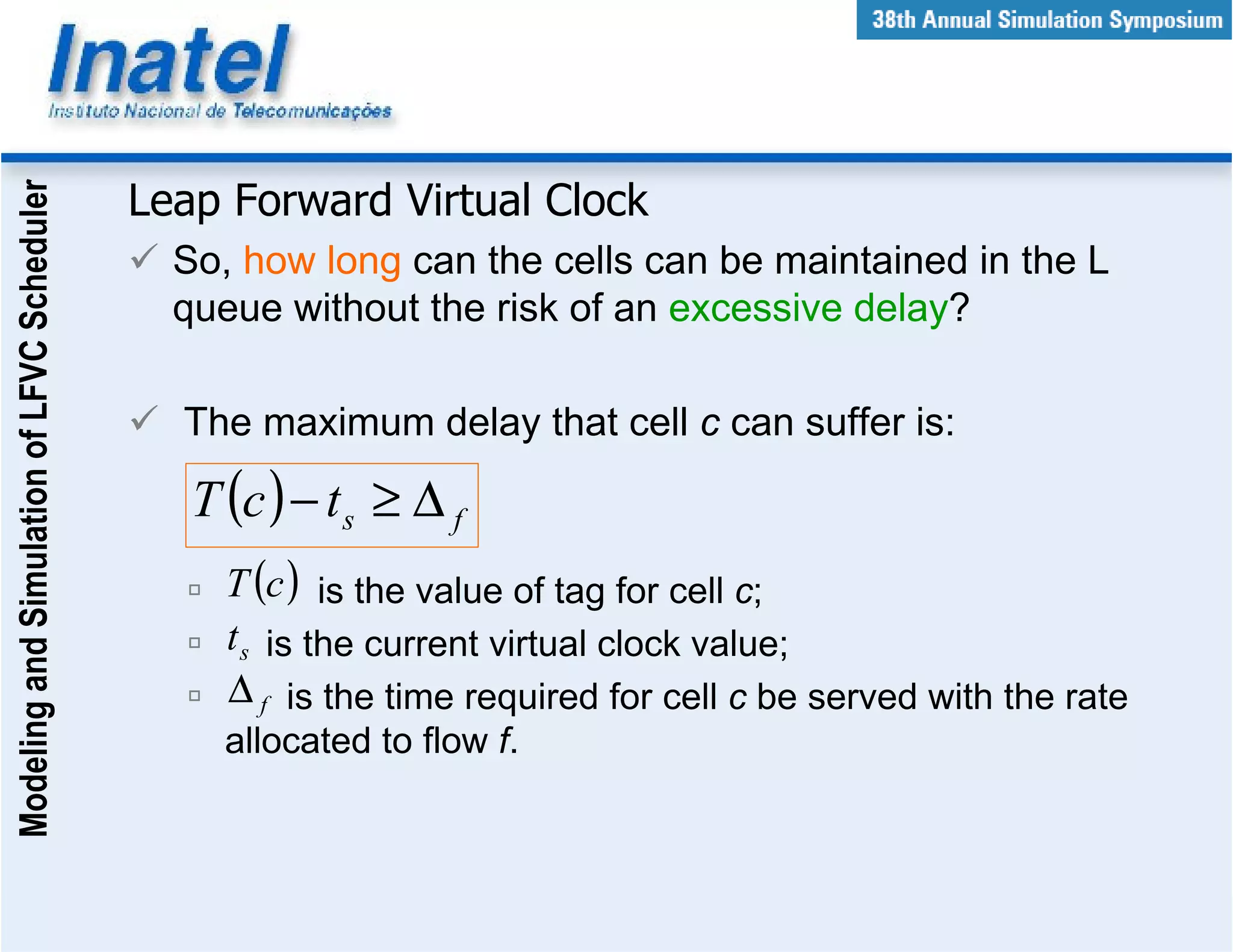
                                              So, how long can the cells can be maintained in the L
                                              queue without the risk of an excessive delay?

                                              The maximum delay that cell c can suffer is:

                                               T (c ) − t s ≥ ∆ f
                                                 T (c ) is the value of tag for cell c;
                                                 t s is the current virtual clock value;
                                                 ∆ f is the time required for cell c be served with the rate
                                                 allocated to flow f.
Modeling and Simulation of LFVC Scheduler


                                            Leap Forward Virtual Clock
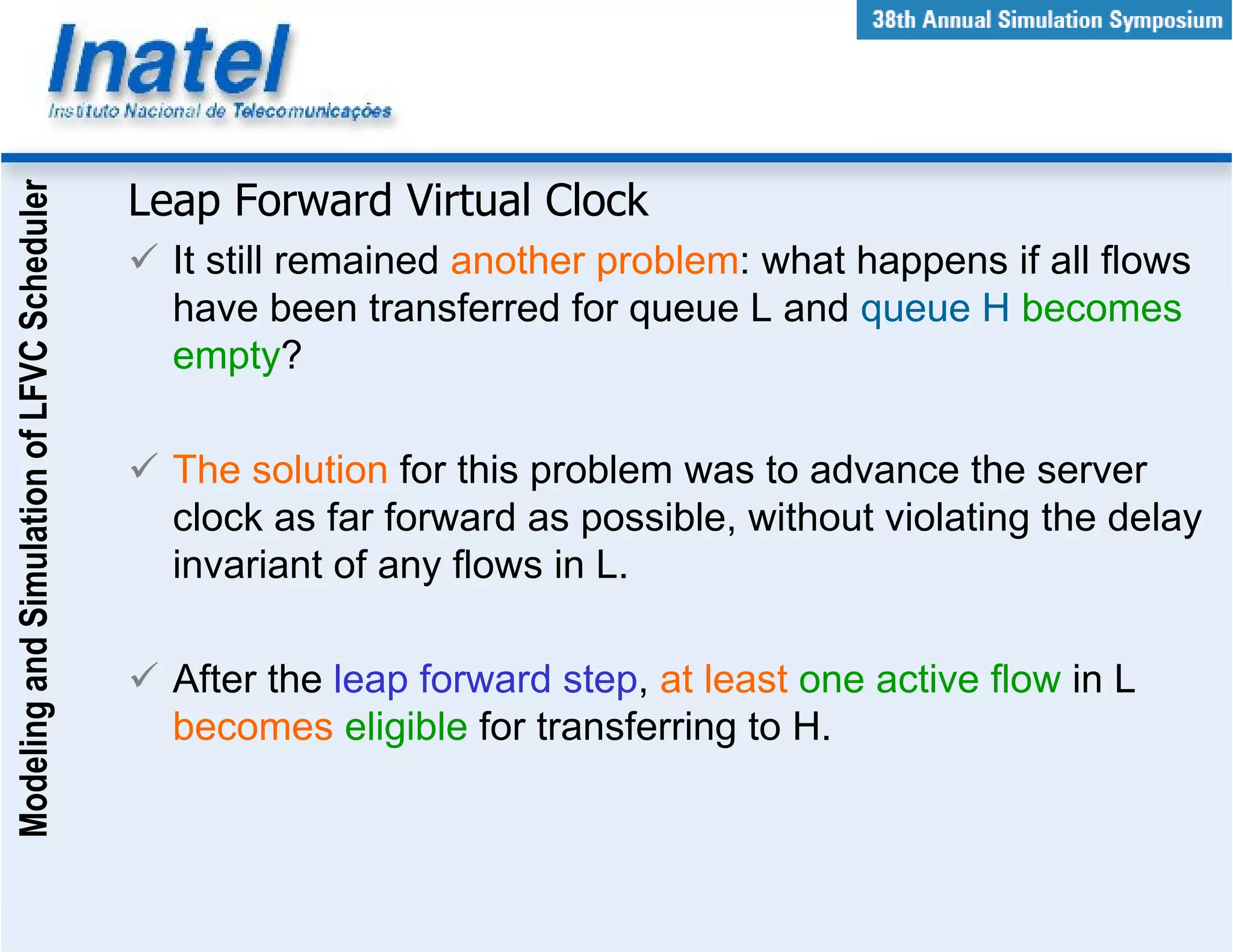
                                              It still remained another problem: what happens if all flows
                                              have been transferred for queue L and queue H becomes
                                              empty?

                                              The solution for this problem was to advance the server
                                              clock as far forward as possible, without violating the delay
                                              invariant of any flows in L.

                                              After the leap forward step, at least one active flow in L
                                              becomes eligible for transferring to H.
Modeling and Simulation of LFVC Scheduler


                                            Developed Model
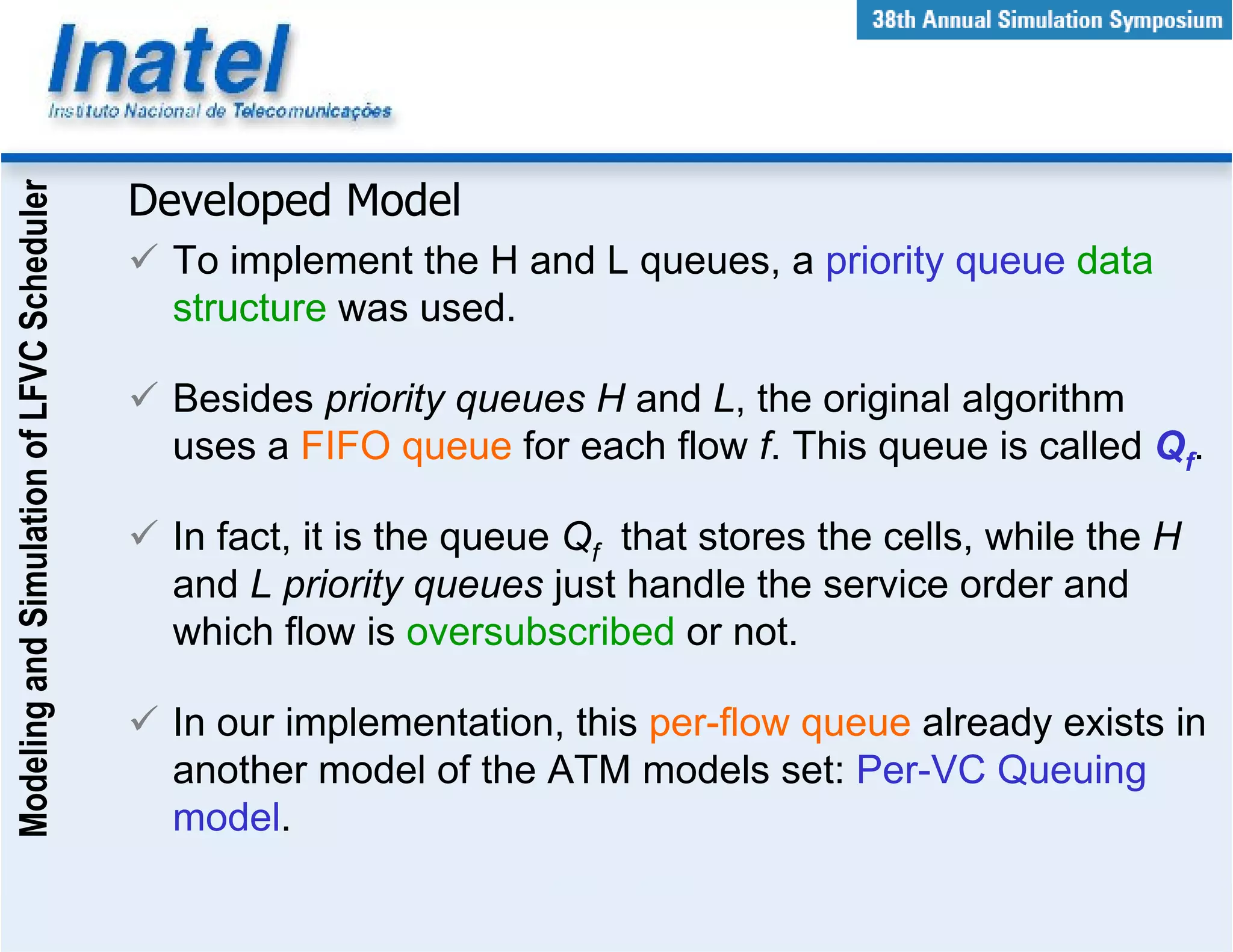
                                              To implement the H and L queues, a priority queue data
                                              structure was used.

                                              Besides priority queues H and L, the original algorithm
                                              uses a FIFO queue for each flow f. This queue is called Qf.

                                              In fact, it is the queue Qf that stores the cells, while the H
                                              and L priority queues just handle the service order and
                                              which flow is oversubscribed or not.

                                              In our implementation, this per-flow queue already exists in
                                              another model of the ATM models set: Per-VC Queuing
                                              model.
Modeling and Simulation of LFVC Scheduler


                                            Developed Model
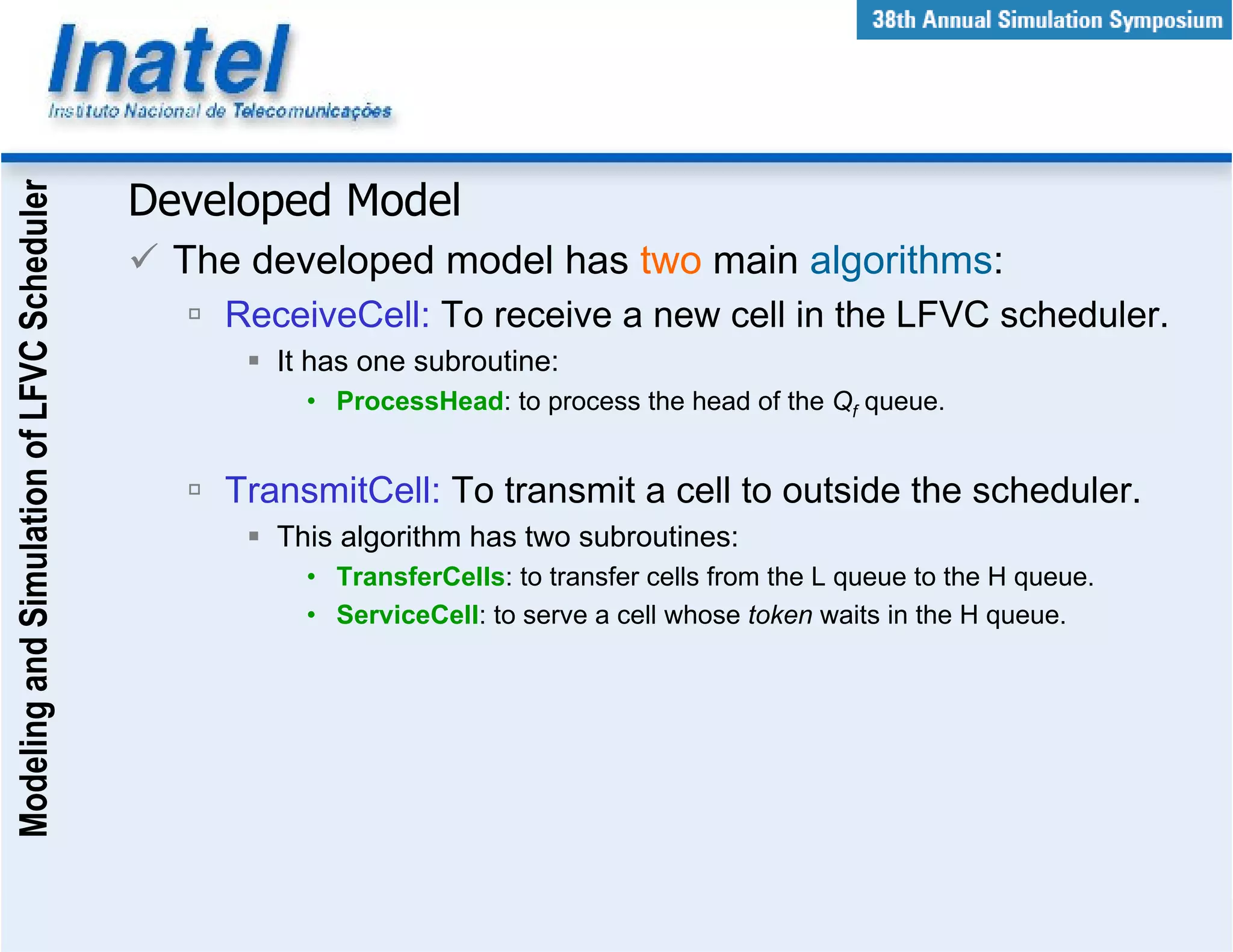
                                              The developed model has two main algorithms:
                                                ReceiveCell: To receive a new cell in the LFVC scheduler.
                                                   It has one subroutine:
                                                     • ProcessHead: to process the head of the Qf queue.


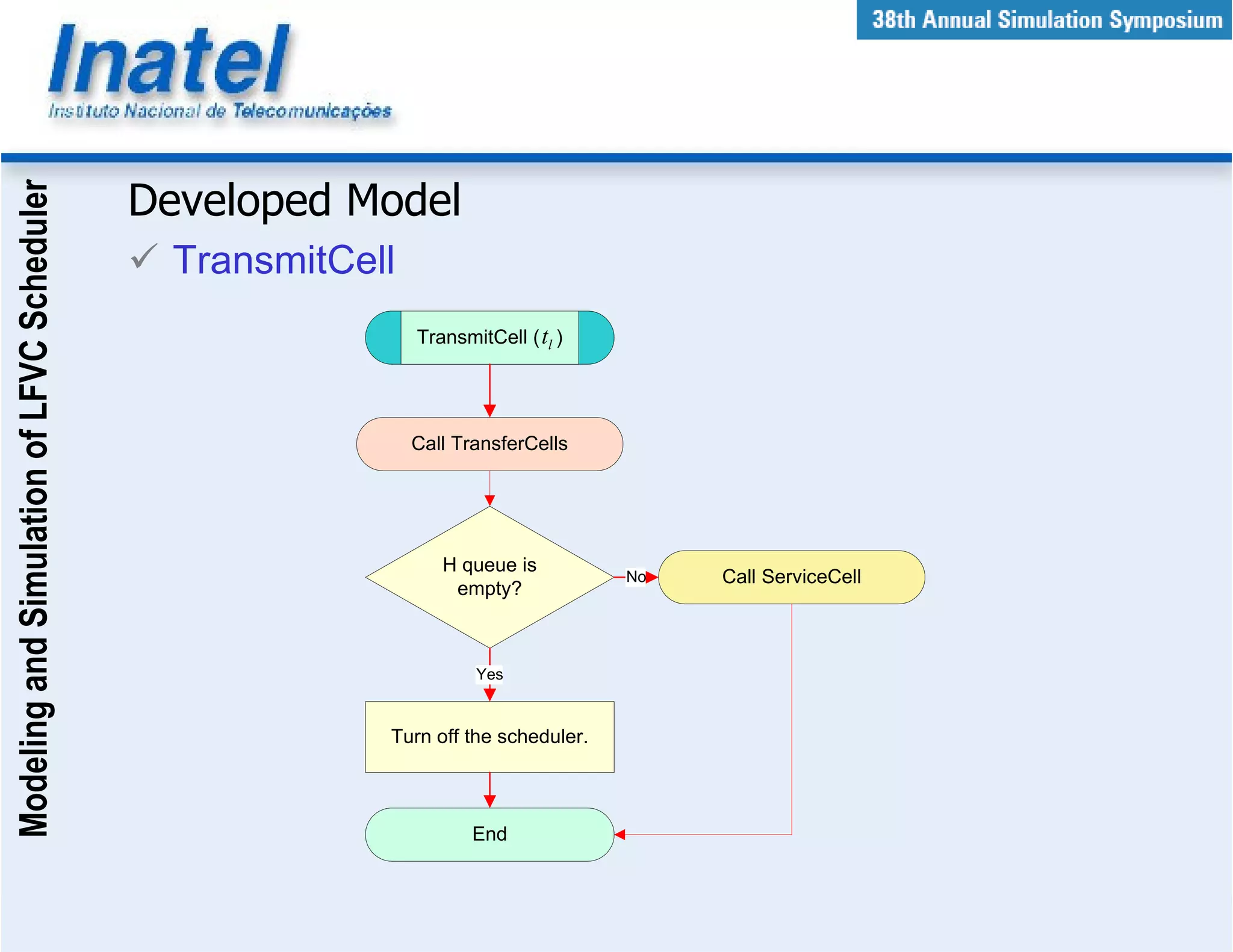
                                                TransmitCell: To transmit a cell to outside the scheduler.
                                                   This algorithm has two subroutines:
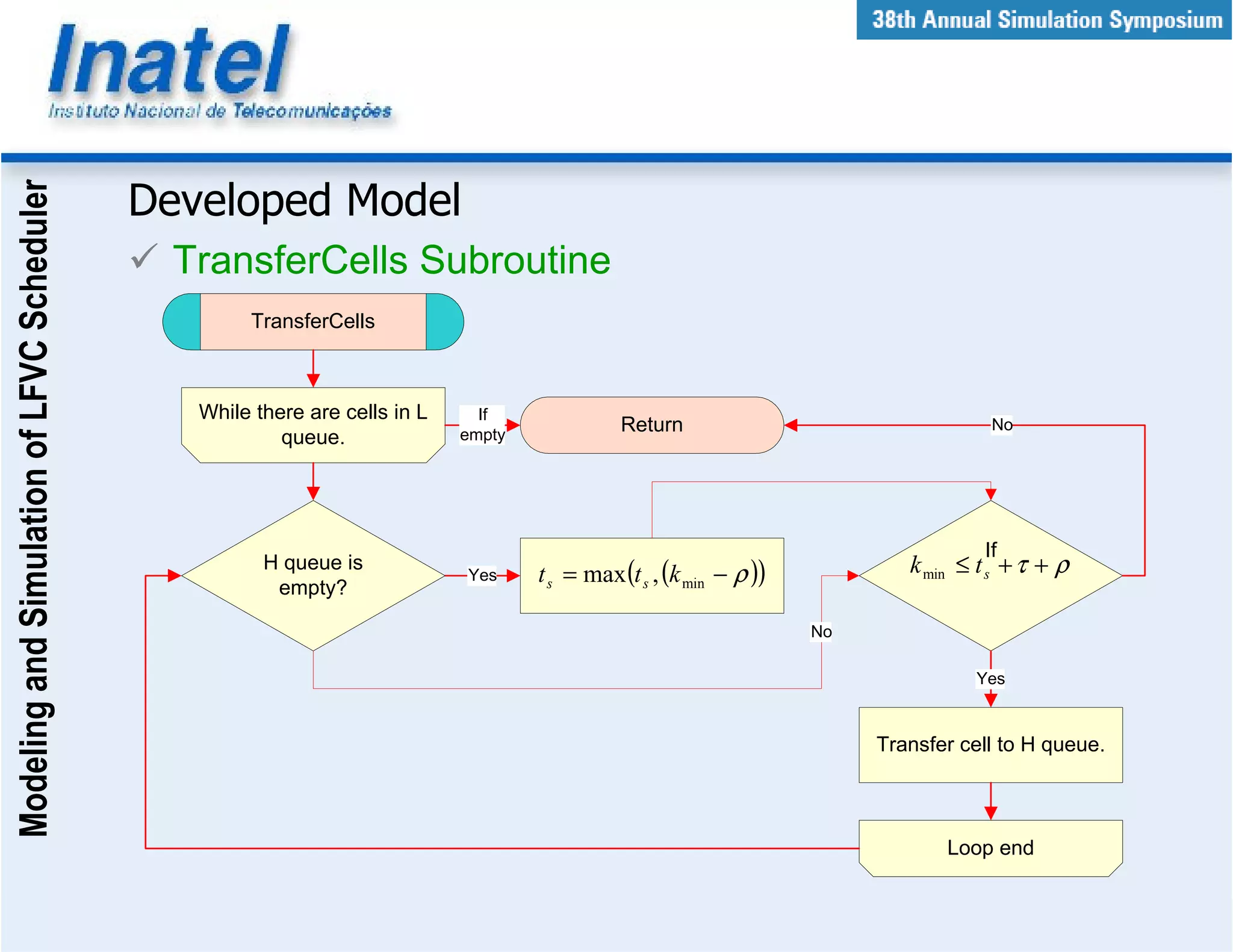
                                                     • TransferCells: to transfer cells from the L queue to the H queue.
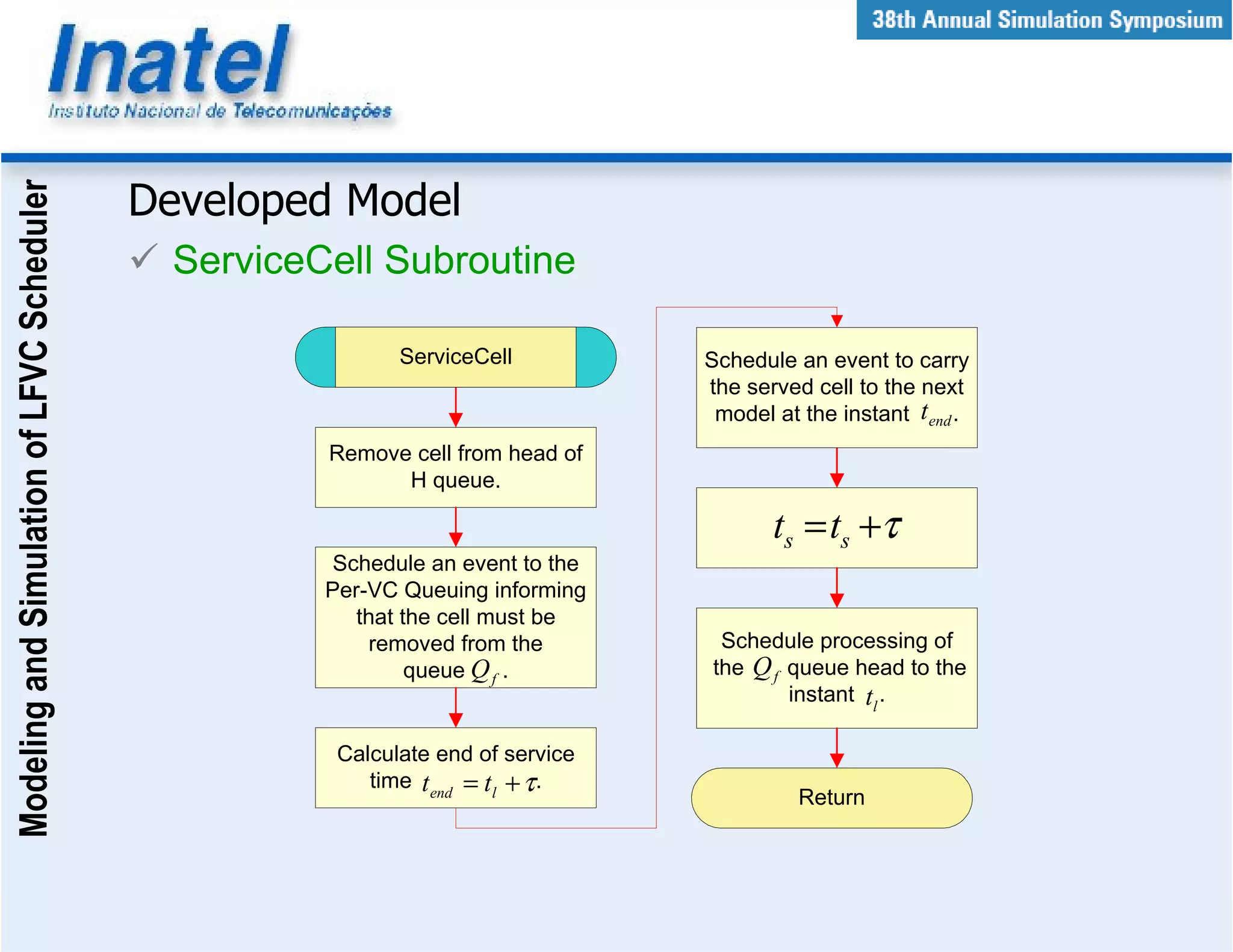
                                                     • ServiceCell: to serve a cell whose token waits in the H queue.
Modeling and Simulation of LFVC Scheduler


                                            Developed Model
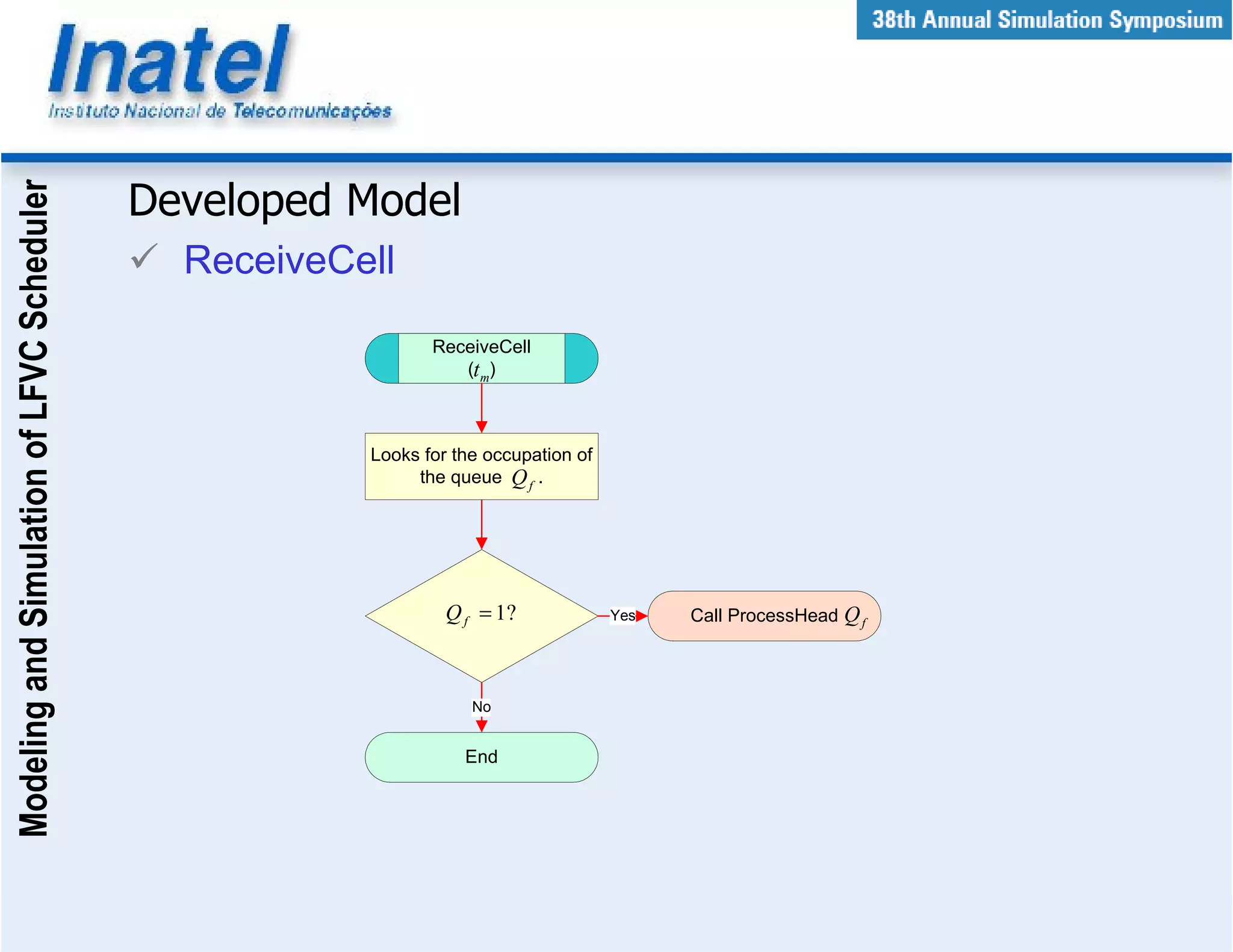
                                              ReceiveCell

                                                              ReceiveCell
                                                                 (t m)


                                                       Looks for the occupation of
                                                            the queue Q f .


                                                                Q f = 1?             Yes   Call ProcessHead Q f


                                                                   No


                                                                  End
t m - Arrival time of a cell from flow f.
                                                                                                                         t f - Current tag of a flow f.
Modeling and Simulation of LFVC Scheduler


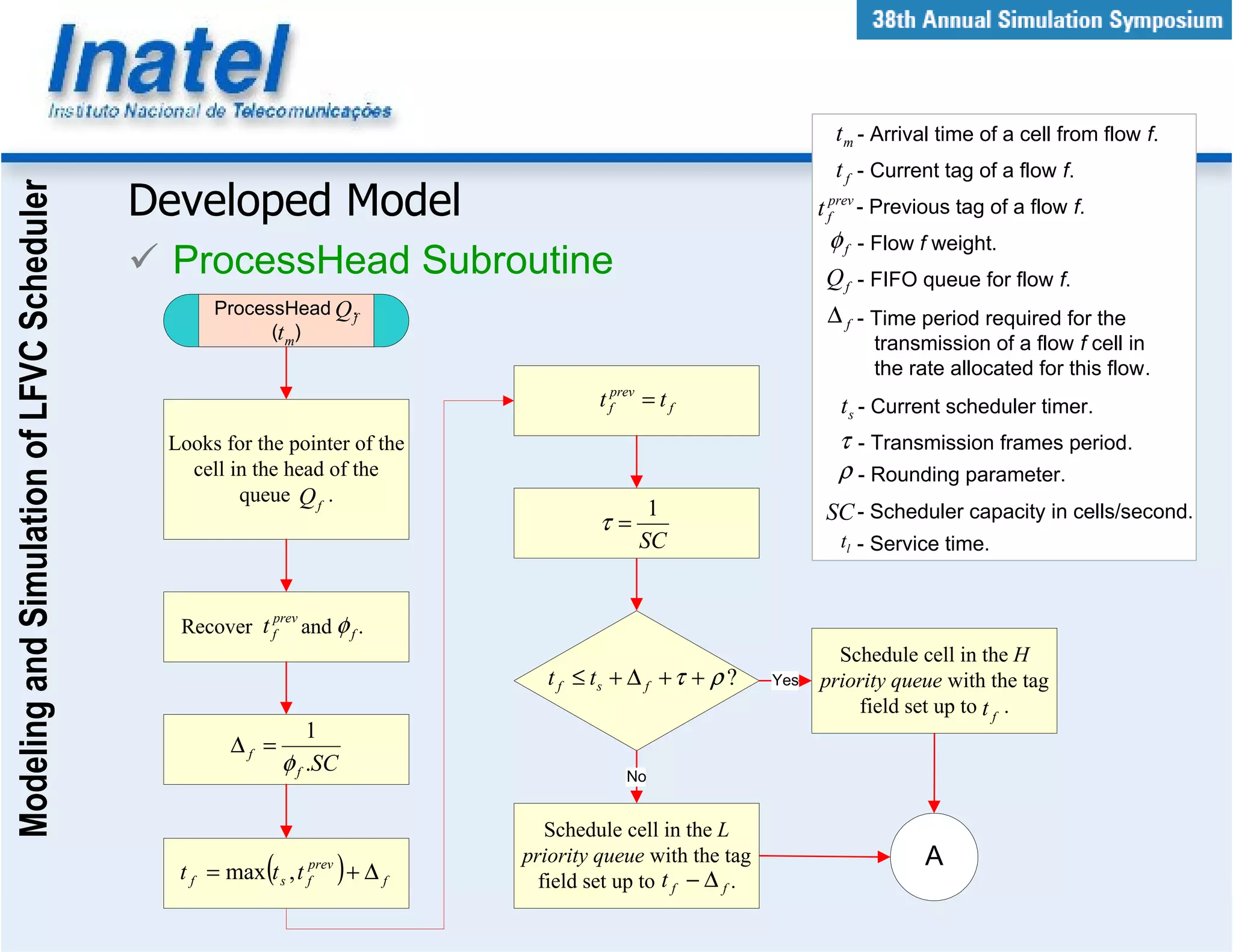
                                            Developed Model                                                            t fprev - Previous tag of a flow f.
                                                                                                                        φ f - Flow f weight.
                                              ProcessHead Subroutine                                                    Q f - FIFO queue for flow f.
                                                   ProcessHead Q .
                                                                 f                                                      ∆ f - Time period required for the
                                                         (t m)
                                                                                                                              transmission of a flow f cell in
                                                                                                                              the rate allocated for this flow.
                                                                                          t fprev = t f                   t s - Current scheduler timer.
                                             Looks for the pointer of the                                                τ - Transmission frames period.
                                               cell in the head of the                                                   ρ - Rounding parameter.
                                                     queue Q f .
                                                                                                 1                      SC - Scheduler capacity in cells/second.
                                                                                          τ=
                                                                                                SC                        tl - Service time.


                                                        prev
                                              Recover t f and φ f .
                                                                                                                         Schedule cell in the H
                                                                                    t f ≤ ts + ∆ f + τ + ρ ?     Yes   priority queue with the tag
                                                                                                                           field set up to t f .
                                                                 1
                                                     ∆f =
                                                             φ f .SC                          No


                                                                                    Schedule cell in the L
                                                                                 priority queue with the tag                         A
                                              t f = max (t s , t fprev ) + ∆ f     field set up to t f − ∆ f .
Modeling and Simulation of LFVC Scheduler


                                            Developed Model
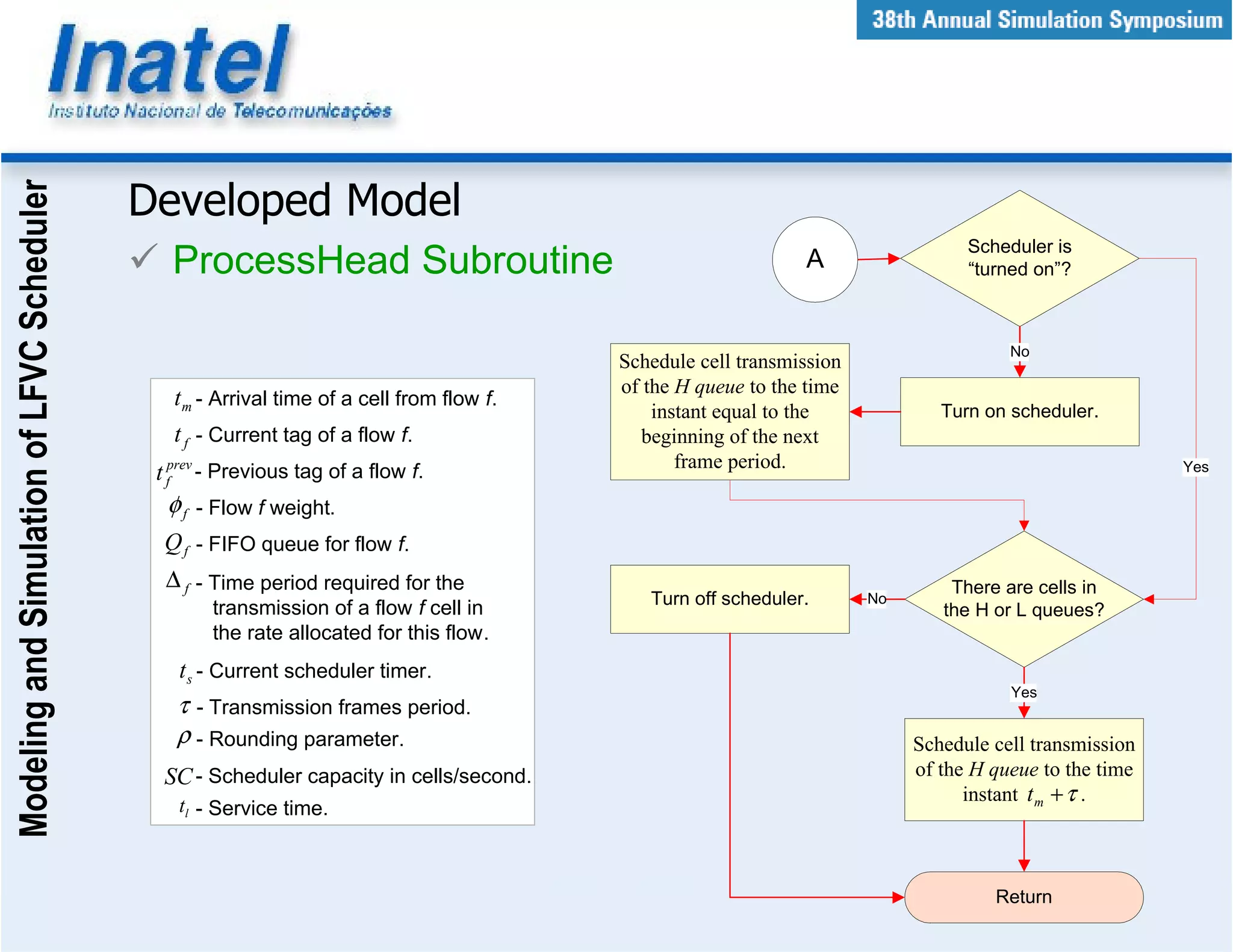
                                                                                                                                   Scheduler is
                                               ProcessHead Subroutine                                           A                  “turned on”?


                                                                                                                                        No
                                                                                           Schedule cell transmission
                                                                                           of the H queue to the time
                                               t m - Arrival time of a cell from flow f.
                                                                                               instant equal to the             Turn on scheduler.
                                               t f - Current tag of a flow f.                 beginning of the next
                                                                                                  frame period.
                                             t fprev - Previous tag of a flow f.                                                                          Yes

                                              φ f - Flow f weight.
                                              Q f - FIFO queue for flow f.
                                              ∆ f - Time period required for the                                                 There are cells in
                                                                                              Turn off scheduler.       No
                                                    transmission of a flow f cell in                                            the H or L queues?
                                                    the rate allocated for this flow.
                                                t s - Current scheduler timer.
                                                                                                                                        Yes
                                               τ - Transmission frames period.
                                               ρ - Rounding parameter.                                                       Schedule cell transmission
                                              SC - Scheduler capacity in cells/second.                                       of the H queue to the time
                                                                                                                                   instant t m + τ .
                                                tl - Service time.


                                                                                                                                      Return
Modeling and Simulation of LFVC Scheduler


                                            Developed Model
                                              TransmitCell
                                                             TransmitCell ( tl )


                                                             Call TransferCells


                                                                H queue is
                                                                                   No   Call ServiceCell
                                                                 empty?


                                                                    Yes


                                                         Turn off the scheduler.


                                                                    End
Modeling and Simulation of LFVC Scheduler


                                            Developed Model
                                              TransferCells Subroutine
                                                    TransferCells


                                               While there are cells in L     If
                                                                            empty
                                                                                              Return                                  No
                                                        queue.


                                                                                                                                     If
                                                      H queue is                                                             k min ≤ t s + τ + ρ
                                                                            Yes     t s = max (t s , (k min − ρ ))
                                                       empty?

                                                                                                                     No

                                                                                                                                    Yes


                                                                                                                          Transfer cell to H queue.


                                                                                                                                 Loop end
Modeling and Simulation of LFVC Scheduler


                                            Developed Model
                                              ServiceCell Subroutine

                                                             ServiceCell          Schedule an event to carry
                                                                                  the served cell to the next
                                                                                   model at the instant t end .
                                                      Remove cell from head of
                                                            H queue.

                                                                                         ts = ts +τ
                                                       Schedule an event to the
                                                      Per-VC Queuing informing
                                                         that the cell must be
                                                          removed from the         Schedule processing of
                                                               queue Q f .        the Q f queue head to the
                                                                                          instant tl .

                                                       Calculate end of service
                                                          time t end = tl + τ .
                                                                                            Return
Modeling and Simulation of LFVC Scheduler


                                            Interaction Between LFVC and ATM Network Models
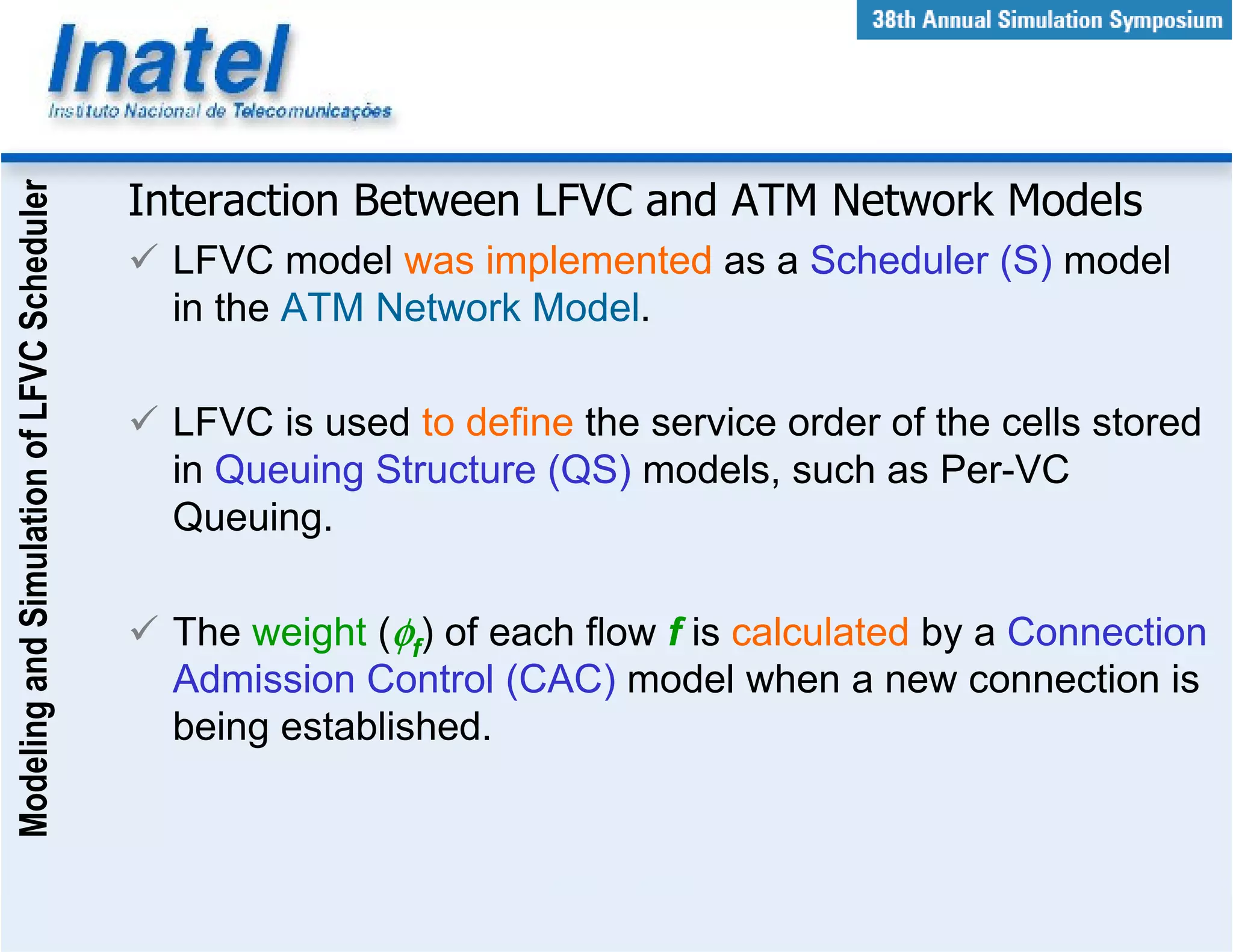
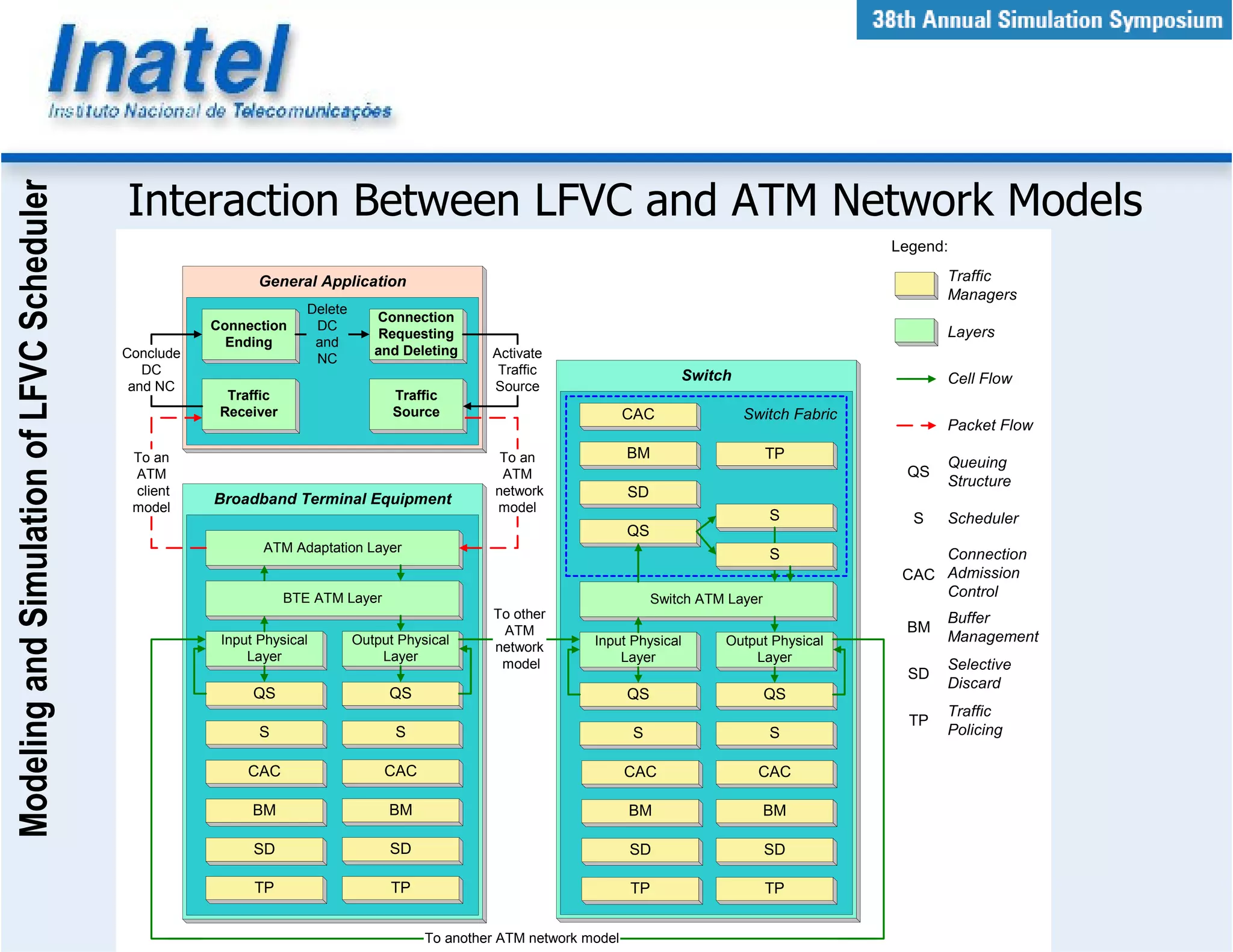
                                              LFVC model was implemented as a Scheduler (S) model
                                              in the ATM Network Model.

                                              LFVC is used to define the service order of the cells stored
                                              in Queuing Structure (QS) models, such as Per-VC
                                              Queuing.

                                              The weight (φf) of each flow f is calculated by a Connection
                                              Admission Control (CAC) model when a new connection is
                                              being established.
Modeling and Simulation of LFVC Scheduler


                                            Interaction Between LFVC and ATM Network Models
                                                                                                                                                           Legend:

                                                              General Application                                                                                 Traffic
                                                                                                                                                                  Managers
                                                                      Delete
                                                                                  Connection
                                                       Connection      DC                                                                                         Layers
                                                                                   Requesting
                                                         Ending        and
                                            Conclude                              and Deleting     Activate
                                                                       NC
                                               DC                                                   Traffic                       Switch
                                             and NC                                                Source
                                                                                                                                                                  Cell Flow
                                                         Traffic                     Traffic
                                                        Receiver                     Source                              CAC               Switch Fabric
                                                                                                                                                                  Packet Flow

                                             To an                                                   To an               BM                      TP
                                                                                                                                                                  Queuing
                                             ATM                                                     ATM                                                    QS
                                                                                                                                                                  Structure
                                             client                                                 network              SD
                                                       Broadband Terminal Equipment
                                             model                                                  model
                                                                                                                                                 S           S    Scheduler
                                                                                                                         QS
                                                              ATM Adaptation Layer
                                                                                                                                                 S              Connection
                                                                                                                                                            CAC Admission
                                                                   BTE ATM Layer                                              Switch ATM Layer                  Control
                                                                                                   To other                                                       Buffer
                                                                                                    ATM                                                     BM
                                                        Input Physical         Output Physical                    Input Physical        Output Physical           Management
                                                                                                   network
                                                            Layer                  Layer                              Layer                 Layer
                                                                                                    model                                                         Selective
                                                                                                                                                             SD
                                                                                                                                                                  Discard
                                                             QS                     QS                                   QS                      QS
                                                                                                                                                                  Traffic
                                                                                                                                                             TP
                                                              S                      S                                    S                      S                Policing

                                                            CAC                    CAC                                   CAC                 CAC

                                                             BM                     BM                                   BM                      BM

                                                             SD                     SD                                   SD                      SD

                                                             TP                      TP                                  TP                      TP


                                                                                          To another ATM network model
Modeling and Simulation of LFVC Scheduler


                                            Model Validation
                                              Model validation was done through service order analysis.

                                              There are 10 applications (1-10) transmitting exactly 1 cell
                                              at time 0.

                                              For these applications, we configured a weight 0.05.

                                              One more application (11) transmits 10 cells starting at
                                              time 0, with a cell interval equals to 1 second.

                                              This application has a weight 0.5.
Modeling and Simulation of LFVC Scheduler


                                            Model Validation
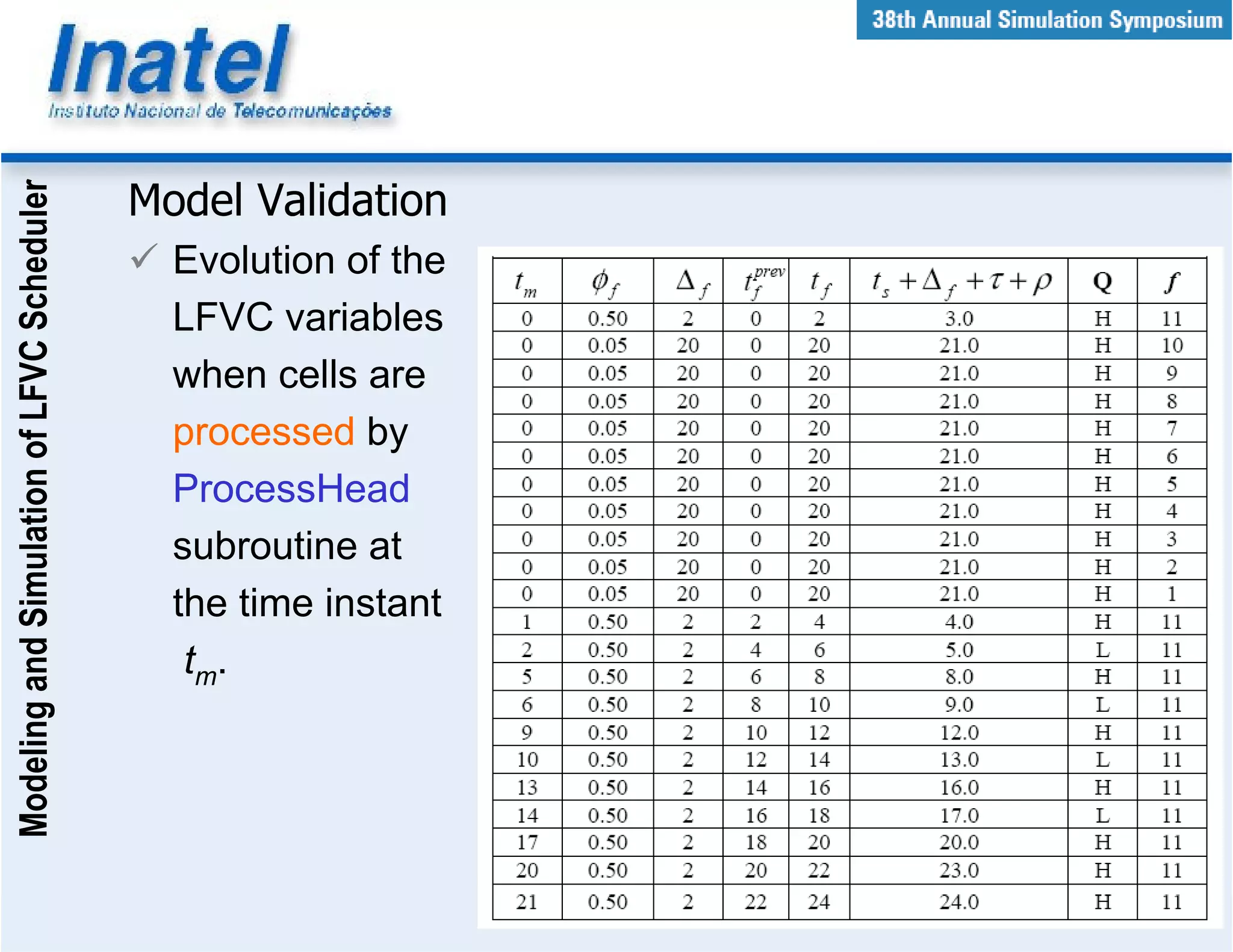
                                              Evolution of the
                                              LFVC variables
                                              when cells are
                                              processed by
                                              ProcessHead
                                              subroutine at
                                              the time instant
                                               tm.
Modeling and Simulation of LFVC Scheduler


                                            Model Validation
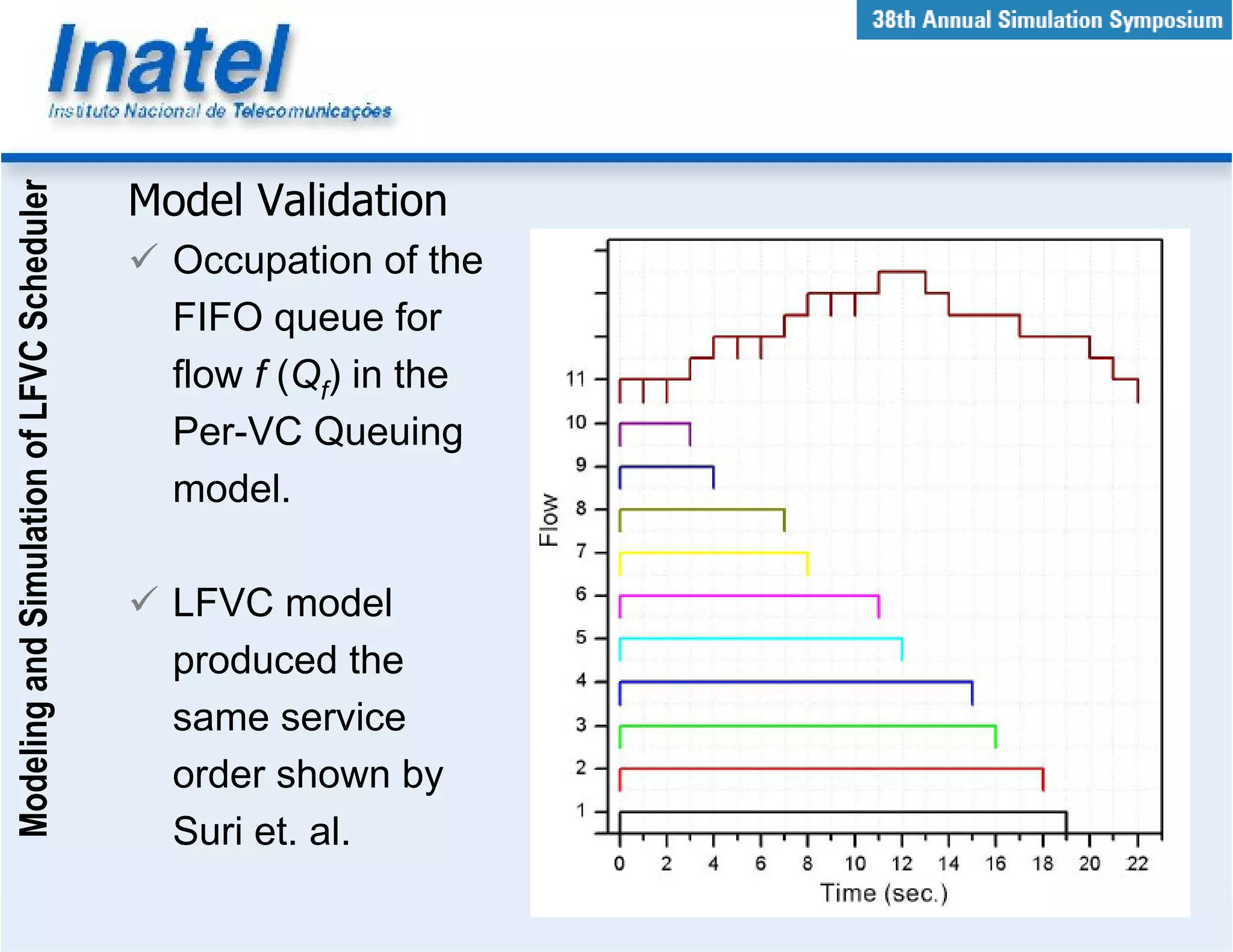
                                              Occupation of the
                                              FIFO queue for
                                              flow f (Qf) in the
                                              Per-VC Queuing
                                              model.

                                              LFVC model
                                              produced the
                                              same service
                                              order shown by
                                              Suri et. al.
Modeling and Simulation of LFVC Scheduler


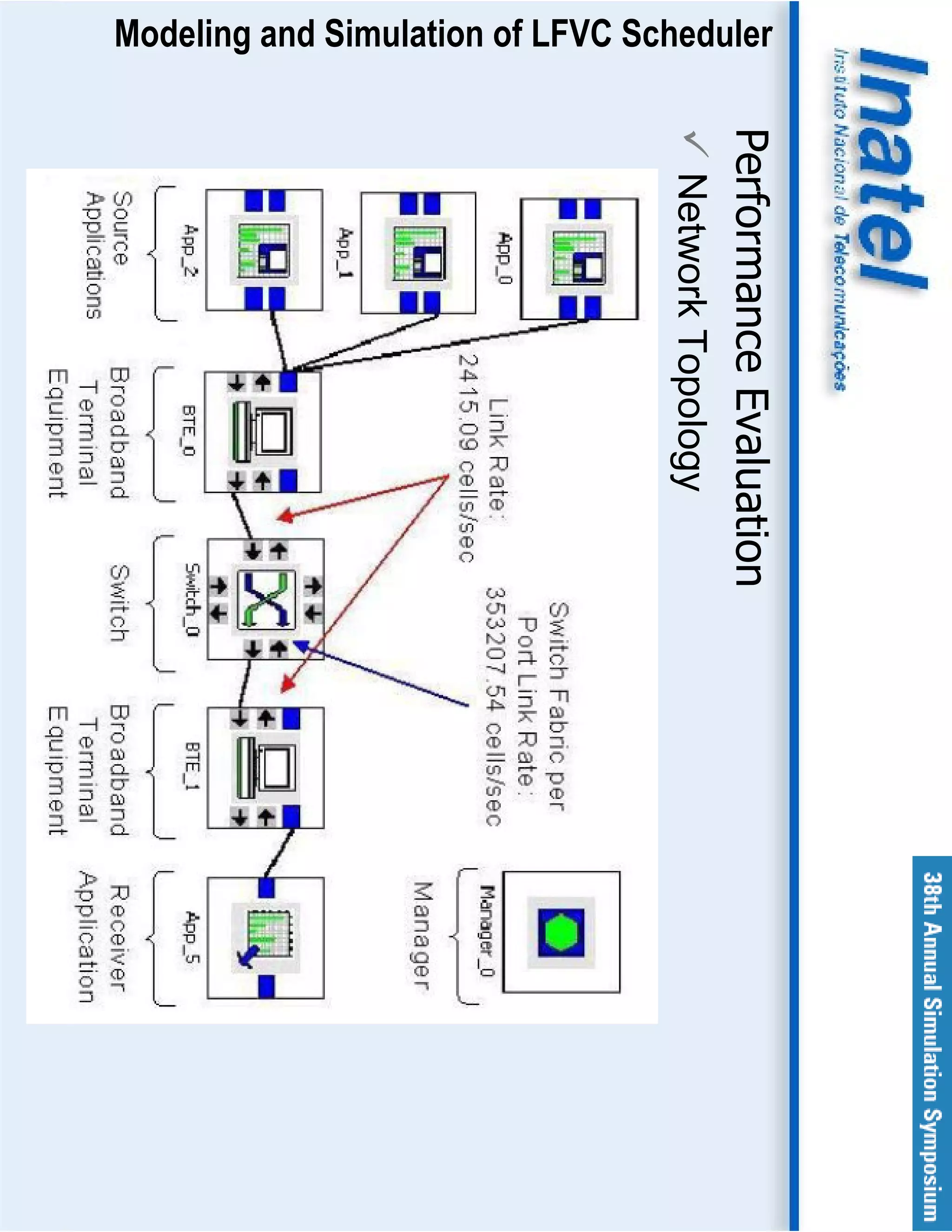
                                                     Performance Evaluation
                                  Network Topology
Modeling and Simulation of LFVC Scheduler


                                            Performance Evaluation
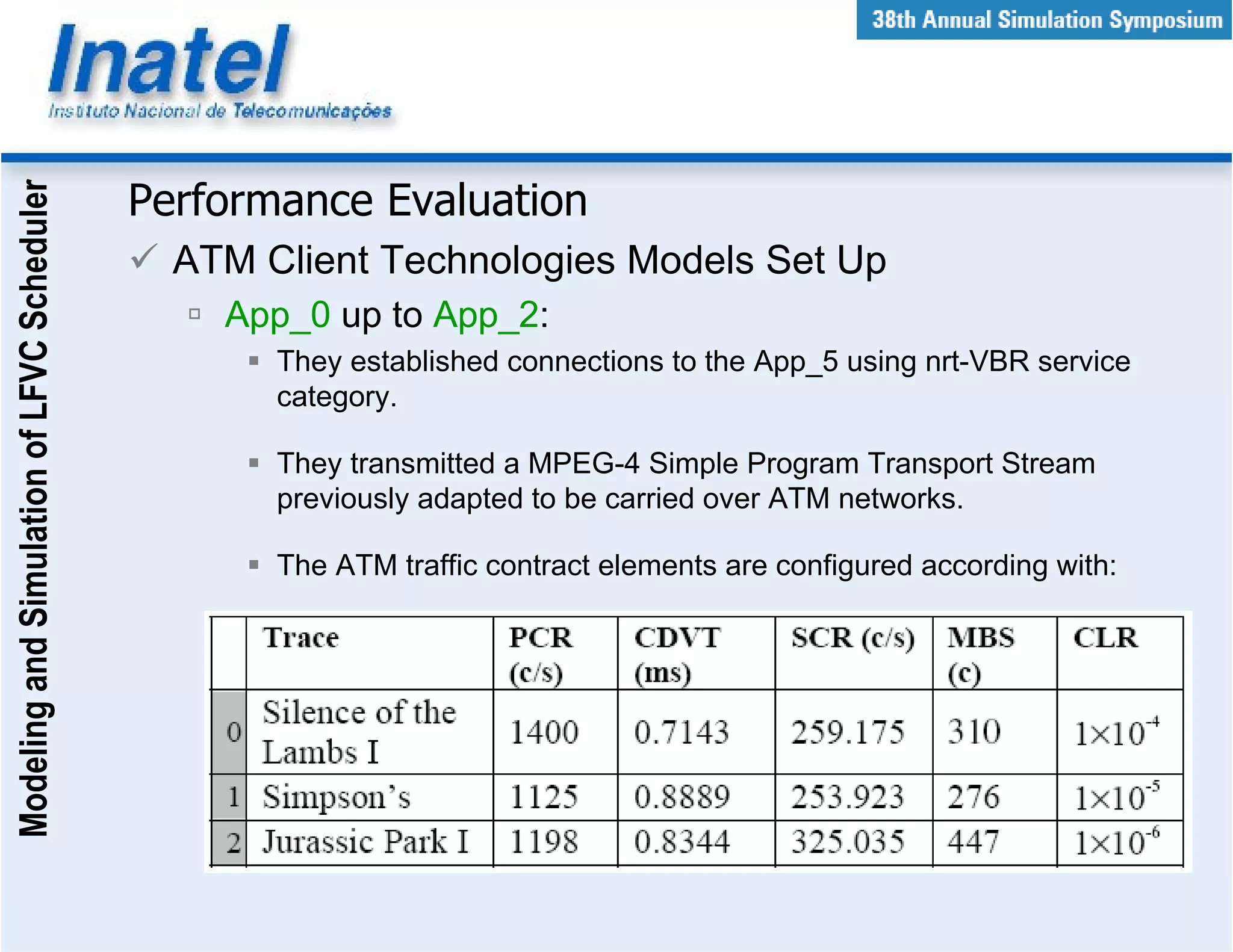
                                              ATM Client Technologies Models Set Up
                                                App_0 up to App_2:
                                                   They established connections to the App_5 using nrt-VBR service
                                                   category.

                                                   They transmitted a MPEG-4 Simple Program Transport Stream
                                                   previously adapted to be carried over ATM networks.

                                                   The ATM traffic contract elements are configured according with:
Modeling and Simulation of LFVC Scheduler


                                            Performance Evaluation
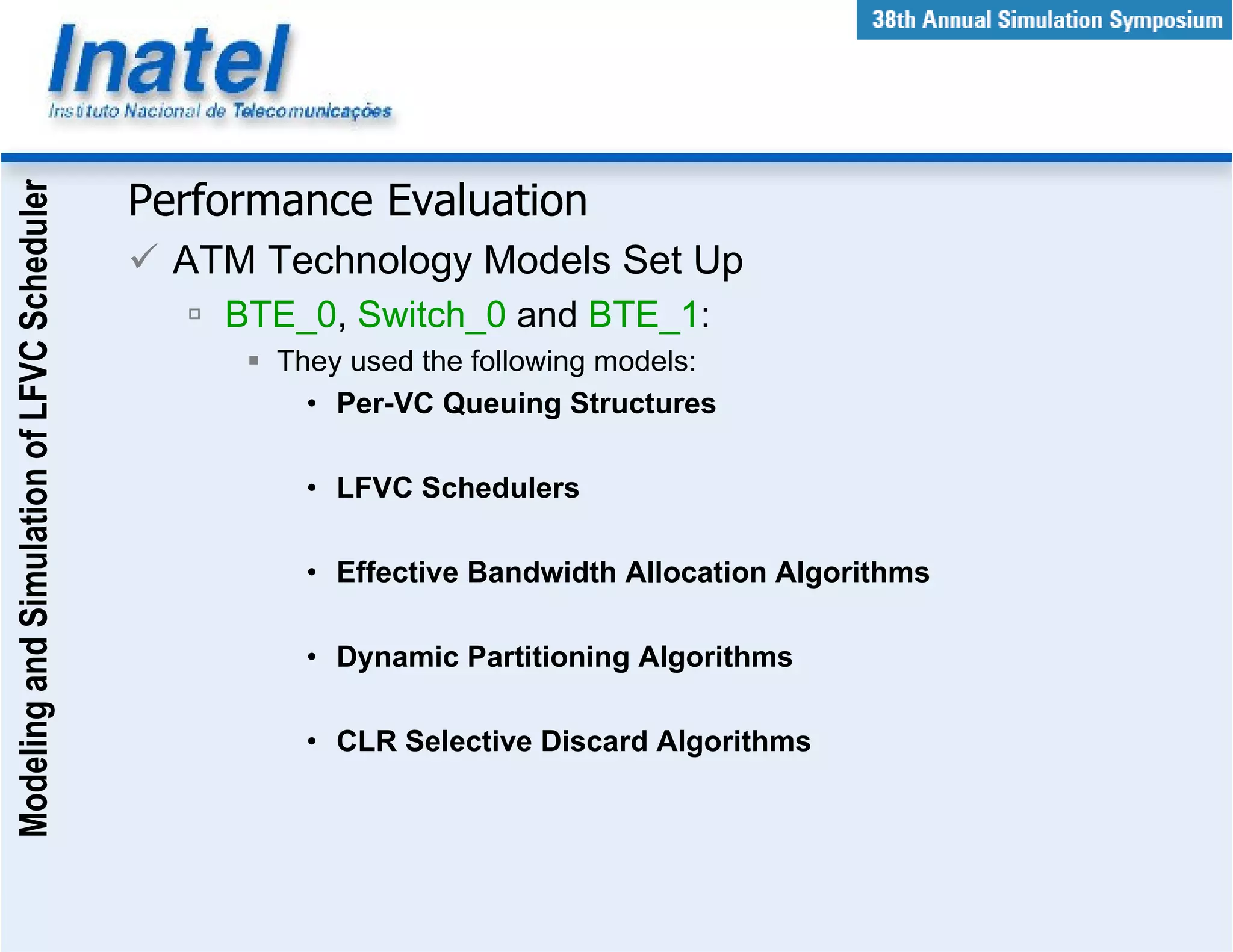
                                              ATM Technology Models Set Up
                                                BTE_0, Switch_0 and BTE_1:
                                                   They used the following models:
                                                     • Per-VC Queuing Structures

                                                     • LFVC Schedulers

                                                     • Effective Bandwidth Allocation Algorithms

                                                     • Dynamic Partitioning Algorithms

                                                     • CLR Selective Discard Algorithms
Modeling and Simulation of LFVC Scheduler


                                            Performance Evaluation
                                               Simulations Set Up
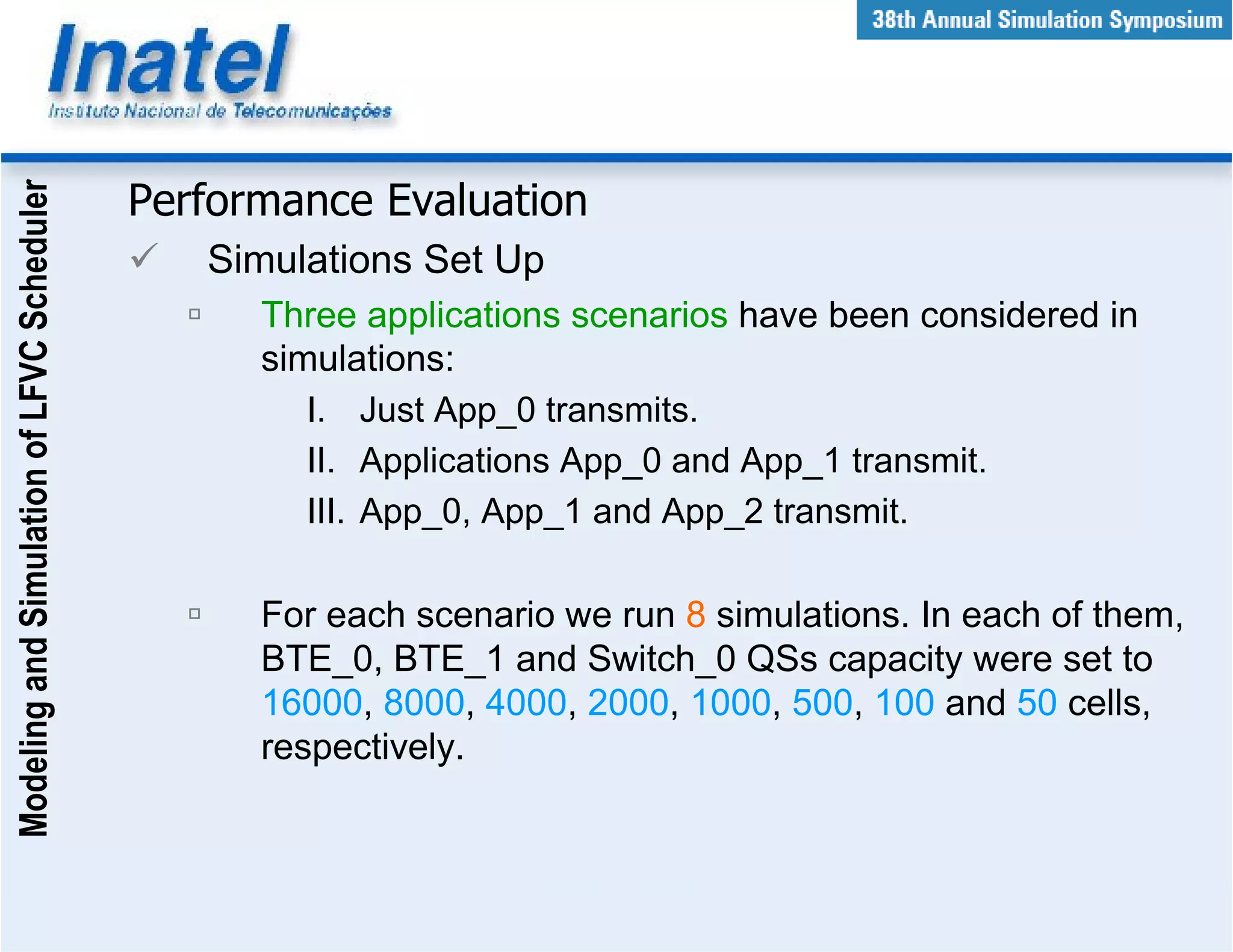
                                                  Three applications scenarios have been considered in
                                                  simulations:
                                                     I. Just App_0 transmits.
                                                     II. Applications App_0 and App_1 transmit.
                                                     III. App_0, App_1 and App_2 transmit.

                                                  For each scenario we run 8 simulations. In each of them,
                                                  BTE_0, BTE_1 and Switch_0 QSs capacity were set to
                                                  16000, 8000, 4000, 2000, 1000, 500, 100 and 50 cells,
                                                  respectively.
Modeling and Simulation of LFVC Scheduler


                                            Performance Evaluation
                                              Numerical Results
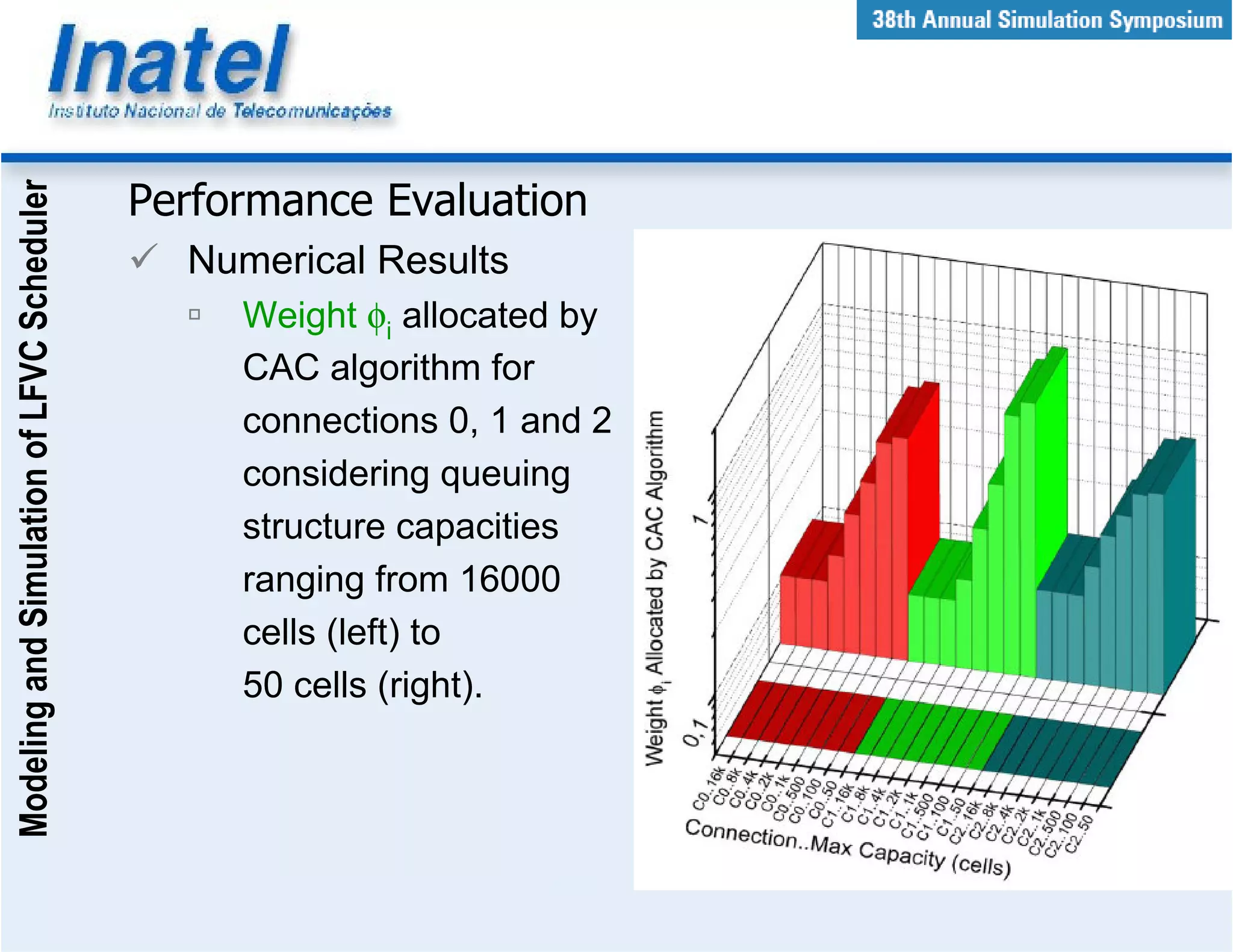
                                                 Weight φi allocated by
                                                 CAC algorithm for
                                                 connections 0, 1 and 2
                                                 considering queuing
                                                 structure capacities
                                                 ranging from 16000
                                                 cells (left) to
                                                 50 cells (right).
Modeling and Simulation of LFVC Scheduler


                                            Performance Evaluation
                                              Numerical Results
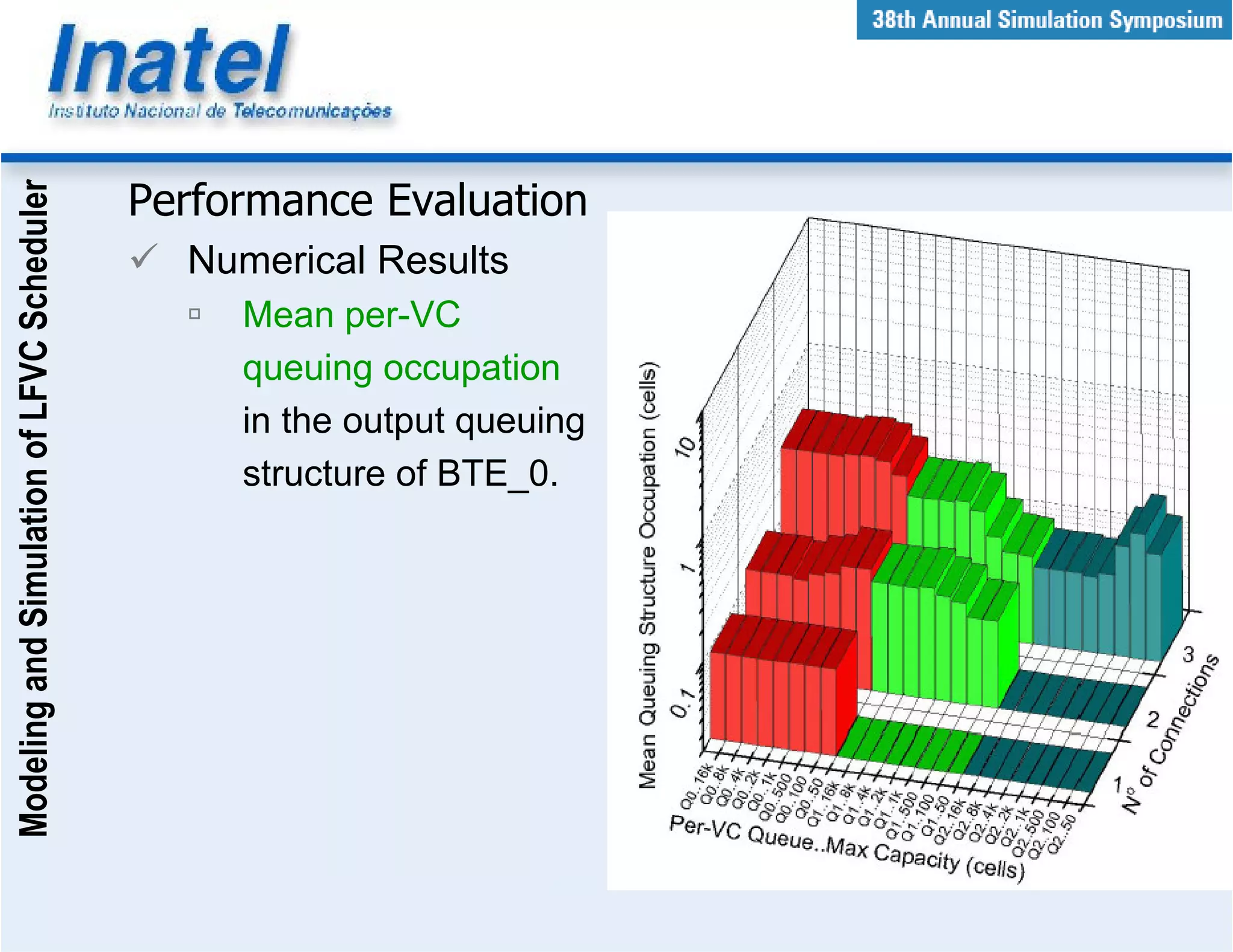
                                                 Mean per-VC
                                                 queuing occupation
                                                 in the output queuing
                                                 structure of BTE_0.
Modeling and Simulation of LFVC Scheduler


                                            Performance Evaluation
                                              Numerical Results
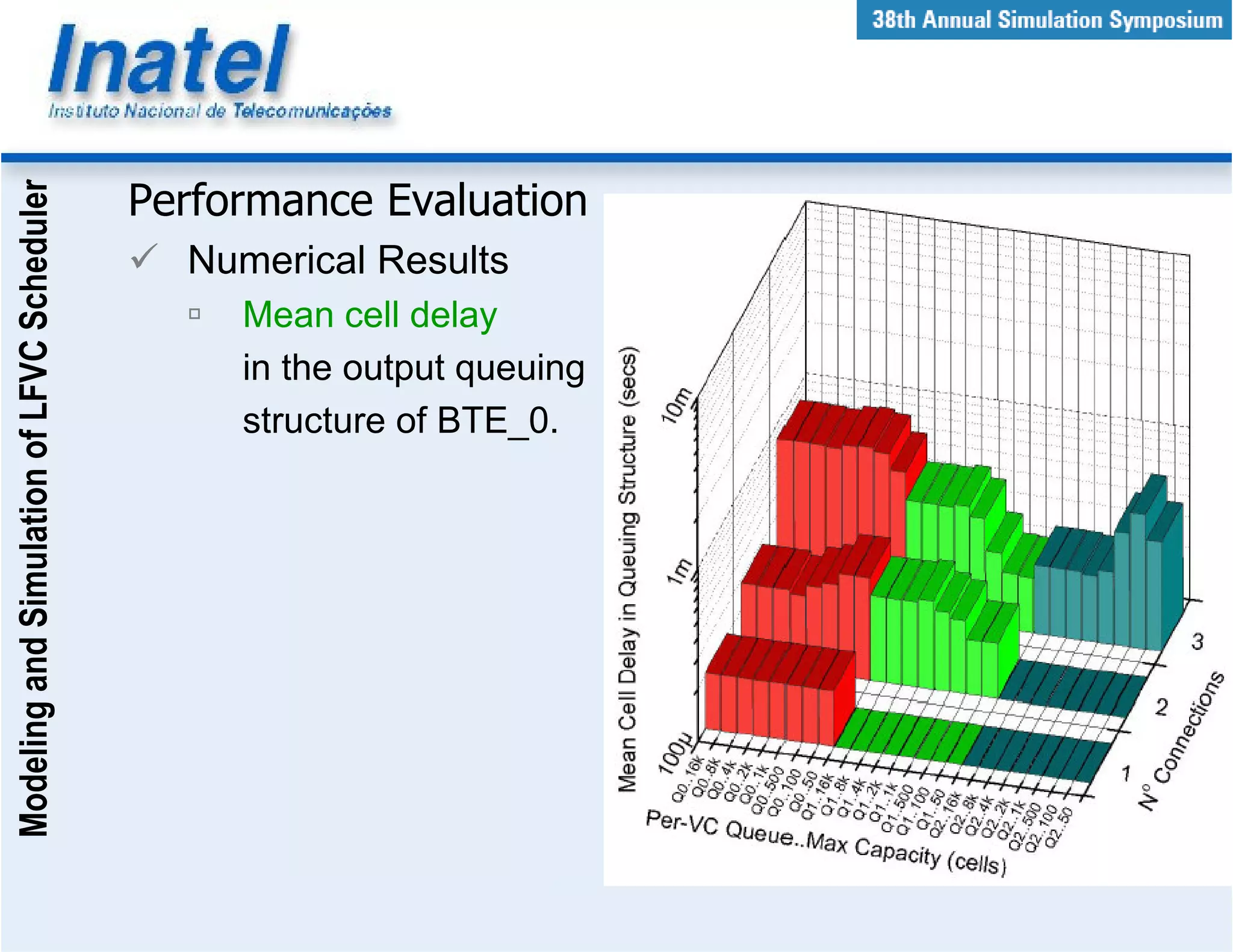
                                                 Mean cell delay
                                                 in the output queuing
                                                 structure of BTE_0.
Modeling and Simulation of LFVC Scheduler


                                            Performance Evaluation
                                              Numerical Results
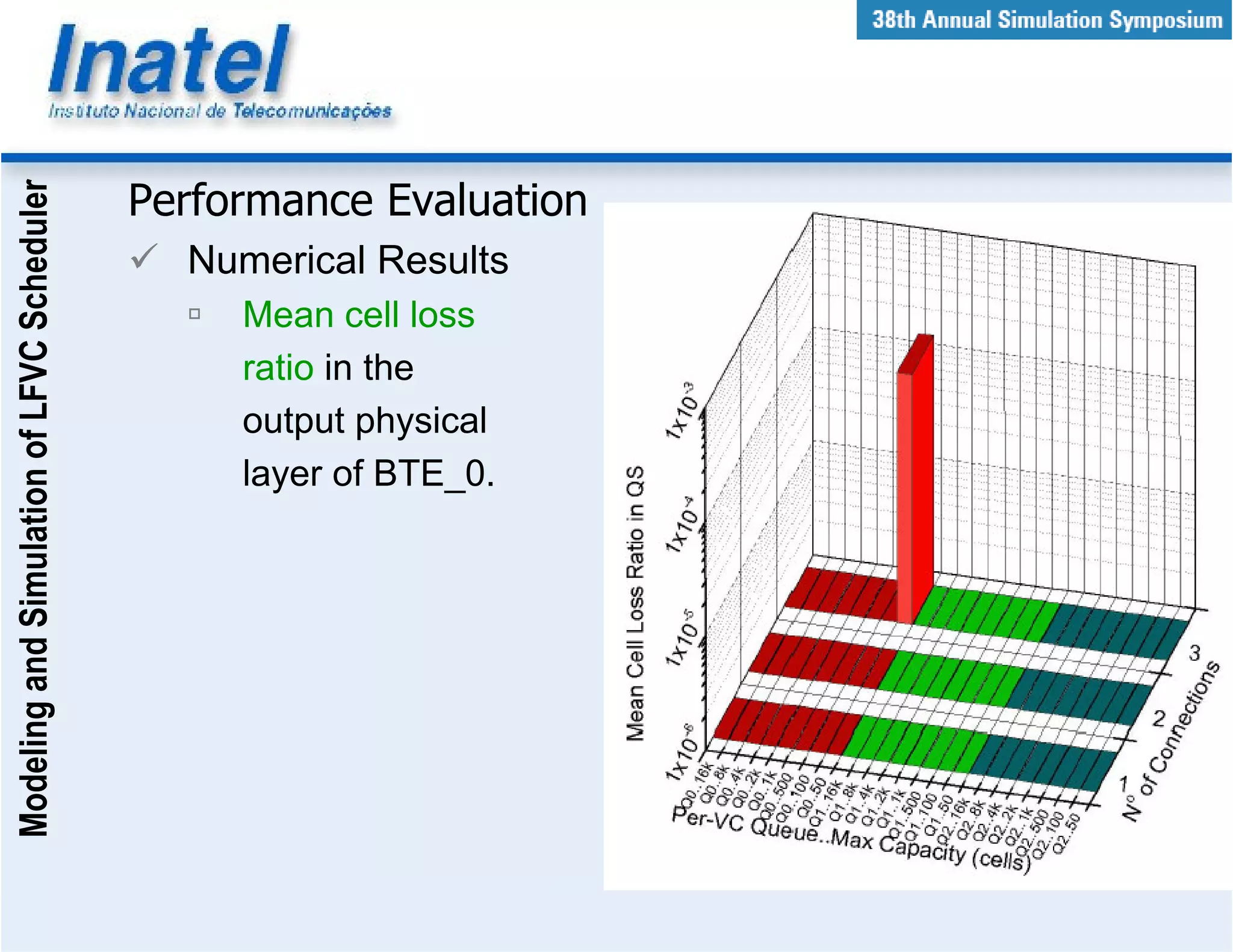
                                                 Mean cell loss
                                                 ratio in the
                                                 output physical
                                                 layer of BTE_0.
Modeling and Simulation of LFVC Scheduler


                                            Final Remarks
                                              The LFVC model interacts with other models of the ATM
                                              model set, improving its quality.

                                              Numerical results validated our model, since it produced
                                              the same service order than the original algorithm.

                                              Results briefly demonstrated how our model can be used
                                              to analyze QoS in ATM networks.

                                              Results showed that LFVC scheduler is capable of
                                              isolating traffic effects among ATM connections.

                                              Future works include a performance comparison between
                                              LFVC scheduler and WF2Q scheduler.
Thank You!

alberti@inatel.br

Apresentação feita em 2005 no Annual Simulation Symposium.

  • 1.
    Modeling and Simulationof a LFVC Scheduler Prof. Antonio M. Alberti INATEL: Instituto Nacional de Telecomunicações National Institute of Telecommunications Santa Rita do Sapucai Brazil
  • 2.
    Modeling and Simulationof LFVC Scheduler Presentation Outline Introduction Leap Forward Virtual Clock Developed Model Interaction Between LFVC and ATM Network Models Model Validation Performance Evaluation Final Remarks
  • 3.
    Modeling and Simulationof LFVC Scheduler Introduction One of the most important issues in integrated services networks is the choice of the service discipline to be used at each packet queuing point in order to select the appropriate packet service order. Why? 1. Service disciplines affect network performance not only in terms of delay and loss, but also in terms of throughput and fairness. 2. Service disciplines become a key to offer QoS isolation among connections/flows in the network.
  • 4.
    Modeling and Simulationof LFVC Scheduler Introduction Amongst current service disciplines, the ones that approximate Generalized Processor Sharing (GPS) have had a lot of success satisfying such requirements. In 1993, Parekh and Gallanger demonstrated that employing GPS servers in network switches, end-to-end QoS guarantees can be provided for a connection. However, GPS is an idealized discipline that does not can be implemented in real world.
  • 5.
    Modeling and Simulationof LFVC Scheduler Introduction So Parekh and Gallanger proposed a packet-based approximation to the GPS, which was called Packet-by- Packet Generalized Processor Sharing (PGPS). In 1996, Bennett and Zhang developed a new algorithm to approximate the GPS called Worst-case Fair Weighted Fair Queuing (WF2Q). Bennett and Zhang have demonstrated that WF2Q can work almost identical as GPS.
  • 6.
    Modeling and Simulationof LFVC Scheduler Introduction Several other service disciplines have been developed since then. However, according to Suri et. al., just two disciplines can work almost identical as GPS: WF2Q and Leap Forward Virtual Clock (LFVC). In addition, there are two important differences among these algorithms: 1. LFVC is simpler to implement than WF2Q. 2. LFVC has a smaller computational overhead .
  • 7.
    Modeling and Simulationof LFVC Scheduler Introduction These factors motivated us to implement LFVC algorithm in the context of an ATM network model previously developed to trustworthily evaluate QoS in ATM networks through simulation. The LFVC algorithm is fundamental in this network model, since very simple scheduling algorithms aren’t capable to capture service differences among connections. Our LFVC scheduler model interacts with the other models from this model set.
  • 8.
    Modeling and Simulationof LFVC Scheduler Leap Forward Virtual Clock LFVC is a work-conserving fair-share scheduler. It will be never turned off if there are cells waiting for service. An ATM cell flow f which temporarily has used more bandwidth than allocated through a weight φf can be disciplined by placing the exceeding cells in a low priority queue L. However, well-behaved cell flows are stored in a high priority queue H.
  • 9.
    Modeling and Simulationof LFVC Scheduler Leap Forward Virtual Clock Virtual clock service disciplines work allocating tags for each cell waiting for service. These tags represent the system clock value, when a cell will be served. Therefore, ATM cells are served in an increasing order of their tags. Just cells in the H queue are served. Cells in the L queue must be transferred to the H queue, in order to be served.
  • 10.
    Modeling and Simulationof LFVC Scheduler Leap Forward Virtual Clock So, how long can the cells can be maintained in the L queue without the risk of an excessive delay? The maximum delay that cell c can suffer is: T (c ) − t s ≥ ∆ f T (c ) is the value of tag for cell c; t s is the current virtual clock value; ∆ f is the time required for cell c be served with the rate allocated to flow f.
  • 11.
    Modeling and Simulationof LFVC Scheduler Leap Forward Virtual Clock It still remained another problem: what happens if all flows have been transferred for queue L and queue H becomes empty? The solution for this problem was to advance the server clock as far forward as possible, without violating the delay invariant of any flows in L. After the leap forward step, at least one active flow in L becomes eligible for transferring to H.
  • 12.
    Modeling and Simulationof LFVC Scheduler Developed Model To implement the H and L queues, a priority queue data structure was used. Besides priority queues H and L, the original algorithm uses a FIFO queue for each flow f. This queue is called Qf. In fact, it is the queue Qf that stores the cells, while the H and L priority queues just handle the service order and which flow is oversubscribed or not. In our implementation, this per-flow queue already exists in another model of the ATM models set: Per-VC Queuing model.
  • 13.
    Modeling and Simulationof LFVC Scheduler Developed Model The developed model has two main algorithms: ReceiveCell: To receive a new cell in the LFVC scheduler. It has one subroutine: • ProcessHead: to process the head of the Qf queue. TransmitCell: To transmit a cell to outside the scheduler. This algorithm has two subroutines: • TransferCells: to transfer cells from the L queue to the H queue. • ServiceCell: to serve a cell whose token waits in the H queue.
  • 14.
    Modeling and Simulationof LFVC Scheduler Developed Model ReceiveCell ReceiveCell (t m) Looks for the occupation of the queue Q f . Q f = 1? Yes Call ProcessHead Q f No End
  • 15.
    t m -Arrival time of a cell from flow f. t f - Current tag of a flow f. Modeling and Simulation of LFVC Scheduler Developed Model t fprev - Previous tag of a flow f. φ f - Flow f weight. ProcessHead Subroutine Q f - FIFO queue for flow f. ProcessHead Q . f ∆ f - Time period required for the (t m) transmission of a flow f cell in the rate allocated for this flow. t fprev = t f t s - Current scheduler timer. Looks for the pointer of the τ - Transmission frames period. cell in the head of the ρ - Rounding parameter. queue Q f . 1 SC - Scheduler capacity in cells/second. τ= SC tl - Service time. prev Recover t f and φ f . Schedule cell in the H t f ≤ ts + ∆ f + τ + ρ ? Yes priority queue with the tag field set up to t f . 1 ∆f = φ f .SC No Schedule cell in the L priority queue with the tag A t f = max (t s , t fprev ) + ∆ f field set up to t f − ∆ f .
  • 16.
    Modeling and Simulationof LFVC Scheduler Developed Model Scheduler is ProcessHead Subroutine A “turned on”? No Schedule cell transmission of the H queue to the time t m - Arrival time of a cell from flow f. instant equal to the Turn on scheduler. t f - Current tag of a flow f. beginning of the next frame period. t fprev - Previous tag of a flow f. Yes φ f - Flow f weight. Q f - FIFO queue for flow f. ∆ f - Time period required for the There are cells in Turn off scheduler. No transmission of a flow f cell in the H or L queues? the rate allocated for this flow. t s - Current scheduler timer. Yes τ - Transmission frames period. ρ - Rounding parameter. Schedule cell transmission SC - Scheduler capacity in cells/second. of the H queue to the time instant t m + τ . tl - Service time. Return
  • 17.
    Modeling and Simulationof LFVC Scheduler Developed Model TransmitCell TransmitCell ( tl ) Call TransferCells H queue is No Call ServiceCell empty? Yes Turn off the scheduler. End
  • 18.
    Modeling and Simulationof LFVC Scheduler Developed Model TransferCells Subroutine TransferCells While there are cells in L If empty Return No queue. If H queue is k min ≤ t s + τ + ρ Yes t s = max (t s , (k min − ρ )) empty? No Yes Transfer cell to H queue. Loop end
  • 19.
    Modeling and Simulationof LFVC Scheduler Developed Model ServiceCell Subroutine ServiceCell Schedule an event to carry the served cell to the next model at the instant t end . Remove cell from head of H queue. ts = ts +τ Schedule an event to the Per-VC Queuing informing that the cell must be removed from the Schedule processing of queue Q f . the Q f queue head to the instant tl . Calculate end of service time t end = tl + τ . Return
  • 20.
    Modeling and Simulationof LFVC Scheduler Interaction Between LFVC and ATM Network Models LFVC model was implemented as a Scheduler (S) model in the ATM Network Model. LFVC is used to define the service order of the cells stored in Queuing Structure (QS) models, such as Per-VC Queuing. The weight (φf) of each flow f is calculated by a Connection Admission Control (CAC) model when a new connection is being established.
  • 21.
    Modeling and Simulationof LFVC Scheduler Interaction Between LFVC and ATM Network Models Legend: General Application Traffic Managers Delete Connection Connection DC Layers Requesting Ending and Conclude and Deleting Activate NC DC Traffic Switch and NC Source Cell Flow Traffic Traffic Receiver Source CAC Switch Fabric Packet Flow To an To an BM TP Queuing ATM ATM QS Structure client network SD Broadband Terminal Equipment model model S S Scheduler QS ATM Adaptation Layer S Connection CAC Admission BTE ATM Layer Switch ATM Layer Control To other Buffer ATM BM Input Physical Output Physical Input Physical Output Physical Management network Layer Layer Layer Layer model Selective SD Discard QS QS QS QS Traffic TP S S S S Policing CAC CAC CAC CAC BM BM BM BM SD SD SD SD TP TP TP TP To another ATM network model
  • 22.
    Modeling and Simulationof LFVC Scheduler Model Validation Model validation was done through service order analysis. There are 10 applications (1-10) transmitting exactly 1 cell at time 0. For these applications, we configured a weight 0.05. One more application (11) transmits 10 cells starting at time 0, with a cell interval equals to 1 second. This application has a weight 0.5.
  • 23.
    Modeling and Simulationof LFVC Scheduler Model Validation Evolution of the LFVC variables when cells are processed by ProcessHead subroutine at the time instant tm.
  • 24.
    Modeling and Simulationof LFVC Scheduler Model Validation Occupation of the FIFO queue for flow f (Qf) in the Per-VC Queuing model. LFVC model produced the same service order shown by Suri et. al.
  • 25.
    Modeling and Simulationof LFVC Scheduler Performance Evaluation Network Topology
  • 26.
    Modeling and Simulationof LFVC Scheduler Performance Evaluation ATM Client Technologies Models Set Up App_0 up to App_2: They established connections to the App_5 using nrt-VBR service category. They transmitted a MPEG-4 Simple Program Transport Stream previously adapted to be carried over ATM networks. The ATM traffic contract elements are configured according with:
  • 27.
    Modeling and Simulationof LFVC Scheduler Performance Evaluation ATM Technology Models Set Up BTE_0, Switch_0 and BTE_1: They used the following models: • Per-VC Queuing Structures • LFVC Schedulers • Effective Bandwidth Allocation Algorithms • Dynamic Partitioning Algorithms • CLR Selective Discard Algorithms
  • 28.
    Modeling and Simulationof LFVC Scheduler Performance Evaluation Simulations Set Up Three applications scenarios have been considered in simulations: I. Just App_0 transmits. II. Applications App_0 and App_1 transmit. III. App_0, App_1 and App_2 transmit. For each scenario we run 8 simulations. In each of them, BTE_0, BTE_1 and Switch_0 QSs capacity were set to 16000, 8000, 4000, 2000, 1000, 500, 100 and 50 cells, respectively.
  • 29.
    Modeling and Simulationof LFVC Scheduler Performance Evaluation Numerical Results Weight φi allocated by CAC algorithm for connections 0, 1 and 2 considering queuing structure capacities ranging from 16000 cells (left) to 50 cells (right).
  • 30.
    Modeling and Simulationof LFVC Scheduler Performance Evaluation Numerical Results Mean per-VC queuing occupation in the output queuing structure of BTE_0.
  • 31.
    Modeling and Simulationof LFVC Scheduler Performance Evaluation Numerical Results Mean cell delay in the output queuing structure of BTE_0.
  • 32.
    Modeling and Simulationof LFVC Scheduler Performance Evaluation Numerical Results Mean cell loss ratio in the output physical layer of BTE_0.
  • 33.
    Modeling and Simulationof LFVC Scheduler Final Remarks The LFVC model interacts with other models of the ATM model set, improving its quality. Numerical results validated our model, since it produced the same service order than the original algorithm. Results briefly demonstrated how our model can be used to analyze QoS in ATM networks. Results showed that LFVC scheduler is capable of isolating traffic effects among ATM connections. Future works include a performance comparison between LFVC scheduler and WF2Q scheduler.
  • 34.