MODULE-4: SYMPOSIUM
OPEN COURSE: COMMUNICATIVE
APPLICATIONS IN ENGLISH
prepared by, Dr Sruthi Nandan
Meaning of symposium
• In ancient Greece, the symposium (Greek: συμπόσιον symposion or
symposio, from συμπίνειν sympinein, "to drink together") was a
part of a banquet that took place after the meal, when drinking for
pleasure was accompanied by music, dancing, recitals, or
conversation.[1] Literary works that describe or take place at a
symposium include two Socratic dialogues, Plato's Symposium and
Xenophon's Symposium, as well as a number of Greek poems such
as the elegies of Theognis of Megara. Symposia are depicted in
Greek and Etruscan art that shows similar scenes.[1]
• In modern usage, it has come to mean an academic conference or
meeting such as a scientific conference. The equivalent of a Greek
symposium in Roman society is the Latin convivium.[1]
• A symposium is generally defined as a meeting organized so that
experts in a given field can meet, present papers, and discuss issues
and trends or make recommendations for a certain course of
action. Some definitions of symposium include a degree of
audience participation that is less than that of a forum, thus
implying a greater structure to the meeting format.
• Symposiums have an implied academic aspect that distinguish them
from seminars. After a symposium, attendees should come away
having gained a greater degree of knowledge about a topic or a
deeper understanding of an issue. They may have heard entirely
new concepts about an existing subject or have been introduced to
something completely new.
FIRST STEPS
• Often the first step in organizing a symposium is to issue a call for
papers on the subject at hand. This process is usually accomplished
through trade publications and their corresponding websites, along
with relevant social media platforms. An organizing committee can
then choose the presenters based on their submissions. The call for
papers has to be completed well in advance of the date of the
symposium.
• If a call for papers is not used, then the organizers of the
symposium may pre-select the panel or panels and request that the
individuals prepare papers on the subject. Meeting planners should
choose a diverse group that is unlikely to repeat the same concepts,
preferably reflecting different disciplines within the same field. An
example would be a symposium on energy that would feature
experts on petroleum, electric, coal, nuclear, and renewable
sources.
FORMAT OF THE SYMPOSIUM
• A symposium can take a number of different formats, which are determined by the number of
presenters, subject matter, time for questions, travel, and—quite simply—the budget. However, a
standard format follows this order:
• Welcome remarks delivered by the hosts/organizers of the symposium.
• Introduction of a moderator for the symposium who will in turn introduce the keynote speaker and
the panelists, pose questions, and facilitate discussion.
• A keynote speaker who will deliver remarks on the overall theme of the symposium. The keynote
speech is typically presented before the panel discussion or during or after a luncheon.
• During the panel discussion, the moderator introduces each presenter with a brief biography. The
speaker will have a few minutes to speak on the topic and may give an overview plus his or her
personal or professional perspective. After the individual presentations, the moderator guides a
roundtable discussion among the panelists, often with pre-selected questions that have been sent
to the panelists in advance.
• The symposium generally concludes with a question and answer period. Often, the hosts simply
take microphones into the audience. For a more structured environment, questions can be
submitted in writing and read by the moderator.
OUTCOMES OF THE SYMPOSIUM
• In addition to publishing the papers submitted
by the panelists, a symposium may also
publish a comprehensive review of the
opinions and any conclusions drawn from the
discussions. A less formal review often takes
the form of a “Notes from the Symposium”
article in the relevant trade journals or online.
• There are lots of different types of academic
event that you might want to attend, such as
conferences, seminars, workshops and
symposiums. Each has its own benefits and
drawbacks, and generally they have a different
slant. Size, for instance, is usually a big factor in
whether something is regarded as a conference
or a symposium. Usually the difference between
a conference and a symposium is that a
conference will be a larger event and a
symposium a smaller one.
Moreover, the difference between a
conference and a seminar may be that a
conference has a more general theme with
a focus on presentations and lectures,
whereas a workshop is usually more specific
and hands-on, so to speak.
However, as we'll see there are grey areas
between these types of events, and the line
isn't always clear. Really, what's important is
that everyone has a good time and learns
something.
Nonetheless, it's good to know exactly what
you're getting into, especially if you're
actually presenting a paper or giving a
lecture. So let's dive into the specific
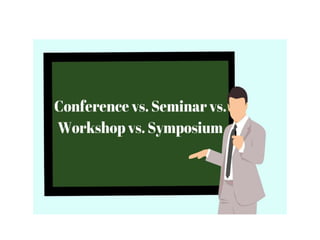
differences between a conference, a
seminar, a workshop, and a symposium.
What's a conference?
• Conferences tend to be the largest events vs.
smaller workshops and seminars. They can
number anywhere between fifty attendees to
thousands of attendees, and the largest may host
even more visitors that that. You'll come across
both national and international conferences –
national conferences are typically attended
primarily by people living within the country
which is hosting the event, while international
conferences can attract visitors from all over the
world.
• Conferences tend to be the most prestigious forms of events as well, so
they are the place where you most want the opportunity to present your
work as a talk or as a poster. Speaking of which, conferences will usually
involve a number of talks by prominent speakers in addition to poster
sessions where researchers present their ideas and data in a visual format.
When you attend a poster session, you can walk around and look at each
of the different posters and stop to chat or to ask questions of the
presenter as well. Presenters will stand next to their poster and will often
have a short 5-10 minute explanation of the poster which they will give to
anyone who asks.
• If the conference is a large one, you will find concurrent events. This
means that there might be two, four, or even more talks happening at the
same time in different locations. ou need to be organised to find out when
and where the talks you want to see are being held, and you should make
good use of your conference timetable which will hold all of this
information.
What's a seminar?
• The difference between a seminar and a workshop is
that a seminar tends to be held within one institution
or university, and will often a seminar will be a small
group of people – say, between five and ten attendees
– who come together to focus on a particular issue.
Often seminars will be less formally structured than
conferences, so one person might give a presentation
but it will probably be brief. There is more of a focus on
discussion at these events, so do feel free to chime in
with your thoughts on the topic at hand.
• Another difference between a seminar and a conference is that
while conferences usually last for between a few days and a week,
seminars will be much shorter. They may be for an hour or two in
the afternoon rather than lasting all day. Some departments will
organise regular seminars, so for example you might meet on the
first Monday of every month.
• Seminars are a great place to test out some new ideas or theories
that you've been thinking about but aren't 100% confident with yet.
If you're working on a concept or an idea for an experiment but you
want to hear some feedback on it before you develop it further,
offer to present it at a seminar. This kind of small group is perfect
for getting honest feedback and you might even get some
suggestions for improvements to your ideas.
What's a symposium?
• The main difference between a symposium and a
conference is that a symposium tends to be
similar to a conference, but smaller. The
definition of a symposium isn't completely clear –
the Oxford Advanced Learner's Dictionary
describes it simply as 'a small conference'.
However, similarly to a workshop, a symposium
tends to focus on a particular issue rather than a
more general theme. Generally a number of
experts will come together in order to present
their ideas and papers to one another.
• Similar to a conference in that the focus is on presentations and
lectures, and less hands-on than a workshop, a symposium is
typically completed in a single day. Symposiums may be more
prestigious than a conference, with an emphasis on experts
presenting their work and occasionally discussing it afterwards
(though not to the extent of a seminar). Finally, symposiums will
generally be smaller than a conference.
• Saying all this, it's likely you'll visit a symposium that seems more
like conference and a workshop that could easily be called a
seminar. The difference isn't always clear, and there's usually some
grey area. What's important is that you learn something while you
are there, and get to listen to some of the leading experts in their
fields discuss their work.
Thank you….

Symposium ppt

  • 1.
    MODULE-4: SYMPOSIUM OPEN COURSE:COMMUNICATIVE APPLICATIONS IN ENGLISH prepared by, Dr Sruthi Nandan
  • 2.
    Meaning of symposium •In ancient Greece, the symposium (Greek: συμπόσιον symposion or symposio, from συμπίνειν sympinein, "to drink together") was a part of a banquet that took place after the meal, when drinking for pleasure was accompanied by music, dancing, recitals, or conversation.[1] Literary works that describe or take place at a symposium include two Socratic dialogues, Plato's Symposium and Xenophon's Symposium, as well as a number of Greek poems such as the elegies of Theognis of Megara. Symposia are depicted in Greek and Etruscan art that shows similar scenes.[1] • In modern usage, it has come to mean an academic conference or meeting such as a scientific conference. The equivalent of a Greek symposium in Roman society is the Latin convivium.[1]
  • 4.
    • A symposiumis generally defined as a meeting organized so that experts in a given field can meet, present papers, and discuss issues and trends or make recommendations for a certain course of action. Some definitions of symposium include a degree of audience participation that is less than that of a forum, thus implying a greater structure to the meeting format. • Symposiums have an implied academic aspect that distinguish them from seminars. After a symposium, attendees should come away having gained a greater degree of knowledge about a topic or a deeper understanding of an issue. They may have heard entirely new concepts about an existing subject or have been introduced to something completely new.
  • 5.
    FIRST STEPS • Oftenthe first step in organizing a symposium is to issue a call for papers on the subject at hand. This process is usually accomplished through trade publications and their corresponding websites, along with relevant social media platforms. An organizing committee can then choose the presenters based on their submissions. The call for papers has to be completed well in advance of the date of the symposium. • If a call for papers is not used, then the organizers of the symposium may pre-select the panel or panels and request that the individuals prepare papers on the subject. Meeting planners should choose a diverse group that is unlikely to repeat the same concepts, preferably reflecting different disciplines within the same field. An example would be a symposium on energy that would feature experts on petroleum, electric, coal, nuclear, and renewable sources.
  • 6.
    FORMAT OF THESYMPOSIUM • A symposium can take a number of different formats, which are determined by the number of presenters, subject matter, time for questions, travel, and—quite simply—the budget. However, a standard format follows this order: • Welcome remarks delivered by the hosts/organizers of the symposium. • Introduction of a moderator for the symposium who will in turn introduce the keynote speaker and the panelists, pose questions, and facilitate discussion. • A keynote speaker who will deliver remarks on the overall theme of the symposium. The keynote speech is typically presented before the panel discussion or during or after a luncheon. • During the panel discussion, the moderator introduces each presenter with a brief biography. The speaker will have a few minutes to speak on the topic and may give an overview plus his or her personal or professional perspective. After the individual presentations, the moderator guides a roundtable discussion among the panelists, often with pre-selected questions that have been sent to the panelists in advance. • The symposium generally concludes with a question and answer period. Often, the hosts simply take microphones into the audience. For a more structured environment, questions can be submitted in writing and read by the moderator.
  • 7.
    OUTCOMES OF THESYMPOSIUM • In addition to publishing the papers submitted by the panelists, a symposium may also publish a comprehensive review of the opinions and any conclusions drawn from the discussions. A less formal review often takes the form of a “Notes from the Symposium” article in the relevant trade journals or online.
  • 9.
    • There arelots of different types of academic event that you might want to attend, such as conferences, seminars, workshops and symposiums. Each has its own benefits and drawbacks, and generally they have a different slant. Size, for instance, is usually a big factor in whether something is regarded as a conference or a symposium. Usually the difference between a conference and a symposium is that a conference will be a larger event and a symposium a smaller one.
  • 10.
    Moreover, the differencebetween a conference and a seminar may be that a conference has a more general theme with a focus on presentations and lectures, whereas a workshop is usually more specific and hands-on, so to speak. However, as we'll see there are grey areas between these types of events, and the line isn't always clear. Really, what's important is that everyone has a good time and learns something. Nonetheless, it's good to know exactly what you're getting into, especially if you're actually presenting a paper or giving a lecture. So let's dive into the specific differences between a conference, a seminar, a workshop, and a symposium.
  • 11.
    What's a conference? •Conferences tend to be the largest events vs. smaller workshops and seminars. They can number anywhere between fifty attendees to thousands of attendees, and the largest may host even more visitors that that. You'll come across both national and international conferences – national conferences are typically attended primarily by people living within the country which is hosting the event, while international conferences can attract visitors from all over the world.
  • 12.
    • Conferences tendto be the most prestigious forms of events as well, so they are the place where you most want the opportunity to present your work as a talk or as a poster. Speaking of which, conferences will usually involve a number of talks by prominent speakers in addition to poster sessions where researchers present their ideas and data in a visual format. When you attend a poster session, you can walk around and look at each of the different posters and stop to chat or to ask questions of the presenter as well. Presenters will stand next to their poster and will often have a short 5-10 minute explanation of the poster which they will give to anyone who asks. • If the conference is a large one, you will find concurrent events. This means that there might be two, four, or even more talks happening at the same time in different locations. ou need to be organised to find out when and where the talks you want to see are being held, and you should make good use of your conference timetable which will hold all of this information.
  • 13.
    What's a seminar? •The difference between a seminar and a workshop is that a seminar tends to be held within one institution or university, and will often a seminar will be a small group of people – say, between five and ten attendees – who come together to focus on a particular issue. Often seminars will be less formally structured than conferences, so one person might give a presentation but it will probably be brief. There is more of a focus on discussion at these events, so do feel free to chime in with your thoughts on the topic at hand.
  • 14.
    • Another differencebetween a seminar and a conference is that while conferences usually last for between a few days and a week, seminars will be much shorter. They may be for an hour or two in the afternoon rather than lasting all day. Some departments will organise regular seminars, so for example you might meet on the first Monday of every month. • Seminars are a great place to test out some new ideas or theories that you've been thinking about but aren't 100% confident with yet. If you're working on a concept or an idea for an experiment but you want to hear some feedback on it before you develop it further, offer to present it at a seminar. This kind of small group is perfect for getting honest feedback and you might even get some suggestions for improvements to your ideas.
  • 15.
    What's a symposium? •The main difference between a symposium and a conference is that a symposium tends to be similar to a conference, but smaller. The definition of a symposium isn't completely clear – the Oxford Advanced Learner's Dictionary describes it simply as 'a small conference'. However, similarly to a workshop, a symposium tends to focus on a particular issue rather than a more general theme. Generally a number of experts will come together in order to present their ideas and papers to one another.
  • 16.
    • Similar toa conference in that the focus is on presentations and lectures, and less hands-on than a workshop, a symposium is typically completed in a single day. Symposiums may be more prestigious than a conference, with an emphasis on experts presenting their work and occasionally discussing it afterwards (though not to the extent of a seminar). Finally, symposiums will generally be smaller than a conference. • Saying all this, it's likely you'll visit a symposium that seems more like conference and a workshop that could easily be called a seminar. The difference isn't always clear, and there's usually some grey area. What's important is that you learn something while you are there, and get to listen to some of the leading experts in their fields discuss their work.
  • 17.