Symmetrical family?
Gender roles, domestic labour and
power in the family
Symmetrical family
• A family where the roles of husband and wife or
cohabiting partners have become more alike
(symmetrical) and equal
• Less patriarchal and male-dominated
• Young and Willmott found this in the modern
family
• 1970’s research – valid for modern family?
• Small sample size
• Questionnaire – may have lied
Conjugal roles
• Conjugal roles – roles played out by male and
female partner in marriage or in a cohabiting
relationship
• Segregated conjugal roles – shows clear
division and separation between male and
female roles
• Integrated (joint) conjugal roles – few
divisions between male and female roles
Conjugal roles
• Instrumental role – the provider/breadwinner
role in the family, often associated by
functionalists with men’s role in family life
• Expressive role – the nurturing, caring and
emotional role, often seen by functionalists as
women’s natural role in the family, linking to
women’s biology
Reasons why Britain has gone from
segregated roles to more integrated roles
• Improved living standards at home
• Decline in extended families
• Improved rights and status of women
• Women in full employment
• Weaker gender identities
Improved living standards in the home
• Central heating, TV, computers, internet
• Encouraging partners to become more home
centered
• Building of relationship at home
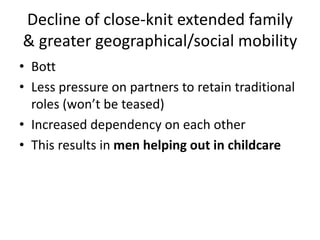
Decline of close-knit extended family
& greater geographical/social mobility
• Bott
• Less pressure on partners to retain traditional
roles (won’t be teased)
• Increased dependency on each other
• This results in men helping out in childcare
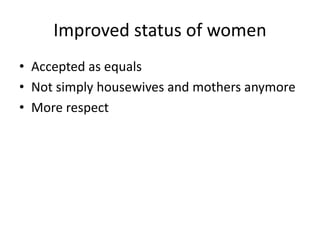
Improved status of women
• Accepted as equals
• Not simply housewives and mothers anymore
• More respect
Women working in paid employment
• More authority and power due to less financial
dependency on men
• Men doing more house work because women are
working; recognition that women can’t do two
jobs at once
• This domestic work is usually masculine-defined
tasks e.g. DIY, gardening, ‘fixing’
• More money for commercialized housework
• This results in both contributing to decision-
making; duel-worker households and shared
control of finances
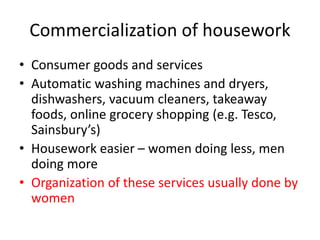
Commercialization of housework
• Consumer goods and services
• Automatic washing machines and dryers,
dishwashers, vacuum cleaners, takeaway
foods, online grocery shopping (e.g. Tesco,
Sainsbury’s)
• Housework easier – women doing less, men
doing more
• Organization of these services usually done by
women
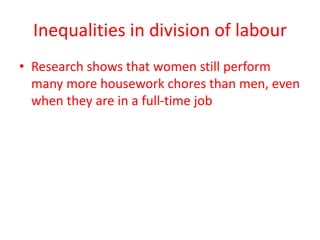
Inequalities in division of labour
• Research shows that women still perform
many more housework chores than men, even
when they are in a full-time job
Perception of “equality” (Oakley)
• Young and Willmott’s evidence for equality of
housework was that 72% of men helped with at
least one piece of housework a week, however
this is very small compared to the women’s
workload
• Oakley argues that this could mean anything from
tucking children into bed to ironing one pair of
trousers, and fewer than ¾’s of the research even
did this much
• Hardly convincing evidence for symmetry
Public belief in sexual division of
labour
• A 2005 report showed that most of the
general public still believe that the women
should take the expressive role and there
should be sexual division of labour
Unequal distribution of power and
decision-making
• Many of the “important” decisions
are still made by the men alone
• Men often the major earners in a household,
leading to more authority
The effects of housework and
childcare on women’s careers
• Duties within the family holding women back
from progressing in careers
• Constraints on the hours and work they can
do
• Seen as “unreliable” by employers because
they will put family first.
• Having children may lead to missing time from
work during which most men can be
advancing their careers; women are held back
Emotional side of family
(Duncombe and Marsden)
• Found that many long-term relationships were
held together by women
• Women who care for emotional side of family
• Not symmetrical because otherwise the men
would deal with emotional side equally

Symmetrical family

  • 1.
    Symmetrical family? Gender roles,domestic labour and power in the family
  • 2.
    Symmetrical family • Afamily where the roles of husband and wife or cohabiting partners have become more alike (symmetrical) and equal • Less patriarchal and male-dominated • Young and Willmott found this in the modern family • 1970’s research – valid for modern family? • Small sample size • Questionnaire – may have lied
  • 3.
    Conjugal roles • Conjugalroles – roles played out by male and female partner in marriage or in a cohabiting relationship • Segregated conjugal roles – shows clear division and separation between male and female roles • Integrated (joint) conjugal roles – few divisions between male and female roles
  • 4.
    Conjugal roles • Instrumentalrole – the provider/breadwinner role in the family, often associated by functionalists with men’s role in family life • Expressive role – the nurturing, caring and emotional role, often seen by functionalists as women’s natural role in the family, linking to women’s biology
  • 5.
    Reasons why Britainhas gone from segregated roles to more integrated roles • Improved living standards at home • Decline in extended families • Improved rights and status of women • Women in full employment • Weaker gender identities
  • 6.
    Improved living standardsin the home • Central heating, TV, computers, internet • Encouraging partners to become more home centered • Building of relationship at home
  • 7.
    Decline of close-knitextended family & greater geographical/social mobility • Bott • Less pressure on partners to retain traditional roles (won’t be teased) • Increased dependency on each other • This results in men helping out in childcare
  • 8.
    Improved status ofwomen • Accepted as equals • Not simply housewives and mothers anymore • More respect
  • 9.
    Women working inpaid employment • More authority and power due to less financial dependency on men • Men doing more house work because women are working; recognition that women can’t do two jobs at once • This domestic work is usually masculine-defined tasks e.g. DIY, gardening, ‘fixing’ • More money for commercialized housework • This results in both contributing to decision- making; duel-worker households and shared control of finances
  • 10.
    Commercialization of housework •Consumer goods and services • Automatic washing machines and dryers, dishwashers, vacuum cleaners, takeaway foods, online grocery shopping (e.g. Tesco, Sainsbury’s) • Housework easier – women doing less, men doing more • Organization of these services usually done by women
  • 11.
    Inequalities in divisionof labour • Research shows that women still perform many more housework chores than men, even when they are in a full-time job
  • 12.
    Perception of “equality”(Oakley) • Young and Willmott’s evidence for equality of housework was that 72% of men helped with at least one piece of housework a week, however this is very small compared to the women’s workload • Oakley argues that this could mean anything from tucking children into bed to ironing one pair of trousers, and fewer than ¾’s of the research even did this much • Hardly convincing evidence for symmetry
  • 13.
    Public belief insexual division of labour • A 2005 report showed that most of the general public still believe that the women should take the expressive role and there should be sexual division of labour
  • 14.
    Unequal distribution ofpower and decision-making • Many of the “important” decisions are still made by the men alone • Men often the major earners in a household, leading to more authority
  • 15.
    The effects ofhousework and childcare on women’s careers • Duties within the family holding women back from progressing in careers • Constraints on the hours and work they can do • Seen as “unreliable” by employers because they will put family first. • Having children may lead to missing time from work during which most men can be advancing their careers; women are held back
  • 16.
    Emotional side offamily (Duncombe and Marsden) • Found that many long-term relationships were held together by women • Women who care for emotional side of family • Not symmetrical because otherwise the men would deal with emotional side equally