Underrepresented Population: The Homeless James D. Worsley, MS, LRT/CTRS Facility Manager Past Homeless Coordinator Mecklenburg County Park & Rec.
What’s in store for you? Common Stereotypes of the Homeless What does it mean to be homeless? How many people are homeless? Where do homeless people typically live? Why are people homeless?
What’s in store for you?  Therapeutic recreation programs for the homeless Partnerships Program sponsors
Common stereotypes of the homeless Most homeless people are single men who are drunks and/or drug addicts. Homelessness is particular to one ethnic, age or social group. Homeless people are dangerous and should be feared.
Common stereotypes of the homeless Homeless people are uneducated and unemployable. People choose to be homeless. Homeless people don’t want help, they just want a hand out.
A homeless individual is someone who: Lacks a fixed, regular and adequate nighttime residence and primarily resides in a temporary, emergency or transitional shelter, in a public or private place not designed for, or ordinarily used as a regular sleeping accommodation for human beings;
Definition continued Is living in an overcrowded, doubled up situation and who is being evicted within seven days, has no subsequent address and lacks the resources and support network needed to obtain access to housing;
Definition continued Is living in substandard housing that has been condemned and has no place to go or the resources to obtain other housing; Is fleeing a domestic violence situation and has no safe place to go.
Definition continued Is being evicted from or forced to leave a dwelling unit within a week or being discharged from an institution after residence of more than 30 consecutive days; Resident for 30 consecutive days or less in hospital, jail, or other institution. According to HUD (Housing and Urban Development)
Demographics  (Based on Census 2000; Urban Institute) National Homelessness 280,527 people were counted in homeless shelters, at soup kitchens, on the streets, etc. Between 2.3 million and 3.5 million people will experience homelessness at least once over the course of a year
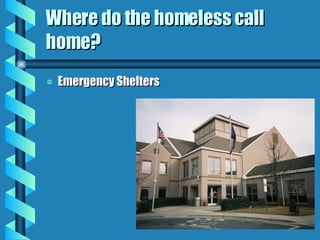
Where do the homeless call home? Emergency Shelters
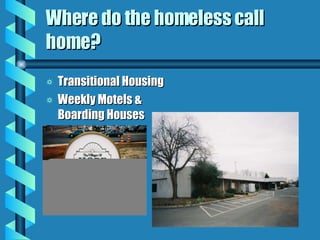
Where do the homeless call home? Transitional Housing Weekly Motels & Boarding Houses
Where do the homeless call home? Doubled or Tripled Up With Family or Friends On the Streets Under bridges In cars Camps in wooded areas Abandoned buildings and Vacant lots
Why are people homeless? Leading causes of homelessness Lack of safe, decent and affordable housing Poverty/low wage earnings Addiction to alcohol and/or drugs
Why are people homeless? Leading causes of homelessness Mental illness Domestic violence Chronic health issues and disabilities
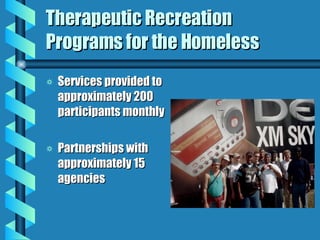
Therapeutic Recreation Programs for the Homeless Services provided to approximately 200 participants monthly Partnerships with approximately 15 agencies
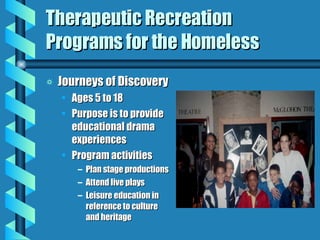
Therapeutic Recreation Programs for the Homeless Journeys of Discovery Ages 5 to 18 Purpose is to provide educational drama experiences Program activities  Plan stage productions Attend live plays Leisure education in reference to culture and heritage
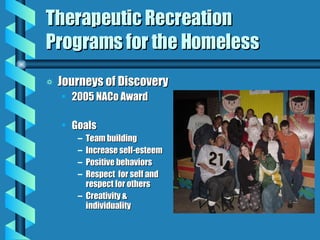
Therapeutic Recreation Programs for the Homeless Journeys of Discovery 2005 NACo Award Goals Team building Increase self-esteem Positive behaviors Respect  for self and respect for others Creativity & individuality
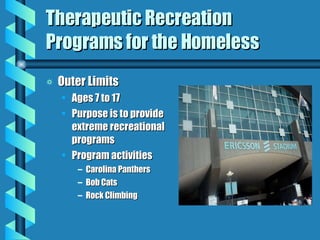
Therapeutic Recreation Programs for the Homeless Outer Limits Ages 7 to 17 Purpose is to provide extreme recreational programs Program activities Carolina Panthers Bob Cats Rock Climbing
Therapeutic Recreation Programs for the Homeless Outer Limits Goals Offers cultural enriching opportunities Positive role models Increases self-esteem Positive behaviors
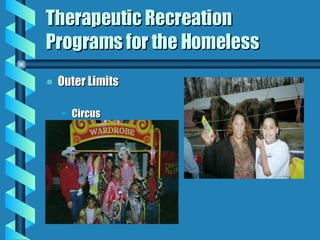
Therapeutic Recreation Programs for the Homeless Outer Limits Circus
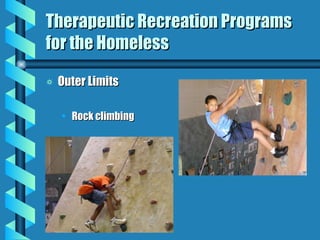
Therapeutic Recreation Programs for the Homeless Outer Limits Rock climbing
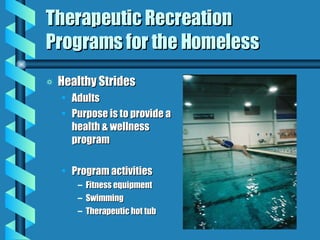
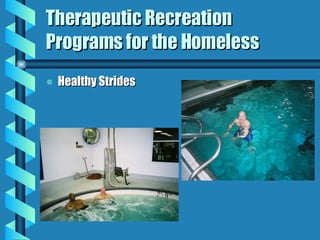
Therapeutic Recreation Programs for the Homeless Healthy Strides Adults Purpose is to provide a health & wellness program Program activities Fitness equipment Swimming Therapeutic hot tub
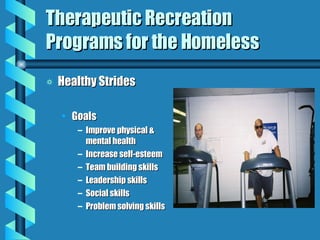
Therapeutic Recreation Programs for the Homeless Healthy Strides Goals Improve physical & mental health Increase self-esteem Team building skills Leadership skills Social skills Problem solving skills
Therapeutic Recreation Programs for the Homeless Healthy Strides
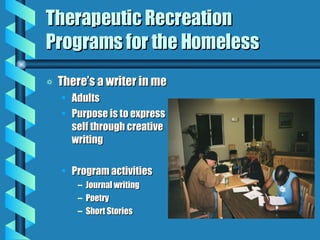
Therapeutic Recreation Programs for the Homeless There’s a writer in me Adults Purpose is to express self through creative writing Program activities Journal writing Poetry Short Stories
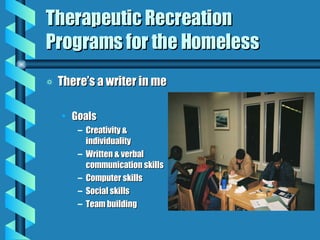
Therapeutic Recreation Programs for the Homeless There’s a writer in me Goals Creativity & individuality Written & verbal communication skills Computer skills Social skills Team building
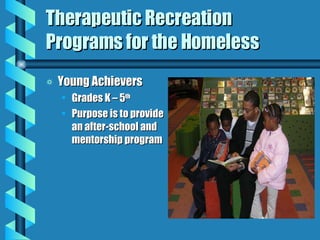
Therapeutic Recreation Programs for the Homeless Young Achievers Grades K – 5 th Purpose is to provide an after-school and mentorship program
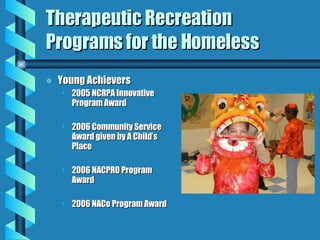
Therapeutic Recreation Programs for the Homeless Young Achievers 2005 NCRPA Innovative Program Award 2006 Community Service Award given by A Child’s Place 2006 NACPRO Program Award 2006 NACo Program Award
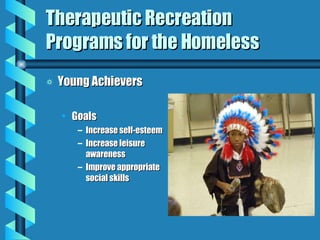
Therapeutic Recreation Programs for the Homeless Young Achievers Goals Increase self-esteem Increase leisure awareness Improve appropriate social skills
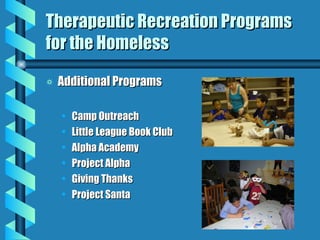
Therapeutic Recreation Programs for the Homeless Additional Programs Camp Outreach Little League Book Club Alpha Academy Project Alpha Giving Thanks Project Santa
QUESTIONS?

Homeless Presentation

  • 1.
    Underrepresented Population: TheHomeless James D. Worsley, MS, LRT/CTRS Facility Manager Past Homeless Coordinator Mecklenburg County Park & Rec.
  • 2.
    What’s in storefor you? Common Stereotypes of the Homeless What does it mean to be homeless? How many people are homeless? Where do homeless people typically live? Why are people homeless?
  • 3.
    What’s in storefor you? Therapeutic recreation programs for the homeless Partnerships Program sponsors
  • 4.
    Common stereotypes ofthe homeless Most homeless people are single men who are drunks and/or drug addicts. Homelessness is particular to one ethnic, age or social group. Homeless people are dangerous and should be feared.
  • 5.
    Common stereotypes ofthe homeless Homeless people are uneducated and unemployable. People choose to be homeless. Homeless people don’t want help, they just want a hand out.
  • 6.
    A homeless individualis someone who: Lacks a fixed, regular and adequate nighttime residence and primarily resides in a temporary, emergency or transitional shelter, in a public or private place not designed for, or ordinarily used as a regular sleeping accommodation for human beings;
  • 7.
    Definition continued Isliving in an overcrowded, doubled up situation and who is being evicted within seven days, has no subsequent address and lacks the resources and support network needed to obtain access to housing;
  • 8.
    Definition continued Isliving in substandard housing that has been condemned and has no place to go or the resources to obtain other housing; Is fleeing a domestic violence situation and has no safe place to go.
  • 9.
    Definition continued Isbeing evicted from or forced to leave a dwelling unit within a week or being discharged from an institution after residence of more than 30 consecutive days; Resident for 30 consecutive days or less in hospital, jail, or other institution. According to HUD (Housing and Urban Development)
  • 10.
    Demographics (Basedon Census 2000; Urban Institute) National Homelessness 280,527 people were counted in homeless shelters, at soup kitchens, on the streets, etc. Between 2.3 million and 3.5 million people will experience homelessness at least once over the course of a year
  • 11.
    Where do thehomeless call home? Emergency Shelters
  • 12.
    Where do thehomeless call home? Transitional Housing Weekly Motels & Boarding Houses
  • 13.
    Where do thehomeless call home? Doubled or Tripled Up With Family or Friends On the Streets Under bridges In cars Camps in wooded areas Abandoned buildings and Vacant lots
  • 14.
    Why are peoplehomeless? Leading causes of homelessness Lack of safe, decent and affordable housing Poverty/low wage earnings Addiction to alcohol and/or drugs
  • 15.
    Why are peoplehomeless? Leading causes of homelessness Mental illness Domestic violence Chronic health issues and disabilities
  • 16.
    Therapeutic Recreation Programsfor the Homeless Services provided to approximately 200 participants monthly Partnerships with approximately 15 agencies
  • 17.
    Therapeutic Recreation Programsfor the Homeless Journeys of Discovery Ages 5 to 18 Purpose is to provide educational drama experiences Program activities Plan stage productions Attend live plays Leisure education in reference to culture and heritage
  • 18.
    Therapeutic Recreation Programsfor the Homeless Journeys of Discovery 2005 NACo Award Goals Team building Increase self-esteem Positive behaviors Respect for self and respect for others Creativity & individuality
  • 19.
    Therapeutic Recreation Programsfor the Homeless Outer Limits Ages 7 to 17 Purpose is to provide extreme recreational programs Program activities Carolina Panthers Bob Cats Rock Climbing
  • 20.
    Therapeutic Recreation Programsfor the Homeless Outer Limits Goals Offers cultural enriching opportunities Positive role models Increases self-esteem Positive behaviors
  • 21.
    Therapeutic Recreation Programsfor the Homeless Outer Limits Circus
  • 22.
    Therapeutic Recreation Programsfor the Homeless Outer Limits Rock climbing
  • 23.
    Therapeutic Recreation Programsfor the Homeless Healthy Strides Adults Purpose is to provide a health & wellness program Program activities Fitness equipment Swimming Therapeutic hot tub
  • 24.
    Therapeutic Recreation Programsfor the Homeless Healthy Strides Goals Improve physical & mental health Increase self-esteem Team building skills Leadership skills Social skills Problem solving skills
  • 25.
    Therapeutic Recreation Programsfor the Homeless Healthy Strides
  • 26.
    Therapeutic Recreation Programsfor the Homeless There’s a writer in me Adults Purpose is to express self through creative writing Program activities Journal writing Poetry Short Stories
  • 27.
    Therapeutic Recreation Programsfor the Homeless There’s a writer in me Goals Creativity & individuality Written & verbal communication skills Computer skills Social skills Team building
  • 28.
    Therapeutic Recreation Programsfor the Homeless Young Achievers Grades K – 5 th Purpose is to provide an after-school and mentorship program
  • 29.
    Therapeutic Recreation Programsfor the Homeless Young Achievers 2005 NCRPA Innovative Program Award 2006 Community Service Award given by A Child’s Place 2006 NACPRO Program Award 2006 NACo Program Award
  • 30.
    Therapeutic Recreation Programsfor the Homeless Young Achievers Goals Increase self-esteem Increase leisure awareness Improve appropriate social skills
  • 31.
    Therapeutic Recreation Programsfor the Homeless Additional Programs Camp Outreach Little League Book Club Alpha Academy Project Alpha Giving Thanks Project Santa
  • 32.