Sociology
According to functionalist George Murdock a
family is defined as “a social group
characterized by common residence, economic
co-operation and reproduction. It includes
adults of both sexes, at least two of whom
maintain a socially approved sexual
relationship and one or more children, own or
adopted of the sexually co-habiting adults.”
There are various types of family that exist in
today’s society, some of the more common
structures include :
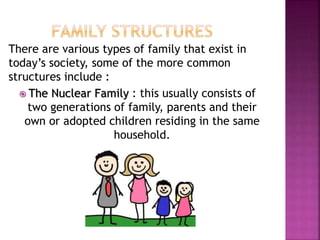
 The Nuclear Family : this usually consists of
two generations of family, parents and their
own or adopted children residing in the same
household.
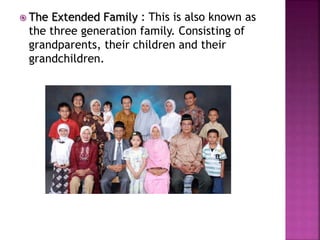
 The Extended Family : This is also known as
the three generation family. Consisting of
grandparents, their children and their
grandchildren.
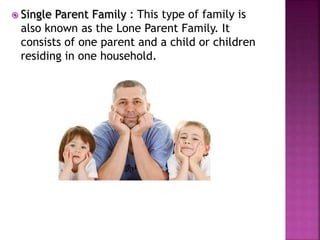
 Single Parent Family : This type of family is
also known as the Lone Parent Family. It
consists of one parent and a child or children
residing in one household.
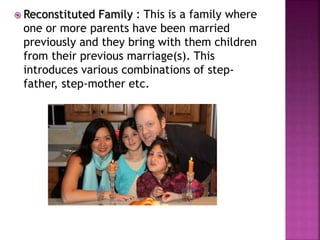
 Reconstituted Family : This is a family where
one or more parents have been married
previously and they bring with them children
from their previous marriage(s). This
introduces various combinations of step-
father, step-mother etc.
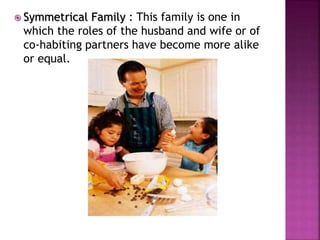
 Symmetrical Family : This family is one in
which the roles of the husband and wife or of
co-habiting partners have become more alike
or equal.
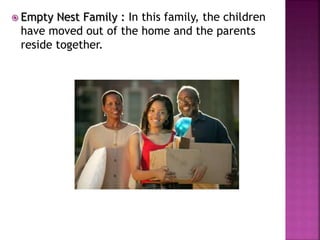
 Empty Nest Family : In this family, the children
have moved out of the home and the parents
reside together.
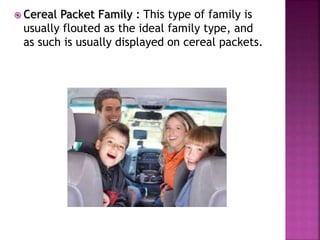
 Cereal Packet Family : This type of family is
usually flouted as the ideal family type, and
as such is usually displayed on cereal packets.
Families can be classified according to the
various categories:
a) On the basis of descent
b) On the basis of authority
c) On the pattern of residence
d) On the amount of mates
 Patrilineal Family : This type of family occurs
when property and title inheritance passes
down through the father’s side.
 Matrilineal Family : This is where the
property and title inheritance passes through
the mother’s side.
 Patriarchal Family : In this type of family, the
father is considered the head.
 Matriarchal Family: In this type of family,
authority is held by the mother
 Patrilocal : When a married couple lives with
or near the husband’s family.
 Matrilocal : When a couple lives with or near
the mother’s family.
 Neo-Local : When a married couple sets up a
home separate from either side of their
families.
 Monogamous Family : In this instance, a
husband only has one wife. This is the
western idea of a typical marriage.
 Polygamous Family : In this case, the
husband has more than one wife at the same
time. This type of family can be found mostly
in Saudi Arabia.
 Polyandrous Family : This family consists of a
wife with more than one husband. This can
be found in the Todas of Southern India.
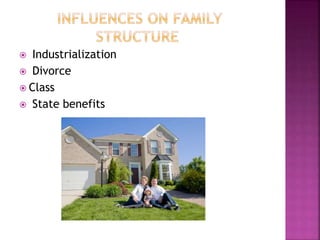
 Industrialization
 Divorce
 Class
 State benefits
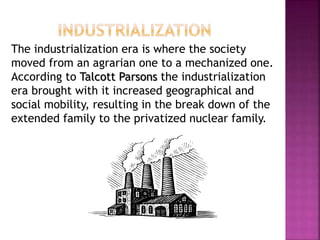
The industrialization era is where the society
moved from an agrarian one to a mechanized one.
According to Talcott Parsons the industrialization
era brought with it increased geographical and
social mobility, resulting in the break down of the
extended family to the privatized nuclear family.
As divorce became socially acceptable and the
government began providing financial
assistance to single parents, many families
broke up. Due to this, more single parent
families were formed as well as reconstituted
ones.
Class highly influences the family structure, as those
with low incomes tend to have a higher divorce rate
due to financial conflicts.
Lower class families are usually matrifocal or single
parent and tend to contribute to the financial and
social instability of the society, as the financial
responsibilities now fall on the one parent due to the
withdrawal of the contribution of the other parent.
Middle class families tend to have less kids than lower
class ones although there is more financial stability.
Higher class families have an average of one or two
children, thus making most higher class families
nuclear ones.
Since the state began granting benefits to
pregnant teenagers and single mothers, there
has been a marked emergence of single parent
families as less people are encouraged to get
married to seek economic support as it is
provided by the state.
GROUP MEMBERS
 Simran Gajraj
 Hoshani Deodass
 Karen Evelyn
 Keleisha Pearce
 Mark Puran
 Gabriela Carryl
 Ashanna Khan
 Shena Cromwell
 Dianna Mingo
 Valencia Ellis
 Paula Higgins
 Terrence Bradford
 Sasha James

Family structures & Classification (for a Sociology Presentation)

  • 1.
  • 2.
    According to functionalistGeorge Murdock a family is defined as “a social group characterized by common residence, economic co-operation and reproduction. It includes adults of both sexes, at least two of whom maintain a socially approved sexual relationship and one or more children, own or adopted of the sexually co-habiting adults.”
  • 3.
    There are varioustypes of family that exist in today’s society, some of the more common structures include :  The Nuclear Family : this usually consists of two generations of family, parents and their own or adopted children residing in the same household.
  • 4.
     The ExtendedFamily : This is also known as the three generation family. Consisting of grandparents, their children and their grandchildren.
  • 5.
     Single ParentFamily : This type of family is also known as the Lone Parent Family. It consists of one parent and a child or children residing in one household.
  • 6.
     Reconstituted Family: This is a family where one or more parents have been married previously and they bring with them children from their previous marriage(s). This introduces various combinations of step- father, step-mother etc.
  • 7.
     Symmetrical Family: This family is one in which the roles of the husband and wife or of co-habiting partners have become more alike or equal.
  • 8.
     Empty NestFamily : In this family, the children have moved out of the home and the parents reside together.
  • 9.
     Cereal PacketFamily : This type of family is usually flouted as the ideal family type, and as such is usually displayed on cereal packets.
  • 10.
    Families can beclassified according to the various categories: a) On the basis of descent b) On the basis of authority c) On the pattern of residence d) On the amount of mates
  • 11.
     Patrilineal Family: This type of family occurs when property and title inheritance passes down through the father’s side.  Matrilineal Family : This is where the property and title inheritance passes through the mother’s side.
  • 12.
     Patriarchal Family: In this type of family, the father is considered the head.  Matriarchal Family: In this type of family, authority is held by the mother
  • 13.
     Patrilocal :When a married couple lives with or near the husband’s family.  Matrilocal : When a couple lives with or near the mother’s family.  Neo-Local : When a married couple sets up a home separate from either side of their families.
  • 14.
     Monogamous Family: In this instance, a husband only has one wife. This is the western idea of a typical marriage.  Polygamous Family : In this case, the husband has more than one wife at the same time. This type of family can be found mostly in Saudi Arabia.  Polyandrous Family : This family consists of a wife with more than one husband. This can be found in the Todas of Southern India.
  • 15.
     Industrialization  Divorce Class  State benefits
  • 16.
    The industrialization erais where the society moved from an agrarian one to a mechanized one. According to Talcott Parsons the industrialization era brought with it increased geographical and social mobility, resulting in the break down of the extended family to the privatized nuclear family.
  • 17.
    As divorce becamesocially acceptable and the government began providing financial assistance to single parents, many families broke up. Due to this, more single parent families were formed as well as reconstituted ones.
  • 18.
    Class highly influencesthe family structure, as those with low incomes tend to have a higher divorce rate due to financial conflicts. Lower class families are usually matrifocal or single parent and tend to contribute to the financial and social instability of the society, as the financial responsibilities now fall on the one parent due to the withdrawal of the contribution of the other parent. Middle class families tend to have less kids than lower class ones although there is more financial stability. Higher class families have an average of one or two children, thus making most higher class families nuclear ones.
  • 19.
    Since the statebegan granting benefits to pregnant teenagers and single mothers, there has been a marked emergence of single parent families as less people are encouraged to get married to seek economic support as it is provided by the state.
  • 20.
    GROUP MEMBERS  SimranGajraj  Hoshani Deodass  Karen Evelyn  Keleisha Pearce  Mark Puran  Gabriela Carryl  Ashanna Khan  Shena Cromwell  Dianna Mingo  Valencia Ellis  Paula Higgins  Terrence Bradford  Sasha James