Homelessness Lacking a true home,  a decent place that supports human dignity and development, provides stability and connects one to a larger community. Every person needs a place to thrive, not just survive.
Homelessness TWO GENERAL CATEGORIES: Temporary homelessness:  a situation that will most likely keep people on the streets a short time (1 night to a few months) Chronic homelessness:  situations that make it very difficult to find stable housing.  Almost always, this homelessness is caused by multiple contributing factors.  Tremendous support and effort is needed to move these people off the streets.
Brainstorming Activity the causes of homelessness
Brainstorming Activity the causes of homelessness No job, lay-offs, unstable employment or economy. Lack of education Broken homes, divorce, abandonment Abuse, domestic violence, runaways Disabilities: physical or mental, deinstitutionalization,  Poverty, “a paycheck away”, lack of a living wage. Major expense, (car, house, etc.), major illness, medical bills Drug/alcohol addiction  Refugee, immigrant, alien Natural disaster Lack of affordable housing Lack of / insufficient support system Too many kids  Societal oppression, prejudice, discrimination Laziness, unwillingness to work Crime / Jail time Others
The longer people are on the streets, the more difficult it is for them to get off the streets and back into mainstream society. The following are some obstacles that people may face in this struggle...
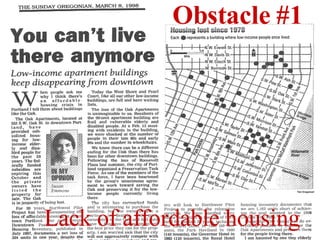
Obstacle #1 Lack of affordable housing
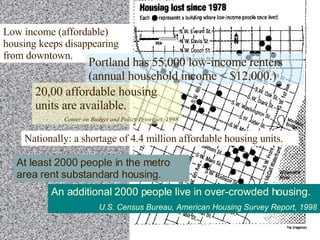
Low income (affordable) housing keeps disappearing from downtown. Portland has 55,000 low-income renters (annual household income < $12,000.) 20,00 affordable housing units are available.   Center on Budget and Policy Priorities, 1998 Nationally: a shortage of 4.4 million affordable housing units. At least 2000 people in the metro area rent substandard housing. An additional 2000 people live in over-crowded housing. U.S. Census Bureau, American Housing Survey Report, 1998
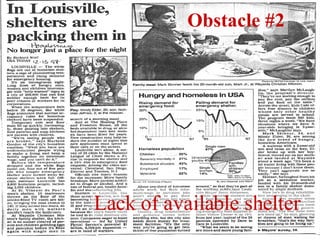
Obstacle #2 Lack of available shelter
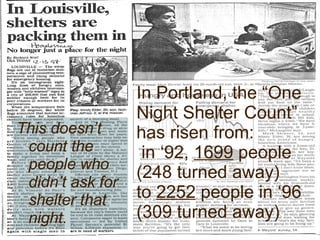
In Portland, the “One Night Shelter Count” has risen from:  in ‘92,  1699  people (248 turned away)  to  2252  people in ‘96 (309 turned away) This doesn’t count the people who didn’t ask for shelter that night.
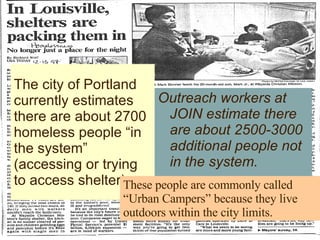
The city of Portland currently estimates there are about 2700 homeless people “in the system” (accessing or trying to access shelter) Outreach workers at JOIN estimate there are about 2500-3000 additional people not in the system. These people are commonly called “Urban Campers” because they live outdoors within the city limits.
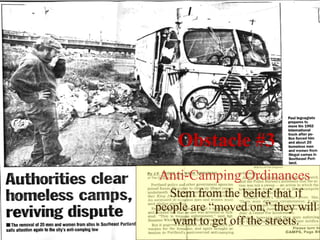
Obstacle #3 Anti-Camping Ordinances   Stem from the belief that if people are “moved on,” they will want to get off the streets.
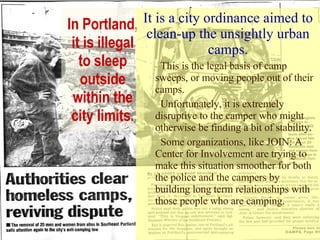
In Portland, it is illegal to sleep outside within the city limits . It is a city ordinance aimed to clean-up the unsightly urban camps. This is the legal basis of camp sweeps, or moving people out of their camps. Unfortunately, it is extremely disruptive to the camper who might otherwise be finding a bit of stability. Some organizations, like JOIN: A Center for Involvement are trying to make this situation smoother for both the police and the campers by building long term relationships with those people who are camping.
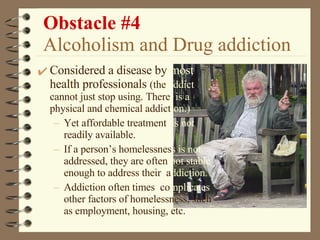
Obstacle #4   Alcoholism and Drug addiction Considered a disease by   most   health professionals  (the  addict  cannot just stop using. There  is a  physical and chemical addict ion.) Yet affordable treatment  is not  readily available. If a person’s homelessnes s   is not  addressed, they are often  not stable  enough to address their  a ddiction. Addiction often times  co mplicates  other factors of homelessness, such   as employment, housing, etc.
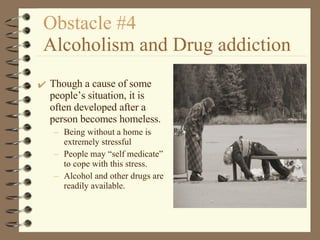
Obstacle #4   Alcoholism and Drug addiction Though a cause of some people’s situation, it is often developed after a person becomes homeless. Being without a home is extremely stressful People may “self medicate” to cope with this stress. Alcohol and other drugs are readily available.
Obstacle #5   Abuse and Domestic Violence Abuse is considered physical, sexual, psychological or emotional harm done to a person.  In most cases it is perpetrated by an acquaintance or family member. Children sent out of the home or who flee at a young age have a difficult time re-entering society as a whole. It is a major cause of homelessness and the trauma from it has tremendous impact on a person’s life.
Obstacle #5   Abuse and Domestic Violence It happens to both men and women, though by far the greatest majority are women.  (96% of reported cases) “ 80+% of the women and children at our shelter are coming directly from D.V. situations.  95 - 100% of those here have violence in their background.” Pat Mohr, Executive Director of the West Women and Children’s Shelter. “ A woman’s risk of death is 20x’s greater if she leaves than if she stays with her abuser.” Kathy Moore, Executive Director of Clackamas Women’s Service
Obstacle #6   Post Traumatic Stress Disorder An extremely disruptive psychological disorder that results from an experience of a traumatic event (witnessing or confronted with death or serious injury or threat to the physical integrity of self or others.) Originally noticed in  war veterans , it often times happens with survivors of domestic violence or other traumatic events. Overwhelming guilt and shame
Obstacle #6  PTSD Post Traumatic Stress Disorder People with PTSD typically experience reliving the trauma in intrusive memories (“flashbacks”) or dreams; have an overall sense of “emotional blunting” and detachment from other people; are unresponsive to surroundings and avoid activities and situations that remind them of the trauma. There is usually a state of hypervigilance, an enhanced startle- reaction, and insomnia. Anxiety and depression are commonly associated, and suicidal ideation is not infrequent. If diagnosed, it is usually treatable.   The ICD-10 Classification of Mental and Behavioural Disorders, Geneva ‘92
Obstacle #6  PTSD Post Traumatic Stress Disorder It is difficult to recover from a life-disruption of this magnitude. Many homeless veterans suffer from PTSD, making it difficult to work on returning to society. Help is available for vets, but they must seek it out.
Answer these questions. What is the major cause of homelessness in the United States?  Who’s fault is it that there are homeless on the street in the United States?  the government’s? globalization - outsourcing of jobs to developing countries? the individual’s? These are unfair questions because they attempt to reduce the issue down to a black and white duality (us versus them).  The issue of homelessness is complicated by societal, governmental, and personal variables.  These are not the right question to ask.  There is no ONE major cause of homelessness; each person’s homeless situation is dependent upon the convergence of bad circumstances. It is no one individual’s or institution’s fault for homelessness, but everyone is responsible for correcting this injustice, especially the wealthy and educated.
Theological Reflection Why should homelessness be our concern? … because we are Christians. “… and then the King will say to those on his right, inherit the kingdom… for I was a stranger and you welcomed me.  What you did for the least of these, you did for me.”  Matt. 25:26 “ And hospitality do not forget, for by this, some, being not aware of it have entertained angels.”   Hebrews 13:2

Homelessness

  • 1.
    Homelessness Lacking atrue home, a decent place that supports human dignity and development, provides stability and connects one to a larger community. Every person needs a place to thrive, not just survive.
  • 2.
    Homelessness TWO GENERALCATEGORIES: Temporary homelessness: a situation that will most likely keep people on the streets a short time (1 night to a few months) Chronic homelessness: situations that make it very difficult to find stable housing. Almost always, this homelessness is caused by multiple contributing factors. Tremendous support and effort is needed to move these people off the streets.
  • 3.
    Brainstorming Activity thecauses of homelessness
  • 4.
    Brainstorming Activity thecauses of homelessness No job, lay-offs, unstable employment or economy. Lack of education Broken homes, divorce, abandonment Abuse, domestic violence, runaways Disabilities: physical or mental, deinstitutionalization, Poverty, “a paycheck away”, lack of a living wage. Major expense, (car, house, etc.), major illness, medical bills Drug/alcohol addiction Refugee, immigrant, alien Natural disaster Lack of affordable housing Lack of / insufficient support system Too many kids Societal oppression, prejudice, discrimination Laziness, unwillingness to work Crime / Jail time Others
  • 5.
    The longer peopleare on the streets, the more difficult it is for them to get off the streets and back into mainstream society. The following are some obstacles that people may face in this struggle...
  • 6.
    Obstacle #1 Lackof affordable housing
  • 7.
    Low income (affordable)housing keeps disappearing from downtown. Portland has 55,000 low-income renters (annual household income < $12,000.) 20,00 affordable housing units are available. Center on Budget and Policy Priorities, 1998 Nationally: a shortage of 4.4 million affordable housing units. At least 2000 people in the metro area rent substandard housing. An additional 2000 people live in over-crowded housing. U.S. Census Bureau, American Housing Survey Report, 1998
  • 8.
    Obstacle #2 Lackof available shelter
  • 9.
    In Portland, the“One Night Shelter Count” has risen from: in ‘92, 1699 people (248 turned away) to 2252 people in ‘96 (309 turned away) This doesn’t count the people who didn’t ask for shelter that night.
  • 10.
    The city ofPortland currently estimates there are about 2700 homeless people “in the system” (accessing or trying to access shelter) Outreach workers at JOIN estimate there are about 2500-3000 additional people not in the system. These people are commonly called “Urban Campers” because they live outdoors within the city limits.
  • 11.
    Obstacle #3 Anti-CampingOrdinances Stem from the belief that if people are “moved on,” they will want to get off the streets.
  • 12.
    In Portland, itis illegal to sleep outside within the city limits . It is a city ordinance aimed to clean-up the unsightly urban camps. This is the legal basis of camp sweeps, or moving people out of their camps. Unfortunately, it is extremely disruptive to the camper who might otherwise be finding a bit of stability. Some organizations, like JOIN: A Center for Involvement are trying to make this situation smoother for both the police and the campers by building long term relationships with those people who are camping.
  • 13.
    Obstacle #4 Alcoholism and Drug addiction Considered a disease by most health professionals (the addict cannot just stop using. There is a physical and chemical addict ion.) Yet affordable treatment is not readily available. If a person’s homelessnes s is not addressed, they are often not stable enough to address their a ddiction. Addiction often times co mplicates other factors of homelessness, such as employment, housing, etc.
  • 14.
    Obstacle #4 Alcoholism and Drug addiction Though a cause of some people’s situation, it is often developed after a person becomes homeless. Being without a home is extremely stressful People may “self medicate” to cope with this stress. Alcohol and other drugs are readily available.
  • 15.
    Obstacle #5 Abuse and Domestic Violence Abuse is considered physical, sexual, psychological or emotional harm done to a person. In most cases it is perpetrated by an acquaintance or family member. Children sent out of the home or who flee at a young age have a difficult time re-entering society as a whole. It is a major cause of homelessness and the trauma from it has tremendous impact on a person’s life.
  • 16.
    Obstacle #5 Abuse and Domestic Violence It happens to both men and women, though by far the greatest majority are women. (96% of reported cases) “ 80+% of the women and children at our shelter are coming directly from D.V. situations. 95 - 100% of those here have violence in their background.” Pat Mohr, Executive Director of the West Women and Children’s Shelter. “ A woman’s risk of death is 20x’s greater if she leaves than if she stays with her abuser.” Kathy Moore, Executive Director of Clackamas Women’s Service
  • 17.
    Obstacle #6 Post Traumatic Stress Disorder An extremely disruptive psychological disorder that results from an experience of a traumatic event (witnessing or confronted with death or serious injury or threat to the physical integrity of self or others.) Originally noticed in war veterans , it often times happens with survivors of domestic violence or other traumatic events. Overwhelming guilt and shame
  • 18.
    Obstacle #6 PTSD Post Traumatic Stress Disorder People with PTSD typically experience reliving the trauma in intrusive memories (“flashbacks”) or dreams; have an overall sense of “emotional blunting” and detachment from other people; are unresponsive to surroundings and avoid activities and situations that remind them of the trauma. There is usually a state of hypervigilance, an enhanced startle- reaction, and insomnia. Anxiety and depression are commonly associated, and suicidal ideation is not infrequent. If diagnosed, it is usually treatable. The ICD-10 Classification of Mental and Behavioural Disorders, Geneva ‘92
  • 19.
    Obstacle #6 PTSD Post Traumatic Stress Disorder It is difficult to recover from a life-disruption of this magnitude. Many homeless veterans suffer from PTSD, making it difficult to work on returning to society. Help is available for vets, but they must seek it out.
  • 20.
    Answer these questions.What is the major cause of homelessness in the United States? Who’s fault is it that there are homeless on the street in the United States? the government’s? globalization - outsourcing of jobs to developing countries? the individual’s? These are unfair questions because they attempt to reduce the issue down to a black and white duality (us versus them). The issue of homelessness is complicated by societal, governmental, and personal variables. These are not the right question to ask. There is no ONE major cause of homelessness; each person’s homeless situation is dependent upon the convergence of bad circumstances. It is no one individual’s or institution’s fault for homelessness, but everyone is responsible for correcting this injustice, especially the wealthy and educated.
  • 21.
    Theological Reflection Whyshould homelessness be our concern? … because we are Christians. “… and then the King will say to those on his right, inherit the kingdom… for I was a stranger and you welcomed me. What you did for the least of these, you did for me.” Matt. 25:26 “ And hospitality do not forget, for by this, some, being not aware of it have entertained angels.” Hebrews 13:2