Sybase IQ


Issue 1                                    Introduction
2012
                                           “Big Data” is the new hot topic for IT managers, and is causing quite a panic amongst some
                                           organizations; but, there is no need to panic, Big Data can be looked upon as Big Opportunity.
IN THIS ISSUE                              With the data explosion companies now have access to more information than ever before – if
                                           the data can be exploited properly it can lead to a big competitive advantage.
Introduction.........................1
                                           With companies acquiring massive amounts of data in different forms from different sources,
SAP Sybase IQ - Turning                    ranging from traditional channels with structured formats to social media channels with
Big Data into a Big                        unstructured formats, it has changed the focus of analytics in the “real-world”. Throughout
                                           organizations there are changes in the way data is being analyzed – in marketing, the focus has
Advantage............................. 2
                                           shifted to digital channels – click streams and social media – to understand buying patterns, and
Gartner Research:                          target marketing activities for maximum impact. In sales, the focus is on what we call “deal
Magic Quadrant for Data                    DNA”, to correlate emails, meeting notes and chatter to assess the probability that a sales
Warehouse Database                         deal will close. On the financial side, simulation is being used to predict margins and portfolio
                                           values; while on the operational side, machine data via sensors, and other kinds of digital data are
Management Systems......... 5
                                           being analyzed to track down operational inefficiencies – it’s no wonder companies are having
About Sybase..................... 29       information overload and are at a loss as to how to manage the information let alone how to use
                                           that information intelligently.

                                           The key to Big Data is the ability to access and connect all the data no matter what type or
                                           where it came from, in order to achieve this you have to break the information silos that trap
                                           data – turning massive amounts of data into actionable insight while providing complete access to
                                           decision makers – creating an environment that offers “intelligence for everyone”.


   Featuring research from
SAP Sybase IQ – Advanced                                  volume, variety and velocity of today’s                     Massive Scalability
Analytics Platform for                                    massive data needs and demands in a cost
                                                          effective and attainable manner.                            With a state of the art query processor
Big Data
                                                                                                                      Sybase IQ thrives on heavy ad hoc query
                                                          Sybase IQ is based on a three layer                         usages by large numbers of concurrent
SAP Sybase IQ is an analytic DBMS
                                                          architecture. A strong data management                      users – it’s designed to handle it. Built
designed specifically for advanced
                                                          layer is the foundation with a highly                       on PlexQ™ technology framework that
analytics, data warehousing, and business
                                                          compressed column store, and shared                         delivers a shared-everything massively
intelligence environments. Able to work
                                                          everything distributed MPP elastic cluster                  parallel processing (MPP) architecture
with massive volumes of structured and
                                                          that supports a variety of workloads and                    based on a columnar data store, it
unstructured data it is ideally suited to Big
                                                          active user community. The application                      delivers new levels of performance.
Data.
                                                          services layer sits above that to provide                   Unlike shared nothing solutions, a PlexQ
                                                          a variety of drivers, APIs, web services,                   grid dynamically manages analytics
Sybase IQ is built on an open, flexible
                                                          and federation capabilities to empower                      workloads across an easily expandable
column-store technology, unlike
                                                          developers. And wrapped around these                        grid of computing resources dedicated to
traditional relational databases, that store
                                                          two technology layers, is a rich ecosystem                  different groups and processes, making
data by row, slowly working through
                                                          of BI tools, partner libraries, packaged                    it simpler and more cost-effective to
each row of entire tables, clogging I/O
                                                          applications, and data integration tools                    support growing volumes of data and
channels, memory, and disk, Sybase IQ
                                                          to give you an end to end solutions. (See                   rapidly growing user communities.
uses a strategy called “vertical portioning”
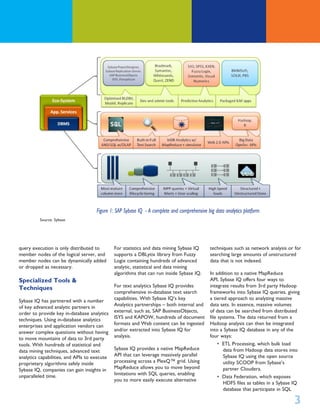
                                                          Figure 1)
that stores data by column, reading only
the columns of data used by the query.                                                                                With PlexQ grid technology, enterprise
Using columns, not rows, delivers a 10 to                 Centralized Access to All                                   IT departments can more easily overcome
100 times performance boost compared                      Your Enterprise Data                                        the scalability limitations of traditional
to the traditional row-based approaches                                                                               data warehouses. Organizations are
– and Sybase IQ supports most of the                      Sybase IQ centralizes “Big Data” analysis                   now able to support user communities
popular hardware and OS configurations.                   of massive volumes of structured and                        across the enterprise, and integrate
                                                          unstructured data together using a                          analytics into business workflows. And,
Big Data is not new to Sybase. Sybase IQ                  wide range of advanced techniques                           it’s easy to leverage advanced analytics
has been building on the vision of a big                  and technologies – offering a data type                     within applications by using hundreds of
data analytics platform for several years                 agnostic engine Sybase IQ doesn’t care                      algorithms and data mining models that
now – the new Sybase IQ 15 family has                     what format of data you have or even                        can run inside Sybase IQ.
been a steady progression of releases                     where it came from. Whether it be                           Elastic computing of logical servers in the
that have followed a conscious roadmap,                   structured in a defined format, semi-                       PlexQ™ technology framework within
each one adding innovations that build                    structured available electronically,                        Sybase IQ allow IT staff to group together
upon the foundation and strengths of                      unstructured requiring text mining or                       compute resources, in a PlexQ grid, into
the previous release. Sybase IQ has been                  analytics tool extraction or web data,                      virtual groups in order to isolate the
designed to meet the growing needs of                     such as, social media – it simply doesn’t                   impact of different workloads and users
IT and Business Analysts to tame the                      matter with Sybase IQ.                                      from each other. When a user connects
                                                                                                                      to a logical server and runs a query, the


SAP Sybase IQ - Turning Big Data into a Big Advantage is published by Sybase. Editorial supplied by Sybase is independent of Gartner analysis. All Gartner research is ©
2012 by Gartner, Inc. All rights reserved. All Gartner materials are used with Gartner’s permission. The use or publication of Gartner research does not indicate Gartner’s
endorsement of Sybase’s products and/or strategies. Reproduction or distribution of this publication in any form without prior written permission is forbidden. The infor-
mation contained herein has been obtained from sources believed to be reliable. Gartner disclaims all warranties as to the accuracy, completeness or adequacy of such
information. Gartner shall have no liability for errors, omissions or inadequacies in the information contained herein or for interpretations thereof. The opinions expressed
herein are subject to change without notice. Although Gartner research may include a discussion of related legal issues, Gartner does not provide legal advice or services
and its research should not be construed or used as such. Gartner is a public company, and its shareholders may include firms and funds that have financial interests in enti-
ties covered in Gartner research. Gartner’s Board of Directors may include senior managers of these firms or funds. Gartner research is produced independently by its
research organization without input or influence from these firms, funds or their managers. For further information on the independence and integrity of Gartner research,
see “Guiding Principles on Independence and Objectivity” on its website, http://www.gartner.com/technology/about/ombudsman/omb_guide2.jsp.


2
Figure 1: SAP Sybase IQ - A complete and comprehensive big data analytics platform
          Source: Sybase


query execution is only distributed to        For statistics and data mining Sybase IQ        techniques such as network analysis or for
member nodes of the logical server, and       supports a DBLytix library from Fuzzy           searching large amounts of unstructured
member nodes can be dynamically added         Logix containing hundreds of advanced           data that is not indexed.
or dropped as necessary.                      analytic, statistical and data mining
                                              algorithms that can run inside Sybase IQ.       In addition to a native MapReduce
Specialized Tools &                                                                           API, Sybase IQ offers four ways to
Techniques                                    For text analytics Sybase IQ provides           integrate results from 3rd party Hadoop
                                              comprehensive in-database text search           frameworks into Sybase IQ queries, giving
Sybase IQ has partnered with a number         capabilities. With Sybase IQ’s key              a tiered approach to analyzing massive
of key advanced analytic partners in          Analytics partnerships – both internal and      data sets. In essence, massive volumes
order to provide key in-database analytics    external, such as, SAP BusinessObjects,         of data can be searched from distributed
techniques. Using in-database analytics       ISYS and KAPOW, hundreds of document            file systems. The data returned from a
enterprises and application vendors can       formats and Web content can be ingested         Hadoop analysis can then be integrated
answer complex questions without having       and/or extracted into Sybase IQ for             into a Sybase IQ database in any of the
to move mountains of data to 3rd party        analysis.                                       four ways:
tools. With hundreds of statistical and                                                            • ETL Processing, which bulk load
data mining techniques, advanced text         Sybase IQ provides a native MapReduce                  data from Hadoop data stores into
analytics capabilities, and APIs to execute   API that can leverage massively parallel               Sybase IQ using the open source
proprietary algorithms safely inside          processing across a PlexQ™ grid. Using                 utility SCOOP from Sybase’s
Sybase IQ, companies can gain insights in     MapReduce allows you to move beyond                    partner Cloudera.
unparalleled time.                            limitations with SQL queries, enabling
                                                                                                   • Data Federation, which exposes
                                              you to more easily execute alternative
                                                                                                     HDFS files as tables in a Sybase IQ
                                                                                                     database that participate in SQL

                                                                                                                                     3
queries (HDFS files do not need to   to search and filter data for analysis in      movement can impose severe constraints
        be loaded into Sybase IQ).           combination with its column store engine.      on timely delivery of the results you
     •	 Query Federation, allowing SQL       Following the SQL Multimedia (SQL/             need to succeed and can account for up
        queries in Sybase IQ to execute      MM) standard for storing and accessing         to 75% of cycle time. By running analytic
        Hadoop processes that return data    geospatial data, Sybase IQ supports 2D         techniques inside the database Sybase
        that is incorporated into the SQL    geometries in the form of points, curves       IQ dramatically accelerates performance,
        result set, and finally.             (line strings and strings of circular arcs),   while avoiding governance and security
                                             and polygons. Sybase IQ also supports flat     concerns caused by data movement. You
    •	 Client-side Federation, which
                                             and round-Earth representations, allowing      need an analytics environment that can
        federates queries across Sybase
                                             you to choose the approach that best           analyze large volumes of data from diverse
        IQ databases and Hadoop files
                                             addresses your situation.                      sources and provide fast, accurate results
        using the TOAD© SQL tool from
                                                                                            - Sybase IQ’s in-database capabilities can
        Sybase’s partner Quest.
                                             Sybase IQ provides enterprises with APIs       give you this advantage.
                                             to create proprietary analytic algorithms
Use “R”, the popular open source
                                             that can run inside the Sybase IQ database     Successful Analytics Platform
statistical tool, to query Sybase IQ
                                             server for top performance. In particular,     for Big Data
databases using an RJDBC interface.
                                             Sybase IQ offers Java and C++ APIs, with
Furthermore, you can execute R libraries
                                             these APIs you can create User Defined       Sybase is on a mission to revolutionize Big
from Sybase IQ as a function call within
                                             Functions (UDFs) that are called through     Data Analytics with Sybase IQ. With our
SQL queries and return result sets.
                                             SQL queries. The UDFs can access all of      centralized data analysis delivering insights
                                             the data within a Sybase IQ database and     across your Enterprise, and our support
Sybase IQ also offers in-database
                                             can leverage a PlexQ™ grid for massively     of large user communities running a wide
execution of Predictive Model Markup
                                             parallel processing. Sybase IQ also offers   range of analytics workloads – allowing
Language (PMML) models through a
                                             an In-database analytics simulator, which    organizations to analyze hundreds of
certified plug-in from Zementis. This
                                             allows you to test a custom built UDF        terabytes, even petabytes of data in
allows you to automate the execution
                                             before deploying it into a production        speeds up to 100 times faster – you can
of analytic models defined using industry
                                             database.                                    see that the big data challenges introduced
standard language and that are created in
SAS, SPSS Clementine, and other popular                                                   at the beginning of this article – volume,
                                             As you can see in-database analytics is a    velocity, variety, costs and skills, are
predictive workbench products. By using
                                             key component to Sybase IQ’s success in      matched with the growing set features
industry standard languages it enables
                                             being an advanced analytics platform for     and capabilities offered by SAP Sybase IQ.
you to leverage your existing investments
                                             Big Data. Data volume, accuracy, and swift Now with accurate complete information
while providing better performance and
                                             processing time are all factors critical for across your enterprise, Big Data doesn’t
scalability.
                                             success but the balancing act between        seem like such a Big Problem it has turned
                                             these key components continues to pose       into a Big Advantage – with SAP Sybase
Within Sybase IQ, the row store SQL
                                             serious challenges for most organizations. IQ!
Anywhere engine, allows you to also
                                             With traditional analytics this data
create indexes of geospatial information
                                                                                            Source: Sybase


4
Gartner Reserch: Magic Quadrant for Data Warehouse
Database Management Systems
The data warehouse DBMS market              used as a data warehouse – rather, a data     data (SSED), excluding all data warehouse
is undergoing a transformation with         warehouse (solution/data architecture)        design-specific structures (such as indexes,
the introduction of “big data” and the      is deployed on a DBMS platform. A data        cubes, stars and summary tables). SSED
logical data warehouse demand for new       warehouse solution architecture can           is the actual row/byte count of data
techniques in practices and technology.     and often does, use many different data       extracted from all sources.
The integration of professional services    constructs and repositories. Importantly,     From 2012 onwards, defining the size of
with product offerings also increased in    the definition of this market is changing     a warehouse will become less important
importance in 2011.                         and a DBMS will become only part of the       and information asset access will become
                                            overall market definition as the logical      more important. Within SSED it is
Market Definition/Description               data warehouse (LDW) continues to             important to separate the actual data size
This document was revised on 05 March       grow in acceptance and deployment.            in a data warehouse from the database
2012. The document you are viewing                                                        total size. Gartner clients report that
is the corrected version. For more        A data warehouse is a database in which         many 100-terabyte warehouses often
information, see the Corrections page on  two or more disparate data sources can          hold less than 30 terabytes of actual data.
gartner.com.                              be brought together in an integrated,           Throughout 2012 and 2013, the size of a
                                          time-variant information management             warehouse will evolve toward a combined
The supplier side of the data warehouse   strategy. Its logical design includes the       metric, relative to the repositories under
database management system (DBMS)         flexibility to introduce additional disparate   direct management of the warehouse and
market consists of those vendors          data without significant modification           complemented by the volume of available
supplying DBMS products for the database of any existing entity design. A data            information accessed by the warehouse,
infrastructure of a data warehouse and    warehouse DBMS is now expected to               as well as its performance in doing so (see
the required operational management       coordinate virtualization strategies, as        Note 3).
controls.                                 well as distributed and/or processing
                                          approaches such as MapReduce, to                In addition, for the purposes of this
For the purposes of this Magic Quadrant   handle one aspect of big or extreme data        analysis, we treat all of a vendor’s
analysis, a DBMS is defined as a complete situations.                                     products as a set. If a vendor markets
software system that supports and                                                         more than one DBMS that can be used
manages a logical database or databases   A data warehouse can be of any size. The        as a data warehouse DBMS, we note
in storage. Data warehouse DBMSs are      sizing definitions of traditional warehouses    this fact in the section related to the
systems that, in addition to supporting   remain as:                                      specific vendor, but evaluate its products
the relational data model (extended to        •	 Small data warehouses are less than      together as a single entity. Further, a
support new structures and data types            5 TB.                                    DBMS product must be part of a vendor’s
such as materialized views, XML and                                                       product set for the majority of the
                                              •	 Midsize data warehouses are 5 TB
metadata-enabled access to content),                                                      calendar year in question. If a product
                                                 to 20 TB.
support data availability to independent                                                  or vendor is acquired mid-year, it will be
front-end application software and            •	 Large data warehouse are greater         labeled appropriately but placed separately
include mechanisms to isolate workload           than 20 TB                               on the Magic Quadrant until the following
requirements (see Note 2) and control                                                     year (see Figure 1).
various parameters of end-user access       Importantly, none of these categories
within a single instance of the data.       qualify a warehouse as a “big data”           There are many different delivery models,
                                            warehouse. Volume alone is not “Big           such as stand-alone DBMS software,
This market is specific to DBMSs used       data.” For the purpose of measuring the       certified configurations, data warehouse
as a platform for a data warehouse. It is   size of a data warehouse database, we         appliances (see Note 1) and cloud (public
important to note that a DBMS cannot be     define data as source-system-extracted        and private) offerings. These are also
                                                                                          evaluated together within the analysis of
                                                                                          each vendor.


                                                                                                                                  5
Figure 1. Magic Quadrant for Data Warehouse Database Management Systems                                   is either a visionary with cloud
                                                                                                          and data warehouse as a service,
                                                                                                          but does not execute against the
                       challengers            leaders
                                                                                                          rest of the market, or it is good at
                                                                                                          execution against two of the many
                                                                                                          use cases in the market with little
                                                             Teradata                                     vision for the remainder.
                                                       Oracle                                          	 The 1010data position is almost
                                                     IBM                                                  perpendicular to our combined
                                                   EMC/Greenplum                                          evaluation criteria. Therefore, we
  ability to execute


                                               Sybase, an SAP Company                                     have placed it with high execution
                           1010data
                                                                                                          against a sub-section of the market
                                                  Microsoft
                                                                                                          we evaluate. From a visionary
                                   ParAccel     Vertica                                                   perspective, 1010data is difficult
                            Kognitio
                                                                                                          to evaluate under current criteria.
                       SAND Technology
                                                                                                          Its approach in using a cloud-
                         Infobright                                                                       based and “as a service” DBMS/
                                                                                                          analytics solution is the primary
                            Actian                                                                        business model and technology
                                                                                                          approach. Cloud-based analytics as
                                                                                                          a service and the ability to deliver
                              Exasol
                                                                                                          under a managed on-premises
                       niche players          visionaries                                                 model, leaves 1010data short of
                                                                                                          the much broader vision desired
                                  completeness of vision                                                  by the greatest portion of the
                                                      As of February 2012
                                                                                                          data warehouse market, but in
                                                                                                          these few delivery segments of the
  Source: Gartner (February 2012)                                                                         market 1010data is a formidable
                                                                                                          performance competitor.
                                                                                                       •	 1010data is expected to add
Magic Quadrant                                              share large amounts of data without           probabilistic matching in 2012.
                                                            needing to manage it locally – for            The company has exhibited
Vendor Strengths and Cautions
                                                            example, large quantities of CPG              significantly more reduced load
1010data                                                                                                  times than some of its significant
                                                            data can be shared by multiple retail
1010data (www.1010data.com) was                                                                           big data competitors, as well as
                                                            companies.
established 11 years ago as a managed                                                                     orders of magnitude and faster
service data warehouse provider with an                   	 As a managed service solution
                                                                                                          performance in extremely large
integrated DBMS and business intelligence                   vendor, 1010data can complement
                                                                                                          datasets. 1010data products read
(BI) solution primarily for the financial                   the customer’s internal IT
                                                                                                          SQL, but also utilize their own,
sector and more recently, the retail/                       department with fast-to-market
                                                                                                          non-SQL language that performs
consumer packaged goods (CPG) sector.                       solutions for business units, so
                                                                                                          high-speed joins with unplanned
1010data can host its solution using                        reducing resource consumption
                                                                                                          data rationalization built into the
traditional software as a service (SaaS)                    within the IT department. More
                                                                                                          queries without the performance
model or support a managed solution                         importantly, the managed service
                                                                                                          disadvantages of using interim
at the customer’s site. 1010data has                        model enables 1010data to leverage
                                                                                                          return datasets.
approximately 200 customers.                                software solutions across multiple
                                                            customers. As new applications are         •	 Perhaps the most important
Strengths                                                   created, they become available to             point raised by those customers
                                                            all clients, increasing the availability      referenced is that 1010data is
   •	 Since 1010data offers a complete                                                                    utilized by both IT and the business
                                                            of these applications to businesses.
      SaaS solution, the customer’s                                                                       with fast response times on queries
                                                            With more than 200 customers,
      business unit and IT organization                                                                   running against hundreds of billions
                                                            1010data has reached a position to
      need little experience of data                                                                      of row tables (with a combined
                                                            break out of its former niche status.
      warehousing or BI. The SaaS model                                                                   number of rows throughout
                                                            The problem is that the company
      also allows multiple organizations to
6
databases exceeding a trillion rows       As the demand for hybrid analytics       Actian
     in the entire database in some            mixing structured data with content      Actian (www.actian.com) offers two
     instances). The company also              increases, 1010data will need to         products, the general-purpose Ingres
     serves as a data aggregator and data      introduce unstructured data analysis     DBMS and Vectorwise, a new offering
     marketplace providing datasets for        as well as operational technology        introduced in June 2010 and targeted at
     rapid enhancement and enrichment          or machine-generated data analysis.      analytic data warehouses. Open-source
     of analytics normally bound to            1010data’s competitors have greater      Ingres, one of the original RDBMS
     internal datasets only.                   financial resources and already are      engines, has a 30-year history and claims
   	 Our reference checks and                  in the process of building out this      more than 10,000 customers running
     discussions with Gartner clients          part of the data warehouse vision.       mission-critical applications, including data
     also show that 1010data is             •	 One of 1010data’s strengths              warehouses.
     price-competitive with non-SaaS           also acts as a caution. While the
     alternatives, especially by reducing      business prefers a solution that is a    Strengths
     the management overheads needed           complete, deployment-ready stack,           •	 The Actian database contains most
     to support a data warehouse               IT departments and purchasing                  of the features necessary for data
     environment. 1010data has                 offices do not. 1010data’s offering is         warehousing, such as partitioning,
     expanded from the financial sector        sold as a fully integrated DBMS and            compression, parallel querying
     (where it began) into a broader           BI solution, which limits potential            and multidimensional structures.
     market, including the retail sector.      customers to those wanting a                   Release 10 added bulk load, scalar
     1010data now claims more than             full solution (primarily because               subqueries, long identifiers and
     200 customers and its customer            of 1010data’s pricing model).                  a geospatial offering that was
     references support our belief that        1010data’s product is a compliant,             community driven with hundreds
     it is one of the stronger small           relational DBMS (RDBMS) that                   of committers contributing code.
     data warehouse DBMS vendors.              customers can use as a stand-alone             The performance of Vectorwise,
     In addition, the company has a            system if desired – but fees are               especially in analytic applications,
     small number of customers that            charged as if the entire solution is           was cited by customers interviewed
     install its system on-premises as         managed. Customers are advised to              by Gartner. With the emergence
     a managed solution, with several          check the total cost of ownership              of new server platforms with
     using 1010data as an enterprise           in such cases, as it may not be                storage-class memory (of 1 TB and
     data warehouse solution vendor.           advantageous to use 1010data in                more), Vectorwise will prove a
     Therefore, from an execution              this way.                                      valuable asset for data warehousing
     standpoint, 1010data matches           •	 As a solution vendor, 1010data                 and analytics as more of the data
     performance, pricing and delivery         has a different competitive                    warehouse moves to memory.
     model for two specific needs in           model from vendors of pure-play             •	 Actian has aggressively pursued
     the market quite well and it is           DBMS offerings. In addition to                 partners, including independent
     expanding both its scope of delivery      competing in the data warehouse                software vendors (ISVs) in the BI
     and its vertical customer base.           DBMS market, it competes with                  market, the primary driver of new
                                               system integration vendors that                installations in data warehousing.
Cautions                                       offer outsourced solutions, such               Both new and existing customers
  •	 The market continues to resist            as Cognizant and HP (via EDS).                 are looking for an open-source
     fully-managed data warehouse              Additionally, IBM, Oracle and other            BI stack with partners such as
     services in many verticals and            large vendors with professional                Jaspersoft and commercial BI
     horizontal use cases. 1010data is         service organizations compete with             vendors such as MicroStrategy
     susceptible to resistance from IT         1010data in two markets, data                  have also engaged with Actian.
     departments requiring all its data        warehouse DBMSs and services. It               Ingres and Vectorwise are gaining
     warehouses to be located in-house,        remains to be seen if this is a bias           attention from vertical application
     along with in-house governance            to be overcome or if the cloud                 vendors, system integrators and
     of the organization’s data assets.        and on-premises mix will ultimately            resellers. Vectorwise uses some
     The IT market is not fickle and           exclude a vendor like 1010data.                Ingres software atop a column store
     persists in its use of better name-       However, based on its extremely                from the MonetDB project and uses
     branded vendors and not simply            positive customer references, it               hardware assists, turning columns
     because they are name-branded.            is very unlikely 1010data will be              into vectors and processing them
                                               excluded from such a mix.                      in x86 chip registers to leverage

                                                                                                                                  7
instruction parallelism and on-chip        •	 Actian offers professional services     Strengths
       caching. Vectorwise has delivered             in data warehousing and has a go-          •	 Greenplum’s understanding and
       several top non-clustered TPC-H               to-market strategy with a growing             vision of the data warehouse
       benchmark results at 1 TB and                 stable of partners – it claims half           market was ahead of the market as
       below. The company was renamed                of its 2011 Vectorwise sales have             it was one of the first to work with
       in late 2011 and introduced another           come though channels. However,                MapReduce, manage external files
       new product offering, the Cloud               it lacks data models and must                 from within the DBMS and optimize
       Action Platform, to support the               continue to add marketing and sales           for very large database sizes. As
       delivery of “Action Apps” that                expertise for data warehousing.               big data is now important in the
       will act on the analytic capabilities         Additionally, Actian has strength             market and the LDW is emerging as
       Actian supports.                              in open-source, but the overall               a necessary functionality to support
    •	 Previous reference checks have                adoption of open-source for data              today’s mix of volume, velocity,
       shown Ingres customers to be very             warehousing remains weak. While               variety and complexity, Greenplum
       loyal. Most have online transaction           Actian has professional services, it          has a base to support this that was
       processing (OLTP) applications,               tends to lack some of the tools and           launched several years ago, which
       but Ingres has also been used                 methodology support that other                translates into the high ability to
       for smaller data warehouses                   organizations have readily available.         execute.
       (historically up to about 2 TB, the        •	 Actian’s new brand and name, as               Greenplum announced the first
       company is targeting warehouses               well as its portfolio expansions, can         unified analytics appliance addressing
       smaller than 10 TB). Among open-              help overcome Ingres’s reputation             big data (a modular solution for
       source DBMS, only Oracle’s MySQL              as an older product that has not              structured and unstructured data),
       compares with proven maturity                 regained much market traction.                in May 2011 that was released
       for mission-critical applications,            Importantly, Actian has taken a bold          in September 2011. The EMC
       including data warehousing.                   stance in attempting to re-establish          Greenplum Data Computing
       Vectorwise has begun to gain new              itself with a new vision and new              Appliance (DCA) uses the
       customers and software partners,              plans for execution. Initial response         Greenplum Database, Greenplum
       targeting another set of use cases.           to Vectorwise is significant with the         HD (Hadoop), and Greenplum
       Now in its version 2.0, it has added          addition of more than 20 customers            Data Integration Accelerator (DIA)
       Windows as a platform and has a               in its first year offering and users          modules that can be configured
       clear road map for several future             should consider Actian’s Vectorwise           within one single appliance cluster.
       releases.                                     to be a new and innovative                    In addition, Greenplum has Chorus,
                                                     solution in that respect. However,            its analytics productivity software,
Cautions                                             market perception is difficult to             leveraging VMware’s technology, to
                                                     change. Both offerings have gained            support automated, self-service data
  •	 Although Vectorwise enhances
                                                     new customers and third-party                 services and collaborative analytics.
     Actian’s ability to support analytic
                                                     relationships, but to become a                In a recent announcement, EMC
     data marts, the company must
                                                     serious competitor in this market             announced the first Hadoop NAS
     continue to address enhanced data
                                                     Actian must continue to show                  attached HDFS system – HDFS
     warehouse functionality, storage
                                                     increased growth in both revenue              running native on EMC Isilon
     management and mixed workload
                                                     and numbers of new customers at               connected to the Greenplum HD
     management if it is to compete
                                                     a higher rate than it has thus far.           or Greenplum Data Computing
     with larger, equally mature vendors
                                                     Effective marketing execution is a            Appliance (DCA). Finally, through
     and meet the needs of the broader
                                                     must-have for Actian to compete.              the external file mechanisms and
     data warehouse DBMS market.
     Vectorwise needs to support more                                                              user defined functions (UDF),
     analytic SQL constructs than it does      EMC/Greenplum                                       Greenplum has started along the
     now and add stored procedures             Greenplum (www.greenplum.com) is part               path to support LDW. Greenplum
     and user-defined functions and            of the Data Products division of EMC                even supports an iOS, Linux and
     data types to move closer to              with a massively parallel processing (MPP)          Windows single-user development
     competitors. Its new product and          data warehouse DBMS running on Linux                system downloadable as free (not
     restructuring around Action Apps          and Unix. It can be sold as an appliance or         open-source) software.
     can be synergistic – but could also       as a stand-alone DBMS and has more than          •	 As Greenplum has settled into
     prove distracting.                        400 customers worldwide.                            the EMC organization, we have


8
seen an increase in hiring directly         presence to compete with all the        Exasol
      related to development. This,               incumbent, large DBMS vendors.          Exasol (www.exasol.com) is a small DBMS
      coupled with the EMC development            Importantly, EMC’s customer base        vendor in Nuremberg, Germany. Exasol
      organization has led Greenplum              is primarily within the IT unit of      has been in business since 2000 with the
      to offer its DCA supporting big             the organization. Data warehousing      first in-memory column-store DBMS,
      data for both structured and                is the technical infrastructure for     EXASolution, available since 2004 and
      unstructured data and intergraded           an intensely business-oriented          primarily used as a data mart for analytic
      MapReduce processing. The DCA               use-case. EMC will need to learn        applications.
      is now assembled by EMC and sold            from its Greenplum acquired
      by its sales force. In an interesting       knowledgebase, specifically how to      Strengths
      manufacturing cost management               solution sell a data warehouse and         •	 Exasol offers an in-memory column-
      model, EMC is assembling its                analytics solution.                           store DBMS for data warehousing.
      appliances in different countries        •	 Interestingly, this year our customer         As we have stated, this technology
      around the world, affording EMC             references have raised several                is one of the critical capabilities of
      Greenplum a tax advantage in many           issues around support. In these               the future for the data warehouse
      countries where others (such as             cases it was not related to the               DBMS market. Exasol runs in a
      Oracle and Teradata) are subject            attention to rapid support and                clustered environment offering
      to stiff import duties. This positions      fixes (with all customers stating             scalability across multiple servers.
      the company for easier entry                fixes were available in an expected,          Not only does this allow for high-
      into global markets. Due to the             timely manner), but more with                 availability in the case of a server
      acquisition, Greenplum has been             the bugs in the first place. We               failure using EXACluster OS, but
      able to work more closely with              would classify these as “growing              also scaling for larger memory sizes.
      VMware, for example rearchitecting          pains” especially for a small                 EXASolution maintains redundant
      the Chorus private cloud offering.          organization (as Greenplum was                copies of the data in memory to
   •	 Our customer references support             pre-acquisition) being integrated             reduce the downtime associated
      the claims of high performance              into a large organization such as             with server failures.
      as well as advantageous price/              EMC. We should also note that in              Exasol also includes the use of disk
      performance ratios. These                   our inquiries with Gartner clients,           for persistence and overflow (if all
      references also support the                 we have seen this issue diminish,             the data does not fit in memory).
      Greenplum claim of scalability to           coupled with consistently high                However, when data is loaded into
      very large database sizes. Reported         marks for personalized customer               Exasol, it is loaded into memory
      sizes range from 10 terabytes to            support.                                      first and then written to the disk,
      more than 500 terabytes. When            •	 As Greenplum leverages EMC                    allowing for the applications to
      this combination of performance             more, it will find itself competing           begin before the slower activity
      and scalability are joined to an            at a higher level with the mature,            of disk input/output (I/O) is
      appliance, the potential of EMC/            incumbent vendors. The major                  completed. This separation of the
      Greenplum to compete in the data            vendors (such as IBM, Oracle, SAP             data access and data persistence
      warehouse market is increased.              and Teradata), have a much larger             model is a visionary change for the
                                                  customer base allowing them, as               market. Additionally, as a column-
Cautions                                          the incumbent, a stronger position.           store, Exasol has excellent data
  •	 Although acquired by EMC 18                  EMC/Greenplum must continue                   compression (reported to be on
     months ago and despite doubling              to demonstrate differentiation as             average, four times faster), thus
     the install-base, Greenplum’s                it addresses the data warehouse               reducing the amount of memory
     market position is sixth or seventh          market and big data is one specific           necessary. EXASolution is sold by
     worldwide. To really increase                area, as is cloud. The company must           the amount of memory used for the
     velocity and gain market share,              continue to support customers                 data.
     Greenplum must continue to                   accustomed to the type of service          •	 Another advantage of Exasol, as
     develop the EMC sales force so               provided by a small company                   with other in-memory DBMSs, is
     that it has the necessary skills             with focused, customer-specific               the high speed of the DBMS. In
     in the DBMS software market.                 professional services solutions,              published benchmarks, Exasol has
     Greenplum must also continue                 issue-focused support and leveraging          attained data warehouse transaction
     to leverage the EMC worldwide                key customer inputs for product               speeds up to 20 times the closest
                                                  enhancements.

                                                                                                                                  9
competitor. Server memory                  Exasol lacked a marketing vision                 vendors such as Quest are less
      is expensive, but these same               to grow beyond the borders of its                likely to support the DBMS,
      benchmarks demonstrated costs              European base. The company began                 requiring Exasol to create their own
      of approximately one-third of the          an expansion plan in 2011 and                    management software.
      standard DBMS. Our reference               will begin to grow offices in other
      checks also validate the claims of         locations, including North America.
                                                                                            IBM
      cost reduction and speed. Another       •	 Another issue is the increasing            IBM (www.ibm.com) offers stand-
      strength of the in-memory nature           competition, both in column-store          alone DBMS solutions as well as data
      of Exasol is removing the necessity        and in-memory. Exasol has a clear          warehouse appliances, currently marketed
      of optimization and calculation            advantage being the first with an          as the IBM Smart Analytics System family
      structures within the database.            in-memory column-store DBMS.               (ISAS) and the Netezza brand. IBM’s
   	 There is no need to build                   Now, most of the DBMS vendors              data warehouse software, InfoSphere
      summaries, aggregates and cubes            offer some form of column-store            Warehouse, is available on Unix, Linux,
      for use in business intelligence           capabilities. Further, when Exasol         Windows and z/OS. IBM has also
      and analytics. This reduces the            began, there were only a handful of        continued research and development and
      overhead in the DBMS by as much            in-memory DBMS, mostly used for            market execution for the Netezza brand
      as 10 times, as well as reducing           streaming data applications. There         and product line following its acquisition.
      the database administrator (DBA)           are now many in-memory DBMSs               IBM has thousands of database customers
      resources used to maintain such            available in both the column and           worldwide and more than 500 appliance
      structures. In addition, this also         row-store variety. Finally, SAP has        customers (Netezza and ISAS combined).
      leads to very fast load times,             released its SAP HANA appliance
      as there are no complicated                with an in-memory column-store             Strengths
      structures to build during loading.        DBMS for an analytics data mart
                                                                                               •	 The breadth of IBM technology
   •	 Customer references clearly                and now available under the SAP
                                                                                                  offerings is complementary to
      espouse the abilities of                   NetWeaver Business Warehouse.
                                                                                                  and part of its solution delivery
      EXASolution for both pure                  As with many technologies,
                                                                                                  capability. InfoSphere Warehouse,
      performance and cost/performance.          being first is not sufficient unless
                                                                                                  a data warehouse offering based
      The references (although few in            capitalized in growth of market
                                                                                                  on IBM DB2, is a software-only
      number) also state that customer           share. Exasol has missed the
                                                                                                  solution. IBM’s data warehouse
      support is excellent. Finally,             window of opportunity of being
                                                                                                  appliance solution, the IBM
      references corroborate the results         first and now faces increased
                                                                                                  Smart Analytics System (ISAS) is
      of the benchmarks mentioned                competition.
                                                                                                  a combined server and storage
      here, with better than 20 times         •	 Customer references report that                  hardware solution (using the IBM
      performance at half to a third             there is one major issue with the                Power Systems server with AIX,
      of the cost. They also support             use of EXASolution – the lack of                 the System x server with Linux or
      the claims of 4 times (or more)            interfaces to common BI tools.                   Windows and the IBM InfoSphere
      compression.                               Exasol offers the standard ODBC                  Warehouse and a robust System
                                                 and JDBC interfaces, but this can                z ISAS data warehouse solution),
Cautions                                         be a performance drawback with                   complete with service and support.
                                                 tools such as BusinessObjects,
  •	 The primary challenge Exasol faces                                                           IBM’s introduction of InfoSphere
                                                 Cognos and SAS. As Exasol has a
     is the small size of the company and                                                         BigInsights includes offerings to aid
                                                 small installed base, it is difficult to
     previous lack of expansion beyond                                                            the design, installation, integration
                                                 engage the tools vendors to assist
     Germany. Exasol was primarily                                                                and monitoring of the use of
                                                 in creating native interfaces to the
     engaged in product development                                                               Hadoop technologies within an
                                                 DBMS. We do expect to see this
     for its first five years of operations                                                       IBM-supported environment. In
                                                 remedied over the next few years
     and with changes in management                                                               IBM’s case, it is important to note
                                                 as the size of the installed base
     two years ago has now obtained                                                               that it has embraced the vision
                                                 grows. Similarly, there is a reported
     the vast majority of its 30 or more                                                          for the LDW – which Gartner
                                                 lack of software to manage the
     customer base in the past two                                                                describes as the emerging new best
                                                 Exasol environment (EXASolution).
     years. These customers are mostly                                                            practices in analytics management.
                                                 Again, with a small installed base,
     located in Germany, with several in                                                          By tying together relational data,
                                                 third-party management software
     Italy and Japan. Until very recently,                                                        data streams and Hadoop files,


10
IBM’s stack builds confidence among         IBM specifically assigns technical         own methodology and highlights
   managers of existing warehouse              account managers to support                that the traditional enterprise data
   implementations that the product is         accounts). Additionally, IBM’s focus       warehouse [EDW] is vital to all data
   evolving as new demands for these           on prospect qualification resulted in      warehouse strategies including as a
   two components of the logical data          a higher growth in 2011 vs. 2009 to        base component for the LDW.
   warehouse emerge.                           2010 for all of its products.              This was IBM’s first incarnation of
	 Additionally, for Smart                   •	 The overall effect is that referenced      the LDW approach. The market
   Consolidation – rather than                 customers are confident regarding          is acknowledging that the EDW
   developing tooling in isolation, IBM        release dates and the road map.            does not have to be the center of
   focused on tooling that existed in          Customers list concurrency,                the strategy but will be significant.
   its Information Integration portfolio       scalability, performance optimization      However, the justification for
   (InfoSphere BluePrint Director).            and support as positives and were          the LDW and evolving existing
   This resulted in improvements in            the most often repeated phrases            warehouses or replacing them
   the area of integration, including but      in the reference survey in 2011.           will be difficult at first because
   not limited to the common Data              References elaborated by indicating        it appears to supporters of
   Warehouse Packs and Models now              that partitioning, compression and         traditional data warehouses to
   supported on DB2 and Netezza                reduced administrative hours all           be a radical departure from their
   platforms alike.                            contribute to their experience to          beloved traditional data warehouse
•	 IBM combines product sales with             support optimized performance.             practices. Gartner’s own research
   solution services. This market           	 At the same time, some references           indicates that the LDW approach is
   demands a widely varied level               reported that optimization of              quickly emerging as the newest data
   of sophistication and knowledge             queries should be targeted rather          warehouse best practice. Gartner
   depending on each client                    than being forced to optimize every        anticipates the LDW will become
   organization’s maturity in analytics        single query because the system is         a best practices approach during
   and information management. As              able to engage a solid query plan for      2013-2015. With market leadership
   noted in the overview, the data             execution. This evaluation considers       there is risk commensurate with the
   warehouse market in 2011 has                the LDW concept to be innovative,          anticipated rewards. IBM will need
   multiple visions for the future.            but has yet to see a wider embrace         to continue their careful education
   IBM has embraced the logical                in the market. IBM’s early adoption        message regarding their leadership
   data warehouse (via “Smart                  of the LDW concept in both its             approach in LDW practices. When
   Consolidation”) approach while              messaging and its product road             engaging in an LDW approach
   continuing to advance its technology        map has established this vendor as         with IBM, clients should insure
   solutions and implementation                an early resource for the market.          they completely understand IBM’s
   practices supporting traditional data       However, the majority of the               positioning for implementing this
   warehousing architectures.                  market for data warehousing will           solution.
   Professional services available             remain significantly focused on         •	 Gartner inquiries report indicate
   from IBM range from expert                  traditional solutions for a minimum        that IBM data warehouse solutions
   education through turnkey                   of the next three years.                   are also marketed and delivered in
   solutions to managed services for                                                      isolation from each other. There are
   data warehousing. Importantly,         Cautions                                        strategic reasons to continue such
   where IBM leverages its services                                                       an approach with any acquisition,
                                            •	 IBM has embraced the logical data
   organization most, is in feeding                                                       but Netezza products tend to have
                                               warehouse vision as the likely
   field experiences into the overall                                                     their own niche in customers’ minds
                                               successor to current best practices
   data warehouse vision. In 2010,                                                        that is viewed as being separate and
                                               in traditional data warehousing. The
   clients reported that IBM’s support                                                    distinct from IBM (but Netezza’s
                                               market has not yet determined if
   appears disconnected from its                                                          growth was more than 30% in 2011,
                                               it is ready to adopt this approach
   product strategy – this improved in                                                    which is faster than its previous
                                               as the new vision for the data
   2011 with an even larger reference                                                     growth rate as an independent
                                               warehouse and abandon 20 years
   base reporting. This does not mean                                                     company).
                                               of traditional best practices.
   the issue has been resolved, but it         IBM’s professional services have        	 As a result, IBM customers often
   appears that IBM’s focus on solution        experience in delivering various           engage only part of the organization
   services is paying off (for example,        aspects of the LDW under its               for solutions and at least in the


                                                                                                                        11
customer’s minds, eliminate the          compressed DBMS. The company                    	 Infobright also released an option
      others. This creates both marketing      provides both an open-source version               for the Enterprise Edition called the
      and sales process challenges. This       (Infobright Community Edition [ICE])               Distributed Load Processor (DLP)
      is not an issue with shortlisted         and a commercial version (Infobright               which allows for the parallel loading
      solutions (IBM should recommend          Enterprise Edition [IEE]). Infobright has          of data into the system at very high
      one solution or another), but does       approximately 200 customers worldwide.             speeds. Infobright has also added
      carry over into the solution delivery                                                       connectivity to Hadoop MapReduce
      team and IBM is missing some             Strengths                                          for the processing of “Big data.”
      opportunities for the different parts       •	 Infobright remains one of the only           This is extremely important to
      of the sales organization to leverage          column-store DBMS in the open-               the machine-generated data world
      each other. IBM has implemented                source software environment.                 as much of this data is stored in
      organizational changes intended to             Its revenue is generated from                Hadoop or other such file systems
      address these issues.                          the Enterprise Edition (using a              and needs to be extracted into a
   	 Netezza and IBM personnel do                    commercial license, rather than a            DBMS for processing.
      interact and coordinate with                   General Public License [GPL]) with        •	 Our customer references are clear
      each other behind the scenes.                  a subscription support model based           on several points. Infobright is
      A marketing solution would                     on the amount of SSED stored in              extremely fast compared to other
      simply begin branding software                 the system. As we stated in 2011,            systems, including MySQL. Reports
      and hardware combinations for                  Infobright decided in mid-2010 to            of up to an average 500% increase
      limited purposes. However, IBM                 focus on operational technology              in performance over MySQL
      will choose the more difficult (and            data (which it calls machine-                deployments have been reported.
      more appropriate) solution of                  generated data). This encompasses            We believe this is not only from
      creating an educational sales and              data from sources such as smart              the column-store design, but also
      implementation process which                   meter data (in the utilities space),         the Knowledge Grid. References
      will demonstrate how software                  customer data records (in the telco          suggest that Infobright is replacing
      and hardware capabilities can be               space) and clickstream data from             an existing MySQL environment
      leveraged effectively to support               Internet interactions.                       with great gains in stability,
      each use case.                              	 This focus has helped Infobright              compression and performance.
   •	 IBM customers report (via inquiry              during 2011 where its customer               Some cases report a year or more
      and reference survey results)                  base has grown to more than 200              without an outage.
      a scattering of intermittent                   direct and OEM channel customers.         	 Finally, many references state that
      and irregular issues with                      Not only has this focus increased            simplicity is a factor in their choice
      product performance or their                   customers, but has also attracted            to use Infobright. We also believe
      implementation experience. Some                a number of additional OEMs                  this will interest OEMs that want to
      of these are possibly attributed to            (now accounting for approximately            build-in Infobright to their existing
      the implementation process and                 40% of customers). This, along               systems for resale. The simplicity
      not the products. However, these               with partnerships with Pentaho,              of management, scalability and
      same customers report that IBM                 Jaspersoft, Talend and others, will          compression all interest the OEM
      support addresses these issues with            help the company grow substantially          looking for a DBMS to embed that
      efficiency. Nonetheless, as with               faster than direct sales only.               requires little support on their part.
      any IT products, an assumption              •	 Infobright has several unique                The focus on machine-generated
      that appliances or certified                   technologies in the DBMS. In                 data has been important to
      configurations alleviate all issues is         addition to the column-store file            Infobright, but we believe that the
      incorrect. Most issues are irregular           system for MySQL, the Knowledge              future will greatly depend on the
      in nature and IBM support is                   Grid in-memory metadata store                company’s ability to leverage these
      intimately involved in the resolution          is a major differentiator for                OEM partners.
      process.                                       Infobright, as this product analyzes
                                                     queries to minimize the number         Cautions
Infobright                                           of “data packs” that have to be          •	 One of the biggest challenges for
Infobright (www.infobright.com) has                  decompressed to give a result (data         a small vendor is to focus on what
offices in Canada, Europe and the                    packs are the compressed domains/           they do well. Infobright has done
U.S. and offers a combination of a                   regions of data in Infobright’s             this with machine-generated data.
column-vectored DBMS and a fully                     offering).

12
However, as a small, relatively              MySQL. To date, Oracle has not             started to produce results, with
   young vendor, Infobright must                done anything other than enhance           several new customers. Kognitio
   continue to differentiate its                the product. However, in the future        has also added several hosting
   offerings and open-source model              when the contract is done with EU,         partners in the U.S. and the U.K.
   from mature column-store DBMSs.              we cannot guarantee that Oracle            offering managed services on WX2.
   Sometimes, these two statements              will not change the agreements,            Its sales model as dbSaaS makes up
   are contradictory not least because          especially those with OEMs. This           almost half of its revenue and has
   the focus on machine-generated               is an issue customers of Infobright        supported much of the company’s
   data cannot be an excuse for                 should monitor in the future.              growth this year.
   ignoring its existing customers                                                      •	 Kognitio continues to invest in
   addressing other data management                                                        in-memory capabilities. Gartner
                                           Kognitio
   use cases, reported in several                                                          considers that in-memory DBMSs
                                           Kognitio (www.kognitio.com) started by
   customer references as an issue. An                                                     can play a major role in enterprises
                                           offering data warehouse appliances and
   example is workload management                                                          information infrastructure and as
                                           warehousing as a hosted service. Today,
   software, where the managed                                                             such Kognitio’s technology has
                                           it has a mixture of less than 50 customers
   workloads are basically for machine-                                                    an opportunity to meet customer
                                           using its DBMS (WX2) separately as an
   generated data and may lack the                                                         demand, given the maturity of its
                                           appliance, a data warehouse DBMS engine,
   robustness needed for management                                                        offering, compared to other more
                                           or data warehousing as a managed service
   of overall workload.                                                                    recent offerings. Kognitio’s DBMS,
                                           (hosted on hardware located at Kognitio’s
•	 There are other issues raised by        sites or those of its partners).                WX2 version 7, already includes
   our reference checks. As with most                                                      in-memory analytics, and customer
   small startup vendors, stability from   Strengths                                       references continue to report
   one release to another can suffer.                                                      that the speed of query and load
                                              •	 Kognitio pioneered the data
   Customer references reveal that                                                         performance is excellent. In 2011,
                                                 warehousing database as a service
   there have been issues with new                                                         Kognitio added Pablo in-memory
                                                 (dbSaaS) model, where a data
   releases, but they are quick to point                                                   online analytical processing (OLAP)
                                                 warehouse DBMS is delivered
   out that the problems are quickly                                                       capabilities to further strengthen its
                                                 as a managed service from the
   resolved. The lack of management                                                        analytical capabilities The DBMS is
                                                 DBMS vendor. Clients buy data
   software (also an issue for smaller                                                     already an in-memory DBMS, with
                                                 warehousing services from Kognitio,
   vendors) was raised. Third-party                                                        hot data held in-memory and cold
                                                 while Kognitio hosts the database.
   software vendors are not quick                                                          data on disk, managed automatically
                                                 Data warehousing dbSaaS permits
   to pick up new, young software                                                          by the DBMS.
                                                 clients to expand their warehouses
   companies, as the potential market                                                   •	 Those customers referenced
                                                 incrementally and clients note
   is small, so this puts more pressure                                                    reported significant concurrency
                                                 that this model provides for low
   on Infobright to produce its own                                                        capabilities, as well as excellent
                                                 upfront costs with virtually no
   management software.                                                                    support and product management.
                                                 capital expenditure required to
•	 Finally, Infobright is open-source            get started. This is a growing            Kognitio is gaining visibility thanks
   and makes use of portions of                  segment of the data warehouse             to the current market interest in
   MySQL, under a Commercial OEM                 DBMS market. Kognitio also works          in-memory technologies. Kognitio’s
   License with Oracle. We always                with deployment partners such             customers report that deployment
   question the open-source model                as Capgemini (and contributes             of large-scale data warehouse
   for revenue generation. First,                to Capgemini’s Immediate cloud            efforts takes as little as 10 weeks
   Infobright has a community version            computing offering).                      using this model. References also
   with less functionality than the                                                        report predictable, linear scaling of
                                              	 Additionally, in line with existing
   Enterprise Edition. This has proven                                                     performance and under the “as a
                                                 market demands, Kognitio has
   useful as a trial system to attract                                                     service” model, customers report
                                                 an appliance to install on-site for
   new customers, but some may opt                                                         scale up and scale down needs as
                                                 customers requiring their own
   for the ICE version in lieu of the                                                      part of a solid account management
                                                 infrastructures. Kognitio opened
   Enterprise Edition.                                                                     approach. Finally and possibly most
                                                 offices in the U.S. three years ago
	 The other issue is specifically the                                                      importantly, references indicate that
                                                 in addition to its U.K. headquarters
   use of MySQL, as it is owned by                                                         new queries and new variations on
                                                 and has continued to expand its
   Oracle. This implies risks remain                                                       existing analytics can be deployed
                                                 presence in the U.S. by hiring
   due to the uncertain future of                                                          rapidly.
                                                 additional resources. This has

                                                                                                                          13
Cautions                                         such as those of IBM (Cognos)             can also leverage SharePoint and
 •	 Kognitio has a very substantial               and SAP (BusinessObjects), is             PowerPivot and the ability to
    opportunity in the small or midsize           difficult to manage. This problem         include an unstructured information
    business data warehouse and                   is compounded by Kognitio’s               type in analytics is the result of
    BI market thanks to its dbSaaS                small market penetration and the          its technology blend and this is a
    model. However, over the past                 resulting scarcity of tool expertise      strength that should definitely not
    year, managed services offerings              in the market. References also            be ignored.
    from IBM and HP/Vertica have                  report the absence of any form of      •	 References report that Microsoft
    experienced growing acceptance                developers’ forum or marketplace,         exhibits one of the best value
    and penetration in the market.                scarcity of skills in the market and      propositions on the market with
    These offerings are not direct                an extremely lean global presence         a low cost and a highly favorable
    competitors to Kognitio’s solution,           makes commitment to the product           price/performance ratio. Skills are
    but the customer base views them              and consistent delivery difficult.        widely available in the marketplace
    as an equal alternative from more                                                       to operate a Microsoft data
    established vendors.                     Microsoft                                      warehouse and there is an easy
 	 Kognitio has not yet addressed            Microsoft (www.microsoft.com) continues        learning curve to acquire those
    some of the very large volume            to market its SQL Server 2008 DBMS             same skills, as needed. As an added
    or variety of data support issues        (Release 2) Business Data Warehouse            bonus, customers report that the
    – more specifically support for          and Fast Track Data Warehouse for data         integration and continuity of a
    content and complexity aspects of        warehousing customers not requiring an         complete Microsoft data warehouse
    extreme information. However,            MPP DBMS. Microsoft released its own           and business intelligence stack is
    Kognitio’s in-memory analytical          MPP data warehouse appliance, the SQL          highly advantageous to time-to-value
    capabilities can be of value in low      Server 2008 R2 Parallel Data Warehouse         in delivery. Noticeably absent are
    latency, high volume analytics.          (Microsoft) (PDW), in November 2010.           any fears regarding vendor lock-in.
    The market shifted dramatically          Strengths                                      According to our reference checks
    during 2011 toward a new position.                                                      and discussions with our clients,
                                                •	 Microsoft spent 2011 revitalizing
    Kognitio did not stand still, but                                                       worldwide support from Microsoft
                                                   its vision for the data warehouse
    market demand regarding new                                                             is extensive, encompassing partners,
                                                   market. Additionally, it announced
    functionality expanded more rapidly                                                     value-added re-sellers, vendors of
                                                   two Apache/Hadoop connectors
    than Kognitio’s product feature                                                         third-party software and tools and
                                                   for SQL Server, SMP and Parallel
    sets. This appears to only be a                                                         widely available SQL Server skills.
                                                   Data Warehouse (PDW) in
    temporary condition while Kognitio             support of the market’s big data      •	 Microsoft references indicate a
    addresses these new expectations.              issues. Many would be surprised          dominant presence in midsize data
 •	 While Kognitio continues to grow               to learn that Microsoft already          warehouses —especially those
    its installed base (with an additional         provided combined structured             end-user organizations reporting
    seven clients in 2011) the company             and unstructured analysis in SQL         that their companies and their data
    remains a small vendor with fewer              Server 2008/R2. A third quarter          management needs are growing.
    than 50 customers worldwide.                   appliance update included support        According to customer references,
    This makes it increasingly difficult           and enhancements for integration         Microsoft assures its customers of
    to sell to organizations that have             with SAP/Business Objects,               a solid data warehouse platform
    incumbent vendors, and to compete              MicroStrategy and Informatica.           including features and functions
    with some of the lower-priced                                                           that run the gamut of traditional
                                                	 In addition, Microsoft offers the
    appliance offerings. Additionally,                                                      warehouse functionality.
                                                   SQL Server Fast Track Data
    as a data warehouse outsourcing                Warehouse, which includes             	 For connectivity in a multi-
    solution, organizations should be              validated reference architectures        vendor environment Microsoft
    aware that they are still responsible          for building a balanced data             offers a SAP/BW, Teradata and
    for contracting and auditing data              warehouse infrastructure. This           Oracle connector. The DBMS
    security procedures.                           road map contributes significantly       supports compression and
 •	 Clients report interoperability                to the company’s vision for the          backup compression, partitioned
    with third-party popular BI tools,             market and its customers. Microsoft      table parallelism, policy-based


14
administration and even star-join          weaknesses cited by references,          Oracle
      query optimization. Microsoft              Microsoft offers all of the “parts”      Oracle (www.oracle.com) offers a choice
      also offers analytics capability,          of a solution, but it is difficult to    of products, which allow customers to
      coordinated through its data               assemble and use those parts out of      choose to build a custom warehouse, use
      warehouse products, to perform             the box.                                 a certified configuration or purchase an
      hybrid analytics, which combine         	 Nevertheless, the strength of             appliance ready for a warehouse design
      data and content —representing             performance/price remains to             and load. In addition to the DBMS and
      an area of important vision in the         balance these issues. Microsoft          certified configurations, Oracle offers
      logical data warehouse space.              maintains these issues are mitigated     three different Exadata branded products:
                                                 by the Reference Architectures in        Oracle Exadata X2-2 for data warehousing
Cautions                                         Fast Track (which does receive high      and mixed workloads, Oracle Exadata
  •	 As of the completion of our                 praise in the market) and appliances     X2-8 for cloud solutions and Oracle
     research for this Magic Quadrant            such as Parallel Data Warehouse          Exadata Storage Expansion Rack X2-2 for
     analysis (November 2011),                   and Business Data Warehouse.             additional storage capacity. Oracle reports
     Microsoft could not provide a            •	 It is important to note that             more than 300,000 customers worldwide.
     production reference for the PDW            Microsoft’s highly improved vision
     – but does have paying customers.           now needs to come to fruition. We        Strengths
     Last year our view, while late,             have seen other vendors bounce              •	 The Oracle DBMS versions
     was that the PDW was arriving               back and forth between focusing                represent approximately 43% of
     just in time for later adopters             on market execution and product                the total DBMS market share
     in the data warehouse appliance             and market vision. If this type of             (not just warehouses) by revenue
     market. This window is not closing          bouncing is the result of revitalizing         worldwide. Customer references
     anytime soon, but credibility               product and solution delivery and              report a tendency to continue to
     needs to be established and some            simply working out the “kinks,”                use Oracle’s DBMS and deploy
     issues continue to be reported              then the vendor is usually successful          more applications on the database.
     by references. The difficulty with          in achieving higher success in the             Further, while there is no accurate
     high availability using active-passive      marketplace. However, we have                  representation of data warehouse
     server clustering and a relative lack       also seen this phenomenon in                   market share (DBMS licenses can be
     of performance-monitoring tools             vendors with inconsistent data                 used for multiple purposes), Oracle
     specifically related to SQL Server          warehouse product leadership.                  announced that 1,000 Oracle
     Integration Services (Microsoft)                                                           Exadata systems for data warehouse
                                              	 At this point, Microsoft is an
     (SSIS) are still reported. Customers                                                       and OLTP are installed as of June
                                                 inconsistent leader with lapses
     are still waiting for SQL Server                                                           2011, purchased as quarter, half and
                                                 in meeting market demands.
     2012 to fix many of these issues,                                                          full rack units.
                                                 Organizations considering Microsoft
     but for now, Microsoft’s execution                                                      	 Frequently, customers have multiple
                                                 should have a clear understanding
     in the data warehouse market is                                                            units working on one warehouse.
                                                 of the expected pace of product
     suffering.                                                                                 Internally, Oracle’s sales training
                                                 enhancements in Microsoft’s road
  •	 The best summary of issues                  map. This is not a “bug” or release            has focused on building value
     probably comes from one of                  issue, but a release management                statements with customers and
     Microsoft’s customer references,            issue. Make sure Microsoft’s                   prospects throughout the year –
     “Easy to use. Hard to make                  product features and release road              the account positioning remains
     perfect.” Several customers                 map remains 10 months ahead of                 technology focused, but has begun
     report issues such as not scaling           your plans to use new features and             to move toward solution selling that
     well across a grid of servers,              releases. Importantly, many aspects            will become critical for promoting
     performance issues with complex             of Microsoft’s vision align with the           Oracle product use to support the
     queries, manual rebuilds of database        LDW, but for now the vision suffers            “logical data warehouse.”
     indexes, a need for multi-server            from cross-product coordination,            •	 Oracle introduced significant
     staging environments and more.              which will become necessary as                 optimization in Oracle Database 11g
     These same references also report           coordination across information                (version 11.2.0.3) with cluster-wide
     difficulty in changing versions. Put        asset types grows more prevalent in            parallel operations executing in
     simply, based on the strengths and          the market.                                    memory (the large memory across


                                                                                                                              15
all Real Application Clusters [RAC]       	 Oracle references also report             continuing improvement. Finally, the
    nodes in the cluster are treated as         that the products and appliances          Oracle licensing model continues
    a single, large memory pool and             appear to advance with additional         to be an issue for these reference
    data is transformed/optimized for           functionality at the desired pace         customers who complain of
    different storage in memory, rather         for the expanding requirements            difficulty in cost planning.
    than on disk). Exadata has Exadata          (functionality, data volume scaling    •	 Oracle faces several challenges
    Smart Scan (to offload some                 and the types and number of               with its LDW vision, but it has
    DBMS functionality to the storage           anticipated queries). In 2011,            time to respond and it is possible
    server), Exadata Hybrid Columnar            references showed that some of the        that an appliance can also contain
    Compression (which reduces                  previously reported issues regarding      a complete array of services
    storage requirements and increases          management tools were resolved.           management, application servers
    performance) and Exadata Smart              The result is that Oracle customers       and data management platform to
    Flash Cache (up to about 5 TB               have a pre-disposition to using           manage a logical data warehouse;
    of flash memory to optimize data            more Oracle products and this             or that many appliances can be
    access and queries).                        includes data warehousing, which          configured to address the LDW.
 	 According to Gartner’s clients and           increases market sales generally and      Oracle’s current strategy for
    client references (interviews began         even more specifically, creates a         analytics information management
    in late 2010, when Gartner spoke            solid pipeline with existing Oracle       remains tightly bound to a
    with over 100 Oracle Exadata                customers.                                repository-based implementation
    warehouse implementations in the                                                      approach. Oracle Big Data
    past 18 months), Oracle Exadata        Cautions                                       Appliance includes its own NoSQL
    exhibits up to a tenfold increase in     •	 Oracle clients are practical and          database (based on BerkeleyDB)
    average performance, compared               realistic in that they recognize the      and an Apache/Hadoop distribution.
    with a similar workload running             consistent strengths of products       	 Prior to the publication of this
    Oracle on stand-alone hardware.             and that any issues are inconvenient      Magic Quadrant analysis, Oracle
    It should be noted this is increased        or nuisances. Oracle has the              announced that Oracle Big Data
    performance measuring Oracle                most customer references of any           Appliance incorporates the
    against Oracle. Oracle Exadata              data warehouse platform within            Cloudera version of Hadoop.
    is not required to deploy a data            Gartner’s client base and so has          Oracle already has the capability
    warehouse on Oracle Database,               the greatest mix of comments              in its various tools (such as Oracle
    but many of the solution design             across these references. However,         Fusion Middleware, Oracle Data
    issues solved by Oracle Exadata             three types of issues are commonly        Integrator and various DBMS
    must then be addressed by clients’          reported directly by customers.           solutions) to address distributed
    implementation teams on their               First, frequent “bugs” or software        data and distributed processing,
    own.                                        issues are reported in new releases,      but its primary message for
 •	 Oracle’s customer references                followed by a difficult patching          warehousing still emphasizes the
    indicate the product is highly              process. Second, when customers           repository management approach in
    stable, consistently meets the              experience specific performance           favor of virtualization or distributed
    performance requirements of their           issues involving complex queries,         processes. This combination of
    use case needs, is easily supported         they are difficult to resolve due         challenges and events will not
    by a widely available skill base            to “poor visibility into the actual       necessarily force Oracle to isolate
    in the market and has a solid               bottleneck.”                              on a single vision for the market,
    list of features (such as Exadata        	 Some improvements in customer              but the temptation to do so will be
    Hybrid Column Compression,                  management experiences are                significant. During 2012 to 2013,
    Oracle Partitioning, Oracle RAC             reported, but according to                it will be important for Oracle to
    and Oracle Automated Storage                references, these issues result           establish its future vision for this
    Management). The net result is              in somewhat higher efforts in             market.
    that implementers who choose to             administration and management of       •	 As a new hardware vendor,
    proceed with Oracle will be able            the environment. Gartner considers        Oracle may pursue the vision of
    to proceed in a straightforward             Oracle’s support regarding these          hardware exclusivity or it may
    manner.                                     issues to be effective and 2011 saw       continue in its agnostic view of


16
hardware configurations. Gartner          new senior management team in               minimal tuning and administration as
     believes that an “appliance only”         place and completed the process             ParAccel’s strengths.
     view of the market is a dangerous         in 2011. New marketing, a new            •	 From its original inception, the
     strategy for Oracle to adopt. The         chief executive and a new COO               ParAccel Analytic Database (PADB)
     traditional data warehouse exhibits       have already begun to change the            was designed for multi-level,
     significant hardware and storage          messaging, but more importantly,            highly recursive analytics on self-
     optimization issues and solving them      substantial changes have taken place        joined datasets. Initially, customers
     represents a significant revenue          regarding the company’s approach            adopted this product for queries
     opportunity. The company’s                to delivery.                                related to topics such as market
     announcement to support Hadoop/        	 As a result of the new team’s                basket analysis and clinical trials
     MapReduce implementations via             efforts, Amazon has invested                data. However, this particular
     the introduction Oracle Big Data          in ParAccel and other channel               strength will also be highly adept in
     Appliance reinforces its approach         partner agreements are in place             providing social analytics support,
     to pursue large portions of the           (or under final negotiation) with           as the same processing techniques
     information management space in           MicroStrategy, Cisco, Dell, Birst           applying to market basket and trials
     an almost appliance-centric manner.       and Accenture. ParAccel has also            data analysis also provide significant
   Customers and implementers should           secured a significantly expanded            capability for social analytics and
     be wary of assuming that purpose-         sales staff with experience of other        many of the new big data dataset
     built appliances will solve their         data warehouse DBMS vendors.                issues. ParAccel customers will be
     analytics issues. This solution may       Finally, the company has introduced         able to utilize the new Hadoop
     not be the best implementation            a licensing model with significant          connectors to either bring data into
     approach for specific organizations,      potential to serve as a cloud-friendly      PADB for in-database operations
     whereas for other organizations           model that supports the LDW. A              (using MapReduce almost in
     it will be a preferred approach.          single license is charged for based         extraction, transformation and
     Additionally, Oracle has retained         on the intended use, regardless of          loading role) or to call to Hadoop
     a significant portion of Sun’s            how much or what type of servers            clusters and receive the results.
     personnel which also constitutes          and storage are used.                    	 ParAccel has shown endurance as
     the Sun institutional memory and       •	 ParAccel shipped version 3.1 in June        its independent niche shrank, after
     2012 will be an important year            2011. The new version included              acquisitions of its analytic DBMS
     in determining how well Oracle            high performance connectors with            competitors. In 2011 it pursued
     executes on its hardware support          Hadoop/MR and addressed an issue            additional funding and changed its
     strategy. The company considers           raised by some customers regarding          executive team (CEO and heads of
     this an opportunity for innovative        online and incremental backup and           sales, engineering and marketing)
     resolutions to how it addresses           restore. The version release also           and hired a new set of senior sales
     market.                                   included a query optimizer and              directors to compete in a changed
                                               storage enhancement features.               market, leveraging a reference base
ParAccel                                       The net result is that ParAccel is          of enthusiastically loyal customers
ParAccel (www.paraccel.com) offers an          expanding its vision for the logical        valuing its performance. A point
analytic platform, based on a column-          data warehouse (with much more              release and aggressive partnering
vectored database designed to enhance          work to complete, specifically for          strategy have also helped the
multi-recursive analytics, especially          virtualization support and semantic         company to hold its ground and
those exhibiting self-join requirements.       management layers), but will need           lay the foundation for future
ParAccel has approximately 40 customers        to address this larger environment          accelerated growth.
worldwide.                                     either directly with new features
                                               or more likely through technology      Cautions
Strengths                                      partnering.
                                                                                        •	 ParAccel remains a small company.
   •	 ParAccel has been in operation for    	 As a smaller vendor, ParAccel may            There are clear advantages and
      five years with some of its earlier      have an advantage in developing             disadvantages from this in today’s
      customers exhibiting production          new partner channels as they offer          market. As a smaller company,
      DBMS operations for warehousing          an alternative to the mega-vendor           ParAccel will become increasingly
      for more than three years. In            solutions. Customer references              attractive to larger IT vendor
      2010, the company began to put a         show performance, support,                  partners as an alternative to


                                                                                                                          17
inviting a “stack” vendor into their       •	 ParAccel has not won significant             targeted the rising role of the data
    accounts. Additionally, vendors of            mind share in the marketplace.               scientist, as it promotes in-database
    new cloud offerings initially sought          Therefore, for all of its new                and external analytics against big
    to find low license costs but now             partnerships, there are many                 data as well as planned support
    spend funds on their development              competing solutions also vying for           for hybrid analytics use-cases,
    models.                                       attention with these new channel             which combine structured data
 	 However, cloud offerings are                   partners and ParAccel cannot be              and content (using a unified query
    maturing and this means that the              all things to all partners. In the past      language for SQL, like access to a
    functionality requirements for high           year, the company has significantly          wide variety of information asset
    availability and backup and restore           revised its go-to-market plans based         types in a single query structure).
    will become more important to                 on what PADB already does and             	 From an execution standpoint,
    cloud solution providers – and                introducing new channel strategies           SAND Technology has completely
    is one of the unresolved issues               for exposing the solution. It will           revised its product distribution
    raised by PADB users. However,                become increasingly important                channels and sales organization,
    at the same time, ParAccel                    for ParAccel to focus on one or              removing its heavy dependency as
    in increasing its research and                two specific differentiators and             SAP’s searchable archive solution
    development spending in this area,            proceed accordingly, for example,            by building up new revenue
    which represents a commitment                 seeking investment in the selected           streams. Importantly, this answers
    to addressing cloud provider                  area, spending research and                  one challenge Gartner identified
    requirements.                                 development funds in these areas,            previously.
                                                  identifying partners with use cases
 •	 ParAccel customer references                                                            	 In 2011, SAND Technology made
                                                  and customers supporting these
    show that they are looking for                                                             significant progress relative to
                                                  differentiators. Cloud analytics is
    features such as online scaling/                                                           Gartner’s Magic Quadrant criteria
                                                  one such area and ParAccel has
    re-organization and Lightweight                                                            and while remaining a niche vendor,
                                                  made a good start. Social analytics
    Directory Access Protocol                                                                  it has advanced in a year when the
                                                  could be another.
    integration. Maturity issues are also                                                      entire market was challenged with
    raised, some of which could relate                                                         greater demands in both execution
    to product and others to a lack         SAND Technology                                    and vision and where most vendors
    of implementation experiences.          SAND Technology (www.sand.com) is a                actually moved backward or
    Customers also report DBMS              tokenized, column-store DBMS vendor. It            struggled to maintain their position.
    crashes and would like to see a         has been in existence for approximately            The company has also focused on
    storage environment that integrates     nine years and reports more than 600               analysis of customer data, but not
    solid state storage with hard-disk      customers using its tools via OEMs and             only structured data, as stated
    drives along with better backup.        direct sales (approximately 100 direct             previously. SAND Technology’s new
 	 While customers suggest a solid-         customers). SAND uses techniques such              vision of the market following its
    state drive (SSD)/disk hybrid           as tokenization and compression to                 improvements during 2011, could
    solution, Gartner does not              strengthen its column-store design. Its            mean that 2012 is a proof point
    necessarily support this approach.      technology is used as an analytic engine           year.
    ParAccel is monitoring specific         and as an archive engine.                       •	 SAND Technology already had text
    use-cases for the benefits of                                                              search capabilities (sound/spell like,
    such a configuration. We hear           Strengths                                          relevance ranking and other text-
    mixed reviews on the standard              •	 In 2011, SAND Technology                     based capabilities) and an extremely
    functionality, with infrequent                endeavored to alter the overall              compact column-store DBMS, as
    reports complaining of too many               position in the data management              well as cloud support functionality
    system parameters, slow real-time             market and largely succeeded. Its            (shared processor/storage and
    loads and even infrequent issues              new vision is to promote the use of          distributed processing management).
    with bulk loads. Microsoft’s TSQL             software features and functionality          In 2010, the company added
    is supported, but PADB doesn’t                to support skilled data management           managed, dependent, disconnected
    support extensions. In general,               professionals so they can                    data marts, enabling synchronization
    customer references indicate more             concentrate on those tasks which             and updates to intermittently
    elasticity is required.                       continue to demand human insight.            connected data marts.
                                                  SAND Technology has specifically


18
As an archive tool, SAND                    is a publicly held company with             •	 Customer references report
      Technology’s solution achieves             regular earnings announcements).               intermittent difficulties of a widely
      greater compression than other             SAND reports that it has adequate              varied nature. While SAND
      DBMSs because of its use of                funding for its current run-                   Technology staff are deeply
      tokenization in addition to the            rate and planning horizon. As a                skilled in their products and data
      column-store and the resulting             company experienced in partnering              warehousing, skills are almost
      archive is SQL-accessible. SAND            and channel delivery, SAND                     completely absent from the general
      Technology plans to introduce              Technology can take advantage                  marketplace. Some customers
      Hadoop/MR capabilities and                 of the current trend for server,               report that retiring or archiving
      extend its unified query language          storage and network vendors that               data off of SAND Technology is
      to put “Big data,” structured data,        have determined it is in their best            difficult (which is ironic as that
      text analytics/search and content          interests to also become data                  was the company’s forte with SAP/
      analytics into its UQL. The result is      management software vendors.                   BW). Some customers report a lack
      that SAND Technology is another         	 SAND’s internal expertise is also               of metadata capabilities and poor
      vendor aggressively seeking to             a valuable asset, both for building            capability to manage data models
      identify its role in the LDW.              channels or as an acquisition target.          in the database. The high praise for
   •	 Almost all customer references             The company has determined that                SAND Technology staff and the
      report that the compression rate           big data customer demands provide              wide variety, but lack of specific
      of SAND’s column-store DBMS is             it with an opportunity to win mind-            trends for the issues reported,
      impressive. Additionally, those using      share as a niche expert in this new            seem to be a symptom of “there
      it as an archive or an enhancement         demand area and is expanding its               just aren’t enough experienced
      to SAP’s Business Warehouse                consulting capability specifically for         personnel” available. It is simply
      Accelerator report solid integration,      this purpose.                                  that SAND Technology’s support
      although direct interfacing proves                                                        and small professional services team
                                              •	 SAND Technology is present in
      more difficult when it is the primary                                                     cannot be everywhere at once.
                                                 practically all the same large brand
      warehouse. SAND Technology                 name customers that every other
      refers to its core engineering as          start up or mega-vendor lists as         Sybase, an SAP Company
      “infinite optimization” because of         their customer base. Additionally,       In 2010, Sybase (www.sybase.com) was
      the tokenization and column store.         they list many of the same channel       acquired by SAP. Both have several DBMS
   	 References report significant               partners. This is evidence more of       products, but our analysis is based on
      advantage from indexing features,          the fickle and inconsistent nature       Sybase IQ, which was the first column-
      the power of the database engine,          of enterprises regarding how they        store DBMS and is SAP/Sybase’s primary
      ease of implementation and                 seek out new technology and              data warehouse DBMS. It is available
      upgrades and support services              how new solutions relate to their        as both a stand-alone DBMS and a data
      (reporting that SAND Technology’s          enterprise “standards,” which is to      warehouse appliance, through several
      professional staff have high levels        say that experimental projects or        system integration vendors. We mention
      of data warehouse and product              “skunkworks” and new technology          SAP HANA here, but we do not have any
      expertise). It is also a good choice       projects both ignore standards           production references at the time of this
      for analytic data marts to support         and do not necessarily see wide          analysis. Sybase has thousands of Sybase
      the off-loading of workloads from          adoption.                                IQ customers worldwide.
      an enterprise data warehouse.           	 However, in SAND Technology’s
      With solid references and reported         case, it has OEM and channel             Strengths
      stability, more implementers during        experience that has not yet resulted        •	 With the release of Sybase IQ 15.3
      2011 expressed an interest in              in significant revenue growth. The             and 15.4, Sybase IQ has moved
      SAND Technology’s vision.                  use of channels is imperative to the           from being an analytics data mart to
                                                 company’s success and development              a data warehouse now supporting
Cautions                                         of two or three significant channel            big data and the LDW. It has
  •	 SAND Technology is small.                   relationships is necessary at this             added substantial mixed workload
     Despite the larger customer                 point. After a year of retrenchment,           management, faster loading
     count attributed to it this year (by        it is time to succeed and the                  capabilities (to address the biggest
     including its much smaller OEM              indicators to watch are channel                issue with disk-based column-store
     indirect customers), company                uptake and delivery on its big data            DBMSs), query parallelism across
     revenue is low (SAND Technology             road map.                                      multiple processors, the ability to

                                                                                                                              19
scale horizontally across a cluster      	 Further, SAP positions Sybase IQ            a standard technology in data
    of servers with MPP capabilities.           as the DBMS of choice for the non-         warehousing, as all vendors are
    Additionally, Sybase has added              SAP data warehouse sitting beside          adding this capability. Not only
    features to IQ such as integrated           the SAP NetWeaver Business                 are there many other column-
    text search and analysis, in-database       Warehouse for those customers              store DBMSs available (such as
    data mining and Web-enabled                 requiring a separate DBMS for the          Exasol, Infobright, ParAccel and
    language drivers such as Python,            general data warehouse. To date,           Vertica), but the general DBMS
    PHP and PERL – each targeted                Gartner has not had a significant          vendors are also adding column
    at a new generation of analytical           number of inquiry clients reporting        storage capabilities (such as EMC/
    applications.                               that they use Sybase IQ combined           Greenplum, IBM, Microsoft, Oracle
 	 With Sybase IQ 15.4, it has added            with SAP NetWeaver Business                and Teradata/Aster Data). Sybase
    capabilities to address the LDW,            Warehouse in a dual warehouse              IQ is the most mature and touts the
    such as distributed data sources            approach. Most report they use SAP         largest market share among column-
    and the ability to combine both             NetWeaver Business Warehouse               store DBMSs.
    structured and unstructured data in         and another product (Oracle, IBM-       	 However, Sybase IQ must now
    the same query. In addition, Sybase         DB2, Teradata, for example) or             differentiate beyond column-store
    IQ now has in-DBMS MapReduce                Sybase IQ and another product.             capabilities as it faces competition
    capabilities and connectors to              We believe this will only increase as      from most of the other vendors.
    Hadoop, adding to the ability to            customers begin to use Sybase ASE          Some of this pressure will be offset
    work with “Big data.” Finally, Sybase       under the SAP Business Suite and           as Sybase IQ matures to a complete
    IQ is the underlying technology of          SAP BW.                                    data warehouse solution and by
    Sybase RAP, The Trading Edition,         •	 From our reference checks, Sybase          SAP’s acquisition of Sybase giving
    including a built-in package for            IQ enjoys some of the most loyal           SAP/Sybase a complete DBMS
    time-series analytics. Sybase IQ and        and happy customers. There were            offering with Sybase ASE, Sybase IQ,
    Sybase RAP, in combination with             virtually no negative comments.            Sybase ESP (CEP) and SAP HANA.
    the Sybase Event Stream Processor           The most common and consistent          •	 A limitation with Sybase IQ is
    (ESP) complex event processing              comment is the performance of              the lack of a Sybase IQ appliance.
    (CEP) technology, creating a general        IQ – all stating that the query            Sybase has tinkered in this space
    real-time analytics platform for            processing is extremely fast with no       with agreements for appliances with
    applications requiring low-latency.         optimization necessary. Customer           third-party ISVs, but it has seen
 •	 Increasingly, Sybase IQ is on the           references also claim that the             little traction with this model. As
    shortlist for a complete data               compression in Sybase can reach up         appliances are widely accepted as
    warehouse solution, as described            to 10 times, which is a high amount        the model for a data warehouse,
    by our client inquiries. In addition,       of compression for a column-store          this may slow adoption of Sybase
    we see Sybase IQ increasing its             DBMS. It is a combination of the           IQ. Sybase does offer certified
    participation in and winning proof of       compression and the column-store           configurations and automated tools
    concepts (POCs), with performance           that allows Sybase IQ to achieve           for reference configurations, but
    up to 100 times that of its nearest         the high performance for data              the market is keenly aware of the
    competitor. Sybase has enhanced             warehousing. It is important to            difference forcing Sybase IQ out of
    the workload management                     note that Sybase exhibited both            the final list of choices for a data
    capabilities of IQ over the past            execution and vision similar to that       warehouse in many situations. With
    several releases and now shows              of 2010. The broader expectations          SAP moving toward an appliance
    good performance in a complex               represented in the 2011 to 2012            model with SAP HANA, we
    mixed-workload environment. The             market influenced Sybase’s position        believe we are not far from seeing
    market perception of Sybase has             in 2012.                                   a renewed effort with hardware
    changed over the past 18 months                                                        vendors to supply a Sybase IQ data
    since the acquisition by SAP. We       Cautions                                        warehouse appliance.
    seldom get inquiries asking about        •	 As we described in our analysis         •	 A new challenge for Sybase
    the viability of Sybase in the market.      for 2011, column-store DBMS                IQ is emerging because of the
    This has also strengthened the              technology is gaining in customer          acquisition by SAP. As SAP defines
    ability of Sybase to lead with IQ as        acceptance and has become almost           its go to market strategy for data
    a data warehouse.                                                                      warehousing and information


20
management, SAP and Sybase               	 Teradata has continued to grow the      •	 Teradata’s installed base continues
     have been slow to articulate to             capabilities of its DBMS technology       to grow. References are most
     customers where and how HANA                by adding bi-temporal, columnar           satisfied by the technology
     and Sybase IQ coexist in the IT             support, automatic advanced               scalability, stability, predictability
     environment, and its overall data           compression options, for example,         of performance, mixed workload
     management strategy regarding the           further demonstrating its technology      capabilities. For customers starting
     combined database offerings.                investment. The attention to “Big         new data warehousing projects,
   	 Gartner’s opinion is SAP would              data,” the extensibility framework        Teradata’s industry models continue
     like to see SAP HANA eventually             for processing languages and mixed        to be seen of great value. At the
     emerge as a data warehouse                  workload management, indicate             same time, Teradata also offers
     appliance option and Sybase ASE             a growing capability to support           professional services with a cohesive
     would serve as the DBMS engine              the LDW and Teradata’s strong             strategy for warehouse deployment
     for the Business Suite. With this           professional services provide             which tools and technology with
     scenario, there is a need for clarity       implementation field experience to        expertise. References also report
     around the role of Sybase IQ, which         support its deployment.                   near 100% uptime.
     has had significant capabilities added   •	 Teradata’s management software,        	 As a result, Teradata has the ability
     in recent releases, adding the ability      including Teradata Active System          to deliver a DBMS, an appliance,
     to virtually manage storage and             Management (TASM) and Viewpoint,          professional services, logical data
     even processing capacity. HANA              is a clear strength. The management       models and tools to manage
     has similar technology capabilities,        software manages the entire data          both the project delivery and the
     but these advances in Sybase IQ             warehouse environment. As a               eventual deployment. In 2011,
     may make it more suitable as an             result, organizations are presented       the addition and leveraging of the
     EDW platform.                               with multiple options as their data       company’s purchase of Aster Data
                                                 volumes and query complexity              added a distributed processing
                                                 grow by allowing management in            extensible framework with the
Teradata
                                                 dual warehouses, single platforms,        immediate addition of MapReduce
Teradata (www.teradata.com) has a
                                                 various appliances and more.              capabilities (product integration is
30-year history in the data warehouse
                                                 Teradata’s Unity supports multi-          under way to its overall portfolio),
market supplying a combination of tuned
                                                 system deployments and confers the        with the potential for further
hardware and analytic specific database
                                                 ability to gain a single operational      extensibility (for example, graph
software. Teradata has more than 1,000
                                                 view across Teradata systems              language commands). The addition
end-user organizations as customers
                                                 and to move and manage data               of new data types (such as bi-
worldwide.
                                                 and applications between multiple         temporality) has extended the
                                                 analytical systems in an enterprise.      analytic capabilities. At the same
Strengths
                                              	 Teradata has a formalized strategy         time, the 2600 series of Teradata’s
   •	 Teradata’s products include                                                          appliances is seeing increasing
                                                 for combining older equipment
      departmental, data mining-                                                           market adoption and providing
                                                 with new generations (“investment
      focused and enterprise solutions.                                                    entry level customers with a lower-
                                                 protection”) the use of virtual
      Its portfolio also includes cloud                                                    priced solution.
                                                 work units can be distributed,
      and big data solutions. Aster
                                                 with more work units on newer
      Data added new capabilities to
                                                 generation nodes, relieving some     Cautions
      Teradata’s product line (such as
                                                 of the performance pressure on         •	 The pre-eminence of appliance
      MapReduce, unstructured data and
                                                 older equipment. In addition to an        solutions in data warehouse bids
      graph analysis). The acquisition
                                                 enterprise active data warehouse          results in a more competitive
      demonstrated a persistent strategy
                                                 for operational analytics support,        environment where Teradata needs
      to address the growing role of the
                                                 features such as object access and        to educate on its differentiating
      data warehouse as an information
                                                 query resource filtering, throttles       value. This has increased Teradata’s
      management platform which goes
                                                 that can be applied to named users,       exposure to competition. In
      beyond addressing data-volume-
                                                 connections or the entire system          the smaller data warehouse
      based issues, but also information
                                                 and performance groups based              markets, Gartner continues to
      variety, velocity issues and
                                                 on relative priority contribute to        note that some clients report
      complexity of information types and
                                                 software management capabilities.         that they selected competitors
      analytic processing.


                                                                                                                          21
because there was “no discernible            •	 Gartner clients indicate during             shared-nothing deployment on MPP
    difference” in performance between              inquiries that they do not use the          clusters of commodity servers with
    Teradata’s offerings and those of               platform to its full potential because      built-in high availability, including
    its competitors’ appliances in such             some of its optimization features           active replicas and automated
    situations.                                     are difficult to understand and             node recovery, Vertica now claims
 	 The same customers also report                   use. However, the most important            to have scaled to 460 nodes.
    that their warehouse workloads                  issue is that prospective clients           Vertica was an early leader in data
    are either somewhat predictable,                are expected to understand the              compression, the use of memory
    or that they usually require four               differentiation between Teradata’s          and disk storage in combination
    of the six data warehouse DBMS                  appliance offerings and the                 for three levels of storage for
    workloads that Gartner defines                  enterprise-class product when               hot and cold data, connectivity to
    and rarely five. In such cases,                 deciding on a purchase. Most entry-         Cloudera’s Distribution for Apache
    Teradata must leverage its 2600                 level and even second-generation            Hadoop (CDH) and extensibility via
    series products, which have lower               warehouse implementers have                 an software development kit that
    first cost or intentionally lengthen            difficulty determining the future           has permitted adding in-database
    the sales cycle to allow for an                 needs of their users.                       execution for pattern matching,
    education process regarding the              	 In short, prospective customers              statistical and linear regression,
    enterprise-class benefits of higher             need to be educated about                   geospatial, social graphing and more.
    end solutions.                                  Teradata’s approach before they can      	 Its separation of a write-optimized
 •	 IT vendor management and                        determine the difference between            store in memory from a read-
    purchasing practices, as well as                its products and more importantly,          optimized store on disk, which
    current market consolidation have               between Teradata’s appliance and            facilitated improved load speed,
    renewed the appeal of a single-                 those offered by competitors. In the        not only tackled a substantial
    vendor approach to IT shops.                    current survey, clients have outlined       problem for columnar databases,
    Teradata continues to take a best-              the overall cost of the Teradata            it also pointed the way to more
    of-breed approach and is aware of               platform as a negative point.               general use of in-memory database
    this issue, as its partnerships involve         However, while the price point              technology. Release 5, which arrived
    both marketing and technological                seems to be an issue, this has not          a month after Vertica’s acquisition
    cooperation. We advise that                     come up as a reason to consider             closed, added rich event and
    organizations should focus on                   an alternative technology for the           statistical processing, in-database
    decision criteria relating to mixed             overall data warehouse platform             user-defined analytic functions,
    workload demands, balanced system               and has generated more interest in          geospatial processing and bulk
    management and data optimization                managing older and less frequently          transfer between clusters.
    and a timeline for adding big data              accessed data with cheaper options.      •	 Vertica’s customers cite its pricing
    issues, which are critical factors                                                          model (based on the amount of
    in selecting the data warehouse           Vertica                                           SSED loaded into the DBMS, rather
    DBMS.                                     Vertica, a HP company (www.vertica.               than on the number of users,
 	 However, some organizations                com) offers a fully integrated column-            servers, chips or cores) and its
    will adopt these solutions more           store analytic DBMS with a number                 performance as key reasons for
    slowly and the result could be that       of additional capabilities for high               selection and satisfaction. Gartner
    Teradata commits resources for            performance and high availability. Derived        spoke with several of Vertica’s
    prospect education with a lower           from research originally done at the              claimed 500 customers using more
    rate of conversion to revenue,            Massachusetts Institute of Technology,            than 100 TB of data (a number
    compared to the majority of the           its acquisition by HP was closed in May           of which have a year or more of
    data warehouse market. However,           2011. Vertica has more than 500 direct            production history) that also cited
    Teradata has exhibited lengthy            and OEM customers. HP also offers an              availability and reliability, as well
    market experience accomplishing           appliance version.                                as ease of version migration. Set
    a balance in the market between                                                             up and automated database design
    championing new practices and             Strengths                                         were also frequently mentioned,
    supporting product development                                                              together with price have helped the
                                                 •	 Vertica has earned its reputation as
    to support new analytics and data                                                           company reach into the midmarket
                                                    an advanced DBMS with a rich array
    warehouse practices.                                                                        for prospects.
                                                    of features. Designed for scalable


22
•	 Flexible deployment options                •	 HP’s extensive partnerships seem         Vendors Added or Dropped
      have helped Vertica’s reach                   to be an asset, but could also create    Exclusion from the Magic Quadrant
      since its earliest days and it was            challenges. For example, in the data     should not disqualify a vendor or its
      the first DBMS to run on cloud                warehouse appliance segment of           products from consideration. Clients
      infrastructure, using Amazon                  the market, Microsoft is a strategic     should examine vendors and products
      Elastic Compute Cloud (EC2). Its              global partner whose flagship SQL        based on their specific needs and
      addition of bulk transfer features            Server product will receive its          circumstances.
      for rapid provisioning and cloning            first refresh in several years during
      of clusters across public and private         2012 and HP is one of two vendors        We review and adjust our inclusion
      cloud and dedicated hardware                  Microsoft will depend on to sell its     criteria for Magic Quadrants and
      continues this theme. This will               Parallel Data Warehouse.                 MarketScopes as markets change. As
      continue to allow Vertica to               	 How HP’s sales force will treat           a result of these adjustments, the mix
      perform more POCs and should                  these two different offerings will       of vendors in any Magic Quadrant or
      be an opportunity to leverage HP’s            create uncertainty, as marketing         MarketScope may change over time. A
      substantial commitment to cloud               of the Vertica appliance and its         vendor appearing in a Magic Quadrant or
      infrastructure.                               Microsoft appliance have been            MarketScope one year and not the next
   	 Vertica will also continue to benefit          underwhelming as Oracle’s Exadata        does not necessarily indicate that we have
      from its SaaS and embedded models             has dominated the airwaves. HP’s         changed our opinion of that vendor.
      and presumably will leverage the              acquisition of Autonomy in October       This may be a reflection of a change in the
      ecosystem of HP partners to                   2011 adds another element that           market and, therefore, changed evaluation
      good advantage. Finally, Vertica              could prove to be synergistic or         criteria, or a change of focus by a vendor.
      Community Edition (free up to 1               delay the formation of a coherent
      TB, 3 nodes) was introduced along             strategy while the management            Added
      with version 5.0 to exploit HP’s              turnover settles. A substantial drop     In 2012, we have added the vendor
      reach to fill its pipeline. Follow up is      in inquiries to Gartner reinforces       Exasol, from Nuremberg, Germany to
      also a key opportunity.                       the impression of a troubling            the Magic Quadrant. Exasol is a small
                                                    slowdown of Vertica’s momentum.          DBMS vendor in Nuremberg, Germany
Cautions                                         •	 The column-store DBMS is no              and has been in business since 2000 with
                                                    longer sufficient for differentiation.   the first in-memory column-store DBMS,
  •	 HP’s acquisition brings uncertainty
                                                    Vertica continues to face                named EXASolution, available since 2004
     along with opportunity. It claims
                                                    competition from more mature             and primarily used in deploying end-
     substantial retention of Vertica
                                                    DBMS vendors as they add                 user specific or departmental analytic
     staff, but its recent history of
                                                    column-store compression and             applications.
     unsuccessful technology acquisitions,
     public dithering over strategy and             other capabilities (hybrid column        Dropped
     management turmoil do not inspire              and row store) to their DBMSs.           We were unable to collect sufficient
     confidence. HP’s prior acquisitions            Oracle Exadata’s and Sybase’s            information, including client references,
     of data warehousing services                   marketing have drowned out               market information, product road
     leader Knightsbridge and system                Vertica’s message, aided by HP’s         map, and strategic direction, to qualify
     integrator EDS did not result in               relative absence from the scene.         Illuminate for inclusion in this Magic
     significant marketplace presence or            Vertica must continue to add high        Quadrant.
     visible wins in the data warehouse             data volume customers with large
     implementation services market and             numbers of users to prove its            Aster Data Systems was acquired by
     much of the experienced talent has             improving workload management            Teradata.
     departed, which leaves EDS lacking             capabilities or be relegated to
     any significant data warehouse                 analytic data mart installations         Vertica Systems was acquired by HP.
     skilled teams and HP is weak in                instead of bidding for the strategic
     data warehouse implementation                  information platform role HP             Inclusion and Exclusion Criteria
     knowledge and experience. None                 aspires to build for it.                    •	 Vendors in this market must have
     of the customer referees we spoke                                                             DBMS software that has been
     to mentioned HP (negatively or                                                                generally available for at least a year.
     positively).                                                                                  We use the most recent release of
                                                                                                   the software for our evaluation. We
                                                                                                   do not consider beta releases.

                                                                                                                                   23
•	 Vendors must have generated             Table 1. Ability to Execute Evaluation Criteria
      revenue from a minimum of 10
                                                 Evaluation Criteria                                           Weighting
      verifiable and distinct organizations
      with data warehouse DBMSs in               Product/Service                                               high
      production.                                Overall Viability (Business Unit, Financial,                  low
   •	 Customers in production must               Strategy, Organization)
      have deployed enterprise-scale
      data warehouses that integrate             Sales Execution/Pricing                                       low
      data from at least two operational         Market Responsiveness and Track Record                        high
      source systems for more than               Marketing Execution                                           standard
      one end-user community (such as
      separate business lines or differing       Customer Experience                                           high
      levels of analytics).                      Operations                                                    low
   •	 Support for these data warehouse
      DBMS products must be available         Source: Gartner (February 2012)
      from the vendor. We also consider
      open-source DBMS products from
      vendors that control or participate     Specific Criteria                                 nature of configurations and workload
      in the engineering of DBMSs.            Product/service includes the technical            mix), general customer perceptions of the
                                              attributes of the DBMS. We include high           vendor and its products, and the diversity
   •	 Vendors participating in the data       availability/disaster recovery, support and       of delivery models. We also consider
      warehouse DBMS market must              management of mixed workloads, speed              the vendor’s ability to adapt to market
      demonstrate their ability to deliver    and scalability of data loading, and support      changes and its history of flexibility when
      the necessary infrastructure and        for new hardware and memory models.               it comes to market dynamics, including
      services to support an enterprise       These attributes are measured across a            use of POCs as required by the market.
      data warehouse.                         variety of database sizes and workloads.
   •	 Products that include unique file       We also consider the automated                    Marketing execution explores how
      management systems embedded in          management and resources necessary to             well the vendor understands and builds
      front-end tools, or that exclusively    manage the data warehouse, especially as          its products in response to the needs of
      support an integrated front-end         it scales to accommodate larger and more          customers (from novices to advanced
      tool, do not qualify for this Magic     complex workloads.                                implementers), and how it develops
      Quadrant.                                                                                 offerings to meet those needs and the
                                              Overall viability includes corporate              needs of the market in general. We also
Evaluation Criteria                           aspects such as the skills of the                 consider the vendor’s geographical ability
                                              personnel, financial stability, research          to deliver solutions.
Ability to Execute
                                              and development investment and merger
Ability to Execute is primarily concerned
                                              and acquisition activity. It also covers          We evaluate customer support and
with the ability and maturity of the
                                              the management’s ability to respond to            professional services as part of the
product and the vendor organization.
                                              market changes and the company’s ability          customer experience criterion, together
Criteria under this heading also consider
                                              to survive market difficulties (crucial for       with input from customer references.
the product’s portability, its ability to
                                              long-term survival).                              Also considered are the track record
run and scale in different operating
                                                                                                of POCs, customers’ perceptions of the
environments (giving the customer a
                                              Under sales execution/pricing we                  product, and customers’ loyalty to the
range of options), and the differentiation
                                              examine the price/performance and                 vendor (this reflects their tolerance of its
between data warehouse DBMS solutions
                                              pricing models of the DBMS, and the               practices and can indicate their degree of
and data warehouse appliances. Ability to
                                              ability of the sales force to manage              satisfaction).
Execute criteria are critical to customers’
                                              accounts (judging from feedback from our
satisfaction and success with a product,
                                              clients). We also consider DBMS software          Operations covers the alignment of
so customer references are weighted
                                              market share.                                     the vendor’s operations, as well as
heavily throughout.
                                                                                                whether, and how, they enhance its
                                              Market responsiveness and track                   ability to deliver. We also include channel
                                              record covers references (for example,            partnerships and the vendor’s ability to
                                              number and size of client companies,              create and use a partnership model.


24
Completeness of Vision                      Table 2. Completeness of Vision Evaluation Criteria
Completeness of Vision encompasses
a vendor’s ability to understand the           Evaluation Criteria                                     Weighting
functionality necessary to support             Market Understanding                                    high
the data warehouse workload design,            Marketing Strategy                                      standard
the product strategy to meet market
requirements, and the ability to               Sales Strategy                                          standard
comprehend overall market trends and           Offering (Product) Strategy                             high
to influence or lead the market when           Business Model                                          standard
necessary. A visionary leadership role is
necessary for the long-term viability of       Vertical/Industry Strategy                              low
product and company. A vendor’s vision         Innovation                                              high
is enhanced by its willingness to extend       Geographic Strategy                                     low
its influence throughout the market by
working with independent, third-party
application software vendors that deliver   Source: Gartner (February 2012)
data-warehouse-driven solutions (such
as BI). A successful vendor will be able
not only to understand the competitive
landscape of data warehouses, but also to  ability to communicate its vision to its      DBMS, specifically for data warehouses.
shape the future of this field.            field organization and, therefore, to clients The use of new storage and hardware
                                           and prospective customers.                    models is key. Increasingly, users expect a
Specific Criteria                                                                        DBMS to become self-tuning, reducing the
                                           Offering (product) strategy covers the resources involved in optimizing the data
Market understanding covers a              areas of product portability and packaging. warehouse, especially as mixed workloads
vendor’s ability to understand and shape   Vendors should demonstrate a diverse          increase. Also addressed here is the
the data warehouse DBMS market and         strategy that enables customers to choose maturation of alternative delivery methods
show leadership in it. In addition to      what they need to build a complete data       such as infrastructure-as-a-service and
examining a vendor’s core competencies     warehouse solution. We also consider the cloud infrastructures.
in this market, we consider its awareness availability of certified configurations and
of new trends, such as the increasing      appliances based on the vendor’s DBMS.        We evaluate a vendor’s worldwide reach
sophistication of end users, the growth in                                               and geographic strategy by considering
data volumes and the changing concept of   Business model covers how a vendor’s          its ability to use its own resources in
the enterprise data warehouse.             model of a target market combines with        different regions, as well as those of
Marketing strategy refers to a vendor’s    its products and pricing, and whether         subsidiaries and partners. This criterion
marketing messages, product focus, and     it can generate profits with this model,      includes a vendor’s ability to support
ability to choose appropriate target       judging from its packaging and offerings.     clients throughout the world, around the
markets and third-party software vendor                                                  clock, in many languages.
partnerships to enhance the marketability  We do not believe that vertical/
of its products. For example, whether      industry strategy is a major focus of the Quadrant Descriptions
the vendor encourages and supports         data warehouse DBMS market, but it does
independent software vendors in its        affect a vendor’s ability to understand its   Leaders
efforts to support the DBMS in native      clients. Items such as vertical sales teams   The Leaders quadrant contains the
mode.                                      and specific vertical data models are         vendors that demonstrate the greatest
                                           considered here.                              support for data warehouses of all
An important criterion is sales strategy.                                                sizes, with large numbers of concurrent
This encompasses all channels and          Innovation is a major criterion when          users and management of mixed data
partnerships developed to assist with      evaluating the vision of data warehouse       warehousing workloads. These vendors
sales and is especially important for      DBMS vendors in developing new                lead in data warehousing by consistently
younger organizations, as it enables them functionality, allocating R&D spending and demonstrating customer satisfaction and
greatly to increase their market presence leading the market in new directions. It       strong support, as well as longevity in
while maintaining a lower cost of sales.   also includes a vendor’s ability to innovate the data warehouse DBMS market, with
This criterion also includes the vendor’s  and develop new functionality in the          strong hardware alliances. Hence, Leaders

                                                                                                                             25
also represent the lowest risk for data      To qualify as Visionaries, vendors must        to compete against each other. In fact, at
warehouse implementations, in relation       demonstrate that they have customers in        times a niche vendor will compete and
to, among other things, performance          production, in order to prove the value        win due to the use case and customer
as mixed workloads, database sizes and       of their functionality and/or architecture.    demands against a leader. This is a
complexity increase. Additionally, the       Our requirements for production                function of new and different demands
market’s maturity demands that Leaders       customers and general availability for         in the market from end-users who are
maintain a strong vision for the key         at least a year mean that Visionaries          implementing with and using products.
trends of the past year: mixed-workload      must be more than just startups with a         The data warehouse market is redefining
management for end-user service-level        good idea. Frequently, Visionaries will        itself and we fully expect the vendors to
satisfaction and data volume management.     drive other vendors and products in            adjust to these new demands.
                                             this market toward new concepts and
Challengers                                  engineering enhancements. In 2010, the         There is more on all of these trends
The Challengers quadrant includes            Visionaries quadrant was thinly populated      in the Market Overview section of
stable vendors with strong, established      with vendors meeting demand from               this document. It is certain that the
offerings but a relative lack of vision.     some market segments for aggressive            information management market and
These vendors have presence in the data      strategies for specific functions, such as     thus the data warehouse DBMS market,
warehouse DBMS space, proven products        the use of MapReduce for large-scale data      is undergoing significant changes and
and demonstrable corporate stability.        analytics and massive process scaling in       the result will be the refinement of this
They generally have a highly capable         heterogeneous hardware environments.           Magic Quadrant’s evaluation criteria in
execution model. Ease of implementation,                                                    coming years reflecting this divergence of
clarity of message and engagement with       Niche Players                                  tradition from the last 20 years toward
clients contribute to these vendors’         Niche Players generally deliver a highly       the future market demands. It is highly
success. Challengers offer a wide variety    specialized product with limited market        probable that traditional execution
of data warehousing implementations          appeal. Frequently, a Niche Player             will remain important while market
for different sizes of data warehouse        provides an exceptional data warehouse         understanding of traditional practices
with mixed workloads. Organizations          DBMS product, but is isolated or limited       becomes less important for visionaries
often purchase Challengers’ products         to a specific end-user community, region       and leaders.
initially for limited deployments, such      or industry. Although the solution itself
as a departmental warehouse or a large       may not have limitations, adoption is          Over the past 20 years, the data
data mart, with the intention of later       limited.                                       warehouse market has exhibited a
scaling them up to an enterprise-class       This quadrant contains vendors in several      pattern wherein visionary architectures
deployment.                                  categories:                                    are adopted by less than 20% of
                                                                                            organizations as much as five to seven
                                                 •	 Those with data warehouse DBMS          years before they become more widely
Visionaries                                         products that lack a strong or a        accepted. In 2011, the warehouse began
Visionaries take a forward-thinking                 large customer base.                    a visionary metamorphosis away from a
approach to managing the hardware,               •	 Those with a data warehouse DBMS        repository-only based solutions toward a
software and end-user aspects of a data             that lacks the functionality of those   coordinated information processing and
warehouse. However, they often suffer               of the Leaders.                         delivery semantic. Gartner calls this new
from a lack of a global, and even strong
                                                 •	 Those with new data warehouse           archetype the “Logical Data Warehouse”
regional, presence. They normally have
                                                    DBMS products that lack general         (LDW) and it has a significant impact on
smaller market shares than Leaders
                                                    customer acceptance or the proven       the vision expectations in the 2012 Magic
and Challengers. New entrants with
                                                    functionality to move beyond niche      Quadrant. The LDW is only one potential
exceptional technology may appear in
                                                    status. Niche Players typically         new set of best practices for warehousing
this quadrant soon after their products
                                                    offer smaller, specialized solutions    and analytics data management. The
become generally available. But, more
                                                    that are used for specific data         warehouse remains mission-critical and
typically, vendors with unique or
                                                    warehouse applications, depending       even more so from 2012 forward (see
exceptional technology appear in this
                                                    on the client’s needs.                  Note 4).
quadrant once their products have been
generally available for several quarters.
                                                                                            Others include wholesale replacement
The Visionaries quadrant is often            Context                                        of the warehouse with search, content
populated by new entrants with new           The apparent backward movement of
                                                                                            analytics and MapReduce clusters for
architectures and functionalities that are   nearly all the vendors does not specifically
                                                                                            example, while dropping the centralized
unproven in the market.                      indicate a change in their relative ability
                                                                                            repository completely. Gartner strongly

26
asserts the position that the LDW is         Acquisitions continued in 2011 with the        data warehouse DBMS vendors must
the correct vision for the new wave          major vendors adding big data solutions        participate in the marketplace to support
of analytics best practices that is now      and the smaller vendors finding new            big data solutions and how well vendor
emerging. However, current adoption is       opportunities with new partners. In 2011,      solutions executed throughout 2011
embryonic and anticipated uptake will be     the role of Sybase as part of SAP became       had significant impact on their execution
incremental for the next two years.          more obvious and EMC established a             rating.
It is very likely that traditional data      clearer road map of how Greenplum
warehouse solutions will become              factors into its larger customer base.         Most importantly, the solution can be any
common practices within the next two                                                        form of execution, a separate product,
years, eclipsed by this new approach.        Aster Data (a significant visionary in 2010    integrated with current products or even
The result will be a radical shift in how    and 2011) was acquired by Teradata and         via a partner (see “Data Warehousing
this particular Magic Quadrant analysis is   Vertica was added to the HP portfolio.         Trends for the CIO, 2011-2012” for new
presented by 2014. It is worthy to note      At the same time, longtime megavendor          and continuing trends in this research).
that vendors such as EMC/Greenplum,          rivals IBM and Oracle continued                In 2011, we saw vendor consolidation
HP/Vertica, ParAccel and SAP/Sybase          to expand their offerings, with IBM            with the larger vendors acquiring many of
continue to apply pressure in the market     focusing on improved solution selling          the innovators and adding their visionary
to move visionary concepts forward.          for a complete data warehouse and              capabilities to more traditional market
The leading vendors are demonstrating        analytics delivery and Oracle expanding        delivery this had the effect of causing a
differing levels of response to this         its appliance, ready to run offerings to       return to a linear trajectory in the analysis
pressure and how they respond will           maintain its strong ability to execute in      results, which means that innovations in
factor significantly into their ability to   the market.                                    delivery models, big data beyond volume
maintain leadership in visionary delivery                                                   management and distributed analytics
to the market.                               Throughout 2011, Microsoft re-focused          could be a wide-open, visionary space in
                                             on its vision for the data warehouse           2012.
The most significant execution change        market and the market is responding with
in the 2011 market was the rapid rise        guarded optimism, so good execution            This Magic Quadrant analysis deals with
in the demand for “Big data,” which was      in 2012 is essential. It is important          the key capabilities of your business
seen as visionary in 2010. During 2011,      to remember that almost any data               analytics framework and your information
we also saw an increased demand for          warehouse DBMS can deliver batch/              capabilities framework. As such, it should
professional services and demands for        bulk load support, basic reporting and         interest anyone involved in defining,
increased specific data warehouse skills     essential OLAP. It is the addition of data     purchasing, building and/or managing a
in the customer base. The result is a        mining, operational BI and real-time           data warehouse environment – notably
much larger playing field, meaning the       components which create complexity.            CIOs, chief technology officers, members
overall represented area for this Magic      As all data warehouse workload “mixes”         of business intelligence (BI) competency
Quadrant analysis is much larger in 2012     are different in each organization and         centers, infrastructure, database and
and will challenge almost every vendor in    the adoption of warehouse capability           data warehouse architects, DBAs and IT
both vision and execution. Some vendors      also varies, it is imperative to do an         purchasing departments.
responded more aggressively than their       appropriate assessment for needs and
market counterparts relative to the          requirements to determine the best             Gartner’s Magic Quadrant process also
LDW for big data market demands and          platform for any implementation.               includes contacts and research regarding
integrating their professional services                                                     vendors that ultimately are not included
organization with product delivery.          Many trends, such as poor data                 in this analysis. This is the process, which
Appliance adoption is continuing.            warehouse performance, heavy                   adds new vendors to the research on
                                             competition and widely disparate               a periodic basis (for example, Exasol in
The DBMS market continued its growth         marketing claims, will continue through        2012). In 2013, we are planning for a
in 2011, with niche vendors pushing          2012 and beyond. In 2011, we saw a             section in the Magic Quadrant analysis on
into challenger and visionary positions.     surge in a desire to explore and pilot         vendors considered but not included.
(Gartner tracks DBMS market share and        big data analytics and processing, in this
it is possible to create approximations      case, mistakenly isolated to MapReduce         Market Overview
of the data warehouse market size            solutions in most inquiries. However this      In 2011, the economic “new normal”
based on informed analysis, but here         surge in interest is also driving the use of   became better understood and
we are referring to DBMS and not data        MapReduce technologies into Gartner’s          organizations in nearly every vertical
warehouse market share.)                     “Trough of Disillusionment.” As a result,      market began to target more holistic


                                                                                                                                  27
and comprehensive efforts to leverage          be uneven and very few (if any) fully         performance relative to their peers.
the information available to them as a         deployed LDWs will exist by the end of        Organizations expect architecture and
means of differentiating their business        2012. We anticipate that it will remain       implementation leadership from vendors’
performance.                                   a strong component of vision evaluation       professional services and support
                                               criteria for some time.                       organizations and/or their partner and
In 2010, revenue in the relational DBMS                                                      distribution channels.
market was up almost 10% over 2009,            A more subtle aspect of the LDW is
at $20.7 billion. There are many factors       that it completely changes the definition     Gartner first identified this trend as part
contributing to the DBMS market growth,        of “size” of a data warehouse away            of the overall data warehouse delivery in
only one of which is the implementation        from repository concepts to access            its Magic Quadrant analysis in 2010 (for
of data warehouses supporting                  and performance. Performance and              2009 market research), where we stated
analytics. However, the combination of         information asset value defined by ease of    vendors have placed “significant and
consumerized information management            access and the ability to apply information   appropriate emphasis on the formalization
with consumer-driven analytics makes           to use cases will become the new and          of professional services to support data
a strong case for asserting that data          most important value-metrics. Even with       warehouse delivery in 2009. Some have
warehouse implementations were a               early adoption, the impact on the Magic       purchased consultancy organizations,
significant contributor to market growth       Quadrant this year is primarily related to    others have introduced formal approaches
in 2011.                                       vendor vision. In “Does the 21st Century      for identifying best practices from their
                                               “Big Data” Warehouse Mean the end             existing field delivery teams and are
DBMS licenses can be implemented               of the Enterprise Data Warehouse?”            creating standards of delivery based on
for any information management use             Gartner released the LDW concept              those experiences.” In our 2011 Magic
case (for example, analytics, OLTP,            after nearly 20 months of tracking the        Quadrant analysis, it became an important
metadata management and master data            phenomenon.                                   evaluation execution criteria and under a
management), which means that the size                                                       solution selling model throughout 2011,
of the data warehouse market can be            The volume, variety, velocity and             organizations implementing warehouse
estimated, rather than reporting actual        complexity issues which constitute big        attributed significant positive effects to the
revenue.                                       data quantitative capabilities and being      presence of qualified professional services
                                               able to address them, constituted a           teams.
The LDW demand in the marketplace              significant portion of the ability to
is significant, but is being pursued           execute in 2011 and we anticipate that        Appliances remain popular and most data
primarily by analytics architecture leader     its importance will increase by the end of    warehouse environments will eventually
organizations. The LDW incorporates a          2012. In “’Big Data’ Is Only the Beginning    include an appliance somewhere.
combined infrastructure of repositories,       of Extreme Information Management”            However, the market has not yet
data virtualization, distributed processing,   Gartner defined a twelve dimensional          determined the acceptable threshold
system auditing metadata, end-user             representation of big data solution design,   regarding “how much” of it is appliance
service level declarations and a decision      which we call Extreme Information             driven. It is important to note that while
engine to determine which of the data          Management issues. Prior to the complete      appliances continued to be popular in
solutions available meet the negotiation       vision, Gartner expressed the quantitative    2011, the No. 1 complaint is inflexibility
between the SLAs and the system                aspects of extreme information                regarding hardware. Further, the appliance
auditing results best.                         management (big data). Gartner first          market (even if all of Teradata, Exadata,
                                               identified this trend; stating “Many          IBM/Netezza and others are included)
During the period from September               organizations that are creating large         after 30 years of Teradata, seven years
2010 through November 2011, Gartner            amounts of data that need to be analyzed      of Netezza and three years of Oracle
inquiries mentioning some aspect of the        and used are turning to MapReduce-            Exadata, constitutes less than 15% of the
LDW design increased from virtually nil        enabled DBMSs to gain performance by          delivered units in the data warehouse
to approximately 15% of data warehouse         processing these large sets of data in a      total market. Given that most large data
inquiries. We anticipate that inquiries        parallel environment”.                        warehouses witness a major revision and
regarding the LDW hybrid environment                                                         retrofit between years five to seven of
will increase at a faster rate, with some      As part of the answer to a troubled           their life cycle, the timing indicates that
aspect of the approach appearing in 25%        economic environment, the data                2012 to 2013 could see an acceleration of
(or slightly higher) of data warehousing       warehouse has become a central element        appliance adoption.
advice inquiries by the end of 2012.           in information management and analytics
However, actual market adoption will           for organizations in differentiating their


28
In 2011, the draw toward analytics has         two identical “warehouses,” while others       chosen vendor. Additionally, Gartner
provided significant new opportunities for     advise their customers to scale a single       clients report that one of the most
entrants into the market or simply new         warehouse with more processing capacity        important results of POCs is simply
opportunities for some struggling vendors      and memory as well as load balancing,          assessing how quickly a solution can be
already in the market. The noSQL               with most of the leaders offer multiple        deployed and configured for operations,
movement (which is really not only SQL)        alternatives.                                  even though the vendor POC team can
has opened the door to information                                                            overtly influence this experience. For this
repositories that more closely resemble        Gartner clients reported an increasing         same reason, while lab-based POCs are
content systems than relational databases.     number of “dual” warehouses in 2011.           acceptable to examine workload mix and
                                               Sometimes, these warehouses are two-           performance metrics in general, they are
The market also changed in another way.        tiered with a base warehouse underneath        not specific for giving information on your
Many of the previous visionaries were          and a query-optimized second warehouse         actual time to delivery.
acquired by the mega vendors (IBM/             in production above it (these are
Netezza, HP/Vertica, SAP/Sybase and            complete copies of the warehouse simply        The data warehousing solution space now
EMC/Greenplum) and hardware and                stored differently). These are sometimes       exhibits two highly distinct populations,
infrastructure vendors found themselves        referred to as side-by-side operations.        traditional data warehouses and
searching for less threatening hardware        However, regardless of what it is named,       hybrid-enabled warehouses combining
partners to share and build their own          this is an optimization strategy based on      structured data and content (either in
channels. As a result, opportunities           separating physical workloads – usually        one management system or via database
for the smaller data warehouse DBMS            isolating loads and basic reporting or basic   management system-enabled functionality
vendors abound as the market builds            OLAP from the more data-intensive data         such as UDFs, managed external
a new set of options for configured            mining efforts.                                processing and so on). The traditional
infrastructures and eco-system partners.                                                      data warehouse solution continues to
                                               Organizations are also seeking alternatives    pursue high performance, integrated
At the same time, some challenges have         to the traditional model where they            data analysis, primarily for structured or
emerged for the traditional leaders.           own software licenses and servers and          tabular data. The performance demands in
Oracle has more than three years               storage. The managed services warehouse        this space continue to rise.
experience in the market with Exadata,         is gaining market traction and companies
which is an inflection point for managing      like IBM’s managed services, HP (via           The hybrid warehouse takes many forms,
and scaling most data warehouses, making       EDS) and even Cognizant (a professional        but in general, the market is demanding
2012 a bell-weather year for determining       services vendor) offer one alternative.        repository, virtualization and distributed
if Oracle’s appliance strategy will continue   Data warehouse database as a service           processing capability, managed by a single
to grow or pause.                              (dbaaS) providers offer a warehouse            system and able to respond to various use
                                               on a platform from companies such as           cases, which is another incarnation of the
Additionally, IBM has begun to leverage        Kognitio and 1010data. dbaaS vendors           logical data warehouse.
the Netezza acquisition by gaining             such as Kognitio and 1010data offer
significant new customers (especially          DBMS implementations hosted on behalf          In addition, we believe the data
relative to Linux). Teradata’s appliance       of its customers with the hosted database      warehouse DBMS market will continue
strategy for its 2600s and 1600s series        off-site.                                      to change in 2012 to fulfill the demand
of products has resulted in both an “on                                                       for high speed, lower latency and large
ramp” for more Teradata customers and          We continue our stance in 2011 and             volumes of data brought about by new
a perimeter defense against the incursions     2012 that POCs are not only mandatory          high-value applications.
of other appliance vendors.                    to evaluate implementation options,
                                               but should be comprehensive examples           As stated in the previous version of this
The market demand is clear in that more        of each of the workload types, which           Magic Quadrant analysis, we believe
data miners are competing with more            regularly occur in your own data               vendors have begun to establish their
reporting and more basic analytics in a        warehouse.                                     positions in preparation for a major
manner that is approaching a 24 hour/                                                         battle over the data management role
day operational window. Some vendors           Organizations executing POCs using             in the enterprise. Vendors that do not
have embraced the dual strategy by             their own data at their own sites have         differentiate their offerings will either
developing or acquiring fast replication       reported experiences different from            leave the market by choice or be forced
and synchronization technology between         common market experiences for their            out by economic necessity.


                                                                                                                                  29
Once vendors have established their                  •	 The rising demand for combining                       •	 A DBMS has to support workloads
positions, the major tussle will begin,                 structured and content information.                      ranging from simple to complex
toward the end of 2013. It is becoming                                                                           and to manage mixed workloads in
clearer that this will represent a major         Organizations have expressed an interest                        many different combinations.
upheaval in the market, one that the             in technical solutions that is starting to                   •	 Users are getting better at creating
larger vendors need to prepare for and           erode the 2009 effect where everyone                            specific SLAs and the implications of
that will give smaller vendors a market          sought vendor financial viability. A spirit                     not meeting them are more serious.
opportunity.                                     of experimentation, pilot schemes and
                                                 prototypes has re-emerged. Organizations                The data warehouse DBMS has evolved
The new analytics infrastructure is a            are reminded to closely align their                     from being an information store to a
combination of services, platforms,              analytics strategies and vendor road maps               support for reporting and traditional
repositories, metadata and optimization          when choosing vendors.                                  BI platforms and now into a broader
techniques which all work in concert.
                                                                                                         analytics infrastructure supporting
The “data warehouse” will become “data           The data warehouse DBMS market is                       operational analytics, performance
warehousing” – again. The concept of a           complex, with a mix of mature and new                   management and other new applications
single grand repository managing all the         products. Its complexity reflects many                  and uses, such as operational BI, real-
information for analytics use cases will be      factors, such as:                                       time fraud detection or consumer
increasingly challenged and near 2017, a
                                                     •	 The need for DBMS systems to                     experience personalization and
new infrastructure of highly-distributed
                                                        support database sizes ranging from              operational technologies (technologies
processes and information assets will have
                                                        the 2 terabytes to 1+ petabytes.                 that stream data from devices such as
emerged.
                                                     •	 The complexity of data in data                   smart meters). Organizations are adding
                                                        warehouses, not only in terms                    additional workloads with OLTP access
As described in “The State of Data
                                                        of interrelationships, but also of               and data loading latency is falling to near-
Warehousing in 2011” several aspects of
                                                        desired data types.                              continuous loading.
this battle are emerging:
    •	 The combination of repositories,              •	 The fact that data warehouses are
                                                                                                         There are many other aspects to the
       data virtualization and data buses               built on many different hardware
                                                                                                         data warehouse DBMS market, such
       is now possible, given the state of              and operating systems, which a
                                                                                                         as pricing models, geographic reach,
       hardware technology.                             DBMS needs to support.
                                                                                                         partner channels, third-party software
    •	 The reduced influence of BI                   •	 The growing and regularly changing               partnerships and data warehouse services
       platform optimization, in favor of               variety of operations performed in               (see “The State of Data Warehousing,
       DBMS optimization.                               data warehouses, which requires                  2012” [forthcoming] and “Data
                                                        continuous management of the                     Warehousing Trends for the CIO, 2011-
    •	 The increasing influence of master
                                                        DBMS.                                            2012” for further information on these
       data management and data quality.
                                                                                                         trends).
    •	 The demand for cloud solutions.
                                                                                                         Source: Gartner Research, G00219281,
                                                                                                         Mark A. Beyer, Donald Feinberg, Merv Adrian,
                                                                                                         Roxane Edjlali, 6 February 2012


                         Note 1
                         Definition of a Data Warehouse Appliance
                          A prepackaged or preconfigured, balanced set of hardware (servers, memory, storage and input/output
                          channels), software (OS, DBMS and management software), service and support, sold as a unit with
                          built-in redundancy for high availability and positioned as a platform for data warehousing. Further, it
                          must be sold on the basis of the amount of SSED (“raw data”) to be stored in the data warehouse and
                          not of configuration (for example, the number of servers or storage spindles).
                          Our performance criteria have some flexibility to accommodate vendors that have several variations,
                          based on desired performance SLAs and the type of workload intended for the appliance. Our primary
                          concern is that the user (buyer) cannot change the configuration due to budgetary issues, thereby
                          adversely affecting the performance of the appliance.


30
Note 2
Definition of Mixed Workload
 The modern complex mixed workload consists of:
 •	 Continuous (near-real-time) data loading, similar to an OLTP workload (due to the updating of indexes and other optimization structures in the
    data warehouse) that creates issues for summary and aggregate management to support dashboards and prebuilt reports.
 •	 Batch data loading, which persists as the market matures and starts to realize that not all data is required for “right time” latency and that some
    information, being less volatile, does not need to be refreshed as often as more dynamic real-time data elements.
 •	 Large numbers of standard reports, thousands per day, requiring SQL tuning, index creation, new types of storage partitioning and other types of
    optimization structure in the data warehouse.
 •	 Tactical business analytics in which business process professionals with limited query language experience use prebuilt analytic data objects with
    aggregated data (prejoins) and designated dimensional drill-downs (summaries). They rely on a BI architect to develop commonly used cubes or
    tables.
 •	 An increasing number of truly ad hoc query users (data miners) with random, unpredictable uses of data, which implies a lack of ability to tune
    specifically for these queries.
 •	 The use of analytics and BI-oriented functionality in OLTP applications, creating a highly tactical use of the data warehouse as a source of informa-
    tion for OLTP applications requiring high-performance queries. This is one force driving the requirement for high availability in the data ware-
    house.


Note 3                                                                              Note 4
Definition of Extreme Information                                                   Definition of Mission-Critical Systems
 Issues of “extreme information” arise from the simultaneous and                       Mission-critical systems are systems that support business processes
 persistent interaction of extreme volume, diversity of data format,                   and the generation of revenue and that, if absent for a period of time
 velocity of record creation, variable latencies and the complexity                    determined by the organization and its service-level agreements, must
 of individual data types within formats. Big data is another popular                  be replaced by manual procedures to prevent loss of revenue or
 term for this concept, but it encourages a focus on a single aspect                   unacceptable increases in business costs. Normally, mission-critical
 (volume), creating definitional issues, which will remain unresolved                  systems require high-availability systems and disaster recovery sites.
 in the market (see “’Big Data’ Is Only the Beginning of Extreme                       We include the use of a DBMS as a data warehouse engine in the
 Information Management”).                                                             mission-critical systems category, as we believe that many, if not most,
                                                                                       data warehouses in use today fit the definition of mission-critical.


                                                                                                                                                             31
Evaluation Criteria Definitions
Ability to Execute

Product/Service: Core goods and services offered by the vendor that compete in/serve the defined market. This includes current product/
service capabilities, quality, feature sets, skills, etc., whether offered natively or through OEM agreements/partnerships as defined in the
market definition and detailed in the subcriteria.

Overall Viability (Business Unit, Financial, Strategy, Organization): Viability includes an assessment of the overall organization’s
financial health, the financial and practical success of the business unit, and the likelihood of the individual business unit to continue investing
in the product, to continue offering the product and to advance the state of the art within the organization’s portfolio of products.

Sales Execution/Pricing: The vendor’s capabilities in all pre-sales activities and the structure that supports them. This includes deal
management, pricing and negotiation, pre-sales support and the overall effectiveness of the sales channel.

Market Responsiveness and Track Record: Ability to respond, change direction, be flexible and achieve competitive success as
opportunities develop, competitors act, customer needs evolve and market dynamics change. This criterion also considers the vendor’s
history of responsiveness.

Marketing Execution: The clarity, quality, creativity and efficacy of programs designed to deliver the organization’s message in order to
influence the market, promote the brand and business, increase awareness of the products, and establish a positive identification with the
product/brand and organization in the minds of buyers. This “mind share” can be driven by a combination of publicity, promotional, thought
leadership, word-of-mouth and sales activities.

Customer Experience: Relationships, products and services/programs that enable clients to be successful with the products evaluated.
Specifically, this includes the ways customers receive technical support or account support. This can also include ancillary tools, customer
support programs (and the quality thereof), availability of user groups, service-level agreements, etc.

Operations: The ability of the organization to meet its goals and commitments. Factors include the quality of the organizational structure
including skills, experiences, programs, systems and other vehicles that enable the organization to operate effectively and efficiently on an
ongoing basis.

Completeness of Vision

Market Understanding: Ability of the vendor to understand buyers’ wants and needs and to translate those into products and services.
Vendors that show the highest degree of vision listen and understand buyers’ wants and needs, and can shape or enhance those with their
added vision.

Marketing Strategy: A clear, differentiated set of messages consistently communicated throughout the organization and externalized
through the website, advertising, customer programs and positioning statements.

Sales Strategy: The strategy for selling product that uses the appropriate network of direct and indirect sales, marketing, service and
communication affiliates that extend the scope and depth of market reach, skills, expertise, technologies, services and the customer base.

Offering (Product) Strategy: The vendor’s approach to product development and delivery that emphasizes differentiation, functionality,
methodology and feature set as they map to current and future requirements.

Business Model: The soundness and logic of the vendor’s underlying business proposition.

Vertical/Industry Strategy: The vendor’s strategy to direct resources, skills and offerings to meet the specific needs of individual market
segments, including verticals.

Innovation: Direct, related, complementary and synergistic layouts of resources, expertise or capital for investment, consolidation,
defensive or pre-emptive purposes.

Geographic Strategy: The vendor’s strategy to direct resources, skills and offerings to meet the specific needs of geographies outside the
“home” or native geography, either directly or through partners, channels and subsidiaries as appropriate for that geography and market.


32
About Sybase
Sybase, an SAP company, is the industry leader in delivering enterprise and mobile
software to manage, analyze and mobilize information. We are recognized globally as a
performance leader, proven in the most data-intensive industries and across all major
systems, networks and devices. Our information management, analytics and enterprise
mobility solutions have powered the world’s most mission-critical systems in financial
services, telecommunications, manufacturing and government. For more information,
visit www.sybase.com. Read Sybase blogs: blogs.sybase.com. Follow us on
Twitter at @Sybase.


                                                                                         33
                                                                                         L03259

Sybase IQ Big Data

  • 1.
    Sybase IQ Issue 1 Introduction 2012 “Big Data” is the new hot topic for IT managers, and is causing quite a panic amongst some organizations; but, there is no need to panic, Big Data can be looked upon as Big Opportunity. IN THIS ISSUE With the data explosion companies now have access to more information than ever before – if the data can be exploited properly it can lead to a big competitive advantage. Introduction.........................1 With companies acquiring massive amounts of data in different forms from different sources, SAP Sybase IQ - Turning ranging from traditional channels with structured formats to social media channels with Big Data into a Big unstructured formats, it has changed the focus of analytics in the “real-world”. Throughout organizations there are changes in the way data is being analyzed – in marketing, the focus has Advantage............................. 2 shifted to digital channels – click streams and social media – to understand buying patterns, and Gartner Research: target marketing activities for maximum impact. In sales, the focus is on what we call “deal Magic Quadrant for Data DNA”, to correlate emails, meeting notes and chatter to assess the probability that a sales Warehouse Database deal will close. On the financial side, simulation is being used to predict margins and portfolio values; while on the operational side, machine data via sensors, and other kinds of digital data are Management Systems......... 5 being analyzed to track down operational inefficiencies – it’s no wonder companies are having About Sybase..................... 29 information overload and are at a loss as to how to manage the information let alone how to use that information intelligently. The key to Big Data is the ability to access and connect all the data no matter what type or where it came from, in order to achieve this you have to break the information silos that trap data – turning massive amounts of data into actionable insight while providing complete access to decision makers – creating an environment that offers “intelligence for everyone”. Featuring research from
  • 2.
    SAP Sybase IQ– Advanced volume, variety and velocity of today’s Massive Scalability Analytics Platform for massive data needs and demands in a cost effective and attainable manner. With a state of the art query processor Big Data Sybase IQ thrives on heavy ad hoc query Sybase IQ is based on a three layer usages by large numbers of concurrent SAP Sybase IQ is an analytic DBMS architecture. A strong data management users – it’s designed to handle it. Built designed specifically for advanced layer is the foundation with a highly on PlexQ™ technology framework that analytics, data warehousing, and business compressed column store, and shared delivers a shared-everything massively intelligence environments. Able to work everything distributed MPP elastic cluster parallel processing (MPP) architecture with massive volumes of structured and that supports a variety of workloads and based on a columnar data store, it unstructured data it is ideally suited to Big active user community. The application delivers new levels of performance. Data. services layer sits above that to provide Unlike shared nothing solutions, a PlexQ a variety of drivers, APIs, web services, grid dynamically manages analytics Sybase IQ is built on an open, flexible and federation capabilities to empower workloads across an easily expandable column-store technology, unlike developers. And wrapped around these grid of computing resources dedicated to traditional relational databases, that store two technology layers, is a rich ecosystem different groups and processes, making data by row, slowly working through of BI tools, partner libraries, packaged it simpler and more cost-effective to each row of entire tables, clogging I/O applications, and data integration tools support growing volumes of data and channels, memory, and disk, Sybase IQ to give you an end to end solutions. (See rapidly growing user communities. uses a strategy called “vertical portioning” Figure 1) that stores data by column, reading only the columns of data used by the query. With PlexQ grid technology, enterprise Using columns, not rows, delivers a 10 to Centralized Access to All IT departments can more easily overcome 100 times performance boost compared Your Enterprise Data the scalability limitations of traditional to the traditional row-based approaches data warehouses. Organizations are – and Sybase IQ supports most of the Sybase IQ centralizes “Big Data” analysis now able to support user communities popular hardware and OS configurations. of massive volumes of structured and across the enterprise, and integrate unstructured data together using a analytics into business workflows. And, Big Data is not new to Sybase. Sybase IQ wide range of advanced techniques it’s easy to leverage advanced analytics has been building on the vision of a big and technologies – offering a data type within applications by using hundreds of data analytics platform for several years agnostic engine Sybase IQ doesn’t care algorithms and data mining models that now – the new Sybase IQ 15 family has what format of data you have or even can run inside Sybase IQ. been a steady progression of releases where it came from. Whether it be Elastic computing of logical servers in the that have followed a conscious roadmap, structured in a defined format, semi- PlexQ™ technology framework within each one adding innovations that build structured available electronically, Sybase IQ allow IT staff to group together upon the foundation and strengths of unstructured requiring text mining or compute resources, in a PlexQ grid, into the previous release. Sybase IQ has been analytics tool extraction or web data, virtual groups in order to isolate the designed to meet the growing needs of such as, social media – it simply doesn’t impact of different workloads and users IT and Business Analysts to tame the matter with Sybase IQ. from each other. When a user connects to a logical server and runs a query, the SAP Sybase IQ - Turning Big Data into a Big Advantage is published by Sybase. Editorial supplied by Sybase is independent of Gartner analysis. All Gartner research is © 2012 by Gartner, Inc. All rights reserved. All Gartner materials are used with Gartner’s permission. The use or publication of Gartner research does not indicate Gartner’s endorsement of Sybase’s products and/or strategies. Reproduction or distribution of this publication in any form without prior written permission is forbidden. The infor- mation contained herein has been obtained from sources believed to be reliable. Gartner disclaims all warranties as to the accuracy, completeness or adequacy of such information. Gartner shall have no liability for errors, omissions or inadequacies in the information contained herein or for interpretations thereof. The opinions expressed herein are subject to change without notice. Although Gartner research may include a discussion of related legal issues, Gartner does not provide legal advice or services and its research should not be construed or used as such. Gartner is a public company, and its shareholders may include firms and funds that have financial interests in enti- ties covered in Gartner research. Gartner’s Board of Directors may include senior managers of these firms or funds. Gartner research is produced independently by its research organization without input or influence from these firms, funds or their managers. For further information on the independence and integrity of Gartner research, see “Guiding Principles on Independence and Objectivity” on its website, http://www.gartner.com/technology/about/ombudsman/omb_guide2.jsp. 2
  • 3.
    Figure 1: SAPSybase IQ - A complete and comprehensive big data analytics platform Source: Sybase query execution is only distributed to For statistics and data mining Sybase IQ techniques such as network analysis or for member nodes of the logical server, and supports a DBLytix library from Fuzzy searching large amounts of unstructured member nodes can be dynamically added Logix containing hundreds of advanced data that is not indexed. or dropped as necessary. analytic, statistical and data mining algorithms that can run inside Sybase IQ. In addition to a native MapReduce Specialized Tools & API, Sybase IQ offers four ways to Techniques For text analytics Sybase IQ provides integrate results from 3rd party Hadoop comprehensive in-database text search frameworks into Sybase IQ queries, giving Sybase IQ has partnered with a number capabilities. With Sybase IQ’s key a tiered approach to analyzing massive of key advanced analytic partners in Analytics partnerships – both internal and data sets. In essence, massive volumes order to provide key in-database analytics external, such as, SAP BusinessObjects, of data can be searched from distributed techniques. Using in-database analytics ISYS and KAPOW, hundreds of document file systems. The data returned from a enterprises and application vendors can formats and Web content can be ingested Hadoop analysis can then be integrated answer complex questions without having and/or extracted into Sybase IQ for into a Sybase IQ database in any of the to move mountains of data to 3rd party analysis. four ways: tools. With hundreds of statistical and • ETL Processing, which bulk load data mining techniques, advanced text Sybase IQ provides a native MapReduce data from Hadoop data stores into analytics capabilities, and APIs to execute API that can leverage massively parallel Sybase IQ using the open source proprietary algorithms safely inside processing across a PlexQ™ grid. Using utility SCOOP from Sybase’s Sybase IQ, companies can gain insights in MapReduce allows you to move beyond partner Cloudera. unparalleled time. limitations with SQL queries, enabling • Data Federation, which exposes you to more easily execute alternative HDFS files as tables in a Sybase IQ database that participate in SQL 3
  • 4.
    queries (HDFS filesdo not need to to search and filter data for analysis in movement can impose severe constraints be loaded into Sybase IQ). combination with its column store engine. on timely delivery of the results you • Query Federation, allowing SQL Following the SQL Multimedia (SQL/ need to succeed and can account for up queries in Sybase IQ to execute MM) standard for storing and accessing to 75% of cycle time. By running analytic Hadoop processes that return data geospatial data, Sybase IQ supports 2D techniques inside the database Sybase that is incorporated into the SQL geometries in the form of points, curves IQ dramatically accelerates performance, result set, and finally. (line strings and strings of circular arcs), while avoiding governance and security and polygons. Sybase IQ also supports flat concerns caused by data movement. You • Client-side Federation, which and round-Earth representations, allowing need an analytics environment that can federates queries across Sybase you to choose the approach that best analyze large volumes of data from diverse IQ databases and Hadoop files addresses your situation. sources and provide fast, accurate results using the TOAD© SQL tool from - Sybase IQ’s in-database capabilities can Sybase’s partner Quest. Sybase IQ provides enterprises with APIs give you this advantage. to create proprietary analytic algorithms Use “R”, the popular open source that can run inside the Sybase IQ database Successful Analytics Platform statistical tool, to query Sybase IQ server for top performance. In particular, for Big Data databases using an RJDBC interface. Sybase IQ offers Java and C++ APIs, with Furthermore, you can execute R libraries these APIs you can create User Defined Sybase is on a mission to revolutionize Big from Sybase IQ as a function call within Functions (UDFs) that are called through Data Analytics with Sybase IQ. With our SQL queries and return result sets. SQL queries. The UDFs can access all of centralized data analysis delivering insights the data within a Sybase IQ database and across your Enterprise, and our support Sybase IQ also offers in-database can leverage a PlexQ™ grid for massively of large user communities running a wide execution of Predictive Model Markup parallel processing. Sybase IQ also offers range of analytics workloads – allowing Language (PMML) models through a an In-database analytics simulator, which organizations to analyze hundreds of certified plug-in from Zementis. This allows you to test a custom built UDF terabytes, even petabytes of data in allows you to automate the execution before deploying it into a production speeds up to 100 times faster – you can of analytic models defined using industry database. see that the big data challenges introduced standard language and that are created in SAS, SPSS Clementine, and other popular at the beginning of this article – volume, As you can see in-database analytics is a velocity, variety, costs and skills, are predictive workbench products. By using key component to Sybase IQ’s success in matched with the growing set features industry standard languages it enables being an advanced analytics platform for and capabilities offered by SAP Sybase IQ. you to leverage your existing investments Big Data. Data volume, accuracy, and swift Now with accurate complete information while providing better performance and processing time are all factors critical for across your enterprise, Big Data doesn’t scalability. success but the balancing act between seem like such a Big Problem it has turned these key components continues to pose into a Big Advantage – with SAP Sybase Within Sybase IQ, the row store SQL serious challenges for most organizations. IQ! Anywhere engine, allows you to also With traditional analytics this data create indexes of geospatial information Source: Sybase 4
  • 5.
    Gartner Reserch: MagicQuadrant for Data Warehouse Database Management Systems The data warehouse DBMS market used as a data warehouse – rather, a data data (SSED), excluding all data warehouse is undergoing a transformation with warehouse (solution/data architecture) design-specific structures (such as indexes, the introduction of “big data” and the is deployed on a DBMS platform. A data cubes, stars and summary tables). SSED logical data warehouse demand for new warehouse solution architecture can is the actual row/byte count of data techniques in practices and technology. and often does, use many different data extracted from all sources. The integration of professional services constructs and repositories. Importantly, From 2012 onwards, defining the size of with product offerings also increased in the definition of this market is changing a warehouse will become less important importance in 2011. and a DBMS will become only part of the and information asset access will become overall market definition as the logical more important. Within SSED it is Market Definition/Description data warehouse (LDW) continues to important to separate the actual data size This document was revised on 05 March grow in acceptance and deployment. in a data warehouse from the database 2012. The document you are viewing total size. Gartner clients report that is the corrected version. For more A data warehouse is a database in which many 100-terabyte warehouses often information, see the Corrections page on two or more disparate data sources can hold less than 30 terabytes of actual data. gartner.com. be brought together in an integrated, Throughout 2012 and 2013, the size of a time-variant information management warehouse will evolve toward a combined The supplier side of the data warehouse strategy. Its logical design includes the metric, relative to the repositories under database management system (DBMS) flexibility to introduce additional disparate direct management of the warehouse and market consists of those vendors data without significant modification complemented by the volume of available supplying DBMS products for the database of any existing entity design. A data information accessed by the warehouse, infrastructure of a data warehouse and warehouse DBMS is now expected to as well as its performance in doing so (see the required operational management coordinate virtualization strategies, as Note 3). controls. well as distributed and/or processing approaches such as MapReduce, to In addition, for the purposes of this For the purposes of this Magic Quadrant handle one aspect of big or extreme data analysis, we treat all of a vendor’s analysis, a DBMS is defined as a complete situations. products as a set. If a vendor markets software system that supports and more than one DBMS that can be used manages a logical database or databases A data warehouse can be of any size. The as a data warehouse DBMS, we note in storage. Data warehouse DBMSs are sizing definitions of traditional warehouses this fact in the section related to the systems that, in addition to supporting remain as: specific vendor, but evaluate its products the relational data model (extended to • Small data warehouses are less than together as a single entity. Further, a support new structures and data types 5 TB. DBMS product must be part of a vendor’s such as materialized views, XML and product set for the majority of the • Midsize data warehouses are 5 TB metadata-enabled access to content), calendar year in question. If a product to 20 TB. support data availability to independent or vendor is acquired mid-year, it will be front-end application software and • Large data warehouse are greater labeled appropriately but placed separately include mechanisms to isolate workload than 20 TB on the Magic Quadrant until the following requirements (see Note 2) and control year (see Figure 1). various parameters of end-user access Importantly, none of these categories within a single instance of the data. qualify a warehouse as a “big data” There are many different delivery models, warehouse. Volume alone is not “Big such as stand-alone DBMS software, This market is specific to DBMSs used data.” For the purpose of measuring the certified configurations, data warehouse as a platform for a data warehouse. It is size of a data warehouse database, we appliances (see Note 1) and cloud (public important to note that a DBMS cannot be define data as source-system-extracted and private) offerings. These are also evaluated together within the analysis of each vendor. 5
  • 6.
    Figure 1. MagicQuadrant for Data Warehouse Database Management Systems is either a visionary with cloud and data warehouse as a service, but does not execute against the challengers leaders rest of the market, or it is good at execution against two of the many use cases in the market with little Teradata vision for the remainder. Oracle The 1010data position is almost IBM perpendicular to our combined EMC/Greenplum evaluation criteria. Therefore, we ability to execute Sybase, an SAP Company have placed it with high execution 1010data against a sub-section of the market Microsoft we evaluate. From a visionary ParAccel Vertica perspective, 1010data is difficult Kognitio to evaluate under current criteria. SAND Technology Its approach in using a cloud- Infobright based and “as a service” DBMS/ analytics solution is the primary Actian business model and technology approach. Cloud-based analytics as a service and the ability to deliver Exasol under a managed on-premises niche players visionaries model, leaves 1010data short of the much broader vision desired completeness of vision by the greatest portion of the As of February 2012 data warehouse market, but in these few delivery segments of the Source: Gartner (February 2012) market 1010data is a formidable performance competitor. • 1010data is expected to add Magic Quadrant share large amounts of data without probabilistic matching in 2012. needing to manage it locally – for The company has exhibited Vendor Strengths and Cautions example, large quantities of CPG significantly more reduced load 1010data times than some of its significant data can be shared by multiple retail 1010data (www.1010data.com) was big data competitors, as well as companies. established 11 years ago as a managed orders of magnitude and faster service data warehouse provider with an As a managed service solution performance in extremely large integrated DBMS and business intelligence vendor, 1010data can complement datasets. 1010data products read (BI) solution primarily for the financial the customer’s internal IT SQL, but also utilize their own, sector and more recently, the retail/ department with fast-to-market non-SQL language that performs consumer packaged goods (CPG) sector. solutions for business units, so high-speed joins with unplanned 1010data can host its solution using reducing resource consumption data rationalization built into the traditional software as a service (SaaS) within the IT department. More queries without the performance model or support a managed solution importantly, the managed service disadvantages of using interim at the customer’s site. 1010data has model enables 1010data to leverage return datasets. approximately 200 customers. software solutions across multiple customers. As new applications are • Perhaps the most important Strengths created, they become available to point raised by those customers all clients, increasing the availability referenced is that 1010data is • Since 1010data offers a complete utilized by both IT and the business of these applications to businesses. SaaS solution, the customer’s with fast response times on queries With more than 200 customers, business unit and IT organization running against hundreds of billions 1010data has reached a position to need little experience of data of row tables (with a combined break out of its former niche status. warehousing or BI. The SaaS model number of rows throughout The problem is that the company also allows multiple organizations to 6
  • 7.
    databases exceeding atrillion rows As the demand for hybrid analytics Actian in the entire database in some mixing structured data with content Actian (www.actian.com) offers two instances). The company also increases, 1010data will need to products, the general-purpose Ingres serves as a data aggregator and data introduce unstructured data analysis DBMS and Vectorwise, a new offering marketplace providing datasets for as well as operational technology introduced in June 2010 and targeted at rapid enhancement and enrichment or machine-generated data analysis. analytic data warehouses. Open-source of analytics normally bound to 1010data’s competitors have greater Ingres, one of the original RDBMS internal datasets only. financial resources and already are engines, has a 30-year history and claims Our reference checks and in the process of building out this more than 10,000 customers running discussions with Gartner clients part of the data warehouse vision. mission-critical applications, including data also show that 1010data is • One of 1010data’s strengths warehouses. price-competitive with non-SaaS also acts as a caution. While the alternatives, especially by reducing business prefers a solution that is a Strengths the management overheads needed complete, deployment-ready stack, • The Actian database contains most to support a data warehouse IT departments and purchasing of the features necessary for data environment. 1010data has offices do not. 1010data’s offering is warehousing, such as partitioning, expanded from the financial sector sold as a fully integrated DBMS and compression, parallel querying (where it began) into a broader BI solution, which limits potential and multidimensional structures. market, including the retail sector. customers to those wanting a Release 10 added bulk load, scalar 1010data now claims more than full solution (primarily because subqueries, long identifiers and 200 customers and its customer of 1010data’s pricing model). a geospatial offering that was references support our belief that 1010data’s product is a compliant, community driven with hundreds it is one of the stronger small relational DBMS (RDBMS) that of committers contributing code. data warehouse DBMS vendors. customers can use as a stand-alone The performance of Vectorwise, In addition, the company has a system if desired – but fees are especially in analytic applications, small number of customers that charged as if the entire solution is was cited by customers interviewed install its system on-premises as managed. Customers are advised to by Gartner. With the emergence a managed solution, with several check the total cost of ownership of new server platforms with using 1010data as an enterprise in such cases, as it may not be storage-class memory (of 1 TB and data warehouse solution vendor. advantageous to use 1010data in more), Vectorwise will prove a Therefore, from an execution this way. valuable asset for data warehousing standpoint, 1010data matches • As a solution vendor, 1010data and analytics as more of the data performance, pricing and delivery has a different competitive warehouse moves to memory. model for two specific needs in model from vendors of pure-play • Actian has aggressively pursued the market quite well and it is DBMS offerings. In addition to partners, including independent expanding both its scope of delivery competing in the data warehouse software vendors (ISVs) in the BI and its vertical customer base. DBMS market, it competes with market, the primary driver of new system integration vendors that installations in data warehousing. Cautions offer outsourced solutions, such Both new and existing customers • The market continues to resist as Cognizant and HP (via EDS). are looking for an open-source fully-managed data warehouse Additionally, IBM, Oracle and other BI stack with partners such as services in many verticals and large vendors with professional Jaspersoft and commercial BI horizontal use cases. 1010data is service organizations compete with vendors such as MicroStrategy susceptible to resistance from IT 1010data in two markets, data have also engaged with Actian. departments requiring all its data warehouse DBMSs and services. It Ingres and Vectorwise are gaining warehouses to be located in-house, remains to be seen if this is a bias attention from vertical application along with in-house governance to be overcome or if the cloud vendors, system integrators and of the organization’s data assets. and on-premises mix will ultimately resellers. Vectorwise uses some The IT market is not fickle and exclude a vendor like 1010data. Ingres software atop a column store persists in its use of better name- However, based on its extremely from the MonetDB project and uses branded vendors and not simply positive customer references, it hardware assists, turning columns because they are name-branded. is very unlikely 1010data will be into vectors and processing them excluded from such a mix. in x86 chip registers to leverage 7
  • 8.
    instruction parallelism andon-chip • Actian offers professional services Strengths caching. Vectorwise has delivered in data warehousing and has a go- • Greenplum’s understanding and several top non-clustered TPC-H to-market strategy with a growing vision of the data warehouse benchmark results at 1 TB and stable of partners – it claims half market was ahead of the market as below. The company was renamed of its 2011 Vectorwise sales have it was one of the first to work with in late 2011 and introduced another come though channels. However, MapReduce, manage external files new product offering, the Cloud it lacks data models and must from within the DBMS and optimize Action Platform, to support the continue to add marketing and sales for very large database sizes. As delivery of “Action Apps” that expertise for data warehousing. big data is now important in the will act on the analytic capabilities Additionally, Actian has strength market and the LDW is emerging as Actian supports. in open-source, but the overall a necessary functionality to support • Previous reference checks have adoption of open-source for data today’s mix of volume, velocity, shown Ingres customers to be very warehousing remains weak. While variety and complexity, Greenplum loyal. Most have online transaction Actian has professional services, it has a base to support this that was processing (OLTP) applications, tends to lack some of the tools and launched several years ago, which but Ingres has also been used methodology support that other translates into the high ability to for smaller data warehouses organizations have readily available. execute. (historically up to about 2 TB, the • Actian’s new brand and name, as Greenplum announced the first company is targeting warehouses well as its portfolio expansions, can unified analytics appliance addressing smaller than 10 TB). Among open- help overcome Ingres’s reputation big data (a modular solution for source DBMS, only Oracle’s MySQL as an older product that has not structured and unstructured data), compares with proven maturity regained much market traction. in May 2011 that was released for mission-critical applications, Importantly, Actian has taken a bold in September 2011. The EMC including data warehousing. stance in attempting to re-establish Greenplum Data Computing Vectorwise has begun to gain new itself with a new vision and new Appliance (DCA) uses the customers and software partners, plans for execution. Initial response Greenplum Database, Greenplum targeting another set of use cases. to Vectorwise is significant with the HD (Hadoop), and Greenplum Now in its version 2.0, it has added addition of more than 20 customers Data Integration Accelerator (DIA) Windows as a platform and has a in its first year offering and users modules that can be configured clear road map for several future should consider Actian’s Vectorwise within one single appliance cluster. releases. to be a new and innovative In addition, Greenplum has Chorus, solution in that respect. However, its analytics productivity software, Cautions market perception is difficult to leveraging VMware’s technology, to change. Both offerings have gained support automated, self-service data • Although Vectorwise enhances new customers and third-party services and collaborative analytics. Actian’s ability to support analytic relationships, but to become a In a recent announcement, EMC data marts, the company must serious competitor in this market announced the first Hadoop NAS continue to address enhanced data Actian must continue to show attached HDFS system – HDFS warehouse functionality, storage increased growth in both revenue running native on EMC Isilon management and mixed workload and numbers of new customers at connected to the Greenplum HD management if it is to compete a higher rate than it has thus far. or Greenplum Data Computing with larger, equally mature vendors Effective marketing execution is a Appliance (DCA). Finally, through and meet the needs of the broader must-have for Actian to compete. the external file mechanisms and data warehouse DBMS market. Vectorwise needs to support more user defined functions (UDF), analytic SQL constructs than it does EMC/Greenplum Greenplum has started along the now and add stored procedures Greenplum (www.greenplum.com) is part path to support LDW. Greenplum and user-defined functions and of the Data Products division of EMC even supports an iOS, Linux and data types to move closer to with a massively parallel processing (MPP) Windows single-user development competitors. Its new product and data warehouse DBMS running on Linux system downloadable as free (not restructuring around Action Apps and Unix. It can be sold as an appliance or open-source) software. can be synergistic – but could also as a stand-alone DBMS and has more than • As Greenplum has settled into prove distracting. 400 customers worldwide. the EMC organization, we have 8
  • 9.
    seen an increasein hiring directly presence to compete with all the Exasol related to development. This, incumbent, large DBMS vendors. Exasol (www.exasol.com) is a small DBMS coupled with the EMC development Importantly, EMC’s customer base vendor in Nuremberg, Germany. Exasol organization has led Greenplum is primarily within the IT unit of has been in business since 2000 with the to offer its DCA supporting big the organization. Data warehousing first in-memory column-store DBMS, data for both structured and is the technical infrastructure for EXASolution, available since 2004 and unstructured data and intergraded an intensely business-oriented primarily used as a data mart for analytic MapReduce processing. The DCA use-case. EMC will need to learn applications. is now assembled by EMC and sold from its Greenplum acquired by its sales force. In an interesting knowledgebase, specifically how to Strengths manufacturing cost management solution sell a data warehouse and • Exasol offers an in-memory column- model, EMC is assembling its analytics solution. store DBMS for data warehousing. appliances in different countries • Interestingly, this year our customer As we have stated, this technology around the world, affording EMC references have raised several is one of the critical capabilities of Greenplum a tax advantage in many issues around support. In these the future for the data warehouse countries where others (such as cases it was not related to the DBMS market. Exasol runs in a Oracle and Teradata) are subject attention to rapid support and clustered environment offering to stiff import duties. This positions fixes (with all customers stating scalability across multiple servers. the company for easier entry fixes were available in an expected, Not only does this allow for high- into global markets. Due to the timely manner), but more with availability in the case of a server acquisition, Greenplum has been the bugs in the first place. We failure using EXACluster OS, but able to work more closely with would classify these as “growing also scaling for larger memory sizes. VMware, for example rearchitecting pains” especially for a small EXASolution maintains redundant the Chorus private cloud offering. organization (as Greenplum was copies of the data in memory to • Our customer references support pre-acquisition) being integrated reduce the downtime associated the claims of high performance into a large organization such as with server failures. as well as advantageous price/ EMC. We should also note that in Exasol also includes the use of disk performance ratios. These our inquiries with Gartner clients, for persistence and overflow (if all references also support the we have seen this issue diminish, the data does not fit in memory). Greenplum claim of scalability to coupled with consistently high However, when data is loaded into very large database sizes. Reported marks for personalized customer Exasol, it is loaded into memory sizes range from 10 terabytes to support. first and then written to the disk, more than 500 terabytes. When • As Greenplum leverages EMC allowing for the applications to this combination of performance more, it will find itself competing begin before the slower activity and scalability are joined to an at a higher level with the mature, of disk input/output (I/O) is appliance, the potential of EMC/ incumbent vendors. The major completed. This separation of the Greenplum to compete in the data vendors (such as IBM, Oracle, SAP data access and data persistence warehouse market is increased. and Teradata), have a much larger model is a visionary change for the customer base allowing them, as market. Additionally, as a column- Cautions the incumbent, a stronger position. store, Exasol has excellent data • Although acquired by EMC 18 EMC/Greenplum must continue compression (reported to be on months ago and despite doubling to demonstrate differentiation as average, four times faster), thus the install-base, Greenplum’s it addresses the data warehouse reducing the amount of memory market position is sixth or seventh market and big data is one specific necessary. EXASolution is sold by worldwide. To really increase area, as is cloud. The company must the amount of memory used for the velocity and gain market share, continue to support customers data. Greenplum must continue to accustomed to the type of service • Another advantage of Exasol, as develop the EMC sales force so provided by a small company with other in-memory DBMSs, is that it has the necessary skills with focused, customer-specific the high speed of the DBMS. In in the DBMS software market. professional services solutions, published benchmarks, Exasol has Greenplum must also continue issue-focused support and leveraging attained data warehouse transaction to leverage the EMC worldwide key customer inputs for product speeds up to 20 times the closest enhancements. 9
  • 10.
    competitor. Server memory Exasol lacked a marketing vision vendors such as Quest are less is expensive, but these same to grow beyond the borders of its likely to support the DBMS, benchmarks demonstrated costs European base. The company began requiring Exasol to create their own of approximately one-third of the an expansion plan in 2011 and management software. standard DBMS. Our reference will begin to grow offices in other checks also validate the claims of locations, including North America. IBM cost reduction and speed. Another • Another issue is the increasing IBM (www.ibm.com) offers stand- strength of the in-memory nature competition, both in column-store alone DBMS solutions as well as data of Exasol is removing the necessity and in-memory. Exasol has a clear warehouse appliances, currently marketed of optimization and calculation advantage being the first with an as the IBM Smart Analytics System family structures within the database. in-memory column-store DBMS. (ISAS) and the Netezza brand. IBM’s There is no need to build Now, most of the DBMS vendors data warehouse software, InfoSphere summaries, aggregates and cubes offer some form of column-store Warehouse, is available on Unix, Linux, for use in business intelligence capabilities. Further, when Exasol Windows and z/OS. IBM has also and analytics. This reduces the began, there were only a handful of continued research and development and overhead in the DBMS by as much in-memory DBMS, mostly used for market execution for the Netezza brand as 10 times, as well as reducing streaming data applications. There and product line following its acquisition. the database administrator (DBA) are now many in-memory DBMSs IBM has thousands of database customers resources used to maintain such available in both the column and worldwide and more than 500 appliance structures. In addition, this also row-store variety. Finally, SAP has customers (Netezza and ISAS combined). leads to very fast load times, released its SAP HANA appliance as there are no complicated with an in-memory column-store Strengths structures to build during loading. DBMS for an analytics data mart • The breadth of IBM technology • Customer references clearly and now available under the SAP offerings is complementary to espouse the abilities of NetWeaver Business Warehouse. and part of its solution delivery EXASolution for both pure As with many technologies, capability. InfoSphere Warehouse, performance and cost/performance. being first is not sufficient unless a data warehouse offering based The references (although few in capitalized in growth of market on IBM DB2, is a software-only number) also state that customer share. Exasol has missed the solution. IBM’s data warehouse support is excellent. Finally, window of opportunity of being appliance solution, the IBM references corroborate the results first and now faces increased Smart Analytics System (ISAS) is of the benchmarks mentioned competition. a combined server and storage here, with better than 20 times • Customer references report that hardware solution (using the IBM performance at half to a third there is one major issue with the Power Systems server with AIX, of the cost. They also support use of EXASolution – the lack of the System x server with Linux or the claims of 4 times (or more) interfaces to common BI tools. Windows and the IBM InfoSphere compression. Exasol offers the standard ODBC Warehouse and a robust System and JDBC interfaces, but this can z ISAS data warehouse solution), Cautions be a performance drawback with complete with service and support. tools such as BusinessObjects, • The primary challenge Exasol faces IBM’s introduction of InfoSphere Cognos and SAS. As Exasol has a is the small size of the company and BigInsights includes offerings to aid small installed base, it is difficult to previous lack of expansion beyond the design, installation, integration engage the tools vendors to assist Germany. Exasol was primarily and monitoring of the use of in creating native interfaces to the engaged in product development Hadoop technologies within an DBMS. We do expect to see this for its first five years of operations IBM-supported environment. In remedied over the next few years and with changes in management IBM’s case, it is important to note as the size of the installed base two years ago has now obtained that it has embraced the vision grows. Similarly, there is a reported the vast majority of its 30 or more for the LDW – which Gartner lack of software to manage the customer base in the past two describes as the emerging new best Exasol environment (EXASolution). years. These customers are mostly practices in analytics management. Again, with a small installed base, located in Germany, with several in By tying together relational data, third-party management software Italy and Japan. Until very recently, data streams and Hadoop files, 10
  • 11.
    IBM’s stack buildsconfidence among IBM specifically assigns technical own methodology and highlights managers of existing warehouse account managers to support that the traditional enterprise data implementations that the product is accounts). Additionally, IBM’s focus warehouse [EDW] is vital to all data evolving as new demands for these on prospect qualification resulted in warehouse strategies including as a two components of the logical data a higher growth in 2011 vs. 2009 to base component for the LDW. warehouse emerge. 2010 for all of its products. This was IBM’s first incarnation of Additionally, for Smart • The overall effect is that referenced the LDW approach. The market Consolidation – rather than customers are confident regarding is acknowledging that the EDW developing tooling in isolation, IBM release dates and the road map. does not have to be the center of focused on tooling that existed in Customers list concurrency, the strategy but will be significant. its Information Integration portfolio scalability, performance optimization However, the justification for (InfoSphere BluePrint Director). and support as positives and were the LDW and evolving existing This resulted in improvements in the most often repeated phrases warehouses or replacing them the area of integration, including but in the reference survey in 2011. will be difficult at first because not limited to the common Data References elaborated by indicating it appears to supporters of Warehouse Packs and Models now that partitioning, compression and traditional data warehouses to supported on DB2 and Netezza reduced administrative hours all be a radical departure from their platforms alike. contribute to their experience to beloved traditional data warehouse • IBM combines product sales with support optimized performance. practices. Gartner’s own research solution services. This market At the same time, some references indicates that the LDW approach is demands a widely varied level reported that optimization of quickly emerging as the newest data of sophistication and knowledge queries should be targeted rather warehouse best practice. Gartner depending on each client than being forced to optimize every anticipates the LDW will become organization’s maturity in analytics single query because the system is a best practices approach during and information management. As able to engage a solid query plan for 2013-2015. With market leadership noted in the overview, the data execution. This evaluation considers there is risk commensurate with the warehouse market in 2011 has the LDW concept to be innovative, anticipated rewards. IBM will need multiple visions for the future. but has yet to see a wider embrace to continue their careful education IBM has embraced the logical in the market. IBM’s early adoption message regarding their leadership data warehouse (via “Smart of the LDW concept in both its approach in LDW practices. When Consolidation”) approach while messaging and its product road engaging in an LDW approach continuing to advance its technology map has established this vendor as with IBM, clients should insure solutions and implementation an early resource for the market. they completely understand IBM’s practices supporting traditional data However, the majority of the positioning for implementing this warehousing architectures. market for data warehousing will solution. Professional services available remain significantly focused on • Gartner inquiries report indicate from IBM range from expert traditional solutions for a minimum that IBM data warehouse solutions education through turnkey of the next three years. are also marketed and delivered in solutions to managed services for isolation from each other. There are data warehousing. Importantly, Cautions strategic reasons to continue such where IBM leverages its services an approach with any acquisition, • IBM has embraced the logical data organization most, is in feeding but Netezza products tend to have warehouse vision as the likely field experiences into the overall their own niche in customers’ minds successor to current best practices data warehouse vision. In 2010, that is viewed as being separate and in traditional data warehousing. The clients reported that IBM’s support distinct from IBM (but Netezza’s market has not yet determined if appears disconnected from its growth was more than 30% in 2011, it is ready to adopt this approach product strategy – this improved in which is faster than its previous as the new vision for the data 2011 with an even larger reference growth rate as an independent warehouse and abandon 20 years base reporting. This does not mean company). of traditional best practices. the issue has been resolved, but it IBM’s professional services have As a result, IBM customers often appears that IBM’s focus on solution experience in delivering various engage only part of the organization services is paying off (for example, aspects of the LDW under its for solutions and at least in the 11
  • 12.
    customer’s minds, eliminatethe compressed DBMS. The company Infobright also released an option others. This creates both marketing provides both an open-source version for the Enterprise Edition called the and sales process challenges. This (Infobright Community Edition [ICE]) Distributed Load Processor (DLP) is not an issue with shortlisted and a commercial version (Infobright which allows for the parallel loading solutions (IBM should recommend Enterprise Edition [IEE]). Infobright has of data into the system at very high one solution or another), but does approximately 200 customers worldwide. speeds. Infobright has also added carry over into the solution delivery connectivity to Hadoop MapReduce team and IBM is missing some Strengths for the processing of “Big data.” opportunities for the different parts • Infobright remains one of the only This is extremely important to of the sales organization to leverage column-store DBMS in the open- the machine-generated data world each other. IBM has implemented source software environment. as much of this data is stored in organizational changes intended to Its revenue is generated from Hadoop or other such file systems address these issues. the Enterprise Edition (using a and needs to be extracted into a Netezza and IBM personnel do commercial license, rather than a DBMS for processing. interact and coordinate with General Public License [GPL]) with • Our customer references are clear each other behind the scenes. a subscription support model based on several points. Infobright is A marketing solution would on the amount of SSED stored in extremely fast compared to other simply begin branding software the system. As we stated in 2011, systems, including MySQL. Reports and hardware combinations for Infobright decided in mid-2010 to of up to an average 500% increase limited purposes. However, IBM focus on operational technology in performance over MySQL will choose the more difficult (and data (which it calls machine- deployments have been reported. more appropriate) solution of generated data). This encompasses We believe this is not only from creating an educational sales and data from sources such as smart the column-store design, but also implementation process which meter data (in the utilities space), the Knowledge Grid. References will demonstrate how software customer data records (in the telco suggest that Infobright is replacing and hardware capabilities can be space) and clickstream data from an existing MySQL environment leveraged effectively to support Internet interactions. with great gains in stability, each use case. This focus has helped Infobright compression and performance. • IBM customers report (via inquiry during 2011 where its customer Some cases report a year or more and reference survey results) base has grown to more than 200 without an outage. a scattering of intermittent direct and OEM channel customers. Finally, many references state that and irregular issues with Not only has this focus increased simplicity is a factor in their choice product performance or their customers, but has also attracted to use Infobright. We also believe implementation experience. Some a number of additional OEMs this will interest OEMs that want to of these are possibly attributed to (now accounting for approximately build-in Infobright to their existing the implementation process and 40% of customers). This, along systems for resale. The simplicity not the products. However, these with partnerships with Pentaho, of management, scalability and same customers report that IBM Jaspersoft, Talend and others, will compression all interest the OEM support addresses these issues with help the company grow substantially looking for a DBMS to embed that efficiency. Nonetheless, as with faster than direct sales only. requires little support on their part. any IT products, an assumption • Infobright has several unique The focus on machine-generated that appliances or certified technologies in the DBMS. In data has been important to configurations alleviate all issues is addition to the column-store file Infobright, but we believe that the incorrect. Most issues are irregular system for MySQL, the Knowledge future will greatly depend on the in nature and IBM support is Grid in-memory metadata store company’s ability to leverage these intimately involved in the resolution is a major differentiator for OEM partners. process. Infobright, as this product analyzes queries to minimize the number Cautions Infobright of “data packs” that have to be • One of the biggest challenges for Infobright (www.infobright.com) has decompressed to give a result (data a small vendor is to focus on what offices in Canada, Europe and the packs are the compressed domains/ they do well. Infobright has done U.S. and offers a combination of a regions of data in Infobright’s this with machine-generated data. column-vectored DBMS and a fully offering). 12
  • 13.
    However, as asmall, relatively MySQL. To date, Oracle has not started to produce results, with young vendor, Infobright must done anything other than enhance several new customers. Kognitio continue to differentiate its the product. However, in the future has also added several hosting offerings and open-source model when the contract is done with EU, partners in the U.S. and the U.K. from mature column-store DBMSs. we cannot guarantee that Oracle offering managed services on WX2. Sometimes, these two statements will not change the agreements, Its sales model as dbSaaS makes up are contradictory not least because especially those with OEMs. This almost half of its revenue and has the focus on machine-generated is an issue customers of Infobright supported much of the company’s data cannot be an excuse for should monitor in the future. growth this year. ignoring its existing customers • Kognitio continues to invest in addressing other data management in-memory capabilities. Gartner Kognitio use cases, reported in several considers that in-memory DBMSs Kognitio (www.kognitio.com) started by customer references as an issue. An can play a major role in enterprises offering data warehouse appliances and example is workload management information infrastructure and as warehousing as a hosted service. Today, software, where the managed such Kognitio’s technology has it has a mixture of less than 50 customers workloads are basically for machine- an opportunity to meet customer using its DBMS (WX2) separately as an generated data and may lack the demand, given the maturity of its appliance, a data warehouse DBMS engine, robustness needed for management offering, compared to other more or data warehousing as a managed service of overall workload. recent offerings. Kognitio’s DBMS, (hosted on hardware located at Kognitio’s • There are other issues raised by sites or those of its partners). WX2 version 7, already includes our reference checks. As with most in-memory analytics, and customer small startup vendors, stability from Strengths references continue to report one release to another can suffer. that the speed of query and load • Kognitio pioneered the data Customer references reveal that performance is excellent. In 2011, warehousing database as a service there have been issues with new Kognitio added Pablo in-memory (dbSaaS) model, where a data releases, but they are quick to point online analytical processing (OLAP) warehouse DBMS is delivered out that the problems are quickly capabilities to further strengthen its as a managed service from the resolved. The lack of management analytical capabilities The DBMS is DBMS vendor. Clients buy data software (also an issue for smaller already an in-memory DBMS, with warehousing services from Kognitio, vendors) was raised. Third-party hot data held in-memory and cold while Kognitio hosts the database. software vendors are not quick data on disk, managed automatically Data warehousing dbSaaS permits to pick up new, young software by the DBMS. clients to expand their warehouses companies, as the potential market • Those customers referenced incrementally and clients note is small, so this puts more pressure reported significant concurrency that this model provides for low on Infobright to produce its own capabilities, as well as excellent upfront costs with virtually no management software. support and product management. capital expenditure required to • Finally, Infobright is open-source get started. This is a growing Kognitio is gaining visibility thanks and makes use of portions of segment of the data warehouse to the current market interest in MySQL, under a Commercial OEM DBMS market. Kognitio also works in-memory technologies. Kognitio’s License with Oracle. We always with deployment partners such customers report that deployment question the open-source model as Capgemini (and contributes of large-scale data warehouse for revenue generation. First, to Capgemini’s Immediate cloud efforts takes as little as 10 weeks Infobright has a community version computing offering). using this model. References also with less functionality than the report predictable, linear scaling of Additionally, in line with existing Enterprise Edition. This has proven performance and under the “as a market demands, Kognitio has useful as a trial system to attract service” model, customers report an appliance to install on-site for new customers, but some may opt scale up and scale down needs as customers requiring their own for the ICE version in lieu of the part of a solid account management infrastructures. Kognitio opened Enterprise Edition. approach. Finally and possibly most offices in the U.S. three years ago The other issue is specifically the importantly, references indicate that in addition to its U.K. headquarters use of MySQL, as it is owned by new queries and new variations on and has continued to expand its Oracle. This implies risks remain existing analytics can be deployed presence in the U.S. by hiring due to the uncertain future of rapidly. additional resources. This has 13
  • 14.
    Cautions such as those of IBM (Cognos) can also leverage SharePoint and • Kognitio has a very substantial and SAP (BusinessObjects), is PowerPivot and the ability to opportunity in the small or midsize difficult to manage. This problem include an unstructured information business data warehouse and is compounded by Kognitio’s type in analytics is the result of BI market thanks to its dbSaaS small market penetration and the its technology blend and this is a model. However, over the past resulting scarcity of tool expertise strength that should definitely not year, managed services offerings in the market. References also be ignored. from IBM and HP/Vertica have report the absence of any form of • References report that Microsoft experienced growing acceptance developers’ forum or marketplace, exhibits one of the best value and penetration in the market. scarcity of skills in the market and propositions on the market with These offerings are not direct an extremely lean global presence a low cost and a highly favorable competitors to Kognitio’s solution, makes commitment to the product price/performance ratio. Skills are but the customer base views them and consistent delivery difficult. widely available in the marketplace as an equal alternative from more to operate a Microsoft data established vendors. Microsoft warehouse and there is an easy Kognitio has not yet addressed Microsoft (www.microsoft.com) continues learning curve to acquire those some of the very large volume to market its SQL Server 2008 DBMS same skills, as needed. As an added or variety of data support issues (Release 2) Business Data Warehouse bonus, customers report that the – more specifically support for and Fast Track Data Warehouse for data integration and continuity of a content and complexity aspects of warehousing customers not requiring an complete Microsoft data warehouse extreme information. However, MPP DBMS. Microsoft released its own and business intelligence stack is Kognitio’s in-memory analytical MPP data warehouse appliance, the SQL highly advantageous to time-to-value capabilities can be of value in low Server 2008 R2 Parallel Data Warehouse in delivery. Noticeably absent are latency, high volume analytics. (Microsoft) (PDW), in November 2010. any fears regarding vendor lock-in. The market shifted dramatically Strengths According to our reference checks during 2011 toward a new position. and discussions with our clients, • Microsoft spent 2011 revitalizing Kognitio did not stand still, but worldwide support from Microsoft its vision for the data warehouse market demand regarding new is extensive, encompassing partners, market. Additionally, it announced functionality expanded more rapidly value-added re-sellers, vendors of two Apache/Hadoop connectors than Kognitio’s product feature third-party software and tools and for SQL Server, SMP and Parallel sets. This appears to only be a widely available SQL Server skills. Data Warehouse (PDW) in temporary condition while Kognitio support of the market’s big data • Microsoft references indicate a addresses these new expectations. issues. Many would be surprised dominant presence in midsize data • While Kognitio continues to grow to learn that Microsoft already warehouses —especially those its installed base (with an additional provided combined structured end-user organizations reporting seven clients in 2011) the company and unstructured analysis in SQL that their companies and their data remains a small vendor with fewer Server 2008/R2. A third quarter management needs are growing. than 50 customers worldwide. appliance update included support According to customer references, This makes it increasingly difficult and enhancements for integration Microsoft assures its customers of to sell to organizations that have with SAP/Business Objects, a solid data warehouse platform incumbent vendors, and to compete MicroStrategy and Informatica. including features and functions with some of the lower-priced that run the gamut of traditional In addition, Microsoft offers the appliance offerings. Additionally, warehouse functionality. SQL Server Fast Track Data as a data warehouse outsourcing Warehouse, which includes For connectivity in a multi- solution, organizations should be validated reference architectures vendor environment Microsoft aware that they are still responsible for building a balanced data offers a SAP/BW, Teradata and for contracting and auditing data warehouse infrastructure. This Oracle connector. The DBMS security procedures. road map contributes significantly supports compression and • Clients report interoperability to the company’s vision for the backup compression, partitioned with third-party popular BI tools, market and its customers. Microsoft table parallelism, policy-based 14
  • 15.
    administration and evenstar-join weaknesses cited by references, Oracle query optimization. Microsoft Microsoft offers all of the “parts” Oracle (www.oracle.com) offers a choice also offers analytics capability, of a solution, but it is difficult to of products, which allow customers to coordinated through its data assemble and use those parts out of choose to build a custom warehouse, use warehouse products, to perform the box. a certified configuration or purchase an hybrid analytics, which combine Nevertheless, the strength of appliance ready for a warehouse design data and content —representing performance/price remains to and load. In addition to the DBMS and an area of important vision in the balance these issues. Microsoft certified configurations, Oracle offers logical data warehouse space. maintains these issues are mitigated three different Exadata branded products: by the Reference Architectures in Oracle Exadata X2-2 for data warehousing Cautions Fast Track (which does receive high and mixed workloads, Oracle Exadata • As of the completion of our praise in the market) and appliances X2-8 for cloud solutions and Oracle research for this Magic Quadrant such as Parallel Data Warehouse Exadata Storage Expansion Rack X2-2 for analysis (November 2011), and Business Data Warehouse. additional storage capacity. Oracle reports Microsoft could not provide a • It is important to note that more than 300,000 customers worldwide. production reference for the PDW Microsoft’s highly improved vision – but does have paying customers. now needs to come to fruition. We Strengths Last year our view, while late, have seen other vendors bounce • The Oracle DBMS versions was that the PDW was arriving back and forth between focusing represent approximately 43% of just in time for later adopters on market execution and product the total DBMS market share in the data warehouse appliance and market vision. If this type of (not just warehouses) by revenue market. This window is not closing bouncing is the result of revitalizing worldwide. Customer references anytime soon, but credibility product and solution delivery and report a tendency to continue to needs to be established and some simply working out the “kinks,” use Oracle’s DBMS and deploy issues continue to be reported then the vendor is usually successful more applications on the database. by references. The difficulty with in achieving higher success in the Further, while there is no accurate high availability using active-passive marketplace. However, we have representation of data warehouse server clustering and a relative lack also seen this phenomenon in market share (DBMS licenses can be of performance-monitoring tools vendors with inconsistent data used for multiple purposes), Oracle specifically related to SQL Server warehouse product leadership. announced that 1,000 Oracle Integration Services (Microsoft) Exadata systems for data warehouse At this point, Microsoft is an (SSIS) are still reported. Customers and OLTP are installed as of June inconsistent leader with lapses are still waiting for SQL Server 2011, purchased as quarter, half and in meeting market demands. 2012 to fix many of these issues, full rack units. Organizations considering Microsoft but for now, Microsoft’s execution Frequently, customers have multiple should have a clear understanding in the data warehouse market is units working on one warehouse. of the expected pace of product suffering. Internally, Oracle’s sales training enhancements in Microsoft’s road • The best summary of issues map. This is not a “bug” or release has focused on building value probably comes from one of issue, but a release management statements with customers and Microsoft’s customer references, issue. Make sure Microsoft’s prospects throughout the year – “Easy to use. Hard to make product features and release road the account positioning remains perfect.” Several customers map remains 10 months ahead of technology focused, but has begun report issues such as not scaling your plans to use new features and to move toward solution selling that well across a grid of servers, releases. Importantly, many aspects will become critical for promoting performance issues with complex of Microsoft’s vision align with the Oracle product use to support the queries, manual rebuilds of database LDW, but for now the vision suffers “logical data warehouse.” indexes, a need for multi-server from cross-product coordination, • Oracle introduced significant staging environments and more. which will become necessary as optimization in Oracle Database 11g These same references also report coordination across information (version 11.2.0.3) with cluster-wide difficulty in changing versions. Put asset types grows more prevalent in parallel operations executing in simply, based on the strengths and the market. memory (the large memory across 15
  • 16.
    all Real ApplicationClusters [RAC] Oracle references also report continuing improvement. Finally, the nodes in the cluster are treated as that the products and appliances Oracle licensing model continues a single, large memory pool and appear to advance with additional to be an issue for these reference data is transformed/optimized for functionality at the desired pace customers who complain of different storage in memory, rather for the expanding requirements difficulty in cost planning. than on disk). Exadata has Exadata (functionality, data volume scaling • Oracle faces several challenges Smart Scan (to offload some and the types and number of with its LDW vision, but it has DBMS functionality to the storage anticipated queries). In 2011, time to respond and it is possible server), Exadata Hybrid Columnar references showed that some of the that an appliance can also contain Compression (which reduces previously reported issues regarding a complete array of services storage requirements and increases management tools were resolved. management, application servers performance) and Exadata Smart The result is that Oracle customers and data management platform to Flash Cache (up to about 5 TB have a pre-disposition to using manage a logical data warehouse; of flash memory to optimize data more Oracle products and this or that many appliances can be access and queries). includes data warehousing, which configured to address the LDW. According to Gartner’s clients and increases market sales generally and Oracle’s current strategy for client references (interviews began even more specifically, creates a analytics information management in late 2010, when Gartner spoke solid pipeline with existing Oracle remains tightly bound to a with over 100 Oracle Exadata customers. repository-based implementation warehouse implementations in the approach. Oracle Big Data past 18 months), Oracle Exadata Cautions Appliance includes its own NoSQL exhibits up to a tenfold increase in • Oracle clients are practical and database (based on BerkeleyDB) average performance, compared realistic in that they recognize the and an Apache/Hadoop distribution. with a similar workload running consistent strengths of products Prior to the publication of this Oracle on stand-alone hardware. and that any issues are inconvenient Magic Quadrant analysis, Oracle It should be noted this is increased or nuisances. Oracle has the announced that Oracle Big Data performance measuring Oracle most customer references of any Appliance incorporates the against Oracle. Oracle Exadata data warehouse platform within Cloudera version of Hadoop. is not required to deploy a data Gartner’s client base and so has Oracle already has the capability warehouse on Oracle Database, the greatest mix of comments in its various tools (such as Oracle but many of the solution design across these references. However, Fusion Middleware, Oracle Data issues solved by Oracle Exadata three types of issues are commonly Integrator and various DBMS must then be addressed by clients’ reported directly by customers. solutions) to address distributed implementation teams on their First, frequent “bugs” or software data and distributed processing, own. issues are reported in new releases, but its primary message for • Oracle’s customer references followed by a difficult patching warehousing still emphasizes the indicate the product is highly process. Second, when customers repository management approach in stable, consistently meets the experience specific performance favor of virtualization or distributed performance requirements of their issues involving complex queries, processes. This combination of use case needs, is easily supported they are difficult to resolve due challenges and events will not by a widely available skill base to “poor visibility into the actual necessarily force Oracle to isolate in the market and has a solid bottleneck.” on a single vision for the market, list of features (such as Exadata Some improvements in customer but the temptation to do so will be Hybrid Column Compression, management experiences are significant. During 2012 to 2013, Oracle Partitioning, Oracle RAC reported, but according to it will be important for Oracle to and Oracle Automated Storage references, these issues result establish its future vision for this Management). The net result is in somewhat higher efforts in market. that implementers who choose to administration and management of • As a new hardware vendor, proceed with Oracle will be able the environment. Gartner considers Oracle may pursue the vision of to proceed in a straightforward Oracle’s support regarding these hardware exclusivity or it may manner. issues to be effective and 2011 saw continue in its agnostic view of 16
  • 17.
    hardware configurations. Gartner new senior management team in minimal tuning and administration as believes that an “appliance only” place and completed the process ParAccel’s strengths. view of the market is a dangerous in 2011. New marketing, a new • From its original inception, the strategy for Oracle to adopt. The chief executive and a new COO ParAccel Analytic Database (PADB) traditional data warehouse exhibits have already begun to change the was designed for multi-level, significant hardware and storage messaging, but more importantly, highly recursive analytics on self- optimization issues and solving them substantial changes have taken place joined datasets. Initially, customers represents a significant revenue regarding the company’s approach adopted this product for queries opportunity. The company’s to delivery. related to topics such as market announcement to support Hadoop/ As a result of the new team’s basket analysis and clinical trials MapReduce implementations via efforts, Amazon has invested data. However, this particular the introduction Oracle Big Data in ParAccel and other channel strength will also be highly adept in Appliance reinforces its approach partner agreements are in place providing social analytics support, to pursue large portions of the (or under final negotiation) with as the same processing techniques information management space in MicroStrategy, Cisco, Dell, Birst applying to market basket and trials an almost appliance-centric manner. and Accenture. ParAccel has also data analysis also provide significant Customers and implementers should secured a significantly expanded capability for social analytics and be wary of assuming that purpose- sales staff with experience of other many of the new big data dataset built appliances will solve their data warehouse DBMS vendors. issues. ParAccel customers will be analytics issues. This solution may Finally, the company has introduced able to utilize the new Hadoop not be the best implementation a licensing model with significant connectors to either bring data into approach for specific organizations, potential to serve as a cloud-friendly PADB for in-database operations whereas for other organizations model that supports the LDW. A (using MapReduce almost in it will be a preferred approach. single license is charged for based extraction, transformation and Additionally, Oracle has retained on the intended use, regardless of loading role) or to call to Hadoop a significant portion of Sun’s how much or what type of servers clusters and receive the results. personnel which also constitutes and storage are used. ParAccel has shown endurance as the Sun institutional memory and • ParAccel shipped version 3.1 in June its independent niche shrank, after 2012 will be an important year 2011. The new version included acquisitions of its analytic DBMS in determining how well Oracle high performance connectors with competitors. In 2011 it pursued executes on its hardware support Hadoop/MR and addressed an issue additional funding and changed its strategy. The company considers raised by some customers regarding executive team (CEO and heads of this an opportunity for innovative online and incremental backup and sales, engineering and marketing) resolutions to how it addresses restore. The version release also and hired a new set of senior sales market. included a query optimizer and directors to compete in a changed storage enhancement features. market, leveraging a reference base ParAccel The net result is that ParAccel is of enthusiastically loyal customers ParAccel (www.paraccel.com) offers an expanding its vision for the logical valuing its performance. A point analytic platform, based on a column- data warehouse (with much more release and aggressive partnering vectored database designed to enhance work to complete, specifically for strategy have also helped the multi-recursive analytics, especially virtualization support and semantic company to hold its ground and those exhibiting self-join requirements. management layers), but will need lay the foundation for future ParAccel has approximately 40 customers to address this larger environment accelerated growth. worldwide. either directly with new features or more likely through technology Cautions Strengths partnering. • ParAccel remains a small company. • ParAccel has been in operation for As a smaller vendor, ParAccel may There are clear advantages and five years with some of its earlier have an advantage in developing disadvantages from this in today’s customers exhibiting production new partner channels as they offer market. As a smaller company, DBMS operations for warehousing an alternative to the mega-vendor ParAccel will become increasingly for more than three years. In solutions. Customer references attractive to larger IT vendor 2010, the company began to put a show performance, support, partners as an alternative to 17
  • 18.
    inviting a “stack”vendor into their • ParAccel has not won significant targeted the rising role of the data accounts. Additionally, vendors of mind share in the marketplace. scientist, as it promotes in-database new cloud offerings initially sought Therefore, for all of its new and external analytics against big to find low license costs but now partnerships, there are many data as well as planned support spend funds on their development competing solutions also vying for for hybrid analytics use-cases, models. attention with these new channel which combine structured data However, cloud offerings are partners and ParAccel cannot be and content (using a unified query maturing and this means that the all things to all partners. In the past language for SQL, like access to a functionality requirements for high year, the company has significantly wide variety of information asset availability and backup and restore revised its go-to-market plans based types in a single query structure). will become more important to on what PADB already does and From an execution standpoint, cloud solution providers – and introducing new channel strategies SAND Technology has completely is one of the unresolved issues for exposing the solution. It will revised its product distribution raised by PADB users. However, become increasingly important channels and sales organization, at the same time, ParAccel for ParAccel to focus on one or removing its heavy dependency as in increasing its research and two specific differentiators and SAP’s searchable archive solution development spending in this area, proceed accordingly, for example, by building up new revenue which represents a commitment seeking investment in the selected streams. Importantly, this answers to addressing cloud provider area, spending research and one challenge Gartner identified requirements. development funds in these areas, previously. identifying partners with use cases • ParAccel customer references In 2011, SAND Technology made and customers supporting these show that they are looking for significant progress relative to differentiators. Cloud analytics is features such as online scaling/ Gartner’s Magic Quadrant criteria one such area and ParAccel has re-organization and Lightweight and while remaining a niche vendor, made a good start. Social analytics Directory Access Protocol it has advanced in a year when the could be another. integration. Maturity issues are also entire market was challenged with raised, some of which could relate greater demands in both execution to product and others to a lack SAND Technology and vision and where most vendors of implementation experiences. SAND Technology (www.sand.com) is a actually moved backward or Customers also report DBMS tokenized, column-store DBMS vendor. It struggled to maintain their position. crashes and would like to see a has been in existence for approximately The company has also focused on storage environment that integrates nine years and reports more than 600 analysis of customer data, but not solid state storage with hard-disk customers using its tools via OEMs and only structured data, as stated drives along with better backup. direct sales (approximately 100 direct previously. SAND Technology’s new While customers suggest a solid- customers). SAND uses techniques such vision of the market following its state drive (SSD)/disk hybrid as tokenization and compression to improvements during 2011, could solution, Gartner does not strengthen its column-store design. Its mean that 2012 is a proof point necessarily support this approach. technology is used as an analytic engine year. ParAccel is monitoring specific and as an archive engine. • SAND Technology already had text use-cases for the benefits of search capabilities (sound/spell like, such a configuration. We hear Strengths relevance ranking and other text- mixed reviews on the standard • In 2011, SAND Technology based capabilities) and an extremely functionality, with infrequent endeavored to alter the overall compact column-store DBMS, as reports complaining of too many position in the data management well as cloud support functionality system parameters, slow real-time market and largely succeeded. Its (shared processor/storage and loads and even infrequent issues new vision is to promote the use of distributed processing management). with bulk loads. Microsoft’s TSQL software features and functionality In 2010, the company added is supported, but PADB doesn’t to support skilled data management managed, dependent, disconnected support extensions. In general, professionals so they can data marts, enabling synchronization customer references indicate more concentrate on those tasks which and updates to intermittently elasticity is required. continue to demand human insight. connected data marts. SAND Technology has specifically 18
  • 19.
    As an archivetool, SAND is a publicly held company with • Customer references report Technology’s solution achieves regular earnings announcements). intermittent difficulties of a widely greater compression than other SAND reports that it has adequate varied nature. While SAND DBMSs because of its use of funding for its current run- Technology staff are deeply tokenization in addition to the rate and planning horizon. As a skilled in their products and data column-store and the resulting company experienced in partnering warehousing, skills are almost archive is SQL-accessible. SAND and channel delivery, SAND completely absent from the general Technology plans to introduce Technology can take advantage marketplace. Some customers Hadoop/MR capabilities and of the current trend for server, report that retiring or archiving extend its unified query language storage and network vendors that data off of SAND Technology is to put “Big data,” structured data, have determined it is in their best difficult (which is ironic as that text analytics/search and content interests to also become data was the company’s forte with SAP/ analytics into its UQL. The result is management software vendors. BW). Some customers report a lack that SAND Technology is another SAND’s internal expertise is also of metadata capabilities and poor vendor aggressively seeking to a valuable asset, both for building capability to manage data models identify its role in the LDW. channels or as an acquisition target. in the database. The high praise for • Almost all customer references The company has determined that SAND Technology staff and the report that the compression rate big data customer demands provide wide variety, but lack of specific of SAND’s column-store DBMS is it with an opportunity to win mind- trends for the issues reported, impressive. Additionally, those using share as a niche expert in this new seem to be a symptom of “there it as an archive or an enhancement demand area and is expanding its just aren’t enough experienced to SAP’s Business Warehouse consulting capability specifically for personnel” available. It is simply Accelerator report solid integration, this purpose. that SAND Technology’s support although direct interfacing proves and small professional services team • SAND Technology is present in more difficult when it is the primary cannot be everywhere at once. practically all the same large brand warehouse. SAND Technology name customers that every other refers to its core engineering as start up or mega-vendor lists as Sybase, an SAP Company “infinite optimization” because of their customer base. Additionally, In 2010, Sybase (www.sybase.com) was the tokenization and column store. they list many of the same channel acquired by SAP. Both have several DBMS References report significant partners. This is evidence more of products, but our analysis is based on advantage from indexing features, the fickle and inconsistent nature Sybase IQ, which was the first column- the power of the database engine, of enterprises regarding how they store DBMS and is SAP/Sybase’s primary ease of implementation and seek out new technology and data warehouse DBMS. It is available upgrades and support services how new solutions relate to their as both a stand-alone DBMS and a data (reporting that SAND Technology’s enterprise “standards,” which is to warehouse appliance, through several professional staff have high levels say that experimental projects or system integration vendors. We mention of data warehouse and product “skunkworks” and new technology SAP HANA here, but we do not have any expertise). It is also a good choice projects both ignore standards production references at the time of this for analytic data marts to support and do not necessarily see wide analysis. Sybase has thousands of Sybase the off-loading of workloads from adoption. IQ customers worldwide. an enterprise data warehouse. However, in SAND Technology’s With solid references and reported case, it has OEM and channel Strengths stability, more implementers during experience that has not yet resulted • With the release of Sybase IQ 15.3 2011 expressed an interest in in significant revenue growth. The and 15.4, Sybase IQ has moved SAND Technology’s vision. use of channels is imperative to the from being an analytics data mart to company’s success and development a data warehouse now supporting Cautions of two or three significant channel big data and the LDW. It has • SAND Technology is small. relationships is necessary at this added substantial mixed workload Despite the larger customer point. After a year of retrenchment, management, faster loading count attributed to it this year (by it is time to succeed and the capabilities (to address the biggest including its much smaller OEM indicators to watch are channel issue with disk-based column-store indirect customers), company uptake and delivery on its big data DBMSs), query parallelism across revenue is low (SAND Technology road map. multiple processors, the ability to 19
  • 20.
    scale horizontally acrossa cluster Further, SAP positions Sybase IQ a standard technology in data of servers with MPP capabilities. as the DBMS of choice for the non- warehousing, as all vendors are Additionally, Sybase has added SAP data warehouse sitting beside adding this capability. Not only features to IQ such as integrated the SAP NetWeaver Business are there many other column- text search and analysis, in-database Warehouse for those customers store DBMSs available (such as data mining and Web-enabled requiring a separate DBMS for the Exasol, Infobright, ParAccel and language drivers such as Python, general data warehouse. To date, Vertica), but the general DBMS PHP and PERL – each targeted Gartner has not had a significant vendors are also adding column at a new generation of analytical number of inquiry clients reporting storage capabilities (such as EMC/ applications. that they use Sybase IQ combined Greenplum, IBM, Microsoft, Oracle With Sybase IQ 15.4, it has added with SAP NetWeaver Business and Teradata/Aster Data). Sybase capabilities to address the LDW, Warehouse in a dual warehouse IQ is the most mature and touts the such as distributed data sources approach. Most report they use SAP largest market share among column- and the ability to combine both NetWeaver Business Warehouse store DBMSs. structured and unstructured data in and another product (Oracle, IBM- However, Sybase IQ must now the same query. In addition, Sybase DB2, Teradata, for example) or differentiate beyond column-store IQ now has in-DBMS MapReduce Sybase IQ and another product. capabilities as it faces competition capabilities and connectors to We believe this will only increase as from most of the other vendors. Hadoop, adding to the ability to customers begin to use Sybase ASE Some of this pressure will be offset work with “Big data.” Finally, Sybase under the SAP Business Suite and as Sybase IQ matures to a complete IQ is the underlying technology of SAP BW. data warehouse solution and by Sybase RAP, The Trading Edition, • From our reference checks, Sybase SAP’s acquisition of Sybase giving including a built-in package for IQ enjoys some of the most loyal SAP/Sybase a complete DBMS time-series analytics. Sybase IQ and and happy customers. There were offering with Sybase ASE, Sybase IQ, Sybase RAP, in combination with virtually no negative comments. Sybase ESP (CEP) and SAP HANA. the Sybase Event Stream Processor The most common and consistent • A limitation with Sybase IQ is (ESP) complex event processing comment is the performance of the lack of a Sybase IQ appliance. (CEP) technology, creating a general IQ – all stating that the query Sybase has tinkered in this space real-time analytics platform for processing is extremely fast with no with agreements for appliances with applications requiring low-latency. optimization necessary. Customer third-party ISVs, but it has seen • Increasingly, Sybase IQ is on the references also claim that the little traction with this model. As shortlist for a complete data compression in Sybase can reach up appliances are widely accepted as warehouse solution, as described to 10 times, which is a high amount the model for a data warehouse, by our client inquiries. In addition, of compression for a column-store this may slow adoption of Sybase we see Sybase IQ increasing its DBMS. It is a combination of the IQ. Sybase does offer certified participation in and winning proof of compression and the column-store configurations and automated tools concepts (POCs), with performance that allows Sybase IQ to achieve for reference configurations, but up to 100 times that of its nearest the high performance for data the market is keenly aware of the competitor. Sybase has enhanced warehousing. It is important to difference forcing Sybase IQ out of the workload management note that Sybase exhibited both the final list of choices for a data capabilities of IQ over the past execution and vision similar to that warehouse in many situations. With several releases and now shows of 2010. The broader expectations SAP moving toward an appliance good performance in a complex represented in the 2011 to 2012 model with SAP HANA, we mixed-workload environment. The market influenced Sybase’s position believe we are not far from seeing market perception of Sybase has in 2012. a renewed effort with hardware changed over the past 18 months vendors to supply a Sybase IQ data since the acquisition by SAP. We Cautions warehouse appliance. seldom get inquiries asking about • As we described in our analysis • A new challenge for Sybase the viability of Sybase in the market. for 2011, column-store DBMS IQ is emerging because of the This has also strengthened the technology is gaining in customer acquisition by SAP. As SAP defines ability of Sybase to lead with IQ as acceptance and has become almost its go to market strategy for data a data warehouse. warehousing and information 20
  • 21.
    management, SAP andSybase Teradata has continued to grow the • Teradata’s installed base continues have been slow to articulate to capabilities of its DBMS technology to grow. References are most customers where and how HANA by adding bi-temporal, columnar satisfied by the technology and Sybase IQ coexist in the IT support, automatic advanced scalability, stability, predictability environment, and its overall data compression options, for example, of performance, mixed workload management strategy regarding the further demonstrating its technology capabilities. For customers starting combined database offerings. investment. The attention to “Big new data warehousing projects, Gartner’s opinion is SAP would data,” the extensibility framework Teradata’s industry models continue like to see SAP HANA eventually for processing languages and mixed to be seen of great value. At the emerge as a data warehouse workload management, indicate same time, Teradata also offers appliance option and Sybase ASE a growing capability to support professional services with a cohesive would serve as the DBMS engine the LDW and Teradata’s strong strategy for warehouse deployment for the Business Suite. With this professional services provide which tools and technology with scenario, there is a need for clarity implementation field experience to expertise. References also report around the role of Sybase IQ, which support its deployment. near 100% uptime. has had significant capabilities added • Teradata’s management software, As a result, Teradata has the ability in recent releases, adding the ability including Teradata Active System to deliver a DBMS, an appliance, to virtually manage storage and Management (TASM) and Viewpoint, professional services, logical data even processing capacity. HANA is a clear strength. The management models and tools to manage has similar technology capabilities, software manages the entire data both the project delivery and the but these advances in Sybase IQ warehouse environment. As a eventual deployment. In 2011, may make it more suitable as an result, organizations are presented the addition and leveraging of the EDW platform. with multiple options as their data company’s purchase of Aster Data volumes and query complexity added a distributed processing grow by allowing management in extensible framework with the Teradata dual warehouses, single platforms, immediate addition of MapReduce Teradata (www.teradata.com) has a various appliances and more. capabilities (product integration is 30-year history in the data warehouse Teradata’s Unity supports multi- under way to its overall portfolio), market supplying a combination of tuned system deployments and confers the with the potential for further hardware and analytic specific database ability to gain a single operational extensibility (for example, graph software. Teradata has more than 1,000 view across Teradata systems language commands). The addition end-user organizations as customers and to move and manage data of new data types (such as bi- worldwide. and applications between multiple temporality) has extended the analytical systems in an enterprise. analytic capabilities. At the same Strengths Teradata has a formalized strategy time, the 2600 series of Teradata’s • Teradata’s products include appliances is seeing increasing for combining older equipment departmental, data mining- market adoption and providing with new generations (“investment focused and enterprise solutions. entry level customers with a lower- protection”) the use of virtual Its portfolio also includes cloud priced solution. work units can be distributed, and big data solutions. Aster with more work units on newer Data added new capabilities to generation nodes, relieving some Cautions Teradata’s product line (such as of the performance pressure on • The pre-eminence of appliance MapReduce, unstructured data and older equipment. In addition to an solutions in data warehouse bids graph analysis). The acquisition enterprise active data warehouse results in a more competitive demonstrated a persistent strategy for operational analytics support, environment where Teradata needs to address the growing role of the features such as object access and to educate on its differentiating data warehouse as an information query resource filtering, throttles value. This has increased Teradata’s management platform which goes that can be applied to named users, exposure to competition. In beyond addressing data-volume- connections or the entire system the smaller data warehouse based issues, but also information and performance groups based markets, Gartner continues to variety, velocity issues and on relative priority contribute to note that some clients report complexity of information types and software management capabilities. that they selected competitors analytic processing. 21
  • 22.
    because there was“no discernible • Gartner clients indicate during shared-nothing deployment on MPP difference” in performance between inquiries that they do not use the clusters of commodity servers with Teradata’s offerings and those of platform to its full potential because built-in high availability, including its competitors’ appliances in such some of its optimization features active replicas and automated situations. are difficult to understand and node recovery, Vertica now claims The same customers also report use. However, the most important to have scaled to 460 nodes. that their warehouse workloads issue is that prospective clients Vertica was an early leader in data are either somewhat predictable, are expected to understand the compression, the use of memory or that they usually require four differentiation between Teradata’s and disk storage in combination of the six data warehouse DBMS appliance offerings and the for three levels of storage for workloads that Gartner defines enterprise-class product when hot and cold data, connectivity to and rarely five. In such cases, deciding on a purchase. Most entry- Cloudera’s Distribution for Apache Teradata must leverage its 2600 level and even second-generation Hadoop (CDH) and extensibility via series products, which have lower warehouse implementers have an software development kit that first cost or intentionally lengthen difficulty determining the future has permitted adding in-database the sales cycle to allow for an needs of their users. execution for pattern matching, education process regarding the In short, prospective customers statistical and linear regression, enterprise-class benefits of higher need to be educated about geospatial, social graphing and more. end solutions. Teradata’s approach before they can Its separation of a write-optimized • IT vendor management and determine the difference between store in memory from a read- purchasing practices, as well as its products and more importantly, optimized store on disk, which current market consolidation have between Teradata’s appliance and facilitated improved load speed, renewed the appeal of a single- those offered by competitors. In the not only tackled a substantial vendor approach to IT shops. current survey, clients have outlined problem for columnar databases, Teradata continues to take a best- the overall cost of the Teradata it also pointed the way to more of-breed approach and is aware of platform as a negative point. general use of in-memory database this issue, as its partnerships involve However, while the price point technology. Release 5, which arrived both marketing and technological seems to be an issue, this has not a month after Vertica’s acquisition cooperation. We advise that come up as a reason to consider closed, added rich event and organizations should focus on an alternative technology for the statistical processing, in-database decision criteria relating to mixed overall data warehouse platform user-defined analytic functions, workload demands, balanced system and has generated more interest in geospatial processing and bulk management and data optimization managing older and less frequently transfer between clusters. and a timeline for adding big data accessed data with cheaper options. • Vertica’s customers cite its pricing issues, which are critical factors model (based on the amount of in selecting the data warehouse Vertica SSED loaded into the DBMS, rather DBMS. Vertica, a HP company (www.vertica. than on the number of users, However, some organizations com) offers a fully integrated column- servers, chips or cores) and its will adopt these solutions more store analytic DBMS with a number performance as key reasons for slowly and the result could be that of additional capabilities for high selection and satisfaction. Gartner Teradata commits resources for performance and high availability. Derived spoke with several of Vertica’s prospect education with a lower from research originally done at the claimed 500 customers using more rate of conversion to revenue, Massachusetts Institute of Technology, than 100 TB of data (a number compared to the majority of the its acquisition by HP was closed in May of which have a year or more of data warehouse market. However, 2011. Vertica has more than 500 direct production history) that also cited Teradata has exhibited lengthy and OEM customers. HP also offers an availability and reliability, as well market experience accomplishing appliance version. as ease of version migration. Set a balance in the market between up and automated database design championing new practices and Strengths were also frequently mentioned, supporting product development together with price have helped the • Vertica has earned its reputation as to support new analytics and data company reach into the midmarket an advanced DBMS with a rich array warehouse practices. for prospects. of features. Designed for scalable 22
  • 23.
    • Flexible deploymentoptions • HP’s extensive partnerships seem Vendors Added or Dropped have helped Vertica’s reach to be an asset, but could also create Exclusion from the Magic Quadrant since its earliest days and it was challenges. For example, in the data should not disqualify a vendor or its the first DBMS to run on cloud warehouse appliance segment of products from consideration. Clients infrastructure, using Amazon the market, Microsoft is a strategic should examine vendors and products Elastic Compute Cloud (EC2). Its global partner whose flagship SQL based on their specific needs and addition of bulk transfer features Server product will receive its circumstances. for rapid provisioning and cloning first refresh in several years during of clusters across public and private 2012 and HP is one of two vendors We review and adjust our inclusion cloud and dedicated hardware Microsoft will depend on to sell its criteria for Magic Quadrants and continues this theme. This will Parallel Data Warehouse. MarketScopes as markets change. As continue to allow Vertica to How HP’s sales force will treat a result of these adjustments, the mix perform more POCs and should these two different offerings will of vendors in any Magic Quadrant or be an opportunity to leverage HP’s create uncertainty, as marketing MarketScope may change over time. A substantial commitment to cloud of the Vertica appliance and its vendor appearing in a Magic Quadrant or infrastructure. Microsoft appliance have been MarketScope one year and not the next Vertica will also continue to benefit underwhelming as Oracle’s Exadata does not necessarily indicate that we have from its SaaS and embedded models has dominated the airwaves. HP’s changed our opinion of that vendor. and presumably will leverage the acquisition of Autonomy in October This may be a reflection of a change in the ecosystem of HP partners to 2011 adds another element that market and, therefore, changed evaluation good advantage. Finally, Vertica could prove to be synergistic or criteria, or a change of focus by a vendor. Community Edition (free up to 1 delay the formation of a coherent TB, 3 nodes) was introduced along strategy while the management Added with version 5.0 to exploit HP’s turnover settles. A substantial drop In 2012, we have added the vendor reach to fill its pipeline. Follow up is in inquiries to Gartner reinforces Exasol, from Nuremberg, Germany to also a key opportunity. the impression of a troubling the Magic Quadrant. Exasol is a small slowdown of Vertica’s momentum. DBMS vendor in Nuremberg, Germany Cautions • The column-store DBMS is no and has been in business since 2000 with longer sufficient for differentiation. the first in-memory column-store DBMS, • HP’s acquisition brings uncertainty Vertica continues to face named EXASolution, available since 2004 along with opportunity. It claims competition from more mature and primarily used in deploying end- substantial retention of Vertica DBMS vendors as they add user specific or departmental analytic staff, but its recent history of column-store compression and applications. unsuccessful technology acquisitions, public dithering over strategy and other capabilities (hybrid column Dropped management turmoil do not inspire and row store) to their DBMSs. We were unable to collect sufficient confidence. HP’s prior acquisitions Oracle Exadata’s and Sybase’s information, including client references, of data warehousing services marketing have drowned out market information, product road leader Knightsbridge and system Vertica’s message, aided by HP’s map, and strategic direction, to qualify integrator EDS did not result in relative absence from the scene. Illuminate for inclusion in this Magic significant marketplace presence or Vertica must continue to add high Quadrant. visible wins in the data warehouse data volume customers with large implementation services market and numbers of users to prove its Aster Data Systems was acquired by much of the experienced talent has improving workload management Teradata. departed, which leaves EDS lacking capabilities or be relegated to any significant data warehouse analytic data mart installations Vertica Systems was acquired by HP. skilled teams and HP is weak in instead of bidding for the strategic data warehouse implementation information platform role HP Inclusion and Exclusion Criteria knowledge and experience. None aspires to build for it. • Vendors in this market must have of the customer referees we spoke DBMS software that has been to mentioned HP (negatively or generally available for at least a year. positively). We use the most recent release of the software for our evaluation. We do not consider beta releases. 23
  • 24.
    • Vendors musthave generated Table 1. Ability to Execute Evaluation Criteria revenue from a minimum of 10 Evaluation Criteria Weighting verifiable and distinct organizations with data warehouse DBMSs in Product/Service high production. Overall Viability (Business Unit, Financial, low • Customers in production must Strategy, Organization) have deployed enterprise-scale data warehouses that integrate Sales Execution/Pricing low data from at least two operational Market Responsiveness and Track Record high source systems for more than Marketing Execution standard one end-user community (such as separate business lines or differing Customer Experience high levels of analytics). Operations low • Support for these data warehouse DBMS products must be available Source: Gartner (February 2012) from the vendor. We also consider open-source DBMS products from vendors that control or participate Specific Criteria nature of configurations and workload in the engineering of DBMSs. Product/service includes the technical mix), general customer perceptions of the attributes of the DBMS. We include high vendor and its products, and the diversity • Vendors participating in the data availability/disaster recovery, support and of delivery models. We also consider warehouse DBMS market must management of mixed workloads, speed the vendor’s ability to adapt to market demonstrate their ability to deliver and scalability of data loading, and support changes and its history of flexibility when the necessary infrastructure and for new hardware and memory models. it comes to market dynamics, including services to support an enterprise These attributes are measured across a use of POCs as required by the market. data warehouse. variety of database sizes and workloads. • Products that include unique file We also consider the automated Marketing execution explores how management systems embedded in management and resources necessary to well the vendor understands and builds front-end tools, or that exclusively manage the data warehouse, especially as its products in response to the needs of support an integrated front-end it scales to accommodate larger and more customers (from novices to advanced tool, do not qualify for this Magic complex workloads. implementers), and how it develops Quadrant. offerings to meet those needs and the Overall viability includes corporate needs of the market in general. We also Evaluation Criteria aspects such as the skills of the consider the vendor’s geographical ability personnel, financial stability, research to deliver solutions. Ability to Execute and development investment and merger Ability to Execute is primarily concerned and acquisition activity. It also covers We evaluate customer support and with the ability and maturity of the the management’s ability to respond to professional services as part of the product and the vendor organization. market changes and the company’s ability customer experience criterion, together Criteria under this heading also consider to survive market difficulties (crucial for with input from customer references. the product’s portability, its ability to long-term survival). Also considered are the track record run and scale in different operating of POCs, customers’ perceptions of the environments (giving the customer a Under sales execution/pricing we product, and customers’ loyalty to the range of options), and the differentiation examine the price/performance and vendor (this reflects their tolerance of its between data warehouse DBMS solutions pricing models of the DBMS, and the practices and can indicate their degree of and data warehouse appliances. Ability to ability of the sales force to manage satisfaction). Execute criteria are critical to customers’ accounts (judging from feedback from our satisfaction and success with a product, clients). We also consider DBMS software Operations covers the alignment of so customer references are weighted market share. the vendor’s operations, as well as heavily throughout. whether, and how, they enhance its Market responsiveness and track ability to deliver. We also include channel record covers references (for example, partnerships and the vendor’s ability to number and size of client companies, create and use a partnership model. 24
  • 25.
    Completeness of Vision Table 2. Completeness of Vision Evaluation Criteria Completeness of Vision encompasses a vendor’s ability to understand the Evaluation Criteria Weighting functionality necessary to support Market Understanding high the data warehouse workload design, Marketing Strategy standard the product strategy to meet market requirements, and the ability to Sales Strategy standard comprehend overall market trends and Offering (Product) Strategy high to influence or lead the market when Business Model standard necessary. A visionary leadership role is necessary for the long-term viability of Vertical/Industry Strategy low product and company. A vendor’s vision Innovation high is enhanced by its willingness to extend Geographic Strategy low its influence throughout the market by working with independent, third-party application software vendors that deliver Source: Gartner (February 2012) data-warehouse-driven solutions (such as BI). A successful vendor will be able not only to understand the competitive landscape of data warehouses, but also to ability to communicate its vision to its DBMS, specifically for data warehouses. shape the future of this field. field organization and, therefore, to clients The use of new storage and hardware and prospective customers. models is key. Increasingly, users expect a Specific Criteria DBMS to become self-tuning, reducing the Offering (product) strategy covers the resources involved in optimizing the data Market understanding covers a areas of product portability and packaging. warehouse, especially as mixed workloads vendor’s ability to understand and shape Vendors should demonstrate a diverse increase. Also addressed here is the the data warehouse DBMS market and strategy that enables customers to choose maturation of alternative delivery methods show leadership in it. In addition to what they need to build a complete data such as infrastructure-as-a-service and examining a vendor’s core competencies warehouse solution. We also consider the cloud infrastructures. in this market, we consider its awareness availability of certified configurations and of new trends, such as the increasing appliances based on the vendor’s DBMS. We evaluate a vendor’s worldwide reach sophistication of end users, the growth in and geographic strategy by considering data volumes and the changing concept of Business model covers how a vendor’s its ability to use its own resources in the enterprise data warehouse. model of a target market combines with different regions, as well as those of Marketing strategy refers to a vendor’s its products and pricing, and whether subsidiaries and partners. This criterion marketing messages, product focus, and it can generate profits with this model, includes a vendor’s ability to support ability to choose appropriate target judging from its packaging and offerings. clients throughout the world, around the markets and third-party software vendor clock, in many languages. partnerships to enhance the marketability We do not believe that vertical/ of its products. For example, whether industry strategy is a major focus of the Quadrant Descriptions the vendor encourages and supports data warehouse DBMS market, but it does independent software vendors in its affect a vendor’s ability to understand its Leaders efforts to support the DBMS in native clients. Items such as vertical sales teams The Leaders quadrant contains the mode. and specific vertical data models are vendors that demonstrate the greatest considered here. support for data warehouses of all An important criterion is sales strategy. sizes, with large numbers of concurrent This encompasses all channels and Innovation is a major criterion when users and management of mixed data partnerships developed to assist with evaluating the vision of data warehouse warehousing workloads. These vendors sales and is especially important for DBMS vendors in developing new lead in data warehousing by consistently younger organizations, as it enables them functionality, allocating R&D spending and demonstrating customer satisfaction and greatly to increase their market presence leading the market in new directions. It strong support, as well as longevity in while maintaining a lower cost of sales. also includes a vendor’s ability to innovate the data warehouse DBMS market, with This criterion also includes the vendor’s and develop new functionality in the strong hardware alliances. Hence, Leaders 25
  • 26.
    also represent thelowest risk for data To qualify as Visionaries, vendors must to compete against each other. In fact, at warehouse implementations, in relation demonstrate that they have customers in times a niche vendor will compete and to, among other things, performance production, in order to prove the value win due to the use case and customer as mixed workloads, database sizes and of their functionality and/or architecture. demands against a leader. This is a complexity increase. Additionally, the Our requirements for production function of new and different demands market’s maturity demands that Leaders customers and general availability for in the market from end-users who are maintain a strong vision for the key at least a year mean that Visionaries implementing with and using products. trends of the past year: mixed-workload must be more than just startups with a The data warehouse market is redefining management for end-user service-level good idea. Frequently, Visionaries will itself and we fully expect the vendors to satisfaction and data volume management. drive other vendors and products in adjust to these new demands. this market toward new concepts and Challengers engineering enhancements. In 2010, the There is more on all of these trends The Challengers quadrant includes Visionaries quadrant was thinly populated in the Market Overview section of stable vendors with strong, established with vendors meeting demand from this document. It is certain that the offerings but a relative lack of vision. some market segments for aggressive information management market and These vendors have presence in the data strategies for specific functions, such as thus the data warehouse DBMS market, warehouse DBMS space, proven products the use of MapReduce for large-scale data is undergoing significant changes and and demonstrable corporate stability. analytics and massive process scaling in the result will be the refinement of this They generally have a highly capable heterogeneous hardware environments. Magic Quadrant’s evaluation criteria in execution model. Ease of implementation, coming years reflecting this divergence of clarity of message and engagement with Niche Players tradition from the last 20 years toward clients contribute to these vendors’ Niche Players generally deliver a highly the future market demands. It is highly success. Challengers offer a wide variety specialized product with limited market probable that traditional execution of data warehousing implementations appeal. Frequently, a Niche Player will remain important while market for different sizes of data warehouse provides an exceptional data warehouse understanding of traditional practices with mixed workloads. Organizations DBMS product, but is isolated or limited becomes less important for visionaries often purchase Challengers’ products to a specific end-user community, region and leaders. initially for limited deployments, such or industry. Although the solution itself as a departmental warehouse or a large may not have limitations, adoption is Over the past 20 years, the data data mart, with the intention of later limited. warehouse market has exhibited a scaling them up to an enterprise-class This quadrant contains vendors in several pattern wherein visionary architectures deployment. categories: are adopted by less than 20% of organizations as much as five to seven • Those with data warehouse DBMS years before they become more widely Visionaries products that lack a strong or a accepted. In 2011, the warehouse began Visionaries take a forward-thinking large customer base. a visionary metamorphosis away from a approach to managing the hardware, • Those with a data warehouse DBMS repository-only based solutions toward a software and end-user aspects of a data that lacks the functionality of those coordinated information processing and warehouse. However, they often suffer of the Leaders. delivery semantic. Gartner calls this new from a lack of a global, and even strong • Those with new data warehouse archetype the “Logical Data Warehouse” regional, presence. They normally have DBMS products that lack general (LDW) and it has a significant impact on smaller market shares than Leaders customer acceptance or the proven the vision expectations in the 2012 Magic and Challengers. New entrants with functionality to move beyond niche Quadrant. The LDW is only one potential exceptional technology may appear in status. Niche Players typically new set of best practices for warehousing this quadrant soon after their products offer smaller, specialized solutions and analytics data management. The become generally available. But, more that are used for specific data warehouse remains mission-critical and typically, vendors with unique or warehouse applications, depending even more so from 2012 forward (see exceptional technology appear in this on the client’s needs. Note 4). quadrant once their products have been generally available for several quarters. Others include wholesale replacement The Visionaries quadrant is often Context of the warehouse with search, content populated by new entrants with new The apparent backward movement of analytics and MapReduce clusters for architectures and functionalities that are nearly all the vendors does not specifically example, while dropping the centralized unproven in the market. indicate a change in their relative ability repository completely. Gartner strongly 26
  • 27.
    asserts the positionthat the LDW is Acquisitions continued in 2011 with the data warehouse DBMS vendors must the correct vision for the new wave major vendors adding big data solutions participate in the marketplace to support of analytics best practices that is now and the smaller vendors finding new big data solutions and how well vendor emerging. However, current adoption is opportunities with new partners. In 2011, solutions executed throughout 2011 embryonic and anticipated uptake will be the role of Sybase as part of SAP became had significant impact on their execution incremental for the next two years. more obvious and EMC established a rating. It is very likely that traditional data clearer road map of how Greenplum warehouse solutions will become factors into its larger customer base. Most importantly, the solution can be any common practices within the next two form of execution, a separate product, years, eclipsed by this new approach. Aster Data (a significant visionary in 2010 integrated with current products or even The result will be a radical shift in how and 2011) was acquired by Teradata and via a partner (see “Data Warehousing this particular Magic Quadrant analysis is Vertica was added to the HP portfolio. Trends for the CIO, 2011-2012” for new presented by 2014. It is worthy to note At the same time, longtime megavendor and continuing trends in this research). that vendors such as EMC/Greenplum, rivals IBM and Oracle continued In 2011, we saw vendor consolidation HP/Vertica, ParAccel and SAP/Sybase to expand their offerings, with IBM with the larger vendors acquiring many of continue to apply pressure in the market focusing on improved solution selling the innovators and adding their visionary to move visionary concepts forward. for a complete data warehouse and capabilities to more traditional market The leading vendors are demonstrating analytics delivery and Oracle expanding delivery this had the effect of causing a differing levels of response to this its appliance, ready to run offerings to return to a linear trajectory in the analysis pressure and how they respond will maintain its strong ability to execute in results, which means that innovations in factor significantly into their ability to the market. delivery models, big data beyond volume maintain leadership in visionary delivery management and distributed analytics to the market. Throughout 2011, Microsoft re-focused could be a wide-open, visionary space in on its vision for the data warehouse 2012. The most significant execution change market and the market is responding with in the 2011 market was the rapid rise guarded optimism, so good execution This Magic Quadrant analysis deals with in the demand for “Big data,” which was in 2012 is essential. It is important the key capabilities of your business seen as visionary in 2010. During 2011, to remember that almost any data analytics framework and your information we also saw an increased demand for warehouse DBMS can deliver batch/ capabilities framework. As such, it should professional services and demands for bulk load support, basic reporting and interest anyone involved in defining, increased specific data warehouse skills essential OLAP. It is the addition of data purchasing, building and/or managing a in the customer base. The result is a mining, operational BI and real-time data warehouse environment – notably much larger playing field, meaning the components which create complexity. CIOs, chief technology officers, members overall represented area for this Magic As all data warehouse workload “mixes” of business intelligence (BI) competency Quadrant analysis is much larger in 2012 are different in each organization and centers, infrastructure, database and and will challenge almost every vendor in the adoption of warehouse capability data warehouse architects, DBAs and IT both vision and execution. Some vendors also varies, it is imperative to do an purchasing departments. responded more aggressively than their appropriate assessment for needs and market counterparts relative to the requirements to determine the best Gartner’s Magic Quadrant process also LDW for big data market demands and platform for any implementation. includes contacts and research regarding integrating their professional services vendors that ultimately are not included organization with product delivery. Many trends, such as poor data in this analysis. This is the process, which Appliance adoption is continuing. warehouse performance, heavy adds new vendors to the research on competition and widely disparate a periodic basis (for example, Exasol in The DBMS market continued its growth marketing claims, will continue through 2012). In 2013, we are planning for a in 2011, with niche vendors pushing 2012 and beyond. In 2011, we saw a section in the Magic Quadrant analysis on into challenger and visionary positions. surge in a desire to explore and pilot vendors considered but not included. (Gartner tracks DBMS market share and big data analytics and processing, in this it is possible to create approximations case, mistakenly isolated to MapReduce Market Overview of the data warehouse market size solutions in most inquiries. However this In 2011, the economic “new normal” based on informed analysis, but here surge in interest is also driving the use of became better understood and we are referring to DBMS and not data MapReduce technologies into Gartner’s organizations in nearly every vertical warehouse market share.) “Trough of Disillusionment.” As a result, market began to target more holistic 27
  • 28.
    and comprehensive effortsto leverage be uneven and very few (if any) fully performance relative to their peers. the information available to them as a deployed LDWs will exist by the end of Organizations expect architecture and means of differentiating their business 2012. We anticipate that it will remain implementation leadership from vendors’ performance. a strong component of vision evaluation professional services and support criteria for some time. organizations and/or their partner and In 2010, revenue in the relational DBMS distribution channels. market was up almost 10% over 2009, A more subtle aspect of the LDW is at $20.7 billion. There are many factors that it completely changes the definition Gartner first identified this trend as part contributing to the DBMS market growth, of “size” of a data warehouse away of the overall data warehouse delivery in only one of which is the implementation from repository concepts to access its Magic Quadrant analysis in 2010 (for of data warehouses supporting and performance. Performance and 2009 market research), where we stated analytics. However, the combination of information asset value defined by ease of vendors have placed “significant and consumerized information management access and the ability to apply information appropriate emphasis on the formalization with consumer-driven analytics makes to use cases will become the new and of professional services to support data a strong case for asserting that data most important value-metrics. Even with warehouse delivery in 2009. Some have warehouse implementations were a early adoption, the impact on the Magic purchased consultancy organizations, significant contributor to market growth Quadrant this year is primarily related to others have introduced formal approaches in 2011. vendor vision. In “Does the 21st Century for identifying best practices from their “Big Data” Warehouse Mean the end existing field delivery teams and are DBMS licenses can be implemented of the Enterprise Data Warehouse?” creating standards of delivery based on for any information management use Gartner released the LDW concept those experiences.” In our 2011 Magic case (for example, analytics, OLTP, after nearly 20 months of tracking the Quadrant analysis, it became an important metadata management and master data phenomenon. evaluation execution criteria and under a management), which means that the size solution selling model throughout 2011, of the data warehouse market can be The volume, variety, velocity and organizations implementing warehouse estimated, rather than reporting actual complexity issues which constitute big attributed significant positive effects to the revenue. data quantitative capabilities and being presence of qualified professional services able to address them, constituted a teams. The LDW demand in the marketplace significant portion of the ability to is significant, but is being pursued execute in 2011 and we anticipate that Appliances remain popular and most data primarily by analytics architecture leader its importance will increase by the end of warehouse environments will eventually organizations. The LDW incorporates a 2012. In “’Big Data’ Is Only the Beginning include an appliance somewhere. combined infrastructure of repositories, of Extreme Information Management” However, the market has not yet data virtualization, distributed processing, Gartner defined a twelve dimensional determined the acceptable threshold system auditing metadata, end-user representation of big data solution design, regarding “how much” of it is appliance service level declarations and a decision which we call Extreme Information driven. It is important to note that while engine to determine which of the data Management issues. Prior to the complete appliances continued to be popular in solutions available meet the negotiation vision, Gartner expressed the quantitative 2011, the No. 1 complaint is inflexibility between the SLAs and the system aspects of extreme information regarding hardware. Further, the appliance auditing results best. management (big data). Gartner first market (even if all of Teradata, Exadata, identified this trend; stating “Many IBM/Netezza and others are included) During the period from September organizations that are creating large after 30 years of Teradata, seven years 2010 through November 2011, Gartner amounts of data that need to be analyzed of Netezza and three years of Oracle inquiries mentioning some aspect of the and used are turning to MapReduce- Exadata, constitutes less than 15% of the LDW design increased from virtually nil enabled DBMSs to gain performance by delivered units in the data warehouse to approximately 15% of data warehouse processing these large sets of data in a total market. Given that most large data inquiries. We anticipate that inquiries parallel environment”. warehouses witness a major revision and regarding the LDW hybrid environment retrofit between years five to seven of will increase at a faster rate, with some As part of the answer to a troubled their life cycle, the timing indicates that aspect of the approach appearing in 25% economic environment, the data 2012 to 2013 could see an acceleration of (or slightly higher) of data warehousing warehouse has become a central element appliance adoption. advice inquiries by the end of 2012. in information management and analytics However, actual market adoption will for organizations in differentiating their 28
  • 29.
    In 2011, thedraw toward analytics has two identical “warehouses,” while others chosen vendor. Additionally, Gartner provided significant new opportunities for advise their customers to scale a single clients report that one of the most entrants into the market or simply new warehouse with more processing capacity important results of POCs is simply opportunities for some struggling vendors and memory as well as load balancing, assessing how quickly a solution can be already in the market. The noSQL with most of the leaders offer multiple deployed and configured for operations, movement (which is really not only SQL) alternatives. even though the vendor POC team can has opened the door to information overtly influence this experience. For this repositories that more closely resemble Gartner clients reported an increasing same reason, while lab-based POCs are content systems than relational databases. number of “dual” warehouses in 2011. acceptable to examine workload mix and Sometimes, these warehouses are two- performance metrics in general, they are The market also changed in another way. tiered with a base warehouse underneath not specific for giving information on your Many of the previous visionaries were and a query-optimized second warehouse actual time to delivery. acquired by the mega vendors (IBM/ in production above it (these are Netezza, HP/Vertica, SAP/Sybase and complete copies of the warehouse simply The data warehousing solution space now EMC/Greenplum) and hardware and stored differently). These are sometimes exhibits two highly distinct populations, infrastructure vendors found themselves referred to as side-by-side operations. traditional data warehouses and searching for less threatening hardware However, regardless of what it is named, hybrid-enabled warehouses combining partners to share and build their own this is an optimization strategy based on structured data and content (either in channels. As a result, opportunities separating physical workloads – usually one management system or via database for the smaller data warehouse DBMS isolating loads and basic reporting or basic management system-enabled functionality vendors abound as the market builds OLAP from the more data-intensive data such as UDFs, managed external a new set of options for configured mining efforts. processing and so on). The traditional infrastructures and eco-system partners. data warehouse solution continues to Organizations are also seeking alternatives pursue high performance, integrated At the same time, some challenges have to the traditional model where they data analysis, primarily for structured or emerged for the traditional leaders. own software licenses and servers and tabular data. The performance demands in Oracle has more than three years storage. The managed services warehouse this space continue to rise. experience in the market with Exadata, is gaining market traction and companies which is an inflection point for managing like IBM’s managed services, HP (via The hybrid warehouse takes many forms, and scaling most data warehouses, making EDS) and even Cognizant (a professional but in general, the market is demanding 2012 a bell-weather year for determining services vendor) offer one alternative. repository, virtualization and distributed if Oracle’s appliance strategy will continue Data warehouse database as a service processing capability, managed by a single to grow or pause. (dbaaS) providers offer a warehouse system and able to respond to various use on a platform from companies such as cases, which is another incarnation of the Additionally, IBM has begun to leverage Kognitio and 1010data. dbaaS vendors logical data warehouse. the Netezza acquisition by gaining such as Kognitio and 1010data offer significant new customers (especially DBMS implementations hosted on behalf In addition, we believe the data relative to Linux). Teradata’s appliance of its customers with the hosted database warehouse DBMS market will continue strategy for its 2600s and 1600s series off-site. to change in 2012 to fulfill the demand of products has resulted in both an “on for high speed, lower latency and large ramp” for more Teradata customers and We continue our stance in 2011 and volumes of data brought about by new a perimeter defense against the incursions 2012 that POCs are not only mandatory high-value applications. of other appliance vendors. to evaluate implementation options, but should be comprehensive examples As stated in the previous version of this The market demand is clear in that more of each of the workload types, which Magic Quadrant analysis, we believe data miners are competing with more regularly occur in your own data vendors have begun to establish their reporting and more basic analytics in a warehouse. positions in preparation for a major manner that is approaching a 24 hour/ battle over the data management role day operational window. Some vendors Organizations executing POCs using in the enterprise. Vendors that do not have embraced the dual strategy by their own data at their own sites have differentiate their offerings will either developing or acquiring fast replication reported experiences different from leave the market by choice or be forced and synchronization technology between common market experiences for their out by economic necessity. 29
  • 30.
    Once vendors haveestablished their • The rising demand for combining • A DBMS has to support workloads positions, the major tussle will begin, structured and content information. ranging from simple to complex toward the end of 2013. It is becoming and to manage mixed workloads in clearer that this will represent a major Organizations have expressed an interest many different combinations. upheaval in the market, one that the in technical solutions that is starting to • Users are getting better at creating larger vendors need to prepare for and erode the 2009 effect where everyone specific SLAs and the implications of that will give smaller vendors a market sought vendor financial viability. A spirit not meeting them are more serious. opportunity. of experimentation, pilot schemes and prototypes has re-emerged. Organizations The data warehouse DBMS has evolved The new analytics infrastructure is a are reminded to closely align their from being an information store to a combination of services, platforms, analytics strategies and vendor road maps support for reporting and traditional repositories, metadata and optimization when choosing vendors. BI platforms and now into a broader techniques which all work in concert. analytics infrastructure supporting The “data warehouse” will become “data The data warehouse DBMS market is operational analytics, performance warehousing” – again. The concept of a complex, with a mix of mature and new management and other new applications single grand repository managing all the products. Its complexity reflects many and uses, such as operational BI, real- information for analytics use cases will be factors, such as: time fraud detection or consumer increasingly challenged and near 2017, a • The need for DBMS systems to experience personalization and new infrastructure of highly-distributed support database sizes ranging from operational technologies (technologies processes and information assets will have the 2 terabytes to 1+ petabytes. that stream data from devices such as emerged. • The complexity of data in data smart meters). Organizations are adding warehouses, not only in terms additional workloads with OLTP access As described in “The State of Data of interrelationships, but also of and data loading latency is falling to near- Warehousing in 2011” several aspects of desired data types. continuous loading. this battle are emerging: • The combination of repositories, • The fact that data warehouses are There are many other aspects to the data virtualization and data buses built on many different hardware data warehouse DBMS market, such is now possible, given the state of and operating systems, which a as pricing models, geographic reach, hardware technology. DBMS needs to support. partner channels, third-party software • The reduced influence of BI • The growing and regularly changing partnerships and data warehouse services platform optimization, in favor of variety of operations performed in (see “The State of Data Warehousing, DBMS optimization. data warehouses, which requires 2012” [forthcoming] and “Data continuous management of the Warehousing Trends for the CIO, 2011- • The increasing influence of master DBMS. 2012” for further information on these data management and data quality. trends). • The demand for cloud solutions. Source: Gartner Research, G00219281, Mark A. Beyer, Donald Feinberg, Merv Adrian, Roxane Edjlali, 6 February 2012 Note 1 Definition of a Data Warehouse Appliance A prepackaged or preconfigured, balanced set of hardware (servers, memory, storage and input/output channels), software (OS, DBMS and management software), service and support, sold as a unit with built-in redundancy for high availability and positioned as a platform for data warehousing. Further, it must be sold on the basis of the amount of SSED (“raw data”) to be stored in the data warehouse and not of configuration (for example, the number of servers or storage spindles). Our performance criteria have some flexibility to accommodate vendors that have several variations, based on desired performance SLAs and the type of workload intended for the appliance. Our primary concern is that the user (buyer) cannot change the configuration due to budgetary issues, thereby adversely affecting the performance of the appliance. 30
  • 31.
    Note 2 Definition ofMixed Workload The modern complex mixed workload consists of: • Continuous (near-real-time) data loading, similar to an OLTP workload (due to the updating of indexes and other optimization structures in the data warehouse) that creates issues for summary and aggregate management to support dashboards and prebuilt reports. • Batch data loading, which persists as the market matures and starts to realize that not all data is required for “right time” latency and that some information, being less volatile, does not need to be refreshed as often as more dynamic real-time data elements. • Large numbers of standard reports, thousands per day, requiring SQL tuning, index creation, new types of storage partitioning and other types of optimization structure in the data warehouse. • Tactical business analytics in which business process professionals with limited query language experience use prebuilt analytic data objects with aggregated data (prejoins) and designated dimensional drill-downs (summaries). They rely on a BI architect to develop commonly used cubes or tables. • An increasing number of truly ad hoc query users (data miners) with random, unpredictable uses of data, which implies a lack of ability to tune specifically for these queries. • The use of analytics and BI-oriented functionality in OLTP applications, creating a highly tactical use of the data warehouse as a source of informa- tion for OLTP applications requiring high-performance queries. This is one force driving the requirement for high availability in the data ware- house. Note 3 Note 4 Definition of Extreme Information Definition of Mission-Critical Systems Issues of “extreme information” arise from the simultaneous and Mission-critical systems are systems that support business processes persistent interaction of extreme volume, diversity of data format, and the generation of revenue and that, if absent for a period of time velocity of record creation, variable latencies and the complexity determined by the organization and its service-level agreements, must of individual data types within formats. Big data is another popular be replaced by manual procedures to prevent loss of revenue or term for this concept, but it encourages a focus on a single aspect unacceptable increases in business costs. Normally, mission-critical (volume), creating definitional issues, which will remain unresolved systems require high-availability systems and disaster recovery sites. in the market (see “’Big Data’ Is Only the Beginning of Extreme We include the use of a DBMS as a data warehouse engine in the Information Management”). mission-critical systems category, as we believe that many, if not most, data warehouses in use today fit the definition of mission-critical. 31
  • 32.
    Evaluation Criteria Definitions Abilityto Execute Product/Service: Core goods and services offered by the vendor that compete in/serve the defined market. This includes current product/ service capabilities, quality, feature sets, skills, etc., whether offered natively or through OEM agreements/partnerships as defined in the market definition and detailed in the subcriteria. Overall Viability (Business Unit, Financial, Strategy, Organization): Viability includes an assessment of the overall organization’s financial health, the financial and practical success of the business unit, and the likelihood of the individual business unit to continue investing in the product, to continue offering the product and to advance the state of the art within the organization’s portfolio of products. Sales Execution/Pricing: The vendor’s capabilities in all pre-sales activities and the structure that supports them. This includes deal management, pricing and negotiation, pre-sales support and the overall effectiveness of the sales channel. Market Responsiveness and Track Record: Ability to respond, change direction, be flexible and achieve competitive success as opportunities develop, competitors act, customer needs evolve and market dynamics change. This criterion also considers the vendor’s history of responsiveness. Marketing Execution: The clarity, quality, creativity and efficacy of programs designed to deliver the organization’s message in order to influence the market, promote the brand and business, increase awareness of the products, and establish a positive identification with the product/brand and organization in the minds of buyers. This “mind share” can be driven by a combination of publicity, promotional, thought leadership, word-of-mouth and sales activities. Customer Experience: Relationships, products and services/programs that enable clients to be successful with the products evaluated. Specifically, this includes the ways customers receive technical support or account support. This can also include ancillary tools, customer support programs (and the quality thereof), availability of user groups, service-level agreements, etc. Operations: The ability of the organization to meet its goals and commitments. Factors include the quality of the organizational structure including skills, experiences, programs, systems and other vehicles that enable the organization to operate effectively and efficiently on an ongoing basis. Completeness of Vision Market Understanding: Ability of the vendor to understand buyers’ wants and needs and to translate those into products and services. Vendors that show the highest degree of vision listen and understand buyers’ wants and needs, and can shape or enhance those with their added vision. Marketing Strategy: A clear, differentiated set of messages consistently communicated throughout the organization and externalized through the website, advertising, customer programs and positioning statements. Sales Strategy: The strategy for selling product that uses the appropriate network of direct and indirect sales, marketing, service and communication affiliates that extend the scope and depth of market reach, skills, expertise, technologies, services and the customer base. Offering (Product) Strategy: The vendor’s approach to product development and delivery that emphasizes differentiation, functionality, methodology and feature set as they map to current and future requirements. Business Model: The soundness and logic of the vendor’s underlying business proposition. Vertical/Industry Strategy: The vendor’s strategy to direct resources, skills and offerings to meet the specific needs of individual market segments, including verticals. Innovation: Direct, related, complementary and synergistic layouts of resources, expertise or capital for investment, consolidation, defensive or pre-emptive purposes. Geographic Strategy: The vendor’s strategy to direct resources, skills and offerings to meet the specific needs of geographies outside the “home” or native geography, either directly or through partners, channels and subsidiaries as appropriate for that geography and market. 32
  • 33.
    About Sybase Sybase, anSAP company, is the industry leader in delivering enterprise and mobile software to manage, analyze and mobilize information. We are recognized globally as a performance leader, proven in the most data-intensive industries and across all major systems, networks and devices. Our information management, analytics and enterprise mobility solutions have powered the world’s most mission-critical systems in financial services, telecommunications, manufacturing and government. For more information, visit www.sybase.com. Read Sybase blogs: blogs.sybase.com. Follow us on Twitter at @Sybase. 33 L03259