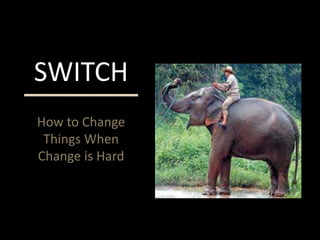
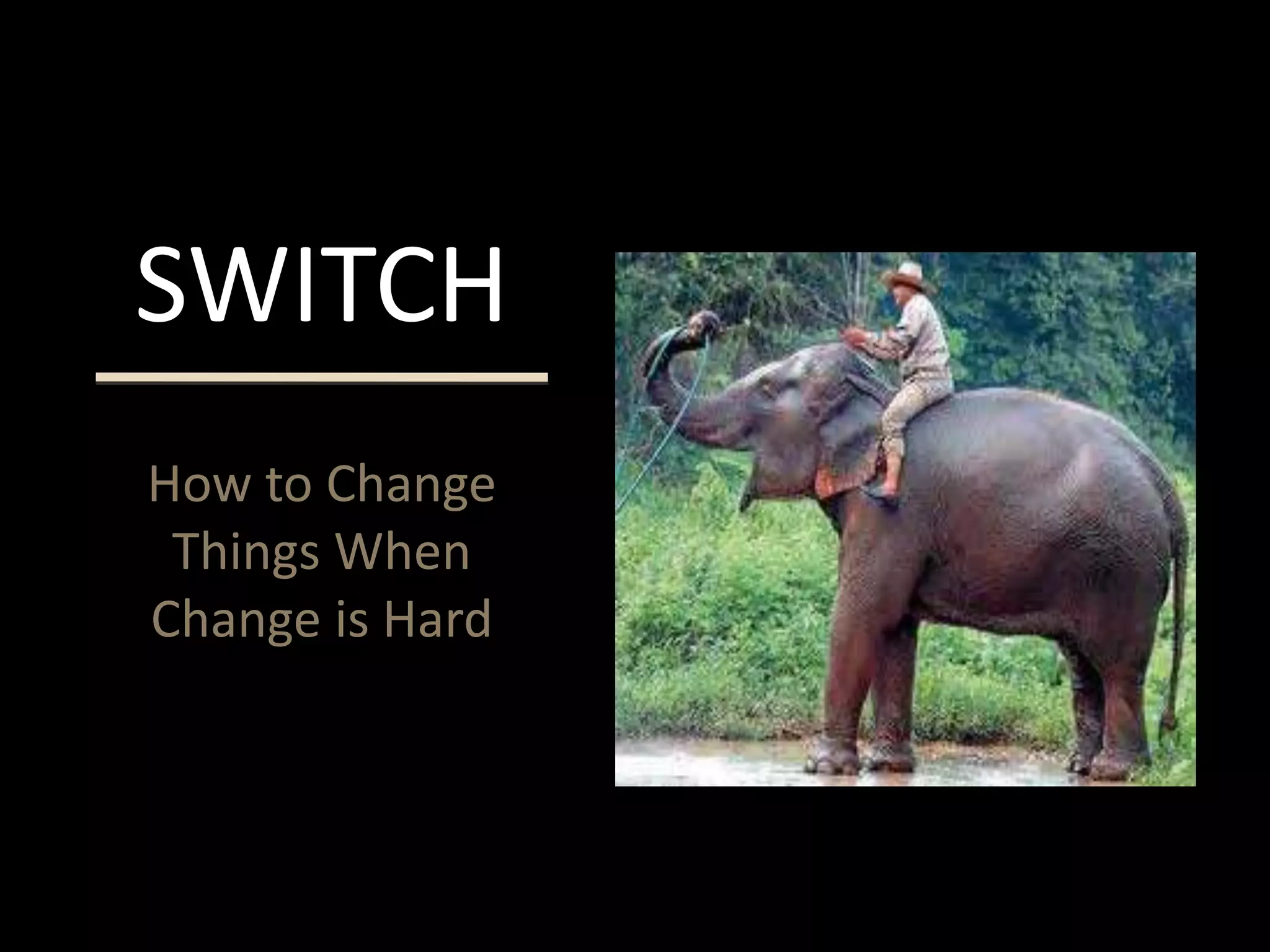
How to Change
Things When
Change is Hard
SWITCH
Change
• Think about a current challenge
• Record:
– Information or data you are gathering
– How you are analyzing the situation
– Your motivation for change
– Your feelings or emotions about the change
– Tension between thinking and feeling about the change
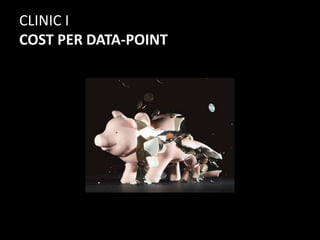
CLINIC I
COST PER DATA-POINT
CLINIC II
REPUTATION
CLINIC III
INNOVATION
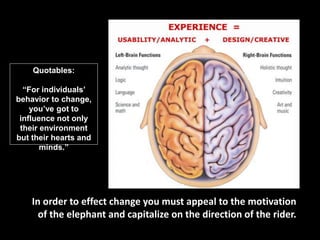
In order to effect change you must appeal to the motivation
of the elephant and capitalize on the direction of the rider.
Quotables:
“For individuals’
behavior to change,
you’ve got to
influence not only
their environment
but their hearts and
minds.”
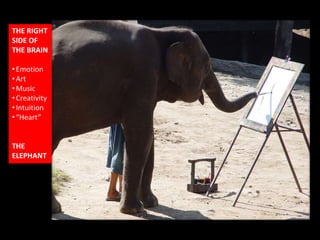
THE RIGHT
SIDE OF
THE BRAIN
•Emotion
•Art
•Music
•Creativity
•Intuition
•“Heart”
THE
ELEPHANT
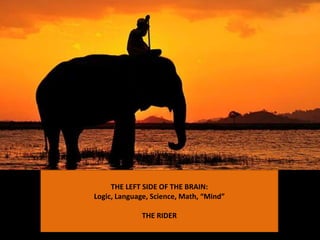
THE LEFT SIDE OF THE BRAIN:
Logic, Language, Science, Math, “Mind”
THE RIDER
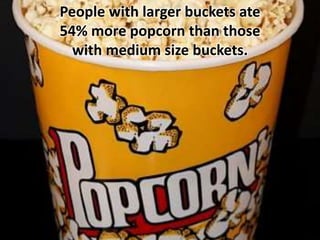
People with larger buckets ate
54% more popcorn than those
with medium size buckets.
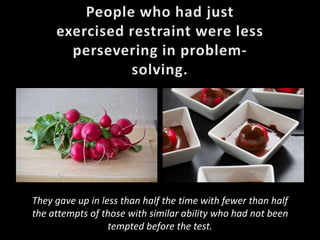
They gave up in less than half the time with fewer than half
the attempts of those with similar ability who had not been
tempted before the test.
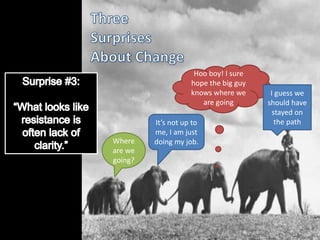
Where
are we
going?
It’s not up to
me, I am just
doing my job.
Hoo boy! I sure
hope the big guy
knows where we
are going
I guess we
should have
stayed on
the path
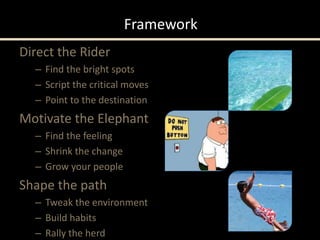
Direct the Rider
– Find the bright spots
– Script the critical moves
– Point to the destination
Motivate the Elephant
– Find the feeling
– Shrink the change
– Grow your people
Shape the path
– Tweak the environment
– Build habits
– Rally the herd
Framework

SWITCH - HOW TO CHANGE THINGS WHEN CHANGE IS HARD

  • 1.
    How to Change ThingsWhen Change is Hard SWITCH
  • 2.
    Change • Think abouta current challenge • Record: – Information or data you are gathering – How you are analyzing the situation – Your motivation for change – Your feelings or emotions about the change – Tension between thinking and feeling about the change
  • 3.
  • 4.
  • 5.
  • 7.
    In order toeffect change you must appeal to the motivation of the elephant and capitalize on the direction of the rider. Quotables: “For individuals’ behavior to change, you’ve got to influence not only their environment but their hearts and minds.”
  • 8.
    THE RIGHT SIDE OF THEBRAIN •Emotion •Art •Music •Creativity •Intuition •“Heart” THE ELEPHANT
  • 9.
    THE LEFT SIDEOF THE BRAIN: Logic, Language, Science, Math, “Mind” THE RIDER
  • 11.
    People with largerbuckets ate 54% more popcorn than those with medium size buckets.
  • 13.
    They gave upin less than half the time with fewer than half the attempts of those with similar ability who had not been tempted before the test.
  • 14.
    Where are we going? It’s notup to me, I am just doing my job. Hoo boy! I sure hope the big guy knows where we are going I guess we should have stayed on the path
  • 16.
    Direct the Rider –Find the bright spots – Script the critical moves – Point to the destination Motivate the Elephant – Find the feeling – Shrink the change – Grow your people Shape the path – Tweak the environment – Build habits – Rally the herd Framework

Editor's Notes

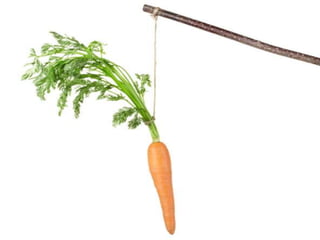
  • #8 The SWITCH framework – psychology of change From Carrot and Stick
  • #9 The SWITCH framework – The Elephant
  • #10 The SWITCH framework Elephant Strengths Energy, drive, instinctive, love, compassion, sympathy, loyalty, gets things done Weaknesses Lazy, skittish, short-term payoff, does not respond to the Rider. The Rider Strengths Long-term planning, direction Weaknesses Overly analytical, indecisive
  • #12 Popcorn – People with larger buckets ate 54% more popcorn than those with medium size buckets If you want people to eat less then give them smaller buckets. You don’t have to worry about their knowledge or their attitude. Can you start getting people to behave in a new way?
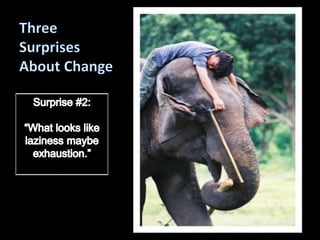
  • #14 Radishes & cookies Sat in a room and increased temptation. Had to use willpower and then found in problem solving activities that they attempted less and there was a decrease in persistence. The more choices offered the more exhausted the Rider gets. Self control is taxing. Change is hard because we wear ourselves out. Tug of war between the elephant and the rider. Controlling the elephant by the rider is exhaustive.
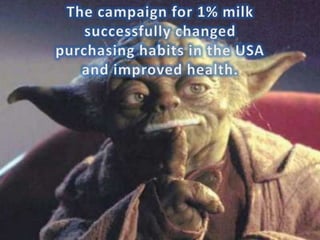
  • #16 1% Milk Which foods? Which meals? Did radio announcement and even showed what fat looked like (5 strips of bacon) Keeping it really simple or the rider will spin his wheels.
  • #17 How is the framework related to the surprises? Direct the Rider – Provide clarity to reduce resistance Motivate the Elephant – Energize us through the exhaustive task of self-monitoring and control Shape the Path – Modify the environment to make change more likely