The Heart of Change By John Kotter and Dan S. Cohen Change is Hard Work…  Billy Crystal
8   Steps to Transforming Your Organization Leadership is  not  something you  do to  people but rather something you  do with  people. Leadership should be viewed as a partnership. You get the best efforts from others not by lighting a fire beneath them but by building a fire within.  Organizations change when people change. People change for emotional reasons. Companies in their life cycle go through stages.  There will always be a time your company will be faced to change or die.  .  What are the factors that would make you feel your organization needs to change?   There are 8 critical Factors for creating a successful change.  If you skip any of the steps you will never produce a satisfying result.
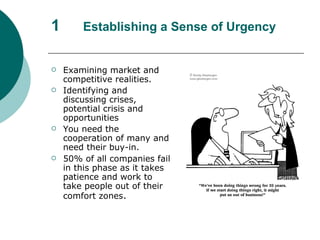
1 Establishing a Sense of Urgency Examining market and competitive realities. Identifying and discussing crises, potential crisis and opportunities You need the cooperation of many and need their buy-in. 50% of all companies fail in this phase as it takes patience and work to take people out of their comfort zones .
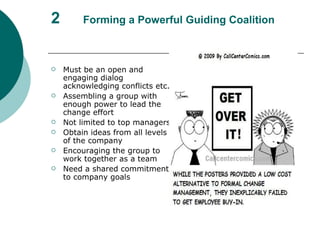
2 Forming a Powerful Guiding Coalition Must be an open and engaging dialog acknowledging conflicts etc. Assembling a group with enough power to lead the change effort Not limited to top managers Obtain ideas from all levels of the company Encouraging the group to work together as a team Need a shared commitment to company goals
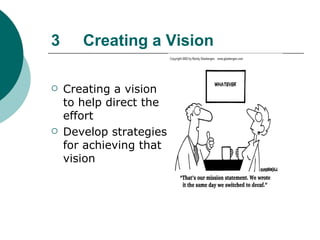
3 Creating a Vision Creating a vision to help direct the effort Develop strategies for achieving that vision
4 Communicating a Vision   Using every vehicle possible to communicate the new vision and strategies Teaching new behaviors by the example of the new coalition
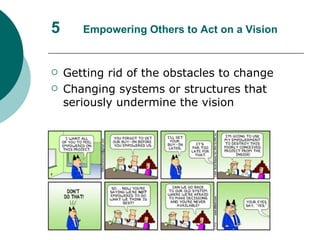
5 Empowering Others to Act on a Vision Getting rid of the obstacles to change Changing systems or structures that seriously undermine the vision
6 Encouraging taking risks  nontraditional ideas, activities and action Planning for and Creating Short Term Wins Planning for visible performance improvements Creating those improvements Recognizing and rewarding employees involved in the improvements
7  Consolidating Improvements    and Producing Still More Changes Using increased credibility to change systems, structures and policies that do not fit the vision. Hiring, promoting and developing employees who can implement the vision Reinvigorating the process with new project, themes and change agents
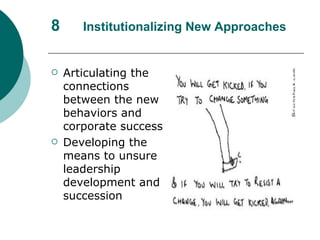
8 Institutionalizing New Approaches Articulating the connections between the new behaviors and corporate success Developing the means to unsure leadership development and succession
Suggested Reading The Heart of Change, John P. Kotter and Dan S. Cohen, Harvard Review Press, Boston Massachusetts How the Mighty Fall, Jim Collins, Harper Collins, New York Change the Culture, Change the Game, Roger Connors and Tom Smith, Portfolio Penguin, New York The Knack, Norm Brodsky and Bo Burlingham, Norm Brodsky and Bo Burlingham, Penguin, New York

8 Steps For Corporate Change

  • 1.
    The Heart ofChange By John Kotter and Dan S. Cohen Change is Hard Work… Billy Crystal
  • 2.
    8 Steps to Transforming Your Organization Leadership is not something you do to people but rather something you do with people. Leadership should be viewed as a partnership. You get the best efforts from others not by lighting a fire beneath them but by building a fire within. Organizations change when people change. People change for emotional reasons. Companies in their life cycle go through stages. There will always be a time your company will be faced to change or die. . What are the factors that would make you feel your organization needs to change? There are 8 critical Factors for creating a successful change. If you skip any of the steps you will never produce a satisfying result.
  • 3.
    1 Establishing aSense of Urgency Examining market and competitive realities. Identifying and discussing crises, potential crisis and opportunities You need the cooperation of many and need their buy-in. 50% of all companies fail in this phase as it takes patience and work to take people out of their comfort zones .
  • 4.
    2 Forming aPowerful Guiding Coalition Must be an open and engaging dialog acknowledging conflicts etc. Assembling a group with enough power to lead the change effort Not limited to top managers Obtain ideas from all levels of the company Encouraging the group to work together as a team Need a shared commitment to company goals
  • 5.
    3 Creating aVision Creating a vision to help direct the effort Develop strategies for achieving that vision
  • 6.
    4 Communicating aVision Using every vehicle possible to communicate the new vision and strategies Teaching new behaviors by the example of the new coalition
  • 7.
    5 Empowering Othersto Act on a Vision Getting rid of the obstacles to change Changing systems or structures that seriously undermine the vision
  • 8.
    6 Encouraging takingrisks nontraditional ideas, activities and action Planning for and Creating Short Term Wins Planning for visible performance improvements Creating those improvements Recognizing and rewarding employees involved in the improvements
  • 9.
    7 ConsolidatingImprovements and Producing Still More Changes Using increased credibility to change systems, structures and policies that do not fit the vision. Hiring, promoting and developing employees who can implement the vision Reinvigorating the process with new project, themes and change agents
  • 10.
    8 Institutionalizing NewApproaches Articulating the connections between the new behaviors and corporate success Developing the means to unsure leadership development and succession
  • 11.
    Suggested Reading TheHeart of Change, John P. Kotter and Dan S. Cohen, Harvard Review Press, Boston Massachusetts How the Mighty Fall, Jim Collins, Harper Collins, New York Change the Culture, Change the Game, Roger Connors and Tom Smith, Portfolio Penguin, New York The Knack, Norm Brodsky and Bo Burlingham, Norm Brodsky and Bo Burlingham, Penguin, New York