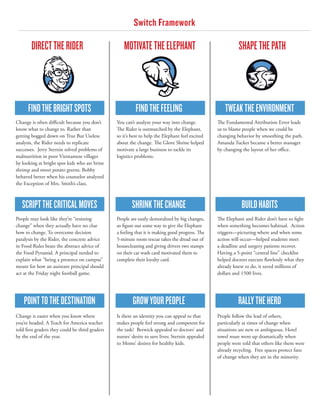
TweaktheEnvironment
BuildHabits
RallytheHerd
DirecttheRider MotivatetheElephant ShapethePath
Switch Framework
FindtheBrightSpots
ScripttheCriticalMoves
PointtotheDestination
FindtheFeeling
ShrinktheChange
GrowYourPeople
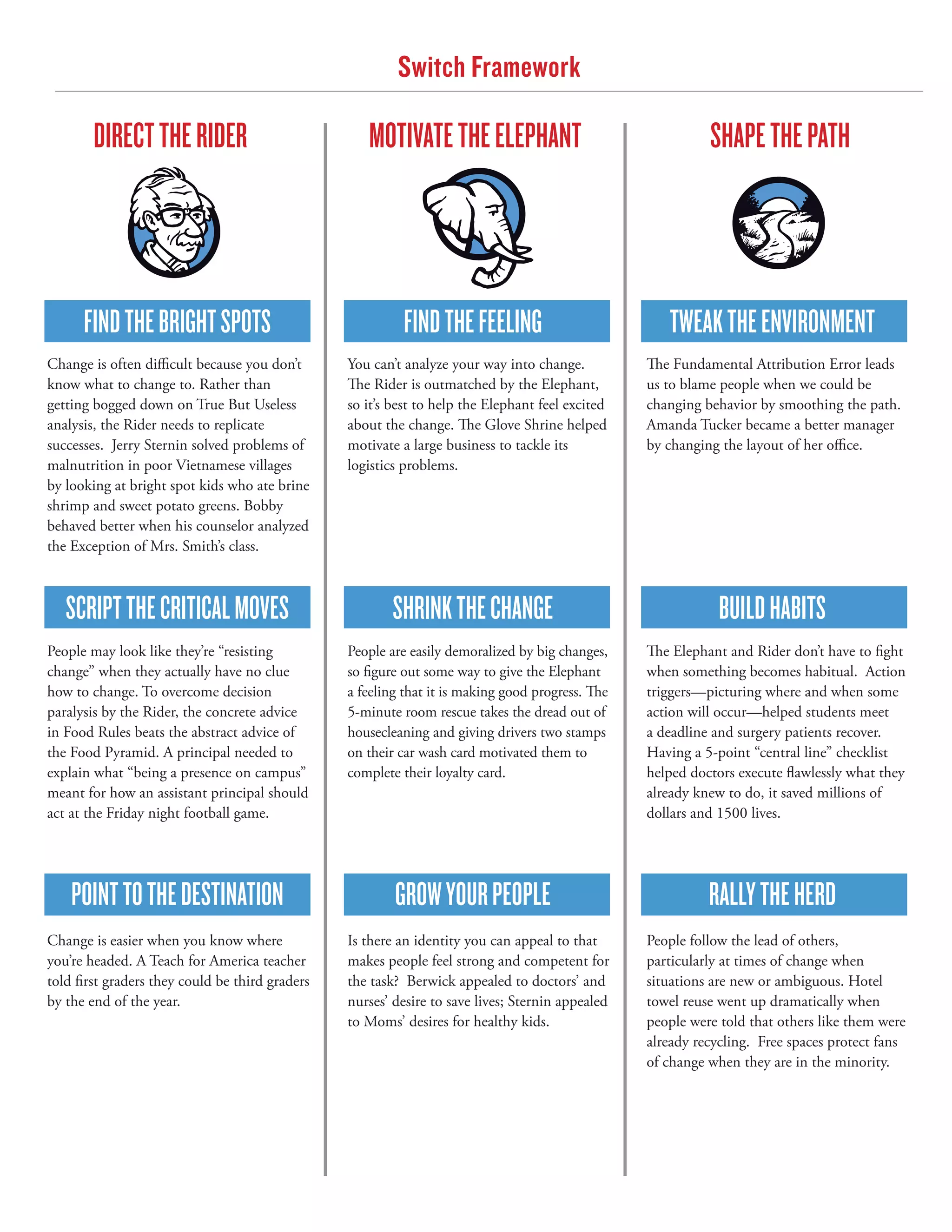
Change is often difficult because you don’t
know what to change to. Rather than
getting bogged down on True But Useless
analysis, the Rider needs to replicate
successes. Jerry Sternin solved problems of
malnutrition in poor Vietnamese villages
by looking at bright spot kids who ate brine
shrimp and sweet potato greens. Bobby
behaved better when his counselor analyzed
the Exception of Mrs. Smith’s class.
You can’t analyze your way into change.
The Rider is outmatched by the Elephant,
so it’s best to help the Elephant feel excited
about the change. The Glove Shrine helped
motivate a large business to tackle its
logistics problems.
The Fundamental Attribution Error leads
us to blame people when we could be
changing behavior by smoothing the path.
Amanda Tucker became a better manager
by changing the layout of her office.
People may look like they’re “resisting
change” when they actually have no clue
how to change. To overcome decision
paralysis by the Rider, the concrete advice
in Food Rules beats the abstract advice of
the Food Pyramid. A principal needed to
explain what “being a presence on campus”
meant for how an assistant principal should
act at the Friday night football game.
People are easily demoralized by big changes,
so figure out some way to give the Elephant
a feeling that it is making good progress. The
5-minute room rescue takes the dread out of
housecleaning and giving drivers two stamps
on their car wash card motivated them to
complete their loyalty card.
The Elephant and Rider don’t have to fight
when something becomes habitual. Action
triggers—picturing where and when some
action will occur—helped students meet
a deadline and surgery patients recover.
Having a 5-point “central line” checklist
helped doctors execute flawlessly what they
already knew to do, it saved millions of
dollars and 1500 lives.
Change is easier when you know where
you’re headed. A Teach for America teacher
told first graders they could be third graders
by the end of the year.
Is there an identity you can appeal to that
makes people feel strong and competent for
the task? Berwick appealed to doctors’ and
nurses’ desire to save lives; Sternin appealed
to Moms’ desires for healthy kids.
People follow the lead of others,
particularly at times of change when
situations are new or ambiguous. Hotel
towel reuse went up dramatically when
people were told that others like them were
already recycling. Free spaces protect fans
of change when they are in the minority.
TweaktheEnvironment
BuildHabits
RallytheHerd
DirecttheRider MotivatetheElephant ShapethePath
Switch Framework
FindtheBrightSpots
ScripttheCriticalMoves
PointtotheDestination
FindtheFeeling
ShrinktheChange
GrowYourPeople

Switch framework 1pdf

  • 1.
    TweaktheEnvironment BuildHabits RallytheHerd DirecttheRider MotivatetheElephant ShapethePath SwitchFramework FindtheBrightSpots ScripttheCriticalMoves PointtotheDestination FindtheFeeling ShrinktheChange GrowYourPeople Change is often difficult because you don’t know what to change to. Rather than getting bogged down on True But Useless analysis, the Rider needs to replicate successes. Jerry Sternin solved problems of malnutrition in poor Vietnamese villages by looking at bright spot kids who ate brine shrimp and sweet potato greens. Bobby behaved better when his counselor analyzed the Exception of Mrs. Smith’s class. You can’t analyze your way into change. The Rider is outmatched by the Elephant, so it’s best to help the Elephant feel excited about the change. The Glove Shrine helped motivate a large business to tackle its logistics problems. The Fundamental Attribution Error leads us to blame people when we could be changing behavior by smoothing the path. Amanda Tucker became a better manager by changing the layout of her office. People may look like they’re “resisting change” when they actually have no clue how to change. To overcome decision paralysis by the Rider, the concrete advice in Food Rules beats the abstract advice of the Food Pyramid. A principal needed to explain what “being a presence on campus” meant for how an assistant principal should act at the Friday night football game. People are easily demoralized by big changes, so figure out some way to give the Elephant a feeling that it is making good progress. The 5-minute room rescue takes the dread out of housecleaning and giving drivers two stamps on their car wash card motivated them to complete their loyalty card. The Elephant and Rider don’t have to fight when something becomes habitual. Action triggers—picturing where and when some action will occur—helped students meet a deadline and surgery patients recover. Having a 5-point “central line” checklist helped doctors execute flawlessly what they already knew to do, it saved millions of dollars and 1500 lives. Change is easier when you know where you’re headed. A Teach for America teacher told first graders they could be third graders by the end of the year. Is there an identity you can appeal to that makes people feel strong and competent for the task? Berwick appealed to doctors’ and nurses’ desire to save lives; Sternin appealed to Moms’ desires for healthy kids. People follow the lead of others, particularly at times of change when situations are new or ambiguous. Hotel towel reuse went up dramatically when people were told that others like them were already recycling. Free spaces protect fans of change when they are in the minority.
  • 2.
    TweaktheEnvironment BuildHabits RallytheHerd DirecttheRider MotivatetheElephant ShapethePath SwitchFramework FindtheBrightSpots ScripttheCriticalMoves PointtotheDestination FindtheFeeling ShrinktheChange GrowYourPeople