Semantics in Declarative System The Evolution of Business Unit Empowerment Dan McCreary Dan McCreary & Associates Wednesday, 5/23/2007  8:00 AM - 9:00 AM  Level: Business/Strategic M D Metadata Solutions
Presentation Summary “ Declarative programming” has become the latest buzzword to describe languages that abstractly define systems  requirements  (the  what ) and leave the implementation (the  how ) to be determined by an independent process. This makes the  semantics  (meaning) of declarative data elements even more critical as these systems are shared between organizations. This presentation: Provides a background of declarative programming Describes why understanding the semantic aspects  of declarative systems is critical to cost-effective  software development Note: All opinions stated in this paper are solely those of the author.
Presentation Summary (cont) Discusses declarative and semantic aspects of common development systems such as;  XHTML, CSS, XForms, XML transforms, XML Schemas, OWL, metadata registries, web services, composition, service-oriented architectures (SOA) and the enterprise service bus (ESB) Discusses how social networking software and Wikis are used to quickly build consensus on precise semantics Presents ten specific recommendations to lower costs of agile information systems
Presentation Includes Definitions  of declarative  systems  and contrasts with them with traditional procedural systems and stand-alone declarative languages  A critical analysis of  semantics  in declarative systems  Case studies  using XForms, Wikis and other collaborative software The role of  social networking  systems, reputation and trust in the development of semantically precise declarative frameworks  Specific  recommendations  of how organizations can be more effective by integrating semantics and declarative systems into their software development processes
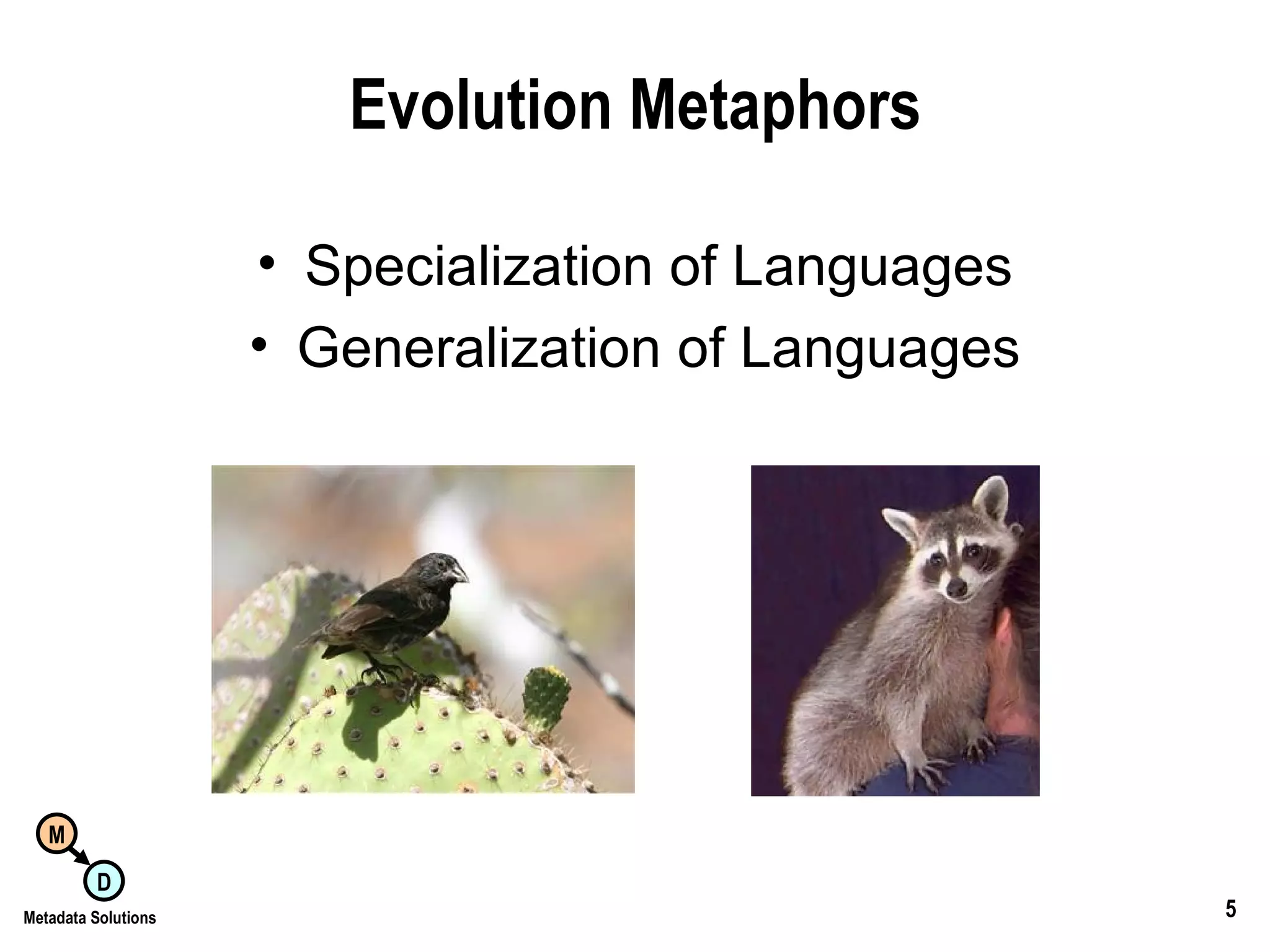
Evolution Metaphors Specialization of Languages Generalization of Languages
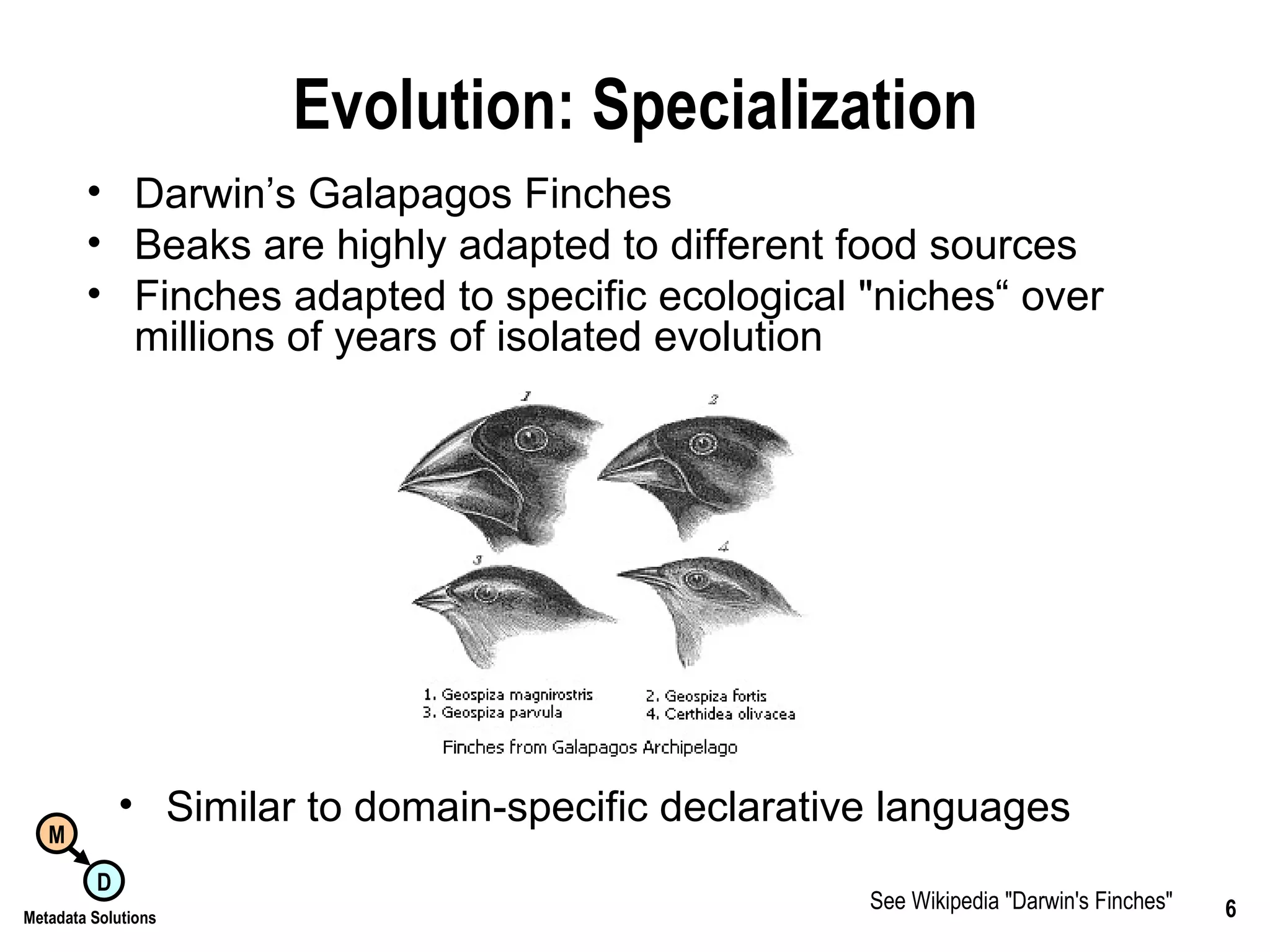
Evolution: Specialization Darwin’s Galapagos Finches Beaks are highly adapted to different food sources  Finches adapted to specific ecological "niches“ over millions of years of isolated evolution Similar to domain-specific declarative languages See Wikipedia "Darwin's Finches"
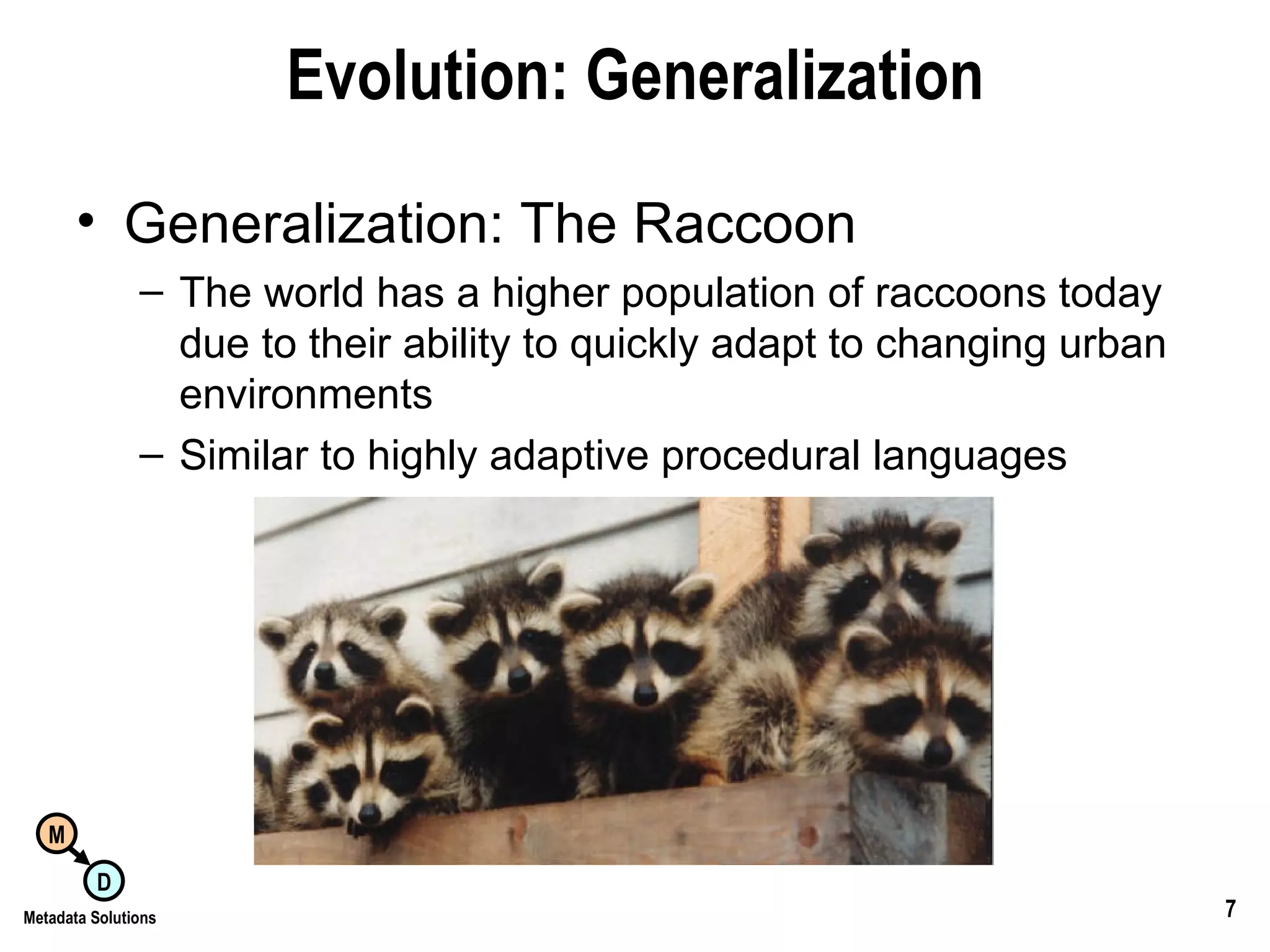
Evolution: Generalization Generalization: The Raccoon The world has a higher population of raccoons today due to their ability to quickly adapt to changing urban environments Similar to highly adaptive procedural languages
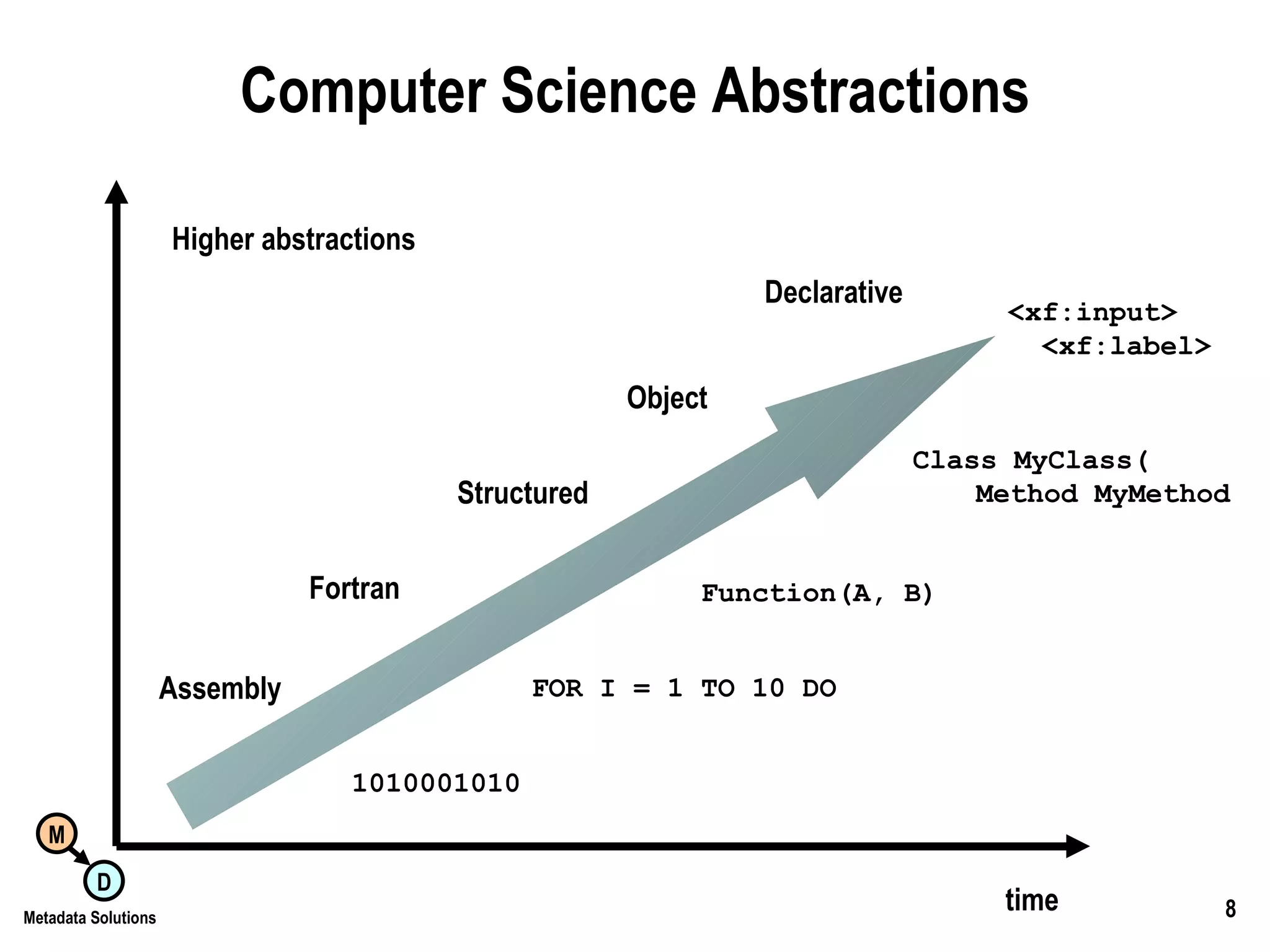
Computer Science Abstractions time Higher abstractions Assembly 1010001010 Fortran FOR I = 1 TO 10 DO Structured Function(A, B) Object Class MyClass( Method MyMethod Declarative <xf:input> <xf:label>
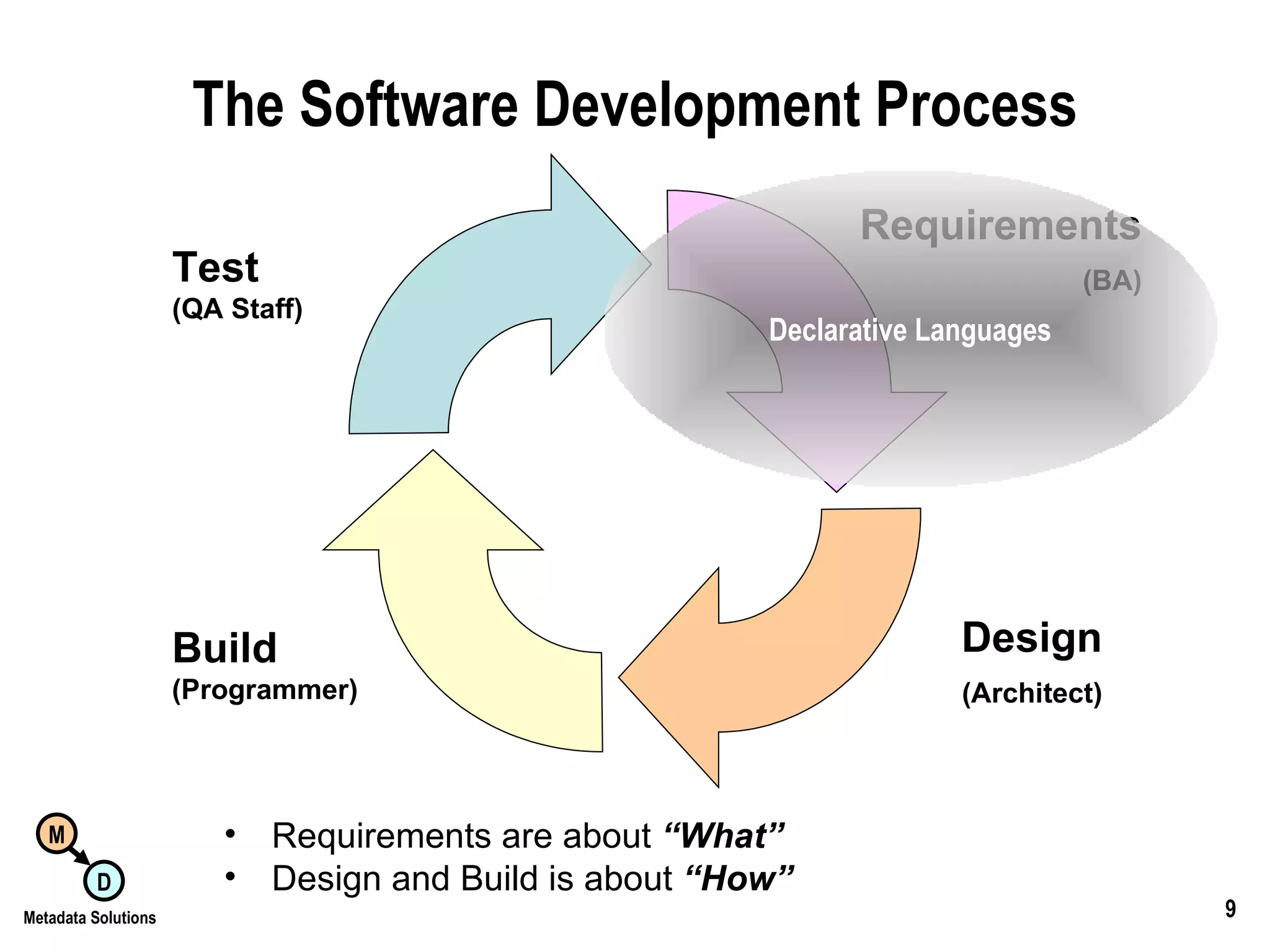
The Software Development Process Requirements are about  “What” Design and Build is about  “How” Requirements (BA) Design (Architect) Build (Programmer) Test (QA Staff) Declarative Languages
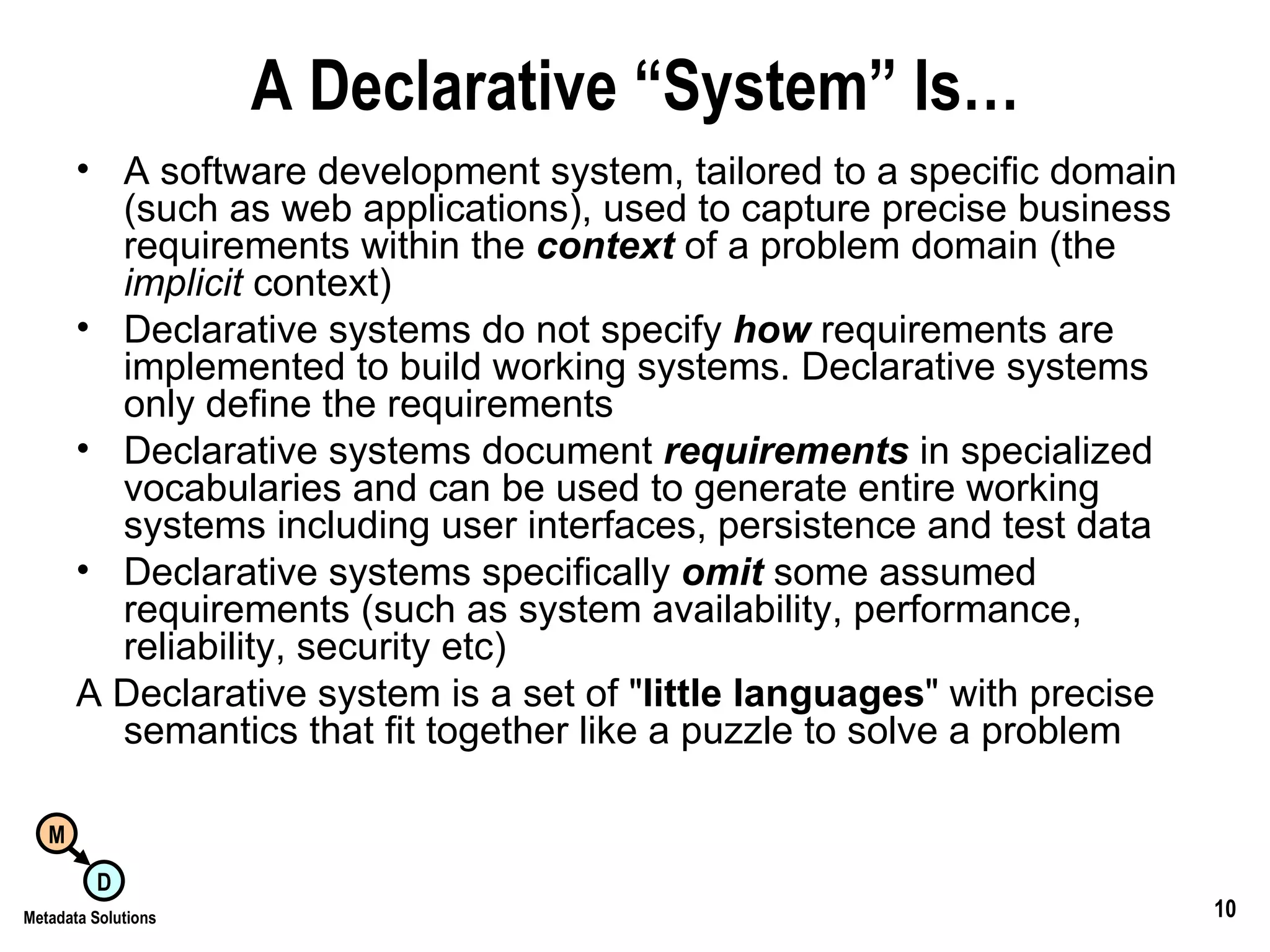
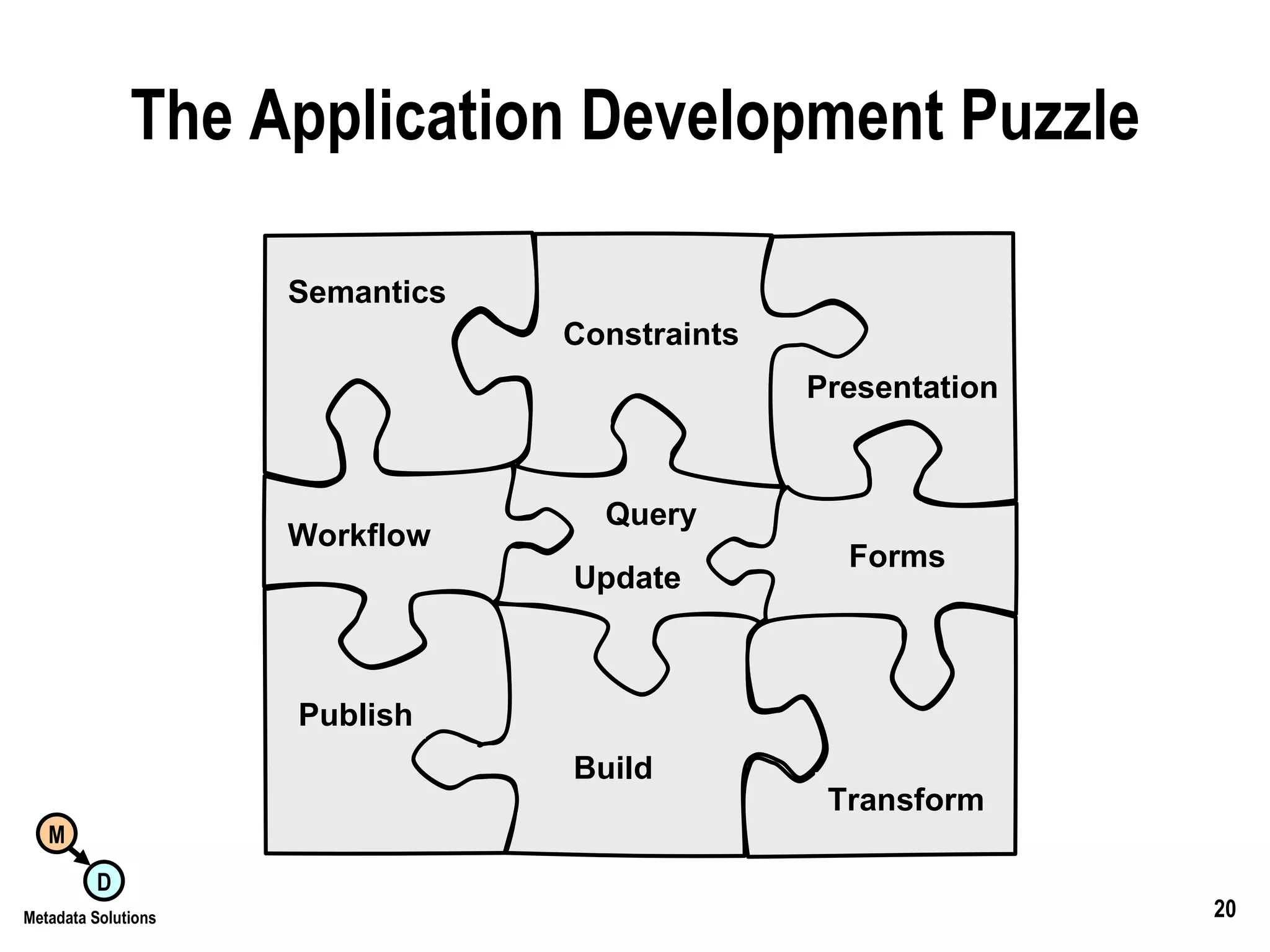
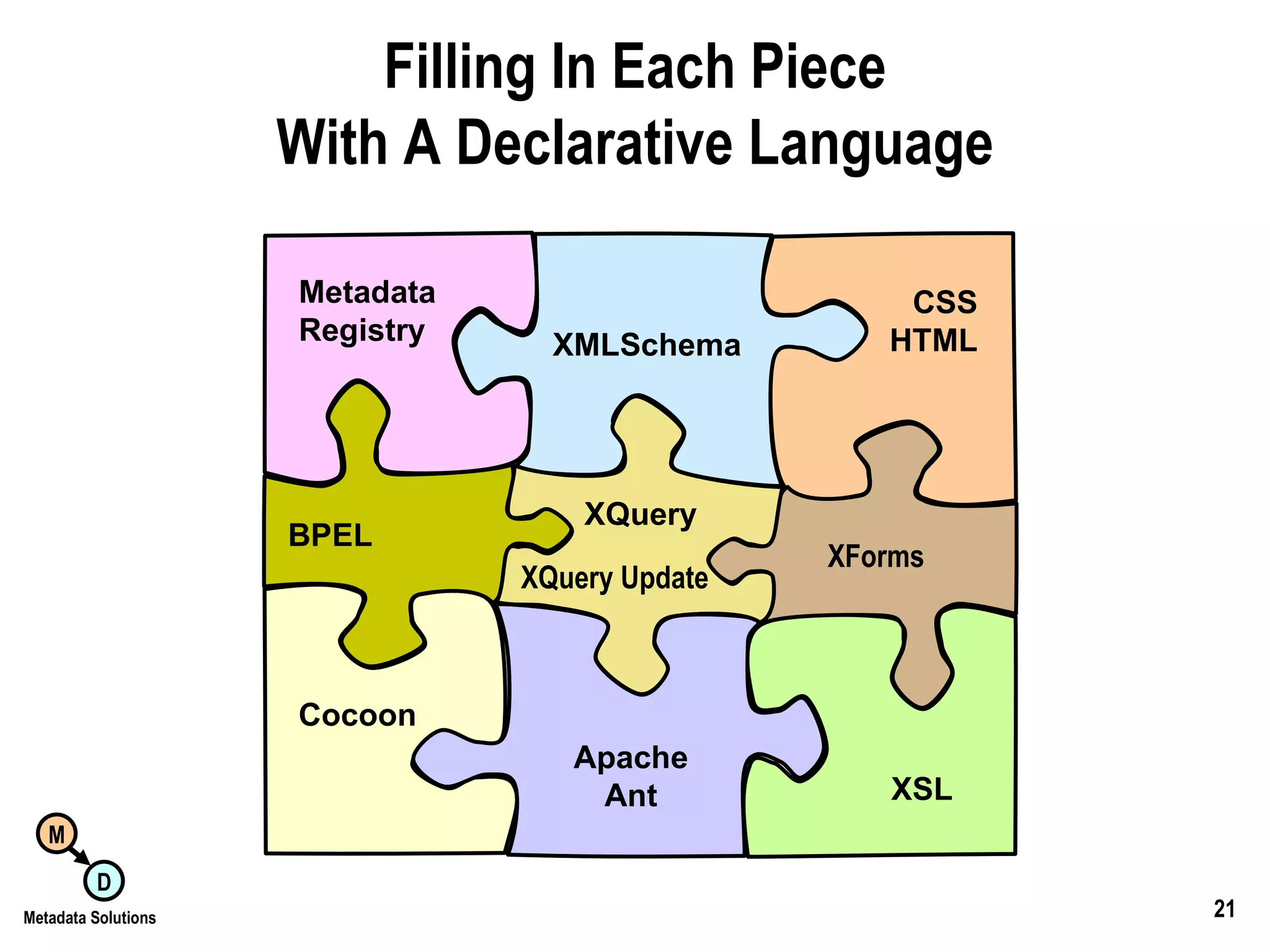
A Declarative “System” Is… A software development system, tailored to a specific domain (such as web applications), used to capture precise business requirements within the  context  of a problem domain (the  implicit  context) Declarative systems do not specify  how  requirements are implemented to build working systems. Declarative systems only define the requirements Declarative systems document  requirements  in specialized vocabularies and can be used to generate entire working systems including user interfaces, persistence and test data Declarative systems specifically  omit   some assumed requirements (such as system availability, performance, reliability, security etc) A Declarative system is a set of &quot; little languages &quot; with precise semantics that fit together like a puzzle to solve a problem
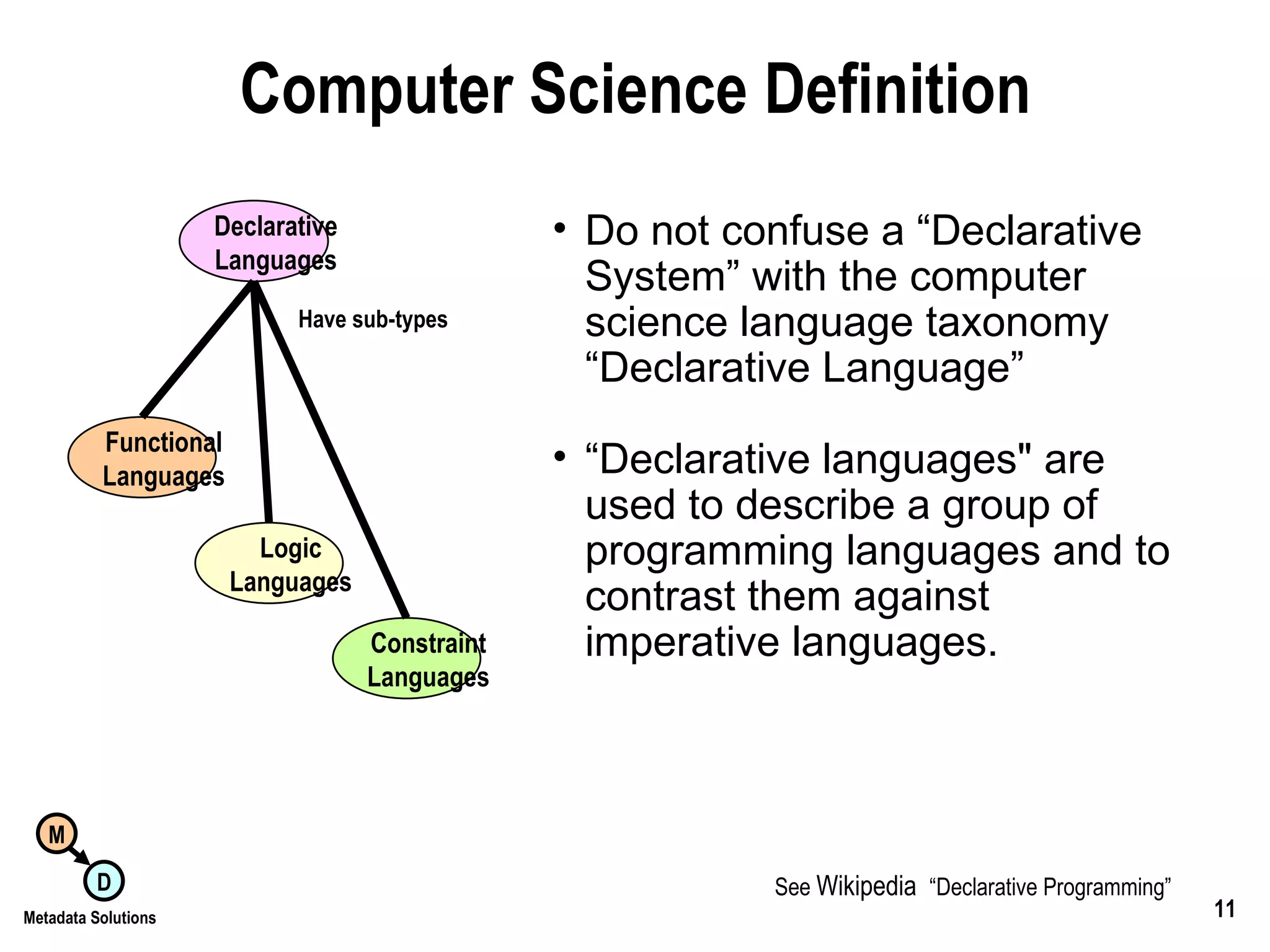
Computer Science Definition Do not confuse a “Declarative System” with the computer science language taxonomy “Declarative Language” “ Declarative languages&quot; are used to describe a group of programming languages and to contrast them against imperative languages.   Declarative Languages Functional Languages Logic Languages Constraint Languages Have sub-types See  Wikipedia   “Declarative Programming”
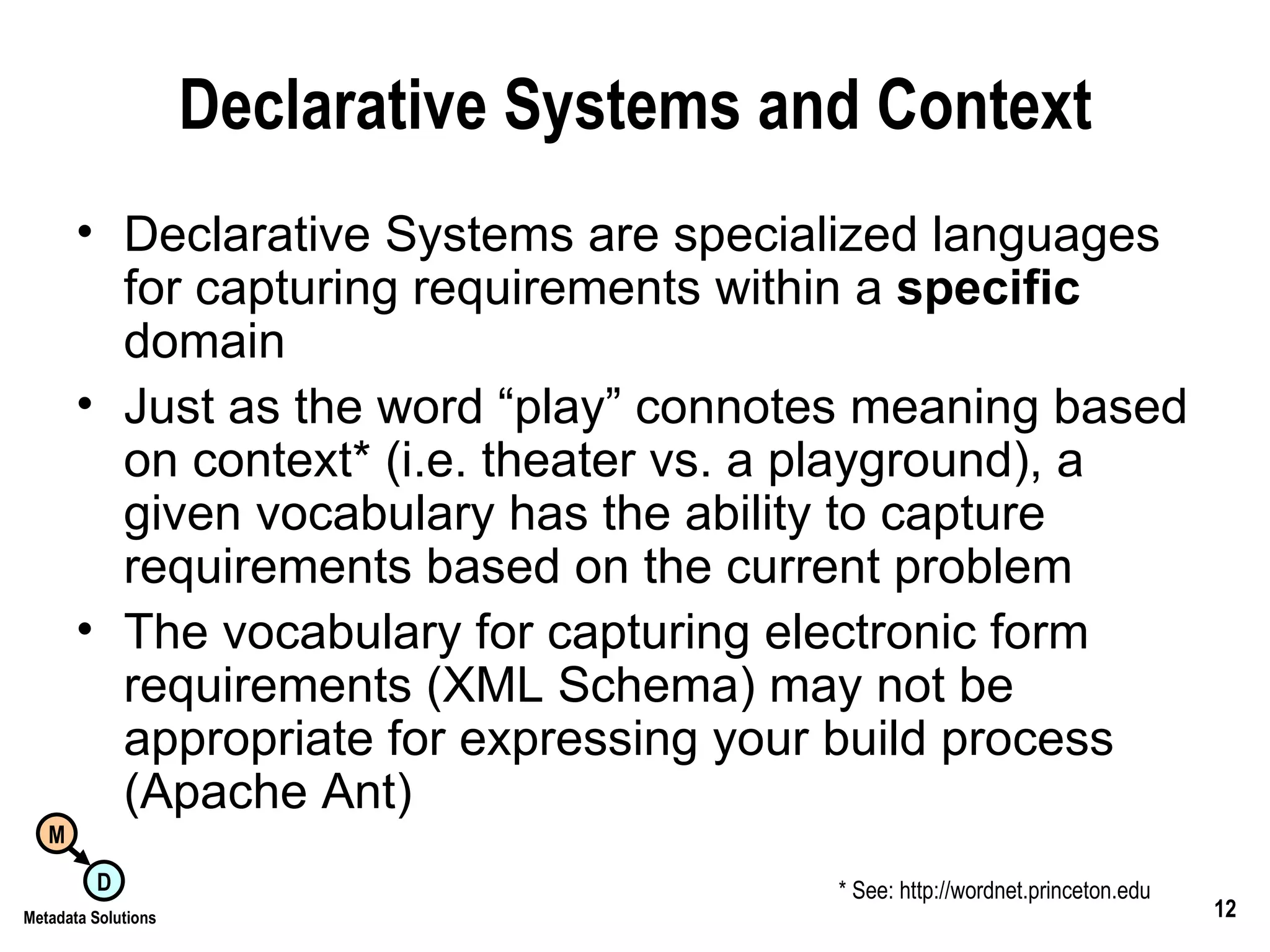
Declarative Systems and Context Declarative Systems are specialized languages for capturing requirements within a  specific  domain Just as the word “play” connotes meaning based on context* (i.e. theater vs. a playground), a given vocabulary has the ability to capture requirements based on the current problem  The vocabulary for capturing electronic form requirements (XML Schema) may not be appropriate for expressing your build process (Apache Ant) * See: http://wordnet.princeton.edu
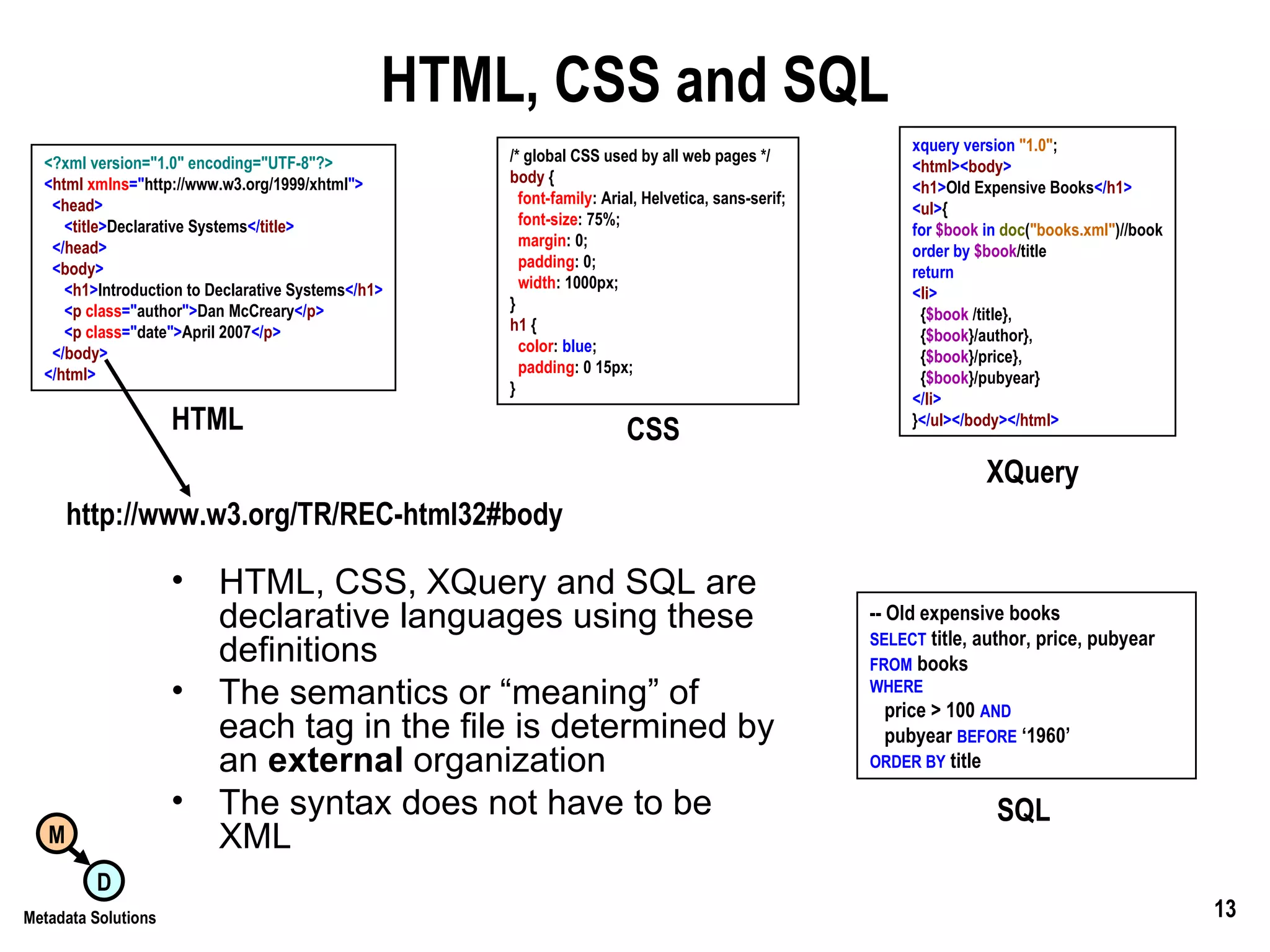
HTML, CSS and SQL HTML, CSS, XQuery and SQL are declarative languages using these definitions The semantics or “meaning” of each tag in the file is determined by an  external  organization The syntax does not have to be XML <?xml version=&quot;1.0&quot; encoding=&quot;UTF-8&quot;?> < html  xmlns =&quot; http://www.w3.org/1999/xhtml &quot;> < head > < title > Declarative Systems </ title > </ head > < body > < h1 > Introduction to Declarative Systems </ h1 > < p  class =&quot; author &quot;> Dan McCreary </ p > < p  class =&quot; date &quot;> April 2007 </ p > </ body > </ html > HTML /* global CSS used by all web pages */ body  { font-family : Arial, Helvetica, sans-serif; font-size : 75%; margin : 0; padding : 0; width : 1000px; } h1  { color :  blue ; padding : 0 15px; } CSS -- Old expensive books SELECT  title, author, price, pubyear FROM  books WHERE price > 100  AND pubyear  BEFORE  ‘1960’ ORDER BY  title SQL xquery   version   &quot;1.0&quot; ; < html >< body > < h1 > Old Expensive Books </ h1 > < ul > { for   $book   in   doc ( &quot;books.xml&quot; )//book order   by   $book /title return < li > { $book  /title}, { $book }/author}, { $book }/price}, { $book }/pubyear} </ li > } </ ul ></ body ></ html > XQuery http://www.w3.org/TR/REC-html32#body
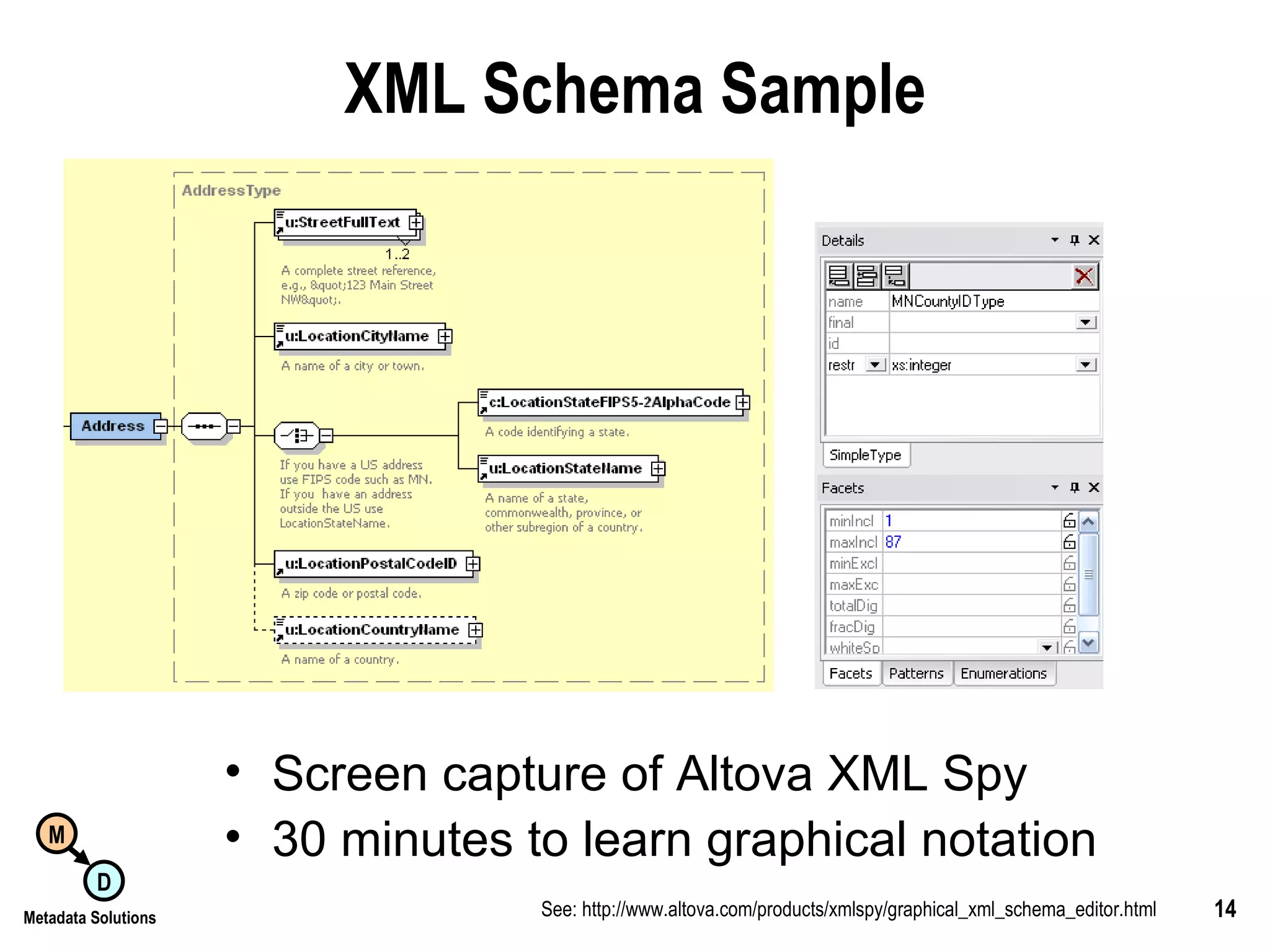
XML Schema Sample Screen capture of Altova XML Spy 30 minutes to learn graphical notation See: http://www.altova.com/products/xmlspy/graphical_xml_schema_editor.html
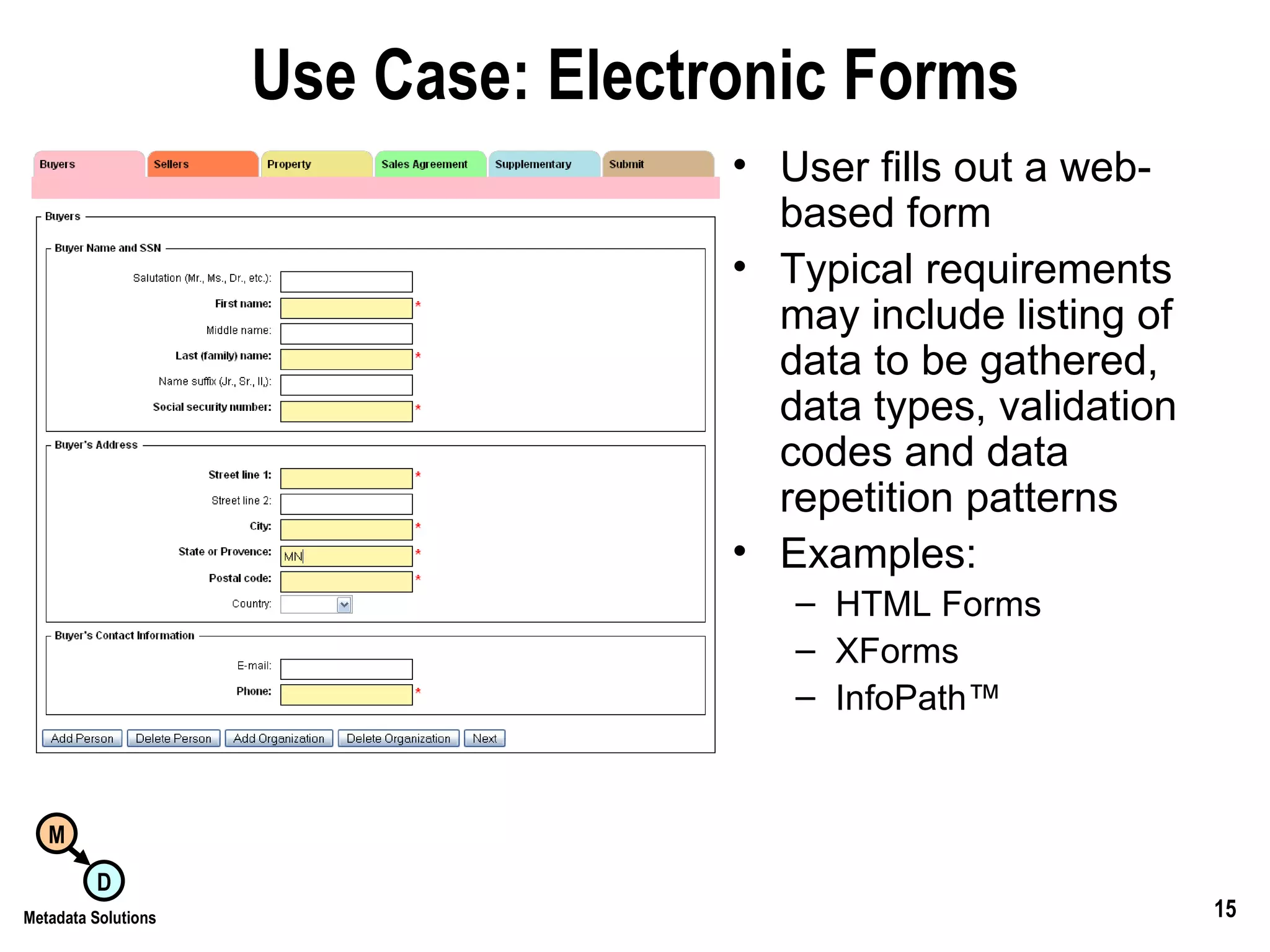
Use Case: Electronic Forms User fills out a web-based form Typical requirements may include listing of data to be gathered, data types, validation codes and data repetition patterns Examples: HTML Forms XForms InfoPath™
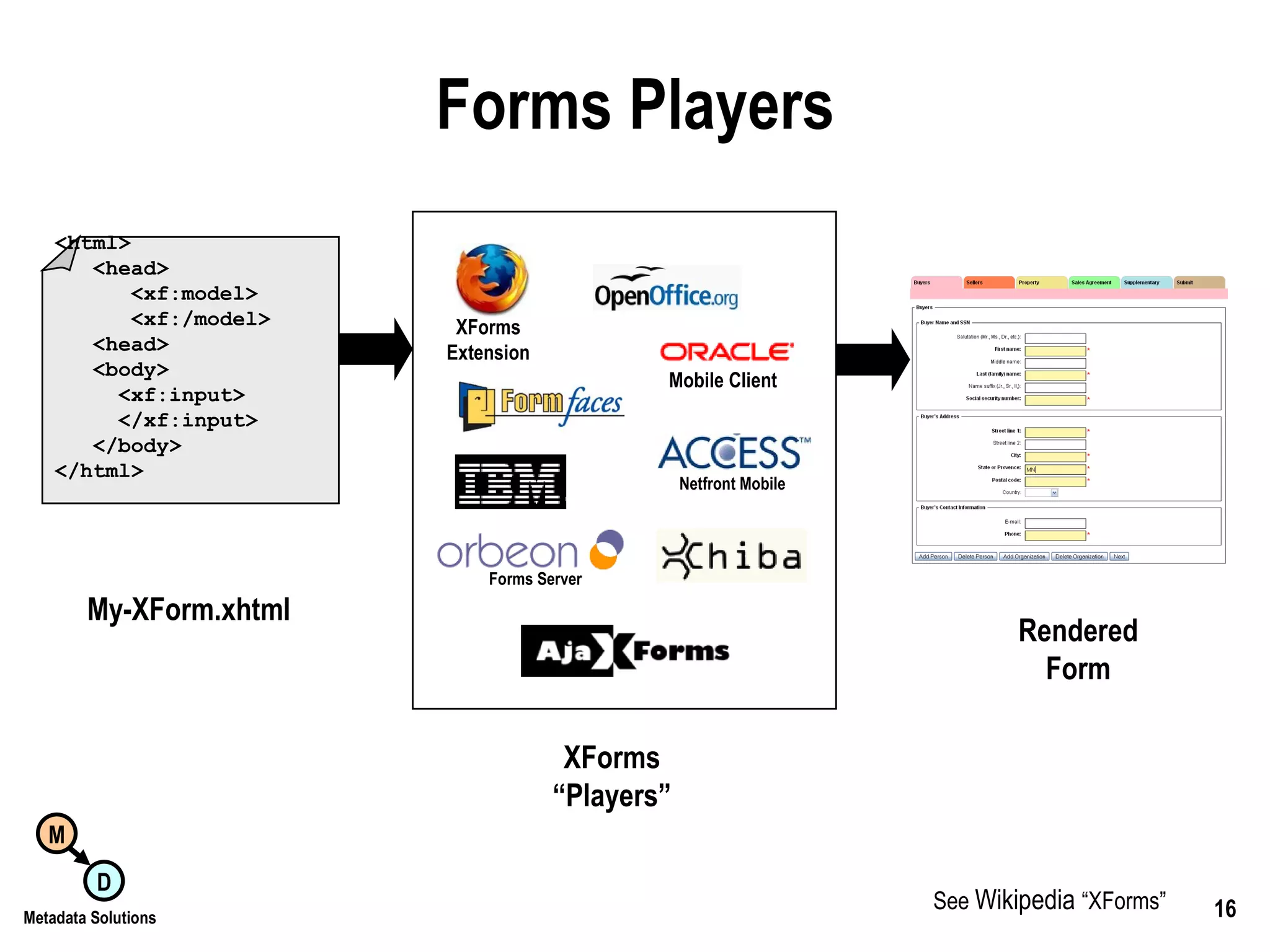
Forms Players <html> <head> <xf:model> <xf:/model> <head> <body> <xf:input> </xf:input> </body> </html> My-XForm.xhtml See  Wikipedia  “XForms” Rendered Form XForms “Players” XForms Extension Mobile Client Forms Server Netfront Mobile
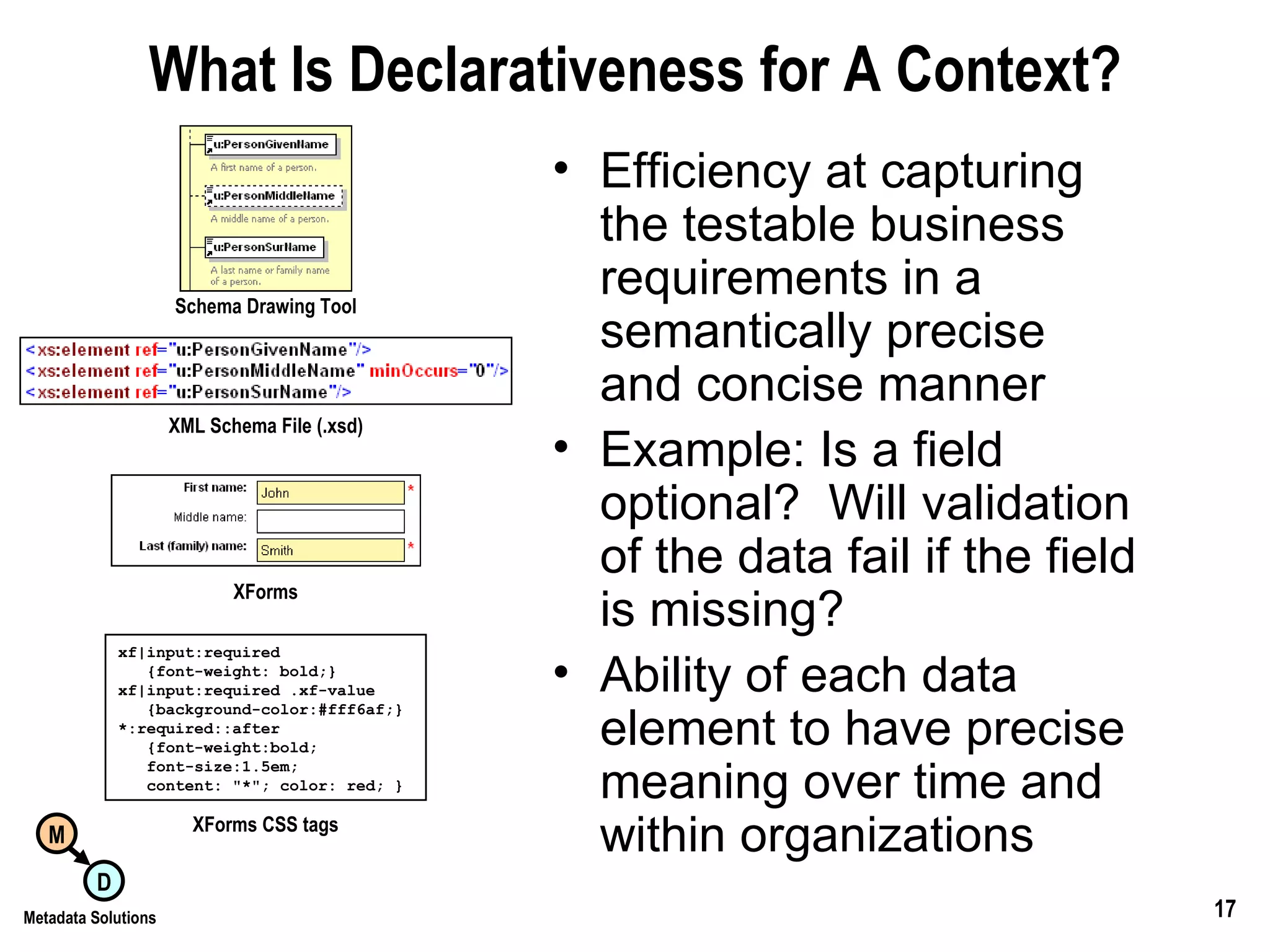
What Is Declarativeness for A Context? Efficiency at capturing the testable business requirements in a semantically precise and concise manner Example: Is a field optional?  Will validation of the data fail if the field is missing? Ability of each data element to have precise meaning over time and within organizations Schema Drawing Tool XML Schema File (.xsd) XForms xf|input:required {font-weight: bold;}  xf|input:required .xf-value {background-color:#fff6af;} *:required::after {font-weight:bold; font-size:1.5em; content: &quot;*&quot;; color: red; }  XForms CSS tags
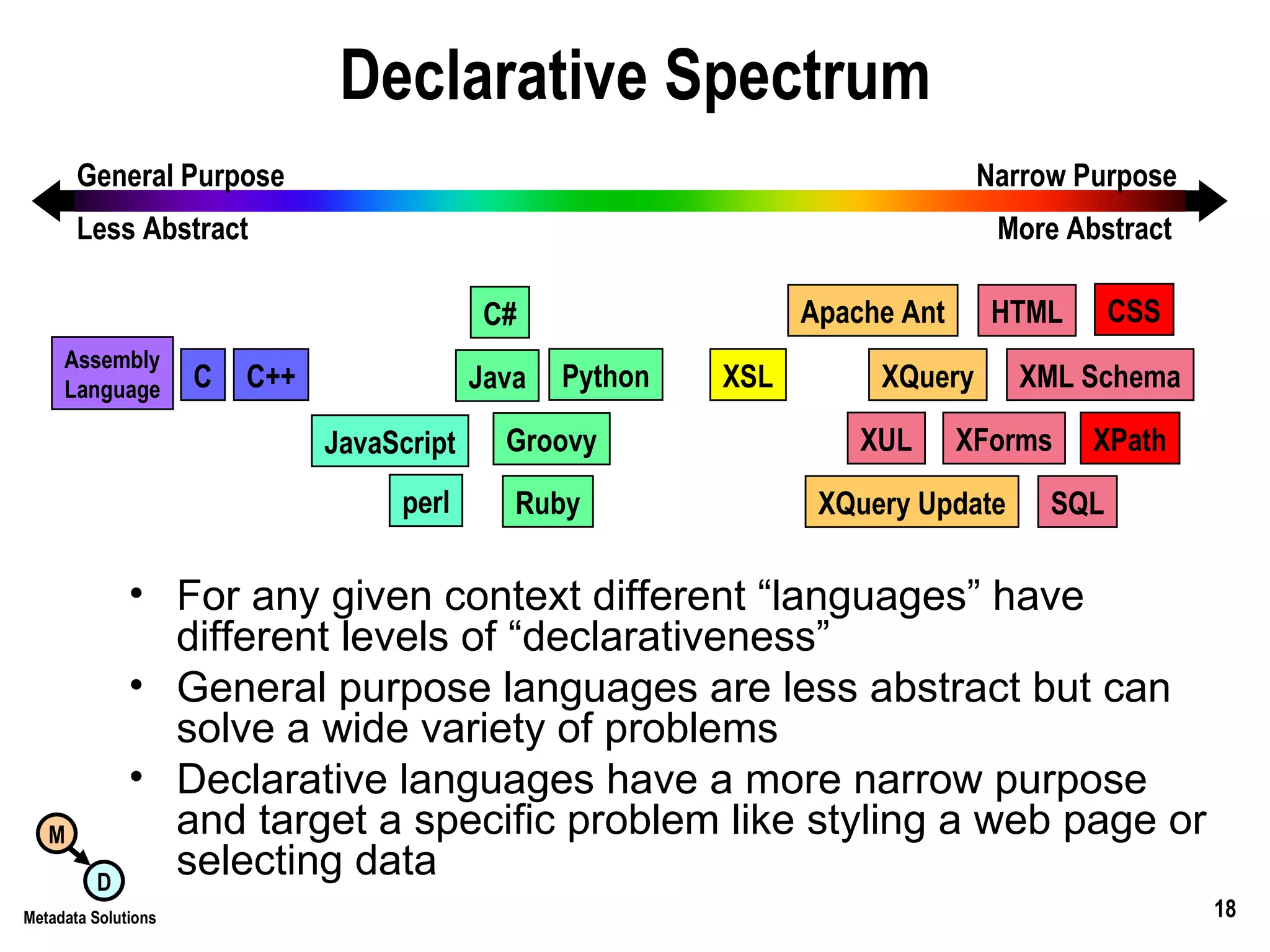
Declarative Spectrum For any given context different “languages” have different levels of “declarativeness” General purpose languages are less abstract but can solve a wide variety of problems Declarative languages have a more narrow purpose and target a specific problem like styling a web page or selecting data HTML Java Assembly Language C C++ JavaScript C# CSS XSL XML Schema Apache Ant XForms XQuery XQuery Update SQL XPath Ruby perl Groovy Python XUL Narrow Purpose More Abstract General Purpose Less Abstract
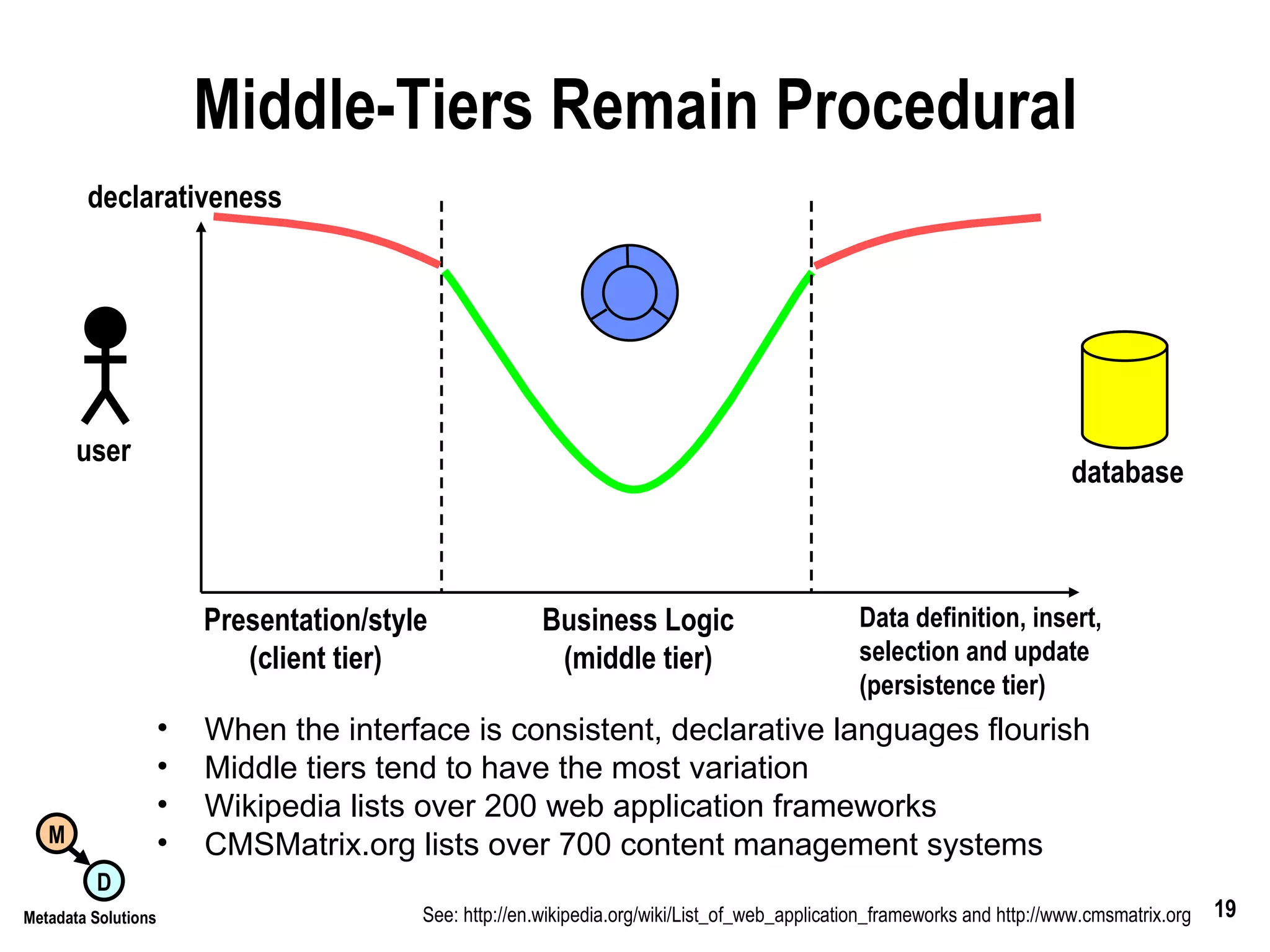
Middle-Tiers Remain Procedural When the interface is consistent, declarative languages flourish Middle tiers tend to have the most variation Wikipedia lists over 200 web application frameworks CMSMatrix.org lists over 700 content management systems user database declarativeness Presentation/style (client tier) Data definition, insert, selection and update (persistence tier) Business Logic (middle tier) See: http://en.wikipedia.org/wiki/List_of_web_application_frameworks and http://www.cmsmatrix.org
The Application Development Puzzle Semantics Constraints Presentation Build Publish Transform Workflow Query Update Forms
Filling In Each Piece With A Declarative Language XMLSchema CSS HTML Apache Ant Metadata Registry Cocoon XSL BPEL XQuery XQuery Update XForms
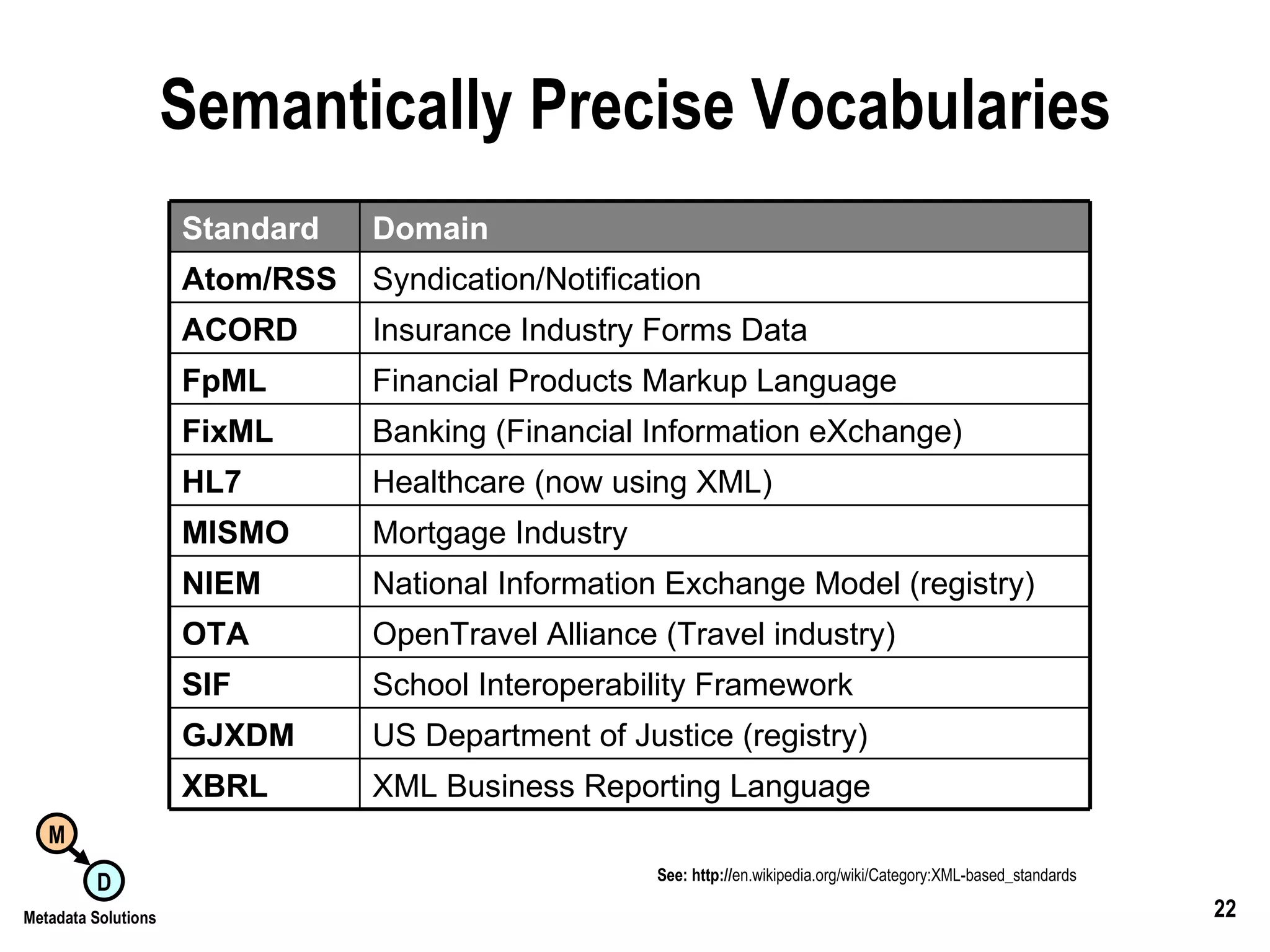
Semantically Precise Vocabularies See: http:// en.wikipedia.org/wiki/Category:XML-based_standards XML Business Reporting Language XBRL US Department of Justice (registry) GJXDM School Interoperability Framework SIF OpenTravel Alliance (Travel industry) OTA National Information Exchange Model (registry) NIEM Mortgage Industry MISMO Healthcare (now using XML) HL7 Banking (Financial Information eXchange) FixML Financial Products Markup Language FpML Insurance Industry Forms Data ACORD Syndication/Notification Atom/RSS Domain Standard
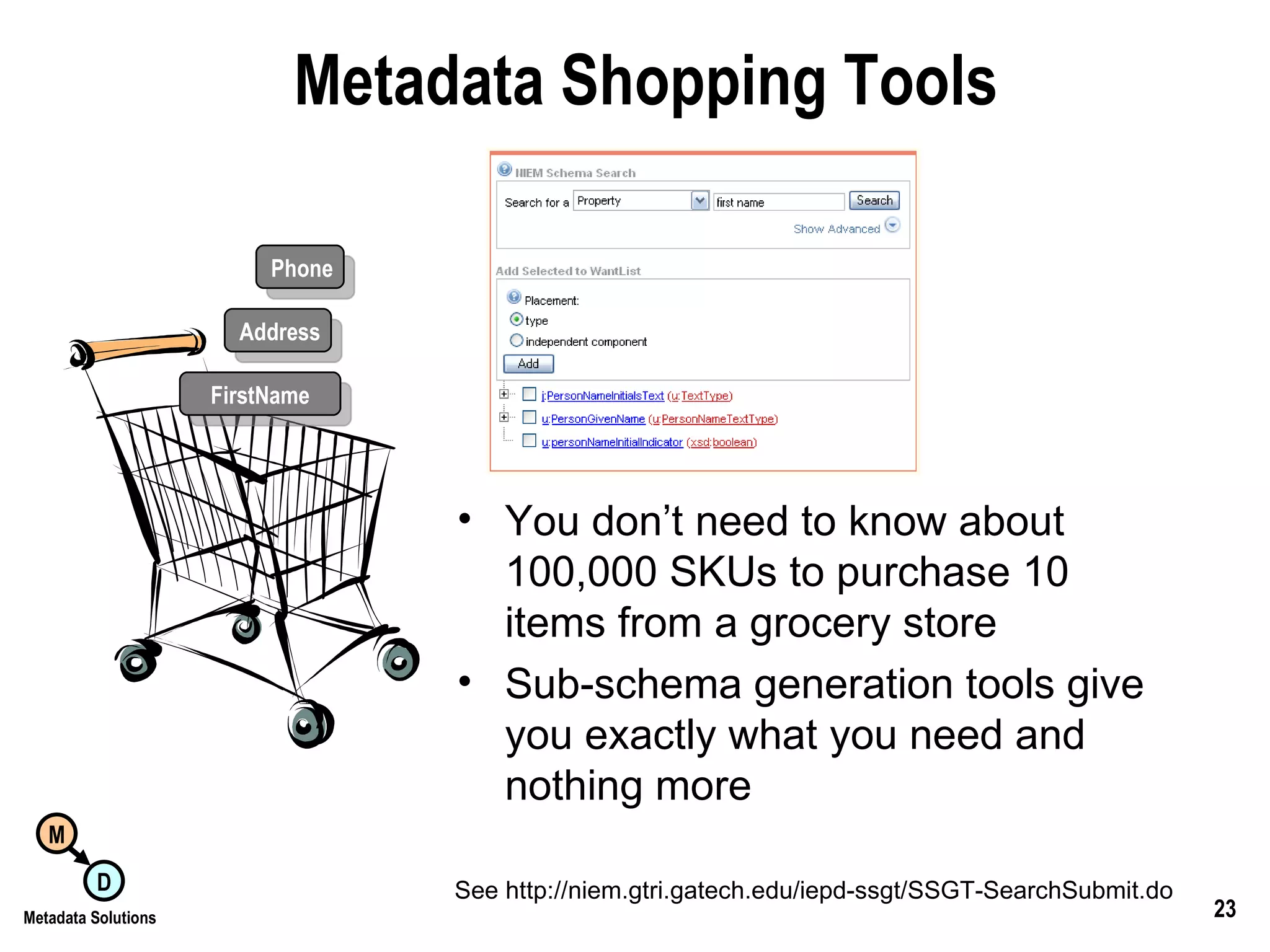
Metadata Shopping Tools You don’t need to know about 100,000 SKUs to purchase 10 items from a grocery store Sub-schema generation tools give you exactly what you need and nothing more Phone Address FirstName See http://niem.gtri.gatech.edu/iepd-ssgt/SSGT-SearchSubmit.do
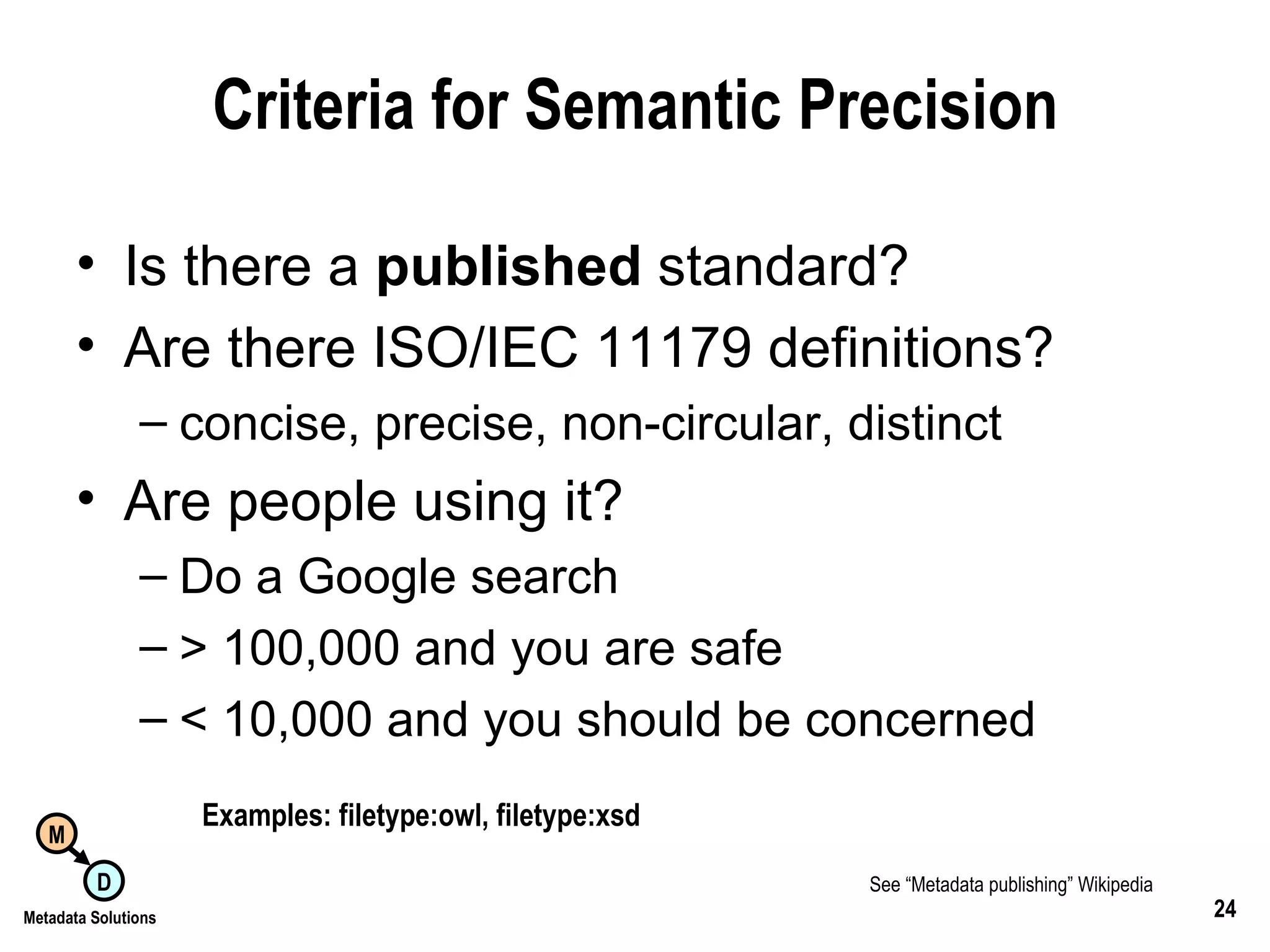
Criteria for Semantic Precision Is there a  published  standard? Are there ISO/IEC 11179 definitions? concise, precise, non-circular, distinct Are people using it? Do a Google search > 100,000 and you are safe < 10,000 and you should be concerned Examples: filetype:owl, filetype:xsd See “Metadata publishing” Wikipedia
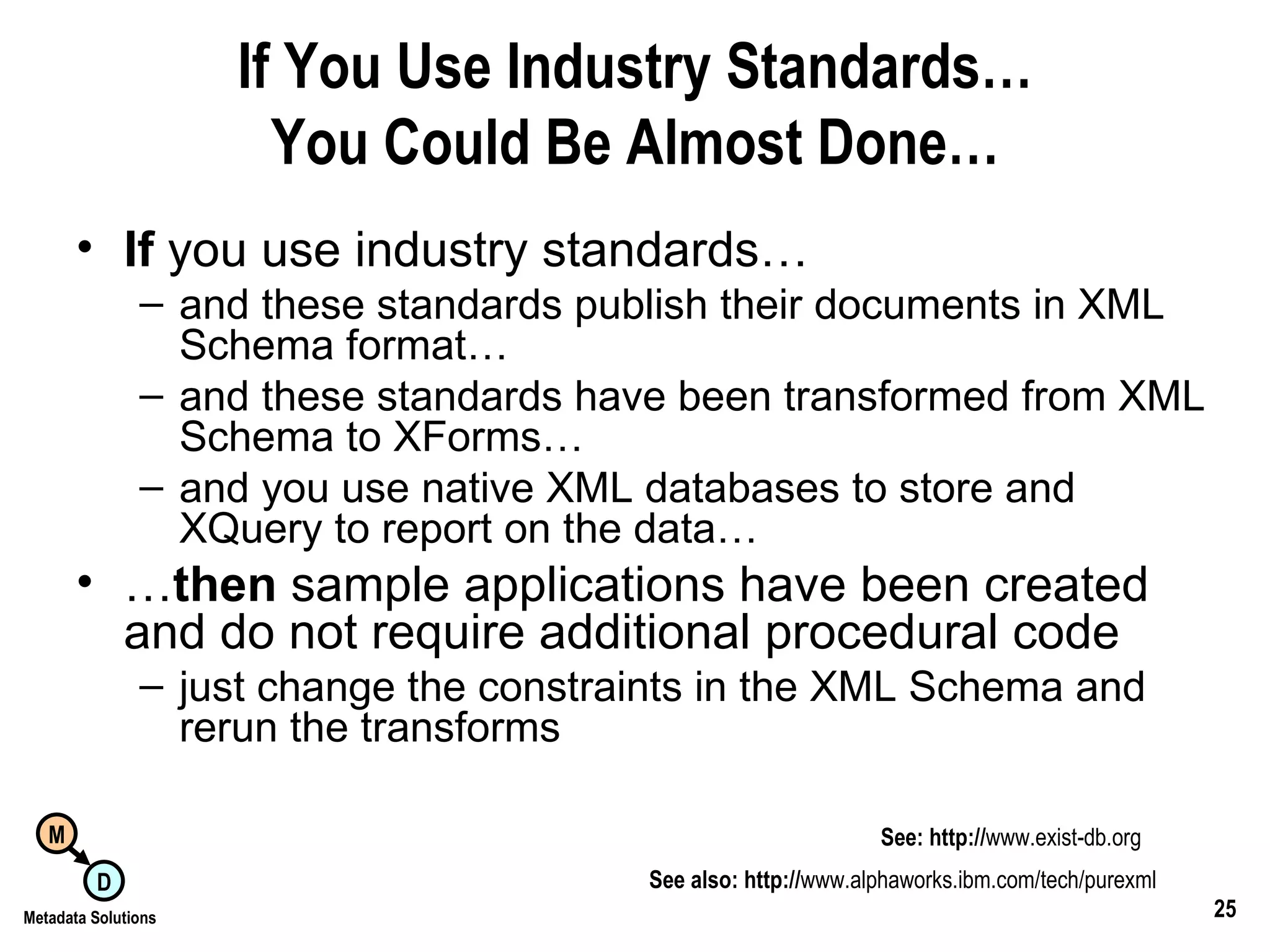
If You Use Industry Standards… You Could Be Almost Done… If  you use industry standards… and these standards publish their documents in XML Schema format… and these standards have been transformed from XML Schema to XForms… and you use native XML databases to store and XQuery to report on the data… … then  sample applications have been created and do not require additional procedural code just change the constraints in the XML Schema and rerun the transforms See also: http:// www.alphaworks.ibm.com/tech/purexml See: http:// www.exist-db.org
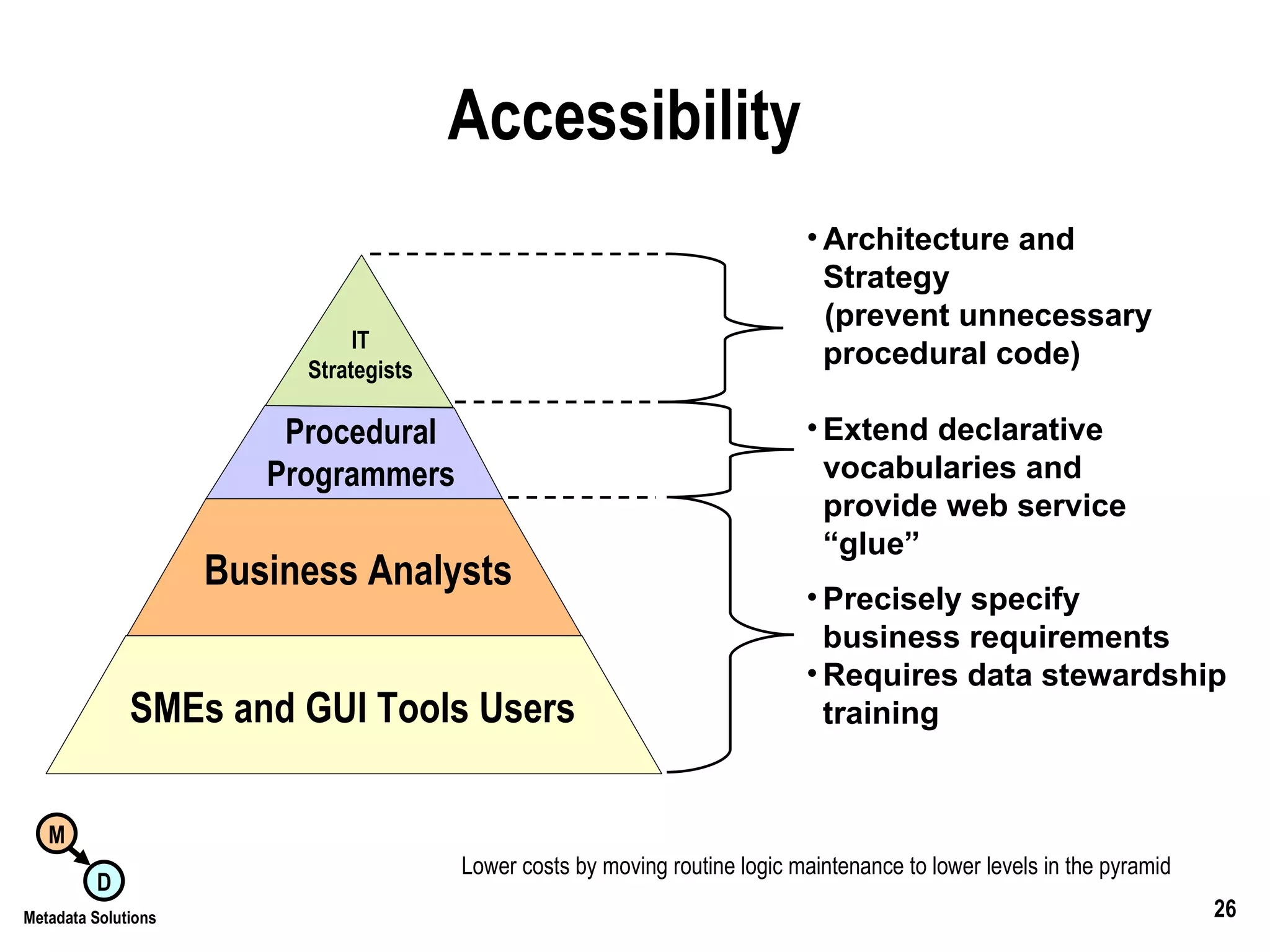
Accessibility Lower costs by moving routine logic maintenance to lower levels in the pyramid Business Analysts SMEs and GUI Tools Users Precisely specify business requirements Requires data stewardship training Procedural Programmers Extend declarative vocabularies and provide web service “glue” IT Strategists Architecture and Strategy (prevent unnecessary procedural code)
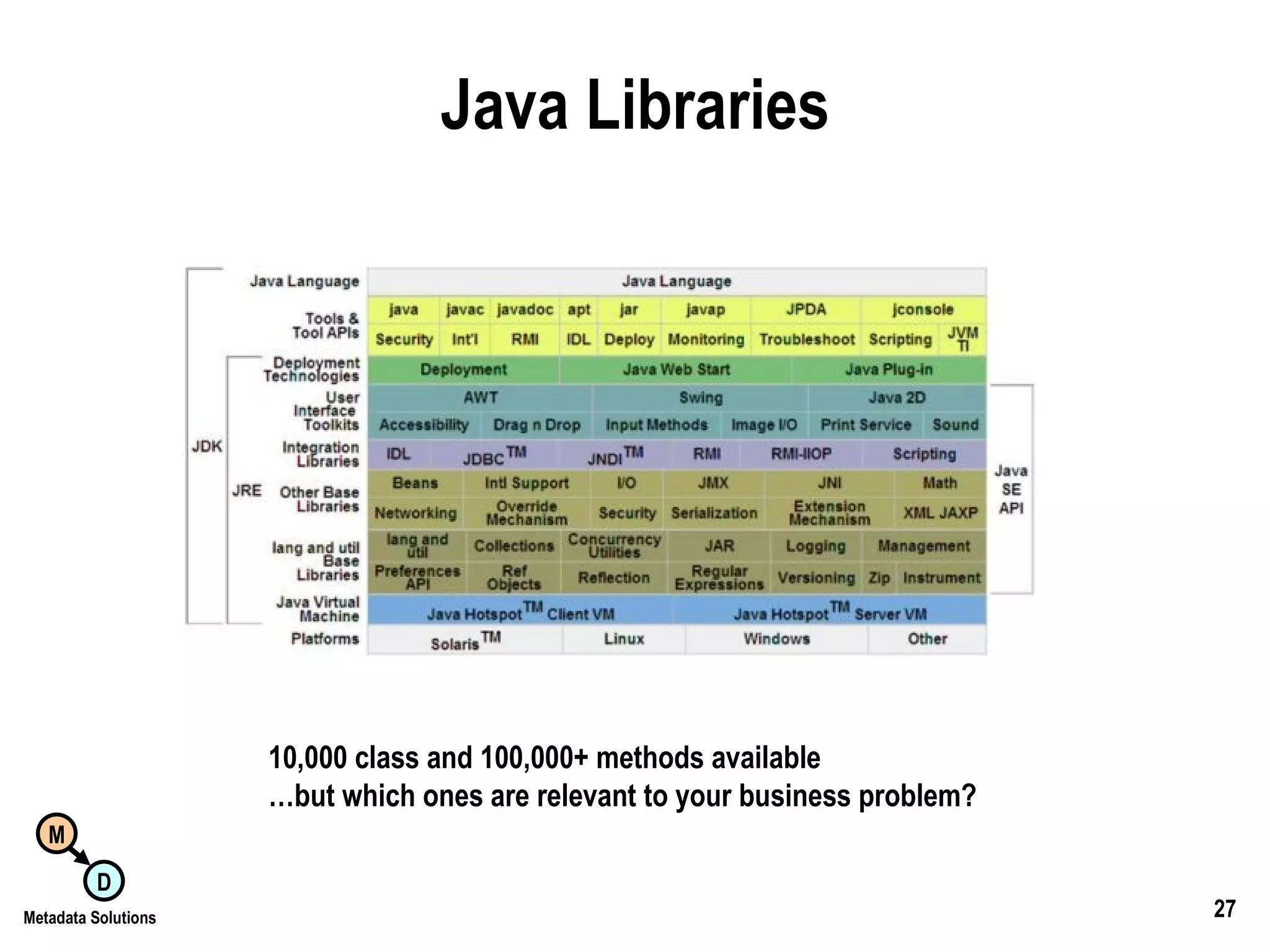
Java Libraries 10,000 class and 100,000+ methods available … but which ones are relevant to your business problem?
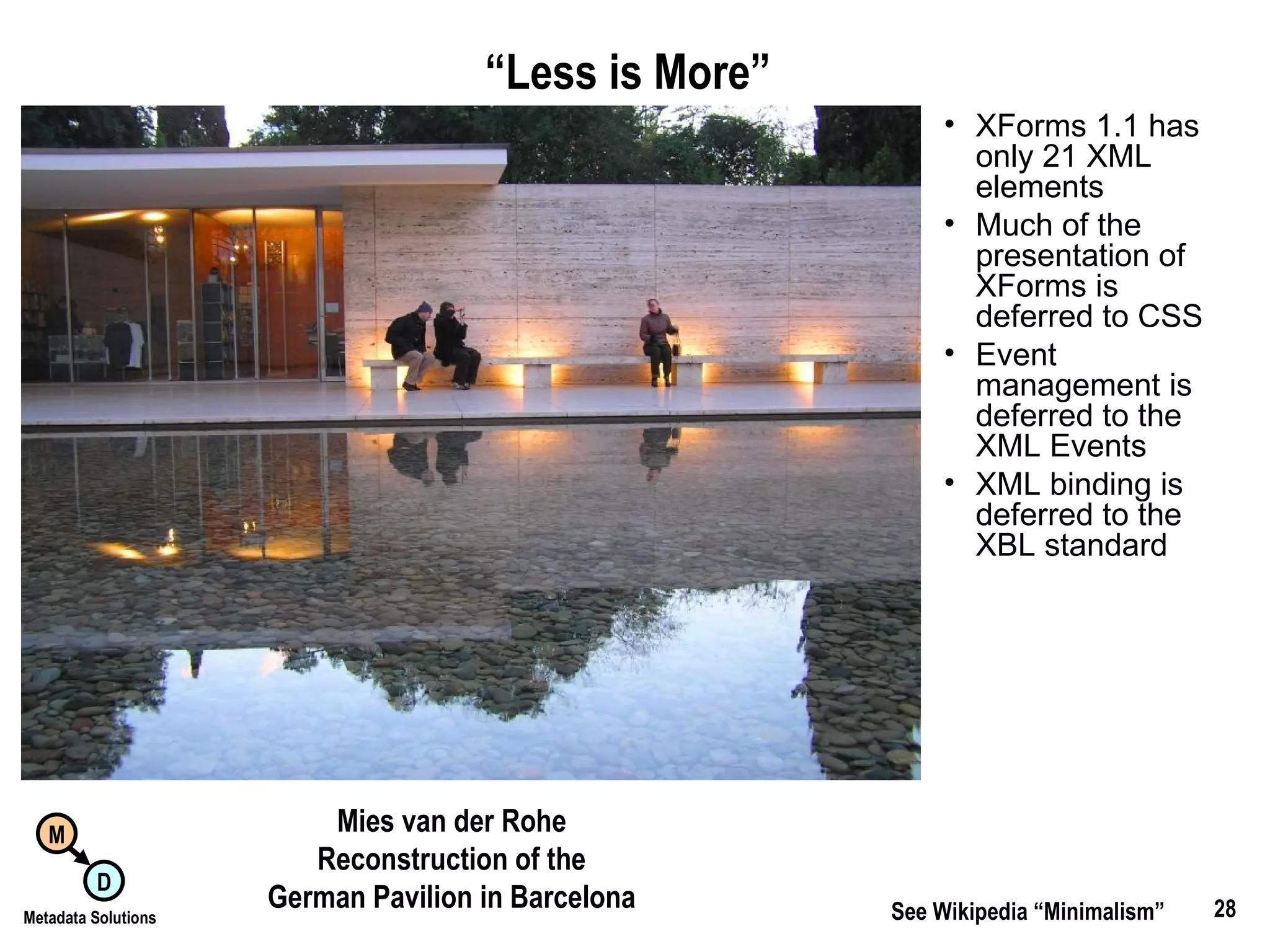
“ Less is More”   XForms 1.1 has only 21 XML elements Much of the presentation of XForms is deferred to CSS Event management is deferred to the XML Events XML binding is deferred to the XBL standard See Wikipedia “Minimalism” Mies van der Rohe Reconstruction of the German Pavilion in Barcelona
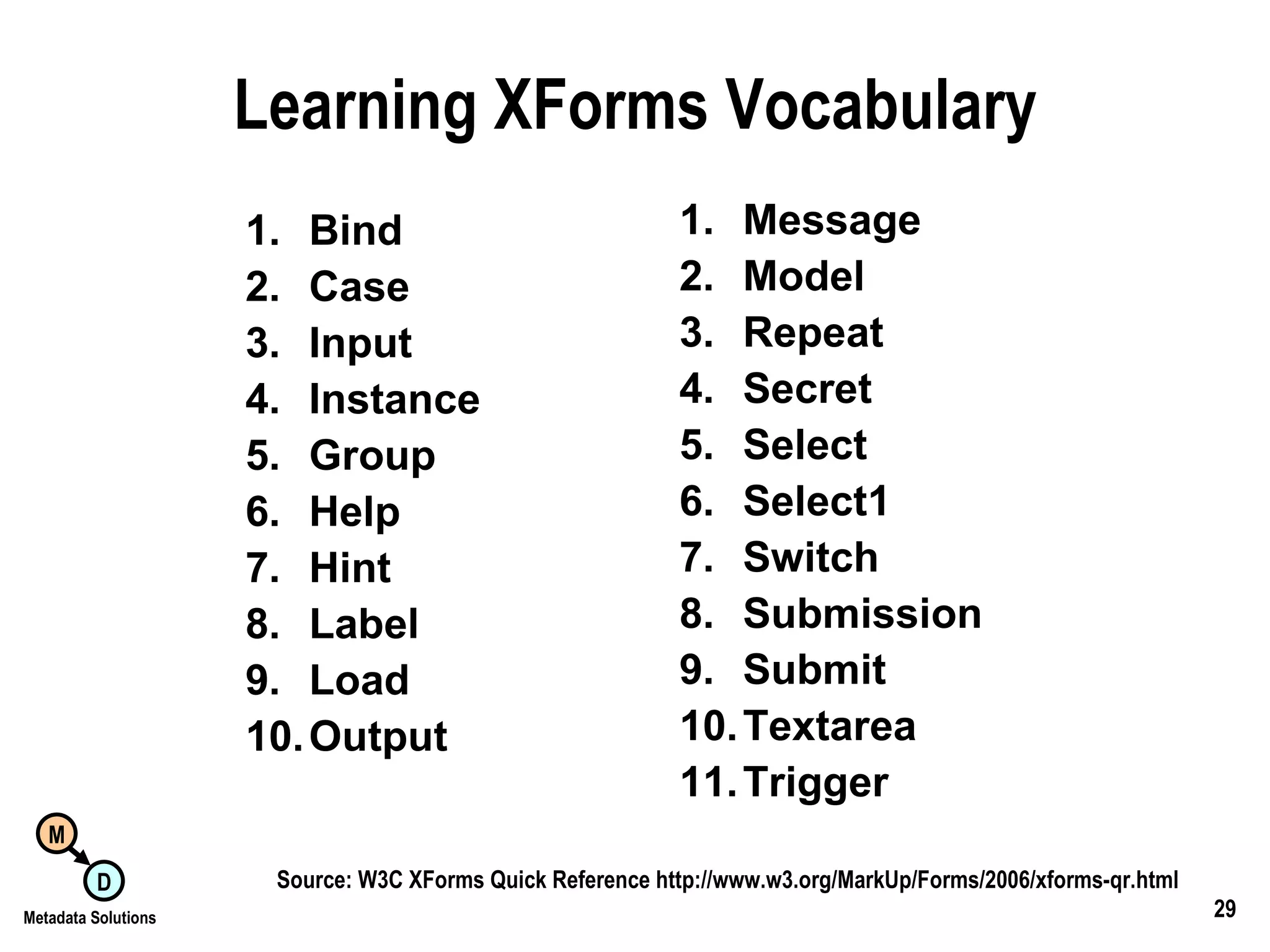
Learning XForms Vocabulary Bind Case Input Instance Group Help Hint Label Load Output Message Model Repeat Secret Select Select1 Switch Submission Submit Textarea Trigger Source: W3C XForms Quick Reference http://www.w3.org/MarkUp/Forms/2006/xforms-qr.html
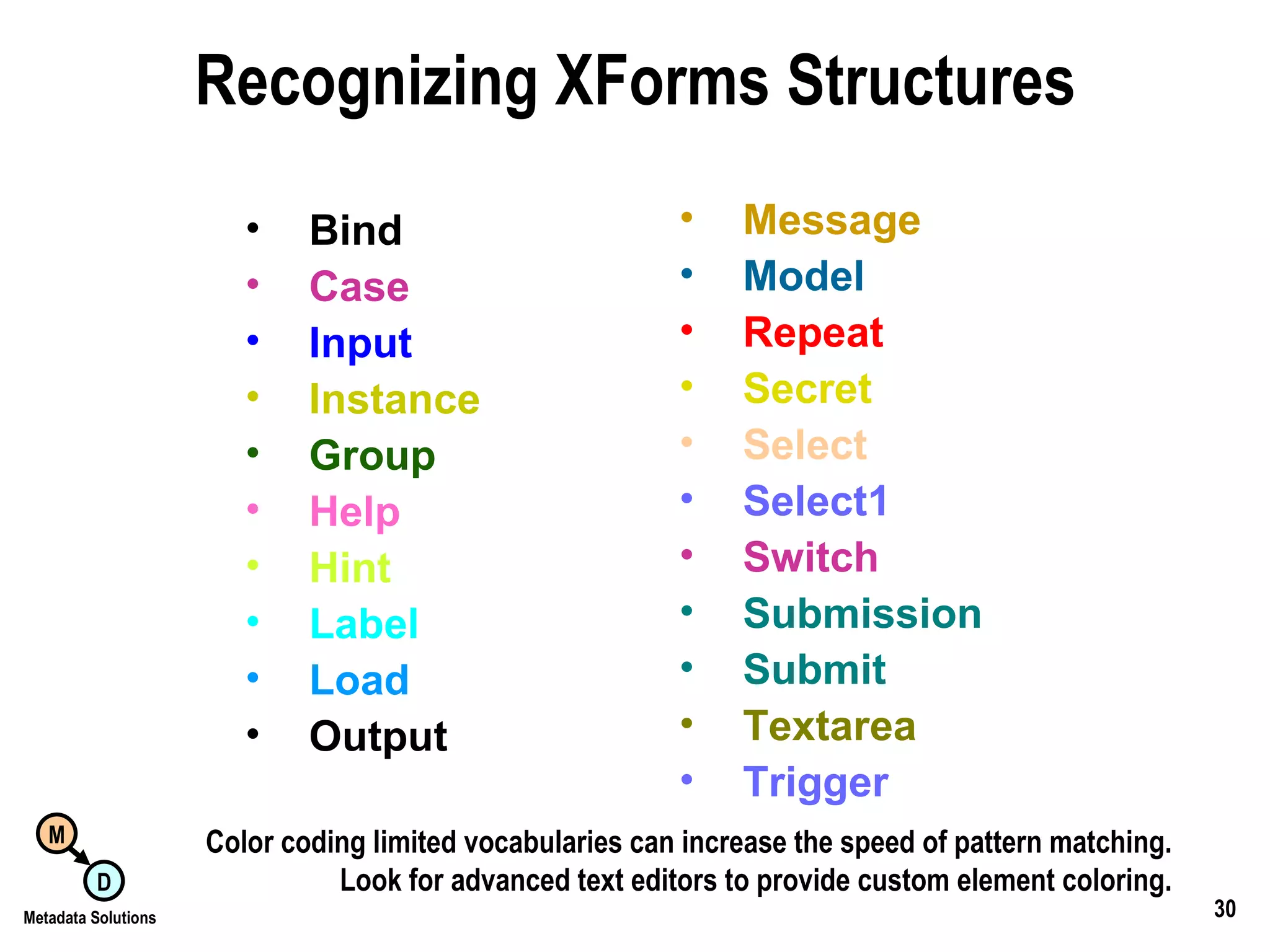
Recognizing XForms Structures Bind Case Input Instance Group Help Hint Label Load Output Message Model Repeat Secret Select Select1 Switch Submission Submit Textarea Trigger Color coding limited vocabularies can increase the speed of pattern matching. Look for advanced text editors to provide custom element coloring.
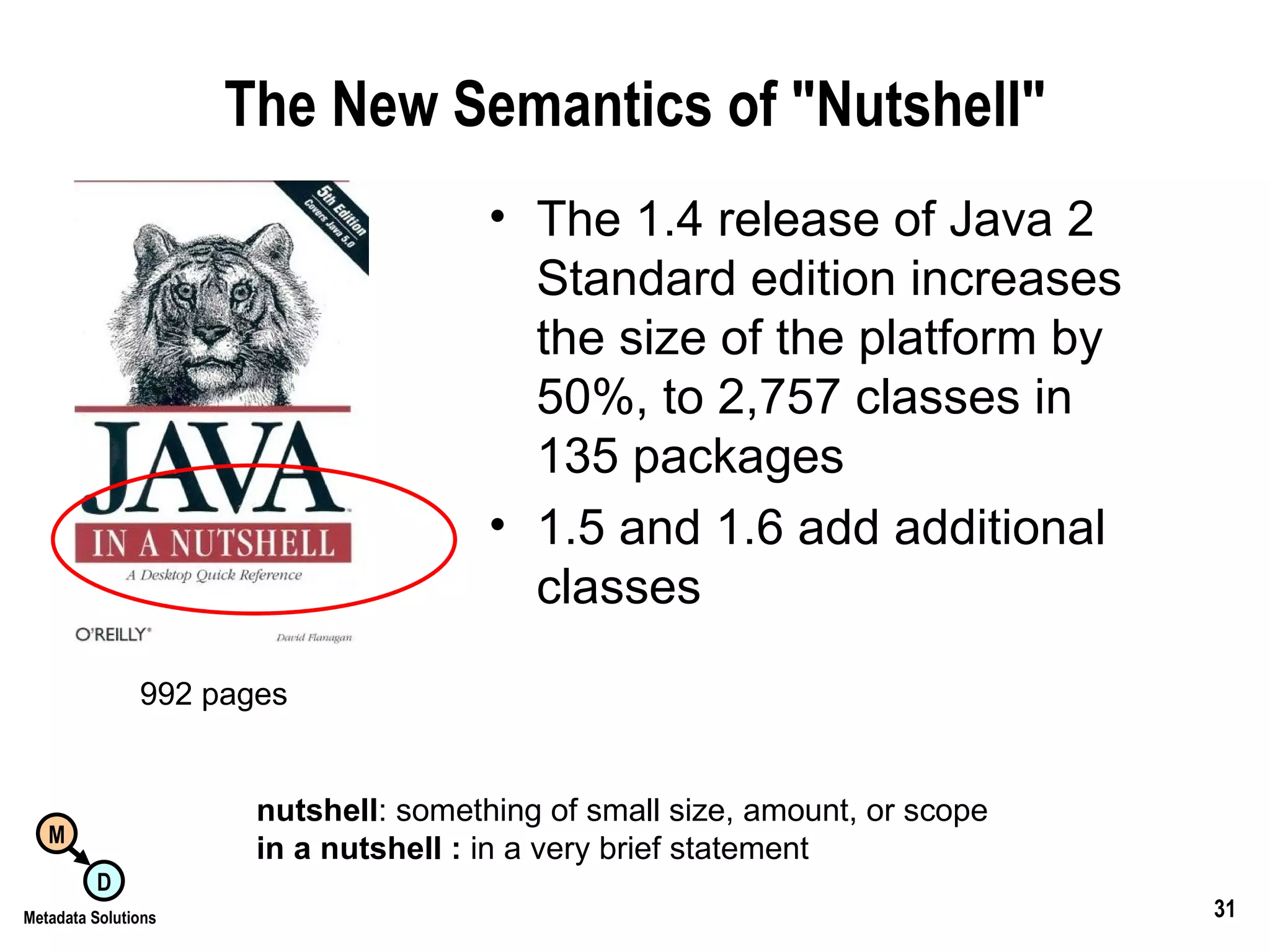
The New Semantics of &quot;Nutshell&quot; The 1.4 release of Java 2 Standard edition increases the size of the platform by 50%, to 2,757 classes in 135 packages 1.5 and 1.6 add additional classes nutshell : something of small size, amount, or scope  in a nutshell   :  in a very brief statement  992 pages
Procedural Programming is Not “Poison” It would be a mistake to tell all your procedural programmers that the programs they are creating are fundamentally evil The relevant questions are: How closely does it fit the problem domain? Can BAs, SMEs and other non-programmers maintain the business rules? What are the chances that others will be able to maintain it in future years? How good are the development tools for your system?
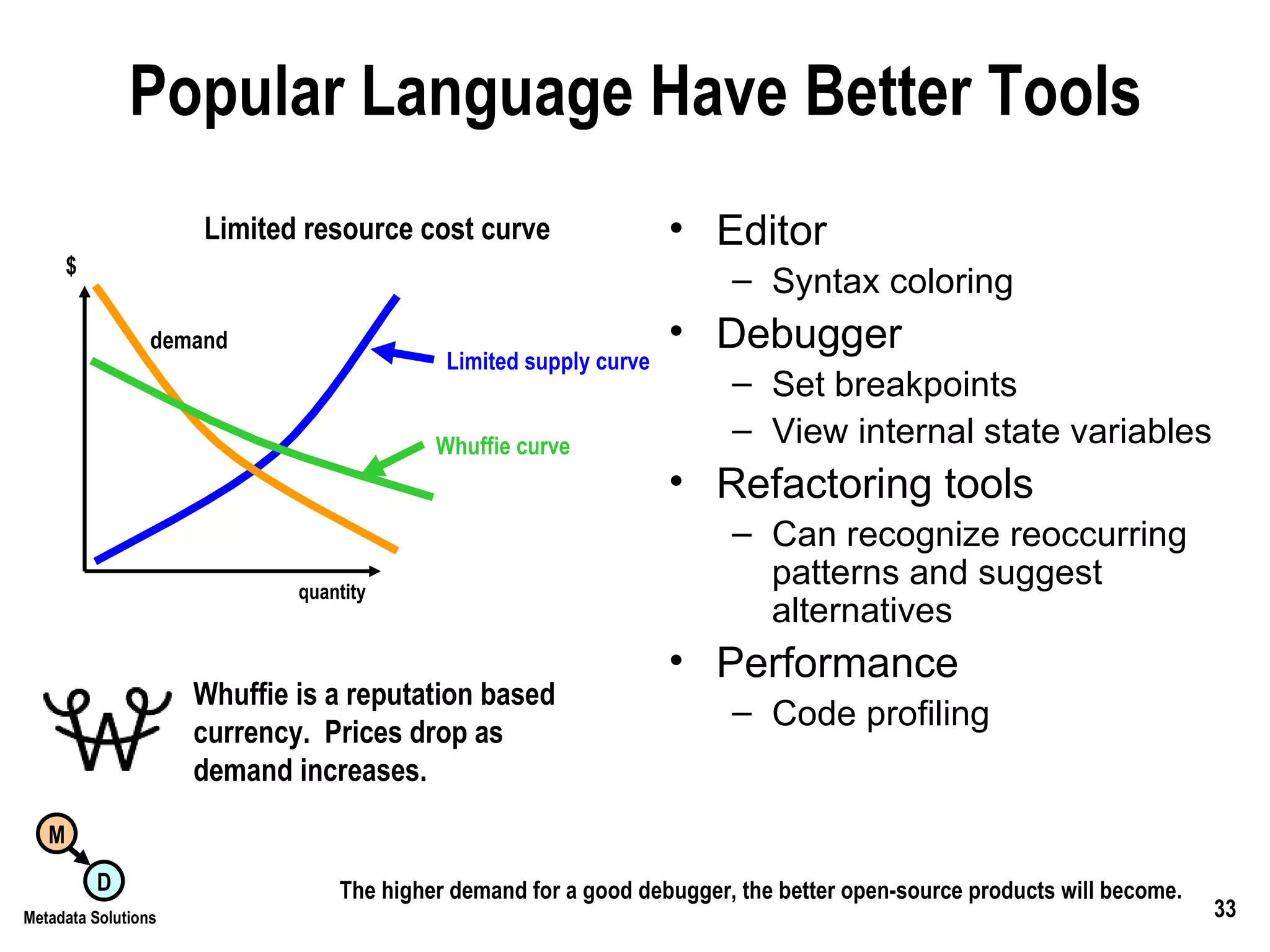
Popular Language Have Better Tools Editor Syntax coloring Debugger Set breakpoints View internal state variables Refactoring tools Can recognize reoccurring patterns and suggest alternatives Performance Code profiling demand Limited supply curve $ quantity Limited resource cost curve Whuffie curve Whuffie is a reputation based currency.  Prices drop as demand increases. The higher demand for a good debugger, the better open-source products will become.
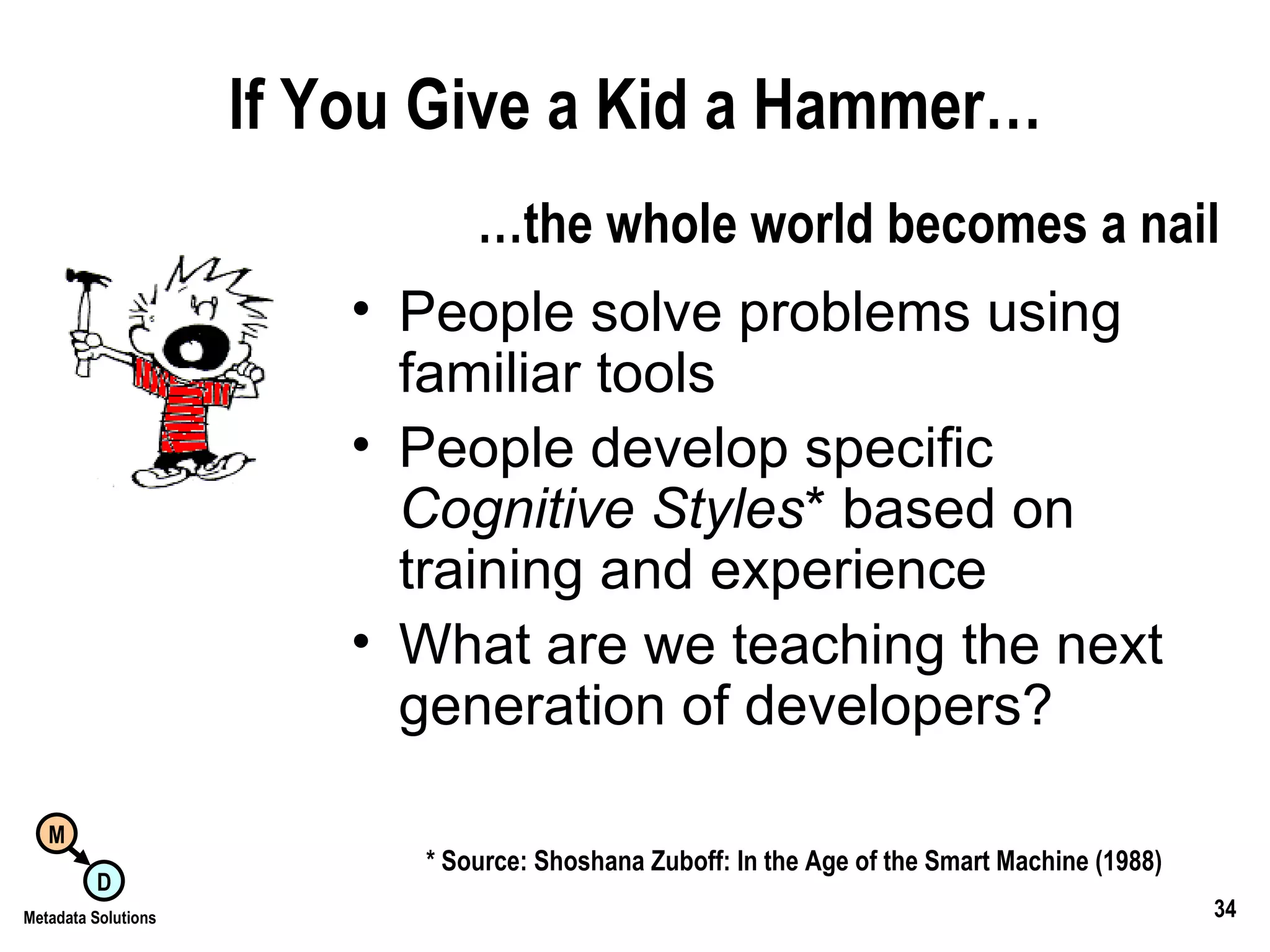
If You Give a Kid a Hammer… People solve problems using  familiar tools  People develop specific  Cognitive Styles * based on  training and experience What are we teaching the next generation of developers? * Source: Shoshana Zuboff: In the Age of the Smart Machine (1988) … the whole world becomes a nail
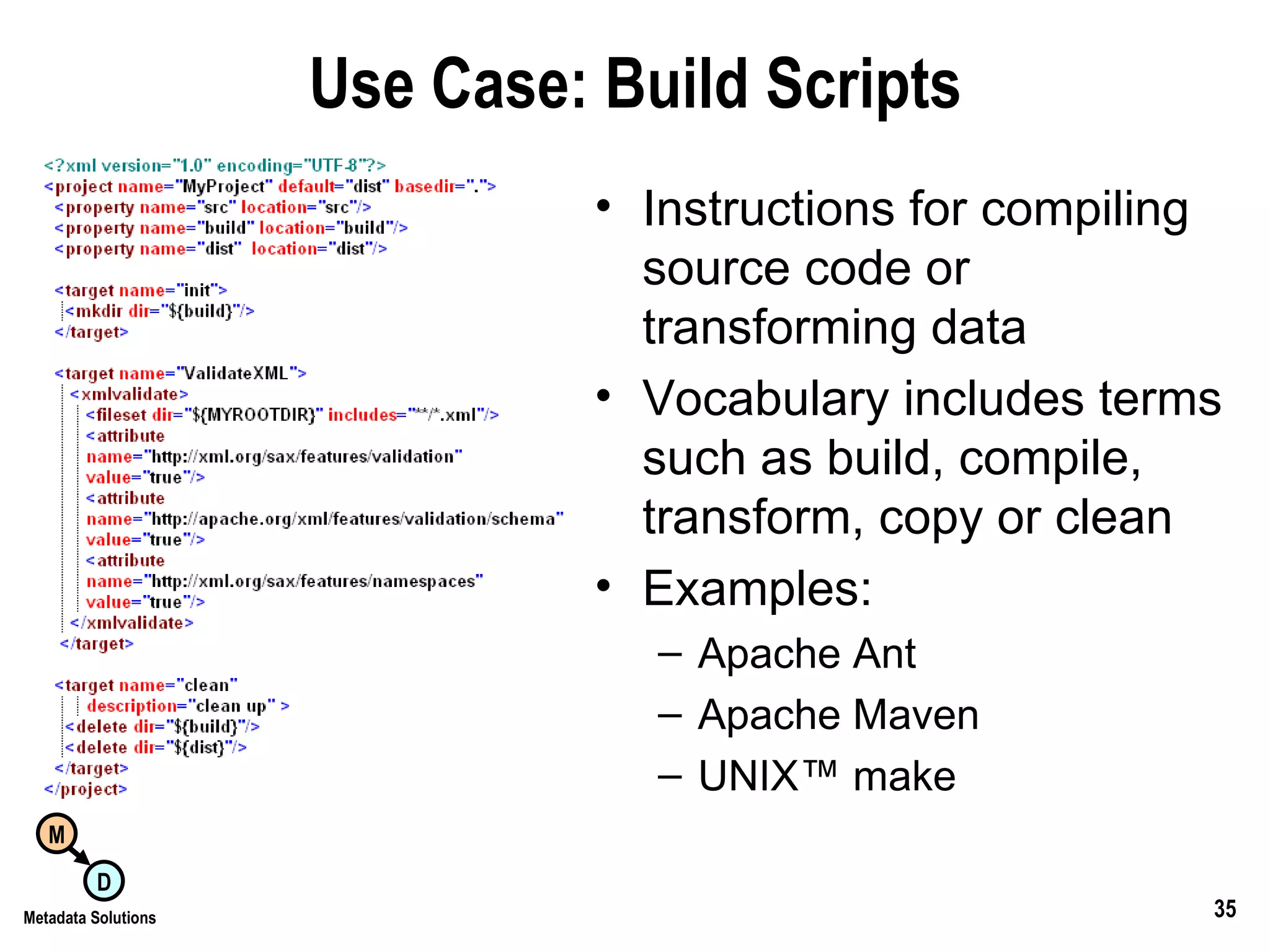
Use Case: Build Scripts Instructions for compiling source code or transforming data Vocabulary includes terms such as build, compile, transform, copy or clean Examples: Apache Ant Apache Maven UNIX™ make
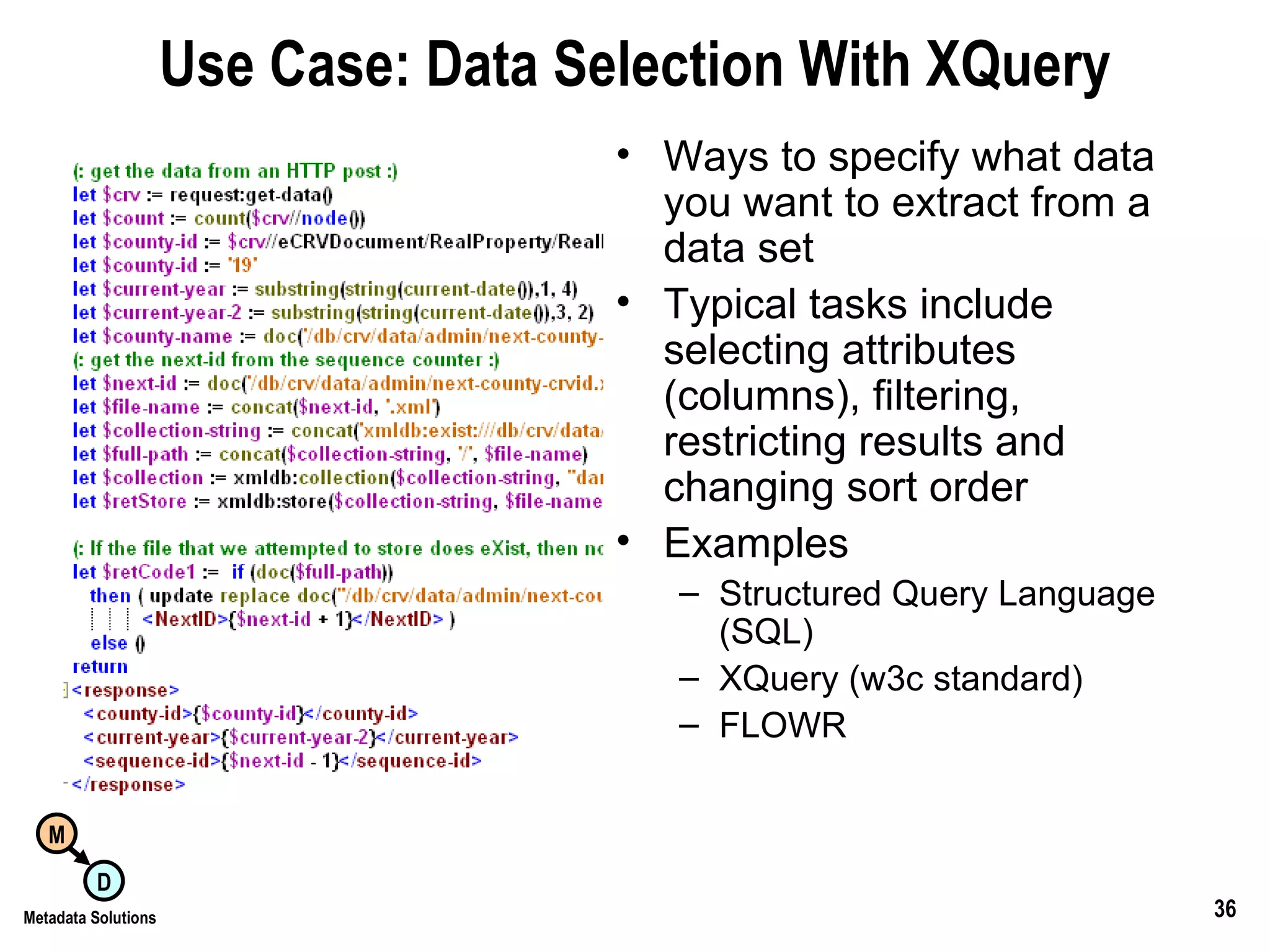
Use Case: Data Selection With XQuery Ways to specify what data you want to extract from a data set Typical tasks include selecting attributes (columns), filtering,  restricting results and changing sort order Examples Structured Query Language (SQL) XQuery (w3c standard) FLOWR
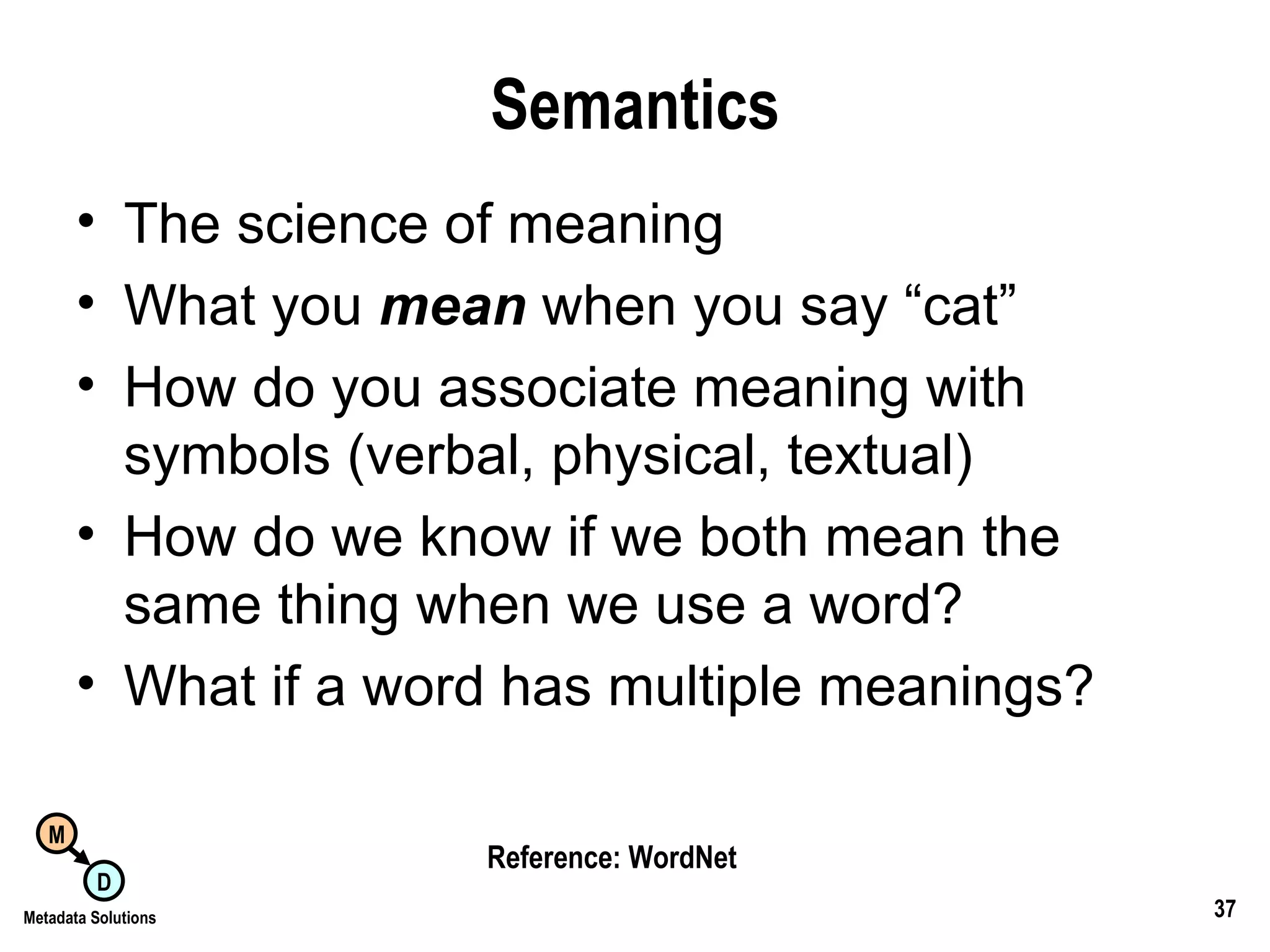
Semantics The science of meaning What you  mean  when you say “cat” How do you associate meaning with symbols (verbal, physical, textual) How do we know if we both mean the same thing when we use a word? What if a word has multiple meanings? Reference: WordNet
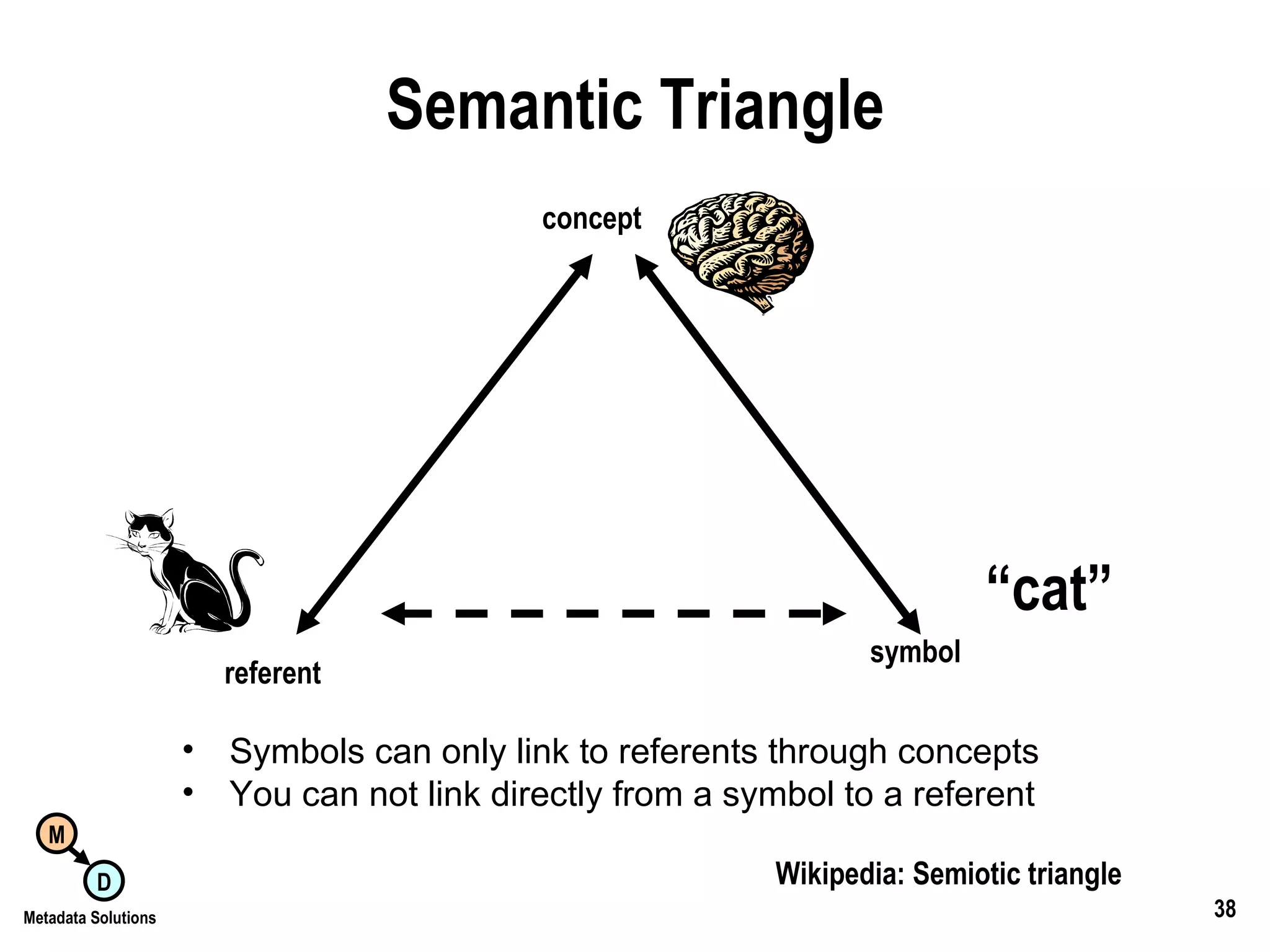
Semantic Triangle Symbols can only link to referents through concepts You can not link directly from a symbol to a referent referent concept symbol “ cat” Wikipedia: Semiotic triangle
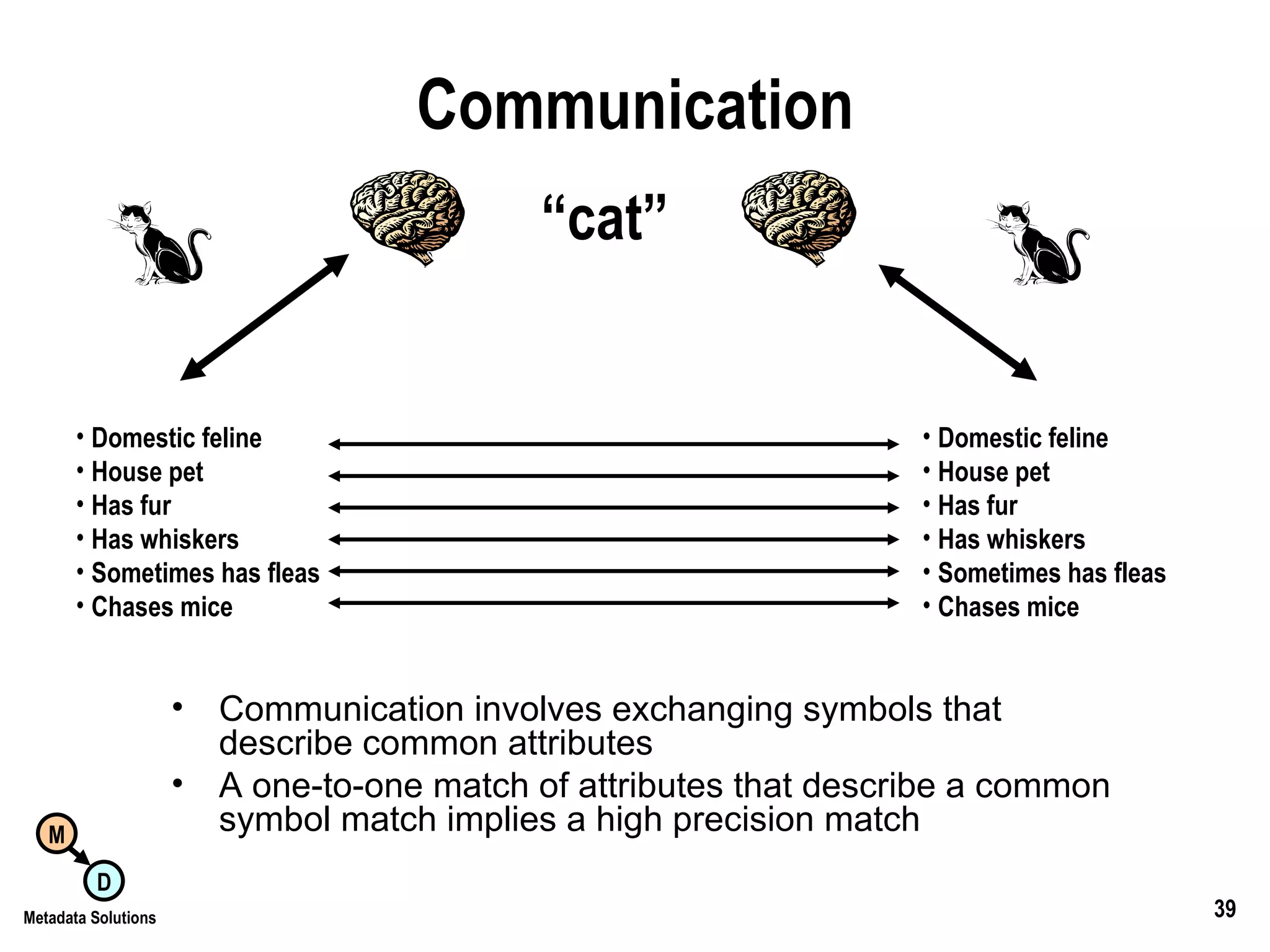
Communication Communication involves exchanging symbols that describe common attributes A one-to-one match of attributes that describe a common symbol match implies a high precision match “ cat” Domestic feline House pet Has fur Has whiskers Sometimes has fleas Chases mice Domestic feline House pet Has fur Has whiskers Sometimes has fleas Chases mice
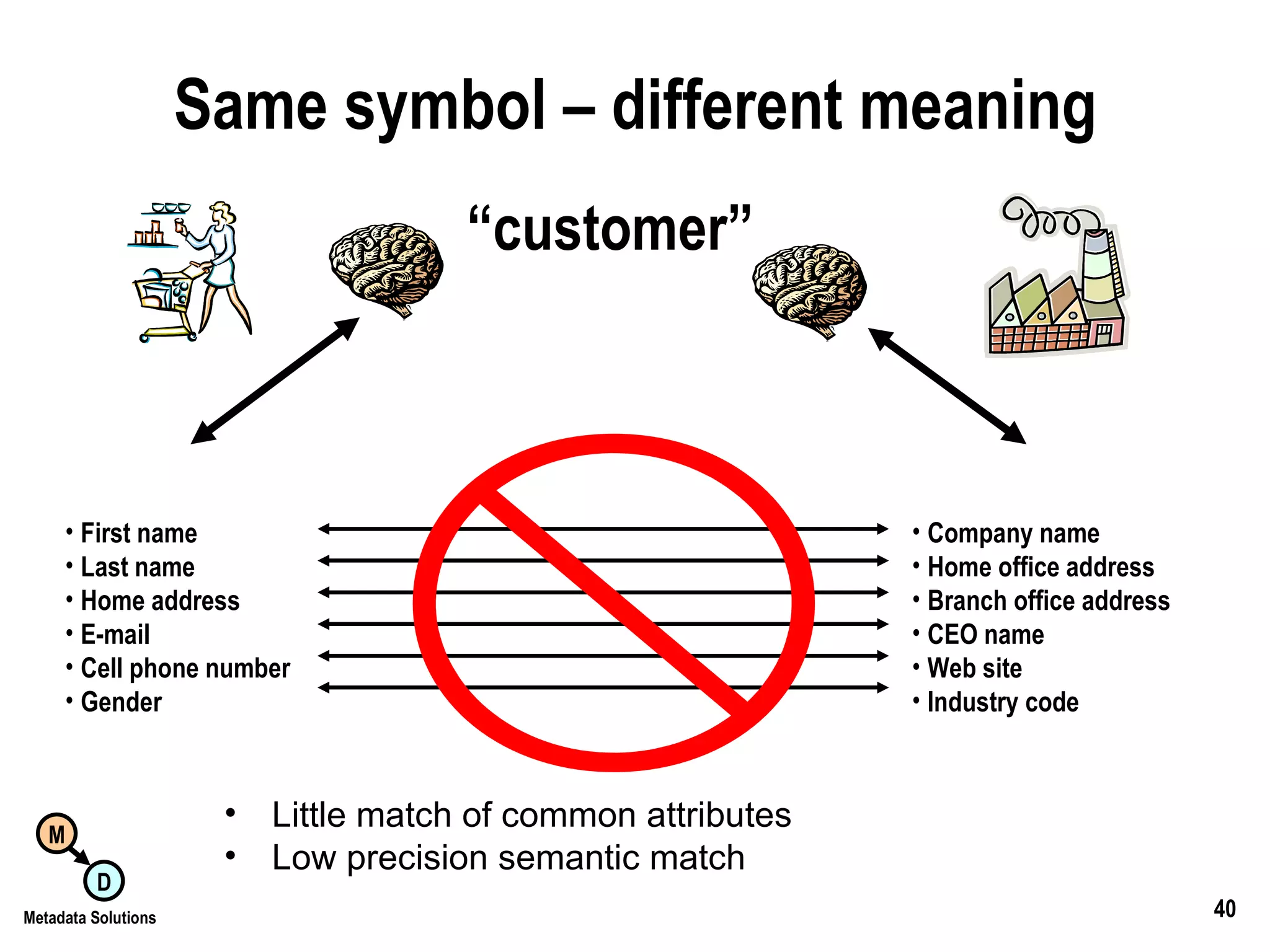
Same symbol – different meaning Little match of common attributes Low precision semantic match “ customer” First name Last name Home address E-mail Cell phone number Gender Company name Home office address Branch office address CEO name Web site Industry code
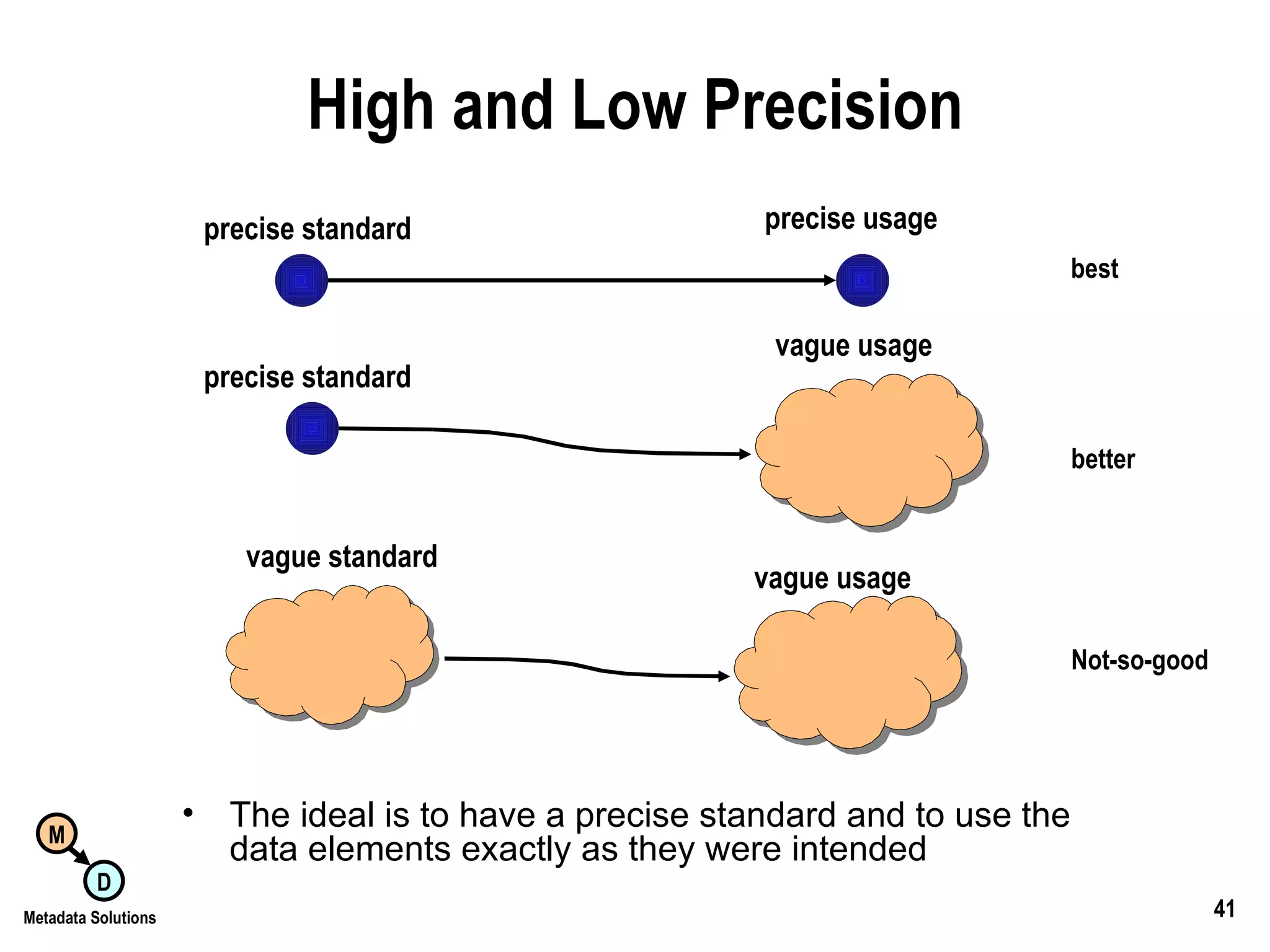
High and Low Precision The ideal is to have a precise standard and to use the data elements exactly as they were intended vague standard vague usage Not-so-good precise standard vague usage better precise standard precise usage best
Semantic Precision Semantic mappings are  relative   in time and between groups of people (organization) Semantic variability over  time Something that has precise meaning to you today may not have the same precise meaning a year from now Our memories are imperfect and change over time Semantic variability  across organizations  (project and organization) A “customer” to one organization may denote a person but to another organization it may denote a company
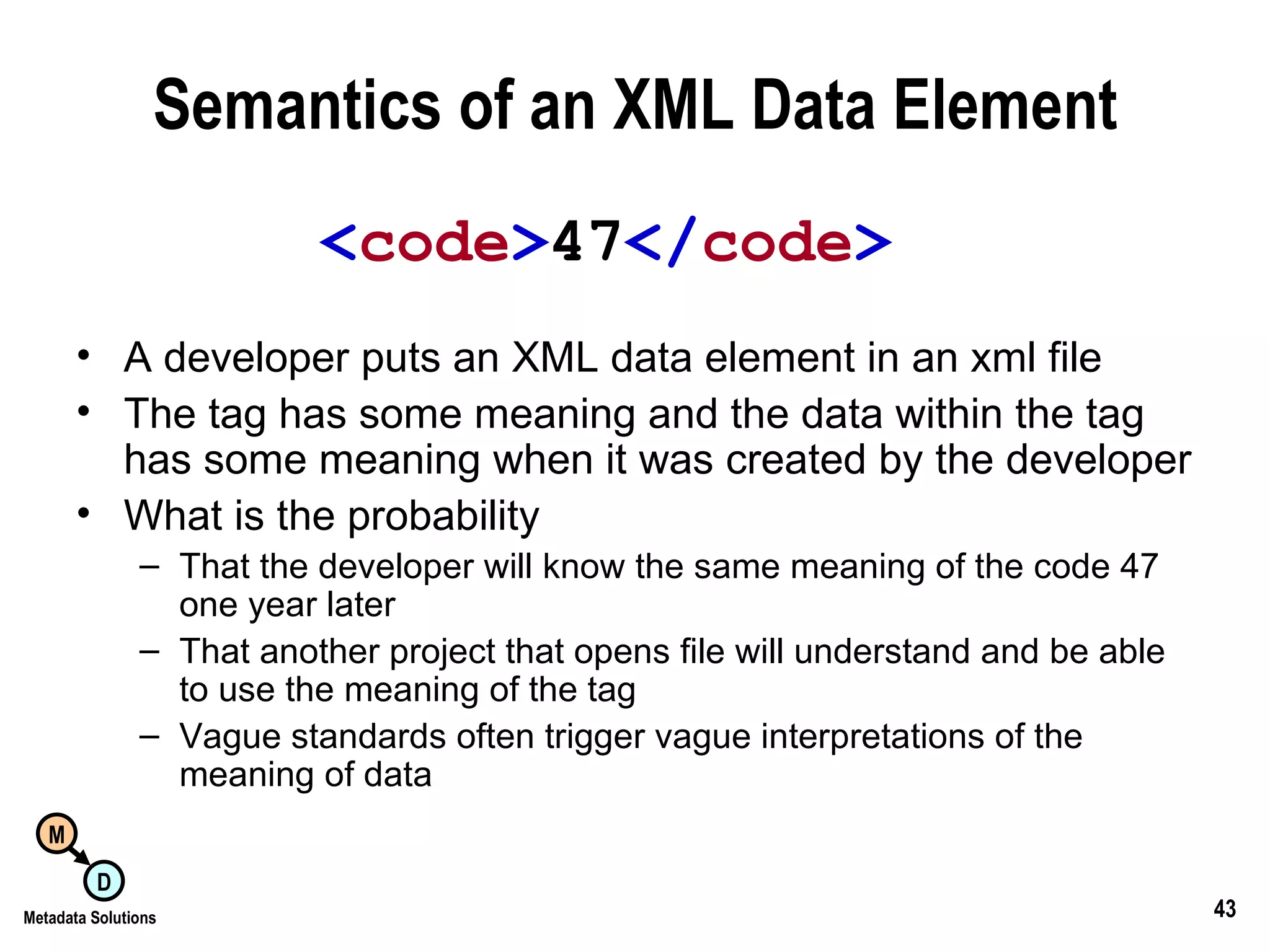
Semantics of an XML Data Element A developer puts an XML data element in an xml file The tag has some meaning and the data within the tag has some meaning when it was created by the developer What is the probability That the developer will know the same meaning of the code 47 one year later That another project that opens file will understand and be able to use the meaning of the tag Vague standards often trigger vague interpretations of the meaning of data < code > 47 </ code >
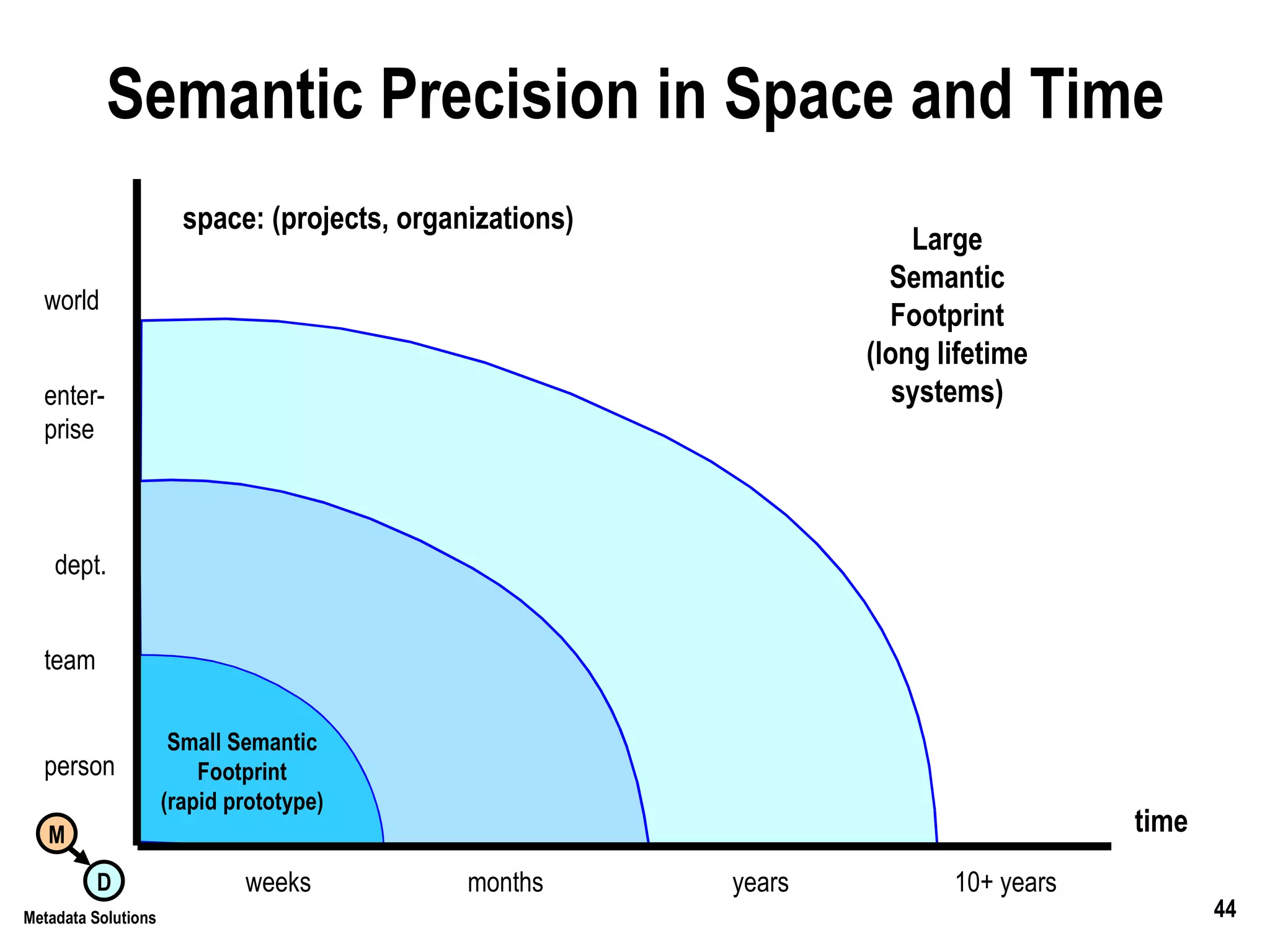
Semantic Precision in Space and Time time space: (projects, organizations) Small Semantic Footprint (rapid prototype) Large Semantic Footprint (long lifetime systems) weeks months years 10+ years person team dept. world enter- prise
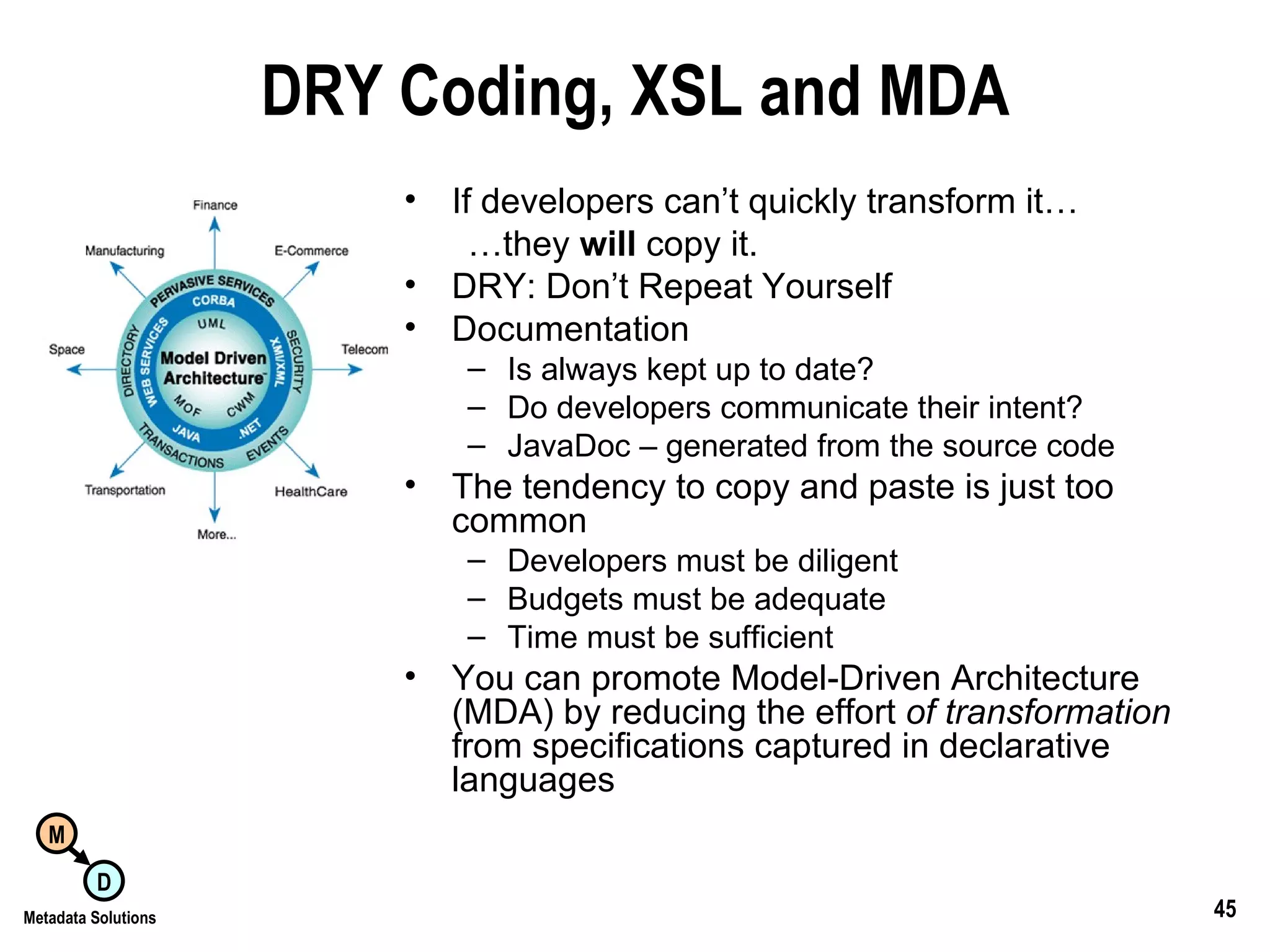
DRY Coding, XSL and MDA If developers can’t quickly transform it… … they  will  copy it. DRY: Don’t Repeat Yourself Documentation Is always kept up to date? Do developers communicate their intent? JavaDoc – generated from the source code The tendency to copy and paste is just too common Developers must be diligent Budgets must be adequate Time must be sufficient You can promote Model-Driven Architecture (MDA) by reducing the effort  of transformation  from specifications captured in declarative languages
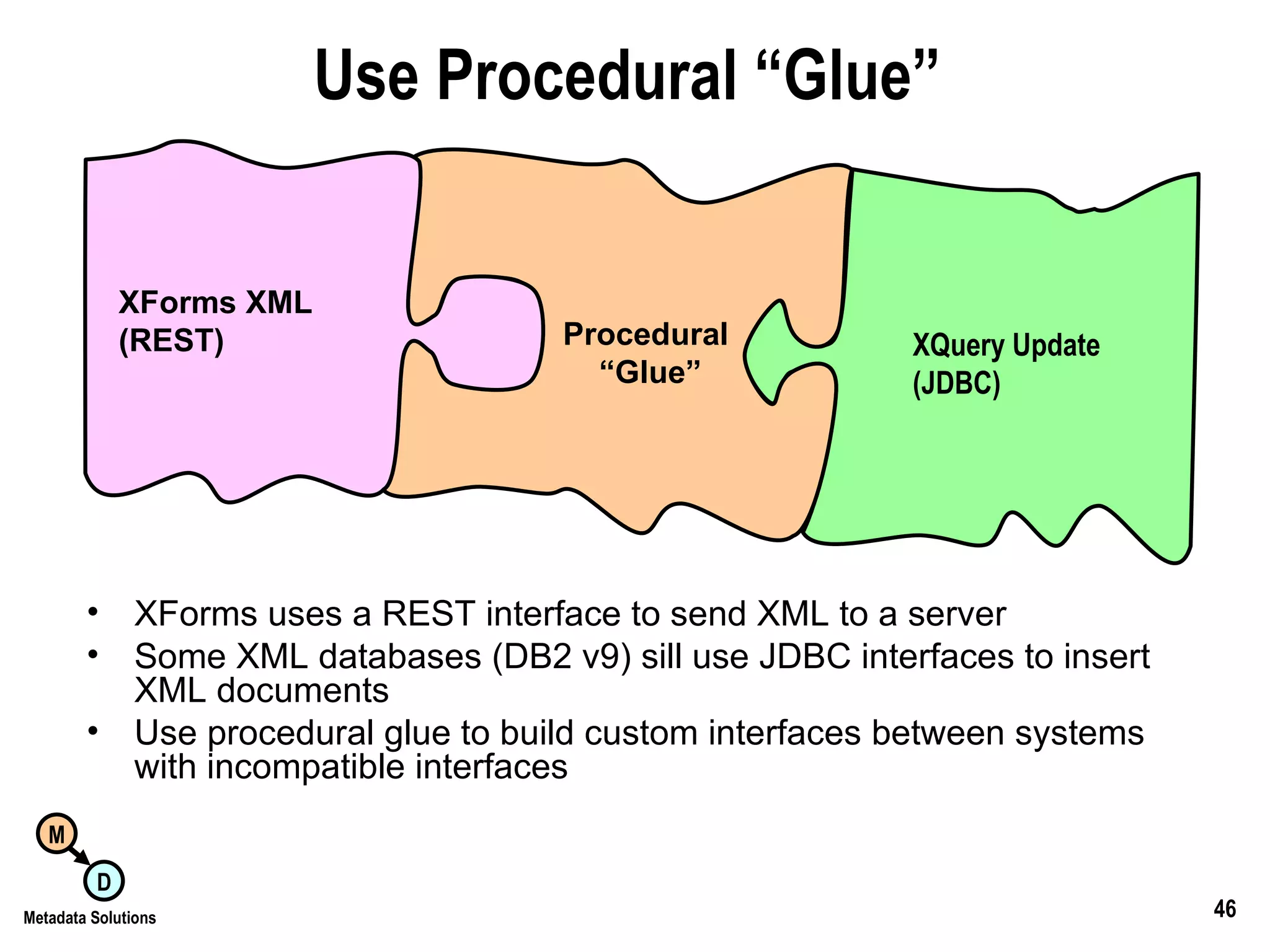
Use Procedural “Glue”  XForms uses a REST interface to send XML to a server Some XML databases (DB2 v9) sill use JDBC interfaces to insert XML documents Use procedural glue to build custom interfaces between systems with incompatible interfaces  Procedural  “Glue” XQuery Update (JDBC) XForms XML (REST)
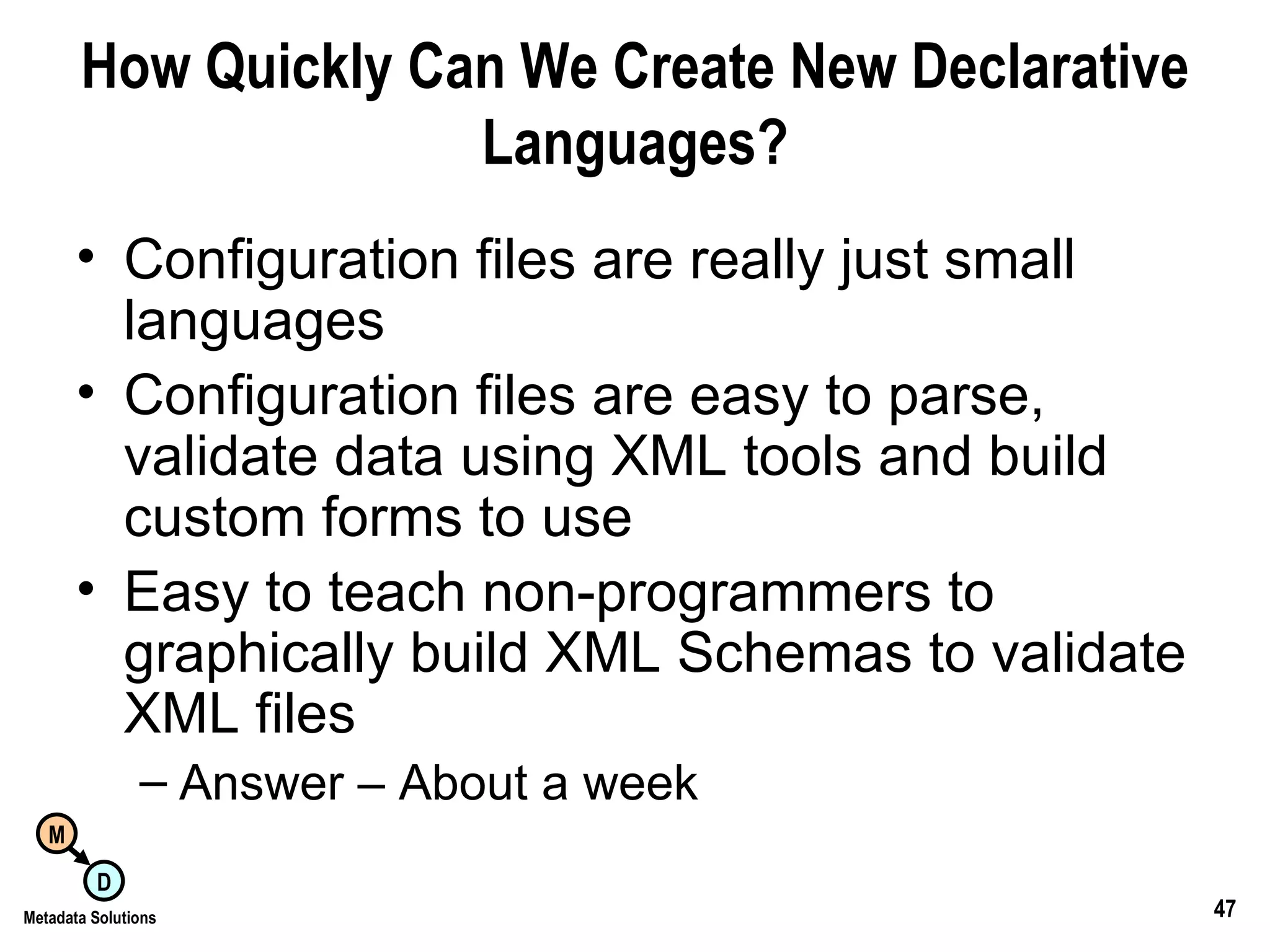
How Quickly Can We Create New Declarative Languages? Configuration files are really just small languages Configuration files are easy to parse, validate data using XML tools and build custom forms to use Easy to teach non-programmers to graphically build XML Schemas to validate XML files Answer – About a week
How Quickly Can We Create Consensus? Example: XForms standard Work started in 2001 XForms 2.0 is still a two to three years away How can we accelerate this consensus building process? What factors impact the rate that species evolve? What impact does life span have on a species? How are design ideas exchanged between species?
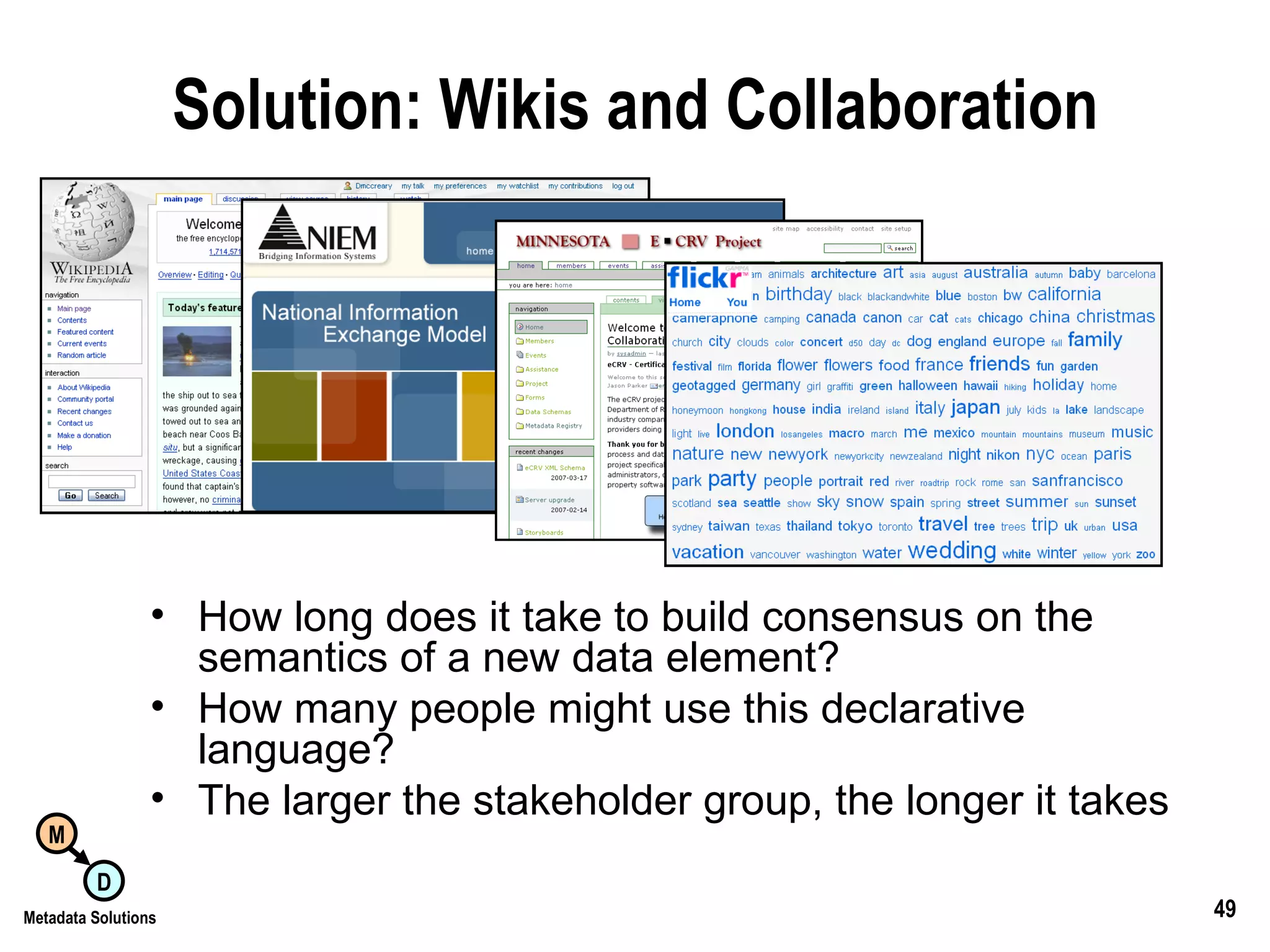
Solution: Wikis and Collaboration How long does it take to build consensus on the semantics of a new data element? How many people might use this declarative language? The larger the stakeholder group, the longer it takes
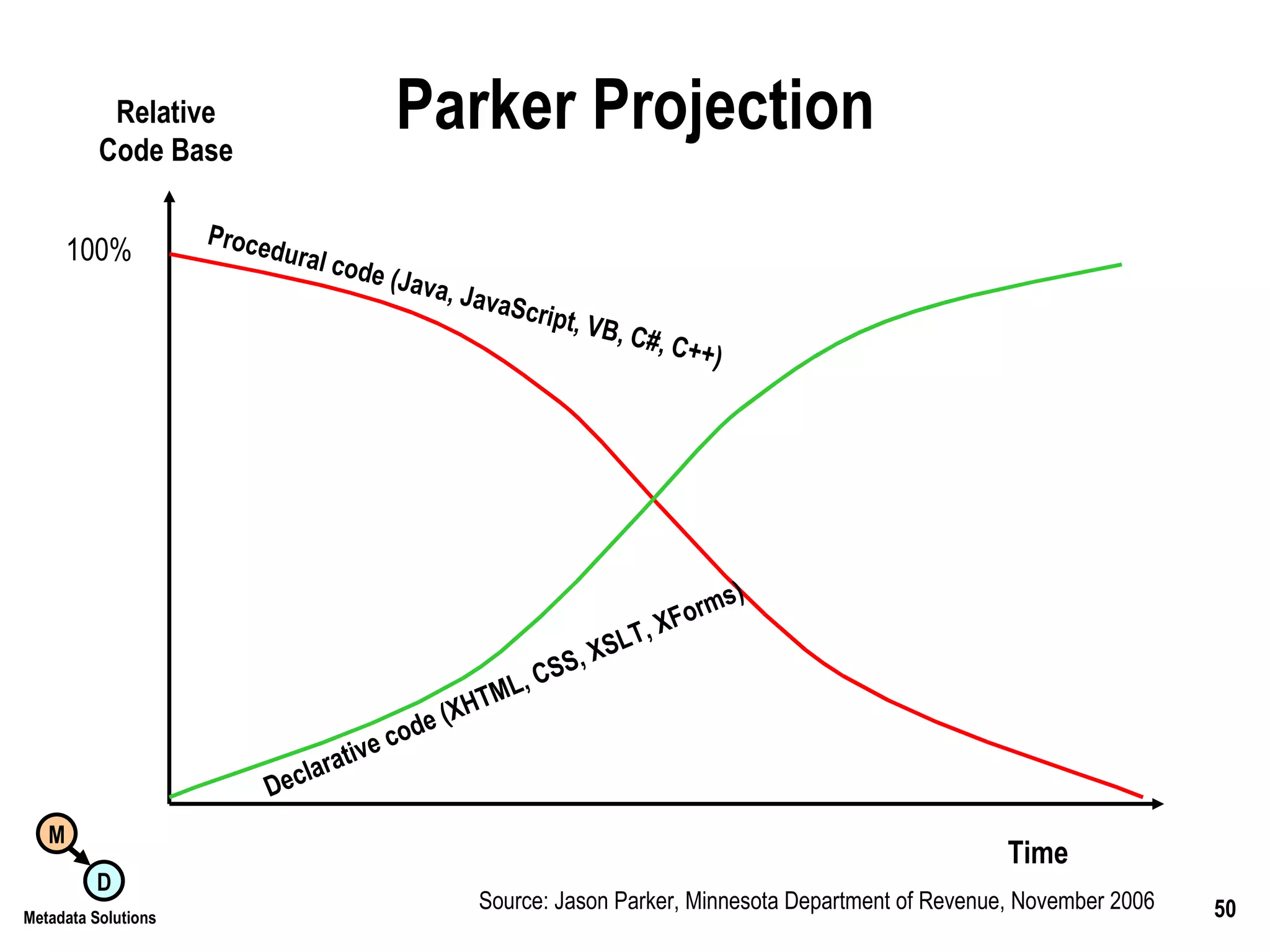
Parker Projection Time Source: Jason Parker, Minnesota Department of Revenue, November 2006 100% Relative Code Base Procedural code (Java, JavaScript, VB, C#, C++) Declarative code (XHTML, CSS, XSLT, XForms)
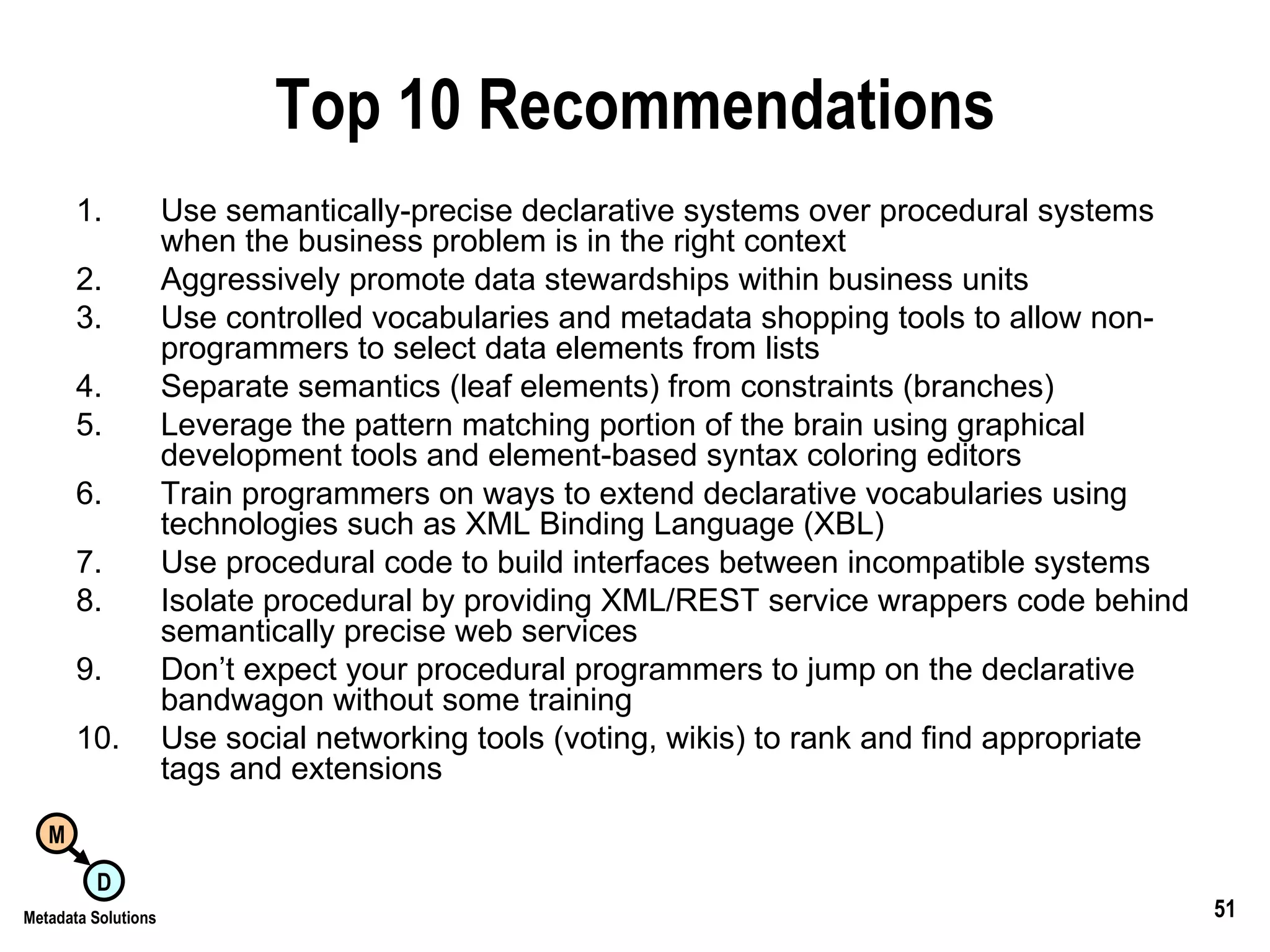
Top 10 Recommendations Use semantically-precise declarative systems over procedural systems when the business problem is in the right context Aggressively promote data stewardships within business units Use controlled vocabularies and metadata shopping tools to allow non-programmers to select data elements from lists Separate semantics (leaf elements) from constraints (branches) Leverage the pattern matching portion of the brain using graphical development tools and element-based syntax coloring editors Train programmers on ways to extend declarative vocabularies using technologies such as XML Binding Language (XBL) Use procedural code to build interfaces between incompatible systems Isolate procedural by providing XML/REST service wrappers code behind semantically precise web services Don’t expect your procedural programmers to jump on the declarative bandwagon without some training Use social networking tools (voting, wikis) to rank and find appropriate tags and extensions
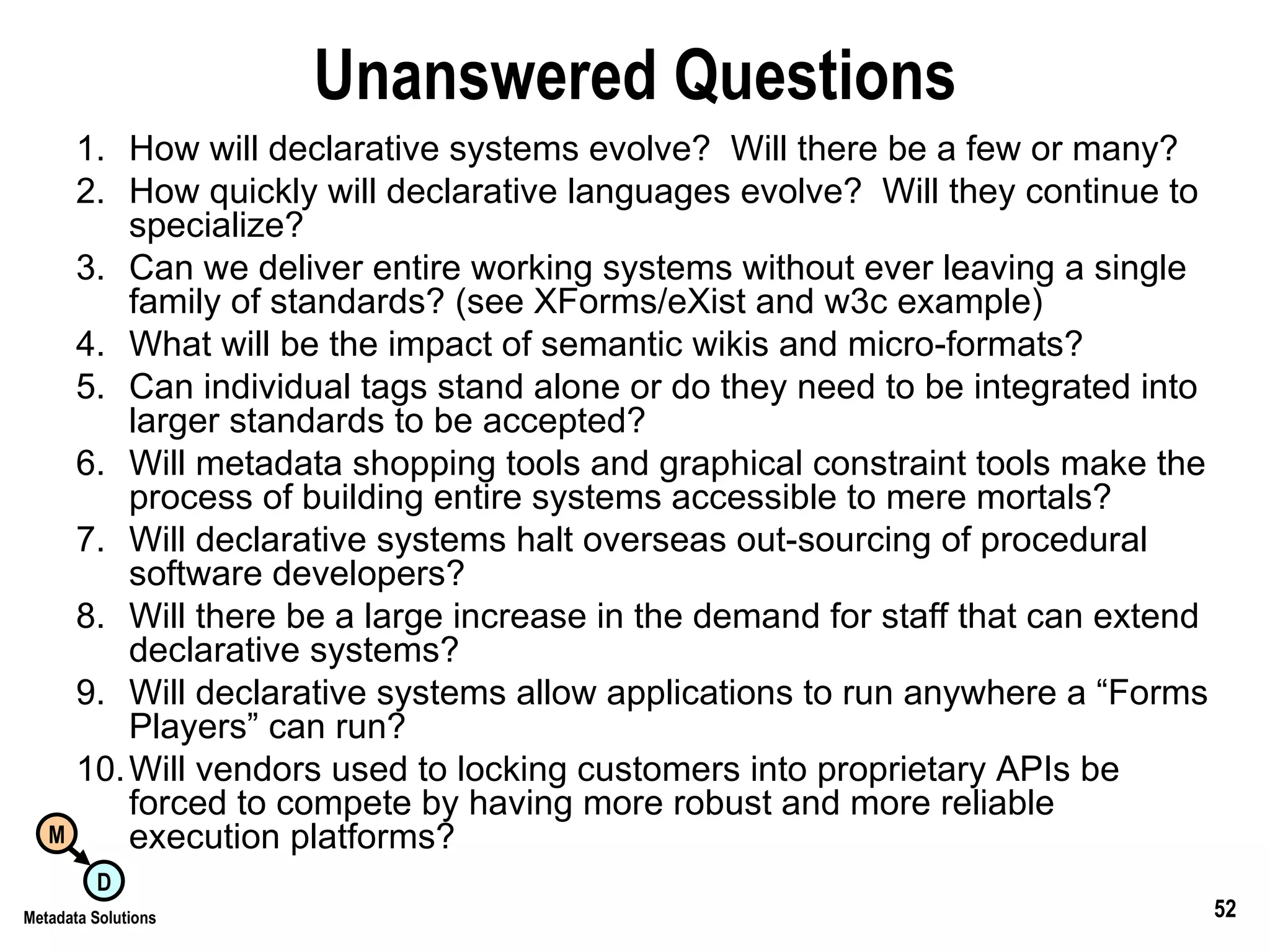
Unanswered Questions How will declarative systems evolve?  Will there be a few or many? How quickly will declarative languages evolve?  Will they continue to specialize? Can we deliver entire working systems without ever leaving a single family of standards? (see XForms/eXist and w3c example) What will be the impact of semantic wikis and micro-formats? Can individual tags stand alone or do they need to be integrated into larger standards to be accepted? Will metadata shopping tools and graphical constraint tools make the process of building entire systems accessible to mere mortals? Will declarative systems halt overseas out-sourcing of procedural software developers? Will there be a large increase in the demand for staff that can extend declarative systems? Will declarative systems allow applications to run anywhere a “Forms Players” can run? Will vendors used to locking customers into proprietary APIs be forced to compete by having more robust and more reliable execution platforms?
Selected References Evolution Charles Darwin,  Origin of the Species Richard Dawkins,  The Blind Watchmaker Cognitive Styles Shoshana Zuboff:  In the Age of the Smart Machine  (1988) Building Trust Succeeding with Objects: Decision Frameworks for Project Management , Adele Goldberg and Kenneth S. Rubin XML Data Standards NIEM Concept of Operations at NIEM.gov ISO/IEC 11179 (wikipedia) XForms XForms.org, wikipedia Domain Specific Languages Niel Ford, Language Oriented Programming Martin Flowler http://www.infoq.com/presentations/domain-specific-languages

Semantics In Declarative Systems

  • 1.
    Semantics in DeclarativeSystem The Evolution of Business Unit Empowerment Dan McCreary Dan McCreary & Associates Wednesday, 5/23/2007 8:00 AM - 9:00 AM Level: Business/Strategic M D Metadata Solutions
  • 2.
    Presentation Summary “Declarative programming” has become the latest buzzword to describe languages that abstractly define systems requirements (the what ) and leave the implementation (the how ) to be determined by an independent process. This makes the semantics (meaning) of declarative data elements even more critical as these systems are shared between organizations. This presentation: Provides a background of declarative programming Describes why understanding the semantic aspects of declarative systems is critical to cost-effective software development Note: All opinions stated in this paper are solely those of the author.
  • 3.
    Presentation Summary (cont)Discusses declarative and semantic aspects of common development systems such as; XHTML, CSS, XForms, XML transforms, XML Schemas, OWL, metadata registries, web services, composition, service-oriented architectures (SOA) and the enterprise service bus (ESB) Discusses how social networking software and Wikis are used to quickly build consensus on precise semantics Presents ten specific recommendations to lower costs of agile information systems
  • 4.
    Presentation Includes Definitions of declarative systems and contrasts with them with traditional procedural systems and stand-alone declarative languages A critical analysis of semantics in declarative systems Case studies using XForms, Wikis and other collaborative software The role of social networking systems, reputation and trust in the development of semantically precise declarative frameworks Specific recommendations of how organizations can be more effective by integrating semantics and declarative systems into their software development processes
  • 5.
    Evolution Metaphors Specializationof Languages Generalization of Languages
  • 6.
    Evolution: Specialization Darwin’sGalapagos Finches Beaks are highly adapted to different food sources Finches adapted to specific ecological &quot;niches“ over millions of years of isolated evolution Similar to domain-specific declarative languages See Wikipedia &quot;Darwin's Finches&quot;
  • 7.
    Evolution: Generalization Generalization:The Raccoon The world has a higher population of raccoons today due to their ability to quickly adapt to changing urban environments Similar to highly adaptive procedural languages
  • 8.
    Computer Science Abstractionstime Higher abstractions Assembly 1010001010 Fortran FOR I = 1 TO 10 DO Structured Function(A, B) Object Class MyClass( Method MyMethod Declarative <xf:input> <xf:label>
  • 9.
    The Software DevelopmentProcess Requirements are about “What” Design and Build is about “How” Requirements (BA) Design (Architect) Build (Programmer) Test (QA Staff) Declarative Languages
  • 10.
    A Declarative “System”Is… A software development system, tailored to a specific domain (such as web applications), used to capture precise business requirements within the context of a problem domain (the implicit context) Declarative systems do not specify how requirements are implemented to build working systems. Declarative systems only define the requirements Declarative systems document requirements in specialized vocabularies and can be used to generate entire working systems including user interfaces, persistence and test data Declarative systems specifically omit some assumed requirements (such as system availability, performance, reliability, security etc) A Declarative system is a set of &quot; little languages &quot; with precise semantics that fit together like a puzzle to solve a problem
  • 11.
    Computer Science DefinitionDo not confuse a “Declarative System” with the computer science language taxonomy “Declarative Language” “ Declarative languages&quot; are used to describe a group of programming languages and to contrast them against imperative languages. Declarative Languages Functional Languages Logic Languages Constraint Languages Have sub-types See Wikipedia “Declarative Programming”
  • 12.
    Declarative Systems andContext Declarative Systems are specialized languages for capturing requirements within a specific domain Just as the word “play” connotes meaning based on context* (i.e. theater vs. a playground), a given vocabulary has the ability to capture requirements based on the current problem The vocabulary for capturing electronic form requirements (XML Schema) may not be appropriate for expressing your build process (Apache Ant) * See: http://wordnet.princeton.edu
  • 13.
    HTML, CSS andSQL HTML, CSS, XQuery and SQL are declarative languages using these definitions The semantics or “meaning” of each tag in the file is determined by an external organization The syntax does not have to be XML <?xml version=&quot;1.0&quot; encoding=&quot;UTF-8&quot;?> < html xmlns =&quot; http://www.w3.org/1999/xhtml &quot;> < head > < title > Declarative Systems </ title > </ head > < body > < h1 > Introduction to Declarative Systems </ h1 > < p class =&quot; author &quot;> Dan McCreary </ p > < p class =&quot; date &quot;> April 2007 </ p > </ body > </ html > HTML /* global CSS used by all web pages */ body { font-family : Arial, Helvetica, sans-serif; font-size : 75%; margin : 0; padding : 0; width : 1000px; } h1 { color : blue ; padding : 0 15px; } CSS -- Old expensive books SELECT title, author, price, pubyear FROM books WHERE price > 100 AND pubyear BEFORE ‘1960’ ORDER BY title SQL xquery version &quot;1.0&quot; ; < html >< body > < h1 > Old Expensive Books </ h1 > < ul > { for $book in doc ( &quot;books.xml&quot; )//book order by $book /title return < li > { $book /title}, { $book }/author}, { $book }/price}, { $book }/pubyear} </ li > } </ ul ></ body ></ html > XQuery http://www.w3.org/TR/REC-html32#body
  • 14.
    XML Schema SampleScreen capture of Altova XML Spy 30 minutes to learn graphical notation See: http://www.altova.com/products/xmlspy/graphical_xml_schema_editor.html
  • 15.
    Use Case: ElectronicForms User fills out a web-based form Typical requirements may include listing of data to be gathered, data types, validation codes and data repetition patterns Examples: HTML Forms XForms InfoPath™
  • 16.
    Forms Players <html><head> <xf:model> <xf:/model> <head> <body> <xf:input> </xf:input> </body> </html> My-XForm.xhtml See Wikipedia “XForms” Rendered Form XForms “Players” XForms Extension Mobile Client Forms Server Netfront Mobile
  • 17.
    What Is Declarativenessfor A Context? Efficiency at capturing the testable business requirements in a semantically precise and concise manner Example: Is a field optional? Will validation of the data fail if the field is missing? Ability of each data element to have precise meaning over time and within organizations Schema Drawing Tool XML Schema File (.xsd) XForms xf|input:required {font-weight: bold;} xf|input:required .xf-value {background-color:#fff6af;} *:required::after {font-weight:bold; font-size:1.5em; content: &quot;*&quot;; color: red; } XForms CSS tags
  • 18.
    Declarative Spectrum Forany given context different “languages” have different levels of “declarativeness” General purpose languages are less abstract but can solve a wide variety of problems Declarative languages have a more narrow purpose and target a specific problem like styling a web page or selecting data HTML Java Assembly Language C C++ JavaScript C# CSS XSL XML Schema Apache Ant XForms XQuery XQuery Update SQL XPath Ruby perl Groovy Python XUL Narrow Purpose More Abstract General Purpose Less Abstract
  • 19.
    Middle-Tiers Remain ProceduralWhen the interface is consistent, declarative languages flourish Middle tiers tend to have the most variation Wikipedia lists over 200 web application frameworks CMSMatrix.org lists over 700 content management systems user database declarativeness Presentation/style (client tier) Data definition, insert, selection and update (persistence tier) Business Logic (middle tier) See: http://en.wikipedia.org/wiki/List_of_web_application_frameworks and http://www.cmsmatrix.org
  • 20.
    The Application DevelopmentPuzzle Semantics Constraints Presentation Build Publish Transform Workflow Query Update Forms
  • 21.
    Filling In EachPiece With A Declarative Language XMLSchema CSS HTML Apache Ant Metadata Registry Cocoon XSL BPEL XQuery XQuery Update XForms
  • 22.
    Semantically Precise VocabulariesSee: http:// en.wikipedia.org/wiki/Category:XML-based_standards XML Business Reporting Language XBRL US Department of Justice (registry) GJXDM School Interoperability Framework SIF OpenTravel Alliance (Travel industry) OTA National Information Exchange Model (registry) NIEM Mortgage Industry MISMO Healthcare (now using XML) HL7 Banking (Financial Information eXchange) FixML Financial Products Markup Language FpML Insurance Industry Forms Data ACORD Syndication/Notification Atom/RSS Domain Standard
  • 23.
    Metadata Shopping ToolsYou don’t need to know about 100,000 SKUs to purchase 10 items from a grocery store Sub-schema generation tools give you exactly what you need and nothing more Phone Address FirstName See http://niem.gtri.gatech.edu/iepd-ssgt/SSGT-SearchSubmit.do
  • 24.
    Criteria for SemanticPrecision Is there a published standard? Are there ISO/IEC 11179 definitions? concise, precise, non-circular, distinct Are people using it? Do a Google search > 100,000 and you are safe < 10,000 and you should be concerned Examples: filetype:owl, filetype:xsd See “Metadata publishing” Wikipedia
  • 25.
    If You UseIndustry Standards… You Could Be Almost Done… If you use industry standards… and these standards publish their documents in XML Schema format… and these standards have been transformed from XML Schema to XForms… and you use native XML databases to store and XQuery to report on the data… … then sample applications have been created and do not require additional procedural code just change the constraints in the XML Schema and rerun the transforms See also: http:// www.alphaworks.ibm.com/tech/purexml See: http:// www.exist-db.org
  • 26.
    Accessibility Lower costsby moving routine logic maintenance to lower levels in the pyramid Business Analysts SMEs and GUI Tools Users Precisely specify business requirements Requires data stewardship training Procedural Programmers Extend declarative vocabularies and provide web service “glue” IT Strategists Architecture and Strategy (prevent unnecessary procedural code)
  • 27.
    Java Libraries 10,000class and 100,000+ methods available … but which ones are relevant to your business problem?
  • 28.
    “ Less isMore” XForms 1.1 has only 21 XML elements Much of the presentation of XForms is deferred to CSS Event management is deferred to the XML Events XML binding is deferred to the XBL standard See Wikipedia “Minimalism” Mies van der Rohe Reconstruction of the German Pavilion in Barcelona
  • 29.
    Learning XForms VocabularyBind Case Input Instance Group Help Hint Label Load Output Message Model Repeat Secret Select Select1 Switch Submission Submit Textarea Trigger Source: W3C XForms Quick Reference http://www.w3.org/MarkUp/Forms/2006/xforms-qr.html
  • 30.
    Recognizing XForms StructuresBind Case Input Instance Group Help Hint Label Load Output Message Model Repeat Secret Select Select1 Switch Submission Submit Textarea Trigger Color coding limited vocabularies can increase the speed of pattern matching. Look for advanced text editors to provide custom element coloring.
  • 31.
    The New Semanticsof &quot;Nutshell&quot; The 1.4 release of Java 2 Standard edition increases the size of the platform by 50%, to 2,757 classes in 135 packages 1.5 and 1.6 add additional classes nutshell : something of small size, amount, or scope in a nutshell : in a very brief statement 992 pages
  • 32.
    Procedural Programming isNot “Poison” It would be a mistake to tell all your procedural programmers that the programs they are creating are fundamentally evil The relevant questions are: How closely does it fit the problem domain? Can BAs, SMEs and other non-programmers maintain the business rules? What are the chances that others will be able to maintain it in future years? How good are the development tools for your system?
  • 33.
    Popular Language HaveBetter Tools Editor Syntax coloring Debugger Set breakpoints View internal state variables Refactoring tools Can recognize reoccurring patterns and suggest alternatives Performance Code profiling demand Limited supply curve $ quantity Limited resource cost curve Whuffie curve Whuffie is a reputation based currency. Prices drop as demand increases. The higher demand for a good debugger, the better open-source products will become.
  • 34.
    If You Givea Kid a Hammer… People solve problems using familiar tools People develop specific Cognitive Styles * based on training and experience What are we teaching the next generation of developers? * Source: Shoshana Zuboff: In the Age of the Smart Machine (1988) … the whole world becomes a nail
  • 35.
    Use Case: BuildScripts Instructions for compiling source code or transforming data Vocabulary includes terms such as build, compile, transform, copy or clean Examples: Apache Ant Apache Maven UNIX™ make
  • 36.
    Use Case: DataSelection With XQuery Ways to specify what data you want to extract from a data set Typical tasks include selecting attributes (columns), filtering, restricting results and changing sort order Examples Structured Query Language (SQL) XQuery (w3c standard) FLOWR
  • 37.
    Semantics The scienceof meaning What you mean when you say “cat” How do you associate meaning with symbols (verbal, physical, textual) How do we know if we both mean the same thing when we use a word? What if a word has multiple meanings? Reference: WordNet
  • 38.
    Semantic Triangle Symbolscan only link to referents through concepts You can not link directly from a symbol to a referent referent concept symbol “ cat” Wikipedia: Semiotic triangle
  • 39.
    Communication Communication involvesexchanging symbols that describe common attributes A one-to-one match of attributes that describe a common symbol match implies a high precision match “ cat” Domestic feline House pet Has fur Has whiskers Sometimes has fleas Chases mice Domestic feline House pet Has fur Has whiskers Sometimes has fleas Chases mice
  • 40.
    Same symbol –different meaning Little match of common attributes Low precision semantic match “ customer” First name Last name Home address E-mail Cell phone number Gender Company name Home office address Branch office address CEO name Web site Industry code
  • 41.
    High and LowPrecision The ideal is to have a precise standard and to use the data elements exactly as they were intended vague standard vague usage Not-so-good precise standard vague usage better precise standard precise usage best
  • 42.
    Semantic Precision Semanticmappings are relative in time and between groups of people (organization) Semantic variability over time Something that has precise meaning to you today may not have the same precise meaning a year from now Our memories are imperfect and change over time Semantic variability across organizations (project and organization) A “customer” to one organization may denote a person but to another organization it may denote a company
  • 43.
    Semantics of anXML Data Element A developer puts an XML data element in an xml file The tag has some meaning and the data within the tag has some meaning when it was created by the developer What is the probability That the developer will know the same meaning of the code 47 one year later That another project that opens file will understand and be able to use the meaning of the tag Vague standards often trigger vague interpretations of the meaning of data < code > 47 </ code >
  • 44.
    Semantic Precision inSpace and Time time space: (projects, organizations) Small Semantic Footprint (rapid prototype) Large Semantic Footprint (long lifetime systems) weeks months years 10+ years person team dept. world enter- prise
  • 45.
    DRY Coding, XSLand MDA If developers can’t quickly transform it… … they will copy it. DRY: Don’t Repeat Yourself Documentation Is always kept up to date? Do developers communicate their intent? JavaDoc – generated from the source code The tendency to copy and paste is just too common Developers must be diligent Budgets must be adequate Time must be sufficient You can promote Model-Driven Architecture (MDA) by reducing the effort of transformation from specifications captured in declarative languages
  • 46.
    Use Procedural “Glue” XForms uses a REST interface to send XML to a server Some XML databases (DB2 v9) sill use JDBC interfaces to insert XML documents Use procedural glue to build custom interfaces between systems with incompatible interfaces Procedural “Glue” XQuery Update (JDBC) XForms XML (REST)
  • 47.
    How Quickly CanWe Create New Declarative Languages? Configuration files are really just small languages Configuration files are easy to parse, validate data using XML tools and build custom forms to use Easy to teach non-programmers to graphically build XML Schemas to validate XML files Answer – About a week
  • 48.
    How Quickly CanWe Create Consensus? Example: XForms standard Work started in 2001 XForms 2.0 is still a two to three years away How can we accelerate this consensus building process? What factors impact the rate that species evolve? What impact does life span have on a species? How are design ideas exchanged between species?
  • 49.
    Solution: Wikis andCollaboration How long does it take to build consensus on the semantics of a new data element? How many people might use this declarative language? The larger the stakeholder group, the longer it takes
  • 50.
    Parker Projection TimeSource: Jason Parker, Minnesota Department of Revenue, November 2006 100% Relative Code Base Procedural code (Java, JavaScript, VB, C#, C++) Declarative code (XHTML, CSS, XSLT, XForms)
  • 51.
    Top 10 RecommendationsUse semantically-precise declarative systems over procedural systems when the business problem is in the right context Aggressively promote data stewardships within business units Use controlled vocabularies and metadata shopping tools to allow non-programmers to select data elements from lists Separate semantics (leaf elements) from constraints (branches) Leverage the pattern matching portion of the brain using graphical development tools and element-based syntax coloring editors Train programmers on ways to extend declarative vocabularies using technologies such as XML Binding Language (XBL) Use procedural code to build interfaces between incompatible systems Isolate procedural by providing XML/REST service wrappers code behind semantically precise web services Don’t expect your procedural programmers to jump on the declarative bandwagon without some training Use social networking tools (voting, wikis) to rank and find appropriate tags and extensions
  • 52.
    Unanswered Questions Howwill declarative systems evolve? Will there be a few or many? How quickly will declarative languages evolve? Will they continue to specialize? Can we deliver entire working systems without ever leaving a single family of standards? (see XForms/eXist and w3c example) What will be the impact of semantic wikis and micro-formats? Can individual tags stand alone or do they need to be integrated into larger standards to be accepted? Will metadata shopping tools and graphical constraint tools make the process of building entire systems accessible to mere mortals? Will declarative systems halt overseas out-sourcing of procedural software developers? Will there be a large increase in the demand for staff that can extend declarative systems? Will declarative systems allow applications to run anywhere a “Forms Players” can run? Will vendors used to locking customers into proprietary APIs be forced to compete by having more robust and more reliable execution platforms?
  • 53.
    Selected References EvolutionCharles Darwin, Origin of the Species Richard Dawkins, The Blind Watchmaker Cognitive Styles Shoshana Zuboff: In the Age of the Smart Machine (1988) Building Trust Succeeding with Objects: Decision Frameworks for Project Management , Adele Goldberg and Kenneth S. Rubin XML Data Standards NIEM Concept of Operations at NIEM.gov ISO/IEC 11179 (wikipedia) XForms XForms.org, wikipedia Domain Specific Languages Niel Ford, Language Oriented Programming Martin Flowler http://www.infoq.com/presentations/domain-specific-languages

Editor's Notes

  • #2 Dan McCreary is a consultant from Minneapolis. This is his third year at SemTech. Last year he presented on using the NIME for K-12 data.