Sustainable
Development and
Use of Resources
TEACHER: C.
WALKER-WILLIAMS
SECTION B
TOPIC: HUMAN
RESOURCES 2
SOCIAL STUDIES
GRADE 10
Migration, Health and
Careers
Objectives
1) Define terms and use concepts
2) Differentiate between natural and human resources
3) Explain the need for developing human resources
4) Explain the factors that contribute to the development of human resources.
5) Identify stages of development of countries.
6) Examines characteristics of population distribution.
7) Identify the features of a population pyramid.
Sustainable Development
The refers to the planned and balanced
development of a society’s resources.
It is also a long term, integrated approach to
develop and achieve a healthy economy and
environment that deals with social issues efficiently
to ensure property for present and future
generations.
What is a resource?
Anything which can be accessed developed and used
to satisfy wants and needs.
Countries have limited and different resources
available to develop their country such as human and
physical/natural.
Natural and Human Resources
What is the difference between human and natural
resources?
Physical resources are a natural resource which includes
minerals, animals and other raw materials used in industries.
The human resources of a country include the mental and
physical strength of the human population that uses skills,
talent, knowledge, gifts and abilities to creativity use the limited
resources available.
Globalization
Globalization has increased the world’s capacity to
communicate and use both the physical and human resources
available.
Globalization has improved internet access, social and
criminal laws, access to information, free trade and
transnational corporations.
It has also increased communicable diseases, a change in the
world’s climate, a shift in wealth, pollution and exploitation.
Government and Resources
How does the government of any country help to sustain
resources?
The government develop human resources through providing various
levels of education to its citizens ( primary, secondary and tertiary) in
order to have a productive skilled labor force and to have people
solve problems.
Based on the population growth, they develop policies that restrict
the use of natural resources and maintain the limited resources
available
Challenges restricting the use
of all resources
1) overpopulation in the cities,
2) pollution due to production
3) social services have little access to funds,
4) persons are unable to access nutritious meals
5) lack of job opportunities
Human Resources
TYPES, FUNCTIONS, MAINTENANCE AND CHALLENGES
Vocabulary Words:
Interdependence - relying on someone/thing for resources or
skills
Employment - paid work
Unemployment -unable to find work while actively searching for
work
Underemployment - over qualified for work therefore underpaid
Workforce/ Labor force - gainfully employed individuals within a
particular age within the population.
Stages of Development
Most countries have three (3) stages of Development.
The stages indicate how the country uses its available
resources.
Developed – Trinidad; Canada ( 1st World)
Developing – Jamaica; Brazil (2nd World)
Underdeveloped- Haiti; Sierra Leone (3rd World)
The Importance of Human Resources
The importance of human resources cannot be
overstated.
The constant changes in society have been a direct
result of the improvement of the standard of living of
individuals.
This has been achieved by the manipulation of the
physical resources available.
The Importance of Human Resources
Human Resources are affected by:
size/ capabilities of individuals
Access to health care and nutrition
Access to education and the development and
utilization of skills
Co-operation, integration and working together.
The Importance of Human Resources
When looking at human resources, government looks at:
The size and composition of the population
A country’s level of health and education
The skills and attitudes of the people have developed
Resources can be accessed, developed and used to satisfy
wants and needs.
Countries have limited and often different resources available
to develop.
The Importance of Human Resources
The government needs to develop human resources in order to
have a productive, skilled labor force and to have people solves
problem. A few problems include:
Overpopulation in cities
Pollution due to production
Social services need with limited funds.
Limited access to nutritious meals
Lack of job opportunities
Developing human resources
Human resources can be developed through:
Education (kindergarten, primary, secondary and tertiary),
Health ( preventative, curative)
Recreation ( hobbies, play, restaurants)
Religion (Catholics, Revivalism, Rastafarianism, Muslim, Hindu)
Protection ( JDF, JCF, Security Guard)
Skills, Talent and Knowledge
Humans are born with innate skills and talents.
The education system is designed to enhance knowledge, skills and talents to
assist and increase productivity.
Governments grant aid to educational institutions and they also provide
programs for skills training.
A healthy person is mentally, physically and emotionally stable through proper
nutrition and access to medical centers.
 A healthy person can access a job, and work well within the period hired to
carry out production.
Skills, Talent and Knowledge
Persons need relaxation and religion as they build
character and morality.
 To maximize one’s potential, the government have to
provide security against abuse, violence and threats by
maintaining a crime free society.
They do this by training person to work with the police
force, military defense, lawyers, and neighborhood watch.
Human Resources Maintained
1. Proper Nutrition and adequate health care for every individual in the
population
2. Recreation for relaxation
3. Education at the primary, secondary and Tertiary levels
4. Control the population’s size.
5. A clean and healthy environment
6. Protection (individual development)
Why do we work?
To be financially independent
To satisfy needs and wants
To socialize and receive rewards
To be productive and earn skills and knowledge
To use time constructively/with purpose
Who makes up the labor force?
Employed citizens.
Workers with contracts.
Persons who are capable of working.
Persons activity seeking employments.
Why Do Females Work?
 Independence from family and male
partners
Socialization
Add income into the home
Persons excluded from work
1)Persons with disabilities
2)Prisoners
3)Mentally unstable persons
4)Children under 16
5)Illegal immigrants
What are the causes of
unemployment?
1) Illiteracy
2) Rapid population growth
3) No education
4) No job opportunities
5) Lack of technology and research
6) Agriculture affords a limited range of occupations
7) Migration
Who are the persons excluded
from working?
1) Persons with physical disabilities
2) Prisoners
3) Persons with mental disorders
4) Persons not considered adult by age
5) Elderly over 70 years.
What are the types of
unemployment?
 Normal – seeking a more profitable job
Casual- work is temporary and on a contract
Seasonal- work is only for a seasons in agriculture (crops) or Tourism
(hotels)
Technical-
Trade cycle- work for a period of 3/6/8 months according to products
being sold
Structural – by contract
Who makes up the labor force?
The labor force consists of those who are
gainfully employed citizens who use their skills,
knowledge and talents to be productive.
 They are usually capable of work, work within
the boundaries of a contract or who are actively
seeking employment.
What is an industry?
This is the economic activities concerned with
the processing of raw materials using a factory or
laboratory.
 The production of goods requires a work force,
equipment tools, chemicals or a formula.
Categories of Industries
Primary- Extraction of raw materials
Secondary- production or manufacturing of raw
materials
Tertiary- Sales and customer service
Quaternary – research and improvements on existing
products
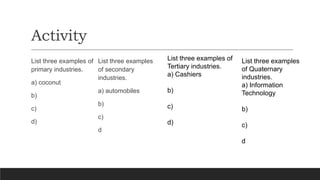
Activity
List three examples of
primary industries.
a) coconut
b)
c)
d)
List three examples
of secondary
industries.
a) automobiles
b)
c)
d
List three examples of
Tertiary industries.
a) Cashiers
b)
c)
d)
List three examples
of Quaternary
industries.
a) Information
Technology
b)
c)
d
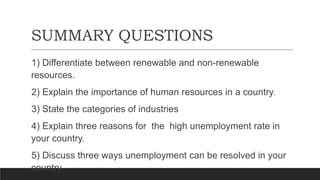
SUMMARY QUESTIONS
1) Differentiate between renewable and non-renewable
resources.
2) Explain the importance of human resources in a country.
3) State the categories of industries
4) Explain three reasons for the high unemployment rate in
your country.
5) Discuss three ways unemployment can be resolved in your
country.
Demographics
POPULATION STATISTICS, POPULATION PYRAMID,
FORMULAS, MIGRATION
Demography
This is the study of populations. It reveals the characteristics of a
population such as it’s size and structure and how it is changed over time.
In order to achieve sustainable development Caribbean governments
need to develop their human resources.
Two major reasons for developing human resources are:
People need to solve problems
The economy need constant improvement with the aid of a large,
productive and skilled workforce
Population
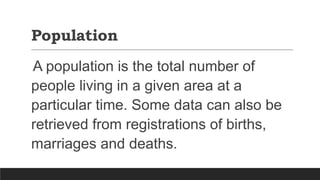
A population is the total number of
people living in a given area at a
particular time. Some data can also be
retrieved from registrations of births,
marriages and deaths.
Major Characteristics of a
Population
Age- People have different requirements for health, education
and other needs at different stages of life, the age structure is
an indication of the level of development of a country.
Sex/Gender – The ratio of males to females gives an
indication of the procreation within a population. It also can
address sender specific health, social and educational issues
that will emerge in the future.
Major Characteristics of a
Population
Occupation – Knowing how occupations are across the
country determines the focus of skills, the shortages in
industries and careers and how skills should be developed. A
country needs people working in all areas of the economy.
Ethnicity- Being aware of the number and size of different
ethnic groups helps to determine what is needed to meet the
different needs of the groups of people. It also invites programs
on integrations and tolerance.
Major Characteristics of a
Population
Religion- A person’s religion is an important part of their life and they may
expect to see some of the religious values they hold reflected in the society in
which they live.
Dependency Ratio – Between 15 and 65 years of age, are said to be
economically productive. Those outside this age range are dependents.
Dependency ratio is the term used to describe the ratio of the number of
depends to the number of economically active people.
A high dependency ratio means that there are a lot of dependents compared
with the working population. In most Caribbean countries the dependency ratio
is quite high.
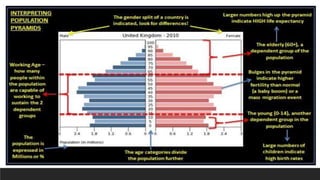
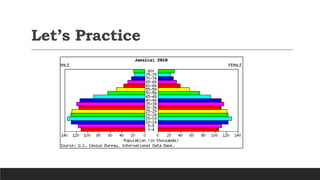
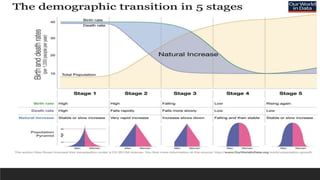
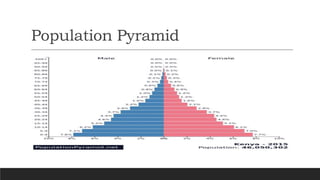
Population Pyramid
This is the age and gender distribution in the shape of a pyramid. The
age and gender are clearly shown.
The shape of the pyramid shows:
How rapid the population is growing
The size of the working population
Dependency ratio
An example of a Population Pyramid is provided for you.
Population Pyramid
Population Pyramid
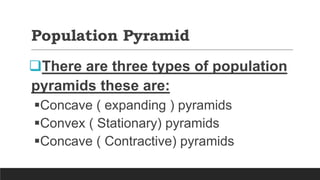
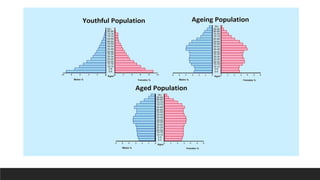
There are three types of population
pyramids these are:
Concave ( expanding ) pyramids
Convex ( Stationary) pyramids
Concave ( Contractive) pyramids
Let’s Practice
Factors that influence population change
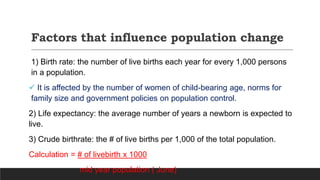
1) Birth rate: the number of live births each year for every 1,000 persons
in a population.
 It is affected by the number of women of child-bearing age, norms for
family size and government policies on population control.
2) Life expectancy: the average number of years a newborn is expected to
live.
3) Crude birthrate: the # of live births per 1,000 of the total population.
Calculation = # of livebirth x 1000
mid year population ( June)
Factors that influence population change
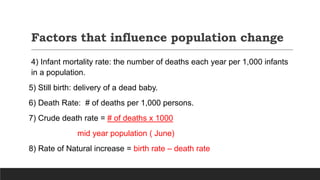
4) Infant mortality rate: the number of deaths each year per 1,000 infants
in a population.
5) Still birth: delivery of a dead baby.
6) Death Rate: # of deaths per 1,000 persons.
7) Crude death rate = # of deaths x 1000
mid year population ( June)
8) Rate of Natural increase = birth rate – death rate
Factors that influence population change
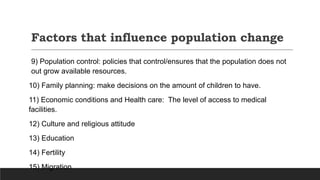
9) Population control: policies that control/ensures that the population does not
out grow available resources.
10) Family planning: make decisions on the amount of children to have.
11) Economic conditions and Health care: The level of access to medical
facilities.
12) Culture and religious attitude
13) Education
14) Fertility
15) Migration
Factors that influence
population change
 Complete the exit activity in the Google Classroom.

Sustainable development human resource grade 10

  • 1.
    Sustainable Development and Use ofResources TEACHER: C. WALKER-WILLIAMS SECTION B TOPIC: HUMAN RESOURCES 2 SOCIAL STUDIES GRADE 10 Migration, Health and Careers
  • 2.
    Objectives 1) Define termsand use concepts 2) Differentiate between natural and human resources 3) Explain the need for developing human resources 4) Explain the factors that contribute to the development of human resources. 5) Identify stages of development of countries. 6) Examines characteristics of population distribution. 7) Identify the features of a population pyramid.
  • 3.
    Sustainable Development The refersto the planned and balanced development of a society’s resources. It is also a long term, integrated approach to develop and achieve a healthy economy and environment that deals with social issues efficiently to ensure property for present and future generations.
  • 4.
    What is aresource? Anything which can be accessed developed and used to satisfy wants and needs. Countries have limited and different resources available to develop their country such as human and physical/natural.
  • 5.
    Natural and HumanResources What is the difference between human and natural resources? Physical resources are a natural resource which includes minerals, animals and other raw materials used in industries. The human resources of a country include the mental and physical strength of the human population that uses skills, talent, knowledge, gifts and abilities to creativity use the limited resources available.
  • 6.
    Globalization Globalization has increasedthe world’s capacity to communicate and use both the physical and human resources available. Globalization has improved internet access, social and criminal laws, access to information, free trade and transnational corporations. It has also increased communicable diseases, a change in the world’s climate, a shift in wealth, pollution and exploitation.
  • 7.
    Government and Resources Howdoes the government of any country help to sustain resources? The government develop human resources through providing various levels of education to its citizens ( primary, secondary and tertiary) in order to have a productive skilled labor force and to have people solve problems. Based on the population growth, they develop policies that restrict the use of natural resources and maintain the limited resources available
  • 8.
    Challenges restricting theuse of all resources 1) overpopulation in the cities, 2) pollution due to production 3) social services have little access to funds, 4) persons are unable to access nutritious meals 5) lack of job opportunities
  • 9.
    Human Resources TYPES, FUNCTIONS,MAINTENANCE AND CHALLENGES
  • 10.
    Vocabulary Words: Interdependence -relying on someone/thing for resources or skills Employment - paid work Unemployment -unable to find work while actively searching for work Underemployment - over qualified for work therefore underpaid Workforce/ Labor force - gainfully employed individuals within a particular age within the population.
  • 11.
    Stages of Development Mostcountries have three (3) stages of Development. The stages indicate how the country uses its available resources. Developed – Trinidad; Canada ( 1st World) Developing – Jamaica; Brazil (2nd World) Underdeveloped- Haiti; Sierra Leone (3rd World)
  • 12.
    The Importance ofHuman Resources The importance of human resources cannot be overstated. The constant changes in society have been a direct result of the improvement of the standard of living of individuals. This has been achieved by the manipulation of the physical resources available.
  • 13.
    The Importance ofHuman Resources Human Resources are affected by: size/ capabilities of individuals Access to health care and nutrition Access to education and the development and utilization of skills Co-operation, integration and working together.
  • 14.
    The Importance ofHuman Resources When looking at human resources, government looks at: The size and composition of the population A country’s level of health and education The skills and attitudes of the people have developed Resources can be accessed, developed and used to satisfy wants and needs. Countries have limited and often different resources available to develop.
  • 15.
    The Importance ofHuman Resources The government needs to develop human resources in order to have a productive, skilled labor force and to have people solves problem. A few problems include: Overpopulation in cities Pollution due to production Social services need with limited funds. Limited access to nutritious meals Lack of job opportunities
  • 16.
    Developing human resources Humanresources can be developed through: Education (kindergarten, primary, secondary and tertiary), Health ( preventative, curative) Recreation ( hobbies, play, restaurants) Religion (Catholics, Revivalism, Rastafarianism, Muslim, Hindu) Protection ( JDF, JCF, Security Guard)
  • 17.
    Skills, Talent andKnowledge Humans are born with innate skills and talents. The education system is designed to enhance knowledge, skills and talents to assist and increase productivity. Governments grant aid to educational institutions and they also provide programs for skills training. A healthy person is mentally, physically and emotionally stable through proper nutrition and access to medical centers.  A healthy person can access a job, and work well within the period hired to carry out production.
  • 18.
    Skills, Talent andKnowledge Persons need relaxation and religion as they build character and morality.  To maximize one’s potential, the government have to provide security against abuse, violence and threats by maintaining a crime free society. They do this by training person to work with the police force, military defense, lawyers, and neighborhood watch.
  • 19.
    Human Resources Maintained 1.Proper Nutrition and adequate health care for every individual in the population 2. Recreation for relaxation 3. Education at the primary, secondary and Tertiary levels 4. Control the population’s size. 5. A clean and healthy environment 6. Protection (individual development)
  • 20.
    Why do wework? To be financially independent To satisfy needs and wants To socialize and receive rewards To be productive and earn skills and knowledge To use time constructively/with purpose
  • 21.
    Who makes upthe labor force? Employed citizens. Workers with contracts. Persons who are capable of working. Persons activity seeking employments.
  • 22.
    Why Do FemalesWork?  Independence from family and male partners Socialization Add income into the home
  • 23.
    Persons excluded fromwork 1)Persons with disabilities 2)Prisoners 3)Mentally unstable persons 4)Children under 16 5)Illegal immigrants
  • 24.
    What are thecauses of unemployment? 1) Illiteracy 2) Rapid population growth 3) No education 4) No job opportunities 5) Lack of technology and research 6) Agriculture affords a limited range of occupations 7) Migration
  • 25.
    Who are thepersons excluded from working? 1) Persons with physical disabilities 2) Prisoners 3) Persons with mental disorders 4) Persons not considered adult by age 5) Elderly over 70 years.
  • 26.
    What are thetypes of unemployment?  Normal – seeking a more profitable job Casual- work is temporary and on a contract Seasonal- work is only for a seasons in agriculture (crops) or Tourism (hotels) Technical- Trade cycle- work for a period of 3/6/8 months according to products being sold Structural – by contract
  • 27.
    Who makes upthe labor force? The labor force consists of those who are gainfully employed citizens who use their skills, knowledge and talents to be productive.  They are usually capable of work, work within the boundaries of a contract or who are actively seeking employment.
  • 28.
    What is anindustry? This is the economic activities concerned with the processing of raw materials using a factory or laboratory.  The production of goods requires a work force, equipment tools, chemicals or a formula.
  • 29.
    Categories of Industries Primary-Extraction of raw materials Secondary- production or manufacturing of raw materials Tertiary- Sales and customer service Quaternary – research and improvements on existing products
  • 30.
    Activity List three examplesof primary industries. a) coconut b) c) d) List three examples of secondary industries. a) automobiles b) c) d List three examples of Tertiary industries. a) Cashiers b) c) d) List three examples of Quaternary industries. a) Information Technology b) c) d
  • 31.
    SUMMARY QUESTIONS 1) Differentiatebetween renewable and non-renewable resources. 2) Explain the importance of human resources in a country. 3) State the categories of industries 4) Explain three reasons for the high unemployment rate in your country. 5) Discuss three ways unemployment can be resolved in your country.
  • 32.
  • 33.
    Demography This is thestudy of populations. It reveals the characteristics of a population such as it’s size and structure and how it is changed over time. In order to achieve sustainable development Caribbean governments need to develop their human resources. Two major reasons for developing human resources are: People need to solve problems The economy need constant improvement with the aid of a large, productive and skilled workforce
  • 34.
    Population A population isthe total number of people living in a given area at a particular time. Some data can also be retrieved from registrations of births, marriages and deaths.
  • 35.
    Major Characteristics ofa Population Age- People have different requirements for health, education and other needs at different stages of life, the age structure is an indication of the level of development of a country. Sex/Gender – The ratio of males to females gives an indication of the procreation within a population. It also can address sender specific health, social and educational issues that will emerge in the future.
  • 36.
    Major Characteristics ofa Population Occupation – Knowing how occupations are across the country determines the focus of skills, the shortages in industries and careers and how skills should be developed. A country needs people working in all areas of the economy. Ethnicity- Being aware of the number and size of different ethnic groups helps to determine what is needed to meet the different needs of the groups of people. It also invites programs on integrations and tolerance.
  • 37.
    Major Characteristics ofa Population Religion- A person’s religion is an important part of their life and they may expect to see some of the religious values they hold reflected in the society in which they live. Dependency Ratio – Between 15 and 65 years of age, are said to be economically productive. Those outside this age range are dependents. Dependency ratio is the term used to describe the ratio of the number of depends to the number of economically active people. A high dependency ratio means that there are a lot of dependents compared with the working population. In most Caribbean countries the dependency ratio is quite high.
  • 38.
    Population Pyramid This isthe age and gender distribution in the shape of a pyramid. The age and gender are clearly shown. The shape of the pyramid shows: How rapid the population is growing The size of the working population Dependency ratio An example of a Population Pyramid is provided for you.
  • 39.
  • 41.
    Population Pyramid There arethree types of population pyramids these are: Concave ( expanding ) pyramids Convex ( Stationary) pyramids Concave ( Contractive) pyramids
  • 43.
  • 44.
    Factors that influencepopulation change 1) Birth rate: the number of live births each year for every 1,000 persons in a population.  It is affected by the number of women of child-bearing age, norms for family size and government policies on population control. 2) Life expectancy: the average number of years a newborn is expected to live. 3) Crude birthrate: the # of live births per 1,000 of the total population. Calculation = # of livebirth x 1000 mid year population ( June)
  • 45.
    Factors that influencepopulation change 4) Infant mortality rate: the number of deaths each year per 1,000 infants in a population. 5) Still birth: delivery of a dead baby. 6) Death Rate: # of deaths per 1,000 persons. 7) Crude death rate = # of deaths x 1000 mid year population ( June) 8) Rate of Natural increase = birth rate – death rate
  • 46.
    Factors that influencepopulation change 9) Population control: policies that control/ensures that the population does not out grow available resources. 10) Family planning: make decisions on the amount of children to have. 11) Economic conditions and Health care: The level of access to medical facilities. 12) Culture and religious attitude 13) Education 14) Fertility 15) Migration
  • 48.
    Factors that influence populationchange  Complete the exit activity in the Google Classroom.