Chapter 5
Part.1
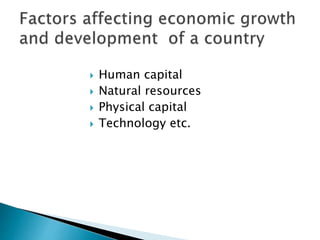
 Human capital
 Natural resources
 Physical capital
 Technology etc.
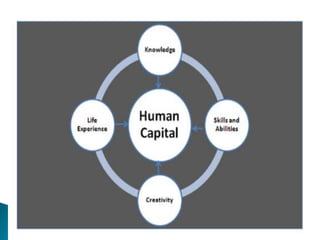
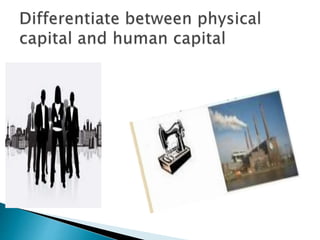
 Human capital is a term popularized by Gary
Becker,an economist from the university of
Chicago,and Jacob Mincer that refers to the
stock of knowledge,habits,social and
personality attributes,including
creativity,embodied in the ability to perform
labor so as to produce economic value.
 An uneducated,untrained and unhealthy
person is not productive.He cannot contribute
to production.On the other hand, an
educated/trained and healthy person is
productive. India’s soft ware companies
employ many physically challenged
persons.They are educated/trained and
therefore productive. Human beings, when
they are given education/training, become
human resources or human capital.
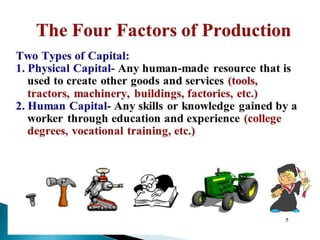
 In economics, physical capital or just capital
is a factor of production(or input into the
process of production),consisting of
machinery,buildings,computers,and the like”
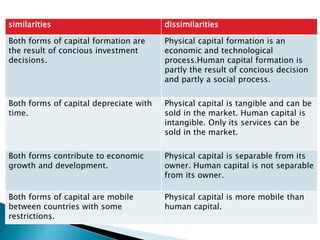
similarities dissimilarities
Both forms of capital formation are
the result of concious investment
decisions.
Physical capital formation is an
economic and technological
process.Human capital formation is
partly the result of concious decision
and partly a social process.
Both forms of capital depreciate with
time.
Physical capital is tangible and can be
sold in the market. Human capital is
intangible. Only its services can be
sold in the market.
Both forms contribute to economic
growth and development.
Physical capital is separable from its
owner. Human capital is not separable
from its owner.
Both forms of capital are mobile
between countries with some
restrictions.
Physical capital is more mobile than
human capital.
Human capital formatoin in india

Human capital formatoin in india

  • 1.
  • 3.
     Human capital Natural resources  Physical capital  Technology etc.
  • 5.
     Human capitalis a term popularized by Gary Becker,an economist from the university of Chicago,and Jacob Mincer that refers to the stock of knowledge,habits,social and personality attributes,including creativity,embodied in the ability to perform labor so as to produce economic value.
  • 7.
     An uneducated,untrainedand unhealthy person is not productive.He cannot contribute to production.On the other hand, an educated/trained and healthy person is productive. India’s soft ware companies employ many physically challenged persons.They are educated/trained and therefore productive. Human beings, when they are given education/training, become human resources or human capital.
  • 8.
     In economics,physical capital or just capital is a factor of production(or input into the process of production),consisting of machinery,buildings,computers,and the like”
  • 11.
    similarities dissimilarities Both formsof capital formation are the result of concious investment decisions. Physical capital formation is an economic and technological process.Human capital formation is partly the result of concious decision and partly a social process. Both forms of capital depreciate with time. Physical capital is tangible and can be sold in the market. Human capital is intangible. Only its services can be sold in the market. Both forms contribute to economic growth and development. Physical capital is separable from its owner. Human capital is not separable from its owner. Both forms of capital are mobile between countries with some restrictions. Physical capital is more mobile than human capital.