Sustainable microBreweries, Inc.
         of asheville, north carolina
Sustainable Water Management Plan
Environmentally Sound, Qualitatively Better!

     Mike Barr, Alicia Case, & Sara DeWald
               National University
     SUS 601 – Introduction to Sustainability
Introduction and proposal
Buy and renovate an existing building, adjacent open space, and
parking lot in the historic downtown area. The brewery and pub will
incorporate a water management strategy that meets best management
practices for water conservation while producing a superior product
meeting high standards for preserving taste, flavor, purity, and
freshness.
• Land use and development strategies
• Water efficiency standards and conservation best management
  practices
  • Cost effective facility/infrastructure upgrades to the existing
    water system

• Water Management Plan vs. Rate Restructuring?
• Water resource management vs. Renovate/Reuse existing
  structure and interiors
• Outreach, education tools and strategies
  • Encouraging water conservation to patrons and customers
City of asheville


• Historically and Architecturally Diverse

• Bars, Brewpubs, Micro Craft Breweries

• Strategic Operating Plan 2012-2013
  • Leadership in Energy and Sustainability
    • Build all Municipal Buildings to LEED Gold Standards
    • Achieve Energy Reduction of 2001 Standards by 2040
    • Proactive Water Management Strategy
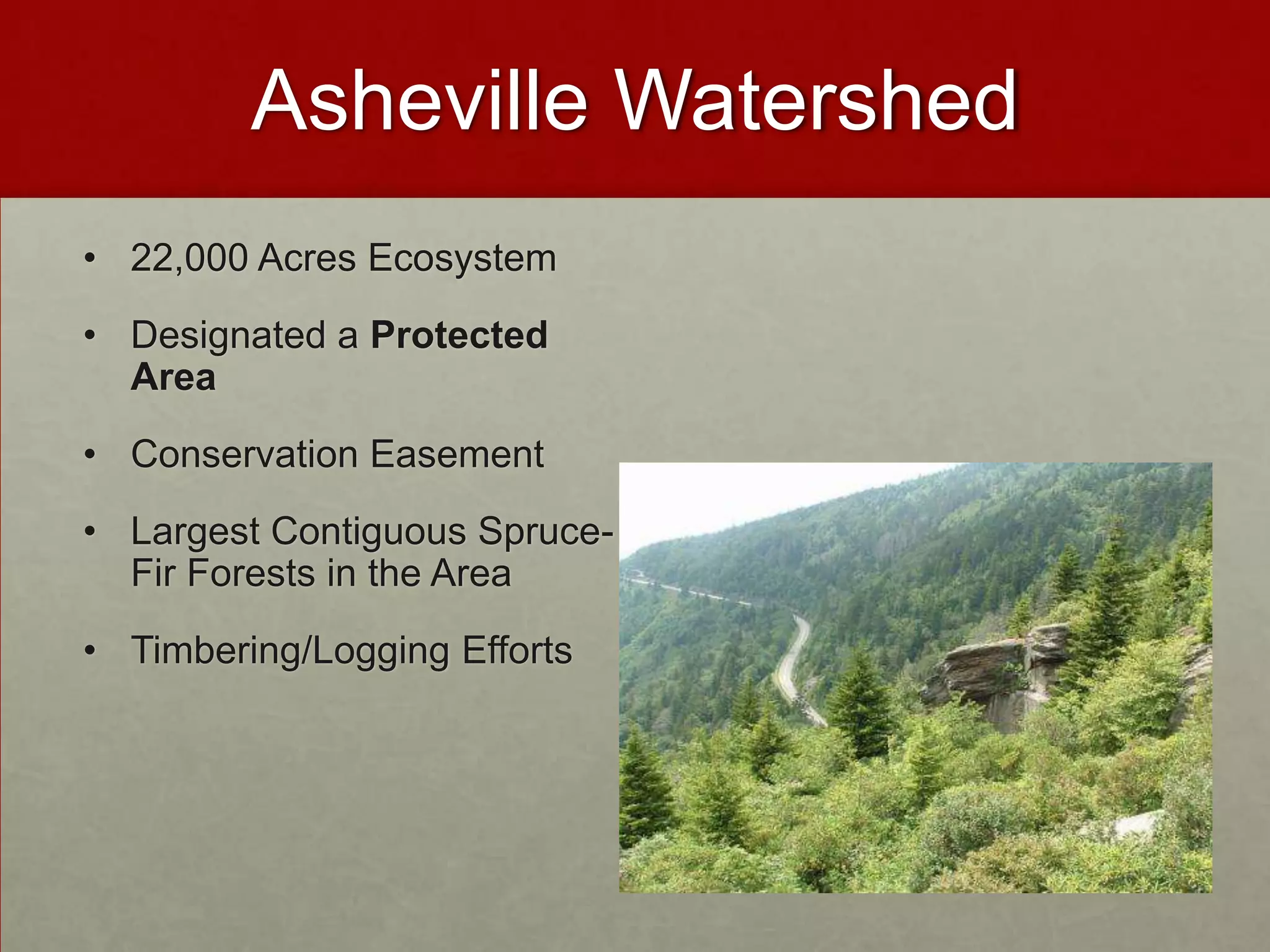
Asheville Watershed
• 22,000 Acres Ecosystem
• Designated a Protected
  Area
• Conservation Easement
• Largest Contiguous Spruce-
  Fir Forests in the Area
• Timbering/Logging Efforts
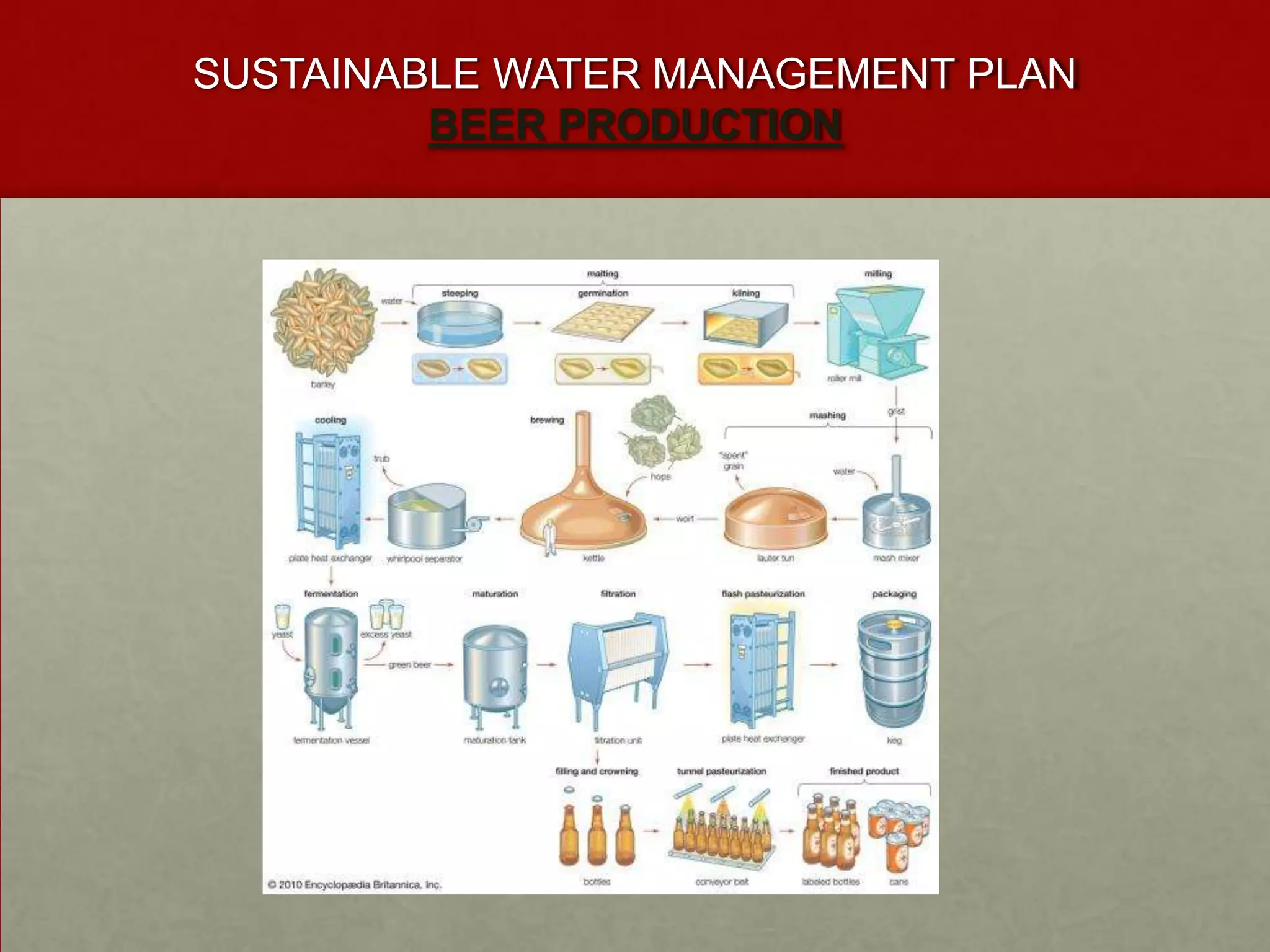
SUSTAINABLE WATER MANAGEMENT PLAN
         BEER PRODUCTION
SUSTAINABLE WATER MANAGEMENT PLAN

                           wastewater


• Wastewater most significant creations in brewery
  process.
• Sustainable Microbreweries generates 5.2L of waste
  water per L of beer produced.
• Tank installation for wastewater treatment to stay on
  site.

Targets
          - 3.5L/1.0L wastewater to beer by 2015
          - treat all wastewater on site by 2015
SUSTAINABLE WATER MANAGEMENT PLAN
                    facility (outdoors)

• Installation of Greenroof
       -reduces heat island effect
       -provides building insulation
       -reduces storm water runoff
       -peak runoff flow rates are reduced by 50-90% compared
to     conventional roofs
• Cisterns for Water Storage
       -water from greenroof stored in basement
       -used for irrigation of planting spaces
• Xeriscaping for outdoor spaces
       -Can reduce water consumption by 50%
       -minimize turf areas, plant native low-water plants, porous
       paving materials
SUSTAINABLE WATER MANAGEMENT PLAN
                      facility (indoors)

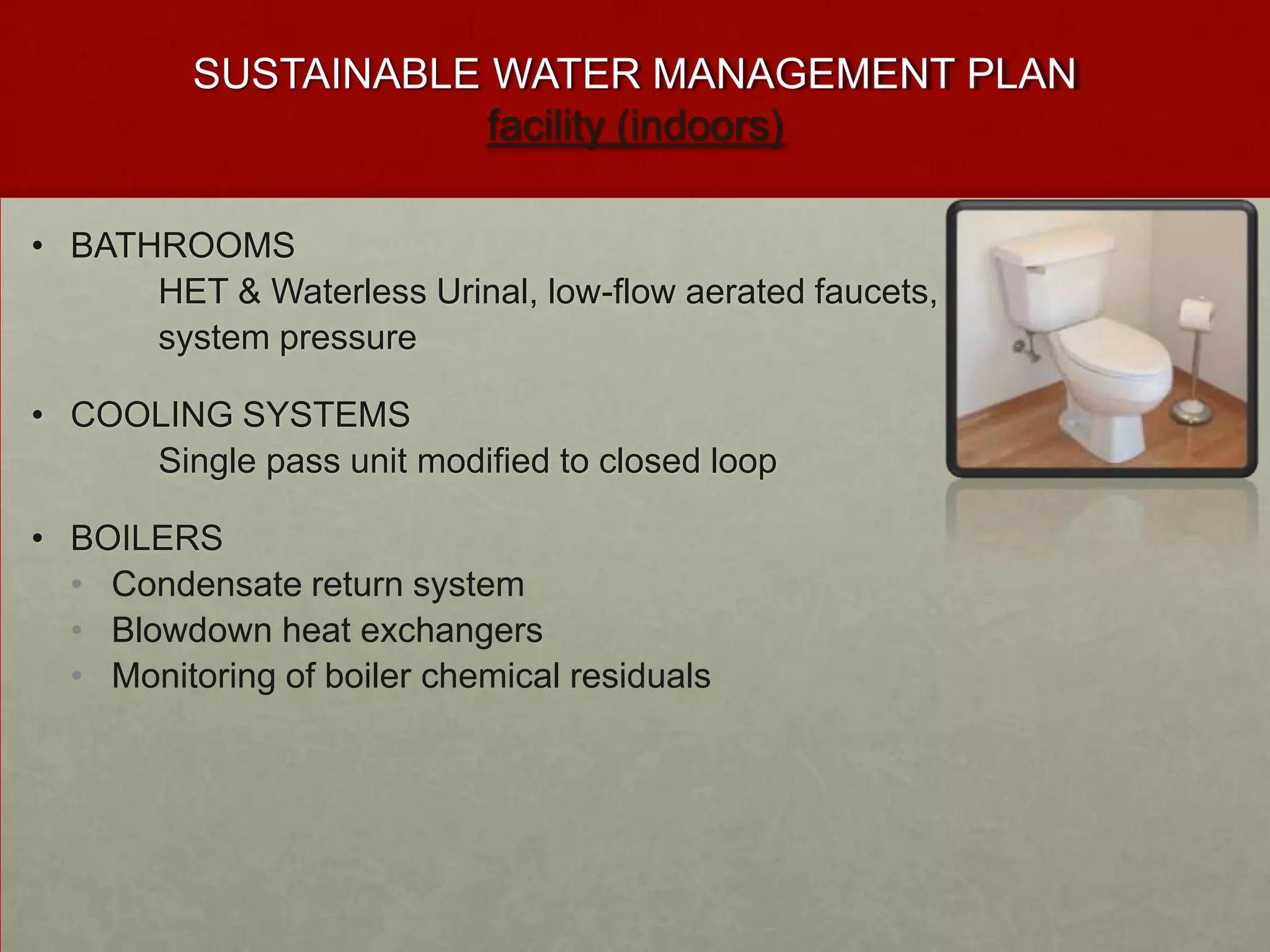
• BATHROOMS
      HET & Waterless Urinal, low-flow aerated faucets,
      system pressure

• COOLING SYSTEMS
     Single pass unit modified to closed loop

• BOILERS
  • Condensate return system
  • Blowdown heat exchangers
  • Monitoring of boiler chemical residuals
Sustainability Practices and
      Social License
TOOLS
• SUSTAINABILITY REPORT

       Internal link- Made accessible to employees for reference

• Employee Tips for Footprint
  Reduction
• Take shorter showers

• Low-flow faucet aerators and shower heads

• Wash only full loads of laundry

• Install a xeriscaped landscape

• Water deeply and infrequently
ONGOING
         MANAGEMENT
• REPORTING

     - Self-audits

• REOCURRING MEETINGS

    - Quarterly
THANK YOU!
REFERENCES
20-20 Site. (2012). Flush With Fun Toilet Facts. Retrieved from http://www.2020site.org/fun-facts/Fun-Toilet-Facts.html
Asheville, NC (December 1996). Asheville Watershed Conservation Easement. Retrieved from
http://www.ashevillenc.gov/Portals/0/city-documents/water/Asheville-Watershed-Conservation-Easement.pdf
Back, L. (September 28, 2010). REI: Portrait of a Responsible Company. Retrieved from http://www.triplepundit.com/2010/09/rei-portrait-of-a-responsible-
company/
Bio-Aquifer Storm System (2011). Eco-Smart. Retrieved from http://www.ecosmartinc.com/catpave3_ecopave2.php
Burgess, J. (2012) Moffett: Asheville watershed rules shouldn’t be too restrictive. Retrieved from http://www.landfortomorrow.org/topnews/moffitt-asheville-
watershed-rules-shouldnt-be-too-restrictive/
Canadian Water Resources Association. (2009). Promoting Effective Water Management: Policies and Procedures. Retrieved from
http://www.cwra.org/about/Policies.aspx
Edwards, A. (2005). The Sustainability Revolution: Portrait of a Paradigm Shift. Gabriola Island, Canada: New Society Publishers.
Forests Monitor (2006). Environmental Impacts of Logging. Retrieved from http://www.forestsmonitor.org/fr/reports/550066/550083
Global Impact. (February 2011). The CEO Water Mandate. Retrieved from http://ceowatermandate.org/files/Ceo_water_mandate.pdf
Federal Energy Management Program. (October 2002). Domestic Water Conservation Technologies. Retrieved from
http://www.nrel.gov/docs/fy03osti/22799.pdf
Green Roof F.A.Q (2012). Green Roofs for Healthy Cities. Retrieved from http://www.greenroofs.org/index.php/about/greenrooffaq
Maidment, P. (01/28/2010). Does Business Need A Social License? http://www.forbes.com/sites/davos/2010/01/28/does-business-need-a-social-licence/
New Belgium Brewing Company. (2011). Sustainability Management System. Retrieved from
http://www.newbelgium.com/Files/SMS%204th%20edition,%202011%20for%20external%20release.pdf
PEPSICO (2012). Environmental Sustainability: Water. Retrieved from http://www.pepsico.com/Purpose/Environmental-Sustainability/Water.html
U.S. Department of Energy. (February 25, 2011). Federal Water Efficiency Best Management Practices. Retrieved from
http://www1.eere.energy.gov/femp/program/waterefficiency_bmp.html
U.S. Environmental Protection Agency. (November 5, 2012). Developing a Water Management Plan. Retrieved from
http://www.epa.gov/oaintrnt/water/plans.htm
Water, Wastewater, & Wetlands (2012). Massachusetts Department of Environmental Protection. Retrieved from
http://www.mass.gov/dep/water/wastewater/grnroof.htm

Sustainable MicroBreweries, Inc. of Asheville, North Carolina

  • 1.
    Sustainable microBreweries, Inc. of asheville, north carolina Sustainable Water Management Plan Environmentally Sound, Qualitatively Better! Mike Barr, Alicia Case, & Sara DeWald National University SUS 601 – Introduction to Sustainability
  • 2.
    Introduction and proposal Buyand renovate an existing building, adjacent open space, and parking lot in the historic downtown area. The brewery and pub will incorporate a water management strategy that meets best management practices for water conservation while producing a superior product meeting high standards for preserving taste, flavor, purity, and freshness. • Land use and development strategies • Water efficiency standards and conservation best management practices • Cost effective facility/infrastructure upgrades to the existing water system • Water Management Plan vs. Rate Restructuring? • Water resource management vs. Renovate/Reuse existing structure and interiors • Outreach, education tools and strategies • Encouraging water conservation to patrons and customers
  • 3.
    City of asheville •Historically and Architecturally Diverse • Bars, Brewpubs, Micro Craft Breweries • Strategic Operating Plan 2012-2013 • Leadership in Energy and Sustainability • Build all Municipal Buildings to LEED Gold Standards • Achieve Energy Reduction of 2001 Standards by 2040 • Proactive Water Management Strategy
  • 4.
    Asheville Watershed • 22,000Acres Ecosystem • Designated a Protected Area • Conservation Easement • Largest Contiguous Spruce- Fir Forests in the Area • Timbering/Logging Efforts
  • 5.
    SUSTAINABLE WATER MANAGEMENTPLAN BEER PRODUCTION
  • 6.
    SUSTAINABLE WATER MANAGEMENTPLAN wastewater • Wastewater most significant creations in brewery process. • Sustainable Microbreweries generates 5.2L of waste water per L of beer produced. • Tank installation for wastewater treatment to stay on site. Targets - 3.5L/1.0L wastewater to beer by 2015 - treat all wastewater on site by 2015
  • 7.
    SUSTAINABLE WATER MANAGEMENTPLAN facility (outdoors) • Installation of Greenroof -reduces heat island effect -provides building insulation -reduces storm water runoff -peak runoff flow rates are reduced by 50-90% compared to conventional roofs • Cisterns for Water Storage -water from greenroof stored in basement -used for irrigation of planting spaces • Xeriscaping for outdoor spaces -Can reduce water consumption by 50% -minimize turf areas, plant native low-water plants, porous paving materials
  • 8.
    SUSTAINABLE WATER MANAGEMENTPLAN facility (indoors) • BATHROOMS HET & Waterless Urinal, low-flow aerated faucets, system pressure • COOLING SYSTEMS Single pass unit modified to closed loop • BOILERS • Condensate return system • Blowdown heat exchangers • Monitoring of boiler chemical residuals
  • 9.
  • 10.
    TOOLS • SUSTAINABILITY REPORT Internal link- Made accessible to employees for reference • Employee Tips for Footprint Reduction • Take shorter showers • Low-flow faucet aerators and shower heads • Wash only full loads of laundry • Install a xeriscaped landscape • Water deeply and infrequently
  • 11.
    ONGOING MANAGEMENT • REPORTING - Self-audits • REOCURRING MEETINGS - Quarterly
  • 12.
    THANK YOU! REFERENCES 20-20 Site.(2012). Flush With Fun Toilet Facts. Retrieved from http://www.2020site.org/fun-facts/Fun-Toilet-Facts.html Asheville, NC (December 1996). Asheville Watershed Conservation Easement. Retrieved from http://www.ashevillenc.gov/Portals/0/city-documents/water/Asheville-Watershed-Conservation-Easement.pdf Back, L. (September 28, 2010). REI: Portrait of a Responsible Company. Retrieved from http://www.triplepundit.com/2010/09/rei-portrait-of-a-responsible- company/ Bio-Aquifer Storm System (2011). Eco-Smart. Retrieved from http://www.ecosmartinc.com/catpave3_ecopave2.php Burgess, J. (2012) Moffett: Asheville watershed rules shouldn’t be too restrictive. Retrieved from http://www.landfortomorrow.org/topnews/moffitt-asheville- watershed-rules-shouldnt-be-too-restrictive/ Canadian Water Resources Association. (2009). Promoting Effective Water Management: Policies and Procedures. Retrieved from http://www.cwra.org/about/Policies.aspx Edwards, A. (2005). The Sustainability Revolution: Portrait of a Paradigm Shift. Gabriola Island, Canada: New Society Publishers. Forests Monitor (2006). Environmental Impacts of Logging. Retrieved from http://www.forestsmonitor.org/fr/reports/550066/550083 Global Impact. (February 2011). The CEO Water Mandate. Retrieved from http://ceowatermandate.org/files/Ceo_water_mandate.pdf Federal Energy Management Program. (October 2002). Domestic Water Conservation Technologies. Retrieved from http://www.nrel.gov/docs/fy03osti/22799.pdf Green Roof F.A.Q (2012). Green Roofs for Healthy Cities. Retrieved from http://www.greenroofs.org/index.php/about/greenrooffaq Maidment, P. (01/28/2010). Does Business Need A Social License? http://www.forbes.com/sites/davos/2010/01/28/does-business-need-a-social-licence/ New Belgium Brewing Company. (2011). Sustainability Management System. Retrieved from http://www.newbelgium.com/Files/SMS%204th%20edition,%202011%20for%20external%20release.pdf PEPSICO (2012). Environmental Sustainability: Water. Retrieved from http://www.pepsico.com/Purpose/Environmental-Sustainability/Water.html U.S. Department of Energy. (February 25, 2011). Federal Water Efficiency Best Management Practices. Retrieved from http://www1.eere.energy.gov/femp/program/waterefficiency_bmp.html U.S. Environmental Protection Agency. (November 5, 2012). Developing a Water Management Plan. Retrieved from http://www.epa.gov/oaintrnt/water/plans.htm Water, Wastewater, & Wetlands (2012). Massachusetts Department of Environmental Protection. Retrieved from http://www.mass.gov/dep/water/wastewater/grnroof.htm

Editor's Notes

  • #3 Research Project Proposal – Innovative Water Management Plan for Sustainable Microbreweries, Inc. of Asheville, North CarolinaSustainable Microbreweries, Inc. of Asheville, North Carolina proposes to buy and renovate an existing building, adjacent open space, and parking lot in the historic downtown area. The brewery and pub will incorporate a water management strategy that meets best management practices for water conservation while producing a superior product meeting high standards for preserving taste, flavor, purity, and freshness.Through our research, Sustainable Microbreweries, Inc. seeks to establish and implement a Sustainability Management Plan  regarding Water Management that answers the following questions:(1) What land use and development strategies can be utilized at our facility to reduce water system resource and energy demands?(2) What water efficiency and conservation best management practices  need to be identified for cost effective facility/infrastructure upgrades to the existing water system?(3) Can our Water Management Plan efforts promote a rate restructuring for our business to encourage water conservation while protecting revenue?(4) How can our sustainability plan meet the requirements for water resource management while upholding our commitment to renovate and reuse as much of the existing structure and interiors as possible?(5) What outreach and education tools and strategies can be utilized for encouraging water conservation to our patrons and customers?Sustainable Microbreweries, Inc. of Asheville, North Carolina seeks the endorsement of its sponsor and stakeholders to proceed with Water Management Plan research and development for incorporation into the existing plans for purchase and renovation of the existing site. It is proposed that the research and development of the Water Management Plan should take no longer than three (3) business weeks to complete, and that the sponsor and stakeholder are thoroughly briefed on the results through visual and oral presentation.
  • #4 Nickname: “Land of the Sky”Motto: “Quality of Service, Quality of Life”Asheville is located in the Blue Ridge Mountains at the confluence of the Swannanoa River and the French Broad River. Asheville has a total area of 41.3 square miles (107.0 km2), of which 40.9 square miles (105.9 km2) is land and 0.4 square miles (1.0 km2) (0.94%) is water.Asheville's historic and architecturally diverse downtown; beautiful preservation; Art Deco, Beaux Arts and Neoclassical architectural styles. Art colony, Healing resort, Home to notable luminaries, statesmen and bohemians.Asheville has a considerable selection of bars, brewpubs, micro craft breweries, and restaurants for a city of its size. There are 50+ local brews from a dozen craft brewing companies. Asheville (per capita) has one of the highest rates of craft brew consumption in the Southeast. Examiner.com readers voted Asheville as “Beer City USA” for the fourth year in a row (2012).Expansion (2012) - Green Man Brewing and Lexington Avenue BreweryProduction Facilities - Sierra Nevada (East Coast operation, 2014);  New Belgium (River Arts District, 2015).Strategic Operating Plan (2012-2013) Vision/mission: Become Southeastern leader in Clean Energy and Environmental Sustainability. Goal: Take Sustainability Program to the next higherlevel.2005 - Mayor Charles Worley signed the U.S. Conference of Mayors Climate Protection Agreement2006 - City Council creates Sustainable Advisory Committee on Energy and the Environment.2007 -City Council becomes the first city on the East Coast to commit to building all municipal buildings to LEED Gold Standards, and to achieve 80 percent energy reduction of 2001 standards by 2040.2007 - City Council signed an agreement with Warren Wilson College stating the intent of the city and college to work together toward climate partnership goals.
  • #5 Asheville, NC resides within the Asheville Watershed, consisting of a 22,000 acres ecosystem, located in Buncombe County, NC. The Asheville watershed is a Protected Area, and was designated as a “nationally significant” natural area in the North Carolina National Heritage Protection Plan (1995). A Conservation Easement was established for the watershed in November 1996. This watershed protects one of the largest contiguous spruce-fir forests in the area, which in turn protects the quality of Asheville's water.The Protected Area status is used primarily to provide the City of Asheville and the surrounding areas a clean, safe, and plentiful drinking water source. The Conservation Easement ensuresProtected Property will be retained forever in its predominantly natural, scenic, and forested condition;Protection of native flora, flora communities, and fauna; and Prevents any use of the Protected Property that would significantly impair or interfere with its conservation values.http://www.ashevillenc.gov/Portals/0/city-documents/water/Asheville-Watershed-Conservation-Easement.pdfThere have been efforts to start logging operations in the watershed area as recently as 2005 with area opposition. Selective timbering operations through professional arborists have been proposed to maintain the health of the forest as well as promote economic development.http://www.landfortomorrow.org/topnews/moffitt-asheville-watershed-rules-shouldnt-be-too-restrictive/Logging Effects on WatershedForests provide a buffer to filter water and to hold soil in place. They sustain water and soil resources through recycling nutrients. In watersheds where forests are degraded or destroyed through logging, clearing, burning, etc., minimum flows decrease during the dry season, leading to drought, while peak floods and soil erosion increase during the wet season. Logging often destroys natural habitats, resulting in the loss of biodiversity and sometimes leading to the local, and possibly global, extinction of species.http://www.forestsmonitor.org/fr/reports/550066/550083
  • #6 The following diagram illustrates the Brewing Process:Malting (wet or dry) – loosens up the endosperm (tissue produced inside of seeds) by degrading the endosperm cell walls; produces enzyme for the the further endosperm cell content degradation during mashing.Milling – provides for optimal conditions for enzymatic activities during mashing for solubilation of fermentable carbohydrates; provides best possible mash separation (i.e. highest possible yield).Mashing – forms an extract with a desired profile of sugars, desired level of protein and minor chemical constituents;conversion of brewing materials in the presence of enzymes, into a fermentable extract suitable for yeast growth and beer production.Lautering – separates extracts won during mashing from spent grain (malt husk) to create wort. It is achieved in either a lautertun, a wide vessel with a false bottom, or a mash filter.Boiling – sterilizes wort, halting enzyme action, concentrates wort, isomerizes hop alpha acid into iso-alpha acid, reduces volatile compound (such as DMS), increases wort color, reduces wort pH, protein coagulate and produces reducing compounds.Cooling – cooling down wort temperature to fermentation temperature in 100oC to 14oC range.Fermenting – converts fermentable sugar to ethanol, carbon dioxide and beer flavorsMaturation – improves/removes unpleasant flavors such as diacetyle (VDK), acetaldehyde, DMS, amylacetate etc.Filtering – makes “bright beer” (gives beer its polished shine and brilliance) and stabilizes.Packaging – putting beer into the containers in which it will leave the brewery. For kegs, this involves flash pasteurization through a plate heat exchanger and then filling the keg to produce the finished product. For bottles, this involves filling and crowning (with a bottle cap), and tunnel pasteurization on a conveyor belt to produce the finished product.PACKAGING - purified air and direct feedingPURCHASING - paper and glass supplies - food products - equipment replacement - supplier requirements Water Usage for Process (3 General Categories) – Brewing Water , Heat Exchanger Water, Cleaning WaterMalting – Water introduced during steeping (soaking grain in liquid (usually water) of a solid so as to extract flavors or to soften it). (Wet process)Mashing – Water introduced with grist from roller mill to mash mixer.Cooling – Water introduced through the plate heat exchanger to take heat away from wort; promotes ideal fermentation.[Notes: Water must be of quality so as not to foul heat exchanger tubes through mineral deposits (precipitates form at/on heat exchanger walls due to decreasing solubility at higher temperatures); Closed loop instead of single pass plate heat exchanger consideration; treatment of wastewater onsite.]Packaging – Water (heated) introduced through the plate heat exchanger to add additional heat (flash pasteurization) to the beer for final packaging to kegs; Bottle/can washing for packaging to bottles/cans.[Note: Purified air and direct feeding considered for bottle/can washing operations. PEPSICO (2012)]Hygiene - COP (cleaning-out-place), CIP (cleaning-in-place) equipment, tanks and pipe lines.[Note: Water used to “pack” lines and tanks thereby excluding oxygen.]Water of required quality for use as the brewing liquor is crucial in creating the beer’s character and flavor. Water impacts beer in 3 ways:(1) Mashing process – enzyme efficiency and wort flavor.(2) Hop utilization – water pH effect on hop utilization.(3) Beer flavor – water adds flavor to beer directlyWater makes up 95% of beer ingredients by weight. Majority of brewers rarely consider water type. Most brewers rarely give it much thought, and water is the least appreciated of beer ingredients. At the other extreme, many brewers spend considerable money on spring water not fully understanding how water affects flavor.High consumption of good quality water is characteristic of beer brewing. An efficient brewery uses between 4 and 5 liters of water to produce one liter of beer. Some breweries use much more water, especially small breweries. Knowing the character/quality of local water source as well as how to adjust it to improve your beer is a critical skill, particularly for more advanced brewers.The effect of brewing water on beer can be characterized by six main water ions: Carbonate, Sodium, Chloride, Sulfate, Calcium and Magnesium.Mineral content [listed as parts per million (ppm) equivalent to one milligram per liter (mg/L)] of local water supply can be obtained from local municipality. Critical ions for each beer type is described below:Lager beer• Soft water with low mineral content, low carbonates• Calcium ions are important at levels > 30 mg/L.Pale ales and bitters• Bicarbonate < 60 mg/L.• Calcium > 125 mg/L• Sulphate > Chloride to bring out the bitter flavorsMild ales and stouts• Carbonates < 60 mg/L• Calcium > 75 mg/L for mild ales• Calcium > 30 mg/L for stoutsBrewing water can be adjusted by the addition of brewing salt(s); Water chemistry can be complicated.
  • #7 -wastewater generated in rinsing, brewing, and cooling process-wastewater has high ratios of solids and isn't pH balanced-treatment tanks remove pollutants by screening, grit removal, and gravity sedimentation
  • #9 -HET/waterless urinals for our employee usage saved over 780,000 gal/yr-cooling system uses 40x less water than a single passage loop-existing boiler maintained and refitted to reuse condensates for 20% cost reduction
  • #10 SOCIAL LICENSE-Provide CSR literature to public -Minimize water impact through measures listed in SMP
  • #13 Thank you for your time and attentiveness during this presentation…Any Questions???