Building Sustainable Communities 
                          2010
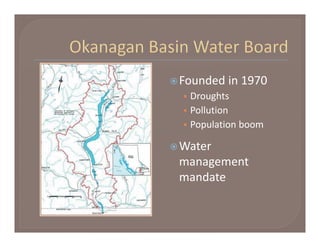
 Founded in 1970
  • Droughts
  • Pollution
  • Population boom

 Water 
 management  
 mandate
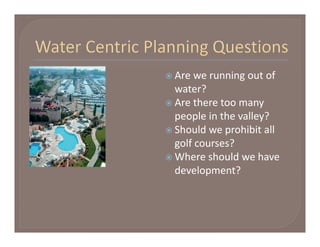
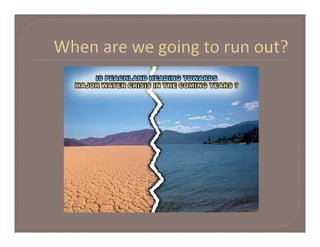
 Are we running out of 
  water?
 Are there too many 
  people in the valley?
 Should we prohibit all 
  golf courses?
 Where should we have 
  development?
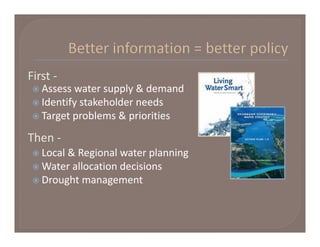
First ‐
  Assess water supply & demand
  Identify stakeholder needs
  Target problems & priorities

Then ‐
  Local & Regional water planning
  Water allocation decisions
  Drought management
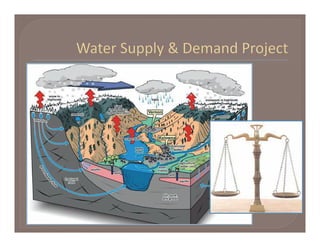
 Water supply & demand

 Endocrine disrupters

 Water use reporting

 Groundwater monitoring

 Drought planning

 Water pricing
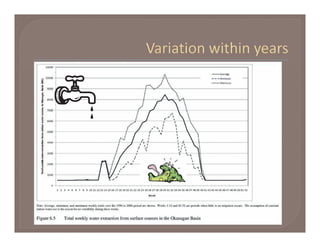
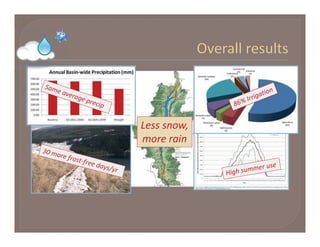
Less snow, 
more rain
summer low‐flows


                   Competition for water
 Healthy waterways?
   • Protect birds & fish, keep water clean, reduce erosion 
 Local agriculture?
   • Health, food security, economic stability
 Green space?
   • Air quality, views, 
 Golf courses?
   • Economic driver, keeps greenspace open, exercise
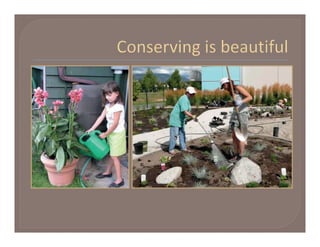
 Green lawns and gardens?
   • Popular hobby, food security, healthy recreation

Minimize conflicts?
Supply reality
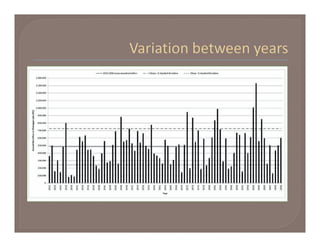
 Shortages happen every summer
 Some years are dry everywhere
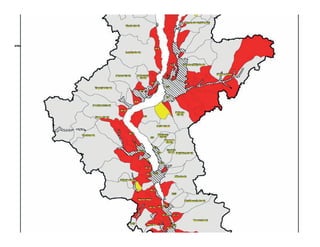
 Some areas higher risk for chronic shortages
 Hillside development on groundwater a high risk
Demand reality
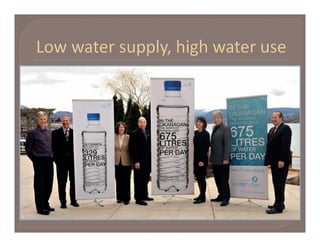
 We use more water than anyone else
 78% of domestic water goes on lawns
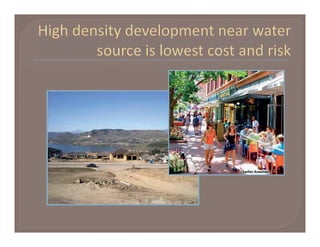
 Not enough water to support sprawl
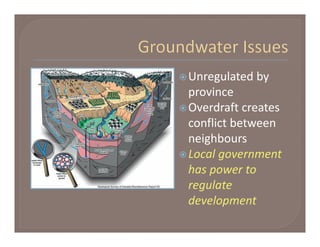
 Unregulated by 
  province
 Overdraft creates 
  conflict between 
  neighbours
 Local government 
  has power to 
  regulate 
  development
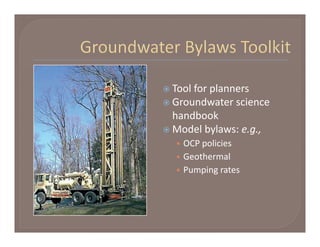
 Tool for planners
 Groundwater science 
  handbook 
 Model bylaws: e.g.,
  • OCP policies
  • Geothermal
  • Pumping rates
www.obwb.ca
www.okwaterwise.ca 

Okanagan Waterwise: Water Centric Planning in the Okanagan - Building Sustainable Communities