WaterWise Landscaping
          Best Practices Manual


          A companion guide to Water Efficient Landscape Design


Prepared for:
City of Lafayette and Town of Erie, Colorado

Grant funding provided by:
           Colorado Department of Local Affairs,
           Office of Smart Growth


Prepared by:
Design Studios West, Inc.
James M. Knopf, ASLA
HydroSystems KDI, Inc.
The Restoration Group, Inc.
Gregory A. White


 This best practices manual was prepared for communities along the Front
 Range. Owing to differernces in elevation, climate and soil composition, the lists
 of drought-tolerant landscaping materials contained within the manual may not
 be appropriate for all areas of the state. Please consult with your local
 landscape architects and master gardeners to ensure that landscaping
 materials are appropriate for your region.
Table of Contents                                                                                                                  Page
1. Introduction...............................................................................................................................3

2. WaterWise Principles and Guidelines.....................................................................................4

     Principle #1 – Plan and design landscaping comprehensively.
     Principle #2 - Evaluate soil and improve, if necessary.
     Principle #3 - Create practical turf areas.
     Principle #4 - Use appropriate plants and group according to their water need.
     Principle #5 - Water efficiently with a properly designed irrigation system.
     Principle #6 - Use organic mulches to reduce surface evaporation of water and weeds.
     Principle #7 - Practice appropriate landscape maintenance.
     Principle #8 – Preserve existing landscape and natural areas.

3. WaterWise Plant Lists .............................................................................................................16

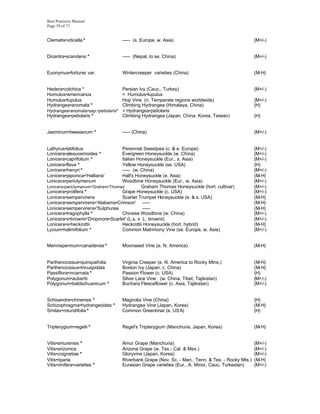
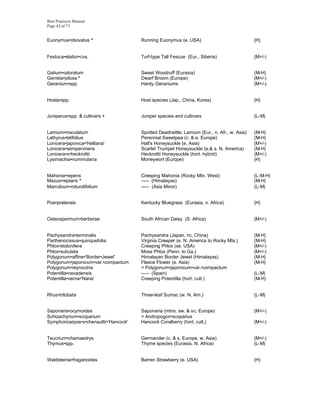
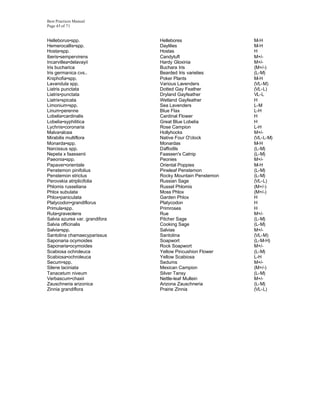
     A. Four Watering Zones – WaterWise Plant Groupings
     B. Plant Lists
           1. Shrubs – Rocky Mountain Natives
           2. Shrubs – Deciduous Introduced
           3. Trees– Deciduous, Rocky Mountain Natives
           4. Trees – Deciduous, Introduced
           5. Evergreens – Coniferous Trees
           6. Evergreens – Coniferous Shrubs
           7. Evergreens – Non-Coniferous
           8. Vines
           9. Groundcovers – Including turf and meadow grasses

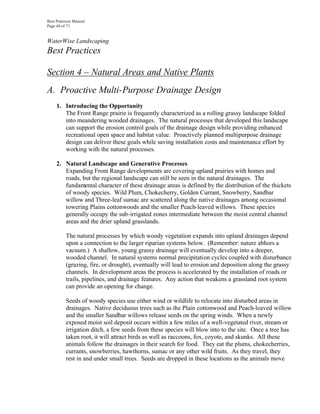
4. Natural Areas and Native Plants ............................................................................................49

     A. Proactive Multi-Purpose Drainage Design
     B. Native Seed Mixes: Short, Medium, Tall Grasses; Wet/Sandy Areas Mix, Wildflowers
     C. Plants to Avoid – Invasive Introduced Plants and Noxious Weeds

5. Understanding Soils and Soil Preparation.............................................................................61

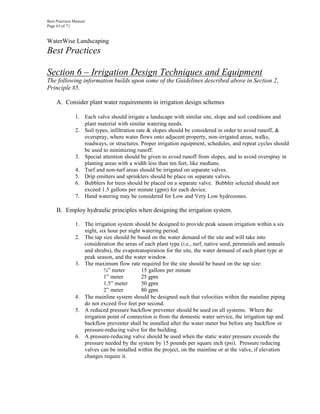
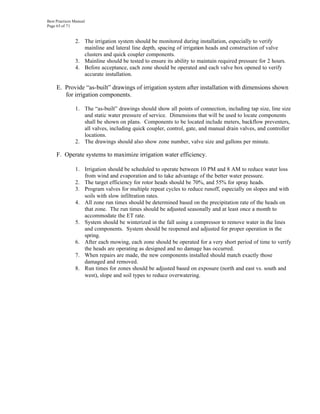
6. Irrigation Design Techniques and Equipment ......................................................................66

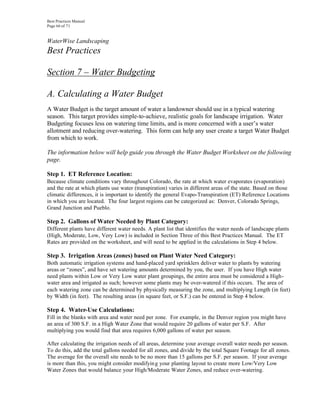
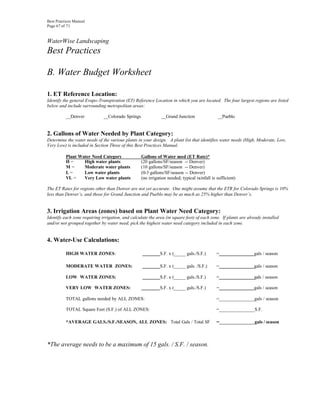
7. Water Budgeting ......................................................................................................................69

     A. Calculating a Water Budget
     B. Water Budget Worksheet

8. Additional Resources...............................................................................................................71
Best Practices Manual
Page 1 of 71


WaterWise Landscaping
Best Practices Manual
Section 1 – Introduction
Prevalent landscaping practices used in of development today have disregarded the long-term effects on
the region’s water supply. Nearly 75% of summer water use is consumed by outdoor vegetation. The
drought in Colorado has highlighted the necessity of using WaterWise design practices in order to best
use our limited water resources. Significant reductions can be gained through minor changes in the
arrangement of plantings, alternative plant selection and soil preparation.

This spring, Lafayette and Erie have worked to draft a Landscape Ordinance that includes WaterWise
landscape practices that will be mandatory for “new” development. This ordinance project will be used
as a model for other Colorado towns, and is funded by a Heritage Grant from the State Department of
Local Affairs. The purpose of the project is to:

       1.   move closer to use of landscaping that matches our semi-arid environment
       2.   include specific direction in choice of plant material
       3.   include illustrations
       4.   to the extent possible, make language of code easy to understand and apply
       5.   include both mandatory xeriscape requirements and aspirational practices

Besides requirements for new development, the process also includes this “Best Practices Manual” that all
citizens can use in making choices about their home landscaping. These Best Practices for landscape
design are derived from the seven principles of Xeriscaping, as well as GreenCo’s Best Management
Practices. This Manual also makes design recommendations based on the regulations outlined in the
Landscape Ordinance.

The intention for these Best Practices is to inform home and property owners about landscape and
irrigation needs unique to Colorado, and to assist in creating responsible landscape and irrigation design
decisions.
Best Practices Manual
Page 2 of 71


WaterWise Landscaping
Best Practices
Section 2 – WaterWise Principles and Guidelines
DSW, Sources: GreenCo BMPs, Xeriscape Principles

This section focuses on eight “principles” that act as goals for smart planting and irrigating in the
Colorado region. Each principle offers a series of design recommendations and techniques in the
form of “guidelines”. The guidelines function as steps to achieve the goals. Each guideline is
not imperative but still important to ensure healthy plant growth, reduced water waste and
increased cost savings over time. The following principles, if used properly, will help to create a
useful, efficient and enjoyable WaterWise landscape.


Principle #1 – Plan and design landscaping comprehensively.
Guidelines

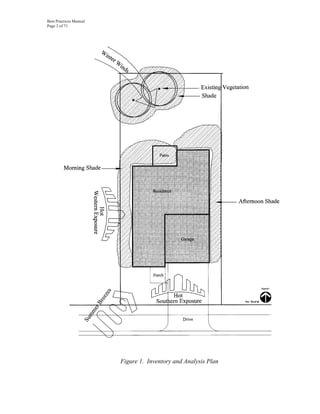
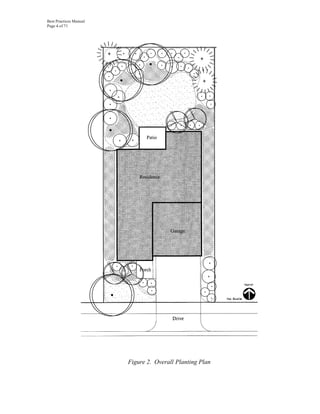
                  A. Start with an inventory and analysis plan of the site that identifies “existing
                     conditions.” Conditions such as drainage areas, sun exposure, soil types, good
                     views, existing plants, etc. will affect how the site is used (Figure 1). Next
                     develop a list of activities and areas, also called a “program,” expected to occur
                     on the site. For example a backyard program might include a lawn play area,
                     dog run, dining patio, barbecue grill, shade trees and shrub beds. Continue by
                     diagramming possible locations for the program activities, while also providing
                     access and traffic patterns or screening as needed. Finally, use this information
                     to develop a plan that integrates plants into the overall scheme (Figure 2).
                  B. Now with your overall plan, consider options on how you would like to
                     conserve water. Several recommendations for water conservation are addressed
                     throughout this document.
                  C. Calculate the water requirements for your landscape using the Water Budget
                     Worksheet provided in Section Seven of this manual. Try not to exceed an
                     average total of 15 gallons per square foot annually.
                  D. Incorporate trees into the landscape to provide shade, reduce stormwater runoff,
                     stabilize soil and protect against wind. If considering the gross site area, a
                     minimum goal of 20 percent tree canopy coverage (at trees’ maturity) for Front
                     Range communities is recommended.
                  E. When designing plant placement on slopes, place lower-water demand plants at
                     the tops of slopes and higher-demand plants at the bottom.
                  F. Artificial flowers and grass are discouraged. Exceptions may be granted for
                     special use areas such as synthetic turf athletic fields.
Best Practices Manual
Page 3 of 71


                        Figure 1. Inventory and Analysis Plan
Best Practices Manual
Page 4 of 71


                        Figure 2. Overall Planting Plan
Best Practices Manual
Page 5 of 71


Principle #2 - Evaluate soil and improve, if necessary.
Guidelines

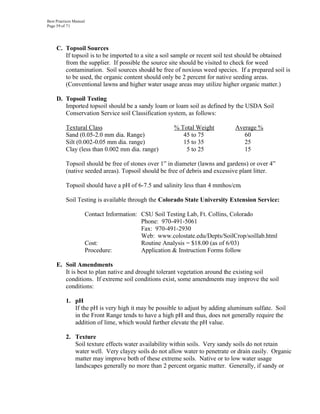
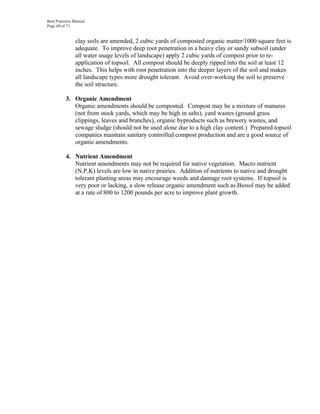
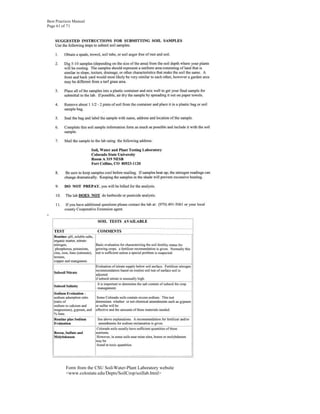
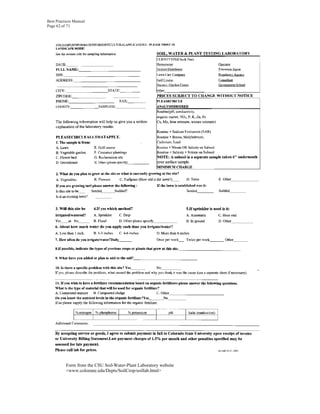
          A. Soil suitability for planting should be evaluated to identify potential soil amendments
             that may improve plant health and survival (see Section Five).
          B. Strip and stockpile existing topsoil prior to major site re-grading. Following
             completion of grading, replace topsoil and improve soil for planting with suitable soil
             amendments.
          C. Improve soil as suitable (see Section Five) before planting and installing the irrigation
             system. Soil improvement promotes better absorption of water, improved water-
             holding capacity and drainage of the soils. It also allows for better oxygen transfer
             within the root zone.
          D. Add organic material to the plant hydrozones, but only as needed. This typically
             means adding organic material for High and Moderate water zones, but not for Low
             and Very Low water zones. pH-balanced examples of organic materials are compost
             (from plants), sphagnum peat and animal manure (other than cow or horse).
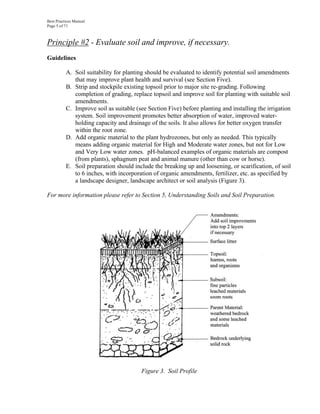
          E. Soil preparation should include the breaking up and loosening, or scarification, of soil
             to 6 inches, with incorporation of organic amendments, fertilizer, etc. as specified by
             a landscape designer, landscape architect or soil analysis (Figure 3).

For more information please refer to Section 5, Understanding Soils and Soil Preparation.


                                        Figure 3. Soil Profile
Best Practices Manual
Page 6 of 71


Principle #3 - Create efficient turf areas.
Guidelines

       A. Include turf areas where they provide defined functions (i.e., recreation, traffic areas,
          etc.). Plantings of trees, shrubs, ground covers and flowers are best separated from
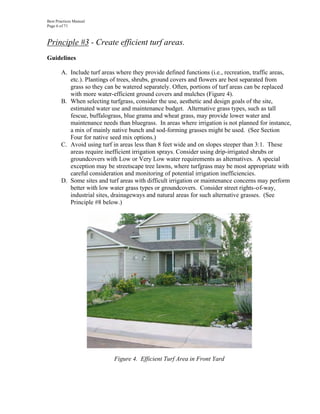
          grass so they can be watered separately. Often, portions of turf areas can be replaced
          with more water-efficient ground covers and mulches (Figure 4).
       B. When selecting turfgrass, consider the use, aesthetic and design goals of the site,
          estimated water use and maintenance budget. Alternative grass types, such as tall
          fescue, buffalograss, blue grama and wheat grass, may provide lower water and
          maintenance needs than bluegrass. In areas where irrigation is not planned for instance,
          a mix of mainly native bunch and sod-forming grasses might be used. (See Section
          Four for native seed mix options.)
       C. Avoid using turf in areas less than 8 feet wide and on slopes steeper than 3:1. These
          areas require inefficient irrigation sprays. Consider using drip-irrigated shrubs or
          groundcovers with Low or Very Low water requirements as alternatives. A special
          exception may be streetscape tree lawns, where turfgrass may be most appropriate with
          careful consideration and monitoring of potential irrigation inefficiencies.
       D. Some sites and turf areas with difficult irrigation or maintenance concerns may perform
          better with low water grass types or groundcovers. Consider street rights-of-way,
          industrial sites, drainageways and natural areas for such alternative grasses. (See
          Principle #8 below.)


                            Figure 4. Efficient Turf Area in Front Yard
Best Practices Manual
Page 7 of 71


Principle #4 - Use appropriate plants and group according to their
water need, i.e. “hydrozoning”.
Guidelines

     A. Plants with lower water requirements, such as native species adapted to Colorado’s
        climate, should be considered. However, other plants can have a place in xeriscape
        designs, even if they require larger amounts of water. The key is to use those plants in
        appropriate locations and not to interplant them with others that have very different,
        lower water requirements. In effect, the grouping of plants into “hydrozones” based on
        their water requirements allows them to be irrigated efficiently. A detailed list of
        Colorado landscape plants and their respective water requirements by “hydrozone
        category” is included in Section Three.
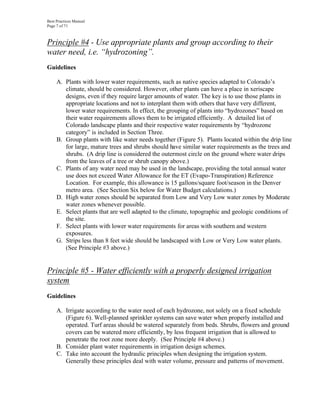
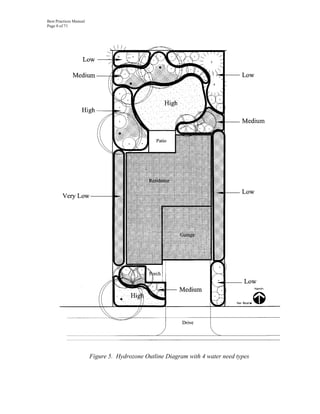
     B. Group plants with like water needs together (Figure 5). Plants located within the drip line
        for large, mature trees and shrubs should have similar water requirements as the trees and
        shrubs. (A drip line is considered the outermost circle on the ground where water drips
        from the leaves of a tree or shrub canopy above.)
     C. Plants of any water need may be used in the landscape, providing the total annual water
        use does not exceed Water Allowance for the ET (Evapo-Transpiration) Reference
        Location. For example, this allowance is 15 gallons/square foot/season in the Denver
        metro area. (See Section Six below for Water Budget calculations.)
     D. High water zones should be separated from Low and Very Low water zones by Moderate
        water zones whenever possible.
     E. Select plants that are well adapted to the climate, topographic and geologic conditions of
        the site.
     F. Select plants with lower water requirements for areas with southern and western
        exposures.
     G. Strips less than 8 feet wide should be landscaped with Low or Very Low water plants.
        (See Principle #3 above.)


Principle #5 - Water efficiently with a properly designed irrigation
system
Guidelines

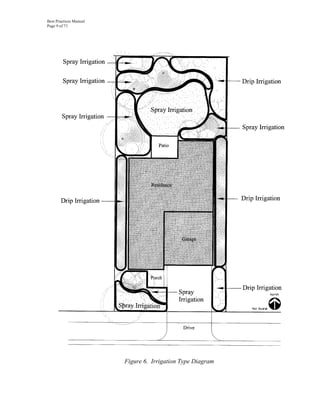
     A. Irrigate according to the water need of each hydrozone, not solely on a fixed schedule
        (Figure 6). Well-planned sprinkler systems can save water when properly installed and
        operated. Turf areas should be watered separately from beds. Shrubs, flowers and ground
        covers can be watered more efficiently, by less frequent irrigation that is allowed to
        penetrate the root zone more deeply. (See Principle #4 above.)
     B. Consider plant water requirements in irrigation design schemes.
     C. Take into account the hydraulic principles when designing the irrigation system.
        Generally these principles deal with water volume, pressure and patterns of movement.
Best Practices Manual
Page 8 of 71


                        Figure 5. Hydrozone Outline Diagram with 4 water need types
Best Practices Manual
Page 9 of 71


                        Figure 6. Irrigation Type Diagram
Best Practices Manual
Page 10 of 71


     D. Install an irrigation controller that offers flexible programming. Landscapes should not
        need as much supplemental watering during a rainy period. Rain or moisture sensors are
        available to coordinate with controllers, and some controllers are self-adjusting based on
        weather conditions.
     E. Ensure that the irrigation system is installed per plan and is accurate.
     F. Provide “as-built” drawings of irrigation system after installation with dimensions shown
        for irrigation components. Such drawings will help to find and correct problems in the
        future.
     G. Operate irrigation systems to maximize irrigation water efficiency.

For more information please refer to Section 6, Irrigation Design Techniques and Equipment.


Principle #6 - Use mulches to reduce surface evaporation of water and
weeds.
Guidelines

     A. Mulched planting beds are an ideal replacement for expansive turf areas. Mulches protect
        and reduce temperature extremes in the soil, minimize evaporation, reduce weed growth
        and slow erosion. Mulches also provide landscape interest. Organic mulches are typically
        bark chips, wood grindings, chopped leaves or pole peelings. Inorganic mulches include
        rock and various gravel products.
     B. Organic mulches are generally recommended for the most benefit of the plants, but the
        roots of some plants perform better with inorganic mulch. Landscape professionals can
        help determine suitable mulches for selected plants. Inorganic mulches may also be
        preferred as more stable in especially windy locations, areas requiring high maintenance
        or those apt to erosion.
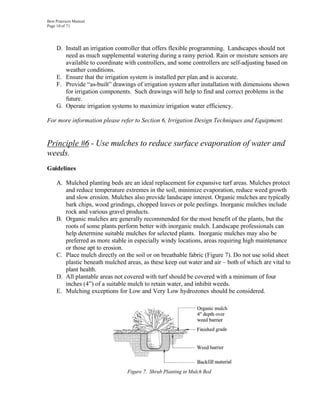
     C. Place mulch directly on the soil or on breathable fabric (Figure 7). Do not use solid sheet
        plastic beneath mulched areas, as these keep out water and air – both of which are vital to
        plant health.
     D. All plantable areas not covered with turf should be covered with a minimum of four
        inches (4”) of a suitable mulch to retain water, and inhibit weeds.
     E. Mulching exceptions for Low and Very Low hydrozones should be considered.


                                 Figure 7. Shrub Planting in Mulch Bed
Best Practices Manual
Page 11 of 71


Principle #7 - Practice appropriate landscape maintenance.
Guidelines

     A. Proper pruning, weeding, mowing and fertilization, plus attention to the irrigation system,
        are needed to maximize water savings. Regular maintenance of planting and irrigation
        system preserves the intended beauty of the landscape, and saves water and maintenance
        costs through efficient operations. Always water according to hydrozone need and current
        soil moisture conditions, rather than according to a rigid schedule.
     B. Landscapes should be maintained to ensure water efficiency. A regular maintenance
        schedule should include but not be limited to checking, adjusting, and repairing irrigation
        equipment; resetting the automatic controller; aerating turf areas; replenishing mulch;
        fertilizing; pruning, and weeding in all landscaped areas.
     C. Whenever possible, repair of irrigation equipment should be done with the originally
        specified materials or their equivalents so that original performance and efficiency can be
        maintained for longer periods. (See Section Six for more Irrigation information.)


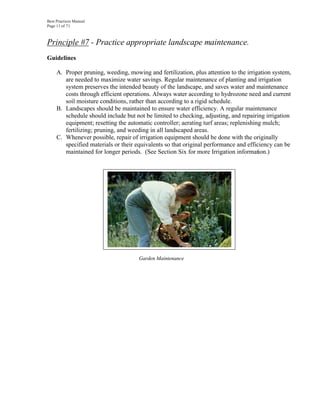
                                      Garden Maintenance
Best Practices Manual
Page 12 of 71


Principle #8 – Preserve existing landscape and natural areas.
Guidelines

     A. Where possible preserve existing native remnant plant communities and site conditions
        that support them.
     B. Where possible preserve healthy trees – established plants have often developed a root
        system that is adapted to lower water conditions.
     C. Local native plants and plants with documented lower water requirements should be
        given priority in landscape design. A native plant is a species that “occurs naturally in a
        particular region, state, ecosystem, and habitat without direct or indirect human action”
        (Federal Native Plant Conservation Committee, 1994). A local native plant is derived
        from “a population or ecotype of the native plant species that was grown from genetically
        local plant materials” (Colorado Native Plant Society).
     D. Use of native plants in the landscape supports local biodiversity, helps sustain local
        wildlife, enhances recreation experience, supports remnant native plant communities and
        reduces water consumption.

                           Natural Area

     E. All landscapes have the
        potential to impact native
        plant communities through
        transport of seeds and plant
        propagules by wind and
        storm drainage. Landscapes
        adjacent to native sites are
        particularly critical due to the
        potential of direct spread, but
        all projects (public or
        private) should not harbor or
        install exotic horticultural
        plant species that are known
        to be invasive and therefore threaten natural areas. A complete list of threatening plants
        to avoid is provided by the Colorado Native Plant Society web site:
        <http://carbon.cudenver.edu/~shill/species_avoid.pdf>.
     F. Landscapes adjacent to native areas should emphasize the use of species with low fuel
        volume of low flammability. Mowing management can be used to limit build up of
        flammable plant materials. Information on the fire-resistance of some native plants can
        be found at < www.ext.colostate.edu/PUBS/NATRES/06307.html>.
     G. Remove species that are designated state noxious weeds, especially ornamental species
        such as purple loosestrife, oxeye daisy, tamarisk, myrtle spurge and yellow toadflax. See
        Section Four below for the 2003 list of noxious weeds for Colorado, or for more
        information see the “Noxious Weed List (Rules and Regulations)” at
        <www.ag.state.co.us/DPI/weeds/weed.html >.

For more information please refer to Section 4, Natural Areas and Native Plants.
Best Practices Manual
Page 13 of 71


WaterWise Landscaping
Best Practices
Section 3 – WaterWise Plant Lists
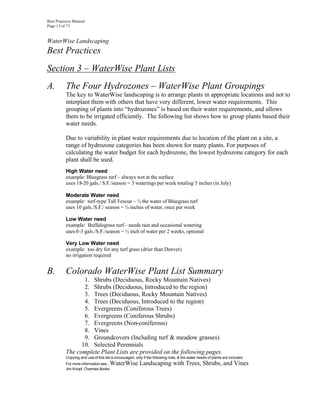
A.        The Four Hydrozones – WaterWise Plant Groupings
          The key to WaterWise landscaping is to arrange plants in appropriate locations and not to
          interplant them with others that have very different, lower water requirements. This
          grouping of plants into “hydrozones” is based on their water requirements, and allows
          them to be irrigated efficiently. The following list shows how to group plants based their
          water needs.

          Due to variability in plant water requirements due to location of the plant on a site, a
          range of hydrozone categories has been shown for many plants. For purposes of
          calculating the water budget for each hydrozone, the lowest hydrozone category for each
          plant shall be used.
          High Water need
          example: Bluegrass turf – always wet at the surface
          uses 18-20 gals./ S.F./season = 3 waterings per week totaling 5 inches (in July)

          Moderate Water need
          example: turf-type Tall Fescue – ½ the water of Bluegrass turf
          uses 10 gals./S.F./ season = ¾ inches of water, once per week

          Low Water need
          example: Buffalograss turf – needs rain and occasional watering
          uses 0 -3 gals./S.F./season = ½ inch of water per 2 weeks, optional

          Very Low Water need
          example: too dry for any turf grass (drier than Denver)
          no irrigation required


B.        Colorado WaterWise Plant List Summary
                 1. Shrubs (Deciduous, Rocky Mountain Natives)
                 2. Shrubs (Deciduous, Introduced to the region)
                 3. Trees (Deciduous, Rocky Mountain Natives)
                 4. Trees (Deciduous, Introduced to the region)
                 5. Evergreens (Coniferous Trees)
                 6. Evergreens (Coniferous Shrubs)
                 7. Evergreens (Non-coniferous)
                 8. Vines
                 9. Groundcovers (Including turf & meadow grasses)
                10. Selected Perennials
          The complete Plant Lists are provided on the following pages.
          Copying and use of this list is encouraged, only if the following note, & the water needs of plants are included.
          For more information see...WaterWise Landscaping with Trees, Shrubs, and Vines
          Jim Knopf, Chamisa Books
Best Practices Manual
Page 14 of 71


                                                                    SHRUBS
                                                   (Deciduous Rocky Mountain Natives)
                                                                     [Revised April '03]


                                                        WATER NEEDS OF PLANTS
                              The following chart shows how to group plants based on their water needs.
                                  Reference Location: Denver. Numbers illustrate typical conditions.

                          * = Plants with potential, but requiring caution due to limited history in Rocky Mountain landscaping.

-------------------------------------------------------------------------------------------------------------------------------------------------
HIGH WATER                          MODERATE WATER                            LOW WATER                              VERY LOW WATER
-------------------------------------------------------------------------------------------------------------------------------------------------
Reference plant:                    Reference plant:                          Reference plant:                       Reference plant:
Bluegrass turf                      Turf-type Tall Fescue                     Buffalograss turf                      Too dry for any turf
(Always wet at surface)             (Half of Bluegrass turf)                  (Like Denver without irrigation)       (drier than Denver )

18-20 gals./ S.F./season            10 gals./S.F./ season                     0-3 gals./S.F./season                  No irrigation
July: 5"-- 3 times per week         .75" -- once per week                     .5" per 2 weeks, optional              No irrigation
                                                                                                                                     _____


Acer•glabrum                                                   Rocky Mountain Maple                                     (M-H)
Acer•grandidentatum                                            Bigtooth Maple, Wasatch Maple                            (M)
Alnus•tenuifolia                                               Rocky Mountain Alder                                     (H)
Amelanchier•alnifolia                                          Rocky Mtn. Serviceberry                                  (M+/-)
Amelanchier•utahensis *                                        Utah Serviceberry                                        (VL- M)
Amorpha•canescens                                              Lead Plant                                               (L- M)
Amorpha•fruticosa                                              False Indigo                                             (M +/-)
Amorpha•nana                                                   Dwarf Lead Plant                                         (L- M)
Atriplex•canescens                                             Four-wing Saltbush                                       (VL-L)
Atriplex•confertifolia                                         Shadscale                                                (VL-L)

Betula•fontinalis                                              Rocky Mtn. River Birch                                   (H)
Betula•glandulosa                                              Bog Birch                                                (H)

Ceratoides•lanata *                                            Winterfat                                                (L)
Cercocarpus•montanus                                           Deciduous Mountain Mahogany                              (L- M)
Chamaebatiaria•millefolium                                     Fernbush                                                 (VL-L)
Chrysothamnus•spp.                                             Rabbitbrush species                                      (VL-L)
Cornus•sericea (now C. stolonifera)
Cornus•stolonifera                                             Redtwig Dogwood                                          (H)
Corylus•cornuta                                                Beaked Hazelnut                                          (H- M)
Crataegus.•var.•occidentalis *                                 Native Hawthorn                                          (M+/-)
Crataegus•erythropoda *                                        (syn.? C. s. var. occidentalis)                          (M+/-)
Crataegus•succulenta•var.•macrantha *                          Native Hawthorn                                          (M+/-)

Fallugia•paradoxa                                              Apache Plume                                             (VL-L)
Fendlera•rupicola                                              Cliff Fendlerbush                                        (L- M)
Forestiera•neomexicana                                         New Mexico Privet                                        (M+/-)
Fraxinus•anomala                                               Singleleaf Ash                                           (L)

Holodiscus•dumosus                                             Rock Spray                                               (L- M)

Jamesia•americana                                              Jamesia                                                  (M - H)

Lonicera•involucrata                                           Twinberry                                                (H)
Lycium•pallidum *                                              Pale Wolfberry                                           (L)

Ostrya•knowltonii *                                            Western Hop Hornbeam                                     (M+/-)
Best Practices Manual
Page 15 of 71


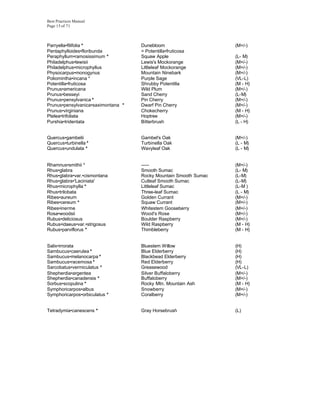
Parryella•filifolia *               Dunebloom                     (M+/-)
Pentaphylloides•floribunda          = Potentilla•fruticosa
Peraphyllum•ramosissimum *          Squaw Apple                   (L- M)
Philadelphus•lewisii                Lewis's Mockorange            (M+/-)
Philadelphus•microphyllus           Littleleaf Mockorange         (M+/-)
Physocarpus•monogynus               Mountain Ninebark             (M+/-)
Poliomintha•incana *                Purple Sage                   (VL-L)
Potentilla•fruticosa                Shrubby Potentilla            (M - H)
Prunus•americana                    Wild Plum                     (M+/-)
Prunus•besseyi                      Sand Cherry                   (L-M)
Prunus•pensylvanica *               Pin Cherry                    (M+/-)
Prunus•pensylvanica•saximontana *   Dwarf Pin Cherry              (M+/-)
Prunus•virginiana                   Chokecherry                   (M - H)
Ptelea•trifoliata                   Hoptree                       (M+/-)
Purshia•tridentata                  Bitterbrush                   (L - H)


Quercus•gambelii                    Gambel's Oak                  (M+/-)
Quercus•turbinella *                Turbinella Oak                (L - M)
Quercus•undulata *                  Wavyleaf Oak                  (L - M)


Rhamnus•smithii *                   -----                         (M+/-)
Rhus•glabra                         Smooth Sumac                  (L- M)
Rhus•glabra•var.•cismontana         Rocky Mountain Smooth Sumac   (L-M)
Rhus•glabra•'Laciniata'             Cutleaf Smooth Sumac          (L-M)
Rhus•microphylla *                  Littleleaf Sumac              (L-M )
Rhus•trilobata                      Three-leaf Sumac              (L - M)
Ribes•aureum                        Golden Currant                (M+/-)
Ribes•cereum *                      Squaw Currant                 (M+/-)
Ribes•inerme                        Whitestem Gooseberry          (M+/-)
Rosa•woodsii                        Wood's Rose                   (M+/-)
Rubus•deliciosus                    Boulder Raspberry             (M+/-)
Rubus•idaeus•var.•strigosus         Wild Raspberry                (M - H)
Rubus•parviflorus *                 Thimbleberry                  (M - H)


Salix•irrorata                      Bluestem Willow               (H)
Sambucus•caerulea *                 Blue Elderberry               (H)
Sambucus•melanocarpa *              Blackbead Elderberry          (H)
Sambucus•racemosa *                 Red Elderberry                (H)
Sarcobatus•vermiculatus *           Greasewood                    (VL-L)
Shepherdia•argentea                 Silver Buffaloberry           (M+/-)
Shepherdia•canadensis *             Buffaloberry                  (M+/-)
Sorbus•scopulina *                  Rocky Mtn. Mountain Ash       (M - H)
Symphoricarpos•albus                Snowberry                     (M+/-)
Symphoricarpos•orbiculatus *        Coralberry                    (M+/-)


Tetradymia•canescens *              Gray Horsebrush               (L)
Best Practices Manual
Page 16 of 71


                                                                    SHRUBS
                                                               (Deciduous, Introduced)
                                                                     [Revised April '03]


                                                        WATER NEEDS OF PLANTS
                              The following chart shows how to group plants based their water needs.
                                Reference Location: Denver. Numbers illustrate typical conditions.

                          * = Plants with potential, but requiring caution due to limited history in Rocky Mountain landscaping.

-------------------------------------------------------------------------------------------------------------------------------------------------
HIGH WATER                          MODERATE WATER                            LOW WATER                              VERY LOW WATER
-------------------------------------------------------------------------------------------------------------------------------------------------
Reference plant:                    Reference plant:                          Reference plant:                       Reference plant:
Bluegrass turf                      Turf-type Tall Fescue                     Buffalograss turf                      Too dry for any turf
(Always wet at surface)             (Half of Bluegrass turf)                  (Like Denver without irrigation)       (drier than Denver )

18-20 gals./ S.F./season            10 gals./S.F./ season                     0-3 gals./S.F./season               No irrigation
July: 5"-- 3 times per week         .75" -- once per week                     .5" per 2 weeks, optional           No irrigation
                                                                                                            _____   ___________________

Abelia•chinensis *                                             Chinese Abelia (China)                                   (M-H)
Abelia•x•grandiflora *                                         Abelia (origin unknown)                                  (M-H)
Abeliophyllum•distichum *                                      ----- (Korea)                                            (M+/-)
Acanthopanax•senticosus *                                      Syn. Elentherococcus s.
Acanthopanax•sieboldianus *                                    = Elentherococcus•sieboldianus
Acer•azimovii * (= A.•ovczimmikovii?)                          Azimov Maple                                             (M+/-)
Acer•campestre *                                               Hedge Maple (e. Europe & w. Asia)                        (M-H)
Acer•ginnala                                                   = Acer•tataricum•ssp.•ginnala
Acer•maximowiczianum *                                         ----- (China-Mongolia-Korea)                             (M-H)
Acer•semenovii *                                               = Acer•tataricum•ssp.•semenovii
Acer•tataricum                                                 Tatarian Maple (A. Minor, se. Asia)                      (L-M)
Acer•tataricum•ssp.•ginnala                                    Ginnala Maple (c. Asia)                                  (L-M)
Acer•tataricum•ssp.•semenovii *                                Turkestan Maple (c. Asia)                                (L-M)
Aesculus•parviflora *                                          Bottlebrush Buckeye (Ga., Ala.)                          (H)
Aesculus•sylvatica *                                           ----- (se. USA)                                          (H)
Alnus•cordata *                                                Italian Alder (Corsica, s. Italy)                        (H)
Alnus•glutinosa *                                              European Alder (Eur., n. Africa, Turkey)                 (H)
Alnus•rubra (was A.•oregona) *                                 Oregon Alder (w. N. Am.)                                 (H)
Amelanchier•stolonifera *                                      Running Serviceberry (ne. N. Am.)                        (H)
Aralia•elata *                                                 Angelica Tree (Jap., Kor., Manch.)                       (M-H)
Aralia•spinosa *                                               Devil's Walkingstick (e. USA)                            (M-H)
Aronia•melanocarpa                                             Chokeberry (e. N. America)                               (M+/-)
Artemisia•abrotanum                                            Southernwood (s. Europe)                                 (M+/-)
Atraphaxis•caucasica *                                         ----- (Transcaucasica)                                   (M+/-)
Atraphaxis•pyrifolia *                                         ----- (c. Asia)                                          (L)


Berberis•koreana *                                             Korean Barberry (Korea)                                  (M+/-)
Berberis•oblonga *                                             ----- (Turkestan)                                        (M-L)
Berberis•thunbergii                                            Japanese Barberry (Jap.)                                 (M-H)
Buddleja•alternifolia *                                        Butterflybush (nw. China)                                (M+/-)
Buddleja•davidii                                               Butterflybush (China)                                    (M+/-)
Buddleja•globosa *                                             ----- (Chile, Argentina, Peru)                           (M+/-)
Buddleja•x•'Lochinch' *                                        ----- (hort. hybrid)                                     (M+/-)


Callicarpa•bodinieri *                                         Beauty Berry (c. & w. China)                             (M+/-)
Callicarpa•dichotoma *                                         Korean Beautyberry (e. USA)                              (H)
Calycanthus•occidentalis *                                     California Allspice (sw. USA)                            (H)
Best Practices Manual
Page 17 of 71


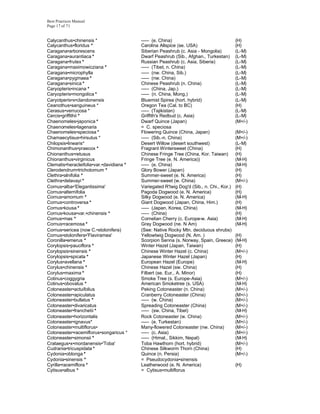
Calycanthus•chinensis *                   ----- (e. China)                                (H)
Calycanthus•floridus *                    Carolina Allspice (se. USA)                     (H)
Caragana•arborescens                      Siberian Peashrub (c. Asia - Mongolia)          (L-M)
Caragana•aurantiaca *                     Dwarf Peashrub (Sib., Afghan., Turkestan)       (L-M)
Caragana•frutex *                         Russian Peashrub (c. Asia, Siberia)             (L-M)
Caragana•maximowicziana *                 ----- (Tibet, n. China)                         (L-M)
Caragana•microphylla                      ----- (nw. China, Sib.)                         (L-M)
Caragana•pygmaea *                        ----- (nw. China)                               (L-M)
Caragana•sinica *                         Chinese Peashrub (n. China)                     (L-M)
Caryopteris•incana *                      ----- (China, Jap.)                             (L-M)
Caryopteris•mongolica *                   ----- (n. China, Mong.)                         (L-M)
Caryotperis•x•clandonensis                Bluemist Spirea (hort. hybrid)                  (L-M)
Ceanothus•sanguineus *                    Oregon Tea (Cal. to BC)                         (H)
Cerasus•verrucosa *                       ----- (Tajikistan)                              (L-M)
Cercis•griffithii *                       Griffith's Redbud (c. Asia)                     (L-M)
Chaenomeles•japonica *                    Dwarf Quince (Japan)                            (M+/-)
Chaenomeles•lagenaria                     = C. speciosa
Chaenomeles•speciosa *                    Flowering Quince (China, Japan)                 (M+/-)
Chamaecytisus•hirsutus *                  ----- (Sib.-n. China)                           (M+/-)
Chilopsis•linearis*                       Desert Willow (desert southwest)                (L-M)
Chimonanthus•praecox *                    Fragrant Wintersweet (China)                    (H)
Chionanthus•retusus                       Chinese Fringe Tree (China, Kor. Taiwan)        (H)
Chionanthus•virginicus                    Fringe Tree (e. N. America))                    (M-H)
Clematis•heracleifolia•var.•davidiana *   ----- (e. China)                                (M-H)
Clerodendrum•trichotomum *                Glory Bower (Japan)                             (H)
Clethra•alnifolia *                       Summer-sweet (e. N. America)                    (H)
Clethra•delavayi *                        Summer-sweet (w. China)                         (M+/-)
Cornus•alba•'Elegantissima'               Variegated R'twig Dog'd (Sib., n. Chi., Kor.)   (H)
Cornus•alternifolia                       Pagoda Dogwood (e. N. America)                  (H)
Cornus•amomum *                           Silky Dogwood (e. N. America)                   (M-H)
Cornus•controversa *                      Giant Dogwood (Japan, China, Him.)              (H)
Cornus•kousa *                            ----- (Japan, Korea, China)                     (M-H)
Cornus•kousa•var.•chinensis *             ----- (China)                                   (H)
Cornus•mas *                              Cornelian Cherry (c. Europe-w. Asia)            (M-H)
Cornus•racemosa *                         Gray Dogwood (ne. N Am)                         (M-H)
Cornus•sericea (now C.•stolonifera)       (See: Native Rocky Mtn. deciduous shrubs)
Cornus•stolonifera•'Flaviramea'           Yellowtwig Dogwood (N. Am. )                    (H)
Coronilla•emerus *                        Scorpion Senna (s. Norway, Spain, Greece)       (M-H)
Corylopsis•pauciflora *                   Winter Hazel (Japan, Taiwan)                    (H)
Corylopsis•sinensis *                     Chinese Winter Hazel (c. China)                 (M+/-)
Corylopsis•spicata *                      Japanese Winter Hazel (Japan)                   (H)
Corylus•avellana *                        European Hazel (Europe)                         (M-H)
Corylus•chinensis *                       Chinese Hazel (sw. China)                       (H)
Corylus•maxima *                          Filbert (se. Eur., A. Minor)                    (H)
Cotinus•coggygria                         Smoke Tree (s. Europe-Asia)                     (M+/-)
Cotinus•obovatus *                        American Smoketree (s. USA)                     (M-H)
Cotoneaster•actuifolius                   Peking Cotoneaster (n. China)                   (M+/-)
Cotoneaster•apiculatus                    Cranberry Cotoneaster (China)                   (M+/-)
Cotoneaster•bullatus *                    ----- (w. China)                                (M+/-)
Cotoneaster•divaricatus                   Spreading Cotoneaster (China)                   (M+/-)
Cotoneaster•franchetii *                  ----- (sw. China, Tibet)                        (M-H)
Cotoneaster•horizontalis                  Rock Cotoneaster (w. China)                     (M+/-)
Cotoneaster•ignavus*                      ----- (e. Turkestan)                            (M+/-)
Cotoneaster•multiflorus•                  Many-flowered Cotoneaster (nw. China)           (M+/-)
Cotoneaster•racemiflorus•songaricus *     ----- (c. Asia)                                 (M+/-)
Cotoneaster•simonsii *                    ----- (Himal., Sikkim, Nepal)                   (M-H)
Crataegus•x•mordanensis•'Toba'            Toba Hawthorn (hort. hybrid)                    (M+/-)
Cudrania•tricuspidata *                   Chinese Silkworm Thorn (China)                  (H)
Cydonia•oblonga *                         Quince (n. Persia)                              (M+/-)
Cydonia•sinensis *                        = Pseudocydonia•sinensis
Cyrilla•racemiflora *                     Leatherwood (e. N. America)                     (H)
Cytisus•albus *                           = Cytisus•multiflorus
Best Practices Manual
Page 18 of 71


Cytisus•decumbens *                        Prostrate Broom (s. Europe)                 (L-M)
Cytisus•hirsutus                           = Chamaecytisus•hirsutus
Cytisus•multiflorus *                      Portuguese Broom (se. Europe)               (L-M)
Cytisus•purgans *                          ----- (s. Eur. - n. Afr.)                   (L-M)
Cytisus•scoparius *                        Scotch Broom (c. & s. Europe)               (L-M)
Cytisus•x•praecox *                        Warminster Broom (hort. hybrid)             (L-M)


Dalea•formosa *                            Feather Plume (w. Tex., Okl., Colo.) (L
Dalea•frutescens *                         Black Dalea (w. Tex., Okla.)                (L)
Dalea•scoparia *                           Broom Dalea (w. Tex., N. Mex., Az.)         (L)
Daphne•caucasica *                         Caucasian Daphne (Caucusus)                 (M+/-)
Daphne•genkwa *                            ----- (China)                               (M+/-)
Daphne•giraldii *                          Daphne (nw. China)                          (M+/-)
Daphne•mezereum *                          February Daphne (Europe, w. Asia)           (M+/-)
Decaisnea•fargesii *                       ----- Bluebean Shrub (w. China)             (M-H)
Deutzia•gracilis *                         Slender Deutzia (Japan)                     (M-H)
Deutzia•scabra *                           Fuzzy Deutzia                               (M-H)
Deutzia•x•lemoinei *                       Lemoine Deutzia (Hort. hybrid)              (M-H)
Diervilla•lonicera *                       ----- (e. N. America)                       (H)
Diervilla•sessilifolia *                   Southern Bush-honeysuckle (se. USA)         (H)
Dipelta•floribunda *                       ----- (c. & w. China)                       (M+/-)
Dipteronia•sinensis *                      ----- (China)                               (M+/-)
Disanthus•cercidifolius *                  ----- (China, Jap.)                         (H)


Elaeagnus•multiflora *                     Cherry Elaeagnus (Jap., China)              (M-H)
Elentherococcus•sieboldianus *             ----- (Jap., China)                         (M+/-)
Eleutherococcus•senticosus *               Siberian Ginseng (ne. Asia)                 (M-H)
Elsholtzia•stauntonii *                    Mint Shrub (n. China)                       (M+/-)
Euonymus•atropurpureus *                   Wahoo (NY to Fla, Minn. to Tex.)            (M-H)
Euonymus•alatus                            Burning Bush Euonymus (China, Jap., Kor.)   (M+/-)
Euonymus•bungeanus *                       Winterberry (China, Korea, Manch., Jap.)    (M+/-)
Euonymus•europaeus *                       Spindletree (Europe)                        (M-H)
Euonymus•nanus•v.•turkestanicus *          Turkestan Euonymus (Caucasus - w. China)    (M+/-)
Euonymus•phellomanus *                     ----- (n. & w. China)                       (M+/-)
Euonymus•sachalinensis *                   Sakhalin Euonymus (ne. Asia)                (M+/-)
Exochorda•albertii (now E. korolkowii )
Exochorda•giraldii *                       Pearlbush (c. China)                        (M+/-)
Exochorda•korolkowii *                     Pearlbush (Uzbekistan, Tajikistan)          (M+/-)
Exochorda•racemosa *                       Common Pearlbush (n. China)                 (M-H)
Exochorda•serratifolia *                   Pearlbush (Korea, Manchuria)                (M+/-)
Exochorda•x•macrantha *                    Pearlbush (hort. hybrid)                    (M+/-)


Fontanesia•phillyreoides•ssp.•fortunei *   ----- (China)                               (M+/-)
Forsythia•mandschurica *                   Manchurian Forsythia (Manch.)               (M+/-)
Forsythia•ovata *                          Early Forsythia (Korea)                     (M+/-)
Forsythia•suspensa *                       Forsythia (China)                           (M+/-)
Forsythia•x•intermedia                     Forsythia (hort. hybrid)                    (M+/-)
Fothergilla•gardenii *                     Fothergilla (Va. - Ga.)                     (H)
Fothergilla•major *                        ----- (Allegheny Mts.)                      (H)


Genista•tinctoria *                        ----- (Europe, w. Asia)                     (L-M)


Halimodendron•halodendron *                Salt Tree (se. Russia-c. & w. Asia)         (VL-L)
Hamamelis•japonica *                       Japanese Witch Hazel (Japan)                (H)
Hamamelis•mollis *                         Chinese Witch Hazel (w. China)              (H)
Hamamelis•vernalis *                       Witch Hazel (s.e. N. America)               (H)
Hamamelis•virginiana *                     Common Witch Hazel (Canada to Georgia)      (H)
Best Practices Manual
Page 19 of 71


Heptacodium•miconioides *                  ----- (China)                               (M+/-)
Hibiscus•syriacus                          Rose-of-Sharon Hibiscus (China, India)      (M+/-)
Hippophaë•rhamnoides                       Sea Buckthorn (Eurasia)                     (M-H)
Holodiscus•discolor *                      Rock Spirea (s. Ore.-s. Calif.)             (M+/-)
Hydrangea•arborescens                      Hills-of-snow Hydrangea (e. USA)            (H)
Hydrangea•involucrata *                    ----- (Japan)                               (H)
Hydrangea•paniculata                       Peegee Hydrangea (China, Japan)             (H)
Hydrangea•quercifolia *                    Oakleaf Hydrangea (se. USA)                 (H)
Hydrangea•serrata *                        ----- (Jap., Korea)                         (M-H)


Indigofera•amblyantha *                    Pink Indigo (China)                         (M+/-)
Indigofera•decora *                          White Chinese Indigo (China)              (M+/-)
Indigofera•gerardiana *                    = Indigofera•heterantha
Indigofera•heterantha *                    ----- (Afghan.-w. China)                    (M+/-)
Indigofera•incarnata *                     = Indigofera•decora
Indigofera•kirilowii *                     ----- (n. China, Korea)                     (M+/-)
Indigofera•potaninii *                     Potanin Indigo (nw. China)                  (M+/-)
Itea•virginica *                           Sweetspire (e. USA)                         (H)


Jasminum•nudiflorum *                      Winter Jasmine (China)                      (M+/-)


Kerria•japonica                            Kerria (Japan)                              (M-H)
Kolkwitzia•amabilis                        Beautybush (China)                          (M+/-)


Leptodermis•oblonga *                      ----- (n. China)                            (M+/-)
Lespedeza•bicolor *                        ----- (Japan)                               (M+/-)
Lespedeza•thunbergii *                     ----- (Japan, China)                        (M+/-)
Ligustrum•vulgare                          Common Privet (Medit. region)               (M+/-)
Lindera•benzoin *                          Spicebush (e. USA)                          (M)
Lindera•obtusiloba*                        ----- (KOr., Jap., China)                   (M-H)
Lonicera.•spinosa *                        ----- (nw Him., Tibet, e. Turkestan)        (M+/-)
Lonicera•alberti *                         ----- (Turkestan, Tibet)                    (M+/-)
Lonicera•caerulea *                        ----- (Tibet, e. Siberia)                   (M+/-)
Lonicera•chrysantha *                      ----- (ne. Asia, c. Japan)                  (M-H)
Lonicera•etrusca *                         ----- (Medit. to s. Switzerland)            (M+/-)
Lonicera•fragrantissima *                  Winter Honeysuckle (China)                  (M-H)
Lonicera•hispida *                         ----- (Turkestan)                           (M+/-)
Lonicera•korolkowii                        ----- (Mts. c. Asia, Afghan. Pak.)          (M+/-)
Lonicera•maackia*                          Amur Honeysuckle (e. Asia)                  (M-H)
Lonicera•maximowiczii•v.•sachalinensis *   Sakhalin Honeysuckle (Manch, China, Kor.)   (M-H)
Lonicera•microphylla *                     ----- (nw. Him., Tibet, Sib.)               (M+/)
Lonicera•morrowii *                        Morrow Honeysuckle (Jap.)                   (M-H)
Lonicera•pileata *                         ----- (China)                               (M+/-)
Lonicera•quinquelocularis *                ----- (Afghan. to Yunnan)                   (M+/-)
Lonicera•spinosa•var.•alberti *            Fragrant Turkestan Honeysuckle (c. Asia)    (M+/-)
Lonicera•standishii *                      Fragrant Winter Honeysuckle (China)         (M+/-)
Lonicera•syringantha                       Lilac-scented Honeysuckle (China, Tibet)    (M-H)
Lonicera•tatarica•'Zabelii'                Zabel's Honeysuckle (c. Asia, Afghan.)      (M+/-)
Lonicera•thibetica *                       Tibetan Honeysuckle (Tibet., w. China)      (M+/-)
Lonicera•xylosteum *                       European Fly Honeysuckle (Eurasia)          (M+/-)
Lonicera•x•Xylosteoides *                  ----- (garden orgin)                        (M+/-)
Lycium•chinense *                          Chinese Wolfberry (e. Asia)                 (M-H)


Magnolia•sieboldii *                       Oyama Magnolia (Jap., Korea, w. China)      (H)
Magnolia•stellata                          Star Magnolia (c. Japan)                    (H)
Myrica•pensylvanica *                      Bayberry (e. N. America)                    (H)
Best Practices Manual
Page 20 of 71


Neillia•thibetica *                 ----- (Himalaya Mts.)                             (M+/-)
Nevieusii•alambamensis *            ----- (se. USA)                                   (H)


Orixa•japonica *                    ----- (Japan, China, Korea)                       (M+/-)


Paeonia•lutea *                     Tree Peony (China, Tibet)                          (M+/-)
Paeonia•suffruticosa *              Tree Peony (China, Tibet)                          (M+/-)
Parrotia•persica *                  ----- (Persia)                                     (M+/-)
Parrotiopsis•jacquemontiana *       ----- (Himalaya)                                   (M-H)
Philadelphus•coronarius +           Sweet Mockorange (Europe, sw. Asia)                (M+/-)
Philadelphus•x•virginalis +         ----- (Hort. Hybrid)                               (M+/-)
Photinia•villosa *                  Oriental Photinia (China, Korea, Jap.)             (M-H)
Physocarpus•opulifolius             Dwarf Ninebark ( e. N. America)                    (M+/-)
Poncirus•trifoliata *               Trifoliate Orange (c. & n. China)                  (M-H)
Prinsepia•sinensis *                ----- (Manchuria)                                  (M+/-)
Prinsepia•uniflora *                ----- (nw. China)                                  (M+/-)
Prunus•andersonii *                 Desert Peach (sw. U.S.A.)                          (L-M)
Prunus•cerasifera                   Cherry Plum (A. Minor, Cauc.)                      (M+/-)
Prunus•cerasifera•'Newport'         Newport Plum (garden origin)                       (M+/-)
Prunus•fruticosa *                  European Dwarf Cherry (Eur.., Siberia)             (M+/-)
Prunus•nigra *                      Canada Plum (ne. N. Am.)                           (M-H)
Prunus•padus *                      Bird Cherry (Eurasia)                              (M+/-)
Prunus•tomentosa                    Nanking Cherry (n. w. China, Tib. Kashmir)         (M-H)
Prunus•x•cistena                    Cistena Plum (hort. hybrid)                        (M+/-)
Pseudocydonia•sinensis *            Quince (China)                                     (M+/-)
Purnus•fasciculata *                Desert Almond (sw. USA)                            (VL-L)
x•Pyr acomeles•vilmorinii *         (Pyracanthus•crenatoserrataXOsteomeles•subrotunda) (M+/-)


Rhamnus•dahuricus *                 Common Buckthorn (e. Russia to Japan)             (M+/-)
Rhamnus•frangula                    Glossy Buckthorn (Eur., Turk., n. Afr.)           (M+/-)
Rhamnus•frangula•'Asplenifolia' *   ----- (Hort. Cultivar)                            (M+/-)
Rhodotypos•scandens *               Jetbead (Japan, China)                            (H)
Rhus•punjabensis *                  ----- (c., w. China)                              (M+/-)
Rhus•typhina                        Staghorn Sumac (e. N. America)                    (M+/-)
Rhus•typhina•'Laciniata'            Cutleaf Staghorn Sumac (?)                        (M+/-)
Ribes•alpinum                       Alpine Currant (w. Europe)                        (M-H)
Ribes•nevadense *                   Sierra Currant (Ore., Cal., Nev.)                 (M+/-)
Rosa•banksiae *                     Banksia Rose (w. & c. China)                      (M+/-)
Rosa•davidii *                      David's Rose (w. & c. China)                      (M+/-)
Rosa•ecae *                         ----- (c. Asia)                                   (M+/-)
Rosa•filipes *                      ----- (w. China)                                  (M+/-)
Rosa•foetida•'Bicolor'              Austrian Copper Rose (c. Asia)                    (M-L)
Rosa•foetida•'Persiana'             Persian Yellow Rose (s.w. Asia)                   (M-L)
Rosa•glauca                         Redleaf Rose (c. & s. Europe)                     (M+/-)
Rosa•helenae *                      Helen Wilson's Rose (c. China)                    (M+/-)
Rosa•hugonis                        = R.•xanthira•f.•hugonis
Rosa•kokanica *                     ----- (c. Asia, China)                            (M+/-)
Rosa•laxa *                         ----- (c. Asia, nw. China)                        (M+/-)
Rosa•moyesii *                      Moyes Rose (w. China)                             (M+/-)
Rosa•persica *                      Persian Rose (Persia, Afghan., c. Asia)           (M+/-)
Rosa•pulverulenta *                 ----- (s. Eur. to Afghanistan)                    (M+/-)
Rosa•rubrifolia (now R.•glauca)
Rosa•rugosa                         Rugosa Rose (e. Russia)                           (M+/-)
Rosa•sericea *                      ----- (c. Asia, w. China)                         (M+/-)
Rosa•setigera *                     Prairie Rose (e. & c. USA)                        (M+/-)
Rosa•webbiana                       ----- (c. Asia, Afghan, Kashmir.)                 (M+/-)
Rosa•wichuriana *                   ----- (e. Asia)                                   (M+/-)
Best Practices Manual
Page 21 of 71


Rosa•xanthina•f.•hugonis                  Father's Rose (c. China)                         (M+/-)
Rosa•x•harisonii *                        Harison's Yellow Rose (Hort. hybrid)             (M+/-)


Salix•discolor                            Pussy Willow (e. N. America)                 (H)
Salix•matsudana•'Tortuosa'                Corkscrew Willow (China, Japan)              (H)
Sambucus•canadensis                       Elderberry (e. N. America)                   (H)
Sibiraea•altaiensis *                     ----- (w. China to Balkans)                  (L-M)
Sibireae•laevigata                        = Siberaea•altaiensis
Sophora•davidii *                         Father David's Sophora (China)               (L-M )
Sorbaria•sorbifolia                       Ural False Spirea (Sib., Manch., Korea, Jap.)(M+/-)
Sorbaria•tomentosa•v.•angustifolia *      ----- (Afghan., Pak., Kashmir)               (L-M)
Spiraea•betulifolia•var.•lucida *         ----- (B.C., Ore., Wyo., Mon.)               (M+/-)
Spiraea•cantoniensis *                    ----- (China)                                (M+/-)
Spiraea•douglasii *                       ----- (B.C. to n. Cal.)                      (M+/-)
Spiraea•japonica *                        ----- (Japan, China)                         (M+/-)
Spiraea•japonica•'Albiflora' *            ----- (Japan)                                (M+/-)
Spiraea•japonica•'Anthony•Waterer'        Anthony Waterer Spirea (garden origin)       (M+/-)
Spiraea•japonica•'Bumalda'                ----- (Hort. cultivar)                       (M+/-)
Spiraea•japonica•'Froebelii'              Froebel's Spirea (garden origin)             (M+/-)
Spiraea•nipponica *                       ----- (Japan)                                (M+/-)
Spiraea•trilobata                         ----- (n. Sib., Turkestan, n. China)         (L-M)
Spiraea•wilsonii *                        ----- (c. & w. China)                        (M+/-)
Spiraea•x•vanhouttei                      Vanhoutte Spirea (hort. hybrid)              (M+/-)
Spirea•x•arguta*                          Garland Spirea (garden origin)               (M+/-)
Staphleya•trifolia*                       Bladdernut (e. USA)                          (M-H)
Staphylea•holocarpa *                     Oriental Bladdernut (China)                  (H)
Staphylea•pinnata *                       European Bladdernut (c., se. Eur. A. Minor) (H)
Stephanandra•incisa *                     Lace Shrub (Jap., Korea, Taiwan)             (H)
Stephanandra•tanakae *                    Lace Shrub (Japan)                           (M-H)
Stephylea•bumalda *                       Japanese Bladdernut (Japan)                  (M-H)
Symphoricarpos•x•chenaultii•'Hancock' +   Hancock Coralberry (garden origin)           (M+/-)
Symplocos•paniculata *                    Sapphireberry (Pakistan to Korea)            (M +/-)
Syringa•amurensis *                       = Syringa•reticulata•v.•mandschurica
Syringa•joskiaea *                        Hungarian Lilac (Hungary)                    (M+/-)
Syringa•meyeri *                          ----- (n. China)                             (M+/-)
Syringa•microphylla *                     Littleleaf Lilac (n. China)                  (M+/-)
Syringa•oblata *                          Early Lilac (n. China)                       (M+/-)
Syringa•patula *                          ----- (Korea, China)                         (M+/-)
Syringa•persica                           Persian Lilac (Persia)                       (M+/-)
Syringa•persica•'Laciniata' *             Cutleaf Persian Lilac (Persia ?)             (M+/-)
Syringa•reflexa *                         Nodding Lilac (c. China)                     (M+/-)
Syringa•reticulata•'Miss•Kim'             Miss Kim Lilac (hort. hybrid)                (M+/-)
Syringa•sweginzowii *                     Chengtu Lilac (nw. China)                    (M+/-)
Syringa•velutina *                        Korean Lilac (Korea)                         (M+/-)
Syringa•villosa                           ----- (China)                                (M+/-)
Syringa•vulgaris                          Common Lilac (s.e. Europe)                   (M+/-)
Syringa•wolfii *                          Wolf's Lilac (Korea, Manchuria)              (M+/-)
Syringa•x•chinensis                       ----- (hort. hybrid)                         (M+/-)
Syringa•x•laciniata                       Cutleaf Lilac (sw. Asia)                     (M+/-)
Syringa•x•prestoniae *                    ----- (Canadian hort. origin)                (M+/-)


Viburnum•burejaeticum *                   ----- (n. China, Korea, Russia)                  (M-H)
Viburnum•carlesii                         Korean Spice Viburnum (Korea, Jap.)              (M-H)
Viburnum•cassinoides *                    Witherod Viburnum (e. N. Am.)                    (H)
Viburnum•dentatum                         Arrowwood Viburnum (e. N. America)               (H-M)
Viburnum•dilatatum *                      Linden Viburnum (China, Jap.)                    (H)
Viburnum•farreri *                        Fragrant Viburnum (n. China)                     (H)
Viburnum•lantana                          Wayfaring Vib. (Eur., n. Afr., Cauc. A. Minor)   (M+/-)
Viburnum•lentago                          Nannyberry (e. N. America)                       (M-H)
Viburnum•opulus                           European Highbush Cranberry (Eurasia)            (H)
Best Practices Manual
Page 22 of 71


Viburnum•opulus•'Compactum'             ----- (cultivar)                                (H)
Viburnum•opulus•'Roseum'                European Snowball Viburnum                      (H)
Viburnum•plicatum *                     ----- (Jap., China)                  (H-M)
Viburnum•plicatum•'Sterile' *           Japanese Snowball Viburnum (Jap. China)         (H)
Viburnum•plicatum•form•'tomentosum' *   Doublefile Viburnum (Jap., China)               (H)
Viburnum•prunifolium                    Black Haw (e. N. Am.)                           (M-H)
Viburnum•sargentii *                    Sargent's Vib. (e. Sib., n. & w. China, Jap.)   (M-H)
Viburnum•setigerum *                    Tea Viburnum (c. & w. China)                    (M+/-)
Viburnum•sieboldii *                    ----- (Japan)                                   (H)
Viburnum•trilobum                       American Highbush Cranberry (N. America)        (H)
Viburnum•trilobum•'Compactum'           ----- (cultivar)                                (H)
Viburnum•x•bodnantense•'Pink•Dawn' *    ----- (hort. hybrid)                            (M-H)
Viburnum•x•carlcephalum                 ----- (hort. hybrid)                            (M-H)
Vitex•agnus-castus•f.•latifolia *       Hardy Chaste Tree (s. Europe to c. Asia)        (L-M)
Vitex•negundo•var.•heterophylla *       Cutleaf Chaste Tree(n. China, Mongolia)         (M+/-)
Vitex•rotundifolia *                    ----- (Asia to Australia)                       (M+/-)


Weigela•florida                         Weigela (n. China, Korea, Jap.)                 (H)
Weigela•middendorffiana *               Middendorff Weigela (n. China, Jap.)            (H)


Xanthocerus•sorbifolium                 Yellowhorn (n. China)                           (M+/-)


Zanthoxylum•piperitum *                 Pepper Tree (China, Korea, Jap.)                (M+/-)
Zanthoxylum•schinifolium *              Pepper Tree (China, Korea, Jap.)                (M+/-)
Zanthoxylum•simulan *                   ----- (China, Taiwan)                           (M-H)
Zenobia•pulverulenta *                  Dusty Zenobia (N. Carolina-Florida
Best Practices Manual
Page 23 of 71


                                                                       Trees
                                                   (Deciduous Rocky Mountain Natives)
                                                                     [Revised April '03]


                                                        WATER NEEDS OF PLANTS

                              The following chart shows how to group plants based on their water needs.
                                  Reference Location: Denver. Numbers illustrate typical conditions.

                          * = Plants with potential, but requiring caution due to limited history in Rocky Mountain landscaping.

-------------------------------------------------------------------------------------------------------------------------------------------------
HIGH WATER                          MODERATE WATER                            LOW WATER                              VERY LOW WATER
-------------------------------------------------------------------------------------------------------------------------------------------------
Reference plant:                    Reference plant:                          Reference plant:                       Reference plant:
Bluegrass turf                      Turf-type Tall Fescue                     Buffalograss turf                      Too dry for any turf
(Always wet at surface)             (Half of Bluegrass turf)                  (Like Denver without irrigation)       (drier than Denver )

18-20 gals./ S.F./season            10 gals./S.F./ season                     0-3 gals./S.F./season                  No irrigation
July: 5"-- 3 times per week         .75" -- once per week                     .5" per 2 weeks, optional              No irrigation
                                                                                                            _____      ___________________


Celtis•occidentalis                                            Hackberry                                                (M-H)
Celtis•reticulata                                              Netleaf Hackberry                                        (M-H)


Fraxinus•cuspidata *                                           Fragrant Ash                                             (M+/-)
Fraxinus•pennsylvanica                                         Green Ash                                                (M-H)


Populus•angustifolia                                           Narrowleaf Cottonwood                                    (H)
Populus•deltoides                                              Plains Cottonwood                                        (H)
Populus•fremontii                                              Fremont's Cottonwood                                     (H)
Populus•tremuloides                                            Aspen                                                    (H)
Populus•x•acuminata                                            Lanceleaf Cottonwood                                     (H)


Sapindus•drummondii *                                          Soapberry                                                (L-M)
Best Practices Manual
Page 24 of 71


                                                                        Trees
                                                               (Deciduous, Introduced)
                                                                      [Revised April '03]

                                                        WATER NEEDS OF PLANTS
                              The following chart shows how to group plants based on their water needs.
                                  Reference Location: Denver. Numbers illustrate typical conditions.

                          * = Plants with potential, but requiring caution due to limited history in Rocky Mountain landscaping.

-------------------------------------------------------------------------------------------------------------------------------------------------
HIGH WATER                          MODERATE WATER                            LOW WATER                              VERY LOW WATER
-------------------------------------------------------------------------------------------------------------------------------------------------
Reference plant:                    Reference plant:                           Reference plant:                      Reference plant:
Bluegrass turf                      Turf-type Tall Fescue                      Buffalograss turf                     Too dry for any turf
(Always wet at surface)             (Half of Bluegrass turf)                   (Like Denver without irrigation)      (drier than Denver )

18-20 gals./ S.F./season            10 gals./S.F./ season                      0-3 gals./S.F./season               No irrigation
July: 5"-- 3 times per week         .75" -- once per week                      .5" per 2 weeks, optional           No irrigation
                                                                                                             _____   ___________________


Acer•capillipes *                                              Snake-bark Maple (Japan)                                 (H)
Acer•cappadocicum *                                            Caucasican Maple (Cauc., A. Minor, n. India)             (M-H)
Acer•cissifolium *                                             Ivy-leafed Maple (c. China)                              (M-H)
Acer•davidii *                                                 Snake-bark Maple (n. China)                              (M-H)
Acer•griseum *                                                 Paperbark Maple (China)                                  (M-H)
Acer•heldreichii *                                             Greek Maple (Cauc., Balk., n. Turkey)                    (M-H)
Acer•macrophyllum *                                            Oregon Maple (w. N. Am.)                                 (H)
Acer•mandschuricum *                                           Manchurian Maple (Korea, Manch.)                         (M-H)
Acer•monspessulanum *                                          Montpelier Maple (Medit.- c. Asia)                       (M+/-)
Acer•palmatum                                                  Japanese Maple (Kor., Jap. )                             (H)
Acer•pectinatum                                                ----- (Tibet, w. & c. China)                             (M-H)
Acer•platanoides                                               Norway Maple (Eur. to n. Persia)                         M-H)
Acer•platanoides•ssp.•turkestanicum *                          Turkestan Maple (c. Asia)                                (M+/-)
Acer•pseudoplatanus *                                          Sycamore Maple (nw. c. Eur. to w. Asia)                  (M-H)
Acer•pseudosieboldianum *                                      Korean Maple (Korea-Manch.)                              (H)
Acer•rubrum                                                    Red Maple (e. N. America)                                (M-H)
Acer•saccharinum                                               Silver Maple (e. N. Am.)                                 (M-H)
Acer•saccharinum•'Laciniatum' +                                Cutleaf Silver Maple (Hort. cultivar                     (M-H)
Acer•saccharum                                                 Sugar Maple (e. N. America)                              (H)
Acer•triflorum *                                               Three-flowered Maple (Manch., Korea)                     (M+/-)
Acer•truncatum *                                               Shantung Maple (n. China, Manch., Korea)                 (H)
Acer•turkestanicum *                                           = A. platanoides ssp. turkestanicum
Aesculus•flava                                                 Sweet Buckeye (e. N. America)                            (M-H)
Aesculus•glabra                                                Ohio Buckeye (e. N. America)                             (M-H)
Aesculus•hippocastanum                                         Horse Chestnut (Eurasia)                                 (M-H)
Aesculus•octandra                                              = Aesculus•flava
Aesculus•pavia *                                               Red Buckeye (se. USA)                                    (H)
Aesculus•turninata *                                           Japanese Horsechestnut (Japan)                           (M-H)
Aesculus•x•carnea *                                            Red-flowered Horsechestnut (hort. hybrid)                (M+/-)
Ailanthus•altissima                                            Tree of Heaven (n. China)                                (L-M-H)
Albizia•julibrissin*                                           Silk Tree (Iran-Japan)                                   (M+/-)
Amelanchier•asiatica *                                         Asiatic Serviceberry (China)                             (M+/-)
Asimia•triloba *                                               Paw Paw (ec. USA)                                        (H?)


Betula•albosinensis *                                          Chinese Red Birch (c., w., nw. China)                    (M-H)
Betula•ermanii *                                               Russian Rock Birch (ne. Asia)                            (H)
Betula•mandshurica•var.•japonica *                             Japanese White Birch (Jap., Sakhalin Is.)                (H)
Betula•maximowicziana *                                        Monarch Birch (Jap.)                                     (H)
Betula•nigra                                                   River Birch (e. USA)                                     (H)
Best Practices Manual
Page 25 of 71


Betula•papyrifera                   Paper Birch (e. N. America)                             (H)
Betula•pendula•'Lacinata'           Cutleaf Weeping Eur.. Birch (hort. hybrid)              (H)
Betula•pendula                      European Birch (Eur.-w. Asia)                           (H)
Betula•utilis•var.•jacquemantii *   Whitebarked Himal. Birch (Kash., c. Nepal)              (M-H)


Carpinus•betulus *                  European Hornbeam (Eur.-w. Asia)                        (H)
Carpinus•carolinana *               American Hornbeam (e. N. America)                       (H)
Carpinus•cordata *                  Heartleaf Hornbeam (China)                              (M-H)
Carpinus•henryana *                 ----- (c. China)                                        (M-H)
Carpinus•japonica *                 Japanese Hornbeam (Japan)                               (H)
Carpinus•laxiflora *                ----- (Jap., Kor., n. & w. China)                       (M-H)
Carpinus•orientalis *               Oriental Hornbeam (se. Eur., A. Minor)                  (M-H)
Carpinus•tschonoskii *              Yeddo Hornbeam (ne. & sw. China)                        (M-H)
Carpinus•turczaninovii *            ----- (w. China)                                        (M+/-)
Carya•illinoinensis *               Pecan (Iowa s. to Mexico)                               (M+/-)
Carya•laciniosa *                   Shellbark Hickory (e. N. America)                       (M-H)
Carya•ovata *                       Shagbark Hickory (e. N. America)                        (H)
Castanea•crenata *                  Japanese Chestnut (Jap.)                                (H)
Castanea•dentata                    American Chestnut (e. N. America)                       (H)
Castanea•mollissima *               Chinese Chestnut (China, Korea)                         (M-H)
Catalpa•bignonioides *              Southern Catalpa (se. USA)                              (H)
Catalpa•bungei *                    ----- (n. China)                                        (M+/-)
Catalpa•fargesii *                  ----- (w. China)                                        (M+/-)
Catalpa•ovata *                     Chinese Catalpa (China)                                 (H)
Catalpa•speciosa                    Catalpa (e. N. America)                                 (M-H)
Celtis•australis *                  Mediterranean Hackberry (Medit., Mid East)              (M+/-)
Celtis•caucasica *                  Caucasican Hackberry (Asia Minor-Afghan.)               (M+/-)
Celtis•laevigata                    Sugarberry (se. USA)                                    (M-H)
Cercidiphyllum•japonicum *          Katsura Tree (Japan, w. China)                          (H-M)
Cercis•canadensis                   Eastern Redbud (e. N. America)                          (M-H)
Cercis•reniformis *                 Texas Redbud (N. Mex., Tex., Okla.)                     (M+/-)
Chitalpa                            = x•Chitalpa•tashkentensis
Cladrastis•lutea *                  Yellowwood (se. USA)                                    (H)
Cladrastis•platycarpa *             Japanese Yellowwood (Jap., China) (H)
Cladrastis•sinensis *               Chinese Yellowwood (China)                              (H)
Corlyus•colurna                     Turkish Hazel (se. Europe, w. Asia)                     (M+/-)
Cornus•walteri *                    Walter Dogwood (c. China)                               (M-H)
Corylus•americana *                 American Hazel (e. N. America)                          (H)
Crataegus•altaica•'Hissarica' *     Hissar Hawthorn (Tajikistan)                            (M+/-)
Crataegus•ambigua +                 Russian Hawthorn (se. Russia)                           (M+/-)
Crataegus•arnoldiana *              ----- (New England)                                     (M+/-)
Crataegus•azarolus *                Red Azarole (s. Eur., n. Afr., w. Asia)                 (M+/-)
Crataegus•crus-galli                Cockspur Hawthorn (se. N. America)                      (M+/-)
Crataegus•laevigata *               English Hawthorn (Eur., n. Afr., India)                 (M-H)
Crataegus•maximowiczii *            ----- (ne. Asia)                                        (M+)
Crataegus•mollis                    Downy Hawthorn (e. N. America)                          (M+/-)
Crataegus•monogyna *                Singleseed Hawthorn (Eur., n. Afr., w. Asia)            (M+/-)
Crataegus•pedicellata *             ----- (ne. USA)                                         (M+/)
Crataegus•phaenopyrum               Washington Hawthorn (se. N. America)                    (M+/-)
Crataegus•pinnatifida *             Chinese Hawberry (c. Asia, Korea)                       (M+/-)
Crataegus•rivularis *               ----- (Rocky Mtn. States)                               (M+/-)
Crataegus•tianshanica *             Tien Shan Hawthorn (c. Asia)                            (M+/-)
Crataegus•turkestanica *            Turkestan Hawthorn (Turkestan)                          (M+/-)
Crataegus•viridis•'Winter•King' *   Winter King Hawthorn (e. USA)                           (M+/-)
Crataegus•x•nitida *                Shining Hawthorn (s. USA)                               (M+/-)
Cyrilla•racemiflora *               Leatherwood (e. N. Am. & e. S. Am.)                     (H)
x•Chitalpa•tashkentensis *          Chiltalpa (Catalpa•bignonioides X Chilopsis•linearis)   (M+/-)


Diospyros•virginiana *              American Persimmon (e. USA)                             (M-H)
Best Practices Manual
Page 26 of 71


Eucommia•ulmoides *                    Hardy Rubber Tree (c. China)                     (M+/-)
Evodia•daniellii *                     = Tetradium•danielii *
Evodia•hupehensis *                    = Tetradium•hupehensis *


Fagus•grandifolia *                    American Beech (e. N. America)                   (H)
Fagus•orientalis *                     Oriental Beech (se. Eur.-Iran)                   (M+/-)
Fagus•sylvatica                        European Beech (Europe)                          (H)
Fraxinus•americana                     White Ash (e. N. America)                        (M-H)
Fraxinus•americana•'Autumn•Purple'     Autumn Purple Ash (hort. cultivar)               (M-H)
Fraxinus•angustifolia•'Raywood' *      Raywood Ash (s. Europe-c. Asia, n. Afr.)         (M+/-)
Fraxinus•angustifolia•ssp.•syriaca *   Turkestan Ash (c. Asia, A. Minor)                (M+/-)
Fraxinus•chinensis *                   Chinese Ash (China)                              (M+/-)
Fraxinus•cuspidata *                   Flowering Ash (N. Mex. to Mex.)                  (L-M)
Fraxinus•excelsior *                   European Ash (Europe, w. Asia)                   (M+/-)
Fraxinus•latifolia *                   Oregon Ash (w. US)                               (M+/-)
Fraxinus•mandshurica *                 Manchurian Ash (n. Asia)                         (M+/-)
Fraxinus•nigra *                       Black Ash (N. Am.)                               (M+/-)
Fraxinus•ornus *                       Flowering Ash (s. Europe-w. Asia)                (M+/-)
Fraxinus•oxycarpa•'Raywood' *          = F. angustifolia 'Raywood'
Fraxinus•quandrangulata *              Blue Ash (Mich., to Ark.)                        (M-H)
Fraxinus•sieboldiana *                 ----- (Japan, China)                             (M-H)
Fraxinus•sogdiana *                    = Fraxinus•angustifolia•ssp.•syriaca
Fraxinus•velutina *                    Velvet Ash (Ariz., N. Mex.)                      (M+/-)


Ginkgo•biloba *                        Ginkgo, Maidenhair Tree (se. China)              (M-H)
Gleditsia•caspica *                    Caspian Honeylocust (Azerbaijan-n. Iran)         (M+/-)
Gleditsia•triacanthos•var.             Honeylocust varieties (c. & e. N. America)       (M-H)
Gymnocladus•dioica                     Kentucky Coffeetree (c. & e. N. America)         (M-H)


Halesia•diptera *                      Two-winged Silverbell (s. USA)                   (H)
Halesia•tetraptera *                   Silverbell Tree (se. USA)                        (H)
Hemiptelea•davidii *                   David Hemiptelea (n. China to Korea)             (M-H)
Hovenia•dulcis *


Idesia•polycarpa *                     ----- (Sichuan)                                  M-H)


Juglans•ailanthifolia *                Japanese Walnut (Jap.)                           (M+/-)
Juglans•ailantifolia *                 Heartnut (Japan)                                 (H)
Juglans•cinerea *                      White Butternut (N. America)                     (M+/-)
Juglans•mandshurica *                  Manchurian Walnut (Manchuria, ne. China)         (M+/-)
Juglans•microcarpa *                   Little Walnut (OK., N. Mex., Tex., Kan., Mex.)   (M+/-)
Juglans•nigra                          Black Walnut (e. USA)                            (M-H)
Juglans•regia•varieties *              Carpathian Walnut varieties (se. Eur. - China)   (M+/-)


Kalopanax•pictus *                     = Kalopanax•septemlobus
Kalopanax•septemlobus *                Castor-aralia (China, Korea, Japan)              (M-H)
Koelreuteria•paniculata                Golden Raintree (n.China, Korea)                 (M+/-)


Laburnum•alpinum *                     Alpine Golden Chaintree (sc. Europe)             (M-H)
Laburnum•anagyroides *                 Common Laburnum (c. & s. Eur.)                   (M+/-)
Laburnum•X•'Waterer' *                 Waterer Laburnum (hort. hybrid)                  (H)
Larix•decidua                          European Larch (Alps, Carpathian Mts.)           (H)
Larix•gmelinii *                       Dahurian Larch (e. Asia)                         (H)
Best Practices Manual
Page 27 of 71


Larix•kaempferi *                     Japanese Larch (Japan)                          (H)
Larix•laricina                        Tamarack (n. N. America)                        (H)
Larix•leptolepis *                    = Larix•kaempferi
Larix•occidentalis *                  Rocky Mtn. Larch (B.C. to Montana) (M-H)
Liquidambar•styraciflua *             Sweetgum (e. N. America to c. America)          (H)
Liriodendron•tulipifera *             Tulip Tree (e. N. America)                      (H)


Maackia•amurensis *                   Amur Maackia (Manchuria, Korea)                 (M+/-)
Maackia•chinensis *                   ----- (c. China)                                (M+/-)
Maclura•pomifera *                    Osage Orange (Ark., Tex.)                       (M+/-)
Magnolia•acuminata *                  Cucmber Tree (e. N. AM)                         (H)
Magnolia•kobus *                      Tree Star Magnolia (Japan)                      (M-H)
Magnolia•x•soulangiana                Saucer Magnolia (hort. hybrid)                  (H)
Malus•'Hopa'                          Hopa Crabapple (hort. cultivar)                 (M+/-)
Malus•'Radiant'                       Radiant Crabapple (hort. cultivar)              (M+/-)
Malus•'Snowdrift'                     Snowdrift Crabapple (hort. cultivar)            (M+/-)
Malus•baccata                         Siberian Crabapple (Manchuria, China)           (M+/-)
Malus•dolgo                           Dolgo Crabapple (Siberia ?)                     (M+/-)
Malus•ioensis                         Prairie Crabapple (c. USA)                      (M+/-)
Malus•ioensis•'Plena'                 Bechtel Crabapple (hort. cultivar)              (M+/-)
Malus•sp.•'Golden•Delicious'          Golden Delicious Apple (hort. cultivar)         (M+/-)
Malus•sp.•'Red•Delicious'             Red Delicious Apple (hort. cultivar)            (M+/-)
Malus•sp.•'Winesap'                   Winesap Apple (hort. cultivar)                  (M+/-)
Malus•spp.                            Common Apple (se. Europe, c. Asia)              (M+/-)
Mespilus•germanica *                  Medlar (Europe-Asia Minor)                      (M+/-)
Metasequoia•glyptostroboides *        Dawn Redwood (w. China)                         (M-H)
Morus•alba                            White Mulberry (Asia)                           (M+/-)
Morus•australis *                     ----- (e. Asia)                                 (M+/-)
Morus•nigra *                         Black Mulberry (sw. Asia)                       (M+/-)
Morus•rubra *                         Red Mulberry (e. N. America)                    (M+/-)


Nothofagus•antarctica *               Southern Beech (Chile, Argentina)               (H)
Nyssa•sylvatica *                     Blackgum (Ontario, Texas)                       (H)


Ostrya•carpinifolia *                 European Hop Hornbeam (s. Eur., se. Asia) (M )
Ostrya•virginiana *                   American Hop Hornbeam (e. N. America)     (H)


Paulownia•fortunei*                   ----- (China, Japan)                            (H)
Paulownia•kawakamii*                  ----- (s. China, Taiwan)                        (H)
Paulownia•tomentosa *                 Empress Tree (c. & w. China)                    (M-H)
Phellodendron•amurense *              Amur Cork Tree (n. China, Jap., Manch.)         (M-H)
Phellodendron•chinese *               Chinese Cork Tree (c. China)                    (M-H)
Phellodendron•Japonicum *             Japanese Cork Tree (c. Japan)                   (H)
Phellodendron•sachalinense *          Sakhalin Cork Tree (w. China, n. Jap., Kor.)    (H)
Pistacia•chinensis *                  Chinese Pistachio (China, Taiwan)               (L-M)
Pistacia•vera *                       Edible Pistachio (Persia, c. Asia)              (L-M)
Platanus•occidentalis *               Eastern Plane Tree (Ia., to Tex. to Mex.)       (H)
Platanus•orientalis *                 Oriental Plane Tree (se. Eur., sw. Asia)        (M+/-)
Platanus•x•acerifolia *               London Plane Tree (hort. hybrid)                (H)
Prunus•armeniaca                      Apricot (c. & e. Asia)                          (M+/-)
Prunus•armeniaca•var.•mandshurica *   = Prunus•mandshurica
Prunus•avium *                        Bird Cherry (Eur.-A. Minor-e. Sib.)             (H-M)
Prunus•cerasus *                      Pie Cherry (se. Eur., Iran, n. India)           (M+/-)
Prunus•cerasus•'Meteor'               Meteor Pie Cherry (hort. cultivar)              (M+/-)
Prunus•cerasus•'Morello'              Morello Pie Cherry (hort. cult.)                (M+/-)
Prunus•cerasus•x•'Montmorency'        Montmorency Pie Cherry (hort. cultivar)         (M+/-)
Prunus•cerasus•x•'North•Star'         North Star Pie Cherry (hort. cultivar) (M+/-)
Prunus•maackii                        Manchurian Cherry (Kor. Manch.)                 (M-H)
Best Practices Manual
Page 28 of 71


Prunus•mahleb *                                   St. Lucie Cherry (Eur.-Asia Minor)           (M+/-)
Prunus•mandshurica *                              Manchurian Apricot (Manchuria, Korea)        (M+/-)
Prunus•persica                                    Peach (c. & e. Asia)                         (M+/-)
Prunus•salicina *                                 Japanese Plum (China, Jap.)                  (H-M)
Prunus•sp.•'Green•Gage'                           Green Gage Plum (hort. cultivar)             (M+/-)
Prunus•sp.•'Stanely'                              Stanley Plum (hort. cultivar)                (M+/-)
Prunus•spp.                                       Domestic Plums                               (M+/-)
Prunus•x•dasycarpa * (P. •armenica x P.•cerasifera) Black Apricot (c. Asia-Asia Minor)         (M-L)
Pseudolarix•kaempferi *                           Golden Larch (e. China)                      (H?)
Ptelea•polyadenia*                                ----- (sw. USA)                              (M+/-)
Pterocarya•fraxinifolia *                         Caucasian Walnut (Caucasus, Persia)          (M+/-)
Pteroceltis•tartarianovii *                       Tartar Wingceltis (n., c. China)             (M+/-)
Pterostyrax•hispida *                             Fragrant Epaulette Tree (Japan, China)       (H?)
Pyrus•bucharica *                                 = Pyrus•korshinsky
Pyrus•calleryana•'Bradford'                       Bradford Pear (China)                        (M+/-)
Pyrus•communis +                                  Common Garden Pear (Europe, w. Asia)         (M+/-)
Pyrus•communis•'Maxine'                           Maxine Pear (hort. cultivar)                 (M+/-)
Pyrus•communis•'Moonglow'                         Moonglow Pear (hort. cultivar)               (M+/-)
Pyrus•korshinsky *                                Buchara Pear (Turkestan)                     (L-M)
Pyrus•salicifolia *                               Willow-leafed Pear (se. Europe, w. Asia)     (M+/-)


Quercus•acutissima *                             Sawtooth Oak (Japan, China, Korea)            (M-H)
Quercus•alba                                     White Oak (e. USA)                            (M+/-)
Quercus•bicolor                                  Swamp White Oak (ne. N. Am.)                  (M+/-)
Quercus•douglasii *                              California Blue Oak (w. US)                   (M+/-)
Quercus•frainetto *                              Hungarian Oak (s. Italy, Balk., Turkey)       (M+/-)
Quercus•glandulifera *                           ----- (Jap., Korea, China)                    (M+/-)
Quercus•imbricaria *                             Shingle Oak (e. & c. USA)                     (M-H)
Quercus•kelloggii *                              California Black Oak (w. US)                  (M+/-)
Quercus•macrocarpa                               Bur Oak (c., ne. N. America)                  (M+/-)
Quercus•mongolica *                              Mongolian Oak (ne. Asia)                      (M+/-)
Quercus•muehlenbergii *                          Chinquapin Oak (e. USA)                       (M-H)
Quercus•palustris                                Pin Oak (ne. N. America)                      (M-H)
Quercus•phellos *                                Willow Oak (se. USA)                          (M-H)
Quercus•prinus *                                 Chestnut Oak (e. USA)                         (M-H)
Quercus•robur                                    English Oak (Europe, n. Afr., w. Asia)        (M-H)
Quercus•rubra                                    Northern Red Oak (ne. USA)                    (M-H)
Quercus•sadleriana *                             Deer Oak (w. USA)                             (M+/-)
Quercus•shumardii *                              Shumard's Oak (c. USA)                        (M-H)
Quercus•vacciniifolia *                          Huckleberry Oak (w. US)                       (M+/-)


Salix•pentandra *                                Laurel-leaf Willow (Eur.)                      (H)
Sassafras•albidum *                              Sassafras (e. N. Am.)                          (H)
Sophora•davidii *                                David's Sophora (China)                        (L-M)
Sophora•japonica (aka Styphnolobium•japonicum)   Japanese Pagoda Tree (China, Korea)            (M+/-)
Sorbus*torminalis *                              Chequer Tree (A. Minor, n. Africa, Eur. Asia) (H)
Sorbus•alnifolia *                               ----- (Jap., Korea)                            (H)
Sorbus•americana                                 American Mtn. Ash (ne. N. America)             (M-H)
Sorbus•aria*                                     Whitebeam Mtn. Ash (Eur.)                      (H)
Sorbus•aucuparia                                 European Mtn. Ash (Eurasia)                    (M-H)
Sorbus•cashmeriana *                             Kashmir Mountain Ash (Himalaya)                (H)
Sorbus•commixta *                                ----- (Korea, Japan)                           (M-H)
Sorbus•decora                                    Showy Mountain Ash (ne. N. America)            (M-H)
Sorbus•forrestii *                               Forest's Mountain Ash (China)                  (M-H)
Sorbus•hupehensis *                              Hupeh Mtn. Ash (c., w. China)                  (M-H)
Sorbus•intermedia *                              Scandinavian Mtn. Ash (Scand.)                 (H)
Sorbus•latifolia *                               ----- (Europe)                                 (M-H)
Sorbus•pohuashanensis *                          ----- (n. China)                               (H)
Sorbus•prattii *                                 Pratt's Mountain Ash (w. China)                (M+/-)
Sorbus•tianschanica *                            Tien Shan Mtn. Ash (c. Asian mtns.)            (H)
Best Practices Manual
Page 29 of 71


Sorbus•x•hybrida *                     Oakleaf Mtn. Ash (hort. hybrid)                (H)
Stranvaesia• davidiana *               Chinese Stranvaesia (w. China)                 (H)
Styphnolobium•japonicum                see Sophora•japonica
Styrax•japonicum *                     Japanese Snowball (Japan, China)               (H)
Styrax•obassia *                       Fragrant Snowbell (Japan)                      (H)
Syringa•pekinensis                     Peking Tree Lilac (n. China)                   (M+/-)
Syringa•reticulata                     Japanese Tree Lilac (n. Japan)                 (M-H)
Syringa•reticulata•var.•mandschurica   Manchurian Tree Lilac (Japan)                  (M+/-)


Taxodium•ascendens *                   Pond Cypress (se. USA)                         (H)
Taxodium•distichum                     Bald Cypress (se. N. America)                  (H)
Tetradium•danielii *                   Korean Evodia (China, Korea)                   (H)
Tetradium•hupehensis *                 Hupeh Bee Bee Tree (sw. China, Korea)          (M+/-)
Tilia•americana                        Basswood (c., e. N. America)                   (H)
Tilia•amurensis *                      Amur Linden (Manch., Korea)                    (M-H)
Tilia•cordata                          Littleleaf Linden (Eur. to Caucasus)           (H)
Tilia•mongolica *                      Mongolian Linden (Mon., e. Russia, n. China)   (M-H)
Tilia•platyphyllos *                   Bigleaf Linden (se., Europe)                   (M-H)
Tilia•tomentosa *                      Silver Linden (se. Europe, w. Asia)            (M+/-)
Tilia•x•euchlora *                     Crimean Linden (hort. hybrid)                  (M-H)
Toona•sinensis                         ----- (China)                                  (M-H)


Ulmus•parvifolia *                     Chinese Elm (China, Japan, Korea)              (M-H)
Ulmus•americana•cvs.                   American Elm (DED resistant cultivars)         (L-M-H)


Zelkova•carpinifolia *                 Caucasian Zelkova (Cauc.)                      (M-H)
Zelkova•serrata *                      Japanese Zelkova (Jap., Taiwan, e. China)      (H)
Zelkova•sinica *                       Chinese Zelkova (e. China)                     (H)
Ziziphus•jujuba *                      Chinese Jujuba (temp. Asia)                    (H-M)
Best Practices Manual
Page 30 of 71


                                                            EVERGREENS
                                                                  (Coniferous Trees)
                                                                     [Revised April '03]


                                                        WATER NEEDS OF PLANTS

                              The following chart shows how to group plants based on their water needs.
                                  Reference Location: Denver. Numbers illustrate typical conditions.

                          * = Plants with potential, but requiring caution due to limited history in Rocky Mountain landscaping.

-------------------------------------------------------------------------------------------------------------------------------------------------
HIGH WATER                          MODERATE WATER                            LOW WATER                              VERY LOW WATER
-------------------------------------------------------------------------------------------------------------------------------------------------
Reference plant:                    Reference plant:                          Reference plant:                       Reference plant:
Bluegrass turf                      Turf-type Tall Fescue                     Buffalograss turf                      Too dry for any turf
(Always wet at surface)             (Half of Bluegrass turf)                  (Like Denver without irrigation)       (drier than Denver )

18-20 gals./ S.F./season            10 gals./S.F./ season                     0-3 gals./S.F./season                  No irrigation
July: 5"-- 3 times per week         .75" -- once per week                     .5" per 2 weeks, optional              No irrigation
                                                                                                            _____      ___________________


Abies•cilicica *                                               Cilician Fir (s. Turkey, nw. Syria, Lebanon)                         (M-H)
Abies•concolor                                                 White Fir (Colo. to Mex.)                                            (M-H)
Abies•holophylla *                                             Manchurian Fir (Manch., Korea)                                       (M-H)
Abies•homolepis *                                              Nikko Fir (Japan)                                                    (H)
Abies•koreana *                                                Korean Fir (s. Korea)                                                (H)
Abies•lasiocarpa                                               Subalpine Fir (Rocky Mtns.)                                          (H)
Abies•nordmanniana *                                           Caucasian Fir (Greece, Cauc., Turkey)                                (M)


Calocedrus•decurrens *                                         Incense Cedar (w. Ore.-Baja Calif.)                                  (M-H)
Cedrus•atlantica *                                             = Cedrus•libani•ssp.•atlantica
Cedrus•deodara *                                               Deodara Cedar (Himilaya Mts. Afghan.-w. Nepal)                       (M-H)
Cedrus•libani *                                                Lebanon Cedar (nw. Syria, se Turkey)                                 (M-H)
Cedrus•libani•ssp.•atlantica *                                 Atlas Cedar (Atlas Mts.)                                             (M-H)
Cedrus•libani•ssp.•stenocoma *                                 Hardy Turkish Cedar (s. Turkey)                                      (M-H)
Cupressus•arizonica *                                          Arizona cypress (Ariz., N. Mex., Tex., Mex.)                         (L-M )
Cupressus•bakeri *                                             Modoc Cypress (Calif., Oregon)                                       (M+/-)


Picea•abies                                                    Norway Spruce (n. & c. Europe)                                       (H)
Picea•engelmannii                                              Engelmann Spruce (B.C. to N. Mex.)                                   (H)
Picea•glauca                                                   White Spruce (n. N. Am.)                                             (M-H)
Picea•glauca•'Black•Hills'                                     Black Hills Spruce (Black Hills S.Dak.)                              (M-/-)
Picea•glauca•'Conica'                                          Dwarf Alberta Spruce (hort. cultivar)                                (H)
Picea•omorika *                                                Serbian Spruce (Balk.)                                               (M-H)
Picea•pungens                                                  Colorado Spruce (Wyo., Colo., N. Mex., Utah)                         (M-H)
Picea•schrenkiana•ssp.•tianshanica *                           ----- (c. Asia)                                                      (M+/-)
Pinus.•heldreichii (was P.•leucodermis) *                      Bosnian Pine (w. Balkans - se. Italy - Greece)                       (M+/-)
Pinus•aristata                                                 Bristlecone Pine (Mts. Cal. to Colo.)                                (M, H)
Pinus•bungeana *                                               Lacebark Pine (nw. China)                                            (M+/-)
Pinus•cembra *                                                 Swiss Stone Pine (c. Eur. mtns.)                                     (M-H)
Pinus•contorta•ssp.•latifolia                                  Lodgepole Pine (Alaska, Cal., to Colo.)                              (M-H)
Pinus•densiflora *                                             Japanese Red Pine (Jap., Korea)                                      (M-H)
Pinus•flexilis                                                 Limber Pine (Albt. to Cal. to Tex.)                                  (M-H)
Pinus•nigra                                                    Austrian Pine (se. Eur., w. Asia, n. Afr.)                           (M-H)
Pinus•peuce *                                                  Macedonian Pine (Balk.)                                              (M-H)
Pinus•ponderosa                                                Ponderosa Pine (w. North America)                                    (M+/-)
Pinus•pumila *                                                 Dwarf Siberian Pine (ne. Asia)                                       (H)
Pinus•strobiformis                                             Southwestern White Pine (Colo., Ariz., n. Mex.                       (M-H)
Best Practices Manual
Page 31 of 71


Pinus•strobus                Eastern White Pine (e. N. America)       (H)
Pinus•sylvestris             Scotch Pine (n. Eurasia)                 (M-H)
Pinus•wallichiana *          Himalayan White Pine (Himalaya Mtns. )   (M-H)
Pseudotsuga•menziesii        Douglas Fir (B.C. to Mex. to Tex.)       (M-H)


Sequoiadendron•giganteum *   Giant Sequoia (Sierra Nevada Mts.)       (H)


Tsuga•canadensis             Canada Hemlock (ne. N. America)          (H)
Best Practices Manual
Page 32 of 71


                                                            EVERGREENS
                                                                  (Coniferous Shrubs)
                                                                      [Revised April '03]


                                                        WATER NEEDS OF PLANTS
                              The following chart shows how to group plants based on their water needs.
                                  Reference Location: Denver. Numbers illustrate typical conditions.

                          * = Plants with potential, but requiring caution due to limited history in Rocky Mountain landscaping.

-------------------------------------------------------------------------------------------------------------------------------------------------
HIGH WATER                          MODERATE WATER                            LOW WATER                              VERY LOW WATER
-------------------------------------------------------------------------------------------------------------------------------------------------
Reference plant:                    Reference plant:                           Reference plant:                      Reference plant:
Bluegrass turf                      Turf-type Tall Fescue                      Buffalograss turf                     Too dry for any turf
(Always wet at surface)             (Half of Bluegrass turf)                   (Like Denver without irrigation)      (drier than Denver )

18-20 gals./ S.F./season            10 gals./S.F./ season                      0-3 gals./S.F./season               No irrigation
July: 5"-- 3 times per week         .75" -- once per week                      .5" per 2 weeks, optional           No irrigation
                                                                                                             _____   ___________________


Chamaecyparis•pisifera *                                       ----- (Japan)                                                        (H)


Juniperus•chinensis                                            Chinese Juniper (e. Asia)                                            (L-M)
Juniperus•chinensis•'Hetzii•Glauca'                            Hetzi Juniper (hort. cultivar)                                       (L-M)
Juniperus•chinensis•'Pfitzeriana'                              Pfitzer Juniper (hort. cultivar)                                     (L-M)
Juniperus•chinensis•'Pfitzeriana•Compacta'                     Compact Pfitzer Juniper (hort. cultivar)                             (L-M)
Juniperus•chinensis•'Tortulosa' *                              Hollywood Juniper (hort. cultivar)                                   (L-M )
Juniperus•chinensis•var.•sargentii                             Sargent's Juniper (e. Asia)                                          (L-M)
Juniperus•communis•saxatilis                                   Mountain Common Juniper (circumboreal)                               (L-M)
Juniperus•horizontalis                                         Horizontal Juniper (Nov. Sc. to Alaska, N J., to Mon.,)              (L-M)
Juniperus•horizontalis•'Bar•Harbor'                            Bar Harbor Juniper (hort. cultivar)                                  (L-M)
Juniperus•horizontalis•'Blue•Chip'                             Blue Chip Juniper (e. Asia)                                          (L-M)
Juniperus•horizontalis•'Plumosa'                               Andorra Juniper (hort. cultivar)                                     (L-M)
Juniperus•horizontalis•'Prince•of•Wales'                       Prince of Wales Juniper (hort. cultivar)                             (L-M)
Juniperus•horizontalis•'Wiltonii'                              Wilton Carpet Juniper (hort. cultivar)                               (L-M)
Juniperus•monosperma                                           Oneseed Juniper (Colo., Utah, Tex., Mex.)                            (VL-L)
Juniperus•osteosperma                                          Utah Juniper (sw. USA)                                               (VL-L)
Juniperus•procumbens var. & cv.                                Japgarden Juniper varieties and cultivars                            (M-H)
Juniperus•sabina                                               Savin Juniper (w. Asia)                                              (L-M)
Juniperus•sabina•'Buffalo'                                     Buffalo Juniper (hort. cultivar)                                     (L-M)
Juniperus•sabina•'Skandia'                                     Skandia Juniper (hort. cultivar)                                     (L-M)
Juniperus•sabina•var.•tamariscifolia                           Tam Juniper (hort. cultivar)                                         (L-M)
Juniperus•scopulorum                                           Rocky Mtn. Juniper (B.C. to s. Ariz., to Tex.)                       (L)
Juniperus•squamata                                             ----- (India, Tibet, Taiwan)                                         (M+/-)
Juniperus•squamata•'Meyeri'                                    ----- (hort. cultivar)                                               (M+/-)
Juniperus•virginiana                                           Eastern Redcedar (e. N. Am.)                                         (M-H)


Microbiota•decussata *                                         Siberian Cypress (Siberia)                                           (M+/-)


Pinus•edulis                                                   Piñon Pine (Wyo., Cal., Mex.)                                        (VL-M)
Pinus•mugo                                                     Mugo Pine (c. Eur. Balk.)                                            (M-H)
Platycladus•orientalis *                                       Oriental Arborvitae (China, Korea)                                   (M+/-)


Taxus•baccata *                                                English Yew (Eur., n. Afr., w. Asia)                                 (H)
Best Practices Manual
Page 33 of 71


Taxus•brevifolia *                              Anticancer Yew (pnw. USA)                  (H)
Taxus•cuspidata *                               Japanese Yew (Jap., Kor., Manchuria)       (H)
Taxus•x•media *                                 ----- (hort. hybrid)                       (H)
Thuja•occidentalis•var.                         Western Arborvitae varieties (e. N. Am.)   (H)
Thuja•orientalis (now Platycladus•orientalis)
Thuyopsis•dolabrata *                           False Arborvitae (Japan)                   (H)
Best Practices Manual
Page 34 of 71


                                                        7. EVERGREENS
                                                                   (Non-coniferous)
                                                                     [Revised April '03]


                                                        WATER NEEDS OF PLANTS

                              The following chart shows how to group plants based on their water needs.
                                  Reference Location: Denver. Numbers illustrate typical conditions.

                          * = Plants with potential, but requiring caution due to limited history in Rocky Mountain landscaping.

-------------------------------------------------------------------------------------------------------------------------------------------------
HIGH WATER                          MODERATE WATER                            LOW WATER                              VERY LOW WATER
-------------------------------------------------------------------------------------------------------------------------------------------------
Reference plant:                    Reference plant:                          Reference plant:                       Reference plant:
Bluegrass turf                      Turf-type Tall Fescue                     Buffalograss turf                      Too dry for any turf
(Always wet at surface)             (Half of Bluegrass turf)                  (Like Denver without irrigation)       (drier than Denver )

18-20 gals./ S.F./season            10 gals./S.F./ season                     0-3 gals./S.F./season                  No irrigation
July: 5"-- 3 times per week         .75" -- once per week                     .5" per 2 weeks, optional              No irrigation
                                                                                                            _____      ___________________


Agave•parryi *                                                 Parry's Agave (Cal., N.Mex., Mex.)                                   (VL-L)
Agave•utahensis *                                              Utah Agave (Cal., Nev. Utah, Ariz.)                                  (VL-L)
Allenrolfea•occidentalis *                                     Iodine Bush (sw. USA, deserts)                                       (L-VL)
Arctostaphylos•patula *                                        Greenleaf Manzanita (sw. USA)                                        (M+/-)
Artemisia•cana •(a.k.a. Seriphidium•canum)                     Black Sage (w. USA)                                                  (VL-M)
Artemisia•tridentata (a.k.a. S. tridentata)                    Big Western Sage (intermtn. w. N. America)                           (VL-M)
Aucuba•japonica *                                              Spotted Laurel (China, Taiwan, s. Japan)                             (H)


Berberis•candidula *                                           Paleleaf Barberry (China)                                            (M+/-)
Berberis•julianae                                              Wintergreen Barberry (w. China)                                      (M+/-)
Berberis•triacanthophora *                                     = Berberis•X•wisleyensis
Berberis•verruculosa *                                         Warty Barberry (w. China)                                            (M+/-)
Berberis•x•wisleyensis *                                       Threespike Barberry (hort. hybrid)                                   (M+/-)
Bruckenthalia•spiculifolia *                                   Spike Heath (se. Europe, Asia Minor)                                 (M+/-)
Buxus•microphylla•v.•koreana *                                 Korean Boxwood (Jap., Korea)                                         (M-H)
Buxus•sempervirens *                                           Common Boxwood (s. Eur., w. Asia , n. Afr.)                          (M-H)


Ceanothus•fendleri                                             Fendler Ceanothus (Rocky Mtn. West)                                  (M+/-)
Ceanothus•integerrimus *                                       Deerbrush (sw. N. America)                                           (M+/-)
Ceanothus•sanguineus *                                         Oregon Tea (B.C. to Mont. to Calif.)                                 (M+/-)
Ceanothus•velutinus *                                          Snowbrush Ceanothus (Western Mtns., USA)                             (M-H)
Cercocarpus•breviflorus                                        = Cercocarpus•ledifolius•v.•paucidentatus
Cercocarpus•intricatus                                         = Cercocarpus•ledifolius•v.•intracatus
Cercocarpus•ledifolius                                         Curlleaf Mtn. Mahogany (Intermtn. USA)                               (VL-L)
Cercocarpus•ledifolius•v.•intracatus                           Littleleaf Mtn. Mahogany (Intermtn. sw. USA)                         (VL-L)
Cercocarpus•ledifolius•v.•paucidentatus                        Hairy Mtn. Mahogany (Ariz., N. Mex., Mex.)                           (VL-L)
Chamaebatiaria•millefolium                                     Fernbush (Ore., e. Cal., Wyo., Ariz.)                                (VL-L)
Cistus•laurifolius *                                           Laurel Rock Rose (sw. Europe)                                        (M+/-)
Coronilla•emerus *                                             Scorpion senna (c. & s. Europe)                                      (L-M)
Cotoneaster•congestus *                                        Pyrenees Cotoneaster (Himilaya Mts.)                                 (M+/-)
Cotoneaster•conspicuus *                                       Wintergreen Cotoneaster (c. China, se. Tibet)                        (M+/-)
Cotoneaster•dammeri *                                          Bearberry cotoneaster (c. China)                                     (M-/-)
Cotoneaster•glaucophyllus *                                    Brightbead Cotoneaster (w. China)                                    (L-M)
Cotoneaster•microphyllus *                                     Littleleaf Cotoneaster (mtns. Afghan. to China )                     (L-M)
Cowania•mexicana (syn. Purshia•mexicana)                       Cliff Rose (intermtn. sw. USA & Mex.)                                (VL-L)
Cytisus•scoparius *                                            Scotch Broom (Europe)                                                (M+/-)
Best Practices Manual
Page 35 of 71


Cytisus•x•praecox *                          Warminster Broom (hort. hybrid)                             (M+/)


Daphne•cneorum                               Daphne (mtns. c. & s. Europe)                               (M+/-)
Daphne•retusa *                              = Daphne•tangutica
Daphne•tangutica *                           ----- (nw. & w. China)                                      (M+/-)
Daphne•x•burkwoodii                          -----                                                       (M+/-)
Daphne•x•burkwoodii•'Carol•Mackie'           Carol Mackie Daphne (hort. cultivar)                        (M+/-)
Daphne•pontica *                             ----- (A. Minor, se. Eur., Cauc.)                           (M+/-)


Elaeagnus•pungens *                          ----- (Jap., China)                                         (VL, M)
Ephedra•americana•v.•andina *+               ----- (Andes, Ecuador. to Patagonia)                        (VL-M)
Ephedra•equisetina +                         ----- (c. Asia, w. china)                                   (VL)
Ephedra•gerardiana *+                        ----- (China, Himalaya)                                     (VL-L)
Ephedra•glauca *                             ----- (c. Asia-Seravshan Mts.)                              (VL-L)
Ephedra•minima *+                            ----- (China)                                               (VL-L)
Ephedra•minuta *                             ----- (c. Asia-Seravshan Mts.)                              (VL-L)
Ephedra•nevadensis *+                        Nevada Ephedra (Great Basin)                                (VL-L)
Ephedra•regaliana *                          ----- (c. Asia-Pamir Mts.)                                  (VL-L)
Ephedra•torreyana +                          Torrey Ephedra (intermtn. sw. USA)                          (VL-L)
Ephedra•viridis +                            Green Ephedra, Mormon Tea (Intermtn. sw. USA)               (VL-L)
Euonymus•fortunei•'Vegetus'                  Euonymus (c. & w. China)                                    (M-H)
Euonymus•kiautschovicus•'Manhattan'          Manhattan Euonymus (hort. cultivar)                         (M-H)


Fargesia•murielae, A. m., Sinarundinaria m. (see Thamnocalamus•spathaceus) *
Fargesia•nitida., Arundinaria n., Sinarundinaria n., Thamnocalamus•nitida (see Sinarundinaria•nitida) *
Fargesia•spathacea, Arundinaria s. (see Thamnocalamus•spathaceus) *
Fuchsia•magellanica *                          Fuchsia (Peru, Chile, Argentina)                     (H)


Garrya•flavescens *                          Yellow Silktassel (e. Cal., w. Az., s. Utah, s. Nev.)       (L)
Garrya•fremontii *                           Fremont's Silktassel (w. Wa., Ore., Cal.)                   (M+/-)
Garrya•wrightii *                            Wright's Silktassel (sw. AZ., s. N. Mex., w. Tex.)          (L)
Gelsemium•sempervirens *                     Carolina Yellow Jasmine (s. USA to c. Am.)                  (H)


Hesperaloe•parviflora +                      Hesperaloe (sw. Texas)                                      (VL-M)


Iberis•sempervirens                          Evergreen Candytuft (Eurasia)                               (M-H)
Ilex•aquifolium *                            English Holly (Eur., n. Afr., w. Asia)                      (H)
Ilex•cornuta *                               Chinese Holly (China, Korea)                                (H)
Ilex•crenata *                               Japanese Holly (Sakhalin Is., Jap., Korea)                  (H)
Ilex•opaca *                                 American Holly (e. USA)                                     (H)
Ilex•wilsonii *                              Wilson's Holly (c., w., e. China, Taiwan)                   (M-H)
Ilex•x•meserveae var.                        Blue Prince & Blue Princess Hollies etc. (hort. hybrids )   (H)


Jasminum•fruticans *                         ----- (Medit. Asia Minor)                                   (L-M)


Kalmia•angustifolia *                        Lambkill Kalmia (Hudson Bay to Georgia)                     (H)
Kalmia•latifolia *                           Mountain Laurel (e. N. Am.)                                 (H)


Lavandula•angustifolia var.                  English Lavender varieties (Medit.)                         (VL-M)
Lavandula•stoechas *                         Spanish Lavender (c. Spain, ne. Portugal)                   (VL-M )
Leucophyllum•minus *                         Cenzia, Texas Ranger (Texas, New Mexico)                    (L)
Lonicera•nitida *                            Boxleaf Honeysuckle (China)                                 (H)
Lonicera•pileata *                           Privet Honeysuckle (China)                                  (H)
Best Practices Manual
Page 36 of 71


Mahonia•aquifolium +                    Oregon Hollygrape (Cascade mtns.)                            (M-H)
Mahonia•fremontii +                     Fremont Mahonia (sw. USA)                                    (VL-L)
Mahonia•haematocarpa +                  Redberry Mahonia (sw. USA)                                   (VL-L)
Mahonia•repens +                        Creeping Mahonia (Rocky Mtn. West)                           (L-H)
Mahonia•trifoliata *+                   Three-leaf Mahonia, Algerita (Ariz., N. Mex., Tex., Mex .)   (L)
x•Mahoberberis•miethkeana *             ----- (Berberis•julianae•X•Mahonia•aquifolium)               (M+/-)


Nandina•domestica *                     Heavenly Bamboo (India to e. China)                          (M-H)
Nolina•microcarpa *                     Bear Grass (sw. USA)                                         (L)


Opuntia•imbricata                       Cholla (Colo., Kan., Tex., & Mex., to Ariz.)                 (VL-L)
Opuntia•polycantha ,etc.                Prickly Pear Cactus species (w. USA, Can., Mex.)             (VL-L)
Osmanthus•americanus *                  Devilwood (se. USA)                                          (H)
Osmanthus•decorus•'Baki•Kasapligil' *   ----- (Caucasus)                                             (H)
Osmanthus•heterophyllus *               Holly Osmanthus (Japan, Taiwan)                              (H)
Osmanthus•x•burkwoodii *                ----- (garden origin)                                        (H)


Paxistima•canbyi                        Eastern Mtn. Lover (e. N. America)                           (M+/-)
Paxistima•myrsinites                    = Paxistima•myrtifolia
Paxistima•myrtifolia *                  Western Mtn. Lover (B.C. Cal., Mont., Colo., N. Mex .)       (M-H)
Phillyrea•vilmoriniana *                = Osmanthus•decorus
Photina•villosa *                       Oriental Photina (Japan, Korea, China)                       (H)
Photinia•serrulata *                    Chinese Photinia (China)                                     (H)
Photinia•x•fraseri *                    Photina (hort. hybrid)                                       (H)
Phyllostachys•aureosulcata *            Yellow-groove Bamboo (ne. China)                             (H)
Phyllostachys•nigra *                   Black Bamboo (e., c. China)                                  (H)
Phyllostachys•nuda *                    Bamboo (China)                                               (H)
Pieris•japonica *                       Japanese Pieris (Jap., Taiwan, e. China)                     (H)
Prunus•laurocerasus•'Schipkaensis' *    Schipkanensis Cherry Laurel (Bulgaria)                       (M-H)
Prunus•laurocerasus•'Zabeliana'*        Zabeliana Cherry Laurel (garden origin)                      (M-H)
Purshia•mexicana                        = Cowania•mexicana
Purshia•tridentata                      Antelope Bitterbrush (Rocky Mtn. West)                       (L-M)
Pyracantha•coccinea                     Pyracantha (Eurasia)                                         (M+/-)


Quercus•grisea *                        Gray Oak (Tex., N. Mex., Mex., s. Colo.)                     (M+/-)
Quercus•turbinella *                    Turban Oak ( Cal., & n. Baja. Ca.. to w. Tex. & se. Colo.)   (M+/-)
Quercus•vacciniifolia *                 Huckleberry Oak (w. US)                                      (M+/-)
Quercus•virginiana•v.•fusiformis *      Texas Shrub Live Oak (Ok., Tex., Mex.)                       (L-M)


Rosmarinus•officinalis•'Arp' *          Rosemary 'Arp' (a hardy cultivar from Arp, Texas)            (L-M)


Santolina•chamaecyparissus              Santolina (w. & c. Medit.)                                   (VL-M)
Santolina•rosmarinifolia                Green Santolina (Portugal to France)                         (L-M)
Santolina•viridis                       = Santolina•rosmarinifolia
Sasa•kurilensis *                       Kurile Islands Bamboo (Jap. Kor.)                            (H)
Sasa•palmata *                          Palmate Bamboo (n. Japan)                                    (H)
Shepherdia•rotundifolia *+              Roundleaf Buffaloberry (Az., Utah)                           (L-M)
Sinarundinaria•nitida *                 Fountain Bamboo (c. China)                                   (H)


Thamnocalamus•spathaceus *              Umbrella Bamboo (c. China)                                   (H)


Viburnum•davidii *                      David's Viburnum (w. China)                                  (M-H)
Best Practices Manual
Page 37 of 71


Viburnum•farreri *                       Fragrant Viburnum (China)                         (M-H)
Viburnum•rhytidophyllum *                Leatherleaf Viburnum (c. & w. China)              (M-H)
Viburnum•x•burkwoodii                    Burkwood Viburnum (hort. hybrid)                  (M-H)
Viburnum•x•rhytidophylloides•'Mohican'   Mohican Lantanaphyllum Viburnum (garden origin)   (M-H)


Yucca•baccata +                          Banana Yucca (Colo. Plateau)                      (VL-L)
Yucca•elata +                            Soaptree Yucca (Az., N. Mex., Mex.)               (VL-L)
Yucca•glauca +                           Front Range Yucca (w. Great Plains)               (VL-L)
Yucca•harrimaniae +                      Harriman Yucca (Colo. Plateau)                    (VL-L)
Best Practices Manual
Page 38 of 71


                                                                     VINES
                                                                    [Revised April '03]


                                                        WATER NEEDS OF PLANTS
                              The following chart shows how to group plants based on their water needs.
                                  Reference Location: Denver. Numbers illustrate typical conditions.

                          * = Plants with potential, but requiring caution due to limited history in Rocky Mountain landscaping.

-------------------------------------------------------------------------------------------------------------------------------------------------
HIGH WATER                          MODERATE WATER                            LOW WATER                              VERY LOW WATER
-------------------------------------------------------------------------------------------------------------------------------------------------
Reference plant:                    Reference plant:                          Reference plant:                       Reference plant:
Bluegrass turf                      Turf-type Tall Fescue                     Buffalograss turf                      Too dry for any turf
(Always wet at surface)             (Half of Bluegrass turf)                  (Like Denver without irrigation)       (drier than Denver )

18-20 gals./ S.F./season            10 gals./S.F./ season                     0-3 gals./S.F./season               No irrigation
July: 5"-- 3 times per week         .75" -- once per week                     .5" per 2 weeks, optional           No irrigation
                                                                                                            _____   ___________________


Akebia•quinata *                                Five-leaf Akebia (Japan, Korea, China)                                              (M-H)
Akebia•trifoliata *                             Three-leaf Akebia (c. China, Jap.)                                                  (M-H)
Akebia•x•pentaphylla *                          (A. quinata x A. trifoliata) (Japan)                                                (M-H)
Ampelopsis•aconitifolia *                       Monkshood Vine (n. China, Mong.)                                                    (M+/-)
Ampelopsis•brevipedunculata *                   Porcelain Vine (China, Jap., Korea)                                                 (M+/-)
Ampelopsis•delavayana *                         ----- (w. China)                                                                    (M+/-)
Ampelopsis•humulifolia *                        ----- (n.China)                                                                     (M+/-)
Ampelopsis•megalophylla *                       ----- (w. China)                                                                    (M+/-)
Aristolochia•durior *                           = Aristolochia•macrophylla
Aristolochia•macrophylla *                      Dutchman's Pipe (Appalachian Mts.)                                                  (M-H)


Campsis•grandiflora *                           Chinese Trumpet Creeper (Jap., China)                                               (M-H)
Campsis•radicans +                              Trumpet Creeper (e. USA)                                                            (M-H)
Celastrus•loeseneri *                           Loeserner Bittersweet (c. China)                                                    (M-H)
Celastrus•orbiculatus *                         Oriental Bittersweet (ne. Asia)                                                     (M-H)
Celastrus•scandens                              Bittersweet (e. N. America)                                                         (M-H)
Clematis (hort. varieties & hybrids)            ----- (hort. hybrids & varieties)                                                   (M-H)
Clematis•alpina *                               ----- (Eurasia)                                                                     (M-H)
Clematis•brevicaudata *                         ----- (Jap., China., w. Mong.)                                                      (M+/-)
Clematis•chrysocoma *                           ----- (sw. China)                                                                   (M+/-)
Clematis•crispa *                               Curly Clematis (se. USA)                                                            (H)
Clematis•fargesii *                             ----- (China)                                                                       (M+/-)
Clematis•flammula                               ----- (s. Eur., to Turkestan)                                                       (M+/-)
Clematis•grata *                                ----- (China, Himalaya)                                                             (M+/-)
Clematis•ligusticifolia                         Western Virgin's Bower (Man. to B.C., Mo., to Calif.)                               (M+/-)
Clematis•macropetala *                          ----- (Siberia, n. China, Mongolia)                                                 (M+/-)
Clematis•maximowicziana                         = Clematis•terniflora
Clematis•montana var. *                         ----- (Afghanistan. to sw. & c. China, Himalaya)                                    (M+/-)
Clematis•paniculata *                           New Zealand Clematis (New Zealand)                                                  (H)
Clematis•paniculata                             = Clematis•terniflora
Clematis•rehderiana *                           Rehder's Clematis (w. China)                                                        (M+/-)
Clematis•tangutica                              Golden Lantern Clematis (Mongolia, nw. China)                                       (M+/-)
Clematis•terniflora                             Sweet Autumn Clematis (Korea, China, Japan)                                         (M+/-)
Clematis•texensis *                             Texas Clematis (sw. USA)                                                            (M+/-)
Clematis•tibetana *                             ----- (Tibet, China, n. India)                                                      (M+/-)
Clematis•vernayi (now C. tibetiana)
Clematis•viorna *                               Leather Flower (s. N. Am.)                                                          (M-H)
Clematis•vitalba *                              Traveller's Joy (Eur., Cauc., c. Asia, n. Afr.)                                     (M+/-)
Best Practices Manual
Page 39 of 71


Clematis•viticella *              ----- (s. Europe, w. Asia)                                     (M+/-)


Dicentra•scandens *               ----- (Nepal, to se. China)                                    (M+/-)


Euonymus•fortunei var.            Wintercreeper varieties (China)                                (M-H)


Hedera•colchica *                  Persian Ivy (Cauc., Turkey)                                   (M+/-)
Humulus•americanus                 = Humulus•lupulus
Humulus•lupulus                    Hop Vine (n. Temperate regions worldwide)                     (M+/-)
Hydrangea•anomala *                Climbing Hydrangea (Himalaya, China)                          (H)
Hydrangea•anomala•ssp.•petiolaris* = Hydrangea•petiolaris
Hydrangea•petiolaris *             Climbing Hydrangea (Japan, China, Korea, Taiwan)              (H)


Jasminum•beesianum *              ----- (China)                                                  (M+/-)


Lathyrus•latifolius                Perennial Sweetpea (c. & e. Europe)                           (M+/-)
Lonicera•alesuosmoides *           Evergreen Honeysuckle (w. China)                              (M+/-)
Lonicera•caprifolium *             Italian Honeysuckle (Eur., s. Asia)                           (M+/-)
Lonicera•flava *                   Yellow Honeysuckle (se. USA)                                  (H)
Lonicera•henyri *                  ----- (w. China)                                              (M+/-)
Lonicera•japonica•'Halliana'       Hall's Honeysuckle (e. Asia)                                  (M-H)
Lonicera•periclymenum              Woodbine Honeysuckle (Eur., w. Asia)                          (M+/-)
Lonicera•periclymenum•'Graham•Thomas'        Graham Thomas Honeysuckle (hort. cultivar)          (M+/-)
Lonicera•prolifera *               Grape Honeysuckle (c. USA)                                    (M+/-)
Lonicera•sempervirens              Scarlet Trumpet Honeysuckle (e. & s. USA)                     (M-H)
Lonicera•sempervirens•'Alabama•Crimson' -----                                                    (M-H)
Lonicera•sempervirens•'Sulphurea              -----                                              (M-H)
Lonicera•tragophylla *             Chinese Woodbine (w. China)                                   (M+/-)
Lonicera•x•brownii•'Dropmore•Scarlet' (L.s. x L. brownii)                                        (M+/-)
Lonicera•x•heckrottii              Heckrottii Honeysuckle (hort. hybrid)                         (M-H)
Lycium•halimifolium *              Common Matrimony Vine (se. Europe, w. Asia)                   (M+/-)


Mennispermum•canadense *          Moonseed Vine (e. N. America)                                  (M-H)


Parthenocissus•quinquefolia       Virginia Creeper (e. N. America to Rocky Mtns.)                (M-H)
Parthenocissus•tricuspidata       Boston Ivy (Japan, c. China)                                   (M-H)
Passiflora•incarnata *            Passion Flower (c. USA)                                        (H)
Polygonum•aubertii                Silver Lace Vine (w. China, Tibet, Tajikistan)                 (M+/-)
Polygonum•baldschuanicum *        Buchara Fleeceflower (c. Asia, Tajikistan)                     (M+/-)


Schisandra•chinensis *            Magnolia Vine (China)                                          (H)
Schizophragma•hydrangeoides *     Hydrangea Vine (Japan, Korea)                                  (M-H)
Smilax•rotundifolia *             Common Greenbriar (e. US A)                                    (H)


Tripterygium•regelii *            Regel's Tripterygium (Manchuria, Japan, Korea)                 (M-H)


Vitis•amurensis *                 Amur Grape (Manchuria)                                         (M+/-)
Vitis•arizonica                   Arizona Grape (w. Tex.- Cal. & Mex.)                           (M+/-)
Vitis•coignetiae *                Gloryvine (Japan, Korea)                                       (M+/-)
Vitis•riparia                     Riverbank Grape (Nov. Sc. - Man., Tenn. & Tex. - Rocky Mts.)   (M-H)
Vitis•vinifera•varieties *        Eurasian Grape varieties (Eur., A. Minor, Cauc. Turkestan)     (M+/-)
Best Practices Manual
Page 40 of 71


Wisteria•floribunda *     Japanese Wisteria (Japan)    (M-H)
Wisteria•macrostachys *   Kentucky Wisteria (c. USA)   (H)
Wisteria•sinensis *       Chinese Wisteria (China)     (M-H)
Best Practices Manual
Page 41 of 71


                                                       GROUND COVERS
                                                       (Icluding turf & meadow grasses)
                                                                     [Revised April '03]

                                                        WATER NEEDS OF PLANTS
                              The following chart shows how to group plants based on their water needs.
                                  Reference Location: Denver. Numbers illustrate typical conditions.

                          * = Plants with potential, but requiring caution due to limited history in Rocky Mountain landscaping.

-------------------------------------------------------------------------------------------------------------------------------------------------
HIGH WATER                          MODERATE WATER                            LOW WATER                              VERY LOW WATER
-------------------------------------------------------------------------------------------------------------------------------------------------
Reference plant:                    Reference plant:                          Reference plant:                       Reference plant:
Bluegrass turf                      Turf-type Tall Fescue                     Buffalograss turf                      Too dry for any turf
(Always wet at surface)             (Half of Bluegrass turf)                  (Like Denver without irrigation)       (drier than Denver )

18-20 gals./ S.F./season            10 gals./S.F./ season                     0-3 gals./S.F./season               No irrigation
July: 5"-- 3 times per week         .75" -- once per week                     .5" per 2 weeks, optional           No irrigation
                                                                                                            _____   ___________________


Achillea•ageratifolia                                          Grecian Yarrow (Greece)                                              (L-M)
Achillea•serbica                                               Serbian Yarrow (Balkans)                                             (L-M)
Aegopodium•podagraria                                          Bishop's Weed (Europe)                                               (H)
Ajuga•reptans                                                  Ajuga (Eur., Persia, Transcaucasia.)                                 (H)
Akebia•quinata *                                               Five-leaf Akebia (Jap., Korea, China)                                (M-H
Andropogon•scoparius                                           Little Blue Stem (syn. Schizachyrium•scoparium)                      (L-M+/-)
Anemopsis•californica *                                        Yerba Mansa        (sw. USA, Mex.)                                   (M-H)
Antennaria•parvifolia                                          Pussytoes (G. Plains, w. to B.C., Wash., Ariz.)                      (M+/-)
Antennaria•rosea                                               Pussytoes (Alaska to Cal. & N. Mex.)                                 (M+/-)
Arabis•alpina *                                                Alpine Rock-cress (Europe, Siberia)                                  (M+/-)
Arctostaphylos•uva-ursi                                        Kinnikinnick (circumpolar)                                           (M+/-)
Arenaria•balearica *                                           Corsican Sandwort (Balearic Is. & Corsica)                           (M+/-)
Aronia•melanocarpa                                             Chokeberry (e. N. Am.)                                               (M-H)
Asperula•odorata                                               = Galium•odoratum
Astroturfoides•ultradeceptiverous                              Astro Turf (Houston, Texas)                                          (L+/M-)
Aurinia•saxatilis                                              Basket-of-gold (c. & se. Europe)                                     (L-M)


Bouteloua•gracilis                                             Blue grama (N. America)                                              (L+/-)
Buchloë•dactyloides                                            Buffalograss (Great Plains)                                          (L)


Campanula•poscharskyana                                        Poscharsky Bellflower (Dalmatia)                                     (M-H)
Cerastium•tomentosum                                           Snow-in-summer (Eur. to w. Asia)                                     (L-M)
Ceratostigma•plumbaginoides                                    Plumbago (w. China)                                                  (M+/-)
Convallaria•majalis                                            Lily-of-the-valley (Eurasia, e. N. America)                          (M-H)
Cotoneaster•apiculatus *                                       Cranberry Cotoneaster (China)                                        (M+/-)
Cotoneaster•dammeri *                                          Creeping Cotoneaster (China)                                         (M+/-)
Cotoneaster•microphyllus *                                     Littleleaf Cotoneaster (Mts. Afghan., China)                         (L-M)


Delosperma•cooperi                                             Hardy Pink Ice Plant (s. Africa)                                     (M+/-)
Delosperma•nubigenum                                           Hardy Yellow Ice Plant (s. Africa)                                   (M+/-)
Duchesnea•indica                                               Mock Strawberry (Korea, Jap., to India)                              (M-H)


Epimedium•alpinum *                                            Alpine Epimedium (s. & c. Europe)                                    (M-H)
Epimedium•grandiflorumum *                                     Longspur Epimedium (n. Japan, Korea, s. Manch.)                      (M-H)
Euonymus•fortunei•'Coloratus'                                  Purpleleaf Wintercreeper (hort. cult.)                               (M+/-)
Best Practices Manual
Page 42 of 71


Euonymus•obovatus *                     Running Euonymus (e. USA)                             (H)


Festuca•elatior•cvs.                    Turf-type Tall Fescue (Eur., Siberia)                 (M+/-)


Galium•odoratum                         Sweet Woodruff (Eurasia)                              (M-H)
Genista•pilosa *                        Dwarf Broom (Europe)                                  (M+/-)
Geranium•spp.                           Hardy Geraniums                                       (M+/-)


Hosta•spp.                              Host species (Jap., China, Korea)                     (H)


Juniperus•spp. & cultivars +            Juniper species and cultivars                         (L-M)


Lamium•maculatum                        Spotted Deadnettle, Lamium (Eur., n. Afr., w. Asia)   (M-H)
Lathyrus•latifolius                     Perennial Sweetpea (c. & e. Europe)                   (M-H)
Lonicera•japonica•'Halliana'            Hall's Honeysuckle (e. Asia)                          (M+/-)
Lonicera•sempervirens                   Scarlet Trumpet Honeysuckle (e.& s. N. America)       (M-H)
Lonicera•x•heckrottii                   Heckrottii Honeysuckle (hort. hybrid)                 (M+/-)
Lysimachia•nummularia                   Moneywort (Europe)                                    (H)


Mahonia•repens                          Creeping Mahonia (Rocky Mtn. West)                    (L-M-H)
Mazus•reptans *                         ----- (Himalayas)                                     (M-H)
Marrubium•rotundifolium                 ----- (Asia Minor)                                    (L-M)


Poa•pratensis                           Kentucky Bluegrass (Eurasia, n. Africa)               (H)


Osteospermum•berberae                   South African Daisy (S. Africa)                       (M+/-)


Pachysandra•terminalis                  Pachysandra (Japan, nc. China)                        (M-H)
Parthenocissus•quinquefolia             Virginia Creeper (e. N. America to Rocky Mts.)        (M-H)
Phlox•stolonifera                       Creeping Phlox (se. USA)                              (M+/-)
Phlox•subulata                          Moss Phlox (Penn. to Ga.)                             (M+/-)
Polygonum•affine•'Border•Jewel'         Himalayan Border Jewel (Himalayas)                    (M-H)
Polygonum•japonicum•var.•compactum      Fleece Flower (e. Asia)                               (M-H)
Polygonum•reynoutria                    = Polygonum•japonicum•var.•compactum
Potentilla•nevadensis                   ----- (Spain)                                         (L-M)
Potentilla•verna•'Nana'                 Creeping Potentilla (hort. cult.)                     (M-H)


Rhus•trilobata                          Three-leaf Sumac (w. N. Am.)                          (L-M)


Saponaria•ocymoides                     Saponaria (mtns. sw. & sc. Europe)                    (M+/-)
Schizachyrium•scoparium                 = Andropogon•scoparius
Symphoricarpos•x•chenaultii•'Hancock'   Hancock Coralberry (hort. cult.)                      (M+/-)


Teucrium•chamaedrys                     Germander (c. & s. Europe, w. Asia)                   (M+/-)
Thymus•spp.                             Thyme species (Eurasia, N. Africa)                    (L-M)


Waldsteinia•fragarioides                Barren Strawberry (e. USA)                            (H)
Best Practices Manual
Page 43 of 71


Veronica•liwanensis     Turkish Veronica (ne. Anatolia, Cauc.)   (M-H)
Veronica•pectinata      Woolly Veronica (e. Balkans, A. Minor)   (L-M)
Vinca•major             ----- (Italy, Balk.)                     (M-H)
Vinca•minor             Vinca (Europe , w. Asia)                 (H)
Best Practices Manual
Page 44 of 71


                                             SELECTED PERENNIALS
                                                                    [Revised April '03]


                                                        WATER NEEDS OF PLANTS
                              The following chart shows how to group plants based on their water needs.
                                  Reference Location: Denver. Numbers illustrate typical conditions.

                          * = Plants with potential, but requiring caution due to limited history in Rocky Mountain landscaping.

-------------------------------------------------------------------------------------------------------------------------------------------------
HIGH WATER                          MODERATE WATER                            LOW WATER                              VERY LOW WATER
-------------------------------------------------------------------------------------------------------------------------------------------------
Reference plant:                    Reference plant:                          Reference plant:                       Reference plant:
Bluegrass turf                      Turf-type Tall Fescue                     Buffalograss turf                      Too dry for any turf
(Always wet at surface)             (Half of Bluegrass turf)                  (Like Denver without irrigation)       (drier than Denver )

18-20 gals./ S.F./season            10 gals./S.F./ season                     0-3 gals ./S.F./season              No irrigation
July: 5"-- 3 times per week         .75" -- once per week                     .5" per 2 weeks, optional           No irrigation
                                                                                                            _____   ___________________


Achillea x 'Coronation Gold'                                            Coronation Gold Yarrow                                      (VL)
Achillea x 'Moonshine'                                                  Moonshine Yarrow                                            (VL-L-M)
Aesclepias•tuberosa                                                     Butterfly Weed                                              M-H
Agastache cana                                                          Double Bubble Mint                                          (M+/-)
Alchemilla•vulgaris                                                     Lady's Mantle                                               M-H
Anthemis•tinctoria                                                      Golden Margurerite                                          M-H
Aquilegia•spp.                                                          Columbines                                                  H
Arum•italicum                                                           Italian Arum                                                M-H
Aster porteri                                                           Porter's Aster                                              (VL-L)
Aster•novae-angliae                                                     New England Aster                                           M-H
Aster•x•frikartii                                                       Frikart's Aster                                             M-H
Aurinia saxatilis                                                       Basket-of-gold                                              (L-M)
Baptisia•australis                                                      Baptisia                                                    M-H
Berlandiera lyrata                                                      Chocolate Flower                                            (VL-L)
Boltonia•asteroides                                                     Boltonia                                                    H
Borago•laxiflora                                                        Borage                                                      M-H
Callirhoë involucrata                                                   Poppy Mallow                                                (L-M)
Centranthus ruber                                                       Centranthus                                                 (L-M-H)
Cerastium tomentosum                                                    Snow-in-summer                                              (L-M)
Chrysanthemum•x•morifolium                                              Chrysanthemums                                              H
Chrysanthemum•x•superbum                                                Shasta Daisy                                                M-H
Convallaria•majalis                                                     Lily-of-the-valley                                          H
Crocosmia•x•crocosmiiflora                                              Crocosmia                                                   H
Crocus spp. *                                                           Crocus species                                              (L-M)
Datura meteloides                                                       Sacred Datura                                               L-M
Delosperma cooperi                                                      Hardy Pink Ice Plant                                        (M+/-)
Delphinium•x•elatum                                                     Hybrid Delphiniums                                          H
Dianthus•spp.                                                           Various Dianthus                                            L-M
Dicentra•eximia                                                         Bleeding Heart                                              H
Dictamnus•albus                                                         Gas Plant                                                   L-M
Digitalis•purpurea                                                      Common Foxglove                                             H
Echinacea•purpurea                                                      Echinacea                                                   M+/-
Echinops•ritro                                                          Globe Thistle                                               H
Eremurus•spp.                                                           Foxtail Lily                                                L-M
Eryngium•spp.                                                           Sea Holly                                                   L-M
Gaillardia aristata                                                     Native Gaillardia                                           (L-M)
Geranium•spp.                                                           Hardy Geraniums                                             M-H
Helianthemum•spp.                                                       Sun-roses                                                   M+/-
Helianthus maximiliani                                                  Maximilian Sunflower                                        (M+/-)
Helianthus•spp.                                                         Sunflowers                                                  M+/-
Best Practices Manual
Page 45 of 71


Helleborus•spp.                 Hellebores                 M-H
Hemerocallis•spp.               Daylilies                  M-H
Hosta•spp.                      Hostas                     H
Iberis•sempervirens             Candytuft                  M+/-
Incarvillea•delavayii           Hardy Gloxinia             M+/-
Iris bucharica                  Buchara Iris               (M+/-)
Iris germanica cvs..            Bearded Iris varieties     (L-M)
Kniphofia•spp.                  Poker Plants               M-H
Lavandula spp.                  Various Lavenders          (VL-M)
Liatris punctata                Dotted Gay Feather         (VL-L)
Liatris•punctata                Dryland Gayfeather         VL-L
Liatris•spicata                 Wetland Gayfeather         H
Limonium•spp.                   Sea Lavenders              L-M
Linum•perenne                   Blue Flax                  L-H
Lobelia•cardinalis              Cardinal Flower            H
Lobelia•syphilitica             Great Blue Lobelia         H
Lychnis•coronaria               Rose Campion               L-H
Malva•alcea                     Hollyhocks                 M+/-
Mirabilis multiflora            Native Four O'clock        (VL-L-M)
Monarda•spp.                    Monardas                   M-H
Narcissus spp.                  Daffodils                  (L-M)
Nepeta x faassenii              Faassen's Catnip           (L-M)
Paeonia•spp.                    Peonies                    M+/-
Papaver•orientale               Oriental Poppies           M-H
Penstemon pinifolius            Pineleaf Penstemon         (L-M)
Penstemon strictus              Rocky Mountain Penstemon   (L-M)
Perovskia atriplicifolia        Russian Sage               (VL-L)
Phlomis russeliana              Russel Phlomis             (M+/-)
Phlox subulata                  Moss Phlox                 (M+/-)
Phlox•paniculata                Garden Phlox               H
Platycodon•grandiflorus         Platycodon                 H
Primula•spp.                    Primroses                  H
Ruta•graveolens                 Rue                        M+/-
Salvia azurea var. grandifora   Pitcher Sage               (L-M)
Salvia officinalis              Cooking Sage               (L-M)
Salvia•spp.                     Salvias                    M+/-
Santolina chamaecyparissus      Santolina                  (VL-M)
Saponaria ocymoides             Soapwort                   (L-M-H)
Saponaria•ocymoides             Rock Soapwort              M+/-
Scabiosa ochroleuca             Yellow Pincushion Flower   (L-M)
Scabiosa•ochroleuca             Yellow Scabiosa            L-H
Secum•spp.                      Sedums                     M+/-
Silene laciniata                Mexican Campion            (M+/-)
Tanacetum niveum                Silver Tansy               (L-M)
Verbascum•chaxii                Nettle-leaf Mullein        M+/-
Zauschneria arizonica           Arizona Zauschneria        (L-M)
Zinnia grandiflora              Prairie Zinnia             (VL-L)
Best Practices Manual
Page 46 of 71


WaterWise Landscaping
Best Practices

Section 4 – Natural Areas and Native Plants
A. Proactive Multi-Purpose Drainage Design
     1. Introducing the Opportunity
        The Front Range prairie is frequently characterized as a rolling grassy landscape folded
        into meandering wooded drainages. The natural processes that developed this landscape
        can support the erosion control goals of the drainage design while providing enhanced
        recreational open space and habitat value. Proactively planned multipurpose drainage
        design can deliver these goals while saving installation costs and maintenance effort by
        working with the natural processes.

     2. Natural Landscape and Generative Processes
        Expanding Front Range developments are covering upland prairies with homes and
        roads, but the regional landscape can still be seen in the natural drainages. The
        fundamental character of these drainage areas is defined by the distribution of the thickets
        of woody species. Wild Plum, Chokecherry, Golden Currant, Snowberry, Sandbar
        willow and Three-leaf sumac are scattered along the native drainages among occasional
        towering Plains cottonwoods and the smaller Peach-leaved willows. These species
        generally occupy the sub-irrigated zones intermediate between the moist central channel
        areas and the drier upland grasslands.

          The natural processes by which woody vegetation expands into upland drainages depend
          upon a connection to the larger riparian systems below. (Remember: nature abhors a
          vacuum.) A shallow, young grassy drainage will eventually develop into a deeper,
          wooded channel. In natural systems normal precipitation cycles coupled with disturbance
          (grazing, fire, or drought), eventually will lead to erosion and deposition along the grassy
          channels. In development areas the process is accelerated by the installation of roads or
          trails, pipelines, and drainage features. Any action that weakens a grassland root system
          can provide an opening for change.

          Seeds of woody species use either wind or wildlife to relocate into disturbed areas in
          drainages. Native deciduous trees such as the Plain cottonwood and Peach-leaved willow
          and the smaller Sandbar willows release seeds on the spring winds. When a newly
          exposed moist soil deposit occurs within a few miles of a well-vegetated river, stream or
          irrigation ditch, a few seeds from these species will blow into to the site. Once a tree has
          taken root, it will attract birds as well as raccoons, fox, coyote, and skunks. All these
          animals follow the drainages in their search for food. They eat the plums, chokecherries,
          currants, snowberries, hawthorns, sumac or any other wild fruits. As they travel, they
          rest in and under small trees. Seeds are dropped in these locations as the animals move
Best Practices Manual
Page 47 of 71


          on. Droppings from animals are concentrated near existing trees. The shade and leaf
          litter beneath the trees provide a moist protected site favorable for establishment.

     3. Choices
        Engineers design channels for expected run off from the new paved surfaces (roofs and
        pavement) and existing or proposed vegetation. When a natural channel contains a well-
        developed woody plant community, the plans may accommodate the existing vegetation
        conditions, allowing the woody vegetation to remain. Woody vegetation supports to
        goals of the drainage program by decreasing peak flows, slowing flow rates, protecting
        slopes channel edges from excess erosion.

          New developments, lacking historic drainage channels, must make decisions related to
          the establishment of woody vegetation. In a short time, windblown woody species will
          find suitable sites in new drainages. Heavier seeded plants will eventually follow. If
          plans do not create channels with adequate flow capacity for the natural process of woody
          plant establishment, they will predetermine a maintenance program including expensive
          woody vegetation control. The erosion control and recreational benefits possible from
          woody vegetation will be diminished in the battle to prevent the inevitable. Channels can
          be sized to accommodate woody vegetation to improve slope stabilization. If this is done
          well, the maintenance program will be able to allow the natural process of woody
          vegetation development to occur. This requires an approach acknowledging and working
          with the natural processes typical of these riparian corridors.

     4. Cost effectiveness
        Proactive, multipurpose drainage design is more cost effective that rigorous maintenance
        designed to remove all woody vegetation. The woody vegetation serves the underlying
        purpose of slope stability and erosion control, becoming an ally to the drainage program,
        instead of a problem. Installation costs of woody vegetation become part of the erosion
        control program. Costly maintenance aimed at prevention or removal of woody
        vegetation is no longer necessary. Mowing requirements may mostly be eliminated as
        perennial vegetation becomes well established. Multipurpose corridors can become more
        diverse, improving in habitat and passive recreational value, over time.

     5. Lower water usage
        In the interest of developing a more water efficient landscape, multipurpose designed
        drainages within a development can provide a cool, shady wooded retreat area without
        requiring installation and maintenance of a supporting irrigation system. Properly
        selected and placed native woody species can be largely self sufficient once installed.

     6. Urban Drainage and Flood Control Support
        UDFCD encourages the natural channel concept in drainage design (V. 1, MD-3-9).
        “Open channel planning and design objectives are often best met by using natural-like
        vegetated channels”. Guidance for planning and execution of this concept is included
        within the Drainage Criteria manual (V. 2.) revegetation section. Native seed mixtures
        for a variety of soil types as well as recommended uses and installation methods for trees
        and shrubs within drainage designs, are included.
Best Practices Manual
Page 48 of 71


     7. Success
        During the spring of the drought year of 2002, a number of drainage improvement
        projects were installed. Native woody plantings of trees and shrubs were successfully
        established in spite of limited or no irrigation. Marcy Gulch at Highlands Ranch, Niver
        Creek in Thornton, Cottonwood Creek in Greenwood Village, and Lilly Gulch in
        Littleton were successfully established in spite of many days of unseasonably hot dry
        conditions.


B. Native Seed Mixes
     1. Colorado Native Seed Mix Summary

          a.   Short Grass Prairie (grasses & wildflowers)
          b.   Mixed Grass Prairie (grasses & wildflowers)
          c.   Tall Grass Prairie (grasses & wildflowers)
          d.   Moist or Wetland Soils (grasses & wildflowers)
          e.   Sandy Loam Soils (grasses & wildflowers)
          f.   Clay Loam Soils (grasses & wildflowers)
          g.   Select Shrubs and Trees for natural areas


          The complete Native Seed lists are provided on the following pages.
Best Practices Manual
          Page 49 of 71


          Shortgrass prairie species Easter daisy/Townsendia                      Heavily grazed native shortgrass prairie
          grandiflorus


Table 1. Native shortgrass mixture for loam to cloay loam dry upland sites. Some taller species included. Fall broadcast seed,
rake or harrow to cover 1/10 to 1/3 inch, mulch recommended.
                                                                         MATURE                       PLS
COMMON NAME                       SCIENTIFIC NAME              VARIETY          SEEDS/LB                                     SUGGESTIONS
                                                                         HEIGHT                     LBS/ACRE

GRASSES AND GRASS-LIKE PLANTS


Buffalograss                      Buchloe dactyloides          Sharp's    4-6"          56000            6.5
Sideoats grama                    Bouteloua curtipendula        Butte     18"          191000            3.0
Blue grama                        Chondrosum gracile           Hachita    6-8"         825000            8.0
Western wheatgrass                Pascopyrum smithii           Barton     18"          110000            4.0
Sand dropseed                     Sporobolus cryptandrus        Native     18"         5,200,000         2.0


TOTAL POUNDS/ACRE                                                                                       23.5
                                                                                                                     1 acre=43560 square feet. Divide
                                                                                                                    this per acre seed quantity by 20 to
                                                                                                                     40 for each to 1000 square feet to
                                                                                                                                 be seeded.

                                                                                                     OUNCES         Double wildflower seeding rate for
ADAPTED NATIVE WILDFLOWERS
                                                                                                      /ACRE                    more color.

Purple prairieclover              Dalea purpurea                          12"          210000            3.0
Blanket flower                    Gailardia aristata                     12-18"        132000            4.0
Golden aster                      Heterotheca villosa                     6-8"         920000            2.0
Gayfeather                        Liatris punctata                       12-18"        138000            4.0
Flax                              Linum lewisii                           18"          293000            2.0
Bluemist penstemon                Penstemon virens                         8"          850000            3.0
Sidebells penstemon               Penstemon secundiflorus                 18"          610000            2.0
Scarlet globemallow               Sphaeralcea coccinea                    6-8"         500000            3.0
Easter daisy                      Townswndia grandiflora                  6-8"        1200000            0.5

TOTAL OUNCES/ACRE                                                                                       23.5

    AV - Arkansas Valley Seed 303-665-6642, WNS - Western Native Seed 719-942-3935. Prepared by The Restoration Group, Inc. 5/03.

Shortgrass Prairie
This vegetation type is typical of high plains areas with 10- 16 inches on annual precipitation. In native areas shallow soil depth,
clay soil, low precipitation, alkaline conditions, heavy grazing or compaction all may contribute to a
Best Practices Manual
            Page 50 of 71


 Prairie coneflower/Ratibida columnifera in restored mixed       Restored mixed grass prairie with wildflowers.
 grass prairie


Table 2. Native mixed grass for sandy loam, loam, clay loam upland sites. Fall broadcast seed, rake or harrow to cover 1/10 to
1/3 inch, mulch recommended.
                                                                         MATURE                       PLS
COMMON NAME                         SCIENTIFIC NAME          VARIETY            SEEDS/LB                                   SUGGESTIONS
                                                                         HEIGHT                     LBS/ACRE

GRASSES AND GRASS-LIKE PLANTS

Sideoats Grama                      Bouteloua curtipendula     Butte      18"          191000           4.8
Buffalograss                        Buchloe dactyloides       Texoca      4-6"         56000            5.0
Blue Grama                          Chondrosum gracile        Hachita     6-8"         825000           4.5
Switchgrass                         Panicum virgatum         Blackwell   24-36"        389000           2.0
Western wheatgrass                  Pascopyrum smithii         Ariba      18"          110000           3.0
Little bluestem                     Schyzachrium scoparium    Pastura    18-24"        260000           2.0
Sand dropseed                       Sporobolus cryptandrus    native      18"         5,200,000         0.5
Green needlegrass                   Stipa viridula            native      24"                           1.5

TOTAL POUNDS PLS/ACRE                                                                                   23.3
                                                                                                                   1 acre=43560 square feet. Divide
                                                                                                                  this per acre seed quantity by 20 to
                                                                                                                   40 for each to 1000 square feet to
                                                                                                                               be seeded.

                                                                                                     OUNCES       Double wildflower seeding rate for
ADAPTED NATIVE WILDFLOWERS
                                                                                                      /ACRE                  more color.


Smooth aster                        Aster laevis                                                        2.0
Purple prairieclover                Dalea purpurea                                     210000           3.0
Blanket flower                      Gaillardia aristata                                132000           6.0
Golden aster                        Heterotheca villosa                                                 2.0
Gayfeather                          Liatris punctata                                  138000            4.0
Flax                                Linum lewisii                                     293000            2.0
Penstemon                           Penstemon angustifolia                 24"        590000            2.0
Prairie coneflower                  Ratibida columnifera                              1230000           2.0

TOTAL OUNCES/ACRE                                                                                       23.0


*AV - Arkansas Valley Seed 303-665-6642, WNS - Western Native Seed 719-942-3935. Prepared by The Restoration Group, Inc. 5/03.

Mixed grass midgrass Prairie
Native areas with richer clay-loam to loamy soil, 14-18 inches of precipitation, and less grazing impact may exhibit the taller
grasses typical of mixed grass prairie. Restored mixed grass prairie is possible on sites with g
Best Practices Manual
         Page 51 of 71


                        Purple prairie clover/Dalea purpurea in restored tallgrass prairie. Grasses will later become 36” or more
                        in height.


Table 3. Native tallgrass mixture for north and east facing sites, low areas. Fall broadcast seed, rake or harrow to cover 1/10
to 1/3 inch, mulch recommended.
                                                                             MATURE
COMMON NAME                      SCIENTIFIC NAME                 VARIETY            SEEDS/LB TOTAL LBS                     SUGGESTIONS
                                                                             HEIGHT          PLS/ACRE

GRASSES AND GRASS-LIKE PLANTS

Big bluestem                     Andropogon gerardi              Pawnee        3-4'     130,000         1.5
Sideoats grama                   Bouteloua curtipendula            Butte       18"      191000          2.8
Blue grama                       Chondrosum gracile               Hachita      6-8"     825000          3.5
Switchgrass                      Panicum virgatum                Blackwell     36"      389000          3.0
Western wheatgrass               Pascopyrum smithii                Ariba       18"      110000          6.0
Little bluestem                  Schizachyrium scoparium          Pastura      24"       26000          3.4
Yellow Indiangrass               Sorghastrum avenaceum              Holt       3-4'     170000          2.1

TOTAL POUNDS PLS/ACRE                                                                                   22.3


                                                                                                                  1 acre=43560 square feet. Divide
                                                                                                                   this per acre seed quantity by 20
                                                                                                                  to 40 for each to 1000 square feet
                                                                                                                             to be seeded.

                                                                                                     OUNCES Double wildflower seeding rate for
ADAPTED NATIVE WILDFLOWERS
                                                                                                      /ACRE            more color.


Showy milkweed                   Asclepias speciosa               native
Blue aster                       Aster laevis                     native       18"                      2.0
Blanket flower                   Gailardia aristata               native      12-18"    132000          2.0
Prairie coneflower               Ratibida columnifera             native      18-24"   1230000          4.0
Purple prairieclover             Dalea (Petalostemum) purpurea    native       12"      210000          4.0
Flax                             Linum lewisii                    native       18"      293000          3.0
Penstemon                        Penstemon strictus               native       24"      590000          4.0

TOTAL OUNCES /ACRE                                                                                      19.0


*AV - Arkansas Valley Seed 303-665-6642, WNS - Western Native Seed 719-942-3935. Prepared by The Restoration Group, Inc. 5/03.


Tallgrass seed mixture
The taller grasses are limited to areas of higher precipitation 16-18 inches along the foothills and moist bottomlands near
streams. Rocky soils may contribute to greater moisture availability and the presence of remnant tallgrass
Best Practices Manual
         Page 52 of 71


      Restored wetland area in small drainage on school grounds with             Restored floodplain meadow in Commons Park near downtown
      outdoor classroom/boardwalk.                                               Denver.


Table 4. Native wetland mix for drainages, swales or detention ponds (soil is moist between precipitation events). Application
rate 1/2 - 1 pound PLS/1000 ft. sq. Broadcast, harrow or rake to cover with 1/10 - 1/3 inch soil.
                                                                MATURE                         PLS
COMMON NAME                      SCIENTIFIC NAME        VARIETY HEIGHT SEEDS/LB              LBS/ACRE            SUGGESTIONS

ADAPTED NATIVE GRASSES AND GRASS-LIKE PLANTS

Wooly sedge                      Carex lanuginosa        Native          18"       322,340     0.1
Nebraska sedge                   Carex nebraskensis      Native          12"       534,100     0.1
Inland saltgrass                 Disticlis stricta       Native        8"-10"      603,820     0.5
Baltic rush                      Juncus balticus         Native        12-18"   12,300,000     0.1
Prairie cordgrass                Spartina pectinata      Native         24"+       183,000     9.5
Switchgrass                      Panicum virgatum       Blackwell       36"+        389000     6.0
Western wheatgrass               Pascopyrum smithii      Arriba          24"       110,000     8.0

TOTAL POUNDS/ACRE                                                                              24.3


                                                                                                         1 acre=43560 square feet. Divide
                                                                                              TOTAL     this per acre seed quantity by 20 to
                                                                                             OZ/ACRE     40 for each to 1000 square feet to
                                                                                                                     be seeded.

                                                                                                        Double wildflower seeding rate for
ADAPTED NATIVE WILDFLOWERS
                                                                                                                   more color.
Aster                            Aster laevis             native        18"       1216000      3.0
Showy milkweed                   Asclepias speciosa       native        30"         58,112     2.0
Swamp milkweed                   Asclepias incarnata      native        36"         68,100     2.0
Nuttall's sunflower              Helianthus nuttallii     native        6'+        250,000     1.0
Wild Bergamot                    Monarda fistulosa        native        24"      1,400,136     3.0

TOTAL OUNCES/ACRE                                                                              11.0


* AV - Arkansas Valley Seed 303-665-6642, WNS - Western Native Seed 719-942-3935. Prepared by The Restoration Group, Inc. 5/03.


Moist /wetland seed mixture
Damp soils along streams, near seeps, and in drainage swales supports wet meadow vegetation. Drainage channels, areas
where water flows or pools after a storm are good sites for these moisture loving species. Using such speci
Best Practices Manual
          Page 53 of 71


       Scarlet globemallow/Sphaeralcea coccina and Western                Restored shortgrass prairie with Sidebells
       wheatgrass/Agropyron smithii in mixed grass prairie                penstemon/Penstemon secundiflorus.
       remnant along Coal Creek in Erie.


Table 5. Recommended native sand prairie for sandy to sandy loam soil. Fall broadcast seed, rake or harrow to cover 1/10 to
1/3 inch, mulch recommended.
                                                                                       TOTAL
                                                                MATURE
COMMON NAME               SCIENTIFIC NAME             VARIETY          SEEDS/LB         PLS                 SUGGESTIONS
                                                                HEIGHT
                                                                                       /ACRE

GRASSES AND GRASS-LIKE PLANTS

Sand bluestem             Andropogon hallii        Garden         36"     113300          2.0
Sideoats grama            Bouteloua curtipendula    Butte         18"     191000          3.2
Prairie sandreed          Calamovilfa longifolia  Goshen         24-36"   273000          2.1
Blue grama                Chondrosum gracile       Hachita        6-8"    825000          2.5
Switchgrass               Panicum virgatum        Blackwell       36"     389000          2.0
Western wheatgrass        Pascopyrum smithii        Arriba       18-24"   110000          6.5
Little bluestem           Schizachyrium scoparium Pastura         24"      26000          3.0
Sand dropseed             Sporobolus cryptandrus                  18"     1758000         0.5

TOTAL POUNDS/ACRE                                                                        21.8

                                                                                               1 acre = 43560 square feet.
                                                                                                 Divide this per acre seed
                                                                                               quantity by 20 to 40 for each
                                                                                              1000 square feet to be seeded.
                                                                                       TOTAL  Double wildflower seeding rate
ADAPTED NATIVE WILDFLOWERS
                                                                                      OZ/ACRE         for more color.

Blue aster                Aster laevis                            18"                     2.0
Blanket flower            Gailardia aristata                     12-18"   132000          6.0
Prairie coneflower        Ratibida columnifera                    24"     1230000         3.0
Purple prairieclover      Dalea (Petalostemum) purpurea           12"     210000          3.0
Flax                      Linum lewisii                           18"     293000          4.0
Penstemon                 Penstemon strictus                     18-24"   592000          4.0

TOTAL OUNCES/ACRE                                                                        22.0


* AV - Arkansas Valley Seed 303-665-6642, WNS - Western Native Seed 719-942-3935. Prepared by The Restoration Group, Inc. 5/03.


Sandy loam seed mixture
Isolated areas of sandy soil are better suited to these deep rooted species. Some native shrubs such as Yucca/Yucca glauca,
Rabbitbrush/Chrysothamnus nauseosus, and Sand sagebrush/Artemisia filifolia are well suited to these areas
Best Practices Manual
          Page 54 of 71


                   Needle-and-threadgrass/Stipa comata with Blanketflower/Gaillardia aristata in mixedgrass prairie.

Table 6. Native seed mixture for use on clay loam soils. Application rate on clean seed bed 1/2-1 pound PLS/1000 sq. ft. Fall
broadcast seed, rake or harrow to cover 1/10 to 1/3 inch, mulch recommended.
                                                                       MATURE                       PLS
COMMON NAME                       SCIENTIFIC NAME          VARIETY            SEEDS/LB                                  SUGGESTIONS
                                                                       HEIGHT                    LBS/ACRE

GRASSES AND GRASS-LIKE PLANTS

Buffalograss                      Buchloe dactyloides       Sharp's        6"        56000            7.6
Sideoats grama                    Bouteloua curtipendula     Butte        18"        191000           3.5
Blue grama                        Chondrosum gracile        Hachita       6-8"       825000           6.0
Western wheatgrass                Pascopyrum smithii        Barton        18"        110000           4.8


TOTAL POUNDS/ACRE                                                                                    21.9
                                                                                                                1 acre=43560 square feet. Divide
                                                                                                               this per acre seed quantity by 20 to
                                                                                                                40 for each to 1000 square feet to
                                                                                                                            be seeded.

                                                                                                                Double wildflower seeding rate for
ADAPTED NATIVE WILDFLOWERS                                                                        0Z/ACRE
                                                                                                                           more color.

Purple prairieclover              Dalea purpurea                         12"         210000           3.0
Blanket flower                    Gailardia aristata                    12-18"       132000           3.0
Gayfeather                        Liatris punctata                      12-18"       138000           3.0
Flax                              Linum lewisii                          18"         293000           4.0
Prairie coneflower                Ratibida columnifera                  18-24"                        3.0
Scarlet globemallow               Sphaeralcea coccinea                    6"                          4.0

TOTAL OUNCES/ACRE                                                                                    20.0


* AV - Arkansas Valley Seed 303-665-6642, WNS - Western Native Seed 719-942-3935. Prepared by The Restoration Group, Inc. 5/03.

Clay loam seed mixture
The shortgrass prairie species are well adapted to clay loam soils.
Best Practices Manual
        Page 55 of 71


                         Native woody shrubs and trees stabilize stream channel in Front range open space area.
                         Shade, habitat, and passive recreational value area also enhanced. No irrigation water is
                         required for this amenity.

Table 7. Native shrub and tree species adapted to the Front Range high plains area. Little or no water is required for these
species if properly located on landscape. Useful for erosion control, shade, and habitat improvement in drainages.
                                                               MATURE            PLS
COMMON NAME            SCIENTIFIC NAME               VARIETY          SEEDS/LB          LOCATION
                                                               HEIGHT          LBS/ACRE


NATIVE WOODY VEGETATION

                                                                                                   Upland areas, establishment watering. Use
Rabbitbrush            Chrysothamnus nauseosus       Native       2-4'
                                                                                                   smaller plants or seed for best results.
                                                                                                   Naturally subirrigated lowlands, moist areas,
                                                                                                   open space drainages. Plant rootball 2-4' into
Plains Cottonwood      Populus sargentii             Native      45-60'
                                                                                                   saturated soil, monthly deep watering if planted
                                                                                                   in upland areas.

                                                                                                   Naturally subirrigated lowlands, shady sites,
Chokecherry            Padus virginiana              Native      10-12'                            northfacing slopes, open space drainages.
                                                                                                   Deep water once a month in upland areas.

                                                                                                   Naturally subirrigated lowlands, shady sites,
Wild plum              Prunus americana              Native       6-8'                             northfacing slopes, open space drainages.
                                                                                                   Deep water once a month in upland areas.

                                                                                                   Naturally subirrigated lowlands, shady sites,
Golden current         Ribes aureum                  Native       3-4'                             northfacing slopes, open space drainages.
                                                                                                   Deep water once a month in upland areas.

                                                                                                   Upland areas, water monthly 1 year to
Three-leaf sumac       Rhus trilobata                Native       4-8'
                                                                                                   establish
                                                                                                   Naturally subirrigated lowlands, moist
Peachleaf willow       Salix amygdaloides            Native      15-35'
                                                                                                   areas, open space drainages.
                                                                                                   Naturally subirrigated lowlands, moist
Sandbar willow         Salix exigua                  Native       5-6'
                                                                                                   areas, open space drainages.

                                                                                                   Naturally subirrigated lowlands, shady sites,
Snowberry              Symphoricarpos occidentalis   Native        2'
                                                                                                   northfacing slopes, open space drainages.

Yucca                  Yucca glauca                  Native        2'                              Upland areas, water 1 year to establish

TOTAL POUNDS PLS/ACRE                                                                       0

        WaterWise Landscaping
* AV - Arkansas Valley Seed 303-665-6642, WNS - Western Native Seed 719-942-3935. Prepared by The Restoration Group, Inc. 5/03.

Woody plants
Most native woody vegetation are adapted to drainages and sites with elevated moisture, such as springs or north-facing slopes.
These species provide critical habitat for wildlife, shade and diversity, and erosion control in drainage areas.
Best Practices Manual
Page 56 of 71


Best Practices

Section 4 – Natural Areas and Native Plants
C. Plants to Avoid – The 2003 State Noxious Weed List
The following noxious weed listings have been excerpted from the Rules and Regulations Pertaining to
the Administration and Enforcement of the Colorado Weed Management Act, as of May 2003. The full
text and current listing are available at <www.ag.state.co.us/DPI/weeds/weed.html>.

"Noxious weed" means an alien plant or parts of an alien plant that have been designated by rule as being
noxious or has been declared a noxious weed by a local advisory board, and meets one or more of the
following criteria:
        (a) Aggressively invades or is detrimental to economic crops or native plant communities;
        (b) Is poisonous to livestock;
        (c) Is a carrier of detrimental insects, diseases, or parasites;
        (d) The direct or indirect effect of the presence of this plant is detrimental to the environmentally
             sound management of natural or agricultural ecosystems.

The following weed species, listed in alphabetical order, are identified as the State Noxious Weeds. They
have been identified by individual counties as problem weeds in the county's area or have been
recommended for management through public testimony. These weed species should be considered by
each local advisory board and local governing body in the development, adoption and enforcement of
their noxious weed list and noxious weed management plan. The State Noxious Weeds are:
Absinth wormwood (Artemisia absinthium)                Meadow knapweed (Centaurea pratensis)
African rue (Peganum harmala)                          Mediterranean sage (Salvia aethiopis)
Black henbane (Hyoscyamus niger)                       Medusahead rye (Taeniatherum caput-medusae)
Black nightshade (Solanum nigrum)                      Moth mullein (Verbascum blattaria)
Blue mustard (Chorispora tenella)                      Musk thistle (Carduus nutans)
Bouncingbet (Saponaria officinalis)                    Myrtle spurge (Euphorbia myrsinites)
Bull thistle (Cirsium vulgare)                         Orange hawkweed (Hieracium aurantiacum)
Camelthorn (Alhagi pseudalhagi)                        Oxeye daisy (Chrysanthemum leucanthemum)
Canada thistle (Cirsium arvense)                       Perennial pepperweed (Lepidium latifolium)
Chicory (Cichorium intybus)                            Perennial sowthistle (Sonchus arvensis)
Chinese clematis (Clematis orientalis)                 Plumeless thistle (Carduus acanthoides)
Coast tarweed (Madia sativa)                           Poison hemlock (Conium maculatum)
Common burdock (Arctium minus)                         Puncturevine (Tribulus terrestris)
Common crupina (Crupina vulgaris)                      Purple loosestrife (Lythrum salicaria)
Common groundsel (Senecio vulgaris)                    Quackgrass (Elytrigia repens)
Common mullein (Verbascum thapsus)                     Redstem filaree (Erodium cicutarium)
Common St. Johnswort (Hypericum perforatum)            Rush skeletonweed (Chondrilla juncea)
Common tansy (Tanacetum vulgare)                       Russian knapweed (Centaurea repens)
Common teasel (Dipsacus fullonum)                      Russian-olive (Elaeagnus angustifolia)
Cypress spurge (Euphorbia cyparissias)                 Russian thistle (Salsola collina and S. iberica)
Dalmatian toadflax, broad-leaved (Linaria dalmatica)   Saltcedar (Tamarix parviflora and T. ramosissima)
Dalmation toadflax, narrow-leaved (L. genistifolia)    Scentless chamomile (Anthemis arvensis)
Dame's rocket (Hesperis matronalis)                    Scotch thistle (Onopordum acanthium and O. tauricum)
Diffuse knapweed (Centaurea diffusa)                   Sericea lespedeza (Lespedeza cuneata)
Downy brome (Bromus tectorum)                          Shepherdspurse (Capsella bursa-pastoris)
Dyer's woad (Isatis tinctoria)                         Spotted knapweed (Centaurea maculosa)
Eurasian watermilfoil (Myriophyllum spicatum)          Spurred anoda (Anoda cristata)
Field bindweed (Convolvulus arvensis)                  Squarrose knapweed (Centaurea virgata)
Flixweed (Descurainia sophia)                          Sulfur cinquefoil (Potentilla recta)
Giant salvinia (Salvinia molesta)                      Swainsonpea (Sphaerophysa salsula)
Green fo xtail (Setaria viridis)                       Tansy ragwort (Senecio jacobaea)
Hairy nightshade (Solanum sarrachoides)                Velvetleaf (Abutilon theophrasti)
Best Practices Manual
Page 57 of 71


Halogeton (Halogeton glomeratus)                             Venice mallow (Hibiscus trionum)
Hoary cress (Cardaria draba)                                 Wild caraway (Carum carvi)
Houndstongue (Cynoglossum officinale)                        Wild mustard (Brassica kaber)
Hydrilla (Hydrilla hydrilla)                                 Wild oats (Avena fatua)
Johnsongrass (Sorghum halepense)                             Wild proso millet (Panicum miliaceum)
Jointed goatgrass (Aegilops cylindrica)                      Yellow foxtail (Setaria glauca)
Kochia (Kochia scoparia)                                     Yellow nutsedge (Cyperus esculentus)
Leafy spurge (Euphorbia esula)                               Yellow starthistle (Centaurea solstitialis)
Mayweed chamomile (Anthemis cotula)                          Yellow toadflax (Linaria vulgaris)


The following weed species are recognized as the top ten prioritized weed species for the State of
Colorado. After analysis of a statewide survey of counties, these species are acknowledged to be
the most widespread and to cause the greatest economic impact in the State of Colorado. These
species shall be considered by each local advisory board and local governing body in the
development, adoption and enforcement of their noxious weed list and noxious weed
management plan. They are listed in alphabetical order:
Canada thistle (Cirsium arvense)                             Houndstongue (Cynoglossum officinale)
Dalmation toadflax (Linaria dalmatica and L. genistifolia)   Leafy spurge (Euphorbia esula)
Diffuse knapweed (Centaurea diffusa)                         Musk thistle (Carduus nutans)
Field bindweed (Convolvulus arvensis)                        Russian knapweed (Centaurea repens)
Hoary cress (Cardaria draba)                                 Yellow toadflax (Linaria vulgaris)


The following weed species may not be present or are not yet widespread or causing great
economic impact within the State of Colorado. However, counties and local advisory boards are
encouraged to contain and eradicate these species before they proliferate and significantly impact
the economic and environmental values of the lands of the State. They are listed in alphabetical
order:
Absinth wormwood (Artemisia absinthium)                      Meadow knapweed (Centaurea pratensis)
African rue (Peganum harmala)                                Moth mullein (Verbascum blattaria)
Bouncingbet (Saponaria officinalis)                          Myrtle spurge (Euphorbia myrsinites)
Camelthorn (Alhagi pseudalhagi)                              Orange hawkweed (Hieracium aurantiacum)
Coast tarweed (Madia sativa)                                 Rush skeletonweed (Chondrilla juncea)
Common crupina (Crupina vulgaris)                            Sericea lespedeza (Lespedeza cuneata)
Common teasel (Dipsacus fullonum)                            Spurred anoda (Anoda cristata)
Cypress spurge (Euphorbia cyparissias)                       Squarrose knapweed (Centaurea virgata)
Dyer's woad (Isatis tinctoria)                               Sulfur cinquefoil (Potentilla recta)
Eurasian watermilfoil (Myriophyllum spicatum)                Tansy ragwort (Senecio jacobaea)
Giant salvinia (Salvinia molesta)                            Venice mallow (Hibiscus trionum)
Hydrilla (Hydrilla hydrilla)                                 Yellow starthistle (Centaurea solstitialis)
Best Practices Manual
Page 58 of 71


WaterWise Landscaping
Best Practices
Section 5 – Understanding Soils and Soil Preparation
     A. Introduction to Soils (See Native Plant Revegetation Guide available at:
        http//parks.state.co.us/cnap/revegetation-guide/reveg_index.html)

          Prairie soils have developed over thousands of years. Native topsoil is a living material
          containing soil microorganisms, seeds, plant roots, and invertebrate animal in a matrix of
          minerals (derived from rocks) and dead organic matter (developed from the breakdown of
          dead plants and animals). Areas with adequate topsoil are better able to develop and
          support healthy vegetation. Native drought tolerant vegetation may be adapted to a broad
          or narrow range of soil types. Successful native and drought tolerant landscapes should
          consider soil properties when designing planting areas. Soil properties include texture,
          chemistry, and structure. Soil pH, salinity, and percent organic matter may be more
          critical to the establishment of native and drought tolerant vegetation than soil
          macronutrient levels (nitrogen, phosphorus, and potassium). In order to better plan for
          specific soils, consult the reference above.

          Topsoil may be recognized in general by its darker color (very dark to deeper brownish
          earth tones). The distinct transition to brighter earth tones may mark the boundary with
          subsoil. Recent precipitation may color surface soils darker and should not be mistaken
          for topsoil. In general topsoil may be 6 to 12 inches deep, deeper in drainages and
          shallower on slopes and hilltops. Old agricultural fields may have less distinct
          boundaries due to years of mixing of upper soils and accelerated erosional loss. Pits may
          be dug to identify topsoil depths prior to removal

     B. Salvage of Soils
        Topsoil is a living material and must be handled carefully to preserve its quality. Planned
        developments are frequently re-graded. Topsoil should be salvaged from all areas and
        stockpiled prior to grading. Topsoil under roads and staging areas should also be
        removed and stock piled. All salvaged topsoil should be reapplied to the portions of the
        development site to be revegetated. Salvage topsoil in drainages before erosion of
        denuded upland areas can contaminate them.

          Topsoil is best if it can be removed and hauled directly to the placement site. If storage is
          necessary it should be for as short a time as possible. The topsoil should be placed in a
          low mound, in a weed free area, with side slopes of 7:1 or less. A ditch and berm
          structure around the pile will help reduce loss to erosion. If the pile is to remain for more
          than four weeks, it should be seeded with a sterile hybrid wheatgrass such as “Regreen”.
          The depth of the pile should be no greater than 2-3 feet to minimize loss of living
          microbial components. In general it is best to move topsoil when it is moist. Avoid
          moving wet soils (may harden to brick-like consistency) or overly dry soils. Dormant
          hauled soils preserve residual native seed and propagules.
Best Practices Manual
Page 59 of 71


     C. Topsoil Sources
        If topsoil is to be imported to a site a soil sample or recent soil test should be obtained
        from the supplier. If possible the source site should be visited to check for weed
        contamination. Soil sources should be free of noxious weed species. If a prepared soil is
        to be used, the organic content should only be 2 percent for native seeding areas.
        (Conventional lawns and higher water usage areas may utilize higher organic matter.)

     D. Topsoil Testing
        Imported topsoil should be a sandy loam or loam soil as defined by the USDA Soil
        Conservation Service soil Classification system, as follows:

          Textural Class                                % Total Weight         Average %
          Sand (0.05-2.0 mm dia. Range)                    45 to 75               60
          Silt (0.002-0.05 mm dia. range)                  15 to 35               25
          Clay (less than 0.002 mm dia. range)              5 to 25               15

          Topsoil should be free of stones over 1” in diameter (lawns and gardens) or over 4”
          (native seeded areas). Topsoil should be free of debris and excessive plant litter.

          Topsoil should have a pH of 6-7.5 and salinity less than 4 mmhos/cm.

          Soil Testing is available through the Colorado State University Extension Service:

                        Contact Information: CSU Soil Testing Lab, Ft. Collins, Colorado
                                             Phone: 970-491-5061
                                             Fax: 970-491-2930
                                             Web: www.colostate.edu/Depts/SoilCrop/soillab.html
                        Cost:                Routine Analysis = $18.00 (as of 6/03)
                        Procedure:           Application & Instruction Forms follow

     E. Soil Amendments
        It is best to plan native and drought tolerant vegetation around the existing soil
        conditions. If extreme soil conditions exist, some amendments may improve the soil
        conditions:

          1. pH
             If the pH is very high it may be possible to adjust by adding aluminum sulfate. Soil
             in the Front Range tends to have a high pH and thus, does not generally require the
             addition of lime, which would further elevate the pH value.

          2. Texture
             Soil texture effects water availability within soils. Very sandy soils do not retain
             water well. Very clayey soils do not allow water to penetrate or drain easily. Organic
             matter may improve both of these extreme soils. Native or to low water usage
             landscapes generally no more than 2 percent organic matter. Generally, if sandy or
Best Practices Manual
Page 60 of 71


               clay soils are amended, 2 cubic yards of composted organic matter/1000 square feet is
               adequate. To improve deep root penetration in a heavy clay or sandy subsoil (under
               all water usage levels of landscape) apply 2 cubic yards of compost prior to re-
               application of topsoil. All compost should be deeply ripped into the soil at least 12
               inches. This helps with root penetration into the deeper layers of the soil and makes
               all landscape types more drought tolerant. Avoid over-working the soil to preserve
               the soil structure.

          3. Organic Amendment
             Organic amendments should be composted. Compost may be a mixture of manures
             (not from stock yards, which may be high in salts), yard wastes (ground grass
             clippings, leaves and branches), organic byproducts such as brewery wastes, and
             sewage sludge (should not be used alone due to a high clay content.) Prepared topsoil
             companies maintain sanitary controlled compost production and are a good source of
             organic amendments.

          4. Nutrient Amendment
             Nutrient amendments may not be required for native vegetation. Macro nutrient
             (N,P,K) levels are low in native prairies. Addition of nutrients to native and drought
             tolerant planting areas may encourage weeds and damage root systems. If topsoil is
             very poor or lacking, a slow release organic amendment such as Biosol may be added
             at a rate of 800 to 1200 pounds per acre to improve plant growth.
Best Practices Manual
Page 61 of 71


          Form from the CSU Soil-Water-Plant Laboratory website
          <www.colostate.edu/Depts/SoilCrop/soillab.html>
Best Practices Manual
Page 62 of 71


          Form from the CSU Soil-Water-Plant Laboratory website
          <www.colostate.edu/Depts/SoilCrop/soillab.html>
Best Practices Manual
Page 63 of 71


WaterWise Landscaping
Best Practices

Section 6 – Irrigation Design Techniques and Equipment
The following information builds upon some of the Guidelines described above in Section 2,
Principle #5.

     A. Consider plant water requirements in irrigation design schemes

               1. Each valve should irrigate a landscape with similar site, slope and soil conditions and
                  plant material with similar watering needs.
               2. Soil types, infiltration rate & slopes should be considered in order to avoid runoff, &
                  overspray, where water flows onto adjacent property, non-irrigated areas, walks,
                  roadways, or structures. Proper irrigation equipment, schedules, and repeat cycles should
                  be used to minimizing runoff.
               3. Special attention should be given to avoid runoff from slopes, and to avoid overspray in
                  planting areas with a width less than ten feet, like medians.
               4. Turf and non-turf areas should be irrigated on separate valves.
               5. Drip emitters and sprinklers should be place on separate valves.
               6. Bubblers for trees should be placed on a separate valve. Bubbler selected should not
                  exceed 1.5 gallons per minute (gpm) for each device.
               7. Hand watering may be considered for Low and Very Low hydrozones.

     B. Employ hydraulic principles when designing the irrigation system.

               1. The irrigation system should be designed to provide peak season irrigation within a six
                  night, six hour per night watering period.
               2. The tap size should be based on the water demand of the site and will take into
                  consideration the areas of each plant type (i.e., turf, native seed, perennials and annuals
                  and shrubs), the evapotranspiration for the site, the water demand of each plant type at
                  peak season, and the water window.
               3. The maximum flow rate required for the site should be based on the tap size:
                           ¾” meter         15 gallons per minute
                           1” meter         25 gpm
                           1.5” meter       50 gpm
                           2” meter         80 gpm
               4. The mainline system should be designed such that velocities within the mainline piping
                  do not exceed five feet per second.
               5. A reduced pressure backflow preventer should be used on all systems. Where the
                  irrigation point of connection is from the domestic water service, the irrigation tap and
                  backflow preventer shall be installed after the water meter but before any backflow or
                  pressure-reducing valve for the building.
               6. A pressure-reducing valve should be used when the static water pressure exceeds the
                  pressure needed by the system by 15 pounds per square inch (psi). Pressure reducing
                  valves can be installed within the project, on the mainline or at the valve, if elevation
                  changes require it.
Best Practices Manual
Page 64 of 71


               7. Turf and grass area design principles:
                        a. No single zone should mix head types, such as rotors and pop-up spray heads on
                            the same zone.
                        b. Sprinklers should be spaced for “head-to-head” coverage, where the spray pattern
                            from one head will reach to the next head. (Another way to describe this is that
                            all sprinkler heads should be spaced at a maximum of 50% of design
                            performance diameter of the sprinkler.) Spacing should be reduced below 50%
                            of design performance diameter when conditions demand.
                        c. No overhead sprinkler irrigation systems should be installed in strips less than 8
                            feet wide.
                        d. Small areas (25 ft wide or less) should be irrigated with fixed nozzle pop-up
                            spray heads with matched precipitation nozzles. Nozzles should be sized to
                            provide head to head coverage. Heads shall pop-up a minimum of 4” in turf
                            areas. Heads can be specified with pressure reducing features, where needed.
                        e. Large areas (wider than 25 ft) should be irrigated with gear driven rotor heads
                            with a minimum precipitation rate of 0.45” per hour for a full circle head. Heads
                            should pop-up a minimum of 4” in turf areas.
                        f. Check valves should be included in heads or valves where low-head drainage
                            will occur due to elevation changes. See irrigation head catalogs for elevation
                            change tolerances.
               8. Shrub bed areas with plant material one gallon in size or larger should be irrigated with a
                   drip or subsurface system.
               9. Perennial and annual beds should be spray irrigated with 12” pop-up spray heads with a
                   maximum spacing of 10’ on center.
               10. Booster pumps should be installed on systems where supply pressure does not meet
                   minimum recommended pressure of the irrigation system, based on hydraulic
                   calculations.
               11. Where the water supplied will be from secondary or other non-potable water sources, the
                   use of non-potable color indicators on the equipment is recommended. This includes
                   purple handles on quick coupler valves and gate valve, caps for irrigation heads, valve
                   box lids and marker tape buried above the mainline.
               12. All systems should be equipped with an automatic rain shut-off device.
               13. All wire connections should be made with watertight connectors and contained in a valve
                   box.

     C. Employ irrigation control systems that offer flexibility in programming.

               1. All irrigation systems should include an electric automatic controller with multiple
                  programs and multiple repeat and rest cycle capabilities and a flexible calendar program.
               2. All controllers should be capable of temporarily shutting down the system by utilizing
                  internal/external options such as rain and wind sensors.
               3. The controller should have the ability to adjust run times based on a percentage of
                  maximum ET (evapotranspiration) rate.
               4. Each zone/valve should have its own station on the controller. The exception is drip
                  valves, which can be doubled on the controller.

     D. Ensure installation of irrigation system is per plan and is accurate.

               1. Irrigation system should be installed per plans.
Best Practices Manual
Page 65 of 71


               2. The irrigation system should be monitored during installation, especially to verify
                  mainline and lateral line depth, spacing of irrigation heads and construction of valve
                  clusters and quick coupler components.
               3. Mainline should be tested to ensure its ability to maintain required pressure for 2 hours.
               4. Before acceptance, each zone should be operated and each valve box opened to verify
                  accurate installation.

     E. Provide “as-built” drawings of irrigation system after installation with dimensions shown
        for irrigation components.

               1. The “as-built” drawings should show all points of connection, including tap size, line size
                  and static water pressure of service. Dimensions that will be used to locate components
                  shall be shown on plans. Components to be located include meters, backflow preventers,
                  all valves, including quick coupler, control, gate, and manual drain valves, and controller
                  locations.
               2. The drawings should also show zone number, valve size and gallons per minute.

     F. Operate systems to maximize irrigation water efficiency.

               1. Irrigation should be scheduled to operate between 10 PM and 8 AM to reduce water loss
                  from wind and evaporation and to take advantage of the better water pressure.
               2. The target efficiency for rotor heads should be 70%, and 55% for spray heads.
               3. Program valves for multiple repeat cycles to reduce runoff, especially on slopes and with
                  soils with slow infiltration rates.
               4. All zone run times should be determined based on the precipitation rate of the heads on
                  that zone. The run times should be adjusted seasonally and at least once a month to
                  accommodate the ET rate.
               5. System should be winterized in the fall using a compressor to remove water in the lines
                  and components. System should be reopened and adjusted for proper operation in the
                  spring.
               6. After each mowing, each zone should be operated for a very short period of time to verify
                  the heads are operating as designed and no damage has occurred.
               7. When repairs are made, the new components installed should match exactly those
                  damaged and removed.
               8. Run times for zones should be adjusted based on exposure (north and east vs. south and
                  west), slope and soil types to reduce overwatering.
Best Practices Manual
Page 66 of 71


WaterWise Landscaping
Best Practices

Section 7 – Water Budgeting

A. Calculating a Water Budget
A Water Budget is the target amount of water a landowner should use in a typical watering
season. This target provides simple-to-achieve, realistic goals for landscape irrigation. Water
Budgeting focuses less on watering time limits, and is more concerned with a user’s water
allotment and reducing over-watering. This form can help any user create a target Water Budget
from which to work.

The information below will help guide you through the Water Budget Worksheet on the following
page.

Step 1. ET Reference Location:
Because climate conditions vary throughout Colorado, the rate at which water evaporates (evaporation)
and the rate at which plants use water (transpiration) varies in different areas of the state. Based on those
climatic differences, it is important to identify the general Evapo-Transpiration (ET) Reference Locations
in which you are located. The four largest regions can be categorized as: Denver, Colorado Springs,
Grand Junction and Pueblo.

Step 2. Gallons of Water Needed by Plant Category:
Different plants have different water needs. A plant list that identifies the water needs of landscape plants
(High, Moderate, Low, Very Low) is included in Section Three of this Best Practices Manual. The ET
Rates are provided on the worksheet, and will need to be applied in the calculations in Step 4 below.

Step 3. Irrigation Areas (zones) based on Plant Water Need Category:
Both automatic irrigation systems and hand-placed yard sprinklers deliver water to plants by watering
areas or “zones”, and have set watering amounts determined by you, the user. If you have High water
need plants within Low or Very Low water plant groupings, the entire area must be considered a High-
water area and irrigated as such; however some plants may be over-watered if this occurs. The area of
each watering zone can be determined by physically measuring the zone, and multiplying Length (in feet)
by Width (in feet). The resulting areas (in square feet, or S.F.) can be entered in Step 4 below.

Step 4. Water-Use Calculations:
Fill in the blanks with area and water need per zone. For example, in the Denver region you might have
an area of 300 S.F. in a High Water Zone that would require 20 gallons of water per S.F. After
multiplying you would find that area requires 6,000 gallons of water per season.

After calculating the irrigation needs of all areas, determine your average overall water needs per season.
To do this, add the total gallons needed for all zones, and divide by the total Square Footage for all zones.
The average for the overall site needs to be no more than 15 gallons per S.F. per season. If your average
is more than this, you might consider modifyin g your planting layout to create more Low/Very Low
Water Zones that would balance your High/Moderate Water Zones, and reduce over-watering.
Best Practices Manual
Page 67 of 71


WaterWise Landscaping
Best Practices

B. Water Budget Worksheet

1. ET Reference Location:
Identify the general Evapo-Transpiration (ET) Reference Location in which you are located. The four largest regions are listed
below and include surrounding metropolitan areas:

          __Denver            __Colorado Springs              __Grand Junction                __Pueblo


2. Gallons of Water Needed by Plant Category:
Determine the water needs of the various plants in your design. A plant list that identifies water needs (High, Moderate, Low,
Very Low) is included in Section Three of this Best Practices Manual.

          Plant Water Need Category                Gallons of Water used (ET Rate)*
          H=      High water plants                (20 gallons/SF/season -- Denver)
          M=      Moderate water plants            (10 gallons/SF/season -- Denver)
          L=      Low water plants                 (0-3 gallons/SF/season -- Denver)
          VL =    Very Low water plants            (no irrigation needed; typical rainfall is sufficient)

The ET Rates for regions other than Denver are not yet accurate. One might assume that the ETR for Colorado Springs is 10%
less than Denver’s, and those for Grand Junction and Pueblo may be as much as 25% higher than Denver’s.


3. Irrigation Areas (zones) based on Plant Water Need Category:
Identify each zone requiring irrigation, and calculate the area (in square feet) of each zone. If plants are already installed
and/or not grouped together by water need, pick the highest water need category included in each zone.


4. Water-Use Calculations:

          HIGH WATER ZONES:                                  S.F. x (_____ gals./S.F.)        =                 gals / season

          MODERATE WATER ZONES:                              S.F. x (_____ gals. /S.F.)       =                 gals / season

          LOW WATER ZONES:                                   S.F. x (_____ gals./S.F.)        =                 gals / season

          VERY LOW WATER ZONES:                              S.F. x (_____ gals./S.F.)        =                 gals / season

          TOTAL gallons needed by ALL ZONES:                                                  =_______________gals / season

          TOTAL Square Feet (S.F.) of ALL ZONES:                                              =_______________S.F.

          *AVERAGE GALS./S.F./SEASON, ALL ZONES: Total Gals / Total SF                        =_______________gals / season


*The average needs to be a maximum of 15 gals. / S.F. / season.
Best Practices Manual
Page 68 of 71


WaterWise Landscaping
Best Practices

Section 8 – Additional Resources

Water Conservation Internet Sources
• Waterwiser, National Water Efficiency Clearinghouse, www.waterwiser.org

• Water Saver Home, www.h2ouse.org

• U.S. Geologic Survey, Water use in the United States, www.water.usgs.gov/watuse

• Western States Water Council, www.westgov.org/wswc

• Colorado Water Conservation Board, www.cwcb.state.co.us

• Colorado Nonpoint Source Program, www.ourwater.com

• Denver Water, www.water.denver.co.gov/indexmain.html

• WaterSaver from Denver Water, www.watersaver.org


WaterWise Landscaping Internet Sources
• GreenCO Best Management Practices, www.grennco.org/bmp_list.html

• National Association of Irrigation Design/ Certification, www.irrigation.org/certification.html

• American Nursery and Landscape Association, www.anla.org

• Associated Landscape Contractors of Colorado, www.alcc.com

• Smart Gardening, www.smartgardening.com

• Xeriscaping, www.xeriscape.org

• Colorado State University Horticulture Department, www.hla.agsci.coloradostate.edu

• CSU Cooperative Extension Service, www.ext.colostate.edu/garden

• Colorado Nurseries, www.colorado-nusery-assn.org
Best Practices Manual
Page 69 of 71


• Gardening Colorado, www.gardeningcolorado.com

• Xeriscape Gardening, www.xratedgardening.com


Seed and Plant Sources
• Garden Centers of Colorado, www.gardencentersofcolorado.org

• Colorado Native Plant Society, www.carbon.cudenver.edu/~shill/conps.html

• High Country Gardens, www.highcountrygardens.com

• Arkansas Valley Seed Solutions, www.seedsolutions.com

• Rocky Mountain Sod Growers Association, www.rockymountainsodgrowers.com


Demonstration Gardens
• Colorado Xeriscape Demonstration Gardens, www.xeriscape.org/demogardens.html


Waterwise Gardening Books
• The Xeriscape Flower Gardener, Jim Knopf, Boulder, CO, Johnson Books, 2003

• Waterwise Landscaping with Trees, Shrubs, and Vines, Jim Knopf

• Xeriscape Plant Guide, Rob Proctor/David Winger, Fulcrum Publishing, 1996

• Xeriscape Handbook, Gayle Weinstein/ David Winger, Fulcrum Publishing, 2003

• Xeriscape Color Guide, David Winger/Denver Water, Fulcrum Publishing, 1998

• Western Garden Book, Kathleen Norris Brenzel, Sunset Publishing, 2001

• Water-Efficient Landscape Guidelines, Richard E Bennett/ Michael S. Hazinski, American
  Water Works Association, 1993

• The Rocky Mountain Perennial Plant Guide, Colorado Nursery Association, 1995

• Rocky Mountain Plant Guide, Colorado Nursery Association, 1993

Waterwise Landscaping: Best Practices Manual - Colorado

  • 1.
    WaterWise Landscaping Best Practices Manual A companion guide to Water Efficient Landscape Design Prepared for: City of Lafayette and Town of Erie, Colorado Grant funding provided by: Colorado Department of Local Affairs, Office of Smart Growth Prepared by: Design Studios West, Inc. James M. Knopf, ASLA HydroSystems KDI, Inc. The Restoration Group, Inc. Gregory A. White This best practices manual was prepared for communities along the Front Range. Owing to differernces in elevation, climate and soil composition, the lists of drought-tolerant landscaping materials contained within the manual may not be appropriate for all areas of the state. Please consult with your local landscape architects and master gardeners to ensure that landscaping materials are appropriate for your region.
  • 2.
    Table of Contents Page 1. Introduction...............................................................................................................................3 2. WaterWise Principles and Guidelines.....................................................................................4 Principle #1 – Plan and design landscaping comprehensively. Principle #2 - Evaluate soil and improve, if necessary. Principle #3 - Create practical turf areas. Principle #4 - Use appropriate plants and group according to their water need. Principle #5 - Water efficiently with a properly designed irrigation system. Principle #6 - Use organic mulches to reduce surface evaporation of water and weeds. Principle #7 - Practice appropriate landscape maintenance. Principle #8 – Preserve existing landscape and natural areas. 3. WaterWise Plant Lists .............................................................................................................16 A. Four Watering Zones – WaterWise Plant Groupings B. Plant Lists 1. Shrubs – Rocky Mountain Natives 2. Shrubs – Deciduous Introduced 3. Trees– Deciduous, Rocky Mountain Natives 4. Trees – Deciduous, Introduced 5. Evergreens – Coniferous Trees 6. Evergreens – Coniferous Shrubs 7. Evergreens – Non-Coniferous 8. Vines 9. Groundcovers – Including turf and meadow grasses 4. Natural Areas and Native Plants ............................................................................................49 A. Proactive Multi-Purpose Drainage Design B. Native Seed Mixes: Short, Medium, Tall Grasses; Wet/Sandy Areas Mix, Wildflowers C. Plants to Avoid – Invasive Introduced Plants and Noxious Weeds 5. Understanding Soils and Soil Preparation.............................................................................61 6. Irrigation Design Techniques and Equipment ......................................................................66 7. Water Budgeting ......................................................................................................................69 A. Calculating a Water Budget B. Water Budget Worksheet 8. Additional Resources...............................................................................................................71
  • 3.
    Best Practices Manual Page1 of 71 WaterWise Landscaping Best Practices Manual Section 1 – Introduction Prevalent landscaping practices used in of development today have disregarded the long-term effects on the region’s water supply. Nearly 75% of summer water use is consumed by outdoor vegetation. The drought in Colorado has highlighted the necessity of using WaterWise design practices in order to best use our limited water resources. Significant reductions can be gained through minor changes in the arrangement of plantings, alternative plant selection and soil preparation. This spring, Lafayette and Erie have worked to draft a Landscape Ordinance that includes WaterWise landscape practices that will be mandatory for “new” development. This ordinance project will be used as a model for other Colorado towns, and is funded by a Heritage Grant from the State Department of Local Affairs. The purpose of the project is to: 1. move closer to use of landscaping that matches our semi-arid environment 2. include specific direction in choice of plant material 3. include illustrations 4. to the extent possible, make language of code easy to understand and apply 5. include both mandatory xeriscape requirements and aspirational practices Besides requirements for new development, the process also includes this “Best Practices Manual” that all citizens can use in making choices about their home landscaping. These Best Practices for landscape design are derived from the seven principles of Xeriscaping, as well as GreenCo’s Best Management Practices. This Manual also makes design recommendations based on the regulations outlined in the Landscape Ordinance. The intention for these Best Practices is to inform home and property owners about landscape and irrigation needs unique to Colorado, and to assist in creating responsible landscape and irrigation design decisions.
  • 4.
    Best Practices Manual Page2 of 71 WaterWise Landscaping Best Practices Section 2 – WaterWise Principles and Guidelines DSW, Sources: GreenCo BMPs, Xeriscape Principles This section focuses on eight “principles” that act as goals for smart planting and irrigating in the Colorado region. Each principle offers a series of design recommendations and techniques in the form of “guidelines”. The guidelines function as steps to achieve the goals. Each guideline is not imperative but still important to ensure healthy plant growth, reduced water waste and increased cost savings over time. The following principles, if used properly, will help to create a useful, efficient and enjoyable WaterWise landscape. Principle #1 – Plan and design landscaping comprehensively. Guidelines A. Start with an inventory and analysis plan of the site that identifies “existing conditions.” Conditions such as drainage areas, sun exposure, soil types, good views, existing plants, etc. will affect how the site is used (Figure 1). Next develop a list of activities and areas, also called a “program,” expected to occur on the site. For example a backyard program might include a lawn play area, dog run, dining patio, barbecue grill, shade trees and shrub beds. Continue by diagramming possible locations for the program activities, while also providing access and traffic patterns or screening as needed. Finally, use this information to develop a plan that integrates plants into the overall scheme (Figure 2). B. Now with your overall plan, consider options on how you would like to conserve water. Several recommendations for water conservation are addressed throughout this document. C. Calculate the water requirements for your landscape using the Water Budget Worksheet provided in Section Seven of this manual. Try not to exceed an average total of 15 gallons per square foot annually. D. Incorporate trees into the landscape to provide shade, reduce stormwater runoff, stabilize soil and protect against wind. If considering the gross site area, a minimum goal of 20 percent tree canopy coverage (at trees’ maturity) for Front Range communities is recommended. E. When designing plant placement on slopes, place lower-water demand plants at the tops of slopes and higher-demand plants at the bottom. F. Artificial flowers and grass are discouraged. Exceptions may be granted for special use areas such as synthetic turf athletic fields.
  • 5.
    Best Practices Manual Page3 of 71 Figure 1. Inventory and Analysis Plan
  • 6.
    Best Practices Manual Page4 of 71 Figure 2. Overall Planting Plan
  • 7.
    Best Practices Manual Page5 of 71 Principle #2 - Evaluate soil and improve, if necessary. Guidelines A. Soil suitability for planting should be evaluated to identify potential soil amendments that may improve plant health and survival (see Section Five). B. Strip and stockpile existing topsoil prior to major site re-grading. Following completion of grading, replace topsoil and improve soil for planting with suitable soil amendments. C. Improve soil as suitable (see Section Five) before planting and installing the irrigation system. Soil improvement promotes better absorption of water, improved water- holding capacity and drainage of the soils. It also allows for better oxygen transfer within the root zone. D. Add organic material to the plant hydrozones, but only as needed. This typically means adding organic material for High and Moderate water zones, but not for Low and Very Low water zones. pH-balanced examples of organic materials are compost (from plants), sphagnum peat and animal manure (other than cow or horse). E. Soil preparation should include the breaking up and loosening, or scarification, of soil to 6 inches, with incorporation of organic amendments, fertilizer, etc. as specified by a landscape designer, landscape architect or soil analysis (Figure 3). For more information please refer to Section 5, Understanding Soils and Soil Preparation. Figure 3. Soil Profile
  • 8.
    Best Practices Manual Page6 of 71 Principle #3 - Create efficient turf areas. Guidelines A. Include turf areas where they provide defined functions (i.e., recreation, traffic areas, etc.). Plantings of trees, shrubs, ground covers and flowers are best separated from grass so they can be watered separately. Often, portions of turf areas can be replaced with more water-efficient ground covers and mulches (Figure 4). B. When selecting turfgrass, consider the use, aesthetic and design goals of the site, estimated water use and maintenance budget. Alternative grass types, such as tall fescue, buffalograss, blue grama and wheat grass, may provide lower water and maintenance needs than bluegrass. In areas where irrigation is not planned for instance, a mix of mainly native bunch and sod-forming grasses might be used. (See Section Four for native seed mix options.) C. Avoid using turf in areas less than 8 feet wide and on slopes steeper than 3:1. These areas require inefficient irrigation sprays. Consider using drip-irrigated shrubs or groundcovers with Low or Very Low water requirements as alternatives. A special exception may be streetscape tree lawns, where turfgrass may be most appropriate with careful consideration and monitoring of potential irrigation inefficiencies. D. Some sites and turf areas with difficult irrigation or maintenance concerns may perform better with low water grass types or groundcovers. Consider street rights-of-way, industrial sites, drainageways and natural areas for such alternative grasses. (See Principle #8 below.) Figure 4. Efficient Turf Area in Front Yard
  • 9.
    Best Practices Manual Page7 of 71 Principle #4 - Use appropriate plants and group according to their water need, i.e. “hydrozoning”. Guidelines A. Plants with lower water requirements, such as native species adapted to Colorado’s climate, should be considered. However, other plants can have a place in xeriscape designs, even if they require larger amounts of water. The key is to use those plants in appropriate locations and not to interplant them with others that have very different, lower water requirements. In effect, the grouping of plants into “hydrozones” based on their water requirements allows them to be irrigated efficiently. A detailed list of Colorado landscape plants and their respective water requirements by “hydrozone category” is included in Section Three. B. Group plants with like water needs together (Figure 5). Plants located within the drip line for large, mature trees and shrubs should have similar water requirements as the trees and shrubs. (A drip line is considered the outermost circle on the ground where water drips from the leaves of a tree or shrub canopy above.) C. Plants of any water need may be used in the landscape, providing the total annual water use does not exceed Water Allowance for the ET (Evapo-Transpiration) Reference Location. For example, this allowance is 15 gallons/square foot/season in the Denver metro area. (See Section Six below for Water Budget calculations.) D. High water zones should be separated from Low and Very Low water zones by Moderate water zones whenever possible. E. Select plants that are well adapted to the climate, topographic and geologic conditions of the site. F. Select plants with lower water requirements for areas with southern and western exposures. G. Strips less than 8 feet wide should be landscaped with Low or Very Low water plants. (See Principle #3 above.) Principle #5 - Water efficiently with a properly designed irrigation system Guidelines A. Irrigate according to the water need of each hydrozone, not solely on a fixed schedule (Figure 6). Well-planned sprinkler systems can save water when properly installed and operated. Turf areas should be watered separately from beds. Shrubs, flowers and ground covers can be watered more efficiently, by less frequent irrigation that is allowed to penetrate the root zone more deeply. (See Principle #4 above.) B. Consider plant water requirements in irrigation design schemes. C. Take into account the hydraulic principles when designing the irrigation system. Generally these principles deal with water volume, pressure and patterns of movement.
  • 10.
    Best Practices Manual Page8 of 71 Figure 5. Hydrozone Outline Diagram with 4 water need types
  • 11.
    Best Practices Manual Page9 of 71 Figure 6. Irrigation Type Diagram
  • 12.
    Best Practices Manual Page10 of 71 D. Install an irrigation controller that offers flexible programming. Landscapes should not need as much supplemental watering during a rainy period. Rain or moisture sensors are available to coordinate with controllers, and some controllers are self-adjusting based on weather conditions. E. Ensure that the irrigation system is installed per plan and is accurate. F. Provide “as-built” drawings of irrigation system after installation with dimensions shown for irrigation components. Such drawings will help to find and correct problems in the future. G. Operate irrigation systems to maximize irrigation water efficiency. For more information please refer to Section 6, Irrigation Design Techniques and Equipment. Principle #6 - Use mulches to reduce surface evaporation of water and weeds. Guidelines A. Mulched planting beds are an ideal replacement for expansive turf areas. Mulches protect and reduce temperature extremes in the soil, minimize evaporation, reduce weed growth and slow erosion. Mulches also provide landscape interest. Organic mulches are typically bark chips, wood grindings, chopped leaves or pole peelings. Inorganic mulches include rock and various gravel products. B. Organic mulches are generally recommended for the most benefit of the plants, but the roots of some plants perform better with inorganic mulch. Landscape professionals can help determine suitable mulches for selected plants. Inorganic mulches may also be preferred as more stable in especially windy locations, areas requiring high maintenance or those apt to erosion. C. Place mulch directly on the soil or on breathable fabric (Figure 7). Do not use solid sheet plastic beneath mulched areas, as these keep out water and air – both of which are vital to plant health. D. All plantable areas not covered with turf should be covered with a minimum of four inches (4”) of a suitable mulch to retain water, and inhibit weeds. E. Mulching exceptions for Low and Very Low hydrozones should be considered. Figure 7. Shrub Planting in Mulch Bed
  • 13.
    Best Practices Manual Page11 of 71 Principle #7 - Practice appropriate landscape maintenance. Guidelines A. Proper pruning, weeding, mowing and fertilization, plus attention to the irrigation system, are needed to maximize water savings. Regular maintenance of planting and irrigation system preserves the intended beauty of the landscape, and saves water and maintenance costs through efficient operations. Always water according to hydrozone need and current soil moisture conditions, rather than according to a rigid schedule. B. Landscapes should be maintained to ensure water efficiency. A regular maintenance schedule should include but not be limited to checking, adjusting, and repairing irrigation equipment; resetting the automatic controller; aerating turf areas; replenishing mulch; fertilizing; pruning, and weeding in all landscaped areas. C. Whenever possible, repair of irrigation equipment should be done with the originally specified materials or their equivalents so that original performance and efficiency can be maintained for longer periods. (See Section Six for more Irrigation information.) Garden Maintenance
  • 14.
    Best Practices Manual Page12 of 71 Principle #8 – Preserve existing landscape and natural areas. Guidelines A. Where possible preserve existing native remnant plant communities and site conditions that support them. B. Where possible preserve healthy trees – established plants have often developed a root system that is adapted to lower water conditions. C. Local native plants and plants with documented lower water requirements should be given priority in landscape design. A native plant is a species that “occurs naturally in a particular region, state, ecosystem, and habitat without direct or indirect human action” (Federal Native Plant Conservation Committee, 1994). A local native plant is derived from “a population or ecotype of the native plant species that was grown from genetically local plant materials” (Colorado Native Plant Society). D. Use of native plants in the landscape supports local biodiversity, helps sustain local wildlife, enhances recreation experience, supports remnant native plant communities and reduces water consumption. Natural Area E. All landscapes have the potential to impact native plant communities through transport of seeds and plant propagules by wind and storm drainage. Landscapes adjacent to native sites are particularly critical due to the potential of direct spread, but all projects (public or private) should not harbor or install exotic horticultural plant species that are known to be invasive and therefore threaten natural areas. A complete list of threatening plants to avoid is provided by the Colorado Native Plant Society web site: <http://carbon.cudenver.edu/~shill/species_avoid.pdf>. F. Landscapes adjacent to native areas should emphasize the use of species with low fuel volume of low flammability. Mowing management can be used to limit build up of flammable plant materials. Information on the fire-resistance of some native plants can be found at < www.ext.colostate.edu/PUBS/NATRES/06307.html>. G. Remove species that are designated state noxious weeds, especially ornamental species such as purple loosestrife, oxeye daisy, tamarisk, myrtle spurge and yellow toadflax. See Section Four below for the 2003 list of noxious weeds for Colorado, or for more information see the “Noxious Weed List (Rules and Regulations)” at <www.ag.state.co.us/DPI/weeds/weed.html >. For more information please refer to Section 4, Natural Areas and Native Plants.
  • 15.
    Best Practices Manual Page13 of 71 WaterWise Landscaping Best Practices Section 3 – WaterWise Plant Lists A. The Four Hydrozones – WaterWise Plant Groupings The key to WaterWise landscaping is to arrange plants in appropriate locations and not to interplant them with others that have very different, lower water requirements. This grouping of plants into “hydrozones” is based on their water requirements, and allows them to be irrigated efficiently. The following list shows how to group plants based their water needs. Due to variability in plant water requirements due to location of the plant on a site, a range of hydrozone categories has been shown for many plants. For purposes of calculating the water budget for each hydrozone, the lowest hydrozone category for each plant shall be used. High Water need example: Bluegrass turf – always wet at the surface uses 18-20 gals./ S.F./season = 3 waterings per week totaling 5 inches (in July) Moderate Water need example: turf-type Tall Fescue – ½ the water of Bluegrass turf uses 10 gals./S.F./ season = ¾ inches of water, once per week Low Water need example: Buffalograss turf – needs rain and occasional watering uses 0 -3 gals./S.F./season = ½ inch of water per 2 weeks, optional Very Low Water need example: too dry for any turf grass (drier than Denver) no irrigation required B. Colorado WaterWise Plant List Summary 1. Shrubs (Deciduous, Rocky Mountain Natives) 2. Shrubs (Deciduous, Introduced to the region) 3. Trees (Deciduous, Rocky Mountain Natives) 4. Trees (Deciduous, Introduced to the region) 5. Evergreens (Coniferous Trees) 6. Evergreens (Coniferous Shrubs) 7. Evergreens (Non-coniferous) 8. Vines 9. Groundcovers (Including turf & meadow grasses) 10. Selected Perennials The complete Plant Lists are provided on the following pages. Copying and use of this list is encouraged, only if the following note, & the water needs of plants are included. For more information see...WaterWise Landscaping with Trees, Shrubs, and Vines Jim Knopf, Chamisa Books
  • 16.
    Best Practices Manual Page14 of 71 SHRUBS (Deciduous Rocky Mountain Natives) [Revised April '03] WATER NEEDS OF PLANTS The following chart shows how to group plants based on their water needs. Reference Location: Denver. Numbers illustrate typical conditions. * = Plants with potential, but requiring caution due to limited history in Rocky Mountain landscaping. ------------------------------------------------------------------------------------------------------------------------------------------------- HIGH WATER MODERATE WATER LOW WATER VERY LOW WATER ------------------------------------------------------------------------------------------------------------------------------------------------- Reference plant: Reference plant: Reference plant: Reference plant: Bluegrass turf Turf-type Tall Fescue Buffalograss turf Too dry for any turf (Always wet at surface) (Half of Bluegrass turf) (Like Denver without irrigation) (drier than Denver ) 18-20 gals./ S.F./season 10 gals./S.F./ season 0-3 gals./S.F./season No irrigation July: 5"-- 3 times per week .75" -- once per week .5" per 2 weeks, optional No irrigation _____ Acer•glabrum Rocky Mountain Maple (M-H) Acer•grandidentatum Bigtooth Maple, Wasatch Maple (M) Alnus•tenuifolia Rocky Mountain Alder (H) Amelanchier•alnifolia Rocky Mtn. Serviceberry (M+/-) Amelanchier•utahensis * Utah Serviceberry (VL- M) Amorpha•canescens Lead Plant (L- M) Amorpha•fruticosa False Indigo (M +/-) Amorpha•nana Dwarf Lead Plant (L- M) Atriplex•canescens Four-wing Saltbush (VL-L) Atriplex•confertifolia Shadscale (VL-L) Betula•fontinalis Rocky Mtn. River Birch (H) Betula•glandulosa Bog Birch (H) Ceratoides•lanata * Winterfat (L) Cercocarpus•montanus Deciduous Mountain Mahogany (L- M) Chamaebatiaria•millefolium Fernbush (VL-L) Chrysothamnus•spp. Rabbitbrush species (VL-L) Cornus•sericea (now C. stolonifera) Cornus•stolonifera Redtwig Dogwood (H) Corylus•cornuta Beaked Hazelnut (H- M) Crataegus.•var.•occidentalis * Native Hawthorn (M+/-) Crataegus•erythropoda * (syn.? C. s. var. occidentalis) (M+/-) Crataegus•succulenta•var.•macrantha * Native Hawthorn (M+/-) Fallugia•paradoxa Apache Plume (VL-L) Fendlera•rupicola Cliff Fendlerbush (L- M) Forestiera•neomexicana New Mexico Privet (M+/-) Fraxinus•anomala Singleleaf Ash (L) Holodiscus•dumosus Rock Spray (L- M) Jamesia•americana Jamesia (M - H) Lonicera•involucrata Twinberry (H) Lycium•pallidum * Pale Wolfberry (L) Ostrya•knowltonii * Western Hop Hornbeam (M+/-)
  • 17.
    Best Practices Manual Page15 of 71 Parryella•filifolia * Dunebloom (M+/-) Pentaphylloides•floribunda = Potentilla•fruticosa Peraphyllum•ramosissimum * Squaw Apple (L- M) Philadelphus•lewisii Lewis's Mockorange (M+/-) Philadelphus•microphyllus Littleleaf Mockorange (M+/-) Physocarpus•monogynus Mountain Ninebark (M+/-) Poliomintha•incana * Purple Sage (VL-L) Potentilla•fruticosa Shrubby Potentilla (M - H) Prunus•americana Wild Plum (M+/-) Prunus•besseyi Sand Cherry (L-M) Prunus•pensylvanica * Pin Cherry (M+/-) Prunus•pensylvanica•saximontana * Dwarf Pin Cherry (M+/-) Prunus•virginiana Chokecherry (M - H) Ptelea•trifoliata Hoptree (M+/-) Purshia•tridentata Bitterbrush (L - H) Quercus•gambelii Gambel's Oak (M+/-) Quercus•turbinella * Turbinella Oak (L - M) Quercus•undulata * Wavyleaf Oak (L - M) Rhamnus•smithii * ----- (M+/-) Rhus•glabra Smooth Sumac (L- M) Rhus•glabra•var.•cismontana Rocky Mountain Smooth Sumac (L-M) Rhus•glabra•'Laciniata' Cutleaf Smooth Sumac (L-M) Rhus•microphylla * Littleleaf Sumac (L-M ) Rhus•trilobata Three-leaf Sumac (L - M) Ribes•aureum Golden Currant (M+/-) Ribes•cereum * Squaw Currant (M+/-) Ribes•inerme Whitestem Gooseberry (M+/-) Rosa•woodsii Wood's Rose (M+/-) Rubus•deliciosus Boulder Raspberry (M+/-) Rubus•idaeus•var.•strigosus Wild Raspberry (M - H) Rubus•parviflorus * Thimbleberry (M - H) Salix•irrorata Bluestem Willow (H) Sambucus•caerulea * Blue Elderberry (H) Sambucus•melanocarpa * Blackbead Elderberry (H) Sambucus•racemosa * Red Elderberry (H) Sarcobatus•vermiculatus * Greasewood (VL-L) Shepherdia•argentea Silver Buffaloberry (M+/-) Shepherdia•canadensis * Buffaloberry (M+/-) Sorbus•scopulina * Rocky Mtn. Mountain Ash (M - H) Symphoricarpos•albus Snowberry (M+/-) Symphoricarpos•orbiculatus * Coralberry (M+/-) Tetradymia•canescens * Gray Horsebrush (L)
  • 18.
    Best Practices Manual Page16 of 71 SHRUBS (Deciduous, Introduced) [Revised April '03] WATER NEEDS OF PLANTS The following chart shows how to group plants based their water needs. Reference Location: Denver. Numbers illustrate typical conditions. * = Plants with potential, but requiring caution due to limited history in Rocky Mountain landscaping. ------------------------------------------------------------------------------------------------------------------------------------------------- HIGH WATER MODERATE WATER LOW WATER VERY LOW WATER ------------------------------------------------------------------------------------------------------------------------------------------------- Reference plant: Reference plant: Reference plant: Reference plant: Bluegrass turf Turf-type Tall Fescue Buffalograss turf Too dry for any turf (Always wet at surface) (Half of Bluegrass turf) (Like Denver without irrigation) (drier than Denver ) 18-20 gals./ S.F./season 10 gals./S.F./ season 0-3 gals./S.F./season No irrigation July: 5"-- 3 times per week .75" -- once per week .5" per 2 weeks, optional No irrigation _____ ___________________ Abelia•chinensis * Chinese Abelia (China) (M-H) Abelia•x•grandiflora * Abelia (origin unknown) (M-H) Abeliophyllum•distichum * ----- (Korea) (M+/-) Acanthopanax•senticosus * Syn. Elentherococcus s. Acanthopanax•sieboldianus * = Elentherococcus•sieboldianus Acer•azimovii * (= A.•ovczimmikovii?) Azimov Maple (M+/-) Acer•campestre * Hedge Maple (e. Europe & w. Asia) (M-H) Acer•ginnala = Acer•tataricum•ssp.•ginnala Acer•maximowiczianum * ----- (China-Mongolia-Korea) (M-H) Acer•semenovii * = Acer•tataricum•ssp.•semenovii Acer•tataricum Tatarian Maple (A. Minor, se. Asia) (L-M) Acer•tataricum•ssp.•ginnala Ginnala Maple (c. Asia) (L-M) Acer•tataricum•ssp.•semenovii * Turkestan Maple (c. Asia) (L-M) Aesculus•parviflora * Bottlebrush Buckeye (Ga., Ala.) (H) Aesculus•sylvatica * ----- (se. USA) (H) Alnus•cordata * Italian Alder (Corsica, s. Italy) (H) Alnus•glutinosa * European Alder (Eur., n. Africa, Turkey) (H) Alnus•rubra (was A.•oregona) * Oregon Alder (w. N. Am.) (H) Amelanchier•stolonifera * Running Serviceberry (ne. N. Am.) (H) Aralia•elata * Angelica Tree (Jap., Kor., Manch.) (M-H) Aralia•spinosa * Devil's Walkingstick (e. USA) (M-H) Aronia•melanocarpa Chokeberry (e. N. America) (M+/-) Artemisia•abrotanum Southernwood (s. Europe) (M+/-) Atraphaxis•caucasica * ----- (Transcaucasica) (M+/-) Atraphaxis•pyrifolia * ----- (c. Asia) (L) Berberis•koreana * Korean Barberry (Korea) (M+/-) Berberis•oblonga * ----- (Turkestan) (M-L) Berberis•thunbergii Japanese Barberry (Jap.) (M-H) Buddleja•alternifolia * Butterflybush (nw. China) (M+/-) Buddleja•davidii Butterflybush (China) (M+/-) Buddleja•globosa * ----- (Chile, Argentina, Peru) (M+/-) Buddleja•x•'Lochinch' * ----- (hort. hybrid) (M+/-) Callicarpa•bodinieri * Beauty Berry (c. & w. China) (M+/-) Callicarpa•dichotoma * Korean Beautyberry (e. USA) (H) Calycanthus•occidentalis * California Allspice (sw. USA) (H)
  • 19.
    Best Practices Manual Page17 of 71 Calycanthus•chinensis * ----- (e. China) (H) Calycanthus•floridus * Carolina Allspice (se. USA) (H) Caragana•arborescens Siberian Peashrub (c. Asia - Mongolia) (L-M) Caragana•aurantiaca * Dwarf Peashrub (Sib., Afghan., Turkestan) (L-M) Caragana•frutex * Russian Peashrub (c. Asia, Siberia) (L-M) Caragana•maximowicziana * ----- (Tibet, n. China) (L-M) Caragana•microphylla ----- (nw. China, Sib.) (L-M) Caragana•pygmaea * ----- (nw. China) (L-M) Caragana•sinica * Chinese Peashrub (n. China) (L-M) Caryopteris•incana * ----- (China, Jap.) (L-M) Caryopteris•mongolica * ----- (n. China, Mong.) (L-M) Caryotperis•x•clandonensis Bluemist Spirea (hort. hybrid) (L-M) Ceanothus•sanguineus * Oregon Tea (Cal. to BC) (H) Cerasus•verrucosa * ----- (Tajikistan) (L-M) Cercis•griffithii * Griffith's Redbud (c. Asia) (L-M) Chaenomeles•japonica * Dwarf Quince (Japan) (M+/-) Chaenomeles•lagenaria = C. speciosa Chaenomeles•speciosa * Flowering Quince (China, Japan) (M+/-) Chamaecytisus•hirsutus * ----- (Sib.-n. China) (M+/-) Chilopsis•linearis* Desert Willow (desert southwest) (L-M) Chimonanthus•praecox * Fragrant Wintersweet (China) (H) Chionanthus•retusus Chinese Fringe Tree (China, Kor. Taiwan) (H) Chionanthus•virginicus Fringe Tree (e. N. America)) (M-H) Clematis•heracleifolia•var.•davidiana * ----- (e. China) (M-H) Clerodendrum•trichotomum * Glory Bower (Japan) (H) Clethra•alnifolia * Summer-sweet (e. N. America) (H) Clethra•delavayi * Summer-sweet (w. China) (M+/-) Cornus•alba•'Elegantissima' Variegated R'twig Dog'd (Sib., n. Chi., Kor.) (H) Cornus•alternifolia Pagoda Dogwood (e. N. America) (H) Cornus•amomum * Silky Dogwood (e. N. America) (M-H) Cornus•controversa * Giant Dogwood (Japan, China, Him.) (H) Cornus•kousa * ----- (Japan, Korea, China) (M-H) Cornus•kousa•var.•chinensis * ----- (China) (H) Cornus•mas * Cornelian Cherry (c. Europe-w. Asia) (M-H) Cornus•racemosa * Gray Dogwood (ne. N Am) (M-H) Cornus•sericea (now C.•stolonifera) (See: Native Rocky Mtn. deciduous shrubs) Cornus•stolonifera•'Flaviramea' Yellowtwig Dogwood (N. Am. ) (H) Coronilla•emerus * Scorpion Senna (s. Norway, Spain, Greece) (M-H) Corylopsis•pauciflora * Winter Hazel (Japan, Taiwan) (H) Corylopsis•sinensis * Chinese Winter Hazel (c. China) (M+/-) Corylopsis•spicata * Japanese Winter Hazel (Japan) (H) Corylus•avellana * European Hazel (Europe) (M-H) Corylus•chinensis * Chinese Hazel (sw. China) (H) Corylus•maxima * Filbert (se. Eur., A. Minor) (H) Cotinus•coggygria Smoke Tree (s. Europe-Asia) (M+/-) Cotinus•obovatus * American Smoketree (s. USA) (M-H) Cotoneaster•actuifolius Peking Cotoneaster (n. China) (M+/-) Cotoneaster•apiculatus Cranberry Cotoneaster (China) (M+/-) Cotoneaster•bullatus * ----- (w. China) (M+/-) Cotoneaster•divaricatus Spreading Cotoneaster (China) (M+/-) Cotoneaster•franchetii * ----- (sw. China, Tibet) (M-H) Cotoneaster•horizontalis Rock Cotoneaster (w. China) (M+/-) Cotoneaster•ignavus* ----- (e. Turkestan) (M+/-) Cotoneaster•multiflorus• Many-flowered Cotoneaster (nw. China) (M+/-) Cotoneaster•racemiflorus•songaricus * ----- (c. Asia) (M+/-) Cotoneaster•simonsii * ----- (Himal., Sikkim, Nepal) (M-H) Crataegus•x•mordanensis•'Toba' Toba Hawthorn (hort. hybrid) (M+/-) Cudrania•tricuspidata * Chinese Silkworm Thorn (China) (H) Cydonia•oblonga * Quince (n. Persia) (M+/-) Cydonia•sinensis * = Pseudocydonia•sinensis Cyrilla•racemiflora * Leatherwood (e. N. America) (H) Cytisus•albus * = Cytisus•multiflorus
  • 20.
    Best Practices Manual Page18 of 71 Cytisus•decumbens * Prostrate Broom (s. Europe) (L-M) Cytisus•hirsutus = Chamaecytisus•hirsutus Cytisus•multiflorus * Portuguese Broom (se. Europe) (L-M) Cytisus•purgans * ----- (s. Eur. - n. Afr.) (L-M) Cytisus•scoparius * Scotch Broom (c. & s. Europe) (L-M) Cytisus•x•praecox * Warminster Broom (hort. hybrid) (L-M) Dalea•formosa * Feather Plume (w. Tex., Okl., Colo.) (L Dalea•frutescens * Black Dalea (w. Tex., Okla.) (L) Dalea•scoparia * Broom Dalea (w. Tex., N. Mex., Az.) (L) Daphne•caucasica * Caucasian Daphne (Caucusus) (M+/-) Daphne•genkwa * ----- (China) (M+/-) Daphne•giraldii * Daphne (nw. China) (M+/-) Daphne•mezereum * February Daphne (Europe, w. Asia) (M+/-) Decaisnea•fargesii * ----- Bluebean Shrub (w. China) (M-H) Deutzia•gracilis * Slender Deutzia (Japan) (M-H) Deutzia•scabra * Fuzzy Deutzia (M-H) Deutzia•x•lemoinei * Lemoine Deutzia (Hort. hybrid) (M-H) Diervilla•lonicera * ----- (e. N. America) (H) Diervilla•sessilifolia * Southern Bush-honeysuckle (se. USA) (H) Dipelta•floribunda * ----- (c. & w. China) (M+/-) Dipteronia•sinensis * ----- (China) (M+/-) Disanthus•cercidifolius * ----- (China, Jap.) (H) Elaeagnus•multiflora * Cherry Elaeagnus (Jap., China) (M-H) Elentherococcus•sieboldianus * ----- (Jap., China) (M+/-) Eleutherococcus•senticosus * Siberian Ginseng (ne. Asia) (M-H) Elsholtzia•stauntonii * Mint Shrub (n. China) (M+/-) Euonymus•atropurpureus * Wahoo (NY to Fla, Minn. to Tex.) (M-H) Euonymus•alatus Burning Bush Euonymus (China, Jap., Kor.) (M+/-) Euonymus•bungeanus * Winterberry (China, Korea, Manch., Jap.) (M+/-) Euonymus•europaeus * Spindletree (Europe) (M-H) Euonymus•nanus•v.•turkestanicus * Turkestan Euonymus (Caucasus - w. China) (M+/-) Euonymus•phellomanus * ----- (n. & w. China) (M+/-) Euonymus•sachalinensis * Sakhalin Euonymus (ne. Asia) (M+/-) Exochorda•albertii (now E. korolkowii ) Exochorda•giraldii * Pearlbush (c. China) (M+/-) Exochorda•korolkowii * Pearlbush (Uzbekistan, Tajikistan) (M+/-) Exochorda•racemosa * Common Pearlbush (n. China) (M-H) Exochorda•serratifolia * Pearlbush (Korea, Manchuria) (M+/-) Exochorda•x•macrantha * Pearlbush (hort. hybrid) (M+/-) Fontanesia•phillyreoides•ssp.•fortunei * ----- (China) (M+/-) Forsythia•mandschurica * Manchurian Forsythia (Manch.) (M+/-) Forsythia•ovata * Early Forsythia (Korea) (M+/-) Forsythia•suspensa * Forsythia (China) (M+/-) Forsythia•x•intermedia Forsythia (hort. hybrid) (M+/-) Fothergilla•gardenii * Fothergilla (Va. - Ga.) (H) Fothergilla•major * ----- (Allegheny Mts.) (H) Genista•tinctoria * ----- (Europe, w. Asia) (L-M) Halimodendron•halodendron * Salt Tree (se. Russia-c. & w. Asia) (VL-L) Hamamelis•japonica * Japanese Witch Hazel (Japan) (H) Hamamelis•mollis * Chinese Witch Hazel (w. China) (H) Hamamelis•vernalis * Witch Hazel (s.e. N. America) (H) Hamamelis•virginiana * Common Witch Hazel (Canada to Georgia) (H)
  • 21.
    Best Practices Manual Page19 of 71 Heptacodium•miconioides * ----- (China) (M+/-) Hibiscus•syriacus Rose-of-Sharon Hibiscus (China, India) (M+/-) Hippophaë•rhamnoides Sea Buckthorn (Eurasia) (M-H) Holodiscus•discolor * Rock Spirea (s. Ore.-s. Calif.) (M+/-) Hydrangea•arborescens Hills-of-snow Hydrangea (e. USA) (H) Hydrangea•involucrata * ----- (Japan) (H) Hydrangea•paniculata Peegee Hydrangea (China, Japan) (H) Hydrangea•quercifolia * Oakleaf Hydrangea (se. USA) (H) Hydrangea•serrata * ----- (Jap., Korea) (M-H) Indigofera•amblyantha * Pink Indigo (China) (M+/-) Indigofera•decora * White Chinese Indigo (China) (M+/-) Indigofera•gerardiana * = Indigofera•heterantha Indigofera•heterantha * ----- (Afghan.-w. China) (M+/-) Indigofera•incarnata * = Indigofera•decora Indigofera•kirilowii * ----- (n. China, Korea) (M+/-) Indigofera•potaninii * Potanin Indigo (nw. China) (M+/-) Itea•virginica * Sweetspire (e. USA) (H) Jasminum•nudiflorum * Winter Jasmine (China) (M+/-) Kerria•japonica Kerria (Japan) (M-H) Kolkwitzia•amabilis Beautybush (China) (M+/-) Leptodermis•oblonga * ----- (n. China) (M+/-) Lespedeza•bicolor * ----- (Japan) (M+/-) Lespedeza•thunbergii * ----- (Japan, China) (M+/-) Ligustrum•vulgare Common Privet (Medit. region) (M+/-) Lindera•benzoin * Spicebush (e. USA) (M) Lindera•obtusiloba* ----- (KOr., Jap., China) (M-H) Lonicera.•spinosa * ----- (nw Him., Tibet, e. Turkestan) (M+/-) Lonicera•alberti * ----- (Turkestan, Tibet) (M+/-) Lonicera•caerulea * ----- (Tibet, e. Siberia) (M+/-) Lonicera•chrysantha * ----- (ne. Asia, c. Japan) (M-H) Lonicera•etrusca * ----- (Medit. to s. Switzerland) (M+/-) Lonicera•fragrantissima * Winter Honeysuckle (China) (M-H) Lonicera•hispida * ----- (Turkestan) (M+/-) Lonicera•korolkowii ----- (Mts. c. Asia, Afghan. Pak.) (M+/-) Lonicera•maackia* Amur Honeysuckle (e. Asia) (M-H) Lonicera•maximowiczii•v.•sachalinensis * Sakhalin Honeysuckle (Manch, China, Kor.) (M-H) Lonicera•microphylla * ----- (nw. Him., Tibet, Sib.) (M+/) Lonicera•morrowii * Morrow Honeysuckle (Jap.) (M-H) Lonicera•pileata * ----- (China) (M+/-) Lonicera•quinquelocularis * ----- (Afghan. to Yunnan) (M+/-) Lonicera•spinosa•var.•alberti * Fragrant Turkestan Honeysuckle (c. Asia) (M+/-) Lonicera•standishii * Fragrant Winter Honeysuckle (China) (M+/-) Lonicera•syringantha Lilac-scented Honeysuckle (China, Tibet) (M-H) Lonicera•tatarica•'Zabelii' Zabel's Honeysuckle (c. Asia, Afghan.) (M+/-) Lonicera•thibetica * Tibetan Honeysuckle (Tibet., w. China) (M+/-) Lonicera•xylosteum * European Fly Honeysuckle (Eurasia) (M+/-) Lonicera•x•Xylosteoides * ----- (garden orgin) (M+/-) Lycium•chinense * Chinese Wolfberry (e. Asia) (M-H) Magnolia•sieboldii * Oyama Magnolia (Jap., Korea, w. China) (H) Magnolia•stellata Star Magnolia (c. Japan) (H) Myrica•pensylvanica * Bayberry (e. N. America) (H)
  • 22.
    Best Practices Manual Page20 of 71 Neillia•thibetica * ----- (Himalaya Mts.) (M+/-) Nevieusii•alambamensis * ----- (se. USA) (H) Orixa•japonica * ----- (Japan, China, Korea) (M+/-) Paeonia•lutea * Tree Peony (China, Tibet) (M+/-) Paeonia•suffruticosa * Tree Peony (China, Tibet) (M+/-) Parrotia•persica * ----- (Persia) (M+/-) Parrotiopsis•jacquemontiana * ----- (Himalaya) (M-H) Philadelphus•coronarius + Sweet Mockorange (Europe, sw. Asia) (M+/-) Philadelphus•x•virginalis + ----- (Hort. Hybrid) (M+/-) Photinia•villosa * Oriental Photinia (China, Korea, Jap.) (M-H) Physocarpus•opulifolius Dwarf Ninebark ( e. N. America) (M+/-) Poncirus•trifoliata * Trifoliate Orange (c. & n. China) (M-H) Prinsepia•sinensis * ----- (Manchuria) (M+/-) Prinsepia•uniflora * ----- (nw. China) (M+/-) Prunus•andersonii * Desert Peach (sw. U.S.A.) (L-M) Prunus•cerasifera Cherry Plum (A. Minor, Cauc.) (M+/-) Prunus•cerasifera•'Newport' Newport Plum (garden origin) (M+/-) Prunus•fruticosa * European Dwarf Cherry (Eur.., Siberia) (M+/-) Prunus•nigra * Canada Plum (ne. N. Am.) (M-H) Prunus•padus * Bird Cherry (Eurasia) (M+/-) Prunus•tomentosa Nanking Cherry (n. w. China, Tib. Kashmir) (M-H) Prunus•x•cistena Cistena Plum (hort. hybrid) (M+/-) Pseudocydonia•sinensis * Quince (China) (M+/-) Purnus•fasciculata * Desert Almond (sw. USA) (VL-L) x•Pyr acomeles•vilmorinii * (Pyracanthus•crenatoserrataXOsteomeles•subrotunda) (M+/-) Rhamnus•dahuricus * Common Buckthorn (e. Russia to Japan) (M+/-) Rhamnus•frangula Glossy Buckthorn (Eur., Turk., n. Afr.) (M+/-) Rhamnus•frangula•'Asplenifolia' * ----- (Hort. Cultivar) (M+/-) Rhodotypos•scandens * Jetbead (Japan, China) (H) Rhus•punjabensis * ----- (c., w. China) (M+/-) Rhus•typhina Staghorn Sumac (e. N. America) (M+/-) Rhus•typhina•'Laciniata' Cutleaf Staghorn Sumac (?) (M+/-) Ribes•alpinum Alpine Currant (w. Europe) (M-H) Ribes•nevadense * Sierra Currant (Ore., Cal., Nev.) (M+/-) Rosa•banksiae * Banksia Rose (w. & c. China) (M+/-) Rosa•davidii * David's Rose (w. & c. China) (M+/-) Rosa•ecae * ----- (c. Asia) (M+/-) Rosa•filipes * ----- (w. China) (M+/-) Rosa•foetida•'Bicolor' Austrian Copper Rose (c. Asia) (M-L) Rosa•foetida•'Persiana' Persian Yellow Rose (s.w. Asia) (M-L) Rosa•glauca Redleaf Rose (c. & s. Europe) (M+/-) Rosa•helenae * Helen Wilson's Rose (c. China) (M+/-) Rosa•hugonis = R.•xanthira•f.•hugonis Rosa•kokanica * ----- (c. Asia, China) (M+/-) Rosa•laxa * ----- (c. Asia, nw. China) (M+/-) Rosa•moyesii * Moyes Rose (w. China) (M+/-) Rosa•moyesii * Moyes Rose (w. China) (M+/-) Rosa•persica * Persian Rose (Persia, Afghan., c. Asia) (M+/-) Rosa•pulverulenta * ----- (s. Eur. to Afghanistan) (M+/-) Rosa•rubrifolia (now R.•glauca) Rosa•rugosa Rugosa Rose (e. Russia) (M+/-) Rosa•sericea * ----- (c. Asia, w. China) (M+/-) Rosa•setigera * Prairie Rose (e. & c. USA) (M+/-) Rosa•webbiana ----- (c. Asia, Afghan, Kashmir.) (M+/-) Rosa•wichuriana * ----- (e. Asia) (M+/-)
  • 23.
    Best Practices Manual Page21 of 71 Rosa•xanthina•f.•hugonis Father's Rose (c. China) (M+/-) Rosa•x•harisonii * Harison's Yellow Rose (Hort. hybrid) (M+/-) Salix•discolor Pussy Willow (e. N. America) (H) Salix•matsudana•'Tortuosa' Corkscrew Willow (China, Japan) (H) Sambucus•canadensis Elderberry (e. N. America) (H) Sibiraea•altaiensis * ----- (w. China to Balkans) (L-M) Sibireae•laevigata = Siberaea•altaiensis Sophora•davidii * Father David's Sophora (China) (L-M ) Sorbaria•sorbifolia Ural False Spirea (Sib., Manch., Korea, Jap.)(M+/-) Sorbaria•tomentosa•v.•angustifolia * ----- (Afghan., Pak., Kashmir) (L-M) Spiraea•betulifolia•var.•lucida * ----- (B.C., Ore., Wyo., Mon.) (M+/-) Spiraea•cantoniensis * ----- (China) (M+/-) Spiraea•douglasii * ----- (B.C. to n. Cal.) (M+/-) Spiraea•japonica * ----- (Japan, China) (M+/-) Spiraea•japonica•'Albiflora' * ----- (Japan) (M+/-) Spiraea•japonica•'Anthony•Waterer' Anthony Waterer Spirea (garden origin) (M+/-) Spiraea•japonica•'Bumalda' ----- (Hort. cultivar) (M+/-) Spiraea•japonica•'Froebelii' Froebel's Spirea (garden origin) (M+/-) Spiraea•nipponica * ----- (Japan) (M+/-) Spiraea•trilobata ----- (n. Sib., Turkestan, n. China) (L-M) Spiraea•wilsonii * ----- (c. & w. China) (M+/-) Spiraea•x•vanhouttei Vanhoutte Spirea (hort. hybrid) (M+/-) Spirea•x•arguta* Garland Spirea (garden origin) (M+/-) Staphleya•trifolia* Bladdernut (e. USA) (M-H) Staphylea•holocarpa * Oriental Bladdernut (China) (H) Staphylea•pinnata * European Bladdernut (c., se. Eur. A. Minor) (H) Stephanandra•incisa * Lace Shrub (Jap., Korea, Taiwan) (H) Stephanandra•tanakae * Lace Shrub (Japan) (M-H) Stephylea•bumalda * Japanese Bladdernut (Japan) (M-H) Symphoricarpos•x•chenaultii•'Hancock' + Hancock Coralberry (garden origin) (M+/-) Symplocos•paniculata * Sapphireberry (Pakistan to Korea) (M +/-) Syringa•amurensis * = Syringa•reticulata•v.•mandschurica Syringa•joskiaea * Hungarian Lilac (Hungary) (M+/-) Syringa•meyeri * ----- (n. China) (M+/-) Syringa•microphylla * Littleleaf Lilac (n. China) (M+/-) Syringa•oblata * Early Lilac (n. China) (M+/-) Syringa•patula * ----- (Korea, China) (M+/-) Syringa•persica Persian Lilac (Persia) (M+/-) Syringa•persica•'Laciniata' * Cutleaf Persian Lilac (Persia ?) (M+/-) Syringa•reflexa * Nodding Lilac (c. China) (M+/-) Syringa•reticulata•'Miss•Kim' Miss Kim Lilac (hort. hybrid) (M+/-) Syringa•sweginzowii * Chengtu Lilac (nw. China) (M+/-) Syringa•velutina * Korean Lilac (Korea) (M+/-) Syringa•villosa ----- (China) (M+/-) Syringa•vulgaris Common Lilac (s.e. Europe) (M+/-) Syringa•wolfii * Wolf's Lilac (Korea, Manchuria) (M+/-) Syringa•x•chinensis ----- (hort. hybrid) (M+/-) Syringa•x•laciniata Cutleaf Lilac (sw. Asia) (M+/-) Syringa•x•prestoniae * ----- (Canadian hort. origin) (M+/-) Viburnum•burejaeticum * ----- (n. China, Korea, Russia) (M-H) Viburnum•carlesii Korean Spice Viburnum (Korea, Jap.) (M-H) Viburnum•cassinoides * Witherod Viburnum (e. N. Am.) (H) Viburnum•dentatum Arrowwood Viburnum (e. N. America) (H-M) Viburnum•dilatatum * Linden Viburnum (China, Jap.) (H) Viburnum•farreri * Fragrant Viburnum (n. China) (H) Viburnum•lantana Wayfaring Vib. (Eur., n. Afr., Cauc. A. Minor) (M+/-) Viburnum•lentago Nannyberry (e. N. America) (M-H) Viburnum•opulus European Highbush Cranberry (Eurasia) (H)
  • 24.
    Best Practices Manual Page22 of 71 Viburnum•opulus•'Compactum' ----- (cultivar) (H) Viburnum•opulus•'Roseum' European Snowball Viburnum (H) Viburnum•plicatum * ----- (Jap., China) (H-M) Viburnum•plicatum•'Sterile' * Japanese Snowball Viburnum (Jap. China) (H) Viburnum•plicatum•form•'tomentosum' * Doublefile Viburnum (Jap., China) (H) Viburnum•prunifolium Black Haw (e. N. Am.) (M-H) Viburnum•sargentii * Sargent's Vib. (e. Sib., n. & w. China, Jap.) (M-H) Viburnum•setigerum * Tea Viburnum (c. & w. China) (M+/-) Viburnum•sieboldii * ----- (Japan) (H) Viburnum•trilobum American Highbush Cranberry (N. America) (H) Viburnum•trilobum•'Compactum' ----- (cultivar) (H) Viburnum•x•bodnantense•'Pink•Dawn' * ----- (hort. hybrid) (M-H) Viburnum•x•carlcephalum ----- (hort. hybrid) (M-H) Vitex•agnus-castus•f.•latifolia * Hardy Chaste Tree (s. Europe to c. Asia) (L-M) Vitex•negundo•var.•heterophylla * Cutleaf Chaste Tree(n. China, Mongolia) (M+/-) Vitex•rotundifolia * ----- (Asia to Australia) (M+/-) Weigela•florida Weigela (n. China, Korea, Jap.) (H) Weigela•middendorffiana * Middendorff Weigela (n. China, Jap.) (H) Xanthocerus•sorbifolium Yellowhorn (n. China) (M+/-) Zanthoxylum•piperitum * Pepper Tree (China, Korea, Jap.) (M+/-) Zanthoxylum•schinifolium * Pepper Tree (China, Korea, Jap.) (M+/-) Zanthoxylum•simulan * ----- (China, Taiwan) (M-H) Zenobia•pulverulenta * Dusty Zenobia (N. Carolina-Florida
  • 25.
    Best Practices Manual Page23 of 71 Trees (Deciduous Rocky Mountain Natives) [Revised April '03] WATER NEEDS OF PLANTS The following chart shows how to group plants based on their water needs. Reference Location: Denver. Numbers illustrate typical conditions. * = Plants with potential, but requiring caution due to limited history in Rocky Mountain landscaping. ------------------------------------------------------------------------------------------------------------------------------------------------- HIGH WATER MODERATE WATER LOW WATER VERY LOW WATER ------------------------------------------------------------------------------------------------------------------------------------------------- Reference plant: Reference plant: Reference plant: Reference plant: Bluegrass turf Turf-type Tall Fescue Buffalograss turf Too dry for any turf (Always wet at surface) (Half of Bluegrass turf) (Like Denver without irrigation) (drier than Denver ) 18-20 gals./ S.F./season 10 gals./S.F./ season 0-3 gals./S.F./season No irrigation July: 5"-- 3 times per week .75" -- once per week .5" per 2 weeks, optional No irrigation _____ ___________________ Celtis•occidentalis Hackberry (M-H) Celtis•reticulata Netleaf Hackberry (M-H) Fraxinus•cuspidata * Fragrant Ash (M+/-) Fraxinus•pennsylvanica Green Ash (M-H) Populus•angustifolia Narrowleaf Cottonwood (H) Populus•deltoides Plains Cottonwood (H) Populus•fremontii Fremont's Cottonwood (H) Populus•tremuloides Aspen (H) Populus•x•acuminata Lanceleaf Cottonwood (H) Sapindus•drummondii * Soapberry (L-M)
  • 26.
    Best Practices Manual Page24 of 71 Trees (Deciduous, Introduced) [Revised April '03] WATER NEEDS OF PLANTS The following chart shows how to group plants based on their water needs. Reference Location: Denver. Numbers illustrate typical conditions. * = Plants with potential, but requiring caution due to limited history in Rocky Mountain landscaping. ------------------------------------------------------------------------------------------------------------------------------------------------- HIGH WATER MODERATE WATER LOW WATER VERY LOW WATER ------------------------------------------------------------------------------------------------------------------------------------------------- Reference plant: Reference plant: Reference plant: Reference plant: Bluegrass turf Turf-type Tall Fescue Buffalograss turf Too dry for any turf (Always wet at surface) (Half of Bluegrass turf) (Like Denver without irrigation) (drier than Denver ) 18-20 gals./ S.F./season 10 gals./S.F./ season 0-3 gals./S.F./season No irrigation July: 5"-- 3 times per week .75" -- once per week .5" per 2 weeks, optional No irrigation _____ ___________________ Acer•capillipes * Snake-bark Maple (Japan) (H) Acer•cappadocicum * Caucasican Maple (Cauc., A. Minor, n. India) (M-H) Acer•cissifolium * Ivy-leafed Maple (c. China) (M-H) Acer•davidii * Snake-bark Maple (n. China) (M-H) Acer•griseum * Paperbark Maple (China) (M-H) Acer•heldreichii * Greek Maple (Cauc., Balk., n. Turkey) (M-H) Acer•macrophyllum * Oregon Maple (w. N. Am.) (H) Acer•mandschuricum * Manchurian Maple (Korea, Manch.) (M-H) Acer•monspessulanum * Montpelier Maple (Medit.- c. Asia) (M+/-) Acer•palmatum Japanese Maple (Kor., Jap. ) (H) Acer•pectinatum ----- (Tibet, w. & c. China) (M-H) Acer•platanoides Norway Maple (Eur. to n. Persia) M-H) Acer•platanoides•ssp.•turkestanicum * Turkestan Maple (c. Asia) (M+/-) Acer•pseudoplatanus * Sycamore Maple (nw. c. Eur. to w. Asia) (M-H) Acer•pseudosieboldianum * Korean Maple (Korea-Manch.) (H) Acer•rubrum Red Maple (e. N. America) (M-H) Acer•saccharinum Silver Maple (e. N. Am.) (M-H) Acer•saccharinum•'Laciniatum' + Cutleaf Silver Maple (Hort. cultivar (M-H) Acer•saccharum Sugar Maple (e. N. America) (H) Acer•triflorum * Three-flowered Maple (Manch., Korea) (M+/-) Acer•truncatum * Shantung Maple (n. China, Manch., Korea) (H) Acer•turkestanicum * = A. platanoides ssp. turkestanicum Aesculus•flava Sweet Buckeye (e. N. America) (M-H) Aesculus•glabra Ohio Buckeye (e. N. America) (M-H) Aesculus•hippocastanum Horse Chestnut (Eurasia) (M-H) Aesculus•octandra = Aesculus•flava Aesculus•pavia * Red Buckeye (se. USA) (H) Aesculus•turninata * Japanese Horsechestnut (Japan) (M-H) Aesculus•x•carnea * Red-flowered Horsechestnut (hort. hybrid) (M+/-) Ailanthus•altissima Tree of Heaven (n. China) (L-M-H) Albizia•julibrissin* Silk Tree (Iran-Japan) (M+/-) Amelanchier•asiatica * Asiatic Serviceberry (China) (M+/-) Asimia•triloba * Paw Paw (ec. USA) (H?) Betula•albosinensis * Chinese Red Birch (c., w., nw. China) (M-H) Betula•ermanii * Russian Rock Birch (ne. Asia) (H) Betula•mandshurica•var.•japonica * Japanese White Birch (Jap., Sakhalin Is.) (H) Betula•maximowicziana * Monarch Birch (Jap.) (H) Betula•nigra River Birch (e. USA) (H)
  • 27.
    Best Practices Manual Page25 of 71 Betula•papyrifera Paper Birch (e. N. America) (H) Betula•pendula•'Lacinata' Cutleaf Weeping Eur.. Birch (hort. hybrid) (H) Betula•pendula European Birch (Eur.-w. Asia) (H) Betula•utilis•var.•jacquemantii * Whitebarked Himal. Birch (Kash., c. Nepal) (M-H) Carpinus•betulus * European Hornbeam (Eur.-w. Asia) (H) Carpinus•carolinana * American Hornbeam (e. N. America) (H) Carpinus•cordata * Heartleaf Hornbeam (China) (M-H) Carpinus•henryana * ----- (c. China) (M-H) Carpinus•japonica * Japanese Hornbeam (Japan) (H) Carpinus•laxiflora * ----- (Jap., Kor., n. & w. China) (M-H) Carpinus•orientalis * Oriental Hornbeam (se. Eur., A. Minor) (M-H) Carpinus•tschonoskii * Yeddo Hornbeam (ne. & sw. China) (M-H) Carpinus•turczaninovii * ----- (w. China) (M+/-) Carya•illinoinensis * Pecan (Iowa s. to Mexico) (M+/-) Carya•laciniosa * Shellbark Hickory (e. N. America) (M-H) Carya•ovata * Shagbark Hickory (e. N. America) (H) Castanea•crenata * Japanese Chestnut (Jap.) (H) Castanea•dentata American Chestnut (e. N. America) (H) Castanea•mollissima * Chinese Chestnut (China, Korea) (M-H) Catalpa•bignonioides * Southern Catalpa (se. USA) (H) Catalpa•bungei * ----- (n. China) (M+/-) Catalpa•fargesii * ----- (w. China) (M+/-) Catalpa•ovata * Chinese Catalpa (China) (H) Catalpa•speciosa Catalpa (e. N. America) (M-H) Celtis•australis * Mediterranean Hackberry (Medit., Mid East) (M+/-) Celtis•caucasica * Caucasican Hackberry (Asia Minor-Afghan.) (M+/-) Celtis•laevigata Sugarberry (se. USA) (M-H) Cercidiphyllum•japonicum * Katsura Tree (Japan, w. China) (H-M) Cercis•canadensis Eastern Redbud (e. N. America) (M-H) Cercis•reniformis * Texas Redbud (N. Mex., Tex., Okla.) (M+/-) Chitalpa = x•Chitalpa•tashkentensis Cladrastis•lutea * Yellowwood (se. USA) (H) Cladrastis•platycarpa * Japanese Yellowwood (Jap., China) (H) Cladrastis•sinensis * Chinese Yellowwood (China) (H) Corlyus•colurna Turkish Hazel (se. Europe, w. Asia) (M+/-) Cornus•walteri * Walter Dogwood (c. China) (M-H) Corylus•americana * American Hazel (e. N. America) (H) Crataegus•altaica•'Hissarica' * Hissar Hawthorn (Tajikistan) (M+/-) Crataegus•ambigua + Russian Hawthorn (se. Russia) (M+/-) Crataegus•arnoldiana * ----- (New England) (M+/-) Crataegus•azarolus * Red Azarole (s. Eur., n. Afr., w. Asia) (M+/-) Crataegus•crus-galli Cockspur Hawthorn (se. N. America) (M+/-) Crataegus•laevigata * English Hawthorn (Eur., n. Afr., India) (M-H) Crataegus•maximowiczii * ----- (ne. Asia) (M+) Crataegus•mollis Downy Hawthorn (e. N. America) (M+/-) Crataegus•monogyna * Singleseed Hawthorn (Eur., n. Afr., w. Asia) (M+/-) Crataegus•pedicellata * ----- (ne. USA) (M+/) Crataegus•phaenopyrum Washington Hawthorn (se. N. America) (M+/-) Crataegus•pinnatifida * Chinese Hawberry (c. Asia, Korea) (M+/-) Crataegus•rivularis * ----- (Rocky Mtn. States) (M+/-) Crataegus•tianshanica * Tien Shan Hawthorn (c. Asia) (M+/-) Crataegus•turkestanica * Turkestan Hawthorn (Turkestan) (M+/-) Crataegus•viridis•'Winter•King' * Winter King Hawthorn (e. USA) (M+/-) Crataegus•x•nitida * Shining Hawthorn (s. USA) (M+/-) Cyrilla•racemiflora * Leatherwood (e. N. Am. & e. S. Am.) (H) x•Chitalpa•tashkentensis * Chiltalpa (Catalpa•bignonioides X Chilopsis•linearis) (M+/-) Diospyros•virginiana * American Persimmon (e. USA) (M-H)
  • 28.
    Best Practices Manual Page26 of 71 Eucommia•ulmoides * Hardy Rubber Tree (c. China) (M+/-) Evodia•daniellii * = Tetradium•danielii * Evodia•hupehensis * = Tetradium•hupehensis * Fagus•grandifolia * American Beech (e. N. America) (H) Fagus•orientalis * Oriental Beech (se. Eur.-Iran) (M+/-) Fagus•sylvatica European Beech (Europe) (H) Fraxinus•americana White Ash (e. N. America) (M-H) Fraxinus•americana•'Autumn•Purple' Autumn Purple Ash (hort. cultivar) (M-H) Fraxinus•angustifolia•'Raywood' * Raywood Ash (s. Europe-c. Asia, n. Afr.) (M+/-) Fraxinus•angustifolia•ssp.•syriaca * Turkestan Ash (c. Asia, A. Minor) (M+/-) Fraxinus•chinensis * Chinese Ash (China) (M+/-) Fraxinus•cuspidata * Flowering Ash (N. Mex. to Mex.) (L-M) Fraxinus•excelsior * European Ash (Europe, w. Asia) (M+/-) Fraxinus•latifolia * Oregon Ash (w. US) (M+/-) Fraxinus•mandshurica * Manchurian Ash (n. Asia) (M+/-) Fraxinus•nigra * Black Ash (N. Am.) (M+/-) Fraxinus•ornus * Flowering Ash (s. Europe-w. Asia) (M+/-) Fraxinus•oxycarpa•'Raywood' * = F. angustifolia 'Raywood' Fraxinus•quandrangulata * Blue Ash (Mich., to Ark.) (M-H) Fraxinus•sieboldiana * ----- (Japan, China) (M-H) Fraxinus•sogdiana * = Fraxinus•angustifolia•ssp.•syriaca Fraxinus•velutina * Velvet Ash (Ariz., N. Mex.) (M+/-) Ginkgo•biloba * Ginkgo, Maidenhair Tree (se. China) (M-H) Gleditsia•caspica * Caspian Honeylocust (Azerbaijan-n. Iran) (M+/-) Gleditsia•triacanthos•var. Honeylocust varieties (c. & e. N. America) (M-H) Gymnocladus•dioica Kentucky Coffeetree (c. & e. N. America) (M-H) Halesia•diptera * Two-winged Silverbell (s. USA) (H) Halesia•tetraptera * Silverbell Tree (se. USA) (H) Hemiptelea•davidii * David Hemiptelea (n. China to Korea) (M-H) Hovenia•dulcis * Idesia•polycarpa * ----- (Sichuan) M-H) Juglans•ailanthifolia * Japanese Walnut (Jap.) (M+/-) Juglans•ailantifolia * Heartnut (Japan) (H) Juglans•cinerea * White Butternut (N. America) (M+/-) Juglans•mandshurica * Manchurian Walnut (Manchuria, ne. China) (M+/-) Juglans•microcarpa * Little Walnut (OK., N. Mex., Tex., Kan., Mex.) (M+/-) Juglans•nigra Black Walnut (e. USA) (M-H) Juglans•regia•varieties * Carpathian Walnut varieties (se. Eur. - China) (M+/-) Kalopanax•pictus * = Kalopanax•septemlobus Kalopanax•septemlobus * Castor-aralia (China, Korea, Japan) (M-H) Koelreuteria•paniculata Golden Raintree (n.China, Korea) (M+/-) Laburnum•alpinum * Alpine Golden Chaintree (sc. Europe) (M-H) Laburnum•anagyroides * Common Laburnum (c. & s. Eur.) (M+/-) Laburnum•X•'Waterer' * Waterer Laburnum (hort. hybrid) (H) Larix•decidua European Larch (Alps, Carpathian Mts.) (H) Larix•gmelinii * Dahurian Larch (e. Asia) (H)
  • 29.
    Best Practices Manual Page27 of 71 Larix•kaempferi * Japanese Larch (Japan) (H) Larix•laricina Tamarack (n. N. America) (H) Larix•leptolepis * = Larix•kaempferi Larix•occidentalis * Rocky Mtn. Larch (B.C. to Montana) (M-H) Liquidambar•styraciflua * Sweetgum (e. N. America to c. America) (H) Liriodendron•tulipifera * Tulip Tree (e. N. America) (H) Maackia•amurensis * Amur Maackia (Manchuria, Korea) (M+/-) Maackia•chinensis * ----- (c. China) (M+/-) Maclura•pomifera * Osage Orange (Ark., Tex.) (M+/-) Magnolia•acuminata * Cucmber Tree (e. N. AM) (H) Magnolia•kobus * Tree Star Magnolia (Japan) (M-H) Magnolia•x•soulangiana Saucer Magnolia (hort. hybrid) (H) Malus•'Hopa' Hopa Crabapple (hort. cultivar) (M+/-) Malus•'Radiant' Radiant Crabapple (hort. cultivar) (M+/-) Malus•'Snowdrift' Snowdrift Crabapple (hort. cultivar) (M+/-) Malus•baccata Siberian Crabapple (Manchuria, China) (M+/-) Malus•dolgo Dolgo Crabapple (Siberia ?) (M+/-) Malus•ioensis Prairie Crabapple (c. USA) (M+/-) Malus•ioensis•'Plena' Bechtel Crabapple (hort. cultivar) (M+/-) Malus•sp.•'Golden•Delicious' Golden Delicious Apple (hort. cultivar) (M+/-) Malus•sp.•'Red•Delicious' Red Delicious Apple (hort. cultivar) (M+/-) Malus•sp.•'Winesap' Winesap Apple (hort. cultivar) (M+/-) Malus•spp. Common Apple (se. Europe, c. Asia) (M+/-) Mespilus•germanica * Medlar (Europe-Asia Minor) (M+/-) Metasequoia•glyptostroboides * Dawn Redwood (w. China) (M-H) Morus•alba White Mulberry (Asia) (M+/-) Morus•australis * ----- (e. Asia) (M+/-) Morus•nigra * Black Mulberry (sw. Asia) (M+/-) Morus•rubra * Red Mulberry (e. N. America) (M+/-) Nothofagus•antarctica * Southern Beech (Chile, Argentina) (H) Nyssa•sylvatica * Blackgum (Ontario, Texas) (H) Ostrya•carpinifolia * European Hop Hornbeam (s. Eur., se. Asia) (M ) Ostrya•virginiana * American Hop Hornbeam (e. N. America) (H) Paulownia•fortunei* ----- (China, Japan) (H) Paulownia•kawakamii* ----- (s. China, Taiwan) (H) Paulownia•tomentosa * Empress Tree (c. & w. China) (M-H) Phellodendron•amurense * Amur Cork Tree (n. China, Jap., Manch.) (M-H) Phellodendron•chinese * Chinese Cork Tree (c. China) (M-H) Phellodendron•Japonicum * Japanese Cork Tree (c. Japan) (H) Phellodendron•sachalinense * Sakhalin Cork Tree (w. China, n. Jap., Kor.) (H) Pistacia•chinensis * Chinese Pistachio (China, Taiwan) (L-M) Pistacia•vera * Edible Pistachio (Persia, c. Asia) (L-M) Platanus•occidentalis * Eastern Plane Tree (Ia., to Tex. to Mex.) (H) Platanus•orientalis * Oriental Plane Tree (se. Eur., sw. Asia) (M+/-) Platanus•x•acerifolia * London Plane Tree (hort. hybrid) (H) Prunus•armeniaca Apricot (c. & e. Asia) (M+/-) Prunus•armeniaca•var.•mandshurica * = Prunus•mandshurica Prunus•avium * Bird Cherry (Eur.-A. Minor-e. Sib.) (H-M) Prunus•cerasus * Pie Cherry (se. Eur., Iran, n. India) (M+/-) Prunus•cerasus•'Meteor' Meteor Pie Cherry (hort. cultivar) (M+/-) Prunus•cerasus•'Morello' Morello Pie Cherry (hort. cult.) (M+/-) Prunus•cerasus•x•'Montmorency' Montmorency Pie Cherry (hort. cultivar) (M+/-) Prunus•cerasus•x•'North•Star' North Star Pie Cherry (hort. cultivar) (M+/-) Prunus•maackii Manchurian Cherry (Kor. Manch.) (M-H)
  • 30.
    Best Practices Manual Page28 of 71 Prunus•mahleb * St. Lucie Cherry (Eur.-Asia Minor) (M+/-) Prunus•mandshurica * Manchurian Apricot (Manchuria, Korea) (M+/-) Prunus•persica Peach (c. & e. Asia) (M+/-) Prunus•salicina * Japanese Plum (China, Jap.) (H-M) Prunus•sp.•'Green•Gage' Green Gage Plum (hort. cultivar) (M+/-) Prunus•sp.•'Stanely' Stanley Plum (hort. cultivar) (M+/-) Prunus•spp. Domestic Plums (M+/-) Prunus•x•dasycarpa * (P. •armenica x P.•cerasifera) Black Apricot (c. Asia-Asia Minor) (M-L) Pseudolarix•kaempferi * Golden Larch (e. China) (H?) Ptelea•polyadenia* ----- (sw. USA) (M+/-) Pterocarya•fraxinifolia * Caucasian Walnut (Caucasus, Persia) (M+/-) Pteroceltis•tartarianovii * Tartar Wingceltis (n., c. China) (M+/-) Pterostyrax•hispida * Fragrant Epaulette Tree (Japan, China) (H?) Pyrus•bucharica * = Pyrus•korshinsky Pyrus•calleryana•'Bradford' Bradford Pear (China) (M+/-) Pyrus•communis + Common Garden Pear (Europe, w. Asia) (M+/-) Pyrus•communis•'Maxine' Maxine Pear (hort. cultivar) (M+/-) Pyrus•communis•'Moonglow' Moonglow Pear (hort. cultivar) (M+/-) Pyrus•korshinsky * Buchara Pear (Turkestan) (L-M) Pyrus•salicifolia * Willow-leafed Pear (se. Europe, w. Asia) (M+/-) Quercus•acutissima * Sawtooth Oak (Japan, China, Korea) (M-H) Quercus•alba White Oak (e. USA) (M+/-) Quercus•bicolor Swamp White Oak (ne. N. Am.) (M+/-) Quercus•douglasii * California Blue Oak (w. US) (M+/-) Quercus•frainetto * Hungarian Oak (s. Italy, Balk., Turkey) (M+/-) Quercus•glandulifera * ----- (Jap., Korea, China) (M+/-) Quercus•imbricaria * Shingle Oak (e. & c. USA) (M-H) Quercus•kelloggii * California Black Oak (w. US) (M+/-) Quercus•macrocarpa Bur Oak (c., ne. N. America) (M+/-) Quercus•mongolica * Mongolian Oak (ne. Asia) (M+/-) Quercus•muehlenbergii * Chinquapin Oak (e. USA) (M-H) Quercus•palustris Pin Oak (ne. N. America) (M-H) Quercus•phellos * Willow Oak (se. USA) (M-H) Quercus•prinus * Chestnut Oak (e. USA) (M-H) Quercus•robur English Oak (Europe, n. Afr., w. Asia) (M-H) Quercus•rubra Northern Red Oak (ne. USA) (M-H) Quercus•sadleriana * Deer Oak (w. USA) (M+/-) Quercus•shumardii * Shumard's Oak (c. USA) (M-H) Quercus•vacciniifolia * Huckleberry Oak (w. US) (M+/-) Salix•pentandra * Laurel-leaf Willow (Eur.) (H) Sassafras•albidum * Sassafras (e. N. Am.) (H) Sophora•davidii * David's Sophora (China) (L-M) Sophora•japonica (aka Styphnolobium•japonicum) Japanese Pagoda Tree (China, Korea) (M+/-) Sorbus*torminalis * Chequer Tree (A. Minor, n. Africa, Eur. Asia) (H) Sorbus•alnifolia * ----- (Jap., Korea) (H) Sorbus•americana American Mtn. Ash (ne. N. America) (M-H) Sorbus•aria* Whitebeam Mtn. Ash (Eur.) (H) Sorbus•aucuparia European Mtn. Ash (Eurasia) (M-H) Sorbus•cashmeriana * Kashmir Mountain Ash (Himalaya) (H) Sorbus•commixta * ----- (Korea, Japan) (M-H) Sorbus•decora Showy Mountain Ash (ne. N. America) (M-H) Sorbus•forrestii * Forest's Mountain Ash (China) (M-H) Sorbus•hupehensis * Hupeh Mtn. Ash (c., w. China) (M-H) Sorbus•intermedia * Scandinavian Mtn. Ash (Scand.) (H) Sorbus•latifolia * ----- (Europe) (M-H) Sorbus•pohuashanensis * ----- (n. China) (H) Sorbus•prattii * Pratt's Mountain Ash (w. China) (M+/-) Sorbus•tianschanica * Tien Shan Mtn. Ash (c. Asian mtns.) (H)
  • 31.
    Best Practices Manual Page29 of 71 Sorbus•x•hybrida * Oakleaf Mtn. Ash (hort. hybrid) (H) Stranvaesia• davidiana * Chinese Stranvaesia (w. China) (H) Styphnolobium•japonicum see Sophora•japonica Styrax•japonicum * Japanese Snowball (Japan, China) (H) Styrax•obassia * Fragrant Snowbell (Japan) (H) Syringa•pekinensis Peking Tree Lilac (n. China) (M+/-) Syringa•reticulata Japanese Tree Lilac (n. Japan) (M-H) Syringa•reticulata•var.•mandschurica Manchurian Tree Lilac (Japan) (M+/-) Taxodium•ascendens * Pond Cypress (se. USA) (H) Taxodium•distichum Bald Cypress (se. N. America) (H) Tetradium•danielii * Korean Evodia (China, Korea) (H) Tetradium•hupehensis * Hupeh Bee Bee Tree (sw. China, Korea) (M+/-) Tilia•americana Basswood (c., e. N. America) (H) Tilia•amurensis * Amur Linden (Manch., Korea) (M-H) Tilia•cordata Littleleaf Linden (Eur. to Caucasus) (H) Tilia•mongolica * Mongolian Linden (Mon., e. Russia, n. China) (M-H) Tilia•platyphyllos * Bigleaf Linden (se., Europe) (M-H) Tilia•tomentosa * Silver Linden (se. Europe, w. Asia) (M+/-) Tilia•x•euchlora * Crimean Linden (hort. hybrid) (M-H) Toona•sinensis ----- (China) (M-H) Ulmus•parvifolia * Chinese Elm (China, Japan, Korea) (M-H) Ulmus•americana•cvs. American Elm (DED resistant cultivars) (L-M-H) Zelkova•carpinifolia * Caucasian Zelkova (Cauc.) (M-H) Zelkova•serrata * Japanese Zelkova (Jap., Taiwan, e. China) (H) Zelkova•sinica * Chinese Zelkova (e. China) (H) Ziziphus•jujuba * Chinese Jujuba (temp. Asia) (H-M)
  • 32.
    Best Practices Manual Page30 of 71 EVERGREENS (Coniferous Trees) [Revised April '03] WATER NEEDS OF PLANTS The following chart shows how to group plants based on their water needs. Reference Location: Denver. Numbers illustrate typical conditions. * = Plants with potential, but requiring caution due to limited history in Rocky Mountain landscaping. ------------------------------------------------------------------------------------------------------------------------------------------------- HIGH WATER MODERATE WATER LOW WATER VERY LOW WATER ------------------------------------------------------------------------------------------------------------------------------------------------- Reference plant: Reference plant: Reference plant: Reference plant: Bluegrass turf Turf-type Tall Fescue Buffalograss turf Too dry for any turf (Always wet at surface) (Half of Bluegrass turf) (Like Denver without irrigation) (drier than Denver ) 18-20 gals./ S.F./season 10 gals./S.F./ season 0-3 gals./S.F./season No irrigation July: 5"-- 3 times per week .75" -- once per week .5" per 2 weeks, optional No irrigation _____ ___________________ Abies•cilicica * Cilician Fir (s. Turkey, nw. Syria, Lebanon) (M-H) Abies•concolor White Fir (Colo. to Mex.) (M-H) Abies•holophylla * Manchurian Fir (Manch., Korea) (M-H) Abies•homolepis * Nikko Fir (Japan) (H) Abies•koreana * Korean Fir (s. Korea) (H) Abies•lasiocarpa Subalpine Fir (Rocky Mtns.) (H) Abies•nordmanniana * Caucasian Fir (Greece, Cauc., Turkey) (M) Calocedrus•decurrens * Incense Cedar (w. Ore.-Baja Calif.) (M-H) Cedrus•atlantica * = Cedrus•libani•ssp.•atlantica Cedrus•deodara * Deodara Cedar (Himilaya Mts. Afghan.-w. Nepal) (M-H) Cedrus•libani * Lebanon Cedar (nw. Syria, se Turkey) (M-H) Cedrus•libani•ssp.•atlantica * Atlas Cedar (Atlas Mts.) (M-H) Cedrus•libani•ssp.•stenocoma * Hardy Turkish Cedar (s. Turkey) (M-H) Cupressus•arizonica * Arizona cypress (Ariz., N. Mex., Tex., Mex.) (L-M ) Cupressus•bakeri * Modoc Cypress (Calif., Oregon) (M+/-) Picea•abies Norway Spruce (n. & c. Europe) (H) Picea•engelmannii Engelmann Spruce (B.C. to N. Mex.) (H) Picea•glauca White Spruce (n. N. Am.) (M-H) Picea•glauca•'Black•Hills' Black Hills Spruce (Black Hills S.Dak.) (M-/-) Picea•glauca•'Conica' Dwarf Alberta Spruce (hort. cultivar) (H) Picea•omorika * Serbian Spruce (Balk.) (M-H) Picea•pungens Colorado Spruce (Wyo., Colo., N. Mex., Utah) (M-H) Picea•schrenkiana•ssp.•tianshanica * ----- (c. Asia) (M+/-) Pinus.•heldreichii (was P.•leucodermis) * Bosnian Pine (w. Balkans - se. Italy - Greece) (M+/-) Pinus•aristata Bristlecone Pine (Mts. Cal. to Colo.) (M, H) Pinus•bungeana * Lacebark Pine (nw. China) (M+/-) Pinus•cembra * Swiss Stone Pine (c. Eur. mtns.) (M-H) Pinus•contorta•ssp.•latifolia Lodgepole Pine (Alaska, Cal., to Colo.) (M-H) Pinus•densiflora * Japanese Red Pine (Jap., Korea) (M-H) Pinus•flexilis Limber Pine (Albt. to Cal. to Tex.) (M-H) Pinus•nigra Austrian Pine (se. Eur., w. Asia, n. Afr.) (M-H) Pinus•peuce * Macedonian Pine (Balk.) (M-H) Pinus•ponderosa Ponderosa Pine (w. North America) (M+/-) Pinus•pumila * Dwarf Siberian Pine (ne. Asia) (H) Pinus•strobiformis Southwestern White Pine (Colo., Ariz., n. Mex. (M-H)
  • 33.
    Best Practices Manual Page31 of 71 Pinus•strobus Eastern White Pine (e. N. America) (H) Pinus•sylvestris Scotch Pine (n. Eurasia) (M-H) Pinus•wallichiana * Himalayan White Pine (Himalaya Mtns. ) (M-H) Pseudotsuga•menziesii Douglas Fir (B.C. to Mex. to Tex.) (M-H) Sequoiadendron•giganteum * Giant Sequoia (Sierra Nevada Mts.) (H) Tsuga•canadensis Canada Hemlock (ne. N. America) (H)
  • 34.
    Best Practices Manual Page32 of 71 EVERGREENS (Coniferous Shrubs) [Revised April '03] WATER NEEDS OF PLANTS The following chart shows how to group plants based on their water needs. Reference Location: Denver. Numbers illustrate typical conditions. * = Plants with potential, but requiring caution due to limited history in Rocky Mountain landscaping. ------------------------------------------------------------------------------------------------------------------------------------------------- HIGH WATER MODERATE WATER LOW WATER VERY LOW WATER ------------------------------------------------------------------------------------------------------------------------------------------------- Reference plant: Reference plant: Reference plant: Reference plant: Bluegrass turf Turf-type Tall Fescue Buffalograss turf Too dry for any turf (Always wet at surface) (Half of Bluegrass turf) (Like Denver without irrigation) (drier than Denver ) 18-20 gals./ S.F./season 10 gals./S.F./ season 0-3 gals./S.F./season No irrigation July: 5"-- 3 times per week .75" -- once per week .5" per 2 weeks, optional No irrigation _____ ___________________ Chamaecyparis•pisifera * ----- (Japan) (H) Juniperus•chinensis Chinese Juniper (e. Asia) (L-M) Juniperus•chinensis•'Hetzii•Glauca' Hetzi Juniper (hort. cultivar) (L-M) Juniperus•chinensis•'Pfitzeriana' Pfitzer Juniper (hort. cultivar) (L-M) Juniperus•chinensis•'Pfitzeriana•Compacta' Compact Pfitzer Juniper (hort. cultivar) (L-M) Juniperus•chinensis•'Tortulosa' * Hollywood Juniper (hort. cultivar) (L-M ) Juniperus•chinensis•var.•sargentii Sargent's Juniper (e. Asia) (L-M) Juniperus•communis•saxatilis Mountain Common Juniper (circumboreal) (L-M) Juniperus•horizontalis Horizontal Juniper (Nov. Sc. to Alaska, N J., to Mon.,) (L-M) Juniperus•horizontalis•'Bar•Harbor' Bar Harbor Juniper (hort. cultivar) (L-M) Juniperus•horizontalis•'Blue•Chip' Blue Chip Juniper (e. Asia) (L-M) Juniperus•horizontalis•'Plumosa' Andorra Juniper (hort. cultivar) (L-M) Juniperus•horizontalis•'Prince•of•Wales' Prince of Wales Juniper (hort. cultivar) (L-M) Juniperus•horizontalis•'Wiltonii' Wilton Carpet Juniper (hort. cultivar) (L-M) Juniperus•monosperma Oneseed Juniper (Colo., Utah, Tex., Mex.) (VL-L) Juniperus•osteosperma Utah Juniper (sw. USA) (VL-L) Juniperus•procumbens var. & cv. Japgarden Juniper varieties and cultivars (M-H) Juniperus•sabina Savin Juniper (w. Asia) (L-M) Juniperus•sabina•'Buffalo' Buffalo Juniper (hort. cultivar) (L-M) Juniperus•sabina•'Skandia' Skandia Juniper (hort. cultivar) (L-M) Juniperus•sabina•var.•tamariscifolia Tam Juniper (hort. cultivar) (L-M) Juniperus•scopulorum Rocky Mtn. Juniper (B.C. to s. Ariz., to Tex.) (L) Juniperus•squamata ----- (India, Tibet, Taiwan) (M+/-) Juniperus•squamata•'Meyeri' ----- (hort. cultivar) (M+/-) Juniperus•virginiana Eastern Redcedar (e. N. Am.) (M-H) Microbiota•decussata * Siberian Cypress (Siberia) (M+/-) Pinus•edulis Piñon Pine (Wyo., Cal., Mex.) (VL-M) Pinus•mugo Mugo Pine (c. Eur. Balk.) (M-H) Platycladus•orientalis * Oriental Arborvitae (China, Korea) (M+/-) Taxus•baccata * English Yew (Eur., n. Afr., w. Asia) (H)
  • 35.
    Best Practices Manual Page33 of 71 Taxus•brevifolia * Anticancer Yew (pnw. USA) (H) Taxus•cuspidata * Japanese Yew (Jap., Kor., Manchuria) (H) Taxus•x•media * ----- (hort. hybrid) (H) Thuja•occidentalis•var. Western Arborvitae varieties (e. N. Am.) (H) Thuja•orientalis (now Platycladus•orientalis) Thuyopsis•dolabrata * False Arborvitae (Japan) (H)
  • 36.
    Best Practices Manual Page34 of 71 7. EVERGREENS (Non-coniferous) [Revised April '03] WATER NEEDS OF PLANTS The following chart shows how to group plants based on their water needs. Reference Location: Denver. Numbers illustrate typical conditions. * = Plants with potential, but requiring caution due to limited history in Rocky Mountain landscaping. ------------------------------------------------------------------------------------------------------------------------------------------------- HIGH WATER MODERATE WATER LOW WATER VERY LOW WATER ------------------------------------------------------------------------------------------------------------------------------------------------- Reference plant: Reference plant: Reference plant: Reference plant: Bluegrass turf Turf-type Tall Fescue Buffalograss turf Too dry for any turf (Always wet at surface) (Half of Bluegrass turf) (Like Denver without irrigation) (drier than Denver ) 18-20 gals./ S.F./season 10 gals./S.F./ season 0-3 gals./S.F./season No irrigation July: 5"-- 3 times per week .75" -- once per week .5" per 2 weeks, optional No irrigation _____ ___________________ Agave•parryi * Parry's Agave (Cal., N.Mex., Mex.) (VL-L) Agave•utahensis * Utah Agave (Cal., Nev. Utah, Ariz.) (VL-L) Allenrolfea•occidentalis * Iodine Bush (sw. USA, deserts) (L-VL) Arctostaphylos•patula * Greenleaf Manzanita (sw. USA) (M+/-) Artemisia•cana •(a.k.a. Seriphidium•canum) Black Sage (w. USA) (VL-M) Artemisia•tridentata (a.k.a. S. tridentata) Big Western Sage (intermtn. w. N. America) (VL-M) Aucuba•japonica * Spotted Laurel (China, Taiwan, s. Japan) (H) Berberis•candidula * Paleleaf Barberry (China) (M+/-) Berberis•julianae Wintergreen Barberry (w. China) (M+/-) Berberis•triacanthophora * = Berberis•X•wisleyensis Berberis•verruculosa * Warty Barberry (w. China) (M+/-) Berberis•x•wisleyensis * Threespike Barberry (hort. hybrid) (M+/-) Bruckenthalia•spiculifolia * Spike Heath (se. Europe, Asia Minor) (M+/-) Buxus•microphylla•v.•koreana * Korean Boxwood (Jap., Korea) (M-H) Buxus•sempervirens * Common Boxwood (s. Eur., w. Asia , n. Afr.) (M-H) Ceanothus•fendleri Fendler Ceanothus (Rocky Mtn. West) (M+/-) Ceanothus•integerrimus * Deerbrush (sw. N. America) (M+/-) Ceanothus•sanguineus * Oregon Tea (B.C. to Mont. to Calif.) (M+/-) Ceanothus•velutinus * Snowbrush Ceanothus (Western Mtns., USA) (M-H) Cercocarpus•breviflorus = Cercocarpus•ledifolius•v.•paucidentatus Cercocarpus•intricatus = Cercocarpus•ledifolius•v.•intracatus Cercocarpus•ledifolius Curlleaf Mtn. Mahogany (Intermtn. USA) (VL-L) Cercocarpus•ledifolius•v.•intracatus Littleleaf Mtn. Mahogany (Intermtn. sw. USA) (VL-L) Cercocarpus•ledifolius•v.•paucidentatus Hairy Mtn. Mahogany (Ariz., N. Mex., Mex.) (VL-L) Chamaebatiaria•millefolium Fernbush (Ore., e. Cal., Wyo., Ariz.) (VL-L) Cistus•laurifolius * Laurel Rock Rose (sw. Europe) (M+/-) Coronilla•emerus * Scorpion senna (c. & s. Europe) (L-M) Cotoneaster•congestus * Pyrenees Cotoneaster (Himilaya Mts.) (M+/-) Cotoneaster•conspicuus * Wintergreen Cotoneaster (c. China, se. Tibet) (M+/-) Cotoneaster•dammeri * Bearberry cotoneaster (c. China) (M-/-) Cotoneaster•glaucophyllus * Brightbead Cotoneaster (w. China) (L-M) Cotoneaster•microphyllus * Littleleaf Cotoneaster (mtns. Afghan. to China ) (L-M) Cowania•mexicana (syn. Purshia•mexicana) Cliff Rose (intermtn. sw. USA & Mex.) (VL-L) Cytisus•scoparius * Scotch Broom (Europe) (M+/-)
  • 37.
    Best Practices Manual Page35 of 71 Cytisus•x•praecox * Warminster Broom (hort. hybrid) (M+/) Daphne•cneorum Daphne (mtns. c. & s. Europe) (M+/-) Daphne•retusa * = Daphne•tangutica Daphne•tangutica * ----- (nw. & w. China) (M+/-) Daphne•x•burkwoodii ----- (M+/-) Daphne•x•burkwoodii•'Carol•Mackie' Carol Mackie Daphne (hort. cultivar) (M+/-) Daphne•pontica * ----- (A. Minor, se. Eur., Cauc.) (M+/-) Elaeagnus•pungens * ----- (Jap., China) (VL, M) Ephedra•americana•v.•andina *+ ----- (Andes, Ecuador. to Patagonia) (VL-M) Ephedra•equisetina + ----- (c. Asia, w. china) (VL) Ephedra•gerardiana *+ ----- (China, Himalaya) (VL-L) Ephedra•glauca * ----- (c. Asia-Seravshan Mts.) (VL-L) Ephedra•minima *+ ----- (China) (VL-L) Ephedra•minuta * ----- (c. Asia-Seravshan Mts.) (VL-L) Ephedra•nevadensis *+ Nevada Ephedra (Great Basin) (VL-L) Ephedra•regaliana * ----- (c. Asia-Pamir Mts.) (VL-L) Ephedra•torreyana + Torrey Ephedra (intermtn. sw. USA) (VL-L) Ephedra•viridis + Green Ephedra, Mormon Tea (Intermtn. sw. USA) (VL-L) Euonymus•fortunei•'Vegetus' Euonymus (c. & w. China) (M-H) Euonymus•kiautschovicus•'Manhattan' Manhattan Euonymus (hort. cultivar) (M-H) Fargesia•murielae, A. m., Sinarundinaria m. (see Thamnocalamus•spathaceus) * Fargesia•nitida., Arundinaria n., Sinarundinaria n., Thamnocalamus•nitida (see Sinarundinaria•nitida) * Fargesia•spathacea, Arundinaria s. (see Thamnocalamus•spathaceus) * Fuchsia•magellanica * Fuchsia (Peru, Chile, Argentina) (H) Garrya•flavescens * Yellow Silktassel (e. Cal., w. Az., s. Utah, s. Nev.) (L) Garrya•fremontii * Fremont's Silktassel (w. Wa., Ore., Cal.) (M+/-) Garrya•wrightii * Wright's Silktassel (sw. AZ., s. N. Mex., w. Tex.) (L) Gelsemium•sempervirens * Carolina Yellow Jasmine (s. USA to c. Am.) (H) Hesperaloe•parviflora + Hesperaloe (sw. Texas) (VL-M) Iberis•sempervirens Evergreen Candytuft (Eurasia) (M-H) Ilex•aquifolium * English Holly (Eur., n. Afr., w. Asia) (H) Ilex•cornuta * Chinese Holly (China, Korea) (H) Ilex•crenata * Japanese Holly (Sakhalin Is., Jap., Korea) (H) Ilex•opaca * American Holly (e. USA) (H) Ilex•wilsonii * Wilson's Holly (c., w., e. China, Taiwan) (M-H) Ilex•x•meserveae var. Blue Prince & Blue Princess Hollies etc. (hort. hybrids ) (H) Jasminum•fruticans * ----- (Medit. Asia Minor) (L-M) Kalmia•angustifolia * Lambkill Kalmia (Hudson Bay to Georgia) (H) Kalmia•latifolia * Mountain Laurel (e. N. Am.) (H) Lavandula•angustifolia var. English Lavender varieties (Medit.) (VL-M) Lavandula•stoechas * Spanish Lavender (c. Spain, ne. Portugal) (VL-M ) Leucophyllum•minus * Cenzia, Texas Ranger (Texas, New Mexico) (L) Lonicera•nitida * Boxleaf Honeysuckle (China) (H) Lonicera•pileata * Privet Honeysuckle (China) (H)
  • 38.
    Best Practices Manual Page36 of 71 Mahonia•aquifolium + Oregon Hollygrape (Cascade mtns.) (M-H) Mahonia•fremontii + Fremont Mahonia (sw. USA) (VL-L) Mahonia•haematocarpa + Redberry Mahonia (sw. USA) (VL-L) Mahonia•repens + Creeping Mahonia (Rocky Mtn. West) (L-H) Mahonia•trifoliata *+ Three-leaf Mahonia, Algerita (Ariz., N. Mex., Tex., Mex .) (L) x•Mahoberberis•miethkeana * ----- (Berberis•julianae•X•Mahonia•aquifolium) (M+/-) Nandina•domestica * Heavenly Bamboo (India to e. China) (M-H) Nolina•microcarpa * Bear Grass (sw. USA) (L) Opuntia•imbricata Cholla (Colo., Kan., Tex., & Mex., to Ariz.) (VL-L) Opuntia•polycantha ,etc. Prickly Pear Cactus species (w. USA, Can., Mex.) (VL-L) Osmanthus•americanus * Devilwood (se. USA) (H) Osmanthus•decorus•'Baki•Kasapligil' * ----- (Caucasus) (H) Osmanthus•heterophyllus * Holly Osmanthus (Japan, Taiwan) (H) Osmanthus•x•burkwoodii * ----- (garden origin) (H) Paxistima•canbyi Eastern Mtn. Lover (e. N. America) (M+/-) Paxistima•myrsinites = Paxistima•myrtifolia Paxistima•myrtifolia * Western Mtn. Lover (B.C. Cal., Mont., Colo., N. Mex .) (M-H) Phillyrea•vilmoriniana * = Osmanthus•decorus Photina•villosa * Oriental Photina (Japan, Korea, China) (H) Photinia•serrulata * Chinese Photinia (China) (H) Photinia•x•fraseri * Photina (hort. hybrid) (H) Phyllostachys•aureosulcata * Yellow-groove Bamboo (ne. China) (H) Phyllostachys•nigra * Black Bamboo (e., c. China) (H) Phyllostachys•nuda * Bamboo (China) (H) Pieris•japonica * Japanese Pieris (Jap., Taiwan, e. China) (H) Prunus•laurocerasus•'Schipkaensis' * Schipkanensis Cherry Laurel (Bulgaria) (M-H) Prunus•laurocerasus•'Zabeliana'* Zabeliana Cherry Laurel (garden origin) (M-H) Purshia•mexicana = Cowania•mexicana Purshia•tridentata Antelope Bitterbrush (Rocky Mtn. West) (L-M) Pyracantha•coccinea Pyracantha (Eurasia) (M+/-) Quercus•grisea * Gray Oak (Tex., N. Mex., Mex., s. Colo.) (M+/-) Quercus•turbinella * Turban Oak ( Cal., & n. Baja. Ca.. to w. Tex. & se. Colo.) (M+/-) Quercus•vacciniifolia * Huckleberry Oak (w. US) (M+/-) Quercus•virginiana•v.•fusiformis * Texas Shrub Live Oak (Ok., Tex., Mex.) (L-M) Rosmarinus•officinalis•'Arp' * Rosemary 'Arp' (a hardy cultivar from Arp, Texas) (L-M) Santolina•chamaecyparissus Santolina (w. & c. Medit.) (VL-M) Santolina•rosmarinifolia Green Santolina (Portugal to France) (L-M) Santolina•viridis = Santolina•rosmarinifolia Sasa•kurilensis * Kurile Islands Bamboo (Jap. Kor.) (H) Sasa•palmata * Palmate Bamboo (n. Japan) (H) Shepherdia•rotundifolia *+ Roundleaf Buffaloberry (Az., Utah) (L-M) Sinarundinaria•nitida * Fountain Bamboo (c. China) (H) Thamnocalamus•spathaceus * Umbrella Bamboo (c. China) (H) Viburnum•davidii * David's Viburnum (w. China) (M-H)
  • 39.
    Best Practices Manual Page37 of 71 Viburnum•farreri * Fragrant Viburnum (China) (M-H) Viburnum•rhytidophyllum * Leatherleaf Viburnum (c. & w. China) (M-H) Viburnum•x•burkwoodii Burkwood Viburnum (hort. hybrid) (M-H) Viburnum•x•rhytidophylloides•'Mohican' Mohican Lantanaphyllum Viburnum (garden origin) (M-H) Yucca•baccata + Banana Yucca (Colo. Plateau) (VL-L) Yucca•elata + Soaptree Yucca (Az., N. Mex., Mex.) (VL-L) Yucca•glauca + Front Range Yucca (w. Great Plains) (VL-L) Yucca•harrimaniae + Harriman Yucca (Colo. Plateau) (VL-L)
  • 40.
    Best Practices Manual Page38 of 71 VINES [Revised April '03] WATER NEEDS OF PLANTS The following chart shows how to group plants based on their water needs. Reference Location: Denver. Numbers illustrate typical conditions. * = Plants with potential, but requiring caution due to limited history in Rocky Mountain landscaping. ------------------------------------------------------------------------------------------------------------------------------------------------- HIGH WATER MODERATE WATER LOW WATER VERY LOW WATER ------------------------------------------------------------------------------------------------------------------------------------------------- Reference plant: Reference plant: Reference plant: Reference plant: Bluegrass turf Turf-type Tall Fescue Buffalograss turf Too dry for any turf (Always wet at surface) (Half of Bluegrass turf) (Like Denver without irrigation) (drier than Denver ) 18-20 gals./ S.F./season 10 gals./S.F./ season 0-3 gals./S.F./season No irrigation July: 5"-- 3 times per week .75" -- once per week .5" per 2 weeks, optional No irrigation _____ ___________________ Akebia•quinata * Five-leaf Akebia (Japan, Korea, China) (M-H) Akebia•trifoliata * Three-leaf Akebia (c. China, Jap.) (M-H) Akebia•x•pentaphylla * (A. quinata x A. trifoliata) (Japan) (M-H) Ampelopsis•aconitifolia * Monkshood Vine (n. China, Mong.) (M+/-) Ampelopsis•brevipedunculata * Porcelain Vine (China, Jap., Korea) (M+/-) Ampelopsis•delavayana * ----- (w. China) (M+/-) Ampelopsis•humulifolia * ----- (n.China) (M+/-) Ampelopsis•megalophylla * ----- (w. China) (M+/-) Aristolochia•durior * = Aristolochia•macrophylla Aristolochia•macrophylla * Dutchman's Pipe (Appalachian Mts.) (M-H) Campsis•grandiflora * Chinese Trumpet Creeper (Jap., China) (M-H) Campsis•radicans + Trumpet Creeper (e. USA) (M-H) Celastrus•loeseneri * Loeserner Bittersweet (c. China) (M-H) Celastrus•orbiculatus * Oriental Bittersweet (ne. Asia) (M-H) Celastrus•scandens Bittersweet (e. N. America) (M-H) Clematis (hort. varieties & hybrids) ----- (hort. hybrids & varieties) (M-H) Clematis•alpina * ----- (Eurasia) (M-H) Clematis•brevicaudata * ----- (Jap., China., w. Mong.) (M+/-) Clematis•chrysocoma * ----- (sw. China) (M+/-) Clematis•crispa * Curly Clematis (se. USA) (H) Clematis•fargesii * ----- (China) (M+/-) Clematis•flammula ----- (s. Eur., to Turkestan) (M+/-) Clematis•grata * ----- (China, Himalaya) (M+/-) Clematis•ligusticifolia Western Virgin's Bower (Man. to B.C., Mo., to Calif.) (M+/-) Clematis•macropetala * ----- (Siberia, n. China, Mongolia) (M+/-) Clematis•maximowicziana = Clematis•terniflora Clematis•montana var. * ----- (Afghanistan. to sw. & c. China, Himalaya) (M+/-) Clematis•paniculata * New Zealand Clematis (New Zealand) (H) Clematis•paniculata = Clematis•terniflora Clematis•rehderiana * Rehder's Clematis (w. China) (M+/-) Clematis•tangutica Golden Lantern Clematis (Mongolia, nw. China) (M+/-) Clematis•terniflora Sweet Autumn Clematis (Korea, China, Japan) (M+/-) Clematis•texensis * Texas Clematis (sw. USA) (M+/-) Clematis•tibetana * ----- (Tibet, China, n. India) (M+/-) Clematis•vernayi (now C. tibetiana) Clematis•viorna * Leather Flower (s. N. Am.) (M-H) Clematis•vitalba * Traveller's Joy (Eur., Cauc., c. Asia, n. Afr.) (M+/-)
  • 41.
    Best Practices Manual Page39 of 71 Clematis•viticella * ----- (s. Europe, w. Asia) (M+/-) Dicentra•scandens * ----- (Nepal, to se. China) (M+/-) Euonymus•fortunei var. Wintercreeper varieties (China) (M-H) Hedera•colchica * Persian Ivy (Cauc., Turkey) (M+/-) Humulus•americanus = Humulus•lupulus Humulus•lupulus Hop Vine (n. Temperate regions worldwide) (M+/-) Hydrangea•anomala * Climbing Hydrangea (Himalaya, China) (H) Hydrangea•anomala•ssp.•petiolaris* = Hydrangea•petiolaris Hydrangea•petiolaris * Climbing Hydrangea (Japan, China, Korea, Taiwan) (H) Jasminum•beesianum * ----- (China) (M+/-) Lathyrus•latifolius Perennial Sweetpea (c. & e. Europe) (M+/-) Lonicera•alesuosmoides * Evergreen Honeysuckle (w. China) (M+/-) Lonicera•caprifolium * Italian Honeysuckle (Eur., s. Asia) (M+/-) Lonicera•flava * Yellow Honeysuckle (se. USA) (H) Lonicera•henyri * ----- (w. China) (M+/-) Lonicera•japonica•'Halliana' Hall's Honeysuckle (e. Asia) (M-H) Lonicera•periclymenum Woodbine Honeysuckle (Eur., w. Asia) (M+/-) Lonicera•periclymenum•'Graham•Thomas' Graham Thomas Honeysuckle (hort. cultivar) (M+/-) Lonicera•prolifera * Grape Honeysuckle (c. USA) (M+/-) Lonicera•sempervirens Scarlet Trumpet Honeysuckle (e. & s. USA) (M-H) Lonicera•sempervirens•'Alabama•Crimson' ----- (M-H) Lonicera•sempervirens•'Sulphurea ----- (M-H) Lonicera•tragophylla * Chinese Woodbine (w. China) (M+/-) Lonicera•x•brownii•'Dropmore•Scarlet' (L.s. x L. brownii) (M+/-) Lonicera•x•heckrottii Heckrottii Honeysuckle (hort. hybrid) (M-H) Lycium•halimifolium * Common Matrimony Vine (se. Europe, w. Asia) (M+/-) Mennispermum•canadense * Moonseed Vine (e. N. America) (M-H) Parthenocissus•quinquefolia Virginia Creeper (e. N. America to Rocky Mtns.) (M-H) Parthenocissus•tricuspidata Boston Ivy (Japan, c. China) (M-H) Passiflora•incarnata * Passion Flower (c. USA) (H) Polygonum•aubertii Silver Lace Vine (w. China, Tibet, Tajikistan) (M+/-) Polygonum•baldschuanicum * Buchara Fleeceflower (c. Asia, Tajikistan) (M+/-) Schisandra•chinensis * Magnolia Vine (China) (H) Schizophragma•hydrangeoides * Hydrangea Vine (Japan, Korea) (M-H) Smilax•rotundifolia * Common Greenbriar (e. US A) (H) Tripterygium•regelii * Regel's Tripterygium (Manchuria, Japan, Korea) (M-H) Vitis•amurensis * Amur Grape (Manchuria) (M+/-) Vitis•arizonica Arizona Grape (w. Tex.- Cal. & Mex.) (M+/-) Vitis•coignetiae * Gloryvine (Japan, Korea) (M+/-) Vitis•riparia Riverbank Grape (Nov. Sc. - Man., Tenn. & Tex. - Rocky Mts.) (M-H) Vitis•vinifera•varieties * Eurasian Grape varieties (Eur., A. Minor, Cauc. Turkestan) (M+/-)
  • 42.
    Best Practices Manual Page40 of 71 Wisteria•floribunda * Japanese Wisteria (Japan) (M-H) Wisteria•macrostachys * Kentucky Wisteria (c. USA) (H) Wisteria•sinensis * Chinese Wisteria (China) (M-H)
  • 43.
    Best Practices Manual Page41 of 71 GROUND COVERS (Icluding turf & meadow grasses) [Revised April '03] WATER NEEDS OF PLANTS The following chart shows how to group plants based on their water needs. Reference Location: Denver. Numbers illustrate typical conditions. * = Plants with potential, but requiring caution due to limited history in Rocky Mountain landscaping. ------------------------------------------------------------------------------------------------------------------------------------------------- HIGH WATER MODERATE WATER LOW WATER VERY LOW WATER ------------------------------------------------------------------------------------------------------------------------------------------------- Reference plant: Reference plant: Reference plant: Reference plant: Bluegrass turf Turf-type Tall Fescue Buffalograss turf Too dry for any turf (Always wet at surface) (Half of Bluegrass turf) (Like Denver without irrigation) (drier than Denver ) 18-20 gals./ S.F./season 10 gals./S.F./ season 0-3 gals./S.F./season No irrigation July: 5"-- 3 times per week .75" -- once per week .5" per 2 weeks, optional No irrigation _____ ___________________ Achillea•ageratifolia Grecian Yarrow (Greece) (L-M) Achillea•serbica Serbian Yarrow (Balkans) (L-M) Aegopodium•podagraria Bishop's Weed (Europe) (H) Ajuga•reptans Ajuga (Eur., Persia, Transcaucasia.) (H) Akebia•quinata * Five-leaf Akebia (Jap., Korea, China) (M-H Andropogon•scoparius Little Blue Stem (syn. Schizachyrium•scoparium) (L-M+/-) Anemopsis•californica * Yerba Mansa (sw. USA, Mex.) (M-H) Antennaria•parvifolia Pussytoes (G. Plains, w. to B.C., Wash., Ariz.) (M+/-) Antennaria•rosea Pussytoes (Alaska to Cal. & N. Mex.) (M+/-) Arabis•alpina * Alpine Rock-cress (Europe, Siberia) (M+/-) Arctostaphylos•uva-ursi Kinnikinnick (circumpolar) (M+/-) Arenaria•balearica * Corsican Sandwort (Balearic Is. & Corsica) (M+/-) Aronia•melanocarpa Chokeberry (e. N. Am.) (M-H) Asperula•odorata = Galium•odoratum Astroturfoides•ultradeceptiverous Astro Turf (Houston, Texas) (L+/M-) Aurinia•saxatilis Basket-of-gold (c. & se. Europe) (L-M) Bouteloua•gracilis Blue grama (N. America) (L+/-) Buchloë•dactyloides Buffalograss (Great Plains) (L) Campanula•poscharskyana Poscharsky Bellflower (Dalmatia) (M-H) Cerastium•tomentosum Snow-in-summer (Eur. to w. Asia) (L-M) Ceratostigma•plumbaginoides Plumbago (w. China) (M+/-) Convallaria•majalis Lily-of-the-valley (Eurasia, e. N. America) (M-H) Cotoneaster•apiculatus * Cranberry Cotoneaster (China) (M+/-) Cotoneaster•dammeri * Creeping Cotoneaster (China) (M+/-) Cotoneaster•microphyllus * Littleleaf Cotoneaster (Mts. Afghan., China) (L-M) Delosperma•cooperi Hardy Pink Ice Plant (s. Africa) (M+/-) Delosperma•nubigenum Hardy Yellow Ice Plant (s. Africa) (M+/-) Duchesnea•indica Mock Strawberry (Korea, Jap., to India) (M-H) Epimedium•alpinum * Alpine Epimedium (s. & c. Europe) (M-H) Epimedium•grandiflorumum * Longspur Epimedium (n. Japan, Korea, s. Manch.) (M-H) Euonymus•fortunei•'Coloratus' Purpleleaf Wintercreeper (hort. cult.) (M+/-)
  • 44.
    Best Practices Manual Page42 of 71 Euonymus•obovatus * Running Euonymus (e. USA) (H) Festuca•elatior•cvs. Turf-type Tall Fescue (Eur., Siberia) (M+/-) Galium•odoratum Sweet Woodruff (Eurasia) (M-H) Genista•pilosa * Dwarf Broom (Europe) (M+/-) Geranium•spp. Hardy Geraniums (M+/-) Hosta•spp. Host species (Jap., China, Korea) (H) Juniperus•spp. & cultivars + Juniper species and cultivars (L-M) Lamium•maculatum Spotted Deadnettle, Lamium (Eur., n. Afr., w. Asia) (M-H) Lathyrus•latifolius Perennial Sweetpea (c. & e. Europe) (M-H) Lonicera•japonica•'Halliana' Hall's Honeysuckle (e. Asia) (M+/-) Lonicera•sempervirens Scarlet Trumpet Honeysuckle (e.& s. N. America) (M-H) Lonicera•x•heckrottii Heckrottii Honeysuckle (hort. hybrid) (M+/-) Lysimachia•nummularia Moneywort (Europe) (H) Mahonia•repens Creeping Mahonia (Rocky Mtn. West) (L-M-H) Mazus•reptans * ----- (Himalayas) (M-H) Marrubium•rotundifolium ----- (Asia Minor) (L-M) Poa•pratensis Kentucky Bluegrass (Eurasia, n. Africa) (H) Osteospermum•berberae South African Daisy (S. Africa) (M+/-) Pachysandra•terminalis Pachysandra (Japan, nc. China) (M-H) Parthenocissus•quinquefolia Virginia Creeper (e. N. America to Rocky Mts.) (M-H) Phlox•stolonifera Creeping Phlox (se. USA) (M+/-) Phlox•subulata Moss Phlox (Penn. to Ga.) (M+/-) Polygonum•affine•'Border•Jewel' Himalayan Border Jewel (Himalayas) (M-H) Polygonum•japonicum•var.•compactum Fleece Flower (e. Asia) (M-H) Polygonum•reynoutria = Polygonum•japonicum•var.•compactum Potentilla•nevadensis ----- (Spain) (L-M) Potentilla•verna•'Nana' Creeping Potentilla (hort. cult.) (M-H) Rhus•trilobata Three-leaf Sumac (w. N. Am.) (L-M) Saponaria•ocymoides Saponaria (mtns. sw. & sc. Europe) (M+/-) Schizachyrium•scoparium = Andropogon•scoparius Symphoricarpos•x•chenaultii•'Hancock' Hancock Coralberry (hort. cult.) (M+/-) Teucrium•chamaedrys Germander (c. & s. Europe, w. Asia) (M+/-) Thymus•spp. Thyme species (Eurasia, N. Africa) (L-M) Waldsteinia•fragarioides Barren Strawberry (e. USA) (H)
  • 45.
    Best Practices Manual Page43 of 71 Veronica•liwanensis Turkish Veronica (ne. Anatolia, Cauc.) (M-H) Veronica•pectinata Woolly Veronica (e. Balkans, A. Minor) (L-M) Vinca•major ----- (Italy, Balk.) (M-H) Vinca•minor Vinca (Europe , w. Asia) (H)
  • 46.
    Best Practices Manual Page44 of 71 SELECTED PERENNIALS [Revised April '03] WATER NEEDS OF PLANTS The following chart shows how to group plants based on their water needs. Reference Location: Denver. Numbers illustrate typical conditions. * = Plants with potential, but requiring caution due to limited history in Rocky Mountain landscaping. ------------------------------------------------------------------------------------------------------------------------------------------------- HIGH WATER MODERATE WATER LOW WATER VERY LOW WATER ------------------------------------------------------------------------------------------------------------------------------------------------- Reference plant: Reference plant: Reference plant: Reference plant: Bluegrass turf Turf-type Tall Fescue Buffalograss turf Too dry for any turf (Always wet at surface) (Half of Bluegrass turf) (Like Denver without irrigation) (drier than Denver ) 18-20 gals./ S.F./season 10 gals./S.F./ season 0-3 gals ./S.F./season No irrigation July: 5"-- 3 times per week .75" -- once per week .5" per 2 weeks, optional No irrigation _____ ___________________ Achillea x 'Coronation Gold' Coronation Gold Yarrow (VL) Achillea x 'Moonshine' Moonshine Yarrow (VL-L-M) Aesclepias•tuberosa Butterfly Weed M-H Agastache cana Double Bubble Mint (M+/-) Alchemilla•vulgaris Lady's Mantle M-H Anthemis•tinctoria Golden Margurerite M-H Aquilegia•spp. Columbines H Arum•italicum Italian Arum M-H Aster porteri Porter's Aster (VL-L) Aster•novae-angliae New England Aster M-H Aster•x•frikartii Frikart's Aster M-H Aurinia saxatilis Basket-of-gold (L-M) Baptisia•australis Baptisia M-H Berlandiera lyrata Chocolate Flower (VL-L) Boltonia•asteroides Boltonia H Borago•laxiflora Borage M-H Callirhoë involucrata Poppy Mallow (L-M) Centranthus ruber Centranthus (L-M-H) Cerastium tomentosum Snow-in-summer (L-M) Chrysanthemum•x•morifolium Chrysanthemums H Chrysanthemum•x•superbum Shasta Daisy M-H Convallaria•majalis Lily-of-the-valley H Crocosmia•x•crocosmiiflora Crocosmia H Crocus spp. * Crocus species (L-M) Datura meteloides Sacred Datura L-M Delosperma cooperi Hardy Pink Ice Plant (M+/-) Delphinium•x•elatum Hybrid Delphiniums H Dianthus•spp. Various Dianthus L-M Dicentra•eximia Bleeding Heart H Dictamnus•albus Gas Plant L-M Digitalis•purpurea Common Foxglove H Echinacea•purpurea Echinacea M+/- Echinops•ritro Globe Thistle H Eremurus•spp. Foxtail Lily L-M Eryngium•spp. Sea Holly L-M Gaillardia aristata Native Gaillardia (L-M) Geranium•spp. Hardy Geraniums M-H Helianthemum•spp. Sun-roses M+/- Helianthus maximiliani Maximilian Sunflower (M+/-) Helianthus•spp. Sunflowers M+/-
  • 47.
    Best Practices Manual Page45 of 71 Helleborus•spp. Hellebores M-H Hemerocallis•spp. Daylilies M-H Hosta•spp. Hostas H Iberis•sempervirens Candytuft M+/- Incarvillea•delavayii Hardy Gloxinia M+/- Iris bucharica Buchara Iris (M+/-) Iris germanica cvs.. Bearded Iris varieties (L-M) Kniphofia•spp. Poker Plants M-H Lavandula spp. Various Lavenders (VL-M) Liatris punctata Dotted Gay Feather (VL-L) Liatris•punctata Dryland Gayfeather VL-L Liatris•spicata Wetland Gayfeather H Limonium•spp. Sea Lavenders L-M Linum•perenne Blue Flax L-H Lobelia•cardinalis Cardinal Flower H Lobelia•syphilitica Great Blue Lobelia H Lychnis•coronaria Rose Campion L-H Malva•alcea Hollyhocks M+/- Mirabilis multiflora Native Four O'clock (VL-L-M) Monarda•spp. Monardas M-H Narcissus spp. Daffodils (L-M) Nepeta x faassenii Faassen's Catnip (L-M) Paeonia•spp. Peonies M+/- Papaver•orientale Oriental Poppies M-H Penstemon pinifolius Pineleaf Penstemon (L-M) Penstemon strictus Rocky Mountain Penstemon (L-M) Perovskia atriplicifolia Russian Sage (VL-L) Phlomis russeliana Russel Phlomis (M+/-) Phlox subulata Moss Phlox (M+/-) Phlox•paniculata Garden Phlox H Platycodon•grandiflorus Platycodon H Primula•spp. Primroses H Ruta•graveolens Rue M+/- Salvia azurea var. grandifora Pitcher Sage (L-M) Salvia officinalis Cooking Sage (L-M) Salvia•spp. Salvias M+/- Santolina chamaecyparissus Santolina (VL-M) Saponaria ocymoides Soapwort (L-M-H) Saponaria•ocymoides Rock Soapwort M+/- Scabiosa ochroleuca Yellow Pincushion Flower (L-M) Scabiosa•ochroleuca Yellow Scabiosa L-H Secum•spp. Sedums M+/- Silene laciniata Mexican Campion (M+/-) Tanacetum niveum Silver Tansy (L-M) Verbascum•chaxii Nettle-leaf Mullein M+/- Zauschneria arizonica Arizona Zauschneria (L-M) Zinnia grandiflora Prairie Zinnia (VL-L)
  • 48.
    Best Practices Manual Page46 of 71 WaterWise Landscaping Best Practices Section 4 – Natural Areas and Native Plants A. Proactive Multi-Purpose Drainage Design 1. Introducing the Opportunity The Front Range prairie is frequently characterized as a rolling grassy landscape folded into meandering wooded drainages. The natural processes that developed this landscape can support the erosion control goals of the drainage design while providing enhanced recreational open space and habitat value. Proactively planned multipurpose drainage design can deliver these goals while saving installation costs and maintenance effort by working with the natural processes. 2. Natural Landscape and Generative Processes Expanding Front Range developments are covering upland prairies with homes and roads, but the regional landscape can still be seen in the natural drainages. The fundamental character of these drainage areas is defined by the distribution of the thickets of woody species. Wild Plum, Chokecherry, Golden Currant, Snowberry, Sandbar willow and Three-leaf sumac are scattered along the native drainages among occasional towering Plains cottonwoods and the smaller Peach-leaved willows. These species generally occupy the sub-irrigated zones intermediate between the moist central channel areas and the drier upland grasslands. The natural processes by which woody vegetation expands into upland drainages depend upon a connection to the larger riparian systems below. (Remember: nature abhors a vacuum.) A shallow, young grassy drainage will eventually develop into a deeper, wooded channel. In natural systems normal precipitation cycles coupled with disturbance (grazing, fire, or drought), eventually will lead to erosion and deposition along the grassy channels. In development areas the process is accelerated by the installation of roads or trails, pipelines, and drainage features. Any action that weakens a grassland root system can provide an opening for change. Seeds of woody species use either wind or wildlife to relocate into disturbed areas in drainages. Native deciduous trees such as the Plain cottonwood and Peach-leaved willow and the smaller Sandbar willows release seeds on the spring winds. When a newly exposed moist soil deposit occurs within a few miles of a well-vegetated river, stream or irrigation ditch, a few seeds from these species will blow into to the site. Once a tree has taken root, it will attract birds as well as raccoons, fox, coyote, and skunks. All these animals follow the drainages in their search for food. They eat the plums, chokecherries, currants, snowberries, hawthorns, sumac or any other wild fruits. As they travel, they rest in and under small trees. Seeds are dropped in these locations as the animals move
  • 49.
    Best Practices Manual Page47 of 71 on. Droppings from animals are concentrated near existing trees. The shade and leaf litter beneath the trees provide a moist protected site favorable for establishment. 3. Choices Engineers design channels for expected run off from the new paved surfaces (roofs and pavement) and existing or proposed vegetation. When a natural channel contains a well- developed woody plant community, the plans may accommodate the existing vegetation conditions, allowing the woody vegetation to remain. Woody vegetation supports to goals of the drainage program by decreasing peak flows, slowing flow rates, protecting slopes channel edges from excess erosion. New developments, lacking historic drainage channels, must make decisions related to the establishment of woody vegetation. In a short time, windblown woody species will find suitable sites in new drainages. Heavier seeded plants will eventually follow. If plans do not create channels with adequate flow capacity for the natural process of woody plant establishment, they will predetermine a maintenance program including expensive woody vegetation control. The erosion control and recreational benefits possible from woody vegetation will be diminished in the battle to prevent the inevitable. Channels can be sized to accommodate woody vegetation to improve slope stabilization. If this is done well, the maintenance program will be able to allow the natural process of woody vegetation development to occur. This requires an approach acknowledging and working with the natural processes typical of these riparian corridors. 4. Cost effectiveness Proactive, multipurpose drainage design is more cost effective that rigorous maintenance designed to remove all woody vegetation. The woody vegetation serves the underlying purpose of slope stability and erosion control, becoming an ally to the drainage program, instead of a problem. Installation costs of woody vegetation become part of the erosion control program. Costly maintenance aimed at prevention or removal of woody vegetation is no longer necessary. Mowing requirements may mostly be eliminated as perennial vegetation becomes well established. Multipurpose corridors can become more diverse, improving in habitat and passive recreational value, over time. 5. Lower water usage In the interest of developing a more water efficient landscape, multipurpose designed drainages within a development can provide a cool, shady wooded retreat area without requiring installation and maintenance of a supporting irrigation system. Properly selected and placed native woody species can be largely self sufficient once installed. 6. Urban Drainage and Flood Control Support UDFCD encourages the natural channel concept in drainage design (V. 1, MD-3-9). “Open channel planning and design objectives are often best met by using natural-like vegetated channels”. Guidance for planning and execution of this concept is included within the Drainage Criteria manual (V. 2.) revegetation section. Native seed mixtures for a variety of soil types as well as recommended uses and installation methods for trees and shrubs within drainage designs, are included.
  • 50.
    Best Practices Manual Page48 of 71 7. Success During the spring of the drought year of 2002, a number of drainage improvement projects were installed. Native woody plantings of trees and shrubs were successfully established in spite of limited or no irrigation. Marcy Gulch at Highlands Ranch, Niver Creek in Thornton, Cottonwood Creek in Greenwood Village, and Lilly Gulch in Littleton were successfully established in spite of many days of unseasonably hot dry conditions. B. Native Seed Mixes 1. Colorado Native Seed Mix Summary a. Short Grass Prairie (grasses & wildflowers) b. Mixed Grass Prairie (grasses & wildflowers) c. Tall Grass Prairie (grasses & wildflowers) d. Moist or Wetland Soils (grasses & wildflowers) e. Sandy Loam Soils (grasses & wildflowers) f. Clay Loam Soils (grasses & wildflowers) g. Select Shrubs and Trees for natural areas The complete Native Seed lists are provided on the following pages.
  • 51.
    Best Practices Manual Page 49 of 71 Shortgrass prairie species Easter daisy/Townsendia Heavily grazed native shortgrass prairie grandiflorus Table 1. Native shortgrass mixture for loam to cloay loam dry upland sites. Some taller species included. Fall broadcast seed, rake or harrow to cover 1/10 to 1/3 inch, mulch recommended. MATURE PLS COMMON NAME SCIENTIFIC NAME VARIETY SEEDS/LB SUGGESTIONS HEIGHT LBS/ACRE GRASSES AND GRASS-LIKE PLANTS Buffalograss Buchloe dactyloides Sharp's 4-6" 56000 6.5 Sideoats grama Bouteloua curtipendula Butte 18" 191000 3.0 Blue grama Chondrosum gracile Hachita 6-8" 825000 8.0 Western wheatgrass Pascopyrum smithii Barton 18" 110000 4.0 Sand dropseed Sporobolus cryptandrus Native 18" 5,200,000 2.0 TOTAL POUNDS/ACRE 23.5 1 acre=43560 square feet. Divide this per acre seed quantity by 20 to 40 for each to 1000 square feet to be seeded. OUNCES Double wildflower seeding rate for ADAPTED NATIVE WILDFLOWERS /ACRE more color. Purple prairieclover Dalea purpurea 12" 210000 3.0 Blanket flower Gailardia aristata 12-18" 132000 4.0 Golden aster Heterotheca villosa 6-8" 920000 2.0 Gayfeather Liatris punctata 12-18" 138000 4.0 Flax Linum lewisii 18" 293000 2.0 Bluemist penstemon Penstemon virens 8" 850000 3.0 Sidebells penstemon Penstemon secundiflorus 18" 610000 2.0 Scarlet globemallow Sphaeralcea coccinea 6-8" 500000 3.0 Easter daisy Townswndia grandiflora 6-8" 1200000 0.5 TOTAL OUNCES/ACRE 23.5 AV - Arkansas Valley Seed 303-665-6642, WNS - Western Native Seed 719-942-3935. Prepared by The Restoration Group, Inc. 5/03. Shortgrass Prairie This vegetation type is typical of high plains areas with 10- 16 inches on annual precipitation. In native areas shallow soil depth, clay soil, low precipitation, alkaline conditions, heavy grazing or compaction all may contribute to a
  • 52.
    Best Practices Manual Page 50 of 71 Prairie coneflower/Ratibida columnifera in restored mixed Restored mixed grass prairie with wildflowers. grass prairie Table 2. Native mixed grass for sandy loam, loam, clay loam upland sites. Fall broadcast seed, rake or harrow to cover 1/10 to 1/3 inch, mulch recommended. MATURE PLS COMMON NAME SCIENTIFIC NAME VARIETY SEEDS/LB SUGGESTIONS HEIGHT LBS/ACRE GRASSES AND GRASS-LIKE PLANTS Sideoats Grama Bouteloua curtipendula Butte 18" 191000 4.8 Buffalograss Buchloe dactyloides Texoca 4-6" 56000 5.0 Blue Grama Chondrosum gracile Hachita 6-8" 825000 4.5 Switchgrass Panicum virgatum Blackwell 24-36" 389000 2.0 Western wheatgrass Pascopyrum smithii Ariba 18" 110000 3.0 Little bluestem Schyzachrium scoparium Pastura 18-24" 260000 2.0 Sand dropseed Sporobolus cryptandrus native 18" 5,200,000 0.5 Green needlegrass Stipa viridula native 24" 1.5 TOTAL POUNDS PLS/ACRE 23.3 1 acre=43560 square feet. Divide this per acre seed quantity by 20 to 40 for each to 1000 square feet to be seeded. OUNCES Double wildflower seeding rate for ADAPTED NATIVE WILDFLOWERS /ACRE more color. Smooth aster Aster laevis 2.0 Purple prairieclover Dalea purpurea 210000 3.0 Blanket flower Gaillardia aristata 132000 6.0 Golden aster Heterotheca villosa 2.0 Gayfeather Liatris punctata 138000 4.0 Flax Linum lewisii 293000 2.0 Penstemon Penstemon angustifolia 24" 590000 2.0 Prairie coneflower Ratibida columnifera 1230000 2.0 TOTAL OUNCES/ACRE 23.0 *AV - Arkansas Valley Seed 303-665-6642, WNS - Western Native Seed 719-942-3935. Prepared by The Restoration Group, Inc. 5/03. Mixed grass midgrass Prairie Native areas with richer clay-loam to loamy soil, 14-18 inches of precipitation, and less grazing impact may exhibit the taller grasses typical of mixed grass prairie. Restored mixed grass prairie is possible on sites with g
  • 53.
    Best Practices Manual Page 51 of 71 Purple prairie clover/Dalea purpurea in restored tallgrass prairie. Grasses will later become 36” or more in height. Table 3. Native tallgrass mixture for north and east facing sites, low areas. Fall broadcast seed, rake or harrow to cover 1/10 to 1/3 inch, mulch recommended. MATURE COMMON NAME SCIENTIFIC NAME VARIETY SEEDS/LB TOTAL LBS SUGGESTIONS HEIGHT PLS/ACRE GRASSES AND GRASS-LIKE PLANTS Big bluestem Andropogon gerardi Pawnee 3-4' 130,000 1.5 Sideoats grama Bouteloua curtipendula Butte 18" 191000 2.8 Blue grama Chondrosum gracile Hachita 6-8" 825000 3.5 Switchgrass Panicum virgatum Blackwell 36" 389000 3.0 Western wheatgrass Pascopyrum smithii Ariba 18" 110000 6.0 Little bluestem Schizachyrium scoparium Pastura 24" 26000 3.4 Yellow Indiangrass Sorghastrum avenaceum Holt 3-4' 170000 2.1 TOTAL POUNDS PLS/ACRE 22.3 1 acre=43560 square feet. Divide this per acre seed quantity by 20 to 40 for each to 1000 square feet to be seeded. OUNCES Double wildflower seeding rate for ADAPTED NATIVE WILDFLOWERS /ACRE more color. Showy milkweed Asclepias speciosa native Blue aster Aster laevis native 18" 2.0 Blanket flower Gailardia aristata native 12-18" 132000 2.0 Prairie coneflower Ratibida columnifera native 18-24" 1230000 4.0 Purple prairieclover Dalea (Petalostemum) purpurea native 12" 210000 4.0 Flax Linum lewisii native 18" 293000 3.0 Penstemon Penstemon strictus native 24" 590000 4.0 TOTAL OUNCES /ACRE 19.0 *AV - Arkansas Valley Seed 303-665-6642, WNS - Western Native Seed 719-942-3935. Prepared by The Restoration Group, Inc. 5/03. Tallgrass seed mixture The taller grasses are limited to areas of higher precipitation 16-18 inches along the foothills and moist bottomlands near streams. Rocky soils may contribute to greater moisture availability and the presence of remnant tallgrass
  • 54.
    Best Practices Manual Page 52 of 71 Restored wetland area in small drainage on school grounds with Restored floodplain meadow in Commons Park near downtown outdoor classroom/boardwalk. Denver. Table 4. Native wetland mix for drainages, swales or detention ponds (soil is moist between precipitation events). Application rate 1/2 - 1 pound PLS/1000 ft. sq. Broadcast, harrow or rake to cover with 1/10 - 1/3 inch soil. MATURE PLS COMMON NAME SCIENTIFIC NAME VARIETY HEIGHT SEEDS/LB LBS/ACRE SUGGESTIONS ADAPTED NATIVE GRASSES AND GRASS-LIKE PLANTS Wooly sedge Carex lanuginosa Native 18" 322,340 0.1 Nebraska sedge Carex nebraskensis Native 12" 534,100 0.1 Inland saltgrass Disticlis stricta Native 8"-10" 603,820 0.5 Baltic rush Juncus balticus Native 12-18" 12,300,000 0.1 Prairie cordgrass Spartina pectinata Native 24"+ 183,000 9.5 Switchgrass Panicum virgatum Blackwell 36"+ 389000 6.0 Western wheatgrass Pascopyrum smithii Arriba 24" 110,000 8.0 TOTAL POUNDS/ACRE 24.3 1 acre=43560 square feet. Divide TOTAL this per acre seed quantity by 20 to OZ/ACRE 40 for each to 1000 square feet to be seeded. Double wildflower seeding rate for ADAPTED NATIVE WILDFLOWERS more color. Aster Aster laevis native 18" 1216000 3.0 Showy milkweed Asclepias speciosa native 30" 58,112 2.0 Swamp milkweed Asclepias incarnata native 36" 68,100 2.0 Nuttall's sunflower Helianthus nuttallii native 6'+ 250,000 1.0 Wild Bergamot Monarda fistulosa native 24" 1,400,136 3.0 TOTAL OUNCES/ACRE 11.0 * AV - Arkansas Valley Seed 303-665-6642, WNS - Western Native Seed 719-942-3935. Prepared by The Restoration Group, Inc. 5/03. Moist /wetland seed mixture Damp soils along streams, near seeps, and in drainage swales supports wet meadow vegetation. Drainage channels, areas where water flows or pools after a storm are good sites for these moisture loving species. Using such speci
  • 55.
    Best Practices Manual Page 53 of 71 Scarlet globemallow/Sphaeralcea coccina and Western Restored shortgrass prairie with Sidebells wheatgrass/Agropyron smithii in mixed grass prairie penstemon/Penstemon secundiflorus. remnant along Coal Creek in Erie. Table 5. Recommended native sand prairie for sandy to sandy loam soil. Fall broadcast seed, rake or harrow to cover 1/10 to 1/3 inch, mulch recommended. TOTAL MATURE COMMON NAME SCIENTIFIC NAME VARIETY SEEDS/LB PLS SUGGESTIONS HEIGHT /ACRE GRASSES AND GRASS-LIKE PLANTS Sand bluestem Andropogon hallii Garden 36" 113300 2.0 Sideoats grama Bouteloua curtipendula Butte 18" 191000 3.2 Prairie sandreed Calamovilfa longifolia Goshen 24-36" 273000 2.1 Blue grama Chondrosum gracile Hachita 6-8" 825000 2.5 Switchgrass Panicum virgatum Blackwell 36" 389000 2.0 Western wheatgrass Pascopyrum smithii Arriba 18-24" 110000 6.5 Little bluestem Schizachyrium scoparium Pastura 24" 26000 3.0 Sand dropseed Sporobolus cryptandrus 18" 1758000 0.5 TOTAL POUNDS/ACRE 21.8 1 acre = 43560 square feet. Divide this per acre seed quantity by 20 to 40 for each 1000 square feet to be seeded. TOTAL Double wildflower seeding rate ADAPTED NATIVE WILDFLOWERS OZ/ACRE for more color. Blue aster Aster laevis 18" 2.0 Blanket flower Gailardia aristata 12-18" 132000 6.0 Prairie coneflower Ratibida columnifera 24" 1230000 3.0 Purple prairieclover Dalea (Petalostemum) purpurea 12" 210000 3.0 Flax Linum lewisii 18" 293000 4.0 Penstemon Penstemon strictus 18-24" 592000 4.0 TOTAL OUNCES/ACRE 22.0 * AV - Arkansas Valley Seed 303-665-6642, WNS - Western Native Seed 719-942-3935. Prepared by The Restoration Group, Inc. 5/03. Sandy loam seed mixture Isolated areas of sandy soil are better suited to these deep rooted species. Some native shrubs such as Yucca/Yucca glauca, Rabbitbrush/Chrysothamnus nauseosus, and Sand sagebrush/Artemisia filifolia are well suited to these areas
  • 56.
    Best Practices Manual Page 54 of 71 Needle-and-threadgrass/Stipa comata with Blanketflower/Gaillardia aristata in mixedgrass prairie. Table 6. Native seed mixture for use on clay loam soils. Application rate on clean seed bed 1/2-1 pound PLS/1000 sq. ft. Fall broadcast seed, rake or harrow to cover 1/10 to 1/3 inch, mulch recommended. MATURE PLS COMMON NAME SCIENTIFIC NAME VARIETY SEEDS/LB SUGGESTIONS HEIGHT LBS/ACRE GRASSES AND GRASS-LIKE PLANTS Buffalograss Buchloe dactyloides Sharp's 6" 56000 7.6 Sideoats grama Bouteloua curtipendula Butte 18" 191000 3.5 Blue grama Chondrosum gracile Hachita 6-8" 825000 6.0 Western wheatgrass Pascopyrum smithii Barton 18" 110000 4.8 TOTAL POUNDS/ACRE 21.9 1 acre=43560 square feet. Divide this per acre seed quantity by 20 to 40 for each to 1000 square feet to be seeded. Double wildflower seeding rate for ADAPTED NATIVE WILDFLOWERS 0Z/ACRE more color. Purple prairieclover Dalea purpurea 12" 210000 3.0 Blanket flower Gailardia aristata 12-18" 132000 3.0 Gayfeather Liatris punctata 12-18" 138000 3.0 Flax Linum lewisii 18" 293000 4.0 Prairie coneflower Ratibida columnifera 18-24" 3.0 Scarlet globemallow Sphaeralcea coccinea 6" 4.0 TOTAL OUNCES/ACRE 20.0 * AV - Arkansas Valley Seed 303-665-6642, WNS - Western Native Seed 719-942-3935. Prepared by The Restoration Group, Inc. 5/03. Clay loam seed mixture The shortgrass prairie species are well adapted to clay loam soils.
  • 57.
    Best Practices Manual Page 55 of 71 Native woody shrubs and trees stabilize stream channel in Front range open space area. Shade, habitat, and passive recreational value area also enhanced. No irrigation water is required for this amenity. Table 7. Native shrub and tree species adapted to the Front Range high plains area. Little or no water is required for these species if properly located on landscape. Useful for erosion control, shade, and habitat improvement in drainages. MATURE PLS COMMON NAME SCIENTIFIC NAME VARIETY SEEDS/LB LOCATION HEIGHT LBS/ACRE NATIVE WOODY VEGETATION Upland areas, establishment watering. Use Rabbitbrush Chrysothamnus nauseosus Native 2-4' smaller plants or seed for best results. Naturally subirrigated lowlands, moist areas, open space drainages. Plant rootball 2-4' into Plains Cottonwood Populus sargentii Native 45-60' saturated soil, monthly deep watering if planted in upland areas. Naturally subirrigated lowlands, shady sites, Chokecherry Padus virginiana Native 10-12' northfacing slopes, open space drainages. Deep water once a month in upland areas. Naturally subirrigated lowlands, shady sites, Wild plum Prunus americana Native 6-8' northfacing slopes, open space drainages. Deep water once a month in upland areas. Naturally subirrigated lowlands, shady sites, Golden current Ribes aureum Native 3-4' northfacing slopes, open space drainages. Deep water once a month in upland areas. Upland areas, water monthly 1 year to Three-leaf sumac Rhus trilobata Native 4-8' establish Naturally subirrigated lowlands, moist Peachleaf willow Salix amygdaloides Native 15-35' areas, open space drainages. Naturally subirrigated lowlands, moist Sandbar willow Salix exigua Native 5-6' areas, open space drainages. Naturally subirrigated lowlands, shady sites, Snowberry Symphoricarpos occidentalis Native 2' northfacing slopes, open space drainages. Yucca Yucca glauca Native 2' Upland areas, water 1 year to establish TOTAL POUNDS PLS/ACRE 0 WaterWise Landscaping * AV - Arkansas Valley Seed 303-665-6642, WNS - Western Native Seed 719-942-3935. Prepared by The Restoration Group, Inc. 5/03. Woody plants Most native woody vegetation are adapted to drainages and sites with elevated moisture, such as springs or north-facing slopes. These species provide critical habitat for wildlife, shade and diversity, and erosion control in drainage areas.
  • 58.
    Best Practices Manual Page56 of 71 Best Practices Section 4 – Natural Areas and Native Plants C. Plants to Avoid – The 2003 State Noxious Weed List The following noxious weed listings have been excerpted from the Rules and Regulations Pertaining to the Administration and Enforcement of the Colorado Weed Management Act, as of May 2003. The full text and current listing are available at <www.ag.state.co.us/DPI/weeds/weed.html>. "Noxious weed" means an alien plant or parts of an alien plant that have been designated by rule as being noxious or has been declared a noxious weed by a local advisory board, and meets one or more of the following criteria: (a) Aggressively invades or is detrimental to economic crops or native plant communities; (b) Is poisonous to livestock; (c) Is a carrier of detrimental insects, diseases, or parasites; (d) The direct or indirect effect of the presence of this plant is detrimental to the environmentally sound management of natural or agricultural ecosystems. The following weed species, listed in alphabetical order, are identified as the State Noxious Weeds. They have been identified by individual counties as problem weeds in the county's area or have been recommended for management through public testimony. These weed species should be considered by each local advisory board and local governing body in the development, adoption and enforcement of their noxious weed list and noxious weed management plan. The State Noxious Weeds are: Absinth wormwood (Artemisia absinthium) Meadow knapweed (Centaurea pratensis) African rue (Peganum harmala) Mediterranean sage (Salvia aethiopis) Black henbane (Hyoscyamus niger) Medusahead rye (Taeniatherum caput-medusae) Black nightshade (Solanum nigrum) Moth mullein (Verbascum blattaria) Blue mustard (Chorispora tenella) Musk thistle (Carduus nutans) Bouncingbet (Saponaria officinalis) Myrtle spurge (Euphorbia myrsinites) Bull thistle (Cirsium vulgare) Orange hawkweed (Hieracium aurantiacum) Camelthorn (Alhagi pseudalhagi) Oxeye daisy (Chrysanthemum leucanthemum) Canada thistle (Cirsium arvense) Perennial pepperweed (Lepidium latifolium) Chicory (Cichorium intybus) Perennial sowthistle (Sonchus arvensis) Chinese clematis (Clematis orientalis) Plumeless thistle (Carduus acanthoides) Coast tarweed (Madia sativa) Poison hemlock (Conium maculatum) Common burdock (Arctium minus) Puncturevine (Tribulus terrestris) Common crupina (Crupina vulgaris) Purple loosestrife (Lythrum salicaria) Common groundsel (Senecio vulgaris) Quackgrass (Elytrigia repens) Common mullein (Verbascum thapsus) Redstem filaree (Erodium cicutarium) Common St. Johnswort (Hypericum perforatum) Rush skeletonweed (Chondrilla juncea) Common tansy (Tanacetum vulgare) Russian knapweed (Centaurea repens) Common teasel (Dipsacus fullonum) Russian-olive (Elaeagnus angustifolia) Cypress spurge (Euphorbia cyparissias) Russian thistle (Salsola collina and S. iberica) Dalmatian toadflax, broad-leaved (Linaria dalmatica) Saltcedar (Tamarix parviflora and T. ramosissima) Dalmation toadflax, narrow-leaved (L. genistifolia) Scentless chamomile (Anthemis arvensis) Dame's rocket (Hesperis matronalis) Scotch thistle (Onopordum acanthium and O. tauricum) Diffuse knapweed (Centaurea diffusa) Sericea lespedeza (Lespedeza cuneata) Downy brome (Bromus tectorum) Shepherdspurse (Capsella bursa-pastoris) Dyer's woad (Isatis tinctoria) Spotted knapweed (Centaurea maculosa) Eurasian watermilfoil (Myriophyllum spicatum) Spurred anoda (Anoda cristata) Field bindweed (Convolvulus arvensis) Squarrose knapweed (Centaurea virgata) Flixweed (Descurainia sophia) Sulfur cinquefoil (Potentilla recta) Giant salvinia (Salvinia molesta) Swainsonpea (Sphaerophysa salsula) Green fo xtail (Setaria viridis) Tansy ragwort (Senecio jacobaea) Hairy nightshade (Solanum sarrachoides) Velvetleaf (Abutilon theophrasti)
  • 59.
    Best Practices Manual Page57 of 71 Halogeton (Halogeton glomeratus) Venice mallow (Hibiscus trionum) Hoary cress (Cardaria draba) Wild caraway (Carum carvi) Houndstongue (Cynoglossum officinale) Wild mustard (Brassica kaber) Hydrilla (Hydrilla hydrilla) Wild oats (Avena fatua) Johnsongrass (Sorghum halepense) Wild proso millet (Panicum miliaceum) Jointed goatgrass (Aegilops cylindrica) Yellow foxtail (Setaria glauca) Kochia (Kochia scoparia) Yellow nutsedge (Cyperus esculentus) Leafy spurge (Euphorbia esula) Yellow starthistle (Centaurea solstitialis) Mayweed chamomile (Anthemis cotula) Yellow toadflax (Linaria vulgaris) The following weed species are recognized as the top ten prioritized weed species for the State of Colorado. After analysis of a statewide survey of counties, these species are acknowledged to be the most widespread and to cause the greatest economic impact in the State of Colorado. These species shall be considered by each local advisory board and local governing body in the development, adoption and enforcement of their noxious weed list and noxious weed management plan. They are listed in alphabetical order: Canada thistle (Cirsium arvense) Houndstongue (Cynoglossum officinale) Dalmation toadflax (Linaria dalmatica and L. genistifolia) Leafy spurge (Euphorbia esula) Diffuse knapweed (Centaurea diffusa) Musk thistle (Carduus nutans) Field bindweed (Convolvulus arvensis) Russian knapweed (Centaurea repens) Hoary cress (Cardaria draba) Yellow toadflax (Linaria vulgaris) The following weed species may not be present or are not yet widespread or causing great economic impact within the State of Colorado. However, counties and local advisory boards are encouraged to contain and eradicate these species before they proliferate and significantly impact the economic and environmental values of the lands of the State. They are listed in alphabetical order: Absinth wormwood (Artemisia absinthium) Meadow knapweed (Centaurea pratensis) African rue (Peganum harmala) Moth mullein (Verbascum blattaria) Bouncingbet (Saponaria officinalis) Myrtle spurge (Euphorbia myrsinites) Camelthorn (Alhagi pseudalhagi) Orange hawkweed (Hieracium aurantiacum) Coast tarweed (Madia sativa) Rush skeletonweed (Chondrilla juncea) Common crupina (Crupina vulgaris) Sericea lespedeza (Lespedeza cuneata) Common teasel (Dipsacus fullonum) Spurred anoda (Anoda cristata) Cypress spurge (Euphorbia cyparissias) Squarrose knapweed (Centaurea virgata) Dyer's woad (Isatis tinctoria) Sulfur cinquefoil (Potentilla recta) Eurasian watermilfoil (Myriophyllum spicatum) Tansy ragwort (Senecio jacobaea) Giant salvinia (Salvinia molesta) Venice mallow (Hibiscus trionum) Hydrilla (Hydrilla hydrilla) Yellow starthistle (Centaurea solstitialis)
  • 60.
    Best Practices Manual Page58 of 71 WaterWise Landscaping Best Practices Section 5 – Understanding Soils and Soil Preparation A. Introduction to Soils (See Native Plant Revegetation Guide available at: http//parks.state.co.us/cnap/revegetation-guide/reveg_index.html) Prairie soils have developed over thousands of years. Native topsoil is a living material containing soil microorganisms, seeds, plant roots, and invertebrate animal in a matrix of minerals (derived from rocks) and dead organic matter (developed from the breakdown of dead plants and animals). Areas with adequate topsoil are better able to develop and support healthy vegetation. Native drought tolerant vegetation may be adapted to a broad or narrow range of soil types. Successful native and drought tolerant landscapes should consider soil properties when designing planting areas. Soil properties include texture, chemistry, and structure. Soil pH, salinity, and percent organic matter may be more critical to the establishment of native and drought tolerant vegetation than soil macronutrient levels (nitrogen, phosphorus, and potassium). In order to better plan for specific soils, consult the reference above. Topsoil may be recognized in general by its darker color (very dark to deeper brownish earth tones). The distinct transition to brighter earth tones may mark the boundary with subsoil. Recent precipitation may color surface soils darker and should not be mistaken for topsoil. In general topsoil may be 6 to 12 inches deep, deeper in drainages and shallower on slopes and hilltops. Old agricultural fields may have less distinct boundaries due to years of mixing of upper soils and accelerated erosional loss. Pits may be dug to identify topsoil depths prior to removal B. Salvage of Soils Topsoil is a living material and must be handled carefully to preserve its quality. Planned developments are frequently re-graded. Topsoil should be salvaged from all areas and stockpiled prior to grading. Topsoil under roads and staging areas should also be removed and stock piled. All salvaged topsoil should be reapplied to the portions of the development site to be revegetated. Salvage topsoil in drainages before erosion of denuded upland areas can contaminate them. Topsoil is best if it can be removed and hauled directly to the placement site. If storage is necessary it should be for as short a time as possible. The topsoil should be placed in a low mound, in a weed free area, with side slopes of 7:1 or less. A ditch and berm structure around the pile will help reduce loss to erosion. If the pile is to remain for more than four weeks, it should be seeded with a sterile hybrid wheatgrass such as “Regreen”. The depth of the pile should be no greater than 2-3 feet to minimize loss of living microbial components. In general it is best to move topsoil when it is moist. Avoid moving wet soils (may harden to brick-like consistency) or overly dry soils. Dormant hauled soils preserve residual native seed and propagules.
  • 61.
    Best Practices Manual Page59 of 71 C. Topsoil Sources If topsoil is to be imported to a site a soil sample or recent soil test should be obtained from the supplier. If possible the source site should be visited to check for weed contamination. Soil sources should be free of noxious weed species. If a prepared soil is to be used, the organic content should only be 2 percent for native seeding areas. (Conventional lawns and higher water usage areas may utilize higher organic matter.) D. Topsoil Testing Imported topsoil should be a sandy loam or loam soil as defined by the USDA Soil Conservation Service soil Classification system, as follows: Textural Class % Total Weight Average % Sand (0.05-2.0 mm dia. Range) 45 to 75 60 Silt (0.002-0.05 mm dia. range) 15 to 35 25 Clay (less than 0.002 mm dia. range) 5 to 25 15 Topsoil should be free of stones over 1” in diameter (lawns and gardens) or over 4” (native seeded areas). Topsoil should be free of debris and excessive plant litter. Topsoil should have a pH of 6-7.5 and salinity less than 4 mmhos/cm. Soil Testing is available through the Colorado State University Extension Service: Contact Information: CSU Soil Testing Lab, Ft. Collins, Colorado Phone: 970-491-5061 Fax: 970-491-2930 Web: www.colostate.edu/Depts/SoilCrop/soillab.html Cost: Routine Analysis = $18.00 (as of 6/03) Procedure: Application & Instruction Forms follow E. Soil Amendments It is best to plan native and drought tolerant vegetation around the existing soil conditions. If extreme soil conditions exist, some amendments may improve the soil conditions: 1. pH If the pH is very high it may be possible to adjust by adding aluminum sulfate. Soil in the Front Range tends to have a high pH and thus, does not generally require the addition of lime, which would further elevate the pH value. 2. Texture Soil texture effects water availability within soils. Very sandy soils do not retain water well. Very clayey soils do not allow water to penetrate or drain easily. Organic matter may improve both of these extreme soils. Native or to low water usage landscapes generally no more than 2 percent organic matter. Generally, if sandy or
  • 62.
    Best Practices Manual Page60 of 71 clay soils are amended, 2 cubic yards of composted organic matter/1000 square feet is adequate. To improve deep root penetration in a heavy clay or sandy subsoil (under all water usage levels of landscape) apply 2 cubic yards of compost prior to re- application of topsoil. All compost should be deeply ripped into the soil at least 12 inches. This helps with root penetration into the deeper layers of the soil and makes all landscape types more drought tolerant. Avoid over-working the soil to preserve the soil structure. 3. Organic Amendment Organic amendments should be composted. Compost may be a mixture of manures (not from stock yards, which may be high in salts), yard wastes (ground grass clippings, leaves and branches), organic byproducts such as brewery wastes, and sewage sludge (should not be used alone due to a high clay content.) Prepared topsoil companies maintain sanitary controlled compost production and are a good source of organic amendments. 4. Nutrient Amendment Nutrient amendments may not be required for native vegetation. Macro nutrient (N,P,K) levels are low in native prairies. Addition of nutrients to native and drought tolerant planting areas may encourage weeds and damage root systems. If topsoil is very poor or lacking, a slow release organic amendment such as Biosol may be added at a rate of 800 to 1200 pounds per acre to improve plant growth.
  • 63.
    Best Practices Manual Page61 of 71 Form from the CSU Soil-Water-Plant Laboratory website <www.colostate.edu/Depts/SoilCrop/soillab.html>
  • 64.
    Best Practices Manual Page62 of 71 Form from the CSU Soil-Water-Plant Laboratory website <www.colostate.edu/Depts/SoilCrop/soillab.html>
  • 65.
    Best Practices Manual Page63 of 71 WaterWise Landscaping Best Practices Section 6 – Irrigation Design Techniques and Equipment The following information builds upon some of the Guidelines described above in Section 2, Principle #5. A. Consider plant water requirements in irrigation design schemes 1. Each valve should irrigate a landscape with similar site, slope and soil conditions and plant material with similar watering needs. 2. Soil types, infiltration rate & slopes should be considered in order to avoid runoff, & overspray, where water flows onto adjacent property, non-irrigated areas, walks, roadways, or structures. Proper irrigation equipment, schedules, and repeat cycles should be used to minimizing runoff. 3. Special attention should be given to avoid runoff from slopes, and to avoid overspray in planting areas with a width less than ten feet, like medians. 4. Turf and non-turf areas should be irrigated on separate valves. 5. Drip emitters and sprinklers should be place on separate valves. 6. Bubblers for trees should be placed on a separate valve. Bubbler selected should not exceed 1.5 gallons per minute (gpm) for each device. 7. Hand watering may be considered for Low and Very Low hydrozones. B. Employ hydraulic principles when designing the irrigation system. 1. The irrigation system should be designed to provide peak season irrigation within a six night, six hour per night watering period. 2. The tap size should be based on the water demand of the site and will take into consideration the areas of each plant type (i.e., turf, native seed, perennials and annuals and shrubs), the evapotranspiration for the site, the water demand of each plant type at peak season, and the water window. 3. The maximum flow rate required for the site should be based on the tap size: ¾” meter 15 gallons per minute 1” meter 25 gpm 1.5” meter 50 gpm 2” meter 80 gpm 4. The mainline system should be designed such that velocities within the mainline piping do not exceed five feet per second. 5. A reduced pressure backflow preventer should be used on all systems. Where the irrigation point of connection is from the domestic water service, the irrigation tap and backflow preventer shall be installed after the water meter but before any backflow or pressure-reducing valve for the building. 6. A pressure-reducing valve should be used when the static water pressure exceeds the pressure needed by the system by 15 pounds per square inch (psi). Pressure reducing valves can be installed within the project, on the mainline or at the valve, if elevation changes require it.
  • 66.
    Best Practices Manual Page64 of 71 7. Turf and grass area design principles: a. No single zone should mix head types, such as rotors and pop-up spray heads on the same zone. b. Sprinklers should be spaced for “head-to-head” coverage, where the spray pattern from one head will reach to the next head. (Another way to describe this is that all sprinkler heads should be spaced at a maximum of 50% of design performance diameter of the sprinkler.) Spacing should be reduced below 50% of design performance diameter when conditions demand. c. No overhead sprinkler irrigation systems should be installed in strips less than 8 feet wide. d. Small areas (25 ft wide or less) should be irrigated with fixed nozzle pop-up spray heads with matched precipitation nozzles. Nozzles should be sized to provide head to head coverage. Heads shall pop-up a minimum of 4” in turf areas. Heads can be specified with pressure reducing features, where needed. e. Large areas (wider than 25 ft) should be irrigated with gear driven rotor heads with a minimum precipitation rate of 0.45” per hour for a full circle head. Heads should pop-up a minimum of 4” in turf areas. f. Check valves should be included in heads or valves where low-head drainage will occur due to elevation changes. See irrigation head catalogs for elevation change tolerances. 8. Shrub bed areas with plant material one gallon in size or larger should be irrigated with a drip or subsurface system. 9. Perennial and annual beds should be spray irrigated with 12” pop-up spray heads with a maximum spacing of 10’ on center. 10. Booster pumps should be installed on systems where supply pressure does not meet minimum recommended pressure of the irrigation system, based on hydraulic calculations. 11. Where the water supplied will be from secondary or other non-potable water sources, the use of non-potable color indicators on the equipment is recommended. This includes purple handles on quick coupler valves and gate valve, caps for irrigation heads, valve box lids and marker tape buried above the mainline. 12. All systems should be equipped with an automatic rain shut-off device. 13. All wire connections should be made with watertight connectors and contained in a valve box. C. Employ irrigation control systems that offer flexibility in programming. 1. All irrigation systems should include an electric automatic controller with multiple programs and multiple repeat and rest cycle capabilities and a flexible calendar program. 2. All controllers should be capable of temporarily shutting down the system by utilizing internal/external options such as rain and wind sensors. 3. The controller should have the ability to adjust run times based on a percentage of maximum ET (evapotranspiration) rate. 4. Each zone/valve should have its own station on the controller. The exception is drip valves, which can be doubled on the controller. D. Ensure installation of irrigation system is per plan and is accurate. 1. Irrigation system should be installed per plans.
  • 67.
    Best Practices Manual Page65 of 71 2. The irrigation system should be monitored during installation, especially to verify mainline and lateral line depth, spacing of irrigation heads and construction of valve clusters and quick coupler components. 3. Mainline should be tested to ensure its ability to maintain required pressure for 2 hours. 4. Before acceptance, each zone should be operated and each valve box opened to verify accurate installation. E. Provide “as-built” drawings of irrigation system after installation with dimensions shown for irrigation components. 1. The “as-built” drawings should show all points of connection, including tap size, line size and static water pressure of service. Dimensions that will be used to locate components shall be shown on plans. Components to be located include meters, backflow preventers, all valves, including quick coupler, control, gate, and manual drain valves, and controller locations. 2. The drawings should also show zone number, valve size and gallons per minute. F. Operate systems to maximize irrigation water efficiency. 1. Irrigation should be scheduled to operate between 10 PM and 8 AM to reduce water loss from wind and evaporation and to take advantage of the better water pressure. 2. The target efficiency for rotor heads should be 70%, and 55% for spray heads. 3. Program valves for multiple repeat cycles to reduce runoff, especially on slopes and with soils with slow infiltration rates. 4. All zone run times should be determined based on the precipitation rate of the heads on that zone. The run times should be adjusted seasonally and at least once a month to accommodate the ET rate. 5. System should be winterized in the fall using a compressor to remove water in the lines and components. System should be reopened and adjusted for proper operation in the spring. 6. After each mowing, each zone should be operated for a very short period of time to verify the heads are operating as designed and no damage has occurred. 7. When repairs are made, the new components installed should match exactly those damaged and removed. 8. Run times for zones should be adjusted based on exposure (north and east vs. south and west), slope and soil types to reduce overwatering.
  • 68.
    Best Practices Manual Page66 of 71 WaterWise Landscaping Best Practices Section 7 – Water Budgeting A. Calculating a Water Budget A Water Budget is the target amount of water a landowner should use in a typical watering season. This target provides simple-to-achieve, realistic goals for landscape irrigation. Water Budgeting focuses less on watering time limits, and is more concerned with a user’s water allotment and reducing over-watering. This form can help any user create a target Water Budget from which to work. The information below will help guide you through the Water Budget Worksheet on the following page. Step 1. ET Reference Location: Because climate conditions vary throughout Colorado, the rate at which water evaporates (evaporation) and the rate at which plants use water (transpiration) varies in different areas of the state. Based on those climatic differences, it is important to identify the general Evapo-Transpiration (ET) Reference Locations in which you are located. The four largest regions can be categorized as: Denver, Colorado Springs, Grand Junction and Pueblo. Step 2. Gallons of Water Needed by Plant Category: Different plants have different water needs. A plant list that identifies the water needs of landscape plants (High, Moderate, Low, Very Low) is included in Section Three of this Best Practices Manual. The ET Rates are provided on the worksheet, and will need to be applied in the calculations in Step 4 below. Step 3. Irrigation Areas (zones) based on Plant Water Need Category: Both automatic irrigation systems and hand-placed yard sprinklers deliver water to plants by watering areas or “zones”, and have set watering amounts determined by you, the user. If you have High water need plants within Low or Very Low water plant groupings, the entire area must be considered a High- water area and irrigated as such; however some plants may be over-watered if this occurs. The area of each watering zone can be determined by physically measuring the zone, and multiplying Length (in feet) by Width (in feet). The resulting areas (in square feet, or S.F.) can be entered in Step 4 below. Step 4. Water-Use Calculations: Fill in the blanks with area and water need per zone. For example, in the Denver region you might have an area of 300 S.F. in a High Water Zone that would require 20 gallons of water per S.F. After multiplying you would find that area requires 6,000 gallons of water per season. After calculating the irrigation needs of all areas, determine your average overall water needs per season. To do this, add the total gallons needed for all zones, and divide by the total Square Footage for all zones. The average for the overall site needs to be no more than 15 gallons per S.F. per season. If your average is more than this, you might consider modifyin g your planting layout to create more Low/Very Low Water Zones that would balance your High/Moderate Water Zones, and reduce over-watering.
  • 69.
    Best Practices Manual Page67 of 71 WaterWise Landscaping Best Practices B. Water Budget Worksheet 1. ET Reference Location: Identify the general Evapo-Transpiration (ET) Reference Location in which you are located. The four largest regions are listed below and include surrounding metropolitan areas: __Denver __Colorado Springs __Grand Junction __Pueblo 2. Gallons of Water Needed by Plant Category: Determine the water needs of the various plants in your design. A plant list that identifies water needs (High, Moderate, Low, Very Low) is included in Section Three of this Best Practices Manual. Plant Water Need Category Gallons of Water used (ET Rate)* H= High water plants (20 gallons/SF/season -- Denver) M= Moderate water plants (10 gallons/SF/season -- Denver) L= Low water plants (0-3 gallons/SF/season -- Denver) VL = Very Low water plants (no irrigation needed; typical rainfall is sufficient) The ET Rates for regions other than Denver are not yet accurate. One might assume that the ETR for Colorado Springs is 10% less than Denver’s, and those for Grand Junction and Pueblo may be as much as 25% higher than Denver’s. 3. Irrigation Areas (zones) based on Plant Water Need Category: Identify each zone requiring irrigation, and calculate the area (in square feet) of each zone. If plants are already installed and/or not grouped together by water need, pick the highest water need category included in each zone. 4. Water-Use Calculations: HIGH WATER ZONES: S.F. x (_____ gals./S.F.) = gals / season MODERATE WATER ZONES: S.F. x (_____ gals. /S.F.) = gals / season LOW WATER ZONES: S.F. x (_____ gals./S.F.) = gals / season VERY LOW WATER ZONES: S.F. x (_____ gals./S.F.) = gals / season TOTAL gallons needed by ALL ZONES: =_______________gals / season TOTAL Square Feet (S.F.) of ALL ZONES: =_______________S.F. *AVERAGE GALS./S.F./SEASON, ALL ZONES: Total Gals / Total SF =_______________gals / season *The average needs to be a maximum of 15 gals. / S.F. / season.
  • 70.
    Best Practices Manual Page68 of 71 WaterWise Landscaping Best Practices Section 8 – Additional Resources Water Conservation Internet Sources • Waterwiser, National Water Efficiency Clearinghouse, www.waterwiser.org • Water Saver Home, www.h2ouse.org • U.S. Geologic Survey, Water use in the United States, www.water.usgs.gov/watuse • Western States Water Council, www.westgov.org/wswc • Colorado Water Conservation Board, www.cwcb.state.co.us • Colorado Nonpoint Source Program, www.ourwater.com • Denver Water, www.water.denver.co.gov/indexmain.html • WaterSaver from Denver Water, www.watersaver.org WaterWise Landscaping Internet Sources • GreenCO Best Management Practices, www.grennco.org/bmp_list.html • National Association of Irrigation Design/ Certification, www.irrigation.org/certification.html • American Nursery and Landscape Association, www.anla.org • Associated Landscape Contractors of Colorado, www.alcc.com • Smart Gardening, www.smartgardening.com • Xeriscaping, www.xeriscape.org • Colorado State University Horticulture Department, www.hla.agsci.coloradostate.edu • CSU Cooperative Extension Service, www.ext.colostate.edu/garden • Colorado Nurseries, www.colorado-nusery-assn.org
  • 71.
    Best Practices Manual Page69 of 71 • Gardening Colorado, www.gardeningcolorado.com • Xeriscape Gardening, www.xratedgardening.com Seed and Plant Sources • Garden Centers of Colorado, www.gardencentersofcolorado.org • Colorado Native Plant Society, www.carbon.cudenver.edu/~shill/conps.html • High Country Gardens, www.highcountrygardens.com • Arkansas Valley Seed Solutions, www.seedsolutions.com • Rocky Mountain Sod Growers Association, www.rockymountainsodgrowers.com Demonstration Gardens • Colorado Xeriscape Demonstration Gardens, www.xeriscape.org/demogardens.html Waterwise Gardening Books • The Xeriscape Flower Gardener, Jim Knopf, Boulder, CO, Johnson Books, 2003 • Waterwise Landscaping with Trees, Shrubs, and Vines, Jim Knopf • Xeriscape Plant Guide, Rob Proctor/David Winger, Fulcrum Publishing, 1996 • Xeriscape Handbook, Gayle Weinstein/ David Winger, Fulcrum Publishing, 2003 • Xeriscape Color Guide, David Winger/Denver Water, Fulcrum Publishing, 1998 • Western Garden Book, Kathleen Norris Brenzel, Sunset Publishing, 2001 • Water-Efficient Landscape Guidelines, Richard E Bennett/ Michael S. Hazinski, American Water Works Association, 1993 • The Rocky Mountain Perennial Plant Guide, Colorado Nursery Association, 1995 • Rocky Mountain Plant Guide, Colorado Nursery Association, 1993