Epidemiologic Surveillance
Dambi Dollo University
Definition of Surveillance
10/09/2024
2
o Surveillance is derived from the French ‘Sur’ (over)
and ‘veiller’ (to watch) - hence ‘to watch over’.
Public Health Surveillance is an on-going
 systematic collection,
 analysis,
 interpretation and
 Dissemination of health-related data essential to the
planning, implementation, and evaluation of public
health practice.
Cont…
10/09/2024
3
 Surveillance can be conducted globally, regionally (like
East Africa), nationally, or institutionally (single health
facility-focused).
 It is a mechanism that public health agencies use to
monitor the health of the community.
 It is for evidence-based setting priorities, planning
programs, and taking action to promote and protect the
public’s health.
Basic Principle
10/09/2024
4
 Public health surveillance’s main function is to serve as
an “early warning system” – providing timely
information needed for action
 (rapid reporting, confirmation, decision making and
response)
Surveillance System’s Good Attributes
10/09/2024
5
 Simple
 Flexible
 Acceptable
 Sensitive; able to detect the problem
 Good predictive value positive; good yield
 Representative
 Timely
 Cost effective
Uses of Public Health Surveillance
10/09/2024
6
 To estimate magnitude of the problem
 Early recognition of epidemics - detect sudden changes in
disease occurrence.
 To identify changes in agents, host factors and health practices
 To follow secular (long-term) trends
 Projections of future trends
 To evaluate public health programs
 To generate hypotheses and stimulate research
10/09/2024
7
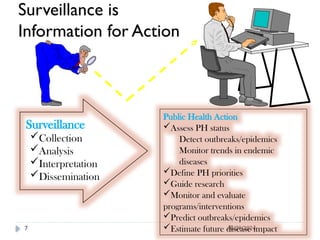
Surveillance is
Information for Action
Surveillance
Collection
Analysis
Interpretation
Dissemination
Public Health Action
Assess PH status
Detect outbreaks/epidemics
Monitor trends in endemic
diseases
Define PH priorities
Guide research
Monitor and evaluate
programs/interventions
Predict outbreaks/epidemics
Estimate future disease impact
Sources of Surveillance Data
10/09/2024
8
 Census data
 Mortality reports (along with
birth and death certificates)
 Morbidity reports
 Hospital data
 Absenteeism records (school,
workplace)
 Epidemic reports
 Laboratory reports and records
 Drug utilization records
 Adverse drug reaction reports
 Special surveys (research data,
serologic surveys)
 Police records (injury, alcohol-
related)
 Information on animal reservoirs
and vectors
 Environmental data (water, food
testing)
 Special surveillance data (injury,
occupational H.)
Selection Criteria for Disease Surveillance
10/09/2024
9
 Magnitude of the disease
 Feasibility of control measures
 Need for monitoring and evaluating the
performance of a control program
 Resource availability
Types of Surveillance
There are 3 main types of surveillance:
1. Passive Surveillance: A surveillance where reports are
awaited and no attempts are made to seek reports actively
from the participants in the system.
2. Active Surveillance: A surveillance where public health
officers seek reports from participants in the surveillance
system on a regular basis, rather than waiting for the
reports.
10
10/09/2024
Types (Cont…)
10/09/2024
11
3. Sentinel Surveillance: uses a pre-arranged sample of
reporting sources to report all cases of one or more
conditions.
 Usually the sample sources are selected to be those most
likely to see cases.
 Sentinel surveillance provides a practical alternative to
population-based surveillance.
Main Purposes of Sentinel Surveillance
10/09/2024
12
 To detect changes
 To direct and focus control efforts
 To develop intervention strategies
 To promote further investigations
 Provide the basis for evaluating preventive strategies and
activities
Types (Cont…)
10/09/2024
13
Modified forms of surveillance include:
1. Intensified Surveillance: The upgrading from a passive to
an active surveillance system for a specified reason and for a
limited period (could be because of an outbreak).
2. Enhanced Surveillance: The collection of additional data
about cases reported under routine surveillance
Critical Information in Surveillance
10/09/2024
14
 Generally, a surveillance system should determine the Who,
What, When, Where, and How questions. The critical
information should include:
 Person: Age, sex
 Time: onset of disease, reporting period
 Place: Woreda, region
 Risk factors
 Number of cases (magnitude)
 Treatment outcome: deaths, recovery (seriousness)
 Mode of treatment: inpatient/outpatient
Case Definition
10/09/2024
15
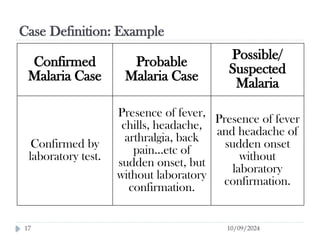
 Case definition includes:
 Criteria: Signs and symptoms with or without a
laboratory test
 Restriction by time, place and person can be done
depending on the nature of the disease
 There are 3 classification of case definitions:
confirmed, probable, and possible cases.
Case Definition (Cont…)
10/09/2024
16
Classification of case definitions:
1. Confirmed: a case definition by appropriate
laboratory test.
2. Probable: a case with typical clinical features of the
disease without laboratory confirmation
3. Possible/Suspect: a case with few of the typical clinical
features.
Use case definition consistently!!
Case Definition: Example
10/09/2024
17
Confirmed
Malaria Case
Probable
Malaria Case
Possible/
Suspected
Malaria
Confirmed by
laboratory test.
Presence of fever,
chills, headache,
arthralgia, back
pain…etc of
sudden onset, but
without laboratory
confirmation.
Presence of fever
and headache of
sudden onset
without
laboratory
confirmation.
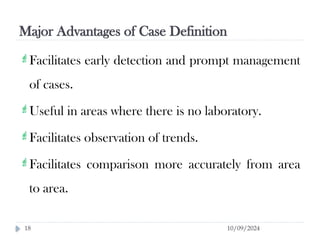
Major Advantages of Case Definition
10/09/2024
18
Facilitates early detection and prompt management
of cases.
Useful in areas where there is no laboratory.
Facilitates observation of trends.
Facilitates comparison more accurately from area
to area.
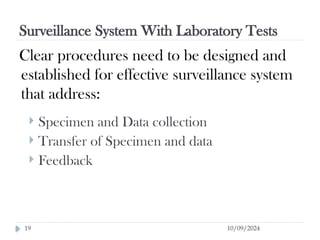
Surveillance System With Laboratory Tests
10/09/2024
19
Clear procedures need to be designed and
established for effective surveillance system
that address:
 Specimen and Data collection
 Transfer of Specimen and data
 Feedback
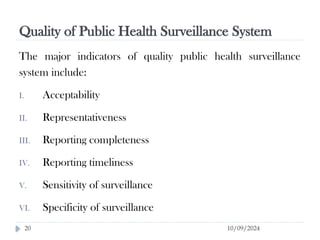
Quality of Public Health Surveillance System
10/09/2024
20
The major indicators of quality public health surveillance
system include:
I. Acceptability
II. Representativeness
III. Reporting completeness
IV. Reporting timeliness
V. Sensitivity of surveillance
VI. Specificity of surveillance
I. Acceptability
10/09/2024
21
 Willingness of persons conducting surveillance
and those providing data to generate accurate,
consistent and timely data.
II. Representativeness
10/09/2024
22
 The degree to which inference can be drawn
from the information gathered by the
surveillance system to the target population.
III. Reporting Completeness
10/09/2024
23
 Proportion of all expected reports in a reporting
system that were actually received.
IV. Reporting Timeliness
10/09/2024
24
 Proportion of all expected reports in a reporting
system received by a given date (due date).
V. Sensitivity of Surveillance
10/09/2024
25
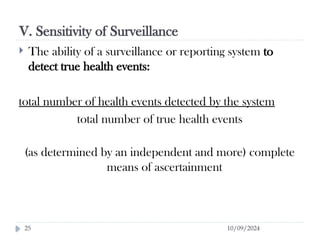
 The ability of a surveillance or reporting system to
detect true health events:
total number of health events detected by the system
total number of true health events
(as determined by an independent and more) complete
means of ascertainment
VI. Specificity of Surveillance
10/09/2024
26
A measure of how infrequently a system
detects false positive health events:
Analysis of Surveillance Data
10/09/2024
27
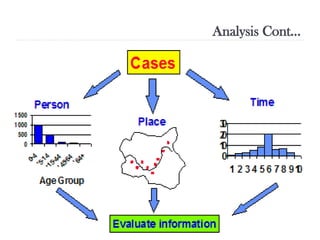
 Descriptive analysis: distribution by time, place and person
 Frequency of events
 Calculate rates- need proper denominator
 Observe trends: comparison current data with expected
value, identify differences, and assess the relevance of the
difference
 Draw graphs to show long term (secular) trends
Analysis Cont…
10/09/2024
28
Dissemination of Surveillance Data
10/09/2024
29
 Disseminate surveillance data to all stakeholders
 Those who provide the reports (health providers)
 The community – affected/potentially affected
 Decision makers
 Disseminate report locally, nationally or globally; as
deemed necessary
 Disseminate report timely and regularly
 Disseminate through appropriate media: newsletter or
bulletin (paper or electronic)
10/09/2024
30 .
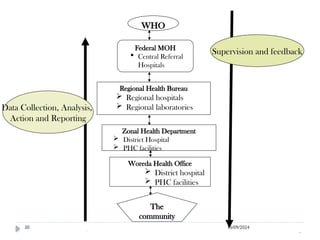
Federal MOH
 Central Referral
Hospitals
Regional Health Bureau
 Regional hospitals
 Regional laboratories
Zonal Health Department
 District Hospital
 PHC facilities
Woreda Health Office
 District hospital
 PHC facilities
The
community
WHO
Data Collection, Analysis,
Action and Reporting
Supervision and feedback
.
Reporting and Feedback Levels
(Local to International)
10/09/2024
31
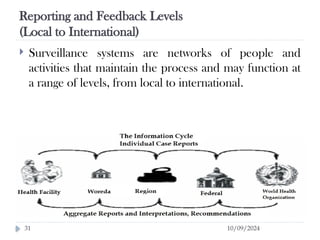
 Surveillance systems are networks of people and
activities that maintain the process and may function at
a range of levels, from local to international.
Evaluating and Improving Surveillance Systems
10/09/2024
32
Should be evaluated periodically to forward
recommendations for improvement:
1. To identify elements of surveillance that should be
enhanced to improve its attributes,
2. To assesses how surveillance findings affect control
efforts, and
3. To improve the quality of data and interpretations
provided by surveillance.
Common Limitations of Surveillance Systems
10/09/2024
33
 Under reporting
 Lack of representativeness of reported cases
 Lack of timeliness
 Inconsistency of case-definitions
 Lack and shortage of qualified staff
 Lack of motivation
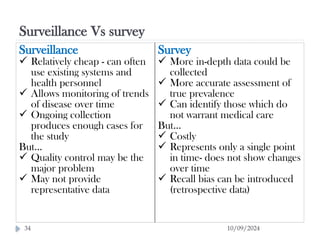
Surveillance Vs survey
10/09/2024
34
Surveillance
 Relatively cheap - can often
use existing systems and
health personnel
 Allows monitoring of trends
of disease over time
 Ongoing collection
produces enough cases for
the study
But…
 Quality control may be the
major problem
 May not provide
representative data
Survey
 More in-depth data could be
collected
 More accurate assessment of
true prevalence
 Can identify those which do
not warrant medical care
But…
 Costly
 Represents only a single point
in time- does not show changes
over time
 Recall bias can be introduced
(retrospective data)
10/09/2024
35
Public Health Surveillance in
Ethiopia
Background of Disease Surveillance in Ethiopia
10/09/2024
36
 Before 1998 Multiple D/s Surveillances
→
 From 1998 – 2009 → Integrated Disease Surveillance and
Response (IDSR)
 Starting from early 2009 Public Health Emergency
→
Management (PHEM)
Public Health Emergency Management (PHEM)
10/09/2024
37
 PHEM is the process of
 anticipating,
 preventing,
 preparing for,
 detecting,
 responding to,
 controlling and
 recovering from consequences of public health threats
so that health and economic impacts are minimized.
IDSR and PHEM
10/09/2024
38
 IDSR and PHEM employ simplified tools for data
collection and analysis & common channels for reporting
and feedback.
 IDSR & PHEM strengthened the capacity to detect and
respond to communicable disease threats and emergencies.
 The integration helped to maximize effective utilization of
scarce resources.
List of Priority Diseases for Surveillance in Ethiopia
10/09/2024
39
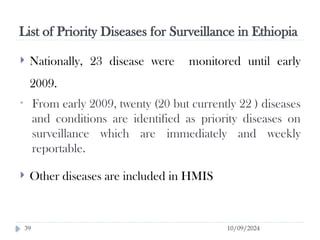
 Nationally, 23 disease were monitored until early
2009.
• From early 2009, twenty (20 but currently 22 ) diseases
and conditions are identified as priority diseases on
surveillance which are immediately and weekly
reportable.
 Other diseases are included in HMIS
Immediately Reportable Diseases
10/09/2024
40
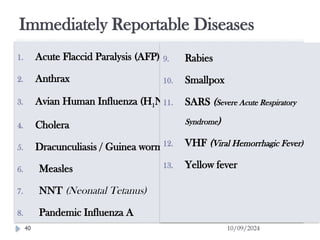
1. Acute Flaccid Paralysis (AFP) /Polio
2. Anthrax
3. Avian Human Influenza (H1N1)
4. Cholera
5. Dracunculiasis / Guinea worm
6. Measles
7. NNT (Neonatal Tetanus)
8. Pandemic Influenza A
9. Rabies
10. Smallpox
11. SARS (Severe Acute Respiratory
Syndrome)
12. VHF (Viral Hemorrhagic Fever)
13. Yellow fever
Weekly Reportable Diseases
10/09/2024
41
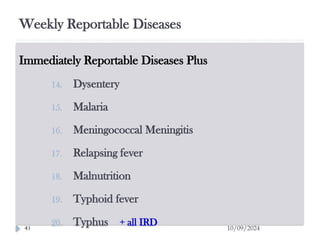
Immediately Reportable Diseases Plus
14. Dysentery
15. Malaria
16. Meningococcal Meningitis
17. Relapsing fever
18. Malnutrition
19. Typhoid fever
20. Typhus + all IRD
Exercise/Assignment
10/09/2024
42
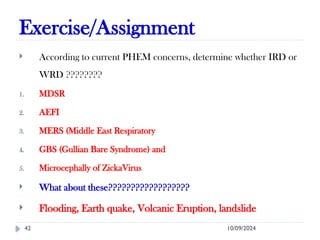
 According to current PHEM concerns, determine whether IRD or
WRD ????????
1. MDSR
2. AEFI
3. MERS (Middle East Respiratory
4. GBS (Gullian Bare Syndrome) and
5. Microcephally of ZickaVirus
 What about these??????????????????
 Flooding, Earth quake, Volcanic Eruption, landslide
Outbreak Investigation & Control
Dambi Dollo University
Learning objectives
10/09/2024
44
After the end of this session, students will be able to:
o State different level of disease occurrences
o List the rationale to investigate outbreak occurrence
o Discuss steps in the investigation of an outbreak
occurrence
o Describe types of outbreak occurrence
o Discuss the outbreak controlling strategies
Epidemiology in Action
10/09/2024
45
 Outbreak Investigations
 Public Health Surveillance
 Community Screening Programs
10/09/2024
Levels of Disease Occurrence
46
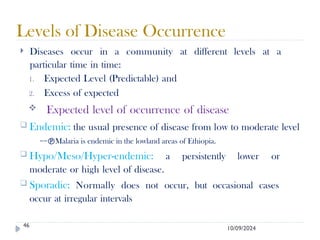
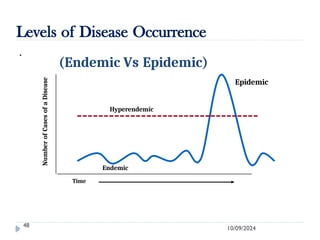
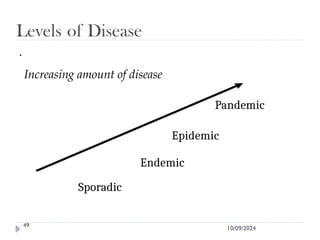
 Diseases occur in a community at different levels at a
particular time in time:
1. Expected Level (Predictable) and
2. Excess of expected
 Expected level of occurrence of disease
 Endemic: the usual presence of disease from low to moderate level
==Malaria is endemic in the lowland areas of Ethiopia.
 Hypo/Meso/Hyper-endemic: a persistently lower or
moderate or high level of disease.
 Sporadic: Normally does not occur, but occasional cases
occur at irregular intervals
Excess of what is expected
10/09/2024
47
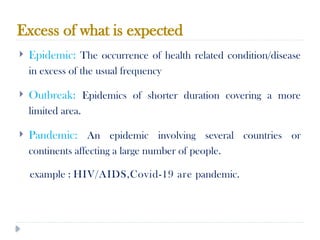
 Epidemic: The occurrence of health related condition/disease
in excess of the usual frequency
 Outbreak: Epidemics of shorter duration covering a more
limited area.
 Pandemic: An epidemic involving several countries or
continents affecting a large number of people.
example : HIV/AIDS,Covid-19 are pandemic.
10/09/2024
Levels of Disease Occurrence
48
.
(Endemic Vs Epidemic)
Epidemic
Endemic
Time
Number
of
Cases
of
a
Disease
Hyperendemic
10/09/2024
Levels of Disease
49
.
Increasing amount of disease
Pandemic
Epidemic
Endemic
Sporadic
What does outbreak investigation & control?
10/09/2024
50
It is the process of identifying:
o The cause of the epidemic
o The source of the epidemic
o The mode of transmission and
o Taking preventive and control measures
Source of an outbreak information
10/09/2024
51
 Routine surveillance
 Health professionals
 Affected community members
What are the objectives for outbreak investigation?
10/09/2024
52
1) To initiate control & prevention measures
 The most important public health reasons for
investigating an outbreak are to help guide disease
prevention and control strategies.
 These disease control efforts depend on several factors,
Including
 knowledge of the agent,
 The natural course of the outbreak,
 The usual transmission mechanism of the disease, and
 Available control measures
2) Research and training opportunity
10/09/2024
53
o Each outbreak should be viewed as an experiment
waiting to be analyzed
o It presents a unique opportunity to study the natural
history of the disease
o It could be a good opportunity to gain additional
knowledge on
 The impact of prevention and control measures
 The usefulness of new epidemiology and laboratory
techniques
3) Public, political and legal obligations
10/09/2024
54
o Politicians and leaders are usually concerned with control of
the epidemic
o Politicians and leaders may sometimes override scientific
concerns
o The public are more concerned in cluster of disease and
potentials of getting medication
o It is right of the community to get treatment/service and it is
government and our duty to protect the community
4) Program considerations
10/09/2024
55
o Occurrence of an outbreak notifies the presence of a
program weakness
o This could help program directors to change or
strengthen the program’s effort in the future to prevent
potential episodes of outbreak occurrence
Steps of outbreak investigation and control
10/09/2024
56
1. Prepare to field work
2. Establish the existence of outbreak
3. Verifying the diagnosis
4. Case definition and case finding
5. Perform descriptive epidemiology
6. Formulate hypotheses
7. Testing hypotheses
8. Refine hypothesis and additional studies
9. Implementing prevention and control activities
10. Communicate findings
 In practice, however, several steps may be done at the same time, or
 The circumstances of the outbreak may dictate that a different order
be followed
Step 1: Prepare for field work
10/09/2024
57
 Before leaving for the field, an investigator must be well
prepared to under take the investigation:
 Investigation (Knowledge in epidemiology and the disease of
concern is important)
 Administrative (Logistics, administrative procedures, travel
arrangements)
 Consultation (Health workers should know their role, and should
participate in the planning phase)
Step 2: Establish the existence of outbreak
10/09/2024
58
 An outbreak is the occurrence of more cases of disease than
expected level
 The investigator has to compare previous case load with the
current to assure the existence of the outbreak
 But be careful, excess cases may not always indicate an
outbreak occurrence rather it may be because:
 Change in population size
 Change in case definition
 Change in reporting procedure
Step 3: Verifying the diagnosis
10/09/2024
59
 The initial report may be spurious and arise from
misinterpretation of the clinical features
 Review clinical and laboratory findings to establish
diagnosis
 Goals in verifying the diagnosis includes:
 To ensure that the problem has been properly diagnosed
 To rule out laboratory error as a basis for the increase in
diagnosed cases
 To ensure the diagnosed disease is possibly epidemic
Step 4: Case definition and case finding
10/09/2024
60
 Prepare “case definition” before starting identification of cases
 It’s aim is to count all cases of the illness
 It is clinical criteria restricted by time, place and person
 Use sensitive or "loose case definition” early in the investigation and use
"tight or strict case definition” for testing hypothesis
= We can find additional cases in
- health facilities
- home visit in epidemic area( kebele or gote level )
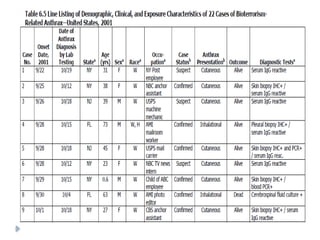
=Information required include personal Identifier(name, tell, address),
demographic(age, sex, occupation), exposure history, clinical information(date of
onset, outcome, sign and symptom),who report? Information
= we will do line listing by taking the above information
10/09/2024
61
10/09/2024
62
Classification of Case Definition
 Possible: cases with subjective signs and symptoms
consistent with the case definition.
 Probable: cases with objective signs and symptoms
consistent with the case definition.
 Definite: laboratory confirmed case
Step 5: Performing Descriptive Epidemiology
10/09/2024
63
 Once data is collected, it should be analyzed by time,
place and person
 The tools to be used when characterizing the epidemic
are epidemic curve, spot map and attack rate
 The characterization often provides clues about
etiology, source and modes of transmission that can be
turned into testable epidemiologic hypothesis
1. Analysis of epidemic by time
10/09/2024
64
 We use epidemic curve to analyze by time taking
- The X- axis; indicating time of onset
-The y-axis; indicating the number of cases appearing
 Epidemic curve can tell as
- nature of epidemic
- hint to etiologies – etiologic agent
- hint about source of exposure
 There are three principal types of epidemic
1. Common source – based on source of exposure
2. Propagative - touches mode of transmission
3. Mixed epidemic – share characteristics of both type
1. Common source epidemic
10/09/2024
65
 It occurs as a result of the exposure of a group of population to a
common source (etiological agent)
o It can result from a single source/ exposure of the
population to the agent
E.g: contaminated water supply, or food in a certain
restaurant
 Three types
1. Point common source
2. Continuous common source
3. Intermittent common source
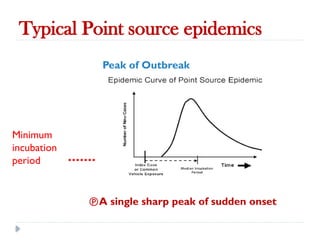
A) Point common source epidemic
10/09/2024
66
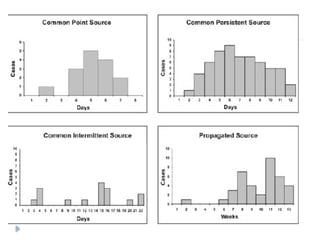
 Single/ones/limited time exposure to the source
 All exposed hosts will develop disease within one
incubation period
 The epidemic usually decline after a few generations,
either because the number of susceptible hosts fall
below some critical level, or because intervention
measures become effective
 A rapid rise and gradual fall of an epidemic curve
suggests a point source epidemic
Typical Point source epidemics
10/09/2024
67
Minimum
incubation
period
Peak of Outbreak
A single sharp peak of sudden onset
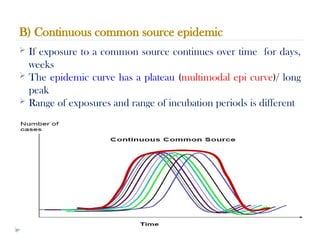
B) Continuous common source epidemic
10/09/2024
68
 If exposure to a common source continues over time for days,
weeks
 The epidemic curve has a plateau (multimodal epi curve)/ long
peak
 Range of exposures and range of incubation periods is different
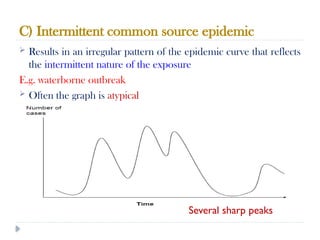
C) Intermittent common source epidemic
10/09/2024
69
 Results in an irregular pattern of the epidemic curve that reflects
the intermittent nature of the exposure
E.g. waterborne outbreak
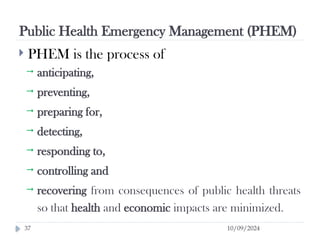
 Often the graph is atypical
Several sharp peaks
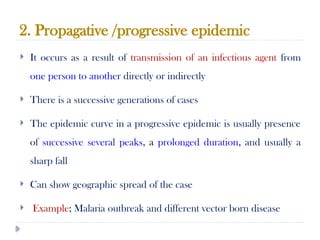
2. Propagative /progressive epidemic
10/09/2024
70
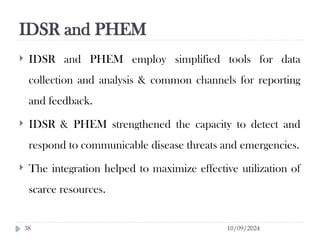
 It occurs as a result of transmission of an infectious agent from
one person to another directly or indirectly
 There is a successive generations of cases
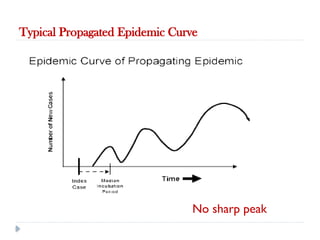
 The epidemic curve in a progressive epidemic is usually presence
of successive several peaks, a prolonged duration, and usually a
sharp fall
 Can show geographic spread of the case
 Example; Malaria outbreak and different vector born disease
Typical Propagated Epidemic Curve
10/09/2024
71
No sharp peak
3. Mixed Epidemic
10/09/2024
72
 It shows the features of both types of epidemics
 It begins with a common source of infectious agent
with subsequent propagated spread because of person
– to- person transmission of the etiologic agent
 E.g. Majority of food borne outbreaks
10/09/2024
73
2. Analysis of epidemic by place
10/09/2024
74
 A spot map is a simple and useful technique for
illustrating where cases live, work or may have been
exposed
 Area map if large area is affected
 It is important to indicate source of outbreak
3. Analysis of epidemic by person
10/09/2024
75
 Characterizing an outbreak occurrence by person is how we
determine what populations are at risk for the disease
 Host characteristics: age, race, sex, or medical status and
exposures-occupation, leisure activities, use of medications,
tobacco and drug use etc…
 These influence susceptibility to disease and opportunities for
exposure to risk factors
 We use attack rates to identify high risk groups
Step 6: Formulating hypothesis
10/09/2024
76
 Depending on the outbreak, the hypothesis may address
 The exposures that caused the disease
 The mode of transmission
 Using :
 Subject-matter knowledge
 Descriptive epidemiology
 Talking with patients
 Talking with local officials
 The hypotheses should be testable
Step 7: Testing the hypothesis
10/09/2024
77
 Here doing analytic studies may be useful.
 Association between the postulated exposure factor and the disease
is tested using analytic design
1. Case control 2. Retrospective Cohort
 Appropriate measure of association should be made
 for case control, odds ratio
 for cohort design, relative risk
 Significance of statistics should be done,
 (Chi-square is the appropriate test, and P-value is estimated at 5 %.)
Step 8: Refining hypotheses and additional studies
10/09/2024
78
o Search for additional cases: Locate unrecognised or
unreported cases
o Environmental studies are equally important in some
settings
Step 9: Implementing control and prevention
10/09/2024
79
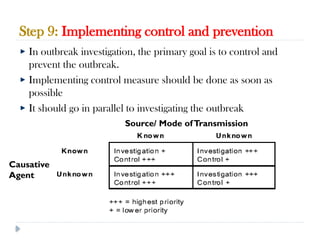
In outbreak investigation, the primary goal is to control and
prevent the outbreak.
Implementing control measure should be done as soon as
possible
It should go in parallel to investigating the outbreak
Source/ Mode ofTransmission
Causative
Agent
Control measures (do early)
10/09/2024
80
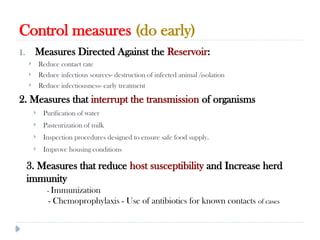
1. Measures Directed Against the Reservoir:
 Reduce contact rate
 Reduce infectious sources- destruction of infected animal /isolation
 Reduce infectiousness- early treatment
2. Measures that interrupt the transmission of organisms
 Purification of water
 Pasteurization of milk
 Inspection procedures designed to ensure safe food supply.
 Improve housing conditions
3. Measures that reduce host susceptibility and Increase herd
immunity
- Immunization
- Chemoprophylaxis - Use of antibiotics for known contacts of cases
Step 10: Communicating findings of investigation
10/09/2024
81
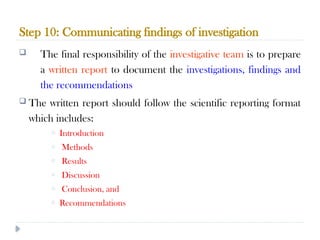
 The final responsibility of the investigative team is to prepare
a written report to document the investigations, findings and
the recommendations
 The written report should follow the scientific reporting format
which includes:
o Introduction
o Methods
o Results
o Discussion
o Conclusion, and
o Recommendations
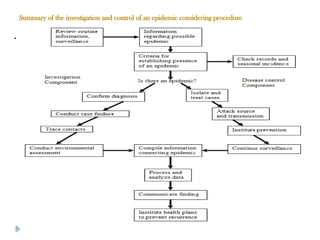
Summary of the investigation and control of an epidemic considering procedure
10/09/2024
82
.
Post-Epidemic Surveillance
10/09/2024
83
 The efficacy of control measures should be assessed day by day
during the outbreak, a final assessment being made after it has
ended
 this will provide a logical basis for post-epidemic surveillance,
and preventive measures aimed at avoiding similar outbreaks in
the future
 develop long term early warning system
 monitor environmental risk factors
The end
10/09/2024
84
Any questions or comments??

Surveillance & Outbreak Investigation.pptx

  • 1.
  • 2.
    Definition of Surveillance 10/09/2024 2 oSurveillance is derived from the French ‘Sur’ (over) and ‘veiller’ (to watch) - hence ‘to watch over’. Public Health Surveillance is an on-going  systematic collection,  analysis,  interpretation and  Dissemination of health-related data essential to the planning, implementation, and evaluation of public health practice.
  • 3.
    Cont… 10/09/2024 3  Surveillance canbe conducted globally, regionally (like East Africa), nationally, or institutionally (single health facility-focused).  It is a mechanism that public health agencies use to monitor the health of the community.  It is for evidence-based setting priorities, planning programs, and taking action to promote and protect the public’s health.
  • 4.
    Basic Principle 10/09/2024 4  Publichealth surveillance’s main function is to serve as an “early warning system” – providing timely information needed for action  (rapid reporting, confirmation, decision making and response)
  • 5.
    Surveillance System’s GoodAttributes 10/09/2024 5  Simple  Flexible  Acceptable  Sensitive; able to detect the problem  Good predictive value positive; good yield  Representative  Timely  Cost effective
  • 6.
    Uses of PublicHealth Surveillance 10/09/2024 6  To estimate magnitude of the problem  Early recognition of epidemics - detect sudden changes in disease occurrence.  To identify changes in agents, host factors and health practices  To follow secular (long-term) trends  Projections of future trends  To evaluate public health programs  To generate hypotheses and stimulate research
  • 7.
    10/09/2024 7 Surveillance is Information forAction Surveillance Collection Analysis Interpretation Dissemination Public Health Action Assess PH status Detect outbreaks/epidemics Monitor trends in endemic diseases Define PH priorities Guide research Monitor and evaluate programs/interventions Predict outbreaks/epidemics Estimate future disease impact
  • 8.
    Sources of SurveillanceData 10/09/2024 8  Census data  Mortality reports (along with birth and death certificates)  Morbidity reports  Hospital data  Absenteeism records (school, workplace)  Epidemic reports  Laboratory reports and records  Drug utilization records  Adverse drug reaction reports  Special surveys (research data, serologic surveys)  Police records (injury, alcohol- related)  Information on animal reservoirs and vectors  Environmental data (water, food testing)  Special surveillance data (injury, occupational H.)
  • 9.
    Selection Criteria forDisease Surveillance 10/09/2024 9  Magnitude of the disease  Feasibility of control measures  Need for monitoring and evaluating the performance of a control program  Resource availability
  • 10.
    Types of Surveillance Thereare 3 main types of surveillance: 1. Passive Surveillance: A surveillance where reports are awaited and no attempts are made to seek reports actively from the participants in the system. 2. Active Surveillance: A surveillance where public health officers seek reports from participants in the surveillance system on a regular basis, rather than waiting for the reports. 10 10/09/2024
  • 11.
    Types (Cont…) 10/09/2024 11 3. SentinelSurveillance: uses a pre-arranged sample of reporting sources to report all cases of one or more conditions.  Usually the sample sources are selected to be those most likely to see cases.  Sentinel surveillance provides a practical alternative to population-based surveillance.
  • 12.
    Main Purposes ofSentinel Surveillance 10/09/2024 12  To detect changes  To direct and focus control efforts  To develop intervention strategies  To promote further investigations  Provide the basis for evaluating preventive strategies and activities
  • 13.
    Types (Cont…) 10/09/2024 13 Modified formsof surveillance include: 1. Intensified Surveillance: The upgrading from a passive to an active surveillance system for a specified reason and for a limited period (could be because of an outbreak). 2. Enhanced Surveillance: The collection of additional data about cases reported under routine surveillance
  • 14.
    Critical Information inSurveillance 10/09/2024 14  Generally, a surveillance system should determine the Who, What, When, Where, and How questions. The critical information should include:  Person: Age, sex  Time: onset of disease, reporting period  Place: Woreda, region  Risk factors  Number of cases (magnitude)  Treatment outcome: deaths, recovery (seriousness)  Mode of treatment: inpatient/outpatient
  • 15.
    Case Definition 10/09/2024 15  Casedefinition includes:  Criteria: Signs and symptoms with or without a laboratory test  Restriction by time, place and person can be done depending on the nature of the disease  There are 3 classification of case definitions: confirmed, probable, and possible cases.
  • 16.
    Case Definition (Cont…) 10/09/2024 16 Classificationof case definitions: 1. Confirmed: a case definition by appropriate laboratory test. 2. Probable: a case with typical clinical features of the disease without laboratory confirmation 3. Possible/Suspect: a case with few of the typical clinical features. Use case definition consistently!!
  • 17.
    Case Definition: Example 10/09/2024 17 Confirmed MalariaCase Probable Malaria Case Possible/ Suspected Malaria Confirmed by laboratory test. Presence of fever, chills, headache, arthralgia, back pain…etc of sudden onset, but without laboratory confirmation. Presence of fever and headache of sudden onset without laboratory confirmation.
  • 18.
    Major Advantages ofCase Definition 10/09/2024 18 Facilitates early detection and prompt management of cases. Useful in areas where there is no laboratory. Facilitates observation of trends. Facilitates comparison more accurately from area to area.
  • 19.
    Surveillance System WithLaboratory Tests 10/09/2024 19 Clear procedures need to be designed and established for effective surveillance system that address:  Specimen and Data collection  Transfer of Specimen and data  Feedback
  • 20.
    Quality of PublicHealth Surveillance System 10/09/2024 20 The major indicators of quality public health surveillance system include: I. Acceptability II. Representativeness III. Reporting completeness IV. Reporting timeliness V. Sensitivity of surveillance VI. Specificity of surveillance
  • 21.
    I. Acceptability 10/09/2024 21  Willingnessof persons conducting surveillance and those providing data to generate accurate, consistent and timely data.
  • 22.
    II. Representativeness 10/09/2024 22  Thedegree to which inference can be drawn from the information gathered by the surveillance system to the target population.
  • 23.
    III. Reporting Completeness 10/09/2024 23 Proportion of all expected reports in a reporting system that were actually received.
  • 24.
    IV. Reporting Timeliness 10/09/2024 24 Proportion of all expected reports in a reporting system received by a given date (due date).
  • 25.
    V. Sensitivity ofSurveillance 10/09/2024 25  The ability of a surveillance or reporting system to detect true health events: total number of health events detected by the system total number of true health events (as determined by an independent and more) complete means of ascertainment
  • 26.
    VI. Specificity ofSurveillance 10/09/2024 26 A measure of how infrequently a system detects false positive health events:
  • 27.
    Analysis of SurveillanceData 10/09/2024 27  Descriptive analysis: distribution by time, place and person  Frequency of events  Calculate rates- need proper denominator  Observe trends: comparison current data with expected value, identify differences, and assess the relevance of the difference  Draw graphs to show long term (secular) trends
  • 28.
  • 29.
    Dissemination of SurveillanceData 10/09/2024 29  Disseminate surveillance data to all stakeholders  Those who provide the reports (health providers)  The community – affected/potentially affected  Decision makers  Disseminate report locally, nationally or globally; as deemed necessary  Disseminate report timely and regularly  Disseminate through appropriate media: newsletter or bulletin (paper or electronic)
  • 30.
    10/09/2024 30 . Federal MOH Central Referral Hospitals Regional Health Bureau  Regional hospitals  Regional laboratories Zonal Health Department  District Hospital  PHC facilities Woreda Health Office  District hospital  PHC facilities The community WHO Data Collection, Analysis, Action and Reporting Supervision and feedback .
  • 31.
    Reporting and FeedbackLevels (Local to International) 10/09/2024 31  Surveillance systems are networks of people and activities that maintain the process and may function at a range of levels, from local to international.
  • 32.
    Evaluating and ImprovingSurveillance Systems 10/09/2024 32 Should be evaluated periodically to forward recommendations for improvement: 1. To identify elements of surveillance that should be enhanced to improve its attributes, 2. To assesses how surveillance findings affect control efforts, and 3. To improve the quality of data and interpretations provided by surveillance.
  • 33.
    Common Limitations ofSurveillance Systems 10/09/2024 33  Under reporting  Lack of representativeness of reported cases  Lack of timeliness  Inconsistency of case-definitions  Lack and shortage of qualified staff  Lack of motivation
  • 34.
    Surveillance Vs survey 10/09/2024 34 Surveillance Relatively cheap - can often use existing systems and health personnel  Allows monitoring of trends of disease over time  Ongoing collection produces enough cases for the study But…  Quality control may be the major problem  May not provide representative data Survey  More in-depth data could be collected  More accurate assessment of true prevalence  Can identify those which do not warrant medical care But…  Costly  Represents only a single point in time- does not show changes over time  Recall bias can be introduced (retrospective data)
  • 35.
  • 36.
    Background of DiseaseSurveillance in Ethiopia 10/09/2024 36  Before 1998 Multiple D/s Surveillances →  From 1998 – 2009 → Integrated Disease Surveillance and Response (IDSR)  Starting from early 2009 Public Health Emergency → Management (PHEM)
  • 37.
    Public Health EmergencyManagement (PHEM) 10/09/2024 37  PHEM is the process of  anticipating,  preventing,  preparing for,  detecting,  responding to,  controlling and  recovering from consequences of public health threats so that health and economic impacts are minimized.
  • 38.
    IDSR and PHEM 10/09/2024 38 IDSR and PHEM employ simplified tools for data collection and analysis & common channels for reporting and feedback.  IDSR & PHEM strengthened the capacity to detect and respond to communicable disease threats and emergencies.  The integration helped to maximize effective utilization of scarce resources.
  • 39.
    List of PriorityDiseases for Surveillance in Ethiopia 10/09/2024 39  Nationally, 23 disease were monitored until early 2009. • From early 2009, twenty (20 but currently 22 ) diseases and conditions are identified as priority diseases on surveillance which are immediately and weekly reportable.  Other diseases are included in HMIS
  • 40.
    Immediately Reportable Diseases 10/09/2024 40 1.Acute Flaccid Paralysis (AFP) /Polio 2. Anthrax 3. Avian Human Influenza (H1N1) 4. Cholera 5. Dracunculiasis / Guinea worm 6. Measles 7. NNT (Neonatal Tetanus) 8. Pandemic Influenza A 9. Rabies 10. Smallpox 11. SARS (Severe Acute Respiratory Syndrome) 12. VHF (Viral Hemorrhagic Fever) 13. Yellow fever
  • 41.
    Weekly Reportable Diseases 10/09/2024 41 ImmediatelyReportable Diseases Plus 14. Dysentery 15. Malaria 16. Meningococcal Meningitis 17. Relapsing fever 18. Malnutrition 19. Typhoid fever 20. Typhus + all IRD
  • 42.
    Exercise/Assignment 10/09/2024 42  According tocurrent PHEM concerns, determine whether IRD or WRD ???????? 1. MDSR 2. AEFI 3. MERS (Middle East Respiratory 4. GBS (Gullian Bare Syndrome) and 5. Microcephally of ZickaVirus  What about these??????????????????  Flooding, Earth quake, Volcanic Eruption, landslide
  • 43.
    Outbreak Investigation &Control Dambi Dollo University
  • 44.
    Learning objectives 10/09/2024 44 After theend of this session, students will be able to: o State different level of disease occurrences o List the rationale to investigate outbreak occurrence o Discuss steps in the investigation of an outbreak occurrence o Describe types of outbreak occurrence o Discuss the outbreak controlling strategies
  • 45.
    Epidemiology in Action 10/09/2024 45 Outbreak Investigations  Public Health Surveillance  Community Screening Programs
  • 46.
    10/09/2024 Levels of DiseaseOccurrence 46  Diseases occur in a community at different levels at a particular time in time: 1. Expected Level (Predictable) and 2. Excess of expected  Expected level of occurrence of disease  Endemic: the usual presence of disease from low to moderate level ==Malaria is endemic in the lowland areas of Ethiopia.  Hypo/Meso/Hyper-endemic: a persistently lower or moderate or high level of disease.  Sporadic: Normally does not occur, but occasional cases occur at irregular intervals
  • 47.
    Excess of whatis expected 10/09/2024 47  Epidemic: The occurrence of health related condition/disease in excess of the usual frequency  Outbreak: Epidemics of shorter duration covering a more limited area.  Pandemic: An epidemic involving several countries or continents affecting a large number of people. example : HIV/AIDS,Covid-19 are pandemic.
  • 48.
    10/09/2024 Levels of DiseaseOccurrence 48 . (Endemic Vs Epidemic) Epidemic Endemic Time Number of Cases of a Disease Hyperendemic
  • 49.
    10/09/2024 Levels of Disease 49 . Increasingamount of disease Pandemic Epidemic Endemic Sporadic
  • 50.
    What does outbreakinvestigation & control? 10/09/2024 50 It is the process of identifying: o The cause of the epidemic o The source of the epidemic o The mode of transmission and o Taking preventive and control measures
  • 51.
    Source of anoutbreak information 10/09/2024 51  Routine surveillance  Health professionals  Affected community members
  • 52.
    What are theobjectives for outbreak investigation? 10/09/2024 52 1) To initiate control & prevention measures  The most important public health reasons for investigating an outbreak are to help guide disease prevention and control strategies.  These disease control efforts depend on several factors, Including  knowledge of the agent,  The natural course of the outbreak,  The usual transmission mechanism of the disease, and  Available control measures
  • 53.
    2) Research andtraining opportunity 10/09/2024 53 o Each outbreak should be viewed as an experiment waiting to be analyzed o It presents a unique opportunity to study the natural history of the disease o It could be a good opportunity to gain additional knowledge on  The impact of prevention and control measures  The usefulness of new epidemiology and laboratory techniques
  • 54.
    3) Public, politicaland legal obligations 10/09/2024 54 o Politicians and leaders are usually concerned with control of the epidemic o Politicians and leaders may sometimes override scientific concerns o The public are more concerned in cluster of disease and potentials of getting medication o It is right of the community to get treatment/service and it is government and our duty to protect the community
  • 55.
    4) Program considerations 10/09/2024 55 oOccurrence of an outbreak notifies the presence of a program weakness o This could help program directors to change or strengthen the program’s effort in the future to prevent potential episodes of outbreak occurrence
  • 56.
    Steps of outbreakinvestigation and control 10/09/2024 56 1. Prepare to field work 2. Establish the existence of outbreak 3. Verifying the diagnosis 4. Case definition and case finding 5. Perform descriptive epidemiology 6. Formulate hypotheses 7. Testing hypotheses 8. Refine hypothesis and additional studies 9. Implementing prevention and control activities 10. Communicate findings  In practice, however, several steps may be done at the same time, or  The circumstances of the outbreak may dictate that a different order be followed
  • 57.
    Step 1: Preparefor field work 10/09/2024 57  Before leaving for the field, an investigator must be well prepared to under take the investigation:  Investigation (Knowledge in epidemiology and the disease of concern is important)  Administrative (Logistics, administrative procedures, travel arrangements)  Consultation (Health workers should know their role, and should participate in the planning phase)
  • 58.
    Step 2: Establishthe existence of outbreak 10/09/2024 58  An outbreak is the occurrence of more cases of disease than expected level  The investigator has to compare previous case load with the current to assure the existence of the outbreak  But be careful, excess cases may not always indicate an outbreak occurrence rather it may be because:  Change in population size  Change in case definition  Change in reporting procedure
  • 59.
    Step 3: Verifyingthe diagnosis 10/09/2024 59  The initial report may be spurious and arise from misinterpretation of the clinical features  Review clinical and laboratory findings to establish diagnosis  Goals in verifying the diagnosis includes:  To ensure that the problem has been properly diagnosed  To rule out laboratory error as a basis for the increase in diagnosed cases  To ensure the diagnosed disease is possibly epidemic
  • 60.
    Step 4: Casedefinition and case finding 10/09/2024 60  Prepare “case definition” before starting identification of cases  It’s aim is to count all cases of the illness  It is clinical criteria restricted by time, place and person  Use sensitive or "loose case definition” early in the investigation and use "tight or strict case definition” for testing hypothesis = We can find additional cases in - health facilities - home visit in epidemic area( kebele or gote level ) =Information required include personal Identifier(name, tell, address), demographic(age, sex, occupation), exposure history, clinical information(date of onset, outcome, sign and symptom),who report? Information = we will do line listing by taking the above information
  • 61.
  • 62.
    10/09/2024 62 Classification of CaseDefinition  Possible: cases with subjective signs and symptoms consistent with the case definition.  Probable: cases with objective signs and symptoms consistent with the case definition.  Definite: laboratory confirmed case
  • 63.
    Step 5: PerformingDescriptive Epidemiology 10/09/2024 63  Once data is collected, it should be analyzed by time, place and person  The tools to be used when characterizing the epidemic are epidemic curve, spot map and attack rate  The characterization often provides clues about etiology, source and modes of transmission that can be turned into testable epidemiologic hypothesis
  • 64.
    1. Analysis ofepidemic by time 10/09/2024 64  We use epidemic curve to analyze by time taking - The X- axis; indicating time of onset -The y-axis; indicating the number of cases appearing  Epidemic curve can tell as - nature of epidemic - hint to etiologies – etiologic agent - hint about source of exposure  There are three principal types of epidemic 1. Common source – based on source of exposure 2. Propagative - touches mode of transmission 3. Mixed epidemic – share characteristics of both type
  • 65.
    1. Common sourceepidemic 10/09/2024 65  It occurs as a result of the exposure of a group of population to a common source (etiological agent) o It can result from a single source/ exposure of the population to the agent E.g: contaminated water supply, or food in a certain restaurant  Three types 1. Point common source 2. Continuous common source 3. Intermittent common source
  • 66.
    A) Point commonsource epidemic 10/09/2024 66  Single/ones/limited time exposure to the source  All exposed hosts will develop disease within one incubation period  The epidemic usually decline after a few generations, either because the number of susceptible hosts fall below some critical level, or because intervention measures become effective  A rapid rise and gradual fall of an epidemic curve suggests a point source epidemic
  • 67.
    Typical Point sourceepidemics 10/09/2024 67 Minimum incubation period Peak of Outbreak A single sharp peak of sudden onset
  • 68.
    B) Continuous commonsource epidemic 10/09/2024 68  If exposure to a common source continues over time for days, weeks  The epidemic curve has a plateau (multimodal epi curve)/ long peak  Range of exposures and range of incubation periods is different
  • 69.
    C) Intermittent commonsource epidemic 10/09/2024 69  Results in an irregular pattern of the epidemic curve that reflects the intermittent nature of the exposure E.g. waterborne outbreak  Often the graph is atypical Several sharp peaks
  • 70.
    2. Propagative /progressiveepidemic 10/09/2024 70  It occurs as a result of transmission of an infectious agent from one person to another directly or indirectly  There is a successive generations of cases  The epidemic curve in a progressive epidemic is usually presence of successive several peaks, a prolonged duration, and usually a sharp fall  Can show geographic spread of the case  Example; Malaria outbreak and different vector born disease
  • 71.
    Typical Propagated EpidemicCurve 10/09/2024 71 No sharp peak
  • 72.
    3. Mixed Epidemic 10/09/2024 72 It shows the features of both types of epidemics  It begins with a common source of infectious agent with subsequent propagated spread because of person – to- person transmission of the etiologic agent  E.g. Majority of food borne outbreaks
  • 73.
  • 74.
    2. Analysis ofepidemic by place 10/09/2024 74  A spot map is a simple and useful technique for illustrating where cases live, work or may have been exposed  Area map if large area is affected  It is important to indicate source of outbreak
  • 75.
    3. Analysis ofepidemic by person 10/09/2024 75  Characterizing an outbreak occurrence by person is how we determine what populations are at risk for the disease  Host characteristics: age, race, sex, or medical status and exposures-occupation, leisure activities, use of medications, tobacco and drug use etc…  These influence susceptibility to disease and opportunities for exposure to risk factors  We use attack rates to identify high risk groups
  • 76.
    Step 6: Formulatinghypothesis 10/09/2024 76  Depending on the outbreak, the hypothesis may address  The exposures that caused the disease  The mode of transmission  Using :  Subject-matter knowledge  Descriptive epidemiology  Talking with patients  Talking with local officials  The hypotheses should be testable
  • 77.
    Step 7: Testingthe hypothesis 10/09/2024 77  Here doing analytic studies may be useful.  Association between the postulated exposure factor and the disease is tested using analytic design 1. Case control 2. Retrospective Cohort  Appropriate measure of association should be made  for case control, odds ratio  for cohort design, relative risk  Significance of statistics should be done,  (Chi-square is the appropriate test, and P-value is estimated at 5 %.)
  • 78.
    Step 8: Refininghypotheses and additional studies 10/09/2024 78 o Search for additional cases: Locate unrecognised or unreported cases o Environmental studies are equally important in some settings
  • 79.
    Step 9: Implementingcontrol and prevention 10/09/2024 79 In outbreak investigation, the primary goal is to control and prevent the outbreak. Implementing control measure should be done as soon as possible It should go in parallel to investigating the outbreak Source/ Mode ofTransmission Causative Agent
  • 80.
    Control measures (doearly) 10/09/2024 80 1. Measures Directed Against the Reservoir:  Reduce contact rate  Reduce infectious sources- destruction of infected animal /isolation  Reduce infectiousness- early treatment 2. Measures that interrupt the transmission of organisms  Purification of water  Pasteurization of milk  Inspection procedures designed to ensure safe food supply.  Improve housing conditions 3. Measures that reduce host susceptibility and Increase herd immunity - Immunization - Chemoprophylaxis - Use of antibiotics for known contacts of cases
  • 81.
    Step 10: Communicatingfindings of investigation 10/09/2024 81  The final responsibility of the investigative team is to prepare a written report to document the investigations, findings and the recommendations  The written report should follow the scientific reporting format which includes: o Introduction o Methods o Results o Discussion o Conclusion, and o Recommendations
  • 82.
    Summary of theinvestigation and control of an epidemic considering procedure 10/09/2024 82 .
  • 83.
    Post-Epidemic Surveillance 10/09/2024 83  Theefficacy of control measures should be assessed day by day during the outbreak, a final assessment being made after it has ended  this will provide a logical basis for post-epidemic surveillance, and preventive measures aimed at avoiding similar outbreaks in the future  develop long term early warning system  monitor environmental risk factors
  • 84.

Editor's Notes

  • #45 Applied epidemiology synthesizes and applies the results of etiologic studies to set priorities for intervention; it evaluates public health interventions and policies; it measures the quality and outcome of medical care; and it effectively communicates epidemiologic findings to health professionals and the public. Outbreak and cluster investigations, public health surveillance and community screening programs represent key areas of public health practice in which systematic application of epidemiologic methods have a large and positive impact.
  • #70 In theory, a propagated epidemic — one spread from person-to-person with increasing numbers of cases in each generation — should have a series of progressively taller peaks one incubation period apart, but in reality few produce this classic pattern.
  • #74 Mapping disease can be done at all levels, on a local, district, regional, countrywide, or international basis, depending on the Purpose, which can be not only to investigate epidemics or disease etiology, but also to plan the allocation of resources on a geographic basis.
  • #79 Confidentiality is an important issue in implementing control measures. Healthcare workers need to be aware of the confidentiality issues relevant to collection, management and sharing of data.