DR:ALIA YOSUF IBRHIM
MASTER OF FAMILY MEDICINE 2016
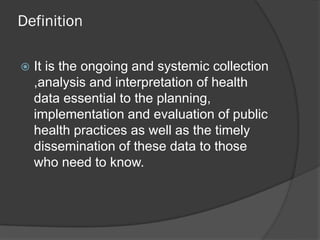
Definition
 It is the ongoing and systemic collection
,analysis and interpretation of health
data essential to the planning,
implementation and evaluation of public
health practices as well as the timely
dissemination of these data to those
who need to know.
 WHO
- Systematic ongoing collection and
analysis of data and the timely
dissemination of information to those who
need to know so that action can be taken.
 CDC
- … use for planning, implementation and
evaluation of public health practice.
- … application of data to prevention and
control.
Definition, cont….
 Epidemiological surveillance is
information for action.
Surveillance
 Ongoing, systematic data
- collection.
- analysis.
- dissemination.
 Link to Public Health practice.
*INFORMATION FOR ACTION*
Surveillance tells us…
 Where the health problems are.
 Who is affected.
 Where to direct prevention and control
activities.
 How to define priorities for health
programs and policies.
 The effectiveness of public health
interventions.
Emerging Diseases/Infections
 Infectious diseases that have been
identified and taxonomically classified
recently.
- e.g. (agents) H5N1 influenza, SARS,
antibiotic resistant organisms
(MRSA,VRE).
 Some “new”, some only recently
recognized in humans.
Re-emerging Infections
 “Old” diseases that have experienced a
resurgence because of change in host-
agent-environment conditions.
- e.g. TB, malaria, syphilis.
Sources of New Diseases
 35+ “new” diseases over the past 40
years.
 Many emerging from animals (zoonotic)
or are associated with animal
populations.
- e.g. Avian flu, SARS, Nipah virus and
new variant CJD.
Causes of Disease Emergence
(1)
 Microbial adaptation and change.
- Gene transfer and mutation.
 Human demographics and behavior.
- Urbanization, sexual behavior, food
sources.
 Economic development and land use.
Causes of Disease Emergence
(2)
 Technology and industry.
- Health (vaccines, blood products),
agricultural practice, animal husbandry.
 International travel and commerce.
- Rapid movement of people, wildlife,
food animals and crops- both legal and
illegal.
Causes of Disease Emergence
(3)
 Breakdown of Public Health measures.
 Human susceptibility to infection.
- Immunosuppressant.
 Climate and weather.
- Global warming, natural disasters.
Causes of Disease Emergence
(4)
 Changing ecosystems.
- Human encroachment into forests.
 Poverty and social inequality.
 War and famine.
 Lack of political will.
 Intent to harm.
The main objectives of surveillance:
1-Identify disease of public health
importance.
2-Identify occurrence of events of public
health importance on time.
3-Identify risk factors
4-Identify population group at risk
5-Explain cause of the outbreak
Main objectives, cont….
6-Monitor disease trends over time, place
and population groups.
7-Assess the effectiveness of containment
activities taken
8- Avail information to improve control and
prevention plans.
9-To provide information about new and
changing trends in the health status of
population.
Cont…
10- To provide feed back to health
authorities for action
11-To provide timely warning of public
health disasters so that intervention can
be mobilized.
Requirements for a Surveillance
System
 Good network of motivated people.
 Clear case definition and reporting
mechanism.
 Efficient communication system.
 Basic put sound epidemiology.
 Laboratory support.
 Good feedback and rapid responses.
Holistic Approach to Surveillance
 Comprehensive, harmonized surveillance
activities.
- Integrated data/information.
- Multidisciplinary.
- Role and function:
: Public Health personnel.
: Clinicians/pathologists/scientists.
- Timeliness/urgency.
- Interagency.
- Sharing of information e.g. zoonotic diseases.
- Local and international level.
Sources of Data
 Notification of Notifiable Diseases.
 Sentinel system.
 Hospital based surveillance.
 Health clinic based surveillance.
 School based surveillance.
 Surveys.
 Private health facility based reporting.
 Special surveillance.
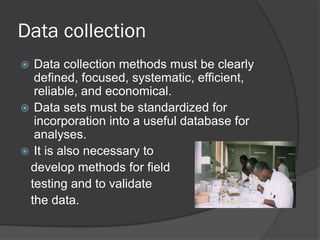
Data collection
 Data collection methods must be clearly
defined, focused, systematic, efficient,
reliable, and economical.
 Data sets must be standardized for
incorporation into a useful database for
analyses.
 It is also necessary to
develop methods for field
testing and to validate
the data.
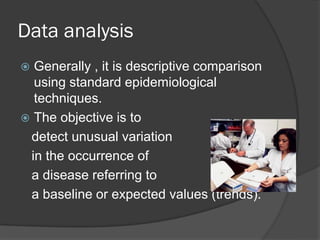
Data analysis
 Generally , it is descriptive comparison
using standard epidemiological
techniques.
 The objective is to
detect unusual variation
in the occurrence of
a disease referring to
a baseline or expected values (trends).
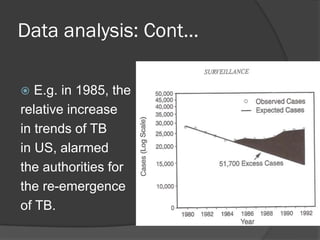
Data analysis: Cont…
 E.g. in 1985, the
relative increase
in trends of TB
in US, alarmed
the authorities for
the re-emergence
of TB.
Sentinel Surveillance
 Collection and analysis of data by
designated institutions selected for their
geographical location, medical specialty
and ability to accurately diagnose and
report high quality data.
e.g. district hospitals.
Community Based Surveillance
 With training, members of the community can
expand facility-based surveillance by detecting
and reporting cases that may go undetected by
the health facility.
 Volunteer providers
Special surveillance network are some time
developed to meet information need that exceed
the capabilities of routine approaches, such as
notifiable disease reporting.
 A good example of this is the use of community
members to detect cases of Guinea worms
(dracunculiasis).
Surveillance Quality
Defined by system attributes:
 Completeness
 Timeliness
 Usefulness
 Sensitivity
 Positive predictive value
 Specificity
 Representativeness
 Simplicity
 Flexibility
 Acceptability
 Stability
Early Warning System
 Verify the nature of the event
 Rapidly implement initial infection
control measures when appropriate
 Expedite diagnosis and confirmation
 Activate the public health response
at the local level
 Raise a global alert if indicated.
Early warning system serves to:
 Detect outbreaks in a timely manner
 Inform appropriate and effective public health
response
 Determine the distribution and spread of disease
 Illustrate epidemiology of new diseases
 Provide info to categorize outbreak as of national
or international importance
 Provide data to evaluate control measures
Common Problems In
Surveillance
 Unclear case definitions
 Poor feedback to point of data
generation
 Excessive data collection - not all data
are used
 Unattainable objectives
Types of surveillance
 Mandatory vs Voluntary
 Active vs Passive
 Sentinel vs All-inclusive
Surveillance methods
Routine reporting (Passive surveillance ),
system:-Immediate
-Weekly
-Monthly
2-sentinel sites (Active surveillance).
3-Surveys+special studies
Cont…
4-Case outbreak investigation
5-Vital registration system
6-Census.
Elements of surveillance:
1- Morbidity and mortality
2- Lab results:
- suspect cases
- confirm cases
-sensitivity/resistance
-Immunity level
-Environment contamination.
3-Prevention and control data
4-Envirnment
5-Disease victors
6-Reservoir animals.
7- Population characteristics
SOURCES OF DATA
 Notification of notifiable disease *
 Sentinel system
 Hospital-based surveillance *
 Health clinic-based surveillance
 School-based surveillance
 Surveys
 Private health facility-based reporting
 Special surveillance
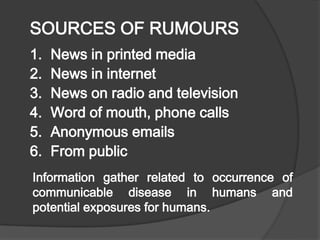
SOURCES OF RUMOURS
1. News in printed media
2. News in internet
3. News on radio and television
4. Word of mouth, phone calls
5. Anonymous emails
6. From public
Information gather related to occurrence of
communicable disease in humans and
potential exposures for humans.
THANKS GOD

Epidemiological surevellance sildes .pdf

  • 1.
    DR:ALIA YOSUF IBRHIM MASTEROF FAMILY MEDICINE 2016
  • 2.
    Definition  It isthe ongoing and systemic collection ,analysis and interpretation of health data essential to the planning, implementation and evaluation of public health practices as well as the timely dissemination of these data to those who need to know.
  • 3.
     WHO - Systematicongoing collection and analysis of data and the timely dissemination of information to those who need to know so that action can be taken.  CDC - … use for planning, implementation and evaluation of public health practice. - … application of data to prevention and control.
  • 4.
    Definition, cont….  Epidemiologicalsurveillance is information for action.
  • 5.
    Surveillance  Ongoing, systematicdata - collection. - analysis. - dissemination.  Link to Public Health practice. *INFORMATION FOR ACTION*
  • 6.
    Surveillance tells us… Where the health problems are.  Who is affected.  Where to direct prevention and control activities.  How to define priorities for health programs and policies.  The effectiveness of public health interventions.
  • 7.
    Emerging Diseases/Infections  Infectiousdiseases that have been identified and taxonomically classified recently. - e.g. (agents) H5N1 influenza, SARS, antibiotic resistant organisms (MRSA,VRE).  Some “new”, some only recently recognized in humans.
  • 8.
    Re-emerging Infections  “Old”diseases that have experienced a resurgence because of change in host- agent-environment conditions. - e.g. TB, malaria, syphilis.
  • 9.
    Sources of NewDiseases  35+ “new” diseases over the past 40 years.  Many emerging from animals (zoonotic) or are associated with animal populations. - e.g. Avian flu, SARS, Nipah virus and new variant CJD.
  • 10.
    Causes of DiseaseEmergence (1)  Microbial adaptation and change. - Gene transfer and mutation.  Human demographics and behavior. - Urbanization, sexual behavior, food sources.  Economic development and land use.
  • 11.
    Causes of DiseaseEmergence (2)  Technology and industry. - Health (vaccines, blood products), agricultural practice, animal husbandry.  International travel and commerce. - Rapid movement of people, wildlife, food animals and crops- both legal and illegal.
  • 12.
    Causes of DiseaseEmergence (3)  Breakdown of Public Health measures.  Human susceptibility to infection. - Immunosuppressant.  Climate and weather. - Global warming, natural disasters.
  • 13.
    Causes of DiseaseEmergence (4)  Changing ecosystems. - Human encroachment into forests.  Poverty and social inequality.  War and famine.  Lack of political will.  Intent to harm.
  • 14.
    The main objectivesof surveillance: 1-Identify disease of public health importance. 2-Identify occurrence of events of public health importance on time. 3-Identify risk factors 4-Identify population group at risk 5-Explain cause of the outbreak
  • 15.
    Main objectives, cont…. 6-Monitordisease trends over time, place and population groups. 7-Assess the effectiveness of containment activities taken 8- Avail information to improve control and prevention plans. 9-To provide information about new and changing trends in the health status of population.
  • 16.
    Cont… 10- To providefeed back to health authorities for action 11-To provide timely warning of public health disasters so that intervention can be mobilized.
  • 17.
    Requirements for aSurveillance System  Good network of motivated people.  Clear case definition and reporting mechanism.  Efficient communication system.  Basic put sound epidemiology.  Laboratory support.  Good feedback and rapid responses.
  • 18.
    Holistic Approach toSurveillance  Comprehensive, harmonized surveillance activities. - Integrated data/information. - Multidisciplinary. - Role and function: : Public Health personnel. : Clinicians/pathologists/scientists. - Timeliness/urgency. - Interagency. - Sharing of information e.g. zoonotic diseases. - Local and international level.
  • 19.
    Sources of Data Notification of Notifiable Diseases.  Sentinel system.  Hospital based surveillance.  Health clinic based surveillance.  School based surveillance.  Surveys.  Private health facility based reporting.  Special surveillance.
  • 20.
    Data collection  Datacollection methods must be clearly defined, focused, systematic, efficient, reliable, and economical.  Data sets must be standardized for incorporation into a useful database for analyses.  It is also necessary to develop methods for field testing and to validate the data.
  • 21.
    Data analysis  Generally, it is descriptive comparison using standard epidemiological techniques.  The objective is to detect unusual variation in the occurrence of a disease referring to a baseline or expected values (trends).
  • 22.
    Data analysis: Cont… E.g. in 1985, the relative increase in trends of TB in US, alarmed the authorities for the re-emergence of TB.
  • 23.
    Sentinel Surveillance  Collectionand analysis of data by designated institutions selected for their geographical location, medical specialty and ability to accurately diagnose and report high quality data. e.g. district hospitals.
  • 24.
    Community Based Surveillance With training, members of the community can expand facility-based surveillance by detecting and reporting cases that may go undetected by the health facility.  Volunteer providers Special surveillance network are some time developed to meet information need that exceed the capabilities of routine approaches, such as notifiable disease reporting.  A good example of this is the use of community members to detect cases of Guinea worms (dracunculiasis).
  • 25.
    Surveillance Quality Defined bysystem attributes:  Completeness  Timeliness  Usefulness  Sensitivity  Positive predictive value  Specificity  Representativeness  Simplicity  Flexibility  Acceptability  Stability
  • 26.
    Early Warning System Verify the nature of the event  Rapidly implement initial infection control measures when appropriate  Expedite diagnosis and confirmation  Activate the public health response at the local level  Raise a global alert if indicated.
  • 27.
    Early warning systemserves to:  Detect outbreaks in a timely manner  Inform appropriate and effective public health response  Determine the distribution and spread of disease  Illustrate epidemiology of new diseases  Provide info to categorize outbreak as of national or international importance  Provide data to evaluate control measures
  • 28.
    Common Problems In Surveillance Unclear case definitions  Poor feedback to point of data generation  Excessive data collection - not all data are used  Unattainable objectives
  • 29.
    Types of surveillance Mandatory vs Voluntary  Active vs Passive  Sentinel vs All-inclusive
  • 30.
    Surveillance methods Routine reporting(Passive surveillance ), system:-Immediate -Weekly -Monthly 2-sentinel sites (Active surveillance). 3-Surveys+special studies
  • 31.
    Cont… 4-Case outbreak investigation 5-Vitalregistration system 6-Census.
  • 32.
    Elements of surveillance: 1-Morbidity and mortality 2- Lab results: - suspect cases - confirm cases -sensitivity/resistance -Immunity level -Environment contamination.
  • 33.
    3-Prevention and controldata 4-Envirnment 5-Disease victors 6-Reservoir animals. 7- Population characteristics
  • 34.
    SOURCES OF DATA Notification of notifiable disease *  Sentinel system  Hospital-based surveillance *  Health clinic-based surveillance  School-based surveillance  Surveys  Private health facility-based reporting  Special surveillance
  • 35.
    SOURCES OF RUMOURS 1.News in printed media 2. News in internet 3. News on radio and television 4. Word of mouth, phone calls 5. Anonymous emails 6. From public Information gather related to occurrence of communicable disease in humans and potential exposures for humans.
  • 36.