EXTENSIVE SURVEY PROJECT
Submitted in partial fulfilment of the requirement for
major project at
COLLEGE CAMPUS
SUBMITTED BY
GROUP NO. 1
Civil engineering department
GOVERNMENT POLYTECHNIC COLLEGE
BUDGAM
Acknowledgement
We would like to express our sincere gratitude to
our project guides for giving us the opportunity
to work on this project. It would never be possible
for us to take this project to this level without
their innovative ideas and there relentless
support and encouragement
Project guides:
1) Er. Umer salam
2) Er. Tahseen
Name of Group1 students
1)Suhaib ul hassan 2) Taliba farooq
3) shahid nazir paray 4) danish ahmad
5)Mukhtar ahmad 6) sumiya altaf
7) ziya ul haq 8)wani shahid
9)Rayees ahmad dar 10)Mohd asif bhat
11)Bashrat nazir 12)Iqra
INTRODUCTION
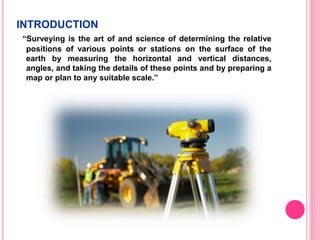
“Surveying is the art of and science of determining the relative
positions of various points or stations on the surface of the
earth by measuring the horizontal and vertical distances,
angles, and taking the details of these points and by preparing a
map or plan to any suitable scale.”
OBJECTIVE OF SURVEYING
 The object of surveying is to prepare a map or plan to show
the relative positions of the objects on the surface of the earth.
The map or plan is drawn to some suitable scale. It also
shows boundaries of districts, states, and countries too. It also
includes details of different engineering features such as
buildings, roads, railways, dams, canals etc.
 To prepare a topographical map which shows hills, valleys,
rivers, forests, villages, towns etc.
 To prepare a cadastral map which shows the boundaries of
fields, plots, houses and other properties..
 To prepare an engineering map which shows the position of
engineering works such as buildings, roads, railways, dams,
canals.
LEVELING
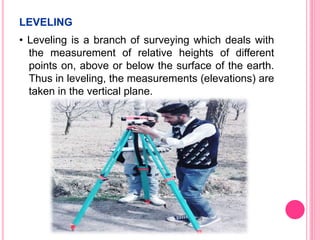
• Leveling is a branch of surveying which deals with
the measurement of relative heights of different
points on, above or below the surface of the earth.
Thus in leveling, the measurements (elevations) are
taken in the vertical plane.
TYPES OF LEVELLING
The following are the different types of levelling
 Simple levelling
 Differential levelling
 Fly levelling
 Profile levelling
 Cross sectioning and
 Reciprocal levelling.
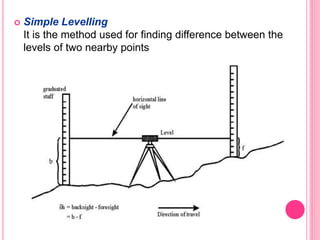
 Simple Levelling
It is the method used for finding difference between the
levels of two nearby points
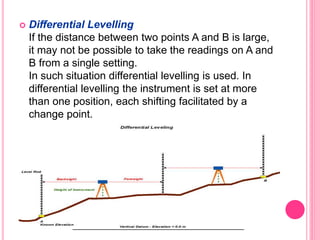
 Differential Levelling
If the distance between two points A and B is large,
it may not be possible to take the readings on A and
B from a single setting.
In such situation differential levelling is used. In
differential levelling the instrument is set at more
than one position, each shifting facilitated by a
change point.
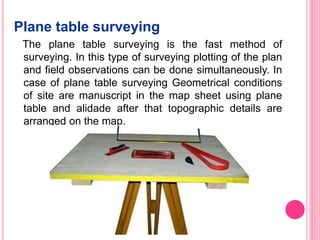
Plane table surveying
The plane table surveying is the fast method of
surveying. In this type of surveying plotting of the plan
and field observations can be done simultaneously. In
case of plane table surveying Geometrical conditions
of site are manuscript in the map sheet using plane
table and alidade after that topographic details are
arranged on the map.
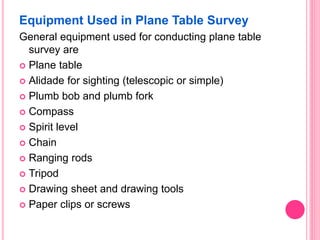
Equipment Used in Plane Table Survey
General equipment used for conducting plane table
survey are
 Plane table
 Alidade for sighting (telescopic or simple)
 Plumb bob and plumb fork
 Compass
 Spirit level
 Chain
 Ranging rods
 Tripod
 Drawing sheet and drawing tools
 Paper clips or screws
Methods of Plane Table Surveying
Generally there are four methods are available to perform
plane table surveying. They are
 Radiation
 Intersection
 Traversing
 Resection
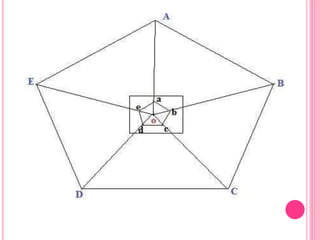
1 RADIATION: In this method, plane table is located at
one point “o” as shown in fig. and perform the whole
from that point. From point O, sight the points A,B,C,D
and E using alidade, locate and plot the points as
a,b,c,d and e in the drawing sheet.
Intersection
 In this method we can locate the point by plotting
two rays from two known stations. As shown in
figure, P and Q are the known station. First the
equipment is placed on P and plot the lines by
sighting the stations A, B and Q. then shift the
equipment to station Q and plot the lines by sighting
stations A, B and P. Finally, the intersection of A and
B rays is the required location of point of
intersection.
Traversing
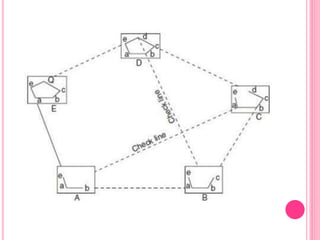
Traversing is the connection of series of straight
lines. In case of traversing, plane table is located at
one point for suppose A as shown below. From that
point sight towards B and measure the distance AB.
Then shift the plane table to point B and sight
towards A and measure BA. Average distance of AB
and Ba are plotted to scale in drawing sheet. Then
Sight the point C from B and measure BC and
repeat the same procedure until last point. Conduct
some checks at some points. Finally traverse lines
are plotted on the drawing sheet.
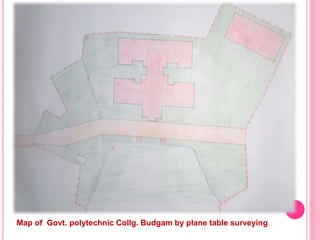
Map of Govt. polytechnic Collg. Budgam by plane table surveying
Compass surveying
Compass surveying is the branch of surveying in
which the position of an object is located using angular
measurements determined by a compass and linear
measurements using a chain or tape. Compass
surveying is used in following circumstances:
 If the surveying area is large, chain surveying is not
adopted for surveying rather compass surveying is
employed.
 If the plot for surveying has numerous obstacles and
undulations which prevents chaining.
 If there is a time limit for surveying, compass
surveying is usually adopted
Magnetic compass
Magnetic compass is used to find out the magnetic
bearing of survey lines. The bearings may either
measured in Whole Circle Bearing (W.C.B) system
or in Quadrantal Bearing (Q.B) system based on
the type of compass used. The basic principle of
magnetic compass is if a strip of steel or iron is
magnetized and pivoted exactly at centre so that it
can swing freely, then it will establish itself in the
magnetic meridian at the place of arrangement.
 Major types of magnetic compass are:
 Prismatic compass
 Surveyor’s compass
 Level compass
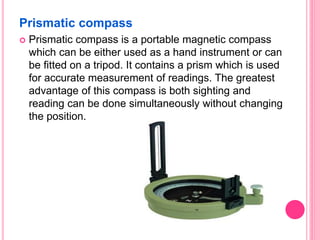
Prismatic compass
 Prismatic compass is a portable magnetic compass
which can be either used as a hand instrument or can
be fitted on a tripod. It contains a prism which is used
for accurate measurement of readings. The greatest
advantage of this compass is both sighting and
reading can be done simultaneously without changing
the position.
Shahid nazir paray

Shahid nazir paray

  • 1.
    EXTENSIVE SURVEY PROJECT Submittedin partial fulfilment of the requirement for major project at COLLEGE CAMPUS SUBMITTED BY GROUP NO. 1 Civil engineering department GOVERNMENT POLYTECHNIC COLLEGE BUDGAM
  • 2.
    Acknowledgement We would liketo express our sincere gratitude to our project guides for giving us the opportunity to work on this project. It would never be possible for us to take this project to this level without their innovative ideas and there relentless support and encouragement Project guides: 1) Er. Umer salam 2) Er. Tahseen
  • 3.
    Name of Group1students 1)Suhaib ul hassan 2) Taliba farooq 3) shahid nazir paray 4) danish ahmad 5)Mukhtar ahmad 6) sumiya altaf 7) ziya ul haq 8)wani shahid 9)Rayees ahmad dar 10)Mohd asif bhat 11)Bashrat nazir 12)Iqra
  • 4.
    INTRODUCTION “Surveying is theart of and science of determining the relative positions of various points or stations on the surface of the earth by measuring the horizontal and vertical distances, angles, and taking the details of these points and by preparing a map or plan to any suitable scale.”
  • 5.
    OBJECTIVE OF SURVEYING The object of surveying is to prepare a map or plan to show the relative positions of the objects on the surface of the earth. The map or plan is drawn to some suitable scale. It also shows boundaries of districts, states, and countries too. It also includes details of different engineering features such as buildings, roads, railways, dams, canals etc.  To prepare a topographical map which shows hills, valleys, rivers, forests, villages, towns etc.  To prepare a cadastral map which shows the boundaries of fields, plots, houses and other properties..  To prepare an engineering map which shows the position of engineering works such as buildings, roads, railways, dams, canals.
  • 6.
    LEVELING • Leveling isa branch of surveying which deals with the measurement of relative heights of different points on, above or below the surface of the earth. Thus in leveling, the measurements (elevations) are taken in the vertical plane.
  • 7.
    TYPES OF LEVELLING Thefollowing are the different types of levelling  Simple levelling  Differential levelling  Fly levelling  Profile levelling  Cross sectioning and  Reciprocal levelling.
  • 8.
     Simple Levelling Itis the method used for finding difference between the levels of two nearby points
  • 9.
     Differential Levelling Ifthe distance between two points A and B is large, it may not be possible to take the readings on A and B from a single setting. In such situation differential levelling is used. In differential levelling the instrument is set at more than one position, each shifting facilitated by a change point.
  • 10.
    Plane table surveying Theplane table surveying is the fast method of surveying. In this type of surveying plotting of the plan and field observations can be done simultaneously. In case of plane table surveying Geometrical conditions of site are manuscript in the map sheet using plane table and alidade after that topographic details are arranged on the map.
  • 11.
    Equipment Used inPlane Table Survey General equipment used for conducting plane table survey are  Plane table  Alidade for sighting (telescopic or simple)  Plumb bob and plumb fork  Compass  Spirit level  Chain  Ranging rods  Tripod  Drawing sheet and drawing tools  Paper clips or screws
  • 12.
    Methods of PlaneTable Surveying Generally there are four methods are available to perform plane table surveying. They are  Radiation  Intersection  Traversing  Resection 1 RADIATION: In this method, plane table is located at one point “o” as shown in fig. and perform the whole from that point. From point O, sight the points A,B,C,D and E using alidade, locate and plot the points as a,b,c,d and e in the drawing sheet.
  • 14.
    Intersection  In thismethod we can locate the point by plotting two rays from two known stations. As shown in figure, P and Q are the known station. First the equipment is placed on P and plot the lines by sighting the stations A, B and Q. then shift the equipment to station Q and plot the lines by sighting stations A, B and P. Finally, the intersection of A and B rays is the required location of point of intersection.
  • 15.
    Traversing Traversing is theconnection of series of straight lines. In case of traversing, plane table is located at one point for suppose A as shown below. From that point sight towards B and measure the distance AB. Then shift the plane table to point B and sight towards A and measure BA. Average distance of AB and Ba are plotted to scale in drawing sheet. Then Sight the point C from B and measure BC and repeat the same procedure until last point. Conduct some checks at some points. Finally traverse lines are plotted on the drawing sheet.
  • 17.
    Map of Govt.polytechnic Collg. Budgam by plane table surveying
  • 18.
    Compass surveying Compass surveyingis the branch of surveying in which the position of an object is located using angular measurements determined by a compass and linear measurements using a chain or tape. Compass surveying is used in following circumstances:  If the surveying area is large, chain surveying is not adopted for surveying rather compass surveying is employed.  If the plot for surveying has numerous obstacles and undulations which prevents chaining.  If there is a time limit for surveying, compass surveying is usually adopted
  • 19.
    Magnetic compass Magnetic compassis used to find out the magnetic bearing of survey lines. The bearings may either measured in Whole Circle Bearing (W.C.B) system or in Quadrantal Bearing (Q.B) system based on the type of compass used. The basic principle of magnetic compass is if a strip of steel or iron is magnetized and pivoted exactly at centre so that it can swing freely, then it will establish itself in the magnetic meridian at the place of arrangement.  Major types of magnetic compass are:  Prismatic compass  Surveyor’s compass  Level compass
  • 20.
    Prismatic compass  Prismaticcompass is a portable magnetic compass which can be either used as a hand instrument or can be fitted on a tripod. It contains a prism which is used for accurate measurement of readings. The greatest advantage of this compass is both sighting and reading can be done simultaneously without changing the position.