TTOOTTAALL KKNNEEEE 
AARRTTHHRROOPPLLAASSTTYY 
FFrraannkk RR.. EEbbeerrtt,, MMDD 
UUnniioonn MMeemmoorriiaall HHoossppiittaall 
BBaallttiimmoorree,, MMaarryyllaanndd
SSUURRGGIICCAALL OOPPTTIIOONNSS FFOORR MMOORRBBIIDD 
OOBBEESSIITTYY 
DR ATUL N.C.PETERS 
Director - Institute Of Bariatric, Metabolic & 
Minimal Access Surgery 
Fortis Hospital, Shalimar Bagh 
New Delhi, India 
+91 - 9810048755 
www.atulpeters.com
Why Say NO to Morbid 
ObesityMorbid Obesity and its 
Treatment Options
What is Morbid Obesity 
• Multi-factorial Disease of Excess Fat Storage 
with a Genetic Basis 
• Associated with Several Serious Medical 
Problems 
• Influenced by the Environment 
• Lifelong and Progressive
WWee aarree ggrroowwiinngg …… 
Ours is the ‘heaviest’ generation and 
we will most definitely be beaten by our children
Who 
can we blame for this?
We are made like that only 
‘Thrifty genes’ 
(Store fat for ‘need’) 
Survival Advantage Thrifty 
genes 
Humans are genetically designed to ‘gain / maintain’ 
weight 
Kaplan L. Body Weight Regulation and Obesity. 

Journal of Gastrointestinal Surgery 2003; 7(4): 443-451 
Physical exercise guaranteed, 
Food scarce
NOW = 
Food Guaranteed 
Exercise / Physical movement ‘Sometimes’ 
OBESITY 
Even when food is in plenty, we are genetically designed to 
store for ‘future’
Ge Thrifty Genneess CCoonnttrriibbuuttee ttoo MMoorrbbiidd 
OObbeessiittyy 
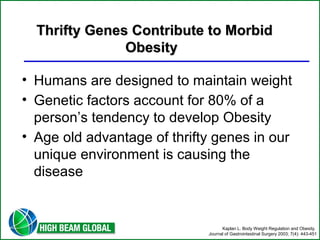
• Humans are designed to maintain weight 
• Genetic factors account for 80% of a 
person’s tendency to develop Obesity 
• Age old advantage of thrifty genes in our 
unique environment is causing the 
disease 
Kaplan L. Body Weight Regulation and Obesity. 

Journal of Gastrointestinal Surgery 2003; 7(4): 443-451
Ghrelin - Produced bbyy tthhee SSttoommaacchh aanndd 
Controls AAppppeettiittee 
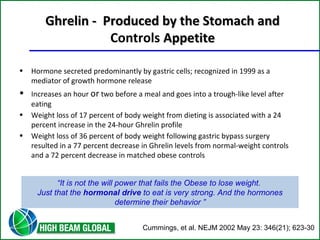
• Hormone secreted predominantly by gastric cells; recognized in 1999 as a 
mediator of growth hormone release 
• Increases an hour or two before a meal and goes into a trough-like level after 
eating 
• Weight loss of 17 percent of body weight from dieting is associated with a 24 
percent increase in the 24-hour Ghrelin profile 
• Weight loss of 36 percent of body weight following gastric bypass surgery 
resulted in a 77 percent decrease in Ghrelin levels from normal-weight controls 
and a 72 percent decrease in matched obese controls 
“It is not the will power that fails the Obese to lose weight. 
Just that the hormonal drive to eat is very strong. And the hormones 
determine their behavior ” 
Cummings, et al. NEJM 2002 May 23: 346(21); 623-30
BBMMII –– AA mmeeaassuurree ooff ddeeggrreeee ooff OObbeessiittyy 
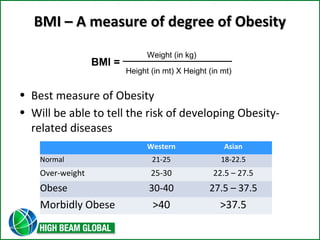
BMI = Weight (in kg) 
• Best measure of Obesity 
• Will be able to tell the risk of developing Obesity-related 
diseases 
Height (in mt) X Height (in mt) 
Western Asian 
Normal 21-25 18-22.5 
Over-weight 25-30 22.5 – 27.5 
Obese 30-40 27.5 – 37.5 
Morbidly Obese >40 >37.5
BBMMII –– AA mmeeaassuurree ooff ddeeggrreeee ooff OObbeessiittyy 
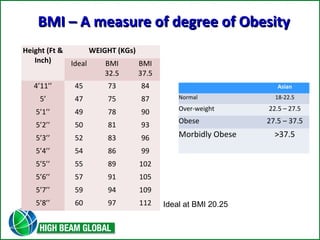
Asian 
Normal 18-22.5 
Over-weight 22.5 – 27.5 
Obese 27.5 – 37.5 
Morbidly Obese >37.5 
Height (Ft & 
Inch) 
WEIGHT (KGs) 
Ideal BMI 
32.5 
BMI 
37.5 
4’11’’ 45 73 84 
5’ 47 75 87 
5’1’’ 49 78 90 
5’2’’ 50 81 93 
5’3’’ 52 83 96 
5’4’’ 54 86 99 
5’5’’ 55 89 102 
5’6’’ 57 91 105 
5’7’’ 59 94 109 
5’8’’ 60 97 112 Ideal at BMI 20.25
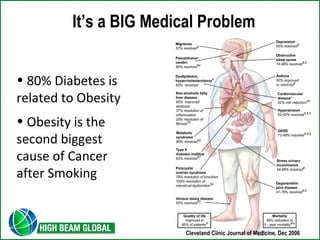
It’s a BIG Medical Problem 
Cleveland Clinic Journal of Medicine, Dec 2006 
• 80% Diabetes is 
related to Obesity 
• Obesity is the 
second biggest 
cause of Cancer 
after Smoking
Diabetes – A surgical perspective
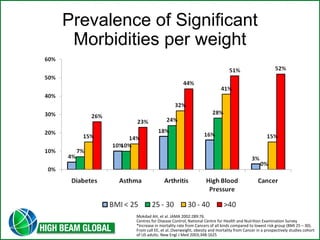
Prevalence of Significant 
Morbidities per weight 
Mokdad AH, et al. JAMA 2002:289:76. 
Centres for Disease Control, National Centre for Health and Nutrition Examination Survey 
*Increase in mortality rate from Cancers of all kinds compared to lowest risk group (BMI 25 – 30). 
From call EE, et al..Overweight, obesity and mortality from Cancer in a prospectively studies cohort 
of US adults. New Engl J Med 2003;348:1625
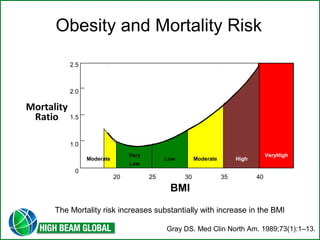
Obesity and Mortality Risk 
BMI 
Gray DS. Med Clin North Am. 1989;73(1):1–13. 
2.5 
2.0 
1.5 
1.0 
0 
20 25 30 35 40 
Mortality 
Ratio 
Moderate Very 
Low 
Low Moderate High VeryHigh 
The Mortality risk increases substantially with increase in the BMI
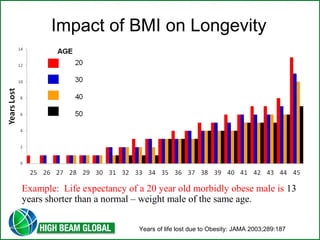
Impact of BMI on Longevity 
High VeryHigh 
Example: Life expectancy of a 20 year old morbidly obese male is 13 
years shorter than a normal – weight male of the same age. 
Years of life lost due to Obesity: JAMA 2003;289:187
Weight Management Tools 
• Diet 
• Exercise 
• Behavior Therapy 
• Medications 
• SURGERY 
Being Overweight / Obese can be treated by Medical Intervention. 
Whereas Morbid Obesity requires Surgical Intervention
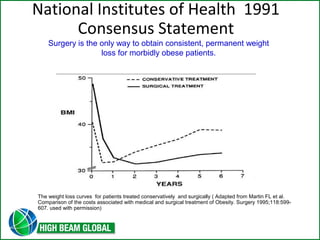
National Institutes of Health 1991 
Consensus Statement 
Surgery is the only way to obtain consistent, permanent weight 
loss for morbidly obese patients. 
The weight loss curves for patients treated conservatively and surgically ( Adapted from Martin FL et al. 
Comparison of the costs associated with medical and surgical treatment of Obesity. Surgery 1995;118:599- 
607. used with permission)
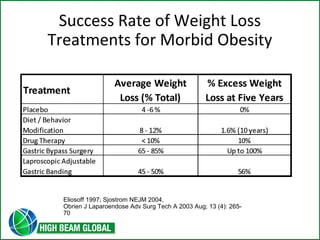
Success Rate of Weight Loss 
Treatments for Morbid Obesity 
Eliosoff 1997; Sjostrom NEJM 2004, 
Obrien J Laparoendose Adv Surg Tech A 2003 Aug; 13 (4): 265- 
70
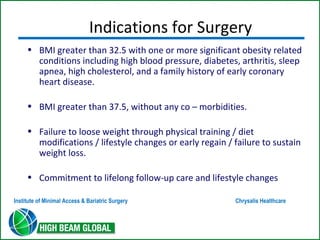
Indications for Surgery 
• BMI greater than 32.5 with one or more significant obesity related 
conditions including high blood pressure, diabetes, arthritis, sleep 
apnea, high cholesterol, and a family history of early coronary 
heart disease. 
• BMI greater than 37.5, without any co – morbidities. 
• Failure to loose weight through physical training / diet 
modifications / lifestyle changes or early regain / failure to sustain 
weight loss. 
• Commitment to lifelong follow-up care and lifestyle changes 
Institute of Minimal Access & Bariatric Surgery Chrysalis Healthcare
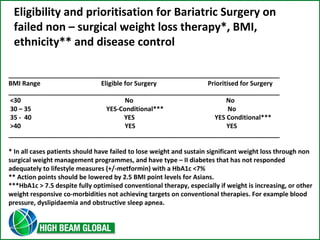
Eligibility and prioritisation for Bariatric Surgery on 
failed non – surgical weight loss therapy*, BMI, 
ethnicity** and disease control 
_____________________________________________________________________________ 
BMI Range Eligible for Surgery Prioritised for Surgery 
_____________________________________________________________________________ 
<30 No No 
30 – 35 YES-Conditional*** No 
35 - 40 YES YES Conditional*** 
>40 YES YES 
_____________________________________________________________________________ 
* In all cases patients should have failed to lose weight and sustain significant weight loss through non 
surgical weight management programmes, and have type – II diabetes that has not responded 
adequately to lifestyle measures (+/-metformin) with a HbA1c <7% 
** Action points should be lowered by 2.5 BMI point levels for Asians. 
***HbA1c > 7.5 despite fully optimised conventional therapy, especially if weight is increasing, or other 
weight responsive co-morbidities not achieving targets on conventional therapies. For example blood 
pressure, dyslipidaemia and obstructive sleep apnea.
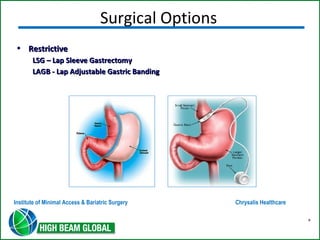
Surgical Options 
• RReessttrriiccttiivvee 
LLSSGG –– LLaapp SSlleeeevvee GGaassttrreeccttoommyy 
LLAAGGBB -- LLaapp AAddjjuussttaabbllee GGaassttrriicc BBaannddiinngg 
Institute of Minimal Access & Bariatric Surgery Chrysalis Healthcare
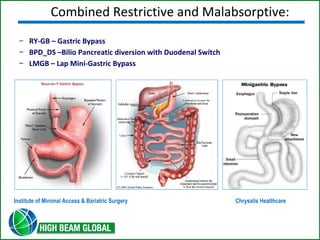
Combined Restrictive and Malabsorptive: 
– RY-GB – Gastric Bypass 
– BPD_DS –Bilio Pancreatic diversion with Duodenal Switch 
– LMGB – Lap Mini-Gastric Bypass 
Institute of Minimal Access & Bariatric Surgery Chrysalis Healthcare
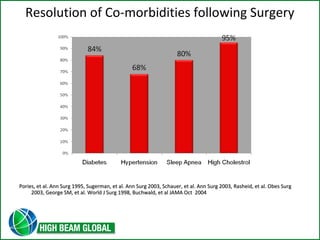
Resolution of Co-morbidities following Surgery 
Pories, et al. Ann Surg 1995, Sugerman, et al. Ann Surg 2003, Schauer, et al. Ann Surg 2003, Rasheid, eett aall.. OObbeess SSuurrgg 
22000033,, GGeeoorrggee SSMM,, eett aall.. WWoorrlldd JJ SSuurrgg 11999988,, BBuucchhwwaalldd,, eett aall JJAAMMAA OOcctt 22000044
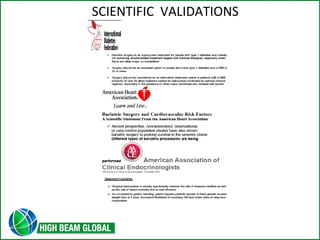
SCIENTIFIC VALIDATIONS
MMiilleess ttoo ggoo bbeeffoorree wwee ssttoopp…… 
Institute of Minimal Access & Bariatric Surgery Chrysalis Healthcare
Thank you. 
Institute of Minimal Access & Bariatric Surgery Chrysalis Healthcare

Surgical options for morbid obesity

  • 1.
    TTOOTTAALL KKNNEEEE AARRTTHHRROOPPLLAASSTTYY FFrraannkk RR.. EEbbeerrtt,, MMDD UUnniioonn MMeemmoorriiaall HHoossppiittaall BBaallttiimmoorree,, MMaarryyllaanndd
  • 2.
    SSUURRGGIICCAALL OOPPTTIIOONNSS FFOORRMMOORRBBIIDD OOBBEESSIITTYY DR ATUL N.C.PETERS Director - Institute Of Bariatric, Metabolic & Minimal Access Surgery Fortis Hospital, Shalimar Bagh New Delhi, India +91 - 9810048755 www.atulpeters.com
  • 3.
    Why Say NOto Morbid ObesityMorbid Obesity and its Treatment Options
  • 4.
    What is MorbidObesity • Multi-factorial Disease of Excess Fat Storage with a Genetic Basis • Associated with Several Serious Medical Problems • Influenced by the Environment • Lifelong and Progressive
  • 5.
    WWee aarree ggrroowwiinngg…… Ours is the ‘heaviest’ generation and we will most definitely be beaten by our children
  • 6.
    Who can weblame for this?
  • 7.
    We are madelike that only ‘Thrifty genes’ (Store fat for ‘need’) Survival Advantage Thrifty genes Humans are genetically designed to ‘gain / maintain’ weight Kaplan L. Body Weight Regulation and Obesity. Journal of Gastrointestinal Surgery 2003; 7(4): 443-451 Physical exercise guaranteed, Food scarce
  • 8.
    NOW = FoodGuaranteed Exercise / Physical movement ‘Sometimes’ OBESITY Even when food is in plenty, we are genetically designed to store for ‘future’
  • 9.
    Ge Thrifty GenneessCCoonnttrriibbuuttee ttoo MMoorrbbiidd OObbeessiittyy • Humans are designed to maintain weight • Genetic factors account for 80% of a person’s tendency to develop Obesity • Age old advantage of thrifty genes in our unique environment is causing the disease Kaplan L. Body Weight Regulation and Obesity. Journal of Gastrointestinal Surgery 2003; 7(4): 443-451
  • 10.
    Ghrelin - Producedbbyy tthhee SSttoommaacchh aanndd Controls AAppppeettiittee • Hormone secreted predominantly by gastric cells; recognized in 1999 as a mediator of growth hormone release • Increases an hour or two before a meal and goes into a trough-like level after eating • Weight loss of 17 percent of body weight from dieting is associated with a 24 percent increase in the 24-hour Ghrelin profile • Weight loss of 36 percent of body weight following gastric bypass surgery resulted in a 77 percent decrease in Ghrelin levels from normal-weight controls and a 72 percent decrease in matched obese controls “It is not the will power that fails the Obese to lose weight. Just that the hormonal drive to eat is very strong. And the hormones determine their behavior ” Cummings, et al. NEJM 2002 May 23: 346(21); 623-30
  • 11.
    BBMMII –– AAmmeeaassuurree ooff ddeeggrreeee ooff OObbeessiittyy BMI = Weight (in kg) • Best measure of Obesity • Will be able to tell the risk of developing Obesity-related diseases Height (in mt) X Height (in mt) Western Asian Normal 21-25 18-22.5 Over-weight 25-30 22.5 – 27.5 Obese 30-40 27.5 – 37.5 Morbidly Obese >40 >37.5
  • 12.
    BBMMII –– AAmmeeaassuurree ooff ddeeggrreeee ooff OObbeessiittyy Asian Normal 18-22.5 Over-weight 22.5 – 27.5 Obese 27.5 – 37.5 Morbidly Obese >37.5 Height (Ft & Inch) WEIGHT (KGs) Ideal BMI 32.5 BMI 37.5 4’11’’ 45 73 84 5’ 47 75 87 5’1’’ 49 78 90 5’2’’ 50 81 93 5’3’’ 52 83 96 5’4’’ 54 86 99 5’5’’ 55 89 102 5’6’’ 57 91 105 5’7’’ 59 94 109 5’8’’ 60 97 112 Ideal at BMI 20.25
  • 13.
    It’s a BIGMedical Problem Cleveland Clinic Journal of Medicine, Dec 2006 • 80% Diabetes is related to Obesity • Obesity is the second biggest cause of Cancer after Smoking
  • 14.
    Diabetes – Asurgical perspective
  • 15.
    Prevalence of Significant Morbidities per weight Mokdad AH, et al. JAMA 2002:289:76. Centres for Disease Control, National Centre for Health and Nutrition Examination Survey *Increase in mortality rate from Cancers of all kinds compared to lowest risk group (BMI 25 – 30). From call EE, et al..Overweight, obesity and mortality from Cancer in a prospectively studies cohort of US adults. New Engl J Med 2003;348:1625
  • 16.
    Obesity and MortalityRisk BMI Gray DS. Med Clin North Am. 1989;73(1):1–13. 2.5 2.0 1.5 1.0 0 20 25 30 35 40 Mortality Ratio Moderate Very Low Low Moderate High VeryHigh The Mortality risk increases substantially with increase in the BMI
  • 17.
    Impact of BMIon Longevity High VeryHigh Example: Life expectancy of a 20 year old morbidly obese male is 13 years shorter than a normal – weight male of the same age. Years of life lost due to Obesity: JAMA 2003;289:187
  • 18.
    Weight Management Tools • Diet • Exercise • Behavior Therapy • Medications • SURGERY Being Overweight / Obese can be treated by Medical Intervention. Whereas Morbid Obesity requires Surgical Intervention
  • 19.
    National Institutes ofHealth 1991 Consensus Statement Surgery is the only way to obtain consistent, permanent weight loss for morbidly obese patients. The weight loss curves for patients treated conservatively and surgically ( Adapted from Martin FL et al. Comparison of the costs associated with medical and surgical treatment of Obesity. Surgery 1995;118:599- 607. used with permission)
  • 20.
    Success Rate ofWeight Loss Treatments for Morbid Obesity Eliosoff 1997; Sjostrom NEJM 2004, Obrien J Laparoendose Adv Surg Tech A 2003 Aug; 13 (4): 265- 70
  • 21.
    Indications for Surgery • BMI greater than 32.5 with one or more significant obesity related conditions including high blood pressure, diabetes, arthritis, sleep apnea, high cholesterol, and a family history of early coronary heart disease. • BMI greater than 37.5, without any co – morbidities. • Failure to loose weight through physical training / diet modifications / lifestyle changes or early regain / failure to sustain weight loss. • Commitment to lifelong follow-up care and lifestyle changes Institute of Minimal Access & Bariatric Surgery Chrysalis Healthcare
  • 22.
    Eligibility and prioritisationfor Bariatric Surgery on failed non – surgical weight loss therapy*, BMI, ethnicity** and disease control _____________________________________________________________________________ BMI Range Eligible for Surgery Prioritised for Surgery _____________________________________________________________________________ <30 No No 30 – 35 YES-Conditional*** No 35 - 40 YES YES Conditional*** >40 YES YES _____________________________________________________________________________ * In all cases patients should have failed to lose weight and sustain significant weight loss through non surgical weight management programmes, and have type – II diabetes that has not responded adequately to lifestyle measures (+/-metformin) with a HbA1c <7% ** Action points should be lowered by 2.5 BMI point levels for Asians. ***HbA1c > 7.5 despite fully optimised conventional therapy, especially if weight is increasing, or other weight responsive co-morbidities not achieving targets on conventional therapies. For example blood pressure, dyslipidaemia and obstructive sleep apnea.
  • 23.
    Surgical Options •RReessttrriiccttiivvee LLSSGG –– LLaapp SSlleeeevvee GGaassttrreeccttoommyy LLAAGGBB -- LLaapp AAddjjuussttaabbllee GGaassttrriicc BBaannddiinngg Institute of Minimal Access & Bariatric Surgery Chrysalis Healthcare
  • 24.
    Combined Restrictive andMalabsorptive: – RY-GB – Gastric Bypass – BPD_DS –Bilio Pancreatic diversion with Duodenal Switch – LMGB – Lap Mini-Gastric Bypass Institute of Minimal Access & Bariatric Surgery Chrysalis Healthcare
  • 25.
    Resolution of Co-morbiditiesfollowing Surgery Pories, et al. Ann Surg 1995, Sugerman, et al. Ann Surg 2003, Schauer, et al. Ann Surg 2003, Rasheid, eett aall.. OObbeess SSuurrgg 22000033,, GGeeoorrggee SSMM,, eett aall.. WWoorrlldd JJ SSuurrgg 11999988,, BBuucchhwwaalldd,, eett aall JJAAMMAA OOcctt 22000044
  • 26.
  • 50.
    MMiilleess ttoo ggoobbeeffoorree wwee ssttoopp…… Institute of Minimal Access & Bariatric Surgery Chrysalis Healthcare
  • 51.
    Thank you. Instituteof Minimal Access & Bariatric Surgery Chrysalis Healthcare