

Continuity and Resilience (CORE)
ISO 22301 BCM Consulting Firm
Presentations by our partners and
extended team of industry experts
Our Contact Details:
INDIA UAE
Continuity and Resilience
Level 15,Eros Corporate Tower
Nehru Place ,New Delhi-110019
Tel: +91 11 41055534/ +91 11 41613033
Fax: ++91 11 41055535
Email: neha@continuityandresilience.com
Continuity and Resilience
P. O. Box 127557
Abu Dhabi, United Arab Emirates
Mobile:+971 50 8460530
Tel: +971 2 8152831
Fax: +971 2 8152888
Email: info@continuityandresilience.com
4th Middle East Business and IT Resilience Summit, March 17th 2015
SUPPLY CHAIN RISK MANAGEMENT
Resilient Supply Chains in Logistics and Other Industries
The 3rd India Business & IT Resilience Summit (27th - 28th May 2015)
Marriott Courtyard, Mumbai, India
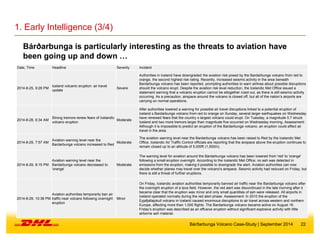
Turning potential supply chain
disruption to competitive advantage
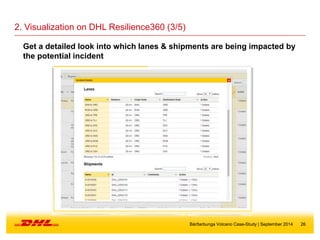
3
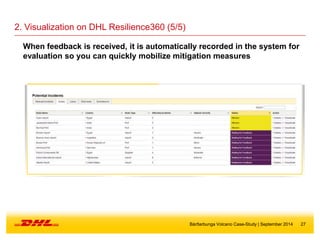
Die Post für Deutschland - The Logistics Company for the World
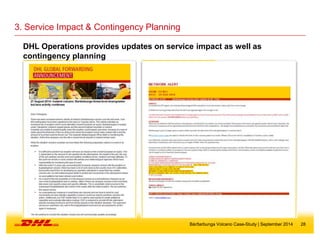
GLOBAL BUSINESS SERVICES
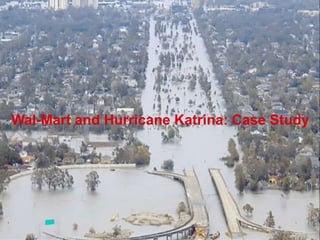
DHL CUSTOMER SOLUTIONS & INNOVATION
Corporate Center
EXPRESS
GLOBAL
FORWARDING,
FREIGHT
Post - eCommerce - Parcel (PeP) SUPPLY CHAIN
Revenue US$ 62.0 Billion (2014)
4
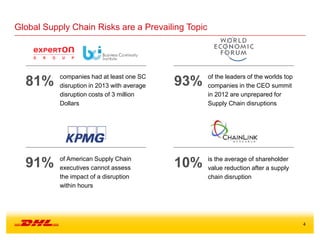
Global Supply Chain Risks are a Prevailing Topic
companies had at least one SC
disruption in 2013 with average
disruption costs of 3 million
Dollars
of the leaders of the worlds top
companies in the CEO summit
in 2012 are unprepared for
Supply Chain disruptions
is the average of shareholder
value reduction after a supply
chain disruption
of American Supply Chain
executives cannot assess
the impact of a disruption
within hours
81% 93%
91% 10%
5
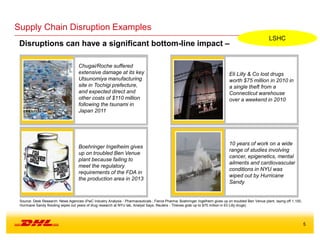
Supply Chain Disruption Examples
Source: Desk Research: News Agencies (PwC Industry Analysis - Pharmaceuticals ; Fierce Pharma: Boehringer Ingelheim gives up on troubled Ben Venue plant, laying off 1,100,
Hurricane Sandy flooding wipes out years of drug research at NYU lab, Analyst Says, Reuters - Thieves grab up to $75 million in Eli Lilly drugs)
Chugai/Roche suffered
extensive damage at its key
Utsunomiya manufacturing
site in Tochigi prefecture,
and expected direct and
other costs of $110 million
following the tsunami in
Japan 2011
Eli Lilly & Co lost drugs
worth $75 million in 2010 in
a single theft from a
Connecticut warehouse
over a weekend in 2010
Boehringer Ingelheim gives
up on troubled Ben Venue
plant because failing to
meet the regulatory
requirements of the FDA in
the production area in 2013
10 years of work on a wide
range of studies involving
cancer, epigenetics, mental
ailments and cardiovascular
conditions in NYU was
wiped out by Hurricane
Sandy
Disruptions can have a significant bottom-line impact –
LSHC
6
Supply Chain Disruption Examples
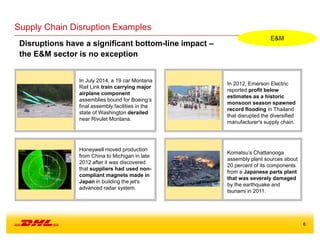
In July 2014, a 19 car Montana
Rail Link train carrying major
airplane component
assemblies bound for Boeing’s
final assembly facilities in the
state of Washington derailed
near Rivulet Montana.
Disruptions have a significant bottom-line impact –
the E&M sector is no exception
In 2012, Emerson Electric
reported profit below
estimates as a historic
monsoon season spawned
record flooding in Thailand
that disrupted the diversified
manufacturer's supply chain.
Honeywell moved production
from China to Michigan in late
2012 after it was discovered
that suppliers had used non-
compliant magnets made in
Japan in building the jet's
advanced radar system.
Komatsu’s Chattanooga
assembly plant sources about
20 percent of its components
from a Japanese parts plant
that was severely damaged
by the earthquake and
tsunami in 2011.
E&M
7
Supply chain disruption examples
Disruptions have a significant bottom-line impact
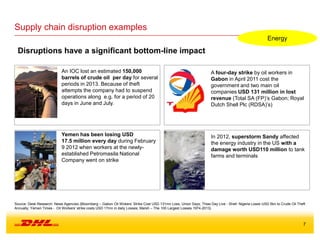
An IOC lost an estimated 150,000
barrels of crude oil per day for several
periods in 2013. Because of theft
attempts the company had to suspend
operations along e.g. for a period of 20
days in June and July.
A four-day strike by oil workers in
Gabon in April 2011 cost the
government and two main oil
companies USD 131 million in lost
revenue (Total SA (FP)’s Gabon; Royal
Dutch Shell Plc (RDSA)’s)
Yemen has been losing USD
17.5 million every day during February
9 2012 when workers at the newly-
established Petromasila National
Company went on strike
In 2012, superstorm Sandy affected
the energy industry in the US with a
damage worth USD110 million to tank
farms and terminals
Source: Desk Research: News Agencies (Bloomberg – Gabon Oil Wokers’ Strike Cost USD 131mn Loss, Union Says; Thias Day Live - Shell: Nigeria Loses USD 5bn to Crude Oil Theft
Annually; Yemen Times - Oil Workers’ strike costs USD 17mn in daily Losses; Marsh – The 100 Largest Losses 1974-2013)
Energy
8
Supply Chain Risk Management as Competitive Advantage
The right supply chain risk management approach can turn a
disruption into a competitive advantage
Source: Earthquake Japan: Annual reports 2011 VW & Toyota; Strike SA: http://www.iol.co.za/business/news/car-factories-stand-idle-as-workers-strike-1.1564825#.U6GJDJR_vzg;
Naamsa Reports see http://www.carmag.co.za/;
Automotive
Scenario Differences in Risk Management Impact
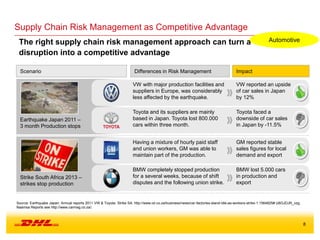
VW with major production facilities and
suppliers in Europe, was considerably
less affected by the earthquake.
Toyota and its suppliers are mainly
based in Japan. Toyota lost 800.000
cars within three month.
VW reported an upside
of car sales in Japan
by 12%
Toyota faced a
downside of car sales
in Japan by -11.5%
Having a mixture of hourly paid staff
and union workers, GM was able to
maintain part of the production.
BMW completely stopped production
for a several weeks, because of shift
disputes and the following union strike.
GM reported stable
sales figures for local
demand and export
BMW lost 5.000 cars
in production and
export
Earthquake Japan 2011 –
3 month Production stops
Strike South Africa 2013 –
strikes stop production
9
Complexity of Supply Chains- Some “reasons”
 Companies seek the spots where it is cheapest to produce today
 Some Auto companies don’t even have a day of safety stock in their I2M
 Companies focus on their core competencies and outsource more
 That has created multiple, long and complex tiers of supply partners
 BUT, also a recent trend of regionalization, producing, supplying in same region
10
And, more “reasons”…….
 Chinese labor cost have gone up a threefold in the last 9 years =>
opportunity for many other SE Asian Countries (not necessarily less risky)
 Companies are constantly moving production- trend is near-shoring
going to Mexico and Eastern Europe
 Emerging markets have driven growth, most recently with Africa continent
 “Center of gravity” is shifting from where to produce and store goods
centrally
Supply chains are not necessarily flexible if you haven’t on
purpose built in redundancy
11
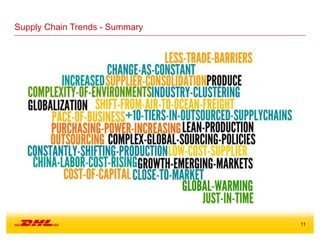
Supply Chain Trends - Summary
12
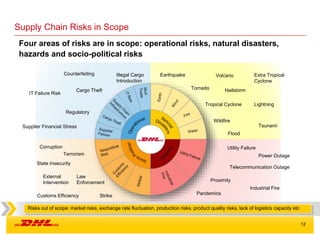
Supply Chain Risks in Scope
Four areas of risks are in scope: operational risks, natural disasters,
hazards and socio-political risks
Illegal Cargo
Introduction
Counterfeiting
Cargo Theft
Regulatory
Supplier Financial Stress
Law
Enforcement
Customs Efficiency Strike
State Insecurity
External
Intervention
Terrorism
Corruption
Extra Tropical
Cyclone
Tropical Cyclone
Wildfire
Lightning
Tsunami
Industrial Fire
Utility Failure
Flood
VolcanoEarthquake
Tornado Hailstorm
IT Failure Risk
Risks out of scope: market risks, exchange rate fluctuation, production risks, product quality risks, lack of logistics capacity etc
Power Outage
Telecommunication Outage
Pandemics
Proximity
13
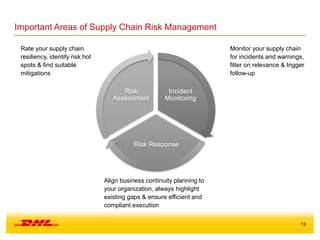
Important Areas of Supply Chain Risk Management
Incident
Monitoring
Risk Response
Risk
Assessment
Rate your supply chain
resiliency, identify risk hot
spots & find suitable
mitigations
Monitor your supply chain
for incidents and warnings,
filter on relevance & trigger
follow-up
Align business continuity planning to
your organization, always highlight
existing gaps & ensure efficient and
compliant execution
14
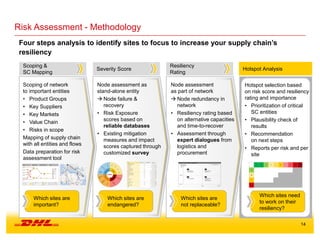
Risk Assessment - Methodology
Hotspot selection based
on risk score and resiliency
rating and importance
• Prioritization of critical
SC entities
• Plausibility check of
results
• Recommendation
on next steps
• Reports per risk and per
site
Resiliency
Rating
Severity Score
Scoping &
SC Mapping
Node assessment
as part of network
 Node redundancy in
network
• Resiliency rating based
on alternative capacities
and time-to-recover
• Assessment through
expert dialogues from
logistics and
procurement
Node assessment as
stand-alone entity
 Node failure &
recovery
• Risk Exposure
scores based on
reliable databases
• Existing mitigation
measures and impact
scores captured through
customized survey
Scoping of network
to important entities
• Product Groups
• Key Suppliers
• Key Markets
• Value Chain
• Risks in scope
Mapping of supply chain
with all entities and flows
Data preparation for risk
assessment tool
Which sites are
important?
Which sites are
endangered?
Which sites are
not replaceable?
Which sites need
to work on their
resiliency?
Four steps analysis to identify sites to focus to increase your supply chain’s
resiliency
Hotspot Analysis
15
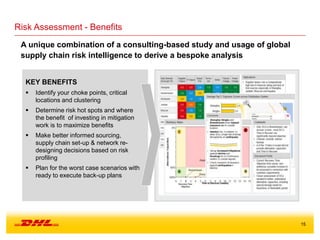
Risk Assessment - Benefits
A unique combination of a consulting-based study and usage of global
supply chain risk intelligence to derive a bespoke analysis
KEY BENEFITS
 Identify your choke points, critical
locations and clustering
 Determine risk hot spots and where
the benefit of investing in mitigation
work is to maximize benefits
 Make better informed sourcing,
supply chain set-up & network re-
designing decisions based on risk
profiling
 Plan for the worst case scenarios with
ready to execute back-up plans
16
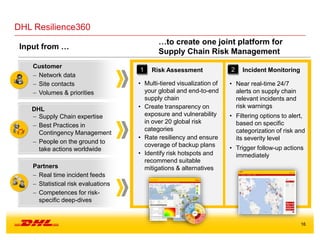
DHL Resilience360
Customer
 Network data
 Site contacts
 Volumes & priorities
 Supply Chain expertise
 Best Practices in
Contingency Management
 People on the ground to
take actions worldwide
Partners
 Real time incident feeds
 Statistical risk evaluations
 Competences for risk-
specific deep-dives
Incident MonitoringRisk Assessment
Input from …
…to create one joint platform for
Supply Chain Risk Management
DHL
I1 I2
• Multi-tiered visualization of
your global and end-to-end
supply chain
• Create transparency on
exposure and vulnerability
in over 20 global risk
categories
• Rate resiliency and ensure
coverage of backup plans
• Identify risk hotspots and
recommend suitable
mitigations & alternatives
• Near real-time 24/7
alerts on supply chain
relevant incidents and
risk warnings
• Filtering options to alert,
based on specific
categorization of risk and
its severity level
• Trigger follow-up actions
immediately
RISK INTELLIGENCE OUTLOOK
FOR INTERNAL USE ONLY
Enhancing Data Utilization
Shehrina Kamal
Bonn, September 2, 2014
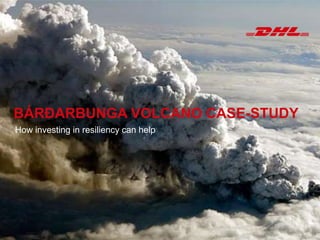
BÁRÐARBUNGA VOLCANO
CASE-STUDY
How investing in resiliency can help
DHL Resilience360
Bonn, September 10, 2014BÁRÐARBUNGA VOLCANO CASE-STUDY
How investing in resiliency can help
18
Introduction
Bárðarbunga Volcano Case-Study | September 2014
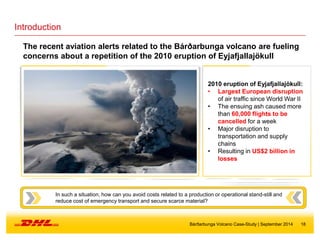
The recent aviation alerts related to the Bárðarbunga volcano are fueling
concerns about a repetition of the 2010 eruption of Eyjafjallajökull
In such a situation, how can you avoid costs related to a production or operational stand-still and
reduce cost of emergency transport and secure scarce material?
2010 eruption of Eyjafjallajökull:
• Largest European disruption
of air traffic since World War II
• The ensuing ash caused more
than 60,000 flights to be
cancelled for a week
• Major disruption to
transportation and supply
chains
• Resulting in US$2 billion in
losses
19
DHL Resilience360
Bárðarbunga Volcano Case-Study | September 2014
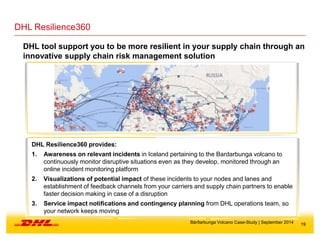
DHL Resilience360 provides:
1. Awareness on relevant incidents in Iceland pertaining to the Bardarbunga volcano to
continuously monitor disruptive situations even as they develop, monitored through an
online incident monitoring platform
2. Visualizations of potential impact of these incidents to your nodes and lanes and
establishment of feedback channels from your carriers and supply chain partners to enable
faster decision making in case of a disruption
3. Service impact notifications and contingency planning from DHL operations team, so
your network keeps moving
DHL tool support you to be more resilient in your supply chain through an
innovative supply chain risk management solution
20
1. Early Intelligence (1/4)
Bárðarbunga Volcano Case-Study | September 2014
Date, Time Headline Severity Incident
2014-8-18, 6:17 PM
Aviation threat level raised to orange
due to increased volcanic activity at
Bardarbunga
Minor
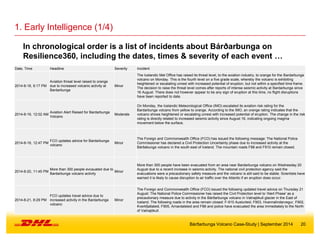
The Icelandic Met Office has raised its threat level, to the aviation industry, to orange for the Bardarbunga
volcano on Monday. This is the fourth level on a five grade scale, whereby the volcano is exhibiting
heightened or escalating unrest with increased potential of eruption, but not within a specified time frame.
The decision to raise the threat level comes after reports of intense seismic activity at Bardarbunga since
16 August. There does not however appear to be any sign of eruption at this time, no flight disruptions
have been reported to date.
2014-8-19, 12:02 AM
Aviation Alert Raised for Bardarbunga
Volcano
Moderate
On Monday, the Icelandic Meteorological Office (IMO) escalated its aviation risk rating for the
Bardarbunga volcano from yellow to orange. According to the IMO, an orange rating indicates that the
volcano shows heightened or escalating unrest with increased potential of eruption. The change in the risk
rating is directly related to increased seismic activity since August 16, indicating ongoing magma
movement below the surface.
2014-8-19, 12:47 PM
FCO updates advice for Bardarbunga
volcano
Minor
The Foreign and Commonwealth Office (FCO) has issued the following message: The National Police
Commissioner has declared a Civil Protection Uncertainty phase due to increased activity at the
Bárðabunga volcano in the south east of Iceland. The mountain roads F88 and F910 remain closed.
2014-8-20, 11:45 PM
More than 300 people evcauated due to
Bardarbunga volcano activity
Minor
More than 300 people have been evacuated from an area near Bardarbunga volcano on Wednesday 20
August due to a recent increase in seismic activity. The national civil protection agency said the
evacuations were a precautionary safety measure and the volcano is still said to be stable. Scientists have
warned it is likely to cause disruption to air traffic over the Atlantic if an eruption does occur.
2014-8-21, 8:29 PM
FCO updates travel advice due to
increased activity in the Bardarbunga
volcano
Minor
The Foreign and Commonwealth Office (FCO) issued the following updated travel advice on Thursday 21
August: The National Police Commissioner has raised the Civil Protection level to 'Alert Phase' as a
precautionary measure due to activity in the Bárðarbunga volcano in Vatnajökull glacier in the East of
Iceland. The following roads in the area remain closed: F-910 Austurleid, F903, Hvannalindarvegur, F902,
Kverkfjallaleid, F905, Arnardalsleid and F88 and police have evacuated the area immediately to the North
of Vatnajökull.
In chronological order is a list of incidents about Bárðarbunga on
Resilience360, including the dates, times & severity of each event …
21
1. Early Intelligence (2/4)
Bárðarbunga Volcano Case-Study | September 2014
Date, Time Headline Severity Incident
2014-8-23, 5:11 PM
Meteorological Office reports small
subglacial eruption underway at
Bardarbunga volcano
Moderate
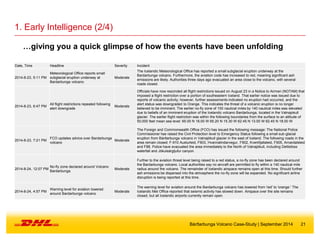
The Icelandic Meteorological Office has reported a small subglacial eruption underway at the
Bardarbunga volcano. Furthermore, the aviation code has increased to red, meaning significant ash
emissions are likely. Authorities three days ago evacuated an area close to the volcano, with several
roads closed.
2014-8-23, 6:47 PM
All flight restrictions repealed following
alert downgrade
Moderate
Officials have now rescinded all flight restrictions issued on August 23 in a Notice to Airmen (NOTAM) that
imposed a flight restriction over a portion of southeastern Iceland. That earlier notice was issued due to
reports of volcanic activity; however, further assessments indicated no eruption had occurred, and the
alert status was downgraded to Orange. This indicates the threat of a volcanic eruption is no longer
believed to be imminent. The earlier no-fly zone of 100 nautical miles by 140 nautical miles was elevated
due to beliefs of an imminent eruption of the Icelandic volcano Bardarbunga, located in the Vatnajokull
glacier. The earlier flight restriction was within the following boundaries from the surface to an altitude of
50,000 feet mean sea level: 65.00 N 18.00 W 65.20 N 15.30 W 62.45 N 13.00 W 62.45 N 18.00 W
2014-8-23, 7:21 PM
FCO updates advice over Bardarbunga
volcano
Moderate
The Foreign and Commonwealth Office (FCO) has issued the following message: The National Police
Commissioner has raised the Civil Protection level to Emergency Status following a small sub-glacial
eruption from Bárðarbunga volcano in Vatnajökull glacier in the east of Iceland. The following roads in the
area remain closed: F-910 Austurleid, F903, Hvannalindarvegur, F902, Kverkfjallaleid, F905, Arnardalsleid
and F88. Police have evacuated the area immediately to the North of Vatnajökull, including Dettisfoss
waterfall and Jökulsárgljufur canyon.
2014-8-24, 12:07 PM
No-fly zone declared around Volcano
Bardarbunga
Moderate
Further to the aviation threat level being raised to a red status, a no-fly zone has been declared around
the Bardarbunga volcano. Local authorities say no aircraft are permitted to fly within a 140 nautical mile
radius around the volcano. The remainder of Icelandic airspace remains open at this time. Should further
ash emissions be dispersed into the atmosphere the no-fly zone will be expanded. No significant airline
disruption is being reported at this time.
2014-8-24, 4:57 PM
Warning level for aviation lowered
around Bardarbunga volcano
Moderate
The warning level for aviation around the Bardarbunga volcano has lowered from 'red' to 'orange.' The
Icelandic Met Office reported that seismic activity has slowed down. Airspace over the site remains
closed, but all Icelandic airports currently remain open.
…giving you a quick glimpse of how the events have been unfolding
22
1. Early Intelligence (3/4)
Bárðarbunga Volcano Case-Study | September 2014
Date, Time Headline Severity Incident
2014-8-25, 9:28 PM
Iceland volcanic eruption: air travel
update
Severe
Authorities in Iceland have downgraded the aviation risk posed by the Bardarbunga volcano from red to
orange, the second highest risk rating. Recently, increased seismic activity in the area beneath
Bardarbunga volcano has been reported, prompting authorities to warn airlines about possible disruptions
should the volcano erupt. Despite the aviation risk level reduction, the Icelandic Met Office issued a
statement warning that a volcanic eruption cannot be altogether ruled out, as there is still seismic activity
occurring. As a precaution, airspace around the volcano is closed off, but all of the nation’s airports are
carrying on normal operations.
2014-8-28, 6:34 AM
Strong tremors renew fears of Icelandic
volcano eruption
Moderate
After authorities lowered a warning for possible air travel disruptions linked to a potential eruption of
Iceland s Bardarbunga volcano from red to orange on Sunday, several larger earthquakes on Wednesday
have renewed fears that the country s largest volcano could erupt. On Tuesday, a magnitude 5.7 struck
Iceland and two more tremors larger than magnitude five occurred on Wednesday morning. Assessment:
Although it is impossible to predict an eruption of the Bardarbunga volcano, an eruption could affect air
travel in the area.
2014-8-29, 7:57 AM
Aviation warning level near the
Bardarbunga volcano increased to Red
Moderate
The aviation warning level near the Bardarbunga volcano has been raised to Red by the Icelandic Met
Office. Icelandic Air Traffic Control officials are reporting that the airspace above the eruption continues to
remain closed up to an altitude of 5,000ft (1,500m).
2014-8-29, 8:15 PM
Aviation warning level near the
Bardarbunga volcano decreased to
'orange'
Moderate
The warning level for aviation around the Bardarbunga volcano has been lowered from 'red' to 'orange'
following a small eruption overnight. According to the Icelandic Met Office, no ash was detected in
emissions from the eruption, making it possible to downgrade the alert. Aviation authorities can now
decide whether planes may travel over the volcano's airspace. Seismic activity had reduced on Friday, but
there is still a threat of further eruptions.
2014-8-29, 10:38 PM
Aviation authorities temporarily ban air
traffic near volcano following overnight
eruption
Minor
On Friday, Icelandic aviation authorities temporarily banned air traffic near the Bardarbunga volcano after
the overnight eruption of a lava field. However, the red alert was discontinued in the late morning after it
became clear that the eruption was minor and only small quantities of ash were released. All airports in
Iceland operated normally during the red alert phase. Assessment: In 2010 the eruption of the
Eyjafjallajokull volcano in Iceland caused enormous disruptions to air travel across western and northern
Europe, affecting more than 1,000 flights. The Bardarbunga volcano became active on August 16.
Friday’s eruption was described as an effusive eruption without significant explosive activity with little
airborne ash material.
Bárðarbunga is particularly interesting as the threats to aviation have
been going up and down …
23
1. Early Intelligence (4/4)
Bárðarbunga Volcano Case-Study | September 2014
Date, Time Headline Severity Incident
2014-8-31, 4:05 PM
Fresh eruption reported at Bardarbunga
volcano, aviation warning code raised to
red
Moderate
A fresh eruption has occurred at the Bardarbunga volcano, sending lava more than 50 meters into the air.
The Icelandic Met Office has since raised its aviation warning code to 'red' from 'orange.'
2014-9-2, 9:39 PM Volcano eruption: no flight disruptions Moderate
Fountains of lava began issuing from the Bardarbunga volcano in Iceland over the weekend, but the
Meteorological Office of Iceland lowered the country’s aviation alert level to orange from red since the
eruption was not producing ash. No flight disruptions have occurred as a result of the eruption. Authorities
believe that a major explosive eruption, which would likely produce ash that hangs in the air, is less likely
now.
2014-9-3, 5:35 PM
Highland roads closed due to possible
flooding north of Vatnajokull glacier
Moderate
Due to another possible volcanic eruption under Vatnajökull, a large area north of the glacier is closed.
According to reports, roads to Askja and Kverkfjöll as well as the Gæsavatnaleið route are closed.
2014-9-7, 10:46 AM
All roads closed around Bardarbunga
volcano due to further eruptions and
increased lava flows
Moderate
According to reports, all roads around the Bardarbunga volcano have been closed to the public in an
attempt to maintain public safety. A further two effusive fissures have opened up about 2 km's north of
Dyngjujokull. Lava is currently streaming out of these two fissures. Travellers are advised to adhere to all
public messages regarding the ongoing volcanic activity at Bardarbunga volcano.
2014-9-9, 8:48 PM
The Bardarbunga volcano continues to
erupt
Severe
The Bardarbunga volcano in Iceland continues to erupt, with streams of lava spewing over 400 feet into
the air, though no ash clouds have begun to form in the area. The volcano began erupting on 31 August,
and two fissures in the earth near the volcano are currently spewing lava. As BSI has mentioned in
previous analyses, the eruptions are effusive, which are unlikely to produce large clouds of ash. However,
should the effusive seams reach the nearby Dyngjujokull glacier, it could cause an explosive eruption and
formation of an ash cloud.
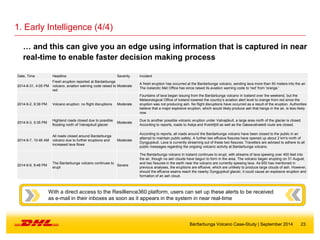
… and this can give you an edge using information that is captured in near
real-time to enable faster decision making process
With a direct access to the Resillience360 platform, users can set up these alerts to be received
as e-mail in their inboxes as soon as it appears in the system in near real-time
24
2. Visualization on DHL Resilience360 (1/5)
Bárðarbunga Volcano Case-Study | September 2014
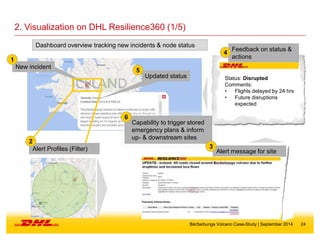
Dashboard overview tracking new incidents & node status
New incident
1
Feedback on status &
actions
Status: Disrupted
Comments:
• Flights delayed by 24 hrs
• Future disruptions
expected
4
Updated status
5
Alert Profiles (Filter)
2
Capability to trigger stored
emergency plans & inform
up- & downstream sites
6
Alert message for site
3
25
2. Visualization on DHL Resilience360 (2/5)
Bárðarbunga Volcano Case-Study | September 2014
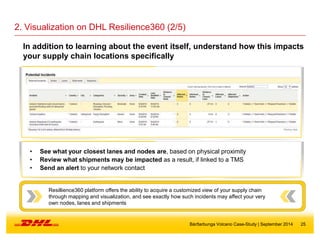
In addition to learning about the event itself, understand how this impacts
your supply chain locations specifically
• See what your closest lanes and nodes are, based on physical proximity
• Review what shipments may be impacted as a result, if linked to a TMS
• Send an alert to your network contact
Resillience360 platform offers the ability to acquire a customized view of your supply chain
through mapping and visualization, and see exactly how such incidents may affect your very
own nodes, lanes and shipments
26
2. Visualization on DHL Resilience360 (3/5)
Bárðarbunga Volcano Case-Study | September 2014
Get a detailed look into which lanes & shipments are being impacted by
the potential incident
27
2. Visualization on DHL Resilience360 (5/5)
Bárðarbunga Volcano Case-Study | September 2014
When feedback is received, it is automatically recorded in the system for
evaluation so you can quickly mobilize mitigation measures
28
3. Service Impact & Contingency Planning
Bárðarbunga Volcano Case-Study | September 2014
DHL Operations provides updates on service impact as well as
contingency planning
29
Wal-Mart and Hurricane Katrina: Case Study
30
Case Study Wal-Mart
August 23 2005: Six days before Katrina hit New Orleans Wal-Mart already identified this
weather phenomenon as a risk.
August 25 2005: Katrina changed path. Wal-Mart assessed situation 12 hours before the
National Weather Service.
August 26 2005: Wal-Mart started to deliver bottled water,
Pop-Tarts and generators next to the danger zone.
August 29 2005: Hurricane Katrina hit New Orleans.
Wal-Mart’s disaster recovery team arrived way before the red cross and US army to
support with first aid and supplies.
31
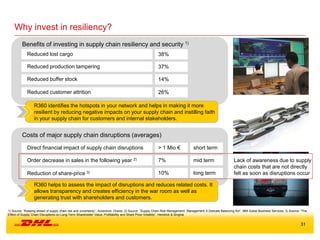
Why invest in resiliency?
Costs of major supply chain disruptions (averages)
Direct financial impact of supply chain disruptions
Reduction of share-price 3)
Order decrease in sales in the following year 2)
1) Source: “Keeping ahead of supply chain risk and uncertainty”, Accenture, Oracle; 2) Source: “Supply Chain Risk Management: Management A Delicate Balancing Act“, IBM Gobal Business Services; 3) Source: “The
Effect of Supply Chain Disruptions on Long-Term Shareholder Value, Profitability and Share Price Volatility”, Hendrick & Singhai
10%
7%
> 1 Mio € short term
long term
mid term Lack of awareness due to supply
chain costs that are not directly
felt as soon as disruptions occur
Benefits of investing in supply chain resiliency and security 1)
Reduced lost cargo 38%
Reduced production tampering 37%
Reduced buffer stock 14%
Reduced customer attrition 26%
R360 helps to assess the impact of disruptions and reduces related costs. It
allows transparency and creates efficiency in the war room as well as
generating trust with shareholders and customers.
R360 identifies the hotspots in your network and helps in making it more
resilient by reducing negative impacts on your supply chain and instilling faith
in your supply chain for customers and internal stakeholders.
32
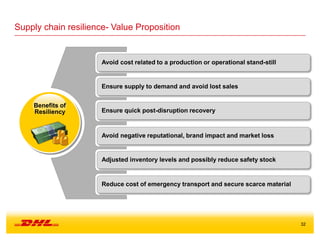
Supply chain resilience- Value Proposition
Avoid cost related to a production or operational stand-still
Ensure supply to demand and avoid lost sales
Ensure quick post-disruption recovery
Reduce cost of emergency transport and secure scarce material
Avoid negative reputational, brand impact and market loss
Adjusted inventory levels and possibly reduce safety stock
Benefits of
Resiliency
33
For More Information on Supply Chain Risk Management
NIL Madhab
Global Customer Manager
DHL Customer Solutions & Innovation
Contact us or visit the Resilience360 website:
http://www.dhl.com/resilience360

Supply Chain Risk Management

  • 1.
    Continuity and Resilience(CORE) ISO 22301 BCM Consulting Firm Presentations by our partners and extended team of industry experts Our Contact Details: INDIA UAE Continuity and Resilience Level 15,Eros Corporate Tower Nehru Place ,New Delhi-110019 Tel: +91 11 41055534/ +91 11 41613033 Fax: ++91 11 41055535 Email: neha@continuityandresilience.com Continuity and Resilience P. O. Box 127557 Abu Dhabi, United Arab Emirates Mobile:+971 50 8460530 Tel: +971 2 8152831 Fax: +971 2 8152888 Email: info@continuityandresilience.com
  • 2.
    4th Middle EastBusiness and IT Resilience Summit, March 17th 2015 SUPPLY CHAIN RISK MANAGEMENT Resilient Supply Chains in Logistics and Other Industries The 3rd India Business & IT Resilience Summit (27th - 28th May 2015) Marriott Courtyard, Mumbai, India Turning potential supply chain disruption to competitive advantage
  • 3.
    3 Die Post fürDeutschland - The Logistics Company for the World GLOBAL BUSINESS SERVICES DHL CUSTOMER SOLUTIONS & INNOVATION Corporate Center EXPRESS GLOBAL FORWARDING, FREIGHT Post - eCommerce - Parcel (PeP) SUPPLY CHAIN Revenue US$ 62.0 Billion (2014)
  • 4.
    4 Global Supply ChainRisks are a Prevailing Topic companies had at least one SC disruption in 2013 with average disruption costs of 3 million Dollars of the leaders of the worlds top companies in the CEO summit in 2012 are unprepared for Supply Chain disruptions is the average of shareholder value reduction after a supply chain disruption of American Supply Chain executives cannot assess the impact of a disruption within hours 81% 93% 91% 10%
  • 5.
    5 Supply Chain DisruptionExamples Source: Desk Research: News Agencies (PwC Industry Analysis - Pharmaceuticals ; Fierce Pharma: Boehringer Ingelheim gives up on troubled Ben Venue plant, laying off 1,100, Hurricane Sandy flooding wipes out years of drug research at NYU lab, Analyst Says, Reuters - Thieves grab up to $75 million in Eli Lilly drugs) Chugai/Roche suffered extensive damage at its key Utsunomiya manufacturing site in Tochigi prefecture, and expected direct and other costs of $110 million following the tsunami in Japan 2011 Eli Lilly & Co lost drugs worth $75 million in 2010 in a single theft from a Connecticut warehouse over a weekend in 2010 Boehringer Ingelheim gives up on troubled Ben Venue plant because failing to meet the regulatory requirements of the FDA in the production area in 2013 10 years of work on a wide range of studies involving cancer, epigenetics, mental ailments and cardiovascular conditions in NYU was wiped out by Hurricane Sandy Disruptions can have a significant bottom-line impact – LSHC
  • 6.
    6 Supply Chain DisruptionExamples In July 2014, a 19 car Montana Rail Link train carrying major airplane component assemblies bound for Boeing’s final assembly facilities in the state of Washington derailed near Rivulet Montana. Disruptions have a significant bottom-line impact – the E&M sector is no exception In 2012, Emerson Electric reported profit below estimates as a historic monsoon season spawned record flooding in Thailand that disrupted the diversified manufacturer's supply chain. Honeywell moved production from China to Michigan in late 2012 after it was discovered that suppliers had used non- compliant magnets made in Japan in building the jet's advanced radar system. Komatsu’s Chattanooga assembly plant sources about 20 percent of its components from a Japanese parts plant that was severely damaged by the earthquake and tsunami in 2011. E&M
  • 7.
    7 Supply chain disruptionexamples Disruptions have a significant bottom-line impact An IOC lost an estimated 150,000 barrels of crude oil per day for several periods in 2013. Because of theft attempts the company had to suspend operations along e.g. for a period of 20 days in June and July. A four-day strike by oil workers in Gabon in April 2011 cost the government and two main oil companies USD 131 million in lost revenue (Total SA (FP)’s Gabon; Royal Dutch Shell Plc (RDSA)’s) Yemen has been losing USD 17.5 million every day during February 9 2012 when workers at the newly- established Petromasila National Company went on strike In 2012, superstorm Sandy affected the energy industry in the US with a damage worth USD110 million to tank farms and terminals Source: Desk Research: News Agencies (Bloomberg – Gabon Oil Wokers’ Strike Cost USD 131mn Loss, Union Says; Thias Day Live - Shell: Nigeria Loses USD 5bn to Crude Oil Theft Annually; Yemen Times - Oil Workers’ strike costs USD 17mn in daily Losses; Marsh – The 100 Largest Losses 1974-2013) Energy
  • 8.
    8 Supply Chain RiskManagement as Competitive Advantage The right supply chain risk management approach can turn a disruption into a competitive advantage Source: Earthquake Japan: Annual reports 2011 VW & Toyota; Strike SA: http://www.iol.co.za/business/news/car-factories-stand-idle-as-workers-strike-1.1564825#.U6GJDJR_vzg; Naamsa Reports see http://www.carmag.co.za/; Automotive Scenario Differences in Risk Management Impact VW with major production facilities and suppliers in Europe, was considerably less affected by the earthquake. Toyota and its suppliers are mainly based in Japan. Toyota lost 800.000 cars within three month. VW reported an upside of car sales in Japan by 12% Toyota faced a downside of car sales in Japan by -11.5% Having a mixture of hourly paid staff and union workers, GM was able to maintain part of the production. BMW completely stopped production for a several weeks, because of shift disputes and the following union strike. GM reported stable sales figures for local demand and export BMW lost 5.000 cars in production and export Earthquake Japan 2011 – 3 month Production stops Strike South Africa 2013 – strikes stop production
  • 9.
    9 Complexity of SupplyChains- Some “reasons”  Companies seek the spots where it is cheapest to produce today  Some Auto companies don’t even have a day of safety stock in their I2M  Companies focus on their core competencies and outsource more  That has created multiple, long and complex tiers of supply partners  BUT, also a recent trend of regionalization, producing, supplying in same region
  • 10.
    10 And, more “reasons”……. Chinese labor cost have gone up a threefold in the last 9 years => opportunity for many other SE Asian Countries (not necessarily less risky)  Companies are constantly moving production- trend is near-shoring going to Mexico and Eastern Europe  Emerging markets have driven growth, most recently with Africa continent  “Center of gravity” is shifting from where to produce and store goods centrally Supply chains are not necessarily flexible if you haven’t on purpose built in redundancy
  • 11.
  • 12.
    12 Supply Chain Risksin Scope Four areas of risks are in scope: operational risks, natural disasters, hazards and socio-political risks Illegal Cargo Introduction Counterfeiting Cargo Theft Regulatory Supplier Financial Stress Law Enforcement Customs Efficiency Strike State Insecurity External Intervention Terrorism Corruption Extra Tropical Cyclone Tropical Cyclone Wildfire Lightning Tsunami Industrial Fire Utility Failure Flood VolcanoEarthquake Tornado Hailstorm IT Failure Risk Risks out of scope: market risks, exchange rate fluctuation, production risks, product quality risks, lack of logistics capacity etc Power Outage Telecommunication Outage Pandemics Proximity
  • 13.
    13 Important Areas ofSupply Chain Risk Management Incident Monitoring Risk Response Risk Assessment Rate your supply chain resiliency, identify risk hot spots & find suitable mitigations Monitor your supply chain for incidents and warnings, filter on relevance & trigger follow-up Align business continuity planning to your organization, always highlight existing gaps & ensure efficient and compliant execution
  • 14.
    14 Risk Assessment -Methodology Hotspot selection based on risk score and resiliency rating and importance • Prioritization of critical SC entities • Plausibility check of results • Recommendation on next steps • Reports per risk and per site Resiliency Rating Severity Score Scoping & SC Mapping Node assessment as part of network  Node redundancy in network • Resiliency rating based on alternative capacities and time-to-recover • Assessment through expert dialogues from logistics and procurement Node assessment as stand-alone entity  Node failure & recovery • Risk Exposure scores based on reliable databases • Existing mitigation measures and impact scores captured through customized survey Scoping of network to important entities • Product Groups • Key Suppliers • Key Markets • Value Chain • Risks in scope Mapping of supply chain with all entities and flows Data preparation for risk assessment tool Which sites are important? Which sites are endangered? Which sites are not replaceable? Which sites need to work on their resiliency? Four steps analysis to identify sites to focus to increase your supply chain’s resiliency Hotspot Analysis
  • 15.
    15 Risk Assessment -Benefits A unique combination of a consulting-based study and usage of global supply chain risk intelligence to derive a bespoke analysis KEY BENEFITS  Identify your choke points, critical locations and clustering  Determine risk hot spots and where the benefit of investing in mitigation work is to maximize benefits  Make better informed sourcing, supply chain set-up & network re- designing decisions based on risk profiling  Plan for the worst case scenarios with ready to execute back-up plans
  • 16.
    16 DHL Resilience360 Customer  Networkdata  Site contacts  Volumes & priorities  Supply Chain expertise  Best Practices in Contingency Management  People on the ground to take actions worldwide Partners  Real time incident feeds  Statistical risk evaluations  Competences for risk- specific deep-dives Incident MonitoringRisk Assessment Input from … …to create one joint platform for Supply Chain Risk Management DHL I1 I2 • Multi-tiered visualization of your global and end-to-end supply chain • Create transparency on exposure and vulnerability in over 20 global risk categories • Rate resiliency and ensure coverage of backup plans • Identify risk hotspots and recommend suitable mitigations & alternatives • Near real-time 24/7 alerts on supply chain relevant incidents and risk warnings • Filtering options to alert, based on specific categorization of risk and its severity level • Trigger follow-up actions immediately
  • 17.
    RISK INTELLIGENCE OUTLOOK FORINTERNAL USE ONLY Enhancing Data Utilization Shehrina Kamal Bonn, September 2, 2014 BÁRÐARBUNGA VOLCANO CASE-STUDY How investing in resiliency can help DHL Resilience360 Bonn, September 10, 2014BÁRÐARBUNGA VOLCANO CASE-STUDY How investing in resiliency can help
  • 18.
    18 Introduction Bárðarbunga Volcano Case-Study| September 2014 The recent aviation alerts related to the Bárðarbunga volcano are fueling concerns about a repetition of the 2010 eruption of Eyjafjallajökull In such a situation, how can you avoid costs related to a production or operational stand-still and reduce cost of emergency transport and secure scarce material? 2010 eruption of Eyjafjallajökull: • Largest European disruption of air traffic since World War II • The ensuing ash caused more than 60,000 flights to be cancelled for a week • Major disruption to transportation and supply chains • Resulting in US$2 billion in losses
  • 19.
    19 DHL Resilience360 Bárðarbunga VolcanoCase-Study | September 2014 DHL Resilience360 provides: 1. Awareness on relevant incidents in Iceland pertaining to the Bardarbunga volcano to continuously monitor disruptive situations even as they develop, monitored through an online incident monitoring platform 2. Visualizations of potential impact of these incidents to your nodes and lanes and establishment of feedback channels from your carriers and supply chain partners to enable faster decision making in case of a disruption 3. Service impact notifications and contingency planning from DHL operations team, so your network keeps moving DHL tool support you to be more resilient in your supply chain through an innovative supply chain risk management solution
  • 20.
    20 1. Early Intelligence(1/4) Bárðarbunga Volcano Case-Study | September 2014 Date, Time Headline Severity Incident 2014-8-18, 6:17 PM Aviation threat level raised to orange due to increased volcanic activity at Bardarbunga Minor The Icelandic Met Office has raised its threat level, to the aviation industry, to orange for the Bardarbunga volcano on Monday. This is the fourth level on a five grade scale, whereby the volcano is exhibiting heightened or escalating unrest with increased potential of eruption, but not within a specified time frame. The decision to raise the threat level comes after reports of intense seismic activity at Bardarbunga since 16 August. There does not however appear to be any sign of eruption at this time, no flight disruptions have been reported to date. 2014-8-19, 12:02 AM Aviation Alert Raised for Bardarbunga Volcano Moderate On Monday, the Icelandic Meteorological Office (IMO) escalated its aviation risk rating for the Bardarbunga volcano from yellow to orange. According to the IMO, an orange rating indicates that the volcano shows heightened or escalating unrest with increased potential of eruption. The change in the risk rating is directly related to increased seismic activity since August 16, indicating ongoing magma movement below the surface. 2014-8-19, 12:47 PM FCO updates advice for Bardarbunga volcano Minor The Foreign and Commonwealth Office (FCO) has issued the following message: The National Police Commissioner has declared a Civil Protection Uncertainty phase due to increased activity at the Bárðabunga volcano in the south east of Iceland. The mountain roads F88 and F910 remain closed. 2014-8-20, 11:45 PM More than 300 people evcauated due to Bardarbunga volcano activity Minor More than 300 people have been evacuated from an area near Bardarbunga volcano on Wednesday 20 August due to a recent increase in seismic activity. The national civil protection agency said the evacuations were a precautionary safety measure and the volcano is still said to be stable. Scientists have warned it is likely to cause disruption to air traffic over the Atlantic if an eruption does occur. 2014-8-21, 8:29 PM FCO updates travel advice due to increased activity in the Bardarbunga volcano Minor The Foreign and Commonwealth Office (FCO) issued the following updated travel advice on Thursday 21 August: The National Police Commissioner has raised the Civil Protection level to 'Alert Phase' as a precautionary measure due to activity in the Bárðarbunga volcano in Vatnajökull glacier in the East of Iceland. The following roads in the area remain closed: F-910 Austurleid, F903, Hvannalindarvegur, F902, Kverkfjallaleid, F905, Arnardalsleid and F88 and police have evacuated the area immediately to the North of Vatnajökull. In chronological order is a list of incidents about Bárðarbunga on Resilience360, including the dates, times & severity of each event …
  • 21.
    21 1. Early Intelligence(2/4) Bárðarbunga Volcano Case-Study | September 2014 Date, Time Headline Severity Incident 2014-8-23, 5:11 PM Meteorological Office reports small subglacial eruption underway at Bardarbunga volcano Moderate The Icelandic Meteorological Office has reported a small subglacial eruption underway at the Bardarbunga volcano. Furthermore, the aviation code has increased to red, meaning significant ash emissions are likely. Authorities three days ago evacuated an area close to the volcano, with several roads closed. 2014-8-23, 6:47 PM All flight restrictions repealed following alert downgrade Moderate Officials have now rescinded all flight restrictions issued on August 23 in a Notice to Airmen (NOTAM) that imposed a flight restriction over a portion of southeastern Iceland. That earlier notice was issued due to reports of volcanic activity; however, further assessments indicated no eruption had occurred, and the alert status was downgraded to Orange. This indicates the threat of a volcanic eruption is no longer believed to be imminent. The earlier no-fly zone of 100 nautical miles by 140 nautical miles was elevated due to beliefs of an imminent eruption of the Icelandic volcano Bardarbunga, located in the Vatnajokull glacier. The earlier flight restriction was within the following boundaries from the surface to an altitude of 50,000 feet mean sea level: 65.00 N 18.00 W 65.20 N 15.30 W 62.45 N 13.00 W 62.45 N 18.00 W 2014-8-23, 7:21 PM FCO updates advice over Bardarbunga volcano Moderate The Foreign and Commonwealth Office (FCO) has issued the following message: The National Police Commissioner has raised the Civil Protection level to Emergency Status following a small sub-glacial eruption from Bárðarbunga volcano in Vatnajökull glacier in the east of Iceland. The following roads in the area remain closed: F-910 Austurleid, F903, Hvannalindarvegur, F902, Kverkfjallaleid, F905, Arnardalsleid and F88. Police have evacuated the area immediately to the North of Vatnajökull, including Dettisfoss waterfall and Jökulsárgljufur canyon. 2014-8-24, 12:07 PM No-fly zone declared around Volcano Bardarbunga Moderate Further to the aviation threat level being raised to a red status, a no-fly zone has been declared around the Bardarbunga volcano. Local authorities say no aircraft are permitted to fly within a 140 nautical mile radius around the volcano. The remainder of Icelandic airspace remains open at this time. Should further ash emissions be dispersed into the atmosphere the no-fly zone will be expanded. No significant airline disruption is being reported at this time. 2014-8-24, 4:57 PM Warning level for aviation lowered around Bardarbunga volcano Moderate The warning level for aviation around the Bardarbunga volcano has lowered from 'red' to 'orange.' The Icelandic Met Office reported that seismic activity has slowed down. Airspace over the site remains closed, but all Icelandic airports currently remain open. …giving you a quick glimpse of how the events have been unfolding
  • 22.
    22 1. Early Intelligence(3/4) Bárðarbunga Volcano Case-Study | September 2014 Date, Time Headline Severity Incident 2014-8-25, 9:28 PM Iceland volcanic eruption: air travel update Severe Authorities in Iceland have downgraded the aviation risk posed by the Bardarbunga volcano from red to orange, the second highest risk rating. Recently, increased seismic activity in the area beneath Bardarbunga volcano has been reported, prompting authorities to warn airlines about possible disruptions should the volcano erupt. Despite the aviation risk level reduction, the Icelandic Met Office issued a statement warning that a volcanic eruption cannot be altogether ruled out, as there is still seismic activity occurring. As a precaution, airspace around the volcano is closed off, but all of the nation’s airports are carrying on normal operations. 2014-8-28, 6:34 AM Strong tremors renew fears of Icelandic volcano eruption Moderate After authorities lowered a warning for possible air travel disruptions linked to a potential eruption of Iceland s Bardarbunga volcano from red to orange on Sunday, several larger earthquakes on Wednesday have renewed fears that the country s largest volcano could erupt. On Tuesday, a magnitude 5.7 struck Iceland and two more tremors larger than magnitude five occurred on Wednesday morning. Assessment: Although it is impossible to predict an eruption of the Bardarbunga volcano, an eruption could affect air travel in the area. 2014-8-29, 7:57 AM Aviation warning level near the Bardarbunga volcano increased to Red Moderate The aviation warning level near the Bardarbunga volcano has been raised to Red by the Icelandic Met Office. Icelandic Air Traffic Control officials are reporting that the airspace above the eruption continues to remain closed up to an altitude of 5,000ft (1,500m). 2014-8-29, 8:15 PM Aviation warning level near the Bardarbunga volcano decreased to 'orange' Moderate The warning level for aviation around the Bardarbunga volcano has been lowered from 'red' to 'orange' following a small eruption overnight. According to the Icelandic Met Office, no ash was detected in emissions from the eruption, making it possible to downgrade the alert. Aviation authorities can now decide whether planes may travel over the volcano's airspace. Seismic activity had reduced on Friday, but there is still a threat of further eruptions. 2014-8-29, 10:38 PM Aviation authorities temporarily ban air traffic near volcano following overnight eruption Minor On Friday, Icelandic aviation authorities temporarily banned air traffic near the Bardarbunga volcano after the overnight eruption of a lava field. However, the red alert was discontinued in the late morning after it became clear that the eruption was minor and only small quantities of ash were released. All airports in Iceland operated normally during the red alert phase. Assessment: In 2010 the eruption of the Eyjafjallajokull volcano in Iceland caused enormous disruptions to air travel across western and northern Europe, affecting more than 1,000 flights. The Bardarbunga volcano became active on August 16. Friday’s eruption was described as an effusive eruption without significant explosive activity with little airborne ash material. Bárðarbunga is particularly interesting as the threats to aviation have been going up and down …
  • 23.
    23 1. Early Intelligence(4/4) Bárðarbunga Volcano Case-Study | September 2014 Date, Time Headline Severity Incident 2014-8-31, 4:05 PM Fresh eruption reported at Bardarbunga volcano, aviation warning code raised to red Moderate A fresh eruption has occurred at the Bardarbunga volcano, sending lava more than 50 meters into the air. The Icelandic Met Office has since raised its aviation warning code to 'red' from 'orange.' 2014-9-2, 9:39 PM Volcano eruption: no flight disruptions Moderate Fountains of lava began issuing from the Bardarbunga volcano in Iceland over the weekend, but the Meteorological Office of Iceland lowered the country’s aviation alert level to orange from red since the eruption was not producing ash. No flight disruptions have occurred as a result of the eruption. Authorities believe that a major explosive eruption, which would likely produce ash that hangs in the air, is less likely now. 2014-9-3, 5:35 PM Highland roads closed due to possible flooding north of Vatnajokull glacier Moderate Due to another possible volcanic eruption under Vatnajökull, a large area north of the glacier is closed. According to reports, roads to Askja and Kverkfjöll as well as the Gæsavatnaleið route are closed. 2014-9-7, 10:46 AM All roads closed around Bardarbunga volcano due to further eruptions and increased lava flows Moderate According to reports, all roads around the Bardarbunga volcano have been closed to the public in an attempt to maintain public safety. A further two effusive fissures have opened up about 2 km's north of Dyngjujokull. Lava is currently streaming out of these two fissures. Travellers are advised to adhere to all public messages regarding the ongoing volcanic activity at Bardarbunga volcano. 2014-9-9, 8:48 PM The Bardarbunga volcano continues to erupt Severe The Bardarbunga volcano in Iceland continues to erupt, with streams of lava spewing over 400 feet into the air, though no ash clouds have begun to form in the area. The volcano began erupting on 31 August, and two fissures in the earth near the volcano are currently spewing lava. As BSI has mentioned in previous analyses, the eruptions are effusive, which are unlikely to produce large clouds of ash. However, should the effusive seams reach the nearby Dyngjujokull glacier, it could cause an explosive eruption and formation of an ash cloud. … and this can give you an edge using information that is captured in near real-time to enable faster decision making process With a direct access to the Resillience360 platform, users can set up these alerts to be received as e-mail in their inboxes as soon as it appears in the system in near real-time
  • 24.
    24 2. Visualization onDHL Resilience360 (1/5) Bárðarbunga Volcano Case-Study | September 2014 Dashboard overview tracking new incidents & node status New incident 1 Feedback on status & actions Status: Disrupted Comments: • Flights delayed by 24 hrs • Future disruptions expected 4 Updated status 5 Alert Profiles (Filter) 2 Capability to trigger stored emergency plans & inform up- & downstream sites 6 Alert message for site 3
  • 25.
    25 2. Visualization onDHL Resilience360 (2/5) Bárðarbunga Volcano Case-Study | September 2014 In addition to learning about the event itself, understand how this impacts your supply chain locations specifically • See what your closest lanes and nodes are, based on physical proximity • Review what shipments may be impacted as a result, if linked to a TMS • Send an alert to your network contact Resillience360 platform offers the ability to acquire a customized view of your supply chain through mapping and visualization, and see exactly how such incidents may affect your very own nodes, lanes and shipments
  • 26.
    26 2. Visualization onDHL Resilience360 (3/5) Bárðarbunga Volcano Case-Study | September 2014 Get a detailed look into which lanes & shipments are being impacted by the potential incident
  • 27.
    27 2. Visualization onDHL Resilience360 (5/5) Bárðarbunga Volcano Case-Study | September 2014 When feedback is received, it is automatically recorded in the system for evaluation so you can quickly mobilize mitigation measures
  • 28.
    28 3. Service Impact& Contingency Planning Bárðarbunga Volcano Case-Study | September 2014 DHL Operations provides updates on service impact as well as contingency planning
  • 29.
    29 Wal-Mart and HurricaneKatrina: Case Study
  • 30.
    30 Case Study Wal-Mart August23 2005: Six days before Katrina hit New Orleans Wal-Mart already identified this weather phenomenon as a risk. August 25 2005: Katrina changed path. Wal-Mart assessed situation 12 hours before the National Weather Service. August 26 2005: Wal-Mart started to deliver bottled water, Pop-Tarts and generators next to the danger zone. August 29 2005: Hurricane Katrina hit New Orleans. Wal-Mart’s disaster recovery team arrived way before the red cross and US army to support with first aid and supplies.
  • 31.
    31 Why invest inresiliency? Costs of major supply chain disruptions (averages) Direct financial impact of supply chain disruptions Reduction of share-price 3) Order decrease in sales in the following year 2) 1) Source: “Keeping ahead of supply chain risk and uncertainty”, Accenture, Oracle; 2) Source: “Supply Chain Risk Management: Management A Delicate Balancing Act“, IBM Gobal Business Services; 3) Source: “The Effect of Supply Chain Disruptions on Long-Term Shareholder Value, Profitability and Share Price Volatility”, Hendrick & Singhai 10% 7% > 1 Mio € short term long term mid term Lack of awareness due to supply chain costs that are not directly felt as soon as disruptions occur Benefits of investing in supply chain resiliency and security 1) Reduced lost cargo 38% Reduced production tampering 37% Reduced buffer stock 14% Reduced customer attrition 26% R360 helps to assess the impact of disruptions and reduces related costs. It allows transparency and creates efficiency in the war room as well as generating trust with shareholders and customers. R360 identifies the hotspots in your network and helps in making it more resilient by reducing negative impacts on your supply chain and instilling faith in your supply chain for customers and internal stakeholders.
  • 32.
    32 Supply chain resilience-Value Proposition Avoid cost related to a production or operational stand-still Ensure supply to demand and avoid lost sales Ensure quick post-disruption recovery Reduce cost of emergency transport and secure scarce material Avoid negative reputational, brand impact and market loss Adjusted inventory levels and possibly reduce safety stock Benefits of Resiliency
  • 33.
    33 For More Informationon Supply Chain Risk Management NIL Madhab Global Customer Manager DHL Customer Solutions & Innovation Contact us or visit the Resilience360 website: http://www.dhl.com/resilience360

Editor's Notes

  • #3 Personal introduction, experience in logistics Privilege to work inside a huge organization but focus on innovation and leverage the global network with half a million So the topic of today: Innovation journey – turning disruption to comp advantage and developing a risk tool for this purpose – that is what I want to talk about today and show you how we applied our work of building a “risk tool” for two of our customers Even though it is called a Risk tool, it is more than that Why does DHL work with innovation? Does anybody know the biggest innovation in logistics?
  • #5 But many of today’s supply chains are not flexible and resilient, here are some evidence supporting this 93 of world leaders feel unprepared for SC disruptions, 91 % of American executives cannot assess impact within hours after an event, and 70-80% have at least one SC disruption And has mentioned, in a study we did with ETH in Zürich showed the average supply chain disruption cost in average just below 3MEUR, according to the 110 respondents – so usually there are not small tickets and as we showed it can also be substantially more costly going to the billions 10% is the average impact of a SC disruption on the share price and PwC shows that the avg. share price drop is 9% the days after you have announced a disruption But there are really good examples of companies that have high resilience It also really depends on your supply chain set-up, some consumer companies we interviewed had +30 days of stock, some technology companies had +3 months of stock for critical components, and some have only 3 days like Automotive, depending on the maturity of your supply chains But we believe that you can “turn a potential disruption into a competitive advantage” and companies we have interviewed made us confirm this That kept us going…
  • #12 But taking one step back, why do supply chain disruptions really exist and why are our supply chains so vulnerable? Here are some of the trends that we have captured impacting the resilience of your supply chains Companies seek the spot where it is cheapest to produce today and are often clustering around certain locations in the world And then of course the lean production best-practices have long ago impacted also supply chains Some Auto companies we work with don’t even have a day of safety stock in their inbound to manufacturing And will only produce what is their core competencies, the rest will be outsourced to lower tier players So that has created multiple of tiers and this has created long and complex supply chains - intertwined web of different actors At the same time, we see a recent trend of regionalization, producing and supplying in the same region Chinese labor cost have gone up a threefold in the last 9 years giving opportunity for many other SE Asian Countries (not necessarily less risky) http://www.clb.org.hk/en/content/wages-china Companies are constantly moving production and now the trend is near-shoring going to Mexico and Eastern Europe Emerging markets have driven the growth, most recently with Africa continent and the “center of gravity” is shifting from where to produce and store your goods centrally These are some of the parameters companies are dealing with and you can read more about this in newly released white paper Supply chains are not necessary flexible if you haven’t on purpose built in redundancy Some companies we interviewed in our efforts to build the tool (Cisco, Intel, Ericsson etc.) from interviews we have done and have sophisticated risk management tools and process in place – they found it worth to invest