WPC OperationalWPC Operational
WorkshopWorkshop
Klein-Kariba Recreation Resort,Klein-Kariba Recreation Resort,
WarmbathsWarmbaths
RECORDING OF WPC PERFORMANCE
MEASUREMENTS
By: Conrad Sebego
26 July 2005
CONTENTSCONTENTS
 Title
 Problem Statement
 Research question
 Definition of terms
 Requirements for measurement
 Why measures fail
 Findings and conclusions
 Preliminary WPC system
TitleTitle
 “Optimum performance
measures to reflect
competitiveness and
productivity improvement of
the companies participating in
the Workplace Challenge
Programme”
What prompted the study?What prompted the study?
 “Lack of uniform performance
measures by companies
participating in Workplace
Challenge Programme makes it
difficult to determine the
overall improvement in
competitiveness and
productivity resulting from
implementation of the WPC
programme.”
What is the singleWhat is the single
objective?objective?
 “What are the uniform
measurement variables within
the dimensions of quality,
speed, cost and morale that
would be sufficient to reliably
and validly indicate
performance (competitiveness
and productivity) of the
companies participating in the
WPC Programme?
What is productivity?What is productivity?
 It is not a measure of costs,
although it is one component of
cost. It does not measure the
cost of a resource, but it is a
measure of the relationship
between quantity of resources
used and quantity (or value in
constant terms) of output.
What is performance?What is performance?
 The word perform means to do, to
accomplish. The act of performing means
to carry out a goal or responsibility.
Performance is the thing done.
 According to Drucker (1973: 455),
performance is the pure essence of
management, independent of time, place
or type of business. To manage is
synonymous with to perform.
Management is independent of
ownership, rank or power. It is objective
function and ought to be grounded in the
responsibility for performance.
 Performance remains one of the classic
problems of management: how to get
people in the organisation to achieve its
goals.
Watch out!Watch out!
 Measures such as machine or
labour utilisation encourage
supervisors to keep machines
and people busy producing
products, even when there is
no market demand. In extreme
cases, local efficiencies can
seem remarkable, but the
business can be left to write
off vast quantities of obsolete
inventory.
Measuring performanceMeasuring performance
 If something can’t be measured
directly, it must have an effect,
which can be measured. If a
process has no intended effect, it is
clearly not worth measuring in the
first place.
 More specifically, any production
process can be measured if what it
is supposed to accomplish and how
it works are understood. As a
minimum, every process must have
at least one customer whose
satisfaction can be determined.
Determining correctDetermining correct
measuresmeasures
 It is easy to underestimate how
hard it is to design good
performance measures, and
there are many examples that
illustrate the dysfunctional
behaviour that can result.
World-classWorld-class
manufacturingmanufacturing
Robert Hayes, Steven Wheelwright, and Kim Clark, in their book
Dynamic Manufacturing, identify these attributes of world class
manufacturers:
 Becoming the best competitor. “Being better than
almost every other company in your industry in at least
one aspect of manufacturing.”
 Growing more rapidly and being more profitable than
competitors. “World class companies can measure
their superior performance by observing how their
products do in the marketplace and by observing their
cashbox.”
 Hiring and retaining the best people. “Having workers
and managers who are so skilled and effective that
other companies are continually seeking to attract
them away from your organisation.”
 Developing a top-notch engineering staff. “Being so
expert in the design and manufacture of production
equipment that equipment suppliers are continually
seeking one’s advice about possible modifications to
their equipment, one’s suggestions for new equipment,
and one’s agreement to be a test site for one of their
pilot models.”
World-class manufacturingWorld-class manufacturing
(cont.(cont.
 Being able to respond quickly and decisively to
changing market conditions. “Being more nimble than
one’s competitors in responding to market shifts or
pricing changes, and in getting new products out into
the market faster than they can.
 Adopting a product and process engineering approach
which maximises the performance of both.
“Intertwining the design of a new product so closely
with the design of its manufacturing process that when
competitors ‘reverse engineer’ the product they find
that they cannot produce a comparable one in their
own factories without major retooling and redesign
expenses.”
 Continually improving facilities, support systems, and
skills that were considered to be “optimal” or “state-of-
the-art” when first introduced, so that “they
increasingly surpass their initial capabilities. This
emphasis on continual improvement is the ultimate test
of a world class organisation.”
Performance successPerformance success
According to Eli Goldratt in his book
“The Goal”, a manufacturing
decision is productive only if it:
 Increases throughput (the rate at
which money is generated through
sales).
 Decreases inventory (things we buy
which we intend to sell).
 Decreases operating expense (money
spent to convert inventory into
throughput).
 A decision is productive if all three
manufacturing performance criteria
are satisfied simultaneously and no
tradeoffs have been permitted.
How to measure?How to measure?
 George Sadler (1993: 3-3.1)[1]…for
productivity measurement, physical
measures, properly weighted
remain significantly more accurate
than dollar-value measures (even
when adjusted or “real”) can ever
be. Purely value-based productivity
measures can be useful, but in the
basic simplified plant-level
productivity measurement
approaches, physical measures
predominate.
[1] William Christopher et al, eds.
Tradeoffs for measuringTradeoffs for measuring
performanceperformance
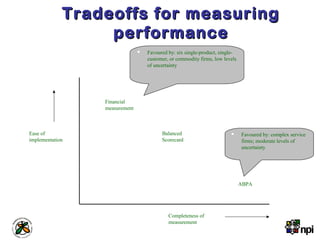
 Financial
measurement
 Balanced
Scorecard
 ABPA
 Favoured by: complex service
firms; moderate levels of
uncertainty
 Favoured by: six single-product, single-
customer, or commodity firms, low levels
of uncertainty
 Ease of
implementation
 Completeness of
measurement
Caution aboutCaution about
measurementmeasurement
 No firm should set up an elaborate
productivity analysis system for its
current operations and anticipate
substantial improvement unless the
firm is one of the very few who have
revolutionised their operations to
become truly world-class, with a
flexible output pattern, sound and
interactive manager-foreman-
employee relationships, ability to
change rapidly as needed, and
effective, customer oriented
systems.
Requirements for measuringRequirements for measuring
performanceperformance
According to Drennan et al:
the principal requirements of measurement are that
it should be appropriate, accurate and objective:
 Appropriate: If the measure is achieved (actual against
standard or objective), the organisation will have achieved
the organisational result it wants.
 Accurate: The measure is believable and preferably
quantifiable. While complete accuracy is a possibility there
is usually a trade-off between accuracy and speedy
reporting. The rule-of-thumb is that a measurement be
sufficiently accurate to engender the right response in
time to effect a better organisational result.
 Objective: The final requirement is that the measure be
objective. The presence of subjectivity inevitably raises
dissent with the outcome of the measure, which may in
turn lead to ambivalent or ineffectual responses to actual
problem situation.
Requirements for measuringRequirements for measuring
performance (cont.performance (cont.
Olve et al (1999: 189)… Criteria which we have found
useful in determining what measures to use:
 Measures should be unambiguous and defined
uniformly throughout the company.
 Taken together, the measures used should sufficiently
cover the aspects of the business which are included in
strategies and critical success factors.
 The measures used in the different perspectives should
be clearly connected. A scorecard may be said to
portray the business as it is, or as we would like it to
be. The picture should be interpreted as a coherent
and convincing report which clearly shows how the
efforts described in the lower portion of the card are
logically justifiable for successfully attaining the
criteria in the upper portion.
 Measures should be useful for setting goals which are
considered realistic by those responsible for achieving
them.
 Measurement must be an easy, uncomplicated process,
and it is must be possible to use the measurements in
different systems like the company’s intranet and data
warehouse, for example.
Requirements for measuringRequirements for measuring
performance (cont.performance (cont.
Meyer (2002: 6)… The rethinking of
performance measurement begins
with a simple question: what
properties do we look for in
performance measures? Ideally, the
performance measures of choice
would meet the following
requirements:
 Parsimony
 Predictive ability
 Pervasiveness
 Stability
 Applicability to compensation
Requirements for measuringRequirements for measuring
performance (cont.performance (cont.
According to Marshall W. Meyer (Ed.
Neely, 2002: 52)… In a world of
perfect measurement, managers
would be able to design optimal
performance measurement systems.
The measures chosen would meet
the following requirements – note
that I am not saying what the
measurements would be, only what
the measures would look like:
Requirements for measuringRequirements for measuring
performance (cont.performance (cont.
 There would be relatively few measures to keep track of, perhaps as
few as three financial measures and three non-financial measures. This
is a matter of parsimony. If there are too many measures, cognitive
limits will be exceeded and information will be lost.
 The non-financial measures would predict subsequent financial
performance, in other words, the non-financials would serve as leading
performance indicators (and the financials as lagging indicators). Non-
financials not demonstrated to be leading indicators would be sidelined
unless, of course, they were tracked as matters of compliance, ethics,
and security – “most do’s” for the firms.
 These measures would pervade the organisation – the same measures
would apply everywhere. Measures pervading the organisation can be
summed from the bottom to the top of the organisation and
decomposed downward, the latter giving managers’ drill-down
capability. Measures pervading the organisation, moreover, permit
performance to be compared across units.
 The measurement system would be stable. Measures would evolve
slowly so as to maintain people’s awareness of long-term goals and
consistency in their behaviour.
 People would be compensated for performance on these measures,
that is, for performance on both financial measures and the non-
financial measures known to be leading indicators of financial results.
Why measures fail?Why measures fail?
 Firms are swamped with measures, and the
problem of too many measures is, if anything,
getting worse, the balanced scorecard
withstanding. It is commonplace for firms to have
fifty to sixty top-level measures, both financial
and non-financial. Many firms, I am sure, have
even more top level measures.
 Our ability to create and disseminate measures
has outpaced, at least for now, our ability to
separate the few non-financial measures
containing information about future financial
performance from the many that do not. To be
sure, research studies show that a myriad of non-
financial measures such as customer and
employee satisfaction affect financial
performance, but their impact is modest, often
firm and industry-specific, ad discoverable only
after the fact.
Why measures fail? (cont.Why measures fail? (cont.
 Few non-financial measures pervade the organisation.
It is easier to find financial measures that pervade the
organisation, but keep in mind that many firms have
struggled unsuccessively to drive measures of
shareholder value from the top to the bottom of the
organisation.
 Performance measures, non-financial measures
especially, never stand still. With use they lose
variance, sometimes rapidly, and hence the capacity to
discriminate good from bad performance. This is the
use-it-and-lose-it principle in performance
measurement. Managers respond by continually
shuffling the measures.
 Compensating people for performance on multiple
measures is extremely difficult. Paying people on a
single measure creates enough dysfunctions. Paying
them on many creates more. The problem is combining
dissimilar measures into an overall evaluation of
performance and hence compensation. If measures are
combined formulaically, people will game the formula.
If measures are combined subjectively, people will not
understand the connection between measured
performance and their compensation.
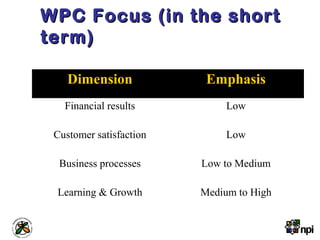
WPC Focus (in the shortWPC Focus (in the short
term)term)
Dimension Emphasis
Financial results Low
Customer satisfaction Low
Business processes Low to Medium
Learning & Growth Medium to High
FindingsFindings
 The emphasis during the discussions was
on the learning and growth opportunities,
the ability to change the employees’
attitude and behaviour in order to
achieve better results. Once the minds of
the people are focused and convinced as
to why they should implement WPC, then
the impact on the rest of the dimensions
would take place by virtue of having
motivated employees, clear team
objectives and goals, clearly defined
individual roles, increased teamwork,
and improved communications between
management and employees.
ConclusionsConclusions
 It became evident during the
discussions that most companies do
not align the green area
measurements with the overall
business objectives. As such,
measuring performance of the
companies is currently achieved via
different channels. A better way to
integrate WPC into the company
strategies is needed to present a
cohesive picture all the time.
WPC ImpactWPC Impact
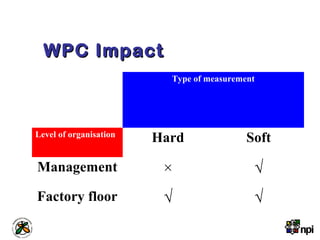
Type of measurement
Level of organisation
Hard Soft
Management × √
Factory floor √ √
Definition of factorsDefinition of factors
(Quality)(Quality)
 To establish priorities, the relative impact or
importance of quality problems must be
determined.
 For internal quality problems, measuring the
frequency of occurrence is not sufficient. The
best measure is costs.
 It is not very difficult to estimate the cost of
rework, scrap, downtime, idle time, or inventory.
 Determining the cost of queue or delay time is a
less tangible problem, but for a specific process,
it is possible to identify the effects of such
delays.
Definition of factorsDefinition of factors
(Cost)(Cost)
 An important consideration in calculating the
cost of rework and scrap is where a problem is
discovered in the production process. Every
step in a process is supposed to add value to the
product.
 This increase in value, means that the cost of a
defect found at the end of the process is going to
be much greater than finding the same defect at
the beginning of the process.
 The actual cost of any particular defect would
also depend on the nature of the defect, its
severity, and other product or process variables.
THANK YOU!THANK YOU!
Any
questions?

QSCM Perf Mngt Study update-2004

  • 1.
    WPC OperationalWPC Operational WorkshopWorkshop Klein-KaribaRecreation Resort,Klein-Kariba Recreation Resort, WarmbathsWarmbaths RECORDING OF WPC PERFORMANCE MEASUREMENTS By: Conrad Sebego 26 July 2005
  • 2.
    CONTENTSCONTENTS  Title  ProblemStatement  Research question  Definition of terms  Requirements for measurement  Why measures fail  Findings and conclusions  Preliminary WPC system
  • 3.
    TitleTitle  “Optimum performance measuresto reflect competitiveness and productivity improvement of the companies participating in the Workplace Challenge Programme”
  • 4.
    What prompted thestudy?What prompted the study?  “Lack of uniform performance measures by companies participating in Workplace Challenge Programme makes it difficult to determine the overall improvement in competitiveness and productivity resulting from implementation of the WPC programme.”
  • 5.
    What is thesingleWhat is the single objective?objective?  “What are the uniform measurement variables within the dimensions of quality, speed, cost and morale that would be sufficient to reliably and validly indicate performance (competitiveness and productivity) of the companies participating in the WPC Programme?
  • 6.
    What is productivity?Whatis productivity?  It is not a measure of costs, although it is one component of cost. It does not measure the cost of a resource, but it is a measure of the relationship between quantity of resources used and quantity (or value in constant terms) of output.
  • 7.
    What is performance?Whatis performance?  The word perform means to do, to accomplish. The act of performing means to carry out a goal or responsibility. Performance is the thing done.  According to Drucker (1973: 455), performance is the pure essence of management, independent of time, place or type of business. To manage is synonymous with to perform. Management is independent of ownership, rank or power. It is objective function and ought to be grounded in the responsibility for performance.  Performance remains one of the classic problems of management: how to get people in the organisation to achieve its goals.
  • 8.
    Watch out!Watch out! Measures such as machine or labour utilisation encourage supervisors to keep machines and people busy producing products, even when there is no market demand. In extreme cases, local efficiencies can seem remarkable, but the business can be left to write off vast quantities of obsolete inventory.
  • 9.
    Measuring performanceMeasuring performance If something can’t be measured directly, it must have an effect, which can be measured. If a process has no intended effect, it is clearly not worth measuring in the first place.  More specifically, any production process can be measured if what it is supposed to accomplish and how it works are understood. As a minimum, every process must have at least one customer whose satisfaction can be determined.
  • 10.
    Determining correctDetermining correct measuresmeasures It is easy to underestimate how hard it is to design good performance measures, and there are many examples that illustrate the dysfunctional behaviour that can result.
  • 11.
    World-classWorld-class manufacturingmanufacturing Robert Hayes, StevenWheelwright, and Kim Clark, in their book Dynamic Manufacturing, identify these attributes of world class manufacturers:  Becoming the best competitor. “Being better than almost every other company in your industry in at least one aspect of manufacturing.”  Growing more rapidly and being more profitable than competitors. “World class companies can measure their superior performance by observing how their products do in the marketplace and by observing their cashbox.”  Hiring and retaining the best people. “Having workers and managers who are so skilled and effective that other companies are continually seeking to attract them away from your organisation.”  Developing a top-notch engineering staff. “Being so expert in the design and manufacture of production equipment that equipment suppliers are continually seeking one’s advice about possible modifications to their equipment, one’s suggestions for new equipment, and one’s agreement to be a test site for one of their pilot models.”
  • 12.
    World-class manufacturingWorld-class manufacturing (cont.(cont. Being able to respond quickly and decisively to changing market conditions. “Being more nimble than one’s competitors in responding to market shifts or pricing changes, and in getting new products out into the market faster than they can.  Adopting a product and process engineering approach which maximises the performance of both. “Intertwining the design of a new product so closely with the design of its manufacturing process that when competitors ‘reverse engineer’ the product they find that they cannot produce a comparable one in their own factories without major retooling and redesign expenses.”  Continually improving facilities, support systems, and skills that were considered to be “optimal” or “state-of- the-art” when first introduced, so that “they increasingly surpass their initial capabilities. This emphasis on continual improvement is the ultimate test of a world class organisation.”
  • 13.
    Performance successPerformance success Accordingto Eli Goldratt in his book “The Goal”, a manufacturing decision is productive only if it:  Increases throughput (the rate at which money is generated through sales).  Decreases inventory (things we buy which we intend to sell).  Decreases operating expense (money spent to convert inventory into throughput).  A decision is productive if all three manufacturing performance criteria are satisfied simultaneously and no tradeoffs have been permitted.
  • 14.
    How to measure?Howto measure?  George Sadler (1993: 3-3.1)[1]…for productivity measurement, physical measures, properly weighted remain significantly more accurate than dollar-value measures (even when adjusted or “real”) can ever be. Purely value-based productivity measures can be useful, but in the basic simplified plant-level productivity measurement approaches, physical measures predominate. [1] William Christopher et al, eds.
  • 15.
    Tradeoffs for measuringTradeoffsfor measuring performanceperformance  Financial measurement  Balanced Scorecard  ABPA  Favoured by: complex service firms; moderate levels of uncertainty  Favoured by: six single-product, single- customer, or commodity firms, low levels of uncertainty  Ease of implementation  Completeness of measurement
  • 16.
    Caution aboutCaution about measurementmeasurement No firm should set up an elaborate productivity analysis system for its current operations and anticipate substantial improvement unless the firm is one of the very few who have revolutionised their operations to become truly world-class, with a flexible output pattern, sound and interactive manager-foreman- employee relationships, ability to change rapidly as needed, and effective, customer oriented systems.
  • 17.
    Requirements for measuringRequirementsfor measuring performanceperformance According to Drennan et al: the principal requirements of measurement are that it should be appropriate, accurate and objective:  Appropriate: If the measure is achieved (actual against standard or objective), the organisation will have achieved the organisational result it wants.  Accurate: The measure is believable and preferably quantifiable. While complete accuracy is a possibility there is usually a trade-off between accuracy and speedy reporting. The rule-of-thumb is that a measurement be sufficiently accurate to engender the right response in time to effect a better organisational result.  Objective: The final requirement is that the measure be objective. The presence of subjectivity inevitably raises dissent with the outcome of the measure, which may in turn lead to ambivalent or ineffectual responses to actual problem situation.
  • 18.
    Requirements for measuringRequirementsfor measuring performance (cont.performance (cont. Olve et al (1999: 189)… Criteria which we have found useful in determining what measures to use:  Measures should be unambiguous and defined uniformly throughout the company.  Taken together, the measures used should sufficiently cover the aspects of the business which are included in strategies and critical success factors.  The measures used in the different perspectives should be clearly connected. A scorecard may be said to portray the business as it is, or as we would like it to be. The picture should be interpreted as a coherent and convincing report which clearly shows how the efforts described in the lower portion of the card are logically justifiable for successfully attaining the criteria in the upper portion.  Measures should be useful for setting goals which are considered realistic by those responsible for achieving them.  Measurement must be an easy, uncomplicated process, and it is must be possible to use the measurements in different systems like the company’s intranet and data warehouse, for example.
  • 19.
    Requirements for measuringRequirementsfor measuring performance (cont.performance (cont. Meyer (2002: 6)… The rethinking of performance measurement begins with a simple question: what properties do we look for in performance measures? Ideally, the performance measures of choice would meet the following requirements:  Parsimony  Predictive ability  Pervasiveness  Stability  Applicability to compensation
  • 20.
    Requirements for measuringRequirementsfor measuring performance (cont.performance (cont. According to Marshall W. Meyer (Ed. Neely, 2002: 52)… In a world of perfect measurement, managers would be able to design optimal performance measurement systems. The measures chosen would meet the following requirements – note that I am not saying what the measurements would be, only what the measures would look like:
  • 21.
    Requirements for measuringRequirementsfor measuring performance (cont.performance (cont.  There would be relatively few measures to keep track of, perhaps as few as three financial measures and three non-financial measures. This is a matter of parsimony. If there are too many measures, cognitive limits will be exceeded and information will be lost.  The non-financial measures would predict subsequent financial performance, in other words, the non-financials would serve as leading performance indicators (and the financials as lagging indicators). Non- financials not demonstrated to be leading indicators would be sidelined unless, of course, they were tracked as matters of compliance, ethics, and security – “most do’s” for the firms.  These measures would pervade the organisation – the same measures would apply everywhere. Measures pervading the organisation can be summed from the bottom to the top of the organisation and decomposed downward, the latter giving managers’ drill-down capability. Measures pervading the organisation, moreover, permit performance to be compared across units.  The measurement system would be stable. Measures would evolve slowly so as to maintain people’s awareness of long-term goals and consistency in their behaviour.  People would be compensated for performance on these measures, that is, for performance on both financial measures and the non- financial measures known to be leading indicators of financial results.
  • 22.
    Why measures fail?Whymeasures fail?  Firms are swamped with measures, and the problem of too many measures is, if anything, getting worse, the balanced scorecard withstanding. It is commonplace for firms to have fifty to sixty top-level measures, both financial and non-financial. Many firms, I am sure, have even more top level measures.  Our ability to create and disseminate measures has outpaced, at least for now, our ability to separate the few non-financial measures containing information about future financial performance from the many that do not. To be sure, research studies show that a myriad of non- financial measures such as customer and employee satisfaction affect financial performance, but their impact is modest, often firm and industry-specific, ad discoverable only after the fact.
  • 23.
    Why measures fail?(cont.Why measures fail? (cont.  Few non-financial measures pervade the organisation. It is easier to find financial measures that pervade the organisation, but keep in mind that many firms have struggled unsuccessively to drive measures of shareholder value from the top to the bottom of the organisation.  Performance measures, non-financial measures especially, never stand still. With use they lose variance, sometimes rapidly, and hence the capacity to discriminate good from bad performance. This is the use-it-and-lose-it principle in performance measurement. Managers respond by continually shuffling the measures.  Compensating people for performance on multiple measures is extremely difficult. Paying people on a single measure creates enough dysfunctions. Paying them on many creates more. The problem is combining dissimilar measures into an overall evaluation of performance and hence compensation. If measures are combined formulaically, people will game the formula. If measures are combined subjectively, people will not understand the connection between measured performance and their compensation.
  • 24.
    WPC Focus (inthe shortWPC Focus (in the short term)term) Dimension Emphasis Financial results Low Customer satisfaction Low Business processes Low to Medium Learning & Growth Medium to High
  • 25.
    FindingsFindings  The emphasisduring the discussions was on the learning and growth opportunities, the ability to change the employees’ attitude and behaviour in order to achieve better results. Once the minds of the people are focused and convinced as to why they should implement WPC, then the impact on the rest of the dimensions would take place by virtue of having motivated employees, clear team objectives and goals, clearly defined individual roles, increased teamwork, and improved communications between management and employees.
  • 26.
    ConclusionsConclusions  It becameevident during the discussions that most companies do not align the green area measurements with the overall business objectives. As such, measuring performance of the companies is currently achieved via different channels. A better way to integrate WPC into the company strategies is needed to present a cohesive picture all the time.
  • 27.
    WPC ImpactWPC Impact Typeof measurement Level of organisation Hard Soft Management × √ Factory floor √ √
  • 28.
    Definition of factorsDefinitionof factors (Quality)(Quality)  To establish priorities, the relative impact or importance of quality problems must be determined.  For internal quality problems, measuring the frequency of occurrence is not sufficient. The best measure is costs.  It is not very difficult to estimate the cost of rework, scrap, downtime, idle time, or inventory.  Determining the cost of queue or delay time is a less tangible problem, but for a specific process, it is possible to identify the effects of such delays.
  • 29.
    Definition of factorsDefinitionof factors (Cost)(Cost)  An important consideration in calculating the cost of rework and scrap is where a problem is discovered in the production process. Every step in a process is supposed to add value to the product.  This increase in value, means that the cost of a defect found at the end of the process is going to be much greater than finding the same defect at the beginning of the process.  The actual cost of any particular defect would also depend on the nature of the defect, its severity, and other product or process variables.
  • 30.