
Supply Chain Management (SCM)
  In Management Information
            System


                      Presented by:-
          Nijo Ninan, Pratik Kochar, Parul Gupta
Introduction
                 to
     Supply Chain Management
 Supply chain management is concerned with the
efficient                integration             of
suppliers, factories, warehouses and stores so that
merchandise is produced and distributed:
– In the right quantities
– To the right locations
– At the right time


In order to
– Minimize total system cost
– Satisfy customer service requirements
Supply Chain Goals

 Efficient supply chain management
 must result in tangible business
 improvements. It is characterized by a
 sharp focus on
  – Revenue growth
  – Better asset utilization
  – Cost reduction.
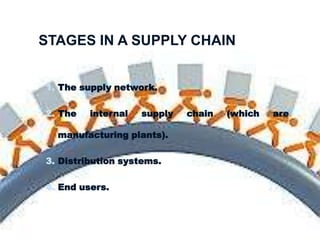
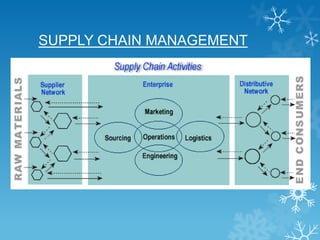
STAGES IN A SUPPLY CHAIN


1. The supply network.

2. The   internal   supply   chain   (which   are

  manufacturing plants).

3. Distribution systems.

4. End users.
FLOW IN SUPPLY CHAIN MANAGEMENT


   Material flow.


   Service flow.


   Information flow


   Funds flow.
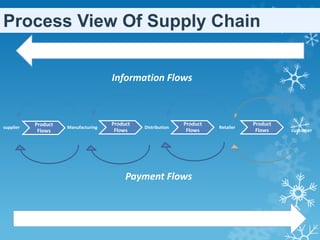
Process View Of Supply Chain
           Supply Chain Planning

                                      Information Flows


            Product                   Product                  Product              Product
supplier              Manufacturing             Distribution             Retailer
             Flows                     Flows                    Flows                Flows    customer


                                           Payment Flows


      Supply Chain
Supplier Relationship Management

There are two types of relationship
between supply chain partners:


1.Commodity based relationship
2.Strategic relationship
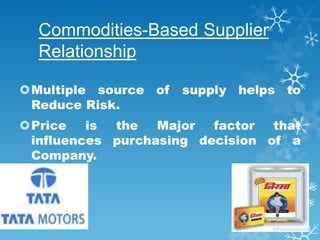
Commodities-Based Supplier
  Relationship

Multiple source of   supply helps to
 Reduce Risk.
Price   is the   Major  factor  that
 influences purchasing decision of a
 Company.
STRATEGIC SUPPLIER
     RELATIONSHIP
Manufactures needs to Maintain         good
 relationships with their suppliers.
Long and short term advantages.
Right quantity and quality of goods at the
 right time from suppliers.
Sometimes     there  will  be    imbalance
 situation among two parties like supplier is
 not interested in maintaining long term
 relationship.
SUPPLY CHAIN MANAGEMENT
SCM: REAL TIME BENEFITS

 Global trading capabilities
 Global knowledge exchange
 Global communities
 Collaborative workflow
 Industry specific marketplaces
 Enterprise to enterprise connectivity
 E-marketplace to e-marketplace connectivity
Changing Paradigm

•   Functional vs Process
•   Products vs Customers
•   Revenues vs Performance
•   Inventory vs Information
•   Transactions vs Relationships
Softwares:- SCM

 Advanced Planning and Scheduling (APS).
Inventory forecasting softwares:
 Valogix
 Smart Forecasts
Supply Chain Management (Scm) In Management

Supply Chain Management (Scm) In Management

  • 1.
    Supply Chain Management(SCM) In Management Information System Presented by:- Nijo Ninan, Pratik Kochar, Parul Gupta
  • 2.
    Introduction to Supply Chain Management  Supply chain management is concerned with the efficient integration of suppliers, factories, warehouses and stores so that merchandise is produced and distributed: – In the right quantities – To the right locations – At the right time In order to – Minimize total system cost – Satisfy customer service requirements
  • 3.
    Supply Chain Goals Efficient supply chain management must result in tangible business improvements. It is characterized by a sharp focus on – Revenue growth – Better asset utilization – Cost reduction.
  • 4.
    STAGES IN ASUPPLY CHAIN 1. The supply network. 2. The internal supply chain (which are manufacturing plants). 3. Distribution systems. 4. End users.
  • 5.
    FLOW IN SUPPLYCHAIN MANAGEMENT  Material flow.  Service flow.  Information flow  Funds flow.
  • 6.
    Process View OfSupply Chain Supply Chain Planning Information Flows Product Product Product Product supplier Manufacturing Distribution Retailer Flows Flows Flows Flows customer Payment Flows Supply Chain
  • 7.
    Supplier Relationship Management Thereare two types of relationship between supply chain partners: 1.Commodity based relationship 2.Strategic relationship
  • 8.
    Commodities-Based Supplier Relationship Multiple source of supply helps to Reduce Risk. Price is the Major factor that influences purchasing decision of a Company.
  • 9.
    STRATEGIC SUPPLIER RELATIONSHIP Manufactures needs to Maintain good relationships with their suppliers. Long and short term advantages. Right quantity and quality of goods at the right time from suppliers. Sometimes there will be imbalance situation among two parties like supplier is not interested in maintaining long term relationship.
  • 10.
  • 11.
    SCM: REAL TIMEBENEFITS  Global trading capabilities  Global knowledge exchange  Global communities  Collaborative workflow  Industry specific marketplaces  Enterprise to enterprise connectivity  E-marketplace to e-marketplace connectivity
  • 12.
    Changing Paradigm • Functional vs Process • Products vs Customers • Revenues vs Performance • Inventory vs Information • Transactions vs Relationships
  • 13.
    Softwares:- SCM  AdvancedPlanning and Scheduling (APS). Inventory forecasting softwares:  Valogix  Smart Forecasts