Copyright © 2013 Dorling Kindersley (India) Pvt. Ltd. 
Chapter 8 
Aggregate Planning in a 
Supply Chain 
Supply Chain Management: Strategy, Planning, and Operation, 5/e Authors: Sunil Chopra, Peter Meindl and D. V. Kalra
Copyright © 2013 Dorling Kindersley (India) Pvt. Ltd. 
Learning Objectives 
• Identify the decisions that are best solved by aggregate planning. 
• Understand the importance of aggregate planning as a supply 
chain activity. 
• Describe the information needed to produce an aggregate plan. 
• Explain the basic trade-offs to consider when creating an 
aggregate plan. 
• Formulate and solve basic aggregate planning problems using 
Microsoft Excel. 
Supply Chain Management: Strategy, Planning, and Operation, 5/e Authors: Sunil Chopra, Peter Meindl and D. V. Kalra
Copyright © 2013 Dorling Kindersley (India) Pvt. Ltd. 
Role of Aggregate Planning 
in a Supply Chain 
• Capacity has a cost and lead times are often long 
• Aggregate planning: 
process by which a company determines levels of capacity, 
production, subcontracting, inventory, stockouts, and pricing 
over a specified time horizon 
goal is to maximize profit 
decisions made at a product family (not SKU) level 
time frame of3 to 18 months 
how can a firm best use the facilities it has? 
Supply Chain Management: Strategy, Planning, and Operation, 5/e Authors: Sunil Chopra, Peter Meindl and D. V. Kalra
Copyright © 2013 Dorling Kindersley (India) Pvt. Ltd. 
Role of Aggregate Planning 
in a Supply Chain 
• Specify operational parameters over the time horizon 
Production rate: Subcontracting 
Workforce: Backlog 
Overtime: Inventory on hand 
Machine capacity level 
• All supply chain stages should work together on an aggregate plan 
that will optimize supply chain performance 
Supply Chain Management: Strategy, Planning, and Operation, 5/e Authors: Sunil Chopra, Peter Meindl and D. V. Kalra
Copyright © 2013 Dorling Kindersley (India) Pvt. Ltd. 
The Aggregate Planning Problem 
• Given the demand forecast for each period in the planning 
horizon, determine the production level, inventory level, and the 
capacity level for each period that maximizes the firm’s (supply 
chain’s) profit over the planning horizon 
• Specify the planning horizon (typically 3-18 months) 
• Specify the duration of each period 
• Specify key information required to develop an aggregate plan 
Supply Chain Management: Strategy, Planning, and Operation, 5/e Authors: Sunil Chopra, Peter Meindl and D. V. Kalra
Copyright © 2013 Dorling Kindersley (India) Pvt. Ltd. 
Information Needed for 
an Aggregate Plan 
• Aggregate demand forecast Ft for each Period t over T periods 
• Production costs 
Labor costs, regular time ($/hr) and overtime ($/hr) 
Subcontracting costs ($/hr or $/unit) 
Cost of changing capacity – hiring or layoff ($/worker), adding or 
reducing machine capacity ($/machine) 
• Labor/machine hours required per unit 
• Inventory holding cost ($/unit/period) 
• Stockout or backlog cost ($/unit/period) 
• Constraints – overtime, layoffs, capital available, stockouts, 
backlogs, from suppliers 
Supply Chain Management: Strategy, Planning, and Operation, 5/e Authors: Sunil Chopra, Peter Meindl and D. V. Kalra
Copyright © 2013 Dorling Kindersley (India) Pvt. Ltd. 
Outputs of Aggregate Plan 
• Production quantity from regular time, overtime, and 
subcontracted time 
• Inventory held 
• Backlog/stockout quantity 
• Machine capacity increase/decrease 
• A poor aggregate plan can result in lost sales, lost profits, excess 
inventory, or excess capacity 
Supply Chain Management: Strategy, Planning, and Operation, 5/e Authors: Sunil Chopra, Peter Meindl and D. V. Kalra
Identifying Aggregate Units of Production 
Copyright © 2013 Dorling Kindersley (India) Pvt. Ltd. 
• Aggregate unit should be identified in a way that the resulting 
production schedule can be accomplished in practice 
• Focus on the bottlenecks when selecting the aggregate unit and 
identifying capacity and production times 
• Account for activities such as setups and maintenance 
Supply Chain Management: Strategy, Planning, and Operation, 5/e Authors: Sunil Chopra, Peter Meindl and D. V. Kalra
Copyright © 2013 Dorling Kindersley (India) Pvt. Ltd. 
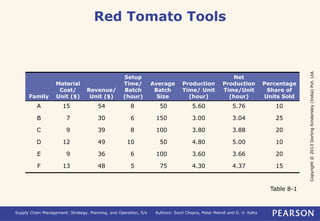
Red Tomato Tools 
Family 
Material 
Cost/ 
Unit ($) 
Revenue/ 
Unit ($) 
Setup 
Time/ 
Batch 
(hour) 
Average 
Batch 
Size 
Production 
Time/ Unit 
(hour) 
Net 
Production 
Time/Unit 
(hour) 
Supply Chain Management: Strategy, Planning, and Operation, 5/e Authors: Sunil Chopra, Peter Meindl and D. V. Kalra 
Percentage 
Share of 
Units Sold 
A 15 54 8 50 5.60 5.76 10 
B 7 30 6 150 3.00 3.04 25 
C 9 39 8 100 3.80 3.88 20 
D 12 49 10 50 4.80 5.00 10 
E 9 36 6 100 3.60 3.66 20 
F 13 48 5 75 4.30 4.37 15 
Table 8-1
Copyright © 2013 Dorling Kindersley (India) Pvt. Ltd. 
Red Tomato Tools 
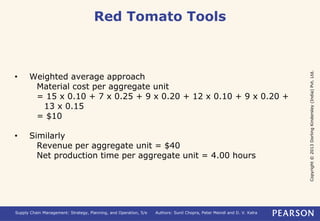
• Weighted average approach 
Material cost per aggregate unit 
= 15 x 0.10 + 7 x 0.25 + 9 x 0.20 + 12 x 0.10 + 9 x 0.20 + 
13 x 0.15 
= $10 
• Similarly 
Revenue per aggregate unit = $40 
Net production time per aggregate unit = 4.00 hours 
Supply Chain Management: Strategy, Planning, and Operation, 5/e Authors: Sunil Chopra, Peter Meindl and D. V. Kalra
Copyright © 2013 Dorling Kindersley (India) Pvt. Ltd. 
Aggregate Planning Strategies 
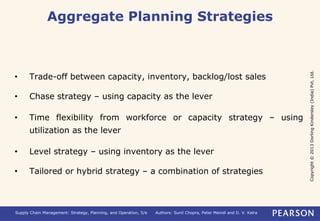
• Trade-off between capacity, inventory, backlog/lost sales 
• Chase strategy – using capacity as the lever 
• Time flexibility from workforce or capacity strategy – using 
utilization as the lever 
• Level strategy – using inventory as the lever 
• Tailored or hybrid strategy – a combination of strategies 
Supply Chain Management: Strategy, Planning, and Operation, 5/e Authors: Sunil Chopra, Peter Meindl and D. V. Kalra
Copyright © 2013 Dorling Kindersley (India) Pvt. Ltd. 
Chase Strategy 
• Vary machine capacity or hire and lay off workers as demand 
varies 
• Often difficult to vary capacity and workforce on short notice 
• Expensive if cost of varying capacity is high 
• Negative effect on workforce morale 
• Results in low levels of inventory 
• Used when inventory holding costs are high and costs of 
changing capacity are low 
Supply Chain Management: Strategy, Planning, and Operation, 5/e Authors: Sunil Chopra, Peter Meindl and D. V. Kalra
Copyright © 2013 Dorling Kindersley (India) Pvt. Ltd. 
Time Flexibility Strategy 
• Use excess machine capacity 
• Workforce stable, number of hours worked varies 
• Use overtime or a flexible work schedule 
• Flexible workforce, avoids morale problems 
• Low levels of inventory, lower utilization 
• Used when inventory holding costs are high and capacity is 
relatively inexpensive 
Supply Chain Management: Strategy, Planning, and Operation, 5/e Authors: Sunil Chopra, Peter Meindl and D. V. Kalra
Copyright © 2013 Dorling Kindersley (India) Pvt. Ltd. 
Level Strategy 
• Stable machine capacity and workforce levels, constant output 
rate 
• Inventory levels fluctuate over time 
• Inventories carried over from high to low demand periods 
• Better for worker morale 
• Large inventories and backlogs may accumulate 
• Used when inventory holding and backlog costs are relatively low 
Supply Chain Management: Strategy, Planning, and Operation, 5/e Authors: Sunil Chopra, Peter Meindl and D. V. Kalra
Copyright © 2013 Dorling Kindersley (India) Pvt. Ltd. 
Aggregate Planning Using 
Linear Programming 
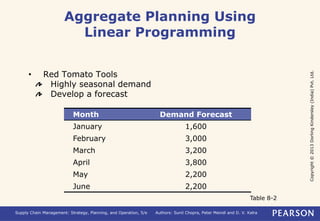
• Red Tomato Tools 
Highly seasonal demand 
Develop a forecast 
Month Demand Forecast 
January 1,600 
February 3,000 
March 3,200 
April 3,800 
May 2,200 
June 2,200 
Table 8-2 
Supply Chain Management: Strategy, Planning, and Operation, 5/e Authors: Sunil Chopra, Peter Meindl and D. V. Kalra
Copyright © 2013 Dorling Kindersley (India) Pvt. Ltd. 
Red Tomato Tools 
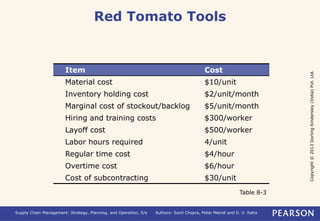
Item Cost 
Material cost $10/unit 
Inventory holding cost $2/unit/month 
Marginal cost of stockout/backlog $5/unit/month 
Hiring and training costs $300/worker 
Layoff cost $500/worker 
Labor hours required 4/unit 
Regular time cost $4/hour 
Overtime cost $6/hour 
Cost of subcontracting $30/unit 
Table 8-3 
Supply Chain Management: Strategy, Planning, and Operation, 5/e Authors: Sunil Chopra, Peter Meindl and D. V. Kalra
Copyright © 2013 Dorling Kindersley (India) Pvt. Ltd. 
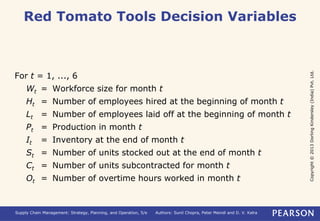
Red Tomato Tools Decision Variables 
For t = 1, ..., 6 
Wt = Workforce size for month t 
Ht = Number of employees hired at the beginning of month t 
Lt = Number of employees laid off at the beginning of month t 
Pt = Production in month t 
It = Inventory at the end of month t 
St = Number of units stocked out at the end of month t 
Ct = Number of units subcontracted for month t 
Ot = Number of overtime hours worked in month t 
Supply Chain Management: Strategy, Planning, and Operation, 5/e Authors: Sunil Chopra, Peter Meindl and D. V. Kalra
Copyright © 2013 Dorling Kindersley (India) Pvt. Ltd. 
Red Tomato Tools Objective Function 
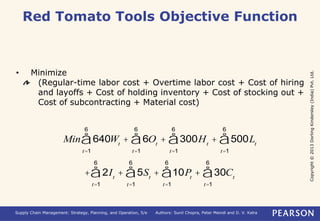
• Minimize 
(Regular-time labor cost + Overtime labor cost + Cost of hiring 
and layoffs + Cost of holding inventory + Cost of stocking out + 
Cost of subcontracting + Material cost) 
6 
å + 6Ot 
Min 640Wt 
t=1 
6 
å + 300Ht 
t=1 
6 
å + 500Lt 
t=1 
6 
å 
t=1 
6 
å + 5St 
+ 2It 
t=1 
6 
å + 10Pt 
t=1 
6 
å + 30Ct 
t=1 
6 
å 
t=1 
Supply Chain Management: Strategy, Planning, and Operation, 5/e Authors: Sunil Chopra, Peter Meindl and D. V. Kalra
Copyright © 2013 Dorling Kindersley (India) Pvt. Ltd. 
Red Tomato Tools Constraints 
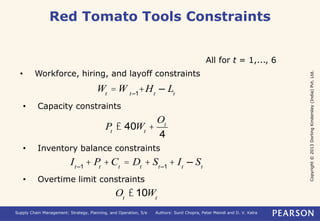
• Workforce, hiring, and layoff constraints 
All for t = 1,..., 6 
Wt =W t –1+Ht – Lt 
• Capacity constraints 
Pt £ 40Wt + 
Ot 
4 
• Inventory balance constraints 
It –1 + Pt +Ct = Dt + St –1 + It – St 
• Overtime limit constraints 
Ot £10Wt 
Supply Chain Management: Strategy, Planning, and Operation, 5/e Authors: Sunil Chopra, Peter Meindl and D. V. Kalra
Copyright © 2013 Dorling Kindersley (India) Pvt. Ltd. 
Red Tomato Tools 
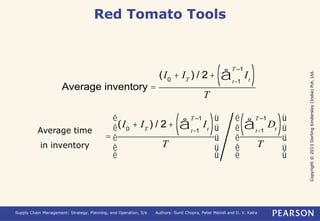
Average inventory = 
T –1 (å ) 
(I0 + IT ) / 2+ I t=1 t 
T 
= 
T –1 (å ) 
(I0 + IT ) / 2+ It=1 t 
T 
é 
ê 
ê 
ê 
ë 
ù 
ú 
ú 
ú 
û 
(å T –1 D) 
t=1 t 
T 
é 
ê 
ê 
ê 
ë 
Supply Chain Management: Strategy, Planning, and Operation, 5/e Authors: Sunil Chopra, Peter Meindl and D. V. Kalra 
ù 
ú 
ú 
ú 
û 
Average time 
in inventory
Copyright © 2013 Dorling Kindersley (India) Pvt. Ltd. 
Red Tomato Tools 
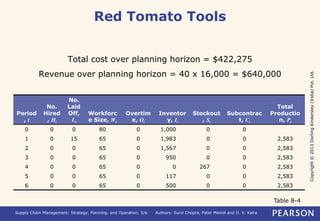
Total cost over planning horizon = $422,275 
Revenue over planning horizon = 40 x 16,000 = $640,000 
Period 
, t 
No. 
Hired 
, Ht 
No. 
Laid 
Off, 
Lt 
Workforc 
e Size, Wt 
Overtim 
e, Ot 
Inventor 
y, It 
Stockout 
, St 
Subcontrac 
t, Ct 
Supply Chain Management: Strategy, Planning, and Operation, 5/e Authors: Sunil Chopra, Peter Meindl and D. V. Kalra 
Total 
Productio 
n, Pt 
0 0 0 80 0 1,000 0 0 
1 0 15 65 0 1,983 0 0 2,583 
2 0 0 65 0 1,567 0 0 2,583 
3 0 0 65 0 950 0 0 2,583 
4 0 0 65 0 0 267 0 2,583 
5 0 0 65 0 117 0 0 2,583 
6 0 0 65 0 500 0 0 2,583 
Table 8-4
Copyright © 2013 Dorling Kindersley (India) Pvt. Ltd. 
Red Tomato Tools 
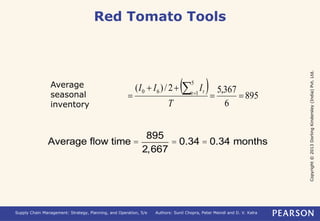
  
895 
5 
  
I I I 
(  ) / 2  
5,367 
t t 
0 6 1   
6 
 
T 
Average 
seasonal 
inventory 
Average flow time = 
895 
2,667 
= 0.34 = 0.34 months 
Supply Chain Management: Strategy, Planning, and Operation, 5/e Authors: Sunil Chopra, Peter Meindl and D. V. Kalra
Copyright © 2013 Dorling Kindersley (India) Pvt. Ltd. 
Red Tomato Tools 
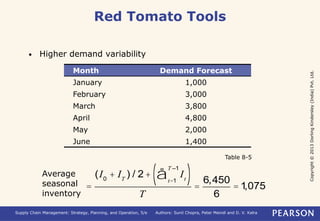
• Higher demand variability 
Month Demand Forecast 
January 1,000 
February 3,000 
March 3,800 
April 4,800 
May 2,000 
June 1,400 
Table 8-5 
= 
T –1 (å ) 
(I0 + IT ) / 2+ I t=1 t 
T 
= 
6,450 
6 
= 1,075 
Average 
seasonal 
inventory 
Supply Chain Management: Strategy, Planning, and Operation, 5/e Authors: Sunil Chopra, Peter Meindl and D. V. Kalra
Copyright © 2013 Dorling Kindersley (India) Pvt. Ltd. 
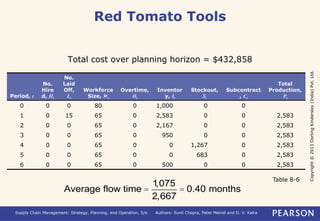
Red Tomato Tools 
Total cost over planning horizon = $432,858 
Period, t 
No. 
Hire 
d, Ht 
No. 
Laid 
Off, 
Lt 
Workforce 
Size, Wt 
Overtime, 
Ot 
Inventor 
y, It 
Stockout, 
St 
Subcontract 
, Ct 
Supply Chain Management: Strategy, Planning, and Operation, 5/e Authors: Sunil Chopra, Peter Meindl and D. V. Kalra 
Total 
Production, 
Pt 
0 0 0 80 0 1,000 0 0 
1 0 15 65 0 2,583 0 0 2,583 
2 0 0 65 0 2,167 0 0 2,583 
3 0 0 65 0 950 0 0 2,583 
4 0 0 65 0 0 1,267 0 2,583 
5 0 0 65 0 0 683 0 2,583 
6 0 0 65 0 500 0 0 2,583 
Table 8-6 
Average flow time = 
1,075 
2,667 
= 0.40 months
Copyright © 2013 Dorling Kindersley (India) Pvt. Ltd. 
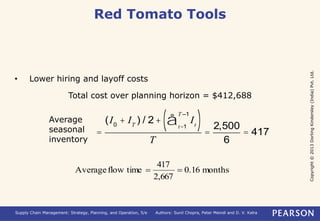
Red Tomato Tools 
• Lower hiring and layoff costs 
Total cost over planning horizon = $412,688 
= 
T –1 (å ) 
(I0 + IT ) / 2+ I t=1 t 
T 
= 
2,500 
6 
= 417 
Average 
seasonal 
inventory 
0.16 months 
417 
Average flow time   
2,667 
Supply Chain Management: Strategy, Planning, and Operation, 5/e Authors: Sunil Chopra, Peter Meindl and D. V. Kalra
Copyright © 2013 Dorling Kindersley (India) Pvt. Ltd. 
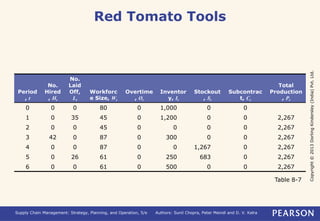
Red Tomato Tools 
Period 
, t 
No. 
Hired 
, Ht 
No. 
Laid 
Off, 
Lt 
Workforc 
e Size, Wt 
Overtime 
, Ot 
Inventor 
y, It 
Stockout 
, St 
Subcontrac 
t, Ct 
Supply Chain Management: Strategy, Planning, and Operation, 5/e Authors: Sunil Chopra, Peter Meindl and D. V. Kalra 
Total 
Production 
, Pt 
0 0 0 80 0 1,000 0 0 
1 0 35 45 0 1,200 0 0 2,267 
2 0 0 45 0 0 0 0 2,267 
3 42 0 87 0 300 0 0 2,267 
4 0 0 87 0 0 1,267 0 2,267 
5 0 26 61 0 250 683 0 2,267 
6 0 0 61 0 500 0 0 2,267 
Table 8-7
Copyright © 2013 Dorling Kindersley (India) Pvt. Ltd. 
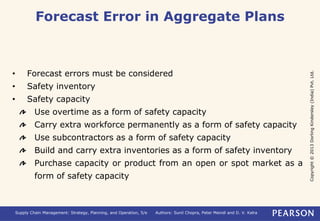
Forecast Error in Aggregate Plans 
• Forecast errors must be considered 
• Safety inventory 
• Safety capacity 
Use overtime as a form of safety capacity 
Carry extra workforce permanently as a form of safety capacity 
Use subcontractors as a form of safety capacity 
Build and carry extra inventories as a form of safety inventory 
Purchase capacity or product from an open or spot market as a 
form of safety capacity 
Supply Chain Management: Strategy, Planning, and Operation, 5/e Authors: Sunil Chopra, Peter Meindl and D. V. Kalra
Copyright © 2013 Dorling Kindersley (India) Pvt. Ltd. 
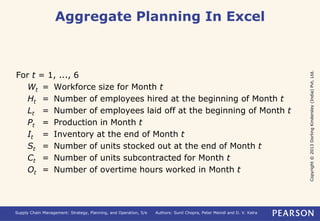
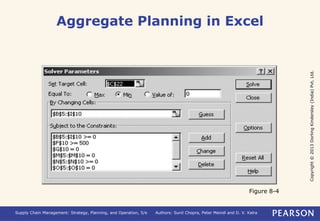
Aggregate Planning In Excel 
For t = 1, ..., 6 
Wt = Workforce size for Month t 
Ht = Number of employees hired at the beginning of Month t 
Lt = Number of employees laid off at the beginning of Month t 
Pt = Production in Month t 
It = Inventory at the end of Month t 
St = Number of units stocked out at the end of Month t 
Ct = Number of units subcontracted for Month t 
Ot = Number of overtime hours worked in Month t 
Supply Chain Management: Strategy, Planning, and Operation, 5/e Authors: Sunil Chopra, Peter Meindl and D. V. Kalra
Copyright © 2013 Dorling Kindersley (India) Pvt. Ltd. 
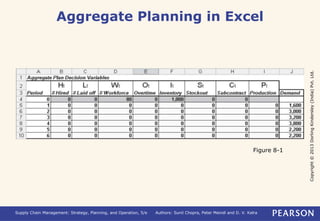
Aggregate Planning in Excel 
Figure 8-1 
Supply Chain Management: Strategy, Planning, and Operation, 5/e Authors: Sunil Chopra, Peter Meindl and D. V. Kalra
Copyright © 2013 Dorling Kindersley (India) Pvt. Ltd. 
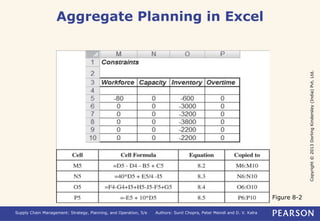
Aggregate Planning in Excel 
Supply Chain Management: Strategy, Planning, and Operation, 5/e Authors: Sunil Chopra, Peter Meindl and D. V. Kalra 
Figure 8-2
Copyright © 2013 Dorling Kindersley (India) Pvt. Ltd. 
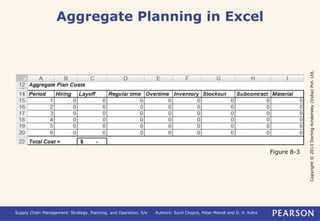
Aggregate Planning in Excel 
Supply Chain Management: Strategy, Planning, and Operation, 5/e Authors: Sunil Chopra, Peter Meindl and D. V. Kalra 
Figure 8-3
Copyright © 2013 Dorling Kindersley (India) Pvt. Ltd. 
Aggregate Planning in Excel 
Figure 8-4 
Supply Chain Management: Strategy, Planning, and Operation, 5/e Authors: Sunil Chopra, Peter Meindl and D. V. Kalra
Copyright © 2013 Dorling Kindersley (India) Pvt. Ltd. 
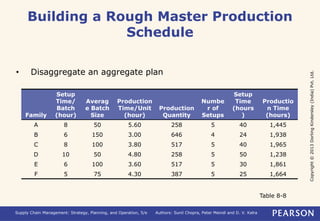
Building a Rough Master Production 
Schedule 
• Disaggregate an aggregate plan 
Family 
Setup 
Time/ 
Batch 
(hour) 
Averag 
e Batch 
Size 
Production 
Time/Unit 
(hour) 
Production 
Quantity 
Numbe 
r of 
Setups 
Setup 
Time 
(hours 
) 
Supply Chain Management: Strategy, Planning, and Operation, 5/e Authors: Sunil Chopra, Peter Meindl and D. V. Kalra 
Productio 
n Time 
(hours) 
A 8 50 5.60 258 5 40 1,445 
B 6 150 3.00 646 4 24 1,938 
C 8 100 3.80 517 5 40 1,965 
D 10 50 4.80 258 5 50 1,238 
E 6 100 3.60 517 5 30 1,861 
F 5 75 4.30 387 5 25 1,664 
Table 8-8
Copyright © 2013 Dorling Kindersley (India) Pvt. Ltd. 
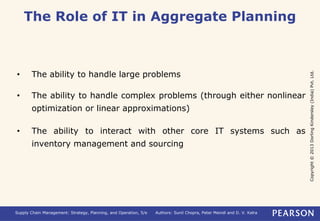
The Role of IT in Aggregate Planning 
• The ability to handle large problems 
• The ability to handle complex problems (through either nonlinear 
optimization or linear approximations) 
• The ability to interact with other core IT systems such as 
inventory management and sourcing 
Supply Chain Management: Strategy, Planning, and Operation, 5/e Authors: Sunil Chopra, Peter Meindl and D. V. Kalra
Inventory Planning and Economic Theory- 
Copyright © 2013 Dorling Kindersley (India) Pvt. Ltd. 
Aberrations 
• Available evidence indicates that Indian industries, by and large do 
not show any serious concern for inventory ordering and carrying 
costs. What are the main reasons for their indifference to scientific 
inventory management techniques? 
• What adaptations of Just In Time (JIT) practices do you visualize 
emerging in the Indian environment in the near future? 
Supply Chain Management: Strategy, Planning, and Operation, 5/e Authors: Sunil Chopra, Peter Meindl and D. V. Kalra
Copyright © 2013 Dorling Kindersley (India) Pvt. Ltd. 
Implementing Aggregate Planning in 
Practice 
• Think beyond the enterprise to the entire supply chain 
• Make plans flexible because forecasts are always inaccurate 
• Rerun the aggregate plan as new data emerge 
• Use aggregate planning as capacity utilization increases 
Supply Chain Management: Strategy, Planning, and Operation, 5/e Authors: Sunil Chopra, Peter Meindl and D. V. Kalra
Copyright © 2013 Dorling Kindersley (India) Pvt. Ltd. 
Summary of Learning Objectives 
• Identify the decisions that are best solved by aggregate planning 
• Understand the importance of aggregate planning as a supply 
chain activity 
• Describe the information needed to produce an aggregate plan 
• Explain the basic trade-offs to consider when creating an 
aggregate plan 
• Formulate and solve aggregate planning problems using Microsoft 
Excel 
Supply Chain Management: Strategy, Planning, and Operation, 5/e Authors: Sunil Chopra, Peter Meindl and D. V. Kalra

Chopra Meindl Chapter 8

  • 1.
    Copyright © 2013Dorling Kindersley (India) Pvt. Ltd. Chapter 8 Aggregate Planning in a Supply Chain Supply Chain Management: Strategy, Planning, and Operation, 5/e Authors: Sunil Chopra, Peter Meindl and D. V. Kalra
  • 2.
    Copyright © 2013Dorling Kindersley (India) Pvt. Ltd. Learning Objectives • Identify the decisions that are best solved by aggregate planning. • Understand the importance of aggregate planning as a supply chain activity. • Describe the information needed to produce an aggregate plan. • Explain the basic trade-offs to consider when creating an aggregate plan. • Formulate and solve basic aggregate planning problems using Microsoft Excel. Supply Chain Management: Strategy, Planning, and Operation, 5/e Authors: Sunil Chopra, Peter Meindl and D. V. Kalra
  • 3.
    Copyright © 2013Dorling Kindersley (India) Pvt. Ltd. Role of Aggregate Planning in a Supply Chain • Capacity has a cost and lead times are often long • Aggregate planning: process by which a company determines levels of capacity, production, subcontracting, inventory, stockouts, and pricing over a specified time horizon goal is to maximize profit decisions made at a product family (not SKU) level time frame of3 to 18 months how can a firm best use the facilities it has? Supply Chain Management: Strategy, Planning, and Operation, 5/e Authors: Sunil Chopra, Peter Meindl and D. V. Kalra
  • 4.
    Copyright © 2013Dorling Kindersley (India) Pvt. Ltd. Role of Aggregate Planning in a Supply Chain • Specify operational parameters over the time horizon Production rate: Subcontracting Workforce: Backlog Overtime: Inventory on hand Machine capacity level • All supply chain stages should work together on an aggregate plan that will optimize supply chain performance Supply Chain Management: Strategy, Planning, and Operation, 5/e Authors: Sunil Chopra, Peter Meindl and D. V. Kalra
  • 5.
    Copyright © 2013Dorling Kindersley (India) Pvt. Ltd. The Aggregate Planning Problem • Given the demand forecast for each period in the planning horizon, determine the production level, inventory level, and the capacity level for each period that maximizes the firm’s (supply chain’s) profit over the planning horizon • Specify the planning horizon (typically 3-18 months) • Specify the duration of each period • Specify key information required to develop an aggregate plan Supply Chain Management: Strategy, Planning, and Operation, 5/e Authors: Sunil Chopra, Peter Meindl and D. V. Kalra
  • 6.
    Copyright © 2013Dorling Kindersley (India) Pvt. Ltd. Information Needed for an Aggregate Plan • Aggregate demand forecast Ft for each Period t over T periods • Production costs Labor costs, regular time ($/hr) and overtime ($/hr) Subcontracting costs ($/hr or $/unit) Cost of changing capacity – hiring or layoff ($/worker), adding or reducing machine capacity ($/machine) • Labor/machine hours required per unit • Inventory holding cost ($/unit/period) • Stockout or backlog cost ($/unit/period) • Constraints – overtime, layoffs, capital available, stockouts, backlogs, from suppliers Supply Chain Management: Strategy, Planning, and Operation, 5/e Authors: Sunil Chopra, Peter Meindl and D. V. Kalra
  • 7.
    Copyright © 2013Dorling Kindersley (India) Pvt. Ltd. Outputs of Aggregate Plan • Production quantity from regular time, overtime, and subcontracted time • Inventory held • Backlog/stockout quantity • Machine capacity increase/decrease • A poor aggregate plan can result in lost sales, lost profits, excess inventory, or excess capacity Supply Chain Management: Strategy, Planning, and Operation, 5/e Authors: Sunil Chopra, Peter Meindl and D. V. Kalra
  • 8.
    Identifying Aggregate Unitsof Production Copyright © 2013 Dorling Kindersley (India) Pvt. Ltd. • Aggregate unit should be identified in a way that the resulting production schedule can be accomplished in practice • Focus on the bottlenecks when selecting the aggregate unit and identifying capacity and production times • Account for activities such as setups and maintenance Supply Chain Management: Strategy, Planning, and Operation, 5/e Authors: Sunil Chopra, Peter Meindl and D. V. Kalra
  • 9.
    Copyright © 2013Dorling Kindersley (India) Pvt. Ltd. Red Tomato Tools Family Material Cost/ Unit ($) Revenue/ Unit ($) Setup Time/ Batch (hour) Average Batch Size Production Time/ Unit (hour) Net Production Time/Unit (hour) Supply Chain Management: Strategy, Planning, and Operation, 5/e Authors: Sunil Chopra, Peter Meindl and D. V. Kalra Percentage Share of Units Sold A 15 54 8 50 5.60 5.76 10 B 7 30 6 150 3.00 3.04 25 C 9 39 8 100 3.80 3.88 20 D 12 49 10 50 4.80 5.00 10 E 9 36 6 100 3.60 3.66 20 F 13 48 5 75 4.30 4.37 15 Table 8-1
  • 10.
    Copyright © 2013Dorling Kindersley (India) Pvt. Ltd. Red Tomato Tools • Weighted average approach Material cost per aggregate unit = 15 x 0.10 + 7 x 0.25 + 9 x 0.20 + 12 x 0.10 + 9 x 0.20 + 13 x 0.15 = $10 • Similarly Revenue per aggregate unit = $40 Net production time per aggregate unit = 4.00 hours Supply Chain Management: Strategy, Planning, and Operation, 5/e Authors: Sunil Chopra, Peter Meindl and D. V. Kalra
  • 11.
    Copyright © 2013Dorling Kindersley (India) Pvt. Ltd. Aggregate Planning Strategies • Trade-off between capacity, inventory, backlog/lost sales • Chase strategy – using capacity as the lever • Time flexibility from workforce or capacity strategy – using utilization as the lever • Level strategy – using inventory as the lever • Tailored or hybrid strategy – a combination of strategies Supply Chain Management: Strategy, Planning, and Operation, 5/e Authors: Sunil Chopra, Peter Meindl and D. V. Kalra
  • 12.
    Copyright © 2013Dorling Kindersley (India) Pvt. Ltd. Chase Strategy • Vary machine capacity or hire and lay off workers as demand varies • Often difficult to vary capacity and workforce on short notice • Expensive if cost of varying capacity is high • Negative effect on workforce morale • Results in low levels of inventory • Used when inventory holding costs are high and costs of changing capacity are low Supply Chain Management: Strategy, Planning, and Operation, 5/e Authors: Sunil Chopra, Peter Meindl and D. V. Kalra
  • 13.
    Copyright © 2013Dorling Kindersley (India) Pvt. Ltd. Time Flexibility Strategy • Use excess machine capacity • Workforce stable, number of hours worked varies • Use overtime or a flexible work schedule • Flexible workforce, avoids morale problems • Low levels of inventory, lower utilization • Used when inventory holding costs are high and capacity is relatively inexpensive Supply Chain Management: Strategy, Planning, and Operation, 5/e Authors: Sunil Chopra, Peter Meindl and D. V. Kalra
  • 14.
    Copyright © 2013Dorling Kindersley (India) Pvt. Ltd. Level Strategy • Stable machine capacity and workforce levels, constant output rate • Inventory levels fluctuate over time • Inventories carried over from high to low demand periods • Better for worker morale • Large inventories and backlogs may accumulate • Used when inventory holding and backlog costs are relatively low Supply Chain Management: Strategy, Planning, and Operation, 5/e Authors: Sunil Chopra, Peter Meindl and D. V. Kalra
  • 15.
    Copyright © 2013Dorling Kindersley (India) Pvt. Ltd. Aggregate Planning Using Linear Programming • Red Tomato Tools Highly seasonal demand Develop a forecast Month Demand Forecast January 1,600 February 3,000 March 3,200 April 3,800 May 2,200 June 2,200 Table 8-2 Supply Chain Management: Strategy, Planning, and Operation, 5/e Authors: Sunil Chopra, Peter Meindl and D. V. Kalra
  • 16.
    Copyright © 2013Dorling Kindersley (India) Pvt. Ltd. Red Tomato Tools Item Cost Material cost $10/unit Inventory holding cost $2/unit/month Marginal cost of stockout/backlog $5/unit/month Hiring and training costs $300/worker Layoff cost $500/worker Labor hours required 4/unit Regular time cost $4/hour Overtime cost $6/hour Cost of subcontracting $30/unit Table 8-3 Supply Chain Management: Strategy, Planning, and Operation, 5/e Authors: Sunil Chopra, Peter Meindl and D. V. Kalra
  • 17.
    Copyright © 2013Dorling Kindersley (India) Pvt. Ltd. Red Tomato Tools Decision Variables For t = 1, ..., 6 Wt = Workforce size for month t Ht = Number of employees hired at the beginning of month t Lt = Number of employees laid off at the beginning of month t Pt = Production in month t It = Inventory at the end of month t St = Number of units stocked out at the end of month t Ct = Number of units subcontracted for month t Ot = Number of overtime hours worked in month t Supply Chain Management: Strategy, Planning, and Operation, 5/e Authors: Sunil Chopra, Peter Meindl and D. V. Kalra
  • 18.
    Copyright © 2013Dorling Kindersley (India) Pvt. Ltd. Red Tomato Tools Objective Function • Minimize (Regular-time labor cost + Overtime labor cost + Cost of hiring and layoffs + Cost of holding inventory + Cost of stocking out + Cost of subcontracting + Material cost) 6 å + 6Ot Min 640Wt t=1 6 å + 300Ht t=1 6 å + 500Lt t=1 6 å t=1 6 å + 5St + 2It t=1 6 å + 10Pt t=1 6 å + 30Ct t=1 6 å t=1 Supply Chain Management: Strategy, Planning, and Operation, 5/e Authors: Sunil Chopra, Peter Meindl and D. V. Kalra
  • 19.
    Copyright © 2013Dorling Kindersley (India) Pvt. Ltd. Red Tomato Tools Constraints • Workforce, hiring, and layoff constraints All for t = 1,..., 6 Wt =W t –1+Ht – Lt • Capacity constraints Pt £ 40Wt + Ot 4 • Inventory balance constraints It –1 + Pt +Ct = Dt + St –1 + It – St • Overtime limit constraints Ot £10Wt Supply Chain Management: Strategy, Planning, and Operation, 5/e Authors: Sunil Chopra, Peter Meindl and D. V. Kalra
  • 20.
    Copyright © 2013Dorling Kindersley (India) Pvt. Ltd. Red Tomato Tools Average inventory = T –1 (å ) (I0 + IT ) / 2+ I t=1 t T = T –1 (å ) (I0 + IT ) / 2+ It=1 t T é ê ê ê ë ù ú ú ú û (å T –1 D) t=1 t T é ê ê ê ë Supply Chain Management: Strategy, Planning, and Operation, 5/e Authors: Sunil Chopra, Peter Meindl and D. V. Kalra ù ú ú ú û Average time in inventory
  • 21.
    Copyright © 2013Dorling Kindersley (India) Pvt. Ltd. Red Tomato Tools Total cost over planning horizon = $422,275 Revenue over planning horizon = 40 x 16,000 = $640,000 Period , t No. Hired , Ht No. Laid Off, Lt Workforc e Size, Wt Overtim e, Ot Inventor y, It Stockout , St Subcontrac t, Ct Supply Chain Management: Strategy, Planning, and Operation, 5/e Authors: Sunil Chopra, Peter Meindl and D. V. Kalra Total Productio n, Pt 0 0 0 80 0 1,000 0 0 1 0 15 65 0 1,983 0 0 2,583 2 0 0 65 0 1,567 0 0 2,583 3 0 0 65 0 950 0 0 2,583 4 0 0 65 0 0 267 0 2,583 5 0 0 65 0 117 0 0 2,583 6 0 0 65 0 500 0 0 2,583 Table 8-4
  • 22.
    Copyright © 2013Dorling Kindersley (India) Pvt. Ltd. Red Tomato Tools   895 5   I I I (  ) / 2  5,367 t t 0 6 1   6  T Average seasonal inventory Average flow time = 895 2,667 = 0.34 = 0.34 months Supply Chain Management: Strategy, Planning, and Operation, 5/e Authors: Sunil Chopra, Peter Meindl and D. V. Kalra
  • 23.
    Copyright © 2013Dorling Kindersley (India) Pvt. Ltd. Red Tomato Tools • Higher demand variability Month Demand Forecast January 1,000 February 3,000 March 3,800 April 4,800 May 2,000 June 1,400 Table 8-5 = T –1 (å ) (I0 + IT ) / 2+ I t=1 t T = 6,450 6 = 1,075 Average seasonal inventory Supply Chain Management: Strategy, Planning, and Operation, 5/e Authors: Sunil Chopra, Peter Meindl and D. V. Kalra
  • 24.
    Copyright © 2013Dorling Kindersley (India) Pvt. Ltd. Red Tomato Tools Total cost over planning horizon = $432,858 Period, t No. Hire d, Ht No. Laid Off, Lt Workforce Size, Wt Overtime, Ot Inventor y, It Stockout, St Subcontract , Ct Supply Chain Management: Strategy, Planning, and Operation, 5/e Authors: Sunil Chopra, Peter Meindl and D. V. Kalra Total Production, Pt 0 0 0 80 0 1,000 0 0 1 0 15 65 0 2,583 0 0 2,583 2 0 0 65 0 2,167 0 0 2,583 3 0 0 65 0 950 0 0 2,583 4 0 0 65 0 0 1,267 0 2,583 5 0 0 65 0 0 683 0 2,583 6 0 0 65 0 500 0 0 2,583 Table 8-6 Average flow time = 1,075 2,667 = 0.40 months
  • 25.
    Copyright © 2013Dorling Kindersley (India) Pvt. Ltd. Red Tomato Tools • Lower hiring and layoff costs Total cost over planning horizon = $412,688 = T –1 (å ) (I0 + IT ) / 2+ I t=1 t T = 2,500 6 = 417 Average seasonal inventory 0.16 months 417 Average flow time   2,667 Supply Chain Management: Strategy, Planning, and Operation, 5/e Authors: Sunil Chopra, Peter Meindl and D. V. Kalra
  • 26.
    Copyright © 2013Dorling Kindersley (India) Pvt. Ltd. Red Tomato Tools Period , t No. Hired , Ht No. Laid Off, Lt Workforc e Size, Wt Overtime , Ot Inventor y, It Stockout , St Subcontrac t, Ct Supply Chain Management: Strategy, Planning, and Operation, 5/e Authors: Sunil Chopra, Peter Meindl and D. V. Kalra Total Production , Pt 0 0 0 80 0 1,000 0 0 1 0 35 45 0 1,200 0 0 2,267 2 0 0 45 0 0 0 0 2,267 3 42 0 87 0 300 0 0 2,267 4 0 0 87 0 0 1,267 0 2,267 5 0 26 61 0 250 683 0 2,267 6 0 0 61 0 500 0 0 2,267 Table 8-7
  • 27.
    Copyright © 2013Dorling Kindersley (India) Pvt. Ltd. Forecast Error in Aggregate Plans • Forecast errors must be considered • Safety inventory • Safety capacity Use overtime as a form of safety capacity Carry extra workforce permanently as a form of safety capacity Use subcontractors as a form of safety capacity Build and carry extra inventories as a form of safety inventory Purchase capacity or product from an open or spot market as a form of safety capacity Supply Chain Management: Strategy, Planning, and Operation, 5/e Authors: Sunil Chopra, Peter Meindl and D. V. Kalra
  • 28.
    Copyright © 2013Dorling Kindersley (India) Pvt. Ltd. Aggregate Planning In Excel For t = 1, ..., 6 Wt = Workforce size for Month t Ht = Number of employees hired at the beginning of Month t Lt = Number of employees laid off at the beginning of Month t Pt = Production in Month t It = Inventory at the end of Month t St = Number of units stocked out at the end of Month t Ct = Number of units subcontracted for Month t Ot = Number of overtime hours worked in Month t Supply Chain Management: Strategy, Planning, and Operation, 5/e Authors: Sunil Chopra, Peter Meindl and D. V. Kalra
  • 29.
    Copyright © 2013Dorling Kindersley (India) Pvt. Ltd. Aggregate Planning in Excel Figure 8-1 Supply Chain Management: Strategy, Planning, and Operation, 5/e Authors: Sunil Chopra, Peter Meindl and D. V. Kalra
  • 30.
    Copyright © 2013Dorling Kindersley (India) Pvt. Ltd. Aggregate Planning in Excel Supply Chain Management: Strategy, Planning, and Operation, 5/e Authors: Sunil Chopra, Peter Meindl and D. V. Kalra Figure 8-2
  • 31.
    Copyright © 2013Dorling Kindersley (India) Pvt. Ltd. Aggregate Planning in Excel Supply Chain Management: Strategy, Planning, and Operation, 5/e Authors: Sunil Chopra, Peter Meindl and D. V. Kalra Figure 8-3
  • 32.
    Copyright © 2013Dorling Kindersley (India) Pvt. Ltd. Aggregate Planning in Excel Figure 8-4 Supply Chain Management: Strategy, Planning, and Operation, 5/e Authors: Sunil Chopra, Peter Meindl and D. V. Kalra
  • 33.
    Copyright © 2013Dorling Kindersley (India) Pvt. Ltd. Building a Rough Master Production Schedule • Disaggregate an aggregate plan Family Setup Time/ Batch (hour) Averag e Batch Size Production Time/Unit (hour) Production Quantity Numbe r of Setups Setup Time (hours ) Supply Chain Management: Strategy, Planning, and Operation, 5/e Authors: Sunil Chopra, Peter Meindl and D. V. Kalra Productio n Time (hours) A 8 50 5.60 258 5 40 1,445 B 6 150 3.00 646 4 24 1,938 C 8 100 3.80 517 5 40 1,965 D 10 50 4.80 258 5 50 1,238 E 6 100 3.60 517 5 30 1,861 F 5 75 4.30 387 5 25 1,664 Table 8-8
  • 34.
    Copyright © 2013Dorling Kindersley (India) Pvt. Ltd. The Role of IT in Aggregate Planning • The ability to handle large problems • The ability to handle complex problems (through either nonlinear optimization or linear approximations) • The ability to interact with other core IT systems such as inventory management and sourcing Supply Chain Management: Strategy, Planning, and Operation, 5/e Authors: Sunil Chopra, Peter Meindl and D. V. Kalra
  • 35.
    Inventory Planning andEconomic Theory- Copyright © 2013 Dorling Kindersley (India) Pvt. Ltd. Aberrations • Available evidence indicates that Indian industries, by and large do not show any serious concern for inventory ordering and carrying costs. What are the main reasons for their indifference to scientific inventory management techniques? • What adaptations of Just In Time (JIT) practices do you visualize emerging in the Indian environment in the near future? Supply Chain Management: Strategy, Planning, and Operation, 5/e Authors: Sunil Chopra, Peter Meindl and D. V. Kalra
  • 36.
    Copyright © 2013Dorling Kindersley (India) Pvt. Ltd. Implementing Aggregate Planning in Practice • Think beyond the enterprise to the entire supply chain • Make plans flexible because forecasts are always inaccurate • Rerun the aggregate plan as new data emerge • Use aggregate planning as capacity utilization increases Supply Chain Management: Strategy, Planning, and Operation, 5/e Authors: Sunil Chopra, Peter Meindl and D. V. Kalra
  • 37.
    Copyright © 2013Dorling Kindersley (India) Pvt. Ltd. Summary of Learning Objectives • Identify the decisions that are best solved by aggregate planning • Understand the importance of aggregate planning as a supply chain activity • Describe the information needed to produce an aggregate plan • Explain the basic trade-offs to consider when creating an aggregate plan • Formulate and solve aggregate planning problems using Microsoft Excel Supply Chain Management: Strategy, Planning, and Operation, 5/e Authors: Sunil Chopra, Peter Meindl and D. V. Kalra