SUPER-PREMIUM ELECTRIC MOTORS
Motors Academy - Webinar Course
Anibal T. de Almeida
ISR-University of Coimbra, Portugal
21st November 2017
1
What is a Super-Premium Motor?
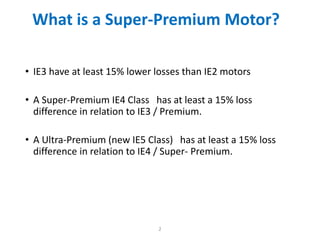
• IE3 have at least 15% lower losses than IE2 motors
• A Super-Premium IE4 Class has at least a 15% loss
difference in relation to IE3 / Premium.
• A Ultra-Premium (new IE5 Class) has at least a 15% loss
difference in relation to IE4 / Super- Premium.
2
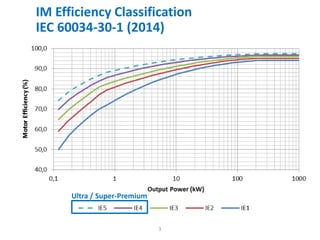
IM Efficiency Classification
IEC 60034-30-1 (2014)
Ultra / Super-Premium
3
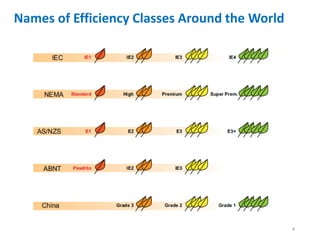
Names of Efficiency Classes Around the World
4
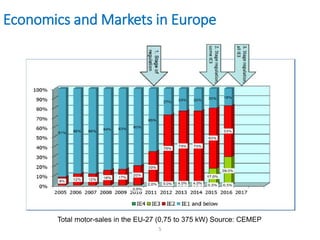
Economics and Markets in Europe
Total motor-sales in the EU-27 (0,75 to 375 kW) Source: CEMEP
5
6
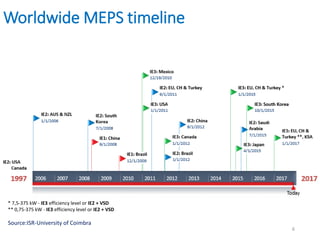
Worldwide MEPS timeline
* 7,5-375 kW - IE3 efficiency level or IE2 + VSD
** 0,75-375 kW - IE3 efficiency level or IE2 + VSD
Source:ISR-University of Coimbra
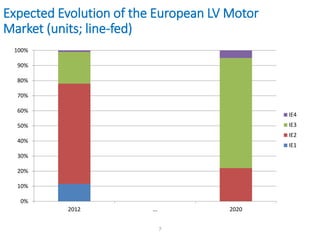
Expected Evolution of the European LV Motor
Market (units; line-fed)
7
0%
10%
20%
30%
40%
50%
60%
70%
80%
90%
100%
2012 ... 2020
IE4
IE3
IE2
IE1
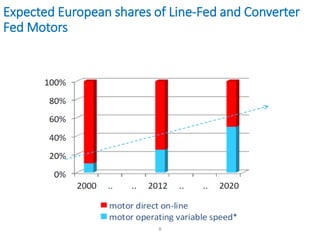
Expected European shares of Line-Fed and Converter
Fed Motors
8
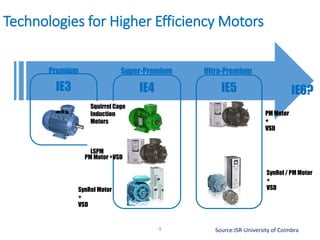
Technologies for Higher Efficiency Motors
9
IE4 IE5
PM Motor
+
VSD
IE3
Squirrel Cage
Induction
Motors
LSPM
SynRel Motor
+
VSD
PM Motor
+
VSD
Premium Super-Premium Ultra-Premium
SynRel / PM Motor
+
VSD
IE6?
PM Motor +VSD
Source:ISR-University of Coimbra
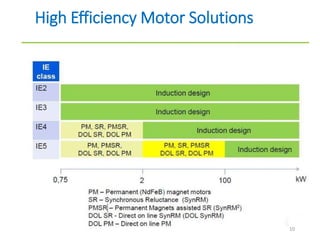
High Efficiency Motor Solutions
10
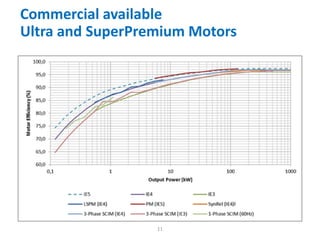
Commercial available
Ultra and SuperPremium Motors
11
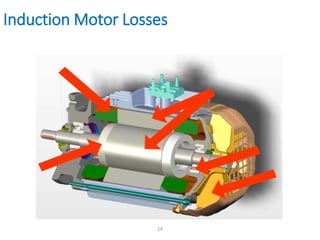
Motor Losses
• The electrical losses (also called Joule losses) are expressed by I2R, and
consequently increase rapidly with the motor load. Electrical losses appear
as heat generated by electric resistance to current flowing in the stator
windings and in the rotor conductor bars and end rings.
• Magnetic losses occur in the steel laminations of the stator and rotor. They
are due to hysteresis and eddy currents, increasing approximately with the
square of the magnetic flux-density.
• Mechanical losses are due to friction in the bearings, ventilation and
windage losses.
• Stray load losses are due to leakage flux, harmonics of the air gap flux
density, non-uniform and inter-bar currents distribution, mechanical
imperfections in the air gap, and irregularities in the air gap flux density.
12
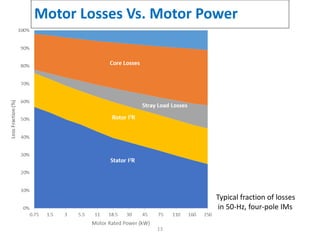
Typical fraction of losses
in 50-Hz, four-pole IMs
Motor Losses Vs. Motor Power
13
14
Induction Motor Losses
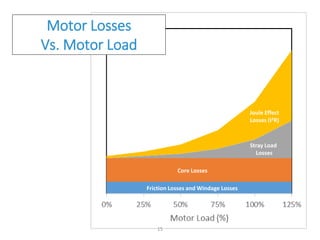
Friction Losses and Windage Losses
Core Losses
Stray Load
Losses
Joule Effect
Losses (I2R)
Motor Losses
Vs. Motor Load
15
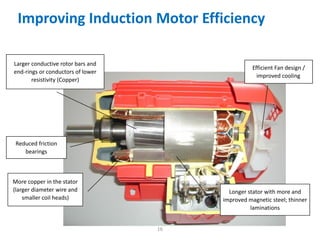
More copper in the stator
(larger diameter wire and
smaller coil heads)
Reduced friction
bearings
Efficient Fan design /
improved cooling
Larger conductive rotor bars and
end-rings or conductors of lower
resistivity (Copper)
Longer stator with more and
improved magnetic steel; thinner
laminations
Improving Induction Motor Efficiency
16
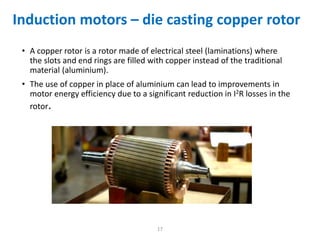
• A copper rotor is a rotor made of electrical steel (laminations) where
the slots and end rings are filled with copper instead of the traditional
material (aluminium).
• The use of copper in place of aluminium can lead to improvements in
motor energy efficiency due to a significant reduction in I2R losses in the
rotor.
17
Induction motors – die casting copper rotor
18
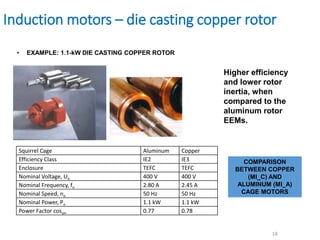
• EXAMPLE: 1.1-kW DIE CASTING COPPER ROTOR
Higher efficiency
and lower rotor
inertia, when
compared to the
aluminum rotor
EEMs.
COMPARISON
BETWEEN COPPER
(MI_C) AND
ALUMINUM (MI_A)
CAGE MOTORS
Squirrel Cage Aluminum Copper
Efficiency Class IE2 IE3
Enclosure TEFC TEFC
Nominal Voltage, Un 400 V 400 V
Nominal Frequency, fn 2.80 A 2.45 A
Nominal Speed, nn 50 Hz 50 Hz
Nominal Power, Pn 1.1 kW 1.1 kW
Power Factor cosφn 0.77 0.78
Induction motors – die casting copper rotor
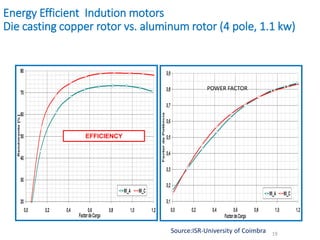
Energy Efficient Indution motors
Die casting copper rotor vs. aluminum rotor (4 pole, 1.1 kw)
19
EFFICIENCY
POWER FACTOR
Source:ISR-University of Coimbra
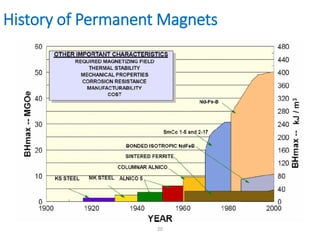
History of Permanent Magnets
20
21
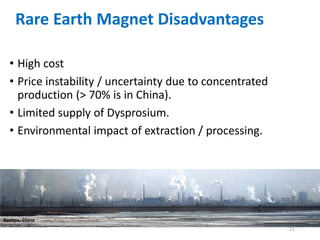
Rare Earth Magnet Disadvantages
• High cost
• Price instability / uncertainty due to concentrated
production (> 70% is in China).
• Limited supply of Dysprosium.
• Environmental impact of extraction / processing.
Baotou, China
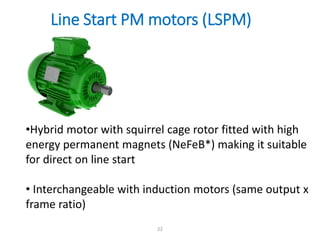
Line Start PM motors (LSPM)
•Hybrid motor with squirrel cage rotor fitted with high
energy permanent magnets (NeFeB*) making it suitable
for direct on line start
• Interchangeable with induction motors (same output x
frame ratio)
22
23
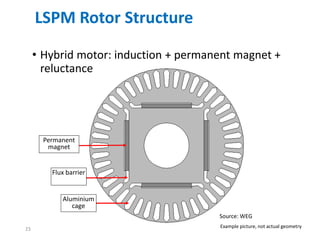
LSPM Rotor Structure
Aluminium
cage
Flux barrier
Permanent
magnet
• Hybrid motor: induction + permanent magnet +
reluctance
Source: WEG
Example picture, not actual geometry
24
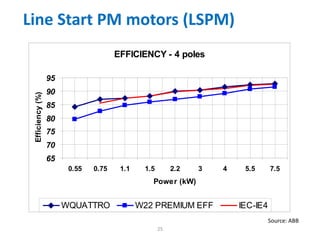
Advantages of LSPM
• Synchronous operation  no I²R losses in the aluminum
cage.
• Higher efficiency compared to Premium Efficiency
induction motors  high energy savings.
• Low bearing temperature  longer life and less
maintenance.
• No sensors  high reliability.
• Interchangeability with existing installations.
• No need for special protection relays.
• High cost
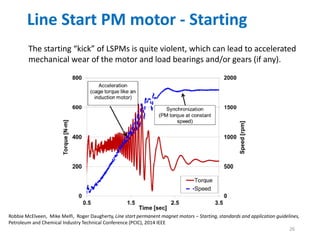
• Torque behaviour
Line Start PM motors (LSPM)
25
EFFICIENCY - 4 poles
65
70
75
80
85
90
95
0.55 0.75 1.1 1.5 2.2 3 4 5.5 7.5
Power (kW)
Efficiency(%)
WQUATTRO W22 PREMIUM EFF IEC-IE4
Source: ABB
26
Line Start PM motor - Starting
Robbie McElveen, Mike Melfi, Roger Daugherty, Line start permanent magnet motors – Starting, standards and application guidelines,
Petroleum and Chemical Industry Technical Conference (PCIC), 2014 IEEE
The starting “kick” of LSPMs is quite violent, which can lead to accelerated
mechanical wear of the motor and load bearings and/or gears (if any).
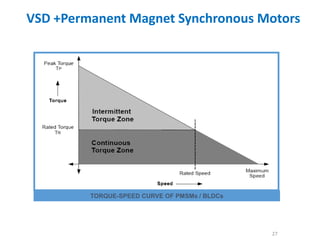
VSD +Permanent Magnet Synchronous Motors
27
TORQUE-SPEED CURVE OF PMSMs / BLDCs
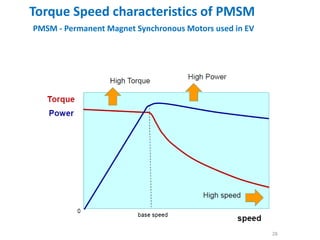
Torque Speed characteristics of PMSM
PMSM - Permanent Magnet Synchronous Motors used in EV
28
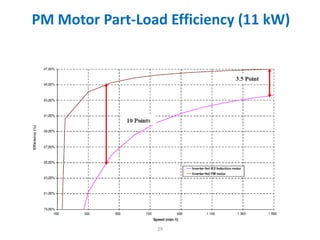
PM Motor Part-Load Efficiency (11 kW)
29
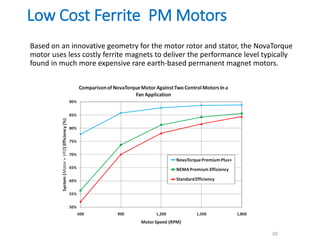
Low Cost Ferrite PM Motors
Based on an innovative geometry for the motor rotor and stator, the NovaTorque
motor uses less costly ferrite magnets to deliver the performance level typically
found in much more expensive rare earth-based permanent magnet motors.
30
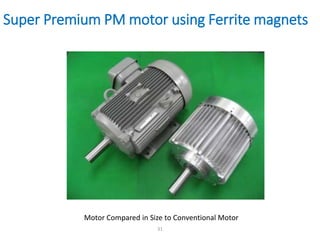
Super Premium PM motor using Ferrite magnets
31
Motor Compared in Size to Conventional Motor
Super Premium PM motor using Ferrite magnets
• The new 11 kW double-rotor, axial-gap motor uses a laminated stator core
based on a low-loss amorphous iron material. The losses from its laminated
material are about 10% of those of conventional electromagnetic steel
laminations.
• An amorphous metal has a disordered atomic structure versus the crystalline
structure of conventional metals, and features a high tensile strength and
extremely low magnetic losses.
32
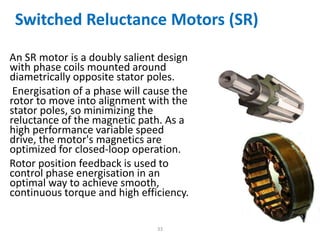
Switched Reluctance Motors (SR)
An SR motor is a doubly salient design
with phase coils mounted around
diametrically opposite stator poles.
Energisation of a phase will cause the
rotor to move into alignment with the
stator poles, so minimizing the
reluctance of the magnetic path. As a
high performance variable speed
drive, the motor's magnetics are
optimized for closed-loop operation.
Rotor position feedback is used to
control phase energisation in an
optimal way to achieve smooth,
continuous torque and high efficiency.
33
Switched Reluctance Motors
34
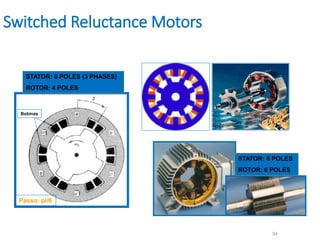
STATOR: 8 POLES
ROTOR: 6 POLES
Passo: pi/6
Bobinas
STATOR: 6 POLES (3 PHASES)
ROTOR: 4 POLES
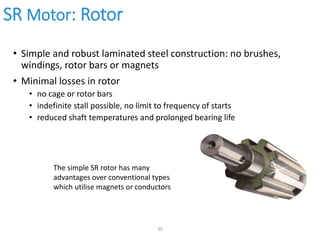
• Simple and robust laminated steel construction: no brushes,
windings, rotor bars or magnets
• Minimal losses in rotor
• no cage or rotor bars
• indefinite stall possible, no limit to frequency of starts
• reduced shaft temperatures and prolonged bearing life
The simple SR rotor has many
advantages over conventional types
which utilise magnets or conductors
SR Motor: Rotor
35
SR Motor: Stator
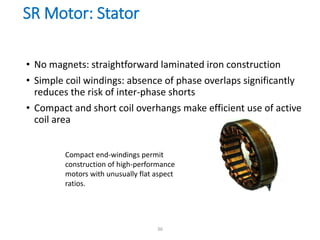
• No magnets: straightforward laminated iron construction
• Simple coil windings: absence of phase overlaps significantly
reduces the risk of inter-phase shorts
• Compact and short coil overhangs make efficient use of active
coil area
Compact end-windings permit
construction of high-performance
motors with unusually flat aspect
ratios.
36
Switched Reluctance Motors
Main advantages:
• High efficiency;
• High torque and high speed capability;
• High reliability and long lifetime;
• Simple construction, robustness;
• Low cost;
• Simpler controller (1 power switch per phase);
• High power density;
• Available in different sizes and shapes.
Main disadvantage: ripple torque and high acoustical noise due to the
high vibration level – research is made to improve these aspects. The
controller is always necessary.
37
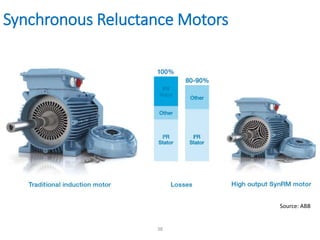
Synchronous Reluctance Motors
38
Source: ABB
Advantages:
• No winding and PM in the rotor
• No rotor losses => lower overall losses => higher efficiency and
smaller size (up to two frame sizes smaller than conventional SCIM).
• Low inertia
• Good acceleration performance
• Low manufacturing costs
Disadvantages:
• Low power factor
• Torque ripple
• Requires VSD to operate
39
Synchronous Reluctance Motors
• Lower stator temperature => extended insulation lifetime and
higher power density (20-40% in relation to SCIM) and/or higher
efficiency. Possibility of achieving standard power and torque
levels at merely a low class-A temperature rise (60 K).
• For the same rated power, efficiency improvement potential
associated with lower losses:
- smaller size for the same efficiency, and and temperature rise;
- higher efficiency & reduced temperature rise for the same frame size;
- combination of the two previous options (approach used for the
commercial version presented).
40
Synchronous Reluctance Motors
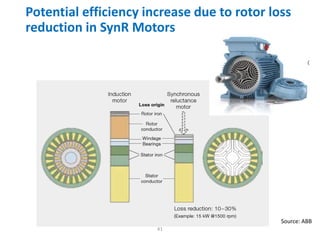
41
Potential efficiency increase due to rotor loss
reduction in SynR Motors
Source: ABB
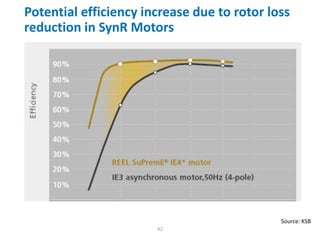
Potential efficiency increase due to rotor loss
reduction in SynR Motors
42
Source: KSB
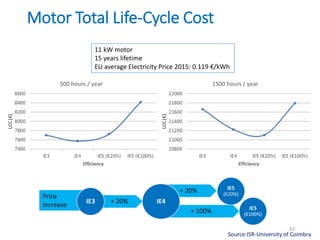
43
Motor Total Life-Cycle Cost
11 kW motor
15 years lifetime
EU average Electricity Price 2015: 0.119 €/kWh
Price
Increase
+ 100%
+ 20%
IE4
IE5
(€20%)
IE5
(€100%)
+ 20%IE3
Source:ISR-University of Coimbra
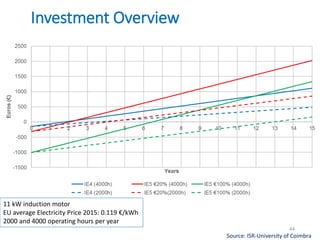
44
Investment Overview
11 kW induction motor
EU average Electricity Price 2015: 0.119 €/kWh
2000 and 4000 operating hours per year
Source: ISR-University of Coimbra
45
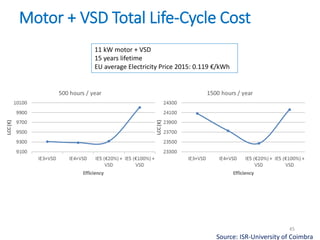
Motor + VSD Total Life-Cycle Cost
11 kW motor + VSD
15 years lifetime
EU average Electricity Price 2015: 0.119 €/kWh
Source: ISR-University of Coimbra
46
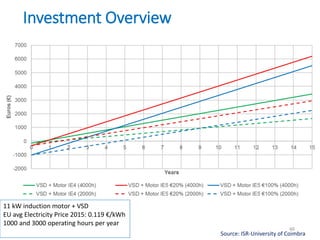
Investment Overview
11 kW induction motor + VSD
EU avg Electricity Price 2015: 0.119 €/kWh
1000 and 3000 operating hours per year
Source: ISR-University of Coimbra

Super-Premium Electric Motors

  • 1.
    SUPER-PREMIUM ELECTRIC MOTORS MotorsAcademy - Webinar Course Anibal T. de Almeida ISR-University of Coimbra, Portugal 21st November 2017 1
  • 2.
    What is aSuper-Premium Motor? • IE3 have at least 15% lower losses than IE2 motors • A Super-Premium IE4 Class has at least a 15% loss difference in relation to IE3 / Premium. • A Ultra-Premium (new IE5 Class) has at least a 15% loss difference in relation to IE4 / Super- Premium. 2
  • 3.
    IM Efficiency Classification IEC60034-30-1 (2014) Ultra / Super-Premium 3
  • 4.
    Names of EfficiencyClasses Around the World 4
  • 5.
    Economics and Marketsin Europe Total motor-sales in the EU-27 (0,75 to 375 kW) Source: CEMEP 5
  • 6.
    6 Worldwide MEPS timeline *7,5-375 kW - IE3 efficiency level or IE2 + VSD ** 0,75-375 kW - IE3 efficiency level or IE2 + VSD Source:ISR-University of Coimbra
  • 7.
    Expected Evolution ofthe European LV Motor Market (units; line-fed) 7 0% 10% 20% 30% 40% 50% 60% 70% 80% 90% 100% 2012 ... 2020 IE4 IE3 IE2 IE1
  • 8.
    Expected European sharesof Line-Fed and Converter Fed Motors 8
  • 9.
    Technologies for HigherEfficiency Motors 9 IE4 IE5 PM Motor + VSD IE3 Squirrel Cage Induction Motors LSPM SynRel Motor + VSD PM Motor + VSD Premium Super-Premium Ultra-Premium SynRel / PM Motor + VSD IE6? PM Motor +VSD Source:ISR-University of Coimbra
  • 10.
  • 11.
    Commercial available Ultra andSuperPremium Motors 11
  • 12.
    Motor Losses • Theelectrical losses (also called Joule losses) are expressed by I2R, and consequently increase rapidly with the motor load. Electrical losses appear as heat generated by electric resistance to current flowing in the stator windings and in the rotor conductor bars and end rings. • Magnetic losses occur in the steel laminations of the stator and rotor. They are due to hysteresis and eddy currents, increasing approximately with the square of the magnetic flux-density. • Mechanical losses are due to friction in the bearings, ventilation and windage losses. • Stray load losses are due to leakage flux, harmonics of the air gap flux density, non-uniform and inter-bar currents distribution, mechanical imperfections in the air gap, and irregularities in the air gap flux density. 12
  • 13.
    Typical fraction oflosses in 50-Hz, four-pole IMs Motor Losses Vs. Motor Power 13
  • 14.
  • 15.
    Friction Losses andWindage Losses Core Losses Stray Load Losses Joule Effect Losses (I2R) Motor Losses Vs. Motor Load 15
  • 16.
    More copper inthe stator (larger diameter wire and smaller coil heads) Reduced friction bearings Efficient Fan design / improved cooling Larger conductive rotor bars and end-rings or conductors of lower resistivity (Copper) Longer stator with more and improved magnetic steel; thinner laminations Improving Induction Motor Efficiency 16
  • 17.
    • A copperrotor is a rotor made of electrical steel (laminations) where the slots and end rings are filled with copper instead of the traditional material (aluminium). • The use of copper in place of aluminium can lead to improvements in motor energy efficiency due to a significant reduction in I2R losses in the rotor. 17 Induction motors – die casting copper rotor
  • 18.
    18 • EXAMPLE: 1.1-kWDIE CASTING COPPER ROTOR Higher efficiency and lower rotor inertia, when compared to the aluminum rotor EEMs. COMPARISON BETWEEN COPPER (MI_C) AND ALUMINUM (MI_A) CAGE MOTORS Squirrel Cage Aluminum Copper Efficiency Class IE2 IE3 Enclosure TEFC TEFC Nominal Voltage, Un 400 V 400 V Nominal Frequency, fn 2.80 A 2.45 A Nominal Speed, nn 50 Hz 50 Hz Nominal Power, Pn 1.1 kW 1.1 kW Power Factor cosφn 0.77 0.78 Induction motors – die casting copper rotor
  • 19.
    Energy Efficient Indutionmotors Die casting copper rotor vs. aluminum rotor (4 pole, 1.1 kw) 19 EFFICIENCY POWER FACTOR Source:ISR-University of Coimbra
  • 20.
  • 21.
    21 Rare Earth MagnetDisadvantages • High cost • Price instability / uncertainty due to concentrated production (> 70% is in China). • Limited supply of Dysprosium. • Environmental impact of extraction / processing. Baotou, China
  • 22.
    Line Start PMmotors (LSPM) •Hybrid motor with squirrel cage rotor fitted with high energy permanent magnets (NeFeB*) making it suitable for direct on line start • Interchangeable with induction motors (same output x frame ratio) 22
  • 23.
    23 LSPM Rotor Structure Aluminium cage Fluxbarrier Permanent magnet • Hybrid motor: induction + permanent magnet + reluctance Source: WEG Example picture, not actual geometry
  • 24.
    24 Advantages of LSPM •Synchronous operation  no I²R losses in the aluminum cage. • Higher efficiency compared to Premium Efficiency induction motors  high energy savings. • Low bearing temperature  longer life and less maintenance. • No sensors  high reliability. • Interchangeability with existing installations. • No need for special protection relays. • High cost • Torque behaviour
  • 25.
    Line Start PMmotors (LSPM) 25 EFFICIENCY - 4 poles 65 70 75 80 85 90 95 0.55 0.75 1.1 1.5 2.2 3 4 5.5 7.5 Power (kW) Efficiency(%) WQUATTRO W22 PREMIUM EFF IEC-IE4 Source: ABB
  • 26.
    26 Line Start PMmotor - Starting Robbie McElveen, Mike Melfi, Roger Daugherty, Line start permanent magnet motors – Starting, standards and application guidelines, Petroleum and Chemical Industry Technical Conference (PCIC), 2014 IEEE The starting “kick” of LSPMs is quite violent, which can lead to accelerated mechanical wear of the motor and load bearings and/or gears (if any).
  • 27.
    VSD +Permanent MagnetSynchronous Motors 27 TORQUE-SPEED CURVE OF PMSMs / BLDCs
  • 28.
    Torque Speed characteristicsof PMSM PMSM - Permanent Magnet Synchronous Motors used in EV 28
  • 29.
    PM Motor Part-LoadEfficiency (11 kW) 29
  • 30.
    Low Cost FerritePM Motors Based on an innovative geometry for the motor rotor and stator, the NovaTorque motor uses less costly ferrite magnets to deliver the performance level typically found in much more expensive rare earth-based permanent magnet motors. 30
  • 31.
    Super Premium PMmotor using Ferrite magnets 31 Motor Compared in Size to Conventional Motor
  • 32.
    Super Premium PMmotor using Ferrite magnets • The new 11 kW double-rotor, axial-gap motor uses a laminated stator core based on a low-loss amorphous iron material. The losses from its laminated material are about 10% of those of conventional electromagnetic steel laminations. • An amorphous metal has a disordered atomic structure versus the crystalline structure of conventional metals, and features a high tensile strength and extremely low magnetic losses. 32
  • 33.
    Switched Reluctance Motors(SR) An SR motor is a doubly salient design with phase coils mounted around diametrically opposite stator poles. Energisation of a phase will cause the rotor to move into alignment with the stator poles, so minimizing the reluctance of the magnetic path. As a high performance variable speed drive, the motor's magnetics are optimized for closed-loop operation. Rotor position feedback is used to control phase energisation in an optimal way to achieve smooth, continuous torque and high efficiency. 33
  • 34.
    Switched Reluctance Motors 34 STATOR:8 POLES ROTOR: 6 POLES Passo: pi/6 Bobinas STATOR: 6 POLES (3 PHASES) ROTOR: 4 POLES
  • 35.
    • Simple androbust laminated steel construction: no brushes, windings, rotor bars or magnets • Minimal losses in rotor • no cage or rotor bars • indefinite stall possible, no limit to frequency of starts • reduced shaft temperatures and prolonged bearing life The simple SR rotor has many advantages over conventional types which utilise magnets or conductors SR Motor: Rotor 35
  • 36.
    SR Motor: Stator •No magnets: straightforward laminated iron construction • Simple coil windings: absence of phase overlaps significantly reduces the risk of inter-phase shorts • Compact and short coil overhangs make efficient use of active coil area Compact end-windings permit construction of high-performance motors with unusually flat aspect ratios. 36
  • 37.
    Switched Reluctance Motors Mainadvantages: • High efficiency; • High torque and high speed capability; • High reliability and long lifetime; • Simple construction, robustness; • Low cost; • Simpler controller (1 power switch per phase); • High power density; • Available in different sizes and shapes. Main disadvantage: ripple torque and high acoustical noise due to the high vibration level – research is made to improve these aspects. The controller is always necessary. 37
  • 38.
  • 39.
    Advantages: • No windingand PM in the rotor • No rotor losses => lower overall losses => higher efficiency and smaller size (up to two frame sizes smaller than conventional SCIM). • Low inertia • Good acceleration performance • Low manufacturing costs Disadvantages: • Low power factor • Torque ripple • Requires VSD to operate 39 Synchronous Reluctance Motors
  • 40.
    • Lower statortemperature => extended insulation lifetime and higher power density (20-40% in relation to SCIM) and/or higher efficiency. Possibility of achieving standard power and torque levels at merely a low class-A temperature rise (60 K). • For the same rated power, efficiency improvement potential associated with lower losses: - smaller size for the same efficiency, and and temperature rise; - higher efficiency & reduced temperature rise for the same frame size; - combination of the two previous options (approach used for the commercial version presented). 40 Synchronous Reluctance Motors
  • 41.
    41 Potential efficiency increasedue to rotor loss reduction in SynR Motors Source: ABB
  • 42.
    Potential efficiency increasedue to rotor loss reduction in SynR Motors 42 Source: KSB
  • 43.
    43 Motor Total Life-CycleCost 11 kW motor 15 years lifetime EU average Electricity Price 2015: 0.119 €/kWh Price Increase + 100% + 20% IE4 IE5 (€20%) IE5 (€100%) + 20%IE3 Source:ISR-University of Coimbra
  • 44.
    44 Investment Overview 11 kWinduction motor EU average Electricity Price 2015: 0.119 €/kWh 2000 and 4000 operating hours per year Source: ISR-University of Coimbra
  • 45.
    45 Motor + VSDTotal Life-Cycle Cost 11 kW motor + VSD 15 years lifetime EU average Electricity Price 2015: 0.119 €/kWh Source: ISR-University of Coimbra
  • 46.
    46 Investment Overview 11 kWinduction motor + VSD EU avg Electricity Price 2015: 0.119 €/kWh 1000 and 3000 operating hours per year Source: ISR-University of Coimbra