Superimposed currents
Dr.Rabia Iqbal
(Lecturer at COMWAVE INSTITUTE,Islamabad)
• to impose, place, or set over, above, or on something else.
OR
• to put or join as an addition
• The superimposition of Electrical stimulation(ES) onto Voluntry
muscular contraction(VOL) can theoretically activate more motor
units than VOL performed alone, which can engender an increase of
the contraction force.
• (superimposed technique: application of an electrical stimulus during
a voluntary muscle action)
• Type; low frequency modified direct current
• Duration ... less than 10ms
• Superimposed direct currents
• Superimposed modified direct currents
• Physiological /therapeutic Effects
• Electrical stimulation (ES) reverses the order of recruitment of motor units (MU) observed with voluntary muscular
contraction (VOL) since under ES, large MU are recruited before small MU
• Stimulation of partially denervated muscles
• Stimulation of innervated muscles
• Re-education of muscle action
• Training new muscle action
• Increase blood supply
• Increase venous and lymphatic drainage
• Prevention from adhesion
• Strengthening and increase bulk of muscle
• detection of central activation failure(CAF)
• The two superimposed techniques can be used to evaluate the ability to fully activate a muscle.
• (evaluation of CAF-central activation failure).
• functional electrical stimulation (FES)
• They can thus be employed to distinguish the central or peripheral nature of fatigue after
exhausting exercise.
• In general, whatever the technique employed, the superimposition of ES onto volitional exercise
does not recruit more MU than VOL, except with eccentric actions.
• The sex and the training level of the subjects can also modify the physiological impact of the
superimposed technique. Although the motor control differs drastically between training with ES
and VOL, the integration of the superimposed technique in training programmes with healthy
subjects does not reveal significant benefits compared with programmes performed only with
voluntary exercises.
• Nevertheless, in a therapeutic context, training programmes using ES superimposition
compensate volume and muscle strength deficit with more efficiency than programmes using VOL
or ES separately.
• The central governor is a proposed process in the brain that regulates
exercise in regard to a neurally calculated safe exertion by the body. In
particular, physical activity is controlled so that its intensity cannot
threaten the body’s homeostasis by causing anoxic damage to the
heart muscle. The central governor limits exercise by reducing the
neural recruitment of muscle fibers. This reduced recruitment causes
the sensation of fatigue.
• failure or lack of efficiency of this central governer causes central
activation failure.
• (CAF of quadriceps is assocciated with osteoarthritis of knee)
)
• Muscle fatigue or neuromuscular disease may result in central
activation failure during maximal voluntary contractions (MVCs).
Superimposition of an electrically stimulated contraction during an
MVC has been used to detect central activation failure.
• To determine the most sensitive means of quantitating central
activation failure using this technique, compare the increment in
isometric force from single, double, and high-frequency trains (50 Hz,
500 or 1000 ms) of stimuli of the nerve imposed during three
separate MVCs of muscles. Completeness of activation can be
quantitated with the central activation ratio (CAR)
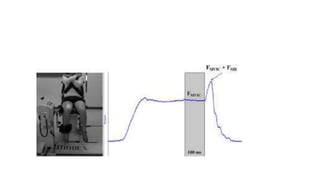
• CAR= MVC/(MVC + stimulated force)
• Two superimposed techniques can be used:
• (i) the twitch interpolation technique (ITT), which consists of
interjecting an electrical stimulus onto the muscle nerve
• (ii) the percutaneous superimposed electrical stimulation technique
(PST), where the stimulation is applied to the muscle belly.
( burst superimposition)
• treatment session: 5-6 days a week
• electrical stimulation is used to elicit muscle contractions via stimulation of the intact or partially
intact peripheral nervous system. One clinical application of electrical stimulation is functional
electrical stimulation (FES) and involves the electrical activation of skeletal muscles to assist
individuals with central nervous system impairments to produce functional movements . During
FES, an electrically elicited muscle contraction is commonly superimposed over a voluntary
contraction to augment force generation by a weak muscle .
• Superimposition of electrical stimulation during voluntary contractions also can be used to
evaluate an individual's ability to activate a skeletal muscle , to characterize the nature of fatigue ,
or to improve muscle strength during postsurgical rehabilitation and in individuals with muscle
weakness due to upper motor neuron injuries . Although electrical stimulation is commonly
superimposed on volitional contractions during clinical applications, the manner in which
volitionally and electrically elicited forces summate has not been clearly identified.
• For accurate generation of targeted joint motions during FES applications, it is crucial that the
appropriate amount of joint torque be generated by the combination of electrical and volitional
contraction forces
• The manner in which volitional force production is augmented by electrical
stimulation may depend on a variety of biophysical factors such as
1-differences in the order
2-rate of fiber recruitment between electrically and volitionally induced
contractions ,
3- distance of electrodes and electric field from target nerve fibers ,
4-tissue conductivity ,
• while developing an EMG-based FES controller, assumed that during
concurrent volitional and electrical activation of muscle, the output force is
the resultant of simple linear summation of the two components
• it is applied to detect strength or activation of muscle
• especially for detection of CAF(central activation failure)
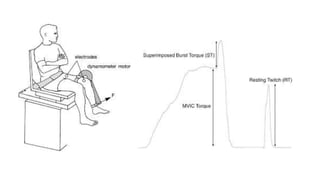
• Method: in a measurement session of a maximal voluntary isometric contraction (MVIC) of the
quadriceps femoris muscle with a burst superimposition technique,patient is seated in an
electromechanical dynamometer.
• sat with the hip flexed to 90 degrees and the knee flexed to 75 degrees.
• The axis of the dynamometer was positioned at the axis of rotation of the knee joint, and the
distal edge of the shin attachment was placed 2 in (5.08 cm) proximal to the lateral malleolus of
the test leg. A waist and a trunk strap were used for stabilization. Two self-adhesive electrodes
were placed over the quadriceps femoris muscle at the motor point of the vastus medialis and
proximal rectus femoris muscles . Subject performed 2 submaximal contractions and 1 MVIC
lasting 2 to 3 seconds each in order to warm up the muscle and to familiarize the patient with the
testing procedure.
• After 5 minutes of rest, subjects were instructed to maximally contract
the quadriceps femoris muscle for approximately 4 seconds. Verbal
encouragement and visual output of their force were used to motivate
the subjects to produce an MVIC. Approximately 3 seconds into the
contraction, the stimulator delivered a supramaximal electrical stimulus
of monophasic rectangular waves at a rate of 100 pulses per second for
100 milliseconds at 135 V. The knee extension force was measured and
recorded using custom-written software with a 200-Hz sampling rate.
• Five minutes of rest was provided between contractions in an effort to
minimize muscular or neuromuscular fatigue. A maximum of 3 trials was
recorded. The highest volitional force achieved during the 3 attempts was
used for analysis. A weight correction was performed automatically by
the computer program by adding the baseline force while the patient was
relaxed to the force measurement.
• Contraindications
• Skin lesions
• fever
• Infections
• Cardiac pace makers
• Open skin wounds
• Pregnancy(pregnant uterus)
precautions
• take care in case of open skin wound..
• do not apply over pregnant uterus
• do not apply in the vicinity of cardiac pace maker
• educate the patient before the application of current
• patient should b mentally relaxed.
Dangers
• electric shock
• hypovolemia
• burns

Superimposed currents

  • 1.
    Superimposed currents Dr.Rabia Iqbal (Lecturerat COMWAVE INSTITUTE,Islamabad)
  • 2.
    • to impose,place, or set over, above, or on something else. OR • to put or join as an addition
  • 3.
    • The superimpositionof Electrical stimulation(ES) onto Voluntry muscular contraction(VOL) can theoretically activate more motor units than VOL performed alone, which can engender an increase of the contraction force. • (superimposed technique: application of an electrical stimulus during a voluntary muscle action) • Type; low frequency modified direct current • Duration ... less than 10ms
  • 4.
    • Superimposed directcurrents • Superimposed modified direct currents
  • 5.
    • Physiological /therapeuticEffects • Electrical stimulation (ES) reverses the order of recruitment of motor units (MU) observed with voluntary muscular contraction (VOL) since under ES, large MU are recruited before small MU • Stimulation of partially denervated muscles • Stimulation of innervated muscles • Re-education of muscle action • Training new muscle action • Increase blood supply • Increase venous and lymphatic drainage • Prevention from adhesion • Strengthening and increase bulk of muscle • detection of central activation failure(CAF)
  • 6.
    • The twosuperimposed techniques can be used to evaluate the ability to fully activate a muscle. • (evaluation of CAF-central activation failure). • functional electrical stimulation (FES) • They can thus be employed to distinguish the central or peripheral nature of fatigue after exhausting exercise. • In general, whatever the technique employed, the superimposition of ES onto volitional exercise does not recruit more MU than VOL, except with eccentric actions. • The sex and the training level of the subjects can also modify the physiological impact of the superimposed technique. Although the motor control differs drastically between training with ES and VOL, the integration of the superimposed technique in training programmes with healthy subjects does not reveal significant benefits compared with programmes performed only with voluntary exercises. • Nevertheless, in a therapeutic context, training programmes using ES superimposition compensate volume and muscle strength deficit with more efficiency than programmes using VOL or ES separately.
  • 7.
    • The centralgovernor is a proposed process in the brain that regulates exercise in regard to a neurally calculated safe exertion by the body. In particular, physical activity is controlled so that its intensity cannot threaten the body’s homeostasis by causing anoxic damage to the heart muscle. The central governor limits exercise by reducing the neural recruitment of muscle fibers. This reduced recruitment causes the sensation of fatigue. • failure or lack of efficiency of this central governer causes central activation failure. • (CAF of quadriceps is assocciated with osteoarthritis of knee)
  • 8.
    ) • Muscle fatigueor neuromuscular disease may result in central activation failure during maximal voluntary contractions (MVCs). Superimposition of an electrically stimulated contraction during an MVC has been used to detect central activation failure. • To determine the most sensitive means of quantitating central activation failure using this technique, compare the increment in isometric force from single, double, and high-frequency trains (50 Hz, 500 or 1000 ms) of stimuli of the nerve imposed during three separate MVCs of muscles. Completeness of activation can be quantitated with the central activation ratio (CAR) • CAR= MVC/(MVC + stimulated force)
  • 9.
    • Two superimposedtechniques can be used: • (i) the twitch interpolation technique (ITT), which consists of interjecting an electrical stimulus onto the muscle nerve • (ii) the percutaneous superimposed electrical stimulation technique (PST), where the stimulation is applied to the muscle belly. ( burst superimposition) • treatment session: 5-6 days a week
  • 10.
    • electrical stimulationis used to elicit muscle contractions via stimulation of the intact or partially intact peripheral nervous system. One clinical application of electrical stimulation is functional electrical stimulation (FES) and involves the electrical activation of skeletal muscles to assist individuals with central nervous system impairments to produce functional movements . During FES, an electrically elicited muscle contraction is commonly superimposed over a voluntary contraction to augment force generation by a weak muscle . • Superimposition of electrical stimulation during voluntary contractions also can be used to evaluate an individual's ability to activate a skeletal muscle , to characterize the nature of fatigue , or to improve muscle strength during postsurgical rehabilitation and in individuals with muscle weakness due to upper motor neuron injuries . Although electrical stimulation is commonly superimposed on volitional contractions during clinical applications, the manner in which volitionally and electrically elicited forces summate has not been clearly identified. • For accurate generation of targeted joint motions during FES applications, it is crucial that the appropriate amount of joint torque be generated by the combination of electrical and volitional contraction forces
  • 11.
    • The mannerin which volitional force production is augmented by electrical stimulation may depend on a variety of biophysical factors such as 1-differences in the order 2-rate of fiber recruitment between electrically and volitionally induced contractions , 3- distance of electrodes and electric field from target nerve fibers , 4-tissue conductivity , • while developing an EMG-based FES controller, assumed that during concurrent volitional and electrical activation of muscle, the output force is the resultant of simple linear summation of the two components
  • 12.
    • it isapplied to detect strength or activation of muscle • especially for detection of CAF(central activation failure) • Method: in a measurement session of a maximal voluntary isometric contraction (MVIC) of the quadriceps femoris muscle with a burst superimposition technique,patient is seated in an electromechanical dynamometer. • sat with the hip flexed to 90 degrees and the knee flexed to 75 degrees. • The axis of the dynamometer was positioned at the axis of rotation of the knee joint, and the distal edge of the shin attachment was placed 2 in (5.08 cm) proximal to the lateral malleolus of the test leg. A waist and a trunk strap were used for stabilization. Two self-adhesive electrodes were placed over the quadriceps femoris muscle at the motor point of the vastus medialis and proximal rectus femoris muscles . Subject performed 2 submaximal contractions and 1 MVIC lasting 2 to 3 seconds each in order to warm up the muscle and to familiarize the patient with the testing procedure.
  • 13.
    • After 5minutes of rest, subjects were instructed to maximally contract the quadriceps femoris muscle for approximately 4 seconds. Verbal encouragement and visual output of their force were used to motivate the subjects to produce an MVIC. Approximately 3 seconds into the contraction, the stimulator delivered a supramaximal electrical stimulus of monophasic rectangular waves at a rate of 100 pulses per second for 100 milliseconds at 135 V. The knee extension force was measured and recorded using custom-written software with a 200-Hz sampling rate. • Five minutes of rest was provided between contractions in an effort to minimize muscular or neuromuscular fatigue. A maximum of 3 trials was recorded. The highest volitional force achieved during the 3 attempts was used for analysis. A weight correction was performed automatically by the computer program by adding the baseline force while the patient was relaxed to the force measurement.
  • 16.
    • Contraindications • Skinlesions • fever • Infections • Cardiac pace makers • Open skin wounds • Pregnancy(pregnant uterus)
  • 17.
    precautions • take carein case of open skin wound.. • do not apply over pregnant uterus • do not apply in the vicinity of cardiac pace maker • educate the patient before the application of current • patient should b mentally relaxed.
  • 18.
    Dangers • electric shock •hypovolemia • burns