Steven Christe1,, Matt Earnshaw2, Keith Hughitt1, Jack Ireland1, Florian Mayer3,
Albert Shih1, Alex Young1
1 NASA GSFC
2 Imperial College   London
3 Vienna University of Technology


                                                        Florian Mayer
   What is Python?
   Introduction to Python
   Scientific Python
     NumPy
     Matplotlib
     SciPy
   Python in solar physics
   General-purpose
   Object-oriented (disputed)
   Cross-platform
     Windows
     Mac OS
     Linux
     Other Unices (FreeBSD, Solaris, etc.)
   High-level
   Internet companies
     Google
     Rackspace
   Games
     Battlefield 2
     Civilization 4
   Graphics
     Walt Disney
   Science
     NASA
     ESRI
   Easy
   Comprehensive standard library (“batteries
    included”)
    Quality does vary, though.
   Good support for scientific tasks
   Permissive open-source license

On the downside:
 Slower, but ways to speed up
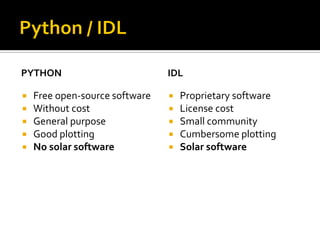
PYTHON                        IDL

 Free open-source software    Proprietary software
 Without cost                 License cost
 General purpose              Small community
 Good plotting                Cumbersome plotting
 No solar software            Solar software
   Implementation started 1989 by Guido van
    Rossum (BDFL)
   2.0 appeared 2000
     Garbage collection
     Unicode
   3.0 appeared 2008
   Astronomy
   Artificial intelligence & machine learning
   Bayesian Statistics
   Biology (including Neuroscience)
   Dynamical systems
   Economics and Econometrics
   Electromagnetics
   Electrical Engineering
   Geosciences
   Molecular modeling
   Signal processing
   Symbolic math, number theory
   pyFITS – read FITS files
   pyRAF – run IRAF tasks
   pywcs
   pyephem – compute positions of objects in
    space
   spacepy (space sciences, just released)
   Planned standard library AstroPy
   Beautiful is better than ugly.
   Explicit is better than implicit.
   Simple is better than complex.
   Readability counts.
   There should be one – and preferably only
    one – obvious way to do it.
   Although that way may not be obvious at first
    unless you're Dutch.
   >>> import this
Brief introduction into Python
   Infix notation operations
   Python 2 defaults to floor division
   More mathematical operations in math
   Complex math in cmath
   Integers are arbitrary size.
   Floats are platform doubles.
   decimal module for arbitrary precision
    decimal numbers
   fractions module for fractions
STRINGS / BYTES            UNICODE

 "foo"                     u"foo"
 Store bytes               Store unicode codepoints
 Useful for binary data    Useful for text
                            Behave as expected for
                             multibyte characters
   [1, 2, 3, 4]          (1, u"foo")
   Mutable               Immutable
   Multiple records      Different objects
                           describing one record
   if/elif/else
   for-loop
     break
     continue
     else
   while-loop
   pass
   Default arguments are evaluated once at
    compile time!
   lambda alternative syntax for definition of
    trivial functions
   Functions are objects, too!
   Unordered key-value mappings
   Approx. O(1) lookup and storage
   Keys must be immutable (hashable)
   Unordered collection of unique objects
   Approx. O(1) membership test
   Members must be immutable (hashable)
   Classes
   Explicit self
   Multiple inheritance

   Also in IDL 8; no escaping it
   try / except / else
   raise
   Exceptions inherit from Exception
PYTHON 2.7                       PYTHON 3.2

 Print statement                 Print function
 String / Unicode                Bytes / String
 Floor division                  Float Division
 Relative imports                Absolute imports
 Lists                           Views


                     Tons of other changes
                      http://bit.ly/newpy3
   Fundamental package for science in Python
   Multidimensional fixed-size, homogenous
    arrays
   Derived objects: e.g. matrices
   More efficient
   Less code
   Python list
   arange
   linspace / logspace
   ones / zeros / eye / diag
   random
   Absence of explicit looping
     Conciseness – less bugs
     Closer to mathematical notation
     More pythonic.
   Also possible for user functions
   Expansion of multidimensional arrays
   Implicit element-by-element behavior
   Boolean area
   Integer area
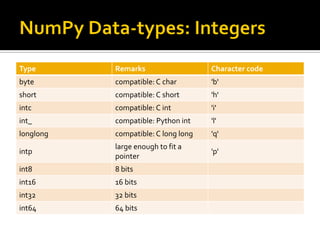
Type       Remarks                   Character code
byte       compatible: C char        'b'
short      compatible: C short       'h'
intc       compatible: C int         'i'
int_       compatible: Python int    'l'
longlong   compatible: C long long   'q'
           large enough to fit a
intp                                 'p'
           pointer
int8       8 bits
int16      16 bits
int32      32 bits
int64      64 bits
Type        Remarks                      Character code
ubyte       compatible: C u. char        'B'
ushort      compatible: C u. short       'H'
uintc       compatible: C unsigned int   'I'
uint        compatible: Python int       'L'
ulonglong   compatible: C long long      'Q'
            large enough to fit a
uintp                                    'P'
            pointer
uint8       8 bits
uint16      16 bits
uint32      32 bits
uint64      64 bits
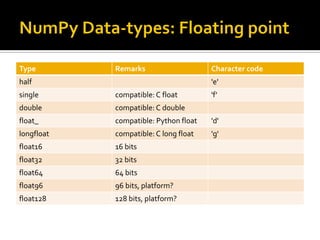
Type        Remarks                    Character code
half                                   'e'
single      compatible: C float        'f'
double      compatible: C double
float_      compatible: Python float   'd'
longfloat   compatible: C long float   'g'
float16     16 bits
float32     32 bits
float64     64 bits
float96     96 bits, platform?
float128    128 bits, platform?
Type         Remarks               Character code
csingle                            'F'
             compatible: Python
complex_                           'D'
             complex
clongfloat                         'G'
complex64    two 32-bit floats
complex128   two 64-bit floats
             two 96-bit floats,
complex192
             platform?
             two 128-bit floats,
complex256
             platform?
   NumPy: weave.blitz (fast NumPy
    expressions)
   NumPy: weave.inline (inline C/C++)
   f2py (interface Fortran)
   Pyrex/Cython (python-like compiled
    language)
 2D plotting library
 Some 3D support
 Publication-quality
  figures
 “Make easy things easy
  and hard things
  possible”
 Configurable using
  matplotlibrc
import numpy as np
from matplotlib import pyplot as plt

t = np.linspace(0, 2, 200)
s = np.sin(2*pi*t)
plt.plot(t, s, linewidth=1.0)

plt.xlabel('time (s)')
plt.ylabel('voltage (mV)')
plt.title('About as simple as it gets, folks')
plt.grid(True)
plt.show()
import numpy as np
from matplotlib import pyplot as plt

def f(t):
  s1 = np.cos(2*pi*t)
  e1 = np.exp(-t)
  return np.multiply(s1,e1)

t1 = np.arange(0.0, 5.0, 0.1)
t2 = np.arange(0.0, 5.0, 0.02)
t3 = np.arange(0.0, 2.0, 0.01)

plt.subplot(211)
l = plot(t1, f(t1), 'bo', t2, f(t2), 'k--',
          markerfacecolor='green')
plt.grid(True)
plt.title('A tale of 2 subplots')
plt.ylabel('Damped oscillation')

plt.subplot(212)
plt.plot(t3, np.cos(2*pi*t3), 'r.')
plt.grid(True)
plt.xlabel('time (s)')
plt.ylabel('Undamped')
plt.show()
import   numpy as np
import   matplotlib.path as mpath
import   matplotlib.patches as mpatches
import   matplotlib.pyplot as plt
Path = mpath.Path
fig = plt.figure()
ax = fig.add_subplot(111)
pathdata = [
  (Path.MOVETO, (1.58, -2.57)),
  (Path.CURVE4, (0.35, -1.1)),
  (Path.CURVE4, (-1.75, 2.0)),
  (Path.CURVE4, (0.375, 2.0)),
  (Path.LINETO, (0.85, 1.15)),
  (Path.CURVE4, (2.2, 3.2)),
  (Path.CURVE4, (3, 0.05)),
  (Path.CURVE4, (2.0, -0.5)),
  (Path.CLOSEPOLY, (1.58, -2.57)),
  ]
codes, verts = zip(*pathdata)
path = mpath.Path(verts, codes)
patch = mpatches.PathPatch(path, facecolor='red',
edgecolor='yellow', alpha=0.5)
ax.add_patch(patch)
x, y = zip(*path.vertices)
line, = ax.plot(x, y, 'go-')
ax.grid()
ax.set_xlim(-3,4)
ax.set_ylim(-3,4)
ax.set_title('spline paths')
plt.show()
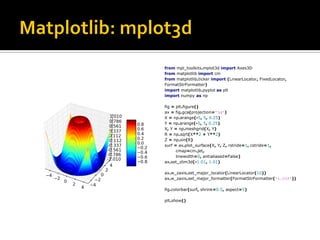
from mpl_toolkits.mplot3d import Axes3D
from matplotlib import cm
from matplotlib.ticker import (LinearLocator, FixedLocator,
FormatStrFormatter)
import matplotlib.pyplot as plt
import numpy as np

fig = plt.figure()
ax = fig.gca(projection='3d')
X = np.arange(-5, 5, 0.25)
Y = np.arange(-5, 5, 0.25)
X, Y = np.meshgrid(X, Y)
R = np.sqrt(X**2 + Y**2)
Z = np.sin(R)
surf = ax.plot_surface(X, Y, Z, rstride=1, cstride=1,
      cmap=cm.jet,
      linewidth=0, antialiased=False)
ax.set_zlim3d(-1.01, 1.01)

ax.w_zaxis.set_major_locator(LinearLocator(10))
ax.w_zaxis.set_major_formatter(FormatStrFormatter('%.03f'))

fig.colorbar(surf, shrink=0.5, aspect=5)

plt.show()
import numpy as np
from matplotlib import pyplot as plt
from matplotlib.patches import Ellipse

NUM = 250

ells = [
   Ellipse(xy=rand(2)*10, width=np.rand(),
     height=np.rand(), angle=np.rand()*360)
       for i in xrange(NUM)]

fig = plt.figure()
ax = fig.add_subplot(111, aspect='equal')
for e in ells:
   ax.add_artist(e)
   e.set_clip_box(ax.bbox)
   e.set_alpha(rand())
   e.set_facecolor(rand(3))

ax.set_xlim(0, 10)
ax.set_ylim(0, 10)

plt.show()
   Statistics
   Optimization
   Numerical integration
   Linear algebra
   Fourier transforms
   Signal processing
   Image processing
   ODE solvers
   Special functions
   And more.
   Three phases
     Glass sample – light grey
     Bubbles – black
     Sand grains – dark grey


   Determine
     Fraction of the sample
      covered by these
     Typical size of sand
      grains or bubbles
1.       Open image and examine it
2.       Crop away panel at bottom
         Examine histogram
3. Apply median filter
4. Determine thresholds
5. Display colored image
6. Use mathematical morphology to clean the
   different phases
7. Attribute labels to all bubbles and sand grains
         Remove from the sand mask grains that are smaller
          than 10 pixels
8.       Compute the mean size of bubbles.
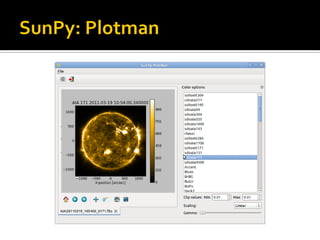
   Spatially aware maps
   Read FITS files
       RHESSI
       SDO/AIA
       EIT
       TRACE
       LASCO
   standard color tables and hist equalization
   basic image coalignment
   VSO
   HEK
   Spatially aware array
   NumPy array
   Based on SolarSoft Map.

   MapCube
   Two APIs
     Legacy API (tries to mimic IDL vso_search)
     New API based on boolean operations
   Create VSO queries from HER responses
   WIP: Plot HER events over images
   Use it!
   File feature requests
   Express opinion on the mailing list / in IRC
   File bug reports
   Contribute documentation
   Contribute code
   Website: http://sunpy.org
   Mailing list: http://bit.ly/sunpy-forum
   IRC: #sunpy on irc.freenode.net
   Git code repository:
    https://github.com/sunpy/sunpy
   Email: florian.mayer@bitsrc.org
   IRC: __name__ in #sunpy on freenode
   XMPP: segfaulthunter@jabber.ccc.de
   SciPy: http://scipy.org
   Astronomical modules: http://bit.ly/astropy
   Science modules: http://bit.ly/sciencepy
   NumPy/IDL: http://hvrd.me/numpy-idl
   Python for interactive data analysis:
    http://bit.ly/pydatatut
   SciPy lecture notes: http://bit.ly/scipylec
   This talk: http://graz-talk.bitsrc.org
   SunPy doc: http://sunpy.org/doc/
   Steven Christe1,
   Matt Earnshaw2
   Keith Hughitt1
   Jack Ireland1             Thanks to
   Florian Mayer3
   Albert Shih1
   Alex Young1
1 NASA GSFC
2 Imperial College London
3 Vienna University of Technology

SunPy: Python for solar physics

  • 1.
    Steven Christe1,, MattEarnshaw2, Keith Hughitt1, Jack Ireland1, Florian Mayer3, Albert Shih1, Alex Young1 1 NASA GSFC 2 Imperial College London 3 Vienna University of Technology Florian Mayer
  • 2.
    What is Python?  Introduction to Python  Scientific Python  NumPy  Matplotlib  SciPy  Python in solar physics
  • 3.
    General-purpose  Object-oriented (disputed)  Cross-platform  Windows  Mac OS  Linux  Other Unices (FreeBSD, Solaris, etc.)  High-level
  • 4.
    Internet companies  Google  Rackspace  Games  Battlefield 2  Civilization 4  Graphics  Walt Disney  Science  NASA  ESRI
  • 5.
    Easy  Comprehensive standard library (“batteries included”) Quality does vary, though.  Good support for scientific tasks  Permissive open-source license On the downside:  Slower, but ways to speed up
  • 6.
    PYTHON IDL  Free open-source software  Proprietary software  Without cost  License cost  General purpose  Small community  Good plotting  Cumbersome plotting  No solar software  Solar software
  • 7.
    Implementation started 1989 by Guido van Rossum (BDFL)  2.0 appeared 2000  Garbage collection  Unicode  3.0 appeared 2008
  • 8.
    Astronomy  Artificial intelligence & machine learning  Bayesian Statistics  Biology (including Neuroscience)  Dynamical systems  Economics and Econometrics  Electromagnetics  Electrical Engineering  Geosciences  Molecular modeling  Signal processing  Symbolic math, number theory
  • 9.
    pyFITS – read FITS files  pyRAF – run IRAF tasks  pywcs  pyephem – compute positions of objects in space  spacepy (space sciences, just released)  Planned standard library AstroPy
  • 10.
    Beautiful is better than ugly.  Explicit is better than implicit.  Simple is better than complex.  Readability counts.  There should be one – and preferably only one – obvious way to do it.  Although that way may not be obvious at first unless you're Dutch.  >>> import this
  • 11.
  • 12.
    Infix notation operations  Python 2 defaults to floor division  More mathematical operations in math  Complex math in cmath
  • 13.
    Integers are arbitrary size.  Floats are platform doubles.  decimal module for arbitrary precision decimal numbers  fractions module for fractions
  • 14.
    STRINGS / BYTES UNICODE  "foo"  u"foo"  Store bytes  Store unicode codepoints  Useful for binary data  Useful for text  Behave as expected for multibyte characters
  • 15.
    [1, 2, 3, 4]  (1, u"foo")  Mutable  Immutable  Multiple records  Different objects describing one record
  • 16.
    if/elif/else  for-loop  break  continue  else  while-loop  pass
  • 17.
    Default arguments are evaluated once at compile time!  lambda alternative syntax for definition of trivial functions  Functions are objects, too!
  • 18.
    Unordered key-value mappings  Approx. O(1) lookup and storage  Keys must be immutable (hashable)
  • 19.
    Unordered collection of unique objects  Approx. O(1) membership test  Members must be immutable (hashable)
  • 20.
    Classes  Explicit self  Multiple inheritance  Also in IDL 8; no escaping it
  • 21.
    try / except / else  raise  Exceptions inherit from Exception
  • 22.
    PYTHON 2.7 PYTHON 3.2  Print statement  Print function  String / Unicode  Bytes / String  Floor division  Float Division  Relative imports  Absolute imports  Lists  Views Tons of other changes http://bit.ly/newpy3
  • 23.
    Fundamental package for science in Python  Multidimensional fixed-size, homogenous arrays  Derived objects: e.g. matrices  More efficient  Less code
  • 24.
    Python list  arange  linspace / logspace  ones / zeros / eye / diag  random
  • 25.
    Absence of explicit looping  Conciseness – less bugs  Closer to mathematical notation  More pythonic.  Also possible for user functions
  • 26.
    Expansion of multidimensional arrays  Implicit element-by-element behavior
  • 33.
    Boolean area  Integer area
  • 34.
    Type Remarks Character code byte compatible: C char 'b' short compatible: C short 'h' intc compatible: C int 'i' int_ compatible: Python int 'l' longlong compatible: C long long 'q' large enough to fit a intp 'p' pointer int8 8 bits int16 16 bits int32 32 bits int64 64 bits
  • 35.
    Type Remarks Character code ubyte compatible: C u. char 'B' ushort compatible: C u. short 'H' uintc compatible: C unsigned int 'I' uint compatible: Python int 'L' ulonglong compatible: C long long 'Q' large enough to fit a uintp 'P' pointer uint8 8 bits uint16 16 bits uint32 32 bits uint64 64 bits
  • 36.
    Type Remarks Character code half 'e' single compatible: C float 'f' double compatible: C double float_ compatible: Python float 'd' longfloat compatible: C long float 'g' float16 16 bits float32 32 bits float64 64 bits float96 96 bits, platform? float128 128 bits, platform?
  • 37.
    Type Remarks Character code csingle 'F' compatible: Python complex_ 'D' complex clongfloat 'G' complex64 two 32-bit floats complex128 two 64-bit floats two 96-bit floats, complex192 platform? two 128-bit floats, complex256 platform?
  • 38.
    NumPy: weave.blitz (fast NumPy expressions)  NumPy: weave.inline (inline C/C++)  f2py (interface Fortran)  Pyrex/Cython (python-like compiled language)
  • 39.
     2D plottinglibrary  Some 3D support  Publication-quality figures  “Make easy things easy and hard things possible”  Configurable using matplotlibrc
  • 40.
    import numpy asnp from matplotlib import pyplot as plt t = np.linspace(0, 2, 200) s = np.sin(2*pi*t) plt.plot(t, s, linewidth=1.0) plt.xlabel('time (s)') plt.ylabel('voltage (mV)') plt.title('About as simple as it gets, folks') plt.grid(True) plt.show()
  • 41.
    import numpy asnp from matplotlib import pyplot as plt def f(t): s1 = np.cos(2*pi*t) e1 = np.exp(-t) return np.multiply(s1,e1) t1 = np.arange(0.0, 5.0, 0.1) t2 = np.arange(0.0, 5.0, 0.02) t3 = np.arange(0.0, 2.0, 0.01) plt.subplot(211) l = plot(t1, f(t1), 'bo', t2, f(t2), 'k--', markerfacecolor='green') plt.grid(True) plt.title('A tale of 2 subplots') plt.ylabel('Damped oscillation') plt.subplot(212) plt.plot(t3, np.cos(2*pi*t3), 'r.') plt.grid(True) plt.xlabel('time (s)') plt.ylabel('Undamped') plt.show()
  • 42.
    import numpy as np import matplotlib.path as mpath import matplotlib.patches as mpatches import matplotlib.pyplot as plt Path = mpath.Path fig = plt.figure() ax = fig.add_subplot(111) pathdata = [ (Path.MOVETO, (1.58, -2.57)), (Path.CURVE4, (0.35, -1.1)), (Path.CURVE4, (-1.75, 2.0)), (Path.CURVE4, (0.375, 2.0)), (Path.LINETO, (0.85, 1.15)), (Path.CURVE4, (2.2, 3.2)), (Path.CURVE4, (3, 0.05)), (Path.CURVE4, (2.0, -0.5)), (Path.CLOSEPOLY, (1.58, -2.57)), ] codes, verts = zip(*pathdata) path = mpath.Path(verts, codes) patch = mpatches.PathPatch(path, facecolor='red', edgecolor='yellow', alpha=0.5) ax.add_patch(patch) x, y = zip(*path.vertices) line, = ax.plot(x, y, 'go-') ax.grid() ax.set_xlim(-3,4) ax.set_ylim(-3,4) ax.set_title('spline paths') plt.show()
  • 43.
    from mpl_toolkits.mplot3d importAxes3D from matplotlib import cm from matplotlib.ticker import (LinearLocator, FixedLocator, FormatStrFormatter) import matplotlib.pyplot as plt import numpy as np fig = plt.figure() ax = fig.gca(projection='3d') X = np.arange(-5, 5, 0.25) Y = np.arange(-5, 5, 0.25) X, Y = np.meshgrid(X, Y) R = np.sqrt(X**2 + Y**2) Z = np.sin(R) surf = ax.plot_surface(X, Y, Z, rstride=1, cstride=1, cmap=cm.jet, linewidth=0, antialiased=False) ax.set_zlim3d(-1.01, 1.01) ax.w_zaxis.set_major_locator(LinearLocator(10)) ax.w_zaxis.set_major_formatter(FormatStrFormatter('%.03f')) fig.colorbar(surf, shrink=0.5, aspect=5) plt.show()
  • 44.
    import numpy asnp from matplotlib import pyplot as plt from matplotlib.patches import Ellipse NUM = 250 ells = [ Ellipse(xy=rand(2)*10, width=np.rand(), height=np.rand(), angle=np.rand()*360) for i in xrange(NUM)] fig = plt.figure() ax = fig.add_subplot(111, aspect='equal') for e in ells: ax.add_artist(e) e.set_clip_box(ax.bbox) e.set_alpha(rand()) e.set_facecolor(rand(3)) ax.set_xlim(0, 10) ax.set_ylim(0, 10) plt.show()
  • 47.
    Statistics  Optimization  Numerical integration  Linear algebra  Fourier transforms  Signal processing  Image processing  ODE solvers  Special functions  And more.
  • 48.
    Three phases  Glass sample – light grey  Bubbles – black  Sand grains – dark grey  Determine  Fraction of the sample covered by these  Typical size of sand grains or bubbles
  • 49.
    1. Open image and examine it 2. Crop away panel at bottom  Examine histogram 3. Apply median filter 4. Determine thresholds 5. Display colored image 6. Use mathematical morphology to clean the different phases 7. Attribute labels to all bubbles and sand grains  Remove from the sand mask grains that are smaller than 10 pixels 8. Compute the mean size of bubbles.
  • 50.
    Spatially aware maps  Read FITS files  RHESSI  SDO/AIA  EIT  TRACE  LASCO  standard color tables and hist equalization  basic image coalignment  VSO  HEK
  • 51.
    Spatially aware array  NumPy array  Based on SolarSoft Map.  MapCube
  • 52.
    Two APIs  Legacy API (tries to mimic IDL vso_search)  New API based on boolean operations
  • 53.
    Create VSO queries from HER responses  WIP: Plot HER events over images
  • 55.
    Use it!  File feature requests  Express opinion on the mailing list / in IRC  File bug reports  Contribute documentation  Contribute code
  • 56.
    Website: http://sunpy.org  Mailing list: http://bit.ly/sunpy-forum  IRC: #sunpy on irc.freenode.net  Git code repository: https://github.com/sunpy/sunpy
  • 57.
    Email: florian.mayer@bitsrc.org  IRC: __name__ in #sunpy on freenode  XMPP: segfaulthunter@jabber.ccc.de
  • 58.
    SciPy: http://scipy.org  Astronomical modules: http://bit.ly/astropy  Science modules: http://bit.ly/sciencepy  NumPy/IDL: http://hvrd.me/numpy-idl  Python for interactive data analysis: http://bit.ly/pydatatut  SciPy lecture notes: http://bit.ly/scipylec  This talk: http://graz-talk.bitsrc.org  SunPy doc: http://sunpy.org/doc/
  • 59.
    Steven Christe1,  Matt Earnshaw2  Keith Hughitt1  Jack Ireland1 Thanks to  Florian Mayer3  Albert Shih1  Alex Young1 1 NASA GSFC 2 Imperial College London 3 Vienna University of Technology