A
PRESENTATION
OFSUMMERTRAINING DONE
ON
CHROME TANNED
LEATHER
AT
SUPER TANNERY INDIA LTD.
JAJMAU, KANPUR
PREPARED BY :
ANAM KHANAM
CSJMA11001390186
ABOUT THE COMPANY
Super Tannery Ltd (STL), established in 1953, started operations by processing 50
Buffalo hides per day, converting them into Vegetable Tanned Leather for shoe soles.
Since then, the company, well guided by a professional approach, has marked an
important name for itself in the world leather map, making it, one of the oldest and
well reputed business houses of Northern India.
Footwear:
Military
Safety
Casual and Formal
Kids
Leather for:
Safety and Casual
Footwear
Upholstery
Lining
Shoe soles
Equestrian
equipment
Accessories:
Bags
Belts
Jackets
Jewellery
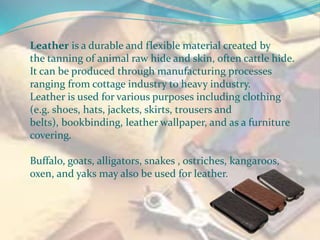
Leather is a durable and flexible material created by
the tanning of animal raw hide and skin, often cattle hide.
It can be produced through manufacturing processes
ranging from cottage industry to heavy industry.
Leather is used for various purposes including clothing
(e.g. shoes, hats, jackets, skirts, trousers and
belts), bookbinding, leather wallpaper, and as a furniture
covering.
Buffalo, goats, alligators, snakes , ostriches, kangaroos,
oxen, and yaks may also be used for leather.
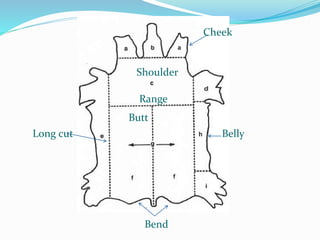
Cheek
Shoulder
Belly
Bend
Butt
Long cut
Range
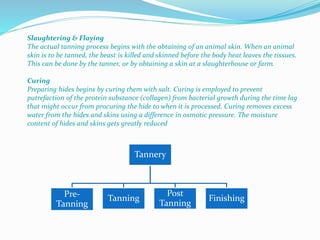
Slaughtering & Flaying
The actual tanning process begins with the obtaining of an animal skin. When an animal
skin is to be tanned, the beast is killed and skinned before the body heat leaves the tissues.
This can be done by the tanner, or by obtaining a skin at a slaughterhouse or farm.
Curing
Preparing hides begins by curing them with salt. Curing is employed to prevent
putrefaction of the protein substance (collagen) from bacterial growth during the time lag
that might occur from procuring the hide to when it is processed. Curing removes excess
water from the hides and skins using a difference in osmotic pressure. The moisture
content of hides and skins gets greatly reduced
Tannery
Pre-
Tanning
Tanning
Post
Tanning
Finishing
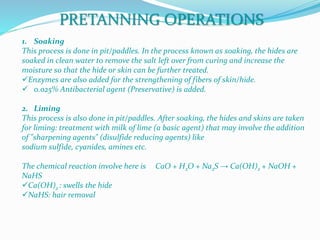
1. Soaking
This process is done in pit/paddles. In the process known as soaking, the hides are
soaked in clean water to remove the salt left over from curing and increase the
moisture so that the hide or skin can be further treated.
Enzymes are also added for the strengthening of fibers of skin/hide.
 0.025% Antibacterial agent (Preservative) is added.
2. Liming
This process is also done in pit/paddles. After soaking, the hides and skins are taken
for liming: treatment with milk of lime (a basic agent) that may involve the addition
of "sharpening agents" (disulfide reducing agents) like
sodium sulfide, cyanides, amines etc.
The chemical reaction involve here is CaO + H2O + Na2S → Ca(OH)2 + NaOH +
NaHS
Ca(OH)2 : swells the hide
NaHS: hair removal
PRETANNING OPERATIONS
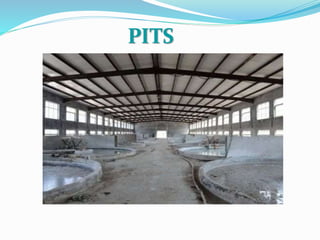
PITS
Mechanical Operations
Unhairing and scudding
Unhairing agents used at this time are: Sodium sulfide, sodium hydroxide, sodium
hydrosulfite, calcium hydrosulfide, dimethyl amine, and Sodium sulfhydrate. The
majority of hair is then removed mechanically, initially with a machine and then by hand
using a dull knife, a process known as scudding.
Fleshing
This is a continuation of the scraping or fleshing that was done by hand. In the tannery it
is completed on a shaving machine. It has the effect of stretching the skin as well as
cleaning the flesh side.
3. Deliming and bating
The pH of the collagen is brought down to a lower level so that enzymes may act on it, in
a process is known as deliming. Deliming agents used are commonly
(NH)4SO4
NH4Cl
Mostly (NH)4SO4 is used in industry as it has less ammoniacal nitrogen content
4.Pickling
Once bating is complete, the hides and skins are treated with a mixture
of common (table) salt and sulfuric acid, in case a mineral tanning is to
be done. This is done to bring down the pH of collagen to a very low
level so as to facilitate the penetration of mineral tanning agent into
the substance. This process is known as pickling. The common salt
(sodium chloride) penetrates the hide twice as fast as the acid and
checks the ill effect of sudden drop of pH.
Reaction involved here is
NaCl + H2O → NaOH + HCl
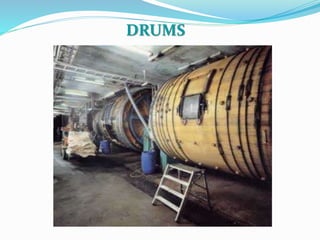
DRUMS
Tanning
Vegetable
Tanning
Chrome
tanning
Other
Materials
Chrome-tanned leather, invented in 1858, is tanned
using chromium sulfate and other salts of chromium. It is
more supple and pliable than vegetable-tanned leather and
does not discolor or lose shape as drastically in water as
vegetable-tanned. It is also known as wet-blue for its color
derived from the chromium. More esoteric colors are
possible using chrome tanning.
Chromium(III)sulfate([Cr(H2O)6]2(SO4)3) has long been
regarded as the most efficient and effective tanning
agent. Chromium(III) compounds of the sort used in
tanning are significantly less toxic than hexavalent
chromium.
CHROME TANNING
Basic Chromium Sulphate
Main advantages of chrome tanning
Quick and easy to produce, usually only taking up to a
day
Water can roll off the surface easily with appropriate
retanning and finishing processes
Soft and supple to the touch
It is possible to obtain leather with a stable colour
It is cheaper to buy than vegetable tanned leather, which
means it is also easier to find
It has a high degree of thermal resistance
Mechanical Operations:-
•Selection
•Splitting
•Shaving
•Trimming
•Weighing
Post Tanning Operations
•Wet Back
•Re-Chroming
•Neutralization & Washing
•Re-Tanning & Dyeing
• Fat Liquoring
•Fixing
Mechanical Operations:-
•Sammying
•Setting
•Vacuum Drying
•Hang Drying & Toggling
•Stacking
•Trimming
SAMMYING MACHINE
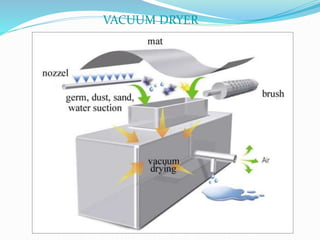
VACUUM DRYER
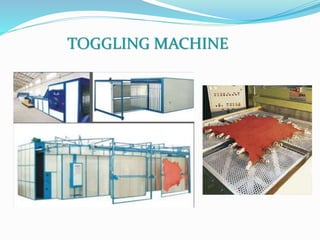
TOGGLING MACHINE
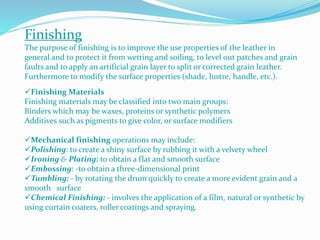
Finishing
The purpose of finishing is to improve the use properties of the leather in
general and to protect it from wetting and soiling, to level out patches and grain
faults and to apply an artificial grain layer to split or corrected grain leather.
Furthermore to modify the surface properties (shade, lustre, handle, etc.).
Finishing Materials
Finishing materials may be classified into two main groups:
Binders which may be waxes, proteins or synthetic polymers
Additives such as pigments to give color, or surface modifiers
Mechanical finishing operations may include:
Polishing: to create a shiny surface by rubbing it with a velvety wheel
Ironing & Plating: to obtain a flat and smooth surface
Embossing: -to obtain a three-dimensional print
Tumbling: - by rotating the drum quickly to create a more evident grain and a
smooth surface
Chemical Finishing: - involves the application of a film, natural or synthetic by
using curtain coaters, roller coatings and spraying.
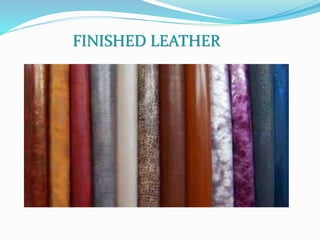
FINISHED LEATHER
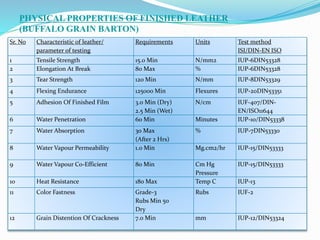
Sr. No Characteristic of leather/
parameter of testing
Requirements Units Test method
ISI/DIN-EN ISO
1 Tensile Strength 15.0 Min N/mm2 IUP-6DIN53328
2 Elongation At Break 80 Max % IUP-6DIN53328
3 Tear Strength 120 Min N/mm IUP-8DIN53329
4 Flexing Endurance 125000 Min Flexures IUP-20DIN53351
5 Adhesion Of Finished Film 3.0 Min (Dry)
2.5 Min (Wet)
N/cm IUF-407/DIN-
EN/ISO11644
6 Water Penetration 60 Min Minutes IUP-10/DIN53338
7 Water Absorption 30 Max
(After 2 Hrs)
% IUP-7DIN53330
8 Water Vapour Permeability 1.0 Min Mg.cm2/hr IUP-15/DIN53333
9 Water Vapour Co-Efficient 80 Min Cm Hg
Pressure
IUP-15/DIN53333
10 Heat Resistance 180 Max Temp C IUP-13
11 Color Fastness Grade-3
Rubs Min 50
Dry
Rubs IUF-2
12 Grain Distention Of Crackness 7.0 Min mm IUP-12/DIN53324
PHYSICAL PROPERTIES OF FINISHED LEATHER
(BUFFALO GRAIN BARTON)
Sr.
No.
Characteristic of leather/
parameter of testing
Requirements Test method
ISI/DIN-EN ISO
1 Determination of moisture 10-16 IUP-2
2 Determination of Total Ash 2.0 max IUP-7/DIN-EN/ISO4047
3 Determination Of Sulphated
Ash Water Soluble
0.5 max IUP-7/DIN-EN/ISO4047
4 Determination Of Solvent
Extractable Substances
3-12 IUP-8/DIN-EN/ISO4048
5 Determination Of Nitrogen &
Hide Substances
1.4 max IUP-10/DIN53308
6 Determination Of Water
Soluble Matters
2.0 max IUP-6/DIN53307
7 Determination Of Chromium
Oxide
2.5 max IUP-8/DIN53309
8 Determination Of pH 3.5 max IUP-11/DIN-EN/ISO4045
CHEMICAL PROPERTIES OF FINISHED LEATHER
(BUFFALO GRAIN BARTON)
NOTE: - Except pH all requirements are in %.
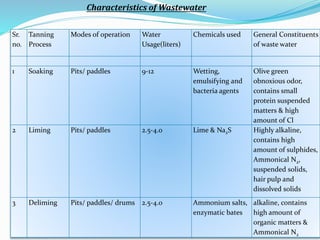
WASTE GENERATION IN TANNERIES
Tanning industry is one of the oldest industries in the world. It is typically
characterized as pollutants generated industries which produce wide varieties of
high strength toxic chemicals. It is recognized as a serious environmental threat
due to high chemical levels including salinity, organic load (chemical oxygen load
or demand, biological oxygen demand), inorganic matter, dissolved, suspended
solids, ammonia, specific pollutants (sulfide, chromium, chloride, sodium and
other salt residues) and heavy metals etc
Water usage and waste water discharge
Raw to Wet Blue= 25-30 l/kg of hide.
Raw to finish= 30-40 l/kg of hide
Sr.
no.
Tanning
Process
Modes of operation Water
Usage(liters)
Chemicals used General Constituents
of waste water
1 Soaking Pits/ paddles 9-12 Wetting,
emulsifying and
bacteria agents
Olive green
obnoxious odor,
contains small
protein suspended
matters & high
amount of Cl
2 Liming Pits/ paddles 2.5-4.0 Lime & Na2S Highly alkaline,
contains high
amount of sulphides,
Ammonical N2,
suspended solids,
hair pulp and
dissolved solids
3 Deliming Pits/ paddles/ drums 2.5-4.0 Ammonium salts,
enzymatic bates
alkaline, contains
high amount of
organic matters &
Ammonical N2
Characteristics of Wastewater
4 Pickling &
Chrome
tanning
Drums 2.0-3.0 Common salt,
acids/basic
chrome salts
Colored ,acidic,
contains high
amount of trivalent
chromium, TDS
and Cl, acidic dyes
& oil emulsion
5 Dyeing & fat
liquoring
Drums 1.0-1.5 Dyes & fatty
acids
6 Composite
waste water
including
washing (raw
to finish)
30-40 Alkaline, colored
contains soluble
proteins,
chromium, high
TDS & Cl, sulfides
and SS
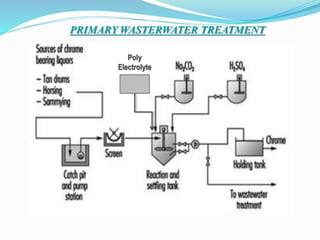
Poly
Electrolyte
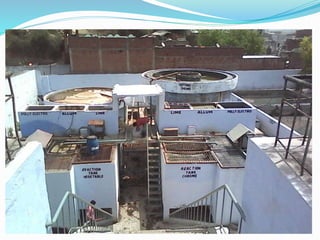
PRIMARY WASTERWATER TREATMENT
Chromium (VI) – the source
It is essential to identify the possible sources of Cr(VI) and the possible generation
of the same during the leather and product manufacturing process.
The possible direct sources of Cr(VI) are the Basic Chromium Sulfate (BCS) used as a
tanning agent, certain class of metal complex dyes and inorganic pigments.
Particularly in the case of pigments based on lead chromate is a possible source of
hexavalent chromium.
Unreduced chromium present tin the leather auxiliaries are the direct source of
Cr(VI). Apart from the direct sources many tools, substances, auxiliaries, chemicals
and process parameters could contribute significantly to the conversion of trivalent
chromium into hexavalent chromium.
Oxidation of Cr(III) to Cr(VI) by oxygen in air during the processes carried out at
higher pH in leather and footwear manufacturing process is an important cause of
Cr(VI) generation.
Some of the possibilities of generation of Cr(VI) are presented below
1. Neutralization
2. Ammonia Treatment
3. Thermal and Photo-ageing
4. Fat liquors
5. Adhesives Used in Product making
Avoidance and Mitigation
• The background of the possible sources of Cr(VI) and possibilities of Cr (VI)
formation torches the pathway of solution to the problem. It is obvious and
principally important to avoid the direct sources of Cr(VI).
• The BCS used for tanning needs to be screened for the level of Cr(VI) and
avoided if found to contain significant mass of Cr(VI).
• The process of Chrome tanning needs to be controlled and monitored.
• Similarly the Dyes and Pigments shall be chosen for processing only if they
contain no or undetectable levels of Cr(VI).
• Fat liquors including synthetic or natural, especially fish oil based fat liquors
with single or multiple unsaturated fatty acids shall be avoided.
• Exposure to direct sunlight for drying may be avoided.
The Various Purity tests done there are:-
1. To determine the Chromium oxide (Cr2O3)
Amount of Cr2O3 3.1675 %
2. To check the purity of recovered BCS From BCS Recovery Plant
Result: 1.26 kg BCS= 0.29 kg Cr2O3
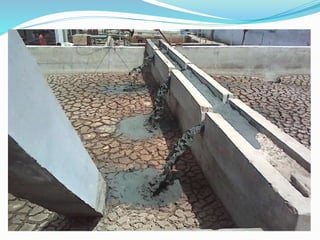
3. To analyze the following parameters after Primary Treatment of Tannery
Effluent, i.e.
Total Suspended Solids in treated water
Presence Of Chromium VI+
pH of the water after treatment
Result:
 TSS in water after treatment is 240 mg/l
 No pink color appears in the sample of treated water. So below the limit.
 The ph of treated water is 7.6
summer training ppt_2_1

summer training ppt_2_1

  • 1.
    A PRESENTATION OFSUMMERTRAINING DONE ON CHROME TANNED LEATHER AT SUPERTANNERY INDIA LTD. JAJMAU, KANPUR PREPARED BY : ANAM KHANAM CSJMA11001390186
  • 2.
    ABOUT THE COMPANY SuperTannery Ltd (STL), established in 1953, started operations by processing 50 Buffalo hides per day, converting them into Vegetable Tanned Leather for shoe soles. Since then, the company, well guided by a professional approach, has marked an important name for itself in the world leather map, making it, one of the oldest and well reputed business houses of Northern India. Footwear: Military Safety Casual and Formal Kids Leather for: Safety and Casual Footwear Upholstery Lining Shoe soles Equestrian equipment Accessories: Bags Belts Jackets Jewellery
  • 3.
    Leather is adurable and flexible material created by the tanning of animal raw hide and skin, often cattle hide. It can be produced through manufacturing processes ranging from cottage industry to heavy industry. Leather is used for various purposes including clothing (e.g. shoes, hats, jackets, skirts, trousers and belts), bookbinding, leather wallpaper, and as a furniture covering. Buffalo, goats, alligators, snakes , ostriches, kangaroos, oxen, and yaks may also be used for leather.
  • 4.
  • 6.
    Slaughtering & Flaying Theactual tanning process begins with the obtaining of an animal skin. When an animal skin is to be tanned, the beast is killed and skinned before the body heat leaves the tissues. This can be done by the tanner, or by obtaining a skin at a slaughterhouse or farm. Curing Preparing hides begins by curing them with salt. Curing is employed to prevent putrefaction of the protein substance (collagen) from bacterial growth during the time lag that might occur from procuring the hide to when it is processed. Curing removes excess water from the hides and skins using a difference in osmotic pressure. The moisture content of hides and skins gets greatly reduced Tannery Pre- Tanning Tanning Post Tanning Finishing
  • 7.
    1. Soaking This processis done in pit/paddles. In the process known as soaking, the hides are soaked in clean water to remove the salt left over from curing and increase the moisture so that the hide or skin can be further treated. Enzymes are also added for the strengthening of fibers of skin/hide.  0.025% Antibacterial agent (Preservative) is added. 2. Liming This process is also done in pit/paddles. After soaking, the hides and skins are taken for liming: treatment with milk of lime (a basic agent) that may involve the addition of "sharpening agents" (disulfide reducing agents) like sodium sulfide, cyanides, amines etc. The chemical reaction involve here is CaO + H2O + Na2S → Ca(OH)2 + NaOH + NaHS Ca(OH)2 : swells the hide NaHS: hair removal PRETANNING OPERATIONS
  • 8.
  • 9.
    Mechanical Operations Unhairing andscudding Unhairing agents used at this time are: Sodium sulfide, sodium hydroxide, sodium hydrosulfite, calcium hydrosulfide, dimethyl amine, and Sodium sulfhydrate. The majority of hair is then removed mechanically, initially with a machine and then by hand using a dull knife, a process known as scudding. Fleshing This is a continuation of the scraping or fleshing that was done by hand. In the tannery it is completed on a shaving machine. It has the effect of stretching the skin as well as cleaning the flesh side. 3. Deliming and bating The pH of the collagen is brought down to a lower level so that enzymes may act on it, in a process is known as deliming. Deliming agents used are commonly (NH)4SO4 NH4Cl Mostly (NH)4SO4 is used in industry as it has less ammoniacal nitrogen content
  • 10.
    4.Pickling Once bating iscomplete, the hides and skins are treated with a mixture of common (table) salt and sulfuric acid, in case a mineral tanning is to be done. This is done to bring down the pH of collagen to a very low level so as to facilitate the penetration of mineral tanning agent into the substance. This process is known as pickling. The common salt (sodium chloride) penetrates the hide twice as fast as the acid and checks the ill effect of sudden drop of pH. Reaction involved here is NaCl + H2O → NaOH + HCl
  • 11.
  • 12.
  • 13.
    Chrome-tanned leather, inventedin 1858, is tanned using chromium sulfate and other salts of chromium. It is more supple and pliable than vegetable-tanned leather and does not discolor or lose shape as drastically in water as vegetable-tanned. It is also known as wet-blue for its color derived from the chromium. More esoteric colors are possible using chrome tanning. Chromium(III)sulfate([Cr(H2O)6]2(SO4)3) has long been regarded as the most efficient and effective tanning agent. Chromium(III) compounds of the sort used in tanning are significantly less toxic than hexavalent chromium. CHROME TANNING
  • 14.
  • 15.
    Main advantages ofchrome tanning Quick and easy to produce, usually only taking up to a day Water can roll off the surface easily with appropriate retanning and finishing processes Soft and supple to the touch It is possible to obtain leather with a stable colour It is cheaper to buy than vegetable tanned leather, which means it is also easier to find It has a high degree of thermal resistance
  • 16.
  • 17.
    Post Tanning Operations •WetBack •Re-Chroming •Neutralization & Washing •Re-Tanning & Dyeing • Fat Liquoring •Fixing Mechanical Operations:- •Sammying •Setting •Vacuum Drying •Hang Drying & Toggling •Stacking •Trimming
  • 18.
  • 19.
  • 20.
  • 21.
    Finishing The purpose offinishing is to improve the use properties of the leather in general and to protect it from wetting and soiling, to level out patches and grain faults and to apply an artificial grain layer to split or corrected grain leather. Furthermore to modify the surface properties (shade, lustre, handle, etc.). Finishing Materials Finishing materials may be classified into two main groups: Binders which may be waxes, proteins or synthetic polymers Additives such as pigments to give color, or surface modifiers Mechanical finishing operations may include: Polishing: to create a shiny surface by rubbing it with a velvety wheel Ironing & Plating: to obtain a flat and smooth surface Embossing: -to obtain a three-dimensional print Tumbling: - by rotating the drum quickly to create a more evident grain and a smooth surface Chemical Finishing: - involves the application of a film, natural or synthetic by using curtain coaters, roller coatings and spraying.
  • 22.
  • 23.
    Sr. No Characteristicof leather/ parameter of testing Requirements Units Test method ISI/DIN-EN ISO 1 Tensile Strength 15.0 Min N/mm2 IUP-6DIN53328 2 Elongation At Break 80 Max % IUP-6DIN53328 3 Tear Strength 120 Min N/mm IUP-8DIN53329 4 Flexing Endurance 125000 Min Flexures IUP-20DIN53351 5 Adhesion Of Finished Film 3.0 Min (Dry) 2.5 Min (Wet) N/cm IUF-407/DIN- EN/ISO11644 6 Water Penetration 60 Min Minutes IUP-10/DIN53338 7 Water Absorption 30 Max (After 2 Hrs) % IUP-7DIN53330 8 Water Vapour Permeability 1.0 Min Mg.cm2/hr IUP-15/DIN53333 9 Water Vapour Co-Efficient 80 Min Cm Hg Pressure IUP-15/DIN53333 10 Heat Resistance 180 Max Temp C IUP-13 11 Color Fastness Grade-3 Rubs Min 50 Dry Rubs IUF-2 12 Grain Distention Of Crackness 7.0 Min mm IUP-12/DIN53324 PHYSICAL PROPERTIES OF FINISHED LEATHER (BUFFALO GRAIN BARTON)
  • 25.
    Sr. No. Characteristic of leather/ parameterof testing Requirements Test method ISI/DIN-EN ISO 1 Determination of moisture 10-16 IUP-2 2 Determination of Total Ash 2.0 max IUP-7/DIN-EN/ISO4047 3 Determination Of Sulphated Ash Water Soluble 0.5 max IUP-7/DIN-EN/ISO4047 4 Determination Of Solvent Extractable Substances 3-12 IUP-8/DIN-EN/ISO4048 5 Determination Of Nitrogen & Hide Substances 1.4 max IUP-10/DIN53308 6 Determination Of Water Soluble Matters 2.0 max IUP-6/DIN53307 7 Determination Of Chromium Oxide 2.5 max IUP-8/DIN53309 8 Determination Of pH 3.5 max IUP-11/DIN-EN/ISO4045 CHEMICAL PROPERTIES OF FINISHED LEATHER (BUFFALO GRAIN BARTON) NOTE: - Except pH all requirements are in %.
  • 26.
    WASTE GENERATION INTANNERIES Tanning industry is one of the oldest industries in the world. It is typically characterized as pollutants generated industries which produce wide varieties of high strength toxic chemicals. It is recognized as a serious environmental threat due to high chemical levels including salinity, organic load (chemical oxygen load or demand, biological oxygen demand), inorganic matter, dissolved, suspended solids, ammonia, specific pollutants (sulfide, chromium, chloride, sodium and other salt residues) and heavy metals etc Water usage and waste water discharge Raw to Wet Blue= 25-30 l/kg of hide. Raw to finish= 30-40 l/kg of hide
  • 27.
    Sr. no. Tanning Process Modes of operationWater Usage(liters) Chemicals used General Constituents of waste water 1 Soaking Pits/ paddles 9-12 Wetting, emulsifying and bacteria agents Olive green obnoxious odor, contains small protein suspended matters & high amount of Cl 2 Liming Pits/ paddles 2.5-4.0 Lime & Na2S Highly alkaline, contains high amount of sulphides, Ammonical N2, suspended solids, hair pulp and dissolved solids 3 Deliming Pits/ paddles/ drums 2.5-4.0 Ammonium salts, enzymatic bates alkaline, contains high amount of organic matters & Ammonical N2 Characteristics of Wastewater
  • 28.
    4 Pickling & Chrome tanning Drums2.0-3.0 Common salt, acids/basic chrome salts Colored ,acidic, contains high amount of trivalent chromium, TDS and Cl, acidic dyes & oil emulsion 5 Dyeing & fat liquoring Drums 1.0-1.5 Dyes & fatty acids 6 Composite waste water including washing (raw to finish) 30-40 Alkaline, colored contains soluble proteins, chromium, high TDS & Cl, sulfides and SS
  • 29.
  • 32.
    Chromium (VI) –the source It is essential to identify the possible sources of Cr(VI) and the possible generation of the same during the leather and product manufacturing process. The possible direct sources of Cr(VI) are the Basic Chromium Sulfate (BCS) used as a tanning agent, certain class of metal complex dyes and inorganic pigments. Particularly in the case of pigments based on lead chromate is a possible source of hexavalent chromium. Unreduced chromium present tin the leather auxiliaries are the direct source of Cr(VI). Apart from the direct sources many tools, substances, auxiliaries, chemicals and process parameters could contribute significantly to the conversion of trivalent chromium into hexavalent chromium. Oxidation of Cr(III) to Cr(VI) by oxygen in air during the processes carried out at higher pH in leather and footwear manufacturing process is an important cause of Cr(VI) generation. Some of the possibilities of generation of Cr(VI) are presented below 1. Neutralization 2. Ammonia Treatment 3. Thermal and Photo-ageing 4. Fat liquors 5. Adhesives Used in Product making
  • 33.
    Avoidance and Mitigation •The background of the possible sources of Cr(VI) and possibilities of Cr (VI) formation torches the pathway of solution to the problem. It is obvious and principally important to avoid the direct sources of Cr(VI). • The BCS used for tanning needs to be screened for the level of Cr(VI) and avoided if found to contain significant mass of Cr(VI). • The process of Chrome tanning needs to be controlled and monitored. • Similarly the Dyes and Pigments shall be chosen for processing only if they contain no or undetectable levels of Cr(VI). • Fat liquors including synthetic or natural, especially fish oil based fat liquors with single or multiple unsaturated fatty acids shall be avoided. • Exposure to direct sunlight for drying may be avoided.
  • 34.
    The Various Puritytests done there are:- 1. To determine the Chromium oxide (Cr2O3) Amount of Cr2O3 3.1675 % 2. To check the purity of recovered BCS From BCS Recovery Plant Result: 1.26 kg BCS= 0.29 kg Cr2O3 3. To analyze the following parameters after Primary Treatment of Tannery Effluent, i.e. Total Suspended Solids in treated water Presence Of Chromium VI+ pH of the water after treatment Result:  TSS in water after treatment is 240 mg/l  No pink color appears in the sample of treated water. So below the limit.  The ph of treated water is 7.6