SUMMER TRAINING WORK ON 
ANTENNA DESIGN & VHDL 
Submitted By 
Vipin Yadav 
2K13-MRCE-MT-ECE-015
INDEX 
• Antenna Introduction 
• HFSS Software 
• Patch shapes and substrate 
• Design Specifications & Feeding techniques 
• Simulation results 
• VHDL & Its Coding Styles 
• Types of Modelling 
• Hierarchy & statements in VHDL
INTRODUCTION 
• An antenna is an electrical device which converts 
electric currents into radio waves, and vice versa. It 
is usually used with a radio transmitter or radio 
receiver. 
• In transmission, a radio transmitter applies an 
oscillating radio frequency electric current to the 
antenna's terminals, and the antenna radiates the 
energy from the current as electromagnetic waves 
(radio waves).
WHY ANTENNAS ? 
• Need of antenna arisen when two person wanted to 
communicate between them when separated by some 
distance and wired communication is not possible. 
• Antennas are required by any radio receiver or 
transmitter to couple its electrical connection to the 
electromagnetic field. 
• Radio waves are electromagnetic waves which carry 
signals through the air (or through space) at the 
speed of light with almost no transmission loss.
HFSS SOFTWARE 
• HFSS (high frequency structural simulator) is a high-performance 
full-wave electromagnetic(EM) field 
simulator for arbitrary 3D volumetric passive device 
modelling that takes advantage of the familiar Microsoft 
Windows graphical user interface. 
• It integrates simulation, visualization, solid modelling, 
and automation in an easy-to-learn environment where 
solutions to 3D EM problem are quickly and accurately 
obtained. 
• Ansoft HFSS employs the Finite Element Method(FEM), 
adaptive meshing, and brilliant graphics to give 
unparalleled performance and insight to all of your 3D EM 
problems.
Microstrip Antenna 
In its most basic form, a Microstrip patch antenna consists of a radiating patch on 
one 
side of a dielectric substrate which has a ground plane on the other side 
For good antenna performance, a thick dielectric substrate having a low dielectric 
constant is desirable since this provides better efficiency, larger bandwidth and better 
radiation . 
Structure of a Microstrip Patch Antenna 
 In genaral Micro strip antennas are also 
known as 
“ PRINTED ANTENNAS ”. 
 These are mostly used at microwave 
frequencies. 
 Because the size of the antenna is directly 
tied the wavelength at the resonant 
frequency. 
 Micro strip patch antenna or patch antenna 
is a narrowband wide-beam antenna.
Patch Shapes Are: 
(a) Single radiating patches 
(b) Single slot radiator
Substrates are: 
The most commonly used substrates are, 
1) Honey comb(dielectric constant=1.07) 
2)Duroid(dielectric constant=2.32) 
3)Quartz(dielectric constant=3.8) 
4)Alumina(dielectric constant=10) 
 A thicker substrate will increase the radiation 
power , reduce conductor loss and improve Band 
width.
Feeding Techniques: 
 Coaxial feed 
 Microstrip feed 
 Proximity coupled microstrip feed 
 Aperture coupled microstrip feed 
 Coplanar wave guide 
 Line Feed 
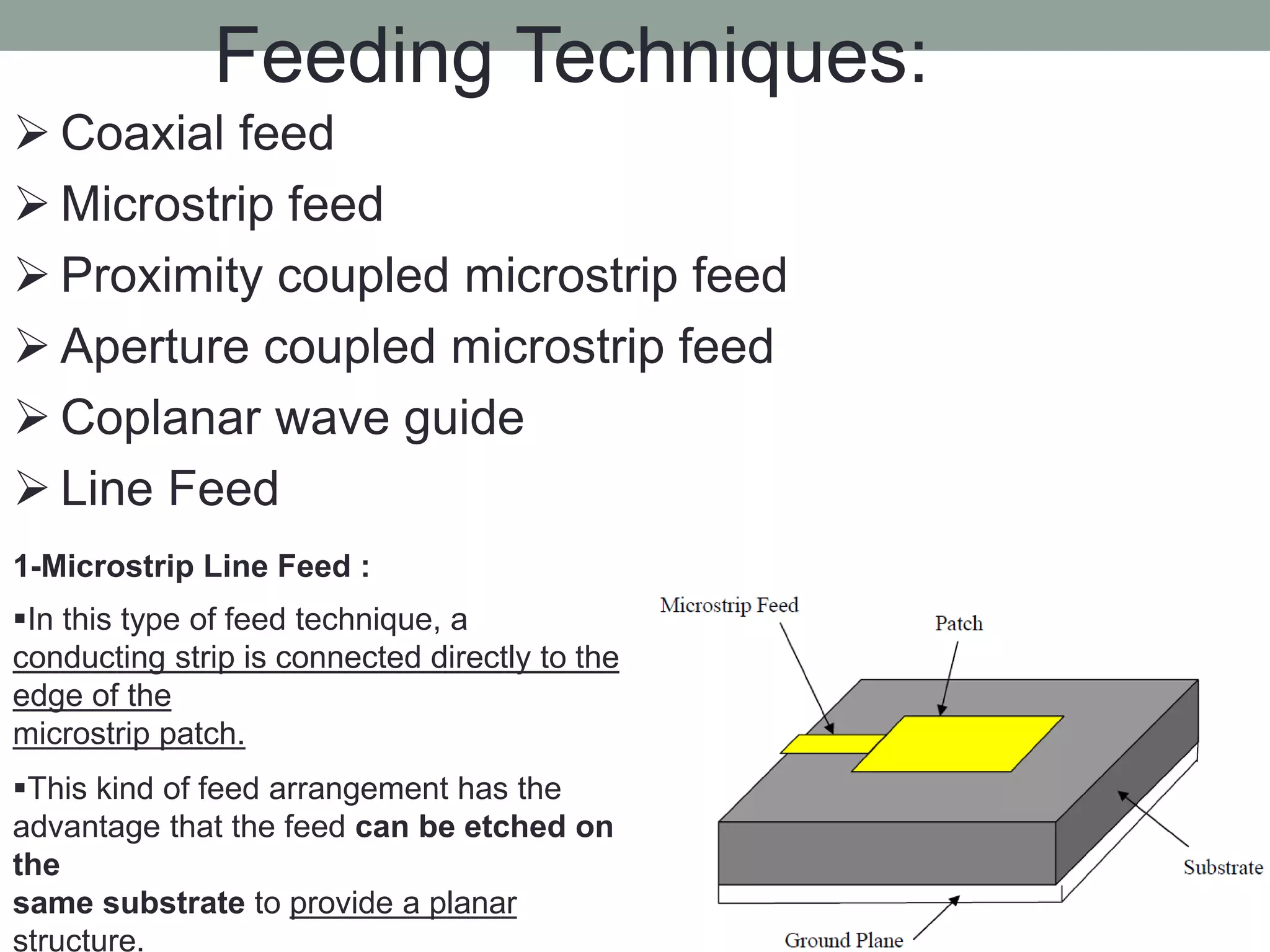
1-Microstrip Line Feed : 
In this type of feed technique, a 
conducting strip is connected directly to the 
edge of the 
microstrip patch. 
This kind of feed arrangement has the 
advantage that the feed can be etched on 
the 
same substrate to provide a planar 
structure.
2-Coaxial Feed :- 
The Coaxial feed or probe feed is a very common 
technique used for feeding Microstrip 
patch antennas. 
Probe fed Rectangular Microstrip 
Patch Antenna from top 
The main advantage of this type of 
feeding scheme is that the feed can be 
placed at any 
desired location inside the patch in order to 
match with its input impedance. 
This feed method is easy to fabricate and 
has low spurious radiation. 
However, its major disadvantage is that it 
Coaxial Ground Plane Connector 
Substrate 
Patch provides narrow bandwidth and is 
difficult to model since a hole has to be 
drilled in the substrate . and the connector 
protrudes outside the ground plane, thus 
not making it completely planar for thick 
substrates . 
Probe fed Rectangular Microstrip Patch Antenna 
from side view
3-Aperture Coupled Feed 
In this type of feed technique, the radiating 
patch and the microstrip feed line are separated 
by the ground plane . 
Coupling between the patch and the feed 
line is made through a slot or an aperture 
in the ground plane. 
The coupling aperture is usually centered under the Aperture-coupled feed 
patch, leading to lower cross polarization due to 
symmetry of the configuration. 
The amount of coupling from the feed line to the patch is determined by the shape, size 
and location of the aperture.
3.2 Project specifications 
Project Specs 
Operating Frequency : 1.575 GHz 
Input Impedance: 50 Ohm 
VSWR: 2:1 @ 1.575 GHz 
Polarization: RHCP 
Bandwidth: 3.8% (~60 MHz) 
Substrate 
RT/Duroid (Rogers Corp.) 
e= 2.22 
h= 125 mils 
tan d = 0.001
Simulation Results of a 1.575 GHz GPS 
Receiver Antenna Design 
Return Loss
VSWR PLOT 
2 D PATTERN
VHDL 
What does HDL stand for? 
HDL is short for Hardware Description Language 
(VHDL – VHSIC Hardware Description Language) 
(Very High Speed Integrated Circuit)
Basic Form of VHDL Code 
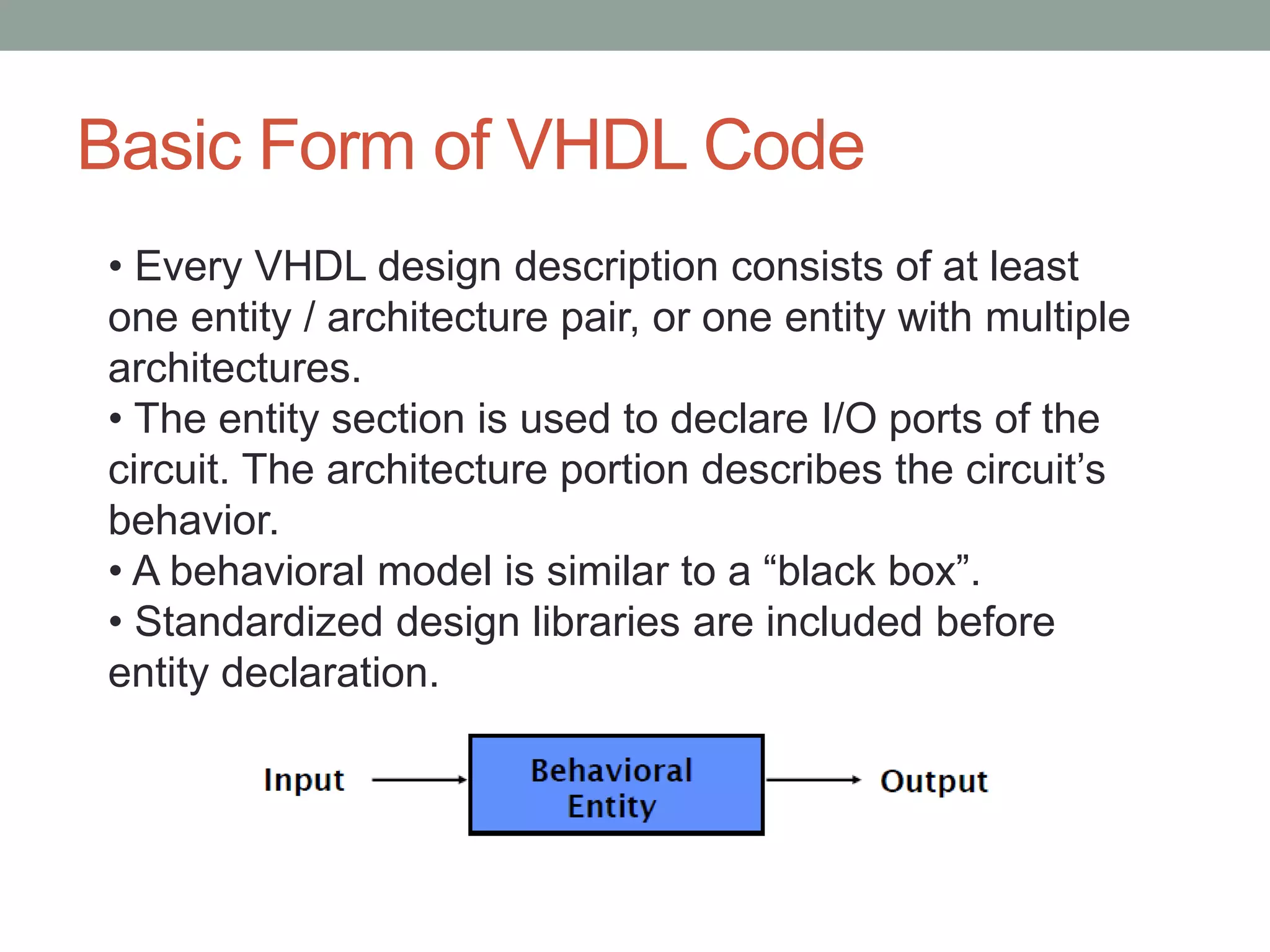
• Every VHDL design description consists of at least 
one entity / architecture pair, or one entity with multiple 
architectures. 
• The entity section is used to declare I/O ports of the 
circuit. The architecture portion describes the circuit’s 
behavior. 
• A behavioral model is similar to a “black box”. 
• Standardized design libraries are included before 
entity declaration.
Standard Libraries 
• Include library ieee; before entity declaration. 
• ieee.std_logic_1164 defines a standard for designers 
to use in describing interconnection data types used in 
VHDL modeling. 
• ieee.std_logic_arith provides a set of arithmetic, 
conversion, comparison functions for signed, 
unsigned, std_ulogic, std_logic, std_logic_vector. 
• Ieee.std_logic_unsigned provides a set of unsigned 
arithmetic, conversion, and comparison functions for 
std_logic_vector.
Entity Declaration 
• An entity declaration describes the interface of the component. 
• PORT clause indicates input and output ports. 
• An entity can be thought of as a symbol for a component.
Port Declaration 
• PORT declaration establishes the interface of the 
object to the outside world. 
• Three parts of the PORT declaration 
• Name 
• Any identifier that is not a reserved word. 
• Mode 
• In, Out, Inout, Buffer 
• Data type 
• Any declared or predefined datatype. 
• Sample PORT declaration syntax:
Architecture Declaration 
• Architecture declarations describe the operation of the 
component. 
• Many architectures may exist for one entity, but only one may be 
active at a time. 
• An architecture is similar to a schematic of the component.
Modeling Styles 
• There are three modeling styles: 
• Behavioral (Sequential) 
• Data flow 
• Structural
VHDL Hierarchy
Sequential vs Concurrent Statements 
• VHDL provides two different types of 
execution: sequential and concurrent. 
• Different types of execution are useful for 
modeling of real hardware. 
• Supports various levels of abstraction. 
• Sequential statements view hardware from a 
“programmer” approach. 
• Concurrent statements are order-independent 
and asynchronous.
Behavioural Style
Data flow Style
Structural Style
 microstrip antennae design & vhdl ppt

microstrip antennae design & vhdl ppt

  • 1.
    SUMMER TRAINING WORKON ANTENNA DESIGN & VHDL Submitted By Vipin Yadav 2K13-MRCE-MT-ECE-015
  • 2.
    INDEX • AntennaIntroduction • HFSS Software • Patch shapes and substrate • Design Specifications & Feeding techniques • Simulation results • VHDL & Its Coding Styles • Types of Modelling • Hierarchy & statements in VHDL
  • 3.
    INTRODUCTION • Anantenna is an electrical device which converts electric currents into radio waves, and vice versa. It is usually used with a radio transmitter or radio receiver. • In transmission, a radio transmitter applies an oscillating radio frequency electric current to the antenna's terminals, and the antenna radiates the energy from the current as electromagnetic waves (radio waves).
  • 4.
    WHY ANTENNAS ? • Need of antenna arisen when two person wanted to communicate between them when separated by some distance and wired communication is not possible. • Antennas are required by any radio receiver or transmitter to couple its electrical connection to the electromagnetic field. • Radio waves are electromagnetic waves which carry signals through the air (or through space) at the speed of light with almost no transmission loss.
  • 5.
    HFSS SOFTWARE •HFSS (high frequency structural simulator) is a high-performance full-wave electromagnetic(EM) field simulator for arbitrary 3D volumetric passive device modelling that takes advantage of the familiar Microsoft Windows graphical user interface. • It integrates simulation, visualization, solid modelling, and automation in an easy-to-learn environment where solutions to 3D EM problem are quickly and accurately obtained. • Ansoft HFSS employs the Finite Element Method(FEM), adaptive meshing, and brilliant graphics to give unparalleled performance and insight to all of your 3D EM problems.
  • 6.
    Microstrip Antenna Inits most basic form, a Microstrip patch antenna consists of a radiating patch on one side of a dielectric substrate which has a ground plane on the other side For good antenna performance, a thick dielectric substrate having a low dielectric constant is desirable since this provides better efficiency, larger bandwidth and better radiation . Structure of a Microstrip Patch Antenna  In genaral Micro strip antennas are also known as “ PRINTED ANTENNAS ”.  These are mostly used at microwave frequencies.  Because the size of the antenna is directly tied the wavelength at the resonant frequency.  Micro strip patch antenna or patch antenna is a narrowband wide-beam antenna.
  • 7.
    Patch Shapes Are: (a) Single radiating patches (b) Single slot radiator
  • 8.
    Substrates are: Themost commonly used substrates are, 1) Honey comb(dielectric constant=1.07) 2)Duroid(dielectric constant=2.32) 3)Quartz(dielectric constant=3.8) 4)Alumina(dielectric constant=10)  A thicker substrate will increase the radiation power , reduce conductor loss and improve Band width.
  • 9.
    Feeding Techniques: Coaxial feed  Microstrip feed  Proximity coupled microstrip feed  Aperture coupled microstrip feed  Coplanar wave guide  Line Feed 1-Microstrip Line Feed : In this type of feed technique, a conducting strip is connected directly to the edge of the microstrip patch. This kind of feed arrangement has the advantage that the feed can be etched on the same substrate to provide a planar structure.
  • 10.
    2-Coaxial Feed :- The Coaxial feed or probe feed is a very common technique used for feeding Microstrip patch antennas. Probe fed Rectangular Microstrip Patch Antenna from top The main advantage of this type of feeding scheme is that the feed can be placed at any desired location inside the patch in order to match with its input impedance. This feed method is easy to fabricate and has low spurious radiation. However, its major disadvantage is that it Coaxial Ground Plane Connector Substrate Patch provides narrow bandwidth and is difficult to model since a hole has to be drilled in the substrate . and the connector protrudes outside the ground plane, thus not making it completely planar for thick substrates . Probe fed Rectangular Microstrip Patch Antenna from side view
  • 11.
    3-Aperture Coupled Feed In this type of feed technique, the radiating patch and the microstrip feed line are separated by the ground plane . Coupling between the patch and the feed line is made through a slot or an aperture in the ground plane. The coupling aperture is usually centered under the Aperture-coupled feed patch, leading to lower cross polarization due to symmetry of the configuration. The amount of coupling from the feed line to the patch is determined by the shape, size and location of the aperture.
  • 12.
    3.2 Project specifications Project Specs Operating Frequency : 1.575 GHz Input Impedance: 50 Ohm VSWR: 2:1 @ 1.575 GHz Polarization: RHCP Bandwidth: 3.8% (~60 MHz) Substrate RT/Duroid (Rogers Corp.) e= 2.22 h= 125 mils tan d = 0.001
  • 13.
    Simulation Results ofa 1.575 GHz GPS Receiver Antenna Design Return Loss
  • 14.
    VSWR PLOT 2D PATTERN
  • 15.
    VHDL What doesHDL stand for? HDL is short for Hardware Description Language (VHDL – VHSIC Hardware Description Language) (Very High Speed Integrated Circuit)
  • 16.
    Basic Form ofVHDL Code • Every VHDL design description consists of at least one entity / architecture pair, or one entity with multiple architectures. • The entity section is used to declare I/O ports of the circuit. The architecture portion describes the circuit’s behavior. • A behavioral model is similar to a “black box”. • Standardized design libraries are included before entity declaration.
  • 17.
    Standard Libraries •Include library ieee; before entity declaration. • ieee.std_logic_1164 defines a standard for designers to use in describing interconnection data types used in VHDL modeling. • ieee.std_logic_arith provides a set of arithmetic, conversion, comparison functions for signed, unsigned, std_ulogic, std_logic, std_logic_vector. • Ieee.std_logic_unsigned provides a set of unsigned arithmetic, conversion, and comparison functions for std_logic_vector.
  • 18.
    Entity Declaration •An entity declaration describes the interface of the component. • PORT clause indicates input and output ports. • An entity can be thought of as a symbol for a component.
  • 19.
    Port Declaration •PORT declaration establishes the interface of the object to the outside world. • Three parts of the PORT declaration • Name • Any identifier that is not a reserved word. • Mode • In, Out, Inout, Buffer • Data type • Any declared or predefined datatype. • Sample PORT declaration syntax:
  • 20.
    Architecture Declaration •Architecture declarations describe the operation of the component. • Many architectures may exist for one entity, but only one may be active at a time. • An architecture is similar to a schematic of the component.
  • 21.
    Modeling Styles •There are three modeling styles: • Behavioral (Sequential) • Data flow • Structural
  • 22.
  • 23.
    Sequential vs ConcurrentStatements • VHDL provides two different types of execution: sequential and concurrent. • Different types of execution are useful for modeling of real hardware. • Supports various levels of abstraction. • Sequential statements view hardware from a “programmer” approach. • Concurrent statements are order-independent and asynchronous.
  • 24.
  • 25.
  • 26.