What is math?

What does it mean
to do math?
What Do Mathematicians Do?
Expanding Students’ Visions through the
Standards for Mathematical Practice

Nicole Rigelman
Portland State University
Teachers of Teachers of Mathematics Annual Meeting
Friday, September 9, 2011
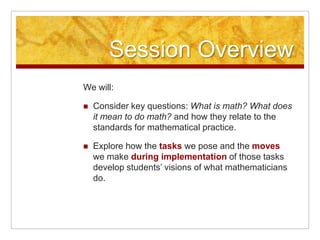
Session Overview
We will:


Consider key questions: What is math? What does
it mean to do math? and how they relate to the
standards for mathematical practice.



Explore how the tasks we pose and the moves
we make during implementation of those tasks
develop students’ visions of what mathematicians
do.
TASKS
as they appear in
curricular/instructional
materials

TASKS
as set up by the
teacher

TASKS
as implemented by the
students

Student Learning

Mathematics Tasks
Framework

Student
Learning

Henningsen& Stein, 1997; Stein & Smith, 1998; Stein, Smith, Henningsen, &Silver, 2000, 2009
Standards for
Mathematical Practice
The Standards for Mathematical Practice
describe varieties of expertise that
mathematics educators at all levels should
seek to develop in their students.

These practices rest on important
“processes and proficiencies” with
longstanding importance in mathematics
education.
- CCSS, 2010
Standards for
Mathematical Practice
1.

Make sense of problems and persevere in solving
them.

2.

Reason abstractly and quantitatively.

3.

Construct viable arguments and critique the
reasoning of others.

4.

Model with mathematics.

5.

Use appropriate tools strategically.

6.

Attend to precision.

7.

Look for and make use of structure.

8.

Look for and express regularity in repeated
reasoning.
Penny Jar Situation


Start with 4 pennies in the jar. Add
5 pennies each day.



Create a table and graph for the
first seven days.



Predict how fourth graders might
reason about the total number of
pennies for the 14th day without
determining the number of
pennies for all the days in
between.
45
40

•39

Number of
Days

Number of
Pennies

start
1
2
3
4
5
6
7

4
9
14
19
24
29
34
39

n

Number of Pennies

35

• 34

30

• 29

25

• 24

20

• 19

15

• 14

10

5

•9
•4

0

0star 1
t

2
3
4
5
Number of Days

6

7
Video case:
A non-proportional linear
relationship


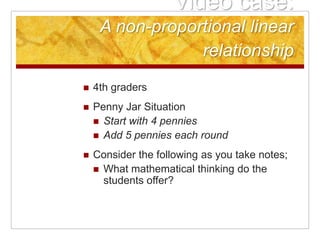
4th graders



Penny Jar Situation
 Start with 4 pennies
 Add 5 pennies each round



Consider the following as you take notes;
 What mathematical thinking do the
students offer?
Video case:
A non-proportional linear
relationship


What specific moves did this teacher
make to support the development of the
mathematical practices in her students?
TASKS
as they appear in
curricular/instructional
materials

TASKS
as set up by the
teacher

TASKS
as implemented by the
students

Student Learning

Mathematics Tasks
Framework

Student
Learning

Henningsen& Stein, 1997; Stein & Smith, 1998; Stein, Smith, Henningsen, &Silver, 2000, 2009
What is math?

What does it mean
to do math?
Reflecting on Our
Practice


Do all students have the opportunity to engage in
mathematical tasks that promote students’
attainment of the mathematical practices on a
regular basis?



How are we, as teacher educators, equipping
teachers (preservice and inservice) for
implementing the standards for mathematical
practice?

What Do Mathematicians Do? Expanding Visions through the SMP

  • 1.
    What is math? Whatdoes it mean to do math?
  • 2.
    What Do MathematiciansDo? Expanding Students’ Visions through the Standards for Mathematical Practice Nicole Rigelman Portland State University Teachers of Teachers of Mathematics Annual Meeting Friday, September 9, 2011
  • 3.
    Session Overview We will:  Considerkey questions: What is math? What does it mean to do math? and how they relate to the standards for mathematical practice.  Explore how the tasks we pose and the moves we make during implementation of those tasks develop students’ visions of what mathematicians do.
  • 4.
    TASKS as they appearin curricular/instructional materials TASKS as set up by the teacher TASKS as implemented by the students Student Learning Mathematics Tasks Framework Student Learning Henningsen& Stein, 1997; Stein & Smith, 1998; Stein, Smith, Henningsen, &Silver, 2000, 2009
  • 5.
    Standards for Mathematical Practice TheStandards for Mathematical Practice describe varieties of expertise that mathematics educators at all levels should seek to develop in their students. These practices rest on important “processes and proficiencies” with longstanding importance in mathematics education. - CCSS, 2010
  • 6.
    Standards for Mathematical Practice 1. Makesense of problems and persevere in solving them. 2. Reason abstractly and quantitatively. 3. Construct viable arguments and critique the reasoning of others. 4. Model with mathematics. 5. Use appropriate tools strategically. 6. Attend to precision. 7. Look for and make use of structure. 8. Look for and express regularity in repeated reasoning.
  • 8.
    Penny Jar Situation  Startwith 4 pennies in the jar. Add 5 pennies each day.  Create a table and graph for the first seven days.  Predict how fourth graders might reason about the total number of pennies for the 14th day without determining the number of pennies for all the days in between.
  • 9.
    45 40 •39 Number of Days Number of Pennies start 1 2 3 4 5 6 7 4 9 14 19 24 29 34 39 n Numberof Pennies 35 • 34 30 • 29 25 • 24 20 • 19 15 • 14 10 5 •9 •4 0 0star 1 t 2 3 4 5 Number of Days 6 7
  • 10.
    Video case: A non-proportionallinear relationship  4th graders  Penny Jar Situation  Start with 4 pennies  Add 5 pennies each round  Consider the following as you take notes;  What mathematical thinking do the students offer?
  • 11.
    Video case: A non-proportionallinear relationship  What specific moves did this teacher make to support the development of the mathematical practices in her students?
  • 12.
    TASKS as they appearin curricular/instructional materials TASKS as set up by the teacher TASKS as implemented by the students Student Learning Mathematics Tasks Framework Student Learning Henningsen& Stein, 1997; Stein & Smith, 1998; Stein, Smith, Henningsen, &Silver, 2000, 2009
  • 13.
    What is math? Whatdoes it mean to do math?
  • 14.
    Reflecting on Our Practice  Doall students have the opportunity to engage in mathematical tasks that promote students’ attainment of the mathematical practices on a regular basis?  How are we, as teacher educators, equipping teachers (preservice and inservice) for implementing the standards for mathematical practice?

Editor's Notes

  • #14 According to Stein and Smith (1998, p. 269), “the day-in and day-out cumulative effect of classroom-based tasks leads to the development of students’ implicit ideas about the nature of mathematics – about whether mathematics is something about which they can personally make sense and about how long and how hard they should have to work to do so.” Further, as tasks pass through the phases shown in the Mathematics Tasks Framework, the nature of the tasks may change and, hence, influence what mathematics students learn.