Dr Paing Soe
SAS
Mental Health
Monywa General Hospital
1. Introduction
2. Suicide
3. The assessment of suicidal risk
4. The management of suicidal patients
5. Suicide prevention
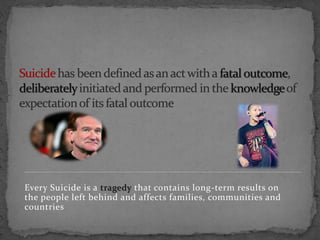
Every Suicide is a tragedy that contains long-term results on
the people left behind and affects families, communities and
countries
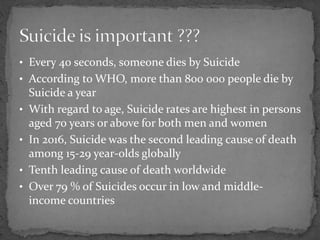
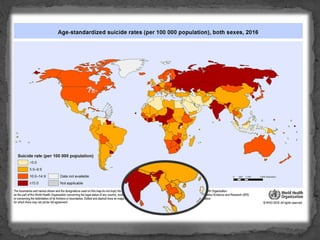
• Every 40 seconds, someone dies by Suicide
• According to WHO, more than 800 000 people die by
Suicide a year
• With regard to age, Suicide rates are highest in persons
aged 70 years or above for both men and women
• In 2016, Suicide was the second leading cause of death
among 15-29 year-olds globally
• Tenth leading cause of death worldwide
• Over 79 % of Suicides occur in low and middle-
income countries
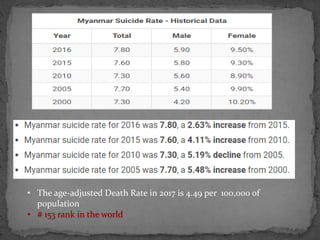
• The age-adjusted Death Rate in 2017 is 4.49 per 100,000 of
population
• # 153 rank in the world
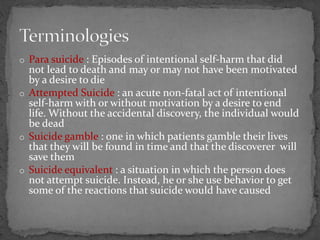
o Para suicide : Episodes of intentional self-harm that did
not lead to death and may or may not have been motivated
by a desire to die
o Attempted Suicide : an acute non-fatal act of intentional
self-harm with or without motivation by a desire to end
life. Without the accidental discovery, the individual would
be dead
o Suicide gamble : one in which patients gamble their lives
that they will be found in time and that the discoverer will
save them
o Suicide equivalent : a situation in which the person does
not attempt suicide. Instead, he or she use behavior to get
some of the reactions that suicide would have caused
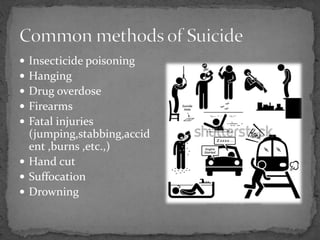
 Insecticide poisoning
 Hanging
 Drug overdose
 Firearms
 Fatal injuries
(jumping,stabbing,accid
ent ,burns ,etc.,)
 Hand cut
 Suffocation
 Drowning
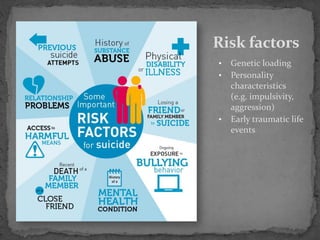
• Genetic loading
• Personality
characteristics
(e.g. impulsivity,
aggression)
• Early traumatic life
events
Risk factors
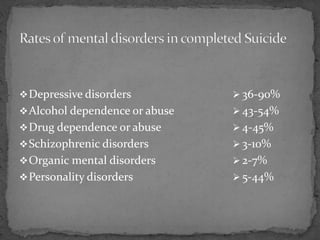
Depressive disorders
Alcohol dependence or abuse
Drug dependence or abuse
Schizophrenic disorders
Organic mental disorders
Personality disorders
 36-90%
 43-54%
 4-45%
 3-10%
 2-7%
 5-44%
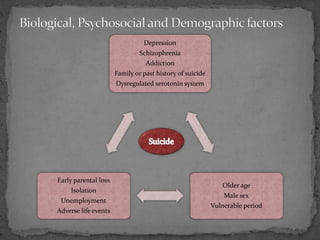
Depression
Schizophrenia
Addiction
Family or past history of suicide
Dysregulated serotonin system
Older age
Male sex
Vulnerable period
Early parental loss
Isolation
Unemployment
Adverse life events
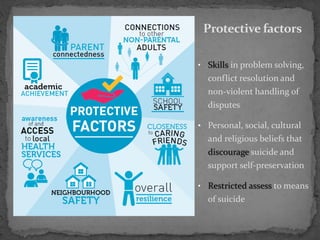
• Skills in problem solving,
conflict resolution and
non-violent handling of
disputes
• Personal, social, cultural
and religious beliefs that
discourage suicide and
support self-preservation
• Restricted assess to means
of suicide
Protective factors
 Psychiatric patients
 Strong association between mental disorder and Suicide
 The rate of suicide is also raised in the period following
discharge from inpatient psychiatric care
 The first week after discharge is the period of highest
risk
 “Rational” suicide
 Suicide can be the rational act of a mentally healthy
person
 “Euthanasia”
 Several European countries (e.g. Switzerland, the
Netherlands, Belgium) have recognized this and made
changes in their law to allow those with a long-term
illness to take their own life with the help from friends,
family, or even medical practitioners
• Older people
• The highest rate of suicide is among people aged over 75
years
• The most frequent methods are hanging among men
and drug overdose among women
• In addition to active self-harm, some older adults die
from deliberate self-neglected (e.g. by refusing food or
necessary treatment)
 Children
 Suicide is rare in children
 Children who have died by suicide have usually shown
antisocial behavior
 Suicidal behavior and depressive disorders are common
among their parents and siblings
 Before death, the children had appeared depressed and
withdrawn, and some had stayed away from school
 Adolescents
 Suicide rates among adolescents have increased in resent
years
 About 70% of adolescents who killed themselves had had
psychiatric disorders mainly depressive and personality
disorders (sometimes comorbid)
 Many of them had misused alcohol or drugs
 Often due to mal-adaptive coping of long-term difficulties
with relationships and other psychosocial problems
 Approximately two-third of them have previous suicide
attempt
 Ethnic groups
 Rates among immigrants closely reflect those in their
countries of origin
 High-risk occupational groups
 Doctors;
 female doctors
 Rate is higher in anesthetists, community health doctors,
general practitioners, and psychiatrists
 Veterinary surgeons
 Farmers
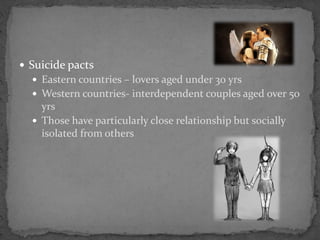
 Suicide pacts
 Eastern countries – lovers aged under 30 yrs
 Western countries- interdependent couples aged over 50
yrs
 Those have particularly close relationship but socially
isolated from others
 Mass suicide
 913 followers of the People’s Temple cult died at
Jonestown, Guyana in 1978
 39 members of the Heaven’s Gate cult in California died
in 1997
1. The common purpose of suicide is to seek a solution.
2. The common goal of suicide is cessation of consciousness.
3. The common stimulus (or information input) in suicide is
intolerable psychological pain
4. The common stressor in suicide is frustrated psychological
needs.
5. The common emotion in suicide is hopelessness-helplessness
6. The common internal attitude in suicide is ambivalence
7. The common cognitive state in suicide is constriction
8. The common action in suicide is escape
9. The common interpersonal act in suicide is communication of
intention
10. The common consistency in suicide is with life-long coping
patterns.
 General issues
 Every doctor should be able to assess the risk of Suicide
 Two requirements;
a. A willingness to make direct but tactful enquiries about the
patient’s intentions
b. To be alert to factors that predict suicide
 The most obvious warning sign is a direct statement of
intent
 Just before the act, there may be a subtle change in their
way of talking about dying, sometimes in the form of
oblique hints instead of former more open statements
• Unhurried and sympathetic manner
• Starting about current problems and patient’s reaction
to them
• Enquires about their losses; both personal
(bereavement, divorce) and financial ,even loss of
status
• Conflict with others, social isolation
• Physical illness ( painful condition in the elderly)
• Mood swing, impulsive or aggressive tendencies
• Altitudes towards religion and death
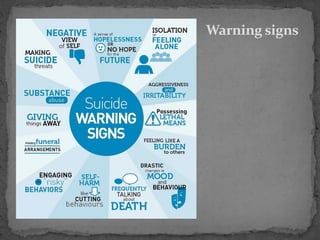
Warning signs
 “I can’t go on living anymore”
 “I wish I was never born”
 “I wish I were dead”
 “I won’t need this anymore”
 “I am so tired of living”
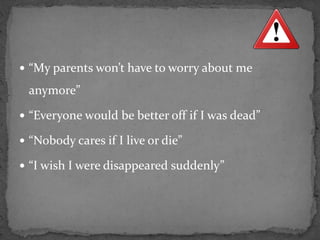
 “My parents won’t have to worry about me
anymore”
 “Everyone w0uld be better off if I was dead”
 “Nobody cares if I live or die”
 “I wish I were disappeared suddenly”
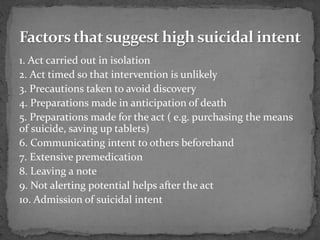
1. Act carried out in isolation
2. Act timed so that intervention is unlikely
3. Precautions taken to avoid discovery
4. Preparations made in anticipation of death
5. Preparations made for the act ( e.g. purchasing the means
of suicide, saving up tablets)
6. Communicating intent to others beforehand
7. Extensive premedication
8. Leaving a note
9. Not alerting potential helps after the act
10. Admission of suicidal intent
Management
of
Suicidal patients
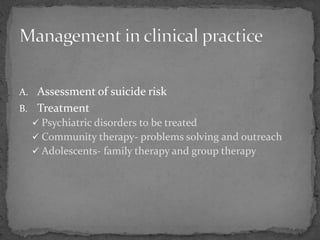
A. Assessment of suicide risk
B. Treatment
 Psychiatric disorders to be treated
 Community therapy- problems solving and outreach
 Adolescents- family therapy and group therapy
 Pharmacological treatment
 Antidepressants
 Antipsychotics
 Lithium or mood stabilizers
 Psychosocial treatment
 Problems solving skill
 Psychotherapy
 Cognitive behavioral therapy
 Outreach
 Family therapy
 Group therapy
General requirements
 Safe ward environment
 An adequate number of well-trained staff
 Good working relationships among staff, and between
staff and patients
 Agreed policies for the observation, assessment and
review of patients
On admission
 assess risk
 Agree the level of observation
 Remove any objects that might be used for suicide
 Discuss and agree plans with the patient
 Agree a policy for visitors ( number, duration of visit,
and what they need to know)
During admission
 Regular review of risk and plans
 Agreed plans for the level of supervision
 Clear communication of assessments and plans between
staff, especially when shifts change
 Agree action to be taken if the patient leaves the ward
without notice or permission
At discharge
 Agree date and plan for aftercare in advance of discharge
 Discuss and agree the plan with the patient and those
involved in their care
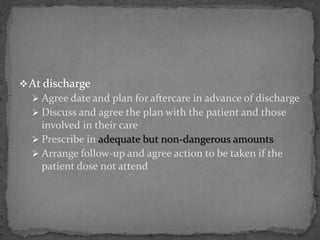
 Prescribe in adequate but non-dangerous amounts
 Arrange follow-up and agree action to be taken if the
patient dose not attend
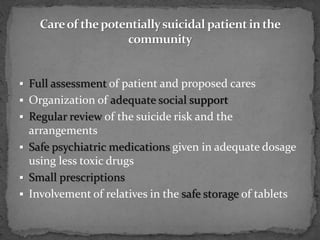
 Full assessment of patient and proposed cares
 Organization of adequate social support
 Regular review of the suicide risk and the
arrangements
 Safe psychiatric medications given in adequate dosage
using less toxic drugs
 Small prescriptions
 Involvement of relatives in the safe storage of tablets
 Better and more accessible psychiatric services
 Restriction of the means of suicide
 Encouragement of responsible media reporting
 Educational programs
 Improved care for high-risk groups
 Crisis centers and telephone ‘hotlines’
 Although suicidal thoughts may return, they are not
permanent
 Heightened suicide risk is often short-term and
situation-specific.
 An individual with previously suicidal thoughts and
attempts can go on to live a long life
• Given the widespread stigma around suicide, most people
who are contemplating suicide do not know who to speak
to.
• Rather than encouraging suicidal behavior, talking openly
can give an individual other options or the time to rethink
his/her decision, thereby preventing suicide.
 Suicidal behavior indicates deep unhappiness but not
necessarily mental disorder.
 Many people living with mental disorders are not
affected by suicidal behavior, and not all people who
take their own lives have a mental disorder.
 The majority of suicides have been preceded by
warning signs, whether verbal or behavioral.
 Of course there are some suicides that occur without
warning.
 But it is important to understand what the warning
signs are and look out for them.
 On the contrary, suicidal people are often ambivalent
about living or dying.
 Someone may act impulsively by drinking pesticides,
for instance, and die a few days later, even though they
would have liked to live on.
 Access to emotional support at the right time can
prevent suicide.
 A significant number of people contemplating suicide
are experiencing anxiety, depression and hopelessness
and may feel that there is no other option.
 People who talk about suicide may be reaching out for
help or support.
Suicide( by dr.ps)

Suicide( by dr.ps)

  • 1.
    Dr Paing Soe SAS MentalHealth Monywa General Hospital
  • 2.
    1. Introduction 2. Suicide 3.The assessment of suicidal risk 4. The management of suicidal patients 5. Suicide prevention
  • 4.
    Every Suicide isa tragedy that contains long-term results on the people left behind and affects families, communities and countries
  • 5.
    • Every 40seconds, someone dies by Suicide • According to WHO, more than 800 000 people die by Suicide a year • With regard to age, Suicide rates are highest in persons aged 70 years or above for both men and women • In 2016, Suicide was the second leading cause of death among 15-29 year-olds globally • Tenth leading cause of death worldwide • Over 79 % of Suicides occur in low and middle- income countries
  • 7.
    • The age-adjustedDeath Rate in 2017 is 4.49 per 100,000 of population • # 153 rank in the world
  • 8.
    o Para suicide: Episodes of intentional self-harm that did not lead to death and may or may not have been motivated by a desire to die o Attempted Suicide : an acute non-fatal act of intentional self-harm with or without motivation by a desire to end life. Without the accidental discovery, the individual would be dead o Suicide gamble : one in which patients gamble their lives that they will be found in time and that the discoverer will save them o Suicide equivalent : a situation in which the person does not attempt suicide. Instead, he or she use behavior to get some of the reactions that suicide would have caused
  • 10.
     Insecticide poisoning Hanging  Drug overdose  Firearms  Fatal injuries (jumping,stabbing,accid ent ,burns ,etc.,)  Hand cut  Suffocation  Drowning
  • 12.
    • Genetic loading •Personality characteristics (e.g. impulsivity, aggression) • Early traumatic life events Risk factors
  • 13.
    Depressive disorders Alcohol dependenceor abuse Drug dependence or abuse Schizophrenic disorders Organic mental disorders Personality disorders  36-90%  43-54%  4-45%  3-10%  2-7%  5-44%
  • 14.
    Depression Schizophrenia Addiction Family or pasthistory of suicide Dysregulated serotonin system Older age Male sex Vulnerable period Early parental loss Isolation Unemployment Adverse life events
  • 15.
    • Skills inproblem solving, conflict resolution and non-violent handling of disputes • Personal, social, cultural and religious beliefs that discourage suicide and support self-preservation • Restricted assess to means of suicide Protective factors
  • 16.
     Psychiatric patients Strong association between mental disorder and Suicide  The rate of suicide is also raised in the period following discharge from inpatient psychiatric care  The first week after discharge is the period of highest risk
  • 17.
     “Rational” suicide Suicide can be the rational act of a mentally healthy person  “Euthanasia”  Several European countries (e.g. Switzerland, the Netherlands, Belgium) have recognized this and made changes in their law to allow those with a long-term illness to take their own life with the help from friends, family, or even medical practitioners
  • 18.
    • Older people •The highest rate of suicide is among people aged over 75 years • The most frequent methods are hanging among men and drug overdose among women • In addition to active self-harm, some older adults die from deliberate self-neglected (e.g. by refusing food or necessary treatment)
  • 19.
     Children  Suicideis rare in children  Children who have died by suicide have usually shown antisocial behavior  Suicidal behavior and depressive disorders are common among their parents and siblings  Before death, the children had appeared depressed and withdrawn, and some had stayed away from school
  • 20.
     Adolescents  Suiciderates among adolescents have increased in resent years  About 70% of adolescents who killed themselves had had psychiatric disorders mainly depressive and personality disorders (sometimes comorbid)  Many of them had misused alcohol or drugs  Often due to mal-adaptive coping of long-term difficulties with relationships and other psychosocial problems  Approximately two-third of them have previous suicide attempt
  • 21.
     Ethnic groups Rates among immigrants closely reflect those in their countries of origin  High-risk occupational groups  Doctors;  female doctors  Rate is higher in anesthetists, community health doctors, general practitioners, and psychiatrists  Veterinary surgeons  Farmers
  • 22.
     Suicide pacts Eastern countries – lovers aged under 30 yrs  Western countries- interdependent couples aged over 50 yrs  Those have particularly close relationship but socially isolated from others
  • 23.
     Mass suicide 913 followers of the People’s Temple cult died at Jonestown, Guyana in 1978  39 members of the Heaven’s Gate cult in California died in 1997
  • 24.
    1. The commonpurpose of suicide is to seek a solution. 2. The common goal of suicide is cessation of consciousness. 3. The common stimulus (or information input) in suicide is intolerable psychological pain 4. The common stressor in suicide is frustrated psychological needs. 5. The common emotion in suicide is hopelessness-helplessness 6. The common internal attitude in suicide is ambivalence 7. The common cognitive state in suicide is constriction 8. The common action in suicide is escape 9. The common interpersonal act in suicide is communication of intention 10. The common consistency in suicide is with life-long coping patterns.
  • 26.
     General issues Every doctor should be able to assess the risk of Suicide  Two requirements; a. A willingness to make direct but tactful enquiries about the patient’s intentions b. To be alert to factors that predict suicide  The most obvious warning sign is a direct statement of intent  Just before the act, there may be a subtle change in their way of talking about dying, sometimes in the form of oblique hints instead of former more open statements
  • 27.
    • Unhurried andsympathetic manner • Starting about current problems and patient’s reaction to them • Enquires about their losses; both personal (bereavement, divorce) and financial ,even loss of status • Conflict with others, social isolation • Physical illness ( painful condition in the elderly) • Mood swing, impulsive or aggressive tendencies • Altitudes towards religion and death
  • 28.
  • 29.
     “I can’tgo on living anymore”  “I wish I was never born”  “I wish I were dead”  “I won’t need this anymore”  “I am so tired of living”
  • 30.
     “My parentswon’t have to worry about me anymore”  “Everyone w0uld be better off if I was dead”  “Nobody cares if I live or die”  “I wish I were disappeared suddenly”
  • 31.
    1. Act carriedout in isolation 2. Act timed so that intervention is unlikely 3. Precautions taken to avoid discovery 4. Preparations made in anticipation of death 5. Preparations made for the act ( e.g. purchasing the means of suicide, saving up tablets) 6. Communicating intent to others beforehand 7. Extensive premedication 8. Leaving a note 9. Not alerting potential helps after the act 10. Admission of suicidal intent
  • 32.
  • 33.
    A. Assessment ofsuicide risk B. Treatment  Psychiatric disorders to be treated  Community therapy- problems solving and outreach  Adolescents- family therapy and group therapy
  • 34.
     Pharmacological treatment Antidepressants  Antipsychotics  Lithium or mood stabilizers  Psychosocial treatment  Problems solving skill  Psychotherapy  Cognitive behavioral therapy  Outreach  Family therapy  Group therapy
  • 35.
    General requirements  Safeward environment  An adequate number of well-trained staff  Good working relationships among staff, and between staff and patients  Agreed policies for the observation, assessment and review of patients
  • 36.
    On admission  assessrisk  Agree the level of observation  Remove any objects that might be used for suicide  Discuss and agree plans with the patient  Agree a policy for visitors ( number, duration of visit, and what they need to know)
  • 37.
    During admission  Regularreview of risk and plans  Agreed plans for the level of supervision  Clear communication of assessments and plans between staff, especially when shifts change  Agree action to be taken if the patient leaves the ward without notice or permission
  • 38.
    At discharge  Agreedate and plan for aftercare in advance of discharge  Discuss and agree the plan with the patient and those involved in their care  Prescribe in adequate but non-dangerous amounts  Arrange follow-up and agree action to be taken if the patient dose not attend
  • 39.
     Full assessmentof patient and proposed cares  Organization of adequate social support  Regular review of the suicide risk and the arrangements  Safe psychiatric medications given in adequate dosage using less toxic drugs  Small prescriptions  Involvement of relatives in the safe storage of tablets
  • 40.
     Better andmore accessible psychiatric services  Restriction of the means of suicide  Encouragement of responsible media reporting  Educational programs  Improved care for high-risk groups  Crisis centers and telephone ‘hotlines’
  • 44.
     Although suicidalthoughts may return, they are not permanent  Heightened suicide risk is often short-term and situation-specific.  An individual with previously suicidal thoughts and attempts can go on to live a long life
  • 45.
    • Given thewidespread stigma around suicide, most people who are contemplating suicide do not know who to speak to. • Rather than encouraging suicidal behavior, talking openly can give an individual other options or the time to rethink his/her decision, thereby preventing suicide.
  • 46.
     Suicidal behaviorindicates deep unhappiness but not necessarily mental disorder.  Many people living with mental disorders are not affected by suicidal behavior, and not all people who take their own lives have a mental disorder.
  • 47.
     The majorityof suicides have been preceded by warning signs, whether verbal or behavioral.  Of course there are some suicides that occur without warning.  But it is important to understand what the warning signs are and look out for them.
  • 48.
     On thecontrary, suicidal people are often ambivalent about living or dying.  Someone may act impulsively by drinking pesticides, for instance, and die a few days later, even though they would have liked to live on.  Access to emotional support at the right time can prevent suicide.
  • 49.
     A significantnumber of people contemplating suicide are experiencing anxiety, depression and hopelessness and may feel that there is no other option.  People who talk about suicide may be reaching out for help or support.