suicide RISk ASSESMENT &PREVENTION
INTRODUCTION
• Suicide is the major cause of death across the
world.
• Epidemiology of suicide is changing.
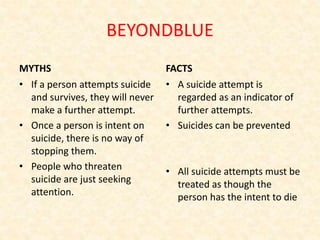
BEYONDBLUE
MYTHS
• If a person attempts suicide
and survives, they will never
make a further attempt.
• Once a person is intent on
suicide, there is no way of
stopping them.
• People who threaten
suicide are just seeking
attention.
FACTS
• A suicide attempt is
regarded as an indicator of
further attempts.
• Suicides can be prevented
• All suicide attempts must be
treated as though the
person has the intent to die
• Suicide is hereditary.
• Only certain types of people
become suicidal.
• Suicide is painless.
• Depression and self-
destructive behavior are
rare in young people.
• Although suicide can be
over-represented in
families, it is attempts not
genetically inherited.
• Everyone has the potential
for suicide.
• Many suicide methods are
very painful.
• Both forms of behavior are
common in adolescents
• All suicidal young people
are depressed.
• Marked and sudden
improvement in the mental
state of an attempter
following a suicidal crisis or
depressive period signifies
that the suicide risk is over.
• Once a young person is
suicidal, they will be suicidal
forever.
• The opposite may be true.
• suicide will only be that way
for a limited period of their
lives.
• Suicidal young people
cannot help themselves.
• Break-ups in relationships
happen so frequently, they
do not cause suicide.
• support and constructive
assistance from caring and
informed people around
them, young people can
gain full self-direction and
self-management in their
lives.
• Suicide can be precipitated
by the loss of a relationship.
• Some people are always
suicidal.
• Every death is preventable
• Nobody is suicidal at all
times.
• No matter how well
intentioned, alert and
diligent people's efforts may
be, there is no way of
preventing all suicides from
occurring.
Terminologies…...
• Suicidal ideation Occurrence of passive thoughts of
wanting to be dead or active thoughts of killing oneself
(Posner, 2007)
• Suicide attempt a potentially self injurious behavior
with at least some intent to die as a result of the act.
(O’Caroll, 1996)
• Deliberate self harm An act with non-fatal outcome, in
which an individual deliberately initiates a non-habitual
behaviour that, without intervention from others, will
cause self harm, aimed at realising changes which the
subject desired via the actual or expected physical
consequences (WHO).
• willful self-inflicting of painful, destructive, or injurious
acts without intent to die(APA)
Terminologies…...
• Suicide gesture— denotes a person
undertaking an unusual, but not fatal,
behavior as a cry for help or to get attention.
• Parasuicide— Term coined by Kreitman, It is
defined as non-fatal act of self–injury or taking
of substance in excess of the generally
recognized or prescribed therapeutic dose
without the intention to kill oneself
Suicidality- a continuum
• from suicidal statement →suicidal gestures →
suicidal attempts → completed suicide
COMMON METHODS
 Pesticide poisoning
Hanging
Firearms
Drug overdose
Fatal injuries
Exsanuinations
Suffocation
Drowning
HISTORICAL PERSPECTIVE
The history of suicide goes back to the ancient times with
earliest written records from Greece (Socrates, Seneca) to
modern day (van Gogh, Hitler…..)
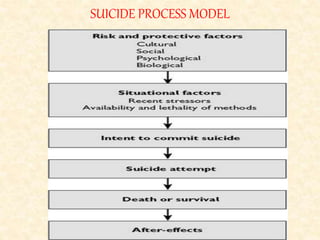
SUICIDE PROCESS & THE ACT OF SUICIDE
• Suicide – fatal outcome of a long term process
• It is a very individual final act of a person
• Involves multiple interacting biological, cultural,
social, situational & psychological factors
SUICIDE PROCESS MODEL
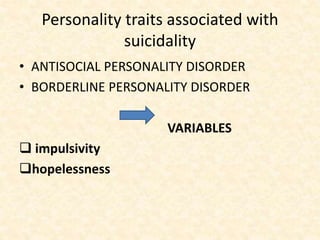
Personality traits associated with
suicidality
• ANTISOCIAL PERSONALITY DISORDER
• BORDERLINE PERSONALITY DISORDER
VARIABLES
 impulsivity
hopelessness
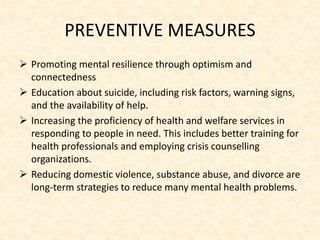
PREVENTIVE MEASURES
 Promoting mental resilience through optimism and
connectedness
 Education about suicide, including risk factors, warning signs,
and the availability of help.
 Increasing the proficiency of health and welfare services in
responding to people in need. This includes better training for
health professionals and employing crisis counselling
organizations.
 Reducing domestic violence, substance abuse, and divorce are
long-term strategies to reduce many mental health problems.
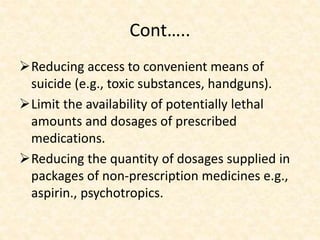
Cont…..
Reducing access to convenient means of
suicide (e.g., toxic substances, handguns).
Limit the availability of potentially lethal
amounts and dosages of prescribed
medications.
Reducing the quantity of dosages supplied in
packages of non-prescription medicines e.g.,
aspirin., psychotropics.
Interventions targeted at high-risk groups.
Family is basic unit where emotional bonding,
social support and training for resilience building
are important for the suicidal prevention.
Proper arrangement for general public health
measures.
In India comprehensive community care services
are promoted to provide services to those
stricken with mental illness.
• School intervention programs - emotional
education in school children can reduce the
incidence of suicide and suicidal attempts
• Government policies on employment, school
welfare, education, farming, substance abuse,
media guidance and public education should be
taken in account for suicide prevention.
• . Professional training about assessment,
diagnosis and treatment support of high-risk
group's detection is required for prompt suicidal
intervention.
There should be responsible media policy for
suicide prevention.
Early detection and early treatment of
depression and other mental disorders.
Enhanced access to mental health services
(such as hot/on line services).
Attention to those suffering chronic somatic
illness.
Arrangement for crises intervention.
Training gatekeepers like parents, teachers,
psychologist, counselors and other professional
helpers who must provide emotional support to
meet the needs of different age groups.
Parents and teachers should not over expect from
their children, especially parents should not
compel to fulfill their own dreams through
children.
. Parents and other family members should
give attention towards changing behaviour of
child and provide help and support to handle
the difficulties of life especially the teenage
issues and emotional ups and downs.
Educating family members or parents
regarding the need to monitor their loved
ones and to monitor to communicate
observations of change or concern.
THANK YOU

suicide.pptx

  • 1.
  • 2.
    INTRODUCTION • Suicide isthe major cause of death across the world. • Epidemiology of suicide is changing.
  • 3.
    BEYONDBLUE MYTHS • If aperson attempts suicide and survives, they will never make a further attempt. • Once a person is intent on suicide, there is no way of stopping them. • People who threaten suicide are just seeking attention. FACTS • A suicide attempt is regarded as an indicator of further attempts. • Suicides can be prevented • All suicide attempts must be treated as though the person has the intent to die
  • 4.
    • Suicide ishereditary. • Only certain types of people become suicidal. • Suicide is painless. • Depression and self- destructive behavior are rare in young people. • Although suicide can be over-represented in families, it is attempts not genetically inherited. • Everyone has the potential for suicide. • Many suicide methods are very painful. • Both forms of behavior are common in adolescents
  • 5.
    • All suicidalyoung people are depressed. • Marked and sudden improvement in the mental state of an attempter following a suicidal crisis or depressive period signifies that the suicide risk is over. • Once a young person is suicidal, they will be suicidal forever. • The opposite may be true. • suicide will only be that way for a limited period of their lives.
  • 6.
    • Suicidal youngpeople cannot help themselves. • Break-ups in relationships happen so frequently, they do not cause suicide. • support and constructive assistance from caring and informed people around them, young people can gain full self-direction and self-management in their lives. • Suicide can be precipitated by the loss of a relationship.
  • 7.
    • Some peopleare always suicidal. • Every death is preventable • Nobody is suicidal at all times. • No matter how well intentioned, alert and diligent people's efforts may be, there is no way of preventing all suicides from occurring.
  • 8.
    Terminologies…... • Suicidal ideationOccurrence of passive thoughts of wanting to be dead or active thoughts of killing oneself (Posner, 2007) • Suicide attempt a potentially self injurious behavior with at least some intent to die as a result of the act. (O’Caroll, 1996) • Deliberate self harm An act with non-fatal outcome, in which an individual deliberately initiates a non-habitual behaviour that, without intervention from others, will cause self harm, aimed at realising changes which the subject desired via the actual or expected physical consequences (WHO). • willful self-inflicting of painful, destructive, or injurious acts without intent to die(APA)
  • 9.
    Terminologies…... • Suicide gesture—denotes a person undertaking an unusual, but not fatal, behavior as a cry for help or to get attention. • Parasuicide— Term coined by Kreitman, It is defined as non-fatal act of self–injury or taking of substance in excess of the generally recognized or prescribed therapeutic dose without the intention to kill oneself
  • 10.
    Suicidality- a continuum •from suicidal statement →suicidal gestures → suicidal attempts → completed suicide
  • 11.
    COMMON METHODS  Pesticidepoisoning Hanging Firearms Drug overdose Fatal injuries Exsanuinations Suffocation Drowning
  • 12.
    HISTORICAL PERSPECTIVE The historyof suicide goes back to the ancient times with earliest written records from Greece (Socrates, Seneca) to modern day (van Gogh, Hitler…..)
  • 13.
    SUICIDE PROCESS &THE ACT OF SUICIDE • Suicide – fatal outcome of a long term process • It is a very individual final act of a person • Involves multiple interacting biological, cultural, social, situational & psychological factors
  • 14.
  • 15.
    Personality traits associatedwith suicidality • ANTISOCIAL PERSONALITY DISORDER • BORDERLINE PERSONALITY DISORDER VARIABLES  impulsivity hopelessness
  • 16.
    PREVENTIVE MEASURES  Promotingmental resilience through optimism and connectedness  Education about suicide, including risk factors, warning signs, and the availability of help.  Increasing the proficiency of health and welfare services in responding to people in need. This includes better training for health professionals and employing crisis counselling organizations.  Reducing domestic violence, substance abuse, and divorce are long-term strategies to reduce many mental health problems.
  • 17.
    Cont….. Reducing access toconvenient means of suicide (e.g., toxic substances, handguns). Limit the availability of potentially lethal amounts and dosages of prescribed medications. Reducing the quantity of dosages supplied in packages of non-prescription medicines e.g., aspirin., psychotropics.
  • 18.
    Interventions targeted athigh-risk groups. Family is basic unit where emotional bonding, social support and training for resilience building are important for the suicidal prevention. Proper arrangement for general public health measures. In India comprehensive community care services are promoted to provide services to those stricken with mental illness.
  • 19.
    • School interventionprograms - emotional education in school children can reduce the incidence of suicide and suicidal attempts • Government policies on employment, school welfare, education, farming, substance abuse, media guidance and public education should be taken in account for suicide prevention. • . Professional training about assessment, diagnosis and treatment support of high-risk group's detection is required for prompt suicidal intervention.
  • 20.
    There should beresponsible media policy for suicide prevention. Early detection and early treatment of depression and other mental disorders. Enhanced access to mental health services (such as hot/on line services). Attention to those suffering chronic somatic illness.
  • 21.
    Arrangement for crisesintervention. Training gatekeepers like parents, teachers, psychologist, counselors and other professional helpers who must provide emotional support to meet the needs of different age groups. Parents and teachers should not over expect from their children, especially parents should not compel to fulfill their own dreams through children.
  • 22.
    . Parents andother family members should give attention towards changing behaviour of child and provide help and support to handle the difficulties of life especially the teenage issues and emotional ups and downs. Educating family members or parents regarding the need to monitor their loved ones and to monitor to communicate observations of change or concern.
  • 23.