“ Successful Lesson Planning Made Easy”
This online workshop isn’t designed for any specific class or age-group.  Rather, it is a general overview to help any teacher develop for successful lesson planning and implement this strategy in their own lesson planning
Understanding your students The preschool classroom The elementary classroom
The Preschool Classroom 4 categories of student characteristics: Physical Emotional & Social Mental Spiritual
Physical Characteristics Young children have high physical needs. Spend extra time responding to physical needs. Large muscles work best. Young children have limited fine muscles. Young children want to play all the time.
Emotional & Social Children have stranger anxiety. Young children need to be affirmed. Compliment good behavior twice as often as you redirect negative behavior. Preschoolers are more emotional when hungry or tired. Young children like playing in groups.
Mental Young children learn through their senses. Young children are egocentric. Young children have short attention spans.  *1 min. for each year of age Young children think literally. Young children are imitators. Young children forget easily.
Spiritual Young children are loving. Young children like to worship. Young children understand salvation. *85% of a person’s basic personality is formed by the 5 th  year of life
The Elementary Classroom 4 categories of student characteristics: Physical Emotional & Social Mental Spiritual
Physical Like to move Developing fine motor skills Boys & girls are at different developmental stages
Emotional & Social Developing independence Capable of deep feelings of love Developing a social conscience Searching for role-models Concerned about other’s feelings Starting to notice opposite sex Like to act grown-up
Mental Self-critical Set high standards Have longer attention spans Stay self-motivated Capable of abstract thought Media-savy Natural gifts begin to blossom
Spiritual Many accept Christ and receive baptism in Holy Spirit Participate in deeper worship experience Need to feel that they have a part in the congregation Aware that they need to seek God
The Count-down is on! Start early! “A little a day keeps panic away” Allow God time to reveal His creative ideas in you
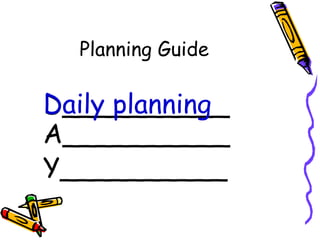
Planning Guide A__________ Y__________ D__________ Daily planning
Daily Planning Steps 1 week before Note the title, subject, objective, & memory verse Read the lesson overview Skim the Bible story headings Look through the student items Locate any items needed for the lesson Begin praying for God to give you His creativity
Daily Planning Steps 5 days prior  (Tues. or Wed.) Read Bible verses Look at lesson objectives Read the Bible lesson
Daily Planning Steps 4 days prior (Wed. or Thurs.) Begin lesson planning Plan your lesson Choose an opening activity Choose how you will present the Bible study Choose how you will teach the memory verse Decide how you will close class time
Daily Planning Steps 1-3 days prior (Fri. or Sat.) Collect supplies Review and fine-tuning Prayer
Daily Planning Steps 1-3 days prior (Fri. or Sat.) Arrive early Make the room comfortable
Planning Guide A__________ Y__________ D__________ Daily planning Daily planning Activities Yourself Activities
Survival Tips for Busy Teachers Leave your book out in the open Keep a “to do, to get” list Effectively use your “think time” Prepare materials, crafts, etc. in advance on a “day off”
References Barna, G. (2003).  Transforming children into spiritual champions.  Ventura, CA: Issachar Resources. Gruber, D. (1993)  Focus on children: A handbook for teachers.  Springfield, MO: Gospel Publishing House.

Successful Lesson Planning Made Easy

  • 1.
    “ Successful LessonPlanning Made Easy”
  • 2.
    This online workshopisn’t designed for any specific class or age-group. Rather, it is a general overview to help any teacher develop for successful lesson planning and implement this strategy in their own lesson planning
  • 3.
    Understanding your studentsThe preschool classroom The elementary classroom
  • 4.
    The Preschool Classroom4 categories of student characteristics: Physical Emotional & Social Mental Spiritual
  • 5.
    Physical Characteristics Youngchildren have high physical needs. Spend extra time responding to physical needs. Large muscles work best. Young children have limited fine muscles. Young children want to play all the time.
  • 6.
    Emotional & SocialChildren have stranger anxiety. Young children need to be affirmed. Compliment good behavior twice as often as you redirect negative behavior. Preschoolers are more emotional when hungry or tired. Young children like playing in groups.
  • 7.
    Mental Young childrenlearn through their senses. Young children are egocentric. Young children have short attention spans. *1 min. for each year of age Young children think literally. Young children are imitators. Young children forget easily.
  • 8.
    Spiritual Young childrenare loving. Young children like to worship. Young children understand salvation. *85% of a person’s basic personality is formed by the 5 th year of life
  • 9.
    The Elementary Classroom4 categories of student characteristics: Physical Emotional & Social Mental Spiritual
  • 10.
    Physical Like tomove Developing fine motor skills Boys & girls are at different developmental stages
  • 11.
    Emotional & SocialDeveloping independence Capable of deep feelings of love Developing a social conscience Searching for role-models Concerned about other’s feelings Starting to notice opposite sex Like to act grown-up
  • 12.
    Mental Self-critical Sethigh standards Have longer attention spans Stay self-motivated Capable of abstract thought Media-savy Natural gifts begin to blossom
  • 13.
    Spiritual Many acceptChrist and receive baptism in Holy Spirit Participate in deeper worship experience Need to feel that they have a part in the congregation Aware that they need to seek God
  • 14.
    The Count-down ison! Start early! “A little a day keeps panic away” Allow God time to reveal His creative ideas in you
  • 15.
    Planning Guide A__________Y__________ D__________ Daily planning
  • 16.
    Daily Planning Steps1 week before Note the title, subject, objective, & memory verse Read the lesson overview Skim the Bible story headings Look through the student items Locate any items needed for the lesson Begin praying for God to give you His creativity
  • 17.
    Daily Planning Steps5 days prior (Tues. or Wed.) Read Bible verses Look at lesson objectives Read the Bible lesson
  • 18.
    Daily Planning Steps4 days prior (Wed. or Thurs.) Begin lesson planning Plan your lesson Choose an opening activity Choose how you will present the Bible study Choose how you will teach the memory verse Decide how you will close class time
  • 19.
    Daily Planning Steps1-3 days prior (Fri. or Sat.) Collect supplies Review and fine-tuning Prayer
  • 20.
    Daily Planning Steps1-3 days prior (Fri. or Sat.) Arrive early Make the room comfortable
  • 21.
    Planning Guide A__________Y__________ D__________ Daily planning Daily planning Activities Yourself Activities
  • 22.
    Survival Tips forBusy Teachers Leave your book out in the open Keep a “to do, to get” list Effectively use your “think time” Prepare materials, crafts, etc. in advance on a “day off”
  • 23.
    References Barna, G.(2003). Transforming children into spiritual champions. Ventura, CA: Issachar Resources. Gruber, D. (1993) Focus on children: A handbook for teachers. Springfield, MO: Gospel Publishing House.

Editor's Notes

  • #2 Welcome to this online children’s ministries training workshop entitled, “Successful Lesson Planning Made Easy.” For the next few minutes, we will be taking a look at some practical steps planning that a teachers can take in a children’s ministries setting to successfully planning lessons using the curriculum they are using. This workshop is not curriculum-dependent. Rather, the concepts discussed can be employed using any curriculum.