Group 5
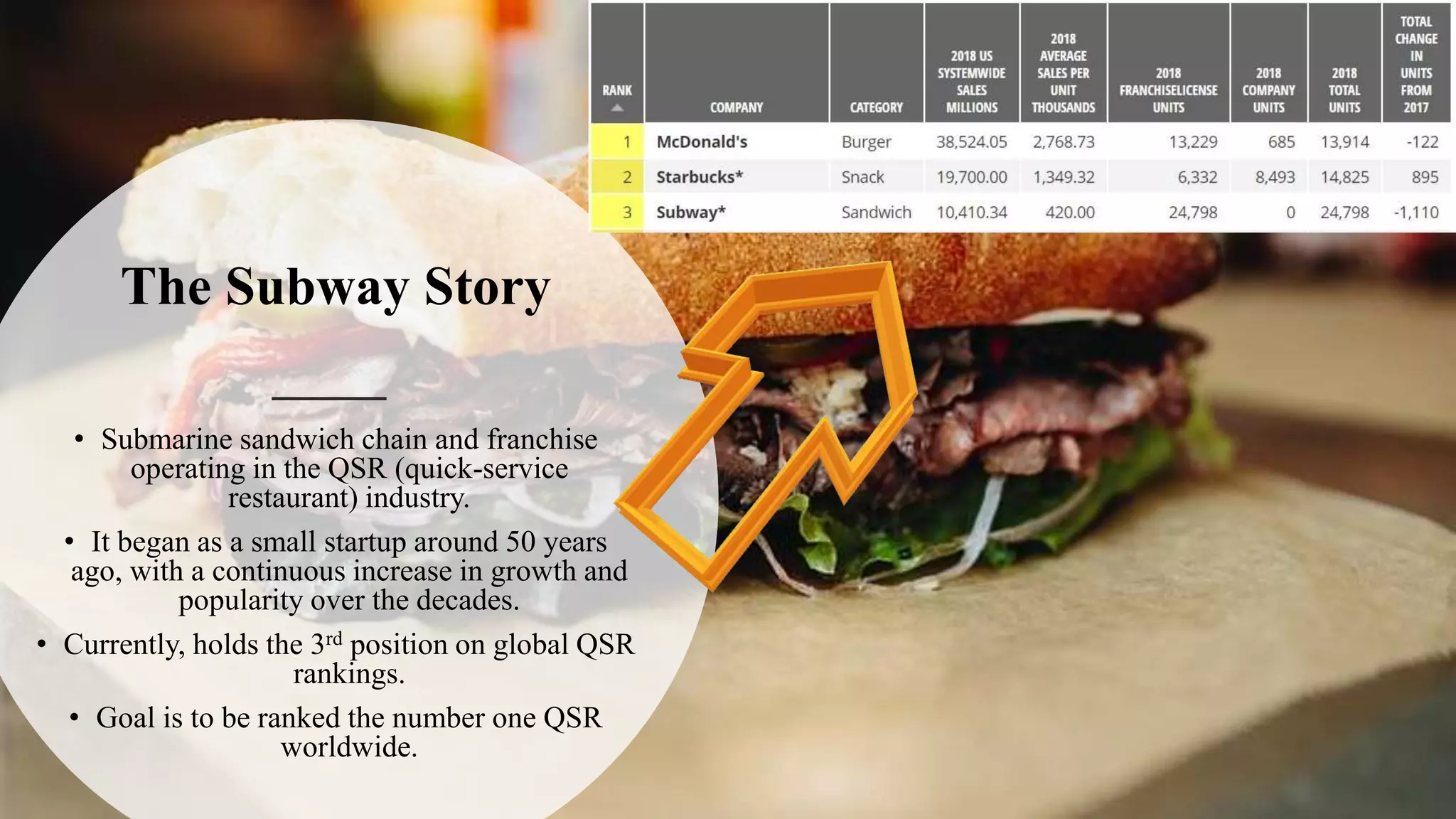
The Subway Story
• Submarine sandwich chain and franchise
operating in the QSR (quick-service
restaurant) industry.
• It began as a small startup around 50 years
ago, with a continuous increase in growth and
popularity over the decades.
• Currently, holds the 3rd position on global QSR
rankings.
• Goal is to be ranked the number one QSR
worldwide.
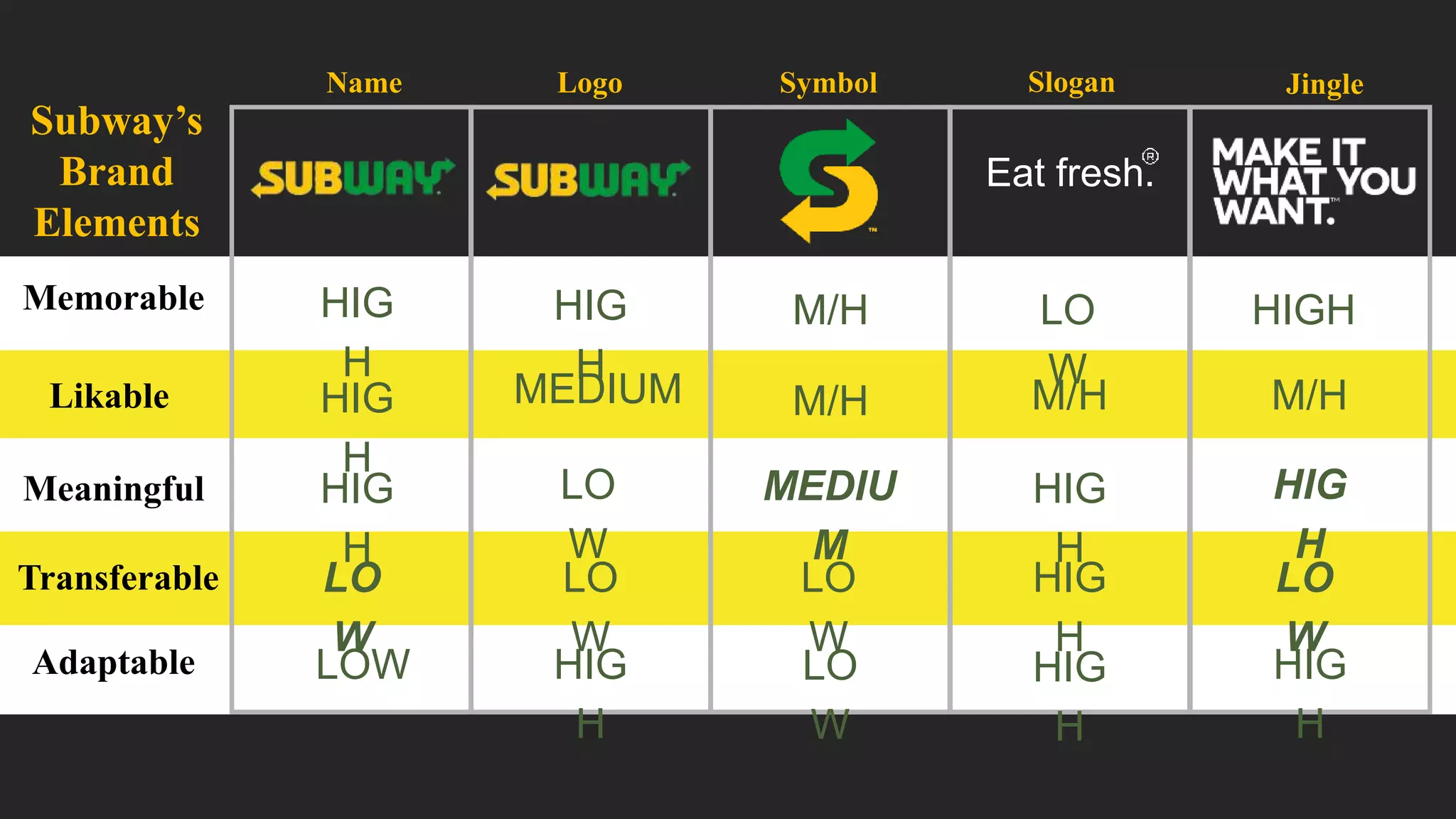
Memorable
Likable
Meaningful
Transferable
Adaptable
HIG
H
HIG
H
HIG
H
LO
W
LOW
HIG
H
LO
W
HIG
H
HIG
H
HIG
H
HIG
H
HIG
H
HIG
H
LO
W
MEDIUM
MEDIU
M
LO
W
LO
W
LO
W
LO
W
M/H
M/H M/H M/H
HIGH
Eat fresh.
Subway’s
Brand
Elements
Jingle
Logo
Name Slogan
Symbol
Marketing Strategy - 4 P’s
Subway adopts a “Traditional Marketing Strategy”, whereby its
promotions revolve around emphasizing product features and benefits,
i.e. customizable combinations, healthy, nutritious, and fresh.
Product
• Subway’s main product is the
submarine sandwich or ‘the sub’.
• Subway’s unique product element
of the marketing mix is the “Do-
it-yourself approach” wherein
customers choose from a wide
variety of different breads and
non-veg./vegetarian options.
Price
• In comparison to other
popular fast food
places, Subway is
premium priced.
• Also does not change its
prices very often.
Placement
• 24,000 branches globally
• In Pakistan, branches in 14 cities,
including cities like Multan,
Rahim Yar Khan, Bahawalpur,
and Sahiwal.
Promotion
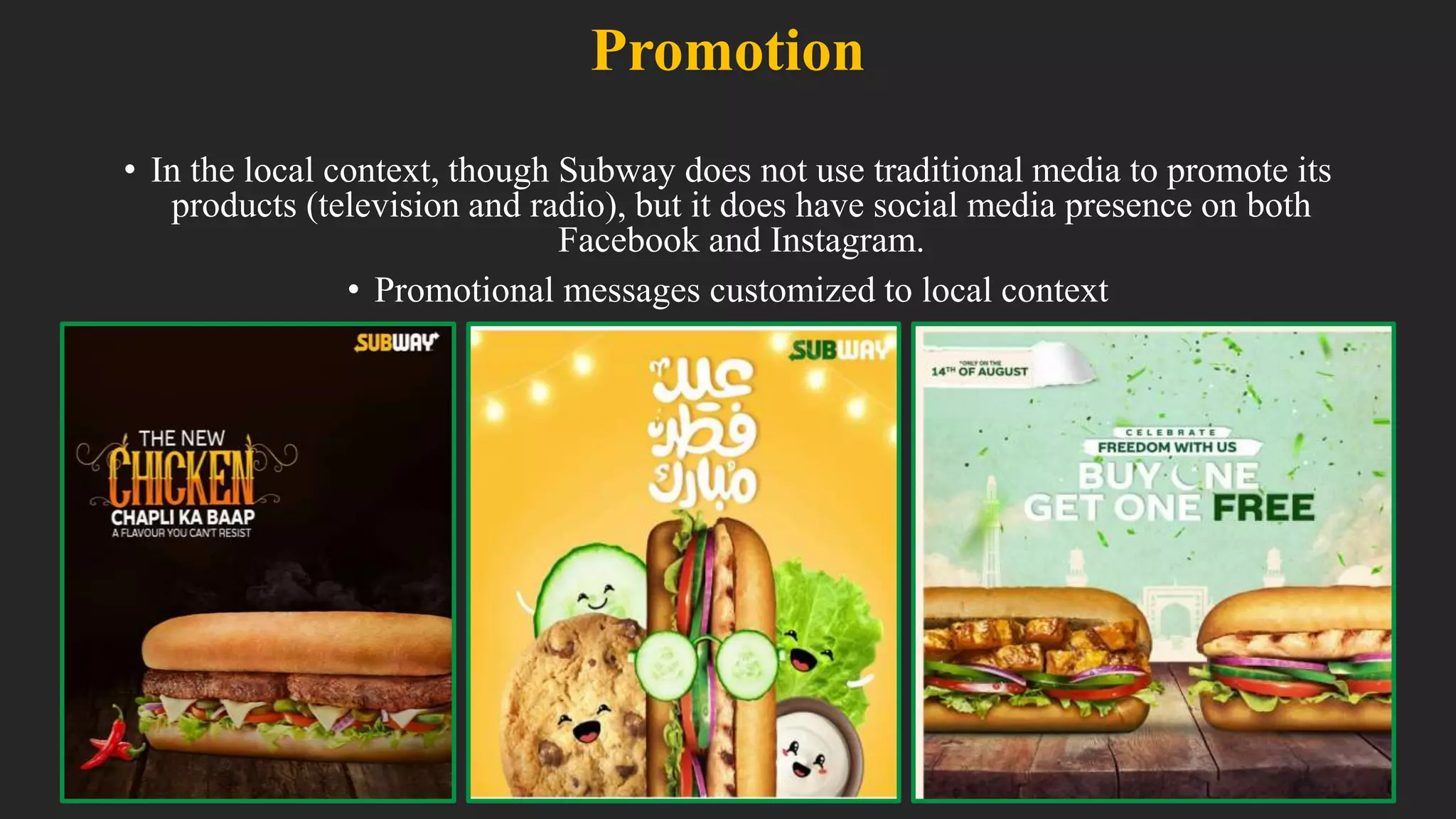
• In the local context, though Subway does not use traditional media to promote its
products (television and radio), but it does have social media presence on both
Facebook and Instagram.
• Promotional messages customized to local context
Competitor
Identification
3 sources of evidence
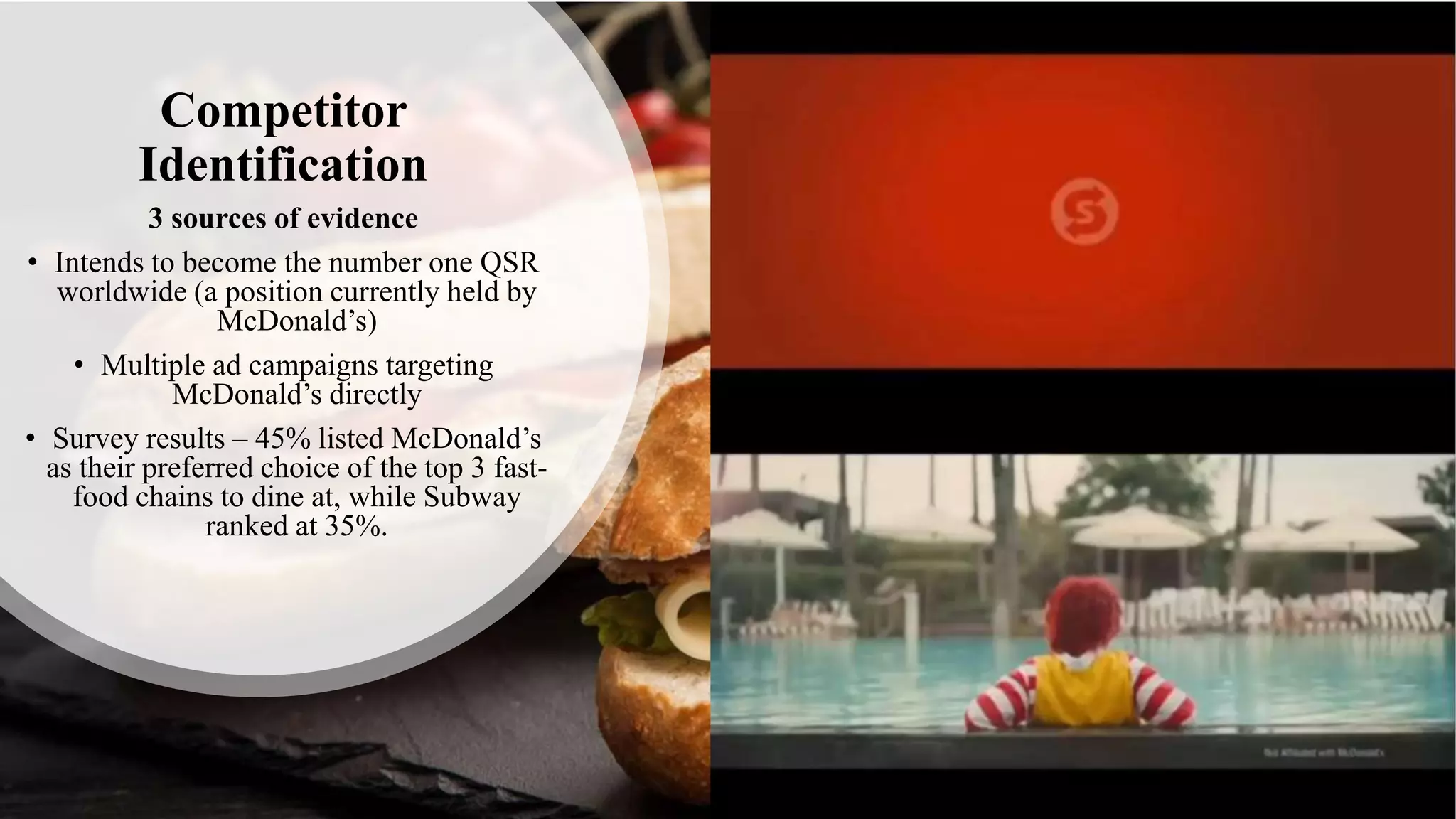
• Intends to become the number one QSR
worldwide (a position currently held by
McDonald’s)
• Multiple ad campaigns targeting
McDonald’s directly
• Survey results – 45% listed McDonald’s
as their preferred choice of the top 3 fast-
food chains to dine at, while Subway
ranked at 35%.
PODs
• High customizability with 3.2 billion
possible combos
• Minimal to no trans fats
• Vegetarian options
• Does not use the harmful ingredient MSG
(monosodium glutamate) in any of its
products
(McDonald’s uses HCFC -22 in its packaging
that contributes ozone depletion)
POPs
• Fast and convenient food
• Consistency of food quality
across different branches
• 24/7 services
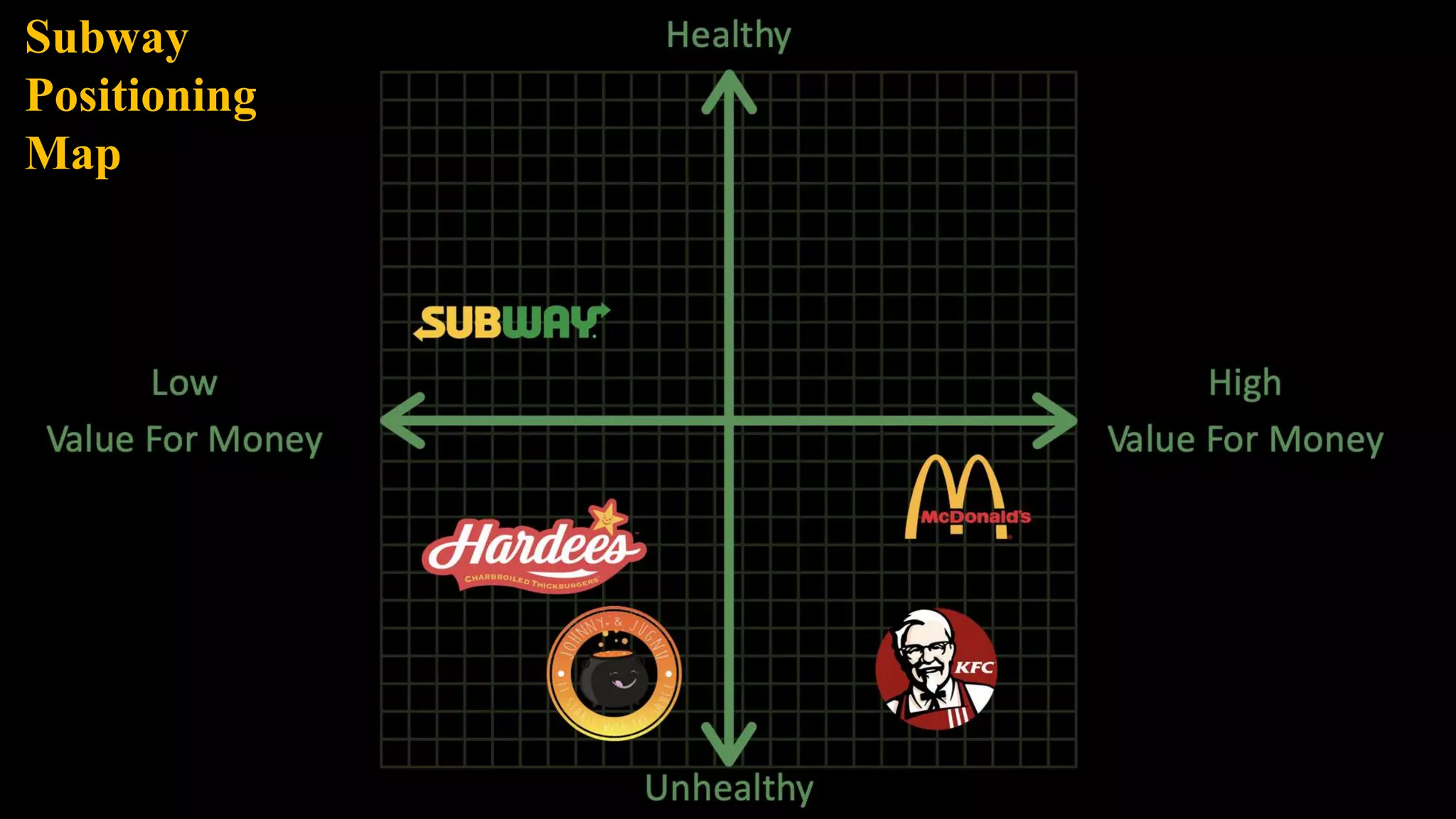
Subway
Positioning
Map
Mental
Association
Map
High frequency NEGATIVE
ASSOCIATIONS
• Insufficient value for money –
small serving size for too high a
price, not fulfilling
• Little to no deal options
• Lack of advertising
• Small, congested branches with
inadequate seating space
High frequency POSITIVE
ASSOCIATIONS
Image
• Healthy
• Hygienic
• Fresh
Performance
• High degree of customizability
• Sense of control and transparency
• Quick and 24/7 service
Composition
• Variety of breads and sauces
Valuable Insights
Social Responsibility
All subway packaging is
recyclable
Low to high frequency
perception  increase
awareness of Subway’s
environmentally-friendly
packaging
Contradiction to
”healthy” brand image
Availability of carbonated
drinks, cookies, and crisps
takes away from Subway’s
“healthy and nutritious”
USP and compromises its
projected brand image
Monotonous taste
Despite the variety of
ingredients and high sub-
sandwich customizability
Overpriced and low
value for money
Subway’s brand mantra
“Cheap, fresh, and
healthy”
Healthy and fresh 
consistent with consumer
perceptions
Cheap  contradictory
CBBE
Pyramid
• On average, 93% able to correctly
identify incomplete images of
Subway’s brand logo and menu
 high brand recognition
• However, only 35% listed
Subway as one of their “top 3
favorite fast-food places to eat at”.
 low brand recall
Salience
User profile 
“Physically-active
individuals”
54% of the Subway users
engage in some sort of
physical activity at least
once a week AND around
10% engaged in such
activities daily.
%
Imagery
While the brand seems to satisfy
consumer needs with respect to
convenience (88%), freshness (90%),
and hygiene (95%), it fails to deliver its
promise of a “cheap” fast-food
alternative.
Only 15% of the consumers found
Subway to have an excellent return on
value for money. Due to its already-
overpriced sandwiches, a significant
86% of the surveyed consumers said that
their buying behavior would decrease
as a result of a significant price increase
at Subway.
Performance
• A significant 76% of the surveyed consumers found
the brand to be likeable, while most consumers did
not perceive the brand as particularly innovative
(19%) or trustworthy (34%).
• The top three feelings evoked by Subway were
warmth (38%), fun (30%), and social approval
(29%).
The fun feeling  the ability to experiment with the
variety of ingredients, to make one’s own customized
sub  a sense of control and immense freedom of
choice with over 3.2 billion possible sub combinations.
Feeling of social approval  adding to Subway’s
brand equity over the long run. This effect can be
attributed to behavioral contagion i.e. when a health-
conscious, physically active individual is seen to be a
regular Subway consumer, it reinforces the brand’s
“healthy and nutritious” food image, essentially acting as
a CTA for potential consumers.
Judgements and Feelings
Brand loyalty context  only 12%
would go out of their way to make a
purchase.
Attitudinal attachment context  only
6% of the Subway consumer considered
the brand “more than a product”
Active engagement context  only 11%
kept up to date with Subway’s social
media presence, and one of the
underlying reasons is that Subway
lacks a prominent one.
Subway significantly lacks in all 3
respects.
Resonance
Tactical Recommendations
Expand menu offerings
• Introduce Breakfast menu (eggs, smoked meats, kebabs, baked beans, cheese), healthy desserts, hot
beverages
• More deal options (option of healthy sides, Kid’s Meals)
Increase advertising and social media presence
• Invest in ad campaigns on high exposure media platforms
• Increase awareness of recyclable packaging (campaigns, “Environmentally responsible” brand image +
nutritional balance and minimal to no trans fats (link)
• Strengthen brand credibility by endorsements via influential and trustworthy brand ambassadors. For
example: professional boxers Mohammad Waseem & Amir “King” Khan.
Prevent diffusion of brand image
• Replace cookies, Lays crisps, sodas etc. with healthier alternatives, as the availability of such products
takes away from Subway’s “Healthy and nutritious” USP/POD, and thus compromises its projected
brand image.

Subway Brand Analysis presentation

  • 1.
  • 2.
    The Subway Story •Submarine sandwich chain and franchise operating in the QSR (quick-service restaurant) industry. • It began as a small startup around 50 years ago, with a continuous increase in growth and popularity over the decades. • Currently, holds the 3rd position on global QSR rankings. • Goal is to be ranked the number one QSR worldwide.
  • 3.
  • 4.
    Marketing Strategy -4 P’s Subway adopts a “Traditional Marketing Strategy”, whereby its promotions revolve around emphasizing product features and benefits, i.e. customizable combinations, healthy, nutritious, and fresh. Product • Subway’s main product is the submarine sandwich or ‘the sub’. • Subway’s unique product element of the marketing mix is the “Do- it-yourself approach” wherein customers choose from a wide variety of different breads and non-veg./vegetarian options. Price • In comparison to other popular fast food places, Subway is premium priced. • Also does not change its prices very often. Placement • 24,000 branches globally • In Pakistan, branches in 14 cities, including cities like Multan, Rahim Yar Khan, Bahawalpur, and Sahiwal.
  • 5.
    Promotion • In thelocal context, though Subway does not use traditional media to promote its products (television and radio), but it does have social media presence on both Facebook and Instagram. • Promotional messages customized to local context
  • 6.
    Competitor Identification 3 sources ofevidence • Intends to become the number one QSR worldwide (a position currently held by McDonald’s) • Multiple ad campaigns targeting McDonald’s directly • Survey results – 45% listed McDonald’s as their preferred choice of the top 3 fast- food chains to dine at, while Subway ranked at 35%.
  • 7.
    PODs • High customizabilitywith 3.2 billion possible combos • Minimal to no trans fats • Vegetarian options • Does not use the harmful ingredient MSG (monosodium glutamate) in any of its products (McDonald’s uses HCFC -22 in its packaging that contributes ozone depletion) POPs • Fast and convenient food • Consistency of food quality across different branches • 24/7 services
  • 8.
  • 9.
  • 10.
    High frequency NEGATIVE ASSOCIATIONS •Insufficient value for money – small serving size for too high a price, not fulfilling • Little to no deal options • Lack of advertising • Small, congested branches with inadequate seating space High frequency POSITIVE ASSOCIATIONS Image • Healthy • Hygienic • Fresh Performance • High degree of customizability • Sense of control and transparency • Quick and 24/7 service Composition • Variety of breads and sauces
  • 11.
    Valuable Insights Social Responsibility Allsubway packaging is recyclable Low to high frequency perception  increase awareness of Subway’s environmentally-friendly packaging Contradiction to ”healthy” brand image Availability of carbonated drinks, cookies, and crisps takes away from Subway’s “healthy and nutritious” USP and compromises its projected brand image Monotonous taste Despite the variety of ingredients and high sub- sandwich customizability Overpriced and low value for money Subway’s brand mantra “Cheap, fresh, and healthy” Healthy and fresh  consistent with consumer perceptions Cheap  contradictory
  • 12.
  • 13.
    • On average,93% able to correctly identify incomplete images of Subway’s brand logo and menu  high brand recognition • However, only 35% listed Subway as one of their “top 3 favorite fast-food places to eat at”.  low brand recall Salience
  • 14.
    User profile  “Physically-active individuals” 54%of the Subway users engage in some sort of physical activity at least once a week AND around 10% engaged in such activities daily. % Imagery
  • 15.
    While the brandseems to satisfy consumer needs with respect to convenience (88%), freshness (90%), and hygiene (95%), it fails to deliver its promise of a “cheap” fast-food alternative. Only 15% of the consumers found Subway to have an excellent return on value for money. Due to its already- overpriced sandwiches, a significant 86% of the surveyed consumers said that their buying behavior would decrease as a result of a significant price increase at Subway. Performance
  • 16.
    • A significant76% of the surveyed consumers found the brand to be likeable, while most consumers did not perceive the brand as particularly innovative (19%) or trustworthy (34%). • The top three feelings evoked by Subway were warmth (38%), fun (30%), and social approval (29%). The fun feeling  the ability to experiment with the variety of ingredients, to make one’s own customized sub  a sense of control and immense freedom of choice with over 3.2 billion possible sub combinations. Feeling of social approval  adding to Subway’s brand equity over the long run. This effect can be attributed to behavioral contagion i.e. when a health- conscious, physically active individual is seen to be a regular Subway consumer, it reinforces the brand’s “healthy and nutritious” food image, essentially acting as a CTA for potential consumers. Judgements and Feelings
  • 17.
    Brand loyalty context only 12% would go out of their way to make a purchase. Attitudinal attachment context  only 6% of the Subway consumer considered the brand “more than a product” Active engagement context  only 11% kept up to date with Subway’s social media presence, and one of the underlying reasons is that Subway lacks a prominent one. Subway significantly lacks in all 3 respects. Resonance
  • 18.
    Tactical Recommendations Expand menuofferings • Introduce Breakfast menu (eggs, smoked meats, kebabs, baked beans, cheese), healthy desserts, hot beverages • More deal options (option of healthy sides, Kid’s Meals) Increase advertising and social media presence • Invest in ad campaigns on high exposure media platforms • Increase awareness of recyclable packaging (campaigns, “Environmentally responsible” brand image + nutritional balance and minimal to no trans fats (link) • Strengthen brand credibility by endorsements via influential and trustworthy brand ambassadors. For example: professional boxers Mohammad Waseem & Amir “King” Khan. Prevent diffusion of brand image • Replace cookies, Lays crisps, sodas etc. with healthier alternatives, as the availability of such products takes away from Subway’s “Healthy and nutritious” USP/POD, and thus compromises its projected brand image.