INTRODUCTION
• Burger King (BK) is an American multinational chain of hamburger fast food
restaurants.
• The Parent organization of the Brand Burger King is “Restaurant Brands
International”.
• Headquartered in the unincorporated area of Miami-Dade County, Florida, the
company was founded in 1953 by Keith J. Kramer and Matthew Burns as Insta-
Burger King, a Jacksonville, Florida–based restaurant chain.
• After Insta-Burger King ran into financial difficulties in 1954, its two Miami-based
franchisees David Edgerton and James McLamore purchased the company and
renamed it "Burger King".
• In 1957, the "Whopper" became the first major addition to the menu, and it has
become Burger King's signature product since.
• As of December 31, 2018, Burger King reported it had 17,796 outlets in 100
countries.
• The number of employees as of 2020 are 2,00,000.
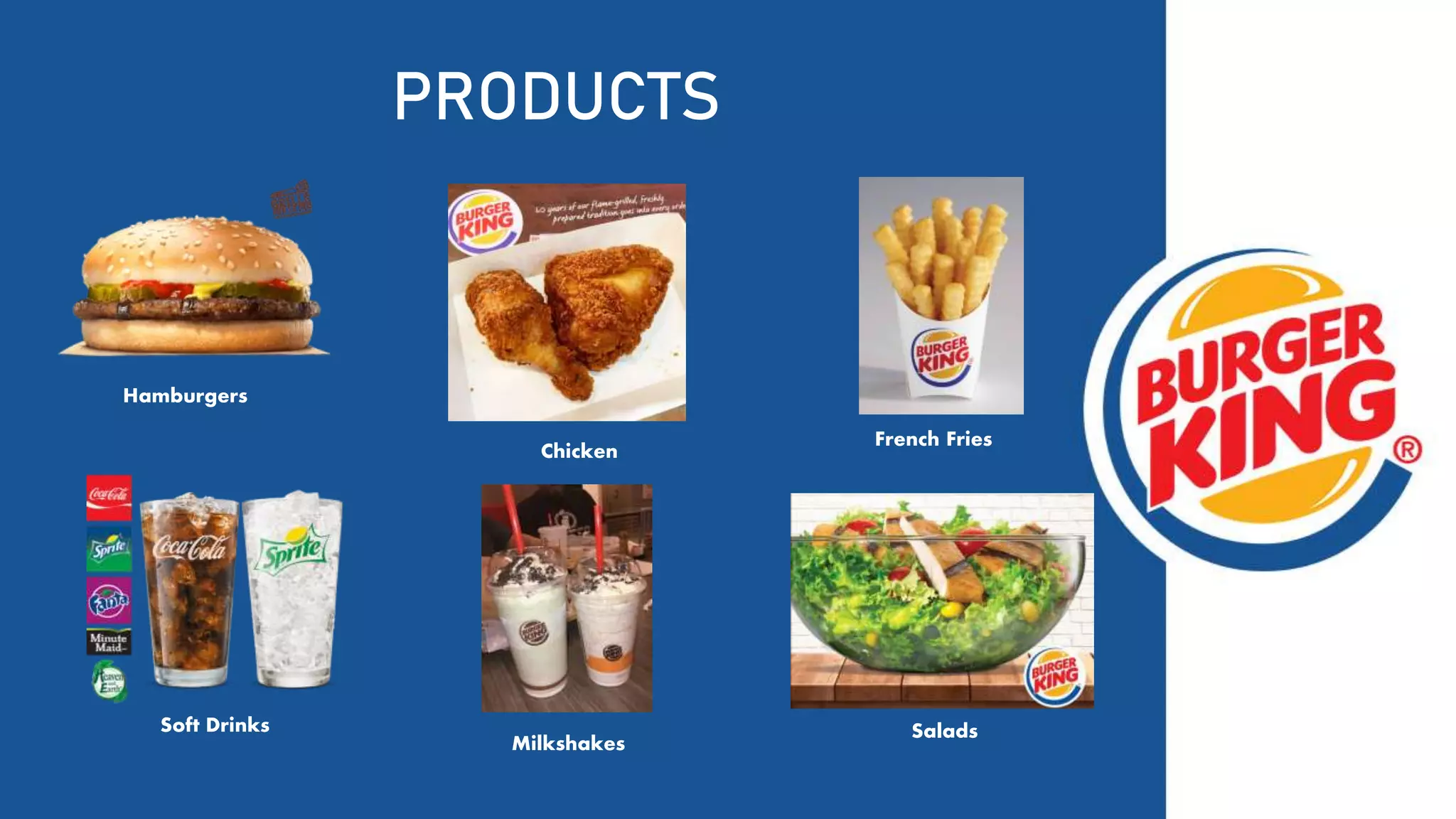
PRODUCTS
Hamburgers
Chicken
French Fries
Soft Drinks
Milkshakes
Salads
Brand and Logo
• The BURGER KING® brand is the second largest fast food hamburger
chain in the world. The original HOME OF THE WHOPPER®,
the BURGER KING® system operates more than 17,800 locations in more
than 100 countries and U.S. territories.
Market Plan
Porter’s 5 Forces
Competitive Rivalry or Competition (Strong Force)
Burger King competes with major firms like McDonald’s and Wendy’s. The degree of
competition is examined in this aspect of the Five Forces Analysis model. The main
external factors that create the strong force of competitive rivalry against Burger King:
• High number of competitors (strong force)
• High variety of firms (strong force)
• Low switching costs (strong force)
Bargaining Power of Customers/Buyers (Strong Force)
• Consumers significantly affect Burger King’s performance and the quick service restaurant
industry environment. This aspect of the Five Forces Analysis model explores the influence of
customers on firms. The main external factors that lead to the strong bargaining power of Burger
King’s customers are as follows:
• Low switching costs (strong force)
• High substitute availability (strong force)
• Moderate presence of consumer organizations (moderate force)
Bargaining Power of Suppliers (Weak Force)
• Suppliers affect the quick service restaurant industry environment through variables
like pricing and supply control. The impact of suppliers on firms like Burger King is
considered in this aspect of the Five Forces analysis. The following are the major
external factors that create the weak bargaining power of Burger King’s suppliers:
• High number of suppliers (weak force)
• High overall supply (weak force)
• Low forward integration (weak force)
Threat of Substitution or Substitutes (Strong Force)
• Substitutes technically compete against Burger King’s products. This aspect of the
Five Forces Analysis model determines the influence of substitution in the fast food
restaurant industry environment. In Burger King’s case, the following are the main
external factors that contribute to the strong threat of substitution:
• Low switching costs (strong force)
• High availability of substitutes (strong force)
• Satisfactory performance of substitutes (strong force)
Threat of New Entrants or New Entry (Moderate Force)
• New entrants can disrupt the performance of Burger King. The effects of new entry on
the fast food restaurant industry environment are examined in this aspect of the Five
Forces analysis. The external factors that lead to the moderate threat of new entrants
against Burger King are as follows:
• Low switching costs (strong force)
• Moderate cost disadvantage (moderate force)
• Moderate cost of doing business (moderate force)
Objectives
• Better restaurant operations
• Branded affordability
• Menu variety and beverage choice
• Grow market share
• Maintain debt-to-capital levels to 35-40%
• Create long-term profitable growth for shareholders
SWOT Analysis
Strengths
• Burger King has very brand awareness globally with around 100 branches
worldwide and still expanding.
• It offers diversified product line which helps attract diversified customers.
• Moreover, it is increasing popularity among middle class customers is raising
the number of loyal customers and repeated visitors.
Weaknesses
• The key weaknesses of the company is advertising unhealthy lifestyle and
menu items that create obesity or other diseases. This in general is raised as
concern of many which sometimes affects the business.
• The network of Burger King is expanding at a slower pace due to lack of
Franchise business preference.
Opportunities
• A very obvious opportunity for Burger King is more expansion, working on
ventures or franchising business to cover major fast food markets in the
world.
• The other opportunity is introducing a healthy food line like salads, more can
be added like cholesterol control items that attract a lot of obese segment.
This will immensely increase the sales.
Threats
• Stern competition in this industry is quite a threat for Burger King. Because
one good product launch of a competitor can hit the business in one go. In
order to compete this, company has to think ahead of time and introduce
strategies and products accordingly.
• High food items cost is directly reflective on prices of the company especially
in inflation season. Thus this can also serve as a threat for the company.
Service Distinction
• McDonalds is more famous than Burger King, and the former has a wider presence than
Burger King.
• When going to the McDonalds restaurant, you get quality service. They concentrate more on
the quality of the service than the speed with which the dishes are served.
• When comparing McDonalds’ service to Burger King’s, the service at Burger King is faster.
• Burger King is known to provide the customer with many choices and also to provide quicker
service.
• At McDonalds, the order is taken by an employee, and the same employee serves the dish.
However, at Burger King, the order is taken at one place, and the food is served at another
place.
Vision
Burger King’s vision statement is “to be the most profitable QSR business,
through a strong franchise system and great people, serving the best burgers in
the world.” This vision statement directs Burger King to achieve leadership in the
global quick service restaurant (QSR) industry or fast food industry.
Marketing Strategy
Market Segmentation
Geographic Segmentation:
• As geographic factors they are located in USA since 1954.On June 30, 2004, Burger
King had almost 7,976 stores all around in USA.
• And many other branches all around the world.
Demographic Segmentation:
• Burger King Start to use a logo in 1955.
• Introducing children to BURGER KING with the famous slogan, “BURGER KING®,
Where Kids Are King!”
Psychographic Segmentation:
• Dividing the customer by lowers social class and working class, which they will buy
their meal in a fast food restaurants quickly and take away their food then they can
able to back to work.
Behavioral Segmentation:
• Dividing the customers by benefits, by speed and by economy, regular
occasions and regular users.
Target Market
• Age: 16-35
• Gender: Male & Female
• Economical conditions: Mostly target the people of high society, with high
income and will to pay.
Market Share:
• Our markets share is 4.6%.
Product Pricing
• Burger King’s pricing strategies are as follows: Market-oriented pricing
strategy.
• Bundle pricing strategy
Product Placement Channels
Burger King uses to distribute its products:
• Restaurants
• Mobile app
• Website for deliveries
BK’s Product promotion channels
• Online Advertisement
• Print media Advertisement
• Bill Boards and Pamphlet
• Sales promotions
• Personal selling
• Public relations
Positioning Market
• Burger King used to position themselves somewhat traditionally as the
number two brand (competing with number one, McDonald’s) – we
try harder (“Have it Your Way”), we’re better (“Whopper Virgins”
taste test), etc.
• Fernando Machado, global CMO, Burger King, said at Zee MELT 2019, an
annual advertising and marketing summit, held in Mumbai, on Thursday.
• Machado added that brand’s positioning can be condensed into three key
points. The first one being that Burger King is a perfectly ‘imperfect’, brand.
Secondly the ‘crown’ which is a very powerful equity, spreads the message
that everyone is welcome. Lastly, the brand respects individuality and this is
reflected through its communication. “We put positioning at the Centre of
every single touch-point,” he added.
Challenges and Opportunities
CHALLENGES
• Ineffective advertising
• Changing executives
• McDonald’s used “value” platform to gain market share.
OPPORTUNITIES
• Smarter target segmentation
• New product introductions
• Social media campaign
Burger King PPT

Burger King PPT

  • 2.
    INTRODUCTION • Burger King(BK) is an American multinational chain of hamburger fast food restaurants. • The Parent organization of the Brand Burger King is “Restaurant Brands International”. • Headquartered in the unincorporated area of Miami-Dade County, Florida, the company was founded in 1953 by Keith J. Kramer and Matthew Burns as Insta- Burger King, a Jacksonville, Florida–based restaurant chain. • After Insta-Burger King ran into financial difficulties in 1954, its two Miami-based franchisees David Edgerton and James McLamore purchased the company and renamed it "Burger King". • In 1957, the "Whopper" became the first major addition to the menu, and it has become Burger King's signature product since. • As of December 31, 2018, Burger King reported it had 17,796 outlets in 100 countries. • The number of employees as of 2020 are 2,00,000.
  • 3.
  • 4.
    Brand and Logo •The BURGER KING® brand is the second largest fast food hamburger chain in the world. The original HOME OF THE WHOPPER®, the BURGER KING® system operates more than 17,800 locations in more than 100 countries and U.S. territories.
  • 5.
    Market Plan Porter’s 5Forces Competitive Rivalry or Competition (Strong Force) Burger King competes with major firms like McDonald’s and Wendy’s. The degree of competition is examined in this aspect of the Five Forces Analysis model. The main external factors that create the strong force of competitive rivalry against Burger King: • High number of competitors (strong force) • High variety of firms (strong force) • Low switching costs (strong force) Bargaining Power of Customers/Buyers (Strong Force) • Consumers significantly affect Burger King’s performance and the quick service restaurant industry environment. This aspect of the Five Forces Analysis model explores the influence of customers on firms. The main external factors that lead to the strong bargaining power of Burger King’s customers are as follows: • Low switching costs (strong force) • High substitute availability (strong force) • Moderate presence of consumer organizations (moderate force)
  • 6.
    Bargaining Power ofSuppliers (Weak Force) • Suppliers affect the quick service restaurant industry environment through variables like pricing and supply control. The impact of suppliers on firms like Burger King is considered in this aspect of the Five Forces analysis. The following are the major external factors that create the weak bargaining power of Burger King’s suppliers: • High number of suppliers (weak force) • High overall supply (weak force) • Low forward integration (weak force) Threat of Substitution or Substitutes (Strong Force) • Substitutes technically compete against Burger King’s products. This aspect of the Five Forces Analysis model determines the influence of substitution in the fast food restaurant industry environment. In Burger King’s case, the following are the main external factors that contribute to the strong threat of substitution: • Low switching costs (strong force) • High availability of substitutes (strong force) • Satisfactory performance of substitutes (strong force)
  • 7.
    Threat of NewEntrants or New Entry (Moderate Force) • New entrants can disrupt the performance of Burger King. The effects of new entry on the fast food restaurant industry environment are examined in this aspect of the Five Forces analysis. The external factors that lead to the moderate threat of new entrants against Burger King are as follows: • Low switching costs (strong force) • Moderate cost disadvantage (moderate force) • Moderate cost of doing business (moderate force)
  • 8.
    Objectives • Better restaurantoperations • Branded affordability • Menu variety and beverage choice • Grow market share • Maintain debt-to-capital levels to 35-40% • Create long-term profitable growth for shareholders
  • 9.
    SWOT Analysis Strengths • BurgerKing has very brand awareness globally with around 100 branches worldwide and still expanding. • It offers diversified product line which helps attract diversified customers. • Moreover, it is increasing popularity among middle class customers is raising the number of loyal customers and repeated visitors. Weaknesses • The key weaknesses of the company is advertising unhealthy lifestyle and menu items that create obesity or other diseases. This in general is raised as concern of many which sometimes affects the business. • The network of Burger King is expanding at a slower pace due to lack of Franchise business preference.
  • 10.
    Opportunities • A veryobvious opportunity for Burger King is more expansion, working on ventures or franchising business to cover major fast food markets in the world. • The other opportunity is introducing a healthy food line like salads, more can be added like cholesterol control items that attract a lot of obese segment. This will immensely increase the sales. Threats • Stern competition in this industry is quite a threat for Burger King. Because one good product launch of a competitor can hit the business in one go. In order to compete this, company has to think ahead of time and introduce strategies and products accordingly. • High food items cost is directly reflective on prices of the company especially in inflation season. Thus this can also serve as a threat for the company.
  • 11.
    Service Distinction • McDonaldsis more famous than Burger King, and the former has a wider presence than Burger King. • When going to the McDonalds restaurant, you get quality service. They concentrate more on the quality of the service than the speed with which the dishes are served. • When comparing McDonalds’ service to Burger King’s, the service at Burger King is faster. • Burger King is known to provide the customer with many choices and also to provide quicker service. • At McDonalds, the order is taken by an employee, and the same employee serves the dish. However, at Burger King, the order is taken at one place, and the food is served at another place. Vision Burger King’s vision statement is “to be the most profitable QSR business, through a strong franchise system and great people, serving the best burgers in the world.” This vision statement directs Burger King to achieve leadership in the global quick service restaurant (QSR) industry or fast food industry. Marketing Strategy
  • 12.
    Market Segmentation Geographic Segmentation: •As geographic factors they are located in USA since 1954.On June 30, 2004, Burger King had almost 7,976 stores all around in USA. • And many other branches all around the world. Demographic Segmentation: • Burger King Start to use a logo in 1955. • Introducing children to BURGER KING with the famous slogan, “BURGER KING®, Where Kids Are King!” Psychographic Segmentation: • Dividing the customer by lowers social class and working class, which they will buy their meal in a fast food restaurants quickly and take away their food then they can able to back to work.
  • 13.
    Behavioral Segmentation: • Dividingthe customers by benefits, by speed and by economy, regular occasions and regular users. Target Market • Age: 16-35 • Gender: Male & Female • Economical conditions: Mostly target the people of high society, with high income and will to pay. Market Share: • Our markets share is 4.6%.
  • 14.
    Product Pricing • BurgerKing’s pricing strategies are as follows: Market-oriented pricing strategy. • Bundle pricing strategy Product Placement Channels Burger King uses to distribute its products: • Restaurants • Mobile app • Website for deliveries BK’s Product promotion channels • Online Advertisement • Print media Advertisement • Bill Boards and Pamphlet • Sales promotions • Personal selling • Public relations
  • 15.
    Positioning Market • BurgerKing used to position themselves somewhat traditionally as the number two brand (competing with number one, McDonald’s) – we try harder (“Have it Your Way”), we’re better (“Whopper Virgins” taste test), etc. • Fernando Machado, global CMO, Burger King, said at Zee MELT 2019, an annual advertising and marketing summit, held in Mumbai, on Thursday. • Machado added that brand’s positioning can be condensed into three key points. The first one being that Burger King is a perfectly ‘imperfect’, brand. Secondly the ‘crown’ which is a very powerful equity, spreads the message that everyone is welcome. Lastly, the brand respects individuality and this is reflected through its communication. “We put positioning at the Centre of every single touch-point,” he added.
  • 16.
    Challenges and Opportunities CHALLENGES •Ineffective advertising • Changing executives • McDonald’s used “value” platform to gain market share. OPPORTUNITIES • Smarter target segmentation • New product introductions • Social media campaign