Substance Use Disorders
Marius Commodore MD
Section of General Internal Medicine
1/20/2016
Substance Use Disorders: Outline
• Definitions:
• Abuse vs Drug Addiction
• Substance Use Disorder
• Demographics: Who is a disordered user of
substance?
• Pathophysiology of Addiction
• Specific substances
• Cocaine
• Opiates
• Marijuana
• Alcohol
• Methamphetamine
• Substance use rehabilitation
Substance Use Disorders: Cases for
Consideration – Sal
• Sal Franco is a 74-year old man, living alone in an apartment complex for older adults. You are the
Senior Services social worker associated with the housing units. Sal and his wife, Maria, owned
and operated a small, local grocery for 44 years (they emigrated from Italy when they were
newlyweds at age 19). They sold the business to their son Dominic when Sal turned 70. The plan
was to enjoy travel and retired life together. However, shortly after retiring, Maria was diagnosed
with an aggressive leukemia, and she died within 4 months. Mr. Franco has been living alone for
over 3 years. Because Sal and Maria spent most of their time working and involved with family
activities, there are few close friends in his life. Dominic's family has Sal to dinner every Sunday,
but has little time during the week because of competing demands. Sal's other children include a
daughter living in another state who calls daily (but seldom visits because of the cost), a daughter
overseas in military service, and a son with Down's Syndrome who lives in a group home about an
hour away.
• Sal indicates that he was a "hard drinker" during his 20s and 30s, when he developed stomach
problems and high blood pressure. At that point, he limited his use of alcohol to his Friday night
poker club and to Sunday dinner with the family. Since Maria's death, Sal has regularly consumed
3 to 4 drinks a day. He says it alleviates some of the pain, stress, and loneliness. It also helps him
sleep, along with the over-the-counter medications that he takes for arthritis pain and as sleep
aides. He came to the clinic because his hypertension and gastritis have become extremely labile
and intractable. When you ask Mr. Franco how he is doing, he says, "Oh, I guess I'm okay for an
old widower. I don't think it really matters how I feel or what I do anymore at my age."
Substance Use Disorders: Cases for
Consideration - George
• George is a 42-year-old man with a history of total hip arthroplasty presented for
first-time visit with complaints of hip pain. One year ago he had a displaced left
femoral neck fracture requiring total hip arthroplasty with subsequent chronic hip
pain. His pain was managed by his orthopedist, originally with oxycodone and
more recently with ibuprofen. Recent extensive reevaluation of his hip pain was
negative.
• He requested that his orthopedist prescribe something stronger like “oxys” for his
pain, as the ibuprofen was ineffective. He was told to discuss his pain
management with his primary care physician (you). He’s been on disability since
his hip surgery and lives with his wife and two children. He denies current or past
alcohol, tobacco, or drug use.
• Currently, he’s on ibuprofen 800 mg three times per day. He walks with a limp and
uses a cane. His vitals are normal. He’s 6 feet tall and weighs 230 pounds. He has
a large, well-healed scar over the left lateral thigh and hip area with no
tenderness or warmth over the hip. He has full range of motion. He doesn’t want
to return to his orthopedist, because “he doesn’t believe that I’m still in pain.”
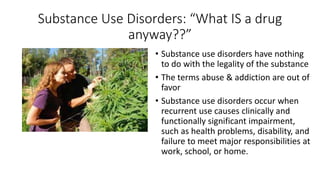
Substance Use Disorders: “What IS a drug
anyway??”
• Substance use disorders have nothing
to do with the legality of the substance
• The terms abuse & addiction are out of
favor
• Substance use disorders occur when
recurrent use causes clinically and
functionally significant impairment,
such as health problems, disability, and
failure to meet major responsibilities at
work, school, or home.
Substance Use Disorders: “What IS a drug
anyway??”
• DSM V describes substance use disorder (SUD):
• Taking the substance in larger amounts and for longer than intended
• Wanting to cut down or quit but not being able to do it
• Spending a lot of time obtaining the substance
• Craving or a strong desire to use the substance
• Repeatedly unable to carry out major obligations at work, school, or home due to use of the substance
• Continued use despite persistent or recurring social or interpersonal problems caused or made worse
by substance use
• Stopping or reducing important social, occupational, or recreational activities due to substance use
• Recurrent use of substances in physically hazardous situations
• Consistent use of substances despite acknowledgment of persistent or recurrent physical or
psychological difficulties from their use
• Tolerance as defined by either a need for markedly increased amounts to achieve intoxication or
desired effect or markedly diminished effect with continued use of the same amount. (Does not apply
for diminished effect when used appropriately under medical supervision e.g. for opioids)
• Withdrawal manifesting as either characteristic syndrome or the substance is used to avoid withdrawal
(Does not apply when used appropriately under medical supervision)
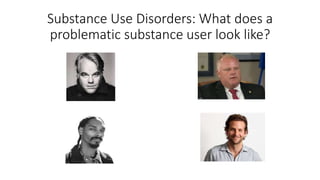
Substance Use Disorders: What does a
problematic substance user look like?
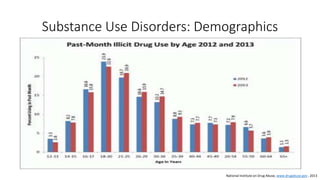
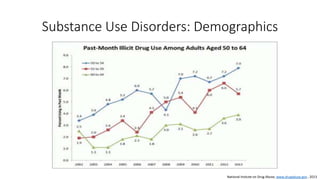
Substance Use Disorders: Demographics
National Institute on Drug Abuse, www.drugabuse.gov , 2013
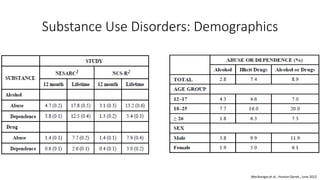
Substance Use Disorders: Demographics
National Insitute on Drug Abuse, www.drugabuse.gov , 2013
Substance Use Disorders: Demographics
Merikangas et al., Human Genet., June 2012
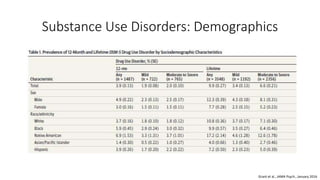
Substance Use Disorders: Demographics
Grant et al., JAMA Psych., January 2016
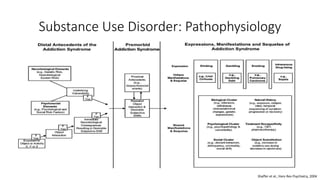
Substance Use Disorder: Pathophysiology
Shaffer et al., Harv Rev Psychiatry, 2004
Substance Use Disorder: Pathophysiology –
Key Molecules
• Key molecules in
substance use disorder:
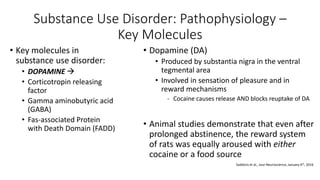
• DOPAMINE 
• Corticotropin releasing
factor
• Gamma aminobutyric acid
(GABA)
• Fas-associated Protein
with Death Domain (FADD)
• Dopamine (DA)
• Produced by substantia nigra in the ventral
tegmental area
• Involved in sensation of pleasure and in
reward mechanisms
- Cocaine causes release AND blocks reuptake of DA
• Animal studies demonstrate that even after
prolonged abstinence, the reward system
of rats was equally aroused with either
cocaine or a food source
Saddoris et al., Jour Neuroscience, January 6th, 2016
Substance Use Disorder: Pathophysiology –
Key Molecules
• Key molecules in
substance use disorder:
• Dopamine
• CORTICOTROPIN-
RELEASING FACTOR 
• Gamma aminobutyric acid
(GABA)
• Fas-associated Protein
with Death Domain (FADD)
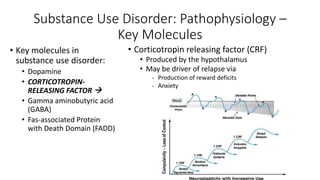
• Corticotropin releasing factor (CRF)
• Produced by the hypothalamus
• May be driver of relapse via
- Production of reward deficits
- Anxiety
Substance Use Disorder: Pathophysiology –
Key Molecules
• Key molecules in substance
use disorder:
• Dopamine
• Corticotropin releasing factor
• GAMMA AMINOBUTYRIC
ACID (GABA) 
• Fas-associated Protein with
Death Domain (FADD)
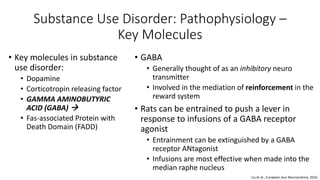
• GABA
• Generally thought of as an inhibitory neuro
transmitter
• Involved in the mediation of reinforcement in the
reward system
• Rats can be entrained to push a lever in
response to infusions of a GABA receptor
agonist
• Entrainment can be extinguished by a GABA
receptor ANtagonist
• Infusions are most effective when made into the
median raphe nucleus
Liu et al., European Jour Neuroscience, 2016
Substance Use Disorder: Pathophysiology –
Key Molecules
• Key molecules in
substance use disorder:
• Dopamine
• Corticotropin releasing
factor
• Gamma aminobutyric acid
• FAS-ASSOCIATED PROTEIN
WITH DEATH DOMAIN
(FADD) 
Garcia-Fuster et al., Neuropsychopharm, 2011
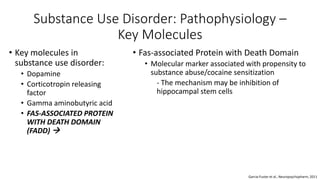
• Fas-associated Protein with Death Domain
• Molecular marker associated with propensity to
substance abuse/cocaine sensitization
- The mechanism may be inhibition of
hippocampal stem cells
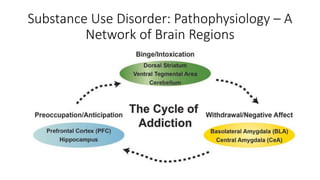
Substance Use Disorder: Pathophysiology – A
Network of Brain Regions
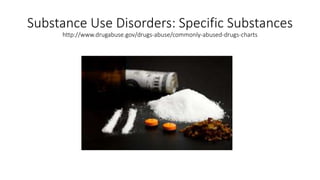
Substance Use Disorders: Specific Substances
http://www.drugabuse.gov/drugs-abuse/commonly-abused-drugs-charts
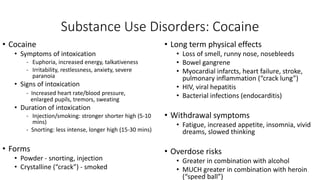
Substance Use Disorders: Cocaine
• Cocaine
• Symptoms of intoxication
- Euphoria, increased energy, talkativeness
- Irritability, restlessness, anxiety, severe
paranoia
• Signs of intoxication
- Increased heart rate/blood pressure,
enlarged pupils, tremors, sweating
• Duration of intoxication
- Injection/smoking: stronger shorter high (5-10
mins)
- Snorting: less intense, longer high (15-30 mins)
• Forms
• Powder - snorting, injection
• Crystalline (“crack”) - smoked
• Long term physical effects
• Loss of smell, runny nose, nosebleeds
• Bowel gangrene
• Myocardial infarcts, heart failure, stroke,
pulmonary inflammation (“crack lung”)
• HIV, viral hepatitis
• Bacterial infections (endocarditis)
• Withdrawal symptoms
• Fatigue, increased appetite, insomnia, vivid
dreams, slowed thinking
• Overdose risks
• Greater in combination with alcohol
• MUCH greater in combination with heroin
(“speed ball”)
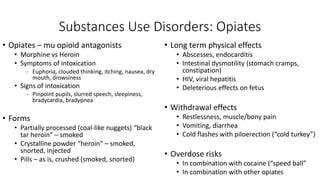
Substances Use Disorders: Opiates
• Opiates – mu opioid antagonists
• Morphine vs Heroin
• Symptoms of intoxication
- Euphoria, clouded thinking, itching, nausea, dry
mouth, drowsiness
• Signs of intoxication
- Pinpoint pupils, slurred speech, sleepiness,
bradycardia, bradypnea
• Forms
• Partially processed (coal-like nuggets) “black
tar heroin” – smoked
• Crystalline powder “heroin” – smoked,
snorted, injected
• Pills – as is, crushed (smoked, snorted)
• Long term physical effects
• Abscesses, endocarditis
• Intestinal dysmotility (stomach cramps,
constipation)
• HIV, viral hepatitis
• Deleterious effects on fetus
• Withdrawal effects
• Restlessness, muscle/bony pain
• Vomiting, diarrhea
• Cold flashes with piloerection (“cold turkey”)
• Overdose risks
• In combination with cocaine (“speed ball”
• In combination with other opiates
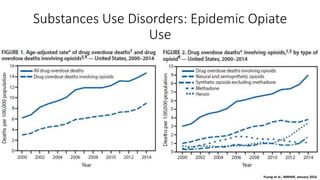
Substances Use Disorders: Epidemic Opiate
Use
Young et al., MMWR, January 2016
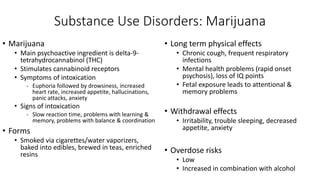
Substance Use Disorders: Marijuana
• Marijuana
• Main psychoactive ingredient is delta-9-
tetrahydrocannabinol (THC)
• Stimulates cannabinoid receptors
• Symptoms of intoxication
- Euphoria followed by drowsiness, increased
heart rate, increased appetite, hallucinations,
panic attacks, anxiety
• Signs of intoxication
- Slow reaction time, problems with learning &
memory, problems with balance & coordination
• Forms
• Smoked via cigarettes/water vaporizers,
baked into edibles, brewed in teas, enriched
resins
• Long term physical effects
• Chronic cough, frequent respiratory
infections
• Mental health problems (rapid onset
psychosis), loss of IQ points
• Fetal exposure leads to attentional &
memory problems
• Withdrawal effects
• Irritability, trouble sleeping, decreased
appetite, anxiety
• Overdose risks
• Low
• Increased in combination with alcohol
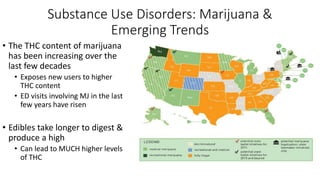
Substance Use Disorders: Marijuana &
Emerging Trends
• The THC content of marijuana
has been increasing over the
last few decades
• Exposes new users to higher
THC content
• ED visits involving MJ in the last
few years have risen
• Edibles take longer to digest &
produce a high
• Can lead to MUCH higher levels
of THC
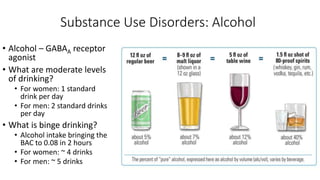
Substance Use Disorders: Alcohol
• Alcohol – GABAA receptor
agonist
• What are moderate levels
of drinking?
• For women: 1 standard
drink per day
• For men: 2 standard drinks
per day
• What is binge drinking?
• Alcohol intake bringing the
BAC to 0.08 in 2 hours
• For women: ~ 4 drinks
• For men: ~ 5 drinks
Substance Use Disorders: Alcohol
• Alcohol
• Symptoms of intoxication
• Euphoria, disinhibition, labile mood, skin
flushing, impaired judgement, poor balance
• Signs of intoxication
• Impaired coordination, slurred speech, slowed
respiration, ataxia
• Forms:
• Bottle of beer (12 oz) – 1 (standard drink)
• 40 oz malt liquor – 4.5
• Bottle of wine (750 ml) – 5
• A fifth of liquor (750 ml) – 17
• Long term physical effects
• Systolic heart failure, stroke, elevated BP
• Cirrhosis, pancreatitis
• Cancer (mouth, esophagus, throat, liver,
breast)
• Withdrawal effects
• Insomnia, irritability, tremor, nausea,
sweating, anxiety, depression
• DEATH!
- Delirium tremens: Occurs 24-72 hrs after
cessation from alcohol
- Nightmares, agitation, global confusion,
disorientation, autonomic dysfunction
• Overdose risks
• Enhanced with other sedative drugs
Substance Use Disorders: Methamphetamine
• Methamphetamine – dopaminergic
stimulant
• Methylated phenylethylamine vs DOUBLE
methylated phenylethylamine
• Symptoms of intoxication
• Increased wakefulness, increased physical
activity, decreased appetite, palpitations
• Signs of intoxication
• Tachypnea, tachycardia, elevated BP,
• Forms:
• White powder, pills – snorted, oral ingestion
• Blue-white crystals (“crystal meth”) –
smoked, injected
• Long term physical effects
• Anxiety, paranoia, mood problems, violence,
hallucinations, delusions
• Weight loss, SEVERE dental problems (“meth
mouth”)
• Intense itching leading to skin sore from
scratching
• HIV, viral hepatitis, fetal effects
• Withdrawal effects
• Depression, anxiety, fatigue
• Overdose risks
• Can be deadly alone
• Masks the intoxicant effects of alcohol
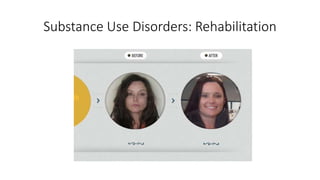
Substance Use Disorders: Rehabilitation
Substance Use Disorders: Diagnosis – ASK!
• Preface your questions -
• “I am going to ask a few questions which
might seem unrelated to what we’ve been
talking about…”
• “I am going to ask some questions which are
a little personal but…”
• “I ask these questions to everyone…”
• “Do you drink any alcohol?”
• Socially – “Well how often is that?
• Rarely – “Can you estimate how often that
is?” or “Once a week? Once a month”
• When I go out with friends – “Well how often
is that?”
• I drink beer – “Oh, for my purposes I think of
beer as alcohol; how often do you drink
beer?”
• When I smoke – “How often do you smoke?”
• “How much do you drink?”
• Let them use traditional amounts – a six
pack, a bottle, a fifth etc
• CAGE questionnaire
• C – Do you ever feel like you need to cut
down on your drinking?
• A – Do you feel annoyed when people ask
you about your drinking?
• How about right now?
• G – Do you every feel guilty about your
drinking?
- How so? Do you hide bottles? Hide this from
spouse/significant other?
• E – Do you ever feel like you need an eye-
opener?
- You ever feel like you need a drink in the
morning just to ‘get right’?
Substance Use Disorders: Diagnosis – ASK!
• Do you use any illegal drugs?
• Don’t say illicit drugs
• Don’t say street drugs
• “Yes.”
• What drug do you use?
• Then - “Do you use any other drugs?”
• Then – Specify some choices…
• “No.”
• Have you ever used an illegal substance in
the past? Which one? Any others?
• When was the last time you used an illegal
drug? How/why did you stop?
• Ask specifically about marijuana!
• For each substance identified, ask how
often and how much is consumed
• “How much money do you spend a week on
[X]?”
• “Can you estimate it for me?”
- Then in your mind, increase that amount by at
least 50%!
• “Have you ever overused prescription
drugs?
• Has a doctor ever stopped prescribing a drug
to you when you weren’t ready to stop??
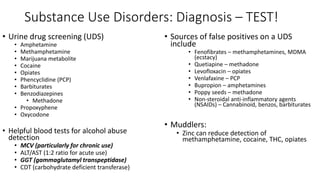
Substance Use Disorders: Diagnosis – TEST!
• Urine drug screening (UDS)
• Amphetamine
• Methamphetamine
• Marijuana metabolite
• Cocaine
• Opiates
• Phencyclidine (PCP)
• Barbiturates
• Benzodiazepines
• Methadone
• Propoxyphene
• Oxycodone
• Helpful blood tests for alcohol abuse
detection
• MCV (particularly for chronic use)
• ALT/AST (1:2 ratio for acute use)
• GGT (gammaglutamyl transpeptidase)
• CDT (carbohydrate deficient transferase)
• Sources of false positives on a UDS
include
• Fenofibrates – methamphetamines, MDMA
(ecstacy)
• Quetiapine – methadone
• Levofloxacin – opiates
• Venlafaxine – PCP
• Bupropion – amphetamines
• Poppy seeds – methadone
• Non-steroidal anti-inflammatory agents
(NSAIDs) – Cannabinoid, benzos, barbiturates
• Muddlers:
• Zinc can reduce detection of
methamphetamine, cocaine, THC, opiates
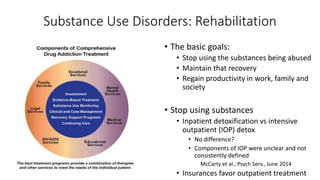
Substance Use Disorders: Rehabilitation
• The basic goals:
• Stop using the substances being abused
• Maintain that recovery
• Regain productivity in work, family and
society
• Stop using substances
• Inpatient detoxification vs intensive
outpatient (IOP) detox
• No difference?
• Components of IOP were unclear and not
consistently defined
McCarty et al., Psych Serv., June 2014
• Insurances favor outpatient treatment
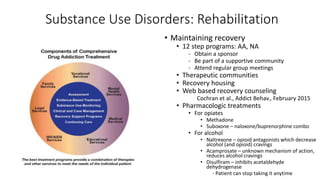
Substance Use Disorders: Rehabilitation
• Maintaining recovery
• 12 step programs: AA, NA
- Obtain a sponsor
- Be part of a supportive community
- Attend regular group meetings
• Therapeutic communities
• Recovery housing
• Web based recovery counseling
Cochran et al., Addict Behav., February 2015
• Pharmacologic treatments
• For opiates
• Methadone
• Suboxone – naloxone/buprenorphine combo
• For alcohol
• Naltrexone – opioid antagonists which decrease
alcohol (and opioid) cravings
• Acamprosate – unknown mechanism of action,
reduces alcohol cravings
• Disulfiram – inhibits acetaldehyde
dehydrogenase
- Patient can stop taking it anytime
Substance Use Disorders: Rehabilitation
• Substance use disorders are widespread and pervasive in society
• Recognizing them must be part of the armamentarium of EVERY
physician
• Always ask everyone
• Substance use disorder develops due to complex interactions
between substances, neurotransmitters and networks of brain
regions
• The effects of substance use are psychiatric, physical and societal
• Recovery is possible but the approach is multimodal, complex and
must be individualized
Substance Use Disorders: Questions?

Substance Use Disorders

  • 1.
    Substance Use Disorders MariusCommodore MD Section of General Internal Medicine 1/20/2016
  • 2.
    Substance Use Disorders:Outline • Definitions: • Abuse vs Drug Addiction • Substance Use Disorder • Demographics: Who is a disordered user of substance? • Pathophysiology of Addiction • Specific substances • Cocaine • Opiates • Marijuana • Alcohol • Methamphetamine • Substance use rehabilitation
  • 3.
    Substance Use Disorders:Cases for Consideration – Sal • Sal Franco is a 74-year old man, living alone in an apartment complex for older adults. You are the Senior Services social worker associated with the housing units. Sal and his wife, Maria, owned and operated a small, local grocery for 44 years (they emigrated from Italy when they were newlyweds at age 19). They sold the business to their son Dominic when Sal turned 70. The plan was to enjoy travel and retired life together. However, shortly after retiring, Maria was diagnosed with an aggressive leukemia, and she died within 4 months. Mr. Franco has been living alone for over 3 years. Because Sal and Maria spent most of their time working and involved with family activities, there are few close friends in his life. Dominic's family has Sal to dinner every Sunday, but has little time during the week because of competing demands. Sal's other children include a daughter living in another state who calls daily (but seldom visits because of the cost), a daughter overseas in military service, and a son with Down's Syndrome who lives in a group home about an hour away. • Sal indicates that he was a "hard drinker" during his 20s and 30s, when he developed stomach problems and high blood pressure. At that point, he limited his use of alcohol to his Friday night poker club and to Sunday dinner with the family. Since Maria's death, Sal has regularly consumed 3 to 4 drinks a day. He says it alleviates some of the pain, stress, and loneliness. It also helps him sleep, along with the over-the-counter medications that he takes for arthritis pain and as sleep aides. He came to the clinic because his hypertension and gastritis have become extremely labile and intractable. When you ask Mr. Franco how he is doing, he says, "Oh, I guess I'm okay for an old widower. I don't think it really matters how I feel or what I do anymore at my age."
  • 4.
    Substance Use Disorders:Cases for Consideration - George • George is a 42-year-old man with a history of total hip arthroplasty presented for first-time visit with complaints of hip pain. One year ago he had a displaced left femoral neck fracture requiring total hip arthroplasty with subsequent chronic hip pain. His pain was managed by his orthopedist, originally with oxycodone and more recently with ibuprofen. Recent extensive reevaluation of his hip pain was negative. • He requested that his orthopedist prescribe something stronger like “oxys” for his pain, as the ibuprofen was ineffective. He was told to discuss his pain management with his primary care physician (you). He’s been on disability since his hip surgery and lives with his wife and two children. He denies current or past alcohol, tobacco, or drug use. • Currently, he’s on ibuprofen 800 mg three times per day. He walks with a limp and uses a cane. His vitals are normal. He’s 6 feet tall and weighs 230 pounds. He has a large, well-healed scar over the left lateral thigh and hip area with no tenderness or warmth over the hip. He has full range of motion. He doesn’t want to return to his orthopedist, because “he doesn’t believe that I’m still in pain.”
  • 5.
    Substance Use Disorders:“What IS a drug anyway??” • Substance use disorders have nothing to do with the legality of the substance • The terms abuse & addiction are out of favor • Substance use disorders occur when recurrent use causes clinically and functionally significant impairment, such as health problems, disability, and failure to meet major responsibilities at work, school, or home.
  • 6.
    Substance Use Disorders:“What IS a drug anyway??” • DSM V describes substance use disorder (SUD): • Taking the substance in larger amounts and for longer than intended • Wanting to cut down or quit but not being able to do it • Spending a lot of time obtaining the substance • Craving or a strong desire to use the substance • Repeatedly unable to carry out major obligations at work, school, or home due to use of the substance • Continued use despite persistent or recurring social or interpersonal problems caused or made worse by substance use • Stopping or reducing important social, occupational, or recreational activities due to substance use • Recurrent use of substances in physically hazardous situations • Consistent use of substances despite acknowledgment of persistent or recurrent physical or psychological difficulties from their use • Tolerance as defined by either a need for markedly increased amounts to achieve intoxication or desired effect or markedly diminished effect with continued use of the same amount. (Does not apply for diminished effect when used appropriately under medical supervision e.g. for opioids) • Withdrawal manifesting as either characteristic syndrome or the substance is used to avoid withdrawal (Does not apply when used appropriately under medical supervision)
  • 7.
    Substance Use Disorders:What does a problematic substance user look like?
  • 8.
    Substance Use Disorders:Demographics National Institute on Drug Abuse, www.drugabuse.gov , 2013
  • 9.
    Substance Use Disorders:Demographics National Insitute on Drug Abuse, www.drugabuse.gov , 2013
  • 10.
    Substance Use Disorders:Demographics Merikangas et al., Human Genet., June 2012
  • 11.
    Substance Use Disorders:Demographics Grant et al., JAMA Psych., January 2016
  • 12.
    Substance Use Disorder:Pathophysiology Shaffer et al., Harv Rev Psychiatry, 2004
  • 13.
    Substance Use Disorder:Pathophysiology – Key Molecules • Key molecules in substance use disorder: • DOPAMINE  • Corticotropin releasing factor • Gamma aminobutyric acid (GABA) • Fas-associated Protein with Death Domain (FADD) • Dopamine (DA) • Produced by substantia nigra in the ventral tegmental area • Involved in sensation of pleasure and in reward mechanisms - Cocaine causes release AND blocks reuptake of DA • Animal studies demonstrate that even after prolonged abstinence, the reward system of rats was equally aroused with either cocaine or a food source Saddoris et al., Jour Neuroscience, January 6th, 2016
  • 14.
    Substance Use Disorder:Pathophysiology – Key Molecules • Key molecules in substance use disorder: • Dopamine • CORTICOTROPIN- RELEASING FACTOR  • Gamma aminobutyric acid (GABA) • Fas-associated Protein with Death Domain (FADD) • Corticotropin releasing factor (CRF) • Produced by the hypothalamus • May be driver of relapse via - Production of reward deficits - Anxiety
  • 15.
    Substance Use Disorder:Pathophysiology – Key Molecules • Key molecules in substance use disorder: • Dopamine • Corticotropin releasing factor • GAMMA AMINOBUTYRIC ACID (GABA)  • Fas-associated Protein with Death Domain (FADD) • GABA • Generally thought of as an inhibitory neuro transmitter • Involved in the mediation of reinforcement in the reward system • Rats can be entrained to push a lever in response to infusions of a GABA receptor agonist • Entrainment can be extinguished by a GABA receptor ANtagonist • Infusions are most effective when made into the median raphe nucleus Liu et al., European Jour Neuroscience, 2016
  • 16.
    Substance Use Disorder:Pathophysiology – Key Molecules • Key molecules in substance use disorder: • Dopamine • Corticotropin releasing factor • Gamma aminobutyric acid • FAS-ASSOCIATED PROTEIN WITH DEATH DOMAIN (FADD)  Garcia-Fuster et al., Neuropsychopharm, 2011 • Fas-associated Protein with Death Domain • Molecular marker associated with propensity to substance abuse/cocaine sensitization - The mechanism may be inhibition of hippocampal stem cells
  • 17.
    Substance Use Disorder:Pathophysiology – A Network of Brain Regions
  • 18.
    Substance Use Disorders:Specific Substances http://www.drugabuse.gov/drugs-abuse/commonly-abused-drugs-charts
  • 19.
    Substance Use Disorders:Cocaine • Cocaine • Symptoms of intoxication - Euphoria, increased energy, talkativeness - Irritability, restlessness, anxiety, severe paranoia • Signs of intoxication - Increased heart rate/blood pressure, enlarged pupils, tremors, sweating • Duration of intoxication - Injection/smoking: stronger shorter high (5-10 mins) - Snorting: less intense, longer high (15-30 mins) • Forms • Powder - snorting, injection • Crystalline (“crack”) - smoked • Long term physical effects • Loss of smell, runny nose, nosebleeds • Bowel gangrene • Myocardial infarcts, heart failure, stroke, pulmonary inflammation (“crack lung”) • HIV, viral hepatitis • Bacterial infections (endocarditis) • Withdrawal symptoms • Fatigue, increased appetite, insomnia, vivid dreams, slowed thinking • Overdose risks • Greater in combination with alcohol • MUCH greater in combination with heroin (“speed ball”)
  • 20.
    Substances Use Disorders:Opiates • Opiates – mu opioid antagonists • Morphine vs Heroin • Symptoms of intoxication - Euphoria, clouded thinking, itching, nausea, dry mouth, drowsiness • Signs of intoxication - Pinpoint pupils, slurred speech, sleepiness, bradycardia, bradypnea • Forms • Partially processed (coal-like nuggets) “black tar heroin” – smoked • Crystalline powder “heroin” – smoked, snorted, injected • Pills – as is, crushed (smoked, snorted) • Long term physical effects • Abscesses, endocarditis • Intestinal dysmotility (stomach cramps, constipation) • HIV, viral hepatitis • Deleterious effects on fetus • Withdrawal effects • Restlessness, muscle/bony pain • Vomiting, diarrhea • Cold flashes with piloerection (“cold turkey”) • Overdose risks • In combination with cocaine (“speed ball” • In combination with other opiates
  • 21.
    Substances Use Disorders:Epidemic Opiate Use Young et al., MMWR, January 2016
  • 22.
    Substance Use Disorders:Marijuana • Marijuana • Main psychoactive ingredient is delta-9- tetrahydrocannabinol (THC) • Stimulates cannabinoid receptors • Symptoms of intoxication - Euphoria followed by drowsiness, increased heart rate, increased appetite, hallucinations, panic attacks, anxiety • Signs of intoxication - Slow reaction time, problems with learning & memory, problems with balance & coordination • Forms • Smoked via cigarettes/water vaporizers, baked into edibles, brewed in teas, enriched resins • Long term physical effects • Chronic cough, frequent respiratory infections • Mental health problems (rapid onset psychosis), loss of IQ points • Fetal exposure leads to attentional & memory problems • Withdrawal effects • Irritability, trouble sleeping, decreased appetite, anxiety • Overdose risks • Low • Increased in combination with alcohol
  • 23.
    Substance Use Disorders:Marijuana & Emerging Trends • The THC content of marijuana has been increasing over the last few decades • Exposes new users to higher THC content • ED visits involving MJ in the last few years have risen • Edibles take longer to digest & produce a high • Can lead to MUCH higher levels of THC
  • 24.
    Substance Use Disorders:Alcohol • Alcohol – GABAA receptor agonist • What are moderate levels of drinking? • For women: 1 standard drink per day • For men: 2 standard drinks per day • What is binge drinking? • Alcohol intake bringing the BAC to 0.08 in 2 hours • For women: ~ 4 drinks • For men: ~ 5 drinks
  • 25.
    Substance Use Disorders:Alcohol • Alcohol • Symptoms of intoxication • Euphoria, disinhibition, labile mood, skin flushing, impaired judgement, poor balance • Signs of intoxication • Impaired coordination, slurred speech, slowed respiration, ataxia • Forms: • Bottle of beer (12 oz) – 1 (standard drink) • 40 oz malt liquor – 4.5 • Bottle of wine (750 ml) – 5 • A fifth of liquor (750 ml) – 17 • Long term physical effects • Systolic heart failure, stroke, elevated BP • Cirrhosis, pancreatitis • Cancer (mouth, esophagus, throat, liver, breast) • Withdrawal effects • Insomnia, irritability, tremor, nausea, sweating, anxiety, depression • DEATH! - Delirium tremens: Occurs 24-72 hrs after cessation from alcohol - Nightmares, agitation, global confusion, disorientation, autonomic dysfunction • Overdose risks • Enhanced with other sedative drugs
  • 26.
    Substance Use Disorders:Methamphetamine • Methamphetamine – dopaminergic stimulant • Methylated phenylethylamine vs DOUBLE methylated phenylethylamine • Symptoms of intoxication • Increased wakefulness, increased physical activity, decreased appetite, palpitations • Signs of intoxication • Tachypnea, tachycardia, elevated BP, • Forms: • White powder, pills – snorted, oral ingestion • Blue-white crystals (“crystal meth”) – smoked, injected • Long term physical effects • Anxiety, paranoia, mood problems, violence, hallucinations, delusions • Weight loss, SEVERE dental problems (“meth mouth”) • Intense itching leading to skin sore from scratching • HIV, viral hepatitis, fetal effects • Withdrawal effects • Depression, anxiety, fatigue • Overdose risks • Can be deadly alone • Masks the intoxicant effects of alcohol
  • 27.
  • 28.
    Substance Use Disorders:Diagnosis – ASK! • Preface your questions - • “I am going to ask a few questions which might seem unrelated to what we’ve been talking about…” • “I am going to ask some questions which are a little personal but…” • “I ask these questions to everyone…” • “Do you drink any alcohol?” • Socially – “Well how often is that? • Rarely – “Can you estimate how often that is?” or “Once a week? Once a month” • When I go out with friends – “Well how often is that?” • I drink beer – “Oh, for my purposes I think of beer as alcohol; how often do you drink beer?” • When I smoke – “How often do you smoke?” • “How much do you drink?” • Let them use traditional amounts – a six pack, a bottle, a fifth etc • CAGE questionnaire • C – Do you ever feel like you need to cut down on your drinking? • A – Do you feel annoyed when people ask you about your drinking? • How about right now? • G – Do you every feel guilty about your drinking? - How so? Do you hide bottles? Hide this from spouse/significant other? • E – Do you ever feel like you need an eye- opener? - You ever feel like you need a drink in the morning just to ‘get right’?
  • 29.
    Substance Use Disorders:Diagnosis – ASK! • Do you use any illegal drugs? • Don’t say illicit drugs • Don’t say street drugs • “Yes.” • What drug do you use? • Then - “Do you use any other drugs?” • Then – Specify some choices… • “No.” • Have you ever used an illegal substance in the past? Which one? Any others? • When was the last time you used an illegal drug? How/why did you stop? • Ask specifically about marijuana! • For each substance identified, ask how often and how much is consumed • “How much money do you spend a week on [X]?” • “Can you estimate it for me?” - Then in your mind, increase that amount by at least 50%! • “Have you ever overused prescription drugs? • Has a doctor ever stopped prescribing a drug to you when you weren’t ready to stop??
  • 30.
    Substance Use Disorders:Diagnosis – TEST! • Urine drug screening (UDS) • Amphetamine • Methamphetamine • Marijuana metabolite • Cocaine • Opiates • Phencyclidine (PCP) • Barbiturates • Benzodiazepines • Methadone • Propoxyphene • Oxycodone • Helpful blood tests for alcohol abuse detection • MCV (particularly for chronic use) • ALT/AST (1:2 ratio for acute use) • GGT (gammaglutamyl transpeptidase) • CDT (carbohydrate deficient transferase) • Sources of false positives on a UDS include • Fenofibrates – methamphetamines, MDMA (ecstacy) • Quetiapine – methadone • Levofloxacin – opiates • Venlafaxine – PCP • Bupropion – amphetamines • Poppy seeds – methadone • Non-steroidal anti-inflammatory agents (NSAIDs) – Cannabinoid, benzos, barbiturates • Muddlers: • Zinc can reduce detection of methamphetamine, cocaine, THC, opiates
  • 31.
    Substance Use Disorders:Rehabilitation • The basic goals: • Stop using the substances being abused • Maintain that recovery • Regain productivity in work, family and society • Stop using substances • Inpatient detoxification vs intensive outpatient (IOP) detox • No difference? • Components of IOP were unclear and not consistently defined McCarty et al., Psych Serv., June 2014 • Insurances favor outpatient treatment
  • 32.
    Substance Use Disorders:Rehabilitation • Maintaining recovery • 12 step programs: AA, NA - Obtain a sponsor - Be part of a supportive community - Attend regular group meetings • Therapeutic communities • Recovery housing • Web based recovery counseling Cochran et al., Addict Behav., February 2015 • Pharmacologic treatments • For opiates • Methadone • Suboxone – naloxone/buprenorphine combo • For alcohol • Naltrexone – opioid antagonists which decrease alcohol (and opioid) cravings • Acamprosate – unknown mechanism of action, reduces alcohol cravings • Disulfiram – inhibits acetaldehyde dehydrogenase - Patient can stop taking it anytime
  • 33.
    Substance Use Disorders:Rehabilitation • Substance use disorders are widespread and pervasive in society • Recognizing them must be part of the armamentarium of EVERY physician • Always ask everyone • Substance use disorder develops due to complex interactions between substances, neurotransmitters and networks of brain regions • The effects of substance use are psychiatric, physical and societal • Recovery is possible but the approach is multimodal, complex and must be individualized
  • 34.