COMMUNITY HEALTH NEEDS ASSESSMENT
2013
ST. FRANCIS HOSPITAL
Delta County
Prepared by: Dr. Laurence G. Weinzimmer and Professor Eric Michel
St.	
  Francis	
  Hospital	
  Community	
  Health-­‐Needs	
  Assessment	


2	
  
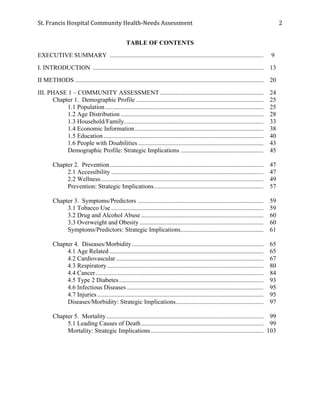
TABLE OF CONTENTS
EXECUTIVE SUMMARY .................................................................................................. 9
I. INTRODUCTION ............................................................................................................. 13
II METHODS ........................................................................................................................ 20
III. PHASE 1 – COMMUNITY ASSESSMENT .................................................................. 24
Chapter 1. Demographic Profile ................................................................................. 25
1.1 Population..................................................................................................... 25
1.2 Age Distribution ........................................................................................... 28
1.3 Household/Family......................................................................................... 33
1.4 Economic Information.................................................................................. 38
1.5 Education...................................................................................................... 40
1.6 People with Disabilities................................................................................ 43
Demographic Profile: Strategic Implications ..................................................... 45
Chapter 2. Prevention.................................................................................................. 47
2.1 Accessibility ................................................................................................. 47
2.2 Wellness........................................................................................................ 49
Prevention: Strategic Implications...................................................................... 57
Chapter 3. Symptoms/Predictors ................................................................................ 59
3.1 Tobacco Use ................................................................................................. 59
3.2 Drug and Alcohol Abuse .............................................................................. 60
3.3 Overweight and Obesity ............................................................................... 60
Symptoms/Predictors: Strategic Implications..................................................... 61
Chapter 4. Diseases/Morbidity.................................................................................... 65
4.1 Age Related .................................................................................................. 65
4.2 Cardiovascular.............................................................................................. 67
4.3 Respiratory.................................................................................................... 80
4.4 Cancer........................................................................................................... 84
4.5 Type 2 Diabetes............................................................................................ 93
4.6 Infectious Diseases ....................................................................................... 95
4.7 Injuries.......................................................................................................... 95
Diseases/Morbidity: Strategic Implications........................................................ 97
Chapter 5. Mortality .................................................................................................... 99
5.1 Leading Causes of Death.............................................................................. 99
Mortality: Strategic Implications........................................................................ 103
St.	
  Francis	
  Hospital	
  Community	
  Health-­‐Needs	
  Assessment	


3	
  
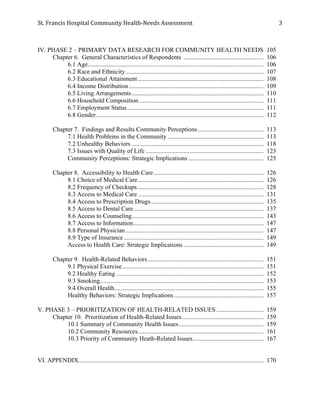
IV. PHASE 2 – PRIMARY DATA RESEARCH FOR COMMUNITY HEALTH NEEDS 105
Chapter 6. General Characteristics of Respondents ................................................... 106
6.1 Age................................................................................................................ 106
6.2 Race and Ethnicity........................................................................................ 107
6.3 Educational Attainment ................................................................................ 108
6.4 Income Distribution...................................................................................... 109
6.5 Living Arrangements.................................................................................... 110
6.6 Household Composition ............................................................................... 111
6.7 Employment Status....................................................................................... 111
6.8 Gender........................................................................................................... 112
Chapter 7. Findings and Results Community Perceptions.......................................... 113
7.1 Health Problems in the Community ............................................................. 113
7.2 Unhealthy Behaviors .................................................................................... 118
7.3 Issues with Quality of Life ........................................................................... 123
Community Perceptions: Strategic Implications ................................................ 125
Chapter 8. Accessibility to Health Care...................................................................... 126
8.1 Choice of Medical Care................................................................................ 126
8.2 Frequency of Checkups ................................................................................ 128
8.3 Access to Medical Care ................................................................................ 131
8.4 Access to Prescription Drugs........................................................................ 135
8.5 Access to Dental Care................................................................................... 137
8.6 Access to Counseling.................................................................................... 143
8.7 Access to Information................................................................................... 147
8.8 Personal Physician........................................................................................ 147
8.9 Type of Insurance ......................................................................................... 149
Access to Health Care: Strategic Implications ................................................... 149
Chapter 9. Health-Related Behaviors.......................................................................... 151
9.1 Physical Exercise.......................................................................................... 151
9.2 Healthy Eating .............................................................................................. 152
9.3 Smoking........................................................................................................ 153
9.4 Overall Health............................................................................................... 155
Healthy Behaviors: Strategic Implications......................................................... 157
V. PHASE 3 – PRIORITIZATION OF HEALTH-RELATED ISSUES .............................. 159
Chapter 10. Prioritization of Health-Related Issues.................................................... 159
10.1 Summary of Community Health Issues...................................................... 159
10.2 Community Resources................................................................................ 161
10.3 Priority of Community Heath-Related Issues............................................. 167
VI. APPENDIX...................................................................................................................... 170
St.	
  Francis	
  Hospital	
  Community	
  Health-­‐Needs	
  Assessment	


4	
  
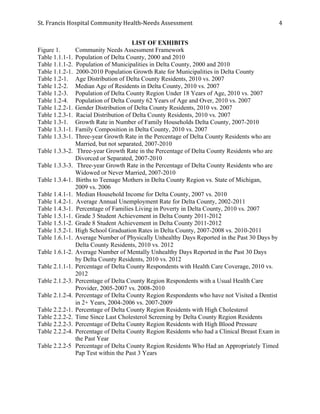
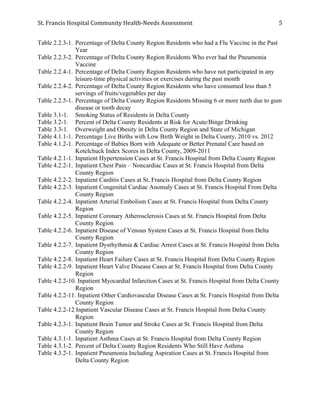
LIST OF EXHIBITS
Figure 1. Community Needs Assessment Framework
Table 1.1.1-1. Population of Delta County, 2000 and 2010
Table 1.1.1-2. Population of Municipalities in Delta County, 2000 and 2010
Table 1.1.2-1. 2000-2010 Population Growth Rate for Municipalities in Delta County
Table 1.2-1. Age Distribution of Delta County Residents, 2010 vs. 2007
Table 1.2-2. Median Age of Residents in Delta County, 2010 vs. 2007
Table 1.2-3. Population of Delta County Region Under 18 Years of Age, 2010 vs. 2007
Table 1.2-4. Population of Delta County 62 Years of Age and Over, 2010 vs. 2007
Table 1.2.2-1. Gender Distribution of Delta County Residents, 2010 vs. 2007
Table 1.2.3-1. Racial Distribution of Delta County Residents, 2010 vs. 2007
Table 1.3-1. Growth Rate in Number of Family Households Delta County, 2007-2010
Table 1.3.1-1. Family Composition in Delta County, 2010 vs. 2007
Table 1.3.3-1. Three-year Growth Rate in the Percentage of Delta County Residents who are
Married, but not separated, 2007-2010
Table 1.3.3-2. Three-year Growth Rate in the Percentage of Delta County Residents who are
Divorced or Separated, 2007-2010
Table 1.3.3-3. Three-year Growth Rate in the Percentage of Delta County Residents who are
Widowed or Never Married, 2007-2010
Table 1.3.4-1. Births to Teenage Mothers in Delta County Region vs. State of Michigan,
2009 vs. 2006
Table 1.4.1-1. Median Household Income for Delta County, 2007 vs. 2010
Table 1.4.2-1. Average Annual Unemployment Rate for Delta County, 2002-2011
Table 1.4.3-1. Percentage of Families Living in Poverty in Delta County, 2010 vs. 2007
Table 1.5.1-1. Grade 3 Student Achievement in Delta County 2011-2012
Table 1.5.1-2. Grade 8 Student Achievement in Delta County 2011-2012
Table 1.5.2-1. High School Graduation Rates in Delta County, 2007-2008 vs. 2010-2011
Table 1.6.1-1. Average Number of Physically Unhealthy Days Reported in the Past 30 Days by
Delta County Residents, 2010 vs. 2012
Table 1.6.1-2. Average Number of Mentally Unhealthy Days Reported in the Past 30 Days
by Delta County Residents, 2010 vs. 2012
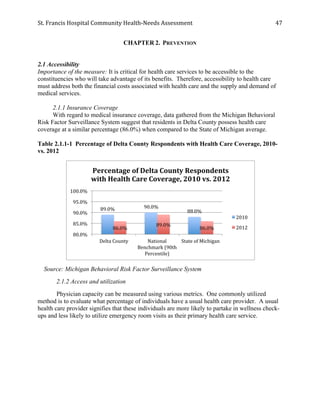
Table 2.1.1-1. Percentage of Delta County Respondents with Health Care Coverage, 2010 vs.
2012
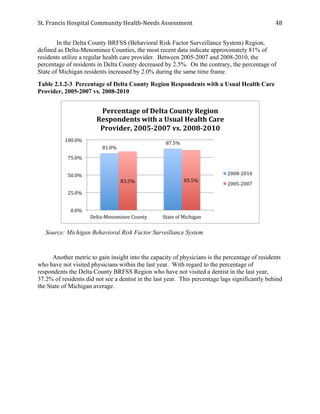
Table 2.1.2-3. Percentage of Delta County Region Respondents with a Usual Health Care
Provider, 2005-2007 vs. 2008-2010
Table 2.1.2-4. Percentage of Delta County Region Respondents who have not Visited a Dentist
in 2+ Years, 2004-2006 vs. 2007-2009
Table 2.2.2-1. Percentage of Delta County Region Residents with High Cholesterol
Table 2.2.2-2. Time Since Last Cholesterol Screening by Delta County Region Residents
Table 2.2.2-3. Percentage of Delta County Region Residents with High Blood Pressure
Table 2.2.2-4. Percentage of Delta County Region Residents who had a Clinical Breast Exam in
the Past Year
Table 2.2.2-5 Percentage of Delta County Region Residents Who Had an Appropriately Timed
Pap Test within the Past 3 Years
St.	
  Francis	
  Hospital	
  Community	
  Health-­‐Needs	
  Assessment	


5	
  
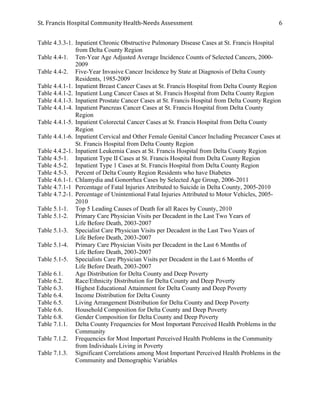
Table 2.2.3-1. Percentage of Delta County Region Residents who had a Flu Vaccine in the Past
Year
Table 2.2.3-2. Percentage of Delta County Region Residents Who ever had the Pneumonia
Vaccine
Table 2.2.4-1. Percentage of Delta County Region Residents who have not participated in any
leisure-time physical activities or exercises during the past month
Table 2.2.4-2. Percentage of Delta County Region Residents who have consumed less than 5
servings of fruits/vegetables per day
Table 2.2.5-1. Percentage of Delta County Region Residents Missing 6 or more teeth due to gum
disease or tooth decay
Table 3.1-1. Smoking Status of Residents in Delta County
Table 3.2-1. Percent of Delta County Residents at Risk for Acute/Binge Drinking
Table 3.3-1. Overweight and Obesity in Delta County Region and State of Michigan
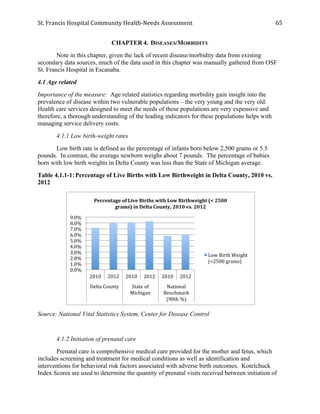
Table 4.1.1-1. Percentage Live Births with Low Birth Weight in Delta County, 2010 vs. 2012
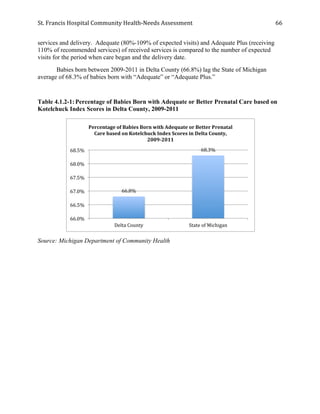
Table 4.1.2-1. Percentage of Babies Born with Adequate or Better Prenatal Care based on
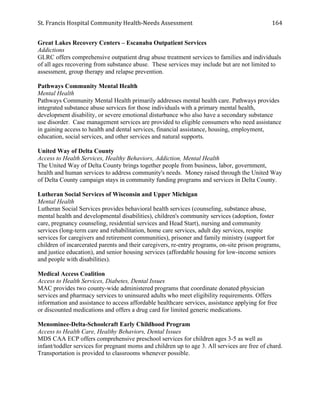
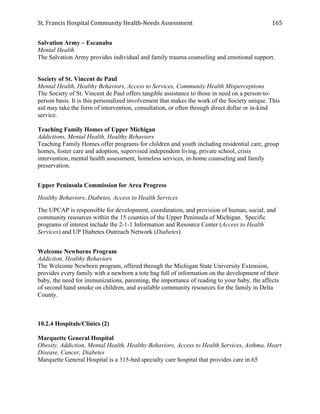
Kotelchuck Index Scores in Delta County, 2009-2011
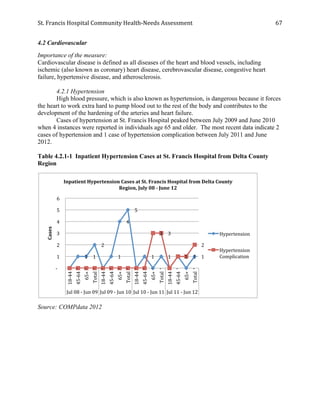
Table 4.2.1-1. Inpatient Hypertension Cases at St. Francis Hospital from Delta County Region
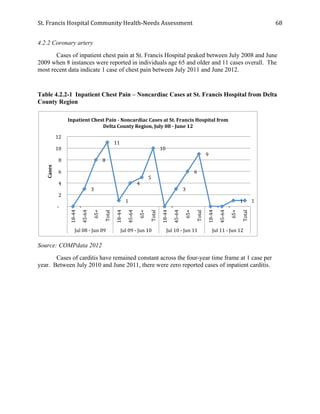
Table 4.2.2-1. Inpatient Chest Pain – Noncardiac Cases at St. Francis Hospital from Delta
County Region
Table 4.2.2-2. Inpatient Carditis Cases at St. Francis Hospital from Delta County Region
Table 4.2.2-3. Inpatient Congenital Cardiac Anomaly Cases at St. Francis Hospital From Delta
County Region
Table 4.2.2-4. Inpatient Arterial Embolism Cases at St. Francis Hospital from Delta County
Region
Table 4.2.2-5. Inpatient Coronary Atherosclerosis Cases at St. Francis Hospital from Delta
County Region
Table 4.2.2-6. Inpatient Disease of Venous System Cases at St. Francis Hospital from Delta
County Region
Table 4.2.2-7. Inpatient Dysrhythmia & Cardiac Arrest Cases at St. Francis Hospital from Delta
County Region
Table 4.2.2-8. Inpatient Heart Failure Cases at St. Francis Hospital from Delta County Region
Table 4.2.2-9. Inpatient Heart Valve Disease Cases at St. Francis Hospital from Delta County
Region
Table 4.2.2-10. Inpatient Myocardial Infarction Cases at St. Francis Hospital from Delta County
Region
Table 4.2.2-11. Inpatient Other Cardiovascular Disease Cases at St. Francis Hospital from Delta
County Region
Table 4.2.2-12 Inpatient Vascular Disease Cases at St. Francis Hospital from Delta County
Region
Table 4.2.3-1. Inpatient Brain Tumor and Stroke Cases at St. Francis Hospital from Delta
County Region
Table 4.3.1-1. Inpatient Asthma Cases at St. Francis Hospital from Delta County Region
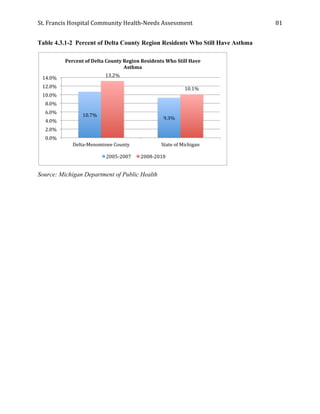
Table 4.3.1-2. Percent of Delta County Region Residents Who Still Have Asthma
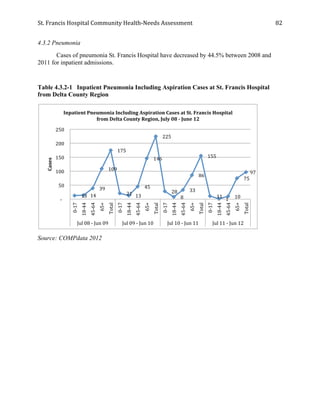
Table 4.3.2-1. Inpatient Pneumonia Including Aspiration Cases at St. Francis Hospital from
Delta County Region
St.	
  Francis	
  Hospital	
  Community	
  Health-­‐Needs	
  Assessment	


6	
  
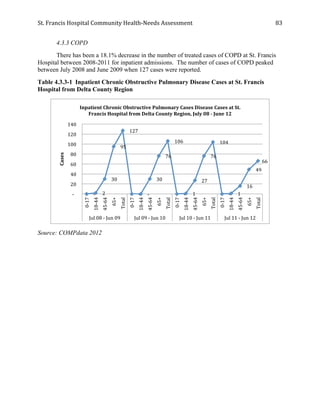
Table 4.3.3-1. Inpatient Chronic Obstructive Pulmonary Disease Cases at St. Francis Hospital
from Delta County Region
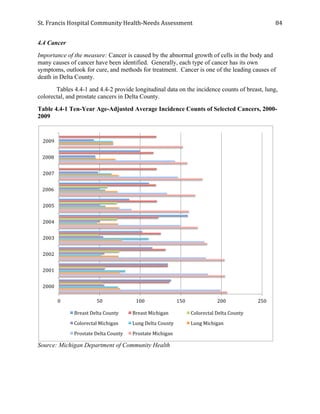
Table 4.4-1. Ten-Year Age Adjusted Average Incidence Counts of Selected Cancers, 2000-
2009
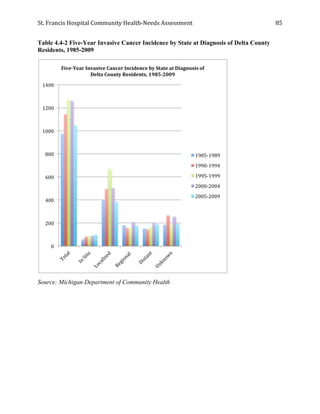
Table 4.4-2. Five-Year Invasive Cancer Incidence by State at Diagnosis of Delta County
Residents, 1985-2009
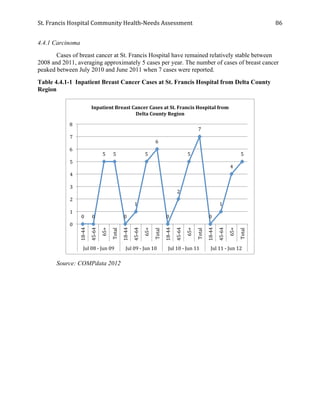
Table 4.4.1-1. Inpatient Breast Cancer Cases at St. Francis Hospital from Delta County Region
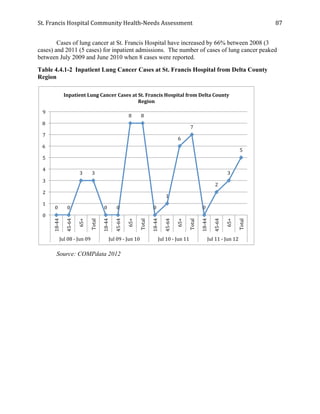
Table 4.4.1-2. Inpatient Lung Cancer Cases at St. Francis Hospital from Delta County Region
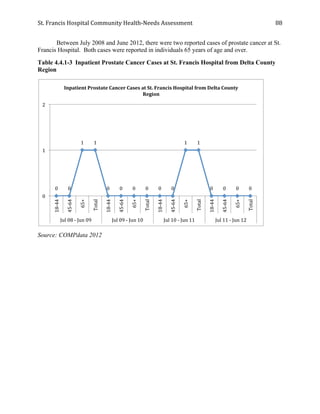
Table 4.4.1-3. Inpatient Prostate Cancer Cases at St. Francis Hospital from Delta County Region
Table 4.4.1-4. Inpatient Pancreas Cancer Cases at St. Francis Hospital from Delta County
Region
Table 4.4.1-5. Inpatient Colorectal Cancer Cases at St. Francis Hospital from Delta County
Region
Table 4.4.1-6. Inpatient Cervical and Other Female Genital Cancer Including Precancer Cases at
St. Francis Hospital from Delta County Region
Table 4.4.2-1. Inpatient Leukemia Cases at St. Francis Hospital from Delta County Region
Table 4.5-1. Inpatient Type II Cases at St. Francis Hospital from Delta County Region
Table 4.5-2. Inpatient Type 1 Cases at St. Francis Hospital from Delta County Region
Table 4.5-3. Percent of Delta County Region Residents who have Diabetes
Table 4.6.1-1. Chlamydia and Gonorrhea Cases by Selected Age Group, 2006-2011
Table 4.7.1-1 Percentage of Fatal Injuries Attributed to Suicide in Delta County, 2005-2010
Table 4.7.2-1. Percentage of Unintentional Fatal Injuries Attributed to Motor Vehicles, 2005-
2010
Table 5.1-1. Top 5 Leading Causes of Death for all Races by County, 2010
Table 5.1-2. Primary Care Physician Visits per Decadent in the Last Two Years of
Life Before Death, 2003-2007
Table 5.1-3. Specialist Care Physician Visits per Decadent in the Last Two Years of
Life Before Death, 2003-2007
Table 5.1-4. Primary Care Physician Visits per Decadent in the Last 6 Months of
Life Before Death, 2003-2007
Table 5.1-5. Specialists Care Physician Visits per Decadent in the Last 6 Months of
Life Before Death, 2003-2007
Table 6.1. Age Distribution for Delta County and Deep Poverty
Table 6.2. Race/Ethnicity Distribution for Delta County and Deep Poverty
Table 6.3. Highest Educational Attainment for Delta County and Deep Poverty
Table 6.4. Income Distribution for Delta County
Table 6.5. Living Arrangement Distribution for Delta County and Deep Poverty
Table 6.6. Household Composition for Delta County and Deep Poverty
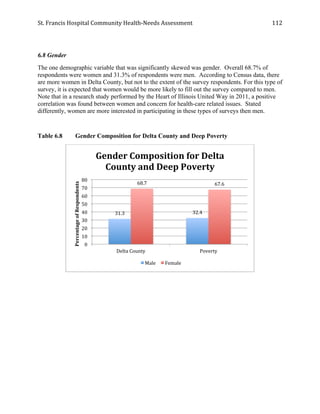
Table 6.8. Gender Composition for Delta County and Deep Poverty
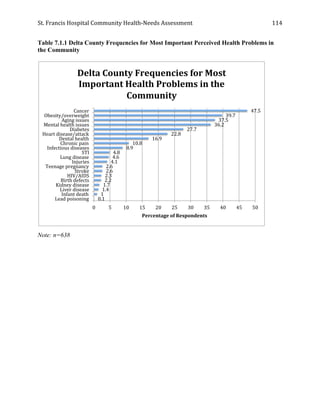
Table 7.1.1. Delta County Frequencies for Most Important Perceived Health Problems in the
Community
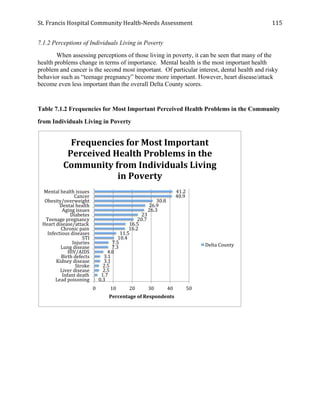
Table 7.1.2. Frequencies for Most Important Perceived Health Problems in the Community
from Individuals Living in Poverty
Table 7.1.3. Significant Correlations among Most Important Perceived Health Problems in the
Community and Demographic Variables
St.	
  Francis	
  Hospital	
  Community	
  Health-­‐Needs	
  Assessment	


7	
  
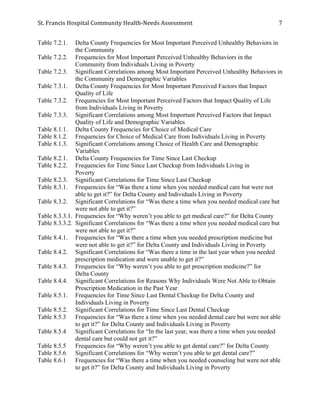
Table 7.2.1. Delta County Frequencies for Most Important Perceived Unhealthy Behaviors in
the Community
Table 7.2.2. Frequencies for Most Important Perceived Unhealthy Behaviors in the
Community from Individuals Living in Poverty
Table 7.2.3. Significant Correlations among Most Important Perceived Unhealthy Behaviors in
the Community and Demographic Variables
Table 7.3.1. Delta County Frequencies for Most Important Perceived Factors that Impact
Quality of Life
Table 7.3.2. Frequencies for Most Important Perceived Factors that Impact Quality of Life
from Individuals Living in Poverty
Table 7.3.3. Significant Correlations among Most Important Perceived Factors that Impact
Quality of Life and Demographic Variables
Table 8.1.1. Delta County Frequencies for Choice of Medical Care
Table 8.1.2. Frequencies for Choice of Medical Care from Individuals Living in Poverty
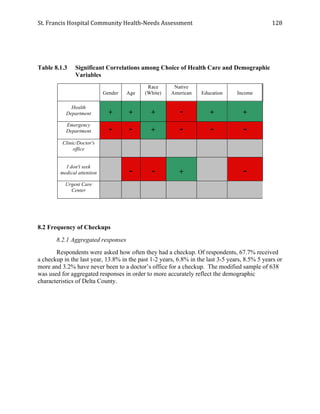
Table 8.1.3. Significant Correlations among Choice of Health Care and Demographic
Variables
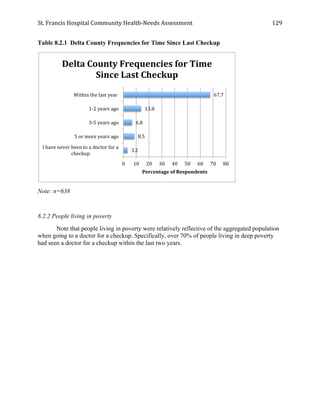
Table 8.2.1. Delta County Frequencies for Time Since Last Checkup
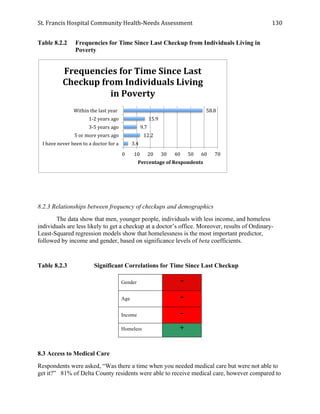
Table 8.2.2. Frequencies for Time Since Last Checkup from Individuals Living in
Poverty
Table 8.2.3. Significant Correlations for Time Since Last Checkup
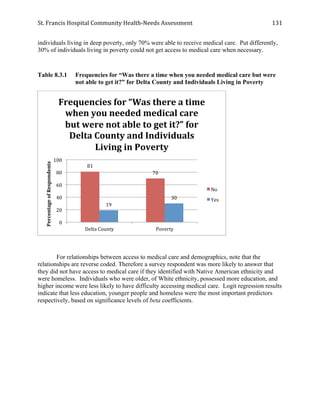
Table 8.3.1. Frequencies for “Was there a time when you needed medical care but were not
able to get it?” for Delta County and Individuals Living in Poverty
Table 8.3.2. Significant Correlations for “Was there a time when you needed medical care but
were not able to get it?”
Table 8.3.3.1. Frequencies for “Why weren’t you able to get medical care?” for Delta County
Table 8.3.3.2. Significant Correlations for “Was there a time when you needed medical care but
were not able to get it?”
Table 8.4.1. Frequencies for “Was there a time when you needed prescription medicine but
were not able to get it?” for Delta County and Individuals Living in Poverty
Table 8.4.2. Significant Correlations for “Was there a time in the last year when you needed
prescription medication and were unable to get it?”
Table 8.4.3. Frequencies for “Why weren’t you able to get prescription medicine?” for
Delta County
Table 8.4.4. Significant Correlations for Reasons Why Individuals Were Not Able to Obtain
Prescription Medication in the Past Year
Table 8.5.1. Frequencies for Time Since Last Dental Checkup for Delta County and
Individuals Living in Poverty
Table 8.5.2. Significant Correlations for Time Since Last Dental Checkup
Table 8.5.3 Frequencies for “Was there a time when you needed dental care but were not able
to get it?” for Delta County and Individuals Living in Poverty
Table 8.5.4	
   Significant Correlations for “In the last year, was there a time when you needed
dental care but could not get it?”
Table 8.5.5 Frequencies for “Why weren’t you able to get dental care?” for Delta County
Table 8.5.6 Significant Correlations for “Why weren’t you able to get dental care?”
Table 8.6.1 Frequencies for “Was there a time when you needed counseling but were not able
to get it?” for Delta County and Individuals Living in Poverty
St.	
  Francis	
  Hospital	
  Community	
  Health-­‐Needs	
  Assessment	


8	
  
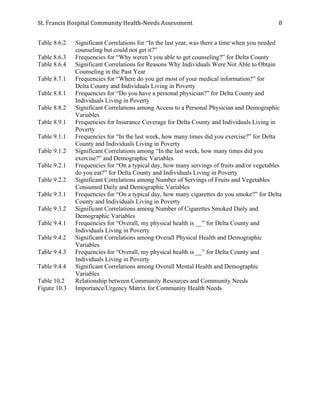
Table 8.6.2 Significant Correlations for “In the last year, was there a time when you needed
counseling but could not get it?”
Table 8.6.3 Frequencies for “Why weren’t you able to get counseling?” for Delta County
Table 8.6.4 Significant Correlations for Reasons Why Individuals Were Not Able to Obtain
Counseling in the Past Year
Table 8.7.1 Frequencies for “Where do you get most of your medical information?” for
Delta County and Individuals Living in Poverty
Table 8.8.1 Frequencies for “Do you have a personal physician?” for Delta County and
Individuals Living in Poverty
Table 8.8.2 Significant Correlations among Access to a Personal Physician and Demographic
Variables
Table 8.9.1 Frequencies for Insurance Coverage for Delta County and Individuals Living in
Poverty
Table 9.1.1 Frequencies for “In the last week, how many times did you exercise?” for Delta
County and Individuals Living in Poverty
Table 9.1.2 Significant Correlations among “In the last week, how many times did you
exercise?” and Demographic Variables
Table 9.2.1 Frequencies for “On a typical day, how many servings of fruits and/or vegetables
do you eat?” for Delta County and Individuals Living in Poverty
Table 9.2.2 Significant Correlations among Number of Servings of Fruits and Vegetables
Consumed Daily and Demographic Variables
Table 9.3.1 Frequencies for “On a typical day, how many cigarettes do you smoke?” for Delta
County and Individuals Living in Poverty
Table 9.3.2 Significant Correlations among Number of Cigarettes Smoked Daily and
Demographic Variables
Table 9.4.1 Frequencies for “Overall, my physical health is __” for Delta County and
Individuals Living in Poverty
Table 9.4.2 Significant Correlations among Overall Physical Health and Demographic
Variables
Table 9.4.3 Frequencies for “Overall, my physical health is __” for Delta County and
Individuals Living in Poverty
Table 9.4.4 Significant Correlations among Overall Mental Health and Demographic
Variables
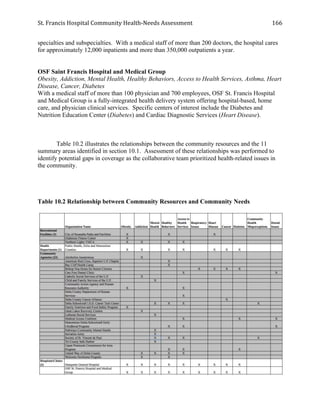
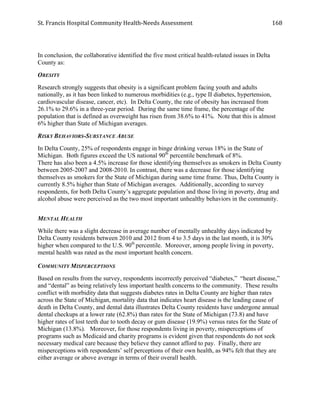
Table 10.2 Relationship between Community Resources and Community Needs
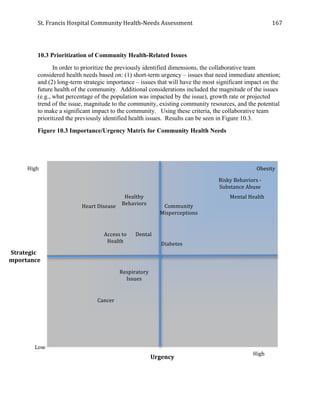
Figure 10.3 Importance/Urgency Matrix for Community Health Needs
	
  
St.	
  Francis	
  Hospital	
  Community	
  Health-­‐Needs	
  Assessment	


9	
  
EXECUTIVE SUMMARY
The Delta County Community Health-Needs Assessment highlights the health needs and
well being of residents in Delta County. Through this needs assessment, collaborative
community partners have identified numerous health issues impacting individuals and families in
the area. Several themes are prevalent in this health-needs assessment – the demographic
composition of the Delta County region, the predictors and prevalence for diseases, leading
causes of mortality, accessibility to health services and healthy behaviors.
Results from this study can be used for strategic decision-making purposes as they directly
relate to the health needs of the community. The study was designed to assess issues and trends
impacting the communities served by OSF St. Francis Hospital, as well as perceptions of
targeted stakeholder groups. Specifically, this assessment provides a detailed analysis of: (1)
Delta County area community health needs using secondary data; and (2) an assessment of
perceptions and behaviors regarding health-related challenges in the community, including
accessibility to needed health care.
PHASE I – USE OF SECONDARY DATA TO IDENTIFY NEEDS
Chapters 1-5 include a detailed analysis of secondary data to assess information regarding
the health status of the community. In order to perform these analyses, information was collected
from numerous secondary sources, including publically available sources as well as private
sources of data. Strategic implications are discussed at the end of each chapter. Specifically,
Phase I of the study highlights several critical areas:
Demographics – Changing demographics forecasts indicate an increase in chronic conditions
such as diabetes, asthma, heart disease, and obesity. Three specific demographic trends in the
region will have a significant impact on health issues, including:
Elderly Population – The 62 and older population has seen a significant increase between
2007 and 2010. While individuals aged 62 and over have recently increased from 21.1% to
23.2% in Delta County, national forecasts estimate that individuals over age 65 will increase by
one-third by 2022.
Poverty – Families living in poverty increased by 1.3% from 2007 to 2010 and the
median annual household income in Delta County is $8,000 less than state averages.
Accessibility to Health Care – The lack of insurance coverage is more prevalent among
socioeconomically disadvantaged groups that are often at high risk for disease and illness. Thus,
a vicious cycle results where individuals who are at the highest risk for diseases are unable to
receive screenings, thus perpetuating a cycle of disease. This is compounded by unhealthy
lifestyles. Even though the State of Michigan is trending positively in terms of individuals
having identifiable health-care providers, Delta County is trending negatively.
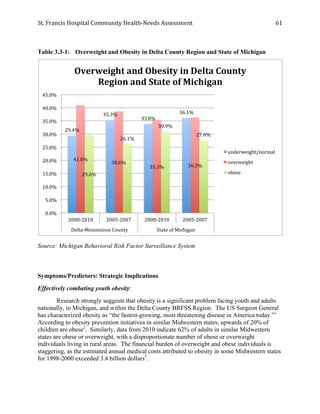
Obesity – Research strongly suggests that obesity is a significant problem facing youth and
adults nationally. In Delta County, 41% of people are overweight versus 35.3% in the State of
Michigan. Additionally, almost 30% of residents in Delta County are considered obese.
St.	
  Francis	
  Hospital	
  Community	
  Health-­‐Needs	
  Assessment	


10	
  
Risky Behavior – For those identifying themselves as smokers, Delta County is 8.5% higher than
State of Michigan averages. Moreover, there has been a 4.5% increase for those identifying
themselves as smokers in Delta County between 2005-2007 and 2008-2010. In contrast, there
was a decrease for those identifying themselves as smokers for the State of Michigan during
same time frame. Also, in Delta County, 25% of respondents engage in binge drinking versus
18% in the State of Michigan. Both figures exceed the US national 90th
percentile benchmark of
8%. Also, alcohol abuse and drug abuse were rated the most prevalent unhealthy behaviors
among survey respondents. Specifically those with more education rated alcohol abuse higher
and those with a Native American background rated drug abuse higher.
Mental Health – While there was a slight decrease in average number of mentally unhealthy
days indicated by Delta County residents between 2010 and 2012 from 4 to 3.5 days in the last
month, it is 30% higher when compared to the U.S. 90th
percentile.
Morbidity Issues – Several different diseases have seen significant growth between 2008-2011.
Hypertension – There are higher rates of hypertension in Delta County (32.5%) versus
the State of Michigan (28%).
Asthma – Asthma rates are higher in Delta County (17.2%) than in the State of Michigan
(15.6%).
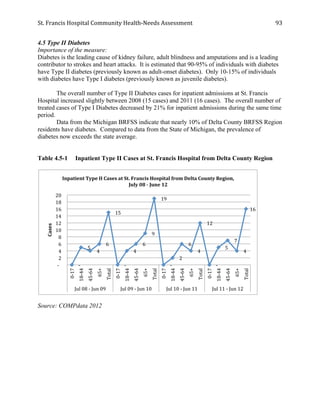
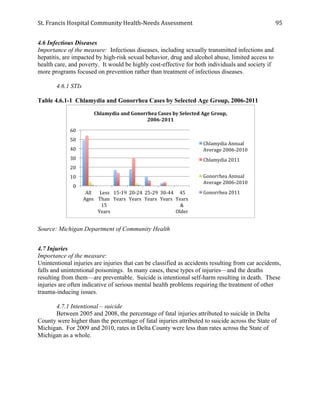
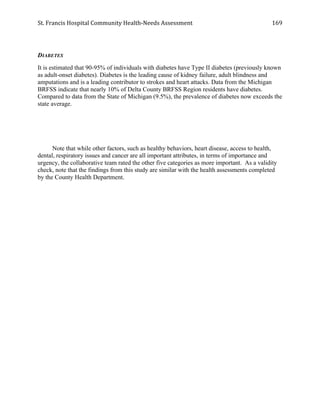
Diabetes – Type II diabetes rates are higher in Delta County (9.8%) versus rates for the
State of Michigan (9.5%).
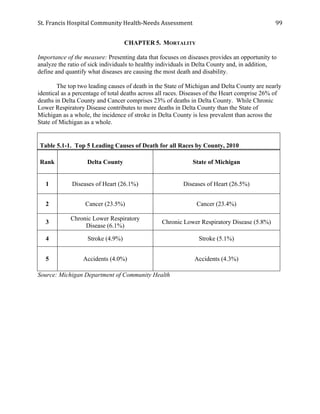
Mortality – The leading causes of death include diseases of the heart and cancer. However,
COPD was higher (6.1%) than the State of Michigan (5.8%).
PHASE II – COLLECTION, ANALYSIS AND INTERPRETATION OF PRIMARY
DATA
A comprehensive understanding of targeted stakeholders was completed in Chapters 6-9.
Specifically, it was important to understand how “at risk” or economically disadvantaged people
perceived: (1) relative importance of health issues; (2) relative importance of unhealthy
behaviors; and (3) access to health care, dental care, counseling and prescription medications.
Through this type of research, opportunities were identified for improving how community
health needs are addressed. Additionally, findings provided insights into how perceptions are
affected by demographic characteristics. Critical findings include:
Misperceptions of community health issues – inconsistencies exist between people’s
perceptions of health issues and actual data.
Heart disease – Residents in Delta County rate heart disease relatively low compared to
actual causes of mortality.
Diabetes – Residents of Delta County also rate diabetes relatively low, even though rates
in Delta County are higher than state averages.
St.	
  Francis	
  Hospital	
  Community	
  Health-­‐Needs	
  Assessment	


11	
  
Perceptions of the importance of access to health services – Access to health services is rated as
the highest determinant to quality of life after job opportunities, particular among women and
older respondents.
Access to Medical Services – Several issues relating to health service access were identified.
Choice of Medical Care – Only 60% of people living in deep poverty seek medical
services at a clinic or doctor’s office. For this segment of the population, it is very common to
seek medical services from an emergency department (11%). Those that tend to use the ED for
primary care include men, younger people, and less educated people with lower incomes.
Access to Medical Care and Prescription Medications – Thirty percent of the population
living in poverty indicated there was a time in the last year when they were not able to get
medical care when needed. The leading causes were lack of insurance and inability to afford a
copayment or deductible. Similar results were found for access to prescription medication.
Access to Dental Care – While significant research exists linking dental care to numerous
diseases, including heart disease, only 55% of the aggregate population had a checkup in the last
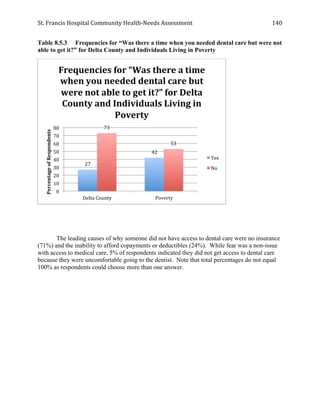
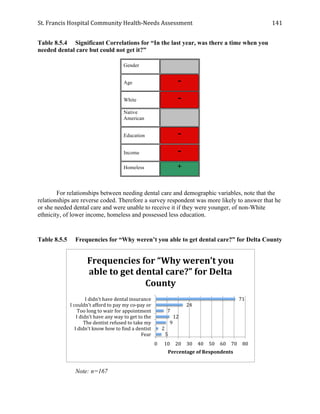
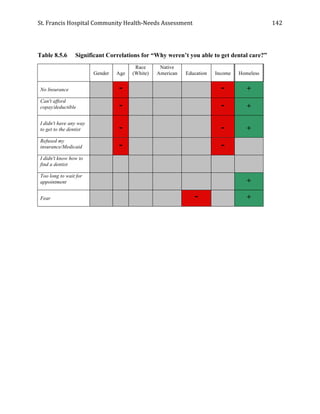
year and only 31% of those living in poverty had a checkup. Moreover, 25% of those living in
poverty have not been to the dentist for 5 or more years. Specifically, younger respondents,
Native Americans, lower income, homeless individuals and less educated people were less likely
to visit a dentist.
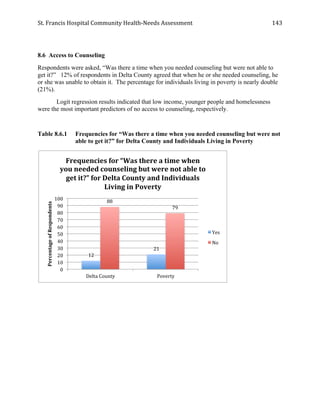
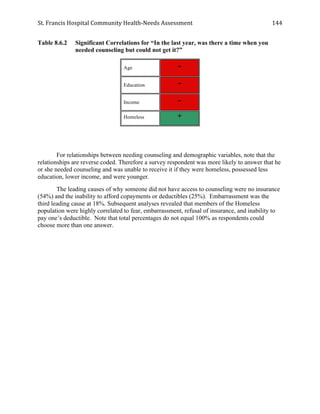
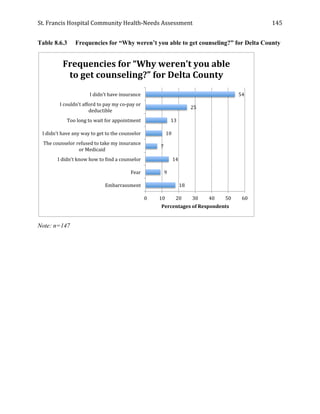
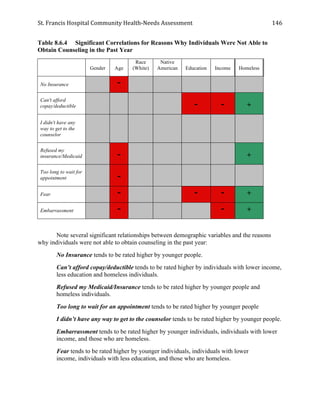
Access to Counseling – Approximately 21% of people living in poverty indicated they
were not able to get counseling when they needed it over the last 12 months. Leading indicators
are younger people, less educated and homelessness. While affordability and insurance were the
leading reasons, fear and embarrassment were also significant.
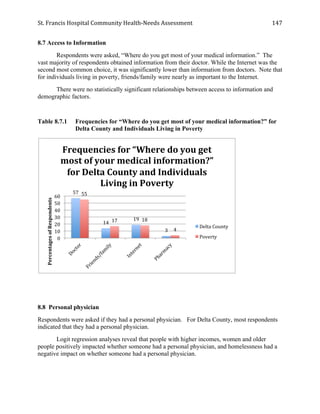
Access to Information – Across categories, residents of Delta County get most of their
medical information from doctors.
Type of Insurance – Across Delta County, the most prevalent type of insurance is private
or commercial; however, those living in poverty are disproportionately more reliant on Medicaid.
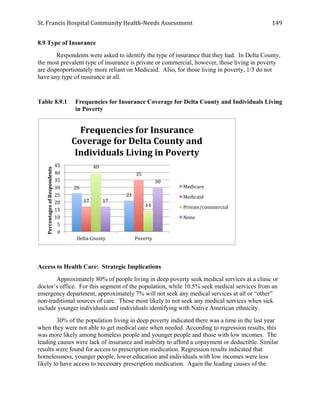
Also for those living in poverty, 30% do not have any type of insurance at all.
Healthy Behaviors – Several issues relating to healthy behaviors were identified.
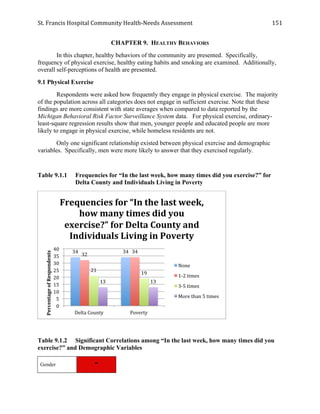
Physical Exercise – Men are more likely to engage in physical exercise. However, only
13% of the population engages in exercise at least 5 times a week.
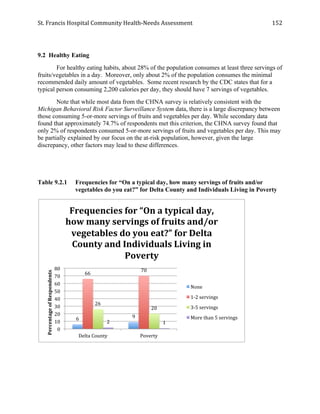
Healthy Eating – Less than 2% of the population consumes at least the minimum
recommended servings of fruits/vegetables in a day. Those that are more likely to have healthy
eating habits include women, people with higher educations and more income, and older people.
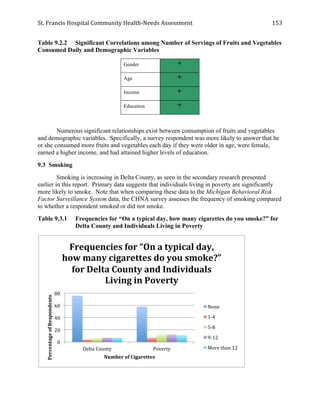
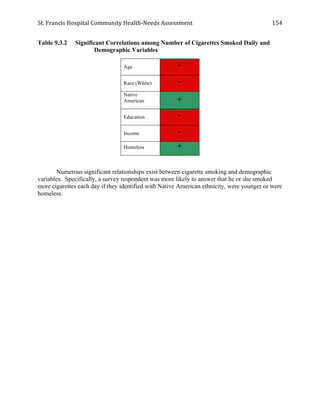
Decrease Smoking – Less educated people, men, younger people, Native Americans and
homeless people are more likely to smoke.
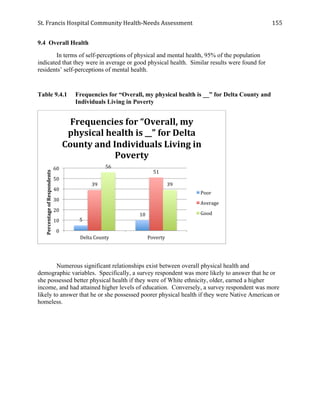
Self-Perceptions of Health – In terms of self-perceptions of physical and mental health,
95% of the population indicated that they were in average or good physical health. Similar
results were found for residents’ self-perceptions of mental health.
St.	
  Francis	
  Hospital	
  Community	
  Health-­‐Needs	
  Assessment	


12	
  
PHASE III – PRIORITIZATION OF HEALTH-RELATED ISSUES
The identification and prioritization of the most important health-related issues in Delta
County are identified in Chapter 10. After summarizing all of the issues in the Community
Health Needs Assessment, a comprehensive analysis of existing community resources was
performed to identify the efficacy to which health-related issues were being addressed. Finally, a
collaborative team of leaders in the healthcare community used an importance/urgency
methodology to consider the most critical issues in the area, including:
o Obesity
o Risky Behaviors-Substance Abuse
o Mental Health
o Community Misperceptions
o Diabetes
Specific criteria used to identify these issues included: (1) magnitude to the community; (2)
strategic importance to the community; (3) existing community resources; (4) potential for
impact; and (5) trends and future forecasts.
St.	
  Francis	
  Hospital	
  Community	
  Health-­‐Needs	
  Assessment	


13	
  
I. INTRODUCTION
Background
The Patient Protection and Affordable Care Act (Affordable Care Act), enacted March 23,
2010 adds new requirements on tax-exempt hospitals to conduct community health-needs
assessments and to adopt implementation strategies to meet the community health needs
identified through the assessments. This community health-needs assessment (CHNA) takes into
account input from specific individuals who represent the broad interest of the community served
by OSF/Saint Francis Hospital, including those with special knowledge of or expertise in public
health. For this study, a community health-needs assessment is defined as a systematic process
involving the community, to identify and analyze community health needs and assets in order to
prioritize these needs, and to plan and act upon unmet community health needs. Results from this
assessment will be made widely available to the public.
The structure of the CHNA is based on standards used by the Internal Revenue Service to
develop Form 990, Schedule H–Hospitals, designated solely for tax-exempt hospitals. The
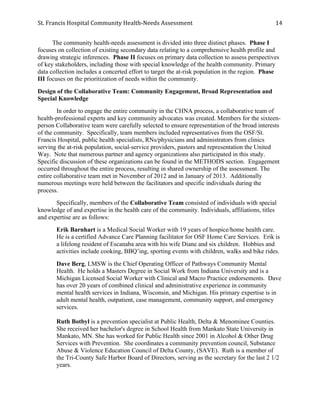
fundamental areas of the community needs assessment are illustrated in Figure 1.
Figure 1. Community Needs Assessment Framework
St.	
  Francis	
  Hospital	
  Community	
  Health-­‐Needs	
  Assessment	


14	
  
The community health-needs assessment is divided into three distinct phases. Phase I
focuses on collection of existing secondary data relating to a comprehensive health profile and
drawing strategic inferences. Phase II focuses on primary data collection to assess perspectives
of key stakeholders, including those with special knowledge of the health community. Primary
data collection includes a concerted effort to target the at-risk population in the region. Phase
III focuses on the prioritization of needs within the community.
Design of the Collaborative Team: Community Engagement, Broad Representation and
Special Knowledge
In order to engage the entire community in the CHNA process, a collaborative team of
health-professional experts and key community advocates was created. Members for the sixteen-
person Collaborative team were carefully selected to ensure representation of the broad interests
of the community. Specifically, team members included representatives from the OSF/St.
Francis Hospital, public health specialists, RNs/physicians and administrators from clinics
serving the at-risk population, social-service providers, pastors and representation the United
Way. Note that numerous partner and agency organizations also participated in this study.
Specific discussion of these organizations can be found in the METHODS section. Engagement
occurred throughout the entire process, resulting in shared ownership of the assessment. The
entire collaborative team met in November of 2012 and in January of 2013. Additionally
numerous meetings were held between the facilitators and specific individuals during the
process.
Specifically, members of the Collaborative Team consisted of individuals with special
knowledge of and expertise in the health care of the community. Individuals, affiliations, titles
and expertise are as follows:
Erik Barnhart is a Medical Social Worker with 19 years of hospice/home health care.
He is a certified Advance Care Planning facilitator for OSF Home Care Services. Erik is
a lifelong resident of Escanaba area with his wife Diane and six children. Hobbies and
activities include cooking, BBQ’ing, sporting events with children, walks and bike rides.
Dave Berg, LMSW is the Chief Operating Officer of Pathways Community Mental
Health. He holds a Masters Degree in Social Work from Indiana University and is a
Michigan Licensed Social Worker with Clinical and Macro Practice endorsements. Dave
has over 20 years of combined clinical and administrative experience in community
mental health services in Indiana, Wisconsin, and Michigan. His primary expertise is in
adult mental health, outpatient, case management, community support, and emergency
services.
Ruth Botbyl is a prevention specialist at Public Health, Delta & Menominee Counties.
She received her bachelor's degree in School Health from Mankato State University in
Mankato, MN. She has worked for Public Health since 2001 in Alcohol & Other Drug
Services with Prevention. She coordinates a community prevention council, Substance
Abuse & Violence Education Council of Delta County, (SAVE). Ruth is a member of
the Tri-County Safe Harbor Board of Directors, serving as the secretary for the last 2 1/2
years.
St.	
  Francis	
  Hospital	
  Community	
  Health-­‐Needs	
  Assessment	


15	
  
Mary Busick is a retired special education teacher with 32 years of service. She began
working as a case manager at Voices for Youth in 2007 and now works with homeless
youth, education, employment, housing and basic needs.
Charlene Carlson spent 21 years as the pastoral associate at St Anne Catholic Church.
In retirement, she leads a weekly bible study at St. Anne and a bereavement group in the
fall and spring. She is a spiritual director for individual and also works at Marygrove
Retreat Center on silent directed retreats. During the two-week fall school, she serves as
a spiritual director at Our Lady Of Divine Providence School of Spirituality.
Tamie Cunningham is the Executive Director of Tri-County Safe Harbor, Inc. (formerly
known as the Alliance Against Violence and Abuse, Inc), which provides services to
domestic violence and sexual assault survivors. She received her bachelor's degree in
Forensics and Psychology from Weber State University in Ogden, UT. She has worked
for Tri-County Safe Harbor since October 2011 and was the Treasurer of the Tri-County
Safe Harbor Board of Directors prior to becoming the Executive Director. Tamie is
directly responsible for supervising the organizational and financial operations of Safe
Harbor, along with community relations, education and awareness. She is a member of
the Substance Abuse and Violence Education (SAVE) Council for Delta County. Tamie's
previous experience was working for the United States Air Force as a Program Manager
for 13 years.
Joan Ecclesine is the Health/Disabilities Manager for the MDS CAA Early Childhood
Program (Menominee-Delta-Schoolcraft Head Start, Early Head Start and Great Start
Readiness Programs).
Mary Lu Gaudette works professionally as a broker in securities sales and service
representing over 100 investment firms. She retired as a full-time Registered Rep.
(insurance agent) from Prudential Ins. Co. in 2001. She has volunteered in many service
arenas. Mary Lu became a Vincentian in 2008. She serves as an intake worker in the
Escanaba St. Vincent de Paul Financial Service Center, as Treasurer of the St. Anne
Conference of St. Vincent de Paul and as the Spiritual Advisor for the Escanaba District
Council.
Sandra (Sandy) Guenette is the Manager of Social Services at OSF St. Francis Hospital.
She received her Bachelor’s degree in Social Work from Northern Michigan University
in 1980. She began her medical social work career in skilled nursing facilities and
transitioned to OSF St. Francis Hospital in 1983. Her main areas of focus in caring for
patients are discharge planning, information and referral, financial assistance, palliative
care and case management. In addition to all aspects of managing the department, she
works closely with interdisciplinary team members in all units of the hospital, community
physicians groups, home health care and other local service agencies to aid the patient’s
experience.
St.	
  Francis	
  Hospital	
  Community	
  Health-­‐Needs	
  Assessment	


16	
  
Irene Lenbergis the Director of Administrative Support Services at Public Health, Delta
& Menominee Counties. She is responsible for human resources and personnel, as well as
directing the activities and projects of the IT department. She graduated from Lake
Superior State University in 1997 with a Bachelor’s of Science in Accounting. She
started at the Health Department as an accountant in 1998, became accounting supervisor
in 2004, and Administrative Director in 2009.
Julie Mallard has been the executive director of the United Way of Delta County since
2005. She is originally from Florida, growing up in the Tampa area and earning her
Bachelor's degree in Public Relations from the University of Florida. After six years
working in public relations and fund development for the local Girl Scout council in
Tampa, Julie was ready for a change of scenery. Small-town life seemed appealing and
she had family in the U.P., so in the winter of 1994 she moved to Manistique and went to
work as marketing director and volunteer coordinator for North Woods Home Nursing
and Hospice. She was with North Woods for 11 years as the company expanded to
include not only home health and hospice services, but also private duty, outpatient
therapy and assisted living. Julie eventually moved to Escanaba to work primarily at
North Woods Assisted Living, where she was responsible for sales and marketing of all
the North Woods companies as well as activities and communications with tenants and
their families at the assisted living facility. In the fall of 2005, the executive director
position opened at the United Way of Delta County and Julie returned to her nonprofit
roots. She has spent the past seven years building relationships with companies and
individual donors, educating the community on the work of the United Way and its
affiliated programs, serving in community groups and collaborative boards addressing a
variety of issues, from substance abuse to early childhood education and raising hundreds
of thousands of dollars each year to be invested back into our community. Julie resides in
Escanaba with her teenage daughter and son, is an active volunteer with Escanaba Noon
Kiwanis Club and Holy Name Catholic School and enjoys photography.
Deacon Dan Powers has been Executive Director at Catholic Social Services for 3
years. Deacon Dan moved to the UP from San Diego, California where he was ordained
a Deacon in 2006. Catholic Social Services is an organization which seeks to nurture and
strengthen families in the Upper Peninsula. It has a growing Child Welfare ministry
which currently cares for 20 children in its foster care services. The agency also
facilitates 6-10 adoptions every year.
Kay Pryal is a Caseworker at Lutheran Social Services, Voices For Youth Program. She
works with homeless youth from ages 10 to 21 years old. Her previous social work
employment includes Big Brothers Big Sisters mentoring program and a caseworker at
Department of Human Services. She received her BSW from Northern Michigan
University.
Kathy Ryno, RN, MSN, is the Health Occupation Instructor at the Delta Schoolcraft
I.S.D. Career Tech Center in Escanaba, Michigan for the past 19 years. She is also an
adjunct faculty member at Bay College in Escanaba for the past ten years. An active
member at the YMCA; she is a certified yoga instructor. Kathy started her nursing
St.	
  Francis	
  Hospital	
  Community	
  Health-­‐Needs	
  Assessment	


17	
  
education at Bay College and completed her BSN from Northern Michigan University,
and a Master’s degree in Nursing Education from Bellin College of Nursing in Green
Bay, Wisconsin. She has been an officer with the Escanaba Eagle’s Auxillary for the
past ten years and belongs to the state Michigan Health Occupation Educators
Association as a regional representative and the student organization Health Occupation
Students of America. She is a tutor for the Delta County Literacy Council and a member
of the County Health Department Family Planning advisory committee.
Caron Salo is the Senior Program /Center Director for the Northern Lights YMCA
located in Escanaba and Iron Mountain. She has worked for the YMCA since 1996. At
the Delta program center, she is responsible for all aspects of YMCA program
development and administration including budget management, marketing, community
partnerships, and strategic planning. At the Dickinson Center, Caron oversees the
management of the facility including program, membership & community development,
budget management, fundraising, and marketing. Currently, Caron is a member of the
OSF St. Francis Advisory Board but has also served as a Jaycee and a member of many
health related coalitions in our community.
Lanna Scannell (CHNA Project Liaison) is the manager of community relations and
development for OSF St. Francis Hospital & Medical Group. She received her bachelor’s
degree in Journalism and Public Relations from Central Michigan University in Mount
Pleasant, MI, and her master of business administration degree from Lake Superior State
University in Sault Ste. Marie, MI. She has worked for OSF since 1994, overseeing
marketing, community relations, advertising, development and government relation’s
efforts, as well as the hospital’s Auxiliary members and volunteers. She is a member of
the Delta County Chamber of Commerce board of directors and a co-chair for the
Substance Abuse and Violence Education (SAVE) Council for Delta County.
Elsie Stafford is a Registered Nurse and a Licensed Nursing Home Administrator. As a
NHA she has managed both long-term care facilities and Assisted Living centers in the
State of Michigan since 2001. After graduating with and AAS in nursing, she worked as
an RN in many capacities for 40 years, specifically in long term care for over 20 years.
Currently she serves on the Bay College nursing advisory board, the Aging and Disability
Resource Collaborative of the UP, member of Health Care Association of Michigan and
Catholic Health Association. She is directly responsible for directing and supervising the
overall operations of the Bishop Noa Home Senior Community.
Jim Wayne has had more than 28 years’ experience with OSF St. Francis Hospital &
Medical Group, serving as Chief Financial Officer and Vice President of Finance prior to
his retirement on January 30, 2013. As part of his responsibilities, he maintained
oversight of the Business Office, Medical Records Department, Foundation and OSF
Medical Group physician practices. He was instrumental in leading the Hospital through
development of a provider-based medical group – improving reimbursement for
physician care – and more recently through the conversion to critical access hospital
status. He was a part of a capital campaign in 2000 to bring dialysis services to Delta
County; guided OSF through the addition of Home Health services, including a
partnership agreement with the former Bay de Noc Hospice to provide end-of-life care to
St.	
  Francis	
  Hospital	
  Community	
  Health-­‐Needs	
  Assessment	


18	
  
terminally ill patients; and formation of the OSF Medical Group. He has also been
actively involved in the community, representing OSF St. Francis Hospital & Medical
Group on many service organizations and at various community events, including the
Medical Access Coalition of Delta and Menominee counties, Upper Peninsula Healthcare
Coalition, United Way of Delta County, Escanaba Noon Kiwanis and the Escanaba Gus
Macker and Slamfest community events.
Sherry Whitman has served for the past nine years as Planner/Program Developer and
MMAP Regional Coordinator for UPCAP. As the Planner/Program Developer, Ms.
Whitman is responsible to draft UPCAP’s U.P. Area Agency on Aging’s Annual
Implementation Plan for Older Adults, helping to develop and administer new programs
and ensure the quality of existing programs for seniors. She is a Master Trainer for
Matter of Balance: Managing Concerns About Falls™ and a certified leader for Creating
Confident Caregivers, both evidenced-based prevention programs that teach people how
to manage their health & well-being. As MMAP Regional Coordinator, she is
responsible to recruit, train, mentor, and supervise over 45 volunteer Medicare/Medicaid
Assistance counselors throughout the Upper Peninsula. Additionally, she is on the
statewide MMAP Advisory Council and is a Certified Medicaid Specialist. Ms. Whitman
graduated from the University of WI-Oshkosh with degrees in Communication and
Business Administration.
Mary Williams, RN is a lifelong resident of Escanaba and has been a registered nurse for
22 years. She has worked as a nursing supervisor in both acute and long-term care
settings. Mary is the Director of the Medical Access Coalition of Delta & Menominee
Counties where she has spent the last 7 years assisting low income, uninsured residents to
access medication and affordable healthcare.
In addition to collaborative team members, the following facilitators managed the process and
prepared the Community Health Needs Assessment. Their qualifications and expertise are as
follows:
Michelle A. Carrothers (Coordinator) is currently the Director of Debt Management
and Revenue Cycle for OSF Healthcare System, a position she has served in since 2002.
Michelle has over 27 years of health care experience. Michelle obtained both a Bachelor
of Science Degree and Masters of Business Administration Degree from Bradley
University in Peoria, IL. She attained her CPA in 1984 and has earned her FHFMA
certification in 2011. Currently, she serves on the Revenue Cycle Key Performance
Indicator Task Force and the National Advisory Council for HFMA National. Michelle
chaired the Illinois Hospital Association Medicaid Cost Work Group and was a member
of the IHA task force that developed the statewide Community Benefit Report that is
submitted to the Attorney General’s Office.
Dawn Irion (Coordinator) is the Community Benefits Coordinator at OSF Healthcare
System. She has worked for OSF Healthcare system since 2004 and has helped
coordinate the submission of the Community Benefit Attorney General report since
2008. She has coordinated and gathered information used in filing IRS Form 990
St.	
  Francis	
  Hospital	
  Community	
  Health-­‐Needs	
  Assessment	


19	
  
Schedule H since 2009 and is a member of Healthcare Financial Management
Association.
Eric J. Michel (Research Associate) MBA, is a faculty member in Leadership at
Christopher Newport University in Newport News, VA. Previously, he served on the
faculty of the Foster College of Business at Bradley University in Peoria, IL. Professor
Michel has coauthored over a dozen papers on leadership and organizational strategy for
presentations at national conferences and for publication in academic journals. He serves
as a consultant to not-for-profit and healthcare organizations in the areas of executive
development and community assessment.
Dr. Laurence G. Weinzimmer (Principal Investigator) Ph.D. is the Caterpillar Inc.
Professor of Strategic Management in the Foster College of Business at Bradley
University in Peoria, IL. An internationally recognized thought leader in organizational
strategy and leadership, he is a sought-after consultant to numerous Fortune 100
companies and not-for-profit organizations. Dr. Weinzimmer has authored over 100
academic papers and four books, including two national best sellers. His work appears in
15 languages, and he has been widely honored for his research accomplishments by many
prestigious organizations, including the Academy of Management. Dr. Weinzimmer has
served as principle investigator for numerous community assessments, including the
United Way, Economic Development Council and numerous hospitals.
Definition of the Community
In order to determine the geographic boundaries for the primary and secondary markets
for OSF/Saint Francis Hospital, analyses were completed to identify what percentage of inpatient
and outpatient activity was represented from Delta County. Data show that Delta County
represents over 80% of all patients.
In terms of patient categories for this CHNA, in addition to defining the community by
geographic boundaries, this study will target the at-risk populations as an area of potential
opportunity to improve the health of this population.
Purpose of the Community Health-Needs Assessment
In the initial meeting, the collaborative committee identified the purpose of this study.
Specifically, this study has been designed to provide necessary information to health-care
organizations, including hospitals, clinics and the health departments, in order to create strategic
plans in program design, access and delivery. Results of this study will act as the platform to
allow health-care organizations to orchestrate limited resources to improve management of high-
priority challenges. By working together, the hospital, clinics and health departments will use
this CHNA to help improve the quality of health care in the defined community. When feasible,
data are assessed longitudinally to assess changes and patterns and benchmarked with state
averages.
St.	
  Francis	
  Hospital	
  Community	
  Health-­‐Needs	
  Assessment	


20	
  
II. METHODS
To complete the comprehensive community health-needs assessment, multiple sources
were examined. Secondary statistical data were used for the first phase of the project.
Additionally, based on a sample of 871 survey respondents from Delta County, phase two
focused on assessing perceptions of the community health issues, unhealthy behaviors, issues
with quality of life, healthy behaviors and access to health care. Data were collected to assess the
importance of specific issues, as well as access to health care.
Phase I. Secondary Data for Community Health Needs Assessment
We first used existing secondary statistical data to develop an overall assessment of the
health-related issues in the community. Note that several tables were aggregated from numerous
data sources.
Five chapters were completed based on assessment of secondary data. Each chapter
contains numerous categories. Within each category, there are specific sections, including
definitions, importance of categories, data and interpretations. At the end of each chapter there is
a section on the key strategic implications that can be drawn from the data.
Note that most of the data used for this phase was acquired via publically available data
sets. However, for specific sections of Chapter 2 and the majority of Chapter 4, the most recent
data available were from 2009. Given a purpose of this assessment is to measure subsequent
improvements to community health over time, using data that are three-four years old is not
sufficient. Therefore we used COMPdata from 2008-2011 for all of our disease categories. This
required manual aggregation of data.
Based on several retreats, a collaborative team of experts from the OSF System identified
six primary categories of diseases, including: age related, cardiovascular, respiratory, cancer,
Type II diabetes and infections. We also identified secondary causes of diseases as well as
intentional and unintentional injuries. In order to define each disease category, we used modified
definitions developed by Sg2. Sg2 specializes in consulting for health care organizations. Their
team of experts includes MDs, PhDs, RNs and health care leaders with extensive strategic,
operational, clinical, academic, technological and financial experience.
Phase II. Primary Data Collection
This section describes the research methods used to collect, code, verify and analyze
primary data. Three specific areas include the research design used for this study: survey design,
data collection and data integrity.
A. Survey Instrument Design
Initially, all surveys used in previous health-needs assessments that we were able to
identify were assessed to identify common themes and approaches to collecting community
health-needs data. In all, 15 surveys were identified. By leveraging best practices from these
surveys, we created our own pilot survey. To ensure that all critical areas were being addressed,
a collaborative team of experts from the OSF System were involved in survey design/approval
St.	
  Francis	
  Hospital	
  Community	
  Health-­‐Needs	
  Assessment	


21	
  
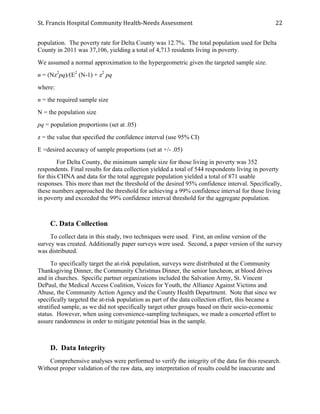
through several fact-finding sessions. Specifically, for the community health need assessment,
five specific areas were included:
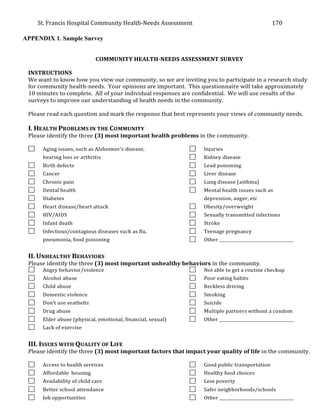
Ratings of health problems in the community – to assess the importance of various
community health concerns. Survey items included areas assessing topics such as cancer,
diabetes and obesity. In all, there were 20 choices provided for survey respondents.
Ratings of unhealthy behaviors in the community – to assess the importance of various
unhealthy behaviors. Survey items included areas assessing topics such as violence, drug
abuse and smoking. In all, there were 14 choices provided for survey respondents.
Ratings of issues with quality of life – to assess the importance of various issues relating
to quality of life in the community. Survey items included areas assessing topics such as
access to health care, safer neighborhoods and effective public transportation. In all,
there were nine choices provided for survey respondents.
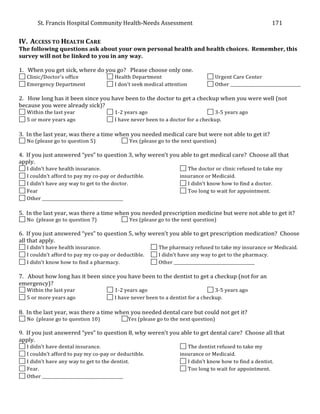
Accessibility to health care – to assess the degree to which residents could have access
to health care when needed. Survey items included areas assessing topics such as access
to medical, dental and mental care, as well as access to prescription drugs.
Healthy behaviors – to assess the degree to which residents exhibited healthy behaviors.
The survey focused on areas such as exercise, healthy eating habits and smoking.
Finally, demographic information was collected to assess background information
necessary to segment markets in terms of the five categories discussed above.
After the initial survey was designed, a pilot study was created to test the psychometric
properties and statistical validity of the survey instrument. The pilot study was conducted at the
Heartland Community Health Clinic’s three facilities. The Heartland Clinic was chosen as it
serves the at-risk population and is located in close proximity to the OSF corporate facilities.
This was necessary to create a standardized survey instrument for all hospitals in the OSF
System. A total of 130 surveys were collected. Results from the pilot survey revealed specific
items to be included/excluded in the final survey instrument. Selection criteria for the final
survey included validity, reliability and frequency measures based on responses from the pilot
sample. Note that these surveys were not included in the final sample. A copy of the final survey
is included in Appendix 1.
B. Sample Size
In order to identify our potential population, we first identified the percentage of the
Delta County population that was living in poverty. Specifically, we multiplied the population of
the county by its respective poverty rate to identify the minimum sample size to study the at-risk
St.	
  Francis	
  Hospital	
  Community	
  Health-­‐Needs	
  Assessment	


22	
  
population. The poverty rate for Delta County was 12.7%. The total population used for Delta
County in 2011 was 37,106, yielding a total of 4,713 residents living in poverty.
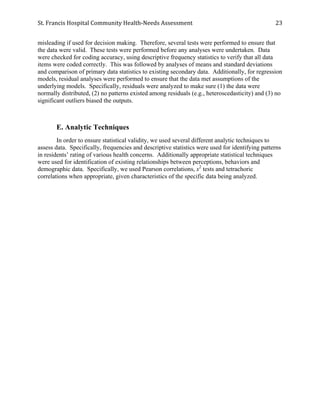
We assumed a normal approximation to the hypergeometric given the targeted sample size.
n = (Nz2
pq)/(E2
(N-1) + z2
pq
where:
n = the required sample size
N = the population size
pq = population proportions (set at .05)
z = the value that specified the confidence interval (use 95% CI)
E =desired accuracy of sample proportions (set at +/- .05)
For Delta County, the minimum sample size for those living in poverty was 352
respondents. Final results for data collection yielded a total of 544 respondents living in poverty
for this CHNA and data for the total aggregate population yielded a total of 871 usable
responses. This more than met the threshold of the desired 95% confidence interval. Specifically,
these numbers approached the threshold for achieving a 99% confidence interval for those living
in poverty and exceeded the 99% confidence interval threshold for the aggregate population.
C. Data Collection
To collect data in this study, two techniques were used. First, an online version of the
survey was created. Additionally paper surveys were used. Second, a paper version of the survey
was distributed.
To specifically target the at-risk population, surveys were distributed at the Community
Thanksgiving Dinner, the Community Christmas Dinner, the senior luncheon, at blood drives
and in churches. Specific partner organizations included the Salvation Army, St. Vincent
DePaul, the Medical Access Coalition, Voices for Youth, the Alliance Against Victims and
Abuse, the Community Action Agency and the County Health Department. Note that since we
specifically targeted the at-risk population as part of the data collection effort, this became a
stratified sample, as we did not specifically target other groups based on their socio-economic
status. However, when using convenience-sampling techniques, we made a concerted effort to
assure randomness in order to mitigate potential bias in the sample.
D. Data Integrity
Comprehensive analyses were performed to verify the integrity of the data for this research.
Without proper validation of the raw data, any interpretation of results could be inaccurate and
St.	
  Francis	
  Hospital	
  Community	
  Health-­‐Needs	
  Assessment	


23	
  
misleading if used for decision making. Therefore, several tests were performed to ensure that
the data were valid. These tests were performed before any analyses were undertaken. Data
were checked for coding accuracy, using descriptive frequency statistics to verify that all data
items were coded correctly. This was followed by analyses of means and standard deviations
and comparison of primary data statistics to existing secondary data. Additionally, for regression
models, residual analyses were performed to ensure that the data met assumptions of the
underlying models. Specifically, residuals were analyzed to make sure (1) the data were
normally distributed, (2) no patterns existed among residuals (e.g., heteroscedasticity) and (3) no
significant outliers biased the outputs.
E. Analytic Techniques
In order to ensure statistical validity, we used several different analytic techniques to
assess data. Specifically, frequencies and descriptive statistics were used for identifying patterns
in residents’ rating of various health concerns. Additionally appropriate statistical techniques
were used for identification of existing relationships between perceptions, behaviors and
demographic data. Specifically, we used Pearson correlations, x2
tests and tetrachoric
correlations when appropriate, given characteristics of the specific data being analyzed.
St.	
  Francis	
  Hospital	
  Community	
  Health-­‐Needs	
  Assessment	


24	
  
PHASE I – SECONDARY DATA RESEARCH FOR
COMMUNITY HEALTH NEEDS
In this section of the community health needs assessment, there are five chapters that
assess different aspects of the general community as well as specific health-related issues. All of
the information in this section is taken from secondary data sources. As described in the
METHODS section, some data sources are publically available and other data sources are
comprised of aggregated hospital data from 2011.
The chapters are as follows:
CHAPTER 1. DEMOGRAPHIC PROFILE
CHAPTER 2. PREVENTION
CHAPTER 3. SYMPTOMS/PREDICTORS
CHAPTER 4. DISEASES/MORBIDITY
CHAPTER 5. MORTALITY
St.	
  Francis	
  Hospital	
  Community	
  Health-­‐Needs	
  Assessment	


25	
  
CHAPTER 1. DEMOGRAPHIC PROFILE
1.1 Population
Importance of the measure: Population data characterizes the individuals residing within the
jurisdictional boundaries of Delta County. Population data provides an overview of population
growth trends and builds a foundation for additional analysis of these data.
1.1.1 Population by Municipality
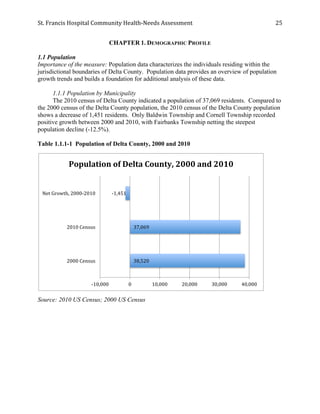
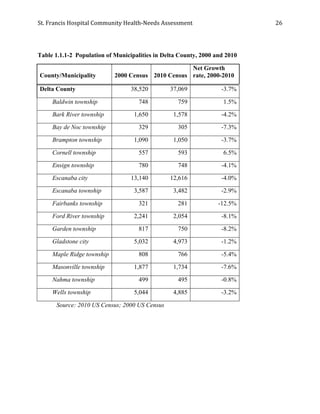
The 2010 census of Delta County indicated a population of 37,069 residents. Compared to
the 2000 census of the Delta County population, the 2010 census of the Delta County population
shows a decrease of 1,451 residents. Only Baldwin Township and Cornell Township recorded
positive growth between 2000 and 2010, with Fairbanks Township netting the steepest
population decline (-12.5%).
Table 1.1.1-1 Population of Delta County, 2000 and 2010
Source: 2010 US Census; 2000 US Census
38,520	
  
37,069	
  
-­‐1,451	
  
-­‐10,000	
   0	
   10,000	
   20,000	
   30,000	
   40,000	
  
2000	
  Census	
  
2010	
  Census	
  
Net	
  Growth,	
  2000-­‐2010	
  
Population	
  of	
  Delta	
  County,	
  2000	
  and	
  2010	
  
St.	
  Francis	
  Hospital	
  Community	
  Health-­‐Needs	
  Assessment	


26	
  
Table 1.1.1-2 Population of Municipalities in Delta County, 2000 and 2010
County/Municipality 2000 Census 2010 Census
Net Growth
rate, 2000-2010
Delta County 38,520 37,069 -3.7%
Baldwin township 748 759 1.5%
Bark River township 1,650 1,578 -4.2%
Bay de Noc township 329 305 -7.3%
Brampton township 1,090 1,050 -3.7%
Cornell township 557 593 6.5%
Ensign township 780 748 -4.1%
Escanaba city 13,140 12,616 -4.0%
Escanaba township 3,587 3,482 -2.9%
Fairbanks township 321 281 -12.5%
Ford River township 2,241 2,054 -8.1%
Garden township 817 750 -8.2%
Gladstone city 5,032 4,973 -1.2%
Maple Ridge township 808 766 -5.4%
Masonville township 1,877 1,734 -7.6%
Nahma township 499 495 -0.8%
Wells township 5,044 4,885 -3.2%
Source: 2010 US Census; 2000 US Census
St.	
  Francis	
  Hospital	
  Community	
  Health-­‐Needs	
  Assessment	


27	
  
1.1.2 Growth Rates
Data from the last three censuses (1990, 2000, 2010) indicate varied population growth for
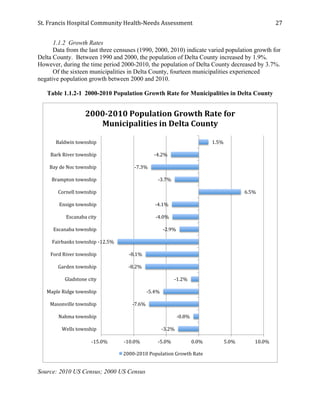
Delta County. Between 1990 and 2000, the population of Delta County increased by 1.9%.
However, during the time period 2000-2010, the population of Delta County decreased by 3.7%.
Of the sixteen municipalities in Delta County, fourteen municipalities experienced
negative population growth between 2000 and 2010.
Table 1.1.2-1 2000-2010 Population Growth Rate for Municipalities in Delta County
Source: 2010 US Census; 2000 US Census
-­‐3.2%	


-­‐0.8%	


-­‐7.6%	


-­‐5.4%	


-­‐1.2%	


-­‐8.2%	


-­‐8.1%	


-­‐12.5%	


-­‐2.9%	


-­‐4.0%	


-­‐4.1%	


6.5%	


-­‐3.7%	


-­‐7.3%	


-­‐4.2%	


1.5%	


-­‐15.0%	


   -­‐10.0%	


   -­‐5.0%	


   0.0%	


   5.0%	


   10.0%	


Wells	
  township	
  
Nahma	
  township	
  
Masonville	
  township	
  
Maple	
  Ridge	
  township	
  
Gladstone	
  city	
  
Garden	
  township	
  
Ford	
  River	
  township	
  
Fairbanks	
  township	
  
Escanaba	
  township	
  
Escanaba	
  city	
  
Ensign	
  township	
  
Cornell	
  township	
  
Brampton	
  township	
  
Bay	
  de	
  Noc	
  township	
  
Bark	
  River	
  township	
  
Baldwin	
  township	
  
2000-­‐2010	
  Population	
  Growth	
  Rate	
  for	
  
Municipalities	
  in	
  Delta	
  County	
  
2000-­‐2010	
  Population	
  Growth	
  Rate	
  
St.	
  Francis	
  Hospital	
  Community	
  Health-­‐Needs	
  Assessment	


28	
  
1.2 Age, Gender and Race Distribution
Importance of the measure: Population data broken down by age groups, gender, and race
provides a foundation to analyze the issues and trends that impact demographic factors including
economic growth and the distribution of health care services. Understanding the cultural
diversity of communities is essential when considering health care infrastructure and service
delivery systems.
1.2.1 Age
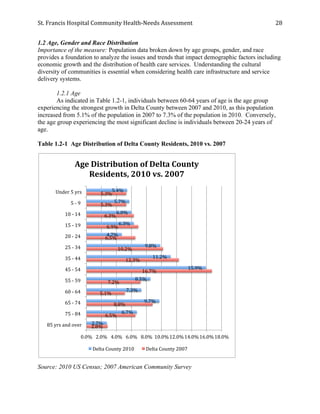
As indicated in Table 1.2-1, individuals between 60-64 years of age is the age group
experiencing the strongest growth in Delta County between 2007 and 2010, as this population
increased from 5.1% of the population in 2007 to 7.3% of the population in 2010. Conversely,
the age group experiencing the most significant decline is individuals between 20-24 years of
age.
Table 1.2-1 Age Distribution of Delta County Residents, 2010 vs. 2007
Source: 2010 US Census; 2007 American Community Survey
5.4%	
  
5.7%	
  
6.0%	
  
6.3%	
  
4.7%	
  
9.8%	
  
11.2%	
  
15.9%	
  
8.5%	
  
7.3%	
  
9.7%	
  
6.7%	
  
2.7%	
  
5.3%	
  
5.3%	
  
6.3%	
  
6.9%	
  
6.5%	
  
10.2%	
  
12.3%	
  
16.7%	
  
7.2%	
  
5.1%	
  
8.8%	
  
6.5%	
  
2.8%	
  
0.0%	
   2.0%	
   4.0%	
   6.0%	
   8.0%	
   10.0%	
  12.0%	
  14.0%	
  16.0%	
  18.0%	


  Under	
  5	
  yrs	


  5	
  -­‐	
  9	


  10	
  -­‐	
  14	


  15	
  -­‐	
  19	


  20	
  -­‐	
  24	


  25	
  -­‐	
  34	


  35	
  -­‐	
  44	


  45	
  -­‐	
  54	


  55	
  -­‐	
  59	


  60	
  -­‐	
  64	


  65	
  -­‐	
  74	


  75	
  -­‐	
  84	


  85	
  yrs	
  and	
  over	
  
Age	
  Distribution	
  of	
  Delta	
  County	
  
Residents,	
  2010	
  vs.	
  2007	
  
Delta	
  County	
  2010	
   Delta	
  County	
  2007	
  
St.	
  Francis	
  Hospital	
  Community	
  Health-­‐Needs	
  Assessment	


29	
  
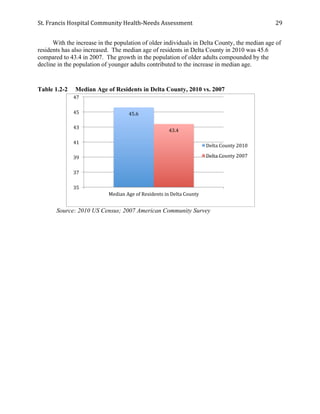
With the increase in the population of older individuals in Delta County, the median age of
residents has also increased. The median age of residents in Delta County in 2010 was 45.6
compared to 43.4 in 2007. The growth in the population of older adults compounded by the
decline in the population of younger adults contributed to the increase in median age.
Table 1.2-2 Median Age of Residents in Delta County, 2010 vs. 2007
Source: 2010 US Census; 2007 American Community Survey
45.6	
  
43.4	
  
35	
  
37	
  
39	
  
41	
  
43	
  
45	
  
47	
  
Median	
  Age	
  of	
  Residents	
  in	
  Delta	
  County	
  
Delta	
  County	
  2010	
  
Delta	
  County	
  2007	
  
St.	
  Francis	
  Hospital	
  Community	
  Health-­‐Needs	
  Assessment	


30	
  
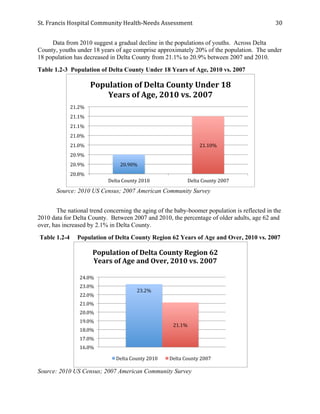
Data from 2010 suggest a gradual decline in the populations of youths. Across Delta
County, youths under 18 years of age comprise approximately 20% of the population. The under
18 population has decreased in Delta County from 21.1% to 20.9% between 2007 and 2010.
Table 1.2-3 Population of Delta County Under 18 Years of Age, 2010 vs. 2007
Source: 2010 US Census; 2007 American Community Survey
The national trend concerning the aging of the baby-boomer population is reflected in the
2010 data for Delta County. Between 2007 and 2010, the percentage of older adults, age 62 and
over, has increased by 2.1% in Delta County.
Table 1.2-4 Population of Delta County Region 62 Years of Age and Over, 2010 vs. 2007
Source: 2010 US Census; 2007 American Community Survey
20.90%	
  
21.10%	
  
20.8%	
  
20.9%	
  
20.9%	
  
21.0%	
  
21.0%	
  
21.1%	
  
21.1%	
  
21.2%	
  
Delta	
  County	
  2010	
   Delta	
  County	
  2007	
  
Population	
  of	
  Delta	
  County	
  Under	
  18	
  
Years	
  of	
  Age,	
  2010	
  vs.	
  2007	
  
23.2%	
  
21.1%	
  
16.0%	
  
17.0%	
  
18.0%	
  
19.0%	
  
20.0%	
  
21.0%	
  
22.0%	
  
23.0%	
  
24.0%	
  
Population	
  of	
  Delta	
  County	
  Region	
  62	
  
Years	
  of	
  Age	
  and	
  Over,	
  2010	
  vs.	
  2007	
  
Delta	
  County	
  2010	
   Delta	
  County	
  2007	
  
St.	
  Francis	
  Hospital	
  Community	
  Health-­‐Needs	
  Assessment	


31	
  
1.2.2 Gender
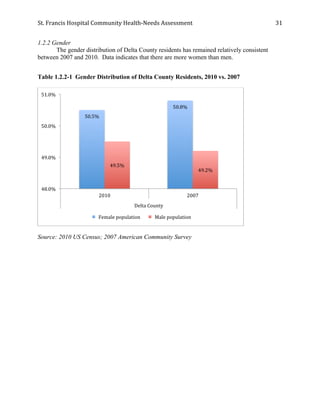
The gender distribution of Delta County residents has remained relatively consistent
between 2007 and 2010. Data indicates that there are more women than men.
Table 1.2.2-1 Gender Distribution of Delta County Residents, 2010 vs. 2007
Source: 2010 US Census; 2007 American Community Survey
50.5%	
  
50.8%	
  
49.5%	
  
49.2%	
  
48.0%	
  
49.0%	
  
50.0%	
  
51.0%	
  
2010	
   2007	
  
Delta	
  County	


  Female	
  population	
   	
  	
  Male	
  population	
  
St.	
  Francis	
  Hospital	
  Community	
  Health-­‐Needs	
  Assessment	


32	
  
1.2.3 Race
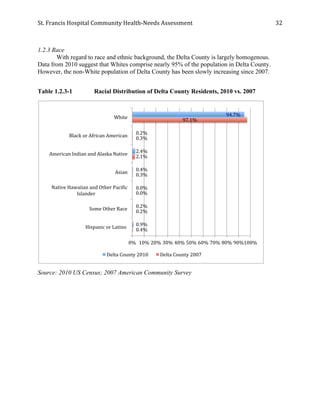
With regard to race and ethnic background, the Delta County is largely homogenous.
Data from 2010 suggest that Whites comprise nearly 95% of the population in Delta County.
However, the non-White population of Delta County has been slowly increasing since 2007.
Table 1.2.3-1 Racial Distribution of Delta County Residents, 2010 vs. 2007
Source: 2010 US Census; 2007 American Community Survey
94.7%	
  
0.2%	
  
2.4%	
  
0.4%	
  
0.0%	
  
0.2%	
  
0.9%	
  
97.1%	
  
0.3%	
  
2.1%	
  
0.3%	
  
0.0%	
  
0.2%	
  
0.4%	
  
0%	
   10%	
  20%	
  30%	
  40%	
  50%	
  60%	
  70%	
  80%	
  90%	
  100%	


  White	


  Black	
  or	
  African	
  American	


  American	
  Indian	
  and	
  Alaska	
  Native	


  Asian	


  Native	
  Hawaiian	
  and	
  Other	
  PaciWic	
  
Islander	


  Some	
  Other	
  Race	


  Hispanic	
  or	
  Latino	
  	
  
Delta	
  County	
  2010	
   Delta	
  County	
  2007	
  
St.	
  Francis	
  Hospital	
  Community	
  Health-­‐Needs	
  Assessment	


33	
  
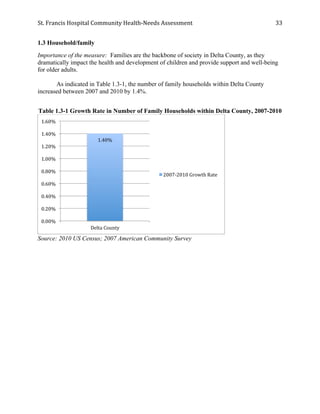
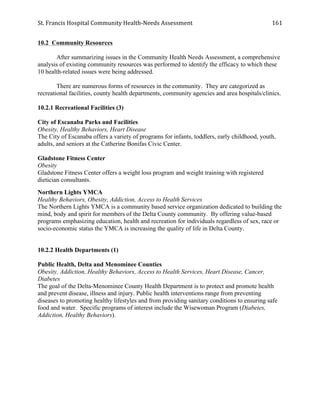
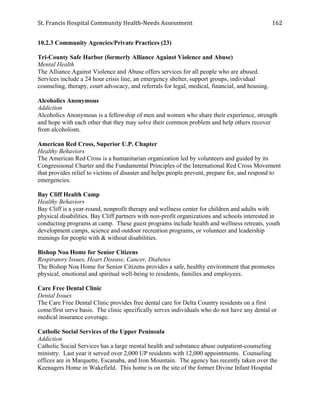
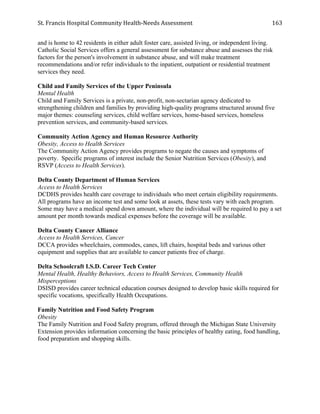
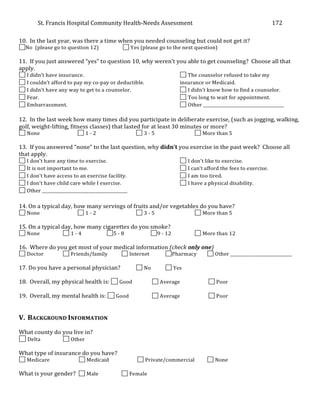
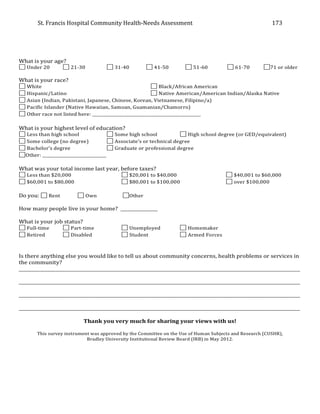
1.3 Household/family
Importance of the measure: Families are the backbone of society in Delta County, as they
dramatically impact the health and development of children and provide support and well-being
for older adults.
As indicated in Table 1.3-1, the number of family households within Delta County
increased between 2007 and 2010 by 1.4%.
Table 1.3-1 Growth Rate in Number of Family Households within Delta County, 2007-2010
Source: 2010 US Census; 2007 American Community Survey
1.40%	
  
0.00%	
  
0.20%	
  
0.40%	
  
0.60%	
  
0.80%	
  
1.00%	
  
1.20%	
  
1.40%	
  
1.60%	
  
Delta	
  County	
  
2007-­‐2010	
  Growth	
  Rate	
  
St.	
  Francis	
  Hospital	
  Community	
  Health-­‐Needs	
  Assessment	


34	
  
1.3.1 /1.3.2 Single and Related Family
In Delta County, data from 2010 suggest a 20.5% increase from 2007 in the number of
female households with no husband present. Across Delta County, the percentage of husband-
wife families has decreased by 0.4%.
Table 1.3.1-1 Family Composition in Delta County, 2010 vs. 2007
Source: 2010 US Census; 2007 American Community Survey
51.7%	
  
16.0%	
  
4.4%	
  
2.6%	
  
8.8%	
  
5.4%	
  
52.1%	
  
18.0%	
  
4.5%	
   2.5%	
   7.3%	
   5.5%	
  
0.0%	
  
10.0%	
  
20.0%	
  
30.0%	
  
40.0%	
  
50.0%	
  
60.0%	


  Husband-­‐
wife	
  family	


  With	
  own	
  
children	
  under	
  
18	
  years	


  Male	
  
householder,	
  
no	
  wife	
  present	


  With	
  own	
  
children	
  under	
  
18	
  years	


  Female	
  
householder,	
  
no	
  husband	
  
present	


  With	
  own	
  
children	
  under	
  
18	
  years	
  
Delta	
  County	
  2010	
   Delta	
  County	
  2007	
  
St.	
  Francis	
  Hospital	
  Community	
  Health-­‐Needs	
  Assessment	


35	
  
1.3.3 Marital status
Between 2007 and 2010, Delta County experienced a 0.2% growth rate in the percentage
of residents who are married but not separated. These findings run counter to data from the State
of Michigan which suggest a decline of 2.3% during the same time period.
Table 1.3.3-1 Three-year Growth Rate in the Percentage of Delta County Residents who
are Married, but not Separated, 2007-2010
Source: 2010 US Census; 2007 American Community Survey
0.2%	
  
-­‐2.3%	
  -­‐3.0%	
  
-­‐2.0%	
  
-­‐1.0%	
  
0.0%	
  
1.0%	
  
2.0%	
  
3.0%	
  
4.0%	
  
5.0%	
  
6.0%	
  
Delta	
  County	
   State	
  of	
  Michigan	
  
Three-­‐year	
  Growth	
  Rate	
  in	
  the	
  Number	
  
of	
  Delta	
  County	
  Residents	
  who	
  are	
  
Married,	
  but	
  not	
  Separated,	
  2007-­‐2010	
  
St.	
  Francis	
  Hospital	
  Community	
  Health-­‐Needs	
  Assessment	


36	
  
The three-year growth rate in the percentage of Delta County residents who are divorced
(0.2%) is lower than the State of Michigan average (0.5%). The three-year growth rate in the
percentage of Delta County residents who are separated (0.2%) is greater than the State of
Michigan average (0%).
Table 1.3.3-2 Three-year Growth Rate in the Percentage of Delta County Residents who
are Divorced or Separated, 2007-2010
Source: 2010 US Census; 2007 American Community Survey
0.2%	
  
0.5%	
  
0.2%	
  
0%	
  
0.0%	
  
0.2%	
  
0.4%	
  
0.6%	
  
Delta	
  County	
   State	
  of	
  Michigan	
  
Three-­‐year	
  Growth	
  Rate	
  in	
  the	
  
Number	
  of	
  Delta	
  County	
  
Residents	
  who	
  are	
  Divorced	
  or	
  
Separated,	
  2007-­‐2010	
  	
  
Divorced	
  
Separated	
  
St.	
  Francis	
  Hospital	
  Community	
  Health-­‐Needs	
  Assessment	


37	
  
The percentage of residents in Delta County who are widowed or never married are
trending in opposite directions compared with State of Michigan averages between 2007 and
2010. The percentage change of non-married residents in Delta County between 2007 and 2010
is considerably less than the State of Michigan average.
Table 1.3.3-3 Three-year Growth Rate in the Percentage of Delta County Residents who
are Widowed or Never Married, 2007-2010
Source: 2010 US Census; 2007 American Community Survey
-­‐0.4%	
  
0.1%	
  
-­‐0.1%	
  
1.8%	
  
-­‐1.0%	
  
-­‐0.5%	
  
0.0%	
  
0.5%	
  
1.0%	
  
1.5%	
  
2.0%	
  
Delta	
  County	
   State	
  of	
  Michigan	
  
Three-­‐year	
  Growth	
  Rate	
  in	
  the	
  
Number	
  of	
  Delta	
  County	
  
Residents	
  who	
  are	
  Widowed	
  or	
  
Never	
  Married,	
  2007-­‐2010	
  	
  
Widowed	
  
Never	
  Married	
  
St.	
  Francis	
  Hospital	
  Community	
  Health-­‐Needs	
  Assessment	


38	
  
1.3.4 Early Sexual Activity Leading to Births from Teenage Mothers
With regard to teenage birth rates, Delta County has a significantly lower teen birth rate in
relation to the State of Michigan for both 2005-2007 and 2008-2010.
Table 1.3.4-1: Births to Teenage Mothers per 1000 Females in Delta County vs. State of
Michigan, 2005-2007 vs. 2008-2010.
Source: Michigan Department of Community Health
1.4 Economic information
Importance of the measure: Median income divides households into two segments with one half
of households earning more than the median income and the other half earning less. Because
median income is not significantly impacted by unusually high or low-income values, it is
considered to be a more reliable indicator than average income. To live in poverty means to not
have enough income to meet one’s basic needs. Accordingly, poverty is associated with
numerous chronic social, health, education, and employment conditions.
1.4.1 Median income level
For 2007 and 2010, the median household income in Delta County lagged behind the State
of Michigan median household income.
30.2	
  
51.1	
  
30.3	
  
53.8	
  
0.0	
  
10.0	
  
20.0	
  
30.0	
  
40.0	
  
50.0	
  
60.0	
  
Delta	
  County	
   State	
  of	
  Michigan	
  
Births	
  to	
  Teenage	
  Mothers	
  per	
  1000	
  
Females	
  in	
  Delta	
  County	
  vs.	
  State	
  of	
  
Michigan,	
  2005-­‐2007	
  vs.	
  2008-­‐2010	
  
2008-­‐2010	
  
2005-­‐2007	
  
St.	
  Francis	
  Hospital	
  Community	
  Health-­‐Needs	
  Assessment	


39	
  
Table 1.4.1-1: Median Household Income for Delta County, 2007 vs. 2010
Source: 2007 & 2010 American Community Survey
1.4.2 Unemployment
The Delta County unemployment rates parallel both the State of Michigan and national
trends. Unemployment in Delta County was higher than the state average until 2008, when the
rate of unemployment in Delta County was lower than the state average.
Table 1.4.2-1:Average Annual Unemployment Rate for Delta County, 2002-2011
Source: Bureau of Labor Statistics
$40,496	
  
$48,432	
  
$37,884	
  
$48,642	
  
$0	
  
$10,000	
  
$20,000	
  
$30,000	
  
$40,000	
  
$50,000	
  
$60,000	
  
Delta	
  County	
   State	
  of	
  Michigan	
  
Median	
  Household	
  Income	
  for	
  
Delta	
  County,	
  2007	
  vs.	
  2010	
  
2010	
  
2007	
  
0.0%	
  
2.0%	
  
4.0%	
  
6.0%	
  
8.0%	
  
10.0%	
  
12.0%	
  
14.0%	
  
16.0%	
  
Average	
  Unemployment	
  Rate	
  for	
  	
  
Delta	
  County,	
  2002-­‐2011	
  
Delta	
  County	
  
State	
  of	
  Michigan	
  
St.	
  Francis	
  Hospital	
  Community	
  Health-­‐Needs	
  Assessment	


40	
  
1.4.3 Families in poverty
Poverty has a significant impact on the development of children and youth. Poverty rates
in Delta County are significantly higher for single-mother led households compared to married-
couple families and all families.
Table 1.4.3-1: Percentage of Families Living in Poverty in Delta County, 2010 vs. 2007
Source: 2010 and 2007 American Community Survey
1.5 Education
Importance of the measure: According to the National Center for Educational Statistics, “the
better educated a person is, the more likely that person is to report being in ‘excellent’ or ‘very
good’ health, regardless of income” (NCES, 2005). Educational attainment and reading/math
scores are well researched, with findings strongly related to an individual’s propensity to earn a
higher salary, gain better employment, and foster multifaceted success in life. As such, research
suggests that the higher the level of educational attainment and the more successful children are
in school, the better one’s heath will be and the greater likelihood of one selecting healthy
lifestyle choices.
1.5.1 3rd
/8th
grade reading and math
In 2011-2012, 6 of the 8 school districts in Delta County had higher averages than the
State of Michigan average (36% “not proficient”) for the percentage of 3rd
grade students who
were “not proficient” at math. These districts included Bark River-Harris (55% “not
proficient”), Big Bay De Noc (44% “not proficient”), Manistique Area (41% “not proficient”),
Mid Peninsula (54% “not proficient”), Nah Tah Wahsh Public (64% “not proficient”), and Rapid
River Public (58% “not proficient”). Two school districts underperformed the State of Michigan
0.0%	
  
5.0%	
  
10.0%	
  
15.0%	
  
20.0%	
  
25.0%	
  
30.0%	
  
35.0%	
  
40.0%	
  
2010	
   2007	
   2010	
   2007	
  
Delta	
  County	
   State	
  of	
  Michigan	
  
Percentage	
  of	
  Families	
  Living	
  in	
  Poverty	
  in	
  
Delta	
  County,	
  2010	
  vs.	
  2007	
  
All	
  families	
  
Married-­‐couple	
  families	
  
Female	
  householder,	
  no	
  
husband	
  present	
  	
  
St.	
  Francis	
  Hospital	
  Community	
  Health-­‐Needs	
  Assessment	


41	
  
(11% “not proficient”) in terms of 3rd
grade readings scores: Mid Peninsula (15% “not
proficient”) and Rapid River Public (16% “not proficient”).
Table 1.5.1-1 Grade 3 Student Achievement in Delta County 2011-2012
Note: Bark River-Harris, Big Bay De Noc, Gladstone Area, and Manistique Area all reported that less than 5% of
3rd
grade students were “not proficient” at reading. Precise percentages were not reported.
Source: Michigan Department of Education, 2011-2012 School Report Card, mischooldata.org
7%	
  
15%	
  
9%	
  
16%	
  
11%	
  
55%	
  
44%	
  
26%	
  
27%	
  
41%	
  
54%	
  
64%	
  
58%	
  
36%	
  
0%	
   10%	
   20%	
   30%	
   40%	
   50%	
   60%	
   70%	
  
Bark	
  River-­‐Harris	
  
Big	
  Bay	
  De	
  Noc	
  
Escanaba	
  Area	
  Public	
  
Gladstone	
  Area	
  
Manistique	
  Area	
  
Mid	
  Peninsula	
  
Nah	
  Tah	
  Wahsh	
  Public	
  
Rapid	
  River	
  Public	
  
State	
  of	
  Michigan	
  
Percentage	
  of	
  3rd	
  Grade	
  Students	
  Deemed	
  
"Not	
  ProVicient"	
  at	
  Reading	
  and	
  Math	
  in	
  
Delta	
  County	
  2011-­‐2012	
  
2012	
  Reading	
   2012	
  	
  Math	
  
St.	
  Francis	
  Hospital	
  Community	
  Health-­‐Needs	
  Assessment	


42	
  
Similarly, in 2011-2012, 5 of the 8 school districts in Delta County had higher averages
than the State of Michigan average (39% “not proficient”) for the percentage of 8th
grade
students who were “not proficient” at math. These districts included Bark River-Harris (52%
“not proficient”), Big Bay De Noc (81% “not proficient”), Gladstone Area (42% “not
proficient”), Mid Peninsula (53% “not proficient”), and Nah Tah Wahsh Public (45% “not
proficient). Four school districts underperformed the State of Michigan (11% “not proficient”)
in terms of 8th
grade readings scores: Big Bay De Noc (22% “not proficient”), Mid Peninsula
(40% “not proficient”), Nah Tah Wahsh Public (45% “not proficient), and Rapid River Public
(16% “not proficient”).
Table 1.5.1-2 Grade 8 Student Achievement in Delta County 2011-2012
Source: Michigan Department of Education, 2011-2012 School Report Card, mischooldata.org
6%	
  
22%	
  
10%	
  
14%	
  
14%	
  
40%	
  
45%	
  
16%	
  
11%	
  
52%	
  
81%	
  
39%	
  
42%	
  
37%	
  
53%	
  
45%	
  
28%	
  
39%	
  
0%	
   10%	
   20%	
   30%	
   40%	
   50%	
   60%	
   70%	
   80%	
   90%	
  
Bark	
  River-­‐Harris	
  
Big	
  Bay	
  De	
  Noc	
  
Escanaba	
  Area	
  Public	
  
Gladstone	
  Area	
  
Manistique	
  Area	
  
Mid	
  Peninsula	
  
Nah	
  Tah	
  Wahsh	
  Public	
  
Rapid	
  River	
  Public	
  
State	
  of	
  Michigan	
  
Percentage	
  of	
  8th	
  Grade	
  Students	
  Deemed	
  
"Not	
  ProVicient"	
  at	
  Reading	
  and	
  Math	
  in	
  
Delta	
  County	
  2011-­‐2012	
  
Reading	
   	
  Math	
  
St.	
  Francis	
  Hospital	
  Community	
  Health-­‐Needs	
  Assessment	


43	
  
1.5.3 High School graduation rates
High school graduation rates in 2007-2008 and 2010-2011 in Delta County are above the
state average (which is 75.5% and 74.33% for years 2007-2008 and 2010-2011, respectively).
Two districts experienced a decline in graduation rates between 2007-2008 and 2010-2011 (Big
Bay De Noc and Gladstone Area).
Table 1.5.3-1 High School Graduation Rates in Delta County, 2007-2008 vs. 2010-2011
Source: Michigan Department of Education, 2007-2008 and 2010-2011 School Report Cards, mischooldata.org
1.6 People with Disabilities
Importance of the measure: According to the US Census Bureau, a disability can be a long-
lasting physical, mental or emotional condition. This condition can make it difficult for a person
to do activities such as walking, climbing stairs, dressing, bathing, learning, or remembering.
This condition can also impede a person from being independent, from being able to go outside
the home alone or to work at a job or business. This condition can also impact a person’s ability
to achieve an education and can influence a person’s ability to access appropriate health care.
1.6.1 Physical
In 2012, residents of Delta County reported experiencing 3.6 days per month in which he
or she felt physically unhealthy. While this is an improvement since 2010, the figures for Delta
County exceed the state average and national benchmarks pegged to data from the Center for
Disease Control Behavioral Risk Factor Surveillance System database.
91.67%	
   94.29%	
   88.89%	
   91.24%	
   83%	
   92.31%	
   92.50%	
  
75.50%	
  
94.29%	
   91.67%	
   93.55%	
   86.84%	
   85.71%	
  
94.74%	
   96.40%	
  
74.33%	
  
0%	
  
20%	
  
40%	
  
60%	
  
80%	
  
100%	
  
120%	
  
High	
  School	
  Graduation	
  Rates	
  in	
  Delta	
  
County,	
  2007-­‐2008	
  vs.	
  2010-­‐2011	
  
2007-­‐2008	
   2010-­‐2011	
  
St.	
  Francis	
  Hospital	
  Community	
  Health-­‐Needs	
  Assessment	


44	
  
Table 1.6.1-1 Average Number of Physically Unhealthy Days Reported in the Past 30 Days
by Delta County Residents, 2010 vs. 2012
Source: Michigan Behavioral Risk Factor Surveillance System
1.6.2 Mental
In 2012, residents of Delta County reported experiencing 3.5 days per month in which he
or she felt mentally unhealthy. While this is an improvement since 2010, the figures for Delta
County are less than the state average, yet lag national benchmarks pegged to data from the
Center for Disease Control Behavioral Risk Factor Surveillance System database.
Table 1.6.1-2 Average Number of Mentally Unhealthy Days Reported in the Past 30 Days
by Delta County Residents, 2010 vs. 2012
Source: Michigan Behavioral Risk Factor Surveillance System
0.0	
  
1.0	
  
2.0	
  
3.0	
  
4.0	
  
5.0	
  
6.0	
  
Delta	
  County	
  	
   National	
  Benchmark	
  
(90th	
  Percentile)	
  
State	
  of	
  Michigan	
  
2010	
  
2012	
  
0.0	
  
0.5	
  
1.0	
  
1.5	
  
2.0	
  
2.5	
  
3.0	
  
3.5	
  
4.0	
  
4.5	
  
Delta	
  County	
   National	
  Benchmark	
  
(90th	
  Percentile)	
  
State	
  of	
  Michigan	
  
2010	
  
2012	
  
St.	
  Francis	
  Hospital	
  Community	
  Health-­‐Needs	
  Assessment	


45	
  
Demographic Profile: Strategic Implications
Changing demographics and health care:
Recent data in May 2012 from the Kaiser Family Foundation1
and Congressional Budget
Office2
suggest that the number of individuals 65 years and older in the United States will
increase by one-third between 2012 and 2022. With the changing demographics, it is anticipated
an increase in chronic conditions such as diabetes, asthma, and heart disease, and obesity will
contribute to the growing cost of health care3
. In addition, advances in medical technology and
medicine may enable individuals to live longer, thus requiring extensive medical care.
Of particular note, the population of individuals 60-64 years of age increased by 2.2% in
Delta County between 2007 and 2010. As individuals age and live with disabilities, it greatly
impacts the degree of self-sufficiency and medical care required to maintain satisfactory well-
being. With the changing demographics resulting from the aging of baby boomers, it is
anticipated Delta County will experience an increase in the number of elderly individuals living
with disabilities and chronic conditions.
Educational attainment and health care:
For over two decades, empirical research strongly suggests a positive relationship
between education and health4,5,6,7
(Adams, 2002; House et. al, 1990; Ross & Wu, 1995; Sander,
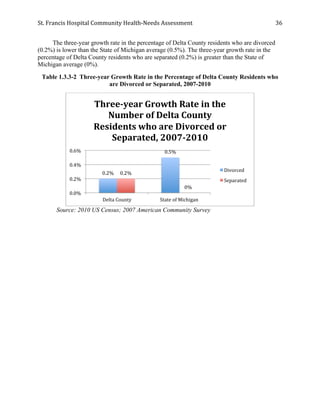
1999). The predominant way education impacts better health is through enhancing the decision-
making capabilities of an individual. In this way, when an individual is better educated, he or
she tends to have a better understanding of symptoms, be better equipped to explain symptoms to
a doctor, and make better choices with regard to individual health inputs. Accordingly, more
effective treatments and positive outcomes result later in life.
A symbiotic relationship exists between health and education. Consider that healthier
children miss fewer days of school and are more "ready to learn.” Success in school begins prior
to kindergarten as new research on cognitive development shows the importance of health,
nutrition, and intellectual stimulation during the first years of life. To be prepared to learn in
kindergarten, children need pre-literacy skills. They must also be able to make and keep friends,
develop positive relationships with adults, and feel a sense of opportunity and excitement for the
world around them. As their child's first teacher, much of this responsibility falls upon parents.
Research tells us the most reliable predictor of educational success for children is whether
they are reading at grade level by the end of 3rd grade. Note that according to data presented in
Chapter 1, while most school districts are above the State of Michigan averages, certain school
districts (e.g., Mid Peninsula and Rapid River) report more students deemed “not proficient”
compared to 3rd
grade students across the State of Michigan.
According to research, a child from a low-income family who completes algebra has
virtually the same chance of going to college as a child from an upper-income family who passes
the course. Thus, it is not about the math, it's about learning to problem solve. Particularly
troubling are data indicating six of eight school districts in Delta County reporting more students
deemed “not proficient” in math compared to 3rd
grade students across the State of Michigan.
This trend continues to 8th
grade, where five of eight school districts in Delta County report more
St.	
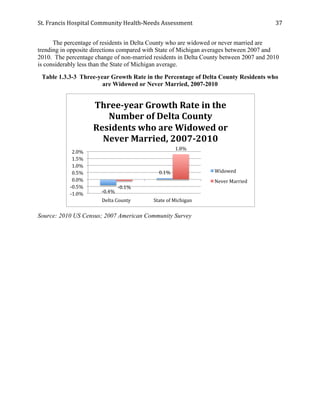
  Francis	
  Hospital	
  Community	
  Health-­‐Needs	
  Assessment	


46	
  
students deemed “not proficient” in math compared to 8th
grade students across the State of
Michigan.
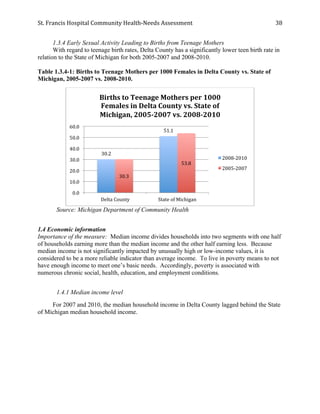
Economic well-being and health care:
Educational attainment also impacts economic well-being. Research suggests that the
more education obtained by individuals, the better jobs these individuals earn8
. Better jobs yield
greater earning and benefits, including health insurance. Furthermore, if educated individuals
are unemployed, research suggests that these individuals are unemployed for shorter durations
than less educated individuals9
. For many individuals, insurance coverage is a primary
consideration when evaluating whether or not to seek medical treatment. Using health care
appropriately, instead of the ER in non-emergencies, is better for patients and lowers cost of
health care to society. Accordingly, the uninsured are less likely to access preventive care or
seek early treatment of illness and therefore may miss more time at work. Similarly, it is
difficult to hold a job when a person is not healthy.
Unemployment leads to poverty and has far-reaching impacts within society. Poverty
disproportionately impacts families and children. Between 2007 and 2010, families living in
poverty in Delta County have increased by 1.3%. These considerations are compounded by the
fact that over 35% of single mothers in Delta County are living in a state of poverty. This figure
exceeds the State of Michigan average.
Endnotes for Chapter 1
1
Kaiser Family Foundation, “Health Care Costs: Key Information on Health Care Costs and Their Impact,” May
2012.
2
Congressional Budget Office, CBO’s 2011 Long-Term Budget Outlook, June 2011, p.ix,
http://www.cbo.gov/ftpdocs/122xx/doc12212/06-21-Long-Term_Budget_Outlook.pdf
3
Kaiser Family Foundation, “Health Care Costs: Key Information on Health Care Costs and Their Impact,” May
2012.
4
Adams, S.J. (2002). Educational attainment and health: Evidence from a sample of older adults. Education
Economics, 10(1), 97-109.
5
House, J., Kessler, R., Herzog, A., Mero, R., Kinney, A. & Breslow, M. (1990). Age, socioeconomic status, and
health. The Milbank Quarterly, 68, 383-411.
6
Ross, C. & Wu, C. (1995). The links between education and health. American Sociological Review, 60, 719-745.
7
Sander, W. (1999). Cognitive ability, schooling, and the demand for alcohol by young adults, Education
Economics, 7, 53-66.
8
Willis, R. (1986). Wage determinants: a survey and reinterpretation of human capital earnings functions. In:
Ashenfelter, O. & Layard, R. (Eds). Handbook of Labor Economics, Volume I (Amsterdam, North-Holland
Publishing Company).
9
Moen, E. (1999). Education, ranking, and competition for jobs. Journal of Labor Economics, 17, 694-723.
St.	
  Francis	
  Hospital	
  Community	
  Health-­‐Needs	
  Assessment	


47	
  
CHAPTER 2. PREVENTION
2.1 Accessibility
Importance of the measure: It is critical for health care services to be accessible to the
constituencies who will take advantage of its benefits. Therefore, accessibility to health care
must address both the financial costs associated with health care and the supply and demand of
medical services.
2.1.1 Insurance Coverage
With regard to medical insurance coverage, data gathered from the Michigan Behavioral
Risk Factor Surveillance System suggest that residents in Delta County possess health care
coverage at a similar percentage (86.0%) when compared to the State of Michigan average.
Table 2.1.1-1 Percentage of Delta County Respondents with Health Care Coverage, 2010-
vs. 2012
Source: Michigan Behavioral Risk Factor Surveillance System
2.1.2 Access and utilization
Physician capacity can be measured using various metrics. One commonly utilized
method is to evaluate what percentage of individuals have a usual health care provider. A usual
health care provider signifies that these individuals are more likely to partake in wellness check-
ups and less likely to utilize emergency room visits as their primary health care service.
89.0%	
   90.0%	
  
88.0%	
  
86.0%	
  
89.0%	
  
86.0%	
  
80.0%	
  
85.0%	
  
90.0%	
  
95.0%	
  
100.0%	
  
Delta	
  County	
   National	
  
Benchmark	
  (90th	
  
Percentile)	
  
State	
  of	
  Michigan	
  
Percentage	
  of	
  Delta	
  County	
  Respondents	
  
with	
  Health	
  Care	
  Coverage,	
  2010	
  vs.	
  2012	
  	
  
2010	
  
2012	
  
St.	
  Francis	
  Hospital	
  Community	
  Health-­‐Needs	
  Assessment	


48	
  
In the Delta County BRFSS (Behavioral Risk Factor Surveillance System) Region,
defined as Delta-Menominee Counties, the most recent data indicate approximately 81% of
residents utilize a regular health care provider. Between 2005-2007 and 2008-2010, the
percentage of residents in Delta County decreased by 2.5%. On the contrary, the percentage of
State of Michigan residents increased by 2.0% during the same time frame.
Table 2.1.2-3 Percentage of Delta County Region Respondents with a Usual Health Care
Provider, 2005-2007 vs. 2008-2010
Source: Michigan Behavioral Risk Factor Surveillance System
Another metric to gain insight into the capacity of physicians is the percentage of residents
who have not visited physicians within the last year. With regard to the percentage of
respondents the Delta County BRFSS Region who have not visited a dentist in the last year,
37.2% of residents did not see a dentist in the last year. This percentage lags significantly behind
the State of Michigan average.
81.0%	
  
87.5%	
  
83.5%	
   85.5%	
  
0.0%	
  
25.0%	
  
50.0%	
  
75.0%	
  
100.0%	
  
Delta-­‐Menominee	
  County	
   State	
  of	
  Michigan	
  
Percentage	
  of	
  Delta	
  County	
  Region	
  
Respondents	
  with	
  a	
  Usual	
  Health	
  Care	
  
Provider,	
  2005-­‐2007	
  vs.	
  2008-­‐2010	


2008-­‐2010	
  
2005-­‐2007	
  
St.	
  Francis	
  Hospital	
  Community	
  Health-­‐Needs	
  Assessment	


49	
  
Table 2.1.2-4 Percentage of Delta County Region Residents who have not Visited a Dentist
in the past year, 2008-2010
Source: Michigan Behavioral Risk Factor Surveillance System
2.2 Wellness
Importance of the measure: Preventative health care measures, including scheduling routine
well-visits, engaging in a healthy lifestyle, and undertaking screenings for diseases, are essential
to combating morbidity and mortality and help reduce health care costs.
2.2.2 Early detection
Residents in the Delta County BRFSS Region report increased prevalence of high
cholesterol. The percentage of residents who report they have high cholesterol (38.8%) is lower
than the State of Michigan average of 39.3%.
In addition, approximately 66% of Delta County residents report having had a cholesterol
screening within the last year. These data for 2005-2007 are lower than the State of Michigan
average of 77.2%.
37.2%	
  
26.2%	
  
0.0%	
  
5.0%	
  
10.0%	
  
15.0%	
  
20.0%	
  
25.0%	
  
30.0%	
  
35.0%	
  
40.0%	
  
Delta-­‐Menominee	
  County	
   State	
  of	
  Michigan	
  
Percentage	
  of	
  Delta	
  County	
  Region	
  
Residents	
  who	
  have	
  not	
  Visited	
  a	
  
Dentist	
  in	
  the	
  past	
  year,	
  2008-­‐2010	
  
2008-­‐2010	
  
St.	
  Francis	
  Hospital	
  Community	
  Health-­‐Needs	
  Assessment	


50	
  
Table 2.2.2-1:Percentage of Delta County Region Residents with High Cholesterol
Source: Michigan Behavioral Risk Factor Surveillance System
Table 2.2.2-2: Percentage of Delta County Region Respondents who have Checked
Cholesterol in the Last Five Years, 2005-2007
Source: Michigan Behavioral Risk Factor Surveillance System
38.8%	
  
39.3%	
  
38.4%	
  
38.6%	
  
38.8%	
  
39.0%	
  
39.2%	
  
39.4%	
  
Delta-­‐Menominee	
  County	
   State	
  of	
  Michigan	
  
Percentage	
  of	
  Delta	
  County	
  Region	
  
Residents	
  with	
  High	
  Cholesterol	
  
2005-­‐2007	
  
60.0%	
  
65.0%	
  
70.0%	
  
75.0%	
  
80.0%	
  
66.7%	
   77.2%	
  
Delta-­‐Menominee	
  County	
   State	
  of	
  Michigan	
  
Percentage	
  of	
  Delta	
  County	
  Region	
  Respondents	
  who	
  
have	
  Checked	
  Cholesterol	
  in	
  the	
  Last	
  Five	
  Years,	
  
2005-­‐2007	
  
2005-­‐2007	
  
St.	
  Francis	
  Hospital	
  Community	
  Health-­‐Needs	
  Assessment	


51	
  
With regard to high blood pressure, the residents in the Delta County BRFSS Region
report a higher percentage of individuals with high blood pressure than residents in the State of
Michigan as a whole for 2005-2007.
Table 2.2.2-3:Percentage of Delta County Region Residents with High Blood Pressure
Source: Michigan Behavioral Risk Factor Surveillance System
Mammograms and PSA tests help to screen individuals for breast and prostate cancers.
With regard to mammograms, 58.1% of Delta County Region residents underwent a clinical
breast exam in the past year. These data are higher than the State of Michigan average of 54.6%.
26.0%	
  
27.0%	
  
28.0%	
  
29.0%	
  
30.0%	
  
31.0%	
  
32.0%	
  
33.0%	
  
Delta-­‐Menominee	
  County	
   State	
  of	
  Michigan	
  
Percentage	
  of	
  Delta	
  County	
  
Region	
  Residents	
  with	
  High	
  Blood	
  
Pressure	
  
2005-­‐2007	
  
St.	
  Francis	
  Hospital	
  Community	
  Health-­‐Needs	
  Assessment	


52	
  
Table 2.2.2-4 Percentage of Delta County Region Residents who had a Clinical Breast
Exam in the Past Year
Source: Michigan Behavioral Risk Factor Surveillance System
Research suggests pap smears are important in detecting pre-cancerous cells in the uterus
and cervix. Data from the 2008-2010 Michigan BRFSS indicate that 76.5% of Delta County
BRFSS Region residents have had a pap smear within the last three years. This percentage is
lower than the State of Michigan average (79.3%).
Table 2.2.2-5 Percentage of Delta County Region Residents who had an Appropriately
Timed Pap Test within the Past 3 Years
Source: Michigan Behavioral Risk Factor Surveillance System
58.10%	
  
54.60%	
  
52.00%	
  
54.00%	
  
56.00%	
  
58.00%	
  
60.00%	
  
Delta-­‐Menominee	
  County	
   State	
  of	
  Michigan	
  
Percentage	
  of	
  Delta	
  County	
  
Region	
  Residents	
  who	
  had	
  a	
  
Clinical	
  Breast	
  Exam	
  in	
  the	
  Past	
  
Year	
  
2008-­‐2010	
  
76.50%	
  
79.30%	
  
75.00%	
  
76.00%	
  
77.00%	
  
78.00%	
  
79.00%	
  
80.00%	
  
Delta-­‐Menominee	
  County	
   State	
  of	
  Michigan	
  
Percentage	
  of	
  Delta	
  County	
  
Region	
  Residents	
  who	
  had	
  an	
  
Appropriately	
  Timed	
  Pap	
  Test	
  
within	
  the	
  Past	
  3	
  Years	
  
2008-­‐2010	
  
St.	
  Francis	
  Hospital	
  Community	
  Health-­‐Needs	
  Assessment	


53	
  
2.2.3 Immunizations
The overall health of a community is impacted by preventative measures including
immunizations and vaccinations. The percentage of people who have had a flu shot in the past
year is approximately 62.7% in the Delta County BRFSS Region. This percentage is over 6
percentage points lower than the State of Michigan average (68.9%) during the same time frame.
Table 2.2.3-1 Percentage of Delta County Region Residents who had a Flu Vaccine in the
Past Year
Source: Michigan Behavioral Risk Factor Surveillance System
Compared to flu shots, pneumonia shots are more frequent with 66.3% of Delta County
BRFSS Region residents having had the pneumonia vaccine. These percentages are just slightly
below the State of Michigan rates.
62.70%	
  
68.90%	
  
58.00%	
  
60.00%	
  
62.00%	
  
64.00%	
  
66.00%	
  
68.00%	
  
70.00%	
  
Delta-­‐Menominee	
  County	
   State	
  of	
  Michigan	
  
Percentage	
  of	
  Delta	
  County	
  
Region	
  Residents	
  who	
  had	
  a	
  Flu	
  
Vaccine	
  in	
  the	
  Past	
  Year	
  
2008-­‐2010	
  
St.	
  Francis	
  Hospital	
  Community	
  Health-­‐Needs	
  Assessment	


54	
  
Table 2.2.3-2 Percentage of Delta County Region Residents who ever had the Pneumonia
Vaccine
Source: Michigan Behavioral Risk Factor Surveillance System
2.2.4 Healthy lifestyle
A healthy lifestyle, comprised of regular physical activity and nutritious diet, has been
shown to increase physical, mental, and emotional well-being.
Residents in the Delta County BRFSS Region adhere to regular sustained physical
activity guidelines at a lower propensity than the State of Michigan average. The most recent
data from 2008-2010 indicate that 23.5% of Delta County residents have not participated in any
leisure-time physical activities or exercises during the past month.
66.30%	
  
67.10%	
  
65.80%	
  
66.00%	
  
66.20%	
  
66.40%	
  
66.60%	
  
66.80%	
  
67.00%	
  
67.20%	
  
Delta-­‐Menominee	
  County	
   State	
  of	
  Michigan	
  
Percentage	
  of	
  Delta	
  County	
  
Region	
  Residents	
  who	
  ever	
  had	
  
the	
  Pneumonia	
  Vaccine	
  
2008-­‐2010	
  
St.	
  Francis	
  Hospital	
  Community	
  Health-­‐Needs	
  Assessment	


55	
  
Table 2.2.4-1 Percentage of Delta County Region Residents who have not participated in
any leisure-time physical activities or exercises during the past month
Source: Michigan Behavioral Risk Factor Surveillance System
Nutrition and diet are critical to preventative care. A moderate percentage of Delta
County BRFSS Region residents report low consumption (less than 5 servings per day) of fruits
and vegetables. In 2005-2007, 25.3% of Delta County BRFSS Region residents consumed less
than 5 servings of fruits/vegetables per day. This percentage is slightly higher than the State of
Michigan average of 24.3% for the same measure.
25.30%	
  
24.30%	
  
23.50%	
  
22.10%	
  
20.00%	
  
21.00%	
  
22.00%	
  
23.00%	
  
24.00%	
  
25.00%	
  
26.00%	
  
Delta-­‐Menominee	
  County	
   State	
  of	
  Michigan	
  
Percentage	
  of	
  Delta	
  County	
  Region	
  
Residents	
  who	
  have	
  not	
  participated	
  in	
  any	
  
leisure-­‐time	
  physical	
  activities	
  or	
  exercises	
  
during	
  the	
  past	
  month	
  
2008-­‐2010	
  
2005-­‐2007	
  
St.	
  Francis	
  Hospital	
  Community	
  Health-­‐Needs	
  Assessment	


56	
  
Table 2.2.4-2 Percentage of Delta County Region Residents who have consumed less than 5
servings of fruits/vegetables per day
Source: Michigan Behavioral Risk Factor Surveillance System
2.2.5 Oral Health
Research suggests that poor oral hygiene leads to more serious medical concerns. For the
2008-2010 time frame, nearly 20% of Delta County Region residents are missing 6 or more teeth
due to gum disease or tooth decay. These figures are over 6 percentage points higher than
comparable data from the State of Michigan as a whole.
Table 2.2.5-1 Percentage of Delta County Region Residents Missing 6 or more teeth due to
gum disease or tooth decay
Source: Michigan Behavioral Risk Factor Surveillance System
25.30%	
  
24.30%	
  
23.80%	
  
24.00%	
  
24.20%	
  
24.40%	
  
24.60%	
  
24.80%	
  
25.00%	
  
25.20%	
  
25.40%	
  
Delta-­‐Menominee	
  County	
   State	
  of	
  Michigan	
  
Percentage	
  of	
  Delta	
  County	
  Region	
  
Residents	
  who	
  have	
  consumed	
  less	
  than	
  5	
  
servings	
  of	
  fruits/vegetables	
  per	
  day	
  
2005-­‐2007	
  
19.9%	
  
13.8%	
  
0.0%	
  
5.0%	
  
10.0%	
  
15.0%	
  
20.0%	
  
25.0%	
  
Delta-­‐Menominee	
  County	
   State	
  of	
  Michigan	
  
Percentage	
  of	
  Delta	
  County	
  Region	
  
Residents	
  missing	
  6	
  or	
  more	
  teeth	
  due	
  to	
  
gum	
  disease	
  or	
  tooth	
  decay 	
  	
  
2008-­‐2010	
  
St.	
  Francis	
  Hospital	
  Community	
  Health-­‐Needs	
  Assessment	


57	
  
Prevention: Strategic Implications
Increase health care insurance coverage:
Research suggests that private health insurance companies cover nearly 1/3 of the
national health expenditures. According to the Kaiser Family Foundation, private health
insurance companies comprised 32.7% of the health expenditures in the United States for 2010.1
While this percentage has held constant around 32% since 1990, it marks an increase of
approximately 11% since 1960. Medicare covered approximately 20.2% of national health
expenditures in 2010, up nearly 4% since 2000. In addition, data suggest the out-of-pocket
expenses incurred by individuals has steadily decreased, from a high of 33.4% of national health
care expenditures in 1970 to 14.7% in 2000, and now 11.6% in 2010. The data are clear:
Americans are paying less for out-of-pocket health care expenditures and relying more and more
on private or public insurance policies to shoulder the financial burdens of health care. Private
funds provided approximately 55% of health care payments in 2010 compared to 45% from
federal and local government funds. 2
The rising cost of health care services has resulted in a significant number of families
cutting back on care and electing to postpone or cancel treatments. A 2011 Kaiser Health
Tracking Poll found that 50% of Americans have cut back on medical treatments in the past 12
months based on cost concerns. 3
Furthermore, 40% reported being “very worried” about
having to shoulder more of the financial burden for their health care. Data seem to reinforce this
concern, as health insurance premiums have consistently outpaced inflation and the growth in
worker earnings.
Increase the prevalence of preventative health care screens:
There appears to be a relationship between individuals who have health insurance and
individuals who take advantage of preventative health care screenings. Research for over twenty
years suggests that the strongest predictors of failure to receive screening tests was lack of
insurance coverage. 4
Furthermore, research suggests that lack of insurance coverage is more
prevalent among socioeconomically disadvantaged groups that are often at high risk for disease
and illness. 5
Thus, a vicious cycle results where individuals who are at the highest risk for
diseases are unable to receiving screening, thus perpetuating a cycle of disease and high health
care expenditures.
Screening guidelines from the United States Preventative Services Task Force offer
insight on appropriate preventative care and screenings for youth, adults, and older individuals. 6
Adherence to these guidelines provides data-driven benchmarks from physicians in the fields of
primary care and preventative medicine. Above all, it is critical for physicians and patients to
engage in thorough evaluation of treatment options and engage in high-quality shared decision-
making regarding treatment options. 7
With regard to immunizations, the Center for Disease Control’s Advisory Committee on
Immunization Practices recommends everyone 6 months and older receive a flu vaccination
every year. 8
The percentage of people who have had a flu shot in the past year is approximately
62.7% in the Delta County BRFSS Region. This percentage is over 6 percentage points lower
St.	
  Francis	
  Hospital	
  Community	
  Health-­‐Needs	
  Assessment	


58	
  
than the State of Michigan average (68.9%) during the same time frame and still considerably
lower than the recommendations from the CDC.
Endnotes for Chapter 2
1
Kaiser Family Foundation, “Health Care Costs: Key Information on Health Care Costs and
Their Impact,” May 2012.
2
Ibid.
3
Kaiser Family Foundation, Kaiser Health Tracking Poll, Toplines, August 10-15, 2011, pp.16-
18, http://www.kff.org/kaiserpolls/8217.cfm.
4
U.S. Department of Health and Human Services, Agency for Healthcare Research and Quality,
National Healthcare Disparities Report, 2005.
5
U.S. Department of Health and Human Services, Healthy People 2010. Retrieved from
http://www.healthlypeople.gov/
6
U.S. Preventative Screening Task Force, Recommendations for Adults, Adolescents, and
Children. Retrieved from http://www.uspreventativeservicestaskforce.org
7
Ibid.
8
Centers for Disease Control and Prevention, Advisory Committee for Immunization Practices,
Comprehensive Recommendations. Retrieved from http://www.cdc.gov/vaccines/pubs/ACIP-
list.htm
St.	
  Francis	
  Hospital	
  Community	
  Health-­‐Needs	
  Assessment	


59	
  
CHAPTER 3. SYMPTOMS AND PREDICTORS
3.1 Tobacco Use
Importance of the measure: In order to appropriately allocate health care resources, a thorough
analysis of the leading indicators regarding morbidity and disease must be conducted. In this
way, health care services and personnel can target affected populations more effectively.
Research suggests tobacco use facilitates a wide variety of adverse medical conditions.
Smoking significantly impacts the health status of individuals. Smoking rates in the
Delta County region are 8.1% higher than rates across the State of Michigan as a whole. Nearly
half of the residents within the Delta County region classify themselves as non-smokers, whereas
approximately a quarter of residents are former smokers.
Table 3.1-1: Smoking Status of Residents in the Delta County Region
Source: Michigan Behavioral Risk Factor Surveillance System
27.8%	
   23.3%	
   19.7%	
   21.7%	
  
23.3%	
   21.6%	
  
25.6%	
   25.7%	
  
49.0%	
  
55.1%	
   54.8%	
  
52.6%	
  
0.0%	
  
10.0%	
  
20.0%	
  
30.0%	
  
40.0%	
  
50.0%	
  
60.0%	
  
2008-­‐2010	
   2005-­‐2007	
   2008-­‐2010	
   2005-­‐2007	
  
Delta-­‐Menominee	
  County	
   State	
  of	
  Michigan	
  
Smoking	
  Status	
  of	
  Delta	
  County	
  Region	
  
Residents	
  
smoker	
   former	
  smoker	
   non-­‐smoker	
  
St.	
  Francis	
  Hospital	
  Community	
  Health-­‐Needs	
  Assessment	


60	
  
3.2 Drug and Alcohol Abuse
Importance of the measure: Alcohol and drugs impair decision-making, often leading to adverse
consequences and outcomes. Research suggests that alcohol is a gateway drug for youths,
leading to increased usage of substances in adult years. Accordingly, the values and behaviors
toward substance usage by high school students is a leading indicator of adult substance abuse in
later years.
Compared to the State of Michigan average (18.0%), Delta County has a higher
percentage of residents at risk for acute or binge drinking, as 2011 and 2012 rates suggest a
quarter of residents engage in binge or heavy drinking.
Table 3.2-1: Percent of Delta County Residents at Risk for Acute/Binge Drinking
Source: Michigan Behavioral Risk Factor Surveillance System
3.3 Overweight and Obesity
Importance of the measure: Individuals who are overweight and obese place greater stress on
internal organs, thus increasing the propensity to utilize health services.
In terms of obesity and being overweight, Table 3.3-1 shows the number of people in the
Delta County BRFSS Region who have trouble with their weight has increased over the five
years from 2005 to 2010. Note specifically that while the proportion of overweight people in
Delta County has increased, comparable proportions of overweight individuals across Michigan
have decreased.
25.0%	
  
8.0%	
  
18.0%	
  
25.0%	
  
8.0%	
  
19.0%	
  
0.0%	
  
5.0%	
  
10.0%	
  
15.0%	
  
20.0%	
  
25.0%	
  
30.0%	
  
Delta	
  County	
   National	
  Benchmark	
  (90th	
  
Percentile)	
  
State	
  of	
  Michigan	
  
Percent	
  of	
  Delta	
  County	
  Residents	
  At	
  
Risk	
  for	
  Acute/Binge	
  Drinking	
  
2012	
   2011	
  
St.	
  Francis	
  Hospital	
  Community	
  Health-­‐Needs	
  Assessment	


61	
  
Table 3.3-1: Overweight and Obesity in Delta County Region and State of Michigan
Source: Michigan Behavioral Risk Factor Surveillance System
Symptoms/Predictors: Strategic Implications
Effectively combating youth obesity:
Research strongly suggests that obesity is a significant problem facing youth and adults
nationally, in Michigan, and within the Delta County BRFSS Region. The US Surgeon General
has characterized obesity as “the fastest-growing, most threatening disease in America today.”1
According to obesity prevention initiatives in similar Midwestern states, upwards of 20% of
children are obese2
. Similarly, data from 2010 indicate 62% of adults in similar Midwestern
states are obese or overweight, with a disproportionate number of obese or overweight
individuals living in rural areas. The financial burden of overweight and obese individuals is
staggering, as the estimated annual medical costs attributed to obesity in some Midwestern states
for 1998-2000 exceeded 3.4 billion dollars3
.
29.4%	
  
35.3%	
  
33.8%	
  
36.1%	
  
41.0%	
  
38.6%	
  
35.3%	
   36.3%	
  
29.6%	
  
26.1%	
  
30.9%	
  
27.6%	
  
0.0%	
  
5.0%	
  
10.0%	
  
15.0%	
  
20.0%	
  
25.0%	
  
30.0%	
  
35.0%	
  
40.0%	
  
45.0%	
  
2008-­‐2010	
   2005-­‐2007	
   2008-­‐2010	
   2005-­‐2007	
  
Delta-­‐Menominee	
  County	
   State	
  of	
  Michigan	
  
Overweight	
  and	
  Obesity	
  in	
  Delta	
  County	
  
Region	
  and	
  State	
  of	
  Michigan	
  
underweight/normal	
  
overweight	
  
obese	
  
St.	
  Francis	
  Hospital	
  Community	
  Health-­‐Needs	
  Assessment	


62	
  
With children, research has linked obesity to numerous chronic diseases including Type
II diabetes4
, hypertension, high blood pressure, and asthma. Adverse physical health side effects
of obesity include orthopedic problems with weakened joints and lower bone density5
.
Detrimental mental health side effects include low self-esteem, poor body image, symptoms of
depression and suicide ideation6
. Obesity impacts educational performance as studies suggest
that overweight students miss one day of school per month on average and school absenteeism of
obese children is six times higher that of non-obese children7
.
With adults, obesity has far-reaching consequences. Legislative testimony has indicated
that obesity-related illnesses contribute to worker absenteeism, slow workflow, and high worker
compensation rates.8
A Duke University study on the effects of obesity in the workforce noted
13 times more missed work days by obese employees than non-obese employees. Nationwide,
lack of physical activity and poor nutrition contribute to an estimated 300,000 preventable deaths
per year.
Within the Delta County BRFSS Region, leading indicators suggest obesity is a growing
concern. With regard to nutrition, evidence suggests residents in the Delta County BRFSS
Region are not eating enough fruits and vegetables. Between 2005 and 2007, 25% of Delta
County BRFSS Region residents consumed less than 5 or more servings of fruits and vegetables
per day. These figures are a full percentage point greater than the State of Michigan average.
Research indicates physical activity helps to prevent illness and obesity9
. Data regarding
the values toward exercise and the actual time spent exercising may contribute to obesity in the
Delta County BRFSS Region. For example, data from the Center for Disease Control indicate
that 66% of children walked or biked to school in 1973. By 2000, that figure had decreased to
only 13%.10
Nearly a quarter of Delta County BRFSS residents do not meet the moderate activity
standard.
Aggressively addressing youth substance abuse:
The use of tobacco, alcohol, and other drugs is a significant contributor to the escalating
costs of health care service delivery. According to the Center for Disease Control, tobacco use is
the leading preventable cause of death in the United States. 11
On a societal level, alcohol,
tobacco, and other drug use leads to accidents, violent behavior, emotional trauma, and assaults.
It is estimated that drug-induced related risky behavior needlessly drains community resources
such as police intervention, emergency services, and criminal justice costs.
The Surgeon General contends that “alcohol remains the most heavily abused substance
by America’s youth.” 12
Dr. Peter Monti, Director of the Center for Alcohol and Addiction
Studies at Brown University notes that alcohol disrupts the continued growth of an adolescent’s
brain and “impacts the brain’s ability to learn life skills.” 13
Studies show that an adolescent
needs to only drink half as much alcohol as an adult to suffer similar adverse brain effects. 14
Research shows that cigarette smoking as a teenager leads to higher risks for lung cancer as an
adult, reduces the rates of lung growth, and the maximum level of lung function that could be
achieved. 15
St.	
  Francis	
  Hospital	
  Community	
  Health-­‐Needs	
  Assessment	


63	
  
Financially, underage drinking is estimated to cost the nation upwards of $62 billion
dollars annually in deaths, injuries, and other economic losses.16
A Columbia University study
examining the impacts of substance abuse in mid-sized cities and rural America suggested that
tobacco use was more prevalent in mid-sized cities and rural areas than large metropolitan areas;
specifically, young adults in mid-sized cities and rural areas were 30% more likely than adults in
larger cities to have smoked a cigarette in the last month. 17
In the Delta County BRFSS Region, smoking rates have increased between 2005-2007
and 2008-2010, whereas smoking trends for the State of Michigan as a whole have declined
during the same time period. Furthermore, rates for residents at risk for acute or binge drinking
are also higher than the state average.
Endnotes for Chapter 3
1
Childhood Obesity: An epidemic is gripping California and the nation: How did we get here?
What do we do now? Advertising supplement to The New York Times, Kaiser Permanente, UC
San Francisco Medical School, UCLA Medical School, January 2006.
2
Obesity Prevention Initiative Act (PA 96-0155): A Report to the Illinois General Assembly,
Illinois Department of Public Health, December 2010.
3
Ibid.
4
Crawford, P., Mitchell, T., & Ikeda, J. (2000). Childhood Overweight: A Fact Sheet for
Professionals, UCB/Cooperative Extension University of California-Berkeley.
5
Xiang, H. (2005). Obesity and Risk of Nonfatal Unintentional Injuries, American Journal of
Preventative Medicine, 29,1, 41-45.
6
U.S. Department of Health and Human Services, Healthy People 2010. Retrieved from
http://www.healthlypeople.gov/
7
Schwimmer, J.B., Burwinkle, T.M., & Varni, J.W. (2003). Health-Related Quality of Life of
Severely Obese Children and Adolescents. Journal of the American Medical Association.
289(14), 1818.
8
Obesity Prevention Initiative Act (PA 96-0155): A Report to the Illinois General Assembly,
Illinois Department of Public Health, December 2010.
9
The Learning Connection: The Value of Improving Nutrition and Physical Activity in Our
Schools. Retrieved from http://www.actionforhealthykids.org
10
U.S. Center for Disease Control and Prevention, Youth Physical Activity: The Role of Families.
Retrieved from http://www.cdc.gov/healthyyouth
11
U.S. Center for Disease Control and Prevention, Smoking and Tobacco Use: Data and
Statistics. Retrieved from http://www.cdc.gov/tobacco
St.	
  Francis	
  Hospital	
  Community	
  Health-­‐Needs	
  Assessment	


64	
  
12
U.S. Department of Health and Human Services. The Surgeon General's Call to Action to
Prevent and Reduce Underage Drinking. Rockville, MD: U.S. Department of Health and Human
Services; 2007. Retrieved from http://www.surgeongeneral.gov/topics/underagedrinking/
13
Monti, P.M., et al. (2005). Adolescence: Booze, Brains, and Behavior. Alcoholism: Clinical
and Experimental Research. 29, 2, 207-220.
14
American Medical Association, Harmful Consequences of Alcohol Use on the Brains of
Children.
15
Preventing Tobacco Use Among Young People, Executive Summary, A Report of the Surgeon
General, 1994, Ch. 1.
16
Pacific Institute for Research and Evaluation, State Underage Drinking Fact Sheets, 2004.
17
The National Center on Addiction and Substance Abuse at Columbia University, Adolescent
Substance Use: America’s #1 Public Health Problem, June 2011.
St.	
  Francis	
  Hospital	
  Community	
  Health-­‐Needs	
  Assessment	


65	
  
CHAPTER 4. DISEASES/MORBIDITY
Note in this chapter, given the lack of recent disease/morbidity data from existing
secondary data sources, much of the data used in this chapter was manually gathered from OSF
St. Francis Hospital in Escanaba.
4.1 Age related
Importance of the measure: Age related statistics regarding morbidity gain insight into the
prevalence of disease within two vulnerable populations – the very young and the very old.
Health care services designed to meet the needs of these populations are very expensive and
therefore, a thorough understanding of the leading indicators for these populations helps with
managing service delivery costs.
4.1.1 Low birth-weight rates
Low birth rate is defined as the percentage of infants born below 2,500 grams or 5.5
pounds. In contrast, the average newborn weighs about 7 pounds. The percentage of babies
born with low birth weights in Delta County was less than the State of Michigan average.
Table 4.1.1-1:Percentage of Live Births with Low Birthweight in Delta County, 2010 vs.
2012
Source: National Vital Statistics System, Center for Disease Control
4.1.2 Initiation of prenatal care
Prenatal care is comprehensive medical care provided for the mother and fetus, which
includes screening and treatment for medical conditions as well as identification and
interventions for behavioral risk factors associated with adverse birth outcomes. Kotelchuck
Index Scores are used to determine the quantity of prenatal visits received between initiation of
0.0%	
  
1.0%	
  
2.0%	
  
3.0%	
  
4.0%	
  
5.0%	
  
6.0%	
  
7.0%	
  
8.0%	
  
9.0%	
  
2010	
   2012	
   2010	
   2012	
   2010	
   2012	
  
Delta	
  County	
   State	
  of	
  
Michigan	
  
National	
  
Benchmark	
  
(90th	
  %)	
  
Percentage	
  of	
  Live	
  Births	
  with	
  Low	
  Birthweight	
  (<	
  2500	
  
grams)	
  in	
  Delta	
  County,	
  2010	
  vs.	
  2012	
  	
  
Low	
  Birth	
  Weight	
  
(<2500	
  grams)	
  
St.	
  Francis	
  Hospital	
  Community	
  Health-­‐Needs	
  Assessment	


66	
  
services and delivery. Adequate (80%-109% of expected visits) and Adequate Plus (receiving
110% of recommended services) of received services is compared to the number of expected
visits for the period when care began and the delivery date.
Babies born between 2009-2011 in Delta County (66.8%) lag the State of Michigan
average of 68.3% of babies born with “Adequate” or “Adequate Plus.”
Table 4.1.2-1:Percentage of Babies Born with Adequate or Better Prenatal Care based on
Kotelchuck Index Scores in Delta County, 2009-2011
Source: Michigan Department of Community Health
66.8%	
  
68.3%	
  
66.0%	
  
66.5%	
  
67.0%	
  
67.5%	
  
68.0%	
  
68.5%	
  
Delta	
  County	
   State	
  of	
  Michigan	
  
Percentage	
  of	
  Babies	
  Born	
  with	
  Adequate	
  or	
  Better	
  Prenatal	
  
Care	
  based	
  on	
  Kotelchuck	
  Index	
  Scores	
  in	
  Delta	
  County,	
  
2009-­‐2011	


St.	
  Francis	
  Hospital	
  Community	
  Health-­‐Needs	
  Assessment	


67	
  
4.2 Cardiovascular
Importance of the measure:
Cardiovascular disease is defined as all diseases of the heart and blood vessels, including
ischemic (also known as coronary) heart disease, cerebrovascular disease, congestive heart
failure, hypertensive disease, and atherosclerosis.
4.2.1 Hypertension
High blood pressure, which is also known as hypertension, is dangerous because it forces
the heart to work extra hard to pump blood out to the rest of the body and contributes to the
development of the hardening of the arteries and heart failure.
Cases of hypertension at St. Francis Hospital peaked between July 2009 and June 2010
when 4 instances were reported in individuals age 65 and older. The most recent data indicate 2
cases of hypertension and 1 case of hypertension complication between July 2011 and June
2012.
Table 4.2.1-1 Inpatient Hypertension Cases at St. Francis Hospital from Delta County
Region
Source: COMPdata 2012
	
  -­‐	


  1	
  	
   	
  1	


  2	


  -­‐	


  1	


  4	


  5	


  -­‐	


  1	


  -­‐	


  1	


  -­‐	


  1	


  -­‐	


  1	


  -­‐	


  -­‐	


  -­‐	


  -­‐	


  -­‐	


  -­‐	


  -­‐	


  -­‐	


  -­‐	


  -­‐	


  3	
  	
   	
  3	


  -­‐	


  1	
  	
   	
  1	


  2	


  -­‐	


  1	


  2	


  3	


  4	


  5	


  6	
  	
  
18-­‐44	
  
45-­‐64	
  
65+	
  
Total	
  
18-­‐44	
  
45-­‐64	
  
65+	
  
Total	
  
18-­‐44	
  
45-­‐64	
  
65+	
  
Total	
  
18-­‐44	
  
45-­‐64	
  
65+	
  
Total	
  
Jul	
  08	
  -­‐	
  Jun	
  09	
   Jul	
  09	
  -­‐	
  Jun	
  10	
   Jul	
  10	
  -­‐	
  Jun	
  11	
   Jul	
  11	
  -­‐	
  Jun	
  12	
  
Cases	
  
Inpatient	
  Hypertension	
  Cases	
  at	
  St.	
  Francis	
  Hospital	
  from	
  Delta	
  County	
  
Region,	
  July	
  08	
  -­‐	
  June	
  12	
  
Hypertension	
  
Hypertension	
  
Complication	
  
St.	
  Francis	
  Hospital	
  Community	
  Health-­‐Needs	
  Assessment	


68	
  
4.2.2 Coronary artery
Cases of inpatient chest pain at St. Francis Hospital peaked between July 2008 and June
2009 when 8 instances were reported in individuals age 65 and older and 11 cases overall. The
most recent data indicate 1 case of chest pain between July 2011 and June 2012.
Table 4.2.2-1 Inpatient Chest Pain – Noncardiac Cases at St. Francis Hospital from Delta
County Region
Source: COMPdata 2012
Cases of carditis have remained constant across the four-year time frame at 1 case per
year. Between July 2010 and June 2011, there were zero reported cases of inpatient carditis.
	
  -­‐	


  3	


  8	


  11	


  1	


  4	


  5	


  10	


  -­‐	


  3	


  6	


  9	


  -­‐	


  -­‐	


  1	
  	
   	
  1	


  -­‐	


  2	


  4	


  6	


  8	


  10	


  12	
  	
  
18-­‐44	
  
45-­‐64	
  
65+	
  
Total	
  
18-­‐44	
  
45-­‐64	
  
65+	
  
Total	
  
18-­‐44	
  
45-­‐64	
  
65+	
  
Total	
  
18-­‐44	
  
45-­‐64	
  
65+	
  
Total	
  
Jul	
  08	
  -­‐	
  Jun	
  09	
   Jul	
  09	
  -­‐	
  Jun	
  10	
   Jul	
  10	
  -­‐	
  Jun	
  11	
   Jul	
  11	
  -­‐	
  Jun	
  12	
  
Cases	
  
Inpatient	
  Chest	
  Pain	
  -­‐	
  Noncardiac	
  Cases	
  at	
  St.	
  Francis	
  Hospital	
  from	
  
Delta	
  County	
  Region,	
  July	
  08	
  -­‐	
  June	
  12	
  
St.	
  Francis	
  Hospital	
  Community	
  Health-­‐Needs	
  Assessment	


69	
  
Table 4.2.2-2 Inpatient Carditis Cases at St. Francis Hospital from Delta County Region
Source: COMPdata 2012
Between July 2008 and June 2012, there was one reported case of congenital cardiac
anomaly. The case was reported in an individual 65 years of age and over.
Table 4.2.2-3 Inpatient Congenital Cardiac Anomaly Cases at St. Francis Hospital From
Delta County Region
Source: COMPdata 2012
	
  -­‐	


  1	


  -­‐	


  1	
  	
   	
  1	


  -­‐	


  -­‐	


  1	


  -­‐	


  -­‐	


  -­‐	


  -­‐	


  -­‐	


  1	


  -­‐	


  1	


  -­‐	


  1	


  2	
  	
  
18-­‐44	
  
45-­‐64	
  
65+	
  
Total	
  
18-­‐44	
  
45-­‐64	
  
65+	
  
Total	
  
18-­‐44	
  
45-­‐64	
  
65+	
  
Total	
  
18-­‐44	
  
45-­‐64	
  
65+	
  
Total	
  
Jul	
  08	
  -­‐	
  Jun	
  09	
   Jul	
  09	
  -­‐	
  Jun	
  10	
   Jul	
  10	
  -­‐	
  Jun	
  11	
   Jul	
  11	
  -­‐	
  Jun	
  12	
  
Cases	
  
Inpatient	
  Carditis	
  Cases	
  at	
  St.	
  Francis	
  Hospital	
  from	
  Delta	
  County	
  
Region,	
  July	
  08	
  -­‐	
  June	
  12	
  
	
  -­‐	


  -­‐	


  -­‐	


  -­‐	


  -­‐	


  -­‐	


  -­‐	


  -­‐	


  -­‐	


  -­‐	


  -­‐	


  -­‐	


  -­‐	


  -­‐	


  1	
  	
   	
  1	


  -­‐	


  1	


  2	
  	
  
18-­‐44	
  
45-­‐64	
  
65+	
  
Total	
  
18-­‐44	
  
45-­‐64	
  
65+	
  
Total	
  
18-­‐44	
  
45-­‐64	
  
65+	
  
Total	
  
18-­‐44	
  
45-­‐64	
  
65+	
  
Total	
  
Jul	
  08	
  -­‐	
  Jun	
  09	
   Jul	
  09	
  -­‐	
  Jun	
  10	
   Jul	
  10	
  -­‐	
  Jun	
  11	
   Jul	
  11	
  -­‐	
  Jun	
  12	
  
Cases	
  
Inpatient	
  Congenital	
  Cardiac	
  Anomaly	
  Cases	
  at	
  St.	
  Francis	
  Hospital	
  from	
  
Delta	
  County	
  Region,	
  July	
  08	
  -­‐	
  June	
  12	
  
St.	
  Francis	
  Hospital	
  Community	
  Health-­‐Needs	
  Assessment	


70	
  
Between July 2008 and June 2012, there were three reported cases of arterial embolism.
One case was reported in an individual 18-44 and two cases were reported in individuals 65
years of age and over. There have been zero instances of arterial embolism since July 2009.
Table 4.2.2-4 Inpatient Arterial Embolism Cases at St. Francis Hospital from Delta County
Region
Source: COMPdata 2012
	
  1	


  -­‐	


  2	


  3	


  -­‐	


  -­‐	


  -­‐	


  -­‐	


  -­‐	


  -­‐	


  -­‐	


  -­‐	


  -­‐	


  -­‐	


  -­‐	


  -­‐	


  -­‐	


  1	


  2	


  3	


  4	
  	
  
18-­‐44	
  
45-­‐64	
  
65+	
  
Total	
  
18-­‐44	
  
45-­‐64	
  
65+	
  
Total	
  
18-­‐44	
  
45-­‐64	
  
65+	
  
Total	
  
18-­‐44	
  
45-­‐64	
  
65+	
  
Total	
  
Jul	
  08	
  -­‐	
  Jun	
  09	
   Jul	
  09	
  -­‐	
  Jun	
  10	
   Jul	
  10	
  -­‐	
  Jun	
  11	
   Jul	
  11	
  -­‐	
  Jun	
  12	
  
Cases	
  
Inpatient	
  Arterial	
  Embolism	
  Cases	
  at	
  St.	
  Francis	
  Hospital	
  from	
  Delta	
  
County	
  Region,	
  July	
  08	
  -­‐	
  June	
  12	
  
St.	
  Francis	
  Hospital	
  Community	
  Health-­‐Needs	
  Assessment	


71	
  
Over the past four years, the number of treated cases of coronary atherosclerosis at St.
Francis Hospital has decreased from 4 cases between July 2008-June 2009 and July 2011-June
2012. For the most recent time period, three cases were reported.
Table 4.2.2-5 Inpatient Coronary Atherosclerosis Cases at St. Francis Hospital from Delta
County Region
Source: COMPdata 2012
	
  -­‐	


  -­‐	


  4	
  	
   	
  4	


  -­‐	


  -­‐	


  3	
  	
   	
  3	


  -­‐	


  1	


  2	


  3	


  -­‐	


  2	


  1	


  3	


  -­‐	


  1	


  2	


  3	


  4	


  5	
  	
  
18-­‐44	
  
45-­‐64	
  
65+	
  
Total	
  
18-­‐44	
  
45-­‐64	
  
65+	
  
Total	
  
18-­‐44	
  
45-­‐64	
  
65+	
  
Total	
  
18-­‐44	
  
45-­‐64	
  
65+	
  
Total	
  
Jul	
  08	
  -­‐	
  Jun	
  09	
   Jul	
  09	
  -­‐	
  Jun	
  10	
   Jul	
  10	
  -­‐	
  Jun	
  11	
   Jul	
  11	
  -­‐	
  Jun	
  12	
  
Cases	
  
Inpatient	
  Coronary	
  Atherosclerosis	
  Cases	
  at	
  St.	
  Francis	
  Hospital	
  from	
  
Delta	
  County	
  Region,	
  July	
  08	
  -­‐	
  June	
  12	
  
St.	
  Francis	
  Hospital	
  Community	
  Health-­‐Needs	
  Assessment	


72	
  
Cases of disease of the venous system at St. Francis Hospital have decreased by 75%
between 2008 (12 cases) and 2011 (3 cases) for inpatient admissions. Cases of disease of the
venous system peaked between July 2009-June 2010 when 21 cases were reported.
Table 4.2.2-6 Inpatient Disease of Venous System Cases at St. Francis Hospital from Delta
County Region
Source: COMPdata 2012
	
  2	


  5	
  	
   	
  5	


  12	


  2	


  8	


  11	


  21	


  2	


  4	


  6	


  12	


  -­‐	


  3	


  -­‐	


  3	


  -­‐	


  5	


  10	


  15	


  20	


  25	
  	
  
18-­‐44	
  
45-­‐64	
  
65+	
  
Total	
  
18-­‐44	
  
45-­‐64	
  
65+	
  
Total	
  
18-­‐44	
  
45-­‐64	
  
65+	
  
Total	
  
18-­‐44	
  
45-­‐64	
  
65+	
  
Total	
  
Jul	
  08	
  -­‐	
  Jun	
  09	
   Jul	
  09	
  -­‐	
  Jun	
  10	
   Jul	
  10	
  -­‐	
  Jun	
  11	
   Jul	
  11	
  -­‐	
  Jun	
  12	
  
Cases	
  
Inpatient	
  Disease	
  of	
  Venous	
  System	
  Cases	
  at	
  St.	
  Francis	
  Hospital	
  from	
  
Delta	
  County	
  Region,	
  July	
  08	
  -­‐	
  June	
  12	
  
St.	
  Francis	
  Hospital	
  Community	
  Health-­‐Needs	
  Assessment	


73	
  
Cases of dysrhythmia and cardiac arrest at St. Francis Hospital have decreased by 29.8%
between 2008 (57 cases) and 2011 (40 cases) for inpatient admissions.
Of particular interest, cases of dysrhythmia and cardiac arrest in individuals age 65 and
over have decreased by 22.2% during the same time frame for inpatient admissions.
Table 4.2.2-7 Inpatient Dysrhythmia & Cardiac Arrest Cases at St. Francis Hospital from
Delta County Region
Source: COMPdata 2012
	
  3	


  9	


  45	


  57	


  2	


  8	


  48	


  58	


  -­‐	


  13	


  40	


  53	


  -­‐	


  5	


  35	


  40	


  -­‐	


  10	


  20	


  30	


  40	


  50	


  60	


  70	
  	
  
18-­‐44	
  
45-­‐64	
  
65+	
  
Total	
  
18-­‐44	
  
45-­‐64	
  
65+	
  
Total	
  
18-­‐44	
  
45-­‐64	
  
65+	
  
Total	
  
18-­‐44	
  
45-­‐64	
  
65+	
  
Total	
  
Jul	
  08	
  -­‐	
  Jun	
  09	
   Jul	
  09	
  -­‐	
  Jun	
  10	
   Jul	
  10	
  -­‐	
  Jun	
  11	
   Jul	
  11	
  -­‐	
  Jun	
  12	
  
Cases	
  
Inpatient	
  Dysrhythmia	
  &	
  Cardiac	
  Arrest	
  Cases	
  at	
  St.	
  Francis	
  Hospital	
  
from	
  Delta	
  County	
  Region,	
  July	
  08	
  -­‐	
  June	
  12	
  
St.	
  Francis	
  Hospital	
  Community	
  Health-­‐Needs	
  Assessment	


74	
  
There has been a 22.6% decrease in the number of treated cases of heart failure at St.
Francis Hospital between 2008 (84 cases) and 2011 (65 cases) for inpatient admissions. The
number of cases peaked between July 2009 and June 2010 when 97 cases were reported.
Table 4.2.2-8 Inpatient Heart Failure Cases at St. Francis Hospital from Delta County
Region
Source: COMPdata 2012
	
  -­‐	


  11	


  73	


  84	


  -­‐	


  9	


  88	


  97	


  -­‐	


  10	


  73	


  83	


  1	
  	
   	
  4	


  60	


  65	


  -­‐	


  20	


  40	


  60	


  80	


  100	


  120	
  	
  
18-­‐44	
  
45-­‐64	
  
65+	
  
Total	
  
18-­‐44	
  
45-­‐64	
  
65+	
  
Total	
  
18-­‐44	
  
45-­‐64	
  
65+	
  
Total	
  
18-­‐44	
  
45-­‐64	
  
65+	
  
Total	
  
Jul	
  08	
  -­‐	
  Jun	
  09	
   Jul	
  09	
  -­‐	
  Jun	
  10	
   Jul	
  10	
  -­‐	
  Jun	
  11	
   Jul	
  11	
  -­‐	
  Jun	
  12	
  
Cases	
  
Inpatient	
  Heart	
  Failure	
  Cases	
  at	
  St.	
  Francis	
  Hospital	
  from	
  Delta	
  County	
  
Region,	
  July	
  08	
  -­‐	
  June	
  12	
  
St.	
  Francis	
  Hospital	
  Community	
  Health-­‐Needs	
  Assessment	


75	
  
Between July 2008 and June 2012, there were seven reported cases of heart valve disease.
All cases were reported in individuals 65 years of age and over. There have been two instances
of heart valve disease since July 2010.
Table 4.2.2-9 Inpatient Heart Valve Disease Cases at St. Francis Hospital from Delta
County Region
Source: COMPdata 2012
	
  -­‐	


  -­‐	


  2	
  	
   	
  2	


  -­‐	


  -­‐	


  3	
  	
   	
  3	


  -­‐	


  -­‐	


  -­‐	


  -­‐	


  -­‐	


  -­‐	


  2	
  	
   	
  2	


  -­‐	


  1	


  2	


  3	


  4	
  	
  
18-­‐44	
  
45-­‐64	
  
65+	
  
Total	
  
18-­‐44	
  
45-­‐64	
  
65+	
  
Total	
  
18-­‐44	
  
45-­‐64	
  
65+	
  
Total	
  
18-­‐44	
  
45-­‐64	
  
65+	
  
Total	
  
Jul	
  08	
  -­‐	
  Jun	
  09	
   Jul	
  09	
  -­‐	
  Jun	
  10	
   Jul	
  10	
  -­‐	
  Jun	
  11	
   Jul	
  11	
  -­‐	
  Jun	
  12	
  
Cases	
  
Inpatient	
  Heart	
  Valve	
  Disease	
  Cases	
  at	
  St.	
  Francis	
  Hospital	
  from	
  Delta	
  
County	
  Region,	
  July	
  08	
  -­‐	
  June	
  12	
  
St.	
  Francis	
  Hospital	
  Community	
  Health-­‐Needs	
  Assessment	


76	
  
Cases of myocardial infarction at St. Francis Hospital have decreased by 59.1% between
2008 (44 cases) and 2011 (18 cases) for inpatient admissions.
Of particular interest, cases of myocardial infarction peaked in July 2008-June 2009
when 44 cases were reported.
Table 4.2.2-10 Inpatient Myocardial Infarction Cases at St. Francis Hospital from Delta
County Region
Source: COMPdata 2012
	
  -­‐	


  2	


  42	


  44	


  -­‐	


  3	


  23	


  26	


  1	
  	
   	
  2	


  25	


  28	


  -­‐	


  1	


  17	
  	
  	
  18	


  -­‐	


  5	


  10	


  15	


  20	


  25	


  30	


  35	


  40	


  45	


  50	
  	
  
18-­‐44	
  
45-­‐64	
  
65+	
  
Total	
  
18-­‐44	
  
45-­‐64	
  
65+	
  
Total	
  
18-­‐44	
  
45-­‐64	
  
65+	
  
Total	
  
18-­‐44	
  
45-­‐64	
  
65+	
  
Total	
  
Jul	
  08	
  -­‐	
  Jun	
  09	
   Jul	
  09	
  -­‐	
  Jun	
  10	
   Jul	
  10	
  -­‐	
  Jun	
  11	
   Jul	
  11	
  -­‐	
  Jun	
  12	
  
Cases	
  
Inpatient	
  Myocardial	
  Infarction	
  Cases	
  at	
  St.	
  Francis	
  Hospital	
  from	
  Delta	
  
County	
  Region,	
  July	
  08	
  -­‐	
  June	
  12	
  
St.	
  Francis	
  Hospital	
  Community	
  Health-­‐Needs	
  Assessment	


77	
  
Cases of other cardiovascular disease at St. Francis Hospital have decreased by 27.5%
between 2008 (29 cases) and 2011 (21 cases) for inpatient admissions.
Of particular interest, cases of other cardiovascular disease peaked in July 2010-June
2011 when 36 cases were reported.
Table 4.2.2-11 Inpatient Other Cardiovascular Disease Cases at St. Francis Hospital from
Delta County Region
Source: COMPdata 2012
	
  3	


  10	


  16	


  29	


  1	


  8	


  19	


  28	


  3	


  13	


  20	


  36	


  -­‐	


  5	


  16	


  21	


  -­‐	


  5	


  10	


  15	


  20	


  25	


  30	


  35	


  40	
  	
  
18-­‐44	
  
45-­‐64	
  
65+	
  
Total	
  
18-­‐44	
  
45-­‐64	
  
65+	
  
Total	
  
18-­‐44	
  
45-­‐64	
  
65+	
  
Total	
  
18-­‐44	
  
45-­‐64	
  
65+	
  
Total	
  
Jul	
  08	
  -­‐	
  Jun	
  09	
   Jul	
  09	
  -­‐	
  Jun	
  10	
   Jul	
  10	
  -­‐	
  Jun	
  11	
   Jul	
  11	
  -­‐	
  Jun	
  12	
  
Cases	
  
Inpatient	
  Other	
  Cardiovascular	
  Disease	
  Cases	
  at	
  St.	
  Francis	
  Hospital	
  
from	
  Delta	
  County	
  Region,	
  July	
  08	
  -­‐	
  June	
  12	
  
St.	
  Francis	
  Hospital	
  Community	
  Health-­‐Needs	
  Assessment	


78	
  
Cases of other vascular disease at St. Francis Hospital have decreased by 20% between
2008 (20 cases) and 2011 (16 cases) for inpatient admissions.
Of particular interest, cases of other vascular disease peaked in July 2009-June 2010
when 21 cases were reported.
Table 4.2.2-12 Inpatient Vascular Disease Cases at St. Francis Hospital from Delta County
Region
Source: COMPdata 2012
	
  -­‐	


  6	


  14	


  20	


  2	


  6	


  13	


  21	


  -­‐	


  3	


  8	


  11	


  -­‐	


  8	
  	
   	
  8	


  16	


  -­‐	


  5	


  10	


  15	


  20	


  25	
  	
  
18-­‐44	
  
45-­‐64	
  
65+	
  
Total	
  
18-­‐44	
  
45-­‐64	
  
65+	
  
Total	
  
18-­‐44	
  
45-­‐64	
  
65+	
  
Total	
  
18-­‐44	
  
45-­‐64	
  
65+	
  
Total	
  
Jul	
  08	
  -­‐	
  Jun	
  09	
   Jul	
  09	
  -­‐	
  Jun	
  10	
   Jul	
  10	
  -­‐	
  Jun	
  11	
   Jul	
  11	
  -­‐	
  Jun	
  12	
  
Cases	
  
Inpatient	
  Vascular	
  Disease	
  Cases	
  at	
  St.	
  Francis	
  Hospital	
  from	
  Delta	
  
County	
  Region,	
  July	
  08	
  -­‐	
  June	
  12	
  
St.	
  Francis	
  Hospital	
  Community	
  Health-­‐Needs	
  Assessment	


79	
  
4.2.3 Stroke
Cases of stroke at St. Francis Hospital have decreased by 15.2% between 2008 (46 cases)
and 2011 (39 cases) for inpatient admissions. Cases of brain tumor have ranged from zero to six
cases during the same time frame for inpatient admissions.
Table 4.2.3-1 Inpatient Brain Tumor and Stroke Cases at St. Francis Hospital from Delta
County Region
Source: COMPdata 2012
0	
  
1	
  
0	
  
1	
  
0	
   0	
   0	
   0	
   0	
   0	
  
1	
   1	
  
0	
   0	
  
1	
   1	
  
0	
  
3	
  
43	
  
46	
  
1	
  
5	
  
38	
  
44	
  
0	
  
4	
  
31	
  
35	
  
1	
  
6	
  
32	
  
39	
  
0	
  
5	
  
10	
  
15	
  
20	
  
25	
  
30	
  
35	
  
40	
  
45	
  
50	
  
18-­‐44	
  
45-­‐64	
  
65+	
  
Total	
  
18-­‐44	
  
45-­‐64	
  
65+	
  
Total	
  
18-­‐44	
  
45-­‐64	
  
65+	
  
Total	
  
18-­‐44	
  
45-­‐64	
  
65+	
  
Total	
  
Jul	
  08	
  -­‐	
  Jun	
  09	
   Jul	
  09	
  -­‐	
  Jun	
  10	
   Jul	
  10	
  -­‐	
  Jun	
  11	
   Jul	
  11	
  -­‐	
  Jun	
  12	
  
Inpatient	
  Brain	
  Tumor	
  and	
  Stroke	
  Cases	
  at	
  St.	
  Francis	
  Hospital	
  from	
  Delta	
  
County	
  Region	
  
Brain	
  Tumor	
  
Stroke	
  
St.	
  Francis	
  Hospital	
  Community	
  Health-­‐Needs	
  Assessment	


80	
  
4.3 Respiratory
Importance of the measure:
Disease of the respiratory system includes acute upper respiratory infections such as
influenza, pneumonia, bronchitis, asthma, emphysema, and Chronic Obstructive Pulmonary
Disease (COPD). These conditions are characterized by breathlessness, wheezing, chronic
coughing, frequent respiratory infections, and chest tightness. Many respiratory conditions can
be successfully controlled with medical supervision and treatment. However, children and adults
who do not have access to adequate medical care are likely to experience repeated serious
episodes, trips to the emergency room and absences from school and work. Hospitalization rates
illustrate the worst episodes of respiratory diseases and are a proxy measure for inadequate
treatment.
4.3.1 Asthma
Treated cases of asthma in Delta County have increased by 47% between 2008 (17 cases)
and 2011 (25 cases) for inpatient admissions. Of particular interest, cases of asthma in
individuals age 65 and older have increased 180% for inpatient admissions during the same time
frame. According to the Michigan BRFSS, asthma rates in the Delta County Region are higher
than the average rate for the State of Michigan.
Table 4.3.1-1 Inpatient Asthma Cases at St. Francis Hospital from Delta County Region
Source: COMPdata 2012
	
  5	


  2	


  5	
  	
   	
  5	


  17	


  6	
  	
   	
  5	


  3	
  	
   	
  4	


  18	


  3	
  	
   	
  4	


  7	


  2	


  16	


  3	


  -­‐	


  8	


  14	


  25	


  -­‐	


  5	


  10	


  15	


  20	


  25	


  30	
  	
  
0-­‐17	
  
18-­‐44	
  
45-­‐64	
  
65+	
  
Total	
  
0-­‐17	
  
18-­‐44	
  
45-­‐64	
  
65+	
  
Total	
  
0-­‐17	
  
18-­‐44	
  
45-­‐64	
  
65+	
  
Total	
  
0-­‐17	
  
18-­‐44	
  
45-­‐64	
  
65+	
  
Total	
  
Jul	
  08	
  -­‐	
  Jun	
  09	
   Jul	
  09	
  -­‐	
  Jun	
  10	
   Jul	
  10	
  -­‐	
  Jun	
  11	
   Jul	
  11	
  -­‐	
  Jun	
  12	
  
Cases	
  
Inpatient	
  Asthma	
  Cases	
  at	
  St.	
  Francis	
  Hospital	
  from	
  Delta	
  County	
  
Region,	
  July	
  08	
  -­‐	
  June	
  12	
  
St.	
  Francis	
  Hospital	
  Community	
  Health-­‐Needs	
  Assessment	


81	
  
Table 4.3.1-2 Percent of Delta County Region Residents Who Still Have Asthma
Source: Michigan Department of Public Health
10.7%	
  
9.3%	
  
13.2%	
  
10.1%	
  
0.0%	
  
2.0%	
  
4.0%	
  
6.0%	
  
8.0%	
  
10.0%	
  
12.0%	
  
14.0%	
  
Delta-­‐Menominee	
  County	
   State	
  of	
  Michigan	
  
Percent	
  of	
  Delta	
  County	
  Region	
  Residents	
  Who	
  Still	
  Have	
  
Asthma	
  
2005-­‐2007	
   2008-­‐2010	
  
St.	
  Francis	
  Hospital	
  Community	
  Health-­‐Needs	
  Assessment	


82	
  
4.3.2 Pneumonia
Cases of pneumonia St. Francis Hospital have decreased by 44.5% between 2008 and
2011 for inpatient admissions.
Table 4.3.2-1 Inpatient Pneumonia Including Aspiration Cases at St. Francis Hospital
from Delta County Region
Source: COMPdata 2012
	
  13	
  	
  	
  14	


  39	


  109	


  175	


  21	
  	
  	
  13	


  45	


  146	


  225	


  28	


  8	


  33	


  86	


  155	


  11	


  1	
  	
   	
  10	


  75	


  97	


  -­‐	


  50	


  100	


  150	


  200	


  250	
  	
  
0-­‐17	
  
18-­‐44	
  
45-­‐64	
  
65+	
  
Total	
  
0-­‐17	
  
18-­‐44	
  
45-­‐64	
  
65+	
  
Total	
  
0-­‐17	
  
18-­‐44	
  
45-­‐64	
  
65+	
  
Total	
  
0-­‐17	
  
18-­‐44	
  
45-­‐64	
  
65+	
  
Total	
  
Jul	
  08	
  -­‐	
  Jun	
  09	
   Jul	
  09	
  -­‐	
  Jun	
  10	
   Jul	
  10	
  -­‐	
  Jun	
  11	
   Jul	
  11	
  -­‐	
  Jun	
  12	
  
Cases	
  
Inpatient	
  Pneumonia	
  Including	
  Aspiration	
  Cases	
  at	
  St.	
  Francis	
  Hospital	
  
from	
  Delta	
  County	
  Region,	
  July	
  08	
  -­‐	
  June	
  12	
  
St.	
  Francis	
  Hospital	
  Community	
  Health-­‐Needs	
  Assessment	


83	
  
4.3.3 COPD
There has been a 18.1% decrease in the number of treated cases of COPD at St. Francis
Hospital between 2008-2011 for inpatient admissions. The number of cases of COPD peaked
between July 2008 and June 2009 when 127 cases were reported.
Table 4.3.3-1 Inpatient Chronic Obstructive Pulmonary Disease Cases at St. Francis
Hospital from Delta County Region
Source: COMPdata 2012
	
  -­‐	


  2	


  30	


  95	


  127	


  -­‐	


  -­‐	


  30	


  76	


  106	


  -­‐	


  1	


  27	


  76	


  104	


  -­‐	


  1	


  16	


  49	


  66	


  -­‐	


  20	


  40	


  60	


  80	


  100	


  120	


  140	
  	
  
0-­‐17	
  
18-­‐44	
  
45-­‐64	
  
65+	
  
Total	
  
0-­‐17	
  
18-­‐44	
  
45-­‐64	
  
65+	
  
Total	
  
0-­‐17	
  
18-­‐44	
  
45-­‐64	
  
65+	
  
Total	
  
0-­‐17	
  
18-­‐44	
  
45-­‐64	
  
65+	
  
Total	
  
Jul	
  08	
  -­‐	
  Jun	
  09	
   Jul	
  09	
  -­‐	
  Jun	
  10	
   Jul	
  10	
  -­‐	
  Jun	
  11	
   Jul	
  11	
  -­‐	
  Jun	
  12	
  
Cases	
  
Inpatient	
  Chronic	
  Obstructive	
  Pulmonary	
  Cases	
  Disease	
  Cases	
  at	
  St.	
  
Francis	
  Hospital	
  from	
  Delta	
  County	
  Region,	
  July	
  08	
  -­‐	
  June	
  12	
  
St.	
  Francis	
  Hospital	
  Community	
  Health-­‐Needs	
  Assessment	


84	
  
4.4 Cancer
Importance of the measure: Cancer is caused by the abnormal growth of cells in the body and
many causes of cancer have been identified. Generally, each type of cancer has its own
symptoms, outlook for cure, and methods for treatment. Cancer is one of the leading causes of
death in Delta County.
Tables 4.4-1 and 4.4-2 provide longitudinal data on the incidence counts of breast, lung,
colorectal, and prostate cancers in Delta County.
Table 4.4-1 Ten-Year Age-Adjusted Average Incidence Counts of Selected Cancers, 2000-
2009
Source: Michigan Department of Community Health
0	
   50	
   100	
   150	
   200	
   250	
  
2000	
  
2001	
  
2002	
  
2003	
  
2004	
  
2005	
  
2006	
  
2007	
  
2008	
  
2009	
  
Breast	
  Delta	
  County	
   Breast	
  Michigan	
   Colorectal	
  Delta	
  County	
  
Colorectal	
  Michigan	
   Lung	
  Delta	
  County	
   Lung	
  Michigan	
  
Prostate	
  Delta	
  County	
   Prostate	
  Michigan	
  
St.	
  Francis	
  Hospital	
  Community	
  Health-­‐Needs	
  Assessment	


85	
  
Table 4.4-2 Five-Year Invasive Cancer Incidence by State at Diagnosis of Delta County
Residents, 1985-2009
Source: Michigan Department of Community Health
0	
  
200	
  
400	
  
600	
  
800	
  
1000	
  
1200	
  
1400	
  
Five-­‐Year	
  Invasive	
  Cancer	
  Incidence	
  by	
  State	
  at	
  Diagnosis	
  of	
  
Delta	
  County	
  Residents,	
  1985-­‐2009	
  
1985-­‐1989	
  
1990-­‐1994	
  
1995-­‐1999	
  
2000-­‐2004	
  
2005-­‐2009	
  
St.	
  Francis	
  Hospital	
  Community	
  Health-­‐Needs	
  Assessment	


86	
  
4.4.1 Carcinoma
Cases of breast cancer at St. Francis Hospital have remained relatively stable between
2008 and 2011, averaging approximately 5 cases per year. The number of cases of breast cancer
peaked between July 2010 and June 2011 when 7 cases were reported.
Table 4.4.1-1 Inpatient Breast Cancer Cases at St. Francis Hospital from Delta County
Region
Source: COMPdata 2012
0	
   0	
  
5	
   5	
  
0	
  
1	
  
5	
  
6	
  
0	
  
2	
  
5	
  
7	
  
0	
  
1	
  
4	
  
5	
  
0	
  
1	
  
2	
  
3	
  
4	
  
5	
  
6	
  
7	
  
8	
  
18-­‐44	
  
45-­‐64	
  
65+	
  
Total	
  
18-­‐44	
  
45-­‐64	
  
65+	
  
Total	
  
18-­‐44	
  
45-­‐64	
  
65+	
  
Total	
  
18-­‐44	
  
45-­‐64	
  
65+	
  
Total	
  
Jul	
  08	
  -­‐	
  Jun	
  09	
   Jul	
  09	
  -­‐	
  Jun	
  10	
   Jul	
  10	
  -­‐	
  Jun	
  11	
   Jul	
  11	
  -­‐	
  Jun	
  12	
  
Inpatient	
  Breast	
  Cancer	
  Cases	
  at	
  St.	
  Francis	
  Hospital	
  from	
  
Delta	
  County	
  Region	
  	
  
St.	
  Francis	
  Hospital	
  Community	
  Health-­‐Needs	
  Assessment	


87	
  
Cases of lung cancer at St. Francis Hospital have increased by 66% between 2008 (3
cases) and 2011 (5 cases) for inpatient admissions. The number of cases of lung cancer peaked
between July 2009 and June 2010 when 8 cases were reported.
Table 4.4.1-2 Inpatient Lung Cancer Cases at St. Francis Hospital from Delta County
Region
Source: COMPdata 2012
0	
   0	
  
3	
   3	
  
0	
   0	
  
8	
   8	
  
0	
  
1	
  
6	
  
7	
  
0	
  
2	
  
3	
  
5	
  
0	
  
1	
  
2	
  
3	
  
4	
  
5	
  
6	
  
7	
  
8	
  
9	
  
18-­‐44	
  
45-­‐64	
  
65+	
  
Total	
  
18-­‐44	
  
45-­‐64	
  
65+	
  
Total	
  
18-­‐44	
  
45-­‐64	
  
65+	
  
Total	
  
18-­‐44	
  
45-­‐64	
  
65+	
  
Total	
  Jul	
  08	
  -­‐	
  Jun	
  09	
   Jul	
  09	
  -­‐	
  Jun	
  10	
   Jul	
  10	
  -­‐	
  Jun	
  11	
   Jul	
  11	
  -­‐	
  Jun	
  12	
  
Inpatient	
  Lung	
  Cancer	
  Cases	
  at	
  St.	
  Francis	
  Hospital	
  from	
  Delta	
  County	
  
Region	
  	
  
St.	
  Francis	
  Hospital	
  Community	
  Health-­‐Needs	
  Assessment	


88	
  
Between July 2008 and June 2012, there were two reported cases of prostate cancer at St.
Francis Hospital. Both cases were reported in individuals 65 years of age and over.
Table 4.4.1-3 Inpatient Prostate Cancer Cases at St. Francis Hospital from Delta County
Region
Source: COMPdata 2012
0	
   0	
  
1	
   1	
  
0	
   0	
   0	
   0	
   0	
   0	
  
1	
   1	
  
0	
   0	
   0	
   0	
  
0	
  
1	
  
2	
  
18-­‐44	
  
45-­‐64	
  
65+	
  
Total	
  
18-­‐44	
  
45-­‐64	
  
65+	
  
Total	
  
18-­‐44	
  
45-­‐64	
  
65+	
  
Total	
  
18-­‐44	
  
45-­‐64	
  
65+	
  
Total	
  
Jul	
  08	
  -­‐	
  Jun	
  09	
   Jul	
  09	
  -­‐	
  Jun	
  10	
   Jul	
  10	
  -­‐	
  Jun	
  11	
   Jul	
  11	
  -­‐	
  Jun	
  12	
  
Inpatient	
  Prostate	
  Cancer	
  Cases	
  at	
  St.	
  Francis	
  Hospital	
  from	
  Delta	
  County	
  
Region	
  
St.	
  Francis	
  Hospital	
  Community	
  Health-­‐Needs	
  Assessment	


89	
  
Between July 2008 and June 2012, there were five reported cases of pancreatic cancer at
St. Francis Hospital. Four cases were reported in individuals 65 years of age and over and one
case was reported in an individual age 45-64.
Table 4.4.1-4 Inpatient Pancreas Cancer Cases at St. Francis Hospital from Delta County
Region
Source: COMPdata 2012
0	
   0	
  
2	
   2	
  
0	
  
1	
   1	
  
2	
  
0	
   0	
  
1	
   1	
  
0	
   0	
   0	
   0	
  
0	
  
1	
  
2	
  
3	
  
18-­‐44	
  
45-­‐64	
  
65+	
  
Total	
  
18-­‐44	
  
45-­‐64	
  
65+	
  
Total	
  
18-­‐44	
  
45-­‐64	
  
65+	
  
Total	
  
18-­‐44	
  
45-­‐64	
  
65+	
  
Total	
  
Jul	
  08	
  -­‐	
  Jun	
  09	
   Jul	
  09	
  -­‐	
  Jun	
  10	
   Jul	
  10	
  -­‐	
  Jun	
  11	
   Jul	
  11	
  -­‐	
  Jun	
  12	
  
Inpatient	
  Pancreas	
  Cancer	
  Cases	
  at	
  St.	
  Francis	
  Hospital	
  from	
  Delta	
  County	
  
Region	
  
St.	
  Francis	
  Hospital	
  Community	
  Health-­‐Needs	
  Assessment	


90	
  
Cases of colorectal cancer at St. Francis Hospital have increased by 22.2% between 2008
and 2011 for inpatient admissions. The number of cases of colorectal cancer peaked between
July 2009 and July 2010 when 14 cases were reported.
Table 4.4.1-5 Inpatient Colorectal Cancer Cases at St. Francis Hospital from Delta County
Region
Source: COMPdata 2012
0	
  
3	
  
6	
  
9	
  
0	
  
1	
  
13	
  
14	
  
2	
  
1	
   1	
  
4	
  
0	
  
1	
  
10	
  
11	
  
0	
  
2	
  
4	
  
6	
  
8	
  
10	
  
12	
  
14	
  
16	
  
18-­‐44	
  
45-­‐64	
  
65+	
  
Total	
  
18-­‐44	
  
45-­‐64	
  
65+	
  
Total	
  
18-­‐44	
  
45-­‐64	
  
65+	
  
Total	
  
18-­‐44	
  
45-­‐64	
  
65+	
  
Total	
  
Jul	
  08	
  -­‐	
  Jun	
  09	
   Jul	
  09	
  -­‐	
  Jun	
  10	
   Jul	
  10	
  -­‐	
  Jun	
  11	
   Jul	
  11	
  -­‐	
  Jun	
  12	
  
Inpatient	
  Colorectal	
  Cancer	
  Cases	
  at	
  St.	
  Francis	
  Hospital	
  from	
  
Delta	
  County	
  Region	
  
St.	
  Francis	
  Hospital	
  Community	
  Health-­‐Needs	
  Assessment	


91	
  
Between July 2008 and June 2012, there were five reported cases of cervical and other
female genital cancer at St. Francis Hospital. One cases was reported in an individual 65 years
of age and over, three cases were reported in individuals age 45-64, and one case was reported in
an individual age 18-44.
Table 4.4.1-6 Inpatient Cervical and Other Female Genital Cancer Including Precancer
Cases at St. Francis Hospital from Delta County Region
Source: COMPdata 2012
0	
  
1	
  
0	
  
1	
  
0	
   0	
   0	
   0	
  
1	
   1	
  
0	
  
2	
  
0	
  
1	
   1	
  
2	
  
0	
  
1	
  
2	
  
3	
  
18-­‐44	
  
45-­‐64	
  
65+	
  
Total	
  
18-­‐44	
  
45-­‐64	
  
65+	
  
Total	
  
18-­‐44	
  
45-­‐64	
  
65+	
  
Total	
  
18-­‐44	
  
45-­‐64	
  
65+	
  
Total	
  
Jul	
  08	
  -­‐	
  Jun	
  09	
   Jul	
  09	
  -­‐	
  Jun	
  10	
   Jul	
  10	
  -­‐	
  Jun	
  11	
   Jul	
  11	
  -­‐	
  Jun	
  12	
  
Inpatient	
  Cervical	
  and	
  Other	
  Female	
  Genital	
  Cancer	
  Including	
  
Precancer	
  Cases	
  at	
  St.	
  Francis	
  Hospital	
  from	
  Delta	
  County	
  Region	
  
St.	
  Francis	
  Hospital	
  Community	
  Health-­‐Needs	
  Assessment	


92	
  
4.4.2 Leukemia
Between July 2008 and June 2012, there were six reported cases of cervical and other
female genital cancer at St. Francis Hospital. Two cases were reported in individuals 65 years of
age and over, three cases were reported in individuals age 45-64, and one case was reported in an
individual age 18-44.
Table 4.4.2-1 Inpatient Leukemia Cases at St. Francis Hospital from Delta County Region
Source: COMPdata 2012
0	
  
2	
  
0	
  
2	
  
0	
  
1	
  
0	
  
1	
   1	
  
0	
   0	
  
1	
  
0	
   0	
  
2	
   2	
  
0	
  
1	
  
2	
  
3	
  
18-­‐44	
  
45-­‐64	
  
65+	
  
Total	
  
18-­‐44	
  
45-­‐64	
  
65+	
  
Total	
  
18-­‐44	
  
45-­‐64	
  
65+	
  
Total	
  
18-­‐44	
  
45-­‐64	
  
65+	
  
Total	
  
Jul	
  08	
  -­‐	
  Jun	
  09	
   Jul	
  09	
  -­‐	
  Jun	
  10	
   Jul	
  10	
  -­‐	
  Jun	
  11	
   Jul	
  11	
  -­‐	
  Jun	
  12	
  
Inpatient	
  Leukemia	
  Cases	
  at	
  St.	
  Francis	
  Hospital	
  from	
  Delta	
  County	
  
Region	
  
St.	
  Francis	
  Hospital	
  Community	
  Health-­‐Needs	
  Assessment	


93	
  
4.5 Type II Diabetes
Importance of the measure:
Diabetes is the leading cause of kidney failure, adult blindness and amputations and is a leading
contributor to strokes and heart attacks. It is estimated that 90-95% of individuals with diabetes
have Type II diabetes (previously known as adult-onset diabetes). Only 10-15% of individuals
with diabetes have Type I diabetes (previously known as juvenile diabetes).
The overall number of Type II Diabetes cases for inpatient admissions at St. Francis
Hospital increased slightly between 2008 (15 cases) and 2011 (16 cases). The overall number of
treated cases of Type I Diabetes decreased by 21% for inpatient admissions during the same time
period.
Data from the Michigan BRFSS indicate that nearly 10% of Delta County BRFSS Region
residents have diabetes. Compared to data from the State of Michigan, the prevalence of
diabetes now exceeds the state average.
Table 4.5-1 Inpatient Type II Cases at St. Francis Hospital from Delta County Region
Source: COMPdata 2012
	
  -­‐	


  5	


  4	


  6	


  15	


  -­‐	


  4	


  6	


  9	


  19	


  -­‐	


  2	


  6	


  4	


  12	


  -­‐	


  5	


  7	


  4	


  16	


  -­‐	


  2	


  4	


  6	


  8	


  10	


  12	


  14	


  16	


  18	


  20	
  	
  
0-­‐17	
  
18-­‐44	
  
45-­‐64	
  
65+	
  
Total	
  
0-­‐17	
  
18-­‐44	
  
45-­‐64	
  
65+	
  
Total	
  
0-­‐17	
  
18-­‐44	
  
45-­‐64	
  
65+	
  
Total	
  
0-­‐17	
  
18-­‐44	
  
45-­‐64	
  
65+	
  
Total	
  
Jul	
  08	
  -­‐	
  Jun	
  09	
   Jul	
  09	
  -­‐	
  Jun	
  10	
   Jul	
  10	
  -­‐	
  Jun	
  11	
   Jul	
  11	
  -­‐	
  Jun	
  12	
  
Cases	
  
Inpatient	
  Type	
  II	
  Cases	
  at	
  St.	
  Francis	
  Hospital	
  from	
  Delta	
  County	
  Region,	
  
July	
  08	
  -­‐	
  June	
  12	
  
St.	
  Francis	
  Hospital	
  Community	
  Health-­‐Needs	
  Assessment	


94	
  
Table 4.5-2 Inpatient Type 1 Cases at St. Francis Hospital from Delta County Region
Source: COMPdata 201
Table 4.5-3 Percent of Delta County Region Residents who have Diabetes
Source: Michigan Department of Public Health
	
  4	


  13	


  2	


  -­‐	


  19	


  3	


  10	


  -­‐	


  -­‐	


  13	


  2	


  9	


  1	


  -­‐	


  12	


  2	


  10	


  3	


  -­‐	


  15	


  -­‐	


  2	


  4	


  6	


  8	


  10	


  12	


  14	


  16	


  18	


  20	
  	
  
0-­‐17	
  
18-­‐44	
  
45-­‐64	
  
65+	
  
Total	
  
0-­‐17	
  
18-­‐44	
  
45-­‐64	
  
65+	
  
Total	
  
0-­‐17	
  
18-­‐44	
  
45-­‐64	
  
65+	
  
Total	
  
0-­‐17	
  
18-­‐44	
  
45-­‐64	
  
65+	
  
Total	
  
Jul	
  08	
  -­‐	
  Jun	
  09	
   Jul	
  09	
  -­‐	
  Jun	
  10	
   Jul	
  10	
  -­‐	
  Jun	
  11	
   Jul	
  11	
  -­‐	
  Jun	
  12	
  
Cases	
  
Inpatient	
  Type	
  I	
  Cases	
  at	
  St.	
  Francis	
  Hospital	
  from	
  Delta	
  County	
  Region,	
  
July	
  08	
  -­‐	
  June	
  12	
  
9.7%	
  
8.5%	
  9.8%	
  
9.5%	
  
7.5%	
  
8.0%	
  
8.5%	
  
9.0%	
  
9.5%	
  
10.0%	
  
Delta-­‐Menominee	
  County	
   State	
  of	
  Michigan	
  
Percent	
  of	
  Delta	
  County	
  Region	
  Residents	
  who	
  have	
  Diabetes	
  
2005-­‐2007	
   2008-­‐2010	
  
St.	
  Francis	
  Hospital	
  Community	
  Health-­‐Needs	
  Assessment	


95	
  
4.6 Infectious Diseases
Importance of the measure: Infectious diseases, including sexually transmitted infections and
hepatitis, are impacted by high-risk sexual behavior, drug and alcohol abuse, limited access to
health care, and poverty. It would be highly cost-effective for both individuals and society if
more programs focused on prevention rather than treatment of infectious diseases.
4.6.1 STIs
Table 4.6.1-1 Chlamydia and Gonorrhea Cases by Selected Age Group, 2006-2011
Source: Michigan Department of Community Health
4.7 Injuries
Importance of the measure:
Unintentional injuries are injuries that can be classified as accidents resulting from car accidents,
falls and unintentional poisonings. In many cases, these types of injuries—and the deaths
resulting from them—are preventable. Suicide is intentional self-harm resulting in death. These
injuries are often indicative of serious mental health problems requiring the treatment of other
trauma-inducing issues.
4.7.1 Intentional – suicide
Between 2005 and 2008, the percentage of fatal injuries attributed to suicide in Delta
County were higher than the percentage of fatal injuries attributed to suicide across the State of
Michigan. For 2009 and 2010, rates in Delta County were less than rates across the State of
Michigan as a whole.
0	
  
10	
  
20	
  
30	
  
40	
  
50	
  
60	
  
All	
  
Ages	
  
	
  Less	
  
Than	
  
15	
  
Years	
  
	
  15-­‐19	
  
Years	
  
	
  20-­‐24	
  
Years	
  
	
  25-­‐29	
  
Years	
  
	
  30-­‐44	
  
Years	
  
	
  45	
  
Years	
  
&	
  
Older	
  
Chlamydia	
  and	
  Gonorrhea	
  Cases	
  by	
  Selected	
  Age	
  Group,	
  
2006-­‐2011	
  	
  
Chlamydia	
  Annual	
  
Average	
  2006-­‐2010	
  
Chlamydia	
  2011	
  
Gonorrhea	
  Annual	
  
Average	
  2006-­‐2010	
  
Gonorrhea	
  2011	
  
St.	
  Francis	
  Hospital	
  Community	
  Health-­‐Needs	
  Assessment	


96	
  
Table 4.7.1-1 Percentage of Fatal Injuries Attributed to Suicide in Delta County, 2005-
2010
Source: Michigan Department of Community Health
4.7.2 Unintentional – motor vehicle
Research suggests that car accidents are a leading cause of unintentional injuries. In
Delta County, rates have historically been lower than rates across the State of Michigan,
however, in 2008 and 2010, rates in Delta County were higher than rates across the State of
Michigan.
33.3	
  
38.1	
  
24	
  
20	
  
7.1	
  
20	
  
19.9	
   19.6	
   19	
   19.9	
   19.7	
   21	
  
0	
  
5	
  
10	
  
15	
  
20	
  
25	
  
30	
  
35	
  
40	
  
45	
  
2005	
   2006	
   2007	
   2008	
   2009	
   2010	
  
Percentage	
  of	
  Fatal	
  Injuries	
  Attributed	
  to	
  Suicide	
  in	
  Delta	
  County,	
  
2005-­‐2010	
  	
  
Delta	
  County	
  
State	
  of	
  Michigan	
  
St.	
  Francis	
  Hospital	
  Community	
  Health-­‐Needs	
  Assessment	


97	
  
Table 4.7.2-1 Percentage of Unintentional Fatal Injuries Attributed to Motor Vehicles,
2005-2010
Source: Michigan Department of Community Health
Diseases/Morbidity: Strategic Implications
Emphasize prenatal health and infant care:
It is essential that infants and children begin life healthy and preferably, at normal birth
weights. Research suggests that infants born at low birth weight are at greater risk for life-
threatening complications including infections, breathing problems, neurological problems and
Sudden Infant Death Syndrome (SIDS).1
Other studies suggest that low birth weight babies are
also at a higher risk for developmental disabilities, such as learning disabilities and attention
deficits, than babies with normal birth weights. Cognitive function of low birth weight babies
may also be diminished leading to higher rates of sub-average IQ (< 85) than normal birth weight
babies. 2
Regular prenatal care is a vital aspect in producing healthy babies and children. The
employment of screening and treatment for medical conditions as well as identification and
interventions for behavioral risk factors associated with poor birth outcomes are important
aspects of prenatal care. Research suggests that women who receive adequate prenatal care are
more likely to have better birth outcomes, such as full term and normal weight babies.3
Prenatal
care can provide health risk assessments for the mother and fetus, early intervention for medical
conditions and education to encourage healthy habits, including nutritional and substance-free
health during pregnancy. According to a study by The National Public Health and Hospital
Institute, cost of care and other financial barriers were cited as reasons expectant mothers did not
get adequate prenatal care.4
16.7	
   16.7	
  
25	
  
40	
  
15.4	
  
35.3	
  
38.4	
  
34.6	
   33.9	
  
31.4	
  
27.8	
  
29.7	
  
0	
  
5	
  
10	
  
15	
  
20	
  
25	
  
30	
  
35	
  
40	
  
45	
  
2005	
   2006	
   2007	
   2008	
   2009	
   2010	
  
Percentage	
  of	
  Unintentional	
  Fatal	
  Injuries	
  Attributed	
  to	
  
Motor	
  Vehicles,	
  2005-­‐2010	
  
Delta	
  County	
  
State	
  of	
  Michigan	
  
St.	
  Francis	
  Hospital	
  Community	
  Health-­‐Needs	
  Assessment	


98	
  
Emphasize the link between blood pressure and cardiovascular diseases:
Research from the Center for Disease Control estimated that the total cost of
cardiovascular diseases in the United States for 2010 was $444 billion. 5
In essence, one out of
every six dollars spent on health care is spent on the diagnosis and treatment of cardiovascular
diseases. 6
However, controlling one’s blood pressure and decreasing one’s intake of cholesterol
also reduces the risk of cardiovascular diseases. For example, research from the CDC suggests a
“12–13 point reduction in average systolic blood pressure over 4 years can reduce heart disease
risk by 21%, stroke risk by 37%, and risk of total cardiovascular death by 25%.” 7
Endnotes Chapter 4
1
Lucile Packard Children’s Hospital at Stanford University, High-Risk Newborn: Low
Birthweight. Retrieved from
http://www.lpch.org/DiseaseHealthInfo/HealthLibrary/hrnewborn/lbw.html.
2
Kessenich, M. (2003). Developmental Outcomes of Premature, Low Birth Weight, and
Medically Fragile Infants. Newborn and Infant Nursing Reviews, 3, 3, 80-87.
3
Kiely, J.L. & Kogan, M.D. (1994). Prenatal Care. In Public Health Surveillance for Women,
Infants, and Children. Atlanta, GA: U.S. Center for Disease Control
4
The National Public Health and Hospital Institute. Barriers to Prenatal Care Study: A Survey of
Women Who Deliver at Public Hospitals, 2003.
5
U.S. Center for Disease Control and Prevention. Heart Disease and Stroke Prevention – At A
Glance 2011.
6
Ibid.
7
Ibid.
St.	
  Francis	
  Hospital	
  Community	
  Health-­‐Needs	
  Assessment	


99	
  
CHAPTER 5. MORTALITY
Importance of the measure: Presenting data that focuses on diseases provides an opportunity to
analyze the ratio of sick individuals to healthy individuals in Delta County and, in addition,
define and quantify what diseases are causing the most death and disability.
The top two leading causes of death in the State of Michigan and Delta County are nearly
identical as a percentage of total deaths across all races. Diseases of the Heart comprise 26% of
deaths in Delta County and Cancer comprises 23% of deaths in Delta County. While Chronic
Lower Respiratory Disease contributes to more deaths in Delta County than the State of
Michigan as a whole, the incidence of stroke in Delta County is less prevalent than across the
State of Michigan as a whole.
Table 5.1-1. Top 5 Leading Causes of Death for all Races by County, 2010
Rank Delta County State of Michigan
1 Diseases of Heart (26.1%) Diseases of Heart (26.5%)
2 Cancer (23.5%) Cancer (23.4%)
3
Chronic Lower Respiratory
Disease (6.1%)
Chronic Lower Respiratory Disease (5.8%)
4 Stroke (4.9%) Stroke (5.1%)
5 Accidents (4.0%) Accidents (4.3%)
Source: Michigan Department of Community Health
St.	
  Francis	
  Hospital	
  Community	
  Health-­‐Needs	
  Assessment	


100	
  
With regard to the number of primary care physician visits per decadent in the last two
years of life prior to death, OSF St. Francis Hospital rates lower than the State of Michigan
average and the US average. Compared as a ratio to the US average, primary care physicians at
St. Francis Hospital averaged 0.93 visits between 2003-2007.
Table 5.1-2 Primary Care Physician Visits per Decadent in the Last Two Years of Life
Before Death, 2003-2007
Source: Dartmouth Atlas of Health Care
0	
  
0.2	
  
0.4	
  
0.6	
  
0.8	
  
1	
  
1.2	
  
1.4	
  
OSF	
  St.	
  
Francis	
  
Hospital	
  
State	
  of	
  
Michigan	
  
Average	
  
US	
  Average	
   US	
  90th	
  
Percentile	
  
US	
  50th	
  
Percentile	
  
Primary	
  Care	
  Physician	
  Visits	
  per	
  
Decadent	
  in	
  the	
  Last	
  Two	
  Years	
  of	
  
Life	
  Before	
  Death,	
  2003-­‐2007	
  	
  
2001-­‐2005	
  
2003-­‐2007	
  
St.	
  Francis	
  Hospital	
  Community	
  Health-­‐Needs	
  Assessment	


101	
  
With regard to the number of specialist care physician visits per decadent in the last two
years of life prior to death, OSF St. Francis Hospital rates lower than the State of Michigan
average and the US average. Compared as a ratio to the US average, specialist physicians at St.
Francis Hospital averaged .49 visits between 2003-2007.
Table 5.1-3 Specialist Care Physician Visits per Decadent in the Last Two Years of Life
Before Death, 2003-2007
Source: Dartmouth Atlas of Health Care
0	
  
0.2	
  
0.4	
  
0.6	
  
0.8	
  
1	
  
1.2	
  
1.4	
  
1.6	
  
1.8	
  
OSF	
  St.	
  Francis	
  
Hospital	
  
State	
  of	
  Michigan	
  
Average	
  
US	
  Average	
   US	
  90th	
  
Percentile	
  
US	
  50th	
  
Percentile	
  
Specialist	
  Care	
  Physician	
  Visits	
  per	
  
Decadent	
  In	
  the	
  Last	
  Two	
  Years	
  of	
  Life	
  
Before	
  Death,	
  2003-­‐2007	
  
2001-­‐2005	
   2003-­‐2007	
  
St.	
  Francis	
  Hospital	
  Community	
  Health-­‐Needs	
  Assessment	


102	
  
With regard to the number of primary care physician visits per decadent in the last six
months of life prior to death, OSF St. Francis Hospital rates lower than the State of Michigan
average and the US average. Compared as a ratio to the US average, primary care physicians at
St. Francis Hospital averaged .83 visits between 2003-2007.
Table 5.1-4 Primary Care Physician Visits per Decadent in the Last 6 Months of Life
Before Death, 2001-2007
Source: Dartmouth Atlas of Health Care
With regard to the number of specialist care physician visits per decadent in the last six
months of life prior to death, OSF St. Francis Hospital rates lower than the State of Michigan
average and the US average. Compared as a ratio to the US average, specialist physicians at St.
Francis Hospital averaged .43 visits between 2003-2007.
0	
  
0.5	
  
1	
  
1.5	
  
OSF	
  St.	
  
Francis	
  
Hospital	
  
State	
  of	
  
Michigan	
  
Average	
  
US	
  Average	
   US	
  90th	
  
Percentile	
  
US	
  50th	
  
Percentile	
  
Primary	
  Care	
  Physician	
  Visits	
  per	
  
Decadent	
  In	
  the	
  Last	
  6	
  Months	
  of	
  
Life	
  Before	
  Death,	
  2001-­‐2007	
  
2001-­‐2005	
  
2003-­‐2007	
  
St.	
  Francis	
  Hospital	
  Community	
  Health-­‐Needs	
  Assessment	


103	
  
Table 5.1-5 Specialists Care Physician Visits per Decadent in the Last 6 Months of Life
Before Death, 2001-2007
Source: Dartmouth Atlas of Health Care
Mortality: Strategic Implications
Minimize unnecessary medical interventions to decrease mortality rates:
Three decades of research suggests that more care for patients is associated with higher
mortality.1
This paradox is best explained by the fact that all medical procedures possess risk and
by increasing the number of interventions a patient receives, the more risk incurred by the
patient. More risk increases the chances of errors and additional physicians becoming involved
to treat the patient. The Institute of Medicine contends that this fragmentary nature of the US
health care delivery system is one of the major drivers of poor quality and higher costs. 2
Poor quality disproportionately impacts those with chronic illnesses. Statistically, an
estimated 90 million Americans live with at least one chronic illness, 70% of Americans die
from chronic disease, and 90% of deaths among the Medicare population are attributed to just
nine chronic illnesses: congestive heart failure, chronic lung disease, cancer, coronary artery
disease, renal failure, peripheral vascular disease, diabetes, chronic liver disease, and dementia.3
The costs to treat chronic diseases are staggering, as inefficiencies drive up the cost of
care. Patients with chronic conditions are often treated by primary care providers in addition to
specialists. In most cases, little is done to coordinate treatments. Over time, as the chronic
condition becomes more debilitating, patients require more care and the cost of care increases.
According to the Dartmouth Institute for Health Policy and Clinical Practice, patients with
chronic illnesses in their last two years of life account for nearly 32% of total Medicare
spending. 4
Furthermore, overtreatment in the U.S. wastes an estimated 20 to 30 cents on every
health care dollar spent.5
0	
  
0.5	
  
1	
  
1.5	
  
2	
  
OSF	
  St.	
  
Francis	
  
Hospital	
  
State	
  of	
  
Michigan	
  
Average	
  
US	
  Average	
   US	
  90th	
  
Percentile	
  
US	
  50th	
  
Percentile	
  
Specialists	
  Care	
  Physician	
  Visits	
  
per	
  Decadent	
  In	
  the	
  Last	
  6	
  Months	
  
of	
  Life	
  Before	
  Death,	
  2001-­‐2007	
  
2001-­‐2005	
  
2003-­‐2007	
  
St.	
  Francis	
  Hospital	
  Community	
  Health-­‐Needs	
  Assessment	


104	
  
As noted in Tables 5.1-2 to 5.1-5, St. Francis Hospital rates lower than the State of
Michigan and US national averages with regard to the number of primary physician and
specialist physician patient visits in the last two years and six months of life.
Address the diverse needs of underserved populations:
Research suggests individuals of color are at greater risk to be afflicted with violent
crime, perinatal conditions, and chronic diseases. The U.S. Bureau of Justice notes that a racial
divide impacts the prevalence of individuals being stricken by violent crime. In 2005, national
homicide rates for African Americans were six times higher than the rates for whites. 6
Adverse
perinatal conditions include poor maternal health and nutrition, inadequate care during
pregnancy and childbirth, and problems relating to premature births.
With regard to chronic diseases including heart disease and cancer, the U.S. Department
of Health and Human Services’ Office of Minority Health suggests African Americans are 30%
less likely to be diagnosed with heart disease than Whites, but are more likely to die from it.
Furthermore, African Americans are 1.5 times more likely than Whites to have high blood
pressure and African American women are 1.7 times more likely to be obese.7
The incidence of strokes disproportionately impacts African Americans, as they are 70%
more prone to having a stroke than Whites. With mortality rates, Black men are 60% more
likely to die from a stroke. For stroke survivors, African Americans are more often disabled than
Whites.8
For cancer, Black men are 30% more likely than Whites to have new cases of prostate
cancer and are twice as likely to be diagnosed with stomach cancer. The 5-year survival rates for
African Americans are lower for lung and pancreatic cancer, and they are 2.4 times as likely to
die from prostate cancer. Black women are 10% less likely to be diagnosed with breast cancer
than Whites, but they are 34% more likely to die from it. Black women are twice as likely to be
diagnosed with stomach cancer and are 2.4 times more likely to die.9
Endnotes for Chapter 5
1
The Dartmouth Institute for Health Policy and Clinical Practice. (2008). Tracking the Care of
Patients with Severe Chronic Illness.
2
Institute of Medicine. (2001). Crossing the Quality Chasm: A New Health System for the 21st
Century.
3
The Dartmouth Institute for Health Policy and Clinical Practice. (2008). Tracking the Care of
Patients with Severe Chronic Illness.
4
Ibid.
5
Skinner, J.S., Fisher, E.S., & Wennberg, J.E. (2005). The Efficiency of Medicare. In D. Wise
(ed.) Analyses in the Economics of Aging. Chicago: University of Chicago Press and NBER.
6
U.S. Bureau of Justice Statistics, Homicide Trends in the U.S. Retrieved from
http://bjs.ojp.usdoj.gov/content/homicide/race.cfm
7
U.S. Department of Health and Human Services’ Office of Minority Health.
8,9
Ibid.
St.	
  Francis	
  Hospital	
  Community	
  Health-­‐Needs	
  Assessment	


105	
  
PHASE II – PRIMARY DATA RESEARCH FOR COMMUNITY HEALTH NEEDS
To meet requirements of section 501(r)(3) of Schedule H Form 990, “…a community
health needs assessment must take into account input from persons who represent the broad
interests of the community served by the hospital(s), including those with special knowledge of
or expertise in public health …” Moreover, for strategic planning purposes of each hospital,
perceptions of various stakeholder groups can provide important insights into perceptions of the
community regarding general health-care effectiveness.
Numerous opportunities may exist that are related to impacting community health
benefits, but are not published in secondary research sources. Rather they are discovered through
unbiased data collection, rigorous statistical modeling and analyses, and simple, common-sense
interpretations and conclusions. Through this type of research, the health-care community can
expect to identify areas for self-improvement, opportunities for addressing community needs and
underlying perceptions of how demographics impact the community’s perceptions and
effectiveness.
Phase II research consists of providing structure, information, documentation and
practical interpretation of data. Five specific objectives are accomplished in the primary
research:
• Create a statistically valid research instrument to collect necessary information;
• Collect data using a partnership process (rather than respondent mentality);
• Assess perceptions of current/potential community issues;
• Segment markets based on key demographics;
• Draw conclusions and discuss potential future directions to improve the health of the
community.
In Phase II of the community health needs assessment, there are four chapters that assess
different aspects of the general community as well as specific health-related issues for the at-risk
population. The chapters are as follows:
CHAPTER 6. GENERAL CHARACTERISTICS OF RESPONDENTS
CHAPTER 7. FINDINGS AND RESULTS COMMUNITY PERCEPTIONS
CHAPTER 8. ACCESSIBILITY TO HEALTH CARE
CHAPTER 9. HEALTH-RELATED BEHAVIORS
St.	
  Francis	
  Hospital	
  Community	
  Health-­‐Needs	
  Assessment	


106	
  
CHAPTER 6. GENERAL CHARACTERISTICS OF RESPONDENTS
As mentioned in the Methods section of this study, data were collected via on-line
surveys and paper surveys. In this chapter, the characteristics of the sample are presented. A total
of 871 surveys were completed. All data includes the entire sample, except where specifically
noted.
Note that for most characteristics in this chapter, data are analyzed for: (1) the overall
sample; and (2) by the at risk population. According to the CDC, at risk populations are
characterized by economic disadvantage. Specifically, according to the CDC Public Health
Workbook, at risk populations are defined as those individuals living in deep poverty, which for
this study is operationalized as those with a household income of less than $20,000. Note that
544 respondents were in this income category.
6.1 Age
The average age of respondents was 54.21 years old. The distribution is reflective of the
2010 Census data, however, the mean age of surveyed respondents is slightly older, compared to
the Census average age of 45.6 years old. This occurred because survey respondents were all
adults, age 18 and above.
Table 6.1 Age Distribution for Delta County and Deep Poverty
4.4	
  
15.6	
  
12.1	
  
16	
  
19.1	
  
16.7	
   16.1	
  
9.2	
  
29.4	
  
12.3	
  
16.8	
  
11.5	
  
9	
  
11.8	
  
0	
  
5	
  
10	
  
15	
  
20	
  
25	
  
30	
  
35	
  
Under	
  20	
   21-­‐30	
   31-­‐40	
   41-­‐50	
   51-­‐60	
   61-­‐70	
   71	
  and	
  
older	
  
Percentage	
  of	
  Respondents	
  
Age	
  Distribution	
  for	
  Delta	
  County	
  
and	
  Deep	
  Poverty	
  
Delta	
  County	
   Poverty	
  
St.	
  Francis	
  Hospital	
  Community	
  Health-­‐Needs	
  Assessment	


107	
  
6.2 Race and Ethnicity
Table 6.2 Race/Ethnicity Distribution for Delta County and Deep Poverty
Overall demographics for race/ethnicity mirrored the secondary data assessed in Phase I.
Comparing to Census data, the survey respondents, most ethnic backgrounds were similar to one
another. While the percentage of individuals identifying as White was lower in the survey data,
higher percentages of individuals identifying as Native Americans and Other were included in
the study.
89.3	
  
0.1	
  
1	
  
3.6	
  
0.8	
  
0	
  
5.2	
  
90.8	
  
0.3	
  
0.2	
  
5.3	
  
1.1	
  
0	
  
2.3	
  
0	
   10	
   20	
   30	
   40	
   50	
   60	
   70	
   80	
   90	
  100	
  
White	
  
Black/African	
  American	
  
Hispanic/Latino	
  
Native	
  American/American	
  Indian/
Alaska	
  Native	
  
PaciWic	
  Islander	
  (Native	
  Hawaiian,	
  
Samoan,	
  Guamanian/Chamorro)	
  
Asian	
  (Indian,	
  Pakistani,	
  Japanese,	
  
Chinese,	
  Korean,	
  Vietnamese,	
  Filipino/a)	
  
Other	
  	
  
Race/Ethnicity	
  Distribution	
  for	
  Delta	
  
County	
  and	
  Deep	
  Poverty	
  
Delta	
  County	
  
Poverty	
  
St.	
  Francis	
  Hospital	
  Community	
  Health-­‐Needs	
  Assessment	


108	
  
6.3 Educational Attainment
Level of education for survey respondents was similar to Census data; however, note that
17.1% of those living in poverty have not completed high school.
Table 6.3 Highest Educational Attainment for Delta County and Deep Poverty
7.6	
  
17.7	
  
11.4	
  
28.4	
  
26.1	
  
5.7	
  
3.1	
  
0.9	
  
5.5	
  
9.6	
  
30	
  
36.9	
  
11.6	
  
5.5	
  
0	
  
5	
  
10	
  
15	
  
20	
  
25	
  
30	
  
35	
  
40	
  
Percentage	
  of	
  Respondents	
  
Highest	
  Educational	
  Attainment	
  for	
  
Delta	
  County	
  and	
  Deep	
  Poverty	
  
Delta	
  County	
   Poverty	
  
St.	
  Francis	
  Hospital	
  Community	
  Health-­‐Needs	
  Assessment	


109	
  
6.4 Income Distribution
Note that income distribution for survey respondents is skewed low, as 46.2% of the overall
sample had an income level of less than $20,000. This is a result of the targeted efforts to survey
the at-risk population.
Table 6.4 Income Distribution for Delta County
46.2	
  
24.1	
  
10.3	
   7.9	
  
4.4	
   7.1	
  
0	
  
10	
  
20	
  
30	
  
40	
  
50	
  
Less	
  than	
  
$20,000	
  
$20,001	
  to	
  
$40,000	
  
$40,001	
  to	
  
$60,000	
  
$60,001	
  to	
  
$80,000	
  
$80,001	
  to	
  
$100,000	
  
over	
  
$100,000	
  
Percentage	
  of	
  Respondents	
  
Income	
  Distribution	
  for	
  Delta	
  
County	
  
Delta	
  County	
  
St.	
  Francis	
  Hospital	
  Community	
  Health-­‐Needs	
  Assessment	


110	
  
6.5 Living Arrangements
Note that overall, there was an equal distribution between those that rented and those that
owned. To protect the dignity of homeless survey respondents, a specific choice of homeless was
not available, rather there was a category for “other.”
Table 6.5 Living Arrangement Distribution for Delta County and Deep Poverty
27.6	
  
60.6	
  
11.8	
  
51.6	
  
25.6	
   22.8	
  
0	
  
10	
  
20	
  
30	
  
40	
  
50	
  
60	
  
70	
  
Rent	
   Own	
   Homeless	
  
Percentage	
  of	
  Respondents	
  
Living	
  Arrangement	
  Distribution	
  
for	
  Delta	
  County	
  and	
  Deep	
  
Poverty	
  
Delta	
  County	
   Poverty	
  
St.	
  Francis	
  Hospital	
  Community	
  Health-­‐Needs	
  Assessment	


111	
  
6.6 Household Composition
Household composition is based on the number of individuals living in a household.
Overall the most prevalent response was 2 people per household, with the exception of those
living in deep poverty, where the most prevalent response was a single household.
Table 6.6 Household Composition for Delta County and Deep Poverty
6.7 Employment Status
For employment status, overall, 28% of respondents were employed full time, 16% were
employed part time, and 10% were unemployed. The rest of the population was either retired, in
school, disabled, or served in the armed forces or was a homemaker.
23.9	
  
39.4	
  
13	
   12.3	
   11.4	
  
31.1	
  
26.5	
  
15.4	
   14	
   13	
  
0	
  
10	
  
20	
  
30	
  
40	
  
50	
  
1	
   2	
   3	
   4	
   5	
  or	
  more	
  
Percentage	
  of	
  Respondents	
  
Number	
  of	
  People	
  in	
  the	
  Home	
  
Household	
  Composition	
  for	
  Delta	
  County	
  
and	
  Deep	
  Poverty	
  
Delta	
  County	
  
Poverty	
  
St.	
  Francis	
  Hospital	
  Community	
  Health-­‐Needs	
  Assessment	


112	
  
6.8 Gender
The one demographic variable that was significantly skewed was gender. Overall 68.7% of
respondents were women and 31.3% of respondents were men. According to Census data, there
are more women in Delta County, but not to the extent of the survey respondents. For this type of
survey, it is expected that women would be more likely to fill out the survey compared to men.
Note that in a research study performed by the Heart of Illinois United Way in 2011, a positive
correlation was found between women and concern for health-care related issues. Stated
differently, women are more interested in participating in these types of surveys then men.
Table 6.8 Gender Composition for Delta County and Deep Poverty
31.3	
   32.4	
  
68.7	
   67.6	
  
0	
  
10	
  
20	
  
30	
  
40	
  
50	
  
60	
  
70	
  
80	
  
Delta	
  County	
   Poverty	
  
Percentage	
  of	
  Respondents	
  
Gender	
  Composition	
  for	
  Delta	
  
County	
  and	
  Deep	
  Poverty	
  
Male	
  	
   Female	
  
St.	
  Francis	
  Hospital	
  Community	
  Health-­‐Needs	
  Assessment	


113	
  
CHAPTER 7. COMMUNITY PERCEPTIONS
In this chapter results of the first three sections of the survey are analyzed and discussed.
Specifically, perceptions of Health Problems in the Community, Unhealthy Behaviors and
factors impacting Quality of Life are presented. First, aggregate scores are presented. Then
responses are presented for those living in deep poverty. After each category, correlation
analyses between perceptions and demographic variables are presented in order to identify where
certain demographic characteristics influence the way respondents perceive specific attributes of
the community.
Note that for aggregated perceptions of the Delta County community, modifications to
data were made given the skewed income data and skewed gender data. Therefore specific cases
were selected randomly based on income and gender, in order to replicate the demographics of
the community based on Census data. The sample used for aggregated analyses contains 638
responses.
7.1 Health Problems in the Community
7.1.1 Aggregated Results
The first dimension of the survey asked respondents to rate the three most important
health problems in the community. Respondents had a choice of 20 different options. The
health problem that rated highest was cancer. It was significantly higher than other categories
based on t-tests between sample means.
This was followed by obesity, aging issues, and mental health issues. Statistically, all
three of these choices were rated similarly. The next set of health problems identified were
diabetes and heart disease, followed by dental health and chronic pain. Other categories were
only identified 10% of the time or less.
Note that perceptions of the community were accurate in some cases, but inaccurate in
others. For example, while cancer is a leading cause of mortality in Delta County, the number of
cases treated has been steadily declining. Also, obesity is an important issue and the survey
respondents accurately identified obesity as an important health problem.
In contrast, heart disease/heart attacks rated 6th
on the list. This is the leading cause of
death in Delta County.
St.	
  Francis	
  Hospital	
  Community	
  Health-­‐Needs	
  Assessment	


114	
  
Table 7.1.1 Delta County Frequencies for Most Important Perceived Health Problems in
the Community
Note: n=638
47.5	
  
39.7	
  
37.5	
  
36.2	
  
27.7	
  
22.8	
  
16.9	
  
10.8	
  
8.9	
  
4.8	
  
4.6	
  
4.1	
  
2.6	
  
2.6	
  
2.3	
  
2.2	
  
1.7	
  
1.4	
  
1	
  
0.1	
  
0	
   5	
   10	
   15	
   20	
   25	
   30	
   35	
   40	
   45	
   50	
  
Cancer	
  
Obesity/overweight	
  
Aging	
  issues	
  
Mental	
  health	
  issues	
  
Diabetes	
  
Heart	
  disease/attack	
  
Dental	
  health	
  
Chronic	
  pain	
  
Infectious	
  diseases	
  
STI	
  
Lung	
  disease	
  
Injuries	
  
Teenage	
  pregnancy	
  
Stroke	
  
HIV/AIDS	
  
Birth	
  defects	
  
Kidney	
  disease	
  
Liver	
  disease	
  
Infant	
  death	
  
Lead	
  poisoning	
  
Percentage	
  of	
  Respondents	
  
Delta	
  County	
  Frequencies	
  for	
  Most	
  
Important	
  Health	
  Problems	
  in	
  the	
  
Community	
  
St.	
  Francis	
  Hospital	
  Community	
  Health-­‐Needs	
  Assessment	


115	
  
7.1.2 Perceptions of Individuals Living in Poverty
When assessing perceptions of those living in poverty, it can be seen that many of the
health problems change in terms of importance. Mental health is the most important health
problem and cancer is the second most important. Of particular interest, dental health and risky
behavior such as “teenage pregnancy” become more important. However, heart disease/attack
become even less important than the overall Delta County scores.
Table 7.1.2 Frequencies for Most Important Perceived Health Problems in the Community
from Individuals Living in Poverty
41.2	
  
40.9	
  
30.8	
  
26.9	
  
26.3	
  
23	
  
20.7	
  
16.5	
  
16.2	
  
11.5	
  
10.4	
  
7.5	
  
7.3	
  
4.8	
  
3.1	
  
3.1	
  
2.5	
  
2.5	
  
1.7	
  
0.3	
  
0	
   10	
   20	
   30	
   40	
   50	
  
Mental	
  health	
  issues	
  
Cancer	
  
Obesity/overweight	
  
Dental	
  health	
  
Aging	
  issues	
  
Diabetes	
  
Teenage	
  pregnancy	
  
Heart	
  disease/attack	
  
Chronic	
  pain	
  
Infectious	
  diseases	
  
STI	
  
Injuries	
  
Lung	
  disease	
  
HIV/AIDS	
  
Birth	
  defects	
  
Kidney	
  disease	
  
Stroke	
  
Liver	
  disease	
  
Infant	
  death	
  
Lead	
  poisoning	
  
Percentage	
  of	
  Respondents	
  
Frequencies	
  for	
  Most	
  Important	
  
Perceived	
  Health	
  Problems	
  in	
  the	
  
Community	
  from	
  Individuals	
  Living	
  
in	
  Poverty	
  
Delta	
  County	
  
St.	
  Francis	
  Hospital	
  Community	
  Health-­‐Needs	
  Assessment	


116	
  
7.1.4 Relationships between Perceptions and Demographics
Only significant relationships are reported in this section. The threshold used for
significant correlations is (p < .05) given the sample size. The following relationships can be
identified.
Aging Issues tend to be rated higher by individuals with the following characteristics:
Older, educated, and higher income.
Birth Defects tend to be rated higher by individuals with lower income.
Cancer tends to be rated higher by individuals with the following characteristics: women,
older, and White ethnicity.
Chronic pain tends to be rated higher by individuals with the following characteristics:
Less educated and lower income.
Dental health tends to be rated higher by individuals with the following characteristics:
Younger, less educated, and lower income.
Diabetes tends to be rated higher by older individuals.
Heart disease/attack tend to be rated higher by people with the following characteristics:
Older, educated, and higher income.
HIV/AIDS tends to be rated higher by people with the following characteristics:
Younger, less educated, and lower income. Individuals of White ethnicity tend to rate
HIV/AIDS lower.
Infectious diseases tends to be rated higher by younger individuals.
Liver disease tends to be rated higher by younger individuals and by individuals of
Native American ethnicity.
Mental Health Issues tend to be rated higher by younger individuals and by individuals
of Native American ethnicity.
Obesity/Overweight tends to be rated higher by people with the following characteristics:
White ethnicity, higher education, and higher income.
STIs tend to be rated higher by people with the following characteristics: younger, less
educated, and lower income.
“Teenage Pregnancy” tends to be rated higher by people with the following
characteristics: younger, less educated, and lower income.
St.	
  Francis	
  Hospital	
  Community	
  Health-­‐Needs	
  Assessment	


117	
  
Table 7.1.3 Significant Correlations among Most Important Perceived Health Problems
in the Community and Demographic Variables
Gender Age
Race
(White)
Native
American Education Income
Aging
issues + + +
Birth
defects -
Cancer + + +
Chronic
pain - -
Dental
health - - -
Diabetes +
Heart
disease/
Heart
attack + + +
HIV/AIDS - - - -
Infectious
diseases -
Liver
disease - +
Lung
disease
Mental
health
issues - +
Obesity/
overweight + + +
STI - - -
Teenage
pregnancy - - -
St.	
  Francis	
  Hospital	
  Community	
  Health-­‐Needs	
  Assessment	


118	
  
7.2 Unhealthy Behaviors
Respondents were asked to select the three most important unhealthy behaviors in the
community out of a total of 14 choices based on importance. Again note that the modified
sample of 638 was used for aggregated responses in order to more accurately reflect the
characteristics of the Delta County population.
7.2.1 Aggregate Unhealthy Behaviors
The unhealthy behaviors that rated highest were drug abuse and alcohol abuse. They
were both significantly higher than other categories based on t-tests between sample means.
This was followed by smoking, lack of exercise, and poor eating habits. Statistically,
these three choices were rated similarly. The next set of unhealthy behaviors identified was
angry behavior and violence. Suicide and child abuse followed next. Other categories were only
identified 10% of the time or less.
Note that perceptions of the community were accurate in some cases, but inaccurate in
others. For example, while drug and alcohol abuse are concerns Delta County, the number of
individuals that smoke has increased steadily.
St.	
  Francis	
  Hospital	
  Community	
  Health-­‐Needs	
  Assessment	


119	
  
Table 7.2.1 Delta County Frequencies for Most Important Perceived Unhealthy
Behaviors in the Community
Note: n=638
7.2.2 Perceptions of Individuals Living in Poverty
When assessing perceptions of those living in poverty, it can be seen that major issues
like domestic abuse and child abuse become more important, indicating that individuals in
poverty perceive more problems with violence in the home. Similarly alcohol abuse is
significantly more important.
53.3	
  
36.7	
  
28	
  
26.1	
  
25.3	
  
21.5	
  
20.2	
  
15.5	
  
11.3	
  
8.2	
  
5.6	
  
3.2	
  
3	
  
2.5	
  
0	
   10	
   20	
   30	
   40	
   50	
   60	
  
Drug	
  abuse	
  
Alcohol	
  abuse	
  
Smoking	
  
Lack	
  of	
  exercise	
  
Poor	
  eating	
  habits	
  
Angry	
  behavior/violence	
  
Domestic	
  violence	
  
Suicide	
  
Child	
  abuse	
  
Not	
  being	
  able	
  to	
  receive	
  a	
  routine	
  checkup	
  
Reckless	
  driving	
  
Unsafe	
  sex	
  
Elder	
  abuse	
  
Failure	
  to	
  wear	
  seatbelts	
  
Percentage	
  of	
  Respondents	
  
Delta	
  County	
  Frequencies	
  for	
  Most	
  
Important	
  Perceived	
  Unhealthy	
  
Behaviors	
  in	
  the	
  Community	
  
St.	
  Francis	
  Hospital	
  Community	
  Health-­‐Needs	
  Assessment	


120	
  
Table 7.2.3 Frequencies for Most Important Perceived Unhealthy Behaviors in the
Community from Individuals Living in Poverty
58.3	
  
56.3	
  
30.5	
  
23.8	
  
22.4	
  
22.4	
  
18.8	
  
16.5	
  
16.2	
  
8.7	
  
8.1	
  
4.8	
  
4.5	
  
3.9	
  
0	
   10	
   20	
   30	
   40	
   50	
   60	
   70	
  
Alcohol	
  abuse	
  
Drug	
  abuse	
  
Angry	
  behavior/violence	
  
Smoking	
  
Domestic	
  violence	
  
Suicide	
  
Lack	
  of	
  exercise	
  
Child	
  abuse	
  
Poor	
  eating	
  habits	
  
Reckless	
  driving	
  
Not	
  being	
  able	
  to	
  receive	
  a	
  routine	
  checkup	
  
Elder	
  abuse	
  
Unsafe	
  sex	
  
Failure	
  to	
  wear	
  seatbelts	
  
Percentage	
  of	
  Respondents	
  
County	
  Frequencies	
  for	
  Most	
  
Important	
  Unhealthy	
  Behaviors	
  in	
  the	
  
Community	
  from	
  individuals	
  living	
  in	
  
poverty	
  
St.	
  Francis	
  Hospital	
  Community	
  Health-­‐Needs	
  Assessment	


121	
  
7.2.3 Relationships between Perceptions and Demographics
Only significant relationships are reported in this section. The threshold used for
significant correlations is (p < .01) given the large sample size. The following relationships can
be identified.
Anger/Violence tends to be rated higher by individuals with the following characteristics:
less educated and lower income.
Alcohol abuse tends to be rated higher by individuals with the following characteristics:
educated and higher income.
Child abuse tends to be rated higher by individuals with the following characteristics:
Women, younger, Native American ethnicity, less educated, and lower income.
Domestic Violence tends to be rated higher by older individuals and individuals
identifying with White ethnicity.
Failure to wear a seatbelt tends to be rated higher by individuals with the following
characteristics: Younger, less educated, and lower income.
Drug abuse tends to be rated higher by individuals identifying with Native American
ethnicity.
Lack of exercise tends to be rated higher by people with the following characteristics:
Men, older, educated, and higher income. Individuals identifying with Native American
ethnicity tend to rate it lower.
Poor eating habits tends to be rated higher by people with the following characteristics:
Educated and higher income.
Reckless driving tends to be rated higher by people with the following characteristic:
Lower income.
Suicide tends to be rated higher by individuals with the following characteristics:
younger, less educated, and lower income.
St.	
  Francis	
  Hospital	
  Community	
  Health-­‐Needs	
  Assessment	


122	
  
Table 7.2.3 Significant Correlations among Most Important Perceived Unhealthy
Behaviors in the Community and Demographic Variables
Gender Age
Race
(White)
Native
American Education Income
Angry
behavior/violence - -
Alcohol abuse + +
Child abuse + - + - -
Domestic violence + +
Failure to wear
seatbelts - - -
Drug abuse +
Elder abuse
Lack of exercise - + - + +
Not being able to
receive a routine
checkup
Poor eating habits + +
Reckless driving -
Smoking
Suicide - - -
Unsafe sex
St.	
  Francis	
  Hospital	
  Community	
  Health-­‐Needs	
  Assessment	


123	
  
7.3 Issues with Quality of Life
Respondents were asked to select the three most important issues impacting quality of life in the
community out of a total of 9 choices based on importance. Again note that the modified sample
of 638 was used for aggregated responses in order to more accurately reflect the characteristics
of Delta County.
7.3.1 Aggregate issues impacting quality of life
The issues impacting quality of life that rated highest were job opportunities and access
to health care. They were both significantly higher than other categories based on t-tests
between sample means. It is not surprising that job opportunities was rated high given the recent
recession.
This was followed by affordable housing. The next factors impacting quality of life
identified were healthy food choices and less poverty. Statistically, both of these choices were
rated similarly. This was followed by safer neighborhoods and transportation.
Table 7.3.1 Delta County Frequencies for Most Important Perceived Factors that Impact
Quality of Life
Note: n=638
66.8	
  
48.7	
  
37.9	
  
31.4	
  
29.7	
  
24.1	
  
18.2	
  
7.5	
  
6.2	
  
0	
   10	
   20	
   30	
   40	
   50	
   60	
   70	
   80	
  
Job	
  opportunities	
  
Access	
  to	
  health	
  services	
  
Affordable	
  housing	
  
Healthy	
  food	
  choices	
  
Less	
  poverty	
  
Safer	
  neighborhoods/schools	
  
Good	
  public	
  transportation	
  
Availability	
  of	
  child	
  care	
  
Better	
  school	
  attendance	
  
Percentage	
  of	
  Respondents	
  
Delta	
  County	
  Frequencies	
  for	
  
Most	
  Important	
  Perceived	
  Factors	
  
that	
  Impact	
  Quality	
  of	
  Life	
  
St.	
  Francis	
  Hospital	
  Community	
  Health-­‐Needs	
  Assessment	


124	
  
7.3.2 Perceptions of Individuals Living in Poverty
When assessing perceptions of those living in poverty, it can be seen that perceptions are
similar to the aggregated sample. With the exception of increased importance for affordable
housing, the results are similar to the previous tables.
Table 7.3.2 Frequencies for Most Important Perceived Factors that Impact Quality of Life
from Individuals Living in Poverty
7.3.3 Relationships between Perceptions and Demographics
Only significant relationships are reported in this section. The threshold used for
significant correlations is (p < .01) given the large sample size. The following relationships can
be identified.
Access to health services tend to be rated higher by individuals with the following
characteristics: Women and older.
Affordable housing tend to be rated higher by people with the following characteristics:
Younger, less educated, and lower income. Individuals identifying with Native American
ethnicity tend to rate it lower.
Availability of child care tends to be rated higher by women and younger people.
Better school attendace tends to be rated higher by younger people and individuals
identifying with White ethnicity.
Public transportation tends to be rated higher by older people.
68.6	
  
49.9	
  
45.9	
  
33.1	
  
27.2	
  
22.7	
  
20.2	
  
9	
  
7.6	
  
0	
   10	
   20	
   30	
   40	
   50	
   60	
   70	
   80	
  
Job	
  opportunities	
  
Affordable	
  housing	
  
Access	
  to	
  health	
  services	
  
Less	
  poverty	
  
Healthy	
  food	
  choices	
  
Good	
  public	
  transportation	
  
Safer	
  neighborhoods/schools	
  
Availability	
  of	
  child	
  care	
  
Better	
  school	
  attendance	
  
Percentage	
  of	
  Respondents	
  
Frequencies	
  for	
  Most	
  Important	
  
Perceived	
  Factors	
  that	
  Impact	
  
Quality	
  of	
  Life	
  from	
  Individuals	
  
Living	
  in	
  Poverty	
  
St.	
  Francis	
  Hospital	
  Community	
  Health-­‐Needs	
  Assessment	


125	
  
Safer neighborhoods tends to be rated higher by White ethnicity and higher income.
7.3.3 Significant Correlations among Most Important Perceived Factors that Impact
Quality of Life and Demographic Variables
Gender Age
Race
(White)
Native
American Education Income
Access to health services + +
Affordable housing - - - -
Availability of child care + -
Better school attendance - +
Job opportunities
Good public transportation +
Healthy food choices
Less poverty
Safer
neighborhoods/schools + +
Community Perceptions: Strategic Implications
Heart disease appears to be perceived relatively low compared to actual causes of
mortality. Specifically, younger people and low-income respondents appear to have the largest
misperceptions regarding the importance of understanding heart disease in the community.
Additionally, dental health seems to be rated relatively low, even though annual dental
checkups are lower than state averages. Younger respondents and those with lower income and
education appeared to have the largest misperceptions.
Finally, there appears to be a misperception between perceived issues with diabetes and
actual cases of diabetes. Specifically, younger respondents tend to misperceive the importance
of diabetes in the community.
St.	
  Francis	
  Hospital	
  Community	
  Health-­‐Needs	
  Assessment	


126	
  
CHAPTER 8. ACCESSIBILITY TO HEALTH CARE
In this chapter, results examining access to health services are presented. Specifically,
access to medical care, prescription medication, dental care and counseling are presented. First,
scores are presented for Delta County. Next, responses are presented for those living in deep
poverty. After each category, relationships between accessibility and demographic variables are
presented in order to identify where certain demographic characteristics influence access to
health services.
8.1 Choice of Medical Care
Respondents were asked to select the type of health care they used when they were sick.
Six different alternatives were presented, including clinic or doctor’s office, emergency
department, Urgent care facility, health department, no medical treatment, and other. The
modified sample of 638 was used for aggregated responses in order to more accurately reflect the
demographic characteristics for Delta County.
8.1.1 Aggregate Reponses
The most common response was clinic/doctor’s office, where 70.9% of survey
respondents chose this as their primary choice for medical care. This was followed by not
seeking medical attention (13%), other (7%), the emergency department at a hospital (5.1%),
urgent care (3%) and health department (1%). Note however that Health Department numbers
may be skewed lower, as no surveys were distributed at the Health Department to ensure
accurate measures for accessibility to health care. Moreover, respondents may have interpreted
the Health Department as a clinic.
Table 8.1.1 Delta County Frequencies for Choice of Medical Care
n=638
70.9	
  
13	
  
7	
  
5.1	
  
3	
  
1	
  
0	
   10	
   20	
   30	
   40	
   50	
   60	
   70	
   80	
  
Clinic/Doctor's	
  ofWice	
  
I	
  don't	
  seek	
  medical	
  attention	
  
Other	
  
Emergency	
  Department	
  
Urgent	
  Care	
  Center	
  
Health	
  Department	
  
Percentage	
  of	
  Respondents	
  
Delta	
  County	
  Frequencies	
  for	
  
Choice	
  of	
  Medical	
  Care	
  
St.	
  Francis	
  Hospital	
  Community	
  Health-­‐Needs	
  Assessment	


127	
  
8.1.2. Perceptions of individuals living in poverty
Note that for individuals living in poverty, only 60% choose a clinic/doctor’s office as
their first choice for medical care. Nineteen percent use an urgent care center and 10.5% utilize
the emergency department when sick.
Table 8.1.2 Frequencies for Choice of Medical Care from Individuals Living in Poverty
8.1.3 Relationships between Choice of Medical Care and Demographics
Note that for Chapter 8 and 9 the homeless are added as a demographic variable.
Health department tends to be rated higher by people with the following characteristics:
Women, older, White ethnicity, educated, and higher income. Individuals identifying
with Native American ethnicity tend to rate it lower.
Emergency department tends to be rated higher by people with the following
characteristics: men, younger, White ethnicity, less education, and lower income.
Individuals identifying with Native American ethnicity tend to rate it lower.
Don’t seek medical treatment tends to be rated higher by people with the following
characteristics: younger and individuals identifying with Native American ethnicity.
Individuals identifying with White ethnicity tend to rate it lower.
60	
  
19	
  
10.5	
  
5	
  
3.5	
  
2	
  
0	
   10	
   20	
   30	
   40	
   50	
   60	
   70	
  
Clinic/Doctor's	
  ofWice	
  
Urgent	
  Care	
  Center	
  
Emergency	
  Department	
  
Other	
  
Health	
  Department	
  
I	
  don't	
  seek	
  medical	
  attention	
  
Percentage	
  of	
  Respondents	
  
Frequencies	
  for	
  Choice	
  of	
  Medical	
  
Care	
  from	
  individuals	
  living	
  in	
  
poverty	
  
St.	
  Francis	
  Hospital	
  Community	
  Health-­‐Needs	
  Assessment	


128	
  
Table 8.1.3 Significant Correlations among Choice of Health Care and Demographic
Variables
Gender Age
Race
(White)
Native
American Education Income
Health
Department + + + - + +
Emergency
Department - - + - - -
Clinic/Doctor's
office
I don't seek
medical attention - - + -
Urgent Care
Center
8.2 Frequency of Checkups
8.2.1 Aggregated responses
Respondents were asked how often they had a checkup. Of respondents, 67.7% received
a checkup in the last year, 13.8% in the past 1-2 years, 6.8% in the last 3-5 years, 8.5% 5 years or
more and 3.2% have never been to a doctor’s office for a checkup. The modified sample of 638
was used for aggregated responses in order to more accurately reflect the demographic
characteristics of Delta County.
St.	
  Francis	
  Hospital	
  Community	
  Health-­‐Needs	
  Assessment	


129	
  
Table 8.2.1 Delta County Frequencies for Time Since Last Checkup
Note: n=638
8.2.2 People living in poverty
Note that people living in poverty were relatively reflective of the aggregated population
when going to a doctor for a checkup. Specifically, over 70% of people living in deep poverty
had seen a doctor for a checkup within the last two years.
67.7	
  
13.8	
  
6.8	
  
8.5	
  
3.2	
  
0	
   10	
   20	
   30	
   40	
   50	
   60	
   70	
   80	
  
Within	
  the	
  last	
  year	
  	
  
1-­‐2	
  years	
  ago	
  
3-­‐5	
  years	
  ago	
  
5	
  or	
  more	
  years	
  ago	
  
I	
  have	
  never	
  been	
  to	
  a	
  doctor	
  for	
  a	
  
checkup	
  
Percentage	
  of	
  Respondents	
  
Delta	
  County	
  Frequencies	
  for	
  Time	
  
Since	
  Last	
  Checkup	
  
St.	
  Francis	
  Hospital	
  Community	
  Health-­‐Needs	
  Assessment	


130	
  
Table 8.2.2 Frequencies for Time Since Last Checkup from Individuals Living in
Poverty
8.2.3 Relationships between frequency of checkups and demographics
The data show that men, younger people, individuals with less income, and homeless
individuals are less likely to get a checkup at a doctor’s office. Moreover, results of Ordinary-
Least-Squared regression models show that homelessness is the most important predictor,
followed by income and gender, based on significance levels of beta coefficients.
Table 8.2.3 Significant Correlations for Time Since Last Checkup
Gender -
Age -
Income -
Homeless +
8.3 Access to Medical Care
Respondents were asked, “Was there a time when you needed medical care but were not able to
get it?” 81% of Delta County residents were able to receive medical care, however compared to
58.8	
  
15.9	
  
9.7	
  
12.2	
  
3.4	
  
0	
   10	
   20	
   30	
   40	
   50	
   60	
   70	
  
Within	
  the	
  last	
  year	
  	
  
1-­‐2	
  years	
  ago	
  
3-­‐5	
  years	
  ago	
  
5	
  or	
  more	
  years	
  ago	
  
I	
  have	
  never	
  been	
  to	
  a	
  doctor	
  for	
  a	
  
Percentage	
  of	
  Respondents	
  
Frequencies	
  for	
  Time	
  Since	
  Last	
  
Checkup	
  from	
  Individuals	
  Living	
  
in	
  Poverty	
  
St.	
  Francis	
  Hospital	
  Community	
  Health-­‐Needs	
  Assessment	


131	
  
individuals living in deep poverty, only 70% were able to receive medical care. Put differently,
30% of individuals living in poverty could not get access to medical care when necessary.
Table 8.3.1 Frequencies for “Was there a time when you needed medical care but were
not able to get it?” for Delta County and Individuals Living in Poverty
For relationships between access to medical care and demographics, note that the
relationships are reverse coded. Therefore a survey respondent was more likely to answer that
they did not have access to medical care if they identified with Native American ethnicity and
were homeless. Individuals who were older, of White ethnicity, possessed more education, and
higher income were less likely to have difficulty accessing medical care. Logit regression results
indicate that less education, younger people and homeless were the most important predictors
respectively, based on significance levels of beta coefficients.
81	
  
70	
  
19	
  
30	
  
0	
  
20	
  
40	
  
60	
  
80	
  
100	
  
Delta	
  County	
   Poverty	
  
Percentage	
  of	
  Respondents	
  
Frequencies	
  for	
  “Was	
  there	
  a	
  time	
  
when	
  you	
  needed	
  medical	
  care	
  
but	
  were	
  not	
  able	
  to	
  get	
  it?”	
  for	
  
Delta	
  County	
  and	
  Individuals	
  
Living	
  in	
  Poverty	
  
No	
  
Yes	
  
St.	
  Francis	
  Hospital	
  Community	
  Health-­‐Needs	
  Assessment	


132	
  
Table 8.3.2 Significant Correlations for “Was there a time when you needed medical
care but were not able to get it?”
Age -
White -
Native
American +
Education -
Income -
Homeless +
The leading causes of why someone did not have access to medical care were no insurance
(66%) and the inability to afford copayments or deductibles (25%). This was followed by too
long to wait for an appointment (14%) and the doctor refusing to accept insurance or Medicaid
(5%). Note that total percentages do not equal 100% as respondents could choose more than one
answer.
St.	
  Francis	
  Hospital	
  Community	
  Health-­‐Needs	
  Assessment	


133	
  
Table 8.3.3.1 Frequencies for “Why weren’t you able to get medical care?” for Delta
County
Note: n=167
8.3.3.2 Relationships between Needing Medical Care and Demographics
No insurance tends to be rated higher by people with the following characteristics:
younger, less educated, lower income, and homeless.
Can’t afford copay/deductible tends to be rated higher by people with the following
characteristics: younger.
No way to get to the Doctor tends to be rated higher by people with the following
characteristics: younger, Native American ethnicity, less educated, and lower income.
66	
  
25	
  
14	
  
1	
  
5	
  
1	
  
2	
  
0	
   10	
   20	
   30	
   40	
   50	
   60	
   70	
  
I	
  didn't	
  have	
  heath	
  insurance	
  
I	
  couldn't	
  afford	
  to	
  pay	
  my	
  co-­‐pay	
  or	
  
deductable	
  
Too	
  long	
  to	
  wait	
  for	
  appointment	
  
I	
  didn't	
  have	
  any	
  way	
  to	
  get	
  to	
  the	
  doctor	
  
The	
  doctor	
  or	
  clinic	
  refused	
  to	
  take	
  my	
  
insurance	
  or	
  Medicaid	
  
I	
  didn't	
  know	
  how	
  to	
  Wind	
  a	
  doctor	
  
Fear	
  
Percentage	
  of	
  Respondents	
  
Frequencies	
  for	
  “Why	
  weren’t	
  you	
  able	
  
to	
  get	
  medical	
  care?”	
  for	
  Delta	
  County	
  
St.	
  Francis	
  Hospital	
  Community	
  Health-­‐Needs	
  Assessment	


134	
  
Refused insurance or Medicaid tends to be rated higher by people with the following
characteristics: Native American ethnicity, less educated, lower income, and homeless.
Individuals of White ethnicity tend to rate it lower.
Fear tends to be rated higher by younger individuals.
Table 8.3.3.2 Significant Correlations for “Was there a time when you needed
medical care but were not able to get it?”
8.4 Access to Prescription Drugs
Respondents were asked, “Was there a time when you needed prescription medicine but
were not able to get it?” 79% of Delta County residents were able to receive prescription
medicine, however compared to individuals living in deep poverty, only 66% were able to
receive prescription drugs. Put differently, 34% of individuals living in poverty could not get
access to medical care when necessary.
Gender Age
Race
(White)
Native
American Education Income Homeless
No Insurance - - - +
Can't afford
copay/deductible -
No way to get to Doctor - + - -
Refused my
insurance/Medicaid - + - - +
I don't know how to find
a doctor
Too long for an
appointment
Fear -
St.	
  Francis	
  Hospital	
  Community	
  Health-­‐Needs	
  Assessment	


135	
  
For relationships between access to prescription medications and demographics, logit
regression results indicate that low income, homeless, younger people, less educated and non-
White residents were the most important predictors respectively, based on significance levels of
beta coefficients.
Table 8.4.1 Frequencies for “Was there a time when you needed prescription medicine
but were not able to get it?” for Delta County and Individuals Living in
Poverty
The leading causes of why someone did not have access to prescription medicine were no
insurance (42%) and the inability to afford copayments or deductibles (35%). This was followed
by no way to get to the pharmacy (5%). Note that total percentages do not equal 100% as
respondents could choose more than one answer.
21	
  
34	
  
79	
  
66	
  
0	
  
10	
  
20	
  
30	
  
40	
  
50	
  
60	
  
70	
  
80	
  
90	
  
Overall	
   Poverty	
  
Percentage	
  of	
  Respondents	
  
Frequencies	
  for	
  “Was	
  there	
  a	
  time	
  when	
  
you	
  needed	
  prescription	
  medicine	
  but	
  were	
  
not	
  able	
  to	
  get	
  it?”	
  for	
  Delta	
  County	
  and	
  
Individuals	
  Living	
  in	
  Poverty	
  
Yes	
  
No	
  
St.	
  Francis	
  Hospital	
  Community	
  Health-­‐Needs	
  Assessment	


136	
  
Table 8.4.2 Significant Correlations for “Was there a time in the last year when you
needed prescription medication and were unable to get it?”
Age -
Education -
Income -
Homeless +
For relationships between needing prescription drugs and demographics, note that the
relationships are reverse coded. Therefore a survey respondent was more likely to answer that
they did not have access to prescription drugs if they were younger, they possessed less
education, lower income, and were homeless.
Table 8.4.3 Frequencies for “Why weren’t you able to get prescription medicine?” for
Delta County
Note: n=167
42	
  
35	
  
5	
  
4	
  
1	
  
0	
   5	
   10	
   15	
   20	
   25	
   30	
   35	
   40	
   45	
  
I	
  didn't	
  have	
  heath	
  insurance	
  
I	
  couldn't	
  afford	
  to	
  pay	
  my	
  co-­‐pay	
  or	
  
deductable	
  
I	
  didn't	
  have	
  any	
  way	
  to	
  get	
  to	
  the	
  pharmacy	
  
The	
  pharmacy	
  refused	
  to	
  take	
  my	
  insurance	
  
or	
  Medicaid	
  
I	
  didn’t	
  know	
  how	
  to	
  Wind	
  a	
  pharmacy	
  
Percentage	
  of	
  Respondents	
  
Frequencies	
  for	
  “Why	
  weren’t	
  you	
  able	
  
to	
  get	
  prescription	
  medicine?”	
  for	
  
Delta	
  County	
  
St.	
  Francis	
  Hospital	
  Community	
  Health-­‐Needs	
  Assessment	


137	
  
Table 8.4.4 Significant Correlations for Reasons Why Individuals Were Not Able to
Obtain Prescription Medication in the Past Year
Note that “No Insurance” tends to be rated higher by people with the following characteristics:
Younger, less educated, and homeless. In addition, younger individuals are more likely to rate
“couldn’t afford copay/deductible” as reasons they were unable to obtain prescription drugs in
the past year. Finally, individuals with lower incomes and homeless individuals are more likely
to rate “I didn’t have any way to get to the pharmacy” as reasons they were unable to obtain
prescription drugs in the past year.
8.5 Access to Dental Care
Respondents were asked when was the last time that they had a dental checkup.
Residents in Delta County indicated that 55% of residents have had a dental checkup in the last
year. For those living in deep poverty, only 31% had a dental checkup in the last year.
Note that Ordinary-Least-Squared regression modeling indicates that homelessness,
lower income, Native American ethnicity and lower education contribute to lower rated access to
dental checkups, based on significance levels of beta coefficients.
Gender Age
Race
(White)
Native
American Education Income Homeless
No Insurance - - +
Can't afford
copay/deductible -
I didn’t know how
to find a pharmacy
Refused my
insurance/Medicaid
I didn't have any
way to get to the
pharmacy - -
St.	
  Francis	
  Hospital	
  Community	
  Health-­‐Needs	
  Assessment	


138	
  
Table 8.5.1 Frequencies for Time Since Last Dental Checkup for Delta County and
Individuals Living in Poverty
Respondents were then asked, “Was there a time when you needed dental care but were
not able to get it?” Note that for Delta County, only 27% respondents indicated that they were
unable to obtain dental care when they needed it. Compared to the figures for people living in
poverty, 42% indicated that they could not get access to dental care when necessary.
Logistic regression modeling indicated that lower income, younger age and non-White
residents were more likely not to have access to dental care, based on significance levels of beta
coefficients.
55	
  
17	
  
11	
  
15	
  
2	
  
31	
  
25	
  
16	
  
25	
  
3	
  
0	
  
10	
  
20	
  
30	
  
40	
  
50	
  
60	
  
Within	
  the	
  
last	
  year	
  
1-­‐2	
  years	
  
ago	
  
3-­‐5	
  years	
  
ago	
  
5	
  or	
  more	
  
years	
  ago	
  
I	
  have	
  
never	
  
been	
  to	
  a	
  
dentist	
  for	
  
a	
  checkup	
  
Percentage	
  of	
  Respondents	
  
Frequencies	
  for	
  Time	
  Since	
  Last	
  
Dental	
  Checkup	
  for	
  Delta	
  County	
  
and	
  Individuals	
  Living	
  in	
  Poverty	
  
Delta	
  County	
  
Poverty	
  
St.	
  Francis	
  Hospital	
  Community	
  Health-­‐Needs	
  Assessment	


139	
  
Table 8.5.2 Significant Correlations for Time Since Last Dental Checkup
Gender
Age -
White -
Native
American +
Education -
Income -
Homeless +
For relationships between time since last dental checkup and demographic variables, note
that the relationships are reverse coded. Therefore a survey respondent was more likely to
answer that a longer time has passed since his or her last dental checkup if they were younger,
they were of Native American ethnicity, they were of lower income, possessed less education
and were homeless.
St.	
  Francis	
  Hospital	
  Community	
  Health-­‐Needs	
  Assessment	


140	
  
Table 8.5.3 Frequencies for “Was there a time when you needed dental care but were not
able to get it?” for Delta County and Individuals Living in Poverty
The leading causes of why someone did not have access to dental care were no insurance
(71%) and the inability to afford copayments or deductibles (24%). While fear was a non-issue
with access to medical care, 5% of respondents indicated they did not get access to dental care
because they were uncomfortable going to the dentist. Note that total percentages do not equal
100% as respondents could choose more than one answer.
27	
  
42	
  
73	
  
53	
  
0	
  
10	
  
20	
  
30	
  
40	
  
50	
  
60	
  
70	
  
80	
  
Delta	
  County	
   Poverty	
  
Percentage	
  of	
  Respondents	
  
Frequencies	
  for	
  “Was	
  there	
  a	
  time	
  
when	
  you	
  needed	
  dental	
  care	
  but	
  
were	
  not	
  able	
  to	
  get	
  it?”	
  for	
  Delta	
  
County	
  and	
  Individuals	
  Living	
  in	
  
Poverty	
  
Yes	
  
No	
  
St.	
  Francis	
  Hospital	
  Community	
  Health-­‐Needs	
  Assessment	


141	
  
Table 8.5.4 Significant Correlations for “In the last year, was there a time when you
needed dental care but could not get it?”
Gender
Age -
White -
Native
American
Education -
Income -
Homeless +
For relationships between needing dental care and demographic variables, note that the
relationships are reverse coded. Therefore a survey respondent was more likely to answer that he
or she needed dental care and were unable to receive it if they were younger, of non-White
ethnicity, of lower income, homeless and possessed less education.
Table 8.5.5 Frequencies for “Why weren’t you able to get dental care?” for Delta County
Note: n=167
71	
  
24	
  
7	
  
12	
  
9	
  
2	
  
5	
  
0	
   10	
   20	
   30	
   40	
   50	
   60	
   70	
   80	
  
I	
  didn't	
  have	
  dental	
  insurance	
  
I	
  couldn't	
  afford	
  to	
  pay	
  my	
  co-­‐pay	
  or	
  
Too	
  long	
  to	
  wair	
  for	
  appointment	
  
I	
  didn't	
  have	
  any	
  way	
  to	
  get	
  to	
  the	
  
The	
  dentist	
  refused	
  to	
  take	
  my	
  
I	
  didn't	
  know	
  how	
  to	
  Wind	
  a	
  dentist	
  
Fear	
  
Percentage	
  of	
  Respondents	
  
Frequencies	
  for	
  “Why	
  weren’t	
  you	
  
able	
  to	
  get	
  dental	
  care?”	
  for	
  Delta	
  
County	
  
St.	
  Francis	
  Hospital	
  Community	
  Health-­‐Needs	
  Assessment	


142	
  
Table 8.5.6 Significant Correlations for “Why weren’t you able to get dental care?”
Gender Age
Race
(White)
Native
American Education Income Homeless
No Insurance - - +
Can't afford
copay/deductible - - +
I didn't have any way
to get to the dentist - - +
Refused my
insurance/Medicaid - -
I didn't know how to
find a dentist
Too long to wait for
appointment +
Fear - +
St.	
  Francis	
  Hospital	
  Community	
  Health-­‐Needs	
  Assessment	


143	
  
8.6 Access to Counseling
Respondents were asked, “Was there a time when you needed counseling but were not able to
get it?” 12% of respondents in Delta County agreed that when he or she needed counseling, he
or she was unable to obtain it. The percentage for individuals living in poverty is nearly double
(21%).
Logit regression results indicated that low income, younger people and homelessness
were the most important predictors of no access to counseling, respectively.
Table 8.6.1 Frequencies for “Was there a time when you needed counseling but were not
able to get it?” for Delta County and Individuals Living in Poverty
12	
  
21	
  
88	
  
79	
  
0	
  
10	
  
20	
  
30	
  
40	
  
50	
  
60	
  
70	
  
80	
  
90	
  
100	
  
Delta	
  County	
   Poverty	
  
Percentage	
  of	
  Respondents	
  
Frequencies	
  for	
  “Was	
  there	
  a	
  time	
  when	
  
you	
  needed	
  counseling	
  but	
  were	
  not	
  able	
  to	
  
get	
  it?”	
  for	
  Delta	
  County	
  and	
  Individuals	
  
Living	
  in	
  Poverty	
  
Yes	
  
No	
  
St.	
  Francis	
  Hospital	
  Community	
  Health-­‐Needs	
  Assessment	


144	
  
Table 8.6.2 Significant Correlations for “In the last year, was there a time when you
needed counseling but could not get it?”
Age -
Education -
Income -
Homeless +
For relationships between needing counseling and demographic variables, note that the
relationships are reverse coded. Therefore a survey respondent was more likely to answer that he
or she needed counseling and was unable to receive it if they were homeless, possessed less
education, lower income, and were younger.
The leading causes of why someone did not have access to counseling were no insurance
(54%) and the inability to afford copayments or deductibles (25%). Embarrassment was the
third leading cause at 18%. Subsequent analyses revealed that members of the Homeless
population were highly correlated to fear, embarrassment, refusal of insurance, and inability to
pay one’s deductible. Note that total percentages do not equal 100% as respondents could
choose more than one answer.
St.	
  Francis	
  Hospital	
  Community	
  Health-­‐Needs	
  Assessment	


145	
  
Table 8.6.3 Frequencies for “Why weren’t you able to get counseling?” for Delta County
Note: n=147
54	
  
25	
  
13	
  
10	
  
7	
  
14	
  
9	
  
18	
  
0	
   10	
   20	
   30	
   40	
   50	
   60	
  
I	
  didn't	
  have	
  insurance	
  
I	
  couldn't	
  afford	
  to	
  pay	
  my	
  co-­‐pay	
  or	
  
deductible	
  
Too	
  long	
  to	
  wait	
  for	
  appointment	
  
I	
  didn't	
  have	
  any	
  way	
  to	
  get	
  to	
  the	
  counselor	
  
The	
  counselor	
  refused	
  to	
  take	
  my	
  insurance	
  
or	
  Medicaid	
  
I	
  didn't	
  know	
  how	
  to	
  Wind	
  a	
  counselor	
  
Fear	
  
Embarrassment	
  
Percentages	
  of	
  Respondents	
  
Frequencies	
  for	
  “Why	
  weren’t	
  you	
  able	
  
to	
  get	
  counseling?”	
  for	
  Delta	
  County	
  
St.	
  Francis	
  Hospital	
  Community	
  Health-­‐Needs	
  Assessment	


146	
  
Table 8.6.4 Significant Correlations for Reasons Why Individuals Were Not Able to
Obtain Counseling in the Past Year
Gender Age
Race
(White)
Native
American Education Income Homeless
No Insurance -
Can't afford
copay/deductible - - +
I didn't have any
way to get to the
counselor
Refused my
insurance/Medicaid - +
Too long to wait for
appointment -
Fear - - - +
Embarrassment - - +
Note several significant relationships between demographic variables and the reasons
why individuals were not able to obtain counseling in the past year:
No Insurance tends to be rated higher by younger people.
Can’t afford copay/deductible tends to be rated higher by individuals with lower income,
less education and homeless individuals.
Refused my Medicaid/Insurance tends to be rated higher by younger people and
homeless individuals.
Too long to wait for an appointment tends to be rated higher by younger people
I didn’t have any way to get to the counselor tends to be rated higher by younger people.
Embarrassment tends to be rated higher by younger individuals, individuals with lower
income, and those who are homeless.
Fear tends to be rated higher by younger individuals, individuals with lower
income, individuals with less education, and those who are homeless.
St.	
  Francis	
  Hospital	
  Community	
  Health-­‐Needs	
  Assessment	


147	
  
8.7 Access to Information
Respondents were asked, “Where do you get most of your medical information.” The
vast majority of respondents obtained information from their doctor. While the Internet was the
second most common choice, it was significantly lower than information from doctors. Note that
for individuals living in poverty, friends/family were nearly as important to the Internet.
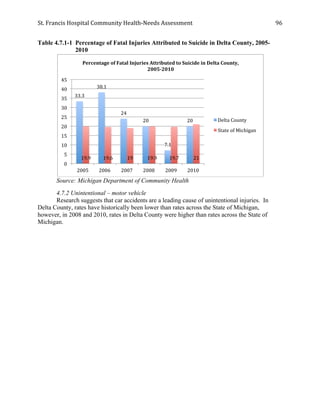
There were no statistically significant relationships between access to information and
demographic factors.
Table 8.7.1 Frequencies for “Where do you get most of your medical information?” for
Delta County and Individuals Living in Poverty
8.8 Personal physician
Respondents were asked if they had a personal physician. For Delta County, most respondents
indicated that they had a personal physician.
Logit regression analyses reveal that people with higher incomes, women and older
people positively impacted whether someone had a personal physician, and homelessness had a
negative impact on whether someone had a personal physician.
57	
  
14	
  
19	
  
3	
  
55	
  
17	
   18	
  
4	
  
0	
  
10	
  
20	
  
30	
  
40	
  
50	
  
60	
  
Percentages	
  of	
  Respondents	
  
Frequencies	
  for	
  “Where	
  do	
  you	
  get	
  
most	
  of	
  your	
  medical	
  information?”	
  
for	
  Delta	
  County	
  and	
  Individuals	
  
Living	
  in	
  Poverty	
  
Delta	
  County	
  
Poverty	
  
St.	
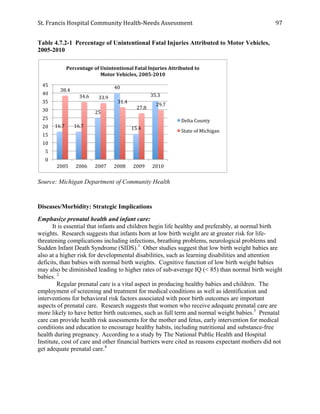
  Francis	
  Hospital	
  Community	
  Health-­‐Needs	
  Assessment	


148	
  
Table 8.8.1 Frequencies for “Do you have a personal physician?” for Delta County and
Individuals Living in Poverty
Numerous significant relationships exist between access to a personal physician and
demographic variables. Specifically, a survey respondent was more likely to answer that he or
she did not have a personal physician if they were homeless and was more likely to answer that
he or she did have a personal physician if he or she was a woman, older, more educated, and earn
more income.
Table 8.8.2 Significant Correlations among Access to a Personal Physician and
Demographic Variables
Gender Age
Race
(White)
Native
American Education Income Homeless
Do you
have a
personal
physician? + + + + -
83	
  
74	
  
17	
  
26	
  
0	
  
20	
  
40	
  
60	
  
80	
  
100	
  
Delta	
  County	
   Poverty	
  
Percentage	
  of	
  Respondents	
  
Frequencies	
  for	
  “Do	
  you	
  have	
  a	
  
personal	
  physician?”	
  for	
  Delta	
  
County	
  and	
  Individuals	
  Living	
  in	
  
Poverty	
  	
  
Yes	
  
No	
  
St.	
  Francis	
  Hospital	
  Community	
  Health-­‐Needs	
  Assessment	


149	
  
8.9 Type of Insurance
Respondents were asked to identify the type of insurance that they had. In Delta County,
the most prevalent type of insurance is private or commercial, however, those living in poverty
are disproportionately more reliant on Medicaid. Also, for those living in poverty, 1/3 do not
have any type of insurance at all.
Table 8.9.1 Frequencies for Insurance Coverage for Delta County and Individuals Living
in Poverty
Access to Health Care: Strategic Implications
Approximately 80% of people living in deep poverty seek medical services at a clinic or
doctor’s office. For this segment of the population, while 10.5% seek medical services from an
emergency department, approximately 7% will not seek any medical services at all or “other”
non-traditional sources of care. Those most likely to not seek any medical services when sick
include younger individuals and individuals identifying with Native American ethnicity.
30% of the population living in deep poverty indicated there was a time in the last year
when they were not able to get medical care when needed. According to regression results, this
was more likely among homeless people and younger people and those with low incomes. The
leading causes were lack of insurance and inability to afford a copayment or deductible. Similar
results were found for access to prescription medication. Regression results indicated that
homelessness, younger people, lower education and individuals with low incomes were less
likely to have access to necessary prescription medication. Again the leading causes of the
26	
  
21	
  
17	
  
35	
  
40	
  
14	
  
17	
  
30	
  
0	
  
5	
  
10	
  
15	
  
20	
  
25	
  
30	
  
35	
  
40	
  
45	
  
Delta	
  County	
   Poverty	
  
Percentages	
  of	
  Respondents	
  
Frequencies	
  for	
  Insurance	
  
Coverage	
  for	
  Delta	
  County	
  and	
  
Individuals	
  Living	
  in	
  Poverty	
  
Medicare	
  
Medicaid	
  
Private/commercial	
  
None	
  
St.	
  Francis	
  Hospital	
  Community	
  Health-­‐Needs	
  Assessment	


150	
  
inability to have access to prescription medications were lack of insurance and inability to afford
copayment or deductibles.
While significant research exists linking dental care to numerous diseases, including heart
disease, 55% of Delta County residents had a checkup in the last year. Specifically, younger
individuals, lower income and less educated people were less likely to visit a dentist. Moreover,
note that almost half of people living in poverty (42%) indicated that they needed dental care in
the last year, but were not able to get it. Lack of dental insurance and inability to afford
copayments were the leading causes, however fear was significantly higher for seeing a dentist
compared to seeing a doctor.
Approximately 25% of people living in deep poverty indicated they were not able to get
counseling when they needed it over the last 12 months. Leading indicators are younger people
and homelessness. While affordability and insurance were the leading reasons, embarrassment
were also significant barriers to mental health services.
Across categories, residents of Delta County get most of their medical information from
doctors and the next most prevalent is the Internet.
The most prevalent type of insurance is private or commercial, however, those living in
poverty are disproportionately more reliant on Medicaid. Also for those living in poverty, 1/3 do
not have any type of insurance at all.
St.	
  Francis	
  Hospital	
  Community	
  Health-­‐Needs	
  Assessment	


151	
  
CHAPTER 9. HEALTHY BEHAVIORS
In this chapter, healthy behaviors of the community are presented. Specifically,
frequency of physical exercise, healthy eating habits and smoking are examined. Additionally,
overall self-perceptions of health are presented.
9.1 Physical Exercise
Respondents were asked how frequently they engage in physical exercise. The majority
of the population across all categories does not engage in sufficient exercise. Note that these
findings are more consistent with state averages when compared to data reported by the
Michigan Behavioral Risk Factor Surveillance System data. For physical exercise, ordinary-
least-square regression results show that men, younger people and educated people are more
likely to engage in physical exercise, while homeless residents are not.
Only one significant relationship existed between physical exercise and demographic
variables. Specifically, men were more likely to answer that they exercised regularly.
Table 9.1.1 Frequencies for “In the last week, how many times did you exercise?” for
Delta County and Individuals Living in Poverty
Table 9.1.2 Significant Correlations among “In the last week, how many times did you
exercise?” and Demographic Variables
Gender -
34	
   34	
  
32	
  
34	
  
21	
  
19	
  
13	
   13	
  
0	
  
5	
  
10	
  
15	
  
20	
  
25	
  
30	
  
35	
  
40	
  
Delta	
  County	
   Poverty	
  	
  
Percentage	
  of	
  Respondents	
  
Frequencies	
  for	
  “In	
  the	
  last	
  week,	
  
how	
  many	
  times	
  did	
  you	
  
exercise?”	
  for	
  Delta	
  County	
  and	
  
Individuals	
  Living	
  in	
  Poverty	
  
None	
  
1-­‐2	
  times	
  
3-­‐5	
  times	
  
More	
  than	
  5	
  times	
  
St.	
  Francis	
  Hospital	
  Community	
  Health-­‐Needs	
  Assessment	


152	
  
9.2 Healthy Eating
For healthy eating habits, about 28% of the population consumes at least three servings of
fruits/vegetables in a day. Moreover, only about 2% of the population consumes the minimal
recommended daily amount of vegetables. Some recent research by the CDC states that for a
typical person consuming 2,200 calories per day, they should have 7 servings of vegetables.
Note that while most data from the CHNA survey is relatively consistent with the
Michigan Behavioral Risk Factor Surveillance System data, there is a large discrepancy between
those consuming 5-or-more servings of fruits and vegetables per day. While secondary data
found that approximately 74.7% of respondents met this criterion, the CHNA survey found that
only 2% of respondents consumed 5-or-more servings of fruits and vegetables per day. This may
be partially explained by our focus on the at-risk population, however, given the large
discrepancy, other factors may lead to these differences.
Table 9.2.1 Frequencies for “On a typical day, how many servings of fruits and/or
vegetables do you eat?” for Delta County and Individuals Living in Poverty
6	
   9	
  
66	
  
70	
  
26	
  
20	
  
2	
   1	
  
0	
  
10	
  
20	
  
30	
  
40	
  
50	
  
60	
  
70	
  
80	
  
Delta	
  County	
   Poverty	
  
Percentage	
  of	
  Respondents	
  
Frequencies	
  for	
  “On	
  a	
  typical	
  day,	
  
how	
  many	
  servings	
  of	
  fruits	
  and/or	
  
vegetables	
  do	
  you	
  eat?”	
  for	
  Delta	
  
County	
  and	
  Individuals	
  Living	
  in	
  
Poverty	
  	
  
None	
  
1-­‐2	
  servings	
  
3-­‐5	
  servings	
  
More	
  than	
  5	
  servings	
  
St.	
  Francis	
  Hospital	
  Community	
  Health-­‐Needs	
  Assessment	


153	
  
Table 9.2.2 Significant Correlations among Number of Servings of Fruits and Vegetables
Consumed Daily and Demographic Variables
Gender +
Age +
Income +
Education +
Numerous significant relationships exist between consumption of fruits and vegetables
and demographic variables. Specifically, a survey respondent was more likely to answer that he
or she consumed more fruits and vegetables each day if they were older in age, were female,
earned a higher income, and had attained higher levels of education.
9.3 Smoking
Smoking is increasing in Delta County, as seen in the secondary research presented
earlier in this report. Primary data suggests that individuals living in poverty are significantly
more likely to smoke. Note that when comparing these data to the Michigan Behavioral Risk
Factor Surveillance System data, the CHNA survey assesses the frequency of smoking compared
to whether a respondent smoked or did not smoke.
Table 9.3.1 Frequencies for “On a typical day, how many cigarettes do you smoke?” for
Delta County and Individuals Living in Poverty
0	
  
20	
  
40	
  
60	
  
80	
  
Delta	
  County	
   Poverty	
  
Percentage	
  of	
  Respondents	
  
Number	
  of	
  Cigarettes	
  
Frequencies	
  for	
  “On	
  a	
  typical	
  day,	
  
how	
  many	
  cigarettes	
  do	
  you	
  smoke?”	
  
for	
  Delta	
  County	
  and	
  Individuals	
  
Living	
  in	
  Poverty	
  
None	
  
1-­‐4	
  
5-­‐8	
  
9-­‐12	
  
More	
  than	
  12	
  
St.	
  Francis	
  Hospital	
  Community	
  Health-­‐Needs	
  Assessment	


154	
  
Table 9.3.2 Significant Correlations among Number of Cigarettes Smoked Daily and
Demographic Variables
Age -
Race (White) -
Native
American +
Education -
Income -
Homeless +
Numerous significant relationships exist between cigarette smoking and demographic
variables. Specifically, a survey respondent was more likely to answer that he or she smoked
more cigarettes each day if they identified with Native American ethnicity, were younger or were
homeless.
St.	
  Francis	
  Hospital	
  Community	
  Health-­‐Needs	
  Assessment	


155	
  
9.4 Overall Health
In terms of self-perceptions of physical and mental health, 95% of the population
indicated that they were in average or good physical health. Similar results were found for
residents’ self-perceptions of mental health.
Table 9.4.1 Frequencies for “Overall, my physical health is __” for Delta County and
Individuals Living in Poverty
Numerous significant relationships exist between overall physical health and
demographic variables. Specifically, a survey respondent was more likely to answer that he or
she possessed better physical health if they were of White ethnicity, older, earned a higher
income, and had attained higher levels of education. Conversely, a survey respondent was more
likely to answer that he or she possessed poorer physical health if they were Native American or
homeless.
5	
  
10	
  
39	
  
51	
  
56	
  
39	
  
0	
  
10	
  
20	
  
30	
  
40	
  
50	
  
60	
  
Delta	
  County	
   Poverty	
  
Percentage	
  of	
  Respondents	
  
Frequencies	
  for	
  “Overall,	
  my	
  
physical	
  health	
  is	
  __”	
  for	
  Delta	
  
County	
  and	
  Individuals	
  Living	
  in	
  
Poverty	
  
Poor	
  
Average	
  
Good	
  
St.	
  Francis	
  Hospital	
  Community	
  Health-­‐Needs	
  Assessment	


156	
  
Table 9.4.2 Significant Correlations among Overall Physical Health and Demographic
Variables
Age +
White +
Native American -
Education +
Income +
Homeless -
Table 9.4.3 Frequencies for “Overall, my mental health is __” Delta County and
Individuals Living in Poverty
0	
  
10	
  
20	
  
30	
  
40	
  
50	
  
60	
  
70	
  
80	
  
Delta	
  County	
   Poverty	
  
Percentage	
  of	
  Respondents	
  
Frequencies	
  for	
  “Overall,	
  my	
  
mental	
  health	
  is	
  __”	
  Delta	
  County	
  
and	
  Individuals	
  Living	
  in	
  Poverty	
  
Poor	
  
Average	
  
Good	
  
St.	
  Francis	
  Hospital	
  Community	
  Health-­‐Needs	
  Assessment	


157	
  
Numerous significant relationships exist between overall mental health and demographic
variables. Specifically, a survey respondent was more likely to answer that he or she possessed
better mental health if they were of White ethnicity, older, earned a higher income, and had
attained higher levels of education. Conversely, a survey respondent was more likely to answer
that he or she possessed poorer mental health if they were Native American or homeless.
Table 9.4.4 Significant Correlations among Overall Mental Health and Demographic
Variables
Age +
White +
Native American -
Education +
Income +
Homeless -
Healthy Behaviors: Strategic Implications
For healthy behaviors, men in Delta County are more likely to engage in physical
exercise, although 34% of the population engages in exercise at least 3 times a week. Similarly
for healthy eating habits, about 28% of the population consumes at least three servings of
fruits/vegetables in a day. Those that are more likely to have healthy eating habits include
women, people with higher educations and more income, and older people. Given the
documented research showing the benefits of physical exercise and healthy eating, this is a
concern for the community, as most primary and secondary diagnoses in the Delta County
community can be mitigated, to some extent, by healthy lifestyle.
Data suggests smoking is a concern in Delta County, with individuals identifying as
Native American and as homeless being more likely to smoke.
St.	
  Francis	
  Hospital	
  Community	
  Health-­‐Needs	
  Assessment	


158	
  
In terms of self-perceptions of physical and mental health, 95% of the population
indicated that they were in average or good physical health. Similar results were found for
residents’ self-perceptions of mental health.
St.	
  Francis	
  Hospital	
  Community	
  Health-­‐Needs	
  Assessment	


159	
  
PHASE III – PRIORITIZATION OF HEALTH-RELATED ISSUES
The identification and prioritization of the most important health-related issues in Delta
County are identified in Phase III. To accomplish this, a summary of Phase I and Phase II were
performed to provide a foundation for the prioritization process. After summarizing all of the
issues in the Community Health Needs Assessment, a comprehensive assessment of existing
community resources was performed to identify the efficacy to which health-related issues were
being addressed. Finally a collaborative team of leaders in the healthcare community used an
importance/urgency methodology to identify the most critical issues in the area. Results are
included in Chapter 10.
CHAPTER 10. PRIORITIZATION OF HEALTH-RELATED ISSUES
In this chapter, we identify the most critical health-related needs in the community. To
accomplish this, first we identified the most important areas of concern. Next we completed a
comprehensive inventory of community resources, and finally we identified the most important
health concerns in the community.
Specific criteria used to identify these issues included: (1) magnitude to the community; (2)
strategic importance to the community; (3) existing community resources; (4) potential for
impact; and (5) trends and future forecasts.
10.1 Summary of Community Health Issues
Based on findings from the previous analyses, a chapter-by-chapter summary of key
takeaways was necessary to provide a foundation to identify the most important health-related
issues in the community. Considerations for identifying key takeaways included prevalence of
the issues, importance to the community, impact, trends and projected growth.
Demographics (Chapter 1) – Three factors were identified as the most important areas
of concern from the demographic analyses: increasing elderly population, mental health rates and
poverty.
Insurance (Chapter 2) – Lack of insurance contributes to decreased accessibility to
health care, including both medical and dental insurance.
Symptoms and Predictors (Chapter 3) – Based on prevalence and growth rates, factors
were identified as having significant impact on the community. These include, obesity,
hypertension and risky behaviors, including drug and alcohol abuse and smoking.
Diseases/Morbidity (Chapter 4) – By evaluating magnitude of morbidities and growth
rates of morbidities, two specific issues were identified. These included asthma and diabetes
(specifically Type II diabetes).
St.	
  Francis	
  Hospital	
  Community	
  Health-­‐Needs	
  Assessment	


160	
  
Mortality (Chapter 5) – The two leading causes of mortality were heart disease and
cancer. While there were other categories for mortality, heart disease and cancer were
significantly more prevalent than all other categories.
Community Misperceptions (Chapter 7) – Based on results from the survey,
respondents to the survey incorrectly perceived “heart disease” and “diabetes” “dental health” as
being relatively unimportant health concerns in the community.
Access to Health Services (Chapter 8) – Results from survey respondents defined as
living in deep poverty indicated that access to healthcare services is limited. This includes
medical, prescription, dental and mental healthcare.
Health-Related Behaviors (Chapter 9) – Results from survey respondents defined as
living in deep poverty indicated that there are limited efforts at proactively managing one’s own
health. This includes limited exercise, poor eating habits and increased incidence of smoking
In order to provide parsimony in the prioritization of key community health-related
issues, the findings were aggregated into 11 key categories, based on similarities and duplication.
The 11 areas were:
o Obesity
o Risky Behaviors -Substance Abuse
o Mental Health
o Healthy Behaviors
o Access to Health Services
o Respiratory Issues
o Heart Disease
o Cancer
o Diabetes
o Community Health Misperceptions
o Dental Issues
St.	
  Francis	
  Hospital	
  Community	
  Health-­‐Needs	
  Assessment	


161	
  
10.2 Community Resources
After summarizing issues in the Community Health Needs Assessment, a comprehensive
analysis of existing community resources was performed to identify the efficacy to which these
10 health-related issues were being addressed.
There are numerous forms of resources in the community. They are categorized as
recreational facilities, county health departments, community agencies and area hospitals/clinics.
10.2.1 Recreational Facilities (3)
City of Escanaba Parks and Facilities
Obesity, Healthy Behaviors, Heart Disease
The City of Escanaba offers a variety of programs for infants, toddlers, early childhood, youth,
adults, and seniors at the Catherine Bonifas Civic Center.
Gladstone Fitness Center
Obesity
Gladstone Fitness Center offers a weight loss program and weight training with registered
dietician consultants.
Northern Lights YMCA
Healthy Behaviors, Obesity, Addiction, Access to Health Services
The Northern Lights YMCA is a community based service organization dedicated to building the
mind, body and spirit for members of the Delta County community. By offering value-based
programs emphasizing education, health and recreation for individuals regardless of sex, race or
socio-economic status the YMCA is increasing the quality of life in Delta County.
10.2.2 Health Departments (1)
Public Health, Delta and Menominee Counties
Obesity, Addiction, Healthy Behaviors, Access to Health Services, Heart Disease, Cancer,
Diabetes
The goal of the Delta-Menominee County Health Department is to protect and promote health
and prevent disease, illness and injury. Public health interventions range from preventing
diseases to promoting healthy lifestyles and from providing sanitary conditions to ensuring safe
food and water. Specific programs of interest include the Wisewoman Program (Diabetes,
Addiction, Healthy Behaviors).
St.	
  Francis	
  Hospital	
  Community	
  Health-­‐Needs	
  Assessment	


162	
  
10.2.3 Community Agencies/Private Practices (23)
Tri-County Safe Harbor (formerly Alliance Against Violence and Abuse)
Mental Health
The Alliance Against Violence and Abuse offers services for all people who are abused.
Services include a 24 hour crisis line, an emergency shelter, support groups, individual
counseling, therapy, court advocacy, and referrals for legal, medical, financial, and housing.
Alcoholics Anonymous
Addiction
Alcoholics Anonymous is a fellowship of men and women who share their experience, strength
and hope with each other that they may solve their common problem and help others recover
from alcoholism.
American Red Cross, Superior U.P. Chapter
Healthy Behaviors
The American Red Cross is a humanitarian organization led by volunteers and guided by its
Congressional Charter and the Fundamental Principles of the International Red Cross Movement
that provides relief to victims of disaster and helps people prevent, prepare for, and respond to
emergencies.
Bay Cliff Health Camp
Healthy Behaviors
Bay Cliff is a year-round, nonprofit therapy and wellness center for children and adults with
physical disabilities. Bay Cliff partners with non-profit organizations and schools interested in
conducting programs at camp. These guest programs include health and wellness retreats, youth
development camps, science and outdoor recreation programs, or volunteer and leadership
trainings for people with & without disabilities.
Bishop Noa Home for Senior Citizens
Respiratory Issues, Heart Disease, Cancer, Diabetes
The Bishop Noa Home for Senior Citizens provides a safe, healthy environment that promotes
physical, emotional and spiritual well-being to residents, families and employees.
Care Free Dental Clinic
Dental Issues
The Care Free Dental Clinic provides free dental care for Delta Country residents on a first
come/first serve basis. The clinic specifically serves individuals who do not have any dental or
medical insurance coverage.
Catholic Social Services of the Upper Peninsula
Addiction
Catholic Social Services has a large mental health and substance abuse outpatient-counseling
ministry. Last year it served over 2,000 UP residents with 12,000 appointments. Counseling
offices are in Marquette, Escanaba, and Iron Mountain. The agency has recently taken over the
Keenagers Home in Wakefield. This home is on the site of the former Divine Infant Hospital
St.	
  Francis	
  Hospital	
  Community	
  Health-­‐Needs	
  Assessment	


163	
  
and is home to 42 residents in either adult foster care, assisted living, or independent living.
Catholic Social Services offers a general assessment for substance abuse and assesses the risk
factors for the person's involvement in substance abuse, and will make treatment
recommendations and/or refer individuals to the inpatient, outpatient or residential treatment
services they need.
Child and Family Services of the Upper Peninsula
Mental Health
Child and Family Services is a private, non-profit, non-sectarian agency dedicated to
strengthening children and families by providing high-quality programs structured around five
major themes: counseling services, child welfare services, home-based services, homeless
prevention services, and community-based services.
Community Action Agency and Human Resource Authority
Obesity, Access to Health Services
The Community Action Agency provides programs to negate the causes and symptoms of
poverty. Specific programs of interest include the Senior Nutrition Services (Obesity), and
RSVP (Access to Health Services).
Delta County Department of Human Services
Access to Health Services
DCDHS provides health care coverage to individuals who meet certain eligibility requirements.
All programs have an income test and some look at assets, these tests vary with each program.
Some may have a medical spend down amount, where the individual will be required to pay a set
amount per month towards medical expenses before the coverage will be available.
Delta County Cancer Alliance
Access to Health Services, Cancer
DCCA provides wheelchairs, commodes, canes, lift chairs, hospital beds and various other
equipment and supplies that are available to cancer patients free of charge.
Delta Schoolcraft I.S.D. Career Tech Center
Mental Health, Healthy Behaviors, Access to Health Services, Community Health
Misperceptions
DSISD provides career technical education courses designed to develop basic skills required for
specific vocations, specifically Health Occupations.
Family Nutrition and Food Safety Program
Obesity
The Family Nutrition and Food Safety program, offered through the Michigan State University
Extension provides information concerning the basic principles of healthy eating, food handling,
food preparation and shopping skills.
St.	
  Francis	
  Hospital	
  Community	
  Health-­‐Needs	
  Assessment	


164	
  
Great Lakes Recovery Centers – Escanaba Outpatient Services
Addictions
GLRC offers comprehensive outpatient drug abuse treatment services to families and individuals
of all ages recovering from substance abuse. These services may include but are not limited to
assessment, group therapy and relapse prevention.
Pathways Community Mental Health
Mental Health
Pathways Community Mental Health primarily addresses mental health care. Pathways provides
integrated substance abuse services for those individuals with a primary mental health,
development disability, or severe emotional disturbance who also have a secondary substance
use disorder. Case management services are provided to eligible consumers who need assistance
in gaining access to health and dental services, financial assistance, housing, employment,
education, social services, and other services and natural supports.
United Way of Delta County
Access to Health Services, Healthy Behaviors, Addiction, Mental Health
The United Way of Delta County brings together people from business, labor, government,
health and human services to address community's needs. Money raised through the United Way
of Delta County campaign stays in community funding programs and services in Delta County.
Lutheran Social Services of Wisconsin and Upper Michigan
Mental Health
Lutheran Social Services provides behavioral health services (counseling, substance abuse,
mental health and developmental disabilities), children's community services (adoption, foster
care, pregnancy counseling, residential services and Head Start), nursing and community
services (long-term care and rehabilitation, home care services, adult day services, respite
services for caregivers and retirement communities), prisoner and family ministry (support for
children of incarcerated parents and their caregivers, re-entry programs, on-site prison programs,
and justice education), and senior housing services (affordable housing for low-income seniors
and people with disabilities).
Medical Access Coalition
Access to Health Services, Diabetes, Dental Issues
MAC provides two county-wide administered programs that coordinate donated physician
services and pharmacy services to uninsured adults who meet eligibility requirements. Offers
information and assistance to access affordable healthcare services, assistance applying for free
or discounted medications and offers a drug card for limited generic medications.
Menominee-Delta-Schoolcraft Early Childhood Program
Access to Health Care, Healthy Behaviors, Dental Issues
MDS CAA ECP offers comprehensive preschool services for children ages 3-5 as well as
infant/toddler services for pregnant moms and children up to age 3. All services are free of chard.
Transportation is provided to classrooms whenever possible.
St.	
  Francis	
  Hospital	
  Community	
  Health-­‐Needs	
  Assessment	


165	
  
Salvation Army – Escanaba
Mental Health
The Salvation Army provides individual and family trauma counseling and emotional support.
Society of St. Vincent de Paul	
  
Mental Health, Healthy Behaviors, Access to Services, Community Health Misperceptions
The Society of St. Vincent de Paul offers tangible assistance to those in need on a person-to-
person basis. It is this personalized involvement that makes the work of the Society unique. This
aid may take the form of intervention, consultation, or often through direct dollar or in-kind
service.
Teaching Family Homes of Upper Michigan
Addictions, Mental Health, Healthy Behaviors
Teaching Family Homes offer programs for children and youth including residential care, group
homes, foster care and adoption, supervised independent living, private school, crisis
intervention, mental health assessment, homeless services, in-home counseling and family
preservation.
Upper Peninsula Commission for Area Progress
Healthy Behaviors, Diabetes, Access to Health Services
The UPCAP is responsible for development, coordination, and provision of human, social, and
community resources within the 15 counties of the Upper Peninsula of Michigan. Specific
programs of interest include the 2-1-1 Information and Resource Center (Access to Health
Services) and UP Diabetes Outreach Network (Diabetes).
Welcome Newborns Program
Addiction, Healthy Behaviors
The Welcome Newborn program, offered through the Michigan State University Extension,
provides every family with a newborn a tote bag full of information on the development of their
baby, the need for immunizations, parenting, the importance of reading to your baby, the affects
of second hand smoke on children, and available community resources for the family in Delta
County.
10.2.4 Hospitals/Clinics (2)
Marquette General Hospital
Obesity, Addiction, Mental Health, Healthy Behaviors, Access to Health Services, Asthma, Heart
Disease, Cancer, Diabetes
Marquette General Hospital is a 315-bed specialty care hospital that provides care in 65
St.	
  Francis	
  Hospital	
  Community	
  Health-­‐Needs	
  Assessment	


166	
  
specialties and subspecialties. With a medical staff of more than 200 doctors, the hospital cares
for approximately 12,000 inpatients and more than 350,000 outpatients a year.
OSF Saint Francis Hospital and Medical Group
Obesity, Addiction, Mental Health, Healthy Behaviors, Access to Health Services, Asthma, Heart
Disease, Cancer, Diabetes
With a medical staff of more than 100 physician and 700 employees, OSF St. Francis Hospital
and Medical Group is a fully-integrated health delivery system offering hospital-based, home
care, and physician clinical services. Specific centers of interest include the Diabetes and
Nutrition Education Center (Diabetes) and Cardiac Diagnostic Services (Heart Disease).
Table 10.2 illustrates the relationships between the community resources and the 11
summary areas identified in section 10.1. Assessment of these relationships was performed to
identify potential gaps in coverage as the collaborative team prioritized health-related issues in
the community.
Table 10.2 Relationship between Community Resources and Community Needs
St.	
  Francis	
  Hospital	
  Community	
  Health-­‐Needs	
  Assessment	


167	


10.3 Prioritization of Community Health-Related Issues
In order to prioritize the previously identified dimensions, the collaborative team
considered health needs based on: (1) short-term urgency – issues that need immediate attention;
and (2) long-term strategic importance – issues that will have the most significant impact on the
future health of the community. Additional considerations included the magnitude of the issues
(e.g., what percentage of the population was impacted by the issue), growth rate or projected
trend of the issue, magnitude to the community, existing community resources, and the potential
to make a significant impact to the community. Using these criteria, the collaborative team
prioritized the previously identified health issues. Results can be seen in Figure 10.3.
Figure 10.3 Importance/Urgency Matrix for Community Health Needs
High	
  
Strategic	
  
Importance	
  
Low	
  
High	
  
Urgency	


Access	
  to	
  
Health	
  
Respiratory	
  
Issues	
  
Obesity	
  
Heart	
  Disease	
  
Cancer	
  
Mental	
  Health	
  	
  
Risky	
  Behaviors	
  -­‐
Substance	
  Abuse	
  
Healthy	
  
Behaviors	
  
Diabetes	
  
Community	
  
Misperceptions	
  
Dental	


St.	
  Francis	
  Hospital	
  Community	
  Health-­‐Needs	
  Assessment	


168	
  
In conclusion, the collaborative identified the five most critical health-related issues in Delta
County as:
OBESITY
Research strongly suggests that obesity is a significant problem facing youth and adults
nationally, as it has been linked to numerous morbidities (e.g., type II diabetes, hypertension,
cardiovascular disease, cancer, etc). In Delta County, the rate of obesity has increased from
26.1% to 29.6% in a three-year period. During the same time frame, the percentage of the
population that is defined as overweight has risen from 38.6% to 41%. Note that this is almost
6% higher than State of Michigan averages.
RISKY BEHAVIORS-SUBSTANCE ABUSE
In Delta County, 25% of respondents engage in binge drinking versus 18% in the State of
Michigan. Both figures exceed the US national 90th
percentile benchmark of 8%.
There has also been a 4.5% increase for those identifying themselves as smokers in Delta County
between 2005-2007 and 2008-2010. In contrast, there was a decrease for those identifying
themselves as smokers for the State of Michigan during same time frame. Thus, Delta County is
currently 8.5% higher than State of Michigan averages. Additionally, according to survey
respondents, for both Delta County’s aggregate population and those living in poverty, drug and
alcohol abuse were perceived as the two most important unhealthy behaviors in the community.
MENTAL HEALTH
While there was a slight decrease in average number of mentally unhealthy days indicated by
Delta County residents between 2010 and 2012 from 4 to 3.5 days in the last month, it is 30%
higher when compared to the U.S. 90th
percentile. Moreover, among people living in poverty,
mental health was rated as the most important health concern.
COMMUNITY MISPERCEPTIONS
Based on results from the survey, respondents incorrectly perceived “diabetes,” “heart disease,”
and “dental” as being relatively less important health concerns to the community. These results
conflict with morbidity data that suggests diabetes rates in Delta County are higher than rates
across the State of Michigan, mortality data that indicates heart disease is the leading cause of
death in Delta County, and dental data illustrates Delta County residents have undergone annual
dental checkups at a lower rate (62.8%) than rates for the State of Michigan (73.8) and have
higher rates of lost teeth due to tooth decay or gum disease (19.9%) versus rates for the State of
Michigan (13.8%). Moreover, for those respondents living in poverty, misperceptions of
programs such as Medicaid and charity programs is evident given that respondents do not seek
necessary medical care because they believe they cannot afford to pay. Finally, there are
misperceptions with respondents’ self perceptions of their own health, as 94% felt that they are
either average or above average in terms of their overall health.
St.	
  Francis	
  Hospital	
  Community	
  Health-­‐Needs	
  Assessment	


169	
  
DIABETES
It is estimated that 90-95% of individuals with diabetes have Type II diabetes (previously known
as adult-onset diabetes). Diabetes is the leading cause of kidney failure, adult blindness and
amputations and is a leading contributor to strokes and heart attacks. Data from the Michigan
BRFSS indicate that nearly 10% of Delta County BRFSS Region residents have diabetes.
Compared to data from the State of Michigan (9.5%), the prevalence of diabetes now exceeds the
state average.
Note that while other factors, such as healthy behaviors, heart disease, access to health,
dental, respiratory issues and cancer are all important attributes, in terms of importance and
urgency, the collaborative team rated the other five categories as more important. As a validity
check, note that the findings from this study are similar with the health assessments completed
by the County Health Department.
St.	
  Francis	
  Hospital	
  Community	
  Health-­‐Needs	
  Assessment	


170	
  
APPENDIX 1. Sample Survey
	
  
St.	
  Francis	
  Hospital	
  Community	
  Health-­‐Needs	
  Assessment	


171	
  
St.	
  Francis	
  Hospital	
  Community	
  Health-­‐Needs	
  Assessment	


172	
  
St.	
  Francis	
  Hospital	
  Community	
  Health-­‐Needs	
  Assessment	


173	
  

Substance Abuse Delta, Michigan

  • 1.
    COMMUNITY HEALTH NEEDSASSESSMENT 2013 ST. FRANCIS HOSPITAL Delta County Prepared by: Dr. Laurence G. Weinzimmer and Professor Eric Michel
  • 2.
    St.  Francis  Hospital  Community  Health-­‐Needs  Assessment     2   TABLE OF CONTENTS EXECUTIVE SUMMARY .................................................................................................. 9 I. INTRODUCTION ............................................................................................................. 13 II METHODS ........................................................................................................................ 20 III. PHASE 1 – COMMUNITY ASSESSMENT .................................................................. 24 Chapter 1. Demographic Profile ................................................................................. 25 1.1 Population..................................................................................................... 25 1.2 Age Distribution ........................................................................................... 28 1.3 Household/Family......................................................................................... 33 1.4 Economic Information.................................................................................. 38 1.5 Education...................................................................................................... 40 1.6 People with Disabilities................................................................................ 43 Demographic Profile: Strategic Implications ..................................................... 45 Chapter 2. Prevention.................................................................................................. 47 2.1 Accessibility ................................................................................................. 47 2.2 Wellness........................................................................................................ 49 Prevention: Strategic Implications...................................................................... 57 Chapter 3. Symptoms/Predictors ................................................................................ 59 3.1 Tobacco Use ................................................................................................. 59 3.2 Drug and Alcohol Abuse .............................................................................. 60 3.3 Overweight and Obesity ............................................................................... 60 Symptoms/Predictors: Strategic Implications..................................................... 61 Chapter 4. Diseases/Morbidity.................................................................................... 65 4.1 Age Related .................................................................................................. 65 4.2 Cardiovascular.............................................................................................. 67 4.3 Respiratory.................................................................................................... 80 4.4 Cancer........................................................................................................... 84 4.5 Type 2 Diabetes............................................................................................ 93 4.6 Infectious Diseases ....................................................................................... 95 4.7 Injuries.......................................................................................................... 95 Diseases/Morbidity: Strategic Implications........................................................ 97 Chapter 5. Mortality .................................................................................................... 99 5.1 Leading Causes of Death.............................................................................. 99 Mortality: Strategic Implications........................................................................ 103
  • 3.
    St.  Francis  Hospital  Community  Health-­‐Needs  Assessment     3   IV. PHASE 2 – PRIMARY DATA RESEARCH FOR COMMUNITY HEALTH NEEDS 105 Chapter 6. General Characteristics of Respondents ................................................... 106 6.1 Age................................................................................................................ 106 6.2 Race and Ethnicity........................................................................................ 107 6.3 Educational Attainment ................................................................................ 108 6.4 Income Distribution...................................................................................... 109 6.5 Living Arrangements.................................................................................... 110 6.6 Household Composition ............................................................................... 111 6.7 Employment Status....................................................................................... 111 6.8 Gender........................................................................................................... 112 Chapter 7. Findings and Results Community Perceptions.......................................... 113 7.1 Health Problems in the Community ............................................................. 113 7.2 Unhealthy Behaviors .................................................................................... 118 7.3 Issues with Quality of Life ........................................................................... 123 Community Perceptions: Strategic Implications ................................................ 125 Chapter 8. Accessibility to Health Care...................................................................... 126 8.1 Choice of Medical Care................................................................................ 126 8.2 Frequency of Checkups ................................................................................ 128 8.3 Access to Medical Care ................................................................................ 131 8.4 Access to Prescription Drugs........................................................................ 135 8.5 Access to Dental Care................................................................................... 137 8.6 Access to Counseling.................................................................................... 143 8.7 Access to Information................................................................................... 147 8.8 Personal Physician........................................................................................ 147 8.9 Type of Insurance ......................................................................................... 149 Access to Health Care: Strategic Implications ................................................... 149 Chapter 9. Health-Related Behaviors.......................................................................... 151 9.1 Physical Exercise.......................................................................................... 151 9.2 Healthy Eating .............................................................................................. 152 9.3 Smoking........................................................................................................ 153 9.4 Overall Health............................................................................................... 155 Healthy Behaviors: Strategic Implications......................................................... 157 V. PHASE 3 – PRIORITIZATION OF HEALTH-RELATED ISSUES .............................. 159 Chapter 10. Prioritization of Health-Related Issues.................................................... 159 10.1 Summary of Community Health Issues...................................................... 159 10.2 Community Resources................................................................................ 161 10.3 Priority of Community Heath-Related Issues............................................. 167 VI. APPENDIX...................................................................................................................... 170
  • 4.
    St.  Francis  Hospital  Community  Health-­‐Needs  Assessment     4   LIST OF EXHIBITS Figure 1. Community Needs Assessment Framework Table 1.1.1-1. Population of Delta County, 2000 and 2010 Table 1.1.1-2. Population of Municipalities in Delta County, 2000 and 2010 Table 1.1.2-1. 2000-2010 Population Growth Rate for Municipalities in Delta County Table 1.2-1. Age Distribution of Delta County Residents, 2010 vs. 2007 Table 1.2-2. Median Age of Residents in Delta County, 2010 vs. 2007 Table 1.2-3. Population of Delta County Region Under 18 Years of Age, 2010 vs. 2007 Table 1.2-4. Population of Delta County 62 Years of Age and Over, 2010 vs. 2007 Table 1.2.2-1. Gender Distribution of Delta County Residents, 2010 vs. 2007 Table 1.2.3-1. Racial Distribution of Delta County Residents, 2010 vs. 2007 Table 1.3-1. Growth Rate in Number of Family Households Delta County, 2007-2010 Table 1.3.1-1. Family Composition in Delta County, 2010 vs. 2007 Table 1.3.3-1. Three-year Growth Rate in the Percentage of Delta County Residents who are Married, but not separated, 2007-2010 Table 1.3.3-2. Three-year Growth Rate in the Percentage of Delta County Residents who are Divorced or Separated, 2007-2010 Table 1.3.3-3. Three-year Growth Rate in the Percentage of Delta County Residents who are Widowed or Never Married, 2007-2010 Table 1.3.4-1. Births to Teenage Mothers in Delta County Region vs. State of Michigan, 2009 vs. 2006 Table 1.4.1-1. Median Household Income for Delta County, 2007 vs. 2010 Table 1.4.2-1. Average Annual Unemployment Rate for Delta County, 2002-2011 Table 1.4.3-1. Percentage of Families Living in Poverty in Delta County, 2010 vs. 2007 Table 1.5.1-1. Grade 3 Student Achievement in Delta County 2011-2012 Table 1.5.1-2. Grade 8 Student Achievement in Delta County 2011-2012 Table 1.5.2-1. High School Graduation Rates in Delta County, 2007-2008 vs. 2010-2011 Table 1.6.1-1. Average Number of Physically Unhealthy Days Reported in the Past 30 Days by Delta County Residents, 2010 vs. 2012 Table 1.6.1-2. Average Number of Mentally Unhealthy Days Reported in the Past 30 Days by Delta County Residents, 2010 vs. 2012 Table 2.1.1-1. Percentage of Delta County Respondents with Health Care Coverage, 2010 vs. 2012 Table 2.1.2-3. Percentage of Delta County Region Respondents with a Usual Health Care Provider, 2005-2007 vs. 2008-2010 Table 2.1.2-4. Percentage of Delta County Region Respondents who have not Visited a Dentist in 2+ Years, 2004-2006 vs. 2007-2009 Table 2.2.2-1. Percentage of Delta County Region Residents with High Cholesterol Table 2.2.2-2. Time Since Last Cholesterol Screening by Delta County Region Residents Table 2.2.2-3. Percentage of Delta County Region Residents with High Blood Pressure Table 2.2.2-4. Percentage of Delta County Region Residents who had a Clinical Breast Exam in the Past Year Table 2.2.2-5 Percentage of Delta County Region Residents Who Had an Appropriately Timed Pap Test within the Past 3 Years
  • 5.
    St.  Francis  Hospital  Community  Health-­‐Needs  Assessment     5   Table 2.2.3-1. Percentage of Delta County Region Residents who had a Flu Vaccine in the Past Year Table 2.2.3-2. Percentage of Delta County Region Residents Who ever had the Pneumonia Vaccine Table 2.2.4-1. Percentage of Delta County Region Residents who have not participated in any leisure-time physical activities or exercises during the past month Table 2.2.4-2. Percentage of Delta County Region Residents who have consumed less than 5 servings of fruits/vegetables per day Table 2.2.5-1. Percentage of Delta County Region Residents Missing 6 or more teeth due to gum disease or tooth decay Table 3.1-1. Smoking Status of Residents in Delta County Table 3.2-1. Percent of Delta County Residents at Risk for Acute/Binge Drinking Table 3.3-1. Overweight and Obesity in Delta County Region and State of Michigan Table 4.1.1-1. Percentage Live Births with Low Birth Weight in Delta County, 2010 vs. 2012 Table 4.1.2-1. Percentage of Babies Born with Adequate or Better Prenatal Care based on Kotelchuck Index Scores in Delta County, 2009-2011 Table 4.2.1-1. Inpatient Hypertension Cases at St. Francis Hospital from Delta County Region Table 4.2.2-1. Inpatient Chest Pain – Noncardiac Cases at St. Francis Hospital from Delta County Region Table 4.2.2-2. Inpatient Carditis Cases at St. Francis Hospital from Delta County Region Table 4.2.2-3. Inpatient Congenital Cardiac Anomaly Cases at St. Francis Hospital From Delta County Region Table 4.2.2-4. Inpatient Arterial Embolism Cases at St. Francis Hospital from Delta County Region Table 4.2.2-5. Inpatient Coronary Atherosclerosis Cases at St. Francis Hospital from Delta County Region Table 4.2.2-6. Inpatient Disease of Venous System Cases at St. Francis Hospital from Delta County Region Table 4.2.2-7. Inpatient Dysrhythmia & Cardiac Arrest Cases at St. Francis Hospital from Delta County Region Table 4.2.2-8. Inpatient Heart Failure Cases at St. Francis Hospital from Delta County Region Table 4.2.2-9. Inpatient Heart Valve Disease Cases at St. Francis Hospital from Delta County Region Table 4.2.2-10. Inpatient Myocardial Infarction Cases at St. Francis Hospital from Delta County Region Table 4.2.2-11. Inpatient Other Cardiovascular Disease Cases at St. Francis Hospital from Delta County Region Table 4.2.2-12 Inpatient Vascular Disease Cases at St. Francis Hospital from Delta County Region Table 4.2.3-1. Inpatient Brain Tumor and Stroke Cases at St. Francis Hospital from Delta County Region Table 4.3.1-1. Inpatient Asthma Cases at St. Francis Hospital from Delta County Region Table 4.3.1-2. Percent of Delta County Region Residents Who Still Have Asthma Table 4.3.2-1. Inpatient Pneumonia Including Aspiration Cases at St. Francis Hospital from Delta County Region
  • 6.
    St.  Francis  Hospital  Community  Health-­‐Needs  Assessment     6   Table 4.3.3-1. Inpatient Chronic Obstructive Pulmonary Disease Cases at St. Francis Hospital from Delta County Region Table 4.4-1. Ten-Year Age Adjusted Average Incidence Counts of Selected Cancers, 2000- 2009 Table 4.4-2. Five-Year Invasive Cancer Incidence by State at Diagnosis of Delta County Residents, 1985-2009 Table 4.4.1-1. Inpatient Breast Cancer Cases at St. Francis Hospital from Delta County Region Table 4.4.1-2. Inpatient Lung Cancer Cases at St. Francis Hospital from Delta County Region Table 4.4.1-3. Inpatient Prostate Cancer Cases at St. Francis Hospital from Delta County Region Table 4.4.1-4. Inpatient Pancreas Cancer Cases at St. Francis Hospital from Delta County Region Table 4.4.1-5. Inpatient Colorectal Cancer Cases at St. Francis Hospital from Delta County Region Table 4.4.1-6. Inpatient Cervical and Other Female Genital Cancer Including Precancer Cases at St. Francis Hospital from Delta County Region Table 4.4.2-1. Inpatient Leukemia Cases at St. Francis Hospital from Delta County Region Table 4.5-1. Inpatient Type II Cases at St. Francis Hospital from Delta County Region Table 4.5-2. Inpatient Type 1 Cases at St. Francis Hospital from Delta County Region Table 4.5-3. Percent of Delta County Region Residents who have Diabetes Table 4.6.1-1. Chlamydia and Gonorrhea Cases by Selected Age Group, 2006-2011 Table 4.7.1-1 Percentage of Fatal Injuries Attributed to Suicide in Delta County, 2005-2010 Table 4.7.2-1. Percentage of Unintentional Fatal Injuries Attributed to Motor Vehicles, 2005- 2010 Table 5.1-1. Top 5 Leading Causes of Death for all Races by County, 2010 Table 5.1-2. Primary Care Physician Visits per Decadent in the Last Two Years of Life Before Death, 2003-2007 Table 5.1-3. Specialist Care Physician Visits per Decadent in the Last Two Years of Life Before Death, 2003-2007 Table 5.1-4. Primary Care Physician Visits per Decadent in the Last 6 Months of Life Before Death, 2003-2007 Table 5.1-5. Specialists Care Physician Visits per Decadent in the Last 6 Months of Life Before Death, 2003-2007 Table 6.1. Age Distribution for Delta County and Deep Poverty Table 6.2. Race/Ethnicity Distribution for Delta County and Deep Poverty Table 6.3. Highest Educational Attainment for Delta County and Deep Poverty Table 6.4. Income Distribution for Delta County Table 6.5. Living Arrangement Distribution for Delta County and Deep Poverty Table 6.6. Household Composition for Delta County and Deep Poverty Table 6.8. Gender Composition for Delta County and Deep Poverty Table 7.1.1. Delta County Frequencies for Most Important Perceived Health Problems in the Community Table 7.1.2. Frequencies for Most Important Perceived Health Problems in the Community from Individuals Living in Poverty Table 7.1.3. Significant Correlations among Most Important Perceived Health Problems in the Community and Demographic Variables
  • 7.
    St.  Francis  Hospital  Community  Health-­‐Needs  Assessment     7   Table 7.2.1. Delta County Frequencies for Most Important Perceived Unhealthy Behaviors in the Community Table 7.2.2. Frequencies for Most Important Perceived Unhealthy Behaviors in the Community from Individuals Living in Poverty Table 7.2.3. Significant Correlations among Most Important Perceived Unhealthy Behaviors in the Community and Demographic Variables Table 7.3.1. Delta County Frequencies for Most Important Perceived Factors that Impact Quality of Life Table 7.3.2. Frequencies for Most Important Perceived Factors that Impact Quality of Life from Individuals Living in Poverty Table 7.3.3. Significant Correlations among Most Important Perceived Factors that Impact Quality of Life and Demographic Variables Table 8.1.1. Delta County Frequencies for Choice of Medical Care Table 8.1.2. Frequencies for Choice of Medical Care from Individuals Living in Poverty Table 8.1.3. Significant Correlations among Choice of Health Care and Demographic Variables Table 8.2.1. Delta County Frequencies for Time Since Last Checkup Table 8.2.2. Frequencies for Time Since Last Checkup from Individuals Living in Poverty Table 8.2.3. Significant Correlations for Time Since Last Checkup Table 8.3.1. Frequencies for “Was there a time when you needed medical care but were not able to get it?” for Delta County and Individuals Living in Poverty Table 8.3.2. Significant Correlations for “Was there a time when you needed medical care but were not able to get it?” Table 8.3.3.1. Frequencies for “Why weren’t you able to get medical care?” for Delta County Table 8.3.3.2. Significant Correlations for “Was there a time when you needed medical care but were not able to get it?” Table 8.4.1. Frequencies for “Was there a time when you needed prescription medicine but were not able to get it?” for Delta County and Individuals Living in Poverty Table 8.4.2. Significant Correlations for “Was there a time in the last year when you needed prescription medication and were unable to get it?” Table 8.4.3. Frequencies for “Why weren’t you able to get prescription medicine?” for Delta County Table 8.4.4. Significant Correlations for Reasons Why Individuals Were Not Able to Obtain Prescription Medication in the Past Year Table 8.5.1. Frequencies for Time Since Last Dental Checkup for Delta County and Individuals Living in Poverty Table 8.5.2. Significant Correlations for Time Since Last Dental Checkup Table 8.5.3 Frequencies for “Was there a time when you needed dental care but were not able to get it?” for Delta County and Individuals Living in Poverty Table 8.5.4   Significant Correlations for “In the last year, was there a time when you needed dental care but could not get it?” Table 8.5.5 Frequencies for “Why weren’t you able to get dental care?” for Delta County Table 8.5.6 Significant Correlations for “Why weren’t you able to get dental care?” Table 8.6.1 Frequencies for “Was there a time when you needed counseling but were not able to get it?” for Delta County and Individuals Living in Poverty
  • 8.
    St.  Francis  Hospital  Community  Health-­‐Needs  Assessment     8   Table 8.6.2 Significant Correlations for “In the last year, was there a time when you needed counseling but could not get it?” Table 8.6.3 Frequencies for “Why weren’t you able to get counseling?” for Delta County Table 8.6.4 Significant Correlations for Reasons Why Individuals Were Not Able to Obtain Counseling in the Past Year Table 8.7.1 Frequencies for “Where do you get most of your medical information?” for Delta County and Individuals Living in Poverty Table 8.8.1 Frequencies for “Do you have a personal physician?” for Delta County and Individuals Living in Poverty Table 8.8.2 Significant Correlations among Access to a Personal Physician and Demographic Variables Table 8.9.1 Frequencies for Insurance Coverage for Delta County and Individuals Living in Poverty Table 9.1.1 Frequencies for “In the last week, how many times did you exercise?” for Delta County and Individuals Living in Poverty Table 9.1.2 Significant Correlations among “In the last week, how many times did you exercise?” and Demographic Variables Table 9.2.1 Frequencies for “On a typical day, how many servings of fruits and/or vegetables do you eat?” for Delta County and Individuals Living in Poverty Table 9.2.2 Significant Correlations among Number of Servings of Fruits and Vegetables Consumed Daily and Demographic Variables Table 9.3.1 Frequencies for “On a typical day, how many cigarettes do you smoke?” for Delta County and Individuals Living in Poverty Table 9.3.2 Significant Correlations among Number of Cigarettes Smoked Daily and Demographic Variables Table 9.4.1 Frequencies for “Overall, my physical health is __” for Delta County and Individuals Living in Poverty Table 9.4.2 Significant Correlations among Overall Physical Health and Demographic Variables Table 9.4.3 Frequencies for “Overall, my physical health is __” for Delta County and Individuals Living in Poverty Table 9.4.4 Significant Correlations among Overall Mental Health and Demographic Variables Table 10.2 Relationship between Community Resources and Community Needs Figure 10.3 Importance/Urgency Matrix for Community Health Needs  
  • 9.
    St.  Francis  Hospital  Community  Health-­‐Needs  Assessment     9   EXECUTIVE SUMMARY The Delta County Community Health-Needs Assessment highlights the health needs and well being of residents in Delta County. Through this needs assessment, collaborative community partners have identified numerous health issues impacting individuals and families in the area. Several themes are prevalent in this health-needs assessment – the demographic composition of the Delta County region, the predictors and prevalence for diseases, leading causes of mortality, accessibility to health services and healthy behaviors. Results from this study can be used for strategic decision-making purposes as they directly relate to the health needs of the community. The study was designed to assess issues and trends impacting the communities served by OSF St. Francis Hospital, as well as perceptions of targeted stakeholder groups. Specifically, this assessment provides a detailed analysis of: (1) Delta County area community health needs using secondary data; and (2) an assessment of perceptions and behaviors regarding health-related challenges in the community, including accessibility to needed health care. PHASE I – USE OF SECONDARY DATA TO IDENTIFY NEEDS Chapters 1-5 include a detailed analysis of secondary data to assess information regarding the health status of the community. In order to perform these analyses, information was collected from numerous secondary sources, including publically available sources as well as private sources of data. Strategic implications are discussed at the end of each chapter. Specifically, Phase I of the study highlights several critical areas: Demographics – Changing demographics forecasts indicate an increase in chronic conditions such as diabetes, asthma, heart disease, and obesity. Three specific demographic trends in the region will have a significant impact on health issues, including: Elderly Population – The 62 and older population has seen a significant increase between 2007 and 2010. While individuals aged 62 and over have recently increased from 21.1% to 23.2% in Delta County, national forecasts estimate that individuals over age 65 will increase by one-third by 2022. Poverty – Families living in poverty increased by 1.3% from 2007 to 2010 and the median annual household income in Delta County is $8,000 less than state averages. Accessibility to Health Care – The lack of insurance coverage is more prevalent among socioeconomically disadvantaged groups that are often at high risk for disease and illness. Thus, a vicious cycle results where individuals who are at the highest risk for diseases are unable to receive screenings, thus perpetuating a cycle of disease. This is compounded by unhealthy lifestyles. Even though the State of Michigan is trending positively in terms of individuals having identifiable health-care providers, Delta County is trending negatively. Obesity – Research strongly suggests that obesity is a significant problem facing youth and adults nationally. In Delta County, 41% of people are overweight versus 35.3% in the State of Michigan. Additionally, almost 30% of residents in Delta County are considered obese.
  • 10.
    St.  Francis  Hospital  Community  Health-­‐Needs  Assessment     10   Risky Behavior – For those identifying themselves as smokers, Delta County is 8.5% higher than State of Michigan averages. Moreover, there has been a 4.5% increase for those identifying themselves as smokers in Delta County between 2005-2007 and 2008-2010. In contrast, there was a decrease for those identifying themselves as smokers for the State of Michigan during same time frame. Also, in Delta County, 25% of respondents engage in binge drinking versus 18% in the State of Michigan. Both figures exceed the US national 90th percentile benchmark of 8%. Also, alcohol abuse and drug abuse were rated the most prevalent unhealthy behaviors among survey respondents. Specifically those with more education rated alcohol abuse higher and those with a Native American background rated drug abuse higher. Mental Health – While there was a slight decrease in average number of mentally unhealthy days indicated by Delta County residents between 2010 and 2012 from 4 to 3.5 days in the last month, it is 30% higher when compared to the U.S. 90th percentile. Morbidity Issues – Several different diseases have seen significant growth between 2008-2011. Hypertension – There are higher rates of hypertension in Delta County (32.5%) versus the State of Michigan (28%). Asthma – Asthma rates are higher in Delta County (17.2%) than in the State of Michigan (15.6%). Diabetes – Type II diabetes rates are higher in Delta County (9.8%) versus rates for the State of Michigan (9.5%). Mortality – The leading causes of death include diseases of the heart and cancer. However, COPD was higher (6.1%) than the State of Michigan (5.8%). PHASE II – COLLECTION, ANALYSIS AND INTERPRETATION OF PRIMARY DATA A comprehensive understanding of targeted stakeholders was completed in Chapters 6-9. Specifically, it was important to understand how “at risk” or economically disadvantaged people perceived: (1) relative importance of health issues; (2) relative importance of unhealthy behaviors; and (3) access to health care, dental care, counseling and prescription medications. Through this type of research, opportunities were identified for improving how community health needs are addressed. Additionally, findings provided insights into how perceptions are affected by demographic characteristics. Critical findings include: Misperceptions of community health issues – inconsistencies exist between people’s perceptions of health issues and actual data. Heart disease – Residents in Delta County rate heart disease relatively low compared to actual causes of mortality. Diabetes – Residents of Delta County also rate diabetes relatively low, even though rates in Delta County are higher than state averages.
  • 11.
    St.  Francis  Hospital  Community  Health-­‐Needs  Assessment     11   Perceptions of the importance of access to health services – Access to health services is rated as the highest determinant to quality of life after job opportunities, particular among women and older respondents. Access to Medical Services – Several issues relating to health service access were identified. Choice of Medical Care – Only 60% of people living in deep poverty seek medical services at a clinic or doctor’s office. For this segment of the population, it is very common to seek medical services from an emergency department (11%). Those that tend to use the ED for primary care include men, younger people, and less educated people with lower incomes. Access to Medical Care and Prescription Medications – Thirty percent of the population living in poverty indicated there was a time in the last year when they were not able to get medical care when needed. The leading causes were lack of insurance and inability to afford a copayment or deductible. Similar results were found for access to prescription medication. Access to Dental Care – While significant research exists linking dental care to numerous diseases, including heart disease, only 55% of the aggregate population had a checkup in the last year and only 31% of those living in poverty had a checkup. Moreover, 25% of those living in poverty have not been to the dentist for 5 or more years. Specifically, younger respondents, Native Americans, lower income, homeless individuals and less educated people were less likely to visit a dentist. Access to Counseling – Approximately 21% of people living in poverty indicated they were not able to get counseling when they needed it over the last 12 months. Leading indicators are younger people, less educated and homelessness. While affordability and insurance were the leading reasons, fear and embarrassment were also significant. Access to Information – Across categories, residents of Delta County get most of their medical information from doctors. Type of Insurance – Across Delta County, the most prevalent type of insurance is private or commercial; however, those living in poverty are disproportionately more reliant on Medicaid. Also for those living in poverty, 30% do not have any type of insurance at all. Healthy Behaviors – Several issues relating to healthy behaviors were identified. Physical Exercise – Men are more likely to engage in physical exercise. However, only 13% of the population engages in exercise at least 5 times a week. Healthy Eating – Less than 2% of the population consumes at least the minimum recommended servings of fruits/vegetables in a day. Those that are more likely to have healthy eating habits include women, people with higher educations and more income, and older people. Decrease Smoking – Less educated people, men, younger people, Native Americans and homeless people are more likely to smoke. Self-Perceptions of Health – In terms of self-perceptions of physical and mental health, 95% of the population indicated that they were in average or good physical health. Similar results were found for residents’ self-perceptions of mental health.
  • 12.
    St.  Francis  Hospital  Community  Health-­‐Needs  Assessment     12   PHASE III – PRIORITIZATION OF HEALTH-RELATED ISSUES The identification and prioritization of the most important health-related issues in Delta County are identified in Chapter 10. After summarizing all of the issues in the Community Health Needs Assessment, a comprehensive analysis of existing community resources was performed to identify the efficacy to which health-related issues were being addressed. Finally, a collaborative team of leaders in the healthcare community used an importance/urgency methodology to consider the most critical issues in the area, including: o Obesity o Risky Behaviors-Substance Abuse o Mental Health o Community Misperceptions o Diabetes Specific criteria used to identify these issues included: (1) magnitude to the community; (2) strategic importance to the community; (3) existing community resources; (4) potential for impact; and (5) trends and future forecasts.
  • 13.
    St.  Francis  Hospital  Community  Health-­‐Needs  Assessment     13   I. INTRODUCTION Background The Patient Protection and Affordable Care Act (Affordable Care Act), enacted March 23, 2010 adds new requirements on tax-exempt hospitals to conduct community health-needs assessments and to adopt implementation strategies to meet the community health needs identified through the assessments. This community health-needs assessment (CHNA) takes into account input from specific individuals who represent the broad interest of the community served by OSF/Saint Francis Hospital, including those with special knowledge of or expertise in public health. For this study, a community health-needs assessment is defined as a systematic process involving the community, to identify and analyze community health needs and assets in order to prioritize these needs, and to plan and act upon unmet community health needs. Results from this assessment will be made widely available to the public. The structure of the CHNA is based on standards used by the Internal Revenue Service to develop Form 990, Schedule H–Hospitals, designated solely for tax-exempt hospitals. The fundamental areas of the community needs assessment are illustrated in Figure 1. Figure 1. Community Needs Assessment Framework
  • 14.
    St.  Francis  Hospital  Community  Health-­‐Needs  Assessment     14   The community health-needs assessment is divided into three distinct phases. Phase I focuses on collection of existing secondary data relating to a comprehensive health profile and drawing strategic inferences. Phase II focuses on primary data collection to assess perspectives of key stakeholders, including those with special knowledge of the health community. Primary data collection includes a concerted effort to target the at-risk population in the region. Phase III focuses on the prioritization of needs within the community. Design of the Collaborative Team: Community Engagement, Broad Representation and Special Knowledge In order to engage the entire community in the CHNA process, a collaborative team of health-professional experts and key community advocates was created. Members for the sixteen- person Collaborative team were carefully selected to ensure representation of the broad interests of the community. Specifically, team members included representatives from the OSF/St. Francis Hospital, public health specialists, RNs/physicians and administrators from clinics serving the at-risk population, social-service providers, pastors and representation the United Way. Note that numerous partner and agency organizations also participated in this study. Specific discussion of these organizations can be found in the METHODS section. Engagement occurred throughout the entire process, resulting in shared ownership of the assessment. The entire collaborative team met in November of 2012 and in January of 2013. Additionally numerous meetings were held between the facilitators and specific individuals during the process. Specifically, members of the Collaborative Team consisted of individuals with special knowledge of and expertise in the health care of the community. Individuals, affiliations, titles and expertise are as follows: Erik Barnhart is a Medical Social Worker with 19 years of hospice/home health care. He is a certified Advance Care Planning facilitator for OSF Home Care Services. Erik is a lifelong resident of Escanaba area with his wife Diane and six children. Hobbies and activities include cooking, BBQ’ing, sporting events with children, walks and bike rides. Dave Berg, LMSW is the Chief Operating Officer of Pathways Community Mental Health. He holds a Masters Degree in Social Work from Indiana University and is a Michigan Licensed Social Worker with Clinical and Macro Practice endorsements. Dave has over 20 years of combined clinical and administrative experience in community mental health services in Indiana, Wisconsin, and Michigan. His primary expertise is in adult mental health, outpatient, case management, community support, and emergency services. Ruth Botbyl is a prevention specialist at Public Health, Delta & Menominee Counties. She received her bachelor's degree in School Health from Mankato State University in Mankato, MN. She has worked for Public Health since 2001 in Alcohol & Other Drug Services with Prevention. She coordinates a community prevention council, Substance Abuse & Violence Education Council of Delta County, (SAVE). Ruth is a member of the Tri-County Safe Harbor Board of Directors, serving as the secretary for the last 2 1/2 years.
  • 15.
    St.  Francis  Hospital  Community  Health-­‐Needs  Assessment     15   Mary Busick is a retired special education teacher with 32 years of service. She began working as a case manager at Voices for Youth in 2007 and now works with homeless youth, education, employment, housing and basic needs. Charlene Carlson spent 21 years as the pastoral associate at St Anne Catholic Church. In retirement, she leads a weekly bible study at St. Anne and a bereavement group in the fall and spring. She is a spiritual director for individual and also works at Marygrove Retreat Center on silent directed retreats. During the two-week fall school, she serves as a spiritual director at Our Lady Of Divine Providence School of Spirituality. Tamie Cunningham is the Executive Director of Tri-County Safe Harbor, Inc. (formerly known as the Alliance Against Violence and Abuse, Inc), which provides services to domestic violence and sexual assault survivors. She received her bachelor's degree in Forensics and Psychology from Weber State University in Ogden, UT. She has worked for Tri-County Safe Harbor since October 2011 and was the Treasurer of the Tri-County Safe Harbor Board of Directors prior to becoming the Executive Director. Tamie is directly responsible for supervising the organizational and financial operations of Safe Harbor, along with community relations, education and awareness. She is a member of the Substance Abuse and Violence Education (SAVE) Council for Delta County. Tamie's previous experience was working for the United States Air Force as a Program Manager for 13 years. Joan Ecclesine is the Health/Disabilities Manager for the MDS CAA Early Childhood Program (Menominee-Delta-Schoolcraft Head Start, Early Head Start and Great Start Readiness Programs). Mary Lu Gaudette works professionally as a broker in securities sales and service representing over 100 investment firms. She retired as a full-time Registered Rep. (insurance agent) from Prudential Ins. Co. in 2001. She has volunteered in many service arenas. Mary Lu became a Vincentian in 2008. She serves as an intake worker in the Escanaba St. Vincent de Paul Financial Service Center, as Treasurer of the St. Anne Conference of St. Vincent de Paul and as the Spiritual Advisor for the Escanaba District Council. Sandra (Sandy) Guenette is the Manager of Social Services at OSF St. Francis Hospital. She received her Bachelor’s degree in Social Work from Northern Michigan University in 1980. She began her medical social work career in skilled nursing facilities and transitioned to OSF St. Francis Hospital in 1983. Her main areas of focus in caring for patients are discharge planning, information and referral, financial assistance, palliative care and case management. In addition to all aspects of managing the department, she works closely with interdisciplinary team members in all units of the hospital, community physicians groups, home health care and other local service agencies to aid the patient’s experience.
  • 16.
    St.  Francis  Hospital  Community  Health-­‐Needs  Assessment     16   Irene Lenbergis the Director of Administrative Support Services at Public Health, Delta & Menominee Counties. She is responsible for human resources and personnel, as well as directing the activities and projects of the IT department. She graduated from Lake Superior State University in 1997 with a Bachelor’s of Science in Accounting. She started at the Health Department as an accountant in 1998, became accounting supervisor in 2004, and Administrative Director in 2009. Julie Mallard has been the executive director of the United Way of Delta County since 2005. She is originally from Florida, growing up in the Tampa area and earning her Bachelor's degree in Public Relations from the University of Florida. After six years working in public relations and fund development for the local Girl Scout council in Tampa, Julie was ready for a change of scenery. Small-town life seemed appealing and she had family in the U.P., so in the winter of 1994 she moved to Manistique and went to work as marketing director and volunteer coordinator for North Woods Home Nursing and Hospice. She was with North Woods for 11 years as the company expanded to include not only home health and hospice services, but also private duty, outpatient therapy and assisted living. Julie eventually moved to Escanaba to work primarily at North Woods Assisted Living, where she was responsible for sales and marketing of all the North Woods companies as well as activities and communications with tenants and their families at the assisted living facility. In the fall of 2005, the executive director position opened at the United Way of Delta County and Julie returned to her nonprofit roots. She has spent the past seven years building relationships with companies and individual donors, educating the community on the work of the United Way and its affiliated programs, serving in community groups and collaborative boards addressing a variety of issues, from substance abuse to early childhood education and raising hundreds of thousands of dollars each year to be invested back into our community. Julie resides in Escanaba with her teenage daughter and son, is an active volunteer with Escanaba Noon Kiwanis Club and Holy Name Catholic School and enjoys photography. Deacon Dan Powers has been Executive Director at Catholic Social Services for 3 years. Deacon Dan moved to the UP from San Diego, California where he was ordained a Deacon in 2006. Catholic Social Services is an organization which seeks to nurture and strengthen families in the Upper Peninsula. It has a growing Child Welfare ministry which currently cares for 20 children in its foster care services. The agency also facilitates 6-10 adoptions every year. Kay Pryal is a Caseworker at Lutheran Social Services, Voices For Youth Program. She works with homeless youth from ages 10 to 21 years old. Her previous social work employment includes Big Brothers Big Sisters mentoring program and a caseworker at Department of Human Services. She received her BSW from Northern Michigan University. Kathy Ryno, RN, MSN, is the Health Occupation Instructor at the Delta Schoolcraft I.S.D. Career Tech Center in Escanaba, Michigan for the past 19 years. She is also an adjunct faculty member at Bay College in Escanaba for the past ten years. An active member at the YMCA; she is a certified yoga instructor. Kathy started her nursing
  • 17.
    St.  Francis  Hospital  Community  Health-­‐Needs  Assessment     17   education at Bay College and completed her BSN from Northern Michigan University, and a Master’s degree in Nursing Education from Bellin College of Nursing in Green Bay, Wisconsin. She has been an officer with the Escanaba Eagle’s Auxillary for the past ten years and belongs to the state Michigan Health Occupation Educators Association as a regional representative and the student organization Health Occupation Students of America. She is a tutor for the Delta County Literacy Council and a member of the County Health Department Family Planning advisory committee. Caron Salo is the Senior Program /Center Director for the Northern Lights YMCA located in Escanaba and Iron Mountain. She has worked for the YMCA since 1996. At the Delta program center, she is responsible for all aspects of YMCA program development and administration including budget management, marketing, community partnerships, and strategic planning. At the Dickinson Center, Caron oversees the management of the facility including program, membership & community development, budget management, fundraising, and marketing. Currently, Caron is a member of the OSF St. Francis Advisory Board but has also served as a Jaycee and a member of many health related coalitions in our community. Lanna Scannell (CHNA Project Liaison) is the manager of community relations and development for OSF St. Francis Hospital & Medical Group. She received her bachelor’s degree in Journalism and Public Relations from Central Michigan University in Mount Pleasant, MI, and her master of business administration degree from Lake Superior State University in Sault Ste. Marie, MI. She has worked for OSF since 1994, overseeing marketing, community relations, advertising, development and government relation’s efforts, as well as the hospital’s Auxiliary members and volunteers. She is a member of the Delta County Chamber of Commerce board of directors and a co-chair for the Substance Abuse and Violence Education (SAVE) Council for Delta County. Elsie Stafford is a Registered Nurse and a Licensed Nursing Home Administrator. As a NHA she has managed both long-term care facilities and Assisted Living centers in the State of Michigan since 2001. After graduating with and AAS in nursing, she worked as an RN in many capacities for 40 years, specifically in long term care for over 20 years. Currently she serves on the Bay College nursing advisory board, the Aging and Disability Resource Collaborative of the UP, member of Health Care Association of Michigan and Catholic Health Association. She is directly responsible for directing and supervising the overall operations of the Bishop Noa Home Senior Community. Jim Wayne has had more than 28 years’ experience with OSF St. Francis Hospital & Medical Group, serving as Chief Financial Officer and Vice President of Finance prior to his retirement on January 30, 2013. As part of his responsibilities, he maintained oversight of the Business Office, Medical Records Department, Foundation and OSF Medical Group physician practices. He was instrumental in leading the Hospital through development of a provider-based medical group – improving reimbursement for physician care – and more recently through the conversion to critical access hospital status. He was a part of a capital campaign in 2000 to bring dialysis services to Delta County; guided OSF through the addition of Home Health services, including a partnership agreement with the former Bay de Noc Hospice to provide end-of-life care to
  • 18.
    St.  Francis  Hospital  Community  Health-­‐Needs  Assessment     18   terminally ill patients; and formation of the OSF Medical Group. He has also been actively involved in the community, representing OSF St. Francis Hospital & Medical Group on many service organizations and at various community events, including the Medical Access Coalition of Delta and Menominee counties, Upper Peninsula Healthcare Coalition, United Way of Delta County, Escanaba Noon Kiwanis and the Escanaba Gus Macker and Slamfest community events. Sherry Whitman has served for the past nine years as Planner/Program Developer and MMAP Regional Coordinator for UPCAP. As the Planner/Program Developer, Ms. Whitman is responsible to draft UPCAP’s U.P. Area Agency on Aging’s Annual Implementation Plan for Older Adults, helping to develop and administer new programs and ensure the quality of existing programs for seniors. She is a Master Trainer for Matter of Balance: Managing Concerns About Falls™ and a certified leader for Creating Confident Caregivers, both evidenced-based prevention programs that teach people how to manage their health & well-being. As MMAP Regional Coordinator, she is responsible to recruit, train, mentor, and supervise over 45 volunteer Medicare/Medicaid Assistance counselors throughout the Upper Peninsula. Additionally, she is on the statewide MMAP Advisory Council and is a Certified Medicaid Specialist. Ms. Whitman graduated from the University of WI-Oshkosh with degrees in Communication and Business Administration. Mary Williams, RN is a lifelong resident of Escanaba and has been a registered nurse for 22 years. She has worked as a nursing supervisor in both acute and long-term care settings. Mary is the Director of the Medical Access Coalition of Delta & Menominee Counties where she has spent the last 7 years assisting low income, uninsured residents to access medication and affordable healthcare. In addition to collaborative team members, the following facilitators managed the process and prepared the Community Health Needs Assessment. Their qualifications and expertise are as follows: Michelle A. Carrothers (Coordinator) is currently the Director of Debt Management and Revenue Cycle for OSF Healthcare System, a position she has served in since 2002. Michelle has over 27 years of health care experience. Michelle obtained both a Bachelor of Science Degree and Masters of Business Administration Degree from Bradley University in Peoria, IL. She attained her CPA in 1984 and has earned her FHFMA certification in 2011. Currently, she serves on the Revenue Cycle Key Performance Indicator Task Force and the National Advisory Council for HFMA National. Michelle chaired the Illinois Hospital Association Medicaid Cost Work Group and was a member of the IHA task force that developed the statewide Community Benefit Report that is submitted to the Attorney General’s Office. Dawn Irion (Coordinator) is the Community Benefits Coordinator at OSF Healthcare System. She has worked for OSF Healthcare system since 2004 and has helped coordinate the submission of the Community Benefit Attorney General report since 2008. She has coordinated and gathered information used in filing IRS Form 990
  • 19.
    St.  Francis  Hospital  Community  Health-­‐Needs  Assessment     19   Schedule H since 2009 and is a member of Healthcare Financial Management Association. Eric J. Michel (Research Associate) MBA, is a faculty member in Leadership at Christopher Newport University in Newport News, VA. Previously, he served on the faculty of the Foster College of Business at Bradley University in Peoria, IL. Professor Michel has coauthored over a dozen papers on leadership and organizational strategy for presentations at national conferences and for publication in academic journals. He serves as a consultant to not-for-profit and healthcare organizations in the areas of executive development and community assessment. Dr. Laurence G. Weinzimmer (Principal Investigator) Ph.D. is the Caterpillar Inc. Professor of Strategic Management in the Foster College of Business at Bradley University in Peoria, IL. An internationally recognized thought leader in organizational strategy and leadership, he is a sought-after consultant to numerous Fortune 100 companies and not-for-profit organizations. Dr. Weinzimmer has authored over 100 academic papers and four books, including two national best sellers. His work appears in 15 languages, and he has been widely honored for his research accomplishments by many prestigious organizations, including the Academy of Management. Dr. Weinzimmer has served as principle investigator for numerous community assessments, including the United Way, Economic Development Council and numerous hospitals. Definition of the Community In order to determine the geographic boundaries for the primary and secondary markets for OSF/Saint Francis Hospital, analyses were completed to identify what percentage of inpatient and outpatient activity was represented from Delta County. Data show that Delta County represents over 80% of all patients. In terms of patient categories for this CHNA, in addition to defining the community by geographic boundaries, this study will target the at-risk populations as an area of potential opportunity to improve the health of this population. Purpose of the Community Health-Needs Assessment In the initial meeting, the collaborative committee identified the purpose of this study. Specifically, this study has been designed to provide necessary information to health-care organizations, including hospitals, clinics and the health departments, in order to create strategic plans in program design, access and delivery. Results of this study will act as the platform to allow health-care organizations to orchestrate limited resources to improve management of high- priority challenges. By working together, the hospital, clinics and health departments will use this CHNA to help improve the quality of health care in the defined community. When feasible, data are assessed longitudinally to assess changes and patterns and benchmarked with state averages.
  • 20.
    St.  Francis  Hospital  Community  Health-­‐Needs  Assessment     20   II. METHODS To complete the comprehensive community health-needs assessment, multiple sources were examined. Secondary statistical data were used for the first phase of the project. Additionally, based on a sample of 871 survey respondents from Delta County, phase two focused on assessing perceptions of the community health issues, unhealthy behaviors, issues with quality of life, healthy behaviors and access to health care. Data were collected to assess the importance of specific issues, as well as access to health care. Phase I. Secondary Data for Community Health Needs Assessment We first used existing secondary statistical data to develop an overall assessment of the health-related issues in the community. Note that several tables were aggregated from numerous data sources. Five chapters were completed based on assessment of secondary data. Each chapter contains numerous categories. Within each category, there are specific sections, including definitions, importance of categories, data and interpretations. At the end of each chapter there is a section on the key strategic implications that can be drawn from the data. Note that most of the data used for this phase was acquired via publically available data sets. However, for specific sections of Chapter 2 and the majority of Chapter 4, the most recent data available were from 2009. Given a purpose of this assessment is to measure subsequent improvements to community health over time, using data that are three-four years old is not sufficient. Therefore we used COMPdata from 2008-2011 for all of our disease categories. This required manual aggregation of data. Based on several retreats, a collaborative team of experts from the OSF System identified six primary categories of diseases, including: age related, cardiovascular, respiratory, cancer, Type II diabetes and infections. We also identified secondary causes of diseases as well as intentional and unintentional injuries. In order to define each disease category, we used modified definitions developed by Sg2. Sg2 specializes in consulting for health care organizations. Their team of experts includes MDs, PhDs, RNs and health care leaders with extensive strategic, operational, clinical, academic, technological and financial experience. Phase II. Primary Data Collection This section describes the research methods used to collect, code, verify and analyze primary data. Three specific areas include the research design used for this study: survey design, data collection and data integrity. A. Survey Instrument Design Initially, all surveys used in previous health-needs assessments that we were able to identify were assessed to identify common themes and approaches to collecting community health-needs data. In all, 15 surveys were identified. By leveraging best practices from these surveys, we created our own pilot survey. To ensure that all critical areas were being addressed, a collaborative team of experts from the OSF System were involved in survey design/approval
  • 21.
    St.  Francis  Hospital  Community  Health-­‐Needs  Assessment     21   through several fact-finding sessions. Specifically, for the community health need assessment, five specific areas were included: Ratings of health problems in the community – to assess the importance of various community health concerns. Survey items included areas assessing topics such as cancer, diabetes and obesity. In all, there were 20 choices provided for survey respondents. Ratings of unhealthy behaviors in the community – to assess the importance of various unhealthy behaviors. Survey items included areas assessing topics such as violence, drug abuse and smoking. In all, there were 14 choices provided for survey respondents. Ratings of issues with quality of life – to assess the importance of various issues relating to quality of life in the community. Survey items included areas assessing topics such as access to health care, safer neighborhoods and effective public transportation. In all, there were nine choices provided for survey respondents. Accessibility to health care – to assess the degree to which residents could have access to health care when needed. Survey items included areas assessing topics such as access to medical, dental and mental care, as well as access to prescription drugs. Healthy behaviors – to assess the degree to which residents exhibited healthy behaviors. The survey focused on areas such as exercise, healthy eating habits and smoking. Finally, demographic information was collected to assess background information necessary to segment markets in terms of the five categories discussed above. After the initial survey was designed, a pilot study was created to test the psychometric properties and statistical validity of the survey instrument. The pilot study was conducted at the Heartland Community Health Clinic’s three facilities. The Heartland Clinic was chosen as it serves the at-risk population and is located in close proximity to the OSF corporate facilities. This was necessary to create a standardized survey instrument for all hospitals in the OSF System. A total of 130 surveys were collected. Results from the pilot survey revealed specific items to be included/excluded in the final survey instrument. Selection criteria for the final survey included validity, reliability and frequency measures based on responses from the pilot sample. Note that these surveys were not included in the final sample. A copy of the final survey is included in Appendix 1. B. Sample Size In order to identify our potential population, we first identified the percentage of the Delta County population that was living in poverty. Specifically, we multiplied the population of the county by its respective poverty rate to identify the minimum sample size to study the at-risk
  • 22.
    St.  Francis  Hospital  Community  Health-­‐Needs  Assessment     22   population. The poverty rate for Delta County was 12.7%. The total population used for Delta County in 2011 was 37,106, yielding a total of 4,713 residents living in poverty. We assumed a normal approximation to the hypergeometric given the targeted sample size. n = (Nz2 pq)/(E2 (N-1) + z2 pq where: n = the required sample size N = the population size pq = population proportions (set at .05) z = the value that specified the confidence interval (use 95% CI) E =desired accuracy of sample proportions (set at +/- .05) For Delta County, the minimum sample size for those living in poverty was 352 respondents. Final results for data collection yielded a total of 544 respondents living in poverty for this CHNA and data for the total aggregate population yielded a total of 871 usable responses. This more than met the threshold of the desired 95% confidence interval. Specifically, these numbers approached the threshold for achieving a 99% confidence interval for those living in poverty and exceeded the 99% confidence interval threshold for the aggregate population. C. Data Collection To collect data in this study, two techniques were used. First, an online version of the survey was created. Additionally paper surveys were used. Second, a paper version of the survey was distributed. To specifically target the at-risk population, surveys were distributed at the Community Thanksgiving Dinner, the Community Christmas Dinner, the senior luncheon, at blood drives and in churches. Specific partner organizations included the Salvation Army, St. Vincent DePaul, the Medical Access Coalition, Voices for Youth, the Alliance Against Victims and Abuse, the Community Action Agency and the County Health Department. Note that since we specifically targeted the at-risk population as part of the data collection effort, this became a stratified sample, as we did not specifically target other groups based on their socio-economic status. However, when using convenience-sampling techniques, we made a concerted effort to assure randomness in order to mitigate potential bias in the sample. D. Data Integrity Comprehensive analyses were performed to verify the integrity of the data for this research. Without proper validation of the raw data, any interpretation of results could be inaccurate and
  • 23.
    St.  Francis  Hospital  Community  Health-­‐Needs  Assessment     23   misleading if used for decision making. Therefore, several tests were performed to ensure that the data were valid. These tests were performed before any analyses were undertaken. Data were checked for coding accuracy, using descriptive frequency statistics to verify that all data items were coded correctly. This was followed by analyses of means and standard deviations and comparison of primary data statistics to existing secondary data. Additionally, for regression models, residual analyses were performed to ensure that the data met assumptions of the underlying models. Specifically, residuals were analyzed to make sure (1) the data were normally distributed, (2) no patterns existed among residuals (e.g., heteroscedasticity) and (3) no significant outliers biased the outputs. E. Analytic Techniques In order to ensure statistical validity, we used several different analytic techniques to assess data. Specifically, frequencies and descriptive statistics were used for identifying patterns in residents’ rating of various health concerns. Additionally appropriate statistical techniques were used for identification of existing relationships between perceptions, behaviors and demographic data. Specifically, we used Pearson correlations, x2 tests and tetrachoric correlations when appropriate, given characteristics of the specific data being analyzed.
  • 24.
    St.  Francis  Hospital  Community  Health-­‐Needs  Assessment     24   PHASE I – SECONDARY DATA RESEARCH FOR COMMUNITY HEALTH NEEDS In this section of the community health needs assessment, there are five chapters that assess different aspects of the general community as well as specific health-related issues. All of the information in this section is taken from secondary data sources. As described in the METHODS section, some data sources are publically available and other data sources are comprised of aggregated hospital data from 2011. The chapters are as follows: CHAPTER 1. DEMOGRAPHIC PROFILE CHAPTER 2. PREVENTION CHAPTER 3. SYMPTOMS/PREDICTORS CHAPTER 4. DISEASES/MORBIDITY CHAPTER 5. MORTALITY
  • 25.
    St.  Francis  Hospital  Community  Health-­‐Needs  Assessment     25   CHAPTER 1. DEMOGRAPHIC PROFILE 1.1 Population Importance of the measure: Population data characterizes the individuals residing within the jurisdictional boundaries of Delta County. Population data provides an overview of population growth trends and builds a foundation for additional analysis of these data. 1.1.1 Population by Municipality The 2010 census of Delta County indicated a population of 37,069 residents. Compared to the 2000 census of the Delta County population, the 2010 census of the Delta County population shows a decrease of 1,451 residents. Only Baldwin Township and Cornell Township recorded positive growth between 2000 and 2010, with Fairbanks Township netting the steepest population decline (-12.5%). Table 1.1.1-1 Population of Delta County, 2000 and 2010 Source: 2010 US Census; 2000 US Census 38,520   37,069   -­‐1,451   -­‐10,000   0   10,000   20,000   30,000   40,000   2000  Census   2010  Census   Net  Growth,  2000-­‐2010   Population  of  Delta  County,  2000  and  2010  
  • 26.
    St.  Francis  Hospital  Community  Health-­‐Needs  Assessment     26   Table 1.1.1-2 Population of Municipalities in Delta County, 2000 and 2010 County/Municipality 2000 Census 2010 Census Net Growth rate, 2000-2010 Delta County 38,520 37,069 -3.7% Baldwin township 748 759 1.5% Bark River township 1,650 1,578 -4.2% Bay de Noc township 329 305 -7.3% Brampton township 1,090 1,050 -3.7% Cornell township 557 593 6.5% Ensign township 780 748 -4.1% Escanaba city 13,140 12,616 -4.0% Escanaba township 3,587 3,482 -2.9% Fairbanks township 321 281 -12.5% Ford River township 2,241 2,054 -8.1% Garden township 817 750 -8.2% Gladstone city 5,032 4,973 -1.2% Maple Ridge township 808 766 -5.4% Masonville township 1,877 1,734 -7.6% Nahma township 499 495 -0.8% Wells township 5,044 4,885 -3.2% Source: 2010 US Census; 2000 US Census
  • 27.
    St.  Francis  Hospital  Community  Health-­‐Needs  Assessment     27   1.1.2 Growth Rates Data from the last three censuses (1990, 2000, 2010) indicate varied population growth for Delta County. Between 1990 and 2000, the population of Delta County increased by 1.9%. However, during the time period 2000-2010, the population of Delta County decreased by 3.7%. Of the sixteen municipalities in Delta County, fourteen municipalities experienced negative population growth between 2000 and 2010. Table 1.1.2-1 2000-2010 Population Growth Rate for Municipalities in Delta County Source: 2010 US Census; 2000 US Census -­‐3.2%         -­‐0.8%         -­‐7.6%         -­‐5.4%         -­‐1.2%         -­‐8.2%         -­‐8.1%         -­‐12.5%         -­‐2.9%         -­‐4.0%         -­‐4.1%         6.5%         -­‐3.7%         -­‐7.3%         -­‐4.2%         1.5%         -­‐15.0%         -­‐10.0%         -­‐5.0%         0.0%         5.0%         10.0%         Wells  township   Nahma  township   Masonville  township   Maple  Ridge  township   Gladstone  city   Garden  township   Ford  River  township   Fairbanks  township   Escanaba  township   Escanaba  city   Ensign  township   Cornell  township   Brampton  township   Bay  de  Noc  township   Bark  River  township   Baldwin  township   2000-­‐2010  Population  Growth  Rate  for   Municipalities  in  Delta  County   2000-­‐2010  Population  Growth  Rate  
  • 28.
    St.  Francis  Hospital  Community  Health-­‐Needs  Assessment     28   1.2 Age, Gender and Race Distribution Importance of the measure: Population data broken down by age groups, gender, and race provides a foundation to analyze the issues and trends that impact demographic factors including economic growth and the distribution of health care services. Understanding the cultural diversity of communities is essential when considering health care infrastructure and service delivery systems. 1.2.1 Age As indicated in Table 1.2-1, individuals between 60-64 years of age is the age group experiencing the strongest growth in Delta County between 2007 and 2010, as this population increased from 5.1% of the population in 2007 to 7.3% of the population in 2010. Conversely, the age group experiencing the most significant decline is individuals between 20-24 years of age. Table 1.2-1 Age Distribution of Delta County Residents, 2010 vs. 2007 Source: 2010 US Census; 2007 American Community Survey 5.4%   5.7%   6.0%   6.3%   4.7%   9.8%   11.2%   15.9%   8.5%   7.3%   9.7%   6.7%   2.7%   5.3%   5.3%   6.3%   6.9%   6.5%   10.2%   12.3%   16.7%   7.2%   5.1%   8.8%   6.5%   2.8%   0.0%   2.0%   4.0%   6.0%   8.0%   10.0%  12.0%  14.0%  16.0%  18.0%          Under  5  yrs          5  -­‐  9            10  -­‐  14            15  -­‐  19            20  -­‐  24            25  -­‐  34            35  -­‐  44            45  -­‐  54            55  -­‐  59            60  -­‐  64            65  -­‐  74            75  -­‐  84            85  yrs  and  over   Age  Distribution  of  Delta  County   Residents,  2010  vs.  2007   Delta  County  2010   Delta  County  2007  
  • 29.
    St.  Francis  Hospital  Community  Health-­‐Needs  Assessment     29   With the increase in the population of older individuals in Delta County, the median age of residents has also increased. The median age of residents in Delta County in 2010 was 45.6 compared to 43.4 in 2007. The growth in the population of older adults compounded by the decline in the population of younger adults contributed to the increase in median age. Table 1.2-2 Median Age of Residents in Delta County, 2010 vs. 2007 Source: 2010 US Census; 2007 American Community Survey 45.6   43.4   35   37   39   41   43   45   47   Median  Age  of  Residents  in  Delta  County   Delta  County  2010   Delta  County  2007  
  • 30.
    St.  Francis  Hospital  Community  Health-­‐Needs  Assessment     30   Data from 2010 suggest a gradual decline in the populations of youths. Across Delta County, youths under 18 years of age comprise approximately 20% of the population. The under 18 population has decreased in Delta County from 21.1% to 20.9% between 2007 and 2010. Table 1.2-3 Population of Delta County Under 18 Years of Age, 2010 vs. 2007 Source: 2010 US Census; 2007 American Community Survey The national trend concerning the aging of the baby-boomer population is reflected in the 2010 data for Delta County. Between 2007 and 2010, the percentage of older adults, age 62 and over, has increased by 2.1% in Delta County. Table 1.2-4 Population of Delta County Region 62 Years of Age and Over, 2010 vs. 2007 Source: 2010 US Census; 2007 American Community Survey 20.90%   21.10%   20.8%   20.9%   20.9%   21.0%   21.0%   21.1%   21.1%   21.2%   Delta  County  2010   Delta  County  2007   Population  of  Delta  County  Under  18   Years  of  Age,  2010  vs.  2007   23.2%   21.1%   16.0%   17.0%   18.0%   19.0%   20.0%   21.0%   22.0%   23.0%   24.0%   Population  of  Delta  County  Region  62   Years  of  Age  and  Over,  2010  vs.  2007   Delta  County  2010   Delta  County  2007  
  • 31.
    St.  Francis  Hospital  Community  Health-­‐Needs  Assessment     31   1.2.2 Gender The gender distribution of Delta County residents has remained relatively consistent between 2007 and 2010. Data indicates that there are more women than men. Table 1.2.2-1 Gender Distribution of Delta County Residents, 2010 vs. 2007 Source: 2010 US Census; 2007 American Community Survey 50.5%   50.8%   49.5%   49.2%   48.0%   49.0%   50.0%   51.0%   2010   2007   Delta  County      Female  population      Male  population  
  • 32.
    St.  Francis  Hospital  Community  Health-­‐Needs  Assessment     32   1.2.3 Race With regard to race and ethnic background, the Delta County is largely homogenous. Data from 2010 suggest that Whites comprise nearly 95% of the population in Delta County. However, the non-White population of Delta County has been slowly increasing since 2007. Table 1.2.3-1 Racial Distribution of Delta County Residents, 2010 vs. 2007 Source: 2010 US Census; 2007 American Community Survey 94.7%   0.2%   2.4%   0.4%   0.0%   0.2%   0.9%   97.1%   0.3%   2.1%   0.3%   0.0%   0.2%   0.4%   0%   10%  20%  30%  40%  50%  60%  70%  80%  90%  100%              White              Black  or  African  American              American  Indian  and  Alaska  Native              Asian              Native  Hawaiian  and  Other  PaciWic   Islander              Some  Other  Race          Hispanic  or  Latino     Delta  County  2010   Delta  County  2007  
  • 33.
    St.  Francis  Hospital  Community  Health-­‐Needs  Assessment     33   1.3 Household/family Importance of the measure: Families are the backbone of society in Delta County, as they dramatically impact the health and development of children and provide support and well-being for older adults. As indicated in Table 1.3-1, the number of family households within Delta County increased between 2007 and 2010 by 1.4%. Table 1.3-1 Growth Rate in Number of Family Households within Delta County, 2007-2010 Source: 2010 US Census; 2007 American Community Survey 1.40%   0.00%   0.20%   0.40%   0.60%   0.80%   1.00%   1.20%   1.40%   1.60%   Delta  County   2007-­‐2010  Growth  Rate  
  • 34.
    St.  Francis  Hospital  Community  Health-­‐Needs  Assessment     34   1.3.1 /1.3.2 Single and Related Family In Delta County, data from 2010 suggest a 20.5% increase from 2007 in the number of female households with no husband present. Across Delta County, the percentage of husband- wife families has decreased by 0.4%. Table 1.3.1-1 Family Composition in Delta County, 2010 vs. 2007 Source: 2010 US Census; 2007 American Community Survey 51.7%   16.0%   4.4%   2.6%   8.8%   5.4%   52.1%   18.0%   4.5%   2.5%   7.3%   5.5%   0.0%   10.0%   20.0%   30.0%   40.0%   50.0%   60.0%              Husband-­‐ wife  family                  With  own   children  under   18  years              Male   householder,   no  wife  present                  With  own   children  under   18  years              Female   householder,   no  husband   present                  With  own   children  under   18  years   Delta  County  2010   Delta  County  2007  
  • 35.
    St.  Francis  Hospital  Community  Health-­‐Needs  Assessment     35   1.3.3 Marital status Between 2007 and 2010, Delta County experienced a 0.2% growth rate in the percentage of residents who are married but not separated. These findings run counter to data from the State of Michigan which suggest a decline of 2.3% during the same time period. Table 1.3.3-1 Three-year Growth Rate in the Percentage of Delta County Residents who are Married, but not Separated, 2007-2010 Source: 2010 US Census; 2007 American Community Survey 0.2%   -­‐2.3%  -­‐3.0%   -­‐2.0%   -­‐1.0%   0.0%   1.0%   2.0%   3.0%   4.0%   5.0%   6.0%   Delta  County   State  of  Michigan   Three-­‐year  Growth  Rate  in  the  Number   of  Delta  County  Residents  who  are   Married,  but  not  Separated,  2007-­‐2010  
  • 36.
    St.  Francis  Hospital  Community  Health-­‐Needs  Assessment     36   The three-year growth rate in the percentage of Delta County residents who are divorced (0.2%) is lower than the State of Michigan average (0.5%). The three-year growth rate in the percentage of Delta County residents who are separated (0.2%) is greater than the State of Michigan average (0%). Table 1.3.3-2 Three-year Growth Rate in the Percentage of Delta County Residents who are Divorced or Separated, 2007-2010 Source: 2010 US Census; 2007 American Community Survey 0.2%   0.5%   0.2%   0%   0.0%   0.2%   0.4%   0.6%   Delta  County   State  of  Michigan   Three-­‐year  Growth  Rate  in  the   Number  of  Delta  County   Residents  who  are  Divorced  or   Separated,  2007-­‐2010     Divorced   Separated  
  • 37.
    St.  Francis  Hospital  Community  Health-­‐Needs  Assessment     37   The percentage of residents in Delta County who are widowed or never married are trending in opposite directions compared with State of Michigan averages between 2007 and 2010. The percentage change of non-married residents in Delta County between 2007 and 2010 is considerably less than the State of Michigan average. Table 1.3.3-3 Three-year Growth Rate in the Percentage of Delta County Residents who are Widowed or Never Married, 2007-2010 Source: 2010 US Census; 2007 American Community Survey -­‐0.4%   0.1%   -­‐0.1%   1.8%   -­‐1.0%   -­‐0.5%   0.0%   0.5%   1.0%   1.5%   2.0%   Delta  County   State  of  Michigan   Three-­‐year  Growth  Rate  in  the   Number  of  Delta  County   Residents  who  are  Widowed  or   Never  Married,  2007-­‐2010     Widowed   Never  Married  
  • 38.
    St.  Francis  Hospital  Community  Health-­‐Needs  Assessment     38   1.3.4 Early Sexual Activity Leading to Births from Teenage Mothers With regard to teenage birth rates, Delta County has a significantly lower teen birth rate in relation to the State of Michigan for both 2005-2007 and 2008-2010. Table 1.3.4-1: Births to Teenage Mothers per 1000 Females in Delta County vs. State of Michigan, 2005-2007 vs. 2008-2010. Source: Michigan Department of Community Health 1.4 Economic information Importance of the measure: Median income divides households into two segments with one half of households earning more than the median income and the other half earning less. Because median income is not significantly impacted by unusually high or low-income values, it is considered to be a more reliable indicator than average income. To live in poverty means to not have enough income to meet one’s basic needs. Accordingly, poverty is associated with numerous chronic social, health, education, and employment conditions. 1.4.1 Median income level For 2007 and 2010, the median household income in Delta County lagged behind the State of Michigan median household income. 30.2   51.1   30.3   53.8   0.0   10.0   20.0   30.0   40.0   50.0   60.0   Delta  County   State  of  Michigan   Births  to  Teenage  Mothers  per  1000   Females  in  Delta  County  vs.  State  of   Michigan,  2005-­‐2007  vs.  2008-­‐2010   2008-­‐2010   2005-­‐2007  
  • 39.
    St.  Francis  Hospital  Community  Health-­‐Needs  Assessment     39   Table 1.4.1-1: Median Household Income for Delta County, 2007 vs. 2010 Source: 2007 & 2010 American Community Survey 1.4.2 Unemployment The Delta County unemployment rates parallel both the State of Michigan and national trends. Unemployment in Delta County was higher than the state average until 2008, when the rate of unemployment in Delta County was lower than the state average. Table 1.4.2-1:Average Annual Unemployment Rate for Delta County, 2002-2011 Source: Bureau of Labor Statistics $40,496   $48,432   $37,884   $48,642   $0   $10,000   $20,000   $30,000   $40,000   $50,000   $60,000   Delta  County   State  of  Michigan   Median  Household  Income  for   Delta  County,  2007  vs.  2010   2010   2007   0.0%   2.0%   4.0%   6.0%   8.0%   10.0%   12.0%   14.0%   16.0%   Average  Unemployment  Rate  for     Delta  County,  2002-­‐2011   Delta  County   State  of  Michigan  
  • 40.
    St.  Francis  Hospital  Community  Health-­‐Needs  Assessment     40   1.4.3 Families in poverty Poverty has a significant impact on the development of children and youth. Poverty rates in Delta County are significantly higher for single-mother led households compared to married- couple families and all families. Table 1.4.3-1: Percentage of Families Living in Poverty in Delta County, 2010 vs. 2007 Source: 2010 and 2007 American Community Survey 1.5 Education Importance of the measure: According to the National Center for Educational Statistics, “the better educated a person is, the more likely that person is to report being in ‘excellent’ or ‘very good’ health, regardless of income” (NCES, 2005). Educational attainment and reading/math scores are well researched, with findings strongly related to an individual’s propensity to earn a higher salary, gain better employment, and foster multifaceted success in life. As such, research suggests that the higher the level of educational attainment and the more successful children are in school, the better one’s heath will be and the greater likelihood of one selecting healthy lifestyle choices. 1.5.1 3rd /8th grade reading and math In 2011-2012, 6 of the 8 school districts in Delta County had higher averages than the State of Michigan average (36% “not proficient”) for the percentage of 3rd grade students who were “not proficient” at math. These districts included Bark River-Harris (55% “not proficient”), Big Bay De Noc (44% “not proficient”), Manistique Area (41% “not proficient”), Mid Peninsula (54% “not proficient”), Nah Tah Wahsh Public (64% “not proficient”), and Rapid River Public (58% “not proficient”). Two school districts underperformed the State of Michigan 0.0%   5.0%   10.0%   15.0%   20.0%   25.0%   30.0%   35.0%   40.0%   2010   2007   2010   2007   Delta  County   State  of  Michigan   Percentage  of  Families  Living  in  Poverty  in   Delta  County,  2010  vs.  2007   All  families   Married-­‐couple  families   Female  householder,  no   husband  present    
  • 41.
    St.  Francis  Hospital  Community  Health-­‐Needs  Assessment     41   (11% “not proficient”) in terms of 3rd grade readings scores: Mid Peninsula (15% “not proficient”) and Rapid River Public (16% “not proficient”). Table 1.5.1-1 Grade 3 Student Achievement in Delta County 2011-2012 Note: Bark River-Harris, Big Bay De Noc, Gladstone Area, and Manistique Area all reported that less than 5% of 3rd grade students were “not proficient” at reading. Precise percentages were not reported. Source: Michigan Department of Education, 2011-2012 School Report Card, mischooldata.org 7%   15%   9%   16%   11%   55%   44%   26%   27%   41%   54%   64%   58%   36%   0%   10%   20%   30%   40%   50%   60%   70%   Bark  River-­‐Harris   Big  Bay  De  Noc   Escanaba  Area  Public   Gladstone  Area   Manistique  Area   Mid  Peninsula   Nah  Tah  Wahsh  Public   Rapid  River  Public   State  of  Michigan   Percentage  of  3rd  Grade  Students  Deemed   "Not  ProVicient"  at  Reading  and  Math  in   Delta  County  2011-­‐2012   2012  Reading   2012    Math  
  • 42.
    St.  Francis  Hospital  Community  Health-­‐Needs  Assessment     42   Similarly, in 2011-2012, 5 of the 8 school districts in Delta County had higher averages than the State of Michigan average (39% “not proficient”) for the percentage of 8th grade students who were “not proficient” at math. These districts included Bark River-Harris (52% “not proficient”), Big Bay De Noc (81% “not proficient”), Gladstone Area (42% “not proficient”), Mid Peninsula (53% “not proficient”), and Nah Tah Wahsh Public (45% “not proficient). Four school districts underperformed the State of Michigan (11% “not proficient”) in terms of 8th grade readings scores: Big Bay De Noc (22% “not proficient”), Mid Peninsula (40% “not proficient”), Nah Tah Wahsh Public (45% “not proficient), and Rapid River Public (16% “not proficient”). Table 1.5.1-2 Grade 8 Student Achievement in Delta County 2011-2012 Source: Michigan Department of Education, 2011-2012 School Report Card, mischooldata.org 6%   22%   10%   14%   14%   40%   45%   16%   11%   52%   81%   39%   42%   37%   53%   45%   28%   39%   0%   10%   20%   30%   40%   50%   60%   70%   80%   90%   Bark  River-­‐Harris   Big  Bay  De  Noc   Escanaba  Area  Public   Gladstone  Area   Manistique  Area   Mid  Peninsula   Nah  Tah  Wahsh  Public   Rapid  River  Public   State  of  Michigan   Percentage  of  8th  Grade  Students  Deemed   "Not  ProVicient"  at  Reading  and  Math  in   Delta  County  2011-­‐2012   Reading    Math  
  • 43.
    St.  Francis  Hospital  Community  Health-­‐Needs  Assessment     43   1.5.3 High School graduation rates High school graduation rates in 2007-2008 and 2010-2011 in Delta County are above the state average (which is 75.5% and 74.33% for years 2007-2008 and 2010-2011, respectively). Two districts experienced a decline in graduation rates between 2007-2008 and 2010-2011 (Big Bay De Noc and Gladstone Area). Table 1.5.3-1 High School Graduation Rates in Delta County, 2007-2008 vs. 2010-2011 Source: Michigan Department of Education, 2007-2008 and 2010-2011 School Report Cards, mischooldata.org 1.6 People with Disabilities Importance of the measure: According to the US Census Bureau, a disability can be a long- lasting physical, mental or emotional condition. This condition can make it difficult for a person to do activities such as walking, climbing stairs, dressing, bathing, learning, or remembering. This condition can also impede a person from being independent, from being able to go outside the home alone or to work at a job or business. This condition can also impact a person’s ability to achieve an education and can influence a person’s ability to access appropriate health care. 1.6.1 Physical In 2012, residents of Delta County reported experiencing 3.6 days per month in which he or she felt physically unhealthy. While this is an improvement since 2010, the figures for Delta County exceed the state average and national benchmarks pegged to data from the Center for Disease Control Behavioral Risk Factor Surveillance System database. 91.67%   94.29%   88.89%   91.24%   83%   92.31%   92.50%   75.50%   94.29%   91.67%   93.55%   86.84%   85.71%   94.74%   96.40%   74.33%   0%   20%   40%   60%   80%   100%   120%   High  School  Graduation  Rates  in  Delta   County,  2007-­‐2008  vs.  2010-­‐2011   2007-­‐2008   2010-­‐2011  
  • 44.
    St.  Francis  Hospital  Community  Health-­‐Needs  Assessment     44   Table 1.6.1-1 Average Number of Physically Unhealthy Days Reported in the Past 30 Days by Delta County Residents, 2010 vs. 2012 Source: Michigan Behavioral Risk Factor Surveillance System 1.6.2 Mental In 2012, residents of Delta County reported experiencing 3.5 days per month in which he or she felt mentally unhealthy. While this is an improvement since 2010, the figures for Delta County are less than the state average, yet lag national benchmarks pegged to data from the Center for Disease Control Behavioral Risk Factor Surveillance System database. Table 1.6.1-2 Average Number of Mentally Unhealthy Days Reported in the Past 30 Days by Delta County Residents, 2010 vs. 2012 Source: Michigan Behavioral Risk Factor Surveillance System 0.0   1.0   2.0   3.0   4.0   5.0   6.0   Delta  County     National  Benchmark   (90th  Percentile)   State  of  Michigan   2010   2012   0.0   0.5   1.0   1.5   2.0   2.5   3.0   3.5   4.0   4.5   Delta  County   National  Benchmark   (90th  Percentile)   State  of  Michigan   2010   2012  
  • 45.
    St.  Francis  Hospital  Community  Health-­‐Needs  Assessment     45   Demographic Profile: Strategic Implications Changing demographics and health care: Recent data in May 2012 from the Kaiser Family Foundation1 and Congressional Budget Office2 suggest that the number of individuals 65 years and older in the United States will increase by one-third between 2012 and 2022. With the changing demographics, it is anticipated an increase in chronic conditions such as diabetes, asthma, and heart disease, and obesity will contribute to the growing cost of health care3 . In addition, advances in medical technology and medicine may enable individuals to live longer, thus requiring extensive medical care. Of particular note, the population of individuals 60-64 years of age increased by 2.2% in Delta County between 2007 and 2010. As individuals age and live with disabilities, it greatly impacts the degree of self-sufficiency and medical care required to maintain satisfactory well- being. With the changing demographics resulting from the aging of baby boomers, it is anticipated Delta County will experience an increase in the number of elderly individuals living with disabilities and chronic conditions. Educational attainment and health care: For over two decades, empirical research strongly suggests a positive relationship between education and health4,5,6,7 (Adams, 2002; House et. al, 1990; Ross & Wu, 1995; Sander, 1999). The predominant way education impacts better health is through enhancing the decision- making capabilities of an individual. In this way, when an individual is better educated, he or she tends to have a better understanding of symptoms, be better equipped to explain symptoms to a doctor, and make better choices with regard to individual health inputs. Accordingly, more effective treatments and positive outcomes result later in life. A symbiotic relationship exists between health and education. Consider that healthier children miss fewer days of school and are more "ready to learn.” Success in school begins prior to kindergarten as new research on cognitive development shows the importance of health, nutrition, and intellectual stimulation during the first years of life. To be prepared to learn in kindergarten, children need pre-literacy skills. They must also be able to make and keep friends, develop positive relationships with adults, and feel a sense of opportunity and excitement for the world around them. As their child's first teacher, much of this responsibility falls upon parents. Research tells us the most reliable predictor of educational success for children is whether they are reading at grade level by the end of 3rd grade. Note that according to data presented in Chapter 1, while most school districts are above the State of Michigan averages, certain school districts (e.g., Mid Peninsula and Rapid River) report more students deemed “not proficient” compared to 3rd grade students across the State of Michigan. According to research, a child from a low-income family who completes algebra has virtually the same chance of going to college as a child from an upper-income family who passes the course. Thus, it is not about the math, it's about learning to problem solve. Particularly troubling are data indicating six of eight school districts in Delta County reporting more students deemed “not proficient” in math compared to 3rd grade students across the State of Michigan. This trend continues to 8th grade, where five of eight school districts in Delta County report more
  • 46.
    St.  Francis  Hospital  Community  Health-­‐Needs  Assessment     46   students deemed “not proficient” in math compared to 8th grade students across the State of Michigan. Economic well-being and health care: Educational attainment also impacts economic well-being. Research suggests that the more education obtained by individuals, the better jobs these individuals earn8 . Better jobs yield greater earning and benefits, including health insurance. Furthermore, if educated individuals are unemployed, research suggests that these individuals are unemployed for shorter durations than less educated individuals9 . For many individuals, insurance coverage is a primary consideration when evaluating whether or not to seek medical treatment. Using health care appropriately, instead of the ER in non-emergencies, is better for patients and lowers cost of health care to society. Accordingly, the uninsured are less likely to access preventive care or seek early treatment of illness and therefore may miss more time at work. Similarly, it is difficult to hold a job when a person is not healthy. Unemployment leads to poverty and has far-reaching impacts within society. Poverty disproportionately impacts families and children. Between 2007 and 2010, families living in poverty in Delta County have increased by 1.3%. These considerations are compounded by the fact that over 35% of single mothers in Delta County are living in a state of poverty. This figure exceeds the State of Michigan average. Endnotes for Chapter 1 1 Kaiser Family Foundation, “Health Care Costs: Key Information on Health Care Costs and Their Impact,” May 2012. 2 Congressional Budget Office, CBO’s 2011 Long-Term Budget Outlook, June 2011, p.ix, http://www.cbo.gov/ftpdocs/122xx/doc12212/06-21-Long-Term_Budget_Outlook.pdf 3 Kaiser Family Foundation, “Health Care Costs: Key Information on Health Care Costs and Their Impact,” May 2012. 4 Adams, S.J. (2002). Educational attainment and health: Evidence from a sample of older adults. Education Economics, 10(1), 97-109. 5 House, J., Kessler, R., Herzog, A., Mero, R., Kinney, A. & Breslow, M. (1990). Age, socioeconomic status, and health. The Milbank Quarterly, 68, 383-411. 6 Ross, C. & Wu, C. (1995). The links between education and health. American Sociological Review, 60, 719-745. 7 Sander, W. (1999). Cognitive ability, schooling, and the demand for alcohol by young adults, Education Economics, 7, 53-66. 8 Willis, R. (1986). Wage determinants: a survey and reinterpretation of human capital earnings functions. In: Ashenfelter, O. & Layard, R. (Eds). Handbook of Labor Economics, Volume I (Amsterdam, North-Holland Publishing Company). 9 Moen, E. (1999). Education, ranking, and competition for jobs. Journal of Labor Economics, 17, 694-723.
  • 47.
    St.  Francis  Hospital  Community  Health-­‐Needs  Assessment     47   CHAPTER 2. PREVENTION 2.1 Accessibility Importance of the measure: It is critical for health care services to be accessible to the constituencies who will take advantage of its benefits. Therefore, accessibility to health care must address both the financial costs associated with health care and the supply and demand of medical services. 2.1.1 Insurance Coverage With regard to medical insurance coverage, data gathered from the Michigan Behavioral Risk Factor Surveillance System suggest that residents in Delta County possess health care coverage at a similar percentage (86.0%) when compared to the State of Michigan average. Table 2.1.1-1 Percentage of Delta County Respondents with Health Care Coverage, 2010- vs. 2012 Source: Michigan Behavioral Risk Factor Surveillance System 2.1.2 Access and utilization Physician capacity can be measured using various metrics. One commonly utilized method is to evaluate what percentage of individuals have a usual health care provider. A usual health care provider signifies that these individuals are more likely to partake in wellness check- ups and less likely to utilize emergency room visits as their primary health care service. 89.0%   90.0%   88.0%   86.0%   89.0%   86.0%   80.0%   85.0%   90.0%   95.0%   100.0%   Delta  County   National   Benchmark  (90th   Percentile)   State  of  Michigan   Percentage  of  Delta  County  Respondents   with  Health  Care  Coverage,  2010  vs.  2012     2010   2012  
  • 48.
    St.  Francis  Hospital  Community  Health-­‐Needs  Assessment     48   In the Delta County BRFSS (Behavioral Risk Factor Surveillance System) Region, defined as Delta-Menominee Counties, the most recent data indicate approximately 81% of residents utilize a regular health care provider. Between 2005-2007 and 2008-2010, the percentage of residents in Delta County decreased by 2.5%. On the contrary, the percentage of State of Michigan residents increased by 2.0% during the same time frame. Table 2.1.2-3 Percentage of Delta County Region Respondents with a Usual Health Care Provider, 2005-2007 vs. 2008-2010 Source: Michigan Behavioral Risk Factor Surveillance System Another metric to gain insight into the capacity of physicians is the percentage of residents who have not visited physicians within the last year. With regard to the percentage of respondents the Delta County BRFSS Region who have not visited a dentist in the last year, 37.2% of residents did not see a dentist in the last year. This percentage lags significantly behind the State of Michigan average. 81.0%   87.5%   83.5%   85.5%   0.0%   25.0%   50.0%   75.0%   100.0%   Delta-­‐Menominee  County   State  of  Michigan   Percentage  of  Delta  County  Region   Respondents  with  a  Usual  Health  Care   Provider,  2005-­‐2007  vs.  2008-­‐2010       2008-­‐2010   2005-­‐2007  
  • 49.
    St.  Francis  Hospital  Community  Health-­‐Needs  Assessment     49   Table 2.1.2-4 Percentage of Delta County Region Residents who have not Visited a Dentist in the past year, 2008-2010 Source: Michigan Behavioral Risk Factor Surveillance System 2.2 Wellness Importance of the measure: Preventative health care measures, including scheduling routine well-visits, engaging in a healthy lifestyle, and undertaking screenings for diseases, are essential to combating morbidity and mortality and help reduce health care costs. 2.2.2 Early detection Residents in the Delta County BRFSS Region report increased prevalence of high cholesterol. The percentage of residents who report they have high cholesterol (38.8%) is lower than the State of Michigan average of 39.3%. In addition, approximately 66% of Delta County residents report having had a cholesterol screening within the last year. These data for 2005-2007 are lower than the State of Michigan average of 77.2%. 37.2%   26.2%   0.0%   5.0%   10.0%   15.0%   20.0%   25.0%   30.0%   35.0%   40.0%   Delta-­‐Menominee  County   State  of  Michigan   Percentage  of  Delta  County  Region   Residents  who  have  not  Visited  a   Dentist  in  the  past  year,  2008-­‐2010   2008-­‐2010  
  • 50.
    St.  Francis  Hospital  Community  Health-­‐Needs  Assessment     50   Table 2.2.2-1:Percentage of Delta County Region Residents with High Cholesterol Source: Michigan Behavioral Risk Factor Surveillance System Table 2.2.2-2: Percentage of Delta County Region Respondents who have Checked Cholesterol in the Last Five Years, 2005-2007 Source: Michigan Behavioral Risk Factor Surveillance System 38.8%   39.3%   38.4%   38.6%   38.8%   39.0%   39.2%   39.4%   Delta-­‐Menominee  County   State  of  Michigan   Percentage  of  Delta  County  Region   Residents  with  High  Cholesterol   2005-­‐2007   60.0%   65.0%   70.0%   75.0%   80.0%   66.7%   77.2%   Delta-­‐Menominee  County   State  of  Michigan   Percentage  of  Delta  County  Region  Respondents  who   have  Checked  Cholesterol  in  the  Last  Five  Years,   2005-­‐2007   2005-­‐2007  
  • 51.
    St.  Francis  Hospital  Community  Health-­‐Needs  Assessment     51   With regard to high blood pressure, the residents in the Delta County BRFSS Region report a higher percentage of individuals with high blood pressure than residents in the State of Michigan as a whole for 2005-2007. Table 2.2.2-3:Percentage of Delta County Region Residents with High Blood Pressure Source: Michigan Behavioral Risk Factor Surveillance System Mammograms and PSA tests help to screen individuals for breast and prostate cancers. With regard to mammograms, 58.1% of Delta County Region residents underwent a clinical breast exam in the past year. These data are higher than the State of Michigan average of 54.6%. 26.0%   27.0%   28.0%   29.0%   30.0%   31.0%   32.0%   33.0%   Delta-­‐Menominee  County   State  of  Michigan   Percentage  of  Delta  County   Region  Residents  with  High  Blood   Pressure   2005-­‐2007  
  • 52.
    St.  Francis  Hospital  Community  Health-­‐Needs  Assessment     52   Table 2.2.2-4 Percentage of Delta County Region Residents who had a Clinical Breast Exam in the Past Year Source: Michigan Behavioral Risk Factor Surveillance System Research suggests pap smears are important in detecting pre-cancerous cells in the uterus and cervix. Data from the 2008-2010 Michigan BRFSS indicate that 76.5% of Delta County BRFSS Region residents have had a pap smear within the last three years. This percentage is lower than the State of Michigan average (79.3%). Table 2.2.2-5 Percentage of Delta County Region Residents who had an Appropriately Timed Pap Test within the Past 3 Years Source: Michigan Behavioral Risk Factor Surveillance System 58.10%   54.60%   52.00%   54.00%   56.00%   58.00%   60.00%   Delta-­‐Menominee  County   State  of  Michigan   Percentage  of  Delta  County   Region  Residents  who  had  a   Clinical  Breast  Exam  in  the  Past   Year   2008-­‐2010   76.50%   79.30%   75.00%   76.00%   77.00%   78.00%   79.00%   80.00%   Delta-­‐Menominee  County   State  of  Michigan   Percentage  of  Delta  County   Region  Residents  who  had  an   Appropriately  Timed  Pap  Test   within  the  Past  3  Years   2008-­‐2010  
  • 53.
    St.  Francis  Hospital  Community  Health-­‐Needs  Assessment     53   2.2.3 Immunizations The overall health of a community is impacted by preventative measures including immunizations and vaccinations. The percentage of people who have had a flu shot in the past year is approximately 62.7% in the Delta County BRFSS Region. This percentage is over 6 percentage points lower than the State of Michigan average (68.9%) during the same time frame. Table 2.2.3-1 Percentage of Delta County Region Residents who had a Flu Vaccine in the Past Year Source: Michigan Behavioral Risk Factor Surveillance System Compared to flu shots, pneumonia shots are more frequent with 66.3% of Delta County BRFSS Region residents having had the pneumonia vaccine. These percentages are just slightly below the State of Michigan rates. 62.70%   68.90%   58.00%   60.00%   62.00%   64.00%   66.00%   68.00%   70.00%   Delta-­‐Menominee  County   State  of  Michigan   Percentage  of  Delta  County   Region  Residents  who  had  a  Flu   Vaccine  in  the  Past  Year   2008-­‐2010  
  • 54.
    St.  Francis  Hospital  Community  Health-­‐Needs  Assessment     54   Table 2.2.3-2 Percentage of Delta County Region Residents who ever had the Pneumonia Vaccine Source: Michigan Behavioral Risk Factor Surveillance System 2.2.4 Healthy lifestyle A healthy lifestyle, comprised of regular physical activity and nutritious diet, has been shown to increase physical, mental, and emotional well-being. Residents in the Delta County BRFSS Region adhere to regular sustained physical activity guidelines at a lower propensity than the State of Michigan average. The most recent data from 2008-2010 indicate that 23.5% of Delta County residents have not participated in any leisure-time physical activities or exercises during the past month. 66.30%   67.10%   65.80%   66.00%   66.20%   66.40%   66.60%   66.80%   67.00%   67.20%   Delta-­‐Menominee  County   State  of  Michigan   Percentage  of  Delta  County   Region  Residents  who  ever  had   the  Pneumonia  Vaccine   2008-­‐2010  
  • 55.
    St.  Francis  Hospital  Community  Health-­‐Needs  Assessment     55   Table 2.2.4-1 Percentage of Delta County Region Residents who have not participated in any leisure-time physical activities or exercises during the past month Source: Michigan Behavioral Risk Factor Surveillance System Nutrition and diet are critical to preventative care. A moderate percentage of Delta County BRFSS Region residents report low consumption (less than 5 servings per day) of fruits and vegetables. In 2005-2007, 25.3% of Delta County BRFSS Region residents consumed less than 5 servings of fruits/vegetables per day. This percentage is slightly higher than the State of Michigan average of 24.3% for the same measure. 25.30%   24.30%   23.50%   22.10%   20.00%   21.00%   22.00%   23.00%   24.00%   25.00%   26.00%   Delta-­‐Menominee  County   State  of  Michigan   Percentage  of  Delta  County  Region   Residents  who  have  not  participated  in  any   leisure-­‐time  physical  activities  or  exercises   during  the  past  month   2008-­‐2010   2005-­‐2007  
  • 56.
    St.  Francis  Hospital  Community  Health-­‐Needs  Assessment     56   Table 2.2.4-2 Percentage of Delta County Region Residents who have consumed less than 5 servings of fruits/vegetables per day Source: Michigan Behavioral Risk Factor Surveillance System 2.2.5 Oral Health Research suggests that poor oral hygiene leads to more serious medical concerns. For the 2008-2010 time frame, nearly 20% of Delta County Region residents are missing 6 or more teeth due to gum disease or tooth decay. These figures are over 6 percentage points higher than comparable data from the State of Michigan as a whole. Table 2.2.5-1 Percentage of Delta County Region Residents Missing 6 or more teeth due to gum disease or tooth decay Source: Michigan Behavioral Risk Factor Surveillance System 25.30%   24.30%   23.80%   24.00%   24.20%   24.40%   24.60%   24.80%   25.00%   25.20%   25.40%   Delta-­‐Menominee  County   State  of  Michigan   Percentage  of  Delta  County  Region   Residents  who  have  consumed  less  than  5   servings  of  fruits/vegetables  per  day   2005-­‐2007   19.9%   13.8%   0.0%   5.0%   10.0%   15.0%   20.0%   25.0%   Delta-­‐Menominee  County   State  of  Michigan   Percentage  of  Delta  County  Region   Residents  missing  6  or  more  teeth  due  to   gum  disease  or  tooth  decay     2008-­‐2010  
  • 57.
    St.  Francis  Hospital  Community  Health-­‐Needs  Assessment     57   Prevention: Strategic Implications Increase health care insurance coverage: Research suggests that private health insurance companies cover nearly 1/3 of the national health expenditures. According to the Kaiser Family Foundation, private health insurance companies comprised 32.7% of the health expenditures in the United States for 2010.1 While this percentage has held constant around 32% since 1990, it marks an increase of approximately 11% since 1960. Medicare covered approximately 20.2% of national health expenditures in 2010, up nearly 4% since 2000. In addition, data suggest the out-of-pocket expenses incurred by individuals has steadily decreased, from a high of 33.4% of national health care expenditures in 1970 to 14.7% in 2000, and now 11.6% in 2010. The data are clear: Americans are paying less for out-of-pocket health care expenditures and relying more and more on private or public insurance policies to shoulder the financial burdens of health care. Private funds provided approximately 55% of health care payments in 2010 compared to 45% from federal and local government funds. 2 The rising cost of health care services has resulted in a significant number of families cutting back on care and electing to postpone or cancel treatments. A 2011 Kaiser Health Tracking Poll found that 50% of Americans have cut back on medical treatments in the past 12 months based on cost concerns. 3 Furthermore, 40% reported being “very worried” about having to shoulder more of the financial burden for their health care. Data seem to reinforce this concern, as health insurance premiums have consistently outpaced inflation and the growth in worker earnings. Increase the prevalence of preventative health care screens: There appears to be a relationship between individuals who have health insurance and individuals who take advantage of preventative health care screenings. Research for over twenty years suggests that the strongest predictors of failure to receive screening tests was lack of insurance coverage. 4 Furthermore, research suggests that lack of insurance coverage is more prevalent among socioeconomically disadvantaged groups that are often at high risk for disease and illness. 5 Thus, a vicious cycle results where individuals who are at the highest risk for diseases are unable to receiving screening, thus perpetuating a cycle of disease and high health care expenditures. Screening guidelines from the United States Preventative Services Task Force offer insight on appropriate preventative care and screenings for youth, adults, and older individuals. 6 Adherence to these guidelines provides data-driven benchmarks from physicians in the fields of primary care and preventative medicine. Above all, it is critical for physicians and patients to engage in thorough evaluation of treatment options and engage in high-quality shared decision- making regarding treatment options. 7 With regard to immunizations, the Center for Disease Control’s Advisory Committee on Immunization Practices recommends everyone 6 months and older receive a flu vaccination every year. 8 The percentage of people who have had a flu shot in the past year is approximately 62.7% in the Delta County BRFSS Region. This percentage is over 6 percentage points lower
  • 58.
    St.  Francis  Hospital  Community  Health-­‐Needs  Assessment     58   than the State of Michigan average (68.9%) during the same time frame and still considerably lower than the recommendations from the CDC. Endnotes for Chapter 2 1 Kaiser Family Foundation, “Health Care Costs: Key Information on Health Care Costs and Their Impact,” May 2012. 2 Ibid. 3 Kaiser Family Foundation, Kaiser Health Tracking Poll, Toplines, August 10-15, 2011, pp.16- 18, http://www.kff.org/kaiserpolls/8217.cfm. 4 U.S. Department of Health and Human Services, Agency for Healthcare Research and Quality, National Healthcare Disparities Report, 2005. 5 U.S. Department of Health and Human Services, Healthy People 2010. Retrieved from http://www.healthlypeople.gov/ 6 U.S. Preventative Screening Task Force, Recommendations for Adults, Adolescents, and Children. Retrieved from http://www.uspreventativeservicestaskforce.org 7 Ibid. 8 Centers for Disease Control and Prevention, Advisory Committee for Immunization Practices, Comprehensive Recommendations. Retrieved from http://www.cdc.gov/vaccines/pubs/ACIP- list.htm
  • 59.
    St.  Francis  Hospital  Community  Health-­‐Needs  Assessment     59   CHAPTER 3. SYMPTOMS AND PREDICTORS 3.1 Tobacco Use Importance of the measure: In order to appropriately allocate health care resources, a thorough analysis of the leading indicators regarding morbidity and disease must be conducted. In this way, health care services and personnel can target affected populations more effectively. Research suggests tobacco use facilitates a wide variety of adverse medical conditions. Smoking significantly impacts the health status of individuals. Smoking rates in the Delta County region are 8.1% higher than rates across the State of Michigan as a whole. Nearly half of the residents within the Delta County region classify themselves as non-smokers, whereas approximately a quarter of residents are former smokers. Table 3.1-1: Smoking Status of Residents in the Delta County Region Source: Michigan Behavioral Risk Factor Surveillance System 27.8%   23.3%   19.7%   21.7%   23.3%   21.6%   25.6%   25.7%   49.0%   55.1%   54.8%   52.6%   0.0%   10.0%   20.0%   30.0%   40.0%   50.0%   60.0%   2008-­‐2010   2005-­‐2007   2008-­‐2010   2005-­‐2007   Delta-­‐Menominee  County   State  of  Michigan   Smoking  Status  of  Delta  County  Region   Residents   smoker   former  smoker   non-­‐smoker  
  • 60.
    St.  Francis  Hospital  Community  Health-­‐Needs  Assessment     60   3.2 Drug and Alcohol Abuse Importance of the measure: Alcohol and drugs impair decision-making, often leading to adverse consequences and outcomes. Research suggests that alcohol is a gateway drug for youths, leading to increased usage of substances in adult years. Accordingly, the values and behaviors toward substance usage by high school students is a leading indicator of adult substance abuse in later years. Compared to the State of Michigan average (18.0%), Delta County has a higher percentage of residents at risk for acute or binge drinking, as 2011 and 2012 rates suggest a quarter of residents engage in binge or heavy drinking. Table 3.2-1: Percent of Delta County Residents at Risk for Acute/Binge Drinking Source: Michigan Behavioral Risk Factor Surveillance System 3.3 Overweight and Obesity Importance of the measure: Individuals who are overweight and obese place greater stress on internal organs, thus increasing the propensity to utilize health services. In terms of obesity and being overweight, Table 3.3-1 shows the number of people in the Delta County BRFSS Region who have trouble with their weight has increased over the five years from 2005 to 2010. Note specifically that while the proportion of overweight people in Delta County has increased, comparable proportions of overweight individuals across Michigan have decreased. 25.0%   8.0%   18.0%   25.0%   8.0%   19.0%   0.0%   5.0%   10.0%   15.0%   20.0%   25.0%   30.0%   Delta  County   National  Benchmark  (90th   Percentile)   State  of  Michigan   Percent  of  Delta  County  Residents  At   Risk  for  Acute/Binge  Drinking   2012   2011  
  • 61.
    St.  Francis  Hospital  Community  Health-­‐Needs  Assessment     61   Table 3.3-1: Overweight and Obesity in Delta County Region and State of Michigan Source: Michigan Behavioral Risk Factor Surveillance System Symptoms/Predictors: Strategic Implications Effectively combating youth obesity: Research strongly suggests that obesity is a significant problem facing youth and adults nationally, in Michigan, and within the Delta County BRFSS Region. The US Surgeon General has characterized obesity as “the fastest-growing, most threatening disease in America today.”1 According to obesity prevention initiatives in similar Midwestern states, upwards of 20% of children are obese2 . Similarly, data from 2010 indicate 62% of adults in similar Midwestern states are obese or overweight, with a disproportionate number of obese or overweight individuals living in rural areas. The financial burden of overweight and obese individuals is staggering, as the estimated annual medical costs attributed to obesity in some Midwestern states for 1998-2000 exceeded 3.4 billion dollars3 . 29.4%   35.3%   33.8%   36.1%   41.0%   38.6%   35.3%   36.3%   29.6%   26.1%   30.9%   27.6%   0.0%   5.0%   10.0%   15.0%   20.0%   25.0%   30.0%   35.0%   40.0%   45.0%   2008-­‐2010   2005-­‐2007   2008-­‐2010   2005-­‐2007   Delta-­‐Menominee  County   State  of  Michigan   Overweight  and  Obesity  in  Delta  County   Region  and  State  of  Michigan   underweight/normal   overweight   obese  
  • 62.
    St.  Francis  Hospital  Community  Health-­‐Needs  Assessment     62   With children, research has linked obesity to numerous chronic diseases including Type II diabetes4 , hypertension, high blood pressure, and asthma. Adverse physical health side effects of obesity include orthopedic problems with weakened joints and lower bone density5 . Detrimental mental health side effects include low self-esteem, poor body image, symptoms of depression and suicide ideation6 . Obesity impacts educational performance as studies suggest that overweight students miss one day of school per month on average and school absenteeism of obese children is six times higher that of non-obese children7 . With adults, obesity has far-reaching consequences. Legislative testimony has indicated that obesity-related illnesses contribute to worker absenteeism, slow workflow, and high worker compensation rates.8 A Duke University study on the effects of obesity in the workforce noted 13 times more missed work days by obese employees than non-obese employees. Nationwide, lack of physical activity and poor nutrition contribute to an estimated 300,000 preventable deaths per year. Within the Delta County BRFSS Region, leading indicators suggest obesity is a growing concern. With regard to nutrition, evidence suggests residents in the Delta County BRFSS Region are not eating enough fruits and vegetables. Between 2005 and 2007, 25% of Delta County BRFSS Region residents consumed less than 5 or more servings of fruits and vegetables per day. These figures are a full percentage point greater than the State of Michigan average. Research indicates physical activity helps to prevent illness and obesity9 . Data regarding the values toward exercise and the actual time spent exercising may contribute to obesity in the Delta County BRFSS Region. For example, data from the Center for Disease Control indicate that 66% of children walked or biked to school in 1973. By 2000, that figure had decreased to only 13%.10 Nearly a quarter of Delta County BRFSS residents do not meet the moderate activity standard. Aggressively addressing youth substance abuse: The use of tobacco, alcohol, and other drugs is a significant contributor to the escalating costs of health care service delivery. According to the Center for Disease Control, tobacco use is the leading preventable cause of death in the United States. 11 On a societal level, alcohol, tobacco, and other drug use leads to accidents, violent behavior, emotional trauma, and assaults. It is estimated that drug-induced related risky behavior needlessly drains community resources such as police intervention, emergency services, and criminal justice costs. The Surgeon General contends that “alcohol remains the most heavily abused substance by America’s youth.” 12 Dr. Peter Monti, Director of the Center for Alcohol and Addiction Studies at Brown University notes that alcohol disrupts the continued growth of an adolescent’s brain and “impacts the brain’s ability to learn life skills.” 13 Studies show that an adolescent needs to only drink half as much alcohol as an adult to suffer similar adverse brain effects. 14 Research shows that cigarette smoking as a teenager leads to higher risks for lung cancer as an adult, reduces the rates of lung growth, and the maximum level of lung function that could be achieved. 15
  • 63.
    St.  Francis  Hospital  Community  Health-­‐Needs  Assessment     63   Financially, underage drinking is estimated to cost the nation upwards of $62 billion dollars annually in deaths, injuries, and other economic losses.16 A Columbia University study examining the impacts of substance abuse in mid-sized cities and rural America suggested that tobacco use was more prevalent in mid-sized cities and rural areas than large metropolitan areas; specifically, young adults in mid-sized cities and rural areas were 30% more likely than adults in larger cities to have smoked a cigarette in the last month. 17 In the Delta County BRFSS Region, smoking rates have increased between 2005-2007 and 2008-2010, whereas smoking trends for the State of Michigan as a whole have declined during the same time period. Furthermore, rates for residents at risk for acute or binge drinking are also higher than the state average. Endnotes for Chapter 3 1 Childhood Obesity: An epidemic is gripping California and the nation: How did we get here? What do we do now? Advertising supplement to The New York Times, Kaiser Permanente, UC San Francisco Medical School, UCLA Medical School, January 2006. 2 Obesity Prevention Initiative Act (PA 96-0155): A Report to the Illinois General Assembly, Illinois Department of Public Health, December 2010. 3 Ibid. 4 Crawford, P., Mitchell, T., & Ikeda, J. (2000). Childhood Overweight: A Fact Sheet for Professionals, UCB/Cooperative Extension University of California-Berkeley. 5 Xiang, H. (2005). Obesity and Risk of Nonfatal Unintentional Injuries, American Journal of Preventative Medicine, 29,1, 41-45. 6 U.S. Department of Health and Human Services, Healthy People 2010. Retrieved from http://www.healthlypeople.gov/ 7 Schwimmer, J.B., Burwinkle, T.M., & Varni, J.W. (2003). Health-Related Quality of Life of Severely Obese Children and Adolescents. Journal of the American Medical Association. 289(14), 1818. 8 Obesity Prevention Initiative Act (PA 96-0155): A Report to the Illinois General Assembly, Illinois Department of Public Health, December 2010. 9 The Learning Connection: The Value of Improving Nutrition and Physical Activity in Our Schools. Retrieved from http://www.actionforhealthykids.org 10 U.S. Center for Disease Control and Prevention, Youth Physical Activity: The Role of Families. Retrieved from http://www.cdc.gov/healthyyouth 11 U.S. Center for Disease Control and Prevention, Smoking and Tobacco Use: Data and Statistics. Retrieved from http://www.cdc.gov/tobacco
  • 64.
    St.  Francis  Hospital  Community  Health-­‐Needs  Assessment     64   12 U.S. Department of Health and Human Services. The Surgeon General's Call to Action to Prevent and Reduce Underage Drinking. Rockville, MD: U.S. Department of Health and Human Services; 2007. Retrieved from http://www.surgeongeneral.gov/topics/underagedrinking/ 13 Monti, P.M., et al. (2005). Adolescence: Booze, Brains, and Behavior. Alcoholism: Clinical and Experimental Research. 29, 2, 207-220. 14 American Medical Association, Harmful Consequences of Alcohol Use on the Brains of Children. 15 Preventing Tobacco Use Among Young People, Executive Summary, A Report of the Surgeon General, 1994, Ch. 1. 16 Pacific Institute for Research and Evaluation, State Underage Drinking Fact Sheets, 2004. 17 The National Center on Addiction and Substance Abuse at Columbia University, Adolescent Substance Use: America’s #1 Public Health Problem, June 2011.
  • 65.
    St.  Francis  Hospital  Community  Health-­‐Needs  Assessment     65   CHAPTER 4. DISEASES/MORBIDITY Note in this chapter, given the lack of recent disease/morbidity data from existing secondary data sources, much of the data used in this chapter was manually gathered from OSF St. Francis Hospital in Escanaba. 4.1 Age related Importance of the measure: Age related statistics regarding morbidity gain insight into the prevalence of disease within two vulnerable populations – the very young and the very old. Health care services designed to meet the needs of these populations are very expensive and therefore, a thorough understanding of the leading indicators for these populations helps with managing service delivery costs. 4.1.1 Low birth-weight rates Low birth rate is defined as the percentage of infants born below 2,500 grams or 5.5 pounds. In contrast, the average newborn weighs about 7 pounds. The percentage of babies born with low birth weights in Delta County was less than the State of Michigan average. Table 4.1.1-1:Percentage of Live Births with Low Birthweight in Delta County, 2010 vs. 2012 Source: National Vital Statistics System, Center for Disease Control 4.1.2 Initiation of prenatal care Prenatal care is comprehensive medical care provided for the mother and fetus, which includes screening and treatment for medical conditions as well as identification and interventions for behavioral risk factors associated with adverse birth outcomes. Kotelchuck Index Scores are used to determine the quantity of prenatal visits received between initiation of 0.0%   1.0%   2.0%   3.0%   4.0%   5.0%   6.0%   7.0%   8.0%   9.0%   2010   2012   2010   2012   2010   2012   Delta  County   State  of   Michigan   National   Benchmark   (90th  %)   Percentage  of  Live  Births  with  Low  Birthweight  (<  2500   grams)  in  Delta  County,  2010  vs.  2012     Low  Birth  Weight   (<2500  grams)  
  • 66.
    St.  Francis  Hospital  Community  Health-­‐Needs  Assessment     66   services and delivery. Adequate (80%-109% of expected visits) and Adequate Plus (receiving 110% of recommended services) of received services is compared to the number of expected visits for the period when care began and the delivery date. Babies born between 2009-2011 in Delta County (66.8%) lag the State of Michigan average of 68.3% of babies born with “Adequate” or “Adequate Plus.” Table 4.1.2-1:Percentage of Babies Born with Adequate or Better Prenatal Care based on Kotelchuck Index Scores in Delta County, 2009-2011 Source: Michigan Department of Community Health 66.8%   68.3%   66.0%   66.5%   67.0%   67.5%   68.0%   68.5%   Delta  County   State  of  Michigan   Percentage  of  Babies  Born  with  Adequate  or  Better  Prenatal   Care  based  on  Kotelchuck  Index  Scores  in  Delta  County,   2009-­‐2011      
  • 67.
    St.  Francis  Hospital  Community  Health-­‐Needs  Assessment     67   4.2 Cardiovascular Importance of the measure: Cardiovascular disease is defined as all diseases of the heart and blood vessels, including ischemic (also known as coronary) heart disease, cerebrovascular disease, congestive heart failure, hypertensive disease, and atherosclerosis. 4.2.1 Hypertension High blood pressure, which is also known as hypertension, is dangerous because it forces the heart to work extra hard to pump blood out to the rest of the body and contributes to the development of the hardening of the arteries and heart failure. Cases of hypertension at St. Francis Hospital peaked between July 2009 and June 2010 when 4 instances were reported in individuals age 65 and older. The most recent data indicate 2 cases of hypertension and 1 case of hypertension complication between July 2011 and June 2012. Table 4.2.1-1 Inpatient Hypertension Cases at St. Francis Hospital from Delta County Region Source: COMPdata 2012  -­‐          1      1      2      -­‐          1      4      5      -­‐          1      -­‐          1      -­‐          1      -­‐          1      -­‐          -­‐          -­‐          -­‐          -­‐          -­‐          -­‐          -­‐          -­‐          -­‐          3      3      -­‐          1      1      2      -­‐          1      2      3      4      5      6     18-­‐44   45-­‐64   65+   Total   18-­‐44   45-­‐64   65+   Total   18-­‐44   45-­‐64   65+   Total   18-­‐44   45-­‐64   65+   Total   Jul  08  -­‐  Jun  09   Jul  09  -­‐  Jun  10   Jul  10  -­‐  Jun  11   Jul  11  -­‐  Jun  12   Cases   Inpatient  Hypertension  Cases  at  St.  Francis  Hospital  from  Delta  County   Region,  July  08  -­‐  June  12   Hypertension   Hypertension   Complication  
  • 68.
    St.  Francis  Hospital  Community  Health-­‐Needs  Assessment     68   4.2.2 Coronary artery Cases of inpatient chest pain at St. Francis Hospital peaked between July 2008 and June 2009 when 8 instances were reported in individuals age 65 and older and 11 cases overall. The most recent data indicate 1 case of chest pain between July 2011 and June 2012. Table 4.2.2-1 Inpatient Chest Pain – Noncardiac Cases at St. Francis Hospital from Delta County Region Source: COMPdata 2012 Cases of carditis have remained constant across the four-year time frame at 1 case per year. Between July 2010 and June 2011, there were zero reported cases of inpatient carditis.  -­‐          3      8      11      1      4      5      10      -­‐          3      6      9      -­‐          -­‐          1      1      -­‐          2      4      6      8      10      12     18-­‐44   45-­‐64   65+   Total   18-­‐44   45-­‐64   65+   Total   18-­‐44   45-­‐64   65+   Total   18-­‐44   45-­‐64   65+   Total   Jul  08  -­‐  Jun  09   Jul  09  -­‐  Jun  10   Jul  10  -­‐  Jun  11   Jul  11  -­‐  Jun  12   Cases   Inpatient  Chest  Pain  -­‐  Noncardiac  Cases  at  St.  Francis  Hospital  from   Delta  County  Region,  July  08  -­‐  June  12  
  • 69.
    St.  Francis  Hospital  Community  Health-­‐Needs  Assessment     69   Table 4.2.2-2 Inpatient Carditis Cases at St. Francis Hospital from Delta County Region Source: COMPdata 2012 Between July 2008 and June 2012, there was one reported case of congenital cardiac anomaly. The case was reported in an individual 65 years of age and over. Table 4.2.2-3 Inpatient Congenital Cardiac Anomaly Cases at St. Francis Hospital From Delta County Region Source: COMPdata 2012  -­‐          1      -­‐          1      1      -­‐          -­‐          1      -­‐          -­‐          -­‐          -­‐          -­‐          1      -­‐          1      -­‐          1      2     18-­‐44   45-­‐64   65+   Total   18-­‐44   45-­‐64   65+   Total   18-­‐44   45-­‐64   65+   Total   18-­‐44   45-­‐64   65+   Total   Jul  08  -­‐  Jun  09   Jul  09  -­‐  Jun  10   Jul  10  -­‐  Jun  11   Jul  11  -­‐  Jun  12   Cases   Inpatient  Carditis  Cases  at  St.  Francis  Hospital  from  Delta  County   Region,  July  08  -­‐  June  12    -­‐          -­‐          -­‐          -­‐          -­‐          -­‐          -­‐          -­‐          -­‐          -­‐          -­‐          -­‐          -­‐          -­‐          1      1      -­‐          1      2     18-­‐44   45-­‐64   65+   Total   18-­‐44   45-­‐64   65+   Total   18-­‐44   45-­‐64   65+   Total   18-­‐44   45-­‐64   65+   Total   Jul  08  -­‐  Jun  09   Jul  09  -­‐  Jun  10   Jul  10  -­‐  Jun  11   Jul  11  -­‐  Jun  12   Cases   Inpatient  Congenital  Cardiac  Anomaly  Cases  at  St.  Francis  Hospital  from   Delta  County  Region,  July  08  -­‐  June  12  
  • 70.
    St.  Francis  Hospital  Community  Health-­‐Needs  Assessment     70   Between July 2008 and June 2012, there were three reported cases of arterial embolism. One case was reported in an individual 18-44 and two cases were reported in individuals 65 years of age and over. There have been zero instances of arterial embolism since July 2009. Table 4.2.2-4 Inpatient Arterial Embolism Cases at St. Francis Hospital from Delta County Region Source: COMPdata 2012  1      -­‐          2      3      -­‐          -­‐          -­‐          -­‐          -­‐          -­‐          -­‐          -­‐          -­‐          -­‐          -­‐          -­‐          -­‐          1      2      3      4     18-­‐44   45-­‐64   65+   Total   18-­‐44   45-­‐64   65+   Total   18-­‐44   45-­‐64   65+   Total   18-­‐44   45-­‐64   65+   Total   Jul  08  -­‐  Jun  09   Jul  09  -­‐  Jun  10   Jul  10  -­‐  Jun  11   Jul  11  -­‐  Jun  12   Cases   Inpatient  Arterial  Embolism  Cases  at  St.  Francis  Hospital  from  Delta   County  Region,  July  08  -­‐  June  12  
  • 71.
    St.  Francis  Hospital  Community  Health-­‐Needs  Assessment     71   Over the past four years, the number of treated cases of coronary atherosclerosis at St. Francis Hospital has decreased from 4 cases between July 2008-June 2009 and July 2011-June 2012. For the most recent time period, three cases were reported. Table 4.2.2-5 Inpatient Coronary Atherosclerosis Cases at St. Francis Hospital from Delta County Region Source: COMPdata 2012  -­‐          -­‐          4      4      -­‐          -­‐          3      3      -­‐          1      2      3      -­‐          2      1      3      -­‐          1      2      3      4      5     18-­‐44   45-­‐64   65+   Total   18-­‐44   45-­‐64   65+   Total   18-­‐44   45-­‐64   65+   Total   18-­‐44   45-­‐64   65+   Total   Jul  08  -­‐  Jun  09   Jul  09  -­‐  Jun  10   Jul  10  -­‐  Jun  11   Jul  11  -­‐  Jun  12   Cases   Inpatient  Coronary  Atherosclerosis  Cases  at  St.  Francis  Hospital  from   Delta  County  Region,  July  08  -­‐  June  12  
  • 72.
    St.  Francis  Hospital  Community  Health-­‐Needs  Assessment     72   Cases of disease of the venous system at St. Francis Hospital have decreased by 75% between 2008 (12 cases) and 2011 (3 cases) for inpatient admissions. Cases of disease of the venous system peaked between July 2009-June 2010 when 21 cases were reported. Table 4.2.2-6 Inpatient Disease of Venous System Cases at St. Francis Hospital from Delta County Region Source: COMPdata 2012  2      5      5      12      2      8      11      21      2      4      6      12      -­‐          3      -­‐          3      -­‐          5      10      15      20      25     18-­‐44   45-­‐64   65+   Total   18-­‐44   45-­‐64   65+   Total   18-­‐44   45-­‐64   65+   Total   18-­‐44   45-­‐64   65+   Total   Jul  08  -­‐  Jun  09   Jul  09  -­‐  Jun  10   Jul  10  -­‐  Jun  11   Jul  11  -­‐  Jun  12   Cases   Inpatient  Disease  of  Venous  System  Cases  at  St.  Francis  Hospital  from   Delta  County  Region,  July  08  -­‐  June  12  
  • 73.
    St.  Francis  Hospital  Community  Health-­‐Needs  Assessment     73   Cases of dysrhythmia and cardiac arrest at St. Francis Hospital have decreased by 29.8% between 2008 (57 cases) and 2011 (40 cases) for inpatient admissions. Of particular interest, cases of dysrhythmia and cardiac arrest in individuals age 65 and over have decreased by 22.2% during the same time frame for inpatient admissions. Table 4.2.2-7 Inpatient Dysrhythmia & Cardiac Arrest Cases at St. Francis Hospital from Delta County Region Source: COMPdata 2012  3      9      45      57      2      8      48      58      -­‐          13      40      53      -­‐          5      35      40      -­‐          10      20      30      40      50      60      70     18-­‐44   45-­‐64   65+   Total   18-­‐44   45-­‐64   65+   Total   18-­‐44   45-­‐64   65+   Total   18-­‐44   45-­‐64   65+   Total   Jul  08  -­‐  Jun  09   Jul  09  -­‐  Jun  10   Jul  10  -­‐  Jun  11   Jul  11  -­‐  Jun  12   Cases   Inpatient  Dysrhythmia  &  Cardiac  Arrest  Cases  at  St.  Francis  Hospital   from  Delta  County  Region,  July  08  -­‐  June  12  
  • 74.
    St.  Francis  Hospital  Community  Health-­‐Needs  Assessment     74   There has been a 22.6% decrease in the number of treated cases of heart failure at St. Francis Hospital between 2008 (84 cases) and 2011 (65 cases) for inpatient admissions. The number of cases peaked between July 2009 and June 2010 when 97 cases were reported. Table 4.2.2-8 Inpatient Heart Failure Cases at St. Francis Hospital from Delta County Region Source: COMPdata 2012  -­‐          11      73      84      -­‐          9      88      97      -­‐          10      73      83      1      4      60      65      -­‐          20      40      60      80      100      120     18-­‐44   45-­‐64   65+   Total   18-­‐44   45-­‐64   65+   Total   18-­‐44   45-­‐64   65+   Total   18-­‐44   45-­‐64   65+   Total   Jul  08  -­‐  Jun  09   Jul  09  -­‐  Jun  10   Jul  10  -­‐  Jun  11   Jul  11  -­‐  Jun  12   Cases   Inpatient  Heart  Failure  Cases  at  St.  Francis  Hospital  from  Delta  County   Region,  July  08  -­‐  June  12  
  • 75.
    St.  Francis  Hospital  Community  Health-­‐Needs  Assessment     75   Between July 2008 and June 2012, there were seven reported cases of heart valve disease. All cases were reported in individuals 65 years of age and over. There have been two instances of heart valve disease since July 2010. Table 4.2.2-9 Inpatient Heart Valve Disease Cases at St. Francis Hospital from Delta County Region Source: COMPdata 2012  -­‐          -­‐          2      2      -­‐          -­‐          3      3      -­‐          -­‐          -­‐          -­‐          -­‐          -­‐          2      2      -­‐          1      2      3      4     18-­‐44   45-­‐64   65+   Total   18-­‐44   45-­‐64   65+   Total   18-­‐44   45-­‐64   65+   Total   18-­‐44   45-­‐64   65+   Total   Jul  08  -­‐  Jun  09   Jul  09  -­‐  Jun  10   Jul  10  -­‐  Jun  11   Jul  11  -­‐  Jun  12   Cases   Inpatient  Heart  Valve  Disease  Cases  at  St.  Francis  Hospital  from  Delta   County  Region,  July  08  -­‐  June  12  
  • 76.
    St.  Francis  Hospital  Community  Health-­‐Needs  Assessment     76   Cases of myocardial infarction at St. Francis Hospital have decreased by 59.1% between 2008 (44 cases) and 2011 (18 cases) for inpatient admissions. Of particular interest, cases of myocardial infarction peaked in July 2008-June 2009 when 44 cases were reported. Table 4.2.2-10 Inpatient Myocardial Infarction Cases at St. Francis Hospital from Delta County Region Source: COMPdata 2012  -­‐          2      42      44      -­‐          3      23      26      1      2      25      28      -­‐          1      17      18      -­‐          5      10      15      20      25      30      35      40      45      50     18-­‐44   45-­‐64   65+   Total   18-­‐44   45-­‐64   65+   Total   18-­‐44   45-­‐64   65+   Total   18-­‐44   45-­‐64   65+   Total   Jul  08  -­‐  Jun  09   Jul  09  -­‐  Jun  10   Jul  10  -­‐  Jun  11   Jul  11  -­‐  Jun  12   Cases   Inpatient  Myocardial  Infarction  Cases  at  St.  Francis  Hospital  from  Delta   County  Region,  July  08  -­‐  June  12  
  • 77.
    St.  Francis  Hospital  Community  Health-­‐Needs  Assessment     77   Cases of other cardiovascular disease at St. Francis Hospital have decreased by 27.5% between 2008 (29 cases) and 2011 (21 cases) for inpatient admissions. Of particular interest, cases of other cardiovascular disease peaked in July 2010-June 2011 when 36 cases were reported. Table 4.2.2-11 Inpatient Other Cardiovascular Disease Cases at St. Francis Hospital from Delta County Region Source: COMPdata 2012  3      10      16      29      1      8      19      28      3      13      20      36      -­‐          5      16      21      -­‐          5      10      15      20      25      30      35      40     18-­‐44   45-­‐64   65+   Total   18-­‐44   45-­‐64   65+   Total   18-­‐44   45-­‐64   65+   Total   18-­‐44   45-­‐64   65+   Total   Jul  08  -­‐  Jun  09   Jul  09  -­‐  Jun  10   Jul  10  -­‐  Jun  11   Jul  11  -­‐  Jun  12   Cases   Inpatient  Other  Cardiovascular  Disease  Cases  at  St.  Francis  Hospital   from  Delta  County  Region,  July  08  -­‐  June  12  
  • 78.
    St.  Francis  Hospital  Community  Health-­‐Needs  Assessment     78   Cases of other vascular disease at St. Francis Hospital have decreased by 20% between 2008 (20 cases) and 2011 (16 cases) for inpatient admissions. Of particular interest, cases of other vascular disease peaked in July 2009-June 2010 when 21 cases were reported. Table 4.2.2-12 Inpatient Vascular Disease Cases at St. Francis Hospital from Delta County Region Source: COMPdata 2012  -­‐          6      14      20      2      6      13      21      -­‐          3      8      11      -­‐          8      8      16      -­‐          5      10      15      20      25     18-­‐44   45-­‐64   65+   Total   18-­‐44   45-­‐64   65+   Total   18-­‐44   45-­‐64   65+   Total   18-­‐44   45-­‐64   65+   Total   Jul  08  -­‐  Jun  09   Jul  09  -­‐  Jun  10   Jul  10  -­‐  Jun  11   Jul  11  -­‐  Jun  12   Cases   Inpatient  Vascular  Disease  Cases  at  St.  Francis  Hospital  from  Delta   County  Region,  July  08  -­‐  June  12  
  • 79.
    St.  Francis  Hospital  Community  Health-­‐Needs  Assessment     79   4.2.3 Stroke Cases of stroke at St. Francis Hospital have decreased by 15.2% between 2008 (46 cases) and 2011 (39 cases) for inpatient admissions. Cases of brain tumor have ranged from zero to six cases during the same time frame for inpatient admissions. Table 4.2.3-1 Inpatient Brain Tumor and Stroke Cases at St. Francis Hospital from Delta County Region Source: COMPdata 2012 0   1   0   1   0   0   0   0   0   0   1   1   0   0   1   1   0   3   43   46   1   5   38   44   0   4   31   35   1   6   32   39   0   5   10   15   20   25   30   35   40   45   50   18-­‐44   45-­‐64   65+   Total   18-­‐44   45-­‐64   65+   Total   18-­‐44   45-­‐64   65+   Total   18-­‐44   45-­‐64   65+   Total   Jul  08  -­‐  Jun  09   Jul  09  -­‐  Jun  10   Jul  10  -­‐  Jun  11   Jul  11  -­‐  Jun  12   Inpatient  Brain  Tumor  and  Stroke  Cases  at  St.  Francis  Hospital  from  Delta   County  Region   Brain  Tumor   Stroke  
  • 80.
    St.  Francis  Hospital  Community  Health-­‐Needs  Assessment     80   4.3 Respiratory Importance of the measure: Disease of the respiratory system includes acute upper respiratory infections such as influenza, pneumonia, bronchitis, asthma, emphysema, and Chronic Obstructive Pulmonary Disease (COPD). These conditions are characterized by breathlessness, wheezing, chronic coughing, frequent respiratory infections, and chest tightness. Many respiratory conditions can be successfully controlled with medical supervision and treatment. However, children and adults who do not have access to adequate medical care are likely to experience repeated serious episodes, trips to the emergency room and absences from school and work. Hospitalization rates illustrate the worst episodes of respiratory diseases and are a proxy measure for inadequate treatment. 4.3.1 Asthma Treated cases of asthma in Delta County have increased by 47% between 2008 (17 cases) and 2011 (25 cases) for inpatient admissions. Of particular interest, cases of asthma in individuals age 65 and older have increased 180% for inpatient admissions during the same time frame. According to the Michigan BRFSS, asthma rates in the Delta County Region are higher than the average rate for the State of Michigan. Table 4.3.1-1 Inpatient Asthma Cases at St. Francis Hospital from Delta County Region Source: COMPdata 2012  5      2      5      5      17      6      5      3      4      18      3      4      7      2      16      3      -­‐          8      14      25      -­‐          5      10      15      20      25      30     0-­‐17   18-­‐44   45-­‐64   65+   Total   0-­‐17   18-­‐44   45-­‐64   65+   Total   0-­‐17   18-­‐44   45-­‐64   65+   Total   0-­‐17   18-­‐44   45-­‐64   65+   Total   Jul  08  -­‐  Jun  09   Jul  09  -­‐  Jun  10   Jul  10  -­‐  Jun  11   Jul  11  -­‐  Jun  12   Cases   Inpatient  Asthma  Cases  at  St.  Francis  Hospital  from  Delta  County   Region,  July  08  -­‐  June  12  
  • 81.
    St.  Francis  Hospital  Community  Health-­‐Needs  Assessment     81   Table 4.3.1-2 Percent of Delta County Region Residents Who Still Have Asthma Source: Michigan Department of Public Health 10.7%   9.3%   13.2%   10.1%   0.0%   2.0%   4.0%   6.0%   8.0%   10.0%   12.0%   14.0%   Delta-­‐Menominee  County   State  of  Michigan   Percent  of  Delta  County  Region  Residents  Who  Still  Have   Asthma   2005-­‐2007   2008-­‐2010  
  • 82.
    St.  Francis  Hospital  Community  Health-­‐Needs  Assessment     82   4.3.2 Pneumonia Cases of pneumonia St. Francis Hospital have decreased by 44.5% between 2008 and 2011 for inpatient admissions. Table 4.3.2-1 Inpatient Pneumonia Including Aspiration Cases at St. Francis Hospital from Delta County Region Source: COMPdata 2012  13      14      39      109      175      21      13      45      146      225      28      8      33      86      155      11      1      10      75      97      -­‐          50      100      150      200      250     0-­‐17   18-­‐44   45-­‐64   65+   Total   0-­‐17   18-­‐44   45-­‐64   65+   Total   0-­‐17   18-­‐44   45-­‐64   65+   Total   0-­‐17   18-­‐44   45-­‐64   65+   Total   Jul  08  -­‐  Jun  09   Jul  09  -­‐  Jun  10   Jul  10  -­‐  Jun  11   Jul  11  -­‐  Jun  12   Cases   Inpatient  Pneumonia  Including  Aspiration  Cases  at  St.  Francis  Hospital   from  Delta  County  Region,  July  08  -­‐  June  12  
  • 83.
    St.  Francis  Hospital  Community  Health-­‐Needs  Assessment     83   4.3.3 COPD There has been a 18.1% decrease in the number of treated cases of COPD at St. Francis Hospital between 2008-2011 for inpatient admissions. The number of cases of COPD peaked between July 2008 and June 2009 when 127 cases were reported. Table 4.3.3-1 Inpatient Chronic Obstructive Pulmonary Disease Cases at St. Francis Hospital from Delta County Region Source: COMPdata 2012  -­‐          2      30      95      127      -­‐          -­‐          30      76      106      -­‐          1      27      76      104      -­‐          1      16      49      66      -­‐          20      40      60      80      100      120      140     0-­‐17   18-­‐44   45-­‐64   65+   Total   0-­‐17   18-­‐44   45-­‐64   65+   Total   0-­‐17   18-­‐44   45-­‐64   65+   Total   0-­‐17   18-­‐44   45-­‐64   65+   Total   Jul  08  -­‐  Jun  09   Jul  09  -­‐  Jun  10   Jul  10  -­‐  Jun  11   Jul  11  -­‐  Jun  12   Cases   Inpatient  Chronic  Obstructive  Pulmonary  Cases  Disease  Cases  at  St.   Francis  Hospital  from  Delta  County  Region,  July  08  -­‐  June  12  
  • 84.
    St.  Francis  Hospital  Community  Health-­‐Needs  Assessment     84   4.4 Cancer Importance of the measure: Cancer is caused by the abnormal growth of cells in the body and many causes of cancer have been identified. Generally, each type of cancer has its own symptoms, outlook for cure, and methods for treatment. Cancer is one of the leading causes of death in Delta County. Tables 4.4-1 and 4.4-2 provide longitudinal data on the incidence counts of breast, lung, colorectal, and prostate cancers in Delta County. Table 4.4-1 Ten-Year Age-Adjusted Average Incidence Counts of Selected Cancers, 2000- 2009 Source: Michigan Department of Community Health 0   50   100   150   200   250   2000   2001   2002   2003   2004   2005   2006   2007   2008   2009   Breast  Delta  County   Breast  Michigan   Colorectal  Delta  County   Colorectal  Michigan   Lung  Delta  County   Lung  Michigan   Prostate  Delta  County   Prostate  Michigan  
  • 85.
    St.  Francis  Hospital  Community  Health-­‐Needs  Assessment     85   Table 4.4-2 Five-Year Invasive Cancer Incidence by State at Diagnosis of Delta County Residents, 1985-2009 Source: Michigan Department of Community Health 0   200   400   600   800   1000   1200   1400   Five-­‐Year  Invasive  Cancer  Incidence  by  State  at  Diagnosis  of   Delta  County  Residents,  1985-­‐2009   1985-­‐1989   1990-­‐1994   1995-­‐1999   2000-­‐2004   2005-­‐2009  
  • 86.
    St.  Francis  Hospital  Community  Health-­‐Needs  Assessment     86   4.4.1 Carcinoma Cases of breast cancer at St. Francis Hospital have remained relatively stable between 2008 and 2011, averaging approximately 5 cases per year. The number of cases of breast cancer peaked between July 2010 and June 2011 when 7 cases were reported. Table 4.4.1-1 Inpatient Breast Cancer Cases at St. Francis Hospital from Delta County Region Source: COMPdata 2012 0   0   5   5   0   1   5   6   0   2   5   7   0   1   4   5   0   1   2   3   4   5   6   7   8   18-­‐44   45-­‐64   65+   Total   18-­‐44   45-­‐64   65+   Total   18-­‐44   45-­‐64   65+   Total   18-­‐44   45-­‐64   65+   Total   Jul  08  -­‐  Jun  09   Jul  09  -­‐  Jun  10   Jul  10  -­‐  Jun  11   Jul  11  -­‐  Jun  12   Inpatient  Breast  Cancer  Cases  at  St.  Francis  Hospital  from   Delta  County  Region    
  • 87.
    St.  Francis  Hospital  Community  Health-­‐Needs  Assessment     87   Cases of lung cancer at St. Francis Hospital have increased by 66% between 2008 (3 cases) and 2011 (5 cases) for inpatient admissions. The number of cases of lung cancer peaked between July 2009 and June 2010 when 8 cases were reported. Table 4.4.1-2 Inpatient Lung Cancer Cases at St. Francis Hospital from Delta County Region Source: COMPdata 2012 0   0   3   3   0   0   8   8   0   1   6   7   0   2   3   5   0   1   2   3   4   5   6   7   8   9   18-­‐44   45-­‐64   65+   Total   18-­‐44   45-­‐64   65+   Total   18-­‐44   45-­‐64   65+   Total   18-­‐44   45-­‐64   65+   Total  Jul  08  -­‐  Jun  09   Jul  09  -­‐  Jun  10   Jul  10  -­‐  Jun  11   Jul  11  -­‐  Jun  12   Inpatient  Lung  Cancer  Cases  at  St.  Francis  Hospital  from  Delta  County   Region    
  • 88.
    St.  Francis  Hospital  Community  Health-­‐Needs  Assessment     88   Between July 2008 and June 2012, there were two reported cases of prostate cancer at St. Francis Hospital. Both cases were reported in individuals 65 years of age and over. Table 4.4.1-3 Inpatient Prostate Cancer Cases at St. Francis Hospital from Delta County Region Source: COMPdata 2012 0   0   1   1   0   0   0   0   0   0   1   1   0   0   0   0   0   1   2   18-­‐44   45-­‐64   65+   Total   18-­‐44   45-­‐64   65+   Total   18-­‐44   45-­‐64   65+   Total   18-­‐44   45-­‐64   65+   Total   Jul  08  -­‐  Jun  09   Jul  09  -­‐  Jun  10   Jul  10  -­‐  Jun  11   Jul  11  -­‐  Jun  12   Inpatient  Prostate  Cancer  Cases  at  St.  Francis  Hospital  from  Delta  County   Region  
  • 89.
    St.  Francis  Hospital  Community  Health-­‐Needs  Assessment     89   Between July 2008 and June 2012, there were five reported cases of pancreatic cancer at St. Francis Hospital. Four cases were reported in individuals 65 years of age and over and one case was reported in an individual age 45-64. Table 4.4.1-4 Inpatient Pancreas Cancer Cases at St. Francis Hospital from Delta County Region Source: COMPdata 2012 0   0   2   2   0   1   1   2   0   0   1   1   0   0   0   0   0   1   2   3   18-­‐44   45-­‐64   65+   Total   18-­‐44   45-­‐64   65+   Total   18-­‐44   45-­‐64   65+   Total   18-­‐44   45-­‐64   65+   Total   Jul  08  -­‐  Jun  09   Jul  09  -­‐  Jun  10   Jul  10  -­‐  Jun  11   Jul  11  -­‐  Jun  12   Inpatient  Pancreas  Cancer  Cases  at  St.  Francis  Hospital  from  Delta  County   Region  
  • 90.
    St.  Francis  Hospital  Community  Health-­‐Needs  Assessment     90   Cases of colorectal cancer at St. Francis Hospital have increased by 22.2% between 2008 and 2011 for inpatient admissions. The number of cases of colorectal cancer peaked between July 2009 and July 2010 when 14 cases were reported. Table 4.4.1-5 Inpatient Colorectal Cancer Cases at St. Francis Hospital from Delta County Region Source: COMPdata 2012 0   3   6   9   0   1   13   14   2   1   1   4   0   1   10   11   0   2   4   6   8   10   12   14   16   18-­‐44   45-­‐64   65+   Total   18-­‐44   45-­‐64   65+   Total   18-­‐44   45-­‐64   65+   Total   18-­‐44   45-­‐64   65+   Total   Jul  08  -­‐  Jun  09   Jul  09  -­‐  Jun  10   Jul  10  -­‐  Jun  11   Jul  11  -­‐  Jun  12   Inpatient  Colorectal  Cancer  Cases  at  St.  Francis  Hospital  from   Delta  County  Region  
  • 91.
    St.  Francis  Hospital  Community  Health-­‐Needs  Assessment     91   Between July 2008 and June 2012, there were five reported cases of cervical and other female genital cancer at St. Francis Hospital. One cases was reported in an individual 65 years of age and over, three cases were reported in individuals age 45-64, and one case was reported in an individual age 18-44. Table 4.4.1-6 Inpatient Cervical and Other Female Genital Cancer Including Precancer Cases at St. Francis Hospital from Delta County Region Source: COMPdata 2012 0   1   0   1   0   0   0   0   1   1   0   2   0   1   1   2   0   1   2   3   18-­‐44   45-­‐64   65+   Total   18-­‐44   45-­‐64   65+   Total   18-­‐44   45-­‐64   65+   Total   18-­‐44   45-­‐64   65+   Total   Jul  08  -­‐  Jun  09   Jul  09  -­‐  Jun  10   Jul  10  -­‐  Jun  11   Jul  11  -­‐  Jun  12   Inpatient  Cervical  and  Other  Female  Genital  Cancer  Including   Precancer  Cases  at  St.  Francis  Hospital  from  Delta  County  Region  
  • 92.
    St.  Francis  Hospital  Community  Health-­‐Needs  Assessment     92   4.4.2 Leukemia Between July 2008 and June 2012, there were six reported cases of cervical and other female genital cancer at St. Francis Hospital. Two cases were reported in individuals 65 years of age and over, three cases were reported in individuals age 45-64, and one case was reported in an individual age 18-44. Table 4.4.2-1 Inpatient Leukemia Cases at St. Francis Hospital from Delta County Region Source: COMPdata 2012 0   2   0   2   0   1   0   1   1   0   0   1   0   0   2   2   0   1   2   3   18-­‐44   45-­‐64   65+   Total   18-­‐44   45-­‐64   65+   Total   18-­‐44   45-­‐64   65+   Total   18-­‐44   45-­‐64   65+   Total   Jul  08  -­‐  Jun  09   Jul  09  -­‐  Jun  10   Jul  10  -­‐  Jun  11   Jul  11  -­‐  Jun  12   Inpatient  Leukemia  Cases  at  St.  Francis  Hospital  from  Delta  County   Region  
  • 93.
    St.  Francis  Hospital  Community  Health-­‐Needs  Assessment     93   4.5 Type II Diabetes Importance of the measure: Diabetes is the leading cause of kidney failure, adult blindness and amputations and is a leading contributor to strokes and heart attacks. It is estimated that 90-95% of individuals with diabetes have Type II diabetes (previously known as adult-onset diabetes). Only 10-15% of individuals with diabetes have Type I diabetes (previously known as juvenile diabetes). The overall number of Type II Diabetes cases for inpatient admissions at St. Francis Hospital increased slightly between 2008 (15 cases) and 2011 (16 cases). The overall number of treated cases of Type I Diabetes decreased by 21% for inpatient admissions during the same time period. Data from the Michigan BRFSS indicate that nearly 10% of Delta County BRFSS Region residents have diabetes. Compared to data from the State of Michigan, the prevalence of diabetes now exceeds the state average. Table 4.5-1 Inpatient Type II Cases at St. Francis Hospital from Delta County Region Source: COMPdata 2012  -­‐          5      4      6      15      -­‐          4      6      9      19      -­‐          2      6      4      12      -­‐          5      7      4      16      -­‐          2      4      6      8      10      12      14      16      18      20     0-­‐17   18-­‐44   45-­‐64   65+   Total   0-­‐17   18-­‐44   45-­‐64   65+   Total   0-­‐17   18-­‐44   45-­‐64   65+   Total   0-­‐17   18-­‐44   45-­‐64   65+   Total   Jul  08  -­‐  Jun  09   Jul  09  -­‐  Jun  10   Jul  10  -­‐  Jun  11   Jul  11  -­‐  Jun  12   Cases   Inpatient  Type  II  Cases  at  St.  Francis  Hospital  from  Delta  County  Region,   July  08  -­‐  June  12  
  • 94.
    St.  Francis  Hospital  Community  Health-­‐Needs  Assessment     94   Table 4.5-2 Inpatient Type 1 Cases at St. Francis Hospital from Delta County Region Source: COMPdata 201 Table 4.5-3 Percent of Delta County Region Residents who have Diabetes Source: Michigan Department of Public Health  4      13      2      -­‐          19      3      10      -­‐          -­‐          13      2      9      1      -­‐          12      2      10      3      -­‐          15      -­‐          2      4      6      8      10      12      14      16      18      20     0-­‐17   18-­‐44   45-­‐64   65+   Total   0-­‐17   18-­‐44   45-­‐64   65+   Total   0-­‐17   18-­‐44   45-­‐64   65+   Total   0-­‐17   18-­‐44   45-­‐64   65+   Total   Jul  08  -­‐  Jun  09   Jul  09  -­‐  Jun  10   Jul  10  -­‐  Jun  11   Jul  11  -­‐  Jun  12   Cases   Inpatient  Type  I  Cases  at  St.  Francis  Hospital  from  Delta  County  Region,   July  08  -­‐  June  12   9.7%   8.5%  9.8%   9.5%   7.5%   8.0%   8.5%   9.0%   9.5%   10.0%   Delta-­‐Menominee  County   State  of  Michigan   Percent  of  Delta  County  Region  Residents  who  have  Diabetes   2005-­‐2007   2008-­‐2010  
  • 95.
    St.  Francis  Hospital  Community  Health-­‐Needs  Assessment     95   4.6 Infectious Diseases Importance of the measure: Infectious diseases, including sexually transmitted infections and hepatitis, are impacted by high-risk sexual behavior, drug and alcohol abuse, limited access to health care, and poverty. It would be highly cost-effective for both individuals and society if more programs focused on prevention rather than treatment of infectious diseases. 4.6.1 STIs Table 4.6.1-1 Chlamydia and Gonorrhea Cases by Selected Age Group, 2006-2011 Source: Michigan Department of Community Health 4.7 Injuries Importance of the measure: Unintentional injuries are injuries that can be classified as accidents resulting from car accidents, falls and unintentional poisonings. In many cases, these types of injuries—and the deaths resulting from them—are preventable. Suicide is intentional self-harm resulting in death. These injuries are often indicative of serious mental health problems requiring the treatment of other trauma-inducing issues. 4.7.1 Intentional – suicide Between 2005 and 2008, the percentage of fatal injuries attributed to suicide in Delta County were higher than the percentage of fatal injuries attributed to suicide across the State of Michigan. For 2009 and 2010, rates in Delta County were less than rates across the State of Michigan as a whole. 0   10   20   30   40   50   60   All   Ages    Less   Than   15   Years    15-­‐19   Years    20-­‐24   Years    25-­‐29   Years    30-­‐44   Years    45   Years   &   Older   Chlamydia  and  Gonorrhea  Cases  by  Selected  Age  Group,   2006-­‐2011     Chlamydia  Annual   Average  2006-­‐2010   Chlamydia  2011   Gonorrhea  Annual   Average  2006-­‐2010   Gonorrhea  2011  
  • 96.
    St.  Francis  Hospital  Community  Health-­‐Needs  Assessment     96   Table 4.7.1-1 Percentage of Fatal Injuries Attributed to Suicide in Delta County, 2005- 2010 Source: Michigan Department of Community Health 4.7.2 Unintentional – motor vehicle Research suggests that car accidents are a leading cause of unintentional injuries. In Delta County, rates have historically been lower than rates across the State of Michigan, however, in 2008 and 2010, rates in Delta County were higher than rates across the State of Michigan. 33.3   38.1   24   20   7.1   20   19.9   19.6   19   19.9   19.7   21   0   5   10   15   20   25   30   35   40   45   2005   2006   2007   2008   2009   2010   Percentage  of  Fatal  Injuries  Attributed  to  Suicide  in  Delta  County,   2005-­‐2010     Delta  County   State  of  Michigan  
  • 97.
    St.  Francis  Hospital  Community  Health-­‐Needs  Assessment     97   Table 4.7.2-1 Percentage of Unintentional Fatal Injuries Attributed to Motor Vehicles, 2005-2010 Source: Michigan Department of Community Health Diseases/Morbidity: Strategic Implications Emphasize prenatal health and infant care: It is essential that infants and children begin life healthy and preferably, at normal birth weights. Research suggests that infants born at low birth weight are at greater risk for life- threatening complications including infections, breathing problems, neurological problems and Sudden Infant Death Syndrome (SIDS).1 Other studies suggest that low birth weight babies are also at a higher risk for developmental disabilities, such as learning disabilities and attention deficits, than babies with normal birth weights. Cognitive function of low birth weight babies may also be diminished leading to higher rates of sub-average IQ (< 85) than normal birth weight babies. 2 Regular prenatal care is a vital aspect in producing healthy babies and children. The employment of screening and treatment for medical conditions as well as identification and interventions for behavioral risk factors associated with poor birth outcomes are important aspects of prenatal care. Research suggests that women who receive adequate prenatal care are more likely to have better birth outcomes, such as full term and normal weight babies.3 Prenatal care can provide health risk assessments for the mother and fetus, early intervention for medical conditions and education to encourage healthy habits, including nutritional and substance-free health during pregnancy. According to a study by The National Public Health and Hospital Institute, cost of care and other financial barriers were cited as reasons expectant mothers did not get adequate prenatal care.4 16.7   16.7   25   40   15.4   35.3   38.4   34.6   33.9   31.4   27.8   29.7   0   5   10   15   20   25   30   35   40   45   2005   2006   2007   2008   2009   2010   Percentage  of  Unintentional  Fatal  Injuries  Attributed  to   Motor  Vehicles,  2005-­‐2010   Delta  County   State  of  Michigan  
  • 98.
    St.  Francis  Hospital  Community  Health-­‐Needs  Assessment     98   Emphasize the link between blood pressure and cardiovascular diseases: Research from the Center for Disease Control estimated that the total cost of cardiovascular diseases in the United States for 2010 was $444 billion. 5 In essence, one out of every six dollars spent on health care is spent on the diagnosis and treatment of cardiovascular diseases. 6 However, controlling one’s blood pressure and decreasing one’s intake of cholesterol also reduces the risk of cardiovascular diseases. For example, research from the CDC suggests a “12–13 point reduction in average systolic blood pressure over 4 years can reduce heart disease risk by 21%, stroke risk by 37%, and risk of total cardiovascular death by 25%.” 7 Endnotes Chapter 4 1 Lucile Packard Children’s Hospital at Stanford University, High-Risk Newborn: Low Birthweight. Retrieved from http://www.lpch.org/DiseaseHealthInfo/HealthLibrary/hrnewborn/lbw.html. 2 Kessenich, M. (2003). Developmental Outcomes of Premature, Low Birth Weight, and Medically Fragile Infants. Newborn and Infant Nursing Reviews, 3, 3, 80-87. 3 Kiely, J.L. & Kogan, M.D. (1994). Prenatal Care. In Public Health Surveillance for Women, Infants, and Children. Atlanta, GA: U.S. Center for Disease Control 4 The National Public Health and Hospital Institute. Barriers to Prenatal Care Study: A Survey of Women Who Deliver at Public Hospitals, 2003. 5 U.S. Center for Disease Control and Prevention. Heart Disease and Stroke Prevention – At A Glance 2011. 6 Ibid. 7 Ibid.
  • 99.
    St.  Francis  Hospital  Community  Health-­‐Needs  Assessment     99   CHAPTER 5. MORTALITY Importance of the measure: Presenting data that focuses on diseases provides an opportunity to analyze the ratio of sick individuals to healthy individuals in Delta County and, in addition, define and quantify what diseases are causing the most death and disability. The top two leading causes of death in the State of Michigan and Delta County are nearly identical as a percentage of total deaths across all races. Diseases of the Heart comprise 26% of deaths in Delta County and Cancer comprises 23% of deaths in Delta County. While Chronic Lower Respiratory Disease contributes to more deaths in Delta County than the State of Michigan as a whole, the incidence of stroke in Delta County is less prevalent than across the State of Michigan as a whole. Table 5.1-1. Top 5 Leading Causes of Death for all Races by County, 2010 Rank Delta County State of Michigan 1 Diseases of Heart (26.1%) Diseases of Heart (26.5%) 2 Cancer (23.5%) Cancer (23.4%) 3 Chronic Lower Respiratory Disease (6.1%) Chronic Lower Respiratory Disease (5.8%) 4 Stroke (4.9%) Stroke (5.1%) 5 Accidents (4.0%) Accidents (4.3%) Source: Michigan Department of Community Health
  • 100.
    St.  Francis  Hospital  Community  Health-­‐Needs  Assessment     100   With regard to the number of primary care physician visits per decadent in the last two years of life prior to death, OSF St. Francis Hospital rates lower than the State of Michigan average and the US average. Compared as a ratio to the US average, primary care physicians at St. Francis Hospital averaged 0.93 visits between 2003-2007. Table 5.1-2 Primary Care Physician Visits per Decadent in the Last Two Years of Life Before Death, 2003-2007 Source: Dartmouth Atlas of Health Care 0   0.2   0.4   0.6   0.8   1   1.2   1.4   OSF  St.   Francis   Hospital   State  of   Michigan   Average   US  Average   US  90th   Percentile   US  50th   Percentile   Primary  Care  Physician  Visits  per   Decadent  in  the  Last  Two  Years  of   Life  Before  Death,  2003-­‐2007     2001-­‐2005   2003-­‐2007  
  • 101.
    St.  Francis  Hospital  Community  Health-­‐Needs  Assessment     101   With regard to the number of specialist care physician visits per decadent in the last two years of life prior to death, OSF St. Francis Hospital rates lower than the State of Michigan average and the US average. Compared as a ratio to the US average, specialist physicians at St. Francis Hospital averaged .49 visits between 2003-2007. Table 5.1-3 Specialist Care Physician Visits per Decadent in the Last Two Years of Life Before Death, 2003-2007 Source: Dartmouth Atlas of Health Care 0   0.2   0.4   0.6   0.8   1   1.2   1.4   1.6   1.8   OSF  St.  Francis   Hospital   State  of  Michigan   Average   US  Average   US  90th   Percentile   US  50th   Percentile   Specialist  Care  Physician  Visits  per   Decadent  In  the  Last  Two  Years  of  Life   Before  Death,  2003-­‐2007   2001-­‐2005   2003-­‐2007  
  • 102.
    St.  Francis  Hospital  Community  Health-­‐Needs  Assessment     102   With regard to the number of primary care physician visits per decadent in the last six months of life prior to death, OSF St. Francis Hospital rates lower than the State of Michigan average and the US average. Compared as a ratio to the US average, primary care physicians at St. Francis Hospital averaged .83 visits between 2003-2007. Table 5.1-4 Primary Care Physician Visits per Decadent in the Last 6 Months of Life Before Death, 2001-2007 Source: Dartmouth Atlas of Health Care With regard to the number of specialist care physician visits per decadent in the last six months of life prior to death, OSF St. Francis Hospital rates lower than the State of Michigan average and the US average. Compared as a ratio to the US average, specialist physicians at St. Francis Hospital averaged .43 visits between 2003-2007. 0   0.5   1   1.5   OSF  St.   Francis   Hospital   State  of   Michigan   Average   US  Average   US  90th   Percentile   US  50th   Percentile   Primary  Care  Physician  Visits  per   Decadent  In  the  Last  6  Months  of   Life  Before  Death,  2001-­‐2007   2001-­‐2005   2003-­‐2007  
  • 103.
    St.  Francis  Hospital  Community  Health-­‐Needs  Assessment     103   Table 5.1-5 Specialists Care Physician Visits per Decadent in the Last 6 Months of Life Before Death, 2001-2007 Source: Dartmouth Atlas of Health Care Mortality: Strategic Implications Minimize unnecessary medical interventions to decrease mortality rates: Three decades of research suggests that more care for patients is associated with higher mortality.1 This paradox is best explained by the fact that all medical procedures possess risk and by increasing the number of interventions a patient receives, the more risk incurred by the patient. More risk increases the chances of errors and additional physicians becoming involved to treat the patient. The Institute of Medicine contends that this fragmentary nature of the US health care delivery system is one of the major drivers of poor quality and higher costs. 2 Poor quality disproportionately impacts those with chronic illnesses. Statistically, an estimated 90 million Americans live with at least one chronic illness, 70% of Americans die from chronic disease, and 90% of deaths among the Medicare population are attributed to just nine chronic illnesses: congestive heart failure, chronic lung disease, cancer, coronary artery disease, renal failure, peripheral vascular disease, diabetes, chronic liver disease, and dementia.3 The costs to treat chronic diseases are staggering, as inefficiencies drive up the cost of care. Patients with chronic conditions are often treated by primary care providers in addition to specialists. In most cases, little is done to coordinate treatments. Over time, as the chronic condition becomes more debilitating, patients require more care and the cost of care increases. According to the Dartmouth Institute for Health Policy and Clinical Practice, patients with chronic illnesses in their last two years of life account for nearly 32% of total Medicare spending. 4 Furthermore, overtreatment in the U.S. wastes an estimated 20 to 30 cents on every health care dollar spent.5 0   0.5   1   1.5   2   OSF  St.   Francis   Hospital   State  of   Michigan   Average   US  Average   US  90th   Percentile   US  50th   Percentile   Specialists  Care  Physician  Visits   per  Decadent  In  the  Last  6  Months   of  Life  Before  Death,  2001-­‐2007   2001-­‐2005   2003-­‐2007  
  • 104.
    St.  Francis  Hospital  Community  Health-­‐Needs  Assessment     104   As noted in Tables 5.1-2 to 5.1-5, St. Francis Hospital rates lower than the State of Michigan and US national averages with regard to the number of primary physician and specialist physician patient visits in the last two years and six months of life. Address the diverse needs of underserved populations: Research suggests individuals of color are at greater risk to be afflicted with violent crime, perinatal conditions, and chronic diseases. The U.S. Bureau of Justice notes that a racial divide impacts the prevalence of individuals being stricken by violent crime. In 2005, national homicide rates for African Americans were six times higher than the rates for whites. 6 Adverse perinatal conditions include poor maternal health and nutrition, inadequate care during pregnancy and childbirth, and problems relating to premature births. With regard to chronic diseases including heart disease and cancer, the U.S. Department of Health and Human Services’ Office of Minority Health suggests African Americans are 30% less likely to be diagnosed with heart disease than Whites, but are more likely to die from it. Furthermore, African Americans are 1.5 times more likely than Whites to have high blood pressure and African American women are 1.7 times more likely to be obese.7 The incidence of strokes disproportionately impacts African Americans, as they are 70% more prone to having a stroke than Whites. With mortality rates, Black men are 60% more likely to die from a stroke. For stroke survivors, African Americans are more often disabled than Whites.8 For cancer, Black men are 30% more likely than Whites to have new cases of prostate cancer and are twice as likely to be diagnosed with stomach cancer. The 5-year survival rates for African Americans are lower for lung and pancreatic cancer, and they are 2.4 times as likely to die from prostate cancer. Black women are 10% less likely to be diagnosed with breast cancer than Whites, but they are 34% more likely to die from it. Black women are twice as likely to be diagnosed with stomach cancer and are 2.4 times more likely to die.9 Endnotes for Chapter 5 1 The Dartmouth Institute for Health Policy and Clinical Practice. (2008). Tracking the Care of Patients with Severe Chronic Illness. 2 Institute of Medicine. (2001). Crossing the Quality Chasm: A New Health System for the 21st Century. 3 The Dartmouth Institute for Health Policy and Clinical Practice. (2008). Tracking the Care of Patients with Severe Chronic Illness. 4 Ibid. 5 Skinner, J.S., Fisher, E.S., & Wennberg, J.E. (2005). The Efficiency of Medicare. In D. Wise (ed.) Analyses in the Economics of Aging. Chicago: University of Chicago Press and NBER. 6 U.S. Bureau of Justice Statistics, Homicide Trends in the U.S. Retrieved from http://bjs.ojp.usdoj.gov/content/homicide/race.cfm 7 U.S. Department of Health and Human Services’ Office of Minority Health. 8,9 Ibid.
  • 105.
    St.  Francis  Hospital  Community  Health-­‐Needs  Assessment     105   PHASE II – PRIMARY DATA RESEARCH FOR COMMUNITY HEALTH NEEDS To meet requirements of section 501(r)(3) of Schedule H Form 990, “…a community health needs assessment must take into account input from persons who represent the broad interests of the community served by the hospital(s), including those with special knowledge of or expertise in public health …” Moreover, for strategic planning purposes of each hospital, perceptions of various stakeholder groups can provide important insights into perceptions of the community regarding general health-care effectiveness. Numerous opportunities may exist that are related to impacting community health benefits, but are not published in secondary research sources. Rather they are discovered through unbiased data collection, rigorous statistical modeling and analyses, and simple, common-sense interpretations and conclusions. Through this type of research, the health-care community can expect to identify areas for self-improvement, opportunities for addressing community needs and underlying perceptions of how demographics impact the community’s perceptions and effectiveness. Phase II research consists of providing structure, information, documentation and practical interpretation of data. Five specific objectives are accomplished in the primary research: • Create a statistically valid research instrument to collect necessary information; • Collect data using a partnership process (rather than respondent mentality); • Assess perceptions of current/potential community issues; • Segment markets based on key demographics; • Draw conclusions and discuss potential future directions to improve the health of the community. In Phase II of the community health needs assessment, there are four chapters that assess different aspects of the general community as well as specific health-related issues for the at-risk population. The chapters are as follows: CHAPTER 6. GENERAL CHARACTERISTICS OF RESPONDENTS CHAPTER 7. FINDINGS AND RESULTS COMMUNITY PERCEPTIONS CHAPTER 8. ACCESSIBILITY TO HEALTH CARE CHAPTER 9. HEALTH-RELATED BEHAVIORS
  • 106.
    St.  Francis  Hospital  Community  Health-­‐Needs  Assessment     106   CHAPTER 6. GENERAL CHARACTERISTICS OF RESPONDENTS As mentioned in the Methods section of this study, data were collected via on-line surveys and paper surveys. In this chapter, the characteristics of the sample are presented. A total of 871 surveys were completed. All data includes the entire sample, except where specifically noted. Note that for most characteristics in this chapter, data are analyzed for: (1) the overall sample; and (2) by the at risk population. According to the CDC, at risk populations are characterized by economic disadvantage. Specifically, according to the CDC Public Health Workbook, at risk populations are defined as those individuals living in deep poverty, which for this study is operationalized as those with a household income of less than $20,000. Note that 544 respondents were in this income category. 6.1 Age The average age of respondents was 54.21 years old. The distribution is reflective of the 2010 Census data, however, the mean age of surveyed respondents is slightly older, compared to the Census average age of 45.6 years old. This occurred because survey respondents were all adults, age 18 and above. Table 6.1 Age Distribution for Delta County and Deep Poverty 4.4   15.6   12.1   16   19.1   16.7   16.1   9.2   29.4   12.3   16.8   11.5   9   11.8   0   5   10   15   20   25   30   35   Under  20   21-­‐30   31-­‐40   41-­‐50   51-­‐60   61-­‐70   71  and   older   Percentage  of  Respondents   Age  Distribution  for  Delta  County   and  Deep  Poverty   Delta  County   Poverty  
  • 107.
    St.  Francis  Hospital  Community  Health-­‐Needs  Assessment     107   6.2 Race and Ethnicity Table 6.2 Race/Ethnicity Distribution for Delta County and Deep Poverty Overall demographics for race/ethnicity mirrored the secondary data assessed in Phase I. Comparing to Census data, the survey respondents, most ethnic backgrounds were similar to one another. While the percentage of individuals identifying as White was lower in the survey data, higher percentages of individuals identifying as Native Americans and Other were included in the study. 89.3   0.1   1   3.6   0.8   0   5.2   90.8   0.3   0.2   5.3   1.1   0   2.3   0   10   20   30   40   50   60   70   80   90  100   White   Black/African  American   Hispanic/Latino   Native  American/American  Indian/ Alaska  Native   PaciWic  Islander  (Native  Hawaiian,   Samoan,  Guamanian/Chamorro)   Asian  (Indian,  Pakistani,  Japanese,   Chinese,  Korean,  Vietnamese,  Filipino/a)   Other     Race/Ethnicity  Distribution  for  Delta   County  and  Deep  Poverty   Delta  County   Poverty  
  • 108.
    St.  Francis  Hospital  Community  Health-­‐Needs  Assessment     108   6.3 Educational Attainment Level of education for survey respondents was similar to Census data; however, note that 17.1% of those living in poverty have not completed high school. Table 6.3 Highest Educational Attainment for Delta County and Deep Poverty 7.6   17.7   11.4   28.4   26.1   5.7   3.1   0.9   5.5   9.6   30   36.9   11.6   5.5   0   5   10   15   20   25   30   35   40   Percentage  of  Respondents   Highest  Educational  Attainment  for   Delta  County  and  Deep  Poverty   Delta  County   Poverty  
  • 109.
    St.  Francis  Hospital  Community  Health-­‐Needs  Assessment     109   6.4 Income Distribution Note that income distribution for survey respondents is skewed low, as 46.2% of the overall sample had an income level of less than $20,000. This is a result of the targeted efforts to survey the at-risk population. Table 6.4 Income Distribution for Delta County 46.2   24.1   10.3   7.9   4.4   7.1   0   10   20   30   40   50   Less  than   $20,000   $20,001  to   $40,000   $40,001  to   $60,000   $60,001  to   $80,000   $80,001  to   $100,000   over   $100,000   Percentage  of  Respondents   Income  Distribution  for  Delta   County   Delta  County  
  • 110.
    St.  Francis  Hospital  Community  Health-­‐Needs  Assessment     110   6.5 Living Arrangements Note that overall, there was an equal distribution between those that rented and those that owned. To protect the dignity of homeless survey respondents, a specific choice of homeless was not available, rather there was a category for “other.” Table 6.5 Living Arrangement Distribution for Delta County and Deep Poverty 27.6   60.6   11.8   51.6   25.6   22.8   0   10   20   30   40   50   60   70   Rent   Own   Homeless   Percentage  of  Respondents   Living  Arrangement  Distribution   for  Delta  County  and  Deep   Poverty   Delta  County   Poverty  
  • 111.
    St.  Francis  Hospital  Community  Health-­‐Needs  Assessment     111   6.6 Household Composition Household composition is based on the number of individuals living in a household. Overall the most prevalent response was 2 people per household, with the exception of those living in deep poverty, where the most prevalent response was a single household. Table 6.6 Household Composition for Delta County and Deep Poverty 6.7 Employment Status For employment status, overall, 28% of respondents were employed full time, 16% were employed part time, and 10% were unemployed. The rest of the population was either retired, in school, disabled, or served in the armed forces or was a homemaker. 23.9   39.4   13   12.3   11.4   31.1   26.5   15.4   14   13   0   10   20   30   40   50   1   2   3   4   5  or  more   Percentage  of  Respondents   Number  of  People  in  the  Home   Household  Composition  for  Delta  County   and  Deep  Poverty   Delta  County   Poverty  
  • 112.
    St.  Francis  Hospital  Community  Health-­‐Needs  Assessment     112   6.8 Gender The one demographic variable that was significantly skewed was gender. Overall 68.7% of respondents were women and 31.3% of respondents were men. According to Census data, there are more women in Delta County, but not to the extent of the survey respondents. For this type of survey, it is expected that women would be more likely to fill out the survey compared to men. Note that in a research study performed by the Heart of Illinois United Way in 2011, a positive correlation was found between women and concern for health-care related issues. Stated differently, women are more interested in participating in these types of surveys then men. Table 6.8 Gender Composition for Delta County and Deep Poverty 31.3   32.4   68.7   67.6   0   10   20   30   40   50   60   70   80   Delta  County   Poverty   Percentage  of  Respondents   Gender  Composition  for  Delta   County  and  Deep  Poverty   Male     Female  
  • 113.
    St.  Francis  Hospital  Community  Health-­‐Needs  Assessment     113   CHAPTER 7. COMMUNITY PERCEPTIONS In this chapter results of the first three sections of the survey are analyzed and discussed. Specifically, perceptions of Health Problems in the Community, Unhealthy Behaviors and factors impacting Quality of Life are presented. First, aggregate scores are presented. Then responses are presented for those living in deep poverty. After each category, correlation analyses between perceptions and demographic variables are presented in order to identify where certain demographic characteristics influence the way respondents perceive specific attributes of the community. Note that for aggregated perceptions of the Delta County community, modifications to data were made given the skewed income data and skewed gender data. Therefore specific cases were selected randomly based on income and gender, in order to replicate the demographics of the community based on Census data. The sample used for aggregated analyses contains 638 responses. 7.1 Health Problems in the Community 7.1.1 Aggregated Results The first dimension of the survey asked respondents to rate the three most important health problems in the community. Respondents had a choice of 20 different options. The health problem that rated highest was cancer. It was significantly higher than other categories based on t-tests between sample means. This was followed by obesity, aging issues, and mental health issues. Statistically, all three of these choices were rated similarly. The next set of health problems identified were diabetes and heart disease, followed by dental health and chronic pain. Other categories were only identified 10% of the time or less. Note that perceptions of the community were accurate in some cases, but inaccurate in others. For example, while cancer is a leading cause of mortality in Delta County, the number of cases treated has been steadily declining. Also, obesity is an important issue and the survey respondents accurately identified obesity as an important health problem. In contrast, heart disease/heart attacks rated 6th on the list. This is the leading cause of death in Delta County.
  • 114.
    St.  Francis  Hospital  Community  Health-­‐Needs  Assessment     114   Table 7.1.1 Delta County Frequencies for Most Important Perceived Health Problems in the Community Note: n=638 47.5   39.7   37.5   36.2   27.7   22.8   16.9   10.8   8.9   4.8   4.6   4.1   2.6   2.6   2.3   2.2   1.7   1.4   1   0.1   0   5   10   15   20   25   30   35   40   45   50   Cancer   Obesity/overweight   Aging  issues   Mental  health  issues   Diabetes   Heart  disease/attack   Dental  health   Chronic  pain   Infectious  diseases   STI   Lung  disease   Injuries   Teenage  pregnancy   Stroke   HIV/AIDS   Birth  defects   Kidney  disease   Liver  disease   Infant  death   Lead  poisoning   Percentage  of  Respondents   Delta  County  Frequencies  for  Most   Important  Health  Problems  in  the   Community  
  • 115.
    St.  Francis  Hospital  Community  Health-­‐Needs  Assessment     115   7.1.2 Perceptions of Individuals Living in Poverty When assessing perceptions of those living in poverty, it can be seen that many of the health problems change in terms of importance. Mental health is the most important health problem and cancer is the second most important. Of particular interest, dental health and risky behavior such as “teenage pregnancy” become more important. However, heart disease/attack become even less important than the overall Delta County scores. Table 7.1.2 Frequencies for Most Important Perceived Health Problems in the Community from Individuals Living in Poverty 41.2   40.9   30.8   26.9   26.3   23   20.7   16.5   16.2   11.5   10.4   7.5   7.3   4.8   3.1   3.1   2.5   2.5   1.7   0.3   0   10   20   30   40   50   Mental  health  issues   Cancer   Obesity/overweight   Dental  health   Aging  issues   Diabetes   Teenage  pregnancy   Heart  disease/attack   Chronic  pain   Infectious  diseases   STI   Injuries   Lung  disease   HIV/AIDS   Birth  defects   Kidney  disease   Stroke   Liver  disease   Infant  death   Lead  poisoning   Percentage  of  Respondents   Frequencies  for  Most  Important   Perceived  Health  Problems  in  the   Community  from  Individuals  Living   in  Poverty   Delta  County  
  • 116.
    St.  Francis  Hospital  Community  Health-­‐Needs  Assessment     116   7.1.4 Relationships between Perceptions and Demographics Only significant relationships are reported in this section. The threshold used for significant correlations is (p < .05) given the sample size. The following relationships can be identified. Aging Issues tend to be rated higher by individuals with the following characteristics: Older, educated, and higher income. Birth Defects tend to be rated higher by individuals with lower income. Cancer tends to be rated higher by individuals with the following characteristics: women, older, and White ethnicity. Chronic pain tends to be rated higher by individuals with the following characteristics: Less educated and lower income. Dental health tends to be rated higher by individuals with the following characteristics: Younger, less educated, and lower income. Diabetes tends to be rated higher by older individuals. Heart disease/attack tend to be rated higher by people with the following characteristics: Older, educated, and higher income. HIV/AIDS tends to be rated higher by people with the following characteristics: Younger, less educated, and lower income. Individuals of White ethnicity tend to rate HIV/AIDS lower. Infectious diseases tends to be rated higher by younger individuals. Liver disease tends to be rated higher by younger individuals and by individuals of Native American ethnicity. Mental Health Issues tend to be rated higher by younger individuals and by individuals of Native American ethnicity. Obesity/Overweight tends to be rated higher by people with the following characteristics: White ethnicity, higher education, and higher income. STIs tend to be rated higher by people with the following characteristics: younger, less educated, and lower income. “Teenage Pregnancy” tends to be rated higher by people with the following characteristics: younger, less educated, and lower income.
  • 117.
    St.  Francis  Hospital  Community  Health-­‐Needs  Assessment     117   Table 7.1.3 Significant Correlations among Most Important Perceived Health Problems in the Community and Demographic Variables Gender Age Race (White) Native American Education Income Aging issues + + + Birth defects - Cancer + + + Chronic pain - - Dental health - - - Diabetes + Heart disease/ Heart attack + + + HIV/AIDS - - - - Infectious diseases - Liver disease - + Lung disease Mental health issues - + Obesity/ overweight + + + STI - - - Teenage pregnancy - - -
  • 118.
    St.  Francis  Hospital  Community  Health-­‐Needs  Assessment     118   7.2 Unhealthy Behaviors Respondents were asked to select the three most important unhealthy behaviors in the community out of a total of 14 choices based on importance. Again note that the modified sample of 638 was used for aggregated responses in order to more accurately reflect the characteristics of the Delta County population. 7.2.1 Aggregate Unhealthy Behaviors The unhealthy behaviors that rated highest were drug abuse and alcohol abuse. They were both significantly higher than other categories based on t-tests between sample means. This was followed by smoking, lack of exercise, and poor eating habits. Statistically, these three choices were rated similarly. The next set of unhealthy behaviors identified was angry behavior and violence. Suicide and child abuse followed next. Other categories were only identified 10% of the time or less. Note that perceptions of the community were accurate in some cases, but inaccurate in others. For example, while drug and alcohol abuse are concerns Delta County, the number of individuals that smoke has increased steadily.
  • 119.
    St.  Francis  Hospital  Community  Health-­‐Needs  Assessment     119   Table 7.2.1 Delta County Frequencies for Most Important Perceived Unhealthy Behaviors in the Community Note: n=638 7.2.2 Perceptions of Individuals Living in Poverty When assessing perceptions of those living in poverty, it can be seen that major issues like domestic abuse and child abuse become more important, indicating that individuals in poverty perceive more problems with violence in the home. Similarly alcohol abuse is significantly more important. 53.3   36.7   28   26.1   25.3   21.5   20.2   15.5   11.3   8.2   5.6   3.2   3   2.5   0   10   20   30   40   50   60   Drug  abuse   Alcohol  abuse   Smoking   Lack  of  exercise   Poor  eating  habits   Angry  behavior/violence   Domestic  violence   Suicide   Child  abuse   Not  being  able  to  receive  a  routine  checkup   Reckless  driving   Unsafe  sex   Elder  abuse   Failure  to  wear  seatbelts   Percentage  of  Respondents   Delta  County  Frequencies  for  Most   Important  Perceived  Unhealthy   Behaviors  in  the  Community  
  • 120.
    St.  Francis  Hospital  Community  Health-­‐Needs  Assessment     120   Table 7.2.3 Frequencies for Most Important Perceived Unhealthy Behaviors in the Community from Individuals Living in Poverty 58.3   56.3   30.5   23.8   22.4   22.4   18.8   16.5   16.2   8.7   8.1   4.8   4.5   3.9   0   10   20   30   40   50   60   70   Alcohol  abuse   Drug  abuse   Angry  behavior/violence   Smoking   Domestic  violence   Suicide   Lack  of  exercise   Child  abuse   Poor  eating  habits   Reckless  driving   Not  being  able  to  receive  a  routine  checkup   Elder  abuse   Unsafe  sex   Failure  to  wear  seatbelts   Percentage  of  Respondents   County  Frequencies  for  Most   Important  Unhealthy  Behaviors  in  the   Community  from  individuals  living  in   poverty  
  • 121.
    St.  Francis  Hospital  Community  Health-­‐Needs  Assessment     121   7.2.3 Relationships between Perceptions and Demographics Only significant relationships are reported in this section. The threshold used for significant correlations is (p < .01) given the large sample size. The following relationships can be identified. Anger/Violence tends to be rated higher by individuals with the following characteristics: less educated and lower income. Alcohol abuse tends to be rated higher by individuals with the following characteristics: educated and higher income. Child abuse tends to be rated higher by individuals with the following characteristics: Women, younger, Native American ethnicity, less educated, and lower income. Domestic Violence tends to be rated higher by older individuals and individuals identifying with White ethnicity. Failure to wear a seatbelt tends to be rated higher by individuals with the following characteristics: Younger, less educated, and lower income. Drug abuse tends to be rated higher by individuals identifying with Native American ethnicity. Lack of exercise tends to be rated higher by people with the following characteristics: Men, older, educated, and higher income. Individuals identifying with Native American ethnicity tend to rate it lower. Poor eating habits tends to be rated higher by people with the following characteristics: Educated and higher income. Reckless driving tends to be rated higher by people with the following characteristic: Lower income. Suicide tends to be rated higher by individuals with the following characteristics: younger, less educated, and lower income.
  • 122.
    St.  Francis  Hospital  Community  Health-­‐Needs  Assessment     122   Table 7.2.3 Significant Correlations among Most Important Perceived Unhealthy Behaviors in the Community and Demographic Variables Gender Age Race (White) Native American Education Income Angry behavior/violence - - Alcohol abuse + + Child abuse + - + - - Domestic violence + + Failure to wear seatbelts - - - Drug abuse + Elder abuse Lack of exercise - + - + + Not being able to receive a routine checkup Poor eating habits + + Reckless driving - Smoking Suicide - - - Unsafe sex
  • 123.
    St.  Francis  Hospital  Community  Health-­‐Needs  Assessment     123   7.3 Issues with Quality of Life Respondents were asked to select the three most important issues impacting quality of life in the community out of a total of 9 choices based on importance. Again note that the modified sample of 638 was used for aggregated responses in order to more accurately reflect the characteristics of Delta County. 7.3.1 Aggregate issues impacting quality of life The issues impacting quality of life that rated highest were job opportunities and access to health care. They were both significantly higher than other categories based on t-tests between sample means. It is not surprising that job opportunities was rated high given the recent recession. This was followed by affordable housing. The next factors impacting quality of life identified were healthy food choices and less poverty. Statistically, both of these choices were rated similarly. This was followed by safer neighborhoods and transportation. Table 7.3.1 Delta County Frequencies for Most Important Perceived Factors that Impact Quality of Life Note: n=638 66.8   48.7   37.9   31.4   29.7   24.1   18.2   7.5   6.2   0   10   20   30   40   50   60   70   80   Job  opportunities   Access  to  health  services   Affordable  housing   Healthy  food  choices   Less  poverty   Safer  neighborhoods/schools   Good  public  transportation   Availability  of  child  care   Better  school  attendance   Percentage  of  Respondents   Delta  County  Frequencies  for   Most  Important  Perceived  Factors   that  Impact  Quality  of  Life  
  • 124.
    St.  Francis  Hospital  Community  Health-­‐Needs  Assessment     124   7.3.2 Perceptions of Individuals Living in Poverty When assessing perceptions of those living in poverty, it can be seen that perceptions are similar to the aggregated sample. With the exception of increased importance for affordable housing, the results are similar to the previous tables. Table 7.3.2 Frequencies for Most Important Perceived Factors that Impact Quality of Life from Individuals Living in Poverty 7.3.3 Relationships between Perceptions and Demographics Only significant relationships are reported in this section. The threshold used for significant correlations is (p < .01) given the large sample size. The following relationships can be identified. Access to health services tend to be rated higher by individuals with the following characteristics: Women and older. Affordable housing tend to be rated higher by people with the following characteristics: Younger, less educated, and lower income. Individuals identifying with Native American ethnicity tend to rate it lower. Availability of child care tends to be rated higher by women and younger people. Better school attendace tends to be rated higher by younger people and individuals identifying with White ethnicity. Public transportation tends to be rated higher by older people. 68.6   49.9   45.9   33.1   27.2   22.7   20.2   9   7.6   0   10   20   30   40   50   60   70   80   Job  opportunities   Affordable  housing   Access  to  health  services   Less  poverty   Healthy  food  choices   Good  public  transportation   Safer  neighborhoods/schools   Availability  of  child  care   Better  school  attendance   Percentage  of  Respondents   Frequencies  for  Most  Important   Perceived  Factors  that  Impact   Quality  of  Life  from  Individuals   Living  in  Poverty  
  • 125.
    St.  Francis  Hospital  Community  Health-­‐Needs  Assessment     125   Safer neighborhoods tends to be rated higher by White ethnicity and higher income. 7.3.3 Significant Correlations among Most Important Perceived Factors that Impact Quality of Life and Demographic Variables Gender Age Race (White) Native American Education Income Access to health services + + Affordable housing - - - - Availability of child care + - Better school attendance - + Job opportunities Good public transportation + Healthy food choices Less poverty Safer neighborhoods/schools + + Community Perceptions: Strategic Implications Heart disease appears to be perceived relatively low compared to actual causes of mortality. Specifically, younger people and low-income respondents appear to have the largest misperceptions regarding the importance of understanding heart disease in the community. Additionally, dental health seems to be rated relatively low, even though annual dental checkups are lower than state averages. Younger respondents and those with lower income and education appeared to have the largest misperceptions. Finally, there appears to be a misperception between perceived issues with diabetes and actual cases of diabetes. Specifically, younger respondents tend to misperceive the importance of diabetes in the community.
  • 126.
    St.  Francis  Hospital  Community  Health-­‐Needs  Assessment     126   CHAPTER 8. ACCESSIBILITY TO HEALTH CARE In this chapter, results examining access to health services are presented. Specifically, access to medical care, prescription medication, dental care and counseling are presented. First, scores are presented for Delta County. Next, responses are presented for those living in deep poverty. After each category, relationships between accessibility and demographic variables are presented in order to identify where certain demographic characteristics influence access to health services. 8.1 Choice of Medical Care Respondents were asked to select the type of health care they used when they were sick. Six different alternatives were presented, including clinic or doctor’s office, emergency department, Urgent care facility, health department, no medical treatment, and other. The modified sample of 638 was used for aggregated responses in order to more accurately reflect the demographic characteristics for Delta County. 8.1.1 Aggregate Reponses The most common response was clinic/doctor’s office, where 70.9% of survey respondents chose this as their primary choice for medical care. This was followed by not seeking medical attention (13%), other (7%), the emergency department at a hospital (5.1%), urgent care (3%) and health department (1%). Note however that Health Department numbers may be skewed lower, as no surveys were distributed at the Health Department to ensure accurate measures for accessibility to health care. Moreover, respondents may have interpreted the Health Department as a clinic. Table 8.1.1 Delta County Frequencies for Choice of Medical Care n=638 70.9   13   7   5.1   3   1   0   10   20   30   40   50   60   70   80   Clinic/Doctor's  ofWice   I  don't  seek  medical  attention   Other   Emergency  Department   Urgent  Care  Center   Health  Department   Percentage  of  Respondents   Delta  County  Frequencies  for   Choice  of  Medical  Care  
  • 127.
    St.  Francis  Hospital  Community  Health-­‐Needs  Assessment     127   8.1.2. Perceptions of individuals living in poverty Note that for individuals living in poverty, only 60% choose a clinic/doctor’s office as their first choice for medical care. Nineteen percent use an urgent care center and 10.5% utilize the emergency department when sick. Table 8.1.2 Frequencies for Choice of Medical Care from Individuals Living in Poverty 8.1.3 Relationships between Choice of Medical Care and Demographics Note that for Chapter 8 and 9 the homeless are added as a demographic variable. Health department tends to be rated higher by people with the following characteristics: Women, older, White ethnicity, educated, and higher income. Individuals identifying with Native American ethnicity tend to rate it lower. Emergency department tends to be rated higher by people with the following characteristics: men, younger, White ethnicity, less education, and lower income. Individuals identifying with Native American ethnicity tend to rate it lower. Don’t seek medical treatment tends to be rated higher by people with the following characteristics: younger and individuals identifying with Native American ethnicity. Individuals identifying with White ethnicity tend to rate it lower. 60   19   10.5   5   3.5   2   0   10   20   30   40   50   60   70   Clinic/Doctor's  ofWice   Urgent  Care  Center   Emergency  Department   Other   Health  Department   I  don't  seek  medical  attention   Percentage  of  Respondents   Frequencies  for  Choice  of  Medical   Care  from  individuals  living  in   poverty  
  • 128.
    St.  Francis  Hospital  Community  Health-­‐Needs  Assessment     128   Table 8.1.3 Significant Correlations among Choice of Health Care and Demographic Variables Gender Age Race (White) Native American Education Income Health Department + + + - + + Emergency Department - - + - - - Clinic/Doctor's office I don't seek medical attention - - + - Urgent Care Center 8.2 Frequency of Checkups 8.2.1 Aggregated responses Respondents were asked how often they had a checkup. Of respondents, 67.7% received a checkup in the last year, 13.8% in the past 1-2 years, 6.8% in the last 3-5 years, 8.5% 5 years or more and 3.2% have never been to a doctor’s office for a checkup. The modified sample of 638 was used for aggregated responses in order to more accurately reflect the demographic characteristics of Delta County.
  • 129.
    St.  Francis  Hospital  Community  Health-­‐Needs  Assessment     129   Table 8.2.1 Delta County Frequencies for Time Since Last Checkup Note: n=638 8.2.2 People living in poverty Note that people living in poverty were relatively reflective of the aggregated population when going to a doctor for a checkup. Specifically, over 70% of people living in deep poverty had seen a doctor for a checkup within the last two years. 67.7   13.8   6.8   8.5   3.2   0   10   20   30   40   50   60   70   80   Within  the  last  year     1-­‐2  years  ago   3-­‐5  years  ago   5  or  more  years  ago   I  have  never  been  to  a  doctor  for  a   checkup   Percentage  of  Respondents   Delta  County  Frequencies  for  Time   Since  Last  Checkup  
  • 130.
    St.  Francis  Hospital  Community  Health-­‐Needs  Assessment     130   Table 8.2.2 Frequencies for Time Since Last Checkup from Individuals Living in Poverty 8.2.3 Relationships between frequency of checkups and demographics The data show that men, younger people, individuals with less income, and homeless individuals are less likely to get a checkup at a doctor’s office. Moreover, results of Ordinary- Least-Squared regression models show that homelessness is the most important predictor, followed by income and gender, based on significance levels of beta coefficients. Table 8.2.3 Significant Correlations for Time Since Last Checkup Gender - Age - Income - Homeless + 8.3 Access to Medical Care Respondents were asked, “Was there a time when you needed medical care but were not able to get it?” 81% of Delta County residents were able to receive medical care, however compared to 58.8   15.9   9.7   12.2   3.4   0   10   20   30   40   50   60   70   Within  the  last  year     1-­‐2  years  ago   3-­‐5  years  ago   5  or  more  years  ago   I  have  never  been  to  a  doctor  for  a   Percentage  of  Respondents   Frequencies  for  Time  Since  Last   Checkup  from  Individuals  Living   in  Poverty  
  • 131.
    St.  Francis  Hospital  Community  Health-­‐Needs  Assessment     131   individuals living in deep poverty, only 70% were able to receive medical care. Put differently, 30% of individuals living in poverty could not get access to medical care when necessary. Table 8.3.1 Frequencies for “Was there a time when you needed medical care but were not able to get it?” for Delta County and Individuals Living in Poverty For relationships between access to medical care and demographics, note that the relationships are reverse coded. Therefore a survey respondent was more likely to answer that they did not have access to medical care if they identified with Native American ethnicity and were homeless. Individuals who were older, of White ethnicity, possessed more education, and higher income were less likely to have difficulty accessing medical care. Logit regression results indicate that less education, younger people and homeless were the most important predictors respectively, based on significance levels of beta coefficients. 81   70   19   30   0   20   40   60   80   100   Delta  County   Poverty   Percentage  of  Respondents   Frequencies  for  “Was  there  a  time   when  you  needed  medical  care   but  were  not  able  to  get  it?”  for   Delta  County  and  Individuals   Living  in  Poverty   No   Yes  
  • 132.
    St.  Francis  Hospital  Community  Health-­‐Needs  Assessment     132   Table 8.3.2 Significant Correlations for “Was there a time when you needed medical care but were not able to get it?” Age - White - Native American + Education - Income - Homeless + The leading causes of why someone did not have access to medical care were no insurance (66%) and the inability to afford copayments or deductibles (25%). This was followed by too long to wait for an appointment (14%) and the doctor refusing to accept insurance or Medicaid (5%). Note that total percentages do not equal 100% as respondents could choose more than one answer.
  • 133.
    St.  Francis  Hospital  Community  Health-­‐Needs  Assessment     133   Table 8.3.3.1 Frequencies for “Why weren’t you able to get medical care?” for Delta County Note: n=167 8.3.3.2 Relationships between Needing Medical Care and Demographics No insurance tends to be rated higher by people with the following characteristics: younger, less educated, lower income, and homeless. Can’t afford copay/deductible tends to be rated higher by people with the following characteristics: younger. No way to get to the Doctor tends to be rated higher by people with the following characteristics: younger, Native American ethnicity, less educated, and lower income. 66   25   14   1   5   1   2   0   10   20   30   40   50   60   70   I  didn't  have  heath  insurance   I  couldn't  afford  to  pay  my  co-­‐pay  or   deductable   Too  long  to  wait  for  appointment   I  didn't  have  any  way  to  get  to  the  doctor   The  doctor  or  clinic  refused  to  take  my   insurance  or  Medicaid   I  didn't  know  how  to  Wind  a  doctor   Fear   Percentage  of  Respondents   Frequencies  for  “Why  weren’t  you  able   to  get  medical  care?”  for  Delta  County  
  • 134.
    St.  Francis  Hospital  Community  Health-­‐Needs  Assessment     134   Refused insurance or Medicaid tends to be rated higher by people with the following characteristics: Native American ethnicity, less educated, lower income, and homeless. Individuals of White ethnicity tend to rate it lower. Fear tends to be rated higher by younger individuals. Table 8.3.3.2 Significant Correlations for “Was there a time when you needed medical care but were not able to get it?” 8.4 Access to Prescription Drugs Respondents were asked, “Was there a time when you needed prescription medicine but were not able to get it?” 79% of Delta County residents were able to receive prescription medicine, however compared to individuals living in deep poverty, only 66% were able to receive prescription drugs. Put differently, 34% of individuals living in poverty could not get access to medical care when necessary. Gender Age Race (White) Native American Education Income Homeless No Insurance - - - + Can't afford copay/deductible - No way to get to Doctor - + - - Refused my insurance/Medicaid - + - - + I don't know how to find a doctor Too long for an appointment Fear -
  • 135.
    St.  Francis  Hospital  Community  Health-­‐Needs  Assessment     135   For relationships between access to prescription medications and demographics, logit regression results indicate that low income, homeless, younger people, less educated and non- White residents were the most important predictors respectively, based on significance levels of beta coefficients. Table 8.4.1 Frequencies for “Was there a time when you needed prescription medicine but were not able to get it?” for Delta County and Individuals Living in Poverty The leading causes of why someone did not have access to prescription medicine were no insurance (42%) and the inability to afford copayments or deductibles (35%). This was followed by no way to get to the pharmacy (5%). Note that total percentages do not equal 100% as respondents could choose more than one answer. 21   34   79   66   0   10   20   30   40   50   60   70   80   90   Overall   Poverty   Percentage  of  Respondents   Frequencies  for  “Was  there  a  time  when   you  needed  prescription  medicine  but  were   not  able  to  get  it?”  for  Delta  County  and   Individuals  Living  in  Poverty   Yes   No  
  • 136.
    St.  Francis  Hospital  Community  Health-­‐Needs  Assessment     136   Table 8.4.2 Significant Correlations for “Was there a time in the last year when you needed prescription medication and were unable to get it?” Age - Education - Income - Homeless + For relationships between needing prescription drugs and demographics, note that the relationships are reverse coded. Therefore a survey respondent was more likely to answer that they did not have access to prescription drugs if they were younger, they possessed less education, lower income, and were homeless. Table 8.4.3 Frequencies for “Why weren’t you able to get prescription medicine?” for Delta County Note: n=167 42   35   5   4   1   0   5   10   15   20   25   30   35   40   45   I  didn't  have  heath  insurance   I  couldn't  afford  to  pay  my  co-­‐pay  or   deductable   I  didn't  have  any  way  to  get  to  the  pharmacy   The  pharmacy  refused  to  take  my  insurance   or  Medicaid   I  didn’t  know  how  to  Wind  a  pharmacy   Percentage  of  Respondents   Frequencies  for  “Why  weren’t  you  able   to  get  prescription  medicine?”  for   Delta  County  
  • 137.
    St.  Francis  Hospital  Community  Health-­‐Needs  Assessment     137   Table 8.4.4 Significant Correlations for Reasons Why Individuals Were Not Able to Obtain Prescription Medication in the Past Year Note that “No Insurance” tends to be rated higher by people with the following characteristics: Younger, less educated, and homeless. In addition, younger individuals are more likely to rate “couldn’t afford copay/deductible” as reasons they were unable to obtain prescription drugs in the past year. Finally, individuals with lower incomes and homeless individuals are more likely to rate “I didn’t have any way to get to the pharmacy” as reasons they were unable to obtain prescription drugs in the past year. 8.5 Access to Dental Care Respondents were asked when was the last time that they had a dental checkup. Residents in Delta County indicated that 55% of residents have had a dental checkup in the last year. For those living in deep poverty, only 31% had a dental checkup in the last year. Note that Ordinary-Least-Squared regression modeling indicates that homelessness, lower income, Native American ethnicity and lower education contribute to lower rated access to dental checkups, based on significance levels of beta coefficients. Gender Age Race (White) Native American Education Income Homeless No Insurance - - + Can't afford copay/deductible - I didn’t know how to find a pharmacy Refused my insurance/Medicaid I didn't have any way to get to the pharmacy - -
  • 138.
    St.  Francis  Hospital  Community  Health-­‐Needs  Assessment     138   Table 8.5.1 Frequencies for Time Since Last Dental Checkup for Delta County and Individuals Living in Poverty Respondents were then asked, “Was there a time when you needed dental care but were not able to get it?” Note that for Delta County, only 27% respondents indicated that they were unable to obtain dental care when they needed it. Compared to the figures for people living in poverty, 42% indicated that they could not get access to dental care when necessary. Logistic regression modeling indicated that lower income, younger age and non-White residents were more likely not to have access to dental care, based on significance levels of beta coefficients. 55   17   11   15   2   31   25   16   25   3   0   10   20   30   40   50   60   Within  the   last  year   1-­‐2  years   ago   3-­‐5  years   ago   5  or  more   years  ago   I  have   never   been  to  a   dentist  for   a  checkup   Percentage  of  Respondents   Frequencies  for  Time  Since  Last   Dental  Checkup  for  Delta  County   and  Individuals  Living  in  Poverty   Delta  County   Poverty  
  • 139.
    St.  Francis  Hospital  Community  Health-­‐Needs  Assessment     139   Table 8.5.2 Significant Correlations for Time Since Last Dental Checkup Gender Age - White - Native American + Education - Income - Homeless + For relationships between time since last dental checkup and demographic variables, note that the relationships are reverse coded. Therefore a survey respondent was more likely to answer that a longer time has passed since his or her last dental checkup if they were younger, they were of Native American ethnicity, they were of lower income, possessed less education and were homeless.
  • 140.
    St.  Francis  Hospital  Community  Health-­‐Needs  Assessment     140   Table 8.5.3 Frequencies for “Was there a time when you needed dental care but were not able to get it?” for Delta County and Individuals Living in Poverty The leading causes of why someone did not have access to dental care were no insurance (71%) and the inability to afford copayments or deductibles (24%). While fear was a non-issue with access to medical care, 5% of respondents indicated they did not get access to dental care because they were uncomfortable going to the dentist. Note that total percentages do not equal 100% as respondents could choose more than one answer. 27   42   73   53   0   10   20   30   40   50   60   70   80   Delta  County   Poverty   Percentage  of  Respondents   Frequencies  for  “Was  there  a  time   when  you  needed  dental  care  but   were  not  able  to  get  it?”  for  Delta   County  and  Individuals  Living  in   Poverty   Yes   No  
  • 141.
    St.  Francis  Hospital  Community  Health-­‐Needs  Assessment     141   Table 8.5.4 Significant Correlations for “In the last year, was there a time when you needed dental care but could not get it?” Gender Age - White - Native American Education - Income - Homeless + For relationships between needing dental care and demographic variables, note that the relationships are reverse coded. Therefore a survey respondent was more likely to answer that he or she needed dental care and were unable to receive it if they were younger, of non-White ethnicity, of lower income, homeless and possessed less education. Table 8.5.5 Frequencies for “Why weren’t you able to get dental care?” for Delta County Note: n=167 71   24   7   12   9   2   5   0   10   20   30   40   50   60   70   80   I  didn't  have  dental  insurance   I  couldn't  afford  to  pay  my  co-­‐pay  or   Too  long  to  wair  for  appointment   I  didn't  have  any  way  to  get  to  the   The  dentist  refused  to  take  my   I  didn't  know  how  to  Wind  a  dentist   Fear   Percentage  of  Respondents   Frequencies  for  “Why  weren’t  you   able  to  get  dental  care?”  for  Delta   County  
  • 142.
    St.  Francis  Hospital  Community  Health-­‐Needs  Assessment     142   Table 8.5.6 Significant Correlations for “Why weren’t you able to get dental care?” Gender Age Race (White) Native American Education Income Homeless No Insurance - - + Can't afford copay/deductible - - + I didn't have any way to get to the dentist - - + Refused my insurance/Medicaid - - I didn't know how to find a dentist Too long to wait for appointment + Fear - +
  • 143.
    St.  Francis  Hospital  Community  Health-­‐Needs  Assessment     143   8.6 Access to Counseling Respondents were asked, “Was there a time when you needed counseling but were not able to get it?” 12% of respondents in Delta County agreed that when he or she needed counseling, he or she was unable to obtain it. The percentage for individuals living in poverty is nearly double (21%). Logit regression results indicated that low income, younger people and homelessness were the most important predictors of no access to counseling, respectively. Table 8.6.1 Frequencies for “Was there a time when you needed counseling but were not able to get it?” for Delta County and Individuals Living in Poverty 12   21   88   79   0   10   20   30   40   50   60   70   80   90   100   Delta  County   Poverty   Percentage  of  Respondents   Frequencies  for  “Was  there  a  time  when   you  needed  counseling  but  were  not  able  to   get  it?”  for  Delta  County  and  Individuals   Living  in  Poverty   Yes   No  
  • 144.
    St.  Francis  Hospital  Community  Health-­‐Needs  Assessment     144   Table 8.6.2 Significant Correlations for “In the last year, was there a time when you needed counseling but could not get it?” Age - Education - Income - Homeless + For relationships between needing counseling and demographic variables, note that the relationships are reverse coded. Therefore a survey respondent was more likely to answer that he or she needed counseling and was unable to receive it if they were homeless, possessed less education, lower income, and were younger. The leading causes of why someone did not have access to counseling were no insurance (54%) and the inability to afford copayments or deductibles (25%). Embarrassment was the third leading cause at 18%. Subsequent analyses revealed that members of the Homeless population were highly correlated to fear, embarrassment, refusal of insurance, and inability to pay one’s deductible. Note that total percentages do not equal 100% as respondents could choose more than one answer.
  • 145.
    St.  Francis  Hospital  Community  Health-­‐Needs  Assessment     145   Table 8.6.3 Frequencies for “Why weren’t you able to get counseling?” for Delta County Note: n=147 54   25   13   10   7   14   9   18   0   10   20   30   40   50   60   I  didn't  have  insurance   I  couldn't  afford  to  pay  my  co-­‐pay  or   deductible   Too  long  to  wait  for  appointment   I  didn't  have  any  way  to  get  to  the  counselor   The  counselor  refused  to  take  my  insurance   or  Medicaid   I  didn't  know  how  to  Wind  a  counselor   Fear   Embarrassment   Percentages  of  Respondents   Frequencies  for  “Why  weren’t  you  able   to  get  counseling?”  for  Delta  County  
  • 146.
    St.  Francis  Hospital  Community  Health-­‐Needs  Assessment     146   Table 8.6.4 Significant Correlations for Reasons Why Individuals Were Not Able to Obtain Counseling in the Past Year Gender Age Race (White) Native American Education Income Homeless No Insurance - Can't afford copay/deductible - - + I didn't have any way to get to the counselor Refused my insurance/Medicaid - + Too long to wait for appointment - Fear - - - + Embarrassment - - + Note several significant relationships between demographic variables and the reasons why individuals were not able to obtain counseling in the past year: No Insurance tends to be rated higher by younger people. Can’t afford copay/deductible tends to be rated higher by individuals with lower income, less education and homeless individuals. Refused my Medicaid/Insurance tends to be rated higher by younger people and homeless individuals. Too long to wait for an appointment tends to be rated higher by younger people I didn’t have any way to get to the counselor tends to be rated higher by younger people. Embarrassment tends to be rated higher by younger individuals, individuals with lower income, and those who are homeless. Fear tends to be rated higher by younger individuals, individuals with lower income, individuals with less education, and those who are homeless.
  • 147.
    St.  Francis  Hospital  Community  Health-­‐Needs  Assessment     147   8.7 Access to Information Respondents were asked, “Where do you get most of your medical information.” The vast majority of respondents obtained information from their doctor. While the Internet was the second most common choice, it was significantly lower than information from doctors. Note that for individuals living in poverty, friends/family were nearly as important to the Internet. There were no statistically significant relationships between access to information and demographic factors. Table 8.7.1 Frequencies for “Where do you get most of your medical information?” for Delta County and Individuals Living in Poverty 8.8 Personal physician Respondents were asked if they had a personal physician. For Delta County, most respondents indicated that they had a personal physician. Logit regression analyses reveal that people with higher incomes, women and older people positively impacted whether someone had a personal physician, and homelessness had a negative impact on whether someone had a personal physician. 57   14   19   3   55   17   18   4   0   10   20   30   40   50   60   Percentages  of  Respondents   Frequencies  for  “Where  do  you  get   most  of  your  medical  information?”   for  Delta  County  and  Individuals   Living  in  Poverty   Delta  County   Poverty  
  • 148.
    St.  Francis  Hospital  Community  Health-­‐Needs  Assessment     148   Table 8.8.1 Frequencies for “Do you have a personal physician?” for Delta County and Individuals Living in Poverty Numerous significant relationships exist between access to a personal physician and demographic variables. Specifically, a survey respondent was more likely to answer that he or she did not have a personal physician if they were homeless and was more likely to answer that he or she did have a personal physician if he or she was a woman, older, more educated, and earn more income. Table 8.8.2 Significant Correlations among Access to a Personal Physician and Demographic Variables Gender Age Race (White) Native American Education Income Homeless Do you have a personal physician? + + + + - 83   74   17   26   0   20   40   60   80   100   Delta  County   Poverty   Percentage  of  Respondents   Frequencies  for  “Do  you  have  a   personal  physician?”  for  Delta   County  and  Individuals  Living  in   Poverty     Yes   No  
  • 149.
    St.  Francis  Hospital  Community  Health-­‐Needs  Assessment     149   8.9 Type of Insurance Respondents were asked to identify the type of insurance that they had. In Delta County, the most prevalent type of insurance is private or commercial, however, those living in poverty are disproportionately more reliant on Medicaid. Also, for those living in poverty, 1/3 do not have any type of insurance at all. Table 8.9.1 Frequencies for Insurance Coverage for Delta County and Individuals Living in Poverty Access to Health Care: Strategic Implications Approximately 80% of people living in deep poverty seek medical services at a clinic or doctor’s office. For this segment of the population, while 10.5% seek medical services from an emergency department, approximately 7% will not seek any medical services at all or “other” non-traditional sources of care. Those most likely to not seek any medical services when sick include younger individuals and individuals identifying with Native American ethnicity. 30% of the population living in deep poverty indicated there was a time in the last year when they were not able to get medical care when needed. According to regression results, this was more likely among homeless people and younger people and those with low incomes. The leading causes were lack of insurance and inability to afford a copayment or deductible. Similar results were found for access to prescription medication. Regression results indicated that homelessness, younger people, lower education and individuals with low incomes were less likely to have access to necessary prescription medication. Again the leading causes of the 26   21   17   35   40   14   17   30   0   5   10   15   20   25   30   35   40   45   Delta  County   Poverty   Percentages  of  Respondents   Frequencies  for  Insurance   Coverage  for  Delta  County  and   Individuals  Living  in  Poverty   Medicare   Medicaid   Private/commercial   None  
  • 150.
    St.  Francis  Hospital  Community  Health-­‐Needs  Assessment     150   inability to have access to prescription medications were lack of insurance and inability to afford copayment or deductibles. While significant research exists linking dental care to numerous diseases, including heart disease, 55% of Delta County residents had a checkup in the last year. Specifically, younger individuals, lower income and less educated people were less likely to visit a dentist. Moreover, note that almost half of people living in poverty (42%) indicated that they needed dental care in the last year, but were not able to get it. Lack of dental insurance and inability to afford copayments were the leading causes, however fear was significantly higher for seeing a dentist compared to seeing a doctor. Approximately 25% of people living in deep poverty indicated they were not able to get counseling when they needed it over the last 12 months. Leading indicators are younger people and homelessness. While affordability and insurance were the leading reasons, embarrassment were also significant barriers to mental health services. Across categories, residents of Delta County get most of their medical information from doctors and the next most prevalent is the Internet. The most prevalent type of insurance is private or commercial, however, those living in poverty are disproportionately more reliant on Medicaid. Also for those living in poverty, 1/3 do not have any type of insurance at all.
  • 151.
    St.  Francis  Hospital  Community  Health-­‐Needs  Assessment     151   CHAPTER 9. HEALTHY BEHAVIORS In this chapter, healthy behaviors of the community are presented. Specifically, frequency of physical exercise, healthy eating habits and smoking are examined. Additionally, overall self-perceptions of health are presented. 9.1 Physical Exercise Respondents were asked how frequently they engage in physical exercise. The majority of the population across all categories does not engage in sufficient exercise. Note that these findings are more consistent with state averages when compared to data reported by the Michigan Behavioral Risk Factor Surveillance System data. For physical exercise, ordinary- least-square regression results show that men, younger people and educated people are more likely to engage in physical exercise, while homeless residents are not. Only one significant relationship existed between physical exercise and demographic variables. Specifically, men were more likely to answer that they exercised regularly. Table 9.1.1 Frequencies for “In the last week, how many times did you exercise?” for Delta County and Individuals Living in Poverty Table 9.1.2 Significant Correlations among “In the last week, how many times did you exercise?” and Demographic Variables Gender - 34   34   32   34   21   19   13   13   0   5   10   15   20   25   30   35   40   Delta  County   Poverty     Percentage  of  Respondents   Frequencies  for  “In  the  last  week,   how  many  times  did  you   exercise?”  for  Delta  County  and   Individuals  Living  in  Poverty   None   1-­‐2  times   3-­‐5  times   More  than  5  times  
  • 152.
    St.  Francis  Hospital  Community  Health-­‐Needs  Assessment     152   9.2 Healthy Eating For healthy eating habits, about 28% of the population consumes at least three servings of fruits/vegetables in a day. Moreover, only about 2% of the population consumes the minimal recommended daily amount of vegetables. Some recent research by the CDC states that for a typical person consuming 2,200 calories per day, they should have 7 servings of vegetables. Note that while most data from the CHNA survey is relatively consistent with the Michigan Behavioral Risk Factor Surveillance System data, there is a large discrepancy between those consuming 5-or-more servings of fruits and vegetables per day. While secondary data found that approximately 74.7% of respondents met this criterion, the CHNA survey found that only 2% of respondents consumed 5-or-more servings of fruits and vegetables per day. This may be partially explained by our focus on the at-risk population, however, given the large discrepancy, other factors may lead to these differences. Table 9.2.1 Frequencies for “On a typical day, how many servings of fruits and/or vegetables do you eat?” for Delta County and Individuals Living in Poverty 6   9   66   70   26   20   2   1   0   10   20   30   40   50   60   70   80   Delta  County   Poverty   Percentage  of  Respondents   Frequencies  for  “On  a  typical  day,   how  many  servings  of  fruits  and/or   vegetables  do  you  eat?”  for  Delta   County  and  Individuals  Living  in   Poverty     None   1-­‐2  servings   3-­‐5  servings   More  than  5  servings  
  • 153.
    St.  Francis  Hospital  Community  Health-­‐Needs  Assessment     153   Table 9.2.2 Significant Correlations among Number of Servings of Fruits and Vegetables Consumed Daily and Demographic Variables Gender + Age + Income + Education + Numerous significant relationships exist between consumption of fruits and vegetables and demographic variables. Specifically, a survey respondent was more likely to answer that he or she consumed more fruits and vegetables each day if they were older in age, were female, earned a higher income, and had attained higher levels of education. 9.3 Smoking Smoking is increasing in Delta County, as seen in the secondary research presented earlier in this report. Primary data suggests that individuals living in poverty are significantly more likely to smoke. Note that when comparing these data to the Michigan Behavioral Risk Factor Surveillance System data, the CHNA survey assesses the frequency of smoking compared to whether a respondent smoked or did not smoke. Table 9.3.1 Frequencies for “On a typical day, how many cigarettes do you smoke?” for Delta County and Individuals Living in Poverty 0   20   40   60   80   Delta  County   Poverty   Percentage  of  Respondents   Number  of  Cigarettes   Frequencies  for  “On  a  typical  day,   how  many  cigarettes  do  you  smoke?”   for  Delta  County  and  Individuals   Living  in  Poverty   None   1-­‐4   5-­‐8   9-­‐12   More  than  12  
  • 154.
    St.  Francis  Hospital  Community  Health-­‐Needs  Assessment     154   Table 9.3.2 Significant Correlations among Number of Cigarettes Smoked Daily and Demographic Variables Age - Race (White) - Native American + Education - Income - Homeless + Numerous significant relationships exist between cigarette smoking and demographic variables. Specifically, a survey respondent was more likely to answer that he or she smoked more cigarettes each day if they identified with Native American ethnicity, were younger or were homeless.
  • 155.
    St.  Francis  Hospital  Community  Health-­‐Needs  Assessment     155   9.4 Overall Health In terms of self-perceptions of physical and mental health, 95% of the population indicated that they were in average or good physical health. Similar results were found for residents’ self-perceptions of mental health. Table 9.4.1 Frequencies for “Overall, my physical health is __” for Delta County and Individuals Living in Poverty Numerous significant relationships exist between overall physical health and demographic variables. Specifically, a survey respondent was more likely to answer that he or she possessed better physical health if they were of White ethnicity, older, earned a higher income, and had attained higher levels of education. Conversely, a survey respondent was more likely to answer that he or she possessed poorer physical health if they were Native American or homeless. 5   10   39   51   56   39   0   10   20   30   40   50   60   Delta  County   Poverty   Percentage  of  Respondents   Frequencies  for  “Overall,  my   physical  health  is  __”  for  Delta   County  and  Individuals  Living  in   Poverty   Poor   Average   Good  
  • 156.
    St.  Francis  Hospital  Community  Health-­‐Needs  Assessment     156   Table 9.4.2 Significant Correlations among Overall Physical Health and Demographic Variables Age + White + Native American - Education + Income + Homeless - Table 9.4.3 Frequencies for “Overall, my mental health is __” Delta County and Individuals Living in Poverty 0   10   20   30   40   50   60   70   80   Delta  County   Poverty   Percentage  of  Respondents   Frequencies  for  “Overall,  my   mental  health  is  __”  Delta  County   and  Individuals  Living  in  Poverty   Poor   Average   Good  
  • 157.
    St.  Francis  Hospital  Community  Health-­‐Needs  Assessment     157   Numerous significant relationships exist between overall mental health and demographic variables. Specifically, a survey respondent was more likely to answer that he or she possessed better mental health if they were of White ethnicity, older, earned a higher income, and had attained higher levels of education. Conversely, a survey respondent was more likely to answer that he or she possessed poorer mental health if they were Native American or homeless. Table 9.4.4 Significant Correlations among Overall Mental Health and Demographic Variables Age + White + Native American - Education + Income + Homeless - Healthy Behaviors: Strategic Implications For healthy behaviors, men in Delta County are more likely to engage in physical exercise, although 34% of the population engages in exercise at least 3 times a week. Similarly for healthy eating habits, about 28% of the population consumes at least three servings of fruits/vegetables in a day. Those that are more likely to have healthy eating habits include women, people with higher educations and more income, and older people. Given the documented research showing the benefits of physical exercise and healthy eating, this is a concern for the community, as most primary and secondary diagnoses in the Delta County community can be mitigated, to some extent, by healthy lifestyle. Data suggests smoking is a concern in Delta County, with individuals identifying as Native American and as homeless being more likely to smoke.
  • 158.
    St.  Francis  Hospital  Community  Health-­‐Needs  Assessment     158   In terms of self-perceptions of physical and mental health, 95% of the population indicated that they were in average or good physical health. Similar results were found for residents’ self-perceptions of mental health.
  • 159.
    St.  Francis  Hospital  Community  Health-­‐Needs  Assessment     159   PHASE III – PRIORITIZATION OF HEALTH-RELATED ISSUES The identification and prioritization of the most important health-related issues in Delta County are identified in Phase III. To accomplish this, a summary of Phase I and Phase II were performed to provide a foundation for the prioritization process. After summarizing all of the issues in the Community Health Needs Assessment, a comprehensive assessment of existing community resources was performed to identify the efficacy to which health-related issues were being addressed. Finally a collaborative team of leaders in the healthcare community used an importance/urgency methodology to identify the most critical issues in the area. Results are included in Chapter 10. CHAPTER 10. PRIORITIZATION OF HEALTH-RELATED ISSUES In this chapter, we identify the most critical health-related needs in the community. To accomplish this, first we identified the most important areas of concern. Next we completed a comprehensive inventory of community resources, and finally we identified the most important health concerns in the community. Specific criteria used to identify these issues included: (1) magnitude to the community; (2) strategic importance to the community; (3) existing community resources; (4) potential for impact; and (5) trends and future forecasts. 10.1 Summary of Community Health Issues Based on findings from the previous analyses, a chapter-by-chapter summary of key takeaways was necessary to provide a foundation to identify the most important health-related issues in the community. Considerations for identifying key takeaways included prevalence of the issues, importance to the community, impact, trends and projected growth. Demographics (Chapter 1) – Three factors were identified as the most important areas of concern from the demographic analyses: increasing elderly population, mental health rates and poverty. Insurance (Chapter 2) – Lack of insurance contributes to decreased accessibility to health care, including both medical and dental insurance. Symptoms and Predictors (Chapter 3) – Based on prevalence and growth rates, factors were identified as having significant impact on the community. These include, obesity, hypertension and risky behaviors, including drug and alcohol abuse and smoking. Diseases/Morbidity (Chapter 4) – By evaluating magnitude of morbidities and growth rates of morbidities, two specific issues were identified. These included asthma and diabetes (specifically Type II diabetes).
  • 160.
    St.  Francis  Hospital  Community  Health-­‐Needs  Assessment     160   Mortality (Chapter 5) – The two leading causes of mortality were heart disease and cancer. While there were other categories for mortality, heart disease and cancer were significantly more prevalent than all other categories. Community Misperceptions (Chapter 7) – Based on results from the survey, respondents to the survey incorrectly perceived “heart disease” and “diabetes” “dental health” as being relatively unimportant health concerns in the community. Access to Health Services (Chapter 8) – Results from survey respondents defined as living in deep poverty indicated that access to healthcare services is limited. This includes medical, prescription, dental and mental healthcare. Health-Related Behaviors (Chapter 9) – Results from survey respondents defined as living in deep poverty indicated that there are limited efforts at proactively managing one’s own health. This includes limited exercise, poor eating habits and increased incidence of smoking In order to provide parsimony in the prioritization of key community health-related issues, the findings were aggregated into 11 key categories, based on similarities and duplication. The 11 areas were: o Obesity o Risky Behaviors -Substance Abuse o Mental Health o Healthy Behaviors o Access to Health Services o Respiratory Issues o Heart Disease o Cancer o Diabetes o Community Health Misperceptions o Dental Issues
  • 161.
    St.  Francis  Hospital  Community  Health-­‐Needs  Assessment     161   10.2 Community Resources After summarizing issues in the Community Health Needs Assessment, a comprehensive analysis of existing community resources was performed to identify the efficacy to which these 10 health-related issues were being addressed. There are numerous forms of resources in the community. They are categorized as recreational facilities, county health departments, community agencies and area hospitals/clinics. 10.2.1 Recreational Facilities (3) City of Escanaba Parks and Facilities Obesity, Healthy Behaviors, Heart Disease The City of Escanaba offers a variety of programs for infants, toddlers, early childhood, youth, adults, and seniors at the Catherine Bonifas Civic Center. Gladstone Fitness Center Obesity Gladstone Fitness Center offers a weight loss program and weight training with registered dietician consultants. Northern Lights YMCA Healthy Behaviors, Obesity, Addiction, Access to Health Services The Northern Lights YMCA is a community based service organization dedicated to building the mind, body and spirit for members of the Delta County community. By offering value-based programs emphasizing education, health and recreation for individuals regardless of sex, race or socio-economic status the YMCA is increasing the quality of life in Delta County. 10.2.2 Health Departments (1) Public Health, Delta and Menominee Counties Obesity, Addiction, Healthy Behaviors, Access to Health Services, Heart Disease, Cancer, Diabetes The goal of the Delta-Menominee County Health Department is to protect and promote health and prevent disease, illness and injury. Public health interventions range from preventing diseases to promoting healthy lifestyles and from providing sanitary conditions to ensuring safe food and water. Specific programs of interest include the Wisewoman Program (Diabetes, Addiction, Healthy Behaviors).
  • 162.
    St.  Francis  Hospital  Community  Health-­‐Needs  Assessment     162   10.2.3 Community Agencies/Private Practices (23) Tri-County Safe Harbor (formerly Alliance Against Violence and Abuse) Mental Health The Alliance Against Violence and Abuse offers services for all people who are abused. Services include a 24 hour crisis line, an emergency shelter, support groups, individual counseling, therapy, court advocacy, and referrals for legal, medical, financial, and housing. Alcoholics Anonymous Addiction Alcoholics Anonymous is a fellowship of men and women who share their experience, strength and hope with each other that they may solve their common problem and help others recover from alcoholism. American Red Cross, Superior U.P. Chapter Healthy Behaviors The American Red Cross is a humanitarian organization led by volunteers and guided by its Congressional Charter and the Fundamental Principles of the International Red Cross Movement that provides relief to victims of disaster and helps people prevent, prepare for, and respond to emergencies. Bay Cliff Health Camp Healthy Behaviors Bay Cliff is a year-round, nonprofit therapy and wellness center for children and adults with physical disabilities. Bay Cliff partners with non-profit organizations and schools interested in conducting programs at camp. These guest programs include health and wellness retreats, youth development camps, science and outdoor recreation programs, or volunteer and leadership trainings for people with & without disabilities. Bishop Noa Home for Senior Citizens Respiratory Issues, Heart Disease, Cancer, Diabetes The Bishop Noa Home for Senior Citizens provides a safe, healthy environment that promotes physical, emotional and spiritual well-being to residents, families and employees. Care Free Dental Clinic Dental Issues The Care Free Dental Clinic provides free dental care for Delta Country residents on a first come/first serve basis. The clinic specifically serves individuals who do not have any dental or medical insurance coverage. Catholic Social Services of the Upper Peninsula Addiction Catholic Social Services has a large mental health and substance abuse outpatient-counseling ministry. Last year it served over 2,000 UP residents with 12,000 appointments. Counseling offices are in Marquette, Escanaba, and Iron Mountain. The agency has recently taken over the Keenagers Home in Wakefield. This home is on the site of the former Divine Infant Hospital
  • 163.
    St.  Francis  Hospital  Community  Health-­‐Needs  Assessment     163   and is home to 42 residents in either adult foster care, assisted living, or independent living. Catholic Social Services offers a general assessment for substance abuse and assesses the risk factors for the person's involvement in substance abuse, and will make treatment recommendations and/or refer individuals to the inpatient, outpatient or residential treatment services they need. Child and Family Services of the Upper Peninsula Mental Health Child and Family Services is a private, non-profit, non-sectarian agency dedicated to strengthening children and families by providing high-quality programs structured around five major themes: counseling services, child welfare services, home-based services, homeless prevention services, and community-based services. Community Action Agency and Human Resource Authority Obesity, Access to Health Services The Community Action Agency provides programs to negate the causes and symptoms of poverty. Specific programs of interest include the Senior Nutrition Services (Obesity), and RSVP (Access to Health Services). Delta County Department of Human Services Access to Health Services DCDHS provides health care coverage to individuals who meet certain eligibility requirements. All programs have an income test and some look at assets, these tests vary with each program. Some may have a medical spend down amount, where the individual will be required to pay a set amount per month towards medical expenses before the coverage will be available. Delta County Cancer Alliance Access to Health Services, Cancer DCCA provides wheelchairs, commodes, canes, lift chairs, hospital beds and various other equipment and supplies that are available to cancer patients free of charge. Delta Schoolcraft I.S.D. Career Tech Center Mental Health, Healthy Behaviors, Access to Health Services, Community Health Misperceptions DSISD provides career technical education courses designed to develop basic skills required for specific vocations, specifically Health Occupations. Family Nutrition and Food Safety Program Obesity The Family Nutrition and Food Safety program, offered through the Michigan State University Extension provides information concerning the basic principles of healthy eating, food handling, food preparation and shopping skills.
  • 164.
    St.  Francis  Hospital  Community  Health-­‐Needs  Assessment     164   Great Lakes Recovery Centers – Escanaba Outpatient Services Addictions GLRC offers comprehensive outpatient drug abuse treatment services to families and individuals of all ages recovering from substance abuse. These services may include but are not limited to assessment, group therapy and relapse prevention. Pathways Community Mental Health Mental Health Pathways Community Mental Health primarily addresses mental health care. Pathways provides integrated substance abuse services for those individuals with a primary mental health, development disability, or severe emotional disturbance who also have a secondary substance use disorder. Case management services are provided to eligible consumers who need assistance in gaining access to health and dental services, financial assistance, housing, employment, education, social services, and other services and natural supports. United Way of Delta County Access to Health Services, Healthy Behaviors, Addiction, Mental Health The United Way of Delta County brings together people from business, labor, government, health and human services to address community's needs. Money raised through the United Way of Delta County campaign stays in community funding programs and services in Delta County. Lutheran Social Services of Wisconsin and Upper Michigan Mental Health Lutheran Social Services provides behavioral health services (counseling, substance abuse, mental health and developmental disabilities), children's community services (adoption, foster care, pregnancy counseling, residential services and Head Start), nursing and community services (long-term care and rehabilitation, home care services, adult day services, respite services for caregivers and retirement communities), prisoner and family ministry (support for children of incarcerated parents and their caregivers, re-entry programs, on-site prison programs, and justice education), and senior housing services (affordable housing for low-income seniors and people with disabilities). Medical Access Coalition Access to Health Services, Diabetes, Dental Issues MAC provides two county-wide administered programs that coordinate donated physician services and pharmacy services to uninsured adults who meet eligibility requirements. Offers information and assistance to access affordable healthcare services, assistance applying for free or discounted medications and offers a drug card for limited generic medications. Menominee-Delta-Schoolcraft Early Childhood Program Access to Health Care, Healthy Behaviors, Dental Issues MDS CAA ECP offers comprehensive preschool services for children ages 3-5 as well as infant/toddler services for pregnant moms and children up to age 3. All services are free of chard. Transportation is provided to classrooms whenever possible.
  • 165.
    St.  Francis  Hospital  Community  Health-­‐Needs  Assessment     165   Salvation Army – Escanaba Mental Health The Salvation Army provides individual and family trauma counseling and emotional support. Society of St. Vincent de Paul   Mental Health, Healthy Behaviors, Access to Services, Community Health Misperceptions The Society of St. Vincent de Paul offers tangible assistance to those in need on a person-to- person basis. It is this personalized involvement that makes the work of the Society unique. This aid may take the form of intervention, consultation, or often through direct dollar or in-kind service. Teaching Family Homes of Upper Michigan Addictions, Mental Health, Healthy Behaviors Teaching Family Homes offer programs for children and youth including residential care, group homes, foster care and adoption, supervised independent living, private school, crisis intervention, mental health assessment, homeless services, in-home counseling and family preservation. Upper Peninsula Commission for Area Progress Healthy Behaviors, Diabetes, Access to Health Services The UPCAP is responsible for development, coordination, and provision of human, social, and community resources within the 15 counties of the Upper Peninsula of Michigan. Specific programs of interest include the 2-1-1 Information and Resource Center (Access to Health Services) and UP Diabetes Outreach Network (Diabetes). Welcome Newborns Program Addiction, Healthy Behaviors The Welcome Newborn program, offered through the Michigan State University Extension, provides every family with a newborn a tote bag full of information on the development of their baby, the need for immunizations, parenting, the importance of reading to your baby, the affects of second hand smoke on children, and available community resources for the family in Delta County. 10.2.4 Hospitals/Clinics (2) Marquette General Hospital Obesity, Addiction, Mental Health, Healthy Behaviors, Access to Health Services, Asthma, Heart Disease, Cancer, Diabetes Marquette General Hospital is a 315-bed specialty care hospital that provides care in 65
  • 166.
    St.  Francis  Hospital  Community  Health-­‐Needs  Assessment     166   specialties and subspecialties. With a medical staff of more than 200 doctors, the hospital cares for approximately 12,000 inpatients and more than 350,000 outpatients a year. OSF Saint Francis Hospital and Medical Group Obesity, Addiction, Mental Health, Healthy Behaviors, Access to Health Services, Asthma, Heart Disease, Cancer, Diabetes With a medical staff of more than 100 physician and 700 employees, OSF St. Francis Hospital and Medical Group is a fully-integrated health delivery system offering hospital-based, home care, and physician clinical services. Specific centers of interest include the Diabetes and Nutrition Education Center (Diabetes) and Cardiac Diagnostic Services (Heart Disease). Table 10.2 illustrates the relationships between the community resources and the 11 summary areas identified in section 10.1. Assessment of these relationships was performed to identify potential gaps in coverage as the collaborative team prioritized health-related issues in the community. Table 10.2 Relationship between Community Resources and Community Needs
  • 167.
    St.  Francis  Hospital  Community  Health-­‐Needs  Assessment     167     10.3 Prioritization of Community Health-Related Issues In order to prioritize the previously identified dimensions, the collaborative team considered health needs based on: (1) short-term urgency – issues that need immediate attention; and (2) long-term strategic importance – issues that will have the most significant impact on the future health of the community. Additional considerations included the magnitude of the issues (e.g., what percentage of the population was impacted by the issue), growth rate or projected trend of the issue, magnitude to the community, existing community resources, and the potential to make a significant impact to the community. Using these criteria, the collaborative team prioritized the previously identified health issues. Results can be seen in Figure 10.3. Figure 10.3 Importance/Urgency Matrix for Community Health Needs High   Strategic   Importance   Low   High   Urgency     Access  to   Health   Respiratory   Issues   Obesity   Heart  Disease   Cancer   Mental  Health     Risky  Behaviors  -­‐ Substance  Abuse   Healthy   Behaviors   Diabetes   Community   Misperceptions   Dental    
  • 168.
    St.  Francis  Hospital  Community  Health-­‐Needs  Assessment     168   In conclusion, the collaborative identified the five most critical health-related issues in Delta County as: OBESITY Research strongly suggests that obesity is a significant problem facing youth and adults nationally, as it has been linked to numerous morbidities (e.g., type II diabetes, hypertension, cardiovascular disease, cancer, etc). In Delta County, the rate of obesity has increased from 26.1% to 29.6% in a three-year period. During the same time frame, the percentage of the population that is defined as overweight has risen from 38.6% to 41%. Note that this is almost 6% higher than State of Michigan averages. RISKY BEHAVIORS-SUBSTANCE ABUSE In Delta County, 25% of respondents engage in binge drinking versus 18% in the State of Michigan. Both figures exceed the US national 90th percentile benchmark of 8%. There has also been a 4.5% increase for those identifying themselves as smokers in Delta County between 2005-2007 and 2008-2010. In contrast, there was a decrease for those identifying themselves as smokers for the State of Michigan during same time frame. Thus, Delta County is currently 8.5% higher than State of Michigan averages. Additionally, according to survey respondents, for both Delta County’s aggregate population and those living in poverty, drug and alcohol abuse were perceived as the two most important unhealthy behaviors in the community. MENTAL HEALTH While there was a slight decrease in average number of mentally unhealthy days indicated by Delta County residents between 2010 and 2012 from 4 to 3.5 days in the last month, it is 30% higher when compared to the U.S. 90th percentile. Moreover, among people living in poverty, mental health was rated as the most important health concern. COMMUNITY MISPERCEPTIONS Based on results from the survey, respondents incorrectly perceived “diabetes,” “heart disease,” and “dental” as being relatively less important health concerns to the community. These results conflict with morbidity data that suggests diabetes rates in Delta County are higher than rates across the State of Michigan, mortality data that indicates heart disease is the leading cause of death in Delta County, and dental data illustrates Delta County residents have undergone annual dental checkups at a lower rate (62.8%) than rates for the State of Michigan (73.8) and have higher rates of lost teeth due to tooth decay or gum disease (19.9%) versus rates for the State of Michigan (13.8%). Moreover, for those respondents living in poverty, misperceptions of programs such as Medicaid and charity programs is evident given that respondents do not seek necessary medical care because they believe they cannot afford to pay. Finally, there are misperceptions with respondents’ self perceptions of their own health, as 94% felt that they are either average or above average in terms of their overall health.
  • 169.
    St.  Francis  Hospital  Community  Health-­‐Needs  Assessment     169   DIABETES It is estimated that 90-95% of individuals with diabetes have Type II diabetes (previously known as adult-onset diabetes). Diabetes is the leading cause of kidney failure, adult blindness and amputations and is a leading contributor to strokes and heart attacks. Data from the Michigan BRFSS indicate that nearly 10% of Delta County BRFSS Region residents have diabetes. Compared to data from the State of Michigan (9.5%), the prevalence of diabetes now exceeds the state average. Note that while other factors, such as healthy behaviors, heart disease, access to health, dental, respiratory issues and cancer are all important attributes, in terms of importance and urgency, the collaborative team rated the other five categories as more important. As a validity check, note that the findings from this study are similar with the health assessments completed by the County Health Department.
  • 170.
    St.  Francis  Hospital  Community  Health-­‐Needs  Assessment     170   APPENDIX 1. Sample Survey  
  • 171.
    St.  Francis  Hospital  Community  Health-­‐Needs  Assessment     171  
  • 172.
    St.  Francis  Hospital  Community  Health-­‐Needs  Assessment     172  
  • 173.
    St.  Francis  Hospital  Community  Health-­‐Needs  Assessment     173