Substance Abuse Issues
In
Monroe County
Prepared for the Monroe County Board of Commissioners
Jerry A. Oley, Chairman
Prepared by:
Kim Comerzan, MSN, RN
Health Officer,
Monroe County Health Department
May, 2014
SUBSTANCE ABUSE; PUBLIC HEALTH ISSUE IN MONROE COUNTY
Table of Contents
Description of Problemโ€ฆโ€ฆโ€ฆโ€ฆโ€ฆโ€ฆโ€ฆโ€ฆโ€ฆโ€ฆโ€ฆโ€ฆโ€ฆโ€ฆโ€ฆโ€ฆโ€ฆโ€ฆโ€ฆโ€ฆโ€ฆ3
Current Activities and Fundingโ€ฆโ€ฆโ€ฆโ€ฆโ€ฆโ€ฆโ€ฆโ€ฆโ€ฆโ€ฆโ€ฆโ€ฆโ€ฆโ€ฆโ€ฆโ€ฆโ€ฆ...5
Future Changes in Substance Abuse Disorder โ€ฆโ€ฆโ€ฆโ€ฆโ€ฆโ€ฆโ€ฆโ€ฆโ€ฆโ€ฆโ€ฆ..8
Recommendations for Future Activitiesโ€ฆโ€ฆโ€ฆโ€ฆโ€ฆโ€ฆโ€ฆโ€ฆโ€ฆโ€ฆโ€ฆโ€ฆโ€ฆโ€ฆ9
Monroe PA2 Budgeted Servicesโ€ฆโ€ฆโ€ฆโ€ฆโ€ฆโ€ฆโ€ฆโ€ฆโ€ฆโ€ฆโ€ฆโ€ฆโ€ฆโ€ฆโ€ฆโ€ฆ...11
APPENDICES
Appendix A
Demographic and Treatment Stats โ€“ Monroe County Heroin
Appendix B
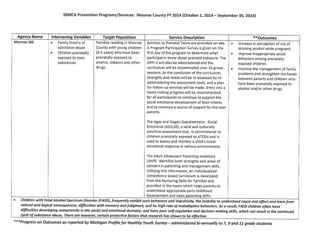
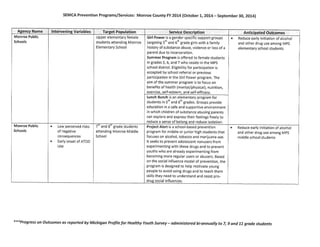
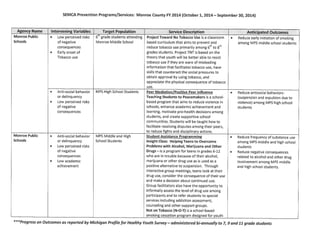
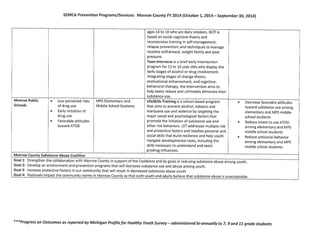
Prevention Programs Monroe Outcome Report
Appendix C
Prevention Programs Monroe Program Summary
Appendix D
Prevention Programs Monroe Programs Progress
Appendix E
Prevention Programs Type & Target Monroe ISD
Appendix F
Prevention Programs Type & Target Monroe Public Schools Data
Appendix G
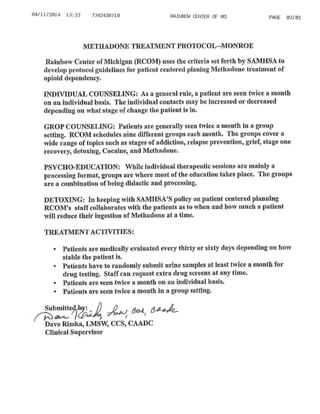
RCOM Methadone Treatment Protocol
Appendix H
Countering the Myths About Methadone_The Partnership at Drugfree
2
SUBSTANCE ABUSE; PUBLIC HEALTH ISSUE IN MONROE COUNTY
Substance Abuse; Public Health Issue In Monroe County
Kim Comerzan
Monroe County Health Department
Description of the Problem
Substance abuse is not new to Monroe County, however in recent years it has become a greater
concern, particularly with the upswing in the use of heroin and prescription drugs. However,
Monroe is not unique as many communities in Michigan and other parts of the country are
dealing with an increase in drug issues.
A review of drug deaths as presented by Dr. Carl Schmidt, Medical Examiner for Monroe
County reflects an increase in drug related deaths over the past 10 years. Since 2004 Monroe
County has seen a total of 285 drug related deaths with 75 of these related to heroin use, 68
related to methadone use, and 67 related to cocaine use. There are a variety of other drugs
identified such as alcohol alprazolam (Xanax), codeine, diazepam (Valium) and Citalopram
(Celexa, an antidepressant) in relation to death but in lesser numbers.
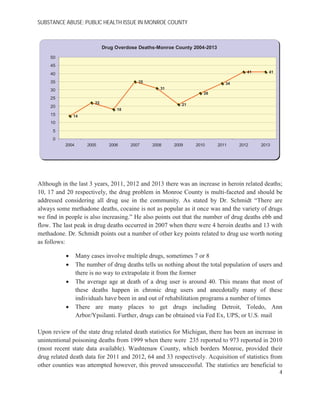
The total number of drug related deaths per year is listed below and then illustrated in a line
graph on the following page. Note that in 2004, there were a total of 14 deaths due to drug use
and 2013 saw 41 drug related deaths in Monroe County. It is also important to point out that
these deaths occurred in Monroe County and they may not all be Monroe County residents.
Year Cases Avg. Age Male Female
2004 14 37.5 9 5
2005 22 39.4 16 6
2006 18 36.3 11 7
2007 35 40.3 24 11
2008 31 39.5 19 12
2009 21 33.2 12 9
2010 28 39.4 16 12
2011 34 39.3 19 15
2012 41 38.4 22 19
2013 41_ 40.4 21 20
TOTAL 285
3
SUBSTANCE ABUSE; PUBLIC HEALTH ISSUE IN MONROE COUNTY
Drug Overdose Deaths-Monroe County 2004-2013
14
22
18
35
31
21
28
34
41 41
0
5
10
15
20
25
30
35
40
45
50
2004 2005 2006 2007 2008 2009 2010 2011 2012 2013
Although in the last 3 years, 2011, 2012 and 2013 there was an increase in heroin related deaths;
10, 17 and 20 respectively, the drug problem in Monroe County is multi-faceted and should be
addressed considering all drug use in the community. As stated by Dr. Schmidt โ€œThere are
always some methadone deaths, cocaine is not as popular as it once was and the variety of drugs
we find in people is also increasing.โ€ He also points out that the number of drug deaths ebb and
flow. The last peak in drug deaths occurred in 2007 when there were 4 heroin deaths and 13 with
methadone. Dr. Schmidt points out a number of other key points related to drug use worth noting
as follows:
Many cases involve multiple drugs, sometimes 7 or 8
The number of drug deaths tells us nothing about the total population of users and
there is no way to extrapolate it from the former
The average age at death of a drug user is around 40. This means that most of
these deaths happen in chronic drug users and anecdotally many of these
individuals have been in and out of rehabilitation programs a number of times
There are many places to get drugs including Detroit, Toledo, Ann
Arbor/Ypsilanti. Further, drugs can be obtained via Fed Ex, UPS, or U.S. mail
Upon review of the state drug related death statistics for Michigan, there has been an increase in
unintentional poisoning deaths from 1999 when there were 235 reported to 973 reported in 2010
(most recent state data available). Washtenaw County, which borders Monroe, provided their
drug related death data for 2011 and 2012, 64 and 33 respectively. Acquisition of statistics from
other counties was attempted however, this proved unsuccessful. The statistics are beneficial to
4
SUBSTANCE ABUSE; PUBLIC HEALTH ISSUE IN MONROE COUNTY
gauge where Monroe County rates in comparison to other counties and the state of Michigan. It
can be surmised that Monroe is in line with other counties across the state related to deaths
caused by drug use/abuse.
It should be noted that although the Monroe County Health Department does not provide
substance abuse treatment or prevention with the exception of one educational curriculum held in
schools upon request, the issue of substance abuse is a public health concern. Also, though
maybe not as significant as drug deaths or criminal acts related to drugs, the impact of drug use
on chronic communicable diseases such as HIV, Hepatitis B and C, Syphilis and Tuberculosis is
of concern. The vast majority of Hepatitis C cases we see in Monroe County are directly related
to injection drug use. Information from the National Survey on Drug Use and Health Report
from 2009 (most recent data attainable) identifies that of all the drugs injected in the U.S., heroin
remains the highest. This survey also states that the rate of past year injection drug use was
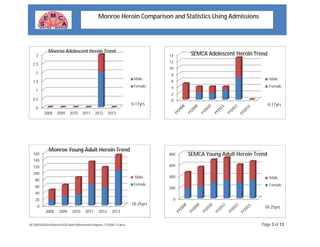
higher in persons 18 to 25 (0.28 percent) and 26 to 34 (0.26 percent) years of age. The rate of
injection use among 12 to 17 year olds was 0.09 percent, the lowest in the survey. This
information should be considered when planning prevention activities and the demographic
audiences targeted for these prevention/education activities. Demographic information for
Monroe County in 2012 as projected by the U.S. Census Bureau based on 2010 census data for
the targeted population is as follows:
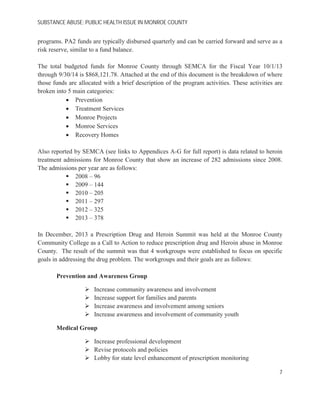
15 โ€“ 17 years of age
o Female 3,363
o Male 3,385
o Total 6,748
18 -24 years of age
o Female 6,168
o Male 6,595
o Total 12,763
Current activities and funding
The Monroe County Health Department through its Solid Waste Program and in partnership with
the Substance Abuse Coalition, Prosecuting Attorney, Michigan State Police and the Monroe
County Sheriffโ€™s Department sponsored 9 medication take back events beginning in May 2009.
The initial collection event took place at the Monroe County Health Department and twice per
year thereafter at multiple other locations. There were 1,205 participants at those events and a
total of 3,386 pounds of medication was received. The Solid Waste Program provided funding
for the mailers to publicize the 9 events at a cost of $15,000, and secured a contract and covered
the cost for a hazardous waste vendor for all 9 events at a cost of $12,000. The County received a
โ€œclean sweepโ€ state grant to cover this cost for two years for a total of $7,044.
5
SUBSTANCE ABUSE; PUBLIC HEALTH ISSUE IN MONROE COUNTY
The special medication take back events ceased at the point the Red Med Box Program was
implemented in 2013 allowing residents to bring their expired and unused medications at
anytime during open hours to 6 designated law enforcement offices. The locations are:
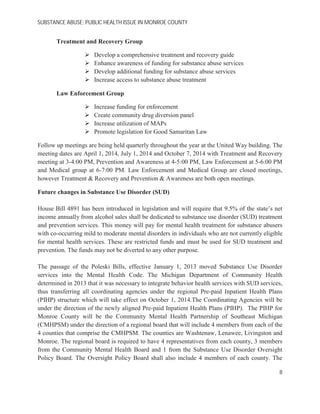
Michigan State Police Post
City of Monroe Police Department,
Bedford Substation of the Monroe County Sheriffโ€™s Department,
Dundee Village Police Department,
Carleton Police Department, and
Erie Township Police Department
The Solid Waste Program secured a grant to cover the cost of purchasing and painting all of the
Red Med Boxes, purchased boxes and bags used inside the bins to collect the medications and
the Solid Waste Program has committed to funding the cost for in-home mailers to promote the
Red Med Box Program in 2014 at a cost of $15,000. Jamie Dean, Coordinator of the Solid Waste
Program, has assisted in the roll out of the Red Med Box Program through presentations, press
releases, bin set up and delivery and serves as a member of the Substance Abuse Coalitionโ€™s
Prevention Task Force.
The Board of Commissioners will be sponsoring two upcoming additional medication take back
events in 2014. These will occur at Mercy Memorial Hospital on May 28, 2014 and at Carr Park
in Bedford Township on July 15, 2014.
There are multiple sources of funding currently allocated to dealing with the problem of
substance abuse in the state of Michigan. Those sources include Medicaid (treatment), Substance
Abuse Federal Block Grant, State of Michigan General Funds, County Public Act 2 (PA2) Funds
(Liquor tax), MICHILD (treatment) and the Adult Benefit Waiver (shifting to Medicaid with
Healthy Michigan plan which is the Medicaid expansion program). The Substance Abuse
Federal Block Grant dollars are allocated through the Substance Abuse and Mental Health
Services Administration (SAMSHA) to Michigan Department of Community Health (MDCH)
and then to the Center for Substance Abuse Treatment (CSAT) and the Center for Substance
Abuse Prevention (CSAP) to provide regulatory and technical assistance in the field. These
Federal Funds are matched with State general funds at approximately 75 to 25% respectively.
The PA2 dollars are generated from the liquor tax collected in the county. The tax is split 50/50
between the County and the Coordinating Agency (CA). These funds flow through the Monroe
County Health Department and go directly to the Southeast Michigan Community Alliance
(SEMCA), Monroe Countyโ€™s coordinating agency. SEMCA will remain the coordinating agency
until October 1, 2014. These funds are used for substance abuse treatment and/or prevention and
CANNOT be used for CA administration. The funds are more flexible than Federal Funds. They
are generally used for innovative programs but can also cover traditional treatment/prevention
6
SUBSTANCE ABUSE; PUBLIC HEALTH ISSUE IN MONROE COUNTY
programs. PA2 funds are typically disbursed quarterly and can be carried forward and serve as a
risk reserve, similar to a fund balance.
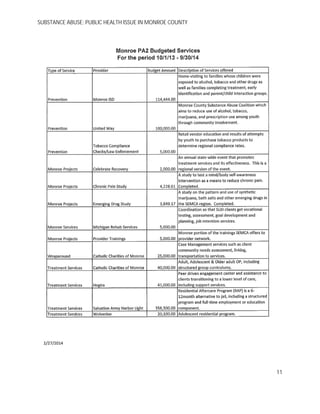
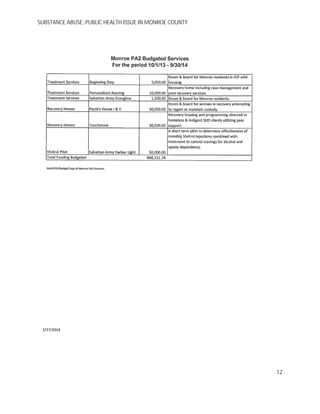
The total budgeted funds for Monroe County through SEMCA for the Fiscal Year 10/1/13
through 9/30/14 is $868,121.78. Attached at the end of this document is the breakdown of where
those funds are allocated with a brief description of the program activities. These activities are
broken into 5 main categories:
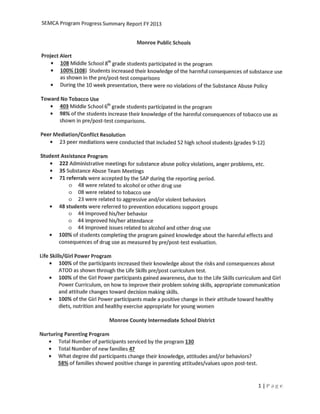
Prevention
Treatment Services
Monroe Projects
Monroe Services
Recovery Homes
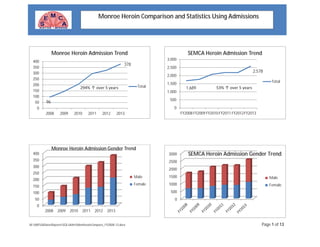
Also reported by SEMCA (see links to Appendices A-G for full report) is data related to heroin
treatment admissions for Monroe County that show an increase of 282 admissions since 2008.
The admissions per year are as follows:
2008 โ€“ 96
2009 โ€“ 144
2010 โ€“ 205
2011 โ€“ 297
2012 โ€“ 325
2013 โ€“ 378
In December, 2013 a Prescription Drug and Heroin Summit was held at the Monroe County
Community College as a Call to Action to reduce prescription drug and Heroin abuse in Monroe
County. The result of the summit was that 4 workgroups were established to focus on specific
goals in addressing the drug problem. The workgroups and their goals are as follows:
Prevention and Awareness Group
Increase community awareness and involvement
Increase support for families and parents
Increase awareness and involvement among seniors
Increase awareness and involvement of community youth
Medical Group
Increase professional development
Revise protocols and policies
Lobby for state level enhancement of prescription monitoring
7
SUBSTANCE ABUSE; PUBLIC HEALTH ISSUE IN MONROE COUNTY
Treatment and Recovery Group
Develop a comprehensive treatment and recovery guide
Enhance awareness of funding for substance abuse services
Develop additional funding for substance abuse services
Increase access to substance abuse treatment
Law Enforcement Group
Increase funding for enforcement
Create community drug diversion panel
Increase utilization of MAPs
Promote legislation for Good Samaritan Law
Follow up meetings are being held quarterly throughout the year at the United Way building. The
meeting dates are April 1, 2014, July 1, 2014 and October 7, 2014 with Treatment and Recovery
meeting at 3-4:00 PM, Prevention and Awareness at 4-5:00 PM, Law Enforcement at 5-6:00 PM
and Medical group at 6-7:00 PM. Law Enforcement and Medical Group are closed meetings,
however Treatment & Recovery and Prevention & Awareness are both open meetings.
Future changes in Substance Use Disorder (SUD)
House Bill 4891 has been introduced in legislation and will require that 9.5% of the stateโ€™s net
income annually from alcohol sales shall be dedicated to substance use disorder (SUD) treatment
and prevention services. This money will pay for mental health treatment for substance abusers
with co-occurring mild to moderate mental disorders in individuals who are not currently eligible
for mental health services. These are restricted funds and must be used for SUD treatment and
prevention. The funds may not be diverted to any other purpose.
The passage of the Poleski Bills, effective January 1, 2013 moved Substance Use Disorder
services into the Mental Health Code. The Michigan Department of Community Health
determined in 2013 that it was necessary to integrate behavior health services with SUD services,
thus transferring all coordinating agencies under the regional Pre-paid Inpatient Health Plans
(PIHP) structure which will take effect on October 1, 2014.The Coordinating Agencies will be
under the direction of the newly aligned Pre-paid Inpatient Health Plans (PIHP). The PIHP for
Monroe County will be the Community Mental Health Partnership of Southeast Michigan
(CMHPSM) under the direction of a regional board that will include 4 members from each of the
4 counties that comprise the CMHPSM. The counties are Washtenaw, Lenawee, Livingston and
Monroe. The regional board is required to have 4 representatives from each county, 3 members
from the Community Mental Health Board and 1 from the Substance Use Disorder Oversight
Policy Board. The Oversight Policy Board shall also include 4 members of each county. The
8
SUBSTANCE ABUSE; PUBLIC HEALTH ISSUE IN MONROE COUNTY
Monroe County Board of Commissioners designated these members from the county to sit on the
Substance Use Disorder Oversight Policy Board and include Commissioner Jon Cook, Floreine
Mentel, Tom Waldecker, and Kim Comerzan. These four individuals currently represent Monroe
County on the SEMCA Board of Directors as well.
This new structure will mean drastic changes in how SUD services are provided within Monroe
County. Options are being explored in relation to what this will look like for the County as the
structure develops. The four members of the SUD Oversight Policy Board have placed the best
interest of Monroe County for these services at the forefront of their agenda and are committed
to do everything in their power to ensure that adequate and appropriate SUD services remain
here for our residents.
Recommendations for future activities
Although there are many activities and individuals dedicated to making an impact on the drug
problem in Monroe County, it would be prudent to also explore other activities and projects that
may aid in the efforts against drug abuse in our communities.
First of all, it is necessary to understand who the drug users are in the county as well as the type
of drugs most used in the community. One method that will be utilized to glean this information
is a Community Health Needs Assessment. The Monroe County Health Department in
partnership with Mercy Memorial Hospital has acquired funding necessary to conduct such an
assessment. This assessment will be funded by the Monroe County Health Plan and coordinated
by the Hospital Council of Northwest Ohio. The Hospital Council of Northwest Ohio has
coordinated numerous community health assessments including our neighbor, Lenawee County.
The first meeting of community partners will be held on May 1, 2014 at 10:00 AM to 12:00 PM
at the Monroe County Health Department.
Analysis of the data collected as a result of the Community Health Needs Assessment will enable
better evaluation of current programs and support development of additional programs with
targeted efforts aimed at improved outcomes. Further, it is expected that the assessment data will
assist Monroe County in securing grant funding previously unavailable without the necessary
supporting data.
Second, education for prevention efforts is always recommended for many reasons but primarily
for avoiding the problems from drug abuse altogether and because it is cost effective. The current
education programs are primarily done by the Monroe County Substance Abuse Coalition and
are focused on school age youth, which is appropriate and necessary. However, it is evident that
the drugs of highest concern for Monroe County are prescription drugs and heroin. While
education related to prescription drugs is important to continue for our youth, it may prove
9
SUBSTANCE ABUSE; PUBLIC HEALTH ISSUE IN MONROE COUNTY
beneficial to explore education and awareness programs directed to young adults since this is the
demographic with the highest rate of heroin use from secondary survey data. We must also
acknowledge that this demographic is known for risky behaviors, hence the increased use. While
the majority will grow out of their use, a small percentage will continue their behavior and this
can then lead to addiction.
Third, there is evidence to support the effectiveness of implementing a screening, brief
intervention, and referral to treatment (SBIRT) program as a comprehensive approach in
behavioral healthcare. This is a project that Commissioner Jon Cook has spent time exploring
and is in support of piloting in Monroe County. Commissioner Cook has met with the SBIRT
coordinator in Washtenaw County and has obtained information related to this type of project.
Further exploration should identify funding and a local facility to consider this program as a pilot
program initially and then more permanent as program evaluation outcomes are known.
Fourth, a review of the Substance Abuse and Mental Health Services Administrationโ€™s
(SAMHSA) National Registry of Evidence-based Programs and Practices (NREPP), 3 evidence
based projects directed toward high school youth look promising and might be worth further
review. These projects are โ€œProject Towards No Drug Abuseโ€ and is designed to help students
develop self-control and communication skills, acquire resources to help resist drug use, improve
decision making skills and develop motivation to not use drugs. โ€œProject MAGIC (Making a
Group and Individual Commitment)โ€ is an alternative to juvenile detention for first-time drug
offenders. Finally โ€œProject Successโ€ is designed to prevent and reduce substance use among
students 12 to 18 years of age.
Currently, there are a number of activities occurring throughout the county through various
venues. All of these programs and activities appear viable and promising. The main point is that
prescription drug and heroin use is a community problem and it will take a collaborative and
coordinated effort to address and make an impact on the issue.
10
SUBSTANCE ABUSE; PUBLIC HEALTH ISSUE IN MONROE COUNTY
11
SUBSTANCE ABUSE; PUBLIC HEALTH ISSUE IN MONROE COUNTY
12
W:MISSADataReportsSQLAdmMonHeroinCompare_FY2008-13.docx Page 1 of 13
Monroe Heroin Comparison and Statistics Using Admissions
0
50
100
150
200
250
300
350
400
2008 2009 2010 2011 2012 2013
Monroe Heroin Admission Trend
Total
96
378
294% โ†‘ over 5 years
0
50
100
150
200
250
300
350
400
2008 2009 2010 2011 2012 2013
Monroe Heroin Admission Gender Trend
Male
Female
0
500
1,000
1,500
2,000
2,500
3,000
FY2008 FY2009 FY2010 FY2011 FY2012FY2013
SEMCA Heroin Admission Trend
Total
1,689
2,578
53% โ†‘ over 5 years
0
500
1000
1500
2000
2500
3000
Male
Female
SEMCA Heroin Admission Gender Trend
W:MISSADataReportsSQLAdmMonHeroinCompare_FY2008-13.docx Page 2 of 13
Monroe Heroin Comparison and Statistics Using Admissions
0
1
2
3
4
5
6
7
2008 2009 2010 2011 2012 2013
Monroe Pregnant With Heroin Trend
Total
0
50
100
150
200
250
2008 2009 2010 2011 2012 2013
Male
Female
Monroe Heroin With Mental Health Issues Trend
0
5
10
15
20
25
FY2008 FY2009 FY2010 FY2011 FY2012 FY2013
SEMCA Pregnant With Heroin Trend
Total
0
500
1000
1500
2000
Male
Female
SEMCA Heroin With Mental Health Issues Trend
W:MISSADataReportsSQLAdmMonHeroinCompare_FY2008-13.docx Page 3 of 13
Monroe Heroin Comparison and Statistics Using Admissions
0
0.5
1
1.5
2
2.5
3
2008 2009 2010 2011 2012 2013
Male
Female
Monroe Adolescent Heroin Trend
0-17yrs
0
20
40
60
80
100
120
140
160
2008 2009 2010 2011 2012 2013
Male
Female
Monroe Young Adult Heroin Trend
18-25yrs
0
2
4
6
8
10
12
14
Male
Female
SEMCA Adolescent Heroin Trend
0-17yrs
0
200
400
600
800
Male
Female
SEMCA Young Adult Heroin Trend
18-25yrs
W:MISSADataReportsSQLAdmMonHeroinCompare_FY2008-13.docx Page 4 of 13
Monroe Heroin Comparison and Statistics Using Admissions
0
50
100
150
200
250
2008 2009 2010 2011 2012 2013
Male
Female
Monroe Adult Heroin Trend
26-50yrs
0
1
2
3
4
5
6
7
8
9
2008 2009 2010 2011 2012 2013
Male
Female
Monroe Older Adult Heroin Trend
51yrs+
0
200
400
600
800
1000
1200
1400
1600
1800
Male
Female
SEMCA Adult Heroin Trend
26-50yrs
0
100
200
300
400
Male
Female
SEMCA Older Adult Heroin Trend
51yrs+
W:MISSADataReportsSQLAdmMonHeroinCompare_FY2008-13.docx Page 5 of 13
Monroe Heroin Comparison and Statistics Using Admissions
7, 2%
7, 2%
8, 2%
356, 94%
African
American/Black
Hispanic
Multi-racial
White
Monroe Heroin Admissions by Race 2013
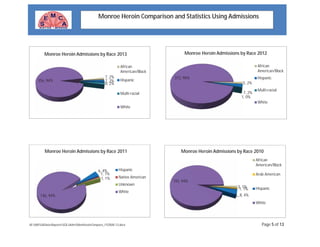
6, 4%
1, 1%
1, 1%
136, 94%
Hispanic
Native American
Unknown
White
Monroe Heroin Admissions by Race 2011
5, 2%
7, 2%
1, 0%
312, 96%
African
American/Black
Hispanic
Multi-racial
White
Monroe Heroin Admissions by Race 2012
3, 1%
1, 1%
8, 4%
193, 94%
African
American/Black
Arab American
Hispanic
White
Monroe Heroin Admissions by Race 2010
W:MISSADataReportsSQLAdmMonHeroinCompare_FY2008-13.docx Page 6 of 13
Monroe Heroin Comparison and Statistics Using Admissions
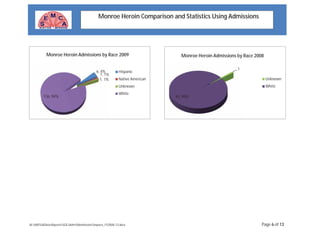
6, 4%
1, 1%
1, 1%
136, 94%
Hispanic
Native American
Unknown
White
Monroe Heroin Admissions by Race 2009
1
95, 99%
Unknown
White
Monroe Heroin Admissions by Race 2008
W:MISSADataReportsSQLAdmMonHeroinCompare_FY2008-13.docx Page 7 of 13
Monroe Heroin Comparison and Statistics Using Admissions
0
10
20
30
40
50
60
70
80
90
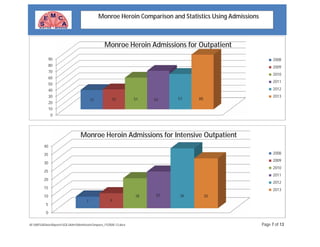
31 32 51 62 57 88
Monroe Heroin Admissions for Outpatient
2008
2009
2010
2011
2012
2013
0
5
10
15
20
25
30
35
40
7 9
18 22 36 30
Monroe Heroin Admissions for Intensive Outpatient
2008
2009
2010
2011
2012
2013
W:MISSADataReportsSQLAdmMonHeroinCompare_FY2008-13.docx Page 8 of 13
Monroe Heroin Comparison and Statistics Using Admissions
0
20
40
60
80
100
120
140
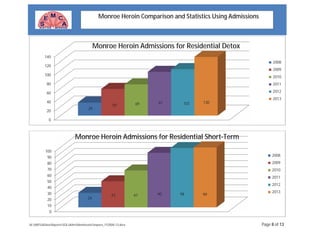
29
59 69 97 103 130
2008
2009
2010
2011
2012
2013
Monroe Heroin Admissions for Residential Detox
0
10
20
30
40
50
60
70
80
90
100
24
43 61 90 98 99
2008
2009
2010
2011
2012
2013
Monroe Heroin Admissions for Residential Short-Term
W:MISSADataReportsSQLAdmMonHeroinCompare_FY2008-13.docx Page 9 of 13
Monroe Heroin Comparison and Statistics Using Admissions
0
5
10
15
20
25
30
35
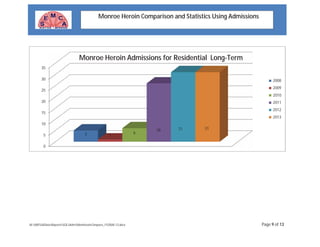
5 1
6
26 31 31
2008
2009
2010
2011
2012
2013
Monroe Heroin Admissions for Residential Long-Term
W:MISSADataReportsSQLAdmMonHeroinCompare_FY2008-13.docx Page 10 of 13
Monroe Heroin Comparison and Statistics Using Admissions
0
20
40
60
80
100
120
140
2008
2009
2010
2011
2012
2013
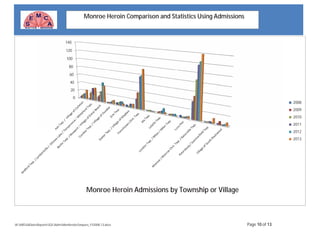
Monroe Heroin Admissions by Township or Village
W:MISSADataReportsSQLAdmMonHeroinCompare_FY2008-13.docx Page 11 of 13
Monroe Heroin Comparison and Statistics Using Admissions
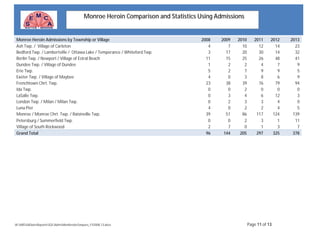
Monroe Heroin Admissions by Township or Village 2008 2009 2010 2011 2012 2013
Ash Twp. / Village of Carleton 4 7 10 12 14 23
Bedford Twp. / Lambertville / Ottawa Lake / Temperance / Whiteford Twp. 3 17 20 30 14 32
Berlin Twp. / Newport / Village of Estral Beach 11 15 25 26 48 41
Dundee Twp. / Village of Dundee 1 2 2 4 7 9
Erie Twp. 5 2 7 9 9 5
Exeter Twp. / Village of Maybee 4 0 3 8 6 9
Frenchtown Chrt. Twp. 23 38 39 76 79 94
Ida Twp. 0 0 2 0 0 0
LaSalle Twp. 0 3 4 6 12 3
London Twp. / Milan / Milan Twp. 0 2 3 3 4 0
Luna Pier 4 0 2 2 4 5
Monroe / Monroe Chrt. Twp. / Raisinville Twp. 39 51 86 117 124 139
Petersburg / Summerfield Twp. 0 0 2 3 1 11
Village of South Rockwood 2 7 0 1 3 7
Grand Total 96 144 205 297 325 378
W:MISSADataReportsSQLAdmMonHeroinCompare_FY2008-13.docx Page 12 of 13
Monroe Heroin Comparison and Statistics Using Admissions
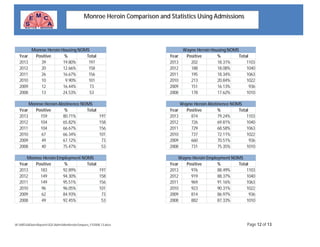
Year Positive % Total
2013 39 19.80% 197
2012 20 12.66% 158
2011 26 16.67% 156
2010 10 9.90% 101
2009 12 16.44% 73
2008 13 24.53% 53
Monroe Heroin Housing NOMS
Year Positive % Total
2013 159 80.71% 197
2012 104 65.82% 158
2011 104 66.67% 156
2010 67 66.34% 101
2009 49 67.12% 73
2008 40 75.47% 53
Monroe Heroin Abstinence NOMS
Year Positive % Total
2013 183 92.89% 197
2012 149 94.30% 158
2011 149 95.51% 156
2010 96 96.05% 101
2009 62 84.93% 73
2008 49 92.45% 53
Monroe Heroin Employment NOMS
Year Positive % Total
2013 202 18.31% 1103
2012 188 18.08% 1040
2011 195 18.34% 1063
2010 213 20.84% 1022
2009 151 16.13% 936
2008 178 17.62% 1010
Wayne Heroin Housing NOMS
Year Positive % Total
2013 874 79.24% 1103
2012 726 69.81% 1040
2011 729 68.58% 1063
2010 737 72.11% 1022
2009 660 70.51% 936
2008 731 75.35% 1010
Wayne Heroin Abstinence NOMS
Year Positive % Total
2013 976 88.49% 1103
2012 919 88.37% 1040
2011 969 91.16% 1063
2010 923 90.31% 1022
2009 814 86.97% 936
2008 882 87.33% 1010
Wayne Heroin Employment NOMS
W:MISSADataReportsSQLAdmMonHeroinCompare_FY2008-13.docx Page 13 of 13
Monroe Heroin Comparison and Statistics Using Admissions
Year Positive % Total
2013 60 30.46% 197
2012 75 47.47% 158
2011 103 66.03% 156
2010 80 79.21% 101
2009 55 75.34% 73
2008 28 52.83% 53
Monroe Heroin SocialConnectedness NOMS
Year Positive % Total
2013 411 37.26% 1103
2012 506 48.65% 1040
2011 594 55.88% 1063
2010 655 64.09% 1022
2009 616 65.81% 936
2008 451 44.65% 1010
Wayne Heroin SocialConnectedness NOMS
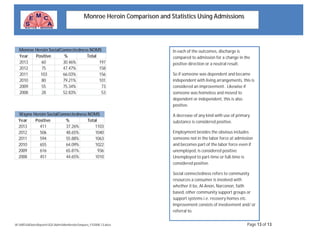
In each of the outcomes, discharge is
compared to admission for a change in the
positive direction or a neutral result.
So if someone was dependent and became
independent with living arrangements, this is
considered an improvement. Likewise if
someone was homeless and moved to
dependent or independent, this is also
positive.
A decrease of any kind with use of primary
substance is considered positive.
Employment besides the obvious includes
someone not in the labor force at admission
and becomes part of the labor force even if
unemployed, is considered positive.
Unemployed to part-time or full-time is
considered positive.
Social connectedness refers to community
resources a consumer is involved with
whether it be, Al-Anon, Narconon, faith
based, other community support groups or
support systems i.e. recovery homes etc.
Improvement consists of involvement and/ or
referral to.
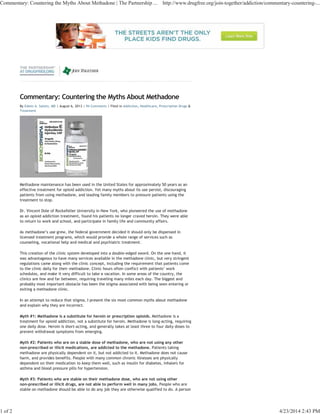
Commentary: Countering the Myths About Methadone
By Edwin A. Salsitz, MD | August 6, 2013 | 94 Comments | Filed in Addiction, Healthcare, Prescription Drugs &
Treatment
Methadone maintenance has been used in the United States for approximately 50 years as an
effective treatment for opioid addiction. Yet many myths about its use persist, discouraging
patients from using methadone, and leading family members to pressure patients using the
treatment to stop.
Dr. Vincent Dole of Rockefeller University in New York, who pioneered the use of methadone
as an opioid addiction treatment, found his patients no longer craved heroin. They were able
to return to work and school, and participate in family life and community affairs.
As methadoneโ€™s use grew, the federal government decided it should only be dispensed in
licensed treatment programs, which would provide a whole range of services such as
counseling, vocational help and medical and psychiatric treatment.
This creation of the clinic system developed into a double-edged sword. On the one hand, it
was advantageous to have many services available in the methadone clinic, but very stringent
regulations came along with the clinic concept, including the requirement that patients come
to the clinic daily for their methadone. Clinic hours often conflict with patientsโ€™ work
schedules, and make it very difficult to take a vacation. In some areas of the country, the
clinics are few and far between, requiring traveling many miles each day. The biggest and
probably most important obstacle has been the stigma associated with being seen entering or
exiting a methadone clinic.
In an attempt to reduce that stigma, I present the six most common myths about methadone
and explain why they are incorrect.
Myth #1: Methadone is a substitute for heroin or prescription opioids. Methadone is a
treatment for opioid addiction, not a substitute for heroin. Methadone is long-acting, requiring
one daily dose. Heroin is short-acting, and generally takes at least three to four daily doses to
prevent withdrawal symptoms from emerging.
Myth #2: Patients who are on a stable dose of methadone, who are not using any other
non-prescribed or illicit medications, are addicted to the methadone. Patients taking
methadone are physically dependent on it, but not addicted to it. Methadone does not cause
harm, and provides benefits. People with many common chronic illnesses are physically
dependent on their medication to keep them well, such as insulin for diabetes, inhalers for
asthma and blood pressure pills for hypertension.
Myth #3: Patients who are stable on their methadone dose, who are not using other
non-prescribed or illicit drugs, are not able to perform well in many jobs. People who are
stable on methadone should be able to do any job they are otherwise qualified to do. A person
Commentary: Countering the Myths About Methadone | The Partnership ... http://www.drugfree.org/join-together/addiction/commentary-countering-...
1 of 2 4/23/2014 2:43 PM
stabilized on the correct dose is not sedated, in withdrawal or euphoric. The most common
description of how a person feels on methadone is โ€œnormal.โ€
Myth #4: Methadone rots teeth and bones. After 50 years of use, methadone remains a safe
medication. There are side effects from taking methadone and other opioids, such as
constipation and increased sweating. These are usually easily manageable. If patients engage
in good dental hygiene, they should not have any dental problems.
Myth #5: Methadone is not advisable in pregnant women. The evidence over the years has
shown that a pregnant woman addicted to opioids has the best possible outcome for herself
and her fetus if she takes either methadone or buprenorphine. A pregnancyโ€™s outcomes are
better for mother and newborn if the mother remains on methadone than if she tapers off and
attempts to be abstinent during pregnancy. Methadone does not cause any abnormalities in
the fetus and does not appear to cause cognitive or any other abnormalities in these children
as they grow up. Babies born to mothers on methadone will experience neonatal abstinence
syndrome, which occurs in most newborns whose mothers were taking opioids during
pregnancy. This syndrome is treated and managed somewhat easily and outcomes for the
newborn are goodโ€”it is not a reason for a pregnant woman to avoid methadone treatment.
Mothers on methadone should breastfeed unless there is some other contraindication, such as
being HIV-positive.
Myth #6: Methadone makes you sterile. This is untrue. Methadone may lower serum
testosterone in men, but this problem is easily diagnosed and treated.
These myths, and the stigma of methadone treatment that accompanies them, are pervasive
and persistent issues for methadone patients. They are often embarrassed to tell their other
physicians, dentists and family members about their treatment. They may feel they are doing
something wrong, when in fact they are doing something very positive for themselves and
their loved ones. These misperceptions can only be corrected with more education for
patients, families, health care providers and the general public.
Edwin A. Salsitz, MD, FASAM, is Medical Director, Office-Based Opioid
Therapy at Beth Israel Medical Center in New York.
PHOTO SOURCE: https://healthy.kaiserpermanente.org
Commentary: Countering the Myths About Methadone | The Partnership ... http://www.drugfree.org/join-together/addiction/commentary-countering-...
2 of 2 4/23/2014 2:43 PM

Substance Abuse Monroe, Michigan

  • 1.
    Substance Abuse Issues In MonroeCounty Prepared for the Monroe County Board of Commissioners Jerry A. Oley, Chairman Prepared by: Kim Comerzan, MSN, RN Health Officer, Monroe County Health Department May, 2014
  • 2.
    SUBSTANCE ABUSE; PUBLICHEALTH ISSUE IN MONROE COUNTY Table of Contents Description of Problemโ€ฆโ€ฆโ€ฆโ€ฆโ€ฆโ€ฆโ€ฆโ€ฆโ€ฆโ€ฆโ€ฆโ€ฆโ€ฆโ€ฆโ€ฆโ€ฆโ€ฆโ€ฆโ€ฆโ€ฆโ€ฆ3 Current Activities and Fundingโ€ฆโ€ฆโ€ฆโ€ฆโ€ฆโ€ฆโ€ฆโ€ฆโ€ฆโ€ฆโ€ฆโ€ฆโ€ฆโ€ฆโ€ฆโ€ฆโ€ฆ...5 Future Changes in Substance Abuse Disorder โ€ฆโ€ฆโ€ฆโ€ฆโ€ฆโ€ฆโ€ฆโ€ฆโ€ฆโ€ฆโ€ฆ..8 Recommendations for Future Activitiesโ€ฆโ€ฆโ€ฆโ€ฆโ€ฆโ€ฆโ€ฆโ€ฆโ€ฆโ€ฆโ€ฆโ€ฆโ€ฆโ€ฆ9 Monroe PA2 Budgeted Servicesโ€ฆโ€ฆโ€ฆโ€ฆโ€ฆโ€ฆโ€ฆโ€ฆโ€ฆโ€ฆโ€ฆโ€ฆโ€ฆโ€ฆโ€ฆโ€ฆ...11 APPENDICES Appendix A Demographic and Treatment Stats โ€“ Monroe County Heroin Appendix B Prevention Programs Monroe Outcome Report Appendix C Prevention Programs Monroe Program Summary Appendix D Prevention Programs Monroe Programs Progress Appendix E Prevention Programs Type & Target Monroe ISD Appendix F Prevention Programs Type & Target Monroe Public Schools Data Appendix G RCOM Methadone Treatment Protocol Appendix H Countering the Myths About Methadone_The Partnership at Drugfree 2
  • 3.
    SUBSTANCE ABUSE; PUBLICHEALTH ISSUE IN MONROE COUNTY Substance Abuse; Public Health Issue In Monroe County Kim Comerzan Monroe County Health Department Description of the Problem Substance abuse is not new to Monroe County, however in recent years it has become a greater concern, particularly with the upswing in the use of heroin and prescription drugs. However, Monroe is not unique as many communities in Michigan and other parts of the country are dealing with an increase in drug issues. A review of drug deaths as presented by Dr. Carl Schmidt, Medical Examiner for Monroe County reflects an increase in drug related deaths over the past 10 years. Since 2004 Monroe County has seen a total of 285 drug related deaths with 75 of these related to heroin use, 68 related to methadone use, and 67 related to cocaine use. There are a variety of other drugs identified such as alcohol alprazolam (Xanax), codeine, diazepam (Valium) and Citalopram (Celexa, an antidepressant) in relation to death but in lesser numbers. The total number of drug related deaths per year is listed below and then illustrated in a line graph on the following page. Note that in 2004, there were a total of 14 deaths due to drug use and 2013 saw 41 drug related deaths in Monroe County. It is also important to point out that these deaths occurred in Monroe County and they may not all be Monroe County residents. Year Cases Avg. Age Male Female 2004 14 37.5 9 5 2005 22 39.4 16 6 2006 18 36.3 11 7 2007 35 40.3 24 11 2008 31 39.5 19 12 2009 21 33.2 12 9 2010 28 39.4 16 12 2011 34 39.3 19 15 2012 41 38.4 22 19 2013 41_ 40.4 21 20 TOTAL 285 3
  • 4.
    SUBSTANCE ABUSE; PUBLICHEALTH ISSUE IN MONROE COUNTY Drug Overdose Deaths-Monroe County 2004-2013 14 22 18 35 31 21 28 34 41 41 0 5 10 15 20 25 30 35 40 45 50 2004 2005 2006 2007 2008 2009 2010 2011 2012 2013 Although in the last 3 years, 2011, 2012 and 2013 there was an increase in heroin related deaths; 10, 17 and 20 respectively, the drug problem in Monroe County is multi-faceted and should be addressed considering all drug use in the community. As stated by Dr. Schmidt โ€œThere are always some methadone deaths, cocaine is not as popular as it once was and the variety of drugs we find in people is also increasing.โ€ He also points out that the number of drug deaths ebb and flow. The last peak in drug deaths occurred in 2007 when there were 4 heroin deaths and 13 with methadone. Dr. Schmidt points out a number of other key points related to drug use worth noting as follows: Many cases involve multiple drugs, sometimes 7 or 8 The number of drug deaths tells us nothing about the total population of users and there is no way to extrapolate it from the former The average age at death of a drug user is around 40. This means that most of these deaths happen in chronic drug users and anecdotally many of these individuals have been in and out of rehabilitation programs a number of times There are many places to get drugs including Detroit, Toledo, Ann Arbor/Ypsilanti. Further, drugs can be obtained via Fed Ex, UPS, or U.S. mail Upon review of the state drug related death statistics for Michigan, there has been an increase in unintentional poisoning deaths from 1999 when there were 235 reported to 973 reported in 2010 (most recent state data available). Washtenaw County, which borders Monroe, provided their drug related death data for 2011 and 2012, 64 and 33 respectively. Acquisition of statistics from other counties was attempted however, this proved unsuccessful. The statistics are beneficial to 4
  • 5.
    SUBSTANCE ABUSE; PUBLICHEALTH ISSUE IN MONROE COUNTY gauge where Monroe County rates in comparison to other counties and the state of Michigan. It can be surmised that Monroe is in line with other counties across the state related to deaths caused by drug use/abuse. It should be noted that although the Monroe County Health Department does not provide substance abuse treatment or prevention with the exception of one educational curriculum held in schools upon request, the issue of substance abuse is a public health concern. Also, though maybe not as significant as drug deaths or criminal acts related to drugs, the impact of drug use on chronic communicable diseases such as HIV, Hepatitis B and C, Syphilis and Tuberculosis is of concern. The vast majority of Hepatitis C cases we see in Monroe County are directly related to injection drug use. Information from the National Survey on Drug Use and Health Report from 2009 (most recent data attainable) identifies that of all the drugs injected in the U.S., heroin remains the highest. This survey also states that the rate of past year injection drug use was higher in persons 18 to 25 (0.28 percent) and 26 to 34 (0.26 percent) years of age. The rate of injection use among 12 to 17 year olds was 0.09 percent, the lowest in the survey. This information should be considered when planning prevention activities and the demographic audiences targeted for these prevention/education activities. Demographic information for Monroe County in 2012 as projected by the U.S. Census Bureau based on 2010 census data for the targeted population is as follows: 15 โ€“ 17 years of age o Female 3,363 o Male 3,385 o Total 6,748 18 -24 years of age o Female 6,168 o Male 6,595 o Total 12,763 Current activities and funding The Monroe County Health Department through its Solid Waste Program and in partnership with the Substance Abuse Coalition, Prosecuting Attorney, Michigan State Police and the Monroe County Sheriffโ€™s Department sponsored 9 medication take back events beginning in May 2009. The initial collection event took place at the Monroe County Health Department and twice per year thereafter at multiple other locations. There were 1,205 participants at those events and a total of 3,386 pounds of medication was received. The Solid Waste Program provided funding for the mailers to publicize the 9 events at a cost of $15,000, and secured a contract and covered the cost for a hazardous waste vendor for all 9 events at a cost of $12,000. The County received a โ€œclean sweepโ€ state grant to cover this cost for two years for a total of $7,044. 5
  • 6.
    SUBSTANCE ABUSE; PUBLICHEALTH ISSUE IN MONROE COUNTY The special medication take back events ceased at the point the Red Med Box Program was implemented in 2013 allowing residents to bring their expired and unused medications at anytime during open hours to 6 designated law enforcement offices. The locations are: Michigan State Police Post City of Monroe Police Department, Bedford Substation of the Monroe County Sheriffโ€™s Department, Dundee Village Police Department, Carleton Police Department, and Erie Township Police Department The Solid Waste Program secured a grant to cover the cost of purchasing and painting all of the Red Med Boxes, purchased boxes and bags used inside the bins to collect the medications and the Solid Waste Program has committed to funding the cost for in-home mailers to promote the Red Med Box Program in 2014 at a cost of $15,000. Jamie Dean, Coordinator of the Solid Waste Program, has assisted in the roll out of the Red Med Box Program through presentations, press releases, bin set up and delivery and serves as a member of the Substance Abuse Coalitionโ€™s Prevention Task Force. The Board of Commissioners will be sponsoring two upcoming additional medication take back events in 2014. These will occur at Mercy Memorial Hospital on May 28, 2014 and at Carr Park in Bedford Township on July 15, 2014. There are multiple sources of funding currently allocated to dealing with the problem of substance abuse in the state of Michigan. Those sources include Medicaid (treatment), Substance Abuse Federal Block Grant, State of Michigan General Funds, County Public Act 2 (PA2) Funds (Liquor tax), MICHILD (treatment) and the Adult Benefit Waiver (shifting to Medicaid with Healthy Michigan plan which is the Medicaid expansion program). The Substance Abuse Federal Block Grant dollars are allocated through the Substance Abuse and Mental Health Services Administration (SAMSHA) to Michigan Department of Community Health (MDCH) and then to the Center for Substance Abuse Treatment (CSAT) and the Center for Substance Abuse Prevention (CSAP) to provide regulatory and technical assistance in the field. These Federal Funds are matched with State general funds at approximately 75 to 25% respectively. The PA2 dollars are generated from the liquor tax collected in the county. The tax is split 50/50 between the County and the Coordinating Agency (CA). These funds flow through the Monroe County Health Department and go directly to the Southeast Michigan Community Alliance (SEMCA), Monroe Countyโ€™s coordinating agency. SEMCA will remain the coordinating agency until October 1, 2014. These funds are used for substance abuse treatment and/or prevention and CANNOT be used for CA administration. The funds are more flexible than Federal Funds. They are generally used for innovative programs but can also cover traditional treatment/prevention 6
  • 7.
    SUBSTANCE ABUSE; PUBLICHEALTH ISSUE IN MONROE COUNTY programs. PA2 funds are typically disbursed quarterly and can be carried forward and serve as a risk reserve, similar to a fund balance. The total budgeted funds for Monroe County through SEMCA for the Fiscal Year 10/1/13 through 9/30/14 is $868,121.78. Attached at the end of this document is the breakdown of where those funds are allocated with a brief description of the program activities. These activities are broken into 5 main categories: Prevention Treatment Services Monroe Projects Monroe Services Recovery Homes Also reported by SEMCA (see links to Appendices A-G for full report) is data related to heroin treatment admissions for Monroe County that show an increase of 282 admissions since 2008. The admissions per year are as follows: 2008 โ€“ 96 2009 โ€“ 144 2010 โ€“ 205 2011 โ€“ 297 2012 โ€“ 325 2013 โ€“ 378 In December, 2013 a Prescription Drug and Heroin Summit was held at the Monroe County Community College as a Call to Action to reduce prescription drug and Heroin abuse in Monroe County. The result of the summit was that 4 workgroups were established to focus on specific goals in addressing the drug problem. The workgroups and their goals are as follows: Prevention and Awareness Group Increase community awareness and involvement Increase support for families and parents Increase awareness and involvement among seniors Increase awareness and involvement of community youth Medical Group Increase professional development Revise protocols and policies Lobby for state level enhancement of prescription monitoring 7
  • 8.
    SUBSTANCE ABUSE; PUBLICHEALTH ISSUE IN MONROE COUNTY Treatment and Recovery Group Develop a comprehensive treatment and recovery guide Enhance awareness of funding for substance abuse services Develop additional funding for substance abuse services Increase access to substance abuse treatment Law Enforcement Group Increase funding for enforcement Create community drug diversion panel Increase utilization of MAPs Promote legislation for Good Samaritan Law Follow up meetings are being held quarterly throughout the year at the United Way building. The meeting dates are April 1, 2014, July 1, 2014 and October 7, 2014 with Treatment and Recovery meeting at 3-4:00 PM, Prevention and Awareness at 4-5:00 PM, Law Enforcement at 5-6:00 PM and Medical group at 6-7:00 PM. Law Enforcement and Medical Group are closed meetings, however Treatment & Recovery and Prevention & Awareness are both open meetings. Future changes in Substance Use Disorder (SUD) House Bill 4891 has been introduced in legislation and will require that 9.5% of the stateโ€™s net income annually from alcohol sales shall be dedicated to substance use disorder (SUD) treatment and prevention services. This money will pay for mental health treatment for substance abusers with co-occurring mild to moderate mental disorders in individuals who are not currently eligible for mental health services. These are restricted funds and must be used for SUD treatment and prevention. The funds may not be diverted to any other purpose. The passage of the Poleski Bills, effective January 1, 2013 moved Substance Use Disorder services into the Mental Health Code. The Michigan Department of Community Health determined in 2013 that it was necessary to integrate behavior health services with SUD services, thus transferring all coordinating agencies under the regional Pre-paid Inpatient Health Plans (PIHP) structure which will take effect on October 1, 2014.The Coordinating Agencies will be under the direction of the newly aligned Pre-paid Inpatient Health Plans (PIHP). The PIHP for Monroe County will be the Community Mental Health Partnership of Southeast Michigan (CMHPSM) under the direction of a regional board that will include 4 members from each of the 4 counties that comprise the CMHPSM. The counties are Washtenaw, Lenawee, Livingston and Monroe. The regional board is required to have 4 representatives from each county, 3 members from the Community Mental Health Board and 1 from the Substance Use Disorder Oversight Policy Board. The Oversight Policy Board shall also include 4 members of each county. The 8
  • 9.
    SUBSTANCE ABUSE; PUBLICHEALTH ISSUE IN MONROE COUNTY Monroe County Board of Commissioners designated these members from the county to sit on the Substance Use Disorder Oversight Policy Board and include Commissioner Jon Cook, Floreine Mentel, Tom Waldecker, and Kim Comerzan. These four individuals currently represent Monroe County on the SEMCA Board of Directors as well. This new structure will mean drastic changes in how SUD services are provided within Monroe County. Options are being explored in relation to what this will look like for the County as the structure develops. The four members of the SUD Oversight Policy Board have placed the best interest of Monroe County for these services at the forefront of their agenda and are committed to do everything in their power to ensure that adequate and appropriate SUD services remain here for our residents. Recommendations for future activities Although there are many activities and individuals dedicated to making an impact on the drug problem in Monroe County, it would be prudent to also explore other activities and projects that may aid in the efforts against drug abuse in our communities. First of all, it is necessary to understand who the drug users are in the county as well as the type of drugs most used in the community. One method that will be utilized to glean this information is a Community Health Needs Assessment. The Monroe County Health Department in partnership with Mercy Memorial Hospital has acquired funding necessary to conduct such an assessment. This assessment will be funded by the Monroe County Health Plan and coordinated by the Hospital Council of Northwest Ohio. The Hospital Council of Northwest Ohio has coordinated numerous community health assessments including our neighbor, Lenawee County. The first meeting of community partners will be held on May 1, 2014 at 10:00 AM to 12:00 PM at the Monroe County Health Department. Analysis of the data collected as a result of the Community Health Needs Assessment will enable better evaluation of current programs and support development of additional programs with targeted efforts aimed at improved outcomes. Further, it is expected that the assessment data will assist Monroe County in securing grant funding previously unavailable without the necessary supporting data. Second, education for prevention efforts is always recommended for many reasons but primarily for avoiding the problems from drug abuse altogether and because it is cost effective. The current education programs are primarily done by the Monroe County Substance Abuse Coalition and are focused on school age youth, which is appropriate and necessary. However, it is evident that the drugs of highest concern for Monroe County are prescription drugs and heroin. While education related to prescription drugs is important to continue for our youth, it may prove 9
  • 10.
    SUBSTANCE ABUSE; PUBLICHEALTH ISSUE IN MONROE COUNTY beneficial to explore education and awareness programs directed to young adults since this is the demographic with the highest rate of heroin use from secondary survey data. We must also acknowledge that this demographic is known for risky behaviors, hence the increased use. While the majority will grow out of their use, a small percentage will continue their behavior and this can then lead to addiction. Third, there is evidence to support the effectiveness of implementing a screening, brief intervention, and referral to treatment (SBIRT) program as a comprehensive approach in behavioral healthcare. This is a project that Commissioner Jon Cook has spent time exploring and is in support of piloting in Monroe County. Commissioner Cook has met with the SBIRT coordinator in Washtenaw County and has obtained information related to this type of project. Further exploration should identify funding and a local facility to consider this program as a pilot program initially and then more permanent as program evaluation outcomes are known. Fourth, a review of the Substance Abuse and Mental Health Services Administrationโ€™s (SAMHSA) National Registry of Evidence-based Programs and Practices (NREPP), 3 evidence based projects directed toward high school youth look promising and might be worth further review. These projects are โ€œProject Towards No Drug Abuseโ€ and is designed to help students develop self-control and communication skills, acquire resources to help resist drug use, improve decision making skills and develop motivation to not use drugs. โ€œProject MAGIC (Making a Group and Individual Commitment)โ€ is an alternative to juvenile detention for first-time drug offenders. Finally โ€œProject Successโ€ is designed to prevent and reduce substance use among students 12 to 18 years of age. Currently, there are a number of activities occurring throughout the county through various venues. All of these programs and activities appear viable and promising. The main point is that prescription drug and heroin use is a community problem and it will take a collaborative and coordinated effort to address and make an impact on the issue. 10
  • 11.
    SUBSTANCE ABUSE; PUBLICHEALTH ISSUE IN MONROE COUNTY 11
  • 12.
    SUBSTANCE ABUSE; PUBLICHEALTH ISSUE IN MONROE COUNTY 12
  • 13.
    W:MISSADataReportsSQLAdmMonHeroinCompare_FY2008-13.docx Page 1of 13 Monroe Heroin Comparison and Statistics Using Admissions 0 50 100 150 200 250 300 350 400 2008 2009 2010 2011 2012 2013 Monroe Heroin Admission Trend Total 96 378 294% โ†‘ over 5 years 0 50 100 150 200 250 300 350 400 2008 2009 2010 2011 2012 2013 Monroe Heroin Admission Gender Trend Male Female 0 500 1,000 1,500 2,000 2,500 3,000 FY2008 FY2009 FY2010 FY2011 FY2012FY2013 SEMCA Heroin Admission Trend Total 1,689 2,578 53% โ†‘ over 5 years 0 500 1000 1500 2000 2500 3000 Male Female SEMCA Heroin Admission Gender Trend
  • 14.
    W:MISSADataReportsSQLAdmMonHeroinCompare_FY2008-13.docx Page 2of 13 Monroe Heroin Comparison and Statistics Using Admissions 0 1 2 3 4 5 6 7 2008 2009 2010 2011 2012 2013 Monroe Pregnant With Heroin Trend Total 0 50 100 150 200 250 2008 2009 2010 2011 2012 2013 Male Female Monroe Heroin With Mental Health Issues Trend 0 5 10 15 20 25 FY2008 FY2009 FY2010 FY2011 FY2012 FY2013 SEMCA Pregnant With Heroin Trend Total 0 500 1000 1500 2000 Male Female SEMCA Heroin With Mental Health Issues Trend
  • 15.
    W:MISSADataReportsSQLAdmMonHeroinCompare_FY2008-13.docx Page 3of 13 Monroe Heroin Comparison and Statistics Using Admissions 0 0.5 1 1.5 2 2.5 3 2008 2009 2010 2011 2012 2013 Male Female Monroe Adolescent Heroin Trend 0-17yrs 0 20 40 60 80 100 120 140 160 2008 2009 2010 2011 2012 2013 Male Female Monroe Young Adult Heroin Trend 18-25yrs 0 2 4 6 8 10 12 14 Male Female SEMCA Adolescent Heroin Trend 0-17yrs 0 200 400 600 800 Male Female SEMCA Young Adult Heroin Trend 18-25yrs
  • 16.
    W:MISSADataReportsSQLAdmMonHeroinCompare_FY2008-13.docx Page 4of 13 Monroe Heroin Comparison and Statistics Using Admissions 0 50 100 150 200 250 2008 2009 2010 2011 2012 2013 Male Female Monroe Adult Heroin Trend 26-50yrs 0 1 2 3 4 5 6 7 8 9 2008 2009 2010 2011 2012 2013 Male Female Monroe Older Adult Heroin Trend 51yrs+ 0 200 400 600 800 1000 1200 1400 1600 1800 Male Female SEMCA Adult Heroin Trend 26-50yrs 0 100 200 300 400 Male Female SEMCA Older Adult Heroin Trend 51yrs+
  • 17.
    W:MISSADataReportsSQLAdmMonHeroinCompare_FY2008-13.docx Page 5of 13 Monroe Heroin Comparison and Statistics Using Admissions 7, 2% 7, 2% 8, 2% 356, 94% African American/Black Hispanic Multi-racial White Monroe Heroin Admissions by Race 2013 6, 4% 1, 1% 1, 1% 136, 94% Hispanic Native American Unknown White Monroe Heroin Admissions by Race 2011 5, 2% 7, 2% 1, 0% 312, 96% African American/Black Hispanic Multi-racial White Monroe Heroin Admissions by Race 2012 3, 1% 1, 1% 8, 4% 193, 94% African American/Black Arab American Hispanic White Monroe Heroin Admissions by Race 2010
  • 18.
    W:MISSADataReportsSQLAdmMonHeroinCompare_FY2008-13.docx Page 6of 13 Monroe Heroin Comparison and Statistics Using Admissions 6, 4% 1, 1% 1, 1% 136, 94% Hispanic Native American Unknown White Monroe Heroin Admissions by Race 2009 1 95, 99% Unknown White Monroe Heroin Admissions by Race 2008
  • 19.
    W:MISSADataReportsSQLAdmMonHeroinCompare_FY2008-13.docx Page 7of 13 Monroe Heroin Comparison and Statistics Using Admissions 0 10 20 30 40 50 60 70 80 90 31 32 51 62 57 88 Monroe Heroin Admissions for Outpatient 2008 2009 2010 2011 2012 2013 0 5 10 15 20 25 30 35 40 7 9 18 22 36 30 Monroe Heroin Admissions for Intensive Outpatient 2008 2009 2010 2011 2012 2013
  • 20.
    W:MISSADataReportsSQLAdmMonHeroinCompare_FY2008-13.docx Page 8of 13 Monroe Heroin Comparison and Statistics Using Admissions 0 20 40 60 80 100 120 140 29 59 69 97 103 130 2008 2009 2010 2011 2012 2013 Monroe Heroin Admissions for Residential Detox 0 10 20 30 40 50 60 70 80 90 100 24 43 61 90 98 99 2008 2009 2010 2011 2012 2013 Monroe Heroin Admissions for Residential Short-Term
  • 21.
    W:MISSADataReportsSQLAdmMonHeroinCompare_FY2008-13.docx Page 9of 13 Monroe Heroin Comparison and Statistics Using Admissions 0 5 10 15 20 25 30 35 5 1 6 26 31 31 2008 2009 2010 2011 2012 2013 Monroe Heroin Admissions for Residential Long-Term
  • 22.
    W:MISSADataReportsSQLAdmMonHeroinCompare_FY2008-13.docx Page 10of 13 Monroe Heroin Comparison and Statistics Using Admissions 0 20 40 60 80 100 120 140 2008 2009 2010 2011 2012 2013 Monroe Heroin Admissions by Township or Village
  • 23.
    W:MISSADataReportsSQLAdmMonHeroinCompare_FY2008-13.docx Page 11of 13 Monroe Heroin Comparison and Statistics Using Admissions Monroe Heroin Admissions by Township or Village 2008 2009 2010 2011 2012 2013 Ash Twp. / Village of Carleton 4 7 10 12 14 23 Bedford Twp. / Lambertville / Ottawa Lake / Temperance / Whiteford Twp. 3 17 20 30 14 32 Berlin Twp. / Newport / Village of Estral Beach 11 15 25 26 48 41 Dundee Twp. / Village of Dundee 1 2 2 4 7 9 Erie Twp. 5 2 7 9 9 5 Exeter Twp. / Village of Maybee 4 0 3 8 6 9 Frenchtown Chrt. Twp. 23 38 39 76 79 94 Ida Twp. 0 0 2 0 0 0 LaSalle Twp. 0 3 4 6 12 3 London Twp. / Milan / Milan Twp. 0 2 3 3 4 0 Luna Pier 4 0 2 2 4 5 Monroe / Monroe Chrt. Twp. / Raisinville Twp. 39 51 86 117 124 139 Petersburg / Summerfield Twp. 0 0 2 3 1 11 Village of South Rockwood 2 7 0 1 3 7 Grand Total 96 144 205 297 325 378
  • 24.
    W:MISSADataReportsSQLAdmMonHeroinCompare_FY2008-13.docx Page 12of 13 Monroe Heroin Comparison and Statistics Using Admissions Year Positive % Total 2013 39 19.80% 197 2012 20 12.66% 158 2011 26 16.67% 156 2010 10 9.90% 101 2009 12 16.44% 73 2008 13 24.53% 53 Monroe Heroin Housing NOMS Year Positive % Total 2013 159 80.71% 197 2012 104 65.82% 158 2011 104 66.67% 156 2010 67 66.34% 101 2009 49 67.12% 73 2008 40 75.47% 53 Monroe Heroin Abstinence NOMS Year Positive % Total 2013 183 92.89% 197 2012 149 94.30% 158 2011 149 95.51% 156 2010 96 96.05% 101 2009 62 84.93% 73 2008 49 92.45% 53 Monroe Heroin Employment NOMS Year Positive % Total 2013 202 18.31% 1103 2012 188 18.08% 1040 2011 195 18.34% 1063 2010 213 20.84% 1022 2009 151 16.13% 936 2008 178 17.62% 1010 Wayne Heroin Housing NOMS Year Positive % Total 2013 874 79.24% 1103 2012 726 69.81% 1040 2011 729 68.58% 1063 2010 737 72.11% 1022 2009 660 70.51% 936 2008 731 75.35% 1010 Wayne Heroin Abstinence NOMS Year Positive % Total 2013 976 88.49% 1103 2012 919 88.37% 1040 2011 969 91.16% 1063 2010 923 90.31% 1022 2009 814 86.97% 936 2008 882 87.33% 1010 Wayne Heroin Employment NOMS
  • 25.
    W:MISSADataReportsSQLAdmMonHeroinCompare_FY2008-13.docx Page 13of 13 Monroe Heroin Comparison and Statistics Using Admissions Year Positive % Total 2013 60 30.46% 197 2012 75 47.47% 158 2011 103 66.03% 156 2010 80 79.21% 101 2009 55 75.34% 73 2008 28 52.83% 53 Monroe Heroin SocialConnectedness NOMS Year Positive % Total 2013 411 37.26% 1103 2012 506 48.65% 1040 2011 594 55.88% 1063 2010 655 64.09% 1022 2009 616 65.81% 936 2008 451 44.65% 1010 Wayne Heroin SocialConnectedness NOMS In each of the outcomes, discharge is compared to admission for a change in the positive direction or a neutral result. So if someone was dependent and became independent with living arrangements, this is considered an improvement. Likewise if someone was homeless and moved to dependent or independent, this is also positive. A decrease of any kind with use of primary substance is considered positive. Employment besides the obvious includes someone not in the labor force at admission and becomes part of the labor force even if unemployed, is considered positive. Unemployed to part-time or full-time is considered positive. Social connectedness refers to community resources a consumer is involved with whether it be, Al-Anon, Narconon, faith based, other community support groups or support systems i.e. recovery homes etc. Improvement consists of involvement and/ or referral to.
  • 46.
    Commentary: Countering theMyths About Methadone By Edwin A. Salsitz, MD | August 6, 2013 | 94 Comments | Filed in Addiction, Healthcare, Prescription Drugs & Treatment Methadone maintenance has been used in the United States for approximately 50 years as an effective treatment for opioid addiction. Yet many myths about its use persist, discouraging patients from using methadone, and leading family members to pressure patients using the treatment to stop. Dr. Vincent Dole of Rockefeller University in New York, who pioneered the use of methadone as an opioid addiction treatment, found his patients no longer craved heroin. They were able to return to work and school, and participate in family life and community affairs. As methadoneโ€™s use grew, the federal government decided it should only be dispensed in licensed treatment programs, which would provide a whole range of services such as counseling, vocational help and medical and psychiatric treatment. This creation of the clinic system developed into a double-edged sword. On the one hand, it was advantageous to have many services available in the methadone clinic, but very stringent regulations came along with the clinic concept, including the requirement that patients come to the clinic daily for their methadone. Clinic hours often conflict with patientsโ€™ work schedules, and make it very difficult to take a vacation. In some areas of the country, the clinics are few and far between, requiring traveling many miles each day. The biggest and probably most important obstacle has been the stigma associated with being seen entering or exiting a methadone clinic. In an attempt to reduce that stigma, I present the six most common myths about methadone and explain why they are incorrect. Myth #1: Methadone is a substitute for heroin or prescription opioids. Methadone is a treatment for opioid addiction, not a substitute for heroin. Methadone is long-acting, requiring one daily dose. Heroin is short-acting, and generally takes at least three to four daily doses to prevent withdrawal symptoms from emerging. Myth #2: Patients who are on a stable dose of methadone, who are not using any other non-prescribed or illicit medications, are addicted to the methadone. Patients taking methadone are physically dependent on it, but not addicted to it. Methadone does not cause harm, and provides benefits. People with many common chronic illnesses are physically dependent on their medication to keep them well, such as insulin for diabetes, inhalers for asthma and blood pressure pills for hypertension. Myth #3: Patients who are stable on their methadone dose, who are not using other non-prescribed or illicit drugs, are not able to perform well in many jobs. People who are stable on methadone should be able to do any job they are otherwise qualified to do. A person Commentary: Countering the Myths About Methadone | The Partnership ... http://www.drugfree.org/join-together/addiction/commentary-countering-... 1 of 2 4/23/2014 2:43 PM
  • 47.
    stabilized on thecorrect dose is not sedated, in withdrawal or euphoric. The most common description of how a person feels on methadone is โ€œnormal.โ€ Myth #4: Methadone rots teeth and bones. After 50 years of use, methadone remains a safe medication. There are side effects from taking methadone and other opioids, such as constipation and increased sweating. These are usually easily manageable. If patients engage in good dental hygiene, they should not have any dental problems. Myth #5: Methadone is not advisable in pregnant women. The evidence over the years has shown that a pregnant woman addicted to opioids has the best possible outcome for herself and her fetus if she takes either methadone or buprenorphine. A pregnancyโ€™s outcomes are better for mother and newborn if the mother remains on methadone than if she tapers off and attempts to be abstinent during pregnancy. Methadone does not cause any abnormalities in the fetus and does not appear to cause cognitive or any other abnormalities in these children as they grow up. Babies born to mothers on methadone will experience neonatal abstinence syndrome, which occurs in most newborns whose mothers were taking opioids during pregnancy. This syndrome is treated and managed somewhat easily and outcomes for the newborn are goodโ€”it is not a reason for a pregnant woman to avoid methadone treatment. Mothers on methadone should breastfeed unless there is some other contraindication, such as being HIV-positive. Myth #6: Methadone makes you sterile. This is untrue. Methadone may lower serum testosterone in men, but this problem is easily diagnosed and treated. These myths, and the stigma of methadone treatment that accompanies them, are pervasive and persistent issues for methadone patients. They are often embarrassed to tell their other physicians, dentists and family members about their treatment. They may feel they are doing something wrong, when in fact they are doing something very positive for themselves and their loved ones. These misperceptions can only be corrected with more education for patients, families, health care providers and the general public. Edwin A. Salsitz, MD, FASAM, is Medical Director, Office-Based Opioid Therapy at Beth Israel Medical Center in New York. PHOTO SOURCE: https://healthy.kaiserpermanente.org Commentary: Countering the Myths About Methadone | The Partnership ... http://www.drugfree.org/join-together/addiction/commentary-countering-... 2 of 2 4/23/2014 2:43 PM