Health and Health Care Landscape
of Osceola and Lake Counties
Research Results from the 2011 Community-
Wide Health Needs Assessment
Prepared by:
A Research Project for
Prepared by:
Martin Hill, PhD
Megan Mullins, PhD
Linda Warner
Laurie Van Ark
The Carl Frost Center for Social Science Research
Hope College
November 2011
Table of Contents
Page
Introduction 6
Background and Objectives 7
Executive Summary 9
Detailed Findings 15
Secondary Data Sources 16
Social Indicators 17
Health Indicators 25
Carl Frost Center for Social Science Research 3
Health Indicators 25
Chronic Health Conditions 36
Adult Risk Behaviors 38
Youth Risk Behaviors 42
Health Care Access 46
Hospital Data 49
Table of Contents (Cont’d.)
Page
Detailed Findings (Cont’d.)
Key Stakeholder In-Depth Interviews 53
Health Care Issues and Accessibility 54
Existing Programs and Services 60
Community Resources and the
Future of Health Care 67
Key Informant Online Survey 70
Carl Frost Center for Social Science Research 4
Key Informant Online Survey 70
Health Conditions 71
Health Behaviors 76
Access to Health Care 80
Gaps in Health Care 88
Barriers to Health Care 93
Identifying and Addressing Needs 96
Table of Contents (Cont’d.)
Page
Detailed Findings (Cont’d.)
Self-Administered Resident Survey 101
Health Landscape of the Community 102
Health Care Access 111
Experience with Health Care Providers 116
General Health Status 122
Conclusion 124
Carl Frost Center for Social Science Research 5
Conclusion 124
Suggested Priorities/Next Steps 140
Methodology 151
APPENDIX 154
Respondent Profiles 155
Definitions of Commonly Used Terms 160
INTRODUCTION
Background and Objectives
The Carl Frost Center for Social Science Research was contracted by
Spectrum Health Reed City Hospital (SHRCH) to conduct a community-wide
health needs assessment in Osceola and Lake counties.
The Patient Protection and Affordable Care Act (PPACA) passed by
Congress in March of 2010 set forth additional requirements that hospitals
must meet in order to maintain their status as a 501(c)(3) Charitable Hospital
Organization. One of the main requirements states that a hospital must
conduct a community health needs assessment (CHNA) and must adopt an
implementation strategy to meet the community health needs identified
Carl Frost Center for Social Science Research 7
implementation strategy to meet the community health needs identified
through the assessment. The law further states that the assessment takes
into account input from persons who represent the broad interests of the
community including those with special knowledge of, or expertise in, public
health.
In response to the PPACA requirements, the CHNA team of SHRCH began
meeting to discuss how the community could collectively meet the
requirement of a CHNA.
Background and Objectives (Cont’d.)
The overall objective of the CHNA is to identify key health and health service
issues in Osceola and Lake counties. The results will be used to assist in
planning, implementation of programs and services, evaluating results,
allocation of resources, and achieving improved health outcomes, specifically
related to identified needs.
More specifically, objectives include:
Gauge the overall health climate or landscape in both counties
Determine positive and negative health indicators
Identify risk behaviors
Carl Frost Center for Social Science Research 8
Identify risk behaviors
Measure the prevalence of chronic conditions
Establish health care access
Ascertain barriers and obstacles to health care
Uncover gaps in health care services or programs
Identify health disparities
EXECUTIVE SUMMARY
Executive Summary
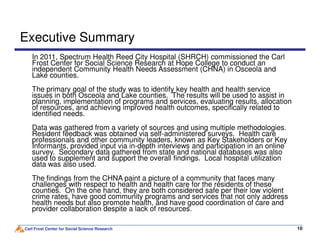
In 2011, Spectrum Health Reed City Hospital (SHRCH) commissioned the Carl
Frost Center for Social Science Research at Hope College to conduct an
independent Community Health Needs Assessment (CHNA) in Osceola and
Lake counties.
The primary goal of the study was to identify key health and health service
issues in both Osceola and Lake counties. The results will be used to assist in
planning, implementation of programs and services, evaluating results, allocation
of resources, and achieving improved health outcomes, specifically related to
identified needs.
Data was gathered from a variety of sources and using multiple methodologies.
Carl Frost Center for Social Science Research 1010
Data was gathered from a variety of sources and using multiple methodologies.
Resident feedback was obtained via self-administered surveys. Health care
professionals and other community leaders, known as Key Stakeholders or Key
Informants, provided input via in-depth interviews and participation in an online
survey. Secondary data gathered from state and national databases was also
used to supplement and support the overall findings. Local hospital utilization
data was also used.
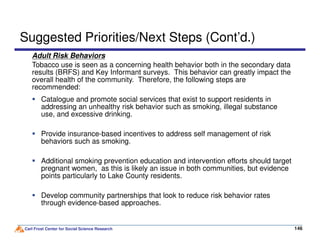
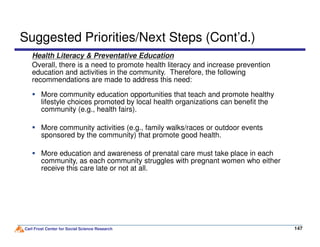
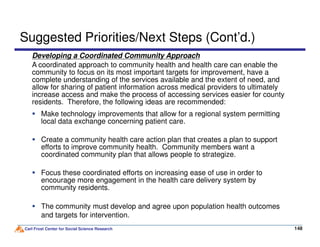
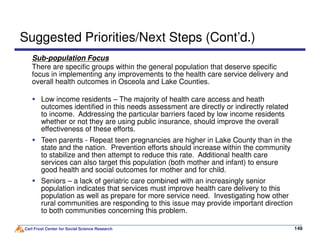
The findings from the CHNA paint a picture of a community that faces many
challenges with respect to health and health care for the residents of these
counties. On the one hand, they are both considered safe per their low violent
crime rates, have good community programs and services that not only address
health needs but also promote health, and have good coordination of care and
provider collaboration despite a lack of resources.
Executive Summary (Cont’d.)
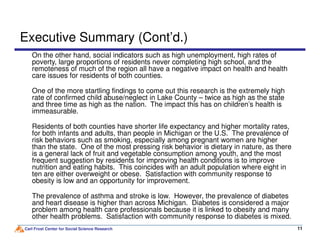
On the other hand, social indicators such as high unemployment, high rates of
poverty, large proportions of residents never completing high school, and the
remoteness of much of the region all have a negative impact on health and health
care issues for residents of both counties.
One of the more startling findings to come out this research is the extremely high
rate of confirmed child abuse/neglect in Lake County – twice as high as the state
and three time as high as the nation. The impact this has on children’s health is
immeasurable.
Residents of both counties have shorter life expectancy and higher mortality rates,
Carl Frost Center for Social Science Research 1111
Residents of both counties have shorter life expectancy and higher mortality rates,
for both infants and adults, than people in Michigan or the U.S. The prevalence of
risk behaviors such as smoking, especially among pregnant women are higher
than the state. One of the most pressing risk behavior is dietary in nature, as there
is a general lack of fruit and vegetable consumption among youth, and the most
frequent suggestion by residents for improving health conditions is to improve
nutrition and eating habits. This coincides with an adult population where eight in
ten are either overweight or obese. Satisfaction with community response to
obesity is low and an opportunity for improvement.
The prevalence of asthma and stroke is low. However, the prevalence of diabetes
and heart disease is higher than across Michigan. Diabetes is considered a major
problem among health care professionals because it is linked to obesity and many
other health problems. Satisfaction with community response to diabetes is mixed.
Executive Summary (Cont’d.)
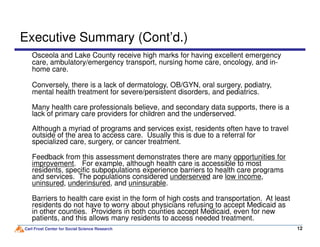
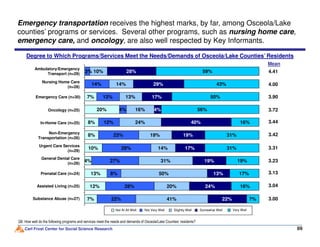
Osceola and Lake County receive high marks for having excellent emergency
care, ambulatory/emergency transport, nursing home care, oncology, and in-
home care.
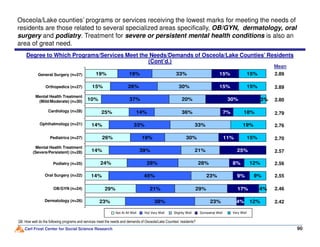
Conversely, there is a lack of dermatology, OB/GYN, oral surgery, podiatry,
mental health treatment for severe/persistent disorders, and pediatrics.
Many health care professionals believe, and secondary data supports, there is a
lack of primary care providers for children and the underserved.
Carl Frost Center for Social Science Research 1212
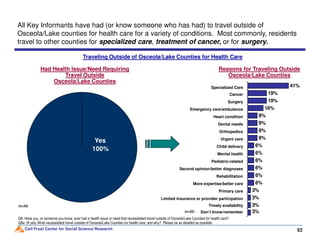
Although a myriad of programs and services exist, residents often have to travel
outside of the area to access care. Usually this is due to a referral for
specialized care, surgery, or cancer treatment.
Feedback from this assessment demonstrates there are many opportunities for
improvement. For example, although health care is accessible to most
residents, specific subpopulations experience barriers to health care programs
and services. The populations considered underserved are low income,
uninsured, underinsured, and uninsurable.
Barriers to health care exist in the form of high costs and transportation. At least
residents do not have to worry about physicians refusing to accept Medicaid as
in other counties. Providers in both counties accept Medicaid, even for new
patients, and this allows many residents to access needed treatment.
Executive Summary (Cont’d.)
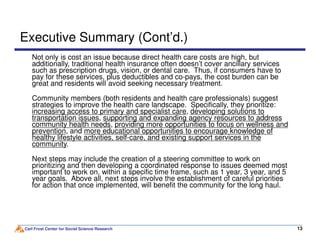
Not only is cost an issue because direct health care costs are high, but
additionally, traditional health insurance often doesn’t cover ancillary services
such as prescription drugs, vision, or dental care. Thus, if consumers have to
pay for these services, plus deductibles and co-pays, the cost burden can be
great and residents will avoid seeking necessary treatment.
Community members (both residents and health care professionals) suggest
strategies to improve the health care landscape. Specifically, they prioritize:
increasing access to primary and specialist care, developing solutions to
transportation issues, supporting and expanding agency resources to address
community health needs, providing more opportunities to focus on wellness and
Carl Frost Center for Social Science Research 1313
community health needs, providing more opportunities to focus on wellness and
prevention, and more educational opportunities to encourage knowledge of
healthy lifestyle activities, self-care, and existing support services in the
community.
Next steps may include the creation of a steering committee to work on
prioritizing and then developing a coordinated response to issues deemed most
important to work on, within a specific time frame, such as 1 year, 3 year, and 5
year goals. Above all, next steps involve the establishment of careful priorities
for action that once implemented, will benefit the community for the long haul.
Executive Summary (Cont’d.)
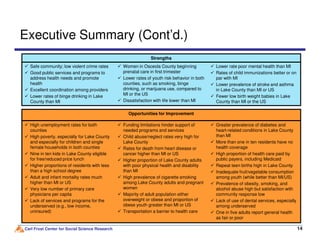
Strengths
Safe community; low violent crime rates
Good public services and programs to
address health needs and promote
health
Excellent coordination among providers
Lower rates of binge drinking in Lake
County than MI
Women in Osceola County beginning
prenatal care in first trimester
Lower rates of youth risk behavior in both
counties, such as smoking, binge
drinking, or marijuana use, compared to
MI or the US
Dissatisfaction with life lower than MI
Lower rate poor mental health than MI
Rates of child immunizations better or on
par with MI
Lower prevalence of stroke and asthma
in Lake County than MI or US
Fewer low birth weight babies in Lake
County than MI or the US
Opportunities for Improvement
High unemployment rates for both Funding limitations hinder support of Greater prevalence of diabetes and
Carl Frost Center for Social Science Research 1414
High unemployment rates for both
counties
High poverty, especially for Lake County
and especially for children and single
female households in both counties
Nine in ten kids in Lake County eligible
for free/reduced price lunch
Higher proportions of residents with less
than a high school degree
Adult and infant mortality rates much
higher than MI or US
Very low number of primary care
physicians per capita
Lack of services and programs for the
underserved (e.g., low income,
uninsured)
Funding limitations hinder support of
needed programs and services
Child abuse/neglect rates very high for
Lake County
Rates for death from heart disease or
cancer higher than MI or US
Higher proportion of Lake County adults
with poor physical health and disability
than MI
High prevalence of cigarette smoking
among Lake County adults and pregnant
women
Majority of adult population either
overweight or obese and proportion of
obese youth greater than MI or US
Transportation a barrier to health care
Greater prevalence of diabetes and
heart-related conditions in Lake County
than MI
More than one in ten residents have no
health coverage
High proportion of health care paid by
public payers, including Medicaid
Repeat teen births high in Lake County
Inadequate fruit/vegetable consumption
among youth (while better than MI/US)
Prevalence of obesity, smoking, and
alcohol abuse high but satisfaction with
community response low
Lack of use of dental services, especially
among underserved
One in five adults report general health
as fair or poor
DETAILED FINDINGS
Secondary Data Sources
Social Indicators
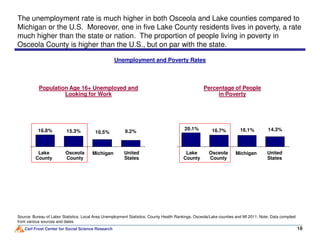
Unemployment and Poverty Rates
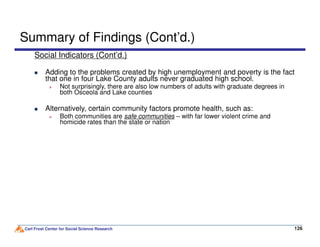
The unemployment rate is much higher in both Osceola and Lake counties compared to
Michigan or the U.S. Moreover, one in five Lake County residents lives in poverty, a rate
much higher than the state or nation. The proportion of people living in poverty in
Osceola County is higher than the U.S., but on par with the state.
Percentage of People
in Poverty
Population Age 16+ Unemployed and
Looking for Work
Carl Frost Center for Social Science Research 18
Source: Bureau of Labor Statistics, Local Area Unemployment Statistics; County Health Rankings. Osceola/Lake counties and MI 2011; Note: Data compiled
from various sources and dates
20.1% 16.7% 14.3%16.1%
Michigan United
States
Osceola
County
16.8% 15.3% 9.2%10.5%
Michigan United
States
Osceola
County
Lake
County
Lake
County
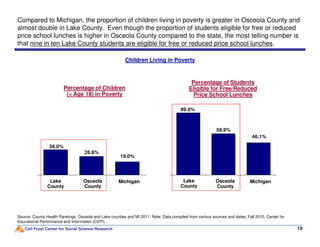
89.0%
Children Living in Poverty
Compared to Michigan, the proportion of children living in poverty is greater in Osceola County and
almost double in Lake County. Even though the proportion of students eligible for free or reduced
price school lunches is higher in Osceola County compared to the state, the most telling number is
that nine in ten Lake County students are eligible for free or reduced price school lunches.
Percentage of Students
Eligible for Free/Reduced
Price School Lunches
Percentage of Children
(< Age 18) in Poverty
Carl Frost Center for Social Science Research
46.1%
58.9%
19
Source: County Health Rankings. Osceola and Lake counties and MI 2011; Note: Data compiled from various sources and dates; Fall 2010, Center for
Educational Performance and Information (CEPI).
36.0%
19.0%
26.6%
MichiganOsceola
County
MichiganOsceola
County
Lake
County
Lake
County
61.5%
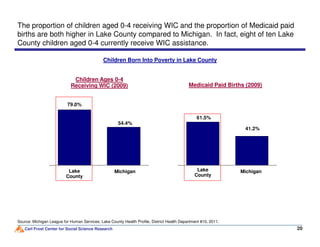
Children Born Into Poverty in Lake County
The proportion of children aged 0-4 receiving WIC and the proportion of Medicaid paid
births are both higher in Lake County compared to Michigan. In fact, eight of ten Lake
County children aged 0-4 currently receive WIC assistance.
Medicaid Paid Births (2009)
54.4%
79.0%
Children Ages 0-4
Receiving WIC (2009)
Carl Frost Center for Social Science Research
41.2%
20
54.4%
MichiganLake
County
MichiganLake
County
Source: Michigan League for Human Services; Lake County Health Profile, District Health Department #10, 2011.
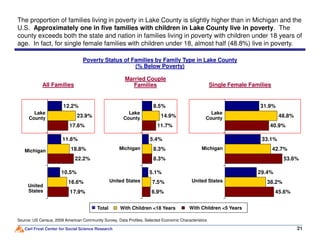
48.8%
40.9%
31.9%
14.9%
11.7%
8.5%
23.9%
17.6%
12.2%
Poverty Status of Families by Family Type in Lake County
(% Below Poverty)
The proportion of families living in poverty in Lake County is slightly higher than in Michigan and the
U.S. Approximately one in five families with children in Lake County live in poverty. The
county exceeds both the state and nation in families living in poverty with children under 18 years of
age. In fact, for single female families with children under 18, almost half (48.8%) live in poverty.
Lake
County
All Families Single Female Families
Married Couple
Families
Lake
County
Lake
County
Carl Frost Center for Social Science Research
42.7%
38.2%
40.9%
53.6%
45.6%
33.1%
29.4%
8.3%
7.5%
11.7%
8.3%
6.9%
5.4%
5.1%
18.8%
16.6%
17.6%
22.2%
17.9%
11.6%
10.5%
21
Source: US Census, 2009 American Community Survey, Data Profiles, Selected Economic Characteristics
Michigan
United
States
Total With Children <18 Years With Children <5 Years
Michigan
United States
Michigan
United States
46.0%
40.3%
39.8%
11.5%
5.1%
7.4%
20.7%
17.4%
12.7%
Poverty Status of Families by Family Type in Osceola County
(% Below Poverty)
Like Lake County, the proportion of families living in poverty in Osceola County is slightly
higher than in Michigan and the U.S. Two in five (39.8%) single female families live in
poverty in Osceola County, vs. 31.9% in Lake County.
Osceola
County
All Families Single Female Families
Married Couple
Families
Osceola
County
Osceola
County
Carl Frost Center for Social Science Research
42.7%
38.2%
40.3%
53.6%
45.6%
33.1%
29.4%
8.3%
7.5%
5.1%
8.3%
6.9%
5.4%
5.1%
18.8%
16.6%
17.4%
22.2%
17.9%
11.6%
10.5%
22
Source: US Census, 2009 American Community Survey, Data Profiles, Selected Economic Characteristics
Michigan
United
States
Total With Children <18 Years With Children <5 Years
Michigan
United States
Michigan
United States
Educational Level Age 25+
Greater proportions of Osceola and Lake County men and women have not graduated
from high school in comparison to Michigan or the U.S. In fact, three in ten Lake County
residents have not graduated from high school, regardless of gender. Conversely, less
than 3% of Lake County residents have graduate degrees.
Men Women
Lake
County
Osceola
County
Michigan U.S.
Lake
County
Osceola
County
Michigan U.S.
No Schooling Completed 0.3% 0.6% 0.8% 1.1% 0.4% 0.3% 0.8% 1.1%
Did Not Graduate High School 30.1% 20.6% 12.6% 15.0% 24.7% 17.6% 9.5% 11.9%
High School Graduate, GED,
or Alternative
38.5% 44.0% 31.5% 29.2% 41.0% 43.6% 32.1% 29.4%
Carl Frost Center for Social Science Research 23
Source: U.S. Census Bureau, American Community Survey, 1-year estimates
or Alternative
Some College, No Degree 19.3% 18.3% 23.0% 19.8% 21.2% 20.4% 23.2% 20.8%
Associate’s Degree 3.8% 4.3% 6.9% 6.7% 4.9% 7.8% 8.9% 8.1%
Bachelor’s Degree 5.8% 8.1% 15.3% 17.6% 5.4% 7.5% 15.0% 17.3%
Master’s Degree 1.6% 3.1% 6.6% 6.8% 1.8% 2.2% 6.9% 7.3%
Professional School Degree 0.3% 0.7% 2.2% 2.5% 0.6% 0.6% 1.2% 1.5%
Doctorate Degree 0.2% 0.4% 1.2% 1.5% 0.0% 0.1% 0.6% 0.8%
0.4
5.46.61.0
536.0
Crime Rates
Violent Crime Rate
Per 100,000 Population
Homicide Rate Per 100,000 Population
Osceola
County
Michigan United
States
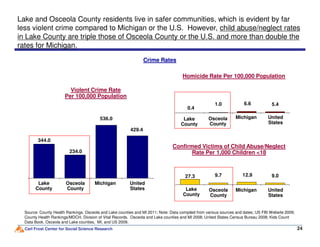
Lake and Osceola County residents live in safer communities, which is evident by far
less violent crime compared to Michigan or the U.S. However, child abuse/neglect rates
in Lake County are triple those of Osceola County or the U.S. and more than double the
rates for Michigan.
Lake
County
Carl Frost Center for Social Science Research
27.3 9.012.99.7
344.0
429.4
234.0
Osceola
County
Michigan United
States
24
Source: County Health Rankings. Osceola and Lake counties and MI 2011; Note: Data compiled from various sources and dates; US FBI Website 2009;
County Health Rankings/MDCH, Division of Vital Records. Osceola and Lake counties and MI 2008; United States Census Bureau 2008; Kids Count
Data Book. Osceola and Lake counties, MI, and US 2009.
County States
Confirmed Victims of Child Abuse/Neglect
Rate Per 1,000 Children <18
Michigan United
States
Osceola
County
Lake
County
County
Lake
County
Health Indicators
74.1
80.880.478.978.9
74.1 75.4 75.9
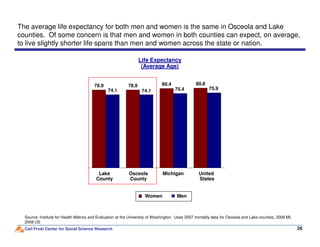
Life Expectancy
(Average Age)
The average life expectancy for both men and women is the same in Osceola and Lake
counties. Of some concern is that men and women in both counties can expect, on average,
to live slightly shorter life spans than men and women across the state or nation.
Carl Frost Center for Social Science Research 26
Osceola
County
Michigan United
States
Source: Institute for Health Metrics and Evaluation at the University of Washington. Uses 2007 mortality data for Osceola and Lake counties, 2009 MI,
2008 US
Women Men
Lake
County
891.9
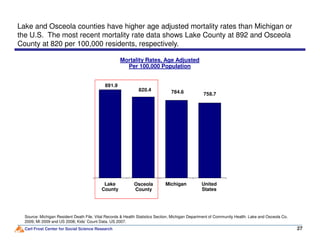
758.7784.6820.4
Mortality Rates, Age Adjusted
Per 100,000 Population
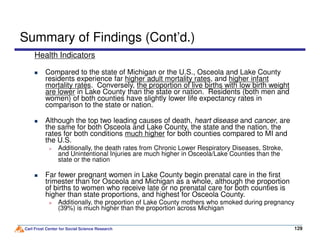
Lake and Osceola counties have higher age adjusted mortality rates than Michigan or
the U.S. The most recent mortality rate data shows Lake County at 892 and Osceola
County at 820 per 100,000 residents, respectively.
Carl Frost Center for Social Science Research 27
Osceola
County
Michigan United
States
Source: Michigan Resident Death File, Vital Records & Health Statistics Section, Michigan Department of Community Health. Lake and Osceola Co.
2009; MI 2009 and US 2008; Kids’ Count Data. US 2007.
Lake
County
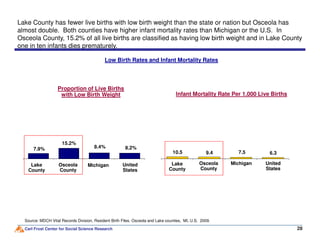
Proportion of Live Births
with Low Birth Weight
Low Birth Rates and Infant Mortality Rates
Lake County has fewer live births with low birth weight than the state or nation but Osceola has
almost double. Both counties have higher infant mortality rates than Michigan or the U.S. In
Osceola County, 15.2% of all live births are classified as having low birth weight and in Lake County
one in ten infants dies prematurely.
Infant Mortality Rate Per 1,000 Live Births
Carl Frost Center for Social Science Research
7.9%
15.2%
8.2%8.4%
10.5 6.37.59.4
28
Source: MDCH Vital Records Division, Resident Birth Files. Osceola and Lake counties, MI, U.S. 2009.
Michigan United
States
Osceola
County
Michigan United
States
Osceola
County
Lake
County
Lake
County
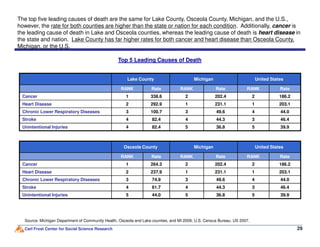
Top 5 Leading Causes of Death
The top five leading causes of death are the same for Lake County, Osceola County, Michigan, and the U.S.,
however, the rate for both counties are higher than the state or nation for each condition. Additionally, cancer is
the leading cause of death in Lake and Osceola counties, whereas the leading cause of death is heart disease in
the state and nation. Lake County has far higher rates for both cancer and heart disease than Osceola County,
Michigan, or the U.S.
Lake County Michigan United States
RANK Rate RANK Rate RANK Rate
Cancer 1 338.6 2 202.4 2 186.2
Heart Disease 2 292.9 1 231.1 1 203.1
Chronic Lower Respiratory Diseases 3 100.7 3 49.6 4 44.0
Stroke 4 82.4 4 44.3 3 46.4
Carl Frost Center for Social Science Research 29
Source: Michigan Department of Community Health, Osceola and Lake counties, and MI 2009; U.S. Census Bureau. US 2007.
Unintentional Injuries 4 82.4 5 36.8 5 39.9
Osceola County Michigan United States
RANK Rate RANK Rate RANK Rate
Cancer 1 264.3 2 202.4 2 186.2
Heart Disease 2 237.9 1 231.1 1 203.1
Chronic Lower Respiratory Diseases 3 74.9 3 49.6 4 44.0
Stroke 4 61.7 4 44.3 3 46.4
Unintentional Injuries 5 44.0 5 36.8 5 39.9
506.3
465.1
489.1
577.2
Cancer Rates
Cancer Diagnosis Rate (Age Adjusted)
Per 100,000 Population
Compared to the state or the nation, cancer diagnosis rates are higher for Lake and
Osceola County residents. Additionally, cancer death rates are notably higher for both
counties as well.
Overall Cancer Death Rate
Per 100,000 Population
Carl Frost Center for Social Science Research
465.1
489.1
338.6
186.2202.4
264.3
30
Osceola
County
Michigan United
States
Source: MDCH Cancer Incidence Files. Osceola/Lake counties , MI; MDCH/ County Health Rankings.
Osceola
County
Michigan United
States
Lake
County
Lake
County
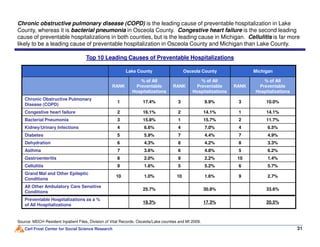
Top 10 Leading Causes of Preventable Hospitalizations
Chronic obstructive pulmonary disease (COPD) is the leading cause of preventable hospitalization in Lake
County, whereas it is bacterial pneumonia in Osceola County. Congestive heart failure is the second leading
cause of preventable hospitalizations in both counties, but is the leading cause in Michigan. Cellulitis is far more
likely to be a leading cause of preventable hospitalization in Osceola County and Michigan than Lake County.
Lake County Osceola County Michigan
RANK
% of All
Preventable
Hospitalizations
RANK
% of All
Preventable
Hospitalizations
RANK
% of All
Preventable
Hospitalizations
Chronic Obstructive Pulmonary
Disease (COPD)
1 17.4% 3 9.9% 3 10.0%
Congestive heart failure 2 16.1% 2 14.1% 1 14.1%
Bacterial Pneumonia 3 15.8% 1 15.7% 2 11.7%
Carl Frost Center for Social Science Research 31
Source: MDCH Resident Inpatient Files, Division of Vital Records. Osceola/Lake counties and MI 2009.
Kidney/Urinary Infections 4 6.6% 4 7.0% 4 6.5%
Diabetes 5 5.9% 7 4.4% 7 4.9%
Dehydration 6 4.3% 8 4.2% 8 3.3%
Asthma 7 3.6% 6 4.8% 5 6.2%
Gastroenteritis 8 2.0% 9 2.2% 10 1.4%
Cellulitis 9 1.6% 5 5.2% 6 5.7%
Grand Mal and Other Epileptic
Conditions
10 1.0% 10 1.6% 9 2.7%
All Other Ambulatory Care Sensitive
Conditions
25.7% 30.8% 33.6%
Preventable Hospitalizations as a %
of All Hospitalizations
19.3% 17.3% 20.5%
69.2% 69.9%73.5%76.9%
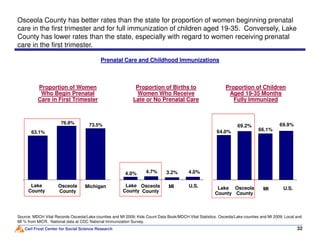
Osceola County has better rates than the state for proportion of women beginning prenatal
care in the first trimester and for full immunization of children aged 19-35. Conversely, Lake
County has lower rates than the state, especially with regard to women receiving prenatal
care in the first trimester.
Proportion of Women
Who Begin Prenatal
Care in First Trimester
Proportion of Children
Aged 19-35 Months
Fully Immunized
Proportion of Births to
Women Who Receive
Late or No Prenatal Care
Prenatal Care and Childhood Immunizations
Carl Frost Center for Social Science Research
4.0% 4.7% 4.0%3.2%
MIOsceola
County
U.S.
64.0%
69.2% 69.9%
66.1%
63.1%
73.5%76.9%
32
Source: MDCH Vital Records Osceola/Lake counties and MI 2009; Kids Count Data Book/MDCH Vital Statistics. Osceola/Lake counties and MI 2009; Local and
MI % from MICR. National data at CDC National Immunization Survey.
MichiganOsceola
County MI U.S.Osceola
County
Lake
County
Lake
County
Lake
County
Health Status
(2006-2010 Prevalence Estimates)
Almost one in five Lake County adults perceive their health as fair or poor. Also, Lake
County adults are more likely to experience poor physical but less likely to experience
poor mental health than people across Michigan.
Perception of General Health
(Fair/Poor)
Poor Physical Health
(On At Least 14 Days in Past
Month)
Poor Mental Health
(On At Least 14 Days in Past
Month)
Carl Frost Center for Social Science Research
14.7%19.1%
33
Source: Michigan Behavioral Risk Factor Survey Prevalence Estimates, 2006-2010.
MichiganLake
County
10.9%15.9%
MichiganLake
County
10.9%8.5%
MichiganLake
County
Heath Status (Cont’d.)
(2006-2010 Prevalence Estimates)
Furthermore, Lake County adults are more likely to be disabled and experience activity
limitation compared to adults across Michigan. Despite this, they are slightly more
satisfied with their lives.
Satisfaction with Life
(Dissatisfied/Very Dissatisfied)
32.3%
Disability Activity Limitation
(At Least 14 Days in Past
Month)
Carl Frost Center for Social Science Research
6.3%5.0%
34
Source: Michigan Behavioral Risk Factor Survey Prevalence Estimates, 2006-2010.
MichiganLake
County
23.5%
MichiganLake
County
7.0%9.4%
MichiganLake
County
30.1%
36.1%
Weight
(2006-2010 Prevalence Estimates)
Almost eight in ten (79.2%) Lake County adults are overweight or obese. The fact the
more than four in ten adults are considered obese should be a major public health
concern and priority for health care professionals in the community.
Overweight
(BMI = 25.0-29.9)
35.6%
43.1%
Obese
(BMI = 30.0+)
Carl Frost Center for Social Science Research
30.1%
35
Source: Michigan Behavioral Risk Factor Survey Prevalence Estimates, 2006-2010.
MichiganLake
County
MichiganLake
County
Chronic Health Conditions
Chronic Conditions
(2006-2010 Prevalence Estimates)
The most prevalent chronic health condition among Lake County adults is diabetes, a rate that is
double that of the state of Michigan. Lake County adults have slightly lower rates for asthma than
the state, but much higher rate of chronic heart conditions such as heart attacks or
angina/coronary heart disease.
Lake
County
Michigan
% %
Ever told have diabetes 18.5% 9.3%
Ever told have asthma 10.3% 15.2%
Still have asthma 8.7% 9.9%
Carl Frost Center for Social Science Research 37
Still have asthma 8.7% 9.9%
Ever told have heart attack 9.2% 4.7%
Ever told have angina/coronary heart
disease
8.7% 4.9%
Ever told have stroke 0.6% 2.8%
Source: Michigan Behavioral Risk Factor Survey Prevalence Estimates, 2006-2010.
Adult Risk Behaviors
27.0%
Tobacco and Alcohol
(2006-2010 Prevalence Estimates)
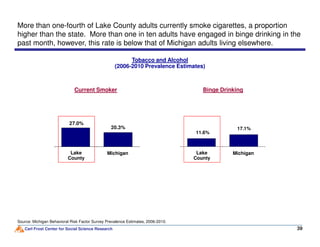
More than one-fourth of Lake County adults currently smoke cigarettes, a proportion
higher than the state. More than one in ten adults have engaged in binge drinking in the
past month, however, this rate is below that of Michigan adults living elsewhere.
Current Smoker Binge Drinking
Carl Frost Center for Social Science Research
20.3%
27.0%
39
Source: Michigan Behavioral Risk Factor Survey Prevalence Estimates, 2006-2010.
MichiganLake
County
17.1%
11.6%
MichiganLake
County
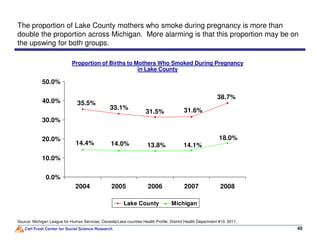
Proportion of Births to Mothers Who Smoked During Pregnancy
in Lake County
The proportion of Lake County mothers who smoke during pregnancy is more than
double the proportion across Michigan. More alarming is that this proportion may be on
the upswing for both groups.
35.5%
33.1%
31.5% 31.6%
38.7%
30.0%
40.0%
50.0%
Carl Frost Center for Social Science Research 40
Source: Michigan League for Human Services; Osceola/Lake counties Health Profile, District Health Department #10, 2011.
18.0%
14.1%13.8%14.0%14.4%
0.0%
10.0%
20.0%
2004 2005 2006 2007 2008
Lake County Michigan
26.0%
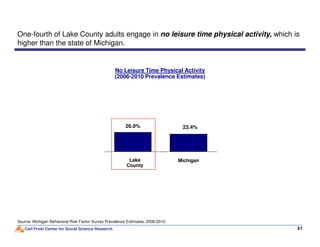
No Leisure Time Physical Activity
(2006-2010 Prevalence Estimates)
One-fourth of Lake County adults engage in no leisure time physical activity, which is
higher than the state of Michigan.
Carl Frost Center for Social Science Research
23.4%26.0%
41
Source: Michigan Behavioral Risk Factor Survey Prevalence Estimates, 2006-2010.
MichiganLake
County
Youth Risk Behaviors
28.6%
Teenage Pregnancy
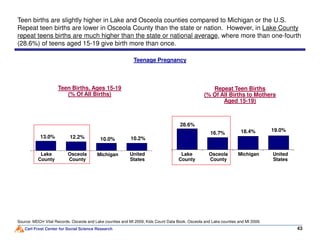
Teen births are slightly higher in Lake and Osceola counties compared to Michigan or the U.S.
Repeat teen births are lower in Osceola County than the state or nation. However, in Lake County
repeat teens births are much higher than the state or national average, where more than one-fourth
(28.6%) of teens aged 15-19 give birth more than once.
Teen Births, Ages 15-19
(% Of All Births)
Repeat Teen Births
(% Of All Births to Mothers
Aged 15-19)
Carl Frost Center for Social Science Research
28.6%
16.7%
19.0%18.4%
43
Source: MDCH Vital Records. Osceola and Lake counties and MI 2009; Kids Count Data Book. Osceola and Lake counties and MI 2009.
13.0% 12.2% 10.2%10.0%
Michigan United
States
Osceola
County
Michigan United
States
Osceola
County
Lake
County
Lake
County
Tobacco, Alcohol and Marijuana Use Among Youth
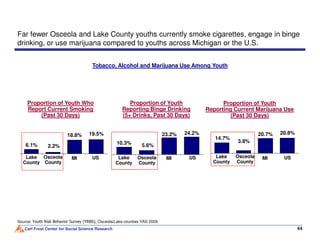
Far fewer Osceola and Lake County youths currently smoke cigarettes, engage in binge
drinking, or use marijuana compared to youths across Michigan or the U.S.
Proportion of Youth Who
Report Current Smoking
(Past 30 Days)
Proportion of Youth
Reporting Binge Drinking
(5+ Drinks, Past 30 Days)
Proportion of Youth
Reporting Current Marijuana Use
(Past 30 Days)
Carl Frost Center for Social Science Research
10.3% 5.6%
24.2%23.2%
44
Source: Youth Risk Behavior Survey (YRBS), Osceola/Lake counties YAS 2009.
6.1% 2.2%
19.5%18.8%
MI USOsceola
County
MI USOsceola
County
14.7%
3.8%
20.8%20.7%
MI USOsceola
County
Lake
County
Lake
County
Lake
County
56.7%
69.1%
63.0%
53.2%
Obesity, Physical Activity and Diet
Among 9th and 11th Grade Students
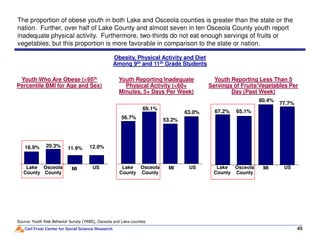
The proportion of obese youth in both Lake and Osceola counties is greater than the state or the
nation. Further, over half of Lake County and almost seven in ten Osceola County youth report
inadequate physical activity. Furthermore, two-thirds do not eat enough servings of fruits or
vegetables, but this proportion is more favorable in comparison to the state or nation.
Youth Who Are Obese (>95th
Percentile BMI for Age and Sex)
Youth Reporting Inadequate
Physical Activity (<60+
Minutes, 5+ Days Per Week)
67.2% 65.1%
77.7%
80.4%
Youth Reporting Less Than 5
Servings of Fruits/Vegetables Per
Day (Past Week)
Carl Frost Center for Social Science Research 45
Source: Youth Risk Behavior Survey (YRBS), Osceola and Lake counties
16.9% 20.3% 12.0%11.9%
MI USOsceola
County
MI USOsceola
County
MI USOsceola
County
Lake
County
Lake
County
Lake
County
Health Care Access
Heath Care Utilization and Access
(2006-2010 Prevalence Estimates)
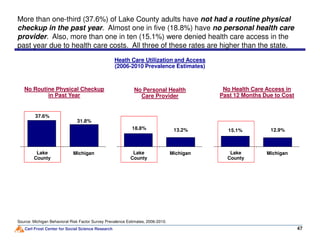
More than one-third (37.6%) of Lake County adults have not had a routine physical
checkup in the past year. Almost one in five (18.8%) have no personal health care
provider. Also, more than one in ten (15.1%) were denied health care access in the
past year due to health care costs. All three of these rates are higher than the state.
No Personal Health
Care Provider
No Health Care Access in
Past 12 Months Due to Cost
31.8%
37.6%
No Routine Physical Checkup
in Past Year
Carl Frost Center for Social Science Research 47
Source: Michigan Behavioral Risk Factor Survey Prevalence Estimates, 2006-2010.
13.2%18.8%
MichiganLake
County
12.9%15.1%
MichiganLake
County
31.8%
MichiganLake
County
Primary Care Physicians and Medicaid Patients
Primary Care Physicians (MDs and DOs)
Per 100,000 Population
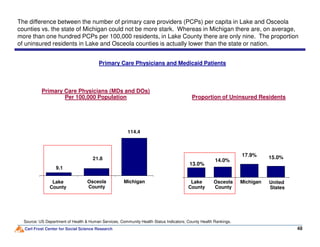
The difference between the number of primary care providers (PCPs) per capita in Lake and Osceola
counties vs. the state of Michigan could not be more stark. Whereas in Michigan there are, on average,
more than one hundred PCPs per 100,000 residents, in Lake County there are only nine. The proportion
of uninsured residents in Lake and Osceola counties is actually lower than the state or nation.
Proportion of Uninsured Residents
Carl Frost Center for Social Science Research
13.0%
14.0%
15.0%17.9%
114.4
21.8
9.1
48
Source: US Department of Health & Human Services, Community Health Status Indicators; County Health Rankings.
Osceola
County
Michigan Osceola
County
Michigan United
States
Lake
County
Lake
County
Hospital Data
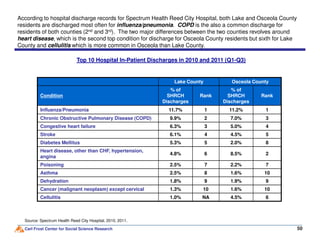
Top 10 Hospital In-Patient Discharges in 2010 and 2011 (Q1-Q3)
According to hospital discharge records for Spectrum Health Reed City Hospital, both Lake and Osceola County
residents are discharged most often for influenza/pneumonia. COPD is the also a common discharge for
residents of both counties (2nd and 3rd). The two major differences between the two counties revolves around
heart disease, which is the second top condition for discharge for Osceola County residents but sixth for Lake
County and cellulitis which is more common in Osceola than Lake County.
Lake County Osceola County
Condition
% of
SHRCH
Discharges
Rank
% of
SHRCH
Discharges
Rank
Influenza/Pneumonia 11.7% 1 11.2% 1
Chronic Obstructive Pulmonary Disease (COPD) 9.9% 2 7.0% 3
Congestive heart failure 6.3% 3 5.0% 4
Carl Frost Center for Social Science Research 50
Congestive heart failure 6.3% 3 5.0% 4
Stroke 6.1% 4 4.5% 5
Diabetes Mellitus 5.3% 5 2.0% 8
Heart disease, other than CHF, hypertension,
angina
4.8% 6 8.5% 2
Poisoning 2.5% 7 2.2% 7
Asthma 2.5% 8 1.6% 10
Dehydration 1.8% 9 1.9% 9
Cancer (malignant neoplasm) except cervical 1.3% 10 1.6% 10
Cellulitis 1.0% NA 4.5% 6
Source: Spectrum Health Reed City Hospital, 2010, 2011.
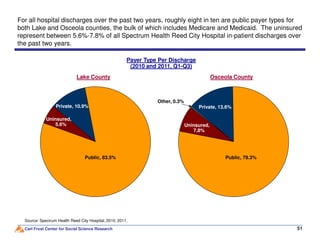
Payer Type Per Discharge
(2010 and 2011, Q1-Q3)
For all hospital discharges over the past two years, roughly eight in ten are public payer types for
both Lake and Osceola counties, the bulk of which includes Medicare and Medicaid. The uninsured
represent between 5.6%-7.8% of all Spectrum Health Reed City Hospital in-patient discharges over
the past two years.
Uninsured,
5.6%
Private, 10.9%
Uninsured,
Private, 13.6%
Other, 0.3%
Lake County Osceola County
Carl Frost Center for Social Science Research 51
Source: Spectrum Health Reed City Hospital, 2010, 2011.
5.6%
Public, 83.5%
Uninsured,
7.8%
Public, 78.3%
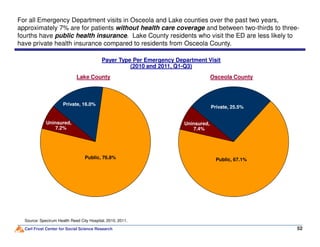
Payer Type Per Emergency Department Visit
(2010 and 2011, Q1-Q3)
For all Emergency Department visits in Osceola and Lake counties over the past two years,
approximately 7% are for patients without health care coverage and between two-thirds to three-
fourths have public health insurance. Lake County residents who visit the ED are less likely to
have private health insurance compared to residents from Osceola County.
Uninsured,
Private, 16.0%
Uninsured,
Private, 25.5%
Lake County Osceola County
Carl Frost Center for Social Science Research 52
Source: Spectrum Health Reed City Hospital, 2010, 2011.
Uninsured,
7.2%
Public, 76.8%
Uninsured,
7.4%
Public, 67.1%
Key Stakeholder In-Depth Interviews
Health Care Issues and Accessibility
These issues are considered to be county-wide, although some Key Stakeholders feel Lake County as
well as outlying residential addresses (e.g., northern areas) struggle more with access issues.
Health care access, obesity, lack of health care resources, poverty, access to specialty care,
an aging population and lack of senior services, mental health treatment (including
substance abuse), chronic disease, and teen pregnancy are identified as the most pressing
health issues in Osceola and Lake Counties, particularly for low income and senior individuals.
Overall, actually, access is the primary challenge in Lake County. And that extends to access to specialty care and
also obviously boils down to mental health care. I actually think there is good access in Lake County if somebody
has a severe mental health disability. Where the primary care gap in mental health is, is for folks with mild to
moderate need.
Overall, it’s poverty. It’s a rural community that is also poor.
If they have insurance, they tend to come in and get care. If they don’t, they wait too long to get services. So that’s
Most Pressing Health Needs or Issues
Carl Frost Center for Social Science Research 55
Q1. What do you feel are the most pressing health needs or issues in Osceola and Lake counties? (PROBE FOR DIFFERENCES BETWEEN SUB-POPULATIONS, GROUPS. ALSO, CLARIFY
ISSUES ARE THE SAME/DIFFERENT FOR COUNTY VS. THEIR LOCAL COMMUNITY)
If they have insurance, they tend to come in and get care. If they don’t, they wait too long to get services. So that’s
certainly a huge difference in the population I see. We do see quite a few uninsured but people wait a long time
before they come in because they don’t want to have to pay out of pocket. Services aren’t free but they are
certainly reduced, but many people here just kind of make do until they can’t anymore.
Weight management. We have a lot of obesity here.
The number one problem for people of low income is transportation and it’s real hard for some of them to get to
hospitals or at all or to doctors or to medical care.
It is not enough to serve the entire county. So recruitment is a big issue for us here, and serving everyone that
needs to be served. I think that substance use and mental health issues are very glaring here. I was really taken
aback by the seriousness of the issues here. It’s a very serious issue here in Lake County.
There is not a hospital in Lake County, there is a hospital in Osceola County that serves part of Lake and Lake does
have some primary care physicians and PAs, but it’s [lack of access] probably more pronounced in Lake than it is in
Osceola.
While Key Stakeholders believe these issues have been somewhat addressed within their
communities, they view the size and scope of these problems as vast. Further, poverty and lack of
transportation are exacerbating the situation. The uninsured, unemployed, low income, and elderly
are touched most by these issues.
We’ve moved into providing substance abuse services because that was very limited, so actually there’s quite a bit of
work going on there. The big gap is in the moderate to mild need so we’re also exploring how much of that they can
do and how much we do.
Baldwin Family Health Care
Cancer screening program
Hospital designation as Critical Access
Hospital merger
Implementation of more substance abuse
programs
Reinstatement of family planning program
Reopening of prison (more employment)
Rural health centers
Satellite health care offices
Teen school health clinic
Ways Most Pressing Health Needs or Issues are Being Addressed
Five of six Key Stakeholders say these issues are addressed at least somewhat through the following:
Carl Frost Center for Social Science Research 56
Q1a. Is there anything currently being done to address these issues? Q1b. (If yes) How are these issues being addressed? (PROBE FOR EFFECTIVENESS) Q1c. (If no) In your opinion, why aren’t
these issues being addressed? Q1d. (If no) In what ways have these issues been addressed in the past, if any? (PROBE FOR EFFECTIVENESS) Q2. What is the size and scope of the most
pressing issue/problem? (PROBE FOR NUMBER/PROPORTION OF PEOPLE TOUCHED, SPECIFIC GROUP TOUCHED. IF HEALTH CARE ACCESS MENTIONED, PROCEED WITH Q5, THEN
COME BACK TO Q3)
do and how much we do.
This [access] is monumental. Again, the transportation issue of people being able to get to medical care. And they
wait, again, since they don’t have a doctor and they don’t have insurance, they wait to go to the hospital on an
emergency basis and things are tough. And they need a surgery they can’t afford. It’s monumental.
In Lake County for example, they have a federally qualified rural health center that allows the use of government
assistance to bring in primary care physicians who have received loans, for example, during their medical training,
and then they have to go to underserved areas to pay off those loans for like two to three years at a time.
There’s nothing that I see from a city or a township or a county level to talk about the community health needs. I was
on a consortium for community health needs for a six county area kind of begun in Clare and they’re doing a lot with
health needs. But Osceola County has not been willing to jump on that bandwagon so to speak and it was a little
disappointing because we tried to get people involved.
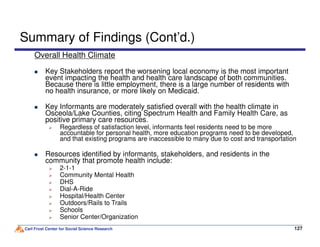
The worsening of the local economy is the most important event impacting the community’s health and
health care landscape. Because there is little employment, there is a large number of residents with no
health insurance or on Medicaid. On the upside, the reopening of the prison, school health clinics, and
the good collaborative history between agencies are seen as areas that positively impact the health
landscape.
In Lake County in particular, the economy has always been bad, so we haven’t really noticed a huge
shift based on the recession because frankly it’s never been good. When your baseline is so poor, I
don’t even think it’s necessarily changed that much. If you start at zero, you don’t really go down that
far.
The relationship between the schools involving Family Health Care. They’ve got the teen health clinic
in the schools and the Baldwin schools is a real hub in the community and I think their superintendent
is one of the best in the three counties.
They all sort of funnel back to the need to have money to do things, whether it’s to build a physician’s
office, recruit a primary care physician, expand your emergency room to take care of patients, etcetera,
Sentinel Events Impacting the Community’s Health and Health Care Landscape
Carl Frost Center for Social Science Research 57
Q3. What are the key sentinel events that may have impacted the community’s health and health care landscape in the past one to two years? (PROBE FOR INFECTIOUS DISEASE
OUTBREAKS, SIGNIFICANT LOCAL, STATE, AND FEDERAL POLICY CHANGES, SIGNIFICANT ECONOMIC EVENTS, DISASTERS, ETC.)
office, recruit a primary care physician, expand your emergency room to take care of patients, etcetera,
it all sort of relates to that. So if there was one tsunami, it would be the economy.
Reopening the prison will hopefully have a positive effect on the tax base an in employing and the
economy, etcetera.
The other thing you have in Lake County honestly, it’s my favorite county of the three to work in, they
have a very good collaborative history there because in large part because they’ve really had no
choice; to kind of collaborate or die in Lake County. In some ways, it’s easier to work within the
county. It’s a huge strength they have that people never really think of. Lake County’s always thought
of being very depressing and the poorest, but I think people need to rethink that a little bit.
For the county, we are primarily for low income. I think people utilize the emergency room much too often because
they have a lack of primary care services. We certainly don’t have enough providers to care for the entire county.
And we certainly would like to expand, but with expansion requires funding to help us recruit professionals and to
retain them.
If you live on the north side of Osceola County, you can drive 45 minutes to get to the hospital to get a lab. So again
people won’t do it because they don’t want to spend the money on gas or it’s just too long because they’re elderly
and they don’t want to or can’t drive that far.
Many times you have to leave the city to go to a specialist.
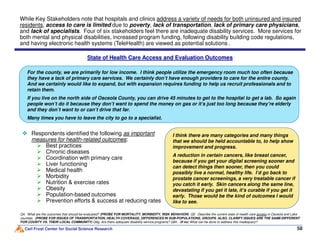
While Key Stakeholders note that hospitals and clinics address a variety of needs for both uninsured and insured
residents, access to care is limited due to poverty, lack of transportation, lack of primary care physicians,
and lack of specialists. Four of six stakeholders feel there are inadequate disability services. More services for
both mental and physical disabilities, increased program funding, following disability building code regulations,
and having electronic health systems (TeleHealth) are viewed as potential solutions .
State of Health Care Access and Evaluation Outcomes
Carl Frost Center for Social Science Research 58
Q4. What are the outcomes that should be evaluated? (PROBE FOR MORTALITY, MORBIDITY, RISK BEHAVIOR) Q5. Describe the current state of health care access in Osceola and Lake
counties. (PROBE FOR ISSUES OF TRANSPORTATION, HEALTH COVERAGE, DIFFERENCES IN SUB-POPULATIONS, GROUPS. ALSO, CLARIFY ISSUES ARE THE SAME/DIFFERENT
FOR COUNTY VS. THEIR LOCAL COMMUNITY) Q6g. Are there adequate disability service programs? Q6h. (If no) What can be done to address this inadequacy?
Respondents identified the following as important
measures for health-related outcomes:
Best practices
Chronic diseases
Coordination with primary care
Liver functioning
Medical health
Morbidity
Nutrition & exercise rates
Obesity
Population-based outcomes
Prevention efforts & success at reducing rates
I think there are many categories and many things
that we should be held accountable to, to help show
improvement and progress.
A reduction in certain cancers, like breast cancer,
because if you get your digital screening sooner and
can detect things then sooner, then you could
possibly live a normal, healthy life. I’d go back to
prostate cancer screenings, a very treatable cancer if
you catch it early. Skin cancers along the same line,
devastating if you get it late, it’s curable if you get it
early. Those would be the kind of outcomes I would
like to see.
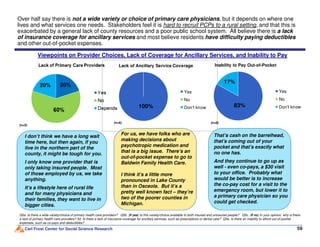
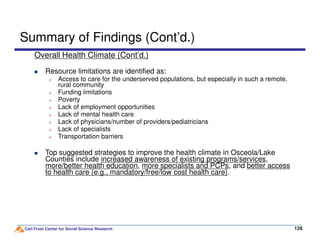
Over half say there is not a wide variety or choice of primary care physicians, but it depends on where one
lives and what services one needs. Stakeholders feel it is hard to recruit PCPs to a rural setting, and that this is
exacerbated by a general lack of county resources and a poor public school system. All believe there is a lack
of insurance coverage for ancillary services and most believe residents have difficulty paying deductibles
and other out-of-pocket expenses.
100%
Lack of Ancillary Service Coverage
Yes
No
Don't know
Viewpoints on Provider Choices, Lack of Coverage for Ancillary Services, and Inability to Pay
(n=5)
83%
17%
Inability to Pay Out-of-Pocket
Yes
No
Don't know
(n=6)(n=6)
Carl Frost Center for Social Science Research 59
Q5a. Is there a wide variety/choice of primary health care providers? Q5b. (If yes) Is this variety/choice available to both insured and uninsured people? Q5c. (If no) In your opinion, why is there
a lack of primary health care providers? 5d. Is there a lack of insurance coverage for ancillary services, such as prescriptions or dental care? Q5e. Is there an inability to afford out-of-pocket
expenses, such as co-pays and deductibles?
I don’t think we have a long wait
time here, but then again, if you
live in the northern part of the
county, it might be tough for you.
I only know one provider that is
only taking insured people. Most
of those employed by us, we take
anything.
It’s a lifestyle here of rural life
and for many physicians and
their families, they want to live in
bigger cities.
For us, we have folks who are
making decisions about
psychotropic medication and
that is a big issue. There’s an
out-of-pocket expense to go to
Baldwin Family Health Care.
I think it’s a little more
pronounced in Lake County
than in Osceola. But it’s a
pretty well known fact – they’re
two of the poorer counties in
Michigan.
That’s cash on the barrelhead,
that’s coming out of your
pocket and that’s exactly what
no one has.
And they continue to go up as
well - even co-pays, a $30 visit
to your office. Probably what
would be better is to increase
the co-pay cost for a visit to the
emergency room, but lower it to
a primary care physician so you
could get checked.
(n=5)
(n=6)(n=6)
Existing Programs and Services
There’s a lot of collaboration among health and human service providers in the
county.
Much, much better but it still needs to be improved.
There is money for the severely mentally impaired but for the other folks who
need medications, they’re not getting it.
I mean primary care is something I think we do pretty well. We do pretty well in
The majority of Key Stakeholders think existing programs and services meet the community’s needs and
demands at least somewhat well. They think Lake and Osceola counties have many good support
services, but the availability of these services is problematic for the elderly, those requiring in-patient or
out-patient mental health (including substance abuse) treatment, and for those with a lack of
transportation.
Programs/Services Meeting Needs in the Community
17%
Carl Frost Center for Social Science Research 61
Q6. How well do existing programs and services meet the needs and demands of people in your community? Would you say they meet them exceptionally well, very well, somewhat well, not very
well, or not at all well? Q6a. Why do you say (INSERT RESPONSE)? (PROBE FOR DIFFERENCES IN SUB-POPULATIONS, GROUPS)
I mean primary care is something I think we do pretty well. We do pretty well in
emergency treatment, we do pretty well at some of the diagnostic things, lab
work, imaging, things like that. In Reed City in particular, cancer treatment and
long-term care.
We offer a lot here [Spectrum Health]. You can get just about anything you
need. We’ve got physical therapy, we’ve got bone density, we’ve got the cancer
services, there are a lot of services that you typically wouldn’t find in a very
small community hospital. We have MRI, just a lot of different things on site so
we can bring it locally. We try to avoid having folks drive to Grand Rapids if we
can. A lot of people don’t like the drive to Grand Rapids, for them that’s the big
city and they don’t want to go and many have said they won’t go.
17%
66%
Very well
Somewhat
well
Not very
well
Not at all
well
(n=6)
Services identified as lacking are specialty services, dental care, mental health services,
OB/GYN services, community centers for families and seniors, in-home respite care, primary
care physicians, and a focus on chronic disease prevention activities.
Programs/Services Lacking in the Community
Chronic disease prevention activities
Community centers for families and seniors
Dental care
In-home respite care
Gyms/Exercise facilities
Mental health services (including substance
abuse)
OB/GYN services
Primary care physicians
Specialty services
Transportation
Youth services
Carl Frost Center for Social Science Research 62
Q6b. What programs or services are lacking in the community? (PROBE FOR PROGRAMS/SERVICES THAT ADDRESS SPECIFIC SUB-POPULATIONS, GROUPS, PRIMARY CARE,
CHRONIC DISEASE)
There’s not a gym. There’s no place, other than the tiny one that we have, no place to really work out. They do
have a nice walking trail system, but I’m not sure how many people use it.
In the county we could use a little more primary care.
I’m not sure that the [OB/GYN] population is there. We have a lot of elderly, or those that are retired, and
because there are not a lot of jobs, a lot of our kids leave and no one lives in this area.
There’re many more services it would be nice to provide – we can’t afford them.
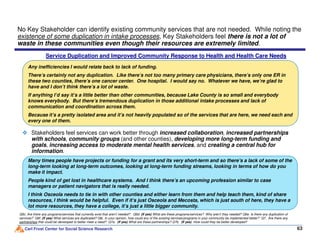
No Key Stakeholder can identify existing community services that are not needed. While noting the
existence of some duplication in intake processes, Key Stakeholders feel there is not a lot of
waste in these communities even though their resources are extremely limited.
Any inefficiencies I would relate back to lack of funding.
There’s certainly not any duplication. Like there’s not too many primary care physicians, there’s only one ER in
these two counties, there’s one cancer center. One hospital. I would say no. Whatever we have, we’re glad to
have and I don’t think there’s a lot of waste.
If anything I’d say it’s a little better than other communities, because Lake County is so small and everybody
knows everybody. But there’s tremendous duplication in those additional intake processes and lack of
communication and coordination across them.
Because it’s a pretty isolated area and it’s not heavily populated so of the services that are here, we need each and
every one of them.
Service Duplication and Improved Community Response to Health and Health Care Needs
Carl Frost Center for Social Science Research 63
Q6c. Are there any programs/services that currently exist that aren’t needed? Q6d. (If yes) What are these programs/services? Why aren’t they needed? Q6e. Is there any duplication of
services? Q6f. (If yes) What services are duplicated? Q6i. In your opinion, how could any of the existing services/programs in your community be implemented better? Q7. Are there any
partnerships that could be developed to better meet a need? Q7a. (If yes) What are these partnerships? Q7b. (If yes) How could they be better developed?
Stakeholders feel services can work better through increased collaboration, increased partnerships
with schools, community groups (and other counties), developing more long-term funding and
goals, increasing access to moderate mental health services, and creating a central hub for
information.
Many times people have projects or funding for a grant and its very short-term and so there’s a lack of some of the
long-term looking at long-term outcomes, looking at long-term funding streams, looking in terms of how do you
make it impact.
People kind of get lost in healthcare systems. And I think there’s an upcoming profession similar to case
managers or patient navigators that is really needed.
I think Osceola needs to tie in with other counties and either learn from them and help teach them, kind of share
resources, I think would be helpful. Even if it’s just Osceola and Mecosta, which is just south of here, they have a
lot more resources, they have a college, it’s just a little bigger community.
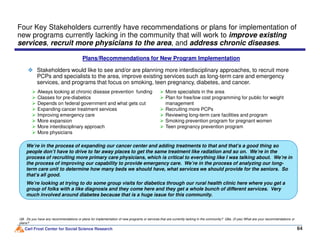
Four Key Stakeholders currently have recommendations or plans for implementation of
new programs currently lacking in the community that will work to improve existing
services, recruit more physicians to the area, and address chronic diseases.
Stakeholders would like to see and/or are planning more interdisciplinary approaches, to recruit more
PCPs and specialists to the area, improve existing services such as long-term care and emergency
services, and programs that focus on smoking, teen pregnancy, diabetes, and cancer.
Always looking at chronic disease prevention funding
Classes for pre-diabetics
Depends on federal government and what gets cut
Expanding cancer treatment services
Improving emergency care
More expansion
More specialists in the area
Plan for free/low cost programming for public for weight
management
Recruiting more PCPs
Reviewing long-term care facilities and program
Smoking prevention program for pregnant women
Plans/Recommendations for New Program Implementation
Carl Frost Center for Social Science Research 64
Q8. Do you have any recommendations or plans for implementation of new programs or services that are currently lacking in the community? Q8a. (If yes) What are your recommendations or
plans?
More interdisciplinary approach
More physicians
Teen pregnancy prevention program
We’re in the process of expanding our cancer center and adding treatments to that and that’s a good thing so
people don’t have to drive to far away places to get the same treatment like radiation and so on. We’re in the
process of recruiting more primary care physicians, which is critical to everything like I was talking about. We’re in
the process of improving our capability to provide emergency care. We’re in the process of analyzing our long-
term care unit to determine how many beds we should have, what services we should provide for the seniors. So
that’s all good.
We’re looking at trying to do some group visits for diabetics through our rural health clinic here where you get a
group of folks with a like diagnosis and they come here and they get a whole bunch of different services. Very
much involved around diabetes because that is a huge issue for this community.
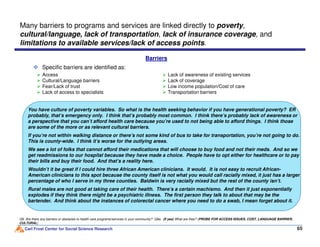
Specific barriers are identified as:
Many barriers to programs and services are linked directly to poverty,
cultural/language, lack of transportation, lack of insurance coverage, and
limitations to available services/lack of access points.
You have culture of poverty variables. So what is the health seeking behavior if you have generational poverty? ER
probably, that’s emergency only. I think that’s probably most common. I think there’s probably lack of awareness or
a perspective that you can’t afford health care because you’re used to not being able to afford things. I think those
Barriers
Access
Cultural/Language barriers
Fear/Lack of trust
Lack of access to specialists
Lack of awareness of existing services
Lack of coverage
Low income population/Cost of care
Transportation barriers
Carl Frost Center for Social Science Research 65
Q9. Are there any barriers or obstacles to health care programs/services in your community? Q9a. (If yes) What are they? (PROBE FOR ACCESS ISSUES, COST, LANGUAGE BARRIER,
CULTURAL)
a perspective that you can’t afford health care because you’re used to not being able to afford things. I think those
are some of the more or as relevant cultural barriers.
If you’re not within walking distance or there’s not some kind of bus to take for transportation, you’re not going to do.
This is county-wide. I think it’s worse for the outlying areas.
We see a lot of folks that cannot afford their medications that will choose to buy food and not their meds. And so we
get readmissions to our hospital because they have made a choice. People have to opt either for healthcare or to pay
their bills and buy their food. And that’s a reality here.
Wouldn’t it be great if I could hire three African American clinicians. It would. It is not easy to recruit African-
American clinicians to this spot because the county itself is not what you would call racially mixed, it just has a larger
percentage of who I serve in my three counties. Baldwin is very racially mixed but the rest of the county isn’t.
Rural males are not good at taking care of their health. There’s a certain machismo. And then it just exponentially
explodes if they think there might be a psychiatric illness. The first person they talk to about that may be the
bartender. And think about the instances of colorectal cancer where you need to do a swab, I mean forget about it.
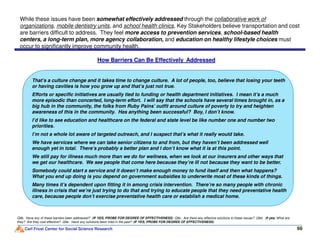
While these issues have been somewhat effectively addressed through the collaborative work of
organizations, mobile dentistry units, and school health clinics, Key Stakeholders believe transportation and cost
are barriers difficult to address. They feel more access to prevention services, school-based health
centers, a long-term plan, more agency collaboration, and education on healthy lifestyle choices must
occur to significantly improve community health.
That’s a culture change and it takes time to change culture. A lot of people, too, believe that losing your teeth
or having cavities is how you grow up and that’s just not true.
Efforts or specific initiatives are usually tied to funding or health department initiatives. I mean it’s a much
more episodic than concerted, long-term effort. I will say that the schools have several times brought in, as a
big hub in the community, the folks from Ruby Pains’ outfit around culture of poverty to try and heighten
awareness of this in the community. Has anything been successful? Boy, I don’t know.
I’d like to see education and healthcare on the federal and state level be like number one and number two
priorities.
How Barriers Can Be Effectively Addressed
Carl Frost Center for Social Science Research 66
Q9b. Have any of these barriers been addressed? (IF YES, PROBE FOR DEGREE OF EFFECTIVENESS) Q9c. Are there any effective solutions to these issues? Q9d. (If yes) What are
they? Are they cost effective? Q9e. Have any solutions been tried in the past? (IF YES, PROBE FOR DEGREE OF EFFECTIVENESS)
priorities.
I’m not a whole lot aware of targeted outreach, and I suspect that’s what it really would take.
We have services where we can take senior citizens to and from, but they haven’t been addressed well
enough yet in total. There’s probably a better plan and I don’t know what it is at this point.
We still pay for illness much more than we do for wellness, when we look at our insurers and other ways that
we get our healthcare. We see people that come here because they’re ill not because they want to be better.
Somebody could start a service and it doesn’t make enough money to fund itself and then what happens?
What you end up doing is you depend on government subsidies to underwrite most of these kinds of things.
Many times it’s dependent upon fitting it in among crisis intervention. There’re so many people with chronic
illness in crisis that we’re just trying to do that and trying to educate people that they need preventative health
care, because people don’t exercise preventative health care or establish a medical home.
Community Resources and the Future
of Health Care
Stakeholders say it is the richness of community collaboration and support in a county with high poverty that
makes their response to access stand out. Resource limitations stem from lack of funding or funding limits, the
rural environment, and existing poverty. All feel relevant stakeholders are involved in the planning and
decision-making for community health needs, while also acknowledging that more community members
should be involved and more long-term planning needs to be developed.
Specifically, Key Stakeholders feel the community houses the following resources:
Resource limitations are identified as:
2-1-1
Agency coordination and
collaboration
Area schools
Baldwin Family Health Care
Community Mental Health
DHS
Dial-A-Ride
Faith-based community
MSU Extension office
Prison reopening
Senior Programs
Use of technology
(e.g., teleconferencing)
Community Resources & Resource Limitations
Funding limitations
Lack of employment opportunities
Poverty
Less federal and state funding for initiatives
Carl Frost Center for Social Science Research 6868
Q10. What resources currently exist in your community beyond programs/services just discussed? (PROBE FOR FINANCIAL, SOCIAL CAPITAL, PEOPLE) Q10a. What are any resource
limitations, if any? (PROBE FOR FINANCIAL, SOCIAL CAPITAL) Q11. With regard to health and health care issues, are relevant stakeholders or community residents involved in planning and
decision making? Q11a. (If yes) Who is involved? (PROBE FOR TITLES/ROLES, NOT NAMES) Q11b. (If no) Should they be? Q11c. (If yes) Who should be?
So many more seniors have issues related to aging, memory, disability, etcetera, not being isolated from their
families, and so there are never enough mental health services, but there are some available.
There always should be more, I don’t care where you live. There should always be more involvement and
investment in keeping people healthy.
It does go clear back to money. One, you don’t have enough money out in the country to start some of these
things, and if you did, there’s not enough money to utilize them. So I think obviously we could use more
resources but you have to be sort of frugal with what you do develop.
I guess I wouldn’t consider it to be a mobilized issue or commitment. I think there’s various committees that have
stakeholders that are looking at specific projects but is it a mobilized group working on an identified health
improvement plan? No.
Lack of employment opportunities
Size/rural nature of county
Less federal and state funding for initiatives
Lack of high speed Internet connections
While some stakeholders are concerned about the unknown elements of federal health care reform and fear it will
be more expensive and result in less hospital reimbursement, most feel positively about health care reform and
believe it will provide more coverage for adults, increase access overall, and be driven by outcomes. They
hope it will help improve health outcomes by promoting prevention and promoting a more active role in self
care by patients.
It’s changing the baseline for who is eligible for Medicaid. So you’re going to improve accessibility just by the fact that people
will have payment sources. Now is there going to be the infrastructure to support that access, that may be a challenge. I think
our goal in Michigan should be to look at healthcare reform and try to ensure that how we interpret certain points of that are
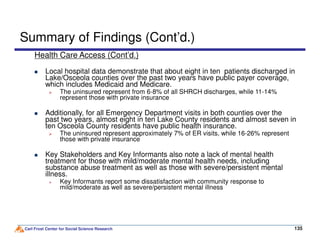
going to focus in on some of the population outcomes.
Transforming – it’s the payers that are driving this, saying it’s not going to be any longer how many people you see, but the
quality of care that you give and you’ll be paid based upon that quality so hours of operation, are you available to your patients,
what do your diabetic hemoglobin A1C’s look like and those are all hard because if people don’t take responsibility for their care,
you can have some impact but not a lot of impact. But I think health reform will help to educate people, the general population as
well, on their responsibility.
I tend to look at it a little differently than a lot of people. I think the fact that every person is going to have some form of payment,
is probably better than what we have now, when you have 40 million Americans that have no way to pay. The problem’s going to
Verbatim Comments on the Future of Health Care
Carl Frost Center for Social Science Research 6969
Q12. What, if any, impact do you think Federal Health Care Reform will have on health care in your community? (PROBE FOR FUTURE OF HEALTH CARE) Q12a. What impact will it have on
health outcomes, if any? Q13. In concluding, do you have any additional comments on any issues regarding health or health care in Osceola and Lake counties that we haven’t discussed so far?
is probably better than what we have now, when you have 40 million Americans that have no way to pay. The problem’s going to
be, as you move forward, is Medicaid and Medicare programs do not pay enough now to cover the cost. You make it up in your
other third-party payers, like the Blue Crosses and Priority Health, and not only do they not pay enough now, they’re going to
ratchet back some of their payments to help fund the additional people they’re going to be put on federally subsidized health
care.
I think it’s going to be more expensive as times go on, I think it’s going to be more difficult for folks to access the services they
need, we’re already seeing that trend. I just look at long-term care alone at this time and we already are asked to do more and
more and more with less and less reimbursement and it’s the same way at the hospital. So for us as providers, the picture is
somewhat grim.
Well I hope it’s good. If the Federal Health Care Reform Act is the plan that actually allows better access and more people to get
into the system, I think it will be good. It also though needs to focus on wellness, not just on illness. And if it’s geared towards
that, I think it will be a good thing for this country.
One Stakeholder’s final comment is that health care needs to be a priority for the country and
supported by state and federal funding, especially in rural communities.
Key Informant Online Survey
Health Conditions
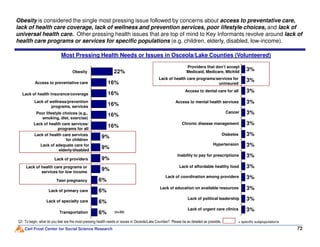
Most Pressing Health Needs or Issues in Osceola/Lake Counties (Volunteered)
16%
16%
16%
16%
16%
22%
Obesity is considered the single most pressing issue followed by concerns about access to preventative care,
lack of health care coverage, lack of wellness and prevention services, poor lifestyle choices, and lack of
universal health care. Other pressing health issues that are top of mind to Key Informants revolve around lack of
health care programs or services for specific populations (e.g. children, elderly, disabled, low-income).
3%
3%
3%
3%
3%
3%
Lack of health insurance/coverage
Poor lifestyle choices (e.g.,
smoking, diet, exercise)
Obesity
Lack of wellness/prevention
programs, services
Lack of health care services/
Access to preventative care
Access to mental health services
Providers that don’t accept
Medicaid, Medicare, MIchild
Access to dental care for all
Chronic disease management
Lack of health care programs/services for
uninsured
Cancer
Carl Frost Center for Social Science Research 72
Q1: To begin, what do you feel are the most pressing health needs or issues in Osceola/Lake Counties? Please be as detailed as possible.
16%
9%
9%
6%
6%
6%
6%
9%
9%
(n=32)
= specific subpopulations
3%
3%
3%
3%
3%
3%
3%
3%
3%
Lack of adequate care for
elderly/disabled
Lack of health care services/
programs for all
Lack of health care services
for children
Lack of providers
Lack of health care programs or
services for low income
Hypertension
Teen pregnancy
Lack of specialty care
Lack of urgent care clinics
Diabetes
Transportation
Lack of coordination among providers
Lack of political leadership
Lack of affordable healthy food
Lack of education on available resources
Lack of primary care
Chronic disease management
Inability to pay for prescriptions
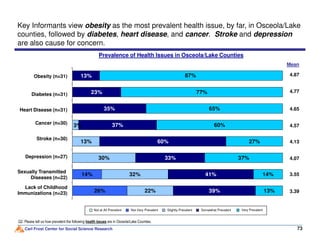
Prevalence of Health Issues in Osceola/Lake Counties
37%
35%
23%
13%
60%
65%
77%
3%
87%
Diabetes (n=31)
Cancer (n=30)
Mean
Heart Disease (n=31)
Obesity (n=31)
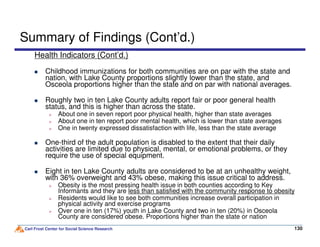
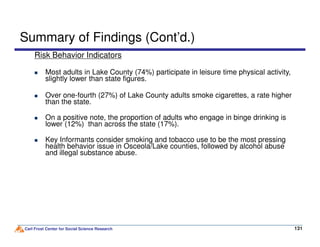
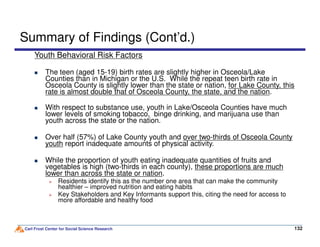
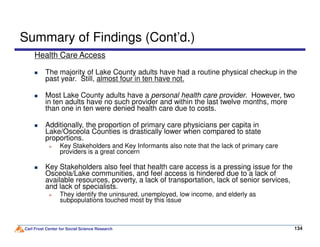
Key Informants view obesity as the most prevalent health issue, by far, in Osceola/Lake
counties, followed by diabetes, heart disease, and cancer. Stroke and depression
are also cause for concern.
4.87
4.77
4.65
4.57
Carl Frost Center for Social Science Research 73
Q2: Please tell us how prevalent the following health issues are in Osceola/Lake Counties.
32%
30%
13%
41%
33%
60%
37%
14%
37%
27%
60%
14%
26%
3%
22% 39% 13%
Lack of Childhood
Immunizations (n=23)
Sexually Transmitted
Diseases (n=22)
Depression (n=27)
Stroke (n=30)
Cancer (n=30)
Somewhat PrevalentSlightly PrevalentNot Very PrevalentNot at All Prevalent Very Prevalent
4.57
4.13
4.07
3.55
3.39
Satisfaction with Community’s Response to Health Issues in Osceola/Lake Counties
23%
10%
8%
7%
10%
4%
57%
55%
44%
13%
24%
44%
Mean
Lack of Childhood
Immunizations (n=25)
Cancer (n=29)
Heart Disease (n=30)
Key Informants are most satisfied with the community’s response to childhood
immunizations, followed by cancer. Conversely, they are least satisfied with the
responses to depression and obesity.
4.24
3.93
3.60
Carl Frost Center for Social Science Research 74
13%
4%
30%
35%
21%
14%
20%
17%
15%
14%
24%
13%
33%
42%
59%
57%
57%
7%
7%
10%
5%
4%
Somewhat SatisfiedSlightly SatisfiedNot Very SatisfiedNot at All Satisfied
Diabetes (n=30)
Sexually Transmitted
Diseases (n=21)
Stroke (n=29)
Depression (n=26)
Obesity (n=30)
Very Satisfied
Q2a: How satisfied are you with the community’s response to these health issues?
3.57
3.52
3.52
3.08
2.90
Performance of Community in Response to Health Issues in Osceola/Lake Counties
The quadrant chart below depicts both problem areas and opportunities. The community’s responses
to cancer, diabetes, and heart disease are fairly strong because they are all prevalent and Key
Informants are satisfied with the community responses. Conversely, obesity is a critical problem area
because it is not only prevalent, but the community response has been less than satisfactory.
SATISFACTION
High
Monitor/Maintain Moderate Strengths to Build On
Lack of
Immunizations
Carl Frost Center for Social Science Research 75
Q2: Please tell us how prevalent the following health issues are in Osceola/Lake Counties.?
Q2a: How satisfied are you with the community’s response to these health issues? (1=Not at all satisfied, 2=Not very satisfied, 3=Slightly satisfied, 4=Somewhat satisfied, 5=Very satisfied)
(n=32)
Low High
SATISFACTION
Low
Cancer
Critical Problems – Top PrioritiesSecondary Priorities
Obesity
Overallmean=3.55
PREVALENCE
Immunizations
Overall mean = 4.25
Sexually Transmitted
Diseases
Diabetes
Stroke
Depression
Heart
Disease
Health Behaviors
Prevalence of Health Behaviors in Osceola/Lake Counties
10%
10%
37%
39%
33%
50%
52%
67%
3%
Alcohol Abuse (n=31)
Smoking and
Tobacco Use (n=30)
Mean
Illegal Substance Abuse
(n=30)
According to Key Informants, smoking and tobacco use is the most prevalent negative
health behavior in Osceola/Lake counties, followed by alcohol abuse, and illegal
substance abuse. Suicide, although it exists, is not considered to be as prevalent as
other health behaviors.
4.67
4.42
4.33
Carl Frost Center for Social Science Research 77
Q3: Please tell us how prevalent the following health behaviors are in Osceola/Lake Counties.
35%
27%
11%
11%
40%
27%
22%
11%
20%
36%
41%
50%
5%
9%
26%
29%
Suicide (n=20)
Child Abuse/Neglect
(n=27)
Domestic Abuse (n=28)
Somewhat PrevalentSlightly PrevalentNot Very PrevalentNot at All Prevalent
Motor Vehicle
Accidents (n=22)
Very Prevalent
3.96
3.81
3.27
2.95
33%
19%
14%
26%
50%
24%
37%
31%
52% 10%
4%
Satisfaction with Community’s Response to Health Behaviors in Osceola/Lake Counties
Mean
Alcohol Abuse (n=27)
Suicide (n=16)
Motor Vehicle
Accidents (n=21)
Key Informants’ satisfaction with the community response to health behaviors overall is
low to moderate. They are least satisfied with responses to child abuse/neglect and
smoking/tobacco use, the latter of which is considered highly prevalent.
3.57
3.13
2.96
Carl Frost Center for Social Science Research
36%
30%
35%
22%
31%
39%
23%
12%12%
9%
4%
8% 38% 23%
20%
27%
20%
8%
4%
78
Somewhat SatisfiedSlightly SatisfiedNot Very SatisfiedNot at All Satisfied Very Satisfied
Q3a: How satisfied are you with the community’s response to these health behaviors?
Smoking and
Tobacco Use (n=25)
Child Abuse/Neglect
(n=26)
Domestic Abuse (n=23)
Illegal Substance Abuse
(n=26)
2.96
2.91
2.84
2.81
Performance of Community in Response to Health Behaviors in Osceola/Lake Counties
Dissatisfaction with community response to health behaviors is demonstrated in the quadrant chart below. For
example, four of the seven behaviors rated can be considered critical problems areas – tobacco use, alcohol
abuse, illegal substance abuse, and domestic abuse – because they are prevalent but satisfaction with
community response is low. Addressing tobacco use should be a top priority for health care professionals in
Osceola and Lake counties.
SATISFACTION
High Monitor/Maintain Moderate Strengths to Build On
Carl Frost Center for Social Science Research 79
(n=31)
Low High
SATISFACTION
Low
Domestic
Abuse
Critical Problems – Top PrioritiesSecondary Priorities
Suicide
Overallmean=3.03
PREVALENCE
Motor Vehicle
Accidents
Overall mean = 3.92
Child Abuse/
Neglect
Alcohol Abuse
Illegal
Substance
Abuse
Smoking/Tobacco Use
Q3: Please tell us how prevalent the following health behaviors are in Osceola/Lake Counties.
Q3a: How satisfied are you with the community’s response to these health behaviors? (1=Not at all satisfied, 2=Not very satisfied, 3=Slightly satisfied, 4=Somewhat satisfied, 5=Very satisfied)
Access to Health Care
Perceptions of Variety and Choice of Primary Medical Care Options
27%
26%
26%
20%
16%
6%
30%
32%
35%
13%
16%
23%10%
10%
10%Senior Adults (n=31)
Low Income (n=30)
Adults (n=31)
Mean
Adults and senior adults have the greatest variety and choice of primary medical care options,
although there is room for improvement as roughly one in three disagrees with this perspective.
Children and residents who are non-English speaking find their options far more limited when it
comes to primary medical care.
3.35
3.19
3.10
Carl Frost Center for Social Science Research 81
Q4: Please tell us your level of agreement with the following statements about the variety and choices of primary medical care in Osceola/Lake Counties.
42%
37%
36%
34%
23%
14%
14%
15%
25%
28%
13%
11%
10%
23%
14%
14%
15%
10% 17%
4%
Children (n=30)
Underinsured (n=28)
AgreeNeither Disagree Nor AgreeDisagreeStrongly Disagree
Non-English
Speaking/ESL (n=26)
Uninsured (n=29)
Strongly Agree
2.86
2.82
2.60
2.50
Reasons for Perceiving a Lack of Primary Medical Care Options for Children
No pediatricians and few choices for OB/GYN that are accessible.
Not enough providers.
There are very few choices in the area for care.
Reasons cited for lack of primary care options for children center around the lack of
pediatric care, lack of choice for primary care providers, and the time required to
get an appointment.
Carl Frost Center for Social Science Research 82
Q4a: (If Strongly Disagree/Disagree/Neutral) Why do you [INSERT RATING] that there is a wide variety and choice of primary care for children?
There is a FQHC in Lake County, outside of that there are limited choices for primary care.
There is no pediatrician in our area that I am aware of.
We have just one source- Family Health Care- not saying they don't do the job, just saying there
is not a wide variety and choice of primary care providers
We only have one place to go to and sometimes have to wait 2 - 4 weeks to get an appointment
While the rural health clinic is available to the children, to my knowledge there are no
pediatricians on staff.
Reasons for Perceiving a Lack of Primary Medical Care Options for Adults
Adults get the required medical attention and services when needed.
As far as I know there are about three physicians available for primary care; therefore, I would not
classify that as wide variety.
I am told there aren’t weekend or after hour primary care hours. Also, I am under the impression it can
take 2 to 3 weeks to get an appointment.
Adults find several barriers to primary medical care access such as the small number of primary care
physicians, limited number of clinics in the region, and restricted clinic hours. In addition, the clinic
is perceived as being for low income or single mothers, a perception that, because of any attached
stigma, may influence some members of the community to seek medical care elsewhere.
Carl Frost Center for Social Science Research 83
Q4a: (If Strongly Disagree/Disagree/Neutral) Why do you [INSERT RATING] that there is a wide variety and choice of primary care for adults?
Only one medical clinic in our immediate area.
There are not many health care providers in the area.
We only have family health service in Baldwin........no real doctor clinics on a known basis. The
perception is it is for low income or single mothers. We have no 24 hour emergency room in our
county.
Reasons for Perceiving a Lack of Primary Medical Care Options for Senior Adults
Family Health Care is the only provider in Lake County and the majority of providers are PA or NP, not
providers the senior adults want to see.
Geriatric specialty not available in this area full-time.
In my opinion, there is a large senior adult population in Lake County. These individuals require more
frequent care than the small rural health clinic is able to adequately provide.
Much more can be done for seniors in this community.
Senior adults are limited in their options for primary medical care for several reasons. First, there is a
large population of seniors requiring frequent service, however there is only one medical care facility
in the counties. Second, there are no full-time geriatric specialists in the area and most providers are
physician assistants or nurse practitioners, not doctors. Third, there is no urgent care close by.
Carl Frost Center for Social Science Research 84
Q4a: (If Strongly Disagree/Disagree/Neutral) Why do you [INSERT RATING] that there is a wide variety and choice of primary care for senior adults?
Much more can be done for seniors in this community.
Not enough providers
Only one Primary Care clinic in Lake County
There are not many care facilities in the area.
When urgent care is provided, the location of necessary services are not close by.
Reasons for Perceiving a Lack of Primary Medical Care Options for Underserved Populations
The greatest obstacle to primary medical care for low income patients is too few providers or options.
In addition, too few providers accept Medicaid patients. Lacking primary care providers, many low
income patients use the emergency department for medical care instead. Although there are few non-
English speaking people in the area, the lack of options overall is seen as their greatest hurdle.
14%
14%
64%
Low Income Population
44%
ESL Population
Not enough providers/
options for low income
Too few providers
accept Medicaid
Rising use of emergency
department
Not many non-English
speaking people in area
Carl Frost Center for Social Science Research 85
Q4a: (If Strongly Disagree/Disagree/Neutral) Why do you [INSERT RATING] that there is a wide variety and choice of primary care for low income/ESL?
7%
7%
7%
7%
7%
(n=14)
6%
19%
31%
Few bilingual/Spanish
speaking
physicians/providers
Language barrier
Few providers/options
for ESL population
(n=16)
Tend to travel out of county
for more/better options
Limited community
resources to meet demand
Personally see low income
people go without health care
department
Lack of health
insurance options
Lack of preventative care
Reasons for Perceiving a Lack of Primary Medical Care Options for Uninsured/Underinsured
27%
53%
Rising use of emergency department
Few places/options for
uninsured/underinsured
The uninsured/underinsured also find too few providers or options to meet their medical
needs and find few providers who accept patients without coverage. Increasing numbers
of the uninsured/underinsured use the emergency department instead of primary care
providers.
Carl Frost Center for Social Science Research 86
Q4a: (If Strongly Disagree/Disagree/Neutral) Why do you [INSERT RATING] that there is a wide variety and choice of primary care for uninsured/underinsured?
7%
7%
20%
(n=17)
Tend to travel out of county for more or
better options
Too few accept patients without
insurance/on sliding scale/for free
Those who lack money receive
subpar health care
54%
54%
62%
Subpopulations Underserved with Regard to Health Care
Are Specific Subpopulations or
Groups Underserved?
Subpopulations or Groups
Underserved
Uninsured
Underinsured
Children
Although nearly half of Key Informants (47%) are unaware of subpopulations in Osceola/Lake
counties that are underserved with respect to health care, a substantial minority (41%) identified
several populations at risk including children and those who lack insurance, either completely or
partially.
Carl Frost Center for Social Science Research
Minorities
46%
31%
31%
8%
8%
8%
15%
87
Q5: Are there specific subpopulations or groups of people in Osceola/Lake Counties that are underserved with regard to health care?
Q5a: (If yes) Which of the following subpopulations are underserved? (Multiple responses allowed)
Yes
41%
No
13%
Don't
know
47%
(n=32) (n=13)
Uninsurable
Senior Adults
Women
Disabled
Those with mental
health issues
Homeless
Gaps in Health Care
Degree to Which Programs/Services Meet the Needs/Demands of Osceola/Lake Counties’ Residents
8%
20%
7% 13%
24%
16%
13%
14%
10%
40%
4%
17%
29%
28%
16%
50%
43%
59%
14%
12%
4%
3%
56%
Mean
4.41
4.00
3.90
3.72
3.44
Emergency transportation receives the highest marks, by far, among Osceola/Lake
counties’ programs or services. Several other programs, such as nursing home care,
emergency care, and oncology, are also well respected by Key Informants.
Emergency Care (n=30)
Ambulatory/Emergency
Transport (n=29)
Oncology (n=25)
Nursing Home Care
(n=28)
In-Home Care (n=25)
Carl Frost Center for Social Science Research 89
Q6: How well do the following programs and services meet the needs and demands of Osceola/Lake Counties’ residents?
7%
12%
13%
4%
10%
8%
8%
41%
50%
31%
14%
19%
24%
22%
13%
19%
17%
19%
40%
7%
16%
17%
19%
31%
31%
16%
8%
22%
28%
27%
23%
28%
12%
20% 24%
Somewhat WellSlightly WellNot Very WellNot At All Well Very Well
3.44
3.42
3.31
3.23
3.13
3.04
3.00
Prenatal Care (n=24)
Urgent Care Services
(n=29)
In-Home Care (n=25)
Non-Emergency
Transportation (n=26)
General Dental Care
(n=26)
Assisted Living (n=25)
Substance Abuse (n=27)
14%
25%
10%
15%
19%
33%
14%
37%
26%
19%
33%
36%
20%
30%
33%
7%
30%
15%
15%
19%
18%
15%
15%
3%
Degree to Which Programs/Services Meet the Needs/Demands of Osceola/Lake Counties’ Residents
(Cont’d.)
Mean
2.89
2.89
2.80
2.79
2.76
Osceola/Lake counties’ programs or services receiving the lowest marks for meeting the needs of
residents are those related to several specialized areas specifically, OB/GYN, dermatology, oral
surgery and podiatry. Treatment for severe or persistent mental health conditions is also an
area of great need.
Orthopedics (n=27)
General Surgery (n=27)
Mental Health Treatment
(Mild/Moderate) (n=30)
Cardiology (n=28)
Ophthalmology (n=21)
Carl Frost Center for Social Science Research
23%
29%
14%
24%
14%
26%
14%
38%
21%
45%
28%
39%
19%
33%
23%
29%
23%
28%
21%
30%
33%
4%
17%
9%
8%
25%
11%
12%
9%
12%
15%
19%
4%
90
Q6: How well do the following programs and services meet the needs and demands of Osceola/Lake Counties’ residents?
Somewhat WellSlightly WellNot Very WellNot At All Well Very Well
2.76
2.70
2.57
2.56
2.55
2.46
2.42
Podiatry (n=25)
Oral Surgery (n=22)
Mental Health Treatment
(Severe/Persistent) (n=28)
Pediatrics (n=27)
OB/GYN (n=24)
Ophthalmology (n=21)
Dermatology (n=26)
Programs/Services Lacking in Osceola/Lake Counties
13%
28%
Specialty programs/
services
Programs/services that address low
income populations (e.g., dental,
mental health, primary care)
Mental health services
More than four in ten Key Informants cannot think of any programs or services that are
lacking in Osceola or Lake counties. Those who can, mention specialty programs/services
most often, followed by services for mental health, pediatrics, and transportation.
6%
6%
Programs/services for uninsured (e.g.,
dental, mental health, primary care)
Carl Frost Center for Social Science Research 91
Q7: What programs or services are lacking in the community, if any? Please be as detailed as possible.
13%
9%
13%
Home care/assisted living for
elderly/disabled/underservedTransportation
Urgent Care
Don’t know/No answer
Pediatrics
Quality care available
throughout the county
(n=32)
Wellness
6%
3%
3%
44%
Traveling Outside of Osceola/Lake Counties for Health Care
Had Health Issue/Need Requiring
Travel Outside
Osceola/Lake Counties
Reasons for Traveling Outside
Osceola/Lake Counties
16%
9%
9%
41%
19%
19%
All Key Informants have had (or know someone who has had) to travel outside of
Osceola/Lake counties for health care for a variety of conditions. Most commonly, residents
travel to other counties for specialized care, treatment of cancer, or for surgery.
Specialized Care
Cancer
Heart condition
Surgery
Dental needs
Emergency care/ambulance
Carl Frost Center for Social Science Research 92
Q8: Have you, or someone you know, ever had a health issue or need that necessitated travel outside of Osceola/Lake Counties for health care?
Q8a: (If yes) What necessitated travel outside of Osceola/Lake Counties for health care, and why? Please be as detailed as possible.
Yes
100%
(n=32)
(n=32)
9%
6%
6%
6%
6%
6%
6%
3%
3%
3%
3%
9%
9%
Limited insurance or provider participation
More expertise/better care
Child delivery
Timely availability
Mental health
Don’t know/remember
Second opinion/better diagnoses
Pediatric-related
Dental needs
Orthopedics
Primary care
Urgent care
Rehabilitation
Barriers to Health Care
Barriers and Obstacles to Health Care
13%
28%
28%Lack of Health Care
Insurance
Transportation
Personal Irresponsibility
50%
56%
59%Personal Irresponsibility
Lack of Awareness of
Existing Services
Transportation
According to Key Informants, lack of health care insurance and personal
irresponsibility are the top barriers or obstacles to accessing health care programs and
services. Transportation, lack of awareness, and unaffordable co-pays or
deductibles are also viewed as barriers.
Single Greatest Barrier/Obstacle Top 3 Barriers/Obstacles
Carl Frost Center for Social Science Research 94
Q9: What are the top three barriers or obstacles to health care programs and services? Please rank from 1 to 3, where 1 is the greatest barrier, 2 is the second greatest barrier, and 3 is the third
greatest barrier.
13%
13%
6%
3%
13%
Lack of Awareness of
Existing Services
Transportation
Unaffordable Co-Pays/
Deductibles
Physicians Not Accepting
Medicaid
Lack of Trust
50%
34%
28%
3%
6%
13%
Lack of Trust
Lack of Health Care
Insurance
Physicians Not Accepting
Medicaid
Inadequate Health Care
Insurance
Unaffordable Co-Pays/
Deductibles
(n=32) (n=32)
Other
Effective Solutions to Barriers and Obstacles to Health Care
9%
22%
16%
13%
Different insurance model (e.g., mandatory health
insurance/free health care)
Increase awareness of existing programs/services
Education (e.g., services offered, payment options,
prevention, wellness)
Address health care costs for those who can’t afford it
The most often cited solution to barriers and obstacles to health care is increased awareness of existing
programs/services. However, it is mentioned by less than one-fourth of the Key Informants. Suggestions are
varied and are targeted toward solving the problem of barriers, including education, different models of health
insurance, addressing health care costs for those who can’t afford it, more acceptance of Medicaid, and
better access to specialists. Because this is a complex issue, half of Key Informants offer no solutions.
Carl Frost Center for Social Science Research 95
Q9a: What, if any, are the effective solutions to these barriers? Please be as detailed as possible and identify which problems you are referring to when discussing solutions.
9%
6%
6%
50%
3%
3%
(n=32)
Better transportation (e.g., free to medical services)
Acceptance of Medicaid by physicians/ Increase
reimbursements
Better access to specialists
Incentives for better lifestyle choices
Address health care costs for those who can’t afford it
Don’t know/No answer
Identifying and Addressing Needs
Individuals and Organizations that Should be Involved in
Addressing Identified Health and Health Care Needs
94%
75%
75%
59%
Government Social Services
Health Care Professionals
Non-Profit Organizations
Mental Health Workers
Key Informants believe input about addressing health care needs should be spread across a
variety of groups or individuals, the most important being health care professionals,
government social services, and mental health workers. Less important are civic
organizations and foundations.
Carl Frost Center for Social Science Research 97
Q10: What individuals or organizations should be involved in addressing identified health and health care needs in the county? (Multiple responses allowed)
50%
44%
41%
41%
37%
37%
3%
Foundations
Elected Officials
Business Leaders
Civic Organizations
School Boards
Churches/Religious Groups
Other
(n=32)
Elements Necessary for Success of Programs that Address Identified Needs
97%
75%
75%
Communication Between Organizations
Common Goals Among Organizations
Ongoing Funding/Sustainability
The most important element to the success of health care programs or services is
ongoing funding or sustainability. Also important are communication between
organizations, the formation of common goals among them, and inviting all
stakeholders to participate.
Carl Frost Center for Social Science Research 98
Q11: What elements are necessary to the success of programs to address identified needs? (Multiple responses allowed)
75%
66%
63%
63%
3%
All Stakeholders are Invited to Participate
Culturally Competent Planning and Administration
Formation of Strategic Relationships
Regional Committee Comprised of Health Care Providers
Other
(n=32)
Overall Satisfaction with Health Climate in Osceola/Lake Counties
Level of Satisfaction
25%
6%
31%
Satisfied/
Very Satisfied
Very Satisfied
Reasons for Rating
Spectrum Health provides excellent care
FHC offers a wide variety of health care
services
Health care services provided within school
system
FHC provides one stop health care service
Good quality care is available or accessible
for the community
The county does well with the resources
available
More individual accountability is needed
Transportation to services outside the
county is a barrier for some
Lower income population needs more
assistance
Overall satisfaction with the health climate in Osceola/Lake Counties is moderate among Key Informants.
Those who are satisfied praise the Family Health Center for offering excellent care, a wide variety of
services, and school-based services. Those dissatisfied see lack of health care access for many
people, lack of education about good health practices, and lack of services and providers.
Carl Frost Center for Social Science Research 99
Q12: Taking everything into account, including health conditions, health behaviors, health care availability, and health care access, how satisfied are you overall with the health climate in
Osceola/Lake Counties? Q12a: Why do you say that? Please be as detailed as possible.
28%
41%
Mean = 3.09
(n=32)
Very Satisfied
Satisfied
Neither Dissatisfied
Nor Satisfied
Dissatisfied
Very Dissatisfied
Education about good health practices is
needed for lower income people.
Health care is geographically limited to
Baldwin area
Many people can't get health care (because
of lack of services, lack of insurance, lack of
education)
Health care services are inadequate.
People need more access to providers
People go out of county to find health care
People think clinics are for lower income
patients and offer lower quality care
Fortunate that health care is available for
such a small, rural county
FHC is endeavoring to address the needs of
people in poverty
Basic care is available, but many can't afford
it
People need more access to providers and
more education about healthy living
Health care availability is satisfactory, but
health conditions and behaviors are not
Suggested Strategies to Improve the Overall Health Climate in Osceola/Lake Counties
9%
9%
13%
25%Education (e.g., prevention, early education)
More medical specialties/More doctors
Better access to free or low-cost health care/
Free clinics
Increase awareness of programs and services
Key Informants offer many strategies for improving the overall health climate in Osceola/Lake
counties. At the top of the list is focusing on prevention and wellness through increased health
education that address issues from lifestyle choices to treatment options. Informants also desire
more medical specialists in the region and more opportunities for free or low-cost health care.
3%
3%
6%
6%Promote personal responsibility/
accountability
More medical facilities
(e.g., urgent care clinic)
Address geographic disparities in funding
and health care within the counties
Address obesity
Carl Frost Center for Social Science Research 100
Q13: What one or two things could be done in Osceola/Lake Counties that would improve the overall health climate in Osceola/Lake Counties? Please be as detailed as possible.
6%
6%
6%
6%
6%
6%
(n=32)
More programs or services
(e.g. prevention programs)
Promote healthy life styles
Better care management
More community involvement
More data collection or sharing of research
Exercise or recreation facilities
3%
3%
3%
19%
3%
3%
Better quality, low-cost food
Don’t know/No answer
Mental health services
Address obesity
More clinic hours
Better OB/pediatric care
Self-Administered Resident Survey
Health Landscape of the Community
19%
19%
24%
24%
Community Characteristics that Promote Health
Outdoors/Rails to Trails
Hospitals/Health Centers
Senior Organizations/Senior Centers
Schools
Characteristics that promote health in Osceola and Lake counties are the outdoor
activities, hospital and health centers, senior organizations, and schools.
Carl Frost Center for Social Science Research
9%
9%
5%
5%
5%
5%
9%
103
(n=21)
Doctors
Preventative Care
Everything
Information/Awareness of Available Programs
Q10: What are the primary characteristics of this community that promote health?
Sports
Money
Health Department Programs
Verbatim Comments: Community Characteristics that Promote Health
Bike trails
Bike trails/Parks
Bringing in people to meals program who let you know about services available-lots of times we aren't aware of helps.
Doctors
Greatly improved hospital.
Health Center where there are doctors
Hospital
Information
Carl Frost Center for Social Science Research 104
Q10: What are the primary characteristics of this community that promote health?
Money
Outdoors, school does good job promoting healthy choices
Preventative check ups
Rails to trails, free flu shots in schools, after hours clinic, dental care in schools
Rails to trails, softball tournaments.
Schools are very good
Senior agencies provide different seminars on health issues.
Services provided at Baldwin Family Health Care and some that are available at the Health Department.
St. Ann's
St. Ann's has exercise equipment
St. Ann's programs
The programs at school
They have everything I need.
17%
22%
22%
33%
Community Characteristics that Deter Health
Poverty/Money
Number/Quality of Physicians
Nutrition
Lack of Exercise Options
Conversely, characteristics that deter health are poverty, lack of number or quality of
physicians, lack of healthy and affordable food, and lack of exercise options,
especially in the winter months.
Carl Frost Center for Social Science Research
11%
6%
6%
6%
17%
6%
6%
105
(n=18)
Lack of Exercise Options
(Especially in Winter)
Jobs
Dirty Restrooms in Businesses
None
Lack of Education
Q11: What are the primary characteristics of this community that deter health?
Laziness
Too Many Negative Issues in a Small Town
Affordable produce and work out facilities
Bad eating habits, laziness
Difficult to exercise during the winter
Dirty restrooms in businesses
Don't know except because of so many low income families, people do not see a doctor when they should
Don't know of any
Fast food
Good doctors
Verbatim Comments: Community Characteristics that Deter Health
Carl Frost Center for Social Science Research 106
Jobs
Lack of education and access to exercise in winter.
Meals program food- used to be prepackaged/salty/carbs/so bad tasting people refused to eat it-for $2. For $5 can get 2
meals at Subway of fresh meat and veggies, and tastes good too! Dr.'s started calling regarding diabetes/blood
pressure/congested heart-issues that the meals were aggravating. Now meals just plain bad!
Money
Money
No jobs- no insurance
Physicians-not enough??
Poverty
Too many negative issues have happened in a small town. Not enough local specialist without having to wait months on end.
Waiting to get into see a good doctor
Q11: What are the primary characteristics of this community that deter health?
12%
12%
14%
17%
50%
50%
52%
Top Issues in the Community That Impact Health
Affordable health
insurance
Affordable health
programs and
services
Dental health
services
Vision health
Substance abuse
services
Affordable healthy
lifestyle services
and programs
Information about how
to cook healthy food
Full service
7%
7%
9%
9%
Affordable
Jobs/
employment
Transportation
Safe
neighborhoods
Community residents cite a multitude of community issues that impact overall health.
However, those cited most often are largely economic, such as lack of
jobs/employment, affordable health care, and dental health services.
Carl Frost Center for Social Science Research
12%
9%
9%
12%
9%
9%
Q9: What are the top five issues in your community that impact health? (Select up to five.)
26%
26%
17%
38%
19%
26%
107
(n=42)
Vision health
services
Mental health
services
More health
professionals
Health services for
senior adults
Affordable fresh/
natural food
Full service
grocery stores
Information about
managing chronic
health conditions
Safe/affordable
places to exercise
Abuse and violenceWalking/bike paths
and trails
5%
2%
7%
2%
0%
Affordable
housing
Education
Language
barriers
Racial
inequalities
Poverty
More specialists
Other
46%
51%
59%
Areas Most Important to Residents to Make Community Healthier
Improve access to health care
Educate residents regarding
health care issues and services
Improve nutrition and eating habits
Community residents suggest improving nutrition and eating habits foremost to make the
community healthier. Other popular mentions are to improve health care access, better educate
residents about existing health care programs and services, find ways to get people to
engage more in physical activity, and improve access to dental care.
Carl Frost Center for Social Science Research
39%
17%
41%
7%
10%
108
(n=41)
Improve access to dental care
Improve access to mental health care
Improve air quality
Improve water quality
Increase participation in physical activity
and exercise programs
Q14: What are the top three areas that are most important to make the residents of this community healthier? (Select up to three.)
20%
20%
20%
40%
Area residents identify a wide array of programs and services that are lacking in the
community. Residents perceive a need for more exercise classes and facilities,
followed by eye care, health care specialists in general, health information classes,
and programs on nutrition.
Health Care Programs or Services That are Lacking in the Community
Exercise classes/facilities
Eye care
Specialists
Health information classes
Carl Frost Center for Social Science Research
Q8: What health care related programs, services, or classes are lacking in Osceola/Lake County? In other words, what programs, services, or classes do you want that are currently
unavailable or lacking? Please be as detailed as possible.
20%
10%
10%
10%
10%
109
(n=10)
Nutrition
Reduced price clinics
Weight/obesity issues
Support for patients' families
Dental care
A fitness center with nutrition or workout classes with open hours for the working people.
Dental
Exercise programs especially for seniors. Meals on wheels.
Eye care
Family exercise center.
How to be healthy, exercise more available
Verbatim Comments: Health Care Programs or Services That are Lacking in the Community
Carl Frost Center for Social Science Research 110
How to be healthy, exercise more available
How to handle challenged children with ADHD, Tourette's, OCD, these type of behaviors. How to have a
healthy family or marriage with a child of the above nature, and dealing with sick mom/dad when you are the
only child. Weight issues.
More clinics with a reduced rate for people who cannot afford health insurance and do not use welfare
services.
We go to GR for an eye specialist. Having one in Osceola County would be more convenient.
We go to Reed City for diabetic classes-Evart for diabetic shoes. Reed City and Grand Rapids for specialists.
Q8: What health care related programs, services, or classes are lacking in Osceola/Lake County? In other words, what programs, services, or classes do you want that are currently
unavailable or lacking? Please be as detailed as possible.
Health Care Access
29%
43%
71%
Most residents surveyed have not had a problem receiving needed health care over the past twelve
months. Those who experienced barriers say the greatest hurdle is lack of money or insurance
to cover the costs. More than four in ten also mention the lack of specialists in the region
contributes to people going without care or seeking it in another county.
Problems Receiving Healthcare
Have Had Problems Receiving
Healthcare in Past 12 Months
Barriers to Accessing Healthcare
Lack of money or insurance
for office visit
Lack of physician specialists
in the area
Lack of transportation
Carl Frost Center for Social Science Research
0%
0%
14%
14%
0%
0%
29%
112
Q6: Was there a time in the past 12 months when you or someone in your family needed to see a doctor but could not?
Q6a: (If yes) Please, tell us some of the reasons why. (Mark all that apply.)
(n=45)
(n=7)
Inability to pay deductible
or co-pay
No, 84%
Yes, 16%
Inconvenient office hours
Lack of transportation
Language/racial/cultural barriers
Don’t know how to find a good doctor
Not comfortable with any doctor
Other
36%
53%
Almost all residents surveyed have a primary care physician. Even though more than
half reported they have private insurance, 20% have Medicaid or a government
sponsored plan and 11% have no coverage.
Medical Home and Type of Heath Care Coverage
Have Personal Primary Care Physician Health Insurance Situation
Private insurance
Employer provided
Yes, 96%
Carl Frost Center for Social Science Research
11%
9%
13%
11%
2%
19%
113
Q3: Do you and your family members have a primary care physician you can visit for questions or concerns about your health?
Q2: Which of these describes your health insurance situation? (Mark all that apply.)
(n=47)
(n=47)
No, 4%
Medicare
Medicare supplemental
Medicaid
Government
None
Self-Pay
15%
24%
30%
Greatest Barriers to Receiving Health Care and Other Essentials
Cost
Receiving dental care
Lack of insurance
Residents surveyed say the greatest barrier to medical care is cost, while transportation
and time are also cited. Residents also mention problems accessing dental care or
having prescription drugs covered. More than one-fourth see no barriers to receiving
health care.
Carl Frost Center for Social Science Research
12%
12%
12%
27%
114
(n=33)
Time
Transportation/Travel
None
Having all prescriptions
covered
Q7: What are the biggest barriers you face in getting medical care?
Appointments 2-3 months away BEFORE I can get [test redacted] mandatory exam has to be done first... No car (mine died)
to get to specialists (none in area). Cost is $333 to cab (at cost to taxpayers!) that I can't live with-so haven't seen doctors in
2 years-problems too severe for local GP. Can't get meds I need that work! Even though I've gone through therapy etc. to
qualify. Got the med that worked and then wouldn't pay when went to refill.
[Circled: dental care] The poor have all the time slots
Cost of tests my insurance does not cover!
Cost seems excessive for the services.
Cost. I like my doctors but co-pays, Rx cost, and the deductibles are so high. We have to meet 15,000 before anything other
than a cough is covered. Thank goodness my Medicare helps but my son needs the cost reduced.
Even with insurance the deductible is too high and also prescriptions that you can't get generic are very high and some meds
Selected Verbatim Comments: Greatest Barriers
Carl Frost Center for Social Science Research 115
Even with insurance the deductible is too high and also prescriptions that you can't get generic are very high and some meds
don't have a generic form
Getting dental care
Hard to get a ride to Big Rapids for prescriptions
I've never had an issue
Need dental care
No barriers-we are blessed with good insurance.
No car
Paying for them
Paying the bills
Time
Travel. Some of the specialists are in Grand Rapids
[Underlined: dental care] Costs-no dental insurance
We have no medical insurance
Q7: What are the biggest barriers you face in getting medical care? Getting prescriptions? Getting dental care?
Experience with Health Care Providers
Satisfaction with Last Healthcare Visit
Almost all (96%) are satisfied with their last health care visit in Osceola or Lake County. In fact, six in ten (60%)
are very satisfied. Resident satisfaction stems from health care professionals who: (1) are caring and friendly,
(2) meet patient expectations, and (3) take the time necessary to satisfy patients. Others appreciated health
care professionals for providing good explanations and answering patient questions.
Satisfaction with Last Visit
96%
Very Satisfied/
Satisfied
15%
15%
19%
19%Concerned/caring/friendly
Met needs/expectations
Takes time/Not rushed
Reasons for Rating
Knows/remembers me
Carl Frost Center for Social Science Research 117
Q5: How satisfied were you with your last visit for health care?
Q5a: Why do you say that?
(n=47)
15%
11%
7%
15%
15%
11%
11%
Good/Great
Answers questions
Explains
Efficient
Other
(n=27)
36%
60%
Very Satisfied
Satisfied
Neither satisfied
nor dissatisfied
Dissatisfied
Very Dissatisfied
2%
2%
New doctor
Knows/remembers me
All my questions were answered.
Because it didn't take me forever to get
waited on. And they seem to care and be
concerned.
Dr. was very conscientious about my
symptoms-explained well-acted very caring.
Have had doctor for 20 years
He is a good doctor
He took his time to explain what was wrong,
Selected Verbatim Comments: Satisfaction with Last Healthcare Visit
Very Satisfied
Because I got done what I needed to in least amount of time
Because I miss my old physician but no choice he went to another
part of [organization redacted].
Got what I needed
I have had my doctor for a long time so he knows me very well.
She took the time to listen to what I had to tell her
They took care of my needs.
Satisfied
Carl Frost Center for Social Science Research 118
He took his time to explain what was wrong,
answered my questions, friendly.
I have great doctors, they have saved my life
several times.
I was provided the service I was looking for.
My doctor takes her time and explains things.
My expectations were met very well
Tests are set up immediately, follow-up calls
are made
The doctor was sincerely concerned about my
condition
The doctor was very thorough and checked
everything.
They give good service
Q5: How satisfied were you with your last visit for health care?
Q5a: Why do you say that?
I've been going to the [location redacted] for a year and still am
having considerable pain
Neither Satisfied nor Dissatisfied
Doctor forgot about a slip for a test I'm suppose to get. This type
of thing has happened before (clinic Doctor) in another county
several times. I had to remind about the other condition I came in
for. Also, waiting for an appointment to discuss problems and am
told to make another appointment (which is 2 more months away)
because they can only deal/bill for one problem at a time. Also
changes in treatments and meds-can't see needed doctors
(foot/chiropractor/teeth) as not covered now and changes from
meds that we finally figured out that work then can't get them
anymore and have to use one that doesn't work .
Dissatisfied
23%
29%
32%
The most important qualities in a health care provider, according to Osceola and Lake
County adults, are that they listen to them, are caring and friendly, explain things
well, take their time, answer questions, and are readily available.
Most Important Quality Sought in Health Care Provider
Listening
Caring/Friendly
Talks with me/explains
Give options/alternatives
9%
9%
9%
Understand feelings/
See whole person
Provide good health care
Carl Frost Center for Social Science Research
18%
15%
21%
9%
23%
119
(n=34)
Talks with me/explains
/informative
Takes time/Doesn’t rush
Answers questions/
Gives feedback
Availability (Can get appt. when
need one/wait time/hours)
6%
6%
6%
9%
9%Provide good health care
Knowledgeable
Helpful
Cost/Coverage
OtherThorough
Q4: What is the most important quality you look for in a health care provider? Please be as detailed as possible.
A doctor who is willing to answer all my questions without time restrictions. Also one who remembers me and knows some of
my past problems.
Alternatives to medications
Availability-late hours, friendly, willing to talk to me
Caring-explains everything- listens to you!
Feedback. Plus clean facilities. Takes time to listen.
Great with children
He talks to me and takes time and listens to me!
How long the wait
Selected Verbatim Comments: Most Important Quality Sought in Health Care Provider
Carl Frost Center for Social Science Research 120
How long the wait
I want a doctor that is straight forward and honest. Doctor terms mean nothing if you don't understand it.
If you need to go and see a doctor you can get into one
Listening to my ailments and taking steps to help. Friendly, knowledgeable can get in to see when needed
One who will take the time to listen to you and provide you with the information you need to keep you healthy
Someone that cares about my health and tries to help me
Someone that takes a reasonable approach. Not too many medications or un-necessary tests.
Taking time to listen to problems and concerns instead of rushing you in and out.
Taking time to listen-gives input and feedback-gives suggestions and options
That they don't rush, take time to answer questions that you have.
Thoroughness and caring
To be thorough when checking the patient. Do the things they are suppose to do and take the time they need
To be treated as though we are important, and not a kind of pay
To provide good health at a reasonable cost
Q4: What is the most important quality you look for in a health care provider? Please be as detailed as possible.
Communication Among Health Care Providers
Quality of Communication
Between HCP and You
92%
Extremely Well/
Somewhat Well
Nine in ten (92%) Osceola and Lake County adults like the quality of communication
between them and their health care provider, while eight in ten (79%) appreciate the
quality of communication between health care providers.
28%
79%
Extremely Well/
Somewhat Well
Quality of Communication
Between HCPs
Carl Frost Center for Social Science Research 121
Q12: How well do you feel your health care providers communicate with you about your health care?
Q13: How well do you feel your health care providers communicate with each other about your health care?
33%
8%
59%
Extremely Well
Somewhat Well
Slightly Well
Not Very Well
(n=39)
Not At All Well
51%
5%
15%
(n=39)
General Health Status
Perception of General Health Status
23%
87%
Good/Very
Good/Excellent
Almost nine in ten (87%) Osceola and Lake County adults surveyed say their health is
very good or excellent. More than one in ten (13%) report fair or poor health.
Carl Frost Center for Social Science Research 123
Q1: Generally, how would you describe your health?
28%
11%
36%
Excellent
Very Good
Good
Fair
(n=47)
Poor
13%
2%
Fair/Poor
CONCLUSION
Summary of Findings
Social Indicators
Osceola and Lake Counties are communities that have a number of social
factors that negatively impact health and quality of life. For example:
The unemployment rate in both counties is high
The rate of confirmed victims of child abuse or neglect for Lake County is two to
three times as high as Michigan or the U.S., respectively
Confirmed victims of child abuse/neglect in Osceola are lower than the state rate,
but higher than the national rate
Far more students are eligible for free or reduced price lunches, compared to
students around the state. In fact, 90% of Lake County students are eligible
Carl Frost Center for Social Science Research 125125
Far more students are eligible for free or reduced price lunches, compared to
students around the state. In fact, 90% of Lake County students are eligible
More children in Lake County receive WIC assistance and more births are
Medicaid paid in comparison to rates across Michigan
Additionally, Osceola and Lake Counties both have more people in poverty
than across the state or nation. In Lake County specifically, there are more
families in poverty (generally and married couples) including those with
children under age 18, compared to Michigan or the U.S.
The overall proportion of single female families living in poverty in Lake
County is a little lower than in Michigan, but the highest proportion of families
living in poverty are for those headed by single females with children under
age 18.
Summary of Findings (Cont’d.)
Social Indicators (Cont’d.)
Adding to the problems created by high unemployment and poverty is the fact
that one in four Lake County adults never graduated high school.
Not surprisingly, there are also low numbers of adults with graduate degrees in
both Osceola and Lake counties
Alternatively, certain community factors promote health, such as:
Both communities are safe communities – with far lower violent crime and
homicide rates than the state or nation
Carl Frost Center for Social Science Research 126126
homicide rates than the state or nation
Summary of Findings (Cont’d.)
Overall Health Climate
Key Stakeholders report the worsening local economy is the most important
event impacting the health and health care landscape of both communities.
Because there is little employment, there is a large number of residents with
no health insurance, or more likely on Medicaid.
Key Informants are moderately satisfied overall with the health climate in
Osceola/Lake Counties, citing Spectrum Health and Family Health Care, as
positive primary care resources.
Regardless of satisfaction level, informants feel residents need to be more
Carl Frost Center for Social Science Research 127127
positive primary care resources.
Regardless of satisfaction level, informants feel residents need to be more
accountable for personal health, more education programs need to be developed,
and that existing programs are inaccessible to many due to cost and transportation
Resources identified by informants, stakeholders, and residents in the
community that promote health include:
2-1-1
Community Mental Health
DHS
Dial-A-Ride
Hospital/Health Center
Outdoors/Rails to Trails
Schools
Senior Center/Organization
Summary of Findings (Cont’d.)
Overall Health Climate (Cont’d.)
Resource limitations are identified as:
Access to care for the underserved populations, but especially in such a remote,
rural community
Funding limitations
Poverty
Lack of employment opportunities
Lack of mental health care
Lack of physicians/number of providers/pediatricians
Carl Frost Center for Social Science Research 128128
Lack of physicians/number of providers/pediatricians
Lack of specialists
Transportation barriers
Top suggested strategies to improve the health climate in Osceola/Lake
Counties include increased awareness of existing programs/services,
more/better health education, more specialists and PCPs, and better access
to health care (e.g., mandatory/free/low cost health care).
Summary of Findings (Cont’d.)
Health Indicators
Compared to the state of Michigan or the U.S., Osceola and Lake County
residents experience far higher adult mortality rates, and higher infant
mortality rates. Conversely, the proportion of live births with low birth weight
are lower in Lake County than the state or nation. Residents (both men and
women) of both counties have slightly lower life expectancy rates in
comparison to the state or nation.
Although the top two leading causes of death, heart disease and cancer, are
the same for both Osceola and Lake County, the state and the nation, the
Carl Frost Center for Social Science Research 129129
Although the top two leading causes of death, heart disease and cancer, are
the same for both Osceola and Lake County, the state and the nation, the
rates for both conditions much higher for both counties compared to MI and
the U.S.
Additionally, the death rates from Chronic Lower Respiratory Diseases, Stroke,
and Unintentional Injuries are much higher in Osceola/Lake Counties than the
state or the nation
Far fewer pregnant women in Lake County begin prenatal care in the first
trimester than for Osceola and Michigan as a whole, although the proportion
of births to women who receive late or no prenatal care for both counties is
higher than state proportions, and highest for Osceola County.
Additionally, the proportion of Lake County mothers who smoked during pregnancy
(39%) is much higher than the proportion across Michigan
Summary of Findings (Cont’d.)
Health Indicators (Cont’d.)
Childhood immunizations for both communities are on par with the state and
nation, with Lake County proportions slightly lower than the state, and
Osceola proportions higher than the state and on par with national averages.
Roughly two in ten Lake County adults report fair or poor general health
status, and this is higher than across the state.
About one in seven report poor physical health, higher than state averages
About one in ten report poor mental health, which is lower than state averages
Carl Frost Center for Social Science Research 130130
About one in ten report poor mental health, which is lower than state averages
One in twenty expressed dissatisfaction with life, less than the state average
One-third of the adult population is disabled to the extent that their daily
activities are limited due to physical, mental, or emotional problems, or they
require the use of special equipment.
Eight in ten Lake County adults are considered to be at an unhealthy weight,
with 36% overweight and 43% obese, making this issue critical to address.
Obesity is the most pressing health issue in both counties according to Key
Informants and they are less than satisfied with the community response to obesity
Residents would like to see both communities increase overall participation in
physical activity and exercise programs
Over one in ten (17%) youth in Lake County and two in ten (20%) in Osceola
County are considered obese. Proportions higher than the state or nation
Summary of Findings (Cont’d.)
Risk Behavior Indicators
Most adults in Lake County (74%) participate in leisure time physical activity,
slightly lower than state figures.
Over one-fourth (27%) of Lake County adults smoke cigarettes, a rate higher
than the state.
On a positive note, the proportion of adults who engage in binge drinking is
lower (12%) than across the state (17%).
Carl Frost Center for Social Science Research 131131
lower (12%) than across the state (17%).
Key Informants consider smoking and tobacco use to be the most pressing
health behavior issue in Osceola/Lake counties, followed by alcohol abuse
and illegal substance abuse.
Summary of Findings (Cont’d.)
Youth Behavioral Risk Factors
The teen (aged 15-19) birth rates are slightly higher in Osceola/Lake
Counties than in Michigan or the U.S. While the repeat teen birth rate in
Osceola County is slightly lower than the state or nation, for Lake County, this
rate is almost double that of Osceola County, the state, and the nation.
With respect to substance use, youth in Lake/Osceola Counties have much
lower levels of smoking tobacco, binge drinking, and marijuana use than
youth across the state or the nation.
Carl Frost Center for Social Science Research 132132
youth across the state or the nation.
Over half (57%) of Lake County youth and over two-thirds of Osceola County
youth report inadequate amounts of physical activity.
While the proportion of youth eating inadequate quantities of fruits and
vegetables is high (two-thirds in each county), these proportions are much
lower than across the state or nation.
Residents identify this as the number one area that can make the community
healthier – improved nutrition and eating habits
Key Stakeholders and Key Informants support this, citing the need for access to
more affordable and healthy food
Summary of Findings (Cont’d.)
Chronic Conditions
The proportions of Lake County residents ever told they had diabetes (19%),
a heart attack (9%), or angina/coronary heart disease (9%) are higher than
across Michigan.
Key Informants believe diabetes is an important health issue in the county and are
only moderately satisfied with the community response to the condition
The proportion of Lake County residents ever told they have had a stroke
(1%), have asthma (10%), and still have asthma (9%) are lower than
Carl Frost Center for Social Science Research 133133
(1%), have asthma (10%), and still have asthma (9%) are lower than
proportions for the same conditions across Michigan.
Key Stakeholders believe chronic disease is one of the most pressing health
needs or issues in Osceola/Lake Counties and feel chronic disease
prevention activities are lacking in the community.
Summary of Findings (Cont’d.)
Health Care Access
The majority of Lake County adults have had a routine physical checkup in the
past year. Still, almost four in ten have not.
Most Lake County adults have a personal health care provider. However, two
in ten adults have no such provider and within the last twelve months, more
than one in ten were denied health care due to costs.
Additionally, the proportion of primary care physicians per capita in
Carl Frost Center for Social Science Research 134134
Additionally, the proportion of primary care physicians per capita in
Lake/Osceola Counties is drastically lower when compared to state
proportions.
Key Stakeholders and Key Informants also note that the lack of primary care
providers is a great concern
Key Stakeholders also feel that health care access is a pressing issue for the
Osceola/Lake communities, and feel access is hindered due to a lack of
available resources, poverty, a lack of transportation, lack of senior services,
and lack of specialists.
They identify the uninsured, unemployed, low income, and elderly as
subpopulations touched most by this issue
Summary of Findings (Cont’d.)
Health Care Access (Cont’d.)
Local hospital data demonstrate that about eight in ten patients discharged in
Lake/Osceola counties over the past two years have public payer coverage,
which includes Medicaid and Medicare.
The uninsured represent from 6-8% of all SHRCH discharges, while 11-14%
represent those with private insurance
Additionally, for all Emergency Department visits in both counties over the
past two years, almost eight in ten Lake County residents and almost seven in
ten Osceola County residents have public health insurance.
Carl Frost Center for Social Science Research 135135
ten Osceola County residents have public health insurance.
The uninsured represent approximately 7% of ER visits, while 16-26% represent
those with private insurance
Key Stakeholders and Key Informants also note a lack of mental health
treatment for those with mild/moderate mental health needs, including
substance abuse treatment as well as those with severe/persistent mental
illness.
Key Informants report some dissatisfaction with community response to
mild/moderate as well as severe/persistent mental illness
Summary of Findings (Cont’d.)
Barriers or Obstacles to Health Care
Stakeholders, informants, and residents agree that some of the most
pressing health needs or issues in Osceola/Lake Counties are related to
poverty, lack of access, lack of specialists, cost, and transportation barriers.
All three groups (Key Stakeholders, Key Informants, participants in Resident
Survey) differ slightly in identifying most important barriers to health care
access. While Key Stakeholders identify lack of coverage, lack of access
points, transportation barriers, cultural/language barriers, and a lack of
Carl Frost Center for Social Science Research 136136
points, transportation barriers, cultural/language barriers, and a lack of
access to specialists, Key Informants mention lack of health care insurance
as the top barrier or obstacle to health care programs and services. Other
barriers identified by Key Informants include transportation, personal
irresponsibility, lack of awareness of existing services, and inability to pay co-
pays or deductibles.
Residents identify cost/inability to pay for services, lack of area specialists,
and lack of transportation as top barriers.
Cost is also mentioned as a barrier by Key Stakeholders who note there is a
lack of coverage for ancillary services and an inability to pay for out-of-pocket
expenses such as co-pays and deductibles.
Summary of Findings (Cont’d.)
Barriers or Obstacles to Health Care (Cont’d.)
Key Informants feel that health care is most accessible for adults and seniors,
moderately so for low income and the under/uninsured, and least accessible
for children.
Informants say a limited number of available primary care physicians, a limited
number of clinics and restricted clinic hours limit access for adults, particularly for
low income and under/uninsured residents
Access for children is also limited due to a lack of available pediatric care and
the length of time between scheduling and seeing a pediatrician, while
Carl Frost Center for Social Science Research 137137
the length of time between scheduling and seeing a pediatrician, while
seniors face a lack of available geriatric care, and ESL residents face
language and cultural hurdles compounded by limited community resources.
Key Informants offer the following suggestions for effective solutions to health
care barriers (in order of frequency mentioned):
Increased awareness of existing programs/services
Education on services offered, payment options, prevention, wellness
Universal health care/increased resident coverage by insurance
Address health care costs for those who can’t afford it
Key Stakeholders suggest access to prevention services, better coordination
and communication across services, increased collaboration with
organizations, schools, and developing long-term funding for initiatives.
Summary of Findings (Cont’d.)
Gaps in Health Care or Services/Programs Offered
Health care professionals agree that Osceola/Lake Counties have a wealth of
health care services and programs that meet the demands of the population,
including:
Emergency care/transport
Long term/nursing home care
Oncology
Physical therapy
Conversely, there is a lack of programs and services to meet the demands of
Carl Frost Center for Social Science Research 138138
Conversely, there is a lack of programs and services to meet the demands of
the population for:
Chronic disease prevention activities
Community centers for families and seniors
Dental care
Gyms/exercise facilities
In-home respite care
Mental health treatment, whether for mild, moderate, severe, or persistent
Specialists (Radiology, Dialysis, Dermatology)
Substance abuse treatment
Transportation
Youth services
Summary of Findings (Cont’d.)
Gaps in Health Care or Services/Programs Offered (Cont’d.)
The majority of residents have to travel outside of Osceola/Lake Counties, or
know someone who does, for certain services, in order to receive specialized
care, treatment for cancer, or for emergency care.
The inability to meet the demand partly stems from a lack of transportation
and a general lack of resources to support existing programs. While
coordination of care between is already good, further improvements in
coordination and communication across services as well as ongoing funding
Carl Frost Center for Social Science Research 139139
coordination and communication across services as well as ongoing funding
will result in a more effective referral system and increase access by the
sharing of resources.
SUGGESTED PRIORITIES/
NEXT STEPS
Suggested Priorities/Next Steps
Overall, this research identifies the pressing and prevalent health needs and
concerns in Osceola and Lake counties as the following: health care access,
chronic disease rates, mental health care services, levels of obesity, adult risk
behaviors, health literacy and health education needs, needs involving
subpopulations such as children and youth, and lack of a coordinated community
approach to these issues in the community. These issues are organized by each
identified need.
Health Care Access
Clearly, access to quality and affordable health care is a challenge for residents
Carl Frost Center for Social Science Research 141141
Clearly, access to quality and affordable health care is a challenge for residents
of Osceola and Lake counties. These communities, especially Lake County, are
struggling with a myriad of issues many of which are directly related to poverty,
and for heath care access, it results in an overuse of other services, such as the
emergency room, to address needs that grow more severe with neglect.
Therefore, the following are suggested to address the issue of access:
Increase access by expanding existing clinic services and hours as well as
increasing awareness about the services offered by clinics.
Implement effective transportation systems that enable residents (especially
seniors and low income) to attend medical appointments.
Suggested Priorities/Next Steps (Cont’d.)
Recruit more primary care physicians and pediatricians to the community,
perhaps through exploring government programs that will support doctors
working in underserved areas (e.g., foreign exchange visitor programs, federal
loan repayment programs for health professionals).
More pediatric care must be made available in these communities. Either more
physicians who work with children must be recruited to the area or current
pediatricians must be encouraged to develop strategies for taking on new
patients. Additionally, wait time between scheduling and actual appointment
must be targeted for intervention in order to improve access for children.
Carl Frost Center for Social Science Research 142142
must be targeted for intervention in order to improve access for children.
Chronic Disease Care
Chronic disease care, especially in the case of diabetes and heart disease, is linked
directly to future health outcomes and care for residents. It is important that
residents receive consistent care, be knowledgeable about their disease, and take
steps toward active self care, or conditions will worsen, creating greater health
problems and more strain on health care delivery.
Suggested Priorities/Next Steps (Cont’d.)
Increase the coordination of care for residents managing chronic disease
(particularly diabetes and heart disease) to ensure they are able to make their
routine check-ups and follow through on treatment recommendations, as well as
Carl Frost Center for Social Science Research 143143
routine check-ups and follow through on treatment recommendations, as well as
ensure they have access to affordable medication to treat their illness.
Make changes to policy and practice that improve patient self-management such
as providing more education and support.
Increase access to specialists, perhaps in innovative ways that do not require
transportation, such as telecommunication systems that allow for specialist care
via computer system and video monitoring.
Host chronic disease prevention activities in the community to promote education
about relevant diseases and awareness of existing support services in the
community.
Mental Health Support
Currently, there is a lack of mental health care in both Osceola and Lake
counties, for both moderate and severe/persistent illnesses. Further, residents
are dissatisfied with ways the community is addressing mental heath needs,
particularly concerning severe/persistent mental illness and substance abuse.
People in both communities are also concerned about the amount of substance
abuse by adults taking place in their community. Therefore…
Suggested Priorities/Next Steps (Cont’d.)
Mental health diagnosis and care should be enhanced based upon the specific
needs and resources available in the community.
Carl Frost Center for Social Science Research 144144
needs and resources available in the community.
Provide more resources for mental health services to residents by recruiting
more practitioners and expanding existing services.
Increase community awareness about support services available and increase
education efforts about coping with mental illness in each community.
Identify the types of mental illness services most lacking in the community and
create a community plan to address this gap in service.
Obesity
Obesity is clearly recognized as a pressing health problem existing in the
community, and is linked to many undesirable health outcomes. This is a
community problem recognized for both adults and youth. Additionally, this is an
area where many residents and health care professionals are dissatisfied with
the community’s response to the problem. The following recommendations are
made to address this community issue, some of which come from
recommendations identified by the Centers for Disease Control and Prevention.
Suggested Priorities/Next Steps (Cont’d.)
Encourage healthy eating, diets, and exercise through a public awareness
Carl Frost Center for Social Science Research 145145
Encourage healthy eating, diets, and exercise through a public awareness
campaign in the community.
Increase access to high quality, fresh, and affordable foods.
Provide insurance-based incentives to address self management education
needs and provide support that motivates residents to address issues
concerning weight.
Investigate whether or not local fitness centers, personal trainers, and
dieticians would be willing to provide discounted services if reimbursed some
way.
Develop community partnerships that look to reduce obesity rates through
evidence-based approaches.
Adult Risk Behaviors
Tobacco use is seen as a concerning health behavior both in the secondary data
results (BRFS) and Key Informant surveys. This behavior can greatly impact the
overall health of the community. Therefore, the following steps are
recommended:
Suggested Priorities/Next Steps (Cont’d.)
Catalogue and promote social services that exist to support residents in
addressing an unhealthy risk behavior such as smoking, illegal substance
use, and excessive drinking.
Carl Frost Center for Social Science Research 146146
Provide insurance-based incentives to address self management of risk
behaviors such as smoking.
Additional smoking prevention education and intervention efforts should target
pregnant women, as this is likely an issue in both communities, but evidence
points particularly to Lake County residents.
Develop community partnerships that look to reduce risk behavior rates
through evidence-based approaches.
Health Literacy & Preventative Education
Overall, there is a need to promote health literacy and increase prevention
education and activities in the community. Therefore, the following
recommendations are made to address this need:
Suggested Priorities/Next Steps (Cont’d.)
More community education opportunities that teach and promote healthy
lifestyle choices promoted by local health organizations can benefit the
community (e.g., health fairs).
More community activities (e.g., family walks/races or outdoor events
Carl Frost Center for Social Science Research 147147
More community activities (e.g., family walks/races or outdoor events
sponsored by the community) that promote good health.
More education and awareness of prenatal care must take place in each
community, as each community struggles with pregnant women who either
receive this care late or not at all.
Developing a Coordinated Community Approach
A coordinated approach to community health and health care can enable the
community to focus on its most important targets for improvement, have a
complete understanding of the services available and the extent of need, and
allow for sharing of patient information across medical providers to ultimately
increase access and make the process of accessing services easier for county
residents. Therefore, the following ideas are recommended:
Suggested Priorities/Next Steps (Cont’d.)
Make technology improvements that allow for a regional system permitting
local data exchange concerning patient care.
Carl Frost Center for Social Science Research 148148
local data exchange concerning patient care.
Create a community health care action plan that creates a plan to support
efforts to improve community health. Community members want a
coordinated community plan that allows people to strategize.
Focus these coordinated efforts on increasing ease of use in order to
encourage more engagement in the health care delivery system by
community residents.
The community must develop and agree upon population health outcomes
and targets for intervention.
Sub-population Focus
There are specific groups within the general population that deserve specific
focus in implementing any improvements to the health care service delivery and
overall health outcomes in Osceola and Lake Counties.
Suggested Priorities/Next Steps (Cont’d.)
Low income residents – The majority of health care access and heath
outcomes identified in this needs assessment are directly or indirectly related
to income. Addressing the particular barriers faced by low income residents
whether or not they are using public insurance, should improve the overall
Carl Frost Center for Social Science Research 149149
whether or not they are using public insurance, should improve the overall
effectiveness of these efforts.
Teen parents - Repeat teen pregnancies are higher in Lake County than in the
state and the nation. Prevention efforts should increase within the community
to stabilize and then attempt to reduce this rate. Additional health care
services can also target this population (both mother and infant) to ensure
good health and social outcomes for mother and for child.
Seniors – a lack of geriatric care combined with an increasingly senior
population indicates that services must improve health care delivery to this
population as well as prepare for more service need. Investigating how other
rural communities are responding to this issue may provide important direction
to both communities concerning this problem.
Next steps may include the creation of a plan to develop a
coordinated response to issues deemed most important to work on, within
a specific time frame, such as 1 year, 3 year, and 5 year goals. Ideally,
these goals will identify careful priorities attached to specific outcomes
Suggested Priorities/Next Steps (Cont’d.)
Children – The proportion of confirmed victims of abuse/neglect in Lake
County is more than double that of the state and triple to Osceola and national
rates. This issue presents itself as a critical one to address in any next steps
toward improving community health.
Carl Frost Center for Social Science Research 150150
these goals will identify careful priorities attached to specific outcomes
and include detailed strategies for how these outcomes will be measured
and achieved. Additionally, the information provided in this needs
assessment can support discussions with different community
stakeholders as well as community leaders located in nearby counties on
how to best address the needs identified here, for pursuit of funding for
new efforts, in support of cross-county collaborative initiatives, and as a
baseline to provide the community with its health profile.
METHODOLOGY
Methodology
This research involved the collection of primary and secondary data. The
table below shows the breakdown of primary data collected with the target
audience, method of data collection, and number of completes:
Data Collection
Methodology Target Audience
Number
Completed
Key Stakeholders In-Depth Telephone
Interviews
Hospital Directors,
Clinic Directors
6
Key Informants Online Survey Directors, 32
Carl Frost Center for Social Science Research 152
Key Informants Online Survey Directors,
Clinicians, Health
Care Professionals
32
Community Residents
(Low Income)
Self-Administered
Survey
Lake County
Osceola County
24
23
Secondary data was derived from local hospital utilization data and various
government and health sources such as the US Census, Michigan
Department of Community Health, County Health Rankings.
Methodology (Cont’d.)
Of the 7 Key Stakeholders invited to participate, 6 completed an in-depth
interview (86% response rate). Key Stakeholders were defined as executive-
level community leaders who:
Have extensive knowledge and expertise on public health issues
Can provide a “50,000 foot perspective”
Are often involved in policy decision making
Examples include hospital administrators and clinic directors
Of the 56 Key Informants invited to take the online survey, 32 completed it for
a 57% response rate. Key Informants are also community leaders who:
Carl Frost Center for Social Science Research 153
a 57% response rate. Key Informants are also community leaders who:
Have extensive knowledge and expertise on public health issues, or
Have experience with subpopulations impacted most by issues in health/health
care
Examples include health care professionals or directors of non-profit organizations
There were 47 community residents from both Lake and Osceola counties
who completed a self-administered survey. All of these participants are
considered to represent the low income subpopulation. The breakdown of
participants per group is as follows:
24 in Lake
23 in Osceola
APPENDIX
Respondent Profiles
Key Stakeholder Interviews
Professional Position Gender
Years in
Current
Position
Years in
Health Care
Field
Chief Clinical Officer and Nursing Home Administrator F 12 28
CEO of Mecosta County Medical Center M 2 20
Executive Director of United Way F 19 --
Carl Frost Center for Social Science Research 156
CEO/President of Family Health Care F <1 25
Health Officer for District Health Dept. #10 F 7 33
Executive Director of West Michigan Community Mental
Health
M 7 --
Key Informant Surveys
Health Officer, Central Michigan District Health Department
Chief Financial Officer, Spectrum Health Reed City Hospital
City Manager, City of Reed City
Clinical Director, Medicine/Surgery, Spectrum Health Reed City Hospital
Clinical Director, Diagnostics, Spectrum Health Reed City Hospital
Clinical Director, Nursing Operations, Spectrum Health Reed City Hospital
Carl Frost Center for Social Science Research 157
Clinical Director, Nursing Operations, Spectrum Health Reed City Hospital
Director of Facilities, Spectrum Health Reed City Hospital
Director of Finance, Spectrum Health Reed City Hospital
Director of Fund Development, Spectrum Health Reed City Hospital
Director of Human Resources, Spectrum Health Reed City Hospital
Director of Quality and Risk, Spectrum Health Reed City Hospital
Director of Service Excellence, Spectrum Health Reed City Hospital
Superintendent, Reed City Public Schools
Key Informant Surveys (Cont’d.)
Baldwin Housing Commission
Grand Oaks Nursing Center
Professional Dental Associates
Spectrum Health Reed City Family Practice
Spectrum Health Reed City Ortho/Sports Medicine
Carl Frost Center for Social Science Research 158
NEED CLIENT ASSISTANCE
ON MISSING
TITLES/ORGANIZATIONS
Gender (n=43)
Male 23%
Female 77%
Age (n=45)
18 to 24 2%
25 to 34 11%
35 to 44 13%
Income (n=35)
Less than $15,000 31%
$15,000-$24,999 34%
$25,000-$34,999 14%
$35,000-$44,999 11%
$45,000-$54,999 --
$55,000-$74,999 3%
Respondent Demographics
Self-Administered Surveys
Carl Frost Center for Social Science Research 159
Q15: What town do you live in? What is your...? Gender, Age, Race/Ethnicity, Education, Income
45 to 54 7%
55 to 64 13%
65 and over 53%
Race/Ethnicity (n=43)
Caucasian 88%
African American 7%
Other 5%
Education (n=43)
Less than high school diploma 9%
High school graduate. GED, or alternative 33%
Some college or Associate’s degree 42%
Bachelor’s degree or higher 16%
$75,000-$99,999 6%
$100,000 or more --
County (n=47)
Lake 51%
Osceola 49%
City/Town (n=38)
Reed City 37%
Baldwin 34%
Chase 8%
Idlewild 5%
Bitely, Hersey, Irons, Lake, Luther, Paris 3% each
Definitions of Commonly Used Terms
ESL – means “English as a second language.” For this population/group,
English is not their primary language. For purposes of this report, it most
often refers to the Hispanic population that has Spanish as their primary
language.
PCP – refers to “primary care provider” or “primary care physician,” but the
key terms are “primary care.” Examples of this are family physicians,
internists, and pediatricians.
Definitions of Commonly Used Words/Acronyms
Carl Frost Center for Social Science Research 161
Binge drinkers – those who consume five or more drinks per occasion (for
men) or four or more drinks per occasion (for women) at least once in the
previous month.
Heavy drinkers – those who consume an average of more than two alcoholic
drinks per day for men and one per day for women in the previous month.

Substance Abuse Lake, Michigan

  • 1.
    Health and HealthCare Landscape of Osceola and Lake Counties Research Results from the 2011 Community- Wide Health Needs Assessment
  • 2.
    Prepared by: A ResearchProject for Prepared by: Martin Hill, PhD Megan Mullins, PhD Linda Warner Laurie Van Ark The Carl Frost Center for Social Science Research Hope College November 2011
  • 3.
    Table of Contents Page Introduction6 Background and Objectives 7 Executive Summary 9 Detailed Findings 15 Secondary Data Sources 16 Social Indicators 17 Health Indicators 25 Carl Frost Center for Social Science Research 3 Health Indicators 25 Chronic Health Conditions 36 Adult Risk Behaviors 38 Youth Risk Behaviors 42 Health Care Access 46 Hospital Data 49
  • 4.
    Table of Contents(Cont’d.) Page Detailed Findings (Cont’d.) Key Stakeholder In-Depth Interviews 53 Health Care Issues and Accessibility 54 Existing Programs and Services 60 Community Resources and the Future of Health Care 67 Key Informant Online Survey 70 Carl Frost Center for Social Science Research 4 Key Informant Online Survey 70 Health Conditions 71 Health Behaviors 76 Access to Health Care 80 Gaps in Health Care 88 Barriers to Health Care 93 Identifying and Addressing Needs 96
  • 5.
    Table of Contents(Cont’d.) Page Detailed Findings (Cont’d.) Self-Administered Resident Survey 101 Health Landscape of the Community 102 Health Care Access 111 Experience with Health Care Providers 116 General Health Status 122 Conclusion 124 Carl Frost Center for Social Science Research 5 Conclusion 124 Suggested Priorities/Next Steps 140 Methodology 151 APPENDIX 154 Respondent Profiles 155 Definitions of Commonly Used Terms 160
  • 6.
  • 7.
    Background and Objectives TheCarl Frost Center for Social Science Research was contracted by Spectrum Health Reed City Hospital (SHRCH) to conduct a community-wide health needs assessment in Osceola and Lake counties. The Patient Protection and Affordable Care Act (PPACA) passed by Congress in March of 2010 set forth additional requirements that hospitals must meet in order to maintain their status as a 501(c)(3) Charitable Hospital Organization. One of the main requirements states that a hospital must conduct a community health needs assessment (CHNA) and must adopt an implementation strategy to meet the community health needs identified Carl Frost Center for Social Science Research 7 implementation strategy to meet the community health needs identified through the assessment. The law further states that the assessment takes into account input from persons who represent the broad interests of the community including those with special knowledge of, or expertise in, public health. In response to the PPACA requirements, the CHNA team of SHRCH began meeting to discuss how the community could collectively meet the requirement of a CHNA.
  • 8.
    Background and Objectives(Cont’d.) The overall objective of the CHNA is to identify key health and health service issues in Osceola and Lake counties. The results will be used to assist in planning, implementation of programs and services, evaluating results, allocation of resources, and achieving improved health outcomes, specifically related to identified needs. More specifically, objectives include: Gauge the overall health climate or landscape in both counties Determine positive and negative health indicators Identify risk behaviors Carl Frost Center for Social Science Research 8 Identify risk behaviors Measure the prevalence of chronic conditions Establish health care access Ascertain barriers and obstacles to health care Uncover gaps in health care services or programs Identify health disparities
  • 9.
  • 10.
    Executive Summary In 2011,Spectrum Health Reed City Hospital (SHRCH) commissioned the Carl Frost Center for Social Science Research at Hope College to conduct an independent Community Health Needs Assessment (CHNA) in Osceola and Lake counties. The primary goal of the study was to identify key health and health service issues in both Osceola and Lake counties. The results will be used to assist in planning, implementation of programs and services, evaluating results, allocation of resources, and achieving improved health outcomes, specifically related to identified needs. Data was gathered from a variety of sources and using multiple methodologies. Carl Frost Center for Social Science Research 1010 Data was gathered from a variety of sources and using multiple methodologies. Resident feedback was obtained via self-administered surveys. Health care professionals and other community leaders, known as Key Stakeholders or Key Informants, provided input via in-depth interviews and participation in an online survey. Secondary data gathered from state and national databases was also used to supplement and support the overall findings. Local hospital utilization data was also used. The findings from the CHNA paint a picture of a community that faces many challenges with respect to health and health care for the residents of these counties. On the one hand, they are both considered safe per their low violent crime rates, have good community programs and services that not only address health needs but also promote health, and have good coordination of care and provider collaboration despite a lack of resources.
  • 11.
    Executive Summary (Cont’d.) Onthe other hand, social indicators such as high unemployment, high rates of poverty, large proportions of residents never completing high school, and the remoteness of much of the region all have a negative impact on health and health care issues for residents of both counties. One of the more startling findings to come out this research is the extremely high rate of confirmed child abuse/neglect in Lake County – twice as high as the state and three time as high as the nation. The impact this has on children’s health is immeasurable. Residents of both counties have shorter life expectancy and higher mortality rates, Carl Frost Center for Social Science Research 1111 Residents of both counties have shorter life expectancy and higher mortality rates, for both infants and adults, than people in Michigan or the U.S. The prevalence of risk behaviors such as smoking, especially among pregnant women are higher than the state. One of the most pressing risk behavior is dietary in nature, as there is a general lack of fruit and vegetable consumption among youth, and the most frequent suggestion by residents for improving health conditions is to improve nutrition and eating habits. This coincides with an adult population where eight in ten are either overweight or obese. Satisfaction with community response to obesity is low and an opportunity for improvement. The prevalence of asthma and stroke is low. However, the prevalence of diabetes and heart disease is higher than across Michigan. Diabetes is considered a major problem among health care professionals because it is linked to obesity and many other health problems. Satisfaction with community response to diabetes is mixed.
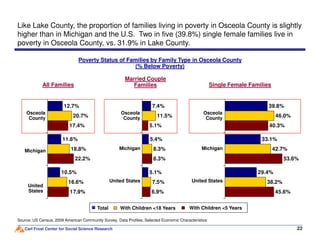
  • 12.
    Executive Summary (Cont’d.) Osceolaand Lake County receive high marks for having excellent emergency care, ambulatory/emergency transport, nursing home care, oncology, and in- home care. Conversely, there is a lack of dermatology, OB/GYN, oral surgery, podiatry, mental health treatment for severe/persistent disorders, and pediatrics. Many health care professionals believe, and secondary data supports, there is a lack of primary care providers for children and the underserved. Carl Frost Center for Social Science Research 1212 Although a myriad of programs and services exist, residents often have to travel outside of the area to access care. Usually this is due to a referral for specialized care, surgery, or cancer treatment. Feedback from this assessment demonstrates there are many opportunities for improvement. For example, although health care is accessible to most residents, specific subpopulations experience barriers to health care programs and services. The populations considered underserved are low income, uninsured, underinsured, and uninsurable. Barriers to health care exist in the form of high costs and transportation. At least residents do not have to worry about physicians refusing to accept Medicaid as in other counties. Providers in both counties accept Medicaid, even for new patients, and this allows many residents to access needed treatment.
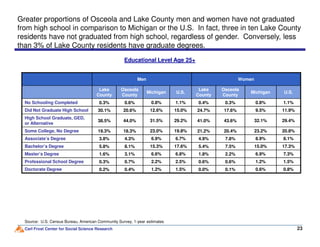
  • 13.
    Executive Summary (Cont’d.) Notonly is cost an issue because direct health care costs are high, but additionally, traditional health insurance often doesn’t cover ancillary services such as prescription drugs, vision, or dental care. Thus, if consumers have to pay for these services, plus deductibles and co-pays, the cost burden can be great and residents will avoid seeking necessary treatment. Community members (both residents and health care professionals) suggest strategies to improve the health care landscape. Specifically, they prioritize: increasing access to primary and specialist care, developing solutions to transportation issues, supporting and expanding agency resources to address community health needs, providing more opportunities to focus on wellness and Carl Frost Center for Social Science Research 1313 community health needs, providing more opportunities to focus on wellness and prevention, and more educational opportunities to encourage knowledge of healthy lifestyle activities, self-care, and existing support services in the community. Next steps may include the creation of a steering committee to work on prioritizing and then developing a coordinated response to issues deemed most important to work on, within a specific time frame, such as 1 year, 3 year, and 5 year goals. Above all, next steps involve the establishment of careful priorities for action that once implemented, will benefit the community for the long haul.
  • 14.
    Executive Summary (Cont’d.) Strengths Safecommunity; low violent crime rates Good public services and programs to address health needs and promote health Excellent coordination among providers Lower rates of binge drinking in Lake County than MI Women in Osceola County beginning prenatal care in first trimester Lower rates of youth risk behavior in both counties, such as smoking, binge drinking, or marijuana use, compared to MI or the US Dissatisfaction with life lower than MI Lower rate poor mental health than MI Rates of child immunizations better or on par with MI Lower prevalence of stroke and asthma in Lake County than MI or US Fewer low birth weight babies in Lake County than MI or the US Opportunities for Improvement High unemployment rates for both Funding limitations hinder support of Greater prevalence of diabetes and Carl Frost Center for Social Science Research 1414 High unemployment rates for both counties High poverty, especially for Lake County and especially for children and single female households in both counties Nine in ten kids in Lake County eligible for free/reduced price lunch Higher proportions of residents with less than a high school degree Adult and infant mortality rates much higher than MI or US Very low number of primary care physicians per capita Lack of services and programs for the underserved (e.g., low income, uninsured) Funding limitations hinder support of needed programs and services Child abuse/neglect rates very high for Lake County Rates for death from heart disease or cancer higher than MI or US Higher proportion of Lake County adults with poor physical health and disability than MI High prevalence of cigarette smoking among Lake County adults and pregnant women Majority of adult population either overweight or obese and proportion of obese youth greater than MI or US Transportation a barrier to health care Greater prevalence of diabetes and heart-related conditions in Lake County than MI More than one in ten residents have no health coverage High proportion of health care paid by public payers, including Medicaid Repeat teen births high in Lake County Inadequate fruit/vegetable consumption among youth (while better than MI/US) Prevalence of obesity, smoking, and alcohol abuse high but satisfaction with community response low Lack of use of dental services, especially among underserved One in five adults report general health as fair or poor
  • 15.
  • 16.
  • 17.
  • 18.
    Unemployment and PovertyRates The unemployment rate is much higher in both Osceola and Lake counties compared to Michigan or the U.S. Moreover, one in five Lake County residents lives in poverty, a rate much higher than the state or nation. The proportion of people living in poverty in Osceola County is higher than the U.S., but on par with the state. Percentage of People in Poverty Population Age 16+ Unemployed and Looking for Work Carl Frost Center for Social Science Research 18 Source: Bureau of Labor Statistics, Local Area Unemployment Statistics; County Health Rankings. Osceola/Lake counties and MI 2011; Note: Data compiled from various sources and dates 20.1% 16.7% 14.3%16.1% Michigan United States Osceola County 16.8% 15.3% 9.2%10.5% Michigan United States Osceola County Lake County Lake County
  • 19.
    89.0% Children Living inPoverty Compared to Michigan, the proportion of children living in poverty is greater in Osceola County and almost double in Lake County. Even though the proportion of students eligible for free or reduced price school lunches is higher in Osceola County compared to the state, the most telling number is that nine in ten Lake County students are eligible for free or reduced price school lunches. Percentage of Students Eligible for Free/Reduced Price School Lunches Percentage of Children (< Age 18) in Poverty Carl Frost Center for Social Science Research 46.1% 58.9% 19 Source: County Health Rankings. Osceola and Lake counties and MI 2011; Note: Data compiled from various sources and dates; Fall 2010, Center for Educational Performance and Information (CEPI). 36.0% 19.0% 26.6% MichiganOsceola County MichiganOsceola County Lake County Lake County
  • 20.
    61.5% Children Born IntoPoverty in Lake County The proportion of children aged 0-4 receiving WIC and the proportion of Medicaid paid births are both higher in Lake County compared to Michigan. In fact, eight of ten Lake County children aged 0-4 currently receive WIC assistance. Medicaid Paid Births (2009) 54.4% 79.0% Children Ages 0-4 Receiving WIC (2009) Carl Frost Center for Social Science Research 41.2% 20 54.4% MichiganLake County MichiganLake County Source: Michigan League for Human Services; Lake County Health Profile, District Health Department #10, 2011.
  • 21.
    48.8% 40.9% 31.9% 14.9% 11.7% 8.5% 23.9% 17.6% 12.2% Poverty Status ofFamilies by Family Type in Lake County (% Below Poverty) The proportion of families living in poverty in Lake County is slightly higher than in Michigan and the U.S. Approximately one in five families with children in Lake County live in poverty. The county exceeds both the state and nation in families living in poverty with children under 18 years of age. In fact, for single female families with children under 18, almost half (48.8%) live in poverty. Lake County All Families Single Female Families Married Couple Families Lake County Lake County Carl Frost Center for Social Science Research 42.7% 38.2% 40.9% 53.6% 45.6% 33.1% 29.4% 8.3% 7.5% 11.7% 8.3% 6.9% 5.4% 5.1% 18.8% 16.6% 17.6% 22.2% 17.9% 11.6% 10.5% 21 Source: US Census, 2009 American Community Survey, Data Profiles, Selected Economic Characteristics Michigan United States Total With Children <18 Years With Children <5 Years Michigan United States Michigan United States
  • 22.
    46.0% 40.3% 39.8% 11.5% 5.1% 7.4% 20.7% 17.4% 12.7% Poverty Status ofFamilies by Family Type in Osceola County (% Below Poverty) Like Lake County, the proportion of families living in poverty in Osceola County is slightly higher than in Michigan and the U.S. Two in five (39.8%) single female families live in poverty in Osceola County, vs. 31.9% in Lake County. Osceola County All Families Single Female Families Married Couple Families Osceola County Osceola County Carl Frost Center for Social Science Research 42.7% 38.2% 40.3% 53.6% 45.6% 33.1% 29.4% 8.3% 7.5% 5.1% 8.3% 6.9% 5.4% 5.1% 18.8% 16.6% 17.4% 22.2% 17.9% 11.6% 10.5% 22 Source: US Census, 2009 American Community Survey, Data Profiles, Selected Economic Characteristics Michigan United States Total With Children <18 Years With Children <5 Years Michigan United States Michigan United States
  • 23.
    Educational Level Age25+ Greater proportions of Osceola and Lake County men and women have not graduated from high school in comparison to Michigan or the U.S. In fact, three in ten Lake County residents have not graduated from high school, regardless of gender. Conversely, less than 3% of Lake County residents have graduate degrees. Men Women Lake County Osceola County Michigan U.S. Lake County Osceola County Michigan U.S. No Schooling Completed 0.3% 0.6% 0.8% 1.1% 0.4% 0.3% 0.8% 1.1% Did Not Graduate High School 30.1% 20.6% 12.6% 15.0% 24.7% 17.6% 9.5% 11.9% High School Graduate, GED, or Alternative 38.5% 44.0% 31.5% 29.2% 41.0% 43.6% 32.1% 29.4% Carl Frost Center for Social Science Research 23 Source: U.S. Census Bureau, American Community Survey, 1-year estimates or Alternative Some College, No Degree 19.3% 18.3% 23.0% 19.8% 21.2% 20.4% 23.2% 20.8% Associate’s Degree 3.8% 4.3% 6.9% 6.7% 4.9% 7.8% 8.9% 8.1% Bachelor’s Degree 5.8% 8.1% 15.3% 17.6% 5.4% 7.5% 15.0% 17.3% Master’s Degree 1.6% 3.1% 6.6% 6.8% 1.8% 2.2% 6.9% 7.3% Professional School Degree 0.3% 0.7% 2.2% 2.5% 0.6% 0.6% 1.2% 1.5% Doctorate Degree 0.2% 0.4% 1.2% 1.5% 0.0% 0.1% 0.6% 0.8%
  • 24.
    0.4 5.46.61.0 536.0 Crime Rates Violent CrimeRate Per 100,000 Population Homicide Rate Per 100,000 Population Osceola County Michigan United States Lake and Osceola County residents live in safer communities, which is evident by far less violent crime compared to Michigan or the U.S. However, child abuse/neglect rates in Lake County are triple those of Osceola County or the U.S. and more than double the rates for Michigan. Lake County Carl Frost Center for Social Science Research 27.3 9.012.99.7 344.0 429.4 234.0 Osceola County Michigan United States 24 Source: County Health Rankings. Osceola and Lake counties and MI 2011; Note: Data compiled from various sources and dates; US FBI Website 2009; County Health Rankings/MDCH, Division of Vital Records. Osceola and Lake counties and MI 2008; United States Census Bureau 2008; Kids Count Data Book. Osceola and Lake counties, MI, and US 2009. County States Confirmed Victims of Child Abuse/Neglect Rate Per 1,000 Children <18 Michigan United States Osceola County Lake County County Lake County
  • 25.
  • 26.
    74.1 80.880.478.978.9 74.1 75.4 75.9 LifeExpectancy (Average Age) The average life expectancy for both men and women is the same in Osceola and Lake counties. Of some concern is that men and women in both counties can expect, on average, to live slightly shorter life spans than men and women across the state or nation. Carl Frost Center for Social Science Research 26 Osceola County Michigan United States Source: Institute for Health Metrics and Evaluation at the University of Washington. Uses 2007 mortality data for Osceola and Lake counties, 2009 MI, 2008 US Women Men Lake County
  • 27.
    891.9 758.7784.6820.4 Mortality Rates, AgeAdjusted Per 100,000 Population Lake and Osceola counties have higher age adjusted mortality rates than Michigan or the U.S. The most recent mortality rate data shows Lake County at 892 and Osceola County at 820 per 100,000 residents, respectively. Carl Frost Center for Social Science Research 27 Osceola County Michigan United States Source: Michigan Resident Death File, Vital Records & Health Statistics Section, Michigan Department of Community Health. Lake and Osceola Co. 2009; MI 2009 and US 2008; Kids’ Count Data. US 2007. Lake County
  • 28.
    Proportion of LiveBirths with Low Birth Weight Low Birth Rates and Infant Mortality Rates Lake County has fewer live births with low birth weight than the state or nation but Osceola has almost double. Both counties have higher infant mortality rates than Michigan or the U.S. In Osceola County, 15.2% of all live births are classified as having low birth weight and in Lake County one in ten infants dies prematurely. Infant Mortality Rate Per 1,000 Live Births Carl Frost Center for Social Science Research 7.9% 15.2% 8.2%8.4% 10.5 6.37.59.4 28 Source: MDCH Vital Records Division, Resident Birth Files. Osceola and Lake counties, MI, U.S. 2009. Michigan United States Osceola County Michigan United States Osceola County Lake County Lake County
  • 29.
    Top 5 LeadingCauses of Death The top five leading causes of death are the same for Lake County, Osceola County, Michigan, and the U.S., however, the rate for both counties are higher than the state or nation for each condition. Additionally, cancer is the leading cause of death in Lake and Osceola counties, whereas the leading cause of death is heart disease in the state and nation. Lake County has far higher rates for both cancer and heart disease than Osceola County, Michigan, or the U.S. Lake County Michigan United States RANK Rate RANK Rate RANK Rate Cancer 1 338.6 2 202.4 2 186.2 Heart Disease 2 292.9 1 231.1 1 203.1 Chronic Lower Respiratory Diseases 3 100.7 3 49.6 4 44.0 Stroke 4 82.4 4 44.3 3 46.4 Carl Frost Center for Social Science Research 29 Source: Michigan Department of Community Health, Osceola and Lake counties, and MI 2009; U.S. Census Bureau. US 2007. Unintentional Injuries 4 82.4 5 36.8 5 39.9 Osceola County Michigan United States RANK Rate RANK Rate RANK Rate Cancer 1 264.3 2 202.4 2 186.2 Heart Disease 2 237.9 1 231.1 1 203.1 Chronic Lower Respiratory Diseases 3 74.9 3 49.6 4 44.0 Stroke 4 61.7 4 44.3 3 46.4 Unintentional Injuries 5 44.0 5 36.8 5 39.9
  • 30.
    506.3 465.1 489.1 577.2 Cancer Rates Cancer DiagnosisRate (Age Adjusted) Per 100,000 Population Compared to the state or the nation, cancer diagnosis rates are higher for Lake and Osceola County residents. Additionally, cancer death rates are notably higher for both counties as well. Overall Cancer Death Rate Per 100,000 Population Carl Frost Center for Social Science Research 465.1 489.1 338.6 186.2202.4 264.3 30 Osceola County Michigan United States Source: MDCH Cancer Incidence Files. Osceola/Lake counties , MI; MDCH/ County Health Rankings. Osceola County Michigan United States Lake County Lake County
  • 31.
    Top 10 LeadingCauses of Preventable Hospitalizations Chronic obstructive pulmonary disease (COPD) is the leading cause of preventable hospitalization in Lake County, whereas it is bacterial pneumonia in Osceola County. Congestive heart failure is the second leading cause of preventable hospitalizations in both counties, but is the leading cause in Michigan. Cellulitis is far more likely to be a leading cause of preventable hospitalization in Osceola County and Michigan than Lake County. Lake County Osceola County Michigan RANK % of All Preventable Hospitalizations RANK % of All Preventable Hospitalizations RANK % of All Preventable Hospitalizations Chronic Obstructive Pulmonary Disease (COPD) 1 17.4% 3 9.9% 3 10.0% Congestive heart failure 2 16.1% 2 14.1% 1 14.1% Bacterial Pneumonia 3 15.8% 1 15.7% 2 11.7% Carl Frost Center for Social Science Research 31 Source: MDCH Resident Inpatient Files, Division of Vital Records. Osceola/Lake counties and MI 2009. Kidney/Urinary Infections 4 6.6% 4 7.0% 4 6.5% Diabetes 5 5.9% 7 4.4% 7 4.9% Dehydration 6 4.3% 8 4.2% 8 3.3% Asthma 7 3.6% 6 4.8% 5 6.2% Gastroenteritis 8 2.0% 9 2.2% 10 1.4% Cellulitis 9 1.6% 5 5.2% 6 5.7% Grand Mal and Other Epileptic Conditions 10 1.0% 10 1.6% 9 2.7% All Other Ambulatory Care Sensitive Conditions 25.7% 30.8% 33.6% Preventable Hospitalizations as a % of All Hospitalizations 19.3% 17.3% 20.5%
  • 32.
    69.2% 69.9%73.5%76.9% Osceola Countyhas better rates than the state for proportion of women beginning prenatal care in the first trimester and for full immunization of children aged 19-35. Conversely, Lake County has lower rates than the state, especially with regard to women receiving prenatal care in the first trimester. Proportion of Women Who Begin Prenatal Care in First Trimester Proportion of Children Aged 19-35 Months Fully Immunized Proportion of Births to Women Who Receive Late or No Prenatal Care Prenatal Care and Childhood Immunizations Carl Frost Center for Social Science Research 4.0% 4.7% 4.0%3.2% MIOsceola County U.S. 64.0% 69.2% 69.9% 66.1% 63.1% 73.5%76.9% 32 Source: MDCH Vital Records Osceola/Lake counties and MI 2009; Kids Count Data Book/MDCH Vital Statistics. Osceola/Lake counties and MI 2009; Local and MI % from MICR. National data at CDC National Immunization Survey. MichiganOsceola County MI U.S.Osceola County Lake County Lake County Lake County
  • 33.
    Health Status (2006-2010 PrevalenceEstimates) Almost one in five Lake County adults perceive their health as fair or poor. Also, Lake County adults are more likely to experience poor physical but less likely to experience poor mental health than people across Michigan. Perception of General Health (Fair/Poor) Poor Physical Health (On At Least 14 Days in Past Month) Poor Mental Health (On At Least 14 Days in Past Month) Carl Frost Center for Social Science Research 14.7%19.1% 33 Source: Michigan Behavioral Risk Factor Survey Prevalence Estimates, 2006-2010. MichiganLake County 10.9%15.9% MichiganLake County 10.9%8.5% MichiganLake County
  • 34.
    Heath Status (Cont’d.) (2006-2010Prevalence Estimates) Furthermore, Lake County adults are more likely to be disabled and experience activity limitation compared to adults across Michigan. Despite this, they are slightly more satisfied with their lives. Satisfaction with Life (Dissatisfied/Very Dissatisfied) 32.3% Disability Activity Limitation (At Least 14 Days in Past Month) Carl Frost Center for Social Science Research 6.3%5.0% 34 Source: Michigan Behavioral Risk Factor Survey Prevalence Estimates, 2006-2010. MichiganLake County 23.5% MichiganLake County 7.0%9.4% MichiganLake County
  • 35.
    30.1% 36.1% Weight (2006-2010 Prevalence Estimates) Almosteight in ten (79.2%) Lake County adults are overweight or obese. The fact the more than four in ten adults are considered obese should be a major public health concern and priority for health care professionals in the community. Overweight (BMI = 25.0-29.9) 35.6% 43.1% Obese (BMI = 30.0+) Carl Frost Center for Social Science Research 30.1% 35 Source: Michigan Behavioral Risk Factor Survey Prevalence Estimates, 2006-2010. MichiganLake County MichiganLake County
  • 36.
  • 37.
    Chronic Conditions (2006-2010 PrevalenceEstimates) The most prevalent chronic health condition among Lake County adults is diabetes, a rate that is double that of the state of Michigan. Lake County adults have slightly lower rates for asthma than the state, but much higher rate of chronic heart conditions such as heart attacks or angina/coronary heart disease. Lake County Michigan % % Ever told have diabetes 18.5% 9.3% Ever told have asthma 10.3% 15.2% Still have asthma 8.7% 9.9% Carl Frost Center for Social Science Research 37 Still have asthma 8.7% 9.9% Ever told have heart attack 9.2% 4.7% Ever told have angina/coronary heart disease 8.7% 4.9% Ever told have stroke 0.6% 2.8% Source: Michigan Behavioral Risk Factor Survey Prevalence Estimates, 2006-2010.
  • 38.
  • 39.
    27.0% Tobacco and Alcohol (2006-2010Prevalence Estimates) More than one-fourth of Lake County adults currently smoke cigarettes, a proportion higher than the state. More than one in ten adults have engaged in binge drinking in the past month, however, this rate is below that of Michigan adults living elsewhere. Current Smoker Binge Drinking Carl Frost Center for Social Science Research 20.3% 27.0% 39 Source: Michigan Behavioral Risk Factor Survey Prevalence Estimates, 2006-2010. MichiganLake County 17.1% 11.6% MichiganLake County
  • 40.
    Proportion of Birthsto Mothers Who Smoked During Pregnancy in Lake County The proportion of Lake County mothers who smoke during pregnancy is more than double the proportion across Michigan. More alarming is that this proportion may be on the upswing for both groups. 35.5% 33.1% 31.5% 31.6% 38.7% 30.0% 40.0% 50.0% Carl Frost Center for Social Science Research 40 Source: Michigan League for Human Services; Osceola/Lake counties Health Profile, District Health Department #10, 2011. 18.0% 14.1%13.8%14.0%14.4% 0.0% 10.0% 20.0% 2004 2005 2006 2007 2008 Lake County Michigan
  • 41.
    26.0% No Leisure TimePhysical Activity (2006-2010 Prevalence Estimates) One-fourth of Lake County adults engage in no leisure time physical activity, which is higher than the state of Michigan. Carl Frost Center for Social Science Research 23.4%26.0% 41 Source: Michigan Behavioral Risk Factor Survey Prevalence Estimates, 2006-2010. MichiganLake County
  • 42.
  • 43.
    28.6% Teenage Pregnancy Teen birthsare slightly higher in Lake and Osceola counties compared to Michigan or the U.S. Repeat teen births are lower in Osceola County than the state or nation. However, in Lake County repeat teens births are much higher than the state or national average, where more than one-fourth (28.6%) of teens aged 15-19 give birth more than once. Teen Births, Ages 15-19 (% Of All Births) Repeat Teen Births (% Of All Births to Mothers Aged 15-19) Carl Frost Center for Social Science Research 28.6% 16.7% 19.0%18.4% 43 Source: MDCH Vital Records. Osceola and Lake counties and MI 2009; Kids Count Data Book. Osceola and Lake counties and MI 2009. 13.0% 12.2% 10.2%10.0% Michigan United States Osceola County Michigan United States Osceola County Lake County Lake County
  • 44.
    Tobacco, Alcohol andMarijuana Use Among Youth Far fewer Osceola and Lake County youths currently smoke cigarettes, engage in binge drinking, or use marijuana compared to youths across Michigan or the U.S. Proportion of Youth Who Report Current Smoking (Past 30 Days) Proportion of Youth Reporting Binge Drinking (5+ Drinks, Past 30 Days) Proportion of Youth Reporting Current Marijuana Use (Past 30 Days) Carl Frost Center for Social Science Research 10.3% 5.6% 24.2%23.2% 44 Source: Youth Risk Behavior Survey (YRBS), Osceola/Lake counties YAS 2009. 6.1% 2.2% 19.5%18.8% MI USOsceola County MI USOsceola County 14.7% 3.8% 20.8%20.7% MI USOsceola County Lake County Lake County Lake County
  • 45.
    56.7% 69.1% 63.0% 53.2% Obesity, Physical Activityand Diet Among 9th and 11th Grade Students The proportion of obese youth in both Lake and Osceola counties is greater than the state or the nation. Further, over half of Lake County and almost seven in ten Osceola County youth report inadequate physical activity. Furthermore, two-thirds do not eat enough servings of fruits or vegetables, but this proportion is more favorable in comparison to the state or nation. Youth Who Are Obese (>95th Percentile BMI for Age and Sex) Youth Reporting Inadequate Physical Activity (<60+ Minutes, 5+ Days Per Week) 67.2% 65.1% 77.7% 80.4% Youth Reporting Less Than 5 Servings of Fruits/Vegetables Per Day (Past Week) Carl Frost Center for Social Science Research 45 Source: Youth Risk Behavior Survey (YRBS), Osceola and Lake counties 16.9% 20.3% 12.0%11.9% MI USOsceola County MI USOsceola County MI USOsceola County Lake County Lake County Lake County
  • 46.
  • 47.
    Heath Care Utilizationand Access (2006-2010 Prevalence Estimates) More than one-third (37.6%) of Lake County adults have not had a routine physical checkup in the past year. Almost one in five (18.8%) have no personal health care provider. Also, more than one in ten (15.1%) were denied health care access in the past year due to health care costs. All three of these rates are higher than the state. No Personal Health Care Provider No Health Care Access in Past 12 Months Due to Cost 31.8% 37.6% No Routine Physical Checkup in Past Year Carl Frost Center for Social Science Research 47 Source: Michigan Behavioral Risk Factor Survey Prevalence Estimates, 2006-2010. 13.2%18.8% MichiganLake County 12.9%15.1% MichiganLake County 31.8% MichiganLake County
  • 48.
    Primary Care Physiciansand Medicaid Patients Primary Care Physicians (MDs and DOs) Per 100,000 Population The difference between the number of primary care providers (PCPs) per capita in Lake and Osceola counties vs. the state of Michigan could not be more stark. Whereas in Michigan there are, on average, more than one hundred PCPs per 100,000 residents, in Lake County there are only nine. The proportion of uninsured residents in Lake and Osceola counties is actually lower than the state or nation. Proportion of Uninsured Residents Carl Frost Center for Social Science Research 13.0% 14.0% 15.0%17.9% 114.4 21.8 9.1 48 Source: US Department of Health & Human Services, Community Health Status Indicators; County Health Rankings. Osceola County Michigan Osceola County Michigan United States Lake County Lake County
  • 49.
  • 50.
    Top 10 HospitalIn-Patient Discharges in 2010 and 2011 (Q1-Q3) According to hospital discharge records for Spectrum Health Reed City Hospital, both Lake and Osceola County residents are discharged most often for influenza/pneumonia. COPD is the also a common discharge for residents of both counties (2nd and 3rd). The two major differences between the two counties revolves around heart disease, which is the second top condition for discharge for Osceola County residents but sixth for Lake County and cellulitis which is more common in Osceola than Lake County. Lake County Osceola County Condition % of SHRCH Discharges Rank % of SHRCH Discharges Rank Influenza/Pneumonia 11.7% 1 11.2% 1 Chronic Obstructive Pulmonary Disease (COPD) 9.9% 2 7.0% 3 Congestive heart failure 6.3% 3 5.0% 4 Carl Frost Center for Social Science Research 50 Congestive heart failure 6.3% 3 5.0% 4 Stroke 6.1% 4 4.5% 5 Diabetes Mellitus 5.3% 5 2.0% 8 Heart disease, other than CHF, hypertension, angina 4.8% 6 8.5% 2 Poisoning 2.5% 7 2.2% 7 Asthma 2.5% 8 1.6% 10 Dehydration 1.8% 9 1.9% 9 Cancer (malignant neoplasm) except cervical 1.3% 10 1.6% 10 Cellulitis 1.0% NA 4.5% 6 Source: Spectrum Health Reed City Hospital, 2010, 2011.
  • 51.
    Payer Type PerDischarge (2010 and 2011, Q1-Q3) For all hospital discharges over the past two years, roughly eight in ten are public payer types for both Lake and Osceola counties, the bulk of which includes Medicare and Medicaid. The uninsured represent between 5.6%-7.8% of all Spectrum Health Reed City Hospital in-patient discharges over the past two years. Uninsured, 5.6% Private, 10.9% Uninsured, Private, 13.6% Other, 0.3% Lake County Osceola County Carl Frost Center for Social Science Research 51 Source: Spectrum Health Reed City Hospital, 2010, 2011. 5.6% Public, 83.5% Uninsured, 7.8% Public, 78.3%
  • 52.
    Payer Type PerEmergency Department Visit (2010 and 2011, Q1-Q3) For all Emergency Department visits in Osceola and Lake counties over the past two years, approximately 7% are for patients without health care coverage and between two-thirds to three- fourths have public health insurance. Lake County residents who visit the ED are less likely to have private health insurance compared to residents from Osceola County. Uninsured, Private, 16.0% Uninsured, Private, 25.5% Lake County Osceola County Carl Frost Center for Social Science Research 52 Source: Spectrum Health Reed City Hospital, 2010, 2011. Uninsured, 7.2% Public, 76.8% Uninsured, 7.4% Public, 67.1%
  • 53.
  • 54.
    Health Care Issuesand Accessibility
  • 55.
    These issues areconsidered to be county-wide, although some Key Stakeholders feel Lake County as well as outlying residential addresses (e.g., northern areas) struggle more with access issues. Health care access, obesity, lack of health care resources, poverty, access to specialty care, an aging population and lack of senior services, mental health treatment (including substance abuse), chronic disease, and teen pregnancy are identified as the most pressing health issues in Osceola and Lake Counties, particularly for low income and senior individuals. Overall, actually, access is the primary challenge in Lake County. And that extends to access to specialty care and also obviously boils down to mental health care. I actually think there is good access in Lake County if somebody has a severe mental health disability. Where the primary care gap in mental health is, is for folks with mild to moderate need. Overall, it’s poverty. It’s a rural community that is also poor. If they have insurance, they tend to come in and get care. If they don’t, they wait too long to get services. So that’s Most Pressing Health Needs or Issues Carl Frost Center for Social Science Research 55 Q1. What do you feel are the most pressing health needs or issues in Osceola and Lake counties? (PROBE FOR DIFFERENCES BETWEEN SUB-POPULATIONS, GROUPS. ALSO, CLARIFY ISSUES ARE THE SAME/DIFFERENT FOR COUNTY VS. THEIR LOCAL COMMUNITY) If they have insurance, they tend to come in and get care. If they don’t, they wait too long to get services. So that’s certainly a huge difference in the population I see. We do see quite a few uninsured but people wait a long time before they come in because they don’t want to have to pay out of pocket. Services aren’t free but they are certainly reduced, but many people here just kind of make do until they can’t anymore. Weight management. We have a lot of obesity here. The number one problem for people of low income is transportation and it’s real hard for some of them to get to hospitals or at all or to doctors or to medical care. It is not enough to serve the entire county. So recruitment is a big issue for us here, and serving everyone that needs to be served. I think that substance use and mental health issues are very glaring here. I was really taken aback by the seriousness of the issues here. It’s a very serious issue here in Lake County. There is not a hospital in Lake County, there is a hospital in Osceola County that serves part of Lake and Lake does have some primary care physicians and PAs, but it’s [lack of access] probably more pronounced in Lake than it is in Osceola.
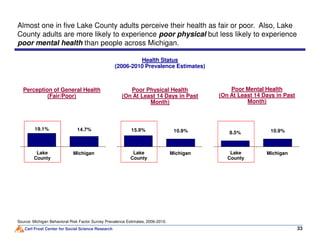
  • 56.
    While Key Stakeholdersbelieve these issues have been somewhat addressed within their communities, they view the size and scope of these problems as vast. Further, poverty and lack of transportation are exacerbating the situation. The uninsured, unemployed, low income, and elderly are touched most by these issues. We’ve moved into providing substance abuse services because that was very limited, so actually there’s quite a bit of work going on there. The big gap is in the moderate to mild need so we’re also exploring how much of that they can do and how much we do. Baldwin Family Health Care Cancer screening program Hospital designation as Critical Access Hospital merger Implementation of more substance abuse programs Reinstatement of family planning program Reopening of prison (more employment) Rural health centers Satellite health care offices Teen school health clinic Ways Most Pressing Health Needs or Issues are Being Addressed Five of six Key Stakeholders say these issues are addressed at least somewhat through the following: Carl Frost Center for Social Science Research 56 Q1a. Is there anything currently being done to address these issues? Q1b. (If yes) How are these issues being addressed? (PROBE FOR EFFECTIVENESS) Q1c. (If no) In your opinion, why aren’t these issues being addressed? Q1d. (If no) In what ways have these issues been addressed in the past, if any? (PROBE FOR EFFECTIVENESS) Q2. What is the size and scope of the most pressing issue/problem? (PROBE FOR NUMBER/PROPORTION OF PEOPLE TOUCHED, SPECIFIC GROUP TOUCHED. IF HEALTH CARE ACCESS MENTIONED, PROCEED WITH Q5, THEN COME BACK TO Q3) do and how much we do. This [access] is monumental. Again, the transportation issue of people being able to get to medical care. And they wait, again, since they don’t have a doctor and they don’t have insurance, they wait to go to the hospital on an emergency basis and things are tough. And they need a surgery they can’t afford. It’s monumental. In Lake County for example, they have a federally qualified rural health center that allows the use of government assistance to bring in primary care physicians who have received loans, for example, during their medical training, and then they have to go to underserved areas to pay off those loans for like two to three years at a time. There’s nothing that I see from a city or a township or a county level to talk about the community health needs. I was on a consortium for community health needs for a six county area kind of begun in Clare and they’re doing a lot with health needs. But Osceola County has not been willing to jump on that bandwagon so to speak and it was a little disappointing because we tried to get people involved.
  • 57.
    The worsening ofthe local economy is the most important event impacting the community’s health and health care landscape. Because there is little employment, there is a large number of residents with no health insurance or on Medicaid. On the upside, the reopening of the prison, school health clinics, and the good collaborative history between agencies are seen as areas that positively impact the health landscape. In Lake County in particular, the economy has always been bad, so we haven’t really noticed a huge shift based on the recession because frankly it’s never been good. When your baseline is so poor, I don’t even think it’s necessarily changed that much. If you start at zero, you don’t really go down that far. The relationship between the schools involving Family Health Care. They’ve got the teen health clinic in the schools and the Baldwin schools is a real hub in the community and I think their superintendent is one of the best in the three counties. They all sort of funnel back to the need to have money to do things, whether it’s to build a physician’s office, recruit a primary care physician, expand your emergency room to take care of patients, etcetera, Sentinel Events Impacting the Community’s Health and Health Care Landscape Carl Frost Center for Social Science Research 57 Q3. What are the key sentinel events that may have impacted the community’s health and health care landscape in the past one to two years? (PROBE FOR INFECTIOUS DISEASE OUTBREAKS, SIGNIFICANT LOCAL, STATE, AND FEDERAL POLICY CHANGES, SIGNIFICANT ECONOMIC EVENTS, DISASTERS, ETC.) office, recruit a primary care physician, expand your emergency room to take care of patients, etcetera, it all sort of relates to that. So if there was one tsunami, it would be the economy. Reopening the prison will hopefully have a positive effect on the tax base an in employing and the economy, etcetera. The other thing you have in Lake County honestly, it’s my favorite county of the three to work in, they have a very good collaborative history there because in large part because they’ve really had no choice; to kind of collaborate or die in Lake County. In some ways, it’s easier to work within the county. It’s a huge strength they have that people never really think of. Lake County’s always thought of being very depressing and the poorest, but I think people need to rethink that a little bit.
  • 58.
    For the county,we are primarily for low income. I think people utilize the emergency room much too often because they have a lack of primary care services. We certainly don’t have enough providers to care for the entire county. And we certainly would like to expand, but with expansion requires funding to help us recruit professionals and to retain them. If you live on the north side of Osceola County, you can drive 45 minutes to get to the hospital to get a lab. So again people won’t do it because they don’t want to spend the money on gas or it’s just too long because they’re elderly and they don’t want to or can’t drive that far. Many times you have to leave the city to go to a specialist. While Key Stakeholders note that hospitals and clinics address a variety of needs for both uninsured and insured residents, access to care is limited due to poverty, lack of transportation, lack of primary care physicians, and lack of specialists. Four of six stakeholders feel there are inadequate disability services. More services for both mental and physical disabilities, increased program funding, following disability building code regulations, and having electronic health systems (TeleHealth) are viewed as potential solutions . State of Health Care Access and Evaluation Outcomes Carl Frost Center for Social Science Research 58 Q4. What are the outcomes that should be evaluated? (PROBE FOR MORTALITY, MORBIDITY, RISK BEHAVIOR) Q5. Describe the current state of health care access in Osceola and Lake counties. (PROBE FOR ISSUES OF TRANSPORTATION, HEALTH COVERAGE, DIFFERENCES IN SUB-POPULATIONS, GROUPS. ALSO, CLARIFY ISSUES ARE THE SAME/DIFFERENT FOR COUNTY VS. THEIR LOCAL COMMUNITY) Q6g. Are there adequate disability service programs? Q6h. (If no) What can be done to address this inadequacy? Respondents identified the following as important measures for health-related outcomes: Best practices Chronic diseases Coordination with primary care Liver functioning Medical health Morbidity Nutrition & exercise rates Obesity Population-based outcomes Prevention efforts & success at reducing rates I think there are many categories and many things that we should be held accountable to, to help show improvement and progress. A reduction in certain cancers, like breast cancer, because if you get your digital screening sooner and can detect things then sooner, then you could possibly live a normal, healthy life. I’d go back to prostate cancer screenings, a very treatable cancer if you catch it early. Skin cancers along the same line, devastating if you get it late, it’s curable if you get it early. Those would be the kind of outcomes I would like to see.
  • 59.
    Over half saythere is not a wide variety or choice of primary care physicians, but it depends on where one lives and what services one needs. Stakeholders feel it is hard to recruit PCPs to a rural setting, and that this is exacerbated by a general lack of county resources and a poor public school system. All believe there is a lack of insurance coverage for ancillary services and most believe residents have difficulty paying deductibles and other out-of-pocket expenses. 100% Lack of Ancillary Service Coverage Yes No Don't know Viewpoints on Provider Choices, Lack of Coverage for Ancillary Services, and Inability to Pay (n=5) 83% 17% Inability to Pay Out-of-Pocket Yes No Don't know (n=6)(n=6) Carl Frost Center for Social Science Research 59 Q5a. Is there a wide variety/choice of primary health care providers? Q5b. (If yes) Is this variety/choice available to both insured and uninsured people? Q5c. (If no) In your opinion, why is there a lack of primary health care providers? 5d. Is there a lack of insurance coverage for ancillary services, such as prescriptions or dental care? Q5e. Is there an inability to afford out-of-pocket expenses, such as co-pays and deductibles? I don’t think we have a long wait time here, but then again, if you live in the northern part of the county, it might be tough for you. I only know one provider that is only taking insured people. Most of those employed by us, we take anything. It’s a lifestyle here of rural life and for many physicians and their families, they want to live in bigger cities. For us, we have folks who are making decisions about psychotropic medication and that is a big issue. There’s an out-of-pocket expense to go to Baldwin Family Health Care. I think it’s a little more pronounced in Lake County than in Osceola. But it’s a pretty well known fact – they’re two of the poorer counties in Michigan. That’s cash on the barrelhead, that’s coming out of your pocket and that’s exactly what no one has. And they continue to go up as well - even co-pays, a $30 visit to your office. Probably what would be better is to increase the co-pay cost for a visit to the emergency room, but lower it to a primary care physician so you could get checked. (n=5) (n=6)(n=6)
  • 60.
  • 61.
    There’s a lotof collaboration among health and human service providers in the county. Much, much better but it still needs to be improved. There is money for the severely mentally impaired but for the other folks who need medications, they’re not getting it. I mean primary care is something I think we do pretty well. We do pretty well in The majority of Key Stakeholders think existing programs and services meet the community’s needs and demands at least somewhat well. They think Lake and Osceola counties have many good support services, but the availability of these services is problematic for the elderly, those requiring in-patient or out-patient mental health (including substance abuse) treatment, and for those with a lack of transportation. Programs/Services Meeting Needs in the Community 17% Carl Frost Center for Social Science Research 61 Q6. How well do existing programs and services meet the needs and demands of people in your community? Would you say they meet them exceptionally well, very well, somewhat well, not very well, or not at all well? Q6a. Why do you say (INSERT RESPONSE)? (PROBE FOR DIFFERENCES IN SUB-POPULATIONS, GROUPS) I mean primary care is something I think we do pretty well. We do pretty well in emergency treatment, we do pretty well at some of the diagnostic things, lab work, imaging, things like that. In Reed City in particular, cancer treatment and long-term care. We offer a lot here [Spectrum Health]. You can get just about anything you need. We’ve got physical therapy, we’ve got bone density, we’ve got the cancer services, there are a lot of services that you typically wouldn’t find in a very small community hospital. We have MRI, just a lot of different things on site so we can bring it locally. We try to avoid having folks drive to Grand Rapids if we can. A lot of people don’t like the drive to Grand Rapids, for them that’s the big city and they don’t want to go and many have said they won’t go. 17% 66% Very well Somewhat well Not very well Not at all well (n=6)
  • 62.
    Services identified aslacking are specialty services, dental care, mental health services, OB/GYN services, community centers for families and seniors, in-home respite care, primary care physicians, and a focus on chronic disease prevention activities. Programs/Services Lacking in the Community Chronic disease prevention activities Community centers for families and seniors Dental care In-home respite care Gyms/Exercise facilities Mental health services (including substance abuse) OB/GYN services Primary care physicians Specialty services Transportation Youth services Carl Frost Center for Social Science Research 62 Q6b. What programs or services are lacking in the community? (PROBE FOR PROGRAMS/SERVICES THAT ADDRESS SPECIFIC SUB-POPULATIONS, GROUPS, PRIMARY CARE, CHRONIC DISEASE) There’s not a gym. There’s no place, other than the tiny one that we have, no place to really work out. They do have a nice walking trail system, but I’m not sure how many people use it. In the county we could use a little more primary care. I’m not sure that the [OB/GYN] population is there. We have a lot of elderly, or those that are retired, and because there are not a lot of jobs, a lot of our kids leave and no one lives in this area. There’re many more services it would be nice to provide – we can’t afford them.
  • 63.
    No Key Stakeholdercan identify existing community services that are not needed. While noting the existence of some duplication in intake processes, Key Stakeholders feel there is not a lot of waste in these communities even though their resources are extremely limited. Any inefficiencies I would relate back to lack of funding. There’s certainly not any duplication. Like there’s not too many primary care physicians, there’s only one ER in these two counties, there’s one cancer center. One hospital. I would say no. Whatever we have, we’re glad to have and I don’t think there’s a lot of waste. If anything I’d say it’s a little better than other communities, because Lake County is so small and everybody knows everybody. But there’s tremendous duplication in those additional intake processes and lack of communication and coordination across them. Because it’s a pretty isolated area and it’s not heavily populated so of the services that are here, we need each and every one of them. Service Duplication and Improved Community Response to Health and Health Care Needs Carl Frost Center for Social Science Research 63 Q6c. Are there any programs/services that currently exist that aren’t needed? Q6d. (If yes) What are these programs/services? Why aren’t they needed? Q6e. Is there any duplication of services? Q6f. (If yes) What services are duplicated? Q6i. In your opinion, how could any of the existing services/programs in your community be implemented better? Q7. Are there any partnerships that could be developed to better meet a need? Q7a. (If yes) What are these partnerships? Q7b. (If yes) How could they be better developed? Stakeholders feel services can work better through increased collaboration, increased partnerships with schools, community groups (and other counties), developing more long-term funding and goals, increasing access to moderate mental health services, and creating a central hub for information. Many times people have projects or funding for a grant and its very short-term and so there’s a lack of some of the long-term looking at long-term outcomes, looking at long-term funding streams, looking in terms of how do you make it impact. People kind of get lost in healthcare systems. And I think there’s an upcoming profession similar to case managers or patient navigators that is really needed. I think Osceola needs to tie in with other counties and either learn from them and help teach them, kind of share resources, I think would be helpful. Even if it’s just Osceola and Mecosta, which is just south of here, they have a lot more resources, they have a college, it’s just a little bigger community.
  • 64.
    Four Key Stakeholderscurrently have recommendations or plans for implementation of new programs currently lacking in the community that will work to improve existing services, recruit more physicians to the area, and address chronic diseases. Stakeholders would like to see and/or are planning more interdisciplinary approaches, to recruit more PCPs and specialists to the area, improve existing services such as long-term care and emergency services, and programs that focus on smoking, teen pregnancy, diabetes, and cancer. Always looking at chronic disease prevention funding Classes for pre-diabetics Depends on federal government and what gets cut Expanding cancer treatment services Improving emergency care More expansion More specialists in the area Plan for free/low cost programming for public for weight management Recruiting more PCPs Reviewing long-term care facilities and program Smoking prevention program for pregnant women Plans/Recommendations for New Program Implementation Carl Frost Center for Social Science Research 64 Q8. Do you have any recommendations or plans for implementation of new programs or services that are currently lacking in the community? Q8a. (If yes) What are your recommendations or plans? More interdisciplinary approach More physicians Teen pregnancy prevention program We’re in the process of expanding our cancer center and adding treatments to that and that’s a good thing so people don’t have to drive to far away places to get the same treatment like radiation and so on. We’re in the process of recruiting more primary care physicians, which is critical to everything like I was talking about. We’re in the process of improving our capability to provide emergency care. We’re in the process of analyzing our long- term care unit to determine how many beds we should have, what services we should provide for the seniors. So that’s all good. We’re looking at trying to do some group visits for diabetics through our rural health clinic here where you get a group of folks with a like diagnosis and they come here and they get a whole bunch of different services. Very much involved around diabetes because that is a huge issue for this community.
  • 65.
    Specific barriers areidentified as: Many barriers to programs and services are linked directly to poverty, cultural/language, lack of transportation, lack of insurance coverage, and limitations to available services/lack of access points. You have culture of poverty variables. So what is the health seeking behavior if you have generational poverty? ER probably, that’s emergency only. I think that’s probably most common. I think there’s probably lack of awareness or a perspective that you can’t afford health care because you’re used to not being able to afford things. I think those Barriers Access Cultural/Language barriers Fear/Lack of trust Lack of access to specialists Lack of awareness of existing services Lack of coverage Low income population/Cost of care Transportation barriers Carl Frost Center for Social Science Research 65 Q9. Are there any barriers or obstacles to health care programs/services in your community? Q9a. (If yes) What are they? (PROBE FOR ACCESS ISSUES, COST, LANGUAGE BARRIER, CULTURAL) a perspective that you can’t afford health care because you’re used to not being able to afford things. I think those are some of the more or as relevant cultural barriers. If you’re not within walking distance or there’s not some kind of bus to take for transportation, you’re not going to do. This is county-wide. I think it’s worse for the outlying areas. We see a lot of folks that cannot afford their medications that will choose to buy food and not their meds. And so we get readmissions to our hospital because they have made a choice. People have to opt either for healthcare or to pay their bills and buy their food. And that’s a reality here. Wouldn’t it be great if I could hire three African American clinicians. It would. It is not easy to recruit African- American clinicians to this spot because the county itself is not what you would call racially mixed, it just has a larger percentage of who I serve in my three counties. Baldwin is very racially mixed but the rest of the county isn’t. Rural males are not good at taking care of their health. There’s a certain machismo. And then it just exponentially explodes if they think there might be a psychiatric illness. The first person they talk to about that may be the bartender. And think about the instances of colorectal cancer where you need to do a swab, I mean forget about it.
  • 66.
    While these issueshave been somewhat effectively addressed through the collaborative work of organizations, mobile dentistry units, and school health clinics, Key Stakeholders believe transportation and cost are barriers difficult to address. They feel more access to prevention services, school-based health centers, a long-term plan, more agency collaboration, and education on healthy lifestyle choices must occur to significantly improve community health. That’s a culture change and it takes time to change culture. A lot of people, too, believe that losing your teeth or having cavities is how you grow up and that’s just not true. Efforts or specific initiatives are usually tied to funding or health department initiatives. I mean it’s a much more episodic than concerted, long-term effort. I will say that the schools have several times brought in, as a big hub in the community, the folks from Ruby Pains’ outfit around culture of poverty to try and heighten awareness of this in the community. Has anything been successful? Boy, I don’t know. I’d like to see education and healthcare on the federal and state level be like number one and number two priorities. How Barriers Can Be Effectively Addressed Carl Frost Center for Social Science Research 66 Q9b. Have any of these barriers been addressed? (IF YES, PROBE FOR DEGREE OF EFFECTIVENESS) Q9c. Are there any effective solutions to these issues? Q9d. (If yes) What are they? Are they cost effective? Q9e. Have any solutions been tried in the past? (IF YES, PROBE FOR DEGREE OF EFFECTIVENESS) priorities. I’m not a whole lot aware of targeted outreach, and I suspect that’s what it really would take. We have services where we can take senior citizens to and from, but they haven’t been addressed well enough yet in total. There’s probably a better plan and I don’t know what it is at this point. We still pay for illness much more than we do for wellness, when we look at our insurers and other ways that we get our healthcare. We see people that come here because they’re ill not because they want to be better. Somebody could start a service and it doesn’t make enough money to fund itself and then what happens? What you end up doing is you depend on government subsidies to underwrite most of these kinds of things. Many times it’s dependent upon fitting it in among crisis intervention. There’re so many people with chronic illness in crisis that we’re just trying to do that and trying to educate people that they need preventative health care, because people don’t exercise preventative health care or establish a medical home.
  • 67.
    Community Resources andthe Future of Health Care
  • 68.
    Stakeholders say itis the richness of community collaboration and support in a county with high poverty that makes their response to access stand out. Resource limitations stem from lack of funding or funding limits, the rural environment, and existing poverty. All feel relevant stakeholders are involved in the planning and decision-making for community health needs, while also acknowledging that more community members should be involved and more long-term planning needs to be developed. Specifically, Key Stakeholders feel the community houses the following resources: Resource limitations are identified as: 2-1-1 Agency coordination and collaboration Area schools Baldwin Family Health Care Community Mental Health DHS Dial-A-Ride Faith-based community MSU Extension office Prison reopening Senior Programs Use of technology (e.g., teleconferencing) Community Resources & Resource Limitations Funding limitations Lack of employment opportunities Poverty Less federal and state funding for initiatives Carl Frost Center for Social Science Research 6868 Q10. What resources currently exist in your community beyond programs/services just discussed? (PROBE FOR FINANCIAL, SOCIAL CAPITAL, PEOPLE) Q10a. What are any resource limitations, if any? (PROBE FOR FINANCIAL, SOCIAL CAPITAL) Q11. With regard to health and health care issues, are relevant stakeholders or community residents involved in planning and decision making? Q11a. (If yes) Who is involved? (PROBE FOR TITLES/ROLES, NOT NAMES) Q11b. (If no) Should they be? Q11c. (If yes) Who should be? So many more seniors have issues related to aging, memory, disability, etcetera, not being isolated from their families, and so there are never enough mental health services, but there are some available. There always should be more, I don’t care where you live. There should always be more involvement and investment in keeping people healthy. It does go clear back to money. One, you don’t have enough money out in the country to start some of these things, and if you did, there’s not enough money to utilize them. So I think obviously we could use more resources but you have to be sort of frugal with what you do develop. I guess I wouldn’t consider it to be a mobilized issue or commitment. I think there’s various committees that have stakeholders that are looking at specific projects but is it a mobilized group working on an identified health improvement plan? No. Lack of employment opportunities Size/rural nature of county Less federal and state funding for initiatives Lack of high speed Internet connections
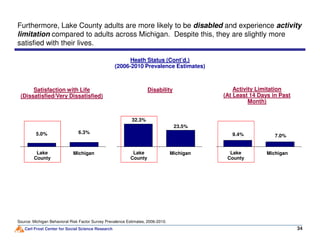
  • 69.
    While some stakeholdersare concerned about the unknown elements of federal health care reform and fear it will be more expensive and result in less hospital reimbursement, most feel positively about health care reform and believe it will provide more coverage for adults, increase access overall, and be driven by outcomes. They hope it will help improve health outcomes by promoting prevention and promoting a more active role in self care by patients. It’s changing the baseline for who is eligible for Medicaid. So you’re going to improve accessibility just by the fact that people will have payment sources. Now is there going to be the infrastructure to support that access, that may be a challenge. I think our goal in Michigan should be to look at healthcare reform and try to ensure that how we interpret certain points of that are going to focus in on some of the population outcomes. Transforming – it’s the payers that are driving this, saying it’s not going to be any longer how many people you see, but the quality of care that you give and you’ll be paid based upon that quality so hours of operation, are you available to your patients, what do your diabetic hemoglobin A1C’s look like and those are all hard because if people don’t take responsibility for their care, you can have some impact but not a lot of impact. But I think health reform will help to educate people, the general population as well, on their responsibility. I tend to look at it a little differently than a lot of people. I think the fact that every person is going to have some form of payment, is probably better than what we have now, when you have 40 million Americans that have no way to pay. The problem’s going to Verbatim Comments on the Future of Health Care Carl Frost Center for Social Science Research 6969 Q12. What, if any, impact do you think Federal Health Care Reform will have on health care in your community? (PROBE FOR FUTURE OF HEALTH CARE) Q12a. What impact will it have on health outcomes, if any? Q13. In concluding, do you have any additional comments on any issues regarding health or health care in Osceola and Lake counties that we haven’t discussed so far? is probably better than what we have now, when you have 40 million Americans that have no way to pay. The problem’s going to be, as you move forward, is Medicaid and Medicare programs do not pay enough now to cover the cost. You make it up in your other third-party payers, like the Blue Crosses and Priority Health, and not only do they not pay enough now, they’re going to ratchet back some of their payments to help fund the additional people they’re going to be put on federally subsidized health care. I think it’s going to be more expensive as times go on, I think it’s going to be more difficult for folks to access the services they need, we’re already seeing that trend. I just look at long-term care alone at this time and we already are asked to do more and more and more with less and less reimbursement and it’s the same way at the hospital. So for us as providers, the picture is somewhat grim. Well I hope it’s good. If the Federal Health Care Reform Act is the plan that actually allows better access and more people to get into the system, I think it will be good. It also though needs to focus on wellness, not just on illness. And if it’s geared towards that, I think it will be a good thing for this country. One Stakeholder’s final comment is that health care needs to be a priority for the country and supported by state and federal funding, especially in rural communities.
  • 70.
  • 71.
  • 72.
    Most Pressing HealthNeeds or Issues in Osceola/Lake Counties (Volunteered) 16% 16% 16% 16% 16% 22% Obesity is considered the single most pressing issue followed by concerns about access to preventative care, lack of health care coverage, lack of wellness and prevention services, poor lifestyle choices, and lack of universal health care. Other pressing health issues that are top of mind to Key Informants revolve around lack of health care programs or services for specific populations (e.g. children, elderly, disabled, low-income). 3% 3% 3% 3% 3% 3% Lack of health insurance/coverage Poor lifestyle choices (e.g., smoking, diet, exercise) Obesity Lack of wellness/prevention programs, services Lack of health care services/ Access to preventative care Access to mental health services Providers that don’t accept Medicaid, Medicare, MIchild Access to dental care for all Chronic disease management Lack of health care programs/services for uninsured Cancer Carl Frost Center for Social Science Research 72 Q1: To begin, what do you feel are the most pressing health needs or issues in Osceola/Lake Counties? Please be as detailed as possible. 16% 9% 9% 6% 6% 6% 6% 9% 9% (n=32) = specific subpopulations 3% 3% 3% 3% 3% 3% 3% 3% 3% Lack of adequate care for elderly/disabled Lack of health care services/ programs for all Lack of health care services for children Lack of providers Lack of health care programs or services for low income Hypertension Teen pregnancy Lack of specialty care Lack of urgent care clinics Diabetes Transportation Lack of coordination among providers Lack of political leadership Lack of affordable healthy food Lack of education on available resources Lack of primary care Chronic disease management Inability to pay for prescriptions
  • 73.
    Prevalence of HealthIssues in Osceola/Lake Counties 37% 35% 23% 13% 60% 65% 77% 3% 87% Diabetes (n=31) Cancer (n=30) Mean Heart Disease (n=31) Obesity (n=31) Key Informants view obesity as the most prevalent health issue, by far, in Osceola/Lake counties, followed by diabetes, heart disease, and cancer. Stroke and depression are also cause for concern. 4.87 4.77 4.65 4.57 Carl Frost Center for Social Science Research 73 Q2: Please tell us how prevalent the following health issues are in Osceola/Lake Counties. 32% 30% 13% 41% 33% 60% 37% 14% 37% 27% 60% 14% 26% 3% 22% 39% 13% Lack of Childhood Immunizations (n=23) Sexually Transmitted Diseases (n=22) Depression (n=27) Stroke (n=30) Cancer (n=30) Somewhat PrevalentSlightly PrevalentNot Very PrevalentNot at All Prevalent Very Prevalent 4.57 4.13 4.07 3.55 3.39
  • 74.
    Satisfaction with Community’sResponse to Health Issues in Osceola/Lake Counties 23% 10% 8% 7% 10% 4% 57% 55% 44% 13% 24% 44% Mean Lack of Childhood Immunizations (n=25) Cancer (n=29) Heart Disease (n=30) Key Informants are most satisfied with the community’s response to childhood immunizations, followed by cancer. Conversely, they are least satisfied with the responses to depression and obesity. 4.24 3.93 3.60 Carl Frost Center for Social Science Research 74 13% 4% 30% 35% 21% 14% 20% 17% 15% 14% 24% 13% 33% 42% 59% 57% 57% 7% 7% 10% 5% 4% Somewhat SatisfiedSlightly SatisfiedNot Very SatisfiedNot at All Satisfied Diabetes (n=30) Sexually Transmitted Diseases (n=21) Stroke (n=29) Depression (n=26) Obesity (n=30) Very Satisfied Q2a: How satisfied are you with the community’s response to these health issues? 3.57 3.52 3.52 3.08 2.90
  • 75.
    Performance of Communityin Response to Health Issues in Osceola/Lake Counties The quadrant chart below depicts both problem areas and opportunities. The community’s responses to cancer, diabetes, and heart disease are fairly strong because they are all prevalent and Key Informants are satisfied with the community responses. Conversely, obesity is a critical problem area because it is not only prevalent, but the community response has been less than satisfactory. SATISFACTION High Monitor/Maintain Moderate Strengths to Build On Lack of Immunizations Carl Frost Center for Social Science Research 75 Q2: Please tell us how prevalent the following health issues are in Osceola/Lake Counties.? Q2a: How satisfied are you with the community’s response to these health issues? (1=Not at all satisfied, 2=Not very satisfied, 3=Slightly satisfied, 4=Somewhat satisfied, 5=Very satisfied) (n=32) Low High SATISFACTION Low Cancer Critical Problems – Top PrioritiesSecondary Priorities Obesity Overallmean=3.55 PREVALENCE Immunizations Overall mean = 4.25 Sexually Transmitted Diseases Diabetes Stroke Depression Heart Disease
  • 76.
  • 77.
    Prevalence of HealthBehaviors in Osceola/Lake Counties 10% 10% 37% 39% 33% 50% 52% 67% 3% Alcohol Abuse (n=31) Smoking and Tobacco Use (n=30) Mean Illegal Substance Abuse (n=30) According to Key Informants, smoking and tobacco use is the most prevalent negative health behavior in Osceola/Lake counties, followed by alcohol abuse, and illegal substance abuse. Suicide, although it exists, is not considered to be as prevalent as other health behaviors. 4.67 4.42 4.33 Carl Frost Center for Social Science Research 77 Q3: Please tell us how prevalent the following health behaviors are in Osceola/Lake Counties. 35% 27% 11% 11% 40% 27% 22% 11% 20% 36% 41% 50% 5% 9% 26% 29% Suicide (n=20) Child Abuse/Neglect (n=27) Domestic Abuse (n=28) Somewhat PrevalentSlightly PrevalentNot Very PrevalentNot at All Prevalent Motor Vehicle Accidents (n=22) Very Prevalent 3.96 3.81 3.27 2.95
  • 78.
    33% 19% 14% 26% 50% 24% 37% 31% 52% 10% 4% Satisfaction withCommunity’s Response to Health Behaviors in Osceola/Lake Counties Mean Alcohol Abuse (n=27) Suicide (n=16) Motor Vehicle Accidents (n=21) Key Informants’ satisfaction with the community response to health behaviors overall is low to moderate. They are least satisfied with responses to child abuse/neglect and smoking/tobacco use, the latter of which is considered highly prevalent. 3.57 3.13 2.96 Carl Frost Center for Social Science Research 36% 30% 35% 22% 31% 39% 23% 12%12% 9% 4% 8% 38% 23% 20% 27% 20% 8% 4% 78 Somewhat SatisfiedSlightly SatisfiedNot Very SatisfiedNot at All Satisfied Very Satisfied Q3a: How satisfied are you with the community’s response to these health behaviors? Smoking and Tobacco Use (n=25) Child Abuse/Neglect (n=26) Domestic Abuse (n=23) Illegal Substance Abuse (n=26) 2.96 2.91 2.84 2.81
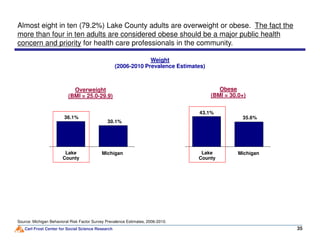
  • 79.
    Performance of Communityin Response to Health Behaviors in Osceola/Lake Counties Dissatisfaction with community response to health behaviors is demonstrated in the quadrant chart below. For example, four of the seven behaviors rated can be considered critical problems areas – tobacco use, alcohol abuse, illegal substance abuse, and domestic abuse – because they are prevalent but satisfaction with community response is low. Addressing tobacco use should be a top priority for health care professionals in Osceola and Lake counties. SATISFACTION High Monitor/Maintain Moderate Strengths to Build On Carl Frost Center for Social Science Research 79 (n=31) Low High SATISFACTION Low Domestic Abuse Critical Problems – Top PrioritiesSecondary Priorities Suicide Overallmean=3.03 PREVALENCE Motor Vehicle Accidents Overall mean = 3.92 Child Abuse/ Neglect Alcohol Abuse Illegal Substance Abuse Smoking/Tobacco Use Q3: Please tell us how prevalent the following health behaviors are in Osceola/Lake Counties. Q3a: How satisfied are you with the community’s response to these health behaviors? (1=Not at all satisfied, 2=Not very satisfied, 3=Slightly satisfied, 4=Somewhat satisfied, 5=Very satisfied)
  • 80.
  • 81.
    Perceptions of Varietyand Choice of Primary Medical Care Options 27% 26% 26% 20% 16% 6% 30% 32% 35% 13% 16% 23%10% 10% 10%Senior Adults (n=31) Low Income (n=30) Adults (n=31) Mean Adults and senior adults have the greatest variety and choice of primary medical care options, although there is room for improvement as roughly one in three disagrees with this perspective. Children and residents who are non-English speaking find their options far more limited when it comes to primary medical care. 3.35 3.19 3.10 Carl Frost Center for Social Science Research 81 Q4: Please tell us your level of agreement with the following statements about the variety and choices of primary medical care in Osceola/Lake Counties. 42% 37% 36% 34% 23% 14% 14% 15% 25% 28% 13% 11% 10% 23% 14% 14% 15% 10% 17% 4% Children (n=30) Underinsured (n=28) AgreeNeither Disagree Nor AgreeDisagreeStrongly Disagree Non-English Speaking/ESL (n=26) Uninsured (n=29) Strongly Agree 2.86 2.82 2.60 2.50
  • 82.
    Reasons for Perceivinga Lack of Primary Medical Care Options for Children No pediatricians and few choices for OB/GYN that are accessible. Not enough providers. There are very few choices in the area for care. Reasons cited for lack of primary care options for children center around the lack of pediatric care, lack of choice for primary care providers, and the time required to get an appointment. Carl Frost Center for Social Science Research 82 Q4a: (If Strongly Disagree/Disagree/Neutral) Why do you [INSERT RATING] that there is a wide variety and choice of primary care for children? There is a FQHC in Lake County, outside of that there are limited choices for primary care. There is no pediatrician in our area that I am aware of. We have just one source- Family Health Care- not saying they don't do the job, just saying there is not a wide variety and choice of primary care providers We only have one place to go to and sometimes have to wait 2 - 4 weeks to get an appointment While the rural health clinic is available to the children, to my knowledge there are no pediatricians on staff.
  • 83.
    Reasons for Perceivinga Lack of Primary Medical Care Options for Adults Adults get the required medical attention and services when needed. As far as I know there are about three physicians available for primary care; therefore, I would not classify that as wide variety. I am told there aren’t weekend or after hour primary care hours. Also, I am under the impression it can take 2 to 3 weeks to get an appointment. Adults find several barriers to primary medical care access such as the small number of primary care physicians, limited number of clinics in the region, and restricted clinic hours. In addition, the clinic is perceived as being for low income or single mothers, a perception that, because of any attached stigma, may influence some members of the community to seek medical care elsewhere. Carl Frost Center for Social Science Research 83 Q4a: (If Strongly Disagree/Disagree/Neutral) Why do you [INSERT RATING] that there is a wide variety and choice of primary care for adults? Only one medical clinic in our immediate area. There are not many health care providers in the area. We only have family health service in Baldwin........no real doctor clinics on a known basis. The perception is it is for low income or single mothers. We have no 24 hour emergency room in our county.
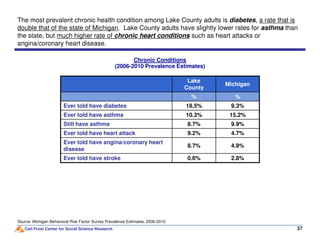
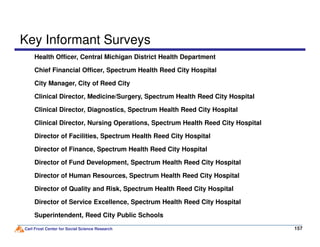
  • 84.
    Reasons for Perceivinga Lack of Primary Medical Care Options for Senior Adults Family Health Care is the only provider in Lake County and the majority of providers are PA or NP, not providers the senior adults want to see. Geriatric specialty not available in this area full-time. In my opinion, there is a large senior adult population in Lake County. These individuals require more frequent care than the small rural health clinic is able to adequately provide. Much more can be done for seniors in this community. Senior adults are limited in their options for primary medical care for several reasons. First, there is a large population of seniors requiring frequent service, however there is only one medical care facility in the counties. Second, there are no full-time geriatric specialists in the area and most providers are physician assistants or nurse practitioners, not doctors. Third, there is no urgent care close by. Carl Frost Center for Social Science Research 84 Q4a: (If Strongly Disagree/Disagree/Neutral) Why do you [INSERT RATING] that there is a wide variety and choice of primary care for senior adults? Much more can be done for seniors in this community. Not enough providers Only one Primary Care clinic in Lake County There are not many care facilities in the area. When urgent care is provided, the location of necessary services are not close by.
  • 85.
    Reasons for Perceivinga Lack of Primary Medical Care Options for Underserved Populations The greatest obstacle to primary medical care for low income patients is too few providers or options. In addition, too few providers accept Medicaid patients. Lacking primary care providers, many low income patients use the emergency department for medical care instead. Although there are few non- English speaking people in the area, the lack of options overall is seen as their greatest hurdle. 14% 14% 64% Low Income Population 44% ESL Population Not enough providers/ options for low income Too few providers accept Medicaid Rising use of emergency department Not many non-English speaking people in area Carl Frost Center for Social Science Research 85 Q4a: (If Strongly Disagree/Disagree/Neutral) Why do you [INSERT RATING] that there is a wide variety and choice of primary care for low income/ESL? 7% 7% 7% 7% 7% (n=14) 6% 19% 31% Few bilingual/Spanish speaking physicians/providers Language barrier Few providers/options for ESL population (n=16) Tend to travel out of county for more/better options Limited community resources to meet demand Personally see low income people go without health care department Lack of health insurance options Lack of preventative care
  • 86.
    Reasons for Perceivinga Lack of Primary Medical Care Options for Uninsured/Underinsured 27% 53% Rising use of emergency department Few places/options for uninsured/underinsured The uninsured/underinsured also find too few providers or options to meet their medical needs and find few providers who accept patients without coverage. Increasing numbers of the uninsured/underinsured use the emergency department instead of primary care providers. Carl Frost Center for Social Science Research 86 Q4a: (If Strongly Disagree/Disagree/Neutral) Why do you [INSERT RATING] that there is a wide variety and choice of primary care for uninsured/underinsured? 7% 7% 20% (n=17) Tend to travel out of county for more or better options Too few accept patients without insurance/on sliding scale/for free Those who lack money receive subpar health care
  • 87.
    54% 54% 62% Subpopulations Underserved withRegard to Health Care Are Specific Subpopulations or Groups Underserved? Subpopulations or Groups Underserved Uninsured Underinsured Children Although nearly half of Key Informants (47%) are unaware of subpopulations in Osceola/Lake counties that are underserved with respect to health care, a substantial minority (41%) identified several populations at risk including children and those who lack insurance, either completely or partially. Carl Frost Center for Social Science Research Minorities 46% 31% 31% 8% 8% 8% 15% 87 Q5: Are there specific subpopulations or groups of people in Osceola/Lake Counties that are underserved with regard to health care? Q5a: (If yes) Which of the following subpopulations are underserved? (Multiple responses allowed) Yes 41% No 13% Don't know 47% (n=32) (n=13) Uninsurable Senior Adults Women Disabled Those with mental health issues Homeless
  • 88.
  • 89.
    Degree to WhichPrograms/Services Meet the Needs/Demands of Osceola/Lake Counties’ Residents 8% 20% 7% 13% 24% 16% 13% 14% 10% 40% 4% 17% 29% 28% 16% 50% 43% 59% 14% 12% 4% 3% 56% Mean 4.41 4.00 3.90 3.72 3.44 Emergency transportation receives the highest marks, by far, among Osceola/Lake counties’ programs or services. Several other programs, such as nursing home care, emergency care, and oncology, are also well respected by Key Informants. Emergency Care (n=30) Ambulatory/Emergency Transport (n=29) Oncology (n=25) Nursing Home Care (n=28) In-Home Care (n=25) Carl Frost Center for Social Science Research 89 Q6: How well do the following programs and services meet the needs and demands of Osceola/Lake Counties’ residents? 7% 12% 13% 4% 10% 8% 8% 41% 50% 31% 14% 19% 24% 22% 13% 19% 17% 19% 40% 7% 16% 17% 19% 31% 31% 16% 8% 22% 28% 27% 23% 28% 12% 20% 24% Somewhat WellSlightly WellNot Very WellNot At All Well Very Well 3.44 3.42 3.31 3.23 3.13 3.04 3.00 Prenatal Care (n=24) Urgent Care Services (n=29) In-Home Care (n=25) Non-Emergency Transportation (n=26) General Dental Care (n=26) Assisted Living (n=25) Substance Abuse (n=27)
  • 90.
    14% 25% 10% 15% 19% 33% 14% 37% 26% 19% 33% 36% 20% 30% 33% 7% 30% 15% 15% 19% 18% 15% 15% 3% Degree to WhichPrograms/Services Meet the Needs/Demands of Osceola/Lake Counties’ Residents (Cont’d.) Mean 2.89 2.89 2.80 2.79 2.76 Osceola/Lake counties’ programs or services receiving the lowest marks for meeting the needs of residents are those related to several specialized areas specifically, OB/GYN, dermatology, oral surgery and podiatry. Treatment for severe or persistent mental health conditions is also an area of great need. Orthopedics (n=27) General Surgery (n=27) Mental Health Treatment (Mild/Moderate) (n=30) Cardiology (n=28) Ophthalmology (n=21) Carl Frost Center for Social Science Research 23% 29% 14% 24% 14% 26% 14% 38% 21% 45% 28% 39% 19% 33% 23% 29% 23% 28% 21% 30% 33% 4% 17% 9% 8% 25% 11% 12% 9% 12% 15% 19% 4% 90 Q6: How well do the following programs and services meet the needs and demands of Osceola/Lake Counties’ residents? Somewhat WellSlightly WellNot Very WellNot At All Well Very Well 2.76 2.70 2.57 2.56 2.55 2.46 2.42 Podiatry (n=25) Oral Surgery (n=22) Mental Health Treatment (Severe/Persistent) (n=28) Pediatrics (n=27) OB/GYN (n=24) Ophthalmology (n=21) Dermatology (n=26)
  • 91.
    Programs/Services Lacking inOsceola/Lake Counties 13% 28% Specialty programs/ services Programs/services that address low income populations (e.g., dental, mental health, primary care) Mental health services More than four in ten Key Informants cannot think of any programs or services that are lacking in Osceola or Lake counties. Those who can, mention specialty programs/services most often, followed by services for mental health, pediatrics, and transportation. 6% 6% Programs/services for uninsured (e.g., dental, mental health, primary care) Carl Frost Center for Social Science Research 91 Q7: What programs or services are lacking in the community, if any? Please be as detailed as possible. 13% 9% 13% Home care/assisted living for elderly/disabled/underservedTransportation Urgent Care Don’t know/No answer Pediatrics Quality care available throughout the county (n=32) Wellness 6% 3% 3% 44%
  • 92.
    Traveling Outside ofOsceola/Lake Counties for Health Care Had Health Issue/Need Requiring Travel Outside Osceola/Lake Counties Reasons for Traveling Outside Osceola/Lake Counties 16% 9% 9% 41% 19% 19% All Key Informants have had (or know someone who has had) to travel outside of Osceola/Lake counties for health care for a variety of conditions. Most commonly, residents travel to other counties for specialized care, treatment of cancer, or for surgery. Specialized Care Cancer Heart condition Surgery Dental needs Emergency care/ambulance Carl Frost Center for Social Science Research 92 Q8: Have you, or someone you know, ever had a health issue or need that necessitated travel outside of Osceola/Lake Counties for health care? Q8a: (If yes) What necessitated travel outside of Osceola/Lake Counties for health care, and why? Please be as detailed as possible. Yes 100% (n=32) (n=32) 9% 6% 6% 6% 6% 6% 6% 3% 3% 3% 3% 9% 9% Limited insurance or provider participation More expertise/better care Child delivery Timely availability Mental health Don’t know/remember Second opinion/better diagnoses Pediatric-related Dental needs Orthopedics Primary care Urgent care Rehabilitation
  • 93.
  • 94.
    Barriers and Obstaclesto Health Care 13% 28% 28%Lack of Health Care Insurance Transportation Personal Irresponsibility 50% 56% 59%Personal Irresponsibility Lack of Awareness of Existing Services Transportation According to Key Informants, lack of health care insurance and personal irresponsibility are the top barriers or obstacles to accessing health care programs and services. Transportation, lack of awareness, and unaffordable co-pays or deductibles are also viewed as barriers. Single Greatest Barrier/Obstacle Top 3 Barriers/Obstacles Carl Frost Center for Social Science Research 94 Q9: What are the top three barriers or obstacles to health care programs and services? Please rank from 1 to 3, where 1 is the greatest barrier, 2 is the second greatest barrier, and 3 is the third greatest barrier. 13% 13% 6% 3% 13% Lack of Awareness of Existing Services Transportation Unaffordable Co-Pays/ Deductibles Physicians Not Accepting Medicaid Lack of Trust 50% 34% 28% 3% 6% 13% Lack of Trust Lack of Health Care Insurance Physicians Not Accepting Medicaid Inadequate Health Care Insurance Unaffordable Co-Pays/ Deductibles (n=32) (n=32) Other
  • 95.
    Effective Solutions toBarriers and Obstacles to Health Care 9% 22% 16% 13% Different insurance model (e.g., mandatory health insurance/free health care) Increase awareness of existing programs/services Education (e.g., services offered, payment options, prevention, wellness) Address health care costs for those who can’t afford it The most often cited solution to barriers and obstacles to health care is increased awareness of existing programs/services. However, it is mentioned by less than one-fourth of the Key Informants. Suggestions are varied and are targeted toward solving the problem of barriers, including education, different models of health insurance, addressing health care costs for those who can’t afford it, more acceptance of Medicaid, and better access to specialists. Because this is a complex issue, half of Key Informants offer no solutions. Carl Frost Center for Social Science Research 95 Q9a: What, if any, are the effective solutions to these barriers? Please be as detailed as possible and identify which problems you are referring to when discussing solutions. 9% 6% 6% 50% 3% 3% (n=32) Better transportation (e.g., free to medical services) Acceptance of Medicaid by physicians/ Increase reimbursements Better access to specialists Incentives for better lifestyle choices Address health care costs for those who can’t afford it Don’t know/No answer
  • 96.
  • 97.
    Individuals and Organizationsthat Should be Involved in Addressing Identified Health and Health Care Needs 94% 75% 75% 59% Government Social Services Health Care Professionals Non-Profit Organizations Mental Health Workers Key Informants believe input about addressing health care needs should be spread across a variety of groups or individuals, the most important being health care professionals, government social services, and mental health workers. Less important are civic organizations and foundations. Carl Frost Center for Social Science Research 97 Q10: What individuals or organizations should be involved in addressing identified health and health care needs in the county? (Multiple responses allowed) 50% 44% 41% 41% 37% 37% 3% Foundations Elected Officials Business Leaders Civic Organizations School Boards Churches/Religious Groups Other (n=32)
  • 98.
    Elements Necessary forSuccess of Programs that Address Identified Needs 97% 75% 75% Communication Between Organizations Common Goals Among Organizations Ongoing Funding/Sustainability The most important element to the success of health care programs or services is ongoing funding or sustainability. Also important are communication between organizations, the formation of common goals among them, and inviting all stakeholders to participate. Carl Frost Center for Social Science Research 98 Q11: What elements are necessary to the success of programs to address identified needs? (Multiple responses allowed) 75% 66% 63% 63% 3% All Stakeholders are Invited to Participate Culturally Competent Planning and Administration Formation of Strategic Relationships Regional Committee Comprised of Health Care Providers Other (n=32)
  • 99.
    Overall Satisfaction withHealth Climate in Osceola/Lake Counties Level of Satisfaction 25% 6% 31% Satisfied/ Very Satisfied Very Satisfied Reasons for Rating Spectrum Health provides excellent care FHC offers a wide variety of health care services Health care services provided within school system FHC provides one stop health care service Good quality care is available or accessible for the community The county does well with the resources available More individual accountability is needed Transportation to services outside the county is a barrier for some Lower income population needs more assistance Overall satisfaction with the health climate in Osceola/Lake Counties is moderate among Key Informants. Those who are satisfied praise the Family Health Center for offering excellent care, a wide variety of services, and school-based services. Those dissatisfied see lack of health care access for many people, lack of education about good health practices, and lack of services and providers. Carl Frost Center for Social Science Research 99 Q12: Taking everything into account, including health conditions, health behaviors, health care availability, and health care access, how satisfied are you overall with the health climate in Osceola/Lake Counties? Q12a: Why do you say that? Please be as detailed as possible. 28% 41% Mean = 3.09 (n=32) Very Satisfied Satisfied Neither Dissatisfied Nor Satisfied Dissatisfied Very Dissatisfied Education about good health practices is needed for lower income people. Health care is geographically limited to Baldwin area Many people can't get health care (because of lack of services, lack of insurance, lack of education) Health care services are inadequate. People need more access to providers People go out of county to find health care People think clinics are for lower income patients and offer lower quality care Fortunate that health care is available for such a small, rural county FHC is endeavoring to address the needs of people in poverty Basic care is available, but many can't afford it People need more access to providers and more education about healthy living Health care availability is satisfactory, but health conditions and behaviors are not
  • 100.
    Suggested Strategies toImprove the Overall Health Climate in Osceola/Lake Counties 9% 9% 13% 25%Education (e.g., prevention, early education) More medical specialties/More doctors Better access to free or low-cost health care/ Free clinics Increase awareness of programs and services Key Informants offer many strategies for improving the overall health climate in Osceola/Lake counties. At the top of the list is focusing on prevention and wellness through increased health education that address issues from lifestyle choices to treatment options. Informants also desire more medical specialists in the region and more opportunities for free or low-cost health care. 3% 3% 6% 6%Promote personal responsibility/ accountability More medical facilities (e.g., urgent care clinic) Address geographic disparities in funding and health care within the counties Address obesity Carl Frost Center for Social Science Research 100 Q13: What one or two things could be done in Osceola/Lake Counties that would improve the overall health climate in Osceola/Lake Counties? Please be as detailed as possible. 6% 6% 6% 6% 6% 6% (n=32) More programs or services (e.g. prevention programs) Promote healthy life styles Better care management More community involvement More data collection or sharing of research Exercise or recreation facilities 3% 3% 3% 19% 3% 3% Better quality, low-cost food Don’t know/No answer Mental health services Address obesity More clinic hours Better OB/pediatric care
  • 101.
  • 102.
    Health Landscape ofthe Community
  • 103.
    19% 19% 24% 24% Community Characteristics thatPromote Health Outdoors/Rails to Trails Hospitals/Health Centers Senior Organizations/Senior Centers Schools Characteristics that promote health in Osceola and Lake counties are the outdoor activities, hospital and health centers, senior organizations, and schools. Carl Frost Center for Social Science Research 9% 9% 5% 5% 5% 5% 9% 103 (n=21) Doctors Preventative Care Everything Information/Awareness of Available Programs Q10: What are the primary characteristics of this community that promote health? Sports Money Health Department Programs
  • 104.
    Verbatim Comments: CommunityCharacteristics that Promote Health Bike trails Bike trails/Parks Bringing in people to meals program who let you know about services available-lots of times we aren't aware of helps. Doctors Greatly improved hospital. Health Center where there are doctors Hospital Information Carl Frost Center for Social Science Research 104 Q10: What are the primary characteristics of this community that promote health? Money Outdoors, school does good job promoting healthy choices Preventative check ups Rails to trails, free flu shots in schools, after hours clinic, dental care in schools Rails to trails, softball tournaments. Schools are very good Senior agencies provide different seminars on health issues. Services provided at Baldwin Family Health Care and some that are available at the Health Department. St. Ann's St. Ann's has exercise equipment St. Ann's programs The programs at school They have everything I need.
  • 105.
    17% 22% 22% 33% Community Characteristics thatDeter Health Poverty/Money Number/Quality of Physicians Nutrition Lack of Exercise Options Conversely, characteristics that deter health are poverty, lack of number or quality of physicians, lack of healthy and affordable food, and lack of exercise options, especially in the winter months. Carl Frost Center for Social Science Research 11% 6% 6% 6% 17% 6% 6% 105 (n=18) Lack of Exercise Options (Especially in Winter) Jobs Dirty Restrooms in Businesses None Lack of Education Q11: What are the primary characteristics of this community that deter health? Laziness Too Many Negative Issues in a Small Town
  • 106.
    Affordable produce andwork out facilities Bad eating habits, laziness Difficult to exercise during the winter Dirty restrooms in businesses Don't know except because of so many low income families, people do not see a doctor when they should Don't know of any Fast food Good doctors Verbatim Comments: Community Characteristics that Deter Health Carl Frost Center for Social Science Research 106 Jobs Lack of education and access to exercise in winter. Meals program food- used to be prepackaged/salty/carbs/so bad tasting people refused to eat it-for $2. For $5 can get 2 meals at Subway of fresh meat and veggies, and tastes good too! Dr.'s started calling regarding diabetes/blood pressure/congested heart-issues that the meals were aggravating. Now meals just plain bad! Money Money No jobs- no insurance Physicians-not enough?? Poverty Too many negative issues have happened in a small town. Not enough local specialist without having to wait months on end. Waiting to get into see a good doctor Q11: What are the primary characteristics of this community that deter health?
  • 107.
    12% 12% 14% 17% 50% 50% 52% Top Issues inthe Community That Impact Health Affordable health insurance Affordable health programs and services Dental health services Vision health Substance abuse services Affordable healthy lifestyle services and programs Information about how to cook healthy food Full service 7% 7% 9% 9% Affordable Jobs/ employment Transportation Safe neighborhoods Community residents cite a multitude of community issues that impact overall health. However, those cited most often are largely economic, such as lack of jobs/employment, affordable health care, and dental health services. Carl Frost Center for Social Science Research 12% 9% 9% 12% 9% 9% Q9: What are the top five issues in your community that impact health? (Select up to five.) 26% 26% 17% 38% 19% 26% 107 (n=42) Vision health services Mental health services More health professionals Health services for senior adults Affordable fresh/ natural food Full service grocery stores Information about managing chronic health conditions Safe/affordable places to exercise Abuse and violenceWalking/bike paths and trails 5% 2% 7% 2% 0% Affordable housing Education Language barriers Racial inequalities Poverty More specialists Other
  • 108.
    46% 51% 59% Areas Most Importantto Residents to Make Community Healthier Improve access to health care Educate residents regarding health care issues and services Improve nutrition and eating habits Community residents suggest improving nutrition and eating habits foremost to make the community healthier. Other popular mentions are to improve health care access, better educate residents about existing health care programs and services, find ways to get people to engage more in physical activity, and improve access to dental care. Carl Frost Center for Social Science Research 39% 17% 41% 7% 10% 108 (n=41) Improve access to dental care Improve access to mental health care Improve air quality Improve water quality Increase participation in physical activity and exercise programs Q14: What are the top three areas that are most important to make the residents of this community healthier? (Select up to three.)
  • 109.
    20% 20% 20% 40% Area residents identifya wide array of programs and services that are lacking in the community. Residents perceive a need for more exercise classes and facilities, followed by eye care, health care specialists in general, health information classes, and programs on nutrition. Health Care Programs or Services That are Lacking in the Community Exercise classes/facilities Eye care Specialists Health information classes Carl Frost Center for Social Science Research Q8: What health care related programs, services, or classes are lacking in Osceola/Lake County? In other words, what programs, services, or classes do you want that are currently unavailable or lacking? Please be as detailed as possible. 20% 10% 10% 10% 10% 109 (n=10) Nutrition Reduced price clinics Weight/obesity issues Support for patients' families Dental care
  • 110.
    A fitness centerwith nutrition or workout classes with open hours for the working people. Dental Exercise programs especially for seniors. Meals on wheels. Eye care Family exercise center. How to be healthy, exercise more available Verbatim Comments: Health Care Programs or Services That are Lacking in the Community Carl Frost Center for Social Science Research 110 How to be healthy, exercise more available How to handle challenged children with ADHD, Tourette's, OCD, these type of behaviors. How to have a healthy family or marriage with a child of the above nature, and dealing with sick mom/dad when you are the only child. Weight issues. More clinics with a reduced rate for people who cannot afford health insurance and do not use welfare services. We go to GR for an eye specialist. Having one in Osceola County would be more convenient. We go to Reed City for diabetic classes-Evart for diabetic shoes. Reed City and Grand Rapids for specialists. Q8: What health care related programs, services, or classes are lacking in Osceola/Lake County? In other words, what programs, services, or classes do you want that are currently unavailable or lacking? Please be as detailed as possible.
  • 111.
  • 112.
    29% 43% 71% Most residents surveyedhave not had a problem receiving needed health care over the past twelve months. Those who experienced barriers say the greatest hurdle is lack of money or insurance to cover the costs. More than four in ten also mention the lack of specialists in the region contributes to people going without care or seeking it in another county. Problems Receiving Healthcare Have Had Problems Receiving Healthcare in Past 12 Months Barriers to Accessing Healthcare Lack of money or insurance for office visit Lack of physician specialists in the area Lack of transportation Carl Frost Center for Social Science Research 0% 0% 14% 14% 0% 0% 29% 112 Q6: Was there a time in the past 12 months when you or someone in your family needed to see a doctor but could not? Q6a: (If yes) Please, tell us some of the reasons why. (Mark all that apply.) (n=45) (n=7) Inability to pay deductible or co-pay No, 84% Yes, 16% Inconvenient office hours Lack of transportation Language/racial/cultural barriers Don’t know how to find a good doctor Not comfortable with any doctor Other
  • 113.
    36% 53% Almost all residentssurveyed have a primary care physician. Even though more than half reported they have private insurance, 20% have Medicaid or a government sponsored plan and 11% have no coverage. Medical Home and Type of Heath Care Coverage Have Personal Primary Care Physician Health Insurance Situation Private insurance Employer provided Yes, 96% Carl Frost Center for Social Science Research 11% 9% 13% 11% 2% 19% 113 Q3: Do you and your family members have a primary care physician you can visit for questions or concerns about your health? Q2: Which of these describes your health insurance situation? (Mark all that apply.) (n=47) (n=47) No, 4% Medicare Medicare supplemental Medicaid Government None Self-Pay
  • 114.
    15% 24% 30% Greatest Barriers toReceiving Health Care and Other Essentials Cost Receiving dental care Lack of insurance Residents surveyed say the greatest barrier to medical care is cost, while transportation and time are also cited. Residents also mention problems accessing dental care or having prescription drugs covered. More than one-fourth see no barriers to receiving health care. Carl Frost Center for Social Science Research 12% 12% 12% 27% 114 (n=33) Time Transportation/Travel None Having all prescriptions covered Q7: What are the biggest barriers you face in getting medical care?
  • 115.
    Appointments 2-3 monthsaway BEFORE I can get [test redacted] mandatory exam has to be done first... No car (mine died) to get to specialists (none in area). Cost is $333 to cab (at cost to taxpayers!) that I can't live with-so haven't seen doctors in 2 years-problems too severe for local GP. Can't get meds I need that work! Even though I've gone through therapy etc. to qualify. Got the med that worked and then wouldn't pay when went to refill. [Circled: dental care] The poor have all the time slots Cost of tests my insurance does not cover! Cost seems excessive for the services. Cost. I like my doctors but co-pays, Rx cost, and the deductibles are so high. We have to meet 15,000 before anything other than a cough is covered. Thank goodness my Medicare helps but my son needs the cost reduced. Even with insurance the deductible is too high and also prescriptions that you can't get generic are very high and some meds Selected Verbatim Comments: Greatest Barriers Carl Frost Center for Social Science Research 115 Even with insurance the deductible is too high and also prescriptions that you can't get generic are very high and some meds don't have a generic form Getting dental care Hard to get a ride to Big Rapids for prescriptions I've never had an issue Need dental care No barriers-we are blessed with good insurance. No car Paying for them Paying the bills Time Travel. Some of the specialists are in Grand Rapids [Underlined: dental care] Costs-no dental insurance We have no medical insurance Q7: What are the biggest barriers you face in getting medical care? Getting prescriptions? Getting dental care?
  • 116.
    Experience with HealthCare Providers
  • 117.
    Satisfaction with LastHealthcare Visit Almost all (96%) are satisfied with their last health care visit in Osceola or Lake County. In fact, six in ten (60%) are very satisfied. Resident satisfaction stems from health care professionals who: (1) are caring and friendly, (2) meet patient expectations, and (3) take the time necessary to satisfy patients. Others appreciated health care professionals for providing good explanations and answering patient questions. Satisfaction with Last Visit 96% Very Satisfied/ Satisfied 15% 15% 19% 19%Concerned/caring/friendly Met needs/expectations Takes time/Not rushed Reasons for Rating Knows/remembers me Carl Frost Center for Social Science Research 117 Q5: How satisfied were you with your last visit for health care? Q5a: Why do you say that? (n=47) 15% 11% 7% 15% 15% 11% 11% Good/Great Answers questions Explains Efficient Other (n=27) 36% 60% Very Satisfied Satisfied Neither satisfied nor dissatisfied Dissatisfied Very Dissatisfied 2% 2% New doctor Knows/remembers me
  • 118.
    All my questionswere answered. Because it didn't take me forever to get waited on. And they seem to care and be concerned. Dr. was very conscientious about my symptoms-explained well-acted very caring. Have had doctor for 20 years He is a good doctor He took his time to explain what was wrong, Selected Verbatim Comments: Satisfaction with Last Healthcare Visit Very Satisfied Because I got done what I needed to in least amount of time Because I miss my old physician but no choice he went to another part of [organization redacted]. Got what I needed I have had my doctor for a long time so he knows me very well. She took the time to listen to what I had to tell her They took care of my needs. Satisfied Carl Frost Center for Social Science Research 118 He took his time to explain what was wrong, answered my questions, friendly. I have great doctors, they have saved my life several times. I was provided the service I was looking for. My doctor takes her time and explains things. My expectations were met very well Tests are set up immediately, follow-up calls are made The doctor was sincerely concerned about my condition The doctor was very thorough and checked everything. They give good service Q5: How satisfied were you with your last visit for health care? Q5a: Why do you say that? I've been going to the [location redacted] for a year and still am having considerable pain Neither Satisfied nor Dissatisfied Doctor forgot about a slip for a test I'm suppose to get. This type of thing has happened before (clinic Doctor) in another county several times. I had to remind about the other condition I came in for. Also, waiting for an appointment to discuss problems and am told to make another appointment (which is 2 more months away) because they can only deal/bill for one problem at a time. Also changes in treatments and meds-can't see needed doctors (foot/chiropractor/teeth) as not covered now and changes from meds that we finally figured out that work then can't get them anymore and have to use one that doesn't work . Dissatisfied
  • 119.
    23% 29% 32% The most importantqualities in a health care provider, according to Osceola and Lake County adults, are that they listen to them, are caring and friendly, explain things well, take their time, answer questions, and are readily available. Most Important Quality Sought in Health Care Provider Listening Caring/Friendly Talks with me/explains Give options/alternatives 9% 9% 9% Understand feelings/ See whole person Provide good health care Carl Frost Center for Social Science Research 18% 15% 21% 9% 23% 119 (n=34) Talks with me/explains /informative Takes time/Doesn’t rush Answers questions/ Gives feedback Availability (Can get appt. when need one/wait time/hours) 6% 6% 6% 9% 9%Provide good health care Knowledgeable Helpful Cost/Coverage OtherThorough Q4: What is the most important quality you look for in a health care provider? Please be as detailed as possible.
  • 120.
    A doctor whois willing to answer all my questions without time restrictions. Also one who remembers me and knows some of my past problems. Alternatives to medications Availability-late hours, friendly, willing to talk to me Caring-explains everything- listens to you! Feedback. Plus clean facilities. Takes time to listen. Great with children He talks to me and takes time and listens to me! How long the wait Selected Verbatim Comments: Most Important Quality Sought in Health Care Provider Carl Frost Center for Social Science Research 120 How long the wait I want a doctor that is straight forward and honest. Doctor terms mean nothing if you don't understand it. If you need to go and see a doctor you can get into one Listening to my ailments and taking steps to help. Friendly, knowledgeable can get in to see when needed One who will take the time to listen to you and provide you with the information you need to keep you healthy Someone that cares about my health and tries to help me Someone that takes a reasonable approach. Not too many medications or un-necessary tests. Taking time to listen to problems and concerns instead of rushing you in and out. Taking time to listen-gives input and feedback-gives suggestions and options That they don't rush, take time to answer questions that you have. Thoroughness and caring To be thorough when checking the patient. Do the things they are suppose to do and take the time they need To be treated as though we are important, and not a kind of pay To provide good health at a reasonable cost Q4: What is the most important quality you look for in a health care provider? Please be as detailed as possible.
  • 121.
    Communication Among HealthCare Providers Quality of Communication Between HCP and You 92% Extremely Well/ Somewhat Well Nine in ten (92%) Osceola and Lake County adults like the quality of communication between them and their health care provider, while eight in ten (79%) appreciate the quality of communication between health care providers. 28% 79% Extremely Well/ Somewhat Well Quality of Communication Between HCPs Carl Frost Center for Social Science Research 121 Q12: How well do you feel your health care providers communicate with you about your health care? Q13: How well do you feel your health care providers communicate with each other about your health care? 33% 8% 59% Extremely Well Somewhat Well Slightly Well Not Very Well (n=39) Not At All Well 51% 5% 15% (n=39)
  • 122.
  • 123.
    Perception of GeneralHealth Status 23% 87% Good/Very Good/Excellent Almost nine in ten (87%) Osceola and Lake County adults surveyed say their health is very good or excellent. More than one in ten (13%) report fair or poor health. Carl Frost Center for Social Science Research 123 Q1: Generally, how would you describe your health? 28% 11% 36% Excellent Very Good Good Fair (n=47) Poor 13% 2% Fair/Poor
  • 124.
  • 125.
    Summary of Findings SocialIndicators Osceola and Lake Counties are communities that have a number of social factors that negatively impact health and quality of life. For example: The unemployment rate in both counties is high The rate of confirmed victims of child abuse or neglect for Lake County is two to three times as high as Michigan or the U.S., respectively Confirmed victims of child abuse/neglect in Osceola are lower than the state rate, but higher than the national rate Far more students are eligible for free or reduced price lunches, compared to students around the state. In fact, 90% of Lake County students are eligible Carl Frost Center for Social Science Research 125125 Far more students are eligible for free or reduced price lunches, compared to students around the state. In fact, 90% of Lake County students are eligible More children in Lake County receive WIC assistance and more births are Medicaid paid in comparison to rates across Michigan Additionally, Osceola and Lake Counties both have more people in poverty than across the state or nation. In Lake County specifically, there are more families in poverty (generally and married couples) including those with children under age 18, compared to Michigan or the U.S. The overall proportion of single female families living in poverty in Lake County is a little lower than in Michigan, but the highest proportion of families living in poverty are for those headed by single females with children under age 18.
  • 126.
    Summary of Findings(Cont’d.) Social Indicators (Cont’d.) Adding to the problems created by high unemployment and poverty is the fact that one in four Lake County adults never graduated high school. Not surprisingly, there are also low numbers of adults with graduate degrees in both Osceola and Lake counties Alternatively, certain community factors promote health, such as: Both communities are safe communities – with far lower violent crime and homicide rates than the state or nation Carl Frost Center for Social Science Research 126126 homicide rates than the state or nation
  • 127.
    Summary of Findings(Cont’d.) Overall Health Climate Key Stakeholders report the worsening local economy is the most important event impacting the health and health care landscape of both communities. Because there is little employment, there is a large number of residents with no health insurance, or more likely on Medicaid. Key Informants are moderately satisfied overall with the health climate in Osceola/Lake Counties, citing Spectrum Health and Family Health Care, as positive primary care resources. Regardless of satisfaction level, informants feel residents need to be more Carl Frost Center for Social Science Research 127127 positive primary care resources. Regardless of satisfaction level, informants feel residents need to be more accountable for personal health, more education programs need to be developed, and that existing programs are inaccessible to many due to cost and transportation Resources identified by informants, stakeholders, and residents in the community that promote health include: 2-1-1 Community Mental Health DHS Dial-A-Ride Hospital/Health Center Outdoors/Rails to Trails Schools Senior Center/Organization
  • 128.
    Summary of Findings(Cont’d.) Overall Health Climate (Cont’d.) Resource limitations are identified as: Access to care for the underserved populations, but especially in such a remote, rural community Funding limitations Poverty Lack of employment opportunities Lack of mental health care Lack of physicians/number of providers/pediatricians Carl Frost Center for Social Science Research 128128 Lack of physicians/number of providers/pediatricians Lack of specialists Transportation barriers Top suggested strategies to improve the health climate in Osceola/Lake Counties include increased awareness of existing programs/services, more/better health education, more specialists and PCPs, and better access to health care (e.g., mandatory/free/low cost health care).
  • 129.
    Summary of Findings(Cont’d.) Health Indicators Compared to the state of Michigan or the U.S., Osceola and Lake County residents experience far higher adult mortality rates, and higher infant mortality rates. Conversely, the proportion of live births with low birth weight are lower in Lake County than the state or nation. Residents (both men and women) of both counties have slightly lower life expectancy rates in comparison to the state or nation. Although the top two leading causes of death, heart disease and cancer, are the same for both Osceola and Lake County, the state and the nation, the Carl Frost Center for Social Science Research 129129 Although the top two leading causes of death, heart disease and cancer, are the same for both Osceola and Lake County, the state and the nation, the rates for both conditions much higher for both counties compared to MI and the U.S. Additionally, the death rates from Chronic Lower Respiratory Diseases, Stroke, and Unintentional Injuries are much higher in Osceola/Lake Counties than the state or the nation Far fewer pregnant women in Lake County begin prenatal care in the first trimester than for Osceola and Michigan as a whole, although the proportion of births to women who receive late or no prenatal care for both counties is higher than state proportions, and highest for Osceola County. Additionally, the proportion of Lake County mothers who smoked during pregnancy (39%) is much higher than the proportion across Michigan
  • 130.
    Summary of Findings(Cont’d.) Health Indicators (Cont’d.) Childhood immunizations for both communities are on par with the state and nation, with Lake County proportions slightly lower than the state, and Osceola proportions higher than the state and on par with national averages. Roughly two in ten Lake County adults report fair or poor general health status, and this is higher than across the state. About one in seven report poor physical health, higher than state averages About one in ten report poor mental health, which is lower than state averages Carl Frost Center for Social Science Research 130130 About one in ten report poor mental health, which is lower than state averages One in twenty expressed dissatisfaction with life, less than the state average One-third of the adult population is disabled to the extent that their daily activities are limited due to physical, mental, or emotional problems, or they require the use of special equipment. Eight in ten Lake County adults are considered to be at an unhealthy weight, with 36% overweight and 43% obese, making this issue critical to address. Obesity is the most pressing health issue in both counties according to Key Informants and they are less than satisfied with the community response to obesity Residents would like to see both communities increase overall participation in physical activity and exercise programs Over one in ten (17%) youth in Lake County and two in ten (20%) in Osceola County are considered obese. Proportions higher than the state or nation
  • 131.
    Summary of Findings(Cont’d.) Risk Behavior Indicators Most adults in Lake County (74%) participate in leisure time physical activity, slightly lower than state figures. Over one-fourth (27%) of Lake County adults smoke cigarettes, a rate higher than the state. On a positive note, the proportion of adults who engage in binge drinking is lower (12%) than across the state (17%). Carl Frost Center for Social Science Research 131131 lower (12%) than across the state (17%). Key Informants consider smoking and tobacco use to be the most pressing health behavior issue in Osceola/Lake counties, followed by alcohol abuse and illegal substance abuse.
  • 132.
    Summary of Findings(Cont’d.) Youth Behavioral Risk Factors The teen (aged 15-19) birth rates are slightly higher in Osceola/Lake Counties than in Michigan or the U.S. While the repeat teen birth rate in Osceola County is slightly lower than the state or nation, for Lake County, this rate is almost double that of Osceola County, the state, and the nation. With respect to substance use, youth in Lake/Osceola Counties have much lower levels of smoking tobacco, binge drinking, and marijuana use than youth across the state or the nation. Carl Frost Center for Social Science Research 132132 youth across the state or the nation. Over half (57%) of Lake County youth and over two-thirds of Osceola County youth report inadequate amounts of physical activity. While the proportion of youth eating inadequate quantities of fruits and vegetables is high (two-thirds in each county), these proportions are much lower than across the state or nation. Residents identify this as the number one area that can make the community healthier – improved nutrition and eating habits Key Stakeholders and Key Informants support this, citing the need for access to more affordable and healthy food
  • 133.
    Summary of Findings(Cont’d.) Chronic Conditions The proportions of Lake County residents ever told they had diabetes (19%), a heart attack (9%), or angina/coronary heart disease (9%) are higher than across Michigan. Key Informants believe diabetes is an important health issue in the county and are only moderately satisfied with the community response to the condition The proportion of Lake County residents ever told they have had a stroke (1%), have asthma (10%), and still have asthma (9%) are lower than Carl Frost Center for Social Science Research 133133 (1%), have asthma (10%), and still have asthma (9%) are lower than proportions for the same conditions across Michigan. Key Stakeholders believe chronic disease is one of the most pressing health needs or issues in Osceola/Lake Counties and feel chronic disease prevention activities are lacking in the community.
  • 134.
    Summary of Findings(Cont’d.) Health Care Access The majority of Lake County adults have had a routine physical checkup in the past year. Still, almost four in ten have not. Most Lake County adults have a personal health care provider. However, two in ten adults have no such provider and within the last twelve months, more than one in ten were denied health care due to costs. Additionally, the proportion of primary care physicians per capita in Carl Frost Center for Social Science Research 134134 Additionally, the proportion of primary care physicians per capita in Lake/Osceola Counties is drastically lower when compared to state proportions. Key Stakeholders and Key Informants also note that the lack of primary care providers is a great concern Key Stakeholders also feel that health care access is a pressing issue for the Osceola/Lake communities, and feel access is hindered due to a lack of available resources, poverty, a lack of transportation, lack of senior services, and lack of specialists. They identify the uninsured, unemployed, low income, and elderly as subpopulations touched most by this issue
  • 135.
    Summary of Findings(Cont’d.) Health Care Access (Cont’d.) Local hospital data demonstrate that about eight in ten patients discharged in Lake/Osceola counties over the past two years have public payer coverage, which includes Medicaid and Medicare. The uninsured represent from 6-8% of all SHRCH discharges, while 11-14% represent those with private insurance Additionally, for all Emergency Department visits in both counties over the past two years, almost eight in ten Lake County residents and almost seven in ten Osceola County residents have public health insurance. Carl Frost Center for Social Science Research 135135 ten Osceola County residents have public health insurance. The uninsured represent approximately 7% of ER visits, while 16-26% represent those with private insurance Key Stakeholders and Key Informants also note a lack of mental health treatment for those with mild/moderate mental health needs, including substance abuse treatment as well as those with severe/persistent mental illness. Key Informants report some dissatisfaction with community response to mild/moderate as well as severe/persistent mental illness
  • 136.
    Summary of Findings(Cont’d.) Barriers or Obstacles to Health Care Stakeholders, informants, and residents agree that some of the most pressing health needs or issues in Osceola/Lake Counties are related to poverty, lack of access, lack of specialists, cost, and transportation barriers. All three groups (Key Stakeholders, Key Informants, participants in Resident Survey) differ slightly in identifying most important barriers to health care access. While Key Stakeholders identify lack of coverage, lack of access points, transportation barriers, cultural/language barriers, and a lack of Carl Frost Center for Social Science Research 136136 points, transportation barriers, cultural/language barriers, and a lack of access to specialists, Key Informants mention lack of health care insurance as the top barrier or obstacle to health care programs and services. Other barriers identified by Key Informants include transportation, personal irresponsibility, lack of awareness of existing services, and inability to pay co- pays or deductibles. Residents identify cost/inability to pay for services, lack of area specialists, and lack of transportation as top barriers. Cost is also mentioned as a barrier by Key Stakeholders who note there is a lack of coverage for ancillary services and an inability to pay for out-of-pocket expenses such as co-pays and deductibles.
  • 137.
    Summary of Findings(Cont’d.) Barriers or Obstacles to Health Care (Cont’d.) Key Informants feel that health care is most accessible for adults and seniors, moderately so for low income and the under/uninsured, and least accessible for children. Informants say a limited number of available primary care physicians, a limited number of clinics and restricted clinic hours limit access for adults, particularly for low income and under/uninsured residents Access for children is also limited due to a lack of available pediatric care and the length of time between scheduling and seeing a pediatrician, while Carl Frost Center for Social Science Research 137137 the length of time between scheduling and seeing a pediatrician, while seniors face a lack of available geriatric care, and ESL residents face language and cultural hurdles compounded by limited community resources. Key Informants offer the following suggestions for effective solutions to health care barriers (in order of frequency mentioned): Increased awareness of existing programs/services Education on services offered, payment options, prevention, wellness Universal health care/increased resident coverage by insurance Address health care costs for those who can’t afford it Key Stakeholders suggest access to prevention services, better coordination and communication across services, increased collaboration with organizations, schools, and developing long-term funding for initiatives.
  • 138.
    Summary of Findings(Cont’d.) Gaps in Health Care or Services/Programs Offered Health care professionals agree that Osceola/Lake Counties have a wealth of health care services and programs that meet the demands of the population, including: Emergency care/transport Long term/nursing home care Oncology Physical therapy Conversely, there is a lack of programs and services to meet the demands of Carl Frost Center for Social Science Research 138138 Conversely, there is a lack of programs and services to meet the demands of the population for: Chronic disease prevention activities Community centers for families and seniors Dental care Gyms/exercise facilities In-home respite care Mental health treatment, whether for mild, moderate, severe, or persistent Specialists (Radiology, Dialysis, Dermatology) Substance abuse treatment Transportation Youth services
  • 139.
    Summary of Findings(Cont’d.) Gaps in Health Care or Services/Programs Offered (Cont’d.) The majority of residents have to travel outside of Osceola/Lake Counties, or know someone who does, for certain services, in order to receive specialized care, treatment for cancer, or for emergency care. The inability to meet the demand partly stems from a lack of transportation and a general lack of resources to support existing programs. While coordination of care between is already good, further improvements in coordination and communication across services as well as ongoing funding Carl Frost Center for Social Science Research 139139 coordination and communication across services as well as ongoing funding will result in a more effective referral system and increase access by the sharing of resources.
  • 140.
  • 141.
    Suggested Priorities/Next Steps Overall,this research identifies the pressing and prevalent health needs and concerns in Osceola and Lake counties as the following: health care access, chronic disease rates, mental health care services, levels of obesity, adult risk behaviors, health literacy and health education needs, needs involving subpopulations such as children and youth, and lack of a coordinated community approach to these issues in the community. These issues are organized by each identified need. Health Care Access Clearly, access to quality and affordable health care is a challenge for residents Carl Frost Center for Social Science Research 141141 Clearly, access to quality and affordable health care is a challenge for residents of Osceola and Lake counties. These communities, especially Lake County, are struggling with a myriad of issues many of which are directly related to poverty, and for heath care access, it results in an overuse of other services, such as the emergency room, to address needs that grow more severe with neglect. Therefore, the following are suggested to address the issue of access: Increase access by expanding existing clinic services and hours as well as increasing awareness about the services offered by clinics. Implement effective transportation systems that enable residents (especially seniors and low income) to attend medical appointments.
  • 142.
    Suggested Priorities/Next Steps(Cont’d.) Recruit more primary care physicians and pediatricians to the community, perhaps through exploring government programs that will support doctors working in underserved areas (e.g., foreign exchange visitor programs, federal loan repayment programs for health professionals). More pediatric care must be made available in these communities. Either more physicians who work with children must be recruited to the area or current pediatricians must be encouraged to develop strategies for taking on new patients. Additionally, wait time between scheduling and actual appointment must be targeted for intervention in order to improve access for children. Carl Frost Center for Social Science Research 142142 must be targeted for intervention in order to improve access for children.
  • 143.
    Chronic Disease Care Chronicdisease care, especially in the case of diabetes and heart disease, is linked directly to future health outcomes and care for residents. It is important that residents receive consistent care, be knowledgeable about their disease, and take steps toward active self care, or conditions will worsen, creating greater health problems and more strain on health care delivery. Suggested Priorities/Next Steps (Cont’d.) Increase the coordination of care for residents managing chronic disease (particularly diabetes and heart disease) to ensure they are able to make their routine check-ups and follow through on treatment recommendations, as well as Carl Frost Center for Social Science Research 143143 routine check-ups and follow through on treatment recommendations, as well as ensure they have access to affordable medication to treat their illness. Make changes to policy and practice that improve patient self-management such as providing more education and support. Increase access to specialists, perhaps in innovative ways that do not require transportation, such as telecommunication systems that allow for specialist care via computer system and video monitoring. Host chronic disease prevention activities in the community to promote education about relevant diseases and awareness of existing support services in the community.
  • 144.
    Mental Health Support Currently,there is a lack of mental health care in both Osceola and Lake counties, for both moderate and severe/persistent illnesses. Further, residents are dissatisfied with ways the community is addressing mental heath needs, particularly concerning severe/persistent mental illness and substance abuse. People in both communities are also concerned about the amount of substance abuse by adults taking place in their community. Therefore… Suggested Priorities/Next Steps (Cont’d.) Mental health diagnosis and care should be enhanced based upon the specific needs and resources available in the community. Carl Frost Center for Social Science Research 144144 needs and resources available in the community. Provide more resources for mental health services to residents by recruiting more practitioners and expanding existing services. Increase community awareness about support services available and increase education efforts about coping with mental illness in each community. Identify the types of mental illness services most lacking in the community and create a community plan to address this gap in service.
  • 145.
    Obesity Obesity is clearlyrecognized as a pressing health problem existing in the community, and is linked to many undesirable health outcomes. This is a community problem recognized for both adults and youth. Additionally, this is an area where many residents and health care professionals are dissatisfied with the community’s response to the problem. The following recommendations are made to address this community issue, some of which come from recommendations identified by the Centers for Disease Control and Prevention. Suggested Priorities/Next Steps (Cont’d.) Encourage healthy eating, diets, and exercise through a public awareness Carl Frost Center for Social Science Research 145145 Encourage healthy eating, diets, and exercise through a public awareness campaign in the community. Increase access to high quality, fresh, and affordable foods. Provide insurance-based incentives to address self management education needs and provide support that motivates residents to address issues concerning weight. Investigate whether or not local fitness centers, personal trainers, and dieticians would be willing to provide discounted services if reimbursed some way. Develop community partnerships that look to reduce obesity rates through evidence-based approaches.
  • 146.
    Adult Risk Behaviors Tobaccouse is seen as a concerning health behavior both in the secondary data results (BRFS) and Key Informant surveys. This behavior can greatly impact the overall health of the community. Therefore, the following steps are recommended: Suggested Priorities/Next Steps (Cont’d.) Catalogue and promote social services that exist to support residents in addressing an unhealthy risk behavior such as smoking, illegal substance use, and excessive drinking. Carl Frost Center for Social Science Research 146146 Provide insurance-based incentives to address self management of risk behaviors such as smoking. Additional smoking prevention education and intervention efforts should target pregnant women, as this is likely an issue in both communities, but evidence points particularly to Lake County residents. Develop community partnerships that look to reduce risk behavior rates through evidence-based approaches.
  • 147.
    Health Literacy &Preventative Education Overall, there is a need to promote health literacy and increase prevention education and activities in the community. Therefore, the following recommendations are made to address this need: Suggested Priorities/Next Steps (Cont’d.) More community education opportunities that teach and promote healthy lifestyle choices promoted by local health organizations can benefit the community (e.g., health fairs). More community activities (e.g., family walks/races or outdoor events Carl Frost Center for Social Science Research 147147 More community activities (e.g., family walks/races or outdoor events sponsored by the community) that promote good health. More education and awareness of prenatal care must take place in each community, as each community struggles with pregnant women who either receive this care late or not at all.
  • 148.
    Developing a CoordinatedCommunity Approach A coordinated approach to community health and health care can enable the community to focus on its most important targets for improvement, have a complete understanding of the services available and the extent of need, and allow for sharing of patient information across medical providers to ultimately increase access and make the process of accessing services easier for county residents. Therefore, the following ideas are recommended: Suggested Priorities/Next Steps (Cont’d.) Make technology improvements that allow for a regional system permitting local data exchange concerning patient care. Carl Frost Center for Social Science Research 148148 local data exchange concerning patient care. Create a community health care action plan that creates a plan to support efforts to improve community health. Community members want a coordinated community plan that allows people to strategize. Focus these coordinated efforts on increasing ease of use in order to encourage more engagement in the health care delivery system by community residents. The community must develop and agree upon population health outcomes and targets for intervention.
  • 149.
    Sub-population Focus There arespecific groups within the general population that deserve specific focus in implementing any improvements to the health care service delivery and overall health outcomes in Osceola and Lake Counties. Suggested Priorities/Next Steps (Cont’d.) Low income residents – The majority of health care access and heath outcomes identified in this needs assessment are directly or indirectly related to income. Addressing the particular barriers faced by low income residents whether or not they are using public insurance, should improve the overall Carl Frost Center for Social Science Research 149149 whether or not they are using public insurance, should improve the overall effectiveness of these efforts. Teen parents - Repeat teen pregnancies are higher in Lake County than in the state and the nation. Prevention efforts should increase within the community to stabilize and then attempt to reduce this rate. Additional health care services can also target this population (both mother and infant) to ensure good health and social outcomes for mother and for child. Seniors – a lack of geriatric care combined with an increasingly senior population indicates that services must improve health care delivery to this population as well as prepare for more service need. Investigating how other rural communities are responding to this issue may provide important direction to both communities concerning this problem.
  • 150.
    Next steps mayinclude the creation of a plan to develop a coordinated response to issues deemed most important to work on, within a specific time frame, such as 1 year, 3 year, and 5 year goals. Ideally, these goals will identify careful priorities attached to specific outcomes Suggested Priorities/Next Steps (Cont’d.) Children – The proportion of confirmed victims of abuse/neglect in Lake County is more than double that of the state and triple to Osceola and national rates. This issue presents itself as a critical one to address in any next steps toward improving community health. Carl Frost Center for Social Science Research 150150 these goals will identify careful priorities attached to specific outcomes and include detailed strategies for how these outcomes will be measured and achieved. Additionally, the information provided in this needs assessment can support discussions with different community stakeholders as well as community leaders located in nearby counties on how to best address the needs identified here, for pursuit of funding for new efforts, in support of cross-county collaborative initiatives, and as a baseline to provide the community with its health profile.
  • 151.
  • 152.
    Methodology This research involvedthe collection of primary and secondary data. The table below shows the breakdown of primary data collected with the target audience, method of data collection, and number of completes: Data Collection Methodology Target Audience Number Completed Key Stakeholders In-Depth Telephone Interviews Hospital Directors, Clinic Directors 6 Key Informants Online Survey Directors, 32 Carl Frost Center for Social Science Research 152 Key Informants Online Survey Directors, Clinicians, Health Care Professionals 32 Community Residents (Low Income) Self-Administered Survey Lake County Osceola County 24 23 Secondary data was derived from local hospital utilization data and various government and health sources such as the US Census, Michigan Department of Community Health, County Health Rankings.
  • 153.
    Methodology (Cont’d.) Of the7 Key Stakeholders invited to participate, 6 completed an in-depth interview (86% response rate). Key Stakeholders were defined as executive- level community leaders who: Have extensive knowledge and expertise on public health issues Can provide a “50,000 foot perspective” Are often involved in policy decision making Examples include hospital administrators and clinic directors Of the 56 Key Informants invited to take the online survey, 32 completed it for a 57% response rate. Key Informants are also community leaders who: Carl Frost Center for Social Science Research 153 a 57% response rate. Key Informants are also community leaders who: Have extensive knowledge and expertise on public health issues, or Have experience with subpopulations impacted most by issues in health/health care Examples include health care professionals or directors of non-profit organizations There were 47 community residents from both Lake and Osceola counties who completed a self-administered survey. All of these participants are considered to represent the low income subpopulation. The breakdown of participants per group is as follows: 24 in Lake 23 in Osceola
  • 154.
  • 155.
  • 156.
    Key Stakeholder Interviews ProfessionalPosition Gender Years in Current Position Years in Health Care Field Chief Clinical Officer and Nursing Home Administrator F 12 28 CEO of Mecosta County Medical Center M 2 20 Executive Director of United Way F 19 -- Carl Frost Center for Social Science Research 156 CEO/President of Family Health Care F <1 25 Health Officer for District Health Dept. #10 F 7 33 Executive Director of West Michigan Community Mental Health M 7 --
  • 157.
    Key Informant Surveys HealthOfficer, Central Michigan District Health Department Chief Financial Officer, Spectrum Health Reed City Hospital City Manager, City of Reed City Clinical Director, Medicine/Surgery, Spectrum Health Reed City Hospital Clinical Director, Diagnostics, Spectrum Health Reed City Hospital Clinical Director, Nursing Operations, Spectrum Health Reed City Hospital Carl Frost Center for Social Science Research 157 Clinical Director, Nursing Operations, Spectrum Health Reed City Hospital Director of Facilities, Spectrum Health Reed City Hospital Director of Finance, Spectrum Health Reed City Hospital Director of Fund Development, Spectrum Health Reed City Hospital Director of Human Resources, Spectrum Health Reed City Hospital Director of Quality and Risk, Spectrum Health Reed City Hospital Director of Service Excellence, Spectrum Health Reed City Hospital Superintendent, Reed City Public Schools
  • 158.
    Key Informant Surveys(Cont’d.) Baldwin Housing Commission Grand Oaks Nursing Center Professional Dental Associates Spectrum Health Reed City Family Practice Spectrum Health Reed City Ortho/Sports Medicine Carl Frost Center for Social Science Research 158 NEED CLIENT ASSISTANCE ON MISSING TITLES/ORGANIZATIONS
  • 159.
    Gender (n=43) Male 23% Female77% Age (n=45) 18 to 24 2% 25 to 34 11% 35 to 44 13% Income (n=35) Less than $15,000 31% $15,000-$24,999 34% $25,000-$34,999 14% $35,000-$44,999 11% $45,000-$54,999 -- $55,000-$74,999 3% Respondent Demographics Self-Administered Surveys Carl Frost Center for Social Science Research 159 Q15: What town do you live in? What is your...? Gender, Age, Race/Ethnicity, Education, Income 45 to 54 7% 55 to 64 13% 65 and over 53% Race/Ethnicity (n=43) Caucasian 88% African American 7% Other 5% Education (n=43) Less than high school diploma 9% High school graduate. GED, or alternative 33% Some college or Associate’s degree 42% Bachelor’s degree or higher 16% $75,000-$99,999 6% $100,000 or more -- County (n=47) Lake 51% Osceola 49% City/Town (n=38) Reed City 37% Baldwin 34% Chase 8% Idlewild 5% Bitely, Hersey, Irons, Lake, Luther, Paris 3% each
  • 160.
  • 161.
    ESL – means“English as a second language.” For this population/group, English is not their primary language. For purposes of this report, it most often refers to the Hispanic population that has Spanish as their primary language. PCP – refers to “primary care provider” or “primary care physician,” but the key terms are “primary care.” Examples of this are family physicians, internists, and pediatricians. Definitions of Commonly Used Words/Acronyms Carl Frost Center for Social Science Research 161 Binge drinkers – those who consume five or more drinks per occasion (for men) or four or more drinks per occasion (for women) at least once in the previous month. Heavy drinkers – those who consume an average of more than two alcoholic drinks per day for men and one per day for women in the previous month.