Drug
EnDangErED
ChilDrEn
guide for law Enforcement
Key insights for partnering with child welfare, medical
providers, treatment providers, prosecutors, and civil attorneys
FOR DRUG ENDANGERED CHILDREN
Drug
EnDangErED
ChilDrEn
guide for law Enforcement
Key insights for partnering with child welfare, medical
providers, treatment providers, prosecutors, and civil attorneys
This project was supported by cooperative agreement number 2010-CK-WX-K014 awarded by the Office of Community
Oriented Policing Services, U.S. Department of Justice. The opinions contained herein are those of the author(s) and do not
necessarily represent the official position or policies of the U.S. Department of Justice. References to specific agencies, com­
panies, products, or services should not be considered an endorsement by the author(s) or the U.S. Department of Justice.
Rather, the references are illustrations to supplement discussion of the issues.
The Internet references cited in this publication were valid as of the date of publication. Given that URLs and websites are in
constant flux, neither the author(s) nor the COPS Office can vouch for their current validity.
Recommended citation:

National Alliance for Drug Endangered Children. 2014. Drug Endangered Children Guide for Law Enforcement: Key Insights 

for Partnering with Child Welfare, Medical Providers, Treatment Providers, Prosecutors, and Civil Attorneys. Washington, 

DC: Office of Community Oriented Policing Services.

ISBN: 978-1-932582-96-3
Published 2014
Contents

Letter from the COPS Office Director .  .  .  .  .  .  .  .  .  .  .  .  .  .  .  .  .  .  .  .  .  .  .  .  .  .  .  .  .  .  .  .  .  .  .  .  .  .  .  .  .  .  .  .  .  .  .  .  .  .  .  .  .  .  .  .  .  .  .  .  .  .  .v

Letter from the National DEC President .  .  .  .  .  .  .  .  .  .  .  .  .  .  .  .  .  .  .  .  .  .  .  .  .  .  .  .  .  .  .  .  .  .  .  .  .  .  .  .  .  .  .  .  .  .  .  .  .  .  .  .  .  .  .  .  .  .  .  . vi

Acknowledgments .  .  .  .  .  .  .  .  .  .  .  .  .  .  .  .  .  .  .  .  .  .  .  .  .  .  .  .  .  .  .  .  .  .  .  .  .  .  .  .  .  .  .  .  .  .  .  .  .  .  .  .  .  .  .  .  .  .  .  .  .  .  .  .  .  .  .  .  .  .  .  .  .  .  .  .  .  .  .vii

About National DEC .  .  .  .  .  .  .  .  .  .  .  .  .  .  .  .  .  .  .  .  .  .  .  .  .  .  .  .  .  .  .  .  .  .  .  .  .  .  .  .  .  .  .  .  .  .  .  .  .  .  .  .  .  .  .  .  .  .  .  .  .  .  .  .  .  .  .  .  .  .  .  .  .  .  . viii

About This Guide .  .  .  .  .  .  .  .  .  .  .  .  .  .  .  .  .  .  .  .  .  .  .  .  .  .  .  .  .  .  .  .  .  .  .  .  .  .  .  .  .  .  .  .  .  .  .  .  .  .  .  .  .  .  .  .  .  .  .  .  .  .  .  .  .  .  .  .  .  .  .  .  .  .  .  .  .  .  .  .1

The Seriousness of the DEC Issue and How the DEC Approach Makes a Difference  .  .  .  .  .  .  .  .  .  .  .  .  .  .  .  .  .  .  .  .  .  .  .2

Law enforcement  .  .  .  .  .  .  .  .  .  .  .  .  .  .  .  .  .  .  .  .  .  .  .  .  .  .  .  .  .  .  .  .  .  .  .  .  .  .  .  .  .  .  .  .  .  .  .  .  .  .  .  .  .  .  .  .  .  .  .  .  .  .  .  .  .  .  .  .  .  .  .  .  .  .  .  .3

Child welfare .  .  .  .  .  .  .  .  .  .  .  .  .  .  .  .  .  .  .  .  .  .  .  .  .  .  .  .  .  .  .  .  .  .  .  .  .  .  .  .  .  .  .  .  .  .  .  .  .  .  .  .  .  .  .  .  .  .  .  .  .  .  .  .  .  .  .  .  .  .  .  .  .  .  .  .  .  .  .  .3

Medical community  .  .  .  .  .  .  .  .  .  .  .  .  .  .  .  .  .  .  .  .  .  .  .  .  .  .  .  .  .  .  .  .  .  .  .  .  .  .  .  .  .  .  .  .  .  .  .  .  .  .  .  .  .  .  .  .  .  .  .  .  .  .  .  .  .  .  .  .  .  .  .  .  .  .4

Behavioral health  .  .  .  .  .  .  .  .  .  .  .  .  .  .  .  .  .  .  .  .  .  .  .  .  .  .  .  .  .  .  .  .  .  .  .  .  .  .  .  .  .  .  .  .  .  .  .  .  .  .  .  .  .  .  .  .  .  .  .  .  .  .  .  .  .  .  .  .  .  .  .  .  .  .  .  .5

Working Together Under the DEC Approach: How We Make Change Happen  .  .  .  .  .  .  .  .  .  .  .  .  .  .  .  .  .  .  .  .  .  .  .  .  .  .  .  .7

It seems clear that it is time to change so, what is change?  .  .  .  .  .  .  .  .  .  .  .  .  .  .  .  .  .  .  .  .  .  .  .  .  .  .  .  .  .  .  .  .  .  .  .  .  .  .  .  .  .  .  .  .7

What happens if we don’t change? .  .  .  .  .  .  .  .  .  .  .  .  .  .  .  .  .  .  .  .  .  .  .  .  .  .  .  .  .  .  .  .  .  .  .  .  .  .  .  .  .  .  .  .  .  .  .  .  .  .  .  .  .  .  .  .  .  .  .  .  .  .  .8

What happens if we do change? .  .  .  .  .  .  .  .  .  .  .  .  .  .  .  .  .  .  .  .  .  .  .  .  .  .  .  .  .  .  .  .  .  .  .  .  .  .  .  .  .  .  .  .  .  .  .  .  .  .  .  .  .  .  .  .  .  .  .  .  .  .  .  .  .8

Gaining Deeper Awareness and Key Insights about DEC Partners  .  .  .  .  .  .  .  .  .  .  .  .  .  .  .  .  .  .  .  .  .  .  .  .  .  .  .  .  .  .  .  .  .  .  .  .  .  .  .  .9

Child welfare: roles and responsibilities .  .  .  .  .  .  .  .  .  .  .  .  .  .  .  .  .  .  .  .  .  .  .  .  .  .  .  .  .  .  .  .  .  .  .  .  .  .  .  .  .  .  .  .  .  .  .  .  .  .  .  .  .  .  .  .  .  .10

Initial calls to child welfare  .  .  .  .  .  .  .  .  .  .  .  .  .  .  .  .  .  .  .  .  .  .  .  .  .  .  .  .  .  .  .  .  .  .  .  .  .  .  .  .  .  .  .  .  .  .  .  .  .  .  .  .  .  .  .  .  .  .  .  .  .  .  .  .  .  .  .  .  .  .  .  .  .  . 10

Child welfare time frames and investigations .  .  .  .  .  .  .  .  .  .  .  .  .  .  .  .  .  .  .  .  .  .  .  .  .  .  .  .  .  .  .  .  .  .  .  .  .  .  .  .  .  .  .  .  .  .  .  .  .  .  .  .  .  .  .  .  .  .  .  .  . 16

Child welfare mandates and children removal .  .  .  .  .  .  .  .  .  .  .  .  .  .  .  .  .  .  .  .  .  .  .  .  .  .  .  .  .  .  .  .  .  .  .  .  .  .  .  .  .  .  .  .  .  .  .  .  .  .  .  .  .  .  .  .  .  .  .  . 19

Child welfare risk and safety assessments .  .  .  .  .  .  .  .  .  .  .  .  .  .  .  .  .  .  .  .  .  .  .  .  .  .  .  .  .  .  .  .  .  .  .  .  .  .  .  .  .  .  .  .  .  .  .  .  .  .  .  .  .  .  .  .  .  .  .  .  .  .  .  . 21

Child welfare service cases  .  .  .  .  .  .  .  .  .  .  .  .  .  .  .  .  .  .  .  .  .  .  .  .  .  .  .  .  .  .  .  .  .  .  .  .  .  .  .  .  .  .  .  .  .  .  .  .  .  .  .  .  .  .  .  .  .  .  .  .  .  .  .  .  .  .  .  .  .  .  .  .  .  .  . 25

Law enforcement and child welfare as DEC partners  .  .  .  .  .  .  .  .  .  .  .  .  .  .  .  .  .  .  .  .  .  .  .  .  .  .  .  .  .  .  .  .  .  .  .  .  .  .  .  .  .  .  .  .  .  .  .  .  .  .  .  .  .  . 26

Child welfare civil attorneys: roles and responsibilities  .  .  .  .  .  .  .  .  .  .  .  .  .  .  .  .  .  .  .  .  .  .  .  .  .  .  .  .  .  .  .  .  .  .  .  .  .  .  .  .  .  .  .  .  .  .28

Criminal prosecutors: roles and responsibilities .  .  .  .  .  .  .  .  .  .  .  .  .  .  .  .  .  .  .  .  .  .  .  .  .  .  .  .  .  .  .  .  .  .  .  .  .  .  .  .  .  .  .  .  .  .  .  .  .  .  .  .30

Medical professionals: roles and responsibilities  .  .  .  .  .  .  .  .  .  .  .  .  .  .  .  .  .  .  .  .  .  .  .  .  .  .  .  .  .  .  .  .  .  .  .  .  .  .  .  .  .  .  .  .  .  .  .  .  .  .  .35

Behavioral health and treatment providers: roles and responsibilities .  .  .  .  .  .  .  .  .  .  .  .  .  .  .  .  .  .  .  .  .  .  .  .  .  .  .  .  .  .  .  .  .  .  .39

Trauma and long-term impacts  .  .  .  .  .  .  .  .  .  .  .  .  .  .  .  .  .  .  .  .  .  .  .  .  .  .  .  .  .  .  .  .  .  .  .  .  .  .  .  .  .  .  .  .  .  .  .  .  .  .  .  .  .  .  .  .  .  .  .  .  .  .  .  .  .  .  .  .  .  .  . 43

Conclusion  .  .  .  .  .  .  .  .  .  .  .  .  .  .  .  .  .  .  .  .  .  .  .  .  .  .  .  .  .  .  .  .  .  .  .  .  .  .  .  .  .  .  .  .  .  .  .  .  .  .  .  .  .  .  .  .  .  .  .  .  .  .  .  .  .  .  .  .  .  .  .  .  .  .  .  .  .  .  .  .  .  .  .  .47

About the COPS Office .  .  .  .  .  .  .  .  .  .  .  .  .  .  .  .  .  .  .  .  .  .  .  .  .  .  .  .  .  .  .  .  .  .  .  .  .  .  .  .  .  .  .  .  .  .  .  .  .  .  .  .  .  .  .  .  .  .  .  .  .  .  .  .  .  .  .  .  .  .  .  .  .  .48
letter from the COPS Office Director

Dear colleagues,
It is estimated that more than 9 million children live in homes where a parent or other adult use illegal drugs . The
impact on children growing up while surrounded by illegal drugs is devastating . They are three times more likely to be
verbally, physically, or sexually abused and four times more likely to be neglected . Finding and protecting these children
is not easy .
Fortunately, organizations like the National Alliance for Drug Endangered Children have made great strides in estab­
lishing training and resources that help law enforcement, social workers, teachers, community groups, and others track
and assist children growing up within such tragic circumstances . We can provide a powerfully visible alternative to the
neglect and violence that are part of the daily lives of too many children . We can reduce the incidence of children’s
exposure to violence and neglect . We can intervene more effectively to help mitigate the long-term negative effects
children face when they are exposed to this kind of trauma .
Identifying and responding to drug endangered children through trauma-informed approaches has not yet become a
central part of law enforcement’s mission to serve and protect . The better the availability of training opportunities and
tools focused on identifying and helping drug endangered children, the better chance we have of making this a central
part of law enforcement’s mission to serve and protect . It needs to be clear that there is an alternative to the neglect,
violence, and fear that are part of the daily lives of these children .
This guide is a companion to the successful Drug Endangered Children Guide for Law Enforcement, which we released
in 2013 . This new guide is designed to help you and your agency in collaborating with other professions that have roles
to play in identifying and serving these children at risk by helping all stakeholders better understand each other . Every
child deserves to grow up in a home that is free from abuse and neglect . Together, we can make that a reality .
Sincerely,
Ronald L . Davis, Director
Office of Community Oriented Policing Services
Drug Endangered Children Guide for Law Enforcement v
vi Drug Endangered Children Guide for Law Enforcement
letter from the national DEC President

Dear law enforcement leaders,
Various aspects of law enforcement work bring you into contact with drug endangered children—children whose well­
being is threatened because of their caregivers’ involvement in the illicit drug trade or in substance abuse . These
children are at significant risk of abuse and neglect, and they often experience exposure to violence and other trauma .
These children may be on their own destructive path to involvement with drugs and substance abuse . As you arrest their
parents for criminal drug activity, you probably assume you will arrest the children some day for similar behavior .
But these children deserve a chance to a better path and our best efforts to help create better outcomes for them and
their families . We all share the responsibility to try to break these multigenerational cycles of abuse and neglect . The
mission of the National Alliance for Drug Endangered Children (National DEC) is to raise awareness about the risks
faced by drug endangered children, to help practitioners implement a collaborative multidisciplinary approach to help
these children, and to institutionalize this collaborative approach so that it becomes the standard way of doing business .
This second DEC Guide for Law Enforcement builds on the concepts, tools, and resources outlined in the first DEC
Guide for Law Enforcement, both of which are available from the COPS Office and National DEC . This latest guide
focuses on implementing the DEC Approach—the collaborative approach between various practitioners that is essential
to trying to improve outcomes for drug endangered children . This guide provides insights about how various practitio­
ners—including child welfare professionals, prosecutors, medical personnel, and treatment providers—are in a position
to help drug endangered children and how they do their jobs . This guide also provides insights about how collaboration
among these practitioners leads to better communication, to much more information about these children and their
families, and to more informed decisions that can lead to better outcomes .
The DEC Approach is an example of community policing—collaboration between community partners to identify and
solve problems and implement effective organizational changes . Law enforcement plays a critical leadership role in the
DEC Approach, and it is our hope that this guide will be a useful tool for law enforcement and other practitioners who
want to get involved in the DEC mission .
Thank you for taking the time to read this guide . Please don’t hesitate to contact any of us at National DEC if we can
be of assistance with your work .
Sincerely,
Chuck Noerenberg, President
National Alliance for Drug Endangered Children
acknowledgments
The National Alliance for Drug Endangered Children (National DEC) is grateful to the U .S . Department of Justice for
its continuous support of the work we are doing to strengthen drug endangered children efforts across the nation . We
would like to thank the Office of Community Oriented Policing Services (COPS Office), which helped create the vision
of a more effective law enforcement response to drug endangered children . As seen throughout this document, the
collaborative DEC approach is inherently a community policing strategy to solve problems, create community partner­
ships, and enhance public safety . We are particularly grateful to Deborah Spence of the COPS Office for her ongoing
support and guidance to National DEC throughout the course of this project .
In addition to the support of the COPS Office, National DEC would like to acknowledge and express its deep gratitude
for the contributions of the many professionals across the nation who provided their perspective, advice, and personal
experience for the contents of this document . The goal of making this resource useful to the practitioners in the field
would have suffered without the many contributions of National DEC’s network of professionals . Their insight and
experience have been critical to making this guide a practical and useful document . To them we are indebted .
Drug Endangered Children Guide for Law Enforcement vii
about national DEC

The National Alliance for Drug Endangered Children (National DEC) is a national nonprofit whose mission is to
break the cycle of abuse and neglect of children by empowering practitioners who work to change the trajectory of the
lives of children and families living in drug environments . We provide training and technical assistance to state, tribal,
and international DEC alliances and all those in the community who assist and care for drug endangered children .
National DEC has two fundamental components . The first is the Drug Endangered Children Organizations—the state,
tribal, provincial, and local DEC alliances—that provide support, training, resources, and connections for local DEC
efforts . The second component is the Drug Endangered Children Effort—the professionals in the field who develop
promising practices that support the implementation and institutionalization of the DEC Approach .
Advocates throughout the United States and Canada have worked hard to create effective collaborations at the national,
state, provincial, tribal, and local levels and to institutionalize the DEC Approach for the benefit of drug endangered
children . We believe that being part of the DEC movement makes you part of a larger solution, connects you to other
professionals working on the same challenges, and helps you advocate more effectively on behalf of children and
families .
We believe that success begins with identifying children at risk . Recognizing children as victims gives us all an oppor­
tunity to provide intervention . By working together and leveraging resources, we can provide drug endangered children
opportunities to live in safe and nurturing environments free from abuse and neglect .
Definition: Drug Endangered Child
The National Alliance for Drug Endangered Children defines drug endangered children as those at risk of suffering
physical or emotional harm as a result of illegal drug use, possession, manufacturing, cultivation, or distribution.
They may also be children whose caretaker’s substance misuse interferes with the caretaker’s ability to parent and
provide a safe and nurturing environment.
The essence of this definition is that “Children + Drugs = Risk.” The DEC movement challenges all of us to recognize
these risks and to work together using the DEC Approach to protect children from neglect and abuse, which all too
often occurs across generations.
Drug Endangered Children Guide for Law Enforcementviii
about This guide
In 2013, the National Alliance for Drug Endangered
Children (National DEC) and the Office of Commu­
nity Oriented Policing Services Office produced the first
Drug Endangered Children Guide for Law Enforcement,
which details the core elements, benefits, and challenges
of the DEC Approach . That guide also provides a basic
blueprint for building and participating in a DEC alli­
ance . We recommend that, if possible, you start with the
first guide for an overview of these topics . You can order
or download that guide from the COPS Office website
(www .cops .usdoj .gov) and the National DEC website
(www .nationaldec .org) free of charge .
For this second guide, Drug Endangered Children Guide
for Law Enforcement: Key Insights for Partnering with
Child Welfare, Medical Providers, Treatment Providers,
Prosecutors, and Civil Attorneys, which builds on the
information and strategies outlined in the first publica­
tion, National DEC reached out to professionals repre­
senting law enforcement, child welfare, prosecution, civil
attorneys, medical, behavioral health, and treatment to
learn from their experiences to gain a deeper awareness of
DEC efforts on two levels:
1 . 	 What are the overall roles and responsibilities of
child welfare, prosecutors, civil attorneys, and
treatment providers?
2 . 	 How did their response to drug endangered
children transform after they learned about the
DEC Approach?
This guide highlights how multiple disciplines have a
critical and overlapping role in protecting children from
maltreatment and offers an overview of the roles and
responsibilities of these key professionals . To be more spe­
cific, this guide
•	 presents a question and answer format;
•	 discusses the seriousness of the DEC problem;
•	 provides a deeper awareness of the roles and
responsibilities of partners in the DEC mission;
•	 highlights why changing our current standards of
practice is critical;
•	 explores how the collaborative DEC Approach
changes professionals’ perspective of and response to
drug endangered children .
Drug Endangered Children Guide for Law Enforcement 1
2 Drug Endangered Children Guide for Law Enforcement


The Seriousness of the DEC issue and
how the DEC approach Makes a Difference
“During the lifetime of a child that is endangered, he/she may have only a few opportunities to
‘escape’ from the dangerous environment they live in . If this opportunity comes in the form of
contact with law enforcement, we have a duty to act  .  .  .  . If we do NOT act, how long will it be
until the next ‘chance’ for that child comes along?!”
– Courtney Pero, Drug Task Force Sergeant, Plano Texas Police Department
Consider these six scenarios:
1 . 	Undercover detectives observe a suspect bringing
an infant to a drug deal . They complete the drug
transaction, the detectives arrest the suspect, and the
child is left with a relative . Later, the detectives talk
about the case and how they can't believe the suspect
brought an infant to the deal .
2 . 	Child welfare is investigating a report of neglect after
a neighbor calls in to say three children (an infant, a
toddler, and a small child) live in a home where there
is only limited adult supervision . When contacted
by child welfare, the mother says “she had to go to
the store, so she took the infant with her and left the
other two children with a friend who must have left .” 
3 . 	 A doctor who has just finished setting a broken arm
of a small child notices the child has lice and bed
bug bites . The mom tells the doctor that she and her
family recently went on a trip and stayed in a dirty
hotel . She also says the child fell down the stairs at
home and broke her arm .
4 . 	 A probation officer has a client who has failed several
urine screens, so the officers complete the paperwork
to revoke the client’s probation . When they go
contact the client at home, they notice three children
there as well; however, the client is not at home .
5 . 	 Aprosecutor is reviewing an affidavit for an arrest
warrant and notices the suspect has a previous arrest
for the same charges, drug distribution, and is currently
on probation . The prosecutor also notices that the
suspect brought an infant to the drug deal in question .
6 . 	 A teacher notices one of her students, who has been
late to school on numerous occasions, has now come
to school with a broken arm . This same student falls
asleep in class and is quiet and withdrawn .
On the surface, these specific incidents may seem to be
independent of each other, involving different profession­
als and different families . However, without additional
information, we don't know if these incidents involve
one family, two families, or six families . It is quite plau­
sible that these seemingly separate incidents all involve
one family—one family with children . Imagine how
much more effective each of these professionals could
be in responding to the children at risk if they had the
complete picture—the information from all of the profes­
sionals involved . That is a key component of the DEC
Approach, sharing information so all involved practitio­
ners can make more informed decisions about helping
drug endangered children .
Each of the disciplines discussed in this guide has author­
ity and responsibility for protecting children . It is a part
of their daily work . In most jurisdictions, all of these
professionals are mandatory reporters of suspected child
maltreatment . However, current systems and working
relationships among these skillful practitioners do not
maximize the opportunities to identify drug endangered
children or to work together for the benefit of children and
families . Given the extensive illicit drug trade in this coun­
try, the pervasiveness of substance abuse, and their direct
impact on the well-being of children, we cannot afford to
take a piecemeal approach to these issues .
Let’s look at a few facts about the seriousness of this issue
and why it compels us to look for a better approach—a col­
laborative drug endangered children approach that puts
not only the short-term but also the long-term interest of
children at the top of our priority list . The following sec­
tions demonstrate what using the DEC Approach means
to the professionals who were a part of creating it .
Law enforcement
For law enforcement, illegal substances and the illegal
drug trade continue to present significant challenges for
the criminal justice system . In the United States in 2012,
an illegal drug arrest was made every 20 seconds—an esti­
mated total of 1,552,432 drug abuse violations . In addi­
tion, there were an estimated 1,282,957 DUI arrests that
same year .1
One-third of inmates in 2011 reported using
drugs at the time of their arrest .2
The number of drug arrests by themselves tells a serious
story about the impact of drug abuse in the United States .
But these arrest numbers don’t reveal the full extent and
impact of drug abuse . Many arrests for nondrug crimes
involve offenders who are substance abusers . The DEC
Approach raises the question as to how many of these
crimes involve children, either directly or indirectly . There
is no doubt that a significant number of the adults arrested
for both drug crimes and nondrug offenses that may have a
connection to substance abuse also have children . Did law
enforcement inform child welfare about these arrest cases
in which children were involved?
Child welfare
For child welfare, in 2012 Child Protective Services agen­
cies received an estimated 3 .4 million referrals involving
approximately 6 .3 million children . Among the 46 states
that reported both screened-in and screened-out referrals,
62 percent of referrals were screened in, and 38 percent
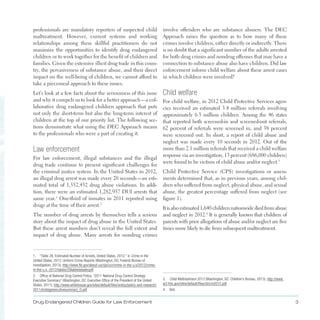
were screened out . In short, a report of child abuse and
neglect was made every 10 seconds in 2012 . Out of the
more than 2 .1 million referrals that received a child welfare
response via an investigation, 13 percent (686,000 children)
were found to be victims of child abuse and/or neglect .3
Child Protective Service (CPS) investigations or assess­
ments determined that, as in previous years, among chil­
dren who suffered from neglect, physical abuse, and sexual
abuse, the greatest percentage suffered from neglect (see
figure 1) .
It is also estimated 1,640 children nationwide died from abuse
and neglect in 2012 .4
It is generally known that children of
parents with prior allegations of abuse and/or neglect are five
times more likely to die from subsequent maltreatment .
Drug Endangered Children Guide for Law Enforcement 3
1. “Table 29. Estimated Number of Arrests, United States, 2012,” in Crime in the
United States, 2012, Uniform Crime Reports (Washington, DC: Federal Bureau of
Investigation, 2013), http://www.fbi.gov/about-us/cjis/ucr/crime-in-the-u.s/2012/crime­
in-the-u.s.-2012/tables/29tabledatadecpdf.
2. Office of National Drug Control Policy, “2011 National Drug Control Strategy:
3. Child Maltreatment 2012 (Washington, DC: Children’s Bureau, 2013), http://www.Executive Summary” (Washington, DC: Executive Office of the President of the United
acf.hhs.gov/sites/default/files/cb/cm2012.pdf.States, 2011), http://www.whitehouse.gov/sites/default/files/ondcp/policy-and-research/
2011strategyexecutivesummary_0.pdf. 4. Ibid.
Figure 1. Children who suffer from neglect, physical abuse, and sexual abuse
9.30%
18.30%
78.30%
Source: Child Maltreatment 2012 (Washington, DC: Children’s Bureau, 2013), 20.
Neglect
Physical abuse
Sexual abuse
The most recent comprehensive survey of the numbers
of children living with adults who abused drugs was
compiled over five years and released in 2009 . This spe­
cial report under the National Survey on Drug Use and
Health indicates the following:
•	 During the past year, 8 .3 million children lived with
at least one parent who abused or was dependent on
alcohol or an illicit drug .
•	 More than two million children lived with at least one
parent who abused or was dependent on an illicit drug .
•	 More than 26 percent were under the age of six and
thus were considered the most vulnerable .
•	 One in ten children lives in a household with a
“substance-dependent or substance-abusing parent .”5
5. “Children Living with Substance-Dependent or Substance-Abusing Parents: 2002
to 2007,” The NSDUH Report. (Rockville, MD: Office of Applied Studies, Substance
Abuse and Mental Health Services Administration, 2009).
Child welfare investigators base their findings on all the
information they have available . If other professionals have
information that may reveal more details about what is
happening in the life of a child, they can make a difference
in the response . This increased information results in more
informed decision making . Using the DEC Approach gives
all professionals a common starting point for their investi­
gations, and the information that is shared with other disci­
plines helps determine if there is abuse or neglect .
Medical community
For the medical community, let’s look at the most recent
Drug Abuse Warning Network (DAWN) data from 2011 .
This network is managed by the Substance Abuse and
Mental Health Services Administration, which reports
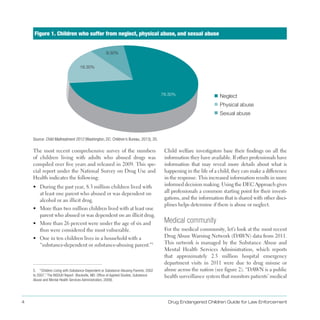
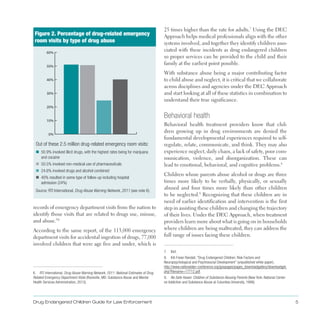
that approximately 2 .5 million hospital emergency
department visits in 2011 were due to drug misuse or
abuse across the nation (see figure 2) . “DAWN is a public
health surveillance system that monitors patients’ medical
Drug Endangered Children Guide for Law Enforcement4
Figure 2. Percentage of drug-related emergency
room visits by type of drug abuse
0%
10%
20%
30%
40%
50%
60%
Out of these 2.5 million drug-related emergency room visits:
n  50.9% involved illicit drugs, with the highest rates being for marijuana
and cocaine
n  50.5% involved non-medical use of pharmaceuticals
n  24.6% involved drugs and alcohol combined
n  40% resulted in some type of follow-up including hospital
admission (24%)
Source: RTI International, Drug Abuse Warning Network, 2011 (see note 6).
records of emergency department visits from the nation to
identify those visits that are related to drugs use, misuse,
and abuse .”6
6. RTI International, Drug Abuse Warning Network, 2011: National Estimates of Drug
Related Emergency Department Visits (Rockville, MD: Substance Abuse and Mental
Health Services Administration, 2013).
According to the same report, of the 113,000 emergency
department visits for accidental ingestion of drugs, 77,000
involved children that were age five and under, which is
25 times higher than the rate for adults .7
Using the DEC
Approach helps medical professionals align with the other
systems involved, and together they identify children asso­
ciated with these incidents as drug endangered children
so proper services can be provided to the child and their
family at the earliest point possible .
With substance abuse being a major contributing factor
to child abuse and neglect, it is critical that we collaborate
across disciplines and agencies under the DEC Approach
and start looking at all of these statistics in combination to
understand their true significance .
Behavioral health
Behavioral health treatment providers know that chil­
dren growing up in drug environments are denied the
fundamental developmental experiences required to self-
regulate, relate, communicate, and think . They may also
experience neglect, daily chaos, a lack of safety, poor com­
munication, violence, and disorganization . These can
lead to emotional, behavioral, and cognitive problems .8
Children whose parents abuse alcohol or drugs are three
times more likely to be verbally, physically, or sexually
abused and four times more likely than other children
to be neglected .9
Recognizing that these children are in
need of earlier identification and intervention is the first
step in assisting these children and changing the trajectory
of their lives . Under the DEC Approach, when treatment
providers learn more about what is going on in households
where children are being maltreated, they can address the
full range of issues facing these children .
7. Ibid.
8. Kiti Freier Randall, “Drug Endangered Children: Risk Factors and
Neuropsychological and Psychosocial Development” (unpublished white paper),
http://www.nationaldec-conference.org/goopages/pages_downloadgallery/downloadget.
php?filename=17712.pdf.
9. No Safe Haven: Children of Substance Abusing Parents (New York: National Center
on Addiction and Substance Abuse at Columbia University, 1999).
Drug Endangered Children Guide for Law Enforcement 5
Drug Endangered Children Guide for Law Enforcement 7
Working Together under the DEC approach:
how We Make Change happen
Using the DEC Approach, professionals around the
nation and across disciplines have found common
ground . Together they are working toward breaking the
cycle of abuse and neglect and creating healthier com­
munities by building stronger families where children
can be safe and thrive .
The DEC Approach is a comprehensive strategy that
focuses on the formation of community-based partner­
ships that engage professionals from multiple disciplines
in developing a collaborative response to rescue, defend,
shelter, and support children living in drug environments .
This joint approach allows various disciplines to perform
their job duties while also assisting in meeting the needs
of these children .
National DEC’s “Children + Drugs = Risk” perspective
and trainings recognize that law enforcement performs
a critical role in every investigation by identifying chil­
dren at risk, gathering and sharing evidence, and bringing
criminal charges for filing by prosecution . Upon comple­
tion of the DEC Approach trainings, law enforcement
officers have the necessary tools to paint a more complete
picture of the child’s life and the potential risks that he
or she is facing . The information and evidence obtained
during a DEC police investigation can be effectively used
by child welfare and other disciplines involved in paral­
lel investigations . The information gathered further serves
to enhance and streamline the identification of services
available for children at risk .
The DEC Approach is based on collaboration and chang­
ing the status quo of how we respond to the needs of drug
endangered children . In order to achieve this, we must
have a common vision, a willingness to gain insight about
our partners, and a commitment to change our practices .
We also need to recognize that there will be controversy
as we learn new perspectives, craft new working relation­
ships, and take greater responsibility for the well-being
of children .
It seems clear that it is time to change so,
what is change?
Change means we change the status quo or the way we
have done business for years: for example, changing our
mindset from “children are child welfare’s responsibili­
ties” to “children are everyone’s responsibility .” When we
change our mindset, “DEC” becomes common termi­
nology, and our response to drug endangered children
becomes a part of our everyday professional practice and
is institutionalized in our agencies .
The Higher Education Research Institute suggests that
inherent in “change” is a belief in the importance of
making a better world and a better society for oneself and
others—belief that “individuals, groups and communities
have the ability to work together to make that change .”10
The common elements for change include the following:
•	 Recognition of an unacceptable situation
•	 Shared vision for a desired outcome
•	 Strong leadership
•	 Guided activities of many
•	 Persistence
10. A Social Change Model of Leadership Development Guidebook, version 3 (Los
Angeles, CA: Higher Education Research Institute, 1996), quoted in Wendy Wagner,
“The Social Change Model of Leadership: A Brief Overview,” Concepts & Connections
15, no. 1 (2006).
8 Drug Endangered Children Guide for Law Enforcement
What happens if we don’t change?
•	 Children may receive no intervention or a delayed
intervention .
•	 Children may receive the wrong type of or
insufficient services .
•	 Children may receive no services or a delay in
services .
•	 Abuse and/or neglect may continue .
•	 Children may suffer long-term effects from abuse
and/or neglect .
•	 Serious injury or fatality may occur to the child .
Practical example: An undercover drug task force
member observes a mother blowing pot smoke into
her two-year-old son’s face to get him to stop crying.
This officer has not only identified a drug endangered
child but also observed an act of child endangerment.
What happens in this situation if the officer does
not call child welfare, as he or she may be afraid of
compromising the undercover investigation?
What happens if we do change?
•	 Earlier intervention and services provided for
children because of earlier identification
•	 Expanded knowledge of and access to other
disciplines
•	 Greater willingness of other agencies to provide
information to law enforcement investigations
•	 Enhanced knowledge of evidence gathering,
increasing law enforcement’s ability to file all
applicable charges
•	 Improved crime reporting by painting a more detailed
picture of the problem
•	 Increased crime prevention by breaking the cycle of
abuse and neglect
•	 Heightened morale and job satisfaction by identifying
and protecting children
Practical example: A patrol officer responds to a call of
a small child wandering around in the neighborhood.
The week prior, the officer arrested the mother of
the child for possession of paraphernalia. In using
the DEC Approach, the officer would look into the
underlying cause of the situation and not just return
the child back home. The officer would investigate
whether substance abuse might be a significant
factor and that the “lack of supervision” is due to the
incapacitation of the caregiver.
Practical example: Upon arrival to the hospital,
law enforcement professionals tell the emergency
department doctor that the three-year-old child was
found wandering the street with only a diaper on
while the temperature was only 45 degrees. In using
the DEC Approach, law enforcement would relay
additional information to the doctor. For example, the
mother appeared to be high, there was no food in the
house, the house was filthy with garbage and feces on
the floor, and there was a white powdery substance
on the kitchen table that tested positive for cocaine.
With this information, the doctor would add a blood
test to the exam to determine whether the child had
ingested any drugs.
Practical example: It is often common practice for
paramedics, EMTs, and fire personnel on scene to
look for any medication a person may be taking.
This may include going into bedrooms, bathrooms,
and kitchens and looking in places where there are
possible medications. This enables them to see parts
of the residence and provide others with information
regarding drugs, risks, and safety issues in the house.
Drug Endangered Children Guide for Law Enforcement 9
gaining Deeper awareness and Key insights about
DEC Partners
“The DEC program in general and the WIDEC [Wisconsin Drug Endangered Children]
Alliance have created many changes in the way we handle children from a law enforcement
perspective when located at a drug investigation scene . Our own agency allows more
documentation of the conditions the drug endangered child is found in . Cooperation between
agencies continues to increase and makes things run more smoothly . Finally, the children are
receiving the services that they are entitled to, and we hope that will help to make changes in
their lives .”
– Cynthia Giese, Special Agent in Charge, Division of Criminal Investigation, Wisconsin Department of Justice
The DEC Approach is a collaborative effort that works
across disciplines, agencies, and jurisdictions . Among the
key partners that law enforcement can work closely with
to identify, protect, and serve drug endangered children
are the local child welfare professionals and the local
prosecutors . In addition, having knowledge from medi­
cal, behavioral health, and treatment professionals assists
law enforcement officers in their response . This chapter
provides information about the roles and responsibilities
of these practitioners as well as insights about how each
discipline can provide leadership in enhanced working
relationships and effective collaborative efforts—DEC
Alliances—with these key partners .
Even though each of the professionals discussed in this
guide is a mandatory reporter (including law enforce­
ment) and is required to call child welfare when abuse or
neglect is known or suspected, many states struggle with
underreporting or lack of reporting for various reasons .
These can include a lack of awareness of who is a manda­
tory reporter, fear of unnecessary removal of children, fear
of being involved in a lengthy court case, the uncertainty
of what information to report or how to report it, stigma
in smaller communities as the “snitch,” and a history of
perceived lack of response .
However, the underreporting of child maltreatment is a
serious problem . What is not reported cannot be inves­
tigated; therefore, children may continue to be at risk
or unsafe . Furthermore, what is not reported reduces
child welfare’s knowledge for future interventions with
the family .11
11. Family Matters: Substance Abuse and the American Family (New York: National
Center on Addiction and Substance Abuse at Columbia University, 2005).
Mandatory reporting is one vital component of identify­
ing and protecting children who are maltreated, but col­
laboration on a broader scale between law enforcement,
child welfare, and other professionals is just as important .
Understanding the basic roles and responsibilities of each
discipline is a key component in building a collaborative
relationship . Having a basic understanding about why an
10 Drug Endangered Children Guide for Law Enforcement
agency responds the way it does eliminates frustration .
This is definitely true with the complexity of the child
welfare system .
“Children and families involved with child welfare often are involved concurrently with other
systems . The absence of effective collaboration among these systems minimizes the ability to
view the child and family as a whole, limiting the potential to make informed case planning
decisions . The DEC Approach, which brings together systems and utilizes the knowledge of
many, maximizes opportunities to intervene and plan to support the child and family and
improve the likelihood of breaking the cycle of abuse and neglect resulting from drug abuse .”
–Sara Wilhelm, Social Work Supervisor, Connecticut Department of Children and Families
Child welfare: roles and responsibilities
Child Welfare is the name of the governmental agency
that responds to reports of child abuse or neglect . Some
states use other names such as Department of Children
& Family Services, Social Services, Human Services,
Family Services, and many more . Child welfare agencies
often include related social service departments such as
food stamp programs, financial assistance and aid, and
housing programs .
Child welfare workers have substantial responsibilities,
which include the following:
•	 Investigate child abuse and neglect .
•	 Identify and assess the safety of children .
•	 Identify and assess the risks to children .
•	 Gather and analyze information and evidence on
children and families .
•	 Provide services to children and families .
•	 Ensure child safety and well-being .
•	 Provide permanency to children .
Initial calls to child welfare
Why do some calls to child welfare get a response and
others do not?
When law enforcement calls child welfare because of
concerns about the well-being of a child, it is easy to imag­
ine that action will be taken quickly by child welfare and
that, at a minimum, there will be an investigation . After
all, law enforcement is used to investigating incidents
and circumstances in which it is not certain that a crime
has occurred .
Citizens are encouraged to call law enforcement with any
concerns about suspicious behavior or potential crimi­
nal activity, and law enforcement usually investigates to
determine what is taking place . Some law enforcement
agencies might assume that a call to child welfare with a
brief description of their concerns is sufficient informa­
tion for child welfare to immediately open an investiga­
tion . Law enforcement has a lot of authority and stature
in its role and thus is able to respond to calls for service
quickly . Because of this experience, law enforcement
might expect that child welfare would or should be able
to respond to law enforcement’s calls in a similar man­
ner . Thus, when child welfare doesn’t automatically
open an investigation when called about potential child
Drug Endangered Children Guide for Law Enforcement 11
maltreatment, law enforcement—using its own standards
for taking action—may become frustrated and conclude
that child welfare isn’t doing its job .
However, child welfare does something with every report
of alleged child abuse or neglect . Child welfare evaluates
and considers each piece of information provided during
the initial call and uses it to determine if the case will be
assigned to a child welfare worker for a response . This usu­
ally involves a supervisor or manager and possibly a group
of child welfare professionals . Child welfare intake work­
ers often refer to a list of questions to obtain information
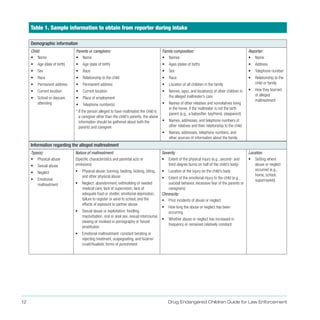
from the caller, including law enforcement . Table 1 on
page 12 lists the types of information a child welfare intake
worker may ask about during the intake call . The exact
questions will vary from jurisdiction to jurisdiction .
KEY DEC INSIGHT: Regarding Calls to 

Child Welfare

Under the DEC Approach, law enforcement learns that
child welfare needs a certain threshold of information
from a call before it can open an investigation. Child wel­
fare agencies often use an information-gathering sheet
to assist in determining whether it has enough evidence
to meet state law requirements for initiating an investiga­
tion into the affairs of a family. Rather than providing brief
information, law enforcement shifts its focus to provid­
ing as much evidence as possible to aid child welfare
in determining whether it can and should investigate.
In some jurisdictions, law enforcement uses the child
welfare intake information sheet as a guide for provid­
ing the most useful and comprehensive information that
child welfare needs. This insight about the standards
that child welfare must use to open an investigation
eliminates frustration, and law enforcement becomes
a collaborative partner with child welfare in identifying
children who have been abused or neglected or are at
significant risk.
The information obtained by a child welfare intake worker
must rise to the level that meets a state’s laws and poli­
cies regarding abuse or neglect in order for child welfare
to legally begin an investigation . If there is not sufficient
evidence of harm or risk to a child, there will likely be no
investigation, and the information gathered from the call is
added to a child welfare database for future reference in the
event of additional calls . This collection of information may
eventually lead to child welfare opening an investigation .
Table 1. Sample information to obtain from reporter during intake
Demographic information
Child: Parents or caregivers: Family composition: Reporter:
•	 Name •	 Name •	 Names •	 Name
•	 Age (date of birth) •	 Age (date of birth) •	 Ages (dates of birth) •	 Address
•	 Sex •	 Race •	 Sex •	 Telephone number
•	 Race •	 Relationship to the child •	 Race •	 Relationship to the
•	 Permanent address •	 Permanent address •	 Location of all children in the family child or family
•	 Current location •	 Current location •	 Names, ages, and location(s) of other children in •	 How they learned
•	 School or daycare
attending
•	 Place of employment
•	 Telephone number(s)
* If the person alleged to have maltreated the child is
a caregiver other than the child's parents, the above
information should be gathered about both the
parents and caregiver.
the alleged maltreater’s care
•	 Names of other relatives and nonrelatives living
in the home, if the maltreater is not the birth
parent (e.g., a babysitter, boyfriend, stepparent)
•	 Names, addresses, and telephone numbers of
other relatives and their relationship to the child
•	 Names, addresses, telephone numbers, and
other sources of information about the family
of alleged
maltreatment
Information regarding the alleged maltreatment
Type(s): Nature of maltreatment: Severity Location
•	 Physical abuse (Specific characteristics and parental acts or •	 Extent of the physical injury (e.g., second- and •	 Setting where
•	 Sexual abuse omissions) third-degree burns on half of the child’s body) abuse or neglect
•	 Neglect
•	 Emotional
maltreatment
•	 Physical abuse: burning, beating, kicking, biting,
and other physical abuse
•	 Neglect: abandonment, withholding of needed
•	 Location of the injury on the child’s body
•	 Extent of the emotional injury to the child (e.g.,
suicidal behavior, excessive fear of the parents or
occurred (e.g.,
home, school,
supermarket)
medical care, lack of supervision, lack of
adequate food or shelter, emotional deprivation,
failure to register or send to school, and the
effects of exposure to partner abuse
•	 Sexual abuse or exploitation: fondling,
masturbation, oral or anal sex, sexual intercourse,
viewing or involved in pornography or forced
prostitution
caregivers)
Chronicity:
•	 Prior incidents of abuse or neglect
•	 How long the abuse or neglect has been
occurring
•	 Whether abuse or neglect has increased in
frequency or remained relatively constant
•	 Emotional maltreatment: constant berating or
rejecting treatment, scapegoating, and bizarre/
cruel/ritualistic forms of punishment
Drug Endangered Children Guide for Law Enforcement12
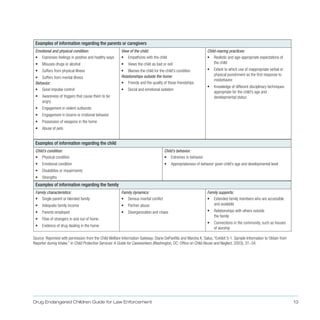
Examples of information regarding the parents or caregivers
Emotional and physical condition:
•	 Expresses feelings in positive and healthy ways
•	 Misuses drugs or alcohol
•	 Suffers from physical illness
•	 Suffers from mental illness
Behavior:
•	 Good impulse control
•	 Awareness of triggers that cause them to be
angry
•	 Engagement in violent outbursts
•	 Engagement in bizarre or irrational behavior
•	 Possession of weapons in the home
•	 Abuse of pets
View of the child:
•	 Empathizes with the child
•	 Views the child as bad or evil
•	 Blames the child for the child's condition
Relationships outside the home:
•	 Friends and the quality of those friendships
•	 Social and emotional isolation
Child-rearing practices:
•	 Realistic and age-appropriate expectations of
the child
•	 Extent to which use of inappropriate verbal or
physical punishment as the first response to
misbehavior
•	 Knowledge of different disciplinary techniques
appropriate for the child's age and
developmental status
Examples of information regarding the child
Child’s condition:
•	 Physical condition
•	 Emotional condition
•	 Disabilities or impairments
•	 Strengths
Child’s behavior:
•	 Extremes in behavior
•	 Appropriateness of behavior given child’s age and developmental level
Examples of information regarding the family
Family characteristics: Family dynamics: Family supports:
•	 Single parent or blended family •	 Serious marital conflict •	 Extended family members who are accessible
•	 Adequate family income •	 Partner abuse and available
•	 Parents employed •	 Disorganization and chaos •	 Relationships with others outside
•	 Flow of strangers in and out of home
the family
•	 Evidence of drug dealing in the home
•	 Connections in the community, such as houses
of worship
Source: Reprinted with permission from the Child Welfare Information Gateway: Diane DePanfilis and Marsha K. Salus, “Exhibit 5-1. Sample Information to Obtain from
Reporter during Intake,” in Child Protective Services: A Guide for Caseworkers (Washington, DC: Office on Child Abuse and Neglect, 2003), 31–34.
Drug Endangered Children Guide for Law Enforcement 13
KEY DEC INSIGHT: Regarding Law 

Enforcement’s Perspective on the 

Life of a Child

Under the DEC Approach, law enforcement learns that

it has unique information and evidence about the harm

experienced by a child and the risks faced by a child.

With this information, law enforcement can greatly

supplement what child welfare may know about a fam­
ily. As trained observers and criminal investigators, law

enforcement may notice different evidence and have

a different understanding of the nature of the risks to

children than a child welfare investigator. This can

include an understanding of what types of drug para­
phernalia and drugs may be present, how the drugs

are ingested, and what their effects may be on users

or those exposed. With repeated visits, and perhaps

repeated arrests, over the course of days, weeks, or

months, law enforcement gains knowledge over time

that paints a more detailed picture of a child’s life. Law

enforcement can also gain information through normal

police work, surveillance, undercover work, or infor­
mants that child welfare wouldn’t normally have access

to. Law enforcement may conclude early on that drug

endangered children are crime victims. These observa­
tions and experiences are invaluable to child welfare

for understanding the nature of the risks faced by drug

endangered children.

Child welfare can respond in several ways to the
initial call:
•	 Screened in: This means there is enough information
to suggest possible abuse or neglect and the need for
intervention involving an investigation by child welfare
of the allegations .
•	 Screened out: This means there is not enough
information regarding abuse or neglect for child
welfare to respond . In most states, this screened out
information is put into the child welfare database and
can be looked at as needed for future reference .
•	 Provision of information or resources: Child welfare
can also provide resources or information to the caller
at this point . This can include a phone number to
another department, information to other programs
such as a homeless shelter, or other community or
program information .
When there is enough information for a case to be screened
in, child welfare opens an investigation .
Why is law enforcement’s perspective of the child’s life
so significant?
Although it may seem obvious that a child is in danger to a
law enforcement officer making a call, child welfare intake
workers must consider a wide array of factors to determine
whether the information is sufficient under each state’s laws
to initiate an investigation . Generally, the more informa­
tion law enforcement can provide about the suspected child
abuse or neglect, the better . Providing as much information
as possible is extremely valuable for child welfare intake
workers during their screening process .
Law enforcement officers often have unique opportunities
to see children and families unannounced during routine
police work, tactical entries, surveillance, and undercover
activities . Information may be gathered through the eyes of
informants, video cameras, or listening devices . This allows
law enforcement to witness activities or circumstances other
professionals might not have the opportunity to see, such as
a parent exposing a child to illicit drugs . This in turn means
that law enforcement has the unique opportunity to report
information to child welfare that others are not aware of . In
addition, law enforcement has unique training, skills, and
Drug Endangered Children Guide for Law Enforcement14
experience that provide perspectives and details about the
circumstances in a home involving children and drugs
that no other professional might have .
How can law enforcement prepare for making an effective
call to child welfare?
Law enforcement officers might think they do not have a
lot of information to provide during the initial call to child
welfare, but they may very well have quite a bit of use­
ful information . The questions that child welfare intake
workers ask during the call can vary from state to state and
jurisdiction to jurisdiction, but there are many similarities .
To help prepare law enforcement officers for their initial
call to child welfare, National DEC’s network of profes­
sionals created the following list of information officers
may be able to provide:
•	 Reason for the call: What is the basis for law
enforcement’s call to child welfare? What did
law enforcement observe, hear, or discover that
led to the call?
•	 First-hand observations (e .g ., pictures or videos,
if possible): Describe the risks to the children, and
provide information that shows the impact the
environment has on the children . (If possible, follow
up with pictures of the residence or environment that
show risk and safety concerns for children) .
•	 Description and chronology of events: Paint a picture
of the life of the child; provide any information during
the initial call that might demonstrate what has
happened to the child and what might happen in this
child’s life on a daily basis .
•	 Statements: These can include statements made by the
child, parent/caretaker, or others, such as a neighbor .
•	 Actions observed of the child or caretaker: For
example, describe if a child appears fearful of a
caretaker (e .g ., the child cowers when a caretaker
talks to the child); if a child is “parentified,” that is he
or she appears to be the adult in the household (e .g .
makes adult decisions or takes care of siblings); or if a
child is not developmentally on target .
•	 History known by law enforcement: This can include
criminal history, pending charges, call history, and
family history .
•	 Current resources, services, or supports of family or
child: Inform child welfare if a family is connected
with a church or has relatives willing to help .
•	 Attitude of family members or caretakers: Describe if
the parents are defensive, do not understand the risk to
the children, or refuse to cooperate .
•	 The alleged perpetrator’s access to the child: For
example, has the alleged perpetrator moved out or
gone to jail? Are the children going back to their
mom’s house today, which may put them at risk? Do
the children have nowhere else to go?
•	 Child’s current medical, mental, social, and
cognitive abilities/levels: These can include noticing
that a three-year-old child is not walking yet, that child
is difficult to understand, or that a child appears ill .
•	 Current family stressors: These can include a parent
losing a job, a family being evicted or moving, a death
occurring in the family, a mother being pregnant, or a
boyfriend or girlfriend moving out or in .
•	 Possible consequences: This includes any impact on
the children from any of the above scenarios .
State mandatory reporting laws may also delineate the type
of information that should be included in a report to child
welfare . According to the U .S . Department of Health and
Human Services, Administration for Children and Fami­
lies, these reports typically include the following:
•	 The name, age, sex, and address of the child
•	 The nature and extent of the child’s injuries
or condition
Drug Endangered Children Guide for Law Enforcement 15
16 Drug Endangered Children Guide for Law Enforcement
•	 The name and address of the parent or other person(s)
responsible for the child’s care
•	 Any other information relevant to the investigation12
Furthermore, reporters must provide as much detailed
information as possible about the following:
•	 The child, the child’s condition, and the child’s
whereabouts
•	 The parents and their whereabouts
•	 The person alleged to have caused the child’s
condition and his or her location
•	 The family, including other children in the home
•	 The type and nature of the maltreatment, such as
the length of time it has been occurring, whether the
maltreatment has increased in severity or frequency,
and whether objects or weapons were used13
The information law enforcement provides to child wel­
fare can help paint a picture for child welfare about poten­
tial child maltreatment . Detailed information from law
enforcement may be critical in enabling child welfare to
open an investigation . The more information law enforce­
ment can provide, the better equipped child welfare is to
make decisions about the children and families involved .
12. Jill Goldman, Marsha K. Salus, Deborah Wolcott, and Kristie Y. Kennedy, “Chapter
Nine: What Does the Child Protection Process Look Like?” in A Coordinated Response to
Child Abuse and Neglect: The Foundation for Practice (Washington, DC: U.S. Department
of Health and Human Services, 2003), https://www.childwelfare.gov/pubs/usermanuals/
foundation/foundationi.cfm.
13. Ibid.
Child welfare time frames and investigations
Why is the response to some calls immediate while
others take days?
When law enforcement officers make a call to child welfare
about potential child abuse or neglect, they may expect
an immediate response and that every call results in an
investigation . In addition, law enforcement might assume
that the investigation commences immediately . When
child welfare doesn’t immediately begin an investigation
and when the time frames for completing the investigation
aren’t clear or aren’t communicated to law enforcement,
frustration and misunderstanding can occur .
The time frame to see the alleged child victim can be any­
where from immediate to 24 hours to up to five working
days (and in some states even longer), depending on the
circumstances of the alleged maltreatment, the current
safety concerns, and the risk of harm to the children .
Depending on the requirements under state laws, child
welfare time frames to see the alleged child victims may
include:
•	 Immediate response: The child is in imminent
danger/risk of harm or has already been harmed .
•	 24-hour response: The child is not in imminent
danger/risk of serious harm, or the child is at moderate
risk .
•	 Multiple-day response: There are no current safety
threats; there is low risk to the child .
•	 No response: There is not enough information
regarding abuse or neglect .
This method of triaging the information allows child wel­
fare to send an investigator to the most at-risk and unsafe
children while allowing more time to deal with other
lower risk calls . For law enforcement, this can be com­
pared to calls coming into dispatch that are triaged and
responded to depending on the information provided .
Those cases appearing to be the most serious and urgent
get attention first .
A similar process may take place during undercover drug
investigations; law enforcement might receive numerous
tips of illegal drug activity taking place, and each called
is screened and placed on a priority list . The screening
process for determining the type of response to these tips
can include identifying proper jurisdiction, type of drug
activity reported, credibility of the caller, details of the
alleged activity, history at that location, and other calls
about that location . Each piece of information is evaluated
and is factored into the decisions made about the case .
How long does child welfare have to complete its
investigation?
The short answer is that child welfare often does not have
a lot of time to complete a child abuse and neglect inves­
tigation . Again, law and policy guide time frames . The
time frames to close an investigation vary from 30 days
to six months or more, all of which depends on state law
and policy .
Knowing the time frames for their jurisdictions will guide
law enforcement agencies in assisting child welfare in a
timely manner . Remember, the more information law
enforcement agencies can provide to child welfare within
their time frames, the greater the likelihood of better out­
comes for children .
More information = more informed decisions =
better outcomes.
What happens during a child welfare investigation?
During a child abuse and neglect investigation, child wel­
fare does the following:
•	 Gather information and evidence
•	 Talk to and interview collateral contacts and family
members
•	 Interview the children, their caretakers, and the
alleged perpetrators
•	 Assess the information and evidence to make
decisions on the best course of action
KEY DEC INSIGHT: Regarding Child
Welfare Time Frames
Under the DEC Approach, law enforcement learns that
if child welfare “screens in” a case for investigation,
there are certain time frames that guide when child wel­
fare initiates the investigation and visits with the child,
depending on the level of danger to the child. The more
serious or imminent the danger to the child, the quicker
the response. This is similar to the decisions that a law
enforcement dispatcher has to make in deciding how
quickly an officer must be dispatched to a potential
crime scene or public safety incident. This makes the
information provided to child welfare all the more criti­
cal, so they can make an accurate assessment of the
urgency of their response.
Once an investigation is initiated by child welfare, there
are also time frames within which the investigation must
be completed. This can be as short as thirty days or as
long as many months. This is somewhat similar to the
time frames that law enforcement must meet to provide
sufficient evidence in a criminal case for a suspect to
be held or the requirements for a speedy trial.
The time frames for both initiating an investigation and
for completing an investigation vary from jurisdiction
to jurisdiction, depending on state and local laws and
policies. But when law enforcement understands the
process and time constraints of its local child welfare
agency, frustration is reduced. Law enforcement can
be helpful by providing their reports to child welfare
and sharing information to child welfare within those
time constraints. This partnership in sharing information
ultimately benefits the children because more informed
decisions can be made.
Drug Endangered Children Guide for Law Enforcement 17
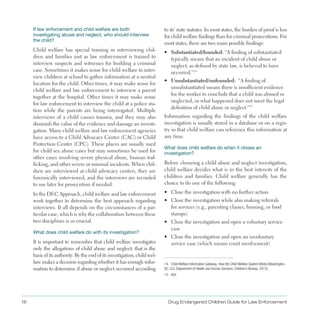
If law enforcement and child welfare are both
investigating abuse and neglect, who should interview
the child?
Child welfare has special training in interviewing chil­
dren and families just as law enforcement is trained to
interview suspects and witnesses for building a criminal
case . Sometimes it makes sense for child welfare to inter­
view children at school to gather information at a neutral
location for the child . Other times, it may make sense for
child welfare and law enforcement to interview a parent
together at the hospital . Other times it may make sense
for law enforcement to interview the child at a police sta­
tion while the parents are being interrogated . Multiple
interviews of a child causes trauma, and they may also
diminish the value of the evidence and damage an investi­
gation . Many child welfare and law enforcement agencies
have access to a Child Advocacy Center (CAC) or Child
Protection Center (CPC) . These places are usually used
for child sex abuse cases but may sometimes be used for
other cases involving severe physical abuse, human traf­
ficking, and other severe or unusual incidents . When chil­
dren are interviewed at child advocacy centers, they are
forensically interviewed, and the interviews are recorded
to use later for prosecution if needed .
In the DEC Approach, child welfare and law enforcement
work together to determine the best approach regarding
interviews . It all depends on the circumstances of a par­
ticular case, which is why the collaboration between these
two disciplines is so crucial .
What does child welfare do with its investigation?
It is important to remember that child welfare investigates
only the allegations of child abuse and neglect; that is the
basis of its authority . By the end of its investigation, child wel­
fare makes a decision regarding whether it has enough infor­
mation to determine if abuse or neglect occurred according
to its’ state statutes . In most states, the burden of proof is less
for child welfare findings than for criminal prosecutions . For
most states, there are two main possible findings:
•	 Substantiated/founded: “A finding of substantiated
typically means that an incident of child abuse or
neglect, as defined by state law, is believed to have
occurred .”14
•	 Unsubstantiated/unfounded: “A finding of
unsubstantiated means there is insufficient evidence
for the worker to conclude that a child was abused or
neglected, or what happened does not meet the legal
definition of child abuse or neglect .”15
Information regarding the findings of the child welfare
investigation is usually stored in a database or on a regis­
try so that child welfare can reference this information at
any time .
What does child welfare do when it closes an
investigation?
Before closuring a child abuse and neglect investigation,
child welfare decides what is in the best interests of the
children and families . Child welfare generally has the
choice to do one of the following:
•	 Close the investigation with no further action
•	 Close the investigation while also making referrals
for services (e .g ., parenting classes, housing, or food
stamps)
•	 Close the investigation and open a voluntary service
case
•	 Close the investigation and open an involuntary
service case (which means court involvement)
14. Child Welfare Information Gateway, How the Child Welfare System Works (Washington,
DC: U.S. Department of Health and Human Services, Children’s Bureau, 2013).
15. Ibid.
Drug Endangered Children Guide for Law Enforcement18
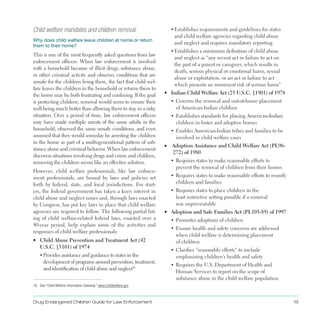
Child welfare mandates and children removal
Why does child welfare leave children at home or return
them to their home?
This is one of the most frequently asked questions from law
enforcement officers . When law enforcement is involved
with a household because of illicit drugs, substance abuse,
or other criminal activity and observes conditions that are
unsafe for the children living there, the fact that child wel­
fare leaves the children in the household or returns them to
the home may be both frustrating and confusing . If the goal
is protecting children, removal would seem to ensure their
well-being much better than allowing them to stay in a risky
situation . Over a period of time, law enforcement officers
may have made multiple arrests of the same adults in the
household, observed the same unsafe conditions, and even
assumed that they would someday be arresting the children
in the home as part of a multi-generational pattern of sub­
stance abuse and criminal behavior . When law enforcement
discovers situations involving drugs and crime and children,
removing the children seems like an effective solution .
However, child welfare professionals, like law enforce­
ment professionals, are bound by laws and policies set
forth by federal, state, and local jurisdictions . For start­
ers, the federal government has taken a keen interest in
child abuse and neglect issues and, through laws enacted
by Congress, has put key laws in place that child welfare
agencies are required to follow . The following partial list­
ing of child welfare-related federal laws, enacted over a
40-year period, help explain some of the activities and
responses of child welfare professionals:
•	 Child Abuse Prevention and Treatment Act (42
U.S.C. §5101) of 1974
▪ Provides assistance and guidance to states in the
development of programs around prevention, treatment,
and identification of child abuse and neglect16
16. See “Child Welfare Information Gateway,” www.childwelfare.gov.
▪ Establishes requirements and guidelines for states
and child welfare agencies regarding child abuse
and neglect and requires mandatory reporting
▪ Establishes a minimum definition of child abuse
and neglect as “any recent act or failure to act on
the part of a parent or caregiver, which results in
death, serious physical or emotional harm, sexual
abuse or exploitation, or an act or failure to act
which presents an imminent risk of serious harm”
•	 Indian Child Welfare Act (25 U.S.C. §1901) of 1978
▪	 Governs the removal and out-of-home placement
of American-Indian children
▪	 Establishes standards for placing American-Indian
children in foster and adoptive homes
▪	 Enables American-Indian tribes and families to be
involved in child welfare cases
•	 Adoption Assistance and Child Welfare Act (PL96­
272) of 1980
▪	 Requires states to make reasonable efforts to
prevent the removal of children from their homes
▪	 Requires states to make reasonable efforts to reunify
children and families
▪	 Requires states to place children in the 

least restrictive setting possible if a removal 

was unpreventable

•	 Adoption and Safe Families Act (PL105-89) of 1997
▪	 Promotes adoptions of children
▪	 Ensure health and safety concerns are addressed
when child welfare is determining placement
of children
▪	 Clarifies ‘’reasonable efforts’‘ to include 

emphasizing children’s health and safety

▪	 Requires the U .S . Department of Health and
Human Services to report on the scope of
substance abuse in the child welfare population
Drug Endangered Children Guide for Law Enforcement 19
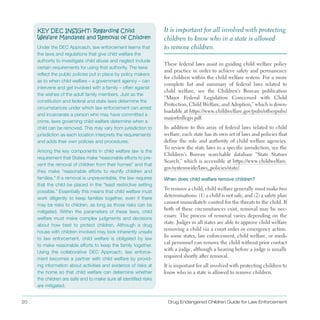
KEY DEC INSIGHT: Regarding Child
Welfare Mandates and Removal of Children
Under the DEC Approach, law enforcement learns that
the laws and regulations that give child welfare the
authority to investigate child abuse and neglect include
certain requirements for using that authority. The laws
reflect the public policies put in place by policy makers
as to when child welfare – a government agency – can
intervene and get involved with a family – often against
the wishes of the adult family members. Just as the
constitution and federal and state laws determine the
circumstances under which law enforcement can arrest
and incarcerate a person who may have committed a
crime, laws governing child welfare determine when a
child can be removed. This may vary from jurisdiction to
jurisdiction as each location interprets the requirements
and adds their own policies and procedures.
Among the key components in child welfare law is the
requirement that States make “reasonable efforts to pre­
vent the removal of children from their homes” and that
they make “reasonable efforts to reunify children and
families.” If a removal is unpreventable, the law requires
that the child be placed in the “least restrictive setting
possible.” Essentially this means that child welfare must
work diligently to keep families together, even if there
may be risks to children, as long as those risks can be
mitigated. Within the parameters of these laws, child
welfare must make complex judgments and decisions
about how best to protect children. Although a drug
house with children involved may look inherently unsafe
to law enforcement, child welfare is obligated by law
to make reasonable efforts to keep the family together.
Using the collaborative DEC Approach, law enforce­
ment becomes a partner with child welfare by provid­
ing information about activities and evidence of risks at
the home so that child welfare can determine whether
the children are safe and to make sure all identified risks
are mitigated.
It is important for all involved with protecting
children to know who in a state is allowed
to remove children .
These federal laws assist in guiding child welfare policy
and practice in order to achieve safety and permanency
for children within the child welfare system . For a more
complete list and summary of federal laws related to
child welfare, see the Children’s Bureau publication
“Major Federal Legislation Concerned with Child
Protection, Child Welfare, and Adoption,” which is down-
loadable at https://www .childwelfare .gov/pubs/otherpubs/
majorfedlegis .pdf .
In addition to this array of federal laws related to child
welfare, each state has its own set of laws and policies that
define the role and authority of child welfare agencies .
To review the state laws in a specific jurisdiction, see the
Children’s Bureau searchable database “State Statues
Search,” which is accessible at https://www .childwelfare .
gov/systemwide/laws_policies/state/ .
When does child welfare remove children?
To remove a child, child welfare generally must make two
determinations: (1) a child is not safe, and (2) a safety plan
cannot immediately control for the threats to the child . If
both of these circumstances exist, removal may be nec­
essary . The process of removal varies depending on the
state . Judges in all states are able to approve child welfare
removing a child via a court order or emergency action .
In some states, law enforcement, child welfare, or medi­
cal personnel can remove the child without prior contact
with a judge, although a hearing before a judge is usually
required shortly after removal .
It is important for all involved with protecting children to
know who in a state is allowed to remove children .
Drug Endangered Children Guide for Law Enforcement20
Drug Endangered Children Guide for Law Enforcement 21
Where are children placed when they are removed?
If removal is necessary to ensure the child’s safety, child
welfare is responsible for placing the child with a foster
home, a kin or family home, a group home, a shelter
home, or an emergency placement home . The availability
and type of placement options vary per state and per area .
Facilities or families certified or licensed by child welfare
have previously been looked at and approved to make sure
they are safe options for the placement of children . Some
of these placements may have restrictions or preferences
in regards to the number of children, the sex of the chil­
dren, or the difficulty/needs of the children .
When placing with kin or family who are not certified or
licensed, child welfare has policies as to what is needed
prior to placement . These requirements vary from state
to state and can include a criminal background check,
a child welfare background check, a medical check of
the children, a home check of the kin or family’s home, a
drug screen of the kin or family placement, etc .
Keep in mind that each placement, even with family, can
cause trauma to a child . But child welfare’s job is trying to
find the best fit for the child .
Does it make sense for law enforcement to place
children without notifying child welfare?
In some jurisdictions, law enforcement has the authority
to remove children from a home because they are not safe
or because the parents have been arrested . To stay on task
and move on to the next case, law enforcement all too
often may leave the child with another family member or
a neighbor without notifying child welfare . Law enforce­
ment may have contacted child welfare for past cases only
to experience frustration at how long the response takes .
And law enforcement may incorrectly assume that place­
ment with a family member or a neighbor is an automati­
cally safe placement .
Child welfare risk and safety assessments
What is the function of child welfare risk and safety
assessments?
Information screened in during the intake process results in
an investigation by child welfare to determine whether the
children have been harmed or are at risk of harm . Although
it may or may not be obvious that a child has been abused or
neglected or is at risk of being mistreated, child welfare has
to examine the harm caused, the current safety of the child,
and the risks of future harm .
If there is a child abuse and neglect investigation, child
welfare gathers information and evidence to complete a risk
assessment and a safety assessment . Both assessments are
tools designed to help child welfare make decisions about
the well-being of the children, including whether to remove
the child or to provide services to the family as part of a rea­
sonable effort to keep the family unified .
In order to complete risk and safety assessments, child
welfare relies on information and evidence that has been
observed, gathered, or provided to them . This is a great area
for law enforcement and child welfare to share information
freely . Child welfare makes decisions with the information it
has, whether that’s a little or a lot, but the more information
child welfare has, the more informed decisions it can make .
The risk assessment evaluates the likelihood of maltreat­
ment in the future . Risk is assessed on a continuum from
low to high and has an open-ended time frame .
The safety assessment is more focused on the immediate
threats to the child . Safety is not assessed on a continuum;
rather, a child is either safe or not . The safety assessment
is mainly used to assist in decisions around the immediate
KEY DEC INSIGHT: Notifying Child 

Welfare for Safe Placement

Under the DEC Approach, law enforcement gains
knowledge about child welfare’s placement process
and the value of making sure child welfare is involved in
any placements. With the primary focus on the safety
of children, a quick placement becomes less important
than a safe placement. Law enforcement becomes
a critical partner in helping child welfare determine
whether a placement with a relative or neighbor is
a safe placement by running names through law
enforcement data bases and intelligence records.
Having knowledge about child welfare’s removal and
placement process and using the DEC Approach
have decreased frustration and changed law enforce­
ment’s response. Collaboration between the disciplines
reduces misunderstandings and ultimately better
serves the children.
needs and issues of the children, including whether removal
is necessary . When child welfare assesses safety, it looks at
three areas:
1 . Threats of danger to the child
2 . Vulnerability of the child
3 . Protective capacity of the parents/caregivers
To be more specific, child welfare determines children
are unsafe when there are “threats of danger” within the
family or home, when “children are vulnerable to such
threats,” and when the caregivers have “insufficient pro­
tective capacities to manage or control the threats,” mak­
ing outside intervention necessary .17
All three of these
conditions must occur for a child to be considered unsafe
to child welfare .
17. Therese Roe Lund and Jennifer Renne, Child Safety: A Guide for Judges and
Attorneys (Washington, DC: ABA Center on Children and the Law, 2009).
KEY DEC INSIGHT: Identifying Risks and
Ensuring Safety
Under the DEC Approach, law enforcement learns
more about why child welfare must determine not only
whether a child has been harmed but also whether
the child is currently safe and what level of risk exists
for future maltreatment. In addition, child welfare must
determine how vulnerable the children are, how well
the adults in the home can protect the children from
harm, and whether providing services to the family and
monitoring their progress and compliance will assist
the caretakers in keeping the children safe. Under a
DEC collaborative partnership, child welfare can share
with law enforcement the risk and safety assessment
tools child welfare uses to make its decisions, and
law enforcement can help provide the evidence and
observations that reveal more about the entire life of
the children involved. This insight into the complexities
of the work of child welfare reduces frustration for law
enforcement and empowers it to be extremely valuable
partners in helping child welfare make a series of dif­
ficult decisions about what will keep children safe and
what, if at all possible, will keep families together.
Child welfare takes steps to keep families together as long
as child safety is maintained . This effort is part of the laws
that govern this practice, such as the Adoption Assistance
and Child Welfare Act of 1980 that requires states to make
reasonable efforts to prevent the removal of children from
their homes or to place children in the least restrictive
setting possible if removal is unpreventable .
Drug Endangered Children Guide for Law Enforcement22
Drug Endangered Children Guide for Law Enforcement 23
What does “vulnerability of the child” mean?	
When assessing a child’s vulnerability, child welfare looks
at the following factors:
•	 Age
•	 Developmental level and mental disabilities
•	 Physical disability and illness
•	 Provocative, irritating, or non-assertive behaviors
•	 Powerlessness and defenselessness
•	 Visibility at school and in the community in general
•	 Ability to communicate
•	 Ability to meet basic needs
•	 Being used as a scapegoat
•	 Accessibility by perpetrator
•	 Perpetrator’s relationship to the child18
Under the DEC Approach, understanding the signs of a
vulnerable child gives law enforcement a better under­
standing of what to look for and document . This makes
law enforcement officers better investigators and better in
their role of protecting public safety .
Practical example: While doing a trash pull, a drug
task force officer is looking for signs of drugs and
children. The officer notices in the trash marijuana
seeds and stems, aluminum foil with burn marks, and
uncovered used hypodermic needles, as well as an
infant’s diapers. The identification of this evidence
raises the level of child welfare’s investigation to a
high priority because of the increased risk to the child.
18. Framework for Safety in Child Welfare (Washington, DC: National Association of
Public Child Welfare Administrators, 2009).
What does “protective capacity of the parent” mean?
Protective capacity refers to whether a caregiver can and
will protect a child . When assessing this capacity, child
welfare takes into account whether the caregiver
•	 demonstrates that his or her first priority is the well­
being of the child;
•	 has adequate knowledge and skills to fulfill his or her
responsibilities and tasks;
•	 has a positive attachment to the child;
•	 is physically able;
•	 understands his or her protective role;
•	 demonstrates impulse control;
•	 is tolerant as a parent;
•	 has a strong bond with the child;
•	 sets aside his or her own needs for the child’s;
•	 expresses love, empathy, and sensitivity toward
the child;
•	 provides for the child via income, employment,
housing, etc .19
Law enforcement officers can also help child welfare deter­
mine the protective capacity of the parents by recording and
sharing their observations and experiences with the family
during their police work . This gives child welfare more
information to work with and professional insights to con­
sider when trying to determine what is best for the children .
Practical example: Drug task force officers doing
surveillance on a home observe cameras on the exterior
of the house, tin foil covering the windows, and multiple
individuals going in and out of the house at all hours of
the night and into the morning while small children are
standing in the doorway. Providing this evidence to child
welfare raises the level of investigation to a high priority
because of the increased risk to the child.
19. Lund and Renne, Child Safety (see note 17).
What does “threat of danger” mean?
Threats of danger include conditions, behaviors, and atti­
tudes present that make a child unsafe . The following list
provides 15 examples of such types of threats:
1 . 	No adult in the home is routinely performing basic and
essential parenting duties and responsibilities .
2 . 	The family lacks sufficient resources, such as food and
shelter, to meet the child’s needs .
3 . 	The caregivers lack the parenting knowledge, skills, and
motivation necessary to ensure a child’s basic needs are
met .
4 . 	The caregivers’ behavior is violent, or they are behaving
dangerously .
5 . 	The caregivers’ behavior is dangerously impulsive, or
they will not/cannot control their behavior .
6 . 	The caregivers’ perceptions of a child are extremely
negative .
7 . 	The caregivers are threatening to severely harm a child,
are fearful they will maltreat the child, and/or request
placement .
8 . 	The caregivers intend(ed) to seriously hurt the child .
9 . 	The caregivers largely reject child protective services
intervention, refuse access to a child, and/or may flee .
10 .The caregivers refuse and/or fail to meet a child’s
exceptional needs that do/can result in severe
consequences to the child .
11 .The child’s living arrangements seriously endanger the
child’s physical health .
12 .A child has serious physical injuries or serious physical
symptoms from maltreatment, and the caregivers are
unwilling or unable to arrange or provide care .
13 .A child shows serious emotional symptoms requiring
immediate help, lacks behavioral control, or exhibits
self-destructive behavior, and the caregivers are
unwilling or unable to arrange or provide care .
14 .A child is profoundly fearful of the home situation or
people within the home .
15 .The caregivers cannot, will not, or do not explain a
child’s injuries or threatening family conditions .20
By developing and sustaining a working partnership with
child welfare, law enforcement can look more broadly at
the evidence in a home—beyond evidence that would
prove a criminal offense—to look for threats of danger
to children .
20. Lund and Renne, Child Safety (see note 17).
Practical example: A drug task force officer conducting
an undercover drug deal is inside a suspect’s residence
when the officer observes the suspect screaming and
Drug Endangered Children Guide for Law Enforcement24
yelling at two small children, who cower away when
the suspect raises his hand. The children are dressed
only in their underwear. In addition, the officer observes
holes in several walls and doors inside the residence.
Identification of this evidence raises the level of child
welfare’s investigation to a high priority because of to
the increased risk to the child.
What is a safety plan?
Child welfare puts a safety plan into place to prevent
removal, if possible . Safety plans incorporate interven­
tions and actions to control and resolve safety threats that,
if they were to continue, would leave the child in danger
of ongoing or immediate harm . The safety plan outlines
“strategies and services developed by the agency and fam­
ily with the explicit goal of ensuring the child’s immediate
safety .”21
Specifically, safety plans describe the following:
•	 The specific actions to resolve the threats
•	 The way the plan will be implemented
•	 The way the plan will be monitored
•	 The family’s involvement and reliability in the plan
Child welfare closes the safety plan first to ensure the
child’s well-being has been protected prior to closing a
child abuse and neglect investigation . This is because
child welfare is unable to monitor safety plans after clos­
ing the investigation .
Child welfare service cases
What is a service case, and when does it happen?
Often child welfare opens service cases so it can provide
families and children services, usually to address child
safety and risk of harm, while the long-term law enforce­
ment investigation is ongoing . Service cases generally open
when child welfare closes investigations . According to the
21. A Framework for Safety in Child Welfare (see note 18).
U .S . Department of Health and Human Services, the rea­
sons for providing services to children and their families
include (1) “preventing future instances of child maltreat­
ment” and (2) “remedying conditions that brought the
children and their family to the attention of the agency .”22
These service cases are different than child welfare investi­
gations, as the cases are generally longer term and provide
services to assist in stabilizing the family structure as well as
in preventing any further or future maltreatment .
22. Child Maltreatment 2011 (Washington, DC: Children’s Bureau, 2012), http://www.
acf.hhs.gov/sites/default/files/cb/cm11.pdf.
What services can child welfare provide families?
After opening a service case, child welfare either directly
provides the services, makes referrals for services with
contracted agencies, or does a combination of both . Ser­
vices can include the following:
•	 Parenting classes
•	 Substance use assessments and treatment
•	 Mental health assessments and treatment
•	 Financial assistance (food stamps, bus passes, etc .)
•	 Therapy
•	 Supervised visitation
•	 Therapeutic visitation
•	 Employment assistance
•	 Housing assistance
•	 Domestic violence services
The type and amount of services depends on the needs
of the children and family as well as the availability of
services within the community .
What is the difference between voluntary and involuntary
service cases?
It is helpful for law enforcement to know the difference
between voluntary and involuntary service cases to bet­
ter understand the family involved and the gravity of the
Drug Endangered Children Guide for Law Enforcement 25
26 Drug Endangered Children Guide for Law Enforcement
family’s circumstances . Whether a family is involved with
child welfare via a voluntary or involuntary case depends
on many factors, including the type, severity, and length
of maltreatment; parental capacity; risk to the children;
level of parental cooperation; vulnerability of the chil­
dren; and family need . Generally, the more severe the
circumstances and maltreatment, the more likely child
welfare will open an involuntary service case .
Voluntary service cases are based on the following factors:
•	 Risk to the children is lower .
•	 Safety concerns to the children are fewer and less severe .
•	 The court is not involved .
•	 The case is meant to be preventative .
•	 The case has the agreement of the family .
•	 The family has ability to withdraw at any time .
At any point in a voluntary service case, child welfare
can file a petition for court involvement, thus making the
case involuntary .
Involuntary service cases are based on the following factors:
•	 The children are at a higher risk .
•	 More child safety concerns need to be addressed than
in a voluntary case .
•	 The court is involved .
•	 Often, the case involves the removal of children,
placement of children, protective orders, and an
increased amount of services and monitoring .
•	 The case includes specific services identified in the
initial filing .
•	 The court monitors the case .
Having a collaborative relationship with child welfare
can be extremely beneficial to law enforcement because
knowing the difference between these two types of ser­
vices helps law enforcement to understand that the cir­
cumstances around abuse and neglect are more severe
for involuntary cases, that there may be protective orders
in place, and that the court monitors families who are
involved in an involuntary case . This information may
lead to a more heightened response and closer monitor­
ing by law enforcement officers when they have contact
with families .
When does a service case close?
Service cases can be open for short periods of time, such as
three to five months, or for longer periods of time, perhaps
three to five years . Closing a service case depends on many
factors, mainly the safety of the children, the risk for future
maltreatment, and the progress of the family . If the fam­
ily is not cooperating in services and the children can be
placed only in foster care or an adoptive home, the service
case remains open for a longer period of time . If the fam­
ily is cooperative and works hard to correct the problems
that brought them to the attention of child welfare, then
the service case may be open for a shorter period of time .
As long as child welfare has a service case open, child
welfare monitors and provides services to the family and
children . Also, as long as a service case is open, child wel­
fare gathers information on the family to assess the safety
of and risk to the children .
Law enforcement and child welfare as DEC partners
How can law enforcement and child welfare help each
other under the DEC Approach?
Law enforcement traditionally focuses on public safety
and criminal activity, including drug arrests, drug sei­
zures, and asset forfeiture . This often means arresting a
parent . Child welfare traditionally focuses on determining
the safety of and level of risk for children . Child welfare is
also required by law to keep family units together if at all
possible . On the surface, these may seem like divergent
organizational priorities, but that’s not true .
Drug Endangered Children Guide for Law Enforcement 27
Generally, the more severe the circumstances and maltreatment, the more likely child welfare
will open an involuntary service case .
Under the DEC Approach, the safety and well-being of
children is top priority . In working more closely with child
welfare, law enforcement fully understands its key role in
child safety, that ensuring a child’s well-being is also law
enforcement’s responsibility and not something handed
over to child welfare . Law enforcement’s key role is its
ability to determine whether a child has been harmed .
The evidence officers share can help child welfare make
decisions about whether the child’s safety can be ensured
and whether a family can remain unified or be re-unified .
For many law enforcement officers, these priorities take
on equal or even greater significance than the number of
drug offenders arrested, of drugs seized, and of drug assets
forfeited because of the officers’ strong desire to protect
children . In some law enforcement agencies, the criteria
for success have expanded to include identifying drug
endangered children and providing evidence to child wel­
fare so it can determine what needs to be done to protect
the safety of those children . Each profession brings its own
authority, standards, and obligations to the collaborative
working partnership for the benefit of children .
Are there specific benefits to law enforcement using
the DEC Approach? Are there specific benefits to child
welfare using the DEC Approach?
Yes, there are identifiable and specific benefits to both law
enforcement and child welfare in their respective areas
of responsibility under the DEC Approach . Examples of
how the DEC Approach benefits law enforcement include
the following:
•	 Helps to prevent crime and break the generational
cycle of abuse and neglect by helping law enforcement
to recognize that identifying and protecting children is
a key component of every drug case
•	 Enhances law enforcement’s evidence collection,
documentation, and testimony for child endangerment,
child maltreatment, or child abuse cases because child
welfare informs law enforcement about risk assessments,
safety assessments, and overall child abuse and neglect
•	 Assists law enforcement in putting together operation
plans because child welfare shares its knowledge
about the children and families associated with the
subjects of criminal investigations
•	 Increases officer safety because child welfare shares
information about household members, associates,
family composition, residence layout, weapons, and
dangerous animals in residence
•	 Enhances law enforcement’s investigations because
child welfare provides additional information
gathered through its interviewing skills and
experience with children and families
•	 Assists law enforcement with the criminal investigation
because child welfare shares its knowledge about prior
substance use, drugs, paraphernalia, and other items
associated with drug activity in the residence (hide
cans, surveillance cameras, potential booby traps,
precursor chemicals, weapons, etc .) because of its prior
contact with the family
Examples of how the DEC Approach benefits child
welfare include the following:
•	 Assists child welfare with risk and safety assessments
because law enforcement officers share what they
see and hear during search warrant executions,
undercover investigations, surveillance, and trash
pulls, such as the following:
▪	 Parents using drugs in front of infants and children
▪	 Parents leaving infants and children unattended to
deal drugs
28 Drug Endangered Children Guide for Law Enforcement
▪	 Parents leaving infants and children with

inappropriate people

▪	 Drugs and paraphernalia present within the residence
▪	 Parents allowing children to use drugs with them
▪	 Parents blowing smoke during drug use in infants’
mouths or faces
▪	 Parents transporting children without proper

safety seats

▪	 Domestic violence occurring in front of children
▪	 Parents using inappropriate and irrational discipline
with their children
▪	 Parents providing an unsafe living environment
because of drug trafficking, manufacturing,
and cultivation
•	 Assists child welfare in assessing the risk and safety
of children by providing access to information from
various law enforcement contact with the following:
▪	 Patrol officers
▪	 Detectives
▪	 SWAT officers
▪	 School resource officers
▪	 DARE officers/instructors
▪	 Drug and other task forces members
▪	 Informants
▪	 Concerned citizens
▪	 Neighbors
•	 Assists child welfare in determining targeted services
for the child and family by having information, such
as the following, from law enforcement:
▪	 Substance use in the home
▪	 Criminal activity in the home
▪	 Violence in the home
▪	 Evidence gathered during law enforcement 

investigations

•	 Increases the safety of child welfare workers when
dealing with dangerous people or criminal activity
during a child abuse and neglect investigation or a
service case by having the above information and a
positive working relationship with law enforcement
These benefits to both law enforcement and child welfare
servetheprimarygoalofprotectingchildren .Withchildsafety
as a priority, both professions can work together in a fashion
thatdoesnotcompromisetheirrespectivemissionsbutthathas
significantbenefitsforidentifying,protecting,andservingdrug
endangered children . This relationship builds trust, facilitates
collaboration, and results in mutually beneficial information
sharing . This means law enforcement can contact child wel­
farewithouthavingtoworrythatchildwelfarewillcompromise
thecriminalinvestigation .Childwelfarecantaketheinforma­
tion and assistance law enforcement provides and use them to
paint a more realistic picture of what drug endangered chil­
dren and families are facing . By helping each other, each pro­
fession becomes more effective, and children and families are
the beneficiaries .
Child welfare civil attorneys: roles and responsibilities
What is the relationship between civil attorneys and child
welfare?
Child welfare civil attorneys generally represent the inter­
ests and process cases for local child welfare agencies .
Their duties may be summarized as follows:
•	 Advising child welfare agencies as to whether they
have sufficient grounds to be involved with families
with children
•	 Representing the child welfare agency in court
proceedings related to child maltreatment cases
•	 Helping to enforce conditions imposed on parents
in child maltreatment cases to protect the safety
of children
•	 Working with criminal prosecutors when there is an
overlapping criminal case
Drug Endangered Children Guide for Law Enforcement 29
“When implemented, the DEC Approach allows child welfare to intervene earlier in children’s
lives at a time when services still have a measurable impact . Without the DEC Approach,
child welfare is often involved only after protective custody is deemed appropriate, which then
introduces out of home placements, more trauma for the child, and more challenges in our
efforts toward family reunification .”
– Jennifer Neely, District Manager, State of Wyoming, Department of Family Services
Although the child welfare system in each state is differ­
ent, and they are all complex, Marilee M . McWilliams,
a civil attorney who works for a child welfare agency in
Arapahoe County, Colorado, said the following when
describing her job:
It is my job to advise the department on the legal

sufficiency of our involvement with families .

I am assigned a case from its inception to the

time it closes . The first hearing is a temporary

custody hearing where I have to show there is a

legal reason for the child to be removed from the

parent or for us to be involved in the family’s life .

The next hearing is a plea dispositional hearing

where the parent has the legal right to ask for

an adjudicatory hearing to a jury or a judge . I

have the duty to prove by a preponderance of

the evidence that the statutory criteria for being

involved with the family are true . We review

proposed treatment plans for legal sufficiency

and handle hearings on what is an appropriate

treatment plan . We make sure that legal timelines

are complied with, such as permanency for

children pursuant to the statute . We also handle

any motions for termination of parental rights,

and we also handle any appeals that are filed in

the dependency and neglect as a result of either

adjudications or termination of parental rights . We

also handle allocation of parental responsibility

motions where custody is given to one or both
parents who are successful in our cases . We
give legal advice to case workers on both court-
involved and non-court-involved cases .
What is the role of child welfare civil court hearings?
Civil court hearings during a child abuse and neglect
investigation occur within a couple of days of child welfare
removing an unsafe child or after child welfare has asked the
court for intervention . This first hearing determines what is
in the child’s best interest around safety and risk, removal,
placement, returning home, placement with kin/family, etc .
The judge ultimately makes decisions based on the infor­
mation and evidence provided by each party at this initial
hearing, as well as any testimony heard . The civil attorney
representing child welfare agencies pursues the course of
action requested by child welfare before the court .
For this initial civil hearing, it is important that child wel­
fare provide the court with all relevant information and
evidence that supports the removal of the children . This
includes any law enforcement information and evidence
that pertains to the child and family . If requested, it may
also be necessary for law enforcement to attend this initial
hearing to testify or to provide any clarification to the law
enforcement investigation . Information and evidence pro­
vided by law enforcement makes child welfare’s case to the
court and advocacy for child safety stronger .
30 Drug Endangered Children Guide for Law Enforcement
Under the DEC Approach, civil attorneys work closely
with additional partners such as criminal prosecutors and
treatment providers . If the common goal of all involved
is breaking cycles of neglect and abuse, a wider array of
alternative sanctions and services may be available .
Criminal prosecutors: roles and responsibilities
Criminal prosecutors are attorneys who are in a position to
file and prosecute criminal charges when criminal statutes
or other statutory provisions involving criminal sanctions
are violated . Criminal prosecutors are referred to as district
attorneys, county attorneys, state’s attorneys, city attorneys,
or other names, depending on the state involved .
The main duties of criminal prosecutors include
the following:
•	 Enforce federal, state, tribal, and local criminal laws
•	 Determine whether law enforcement has collected
enough evidence to file charges against an individual
for committing a crime
•	 Determine exactly what criminal charges to file for
violation of particular criminal statutes
•	 Decide whether to offer or accept a plea bargain from
defendants or to take the charges to trial
•	 Represent the public safety and justice interests
of the community and state when prosecuting
individual offenders
•	 Make sentencing recommendations to the presiding
judges related to criminal convictions
•	 Initiate probation revocation hearings when a
convicted offender violates terms of probation
A prosecutor’s role is to be just and to exercise his or her
discretion so it reflects a high degree of fairness . A prosecu­
tor’s decision on whether or not to undertake prosecutions
can affect the whole system of justice . Each decision made
has tremendous potential to impact on the lives of the indi­
viduals involved if not on the entire community .23
23. The Prosecutor’s Deskbook, ed. Patrick F. Healy (Chicago: National District Attorneys
Association, 1971), 3–5.
Law enforcement professionals work hand in hand
on criminal cases with prosecutors . Law enforcement
responds to incidents of criminal behavior, investigates
the facts and circumstances, and collects the evidence that
the prosecutor includes in the criminal filing . The pros­
ecutor decides whether there is sufficient evidence to file
criminal charges .
Prosecutorial discretion is governed by professional, ethi­
cal, and legal standards . State statutes may give prosecu­
tors the authority to decide whether a particular accused
defendant is eligible for alternate dispositions such as a
diversion program or specialized courts (drug, family,
mental health, etc .) . Prosecutors also have the discretion
to charge, prosecute before a jury or judge, or engage in
plea negotiations .
Prosecutors make sentencing recommendations to judges
for cases they prosecute . Sanctions for particular criminal
offenses are defined by statutes . A possible sentence may
or may not include incarceration in jail or prison . Even if
some jail time is involved, the majority of criminal offenses
rely on community supervision in the form of probation .
The prosecutorial phase is perhaps the most critical stage
of the criminal justice process; at this point, many of the
alleged offender’s and the crime victims’ rights are brought
into play . The criminal justice system offers prosecutors
a lot of influence and flexibility in deciding whether a
case will be prosecuted, plead out, or be dismissed . The
more information and evidence the prosecutor has about
a case, the more comprehensive the decision making can
be about how to move a case forward . The criminal justice
Drug Endangered Children Guide for Law Enforcement 31
and child welfare systems effectively collaborating via the
DEC Approach can significantly impact the lives of drug
endangered children .
“As a prosecutor, I have a responsibility to ‘do justice’ for the community I serve . The DEC
Approach changed my perspective on what that justice looks like . With the DEC Approach,
prosecutors have the ability to use the powers of the office to look at the bigger problem and work
together with other disciplines to create a healthier community by building stronger families’
homes where children are safe .”
– Chris Corken, Assistant County Attorney, Dubuque, Iowa
Why do prosecutors sometimes drop misdemeanor
charges filed with felony drug charges?
When law enforcement brings evidence of criminal behav­
ior that fits within certain criminal offenses, the prosecutor
must decide the full array of possible charges he or she can
bring against the defendant . Serving justice requires that
the prosecutor include the most serious charges possible
in response to the defendant’s criminal behavior . Clear
evidence to charge a major criminal offense may be the
prosecutor’s priority . Lesser charges, such as misdemeanor
child endangerment, may be secondary to the overriding
goal of getting convictions for the highest charges possible .
Should prosecutors pursue charges of child abuse and
neglect along with charging drug offenses?
The goals of getting convictions for the highest charge pos­
sible and convicting drug offenders as part of the enforce­
ment component of the war against drugs might suggest that
it is less important to pursue charges of child maltreatment,
which may have lower penalties . Sentences for multiple
convictions are often served concurrently, so convictions for
lesser offenses wouldn’t automatically result in longer incar­
ceration or an increase in overall sanctions . Thus, it may
seem most efficient to pursue only the most serious charges .
However, pursuing child abuse and neglect charges is a
key component of the DEC Approach . To facilitate this,
prosecutors who are part of the DEC Approach review the
evidence gathered by law enforcement and the informa­
tion provided by child welfare . As a result, the prosecu­
tor knows more about the defendant as a parent and the
dynamics of the family, and this knowledge plays a key role
in helping the prosecutor to determine the most appropri­
ate charges .
Identifying that children are associated with the suspect of
a criminal investigation creates a record of how the chil­
dren were harmed and identifies them as crime victims
(see “Key DEC Insights” sidebar on page 32) . Thus, gath­
ering evidence and filing charges related to child abuse
and neglect gives prosecutors the ability to influence terms
of pretrial release, sentencing, probation, or parole . When
the criminal justice system files criminal charges of child
abuse and neglect, it may impact what happens in child
welfare dependency/civil court . When these two systems
work together, they strengthen each other’s response .
The benefit of this to the criminal justice system is that
as a condition of pretrial release, once the defendant is
charged, he or she can be ordered to comply with the
requirements of the child welfare agency that may be
running a civil proceeding parallel to the criminal justice
proceeding . If the parent or guardian fails to comply with
the service plan ordered through the child welfare agency,
32 Drug Endangered Children Guide for Law Enforcement
KEY DEC INSIGHT: The Value of Pursuing
Child Abuse and Neglect Charges Along
with Drug Offenses
Under the DEC Approach, prosecutors and law
enforcement learn that filing and pursuing convictions
for child abuse and neglect is critical in helping to iden­
tify, protect, and serve drug endangered children. With
a focus on child safety, it is important to ensure that
those who harm children or put children at risk are held
accountable. Potential criminal sanctions can provide
leverage to change the behavior of parents and make
them comply with requirements to keep children safe,
such as abstaining from drug use.
Without filing and pursuing child abuse or neglect
charges, there may be no record of the behavior
that harmed these children. Child abuse and neglect
charges also serve to identify drug endangered children
as crime victims, which helps to create a record that
may be relevant to establish subsequent child maltreat­
ment. It also makes these children eligible for services
paid for by crime victim services funding. These
services may be a vital part of helping drug endangered
children recover from the harms they have faced. Filing
child abuse and neglect charges also becomes part
of the mix of options when the prosecutor is balancing
both the criminal aspects of the case with the goals
of child welfare to provide services and keep a
family together.
he or she may be in violation of bond requirements . Bond
violations could result in the defendant being incarcerated
until such time as the trial is conducted .
Why do prosecutors plea bargain so many cases?
Only a small fraction of all criminal cases charged result
in a trial . Although the right to a jury trial is in the Con­
stitution, a defendant can waive that right . With the
KEY DEC INSIGHT: Plea Bargaining Can
Be an Effective Tool
Under the DEC Approach, plea bargaining can be an
effective way to impose conditions that are in the best
interests of the defendant’s children during a proba­
tionary period. School attendance, regular medical
attention, treatment for addiction, and other conditions
may be included in the plea bargain that benefit drug
endangered children.
tremendous quantify of cases that criminal prosecutors
must handle, decisions must be made as to which cases
can be plea bargained and still serve justice and the public
interest . Plea bargaining is an inherent part of managing
the flow of criminal cases through the court system . Plea
bargaining is arguably a reasonable trade-off that allows a
defendant to plead guilty in exchange for perhaps a con­
viction on a lesser charge while the prosecutor avoids a
full-fledged trial . The plea bargain may include signifi­
cant conditions imposed during probation and may also
include restitution for the victim of the offense .
What options do prosecutors have when filing charges
using the DEC Approach?
In any criminal matter, prosecutors can initially charge,
add a charge, or design a plea-negotiated disposition that
he or she can recommend to the presiding judge . The
DEC Approach combines prosecutors, law enforcement,
and child welfare’s goals to ensure the safety of the public
and the children involved, to hold parents accountable,
and to enable reunification and recovery of the family
involved . Moreover, the DEC Approach enables prosecu­
tors, law enforcement, and child welfare to share informa­
tion . These shared goals and information give prosecutors
a range of options to assist drug endangered children .
Although the law varies from state to state, the options can
include diversion programs, deferred prosecution, plea
Drug Endangered Children Guide for Law Enforcement 33
KEY DEC INSIGHT: Sentencing to Support
Being a Good Parent
The DEC Approach signals to probation and the court
that a key objective of the sentence should be to sup­
port the defendant’s ability to be a fit and appropriate
parent. As part of the terms of the deferred judgment
and sentence, the prosecutor can specifically require
(as a written term of the deferred contract) that the
defendant must comply with all court orders in the child
welfare case and must support and complete all terms
and conditions of the child welfare treatment plan. The
practical result of a violation of the deferred contract is
a felony conviction.
bargains that include conditions on the parents, sentences
of probation that incorporate requirements related to child
safety and well-being, and deferred judgments .
For example, under a deferred judgment and with the con­
sent of the prosecutor, a court may give an offender the
opportunity to complete a period of probation that occurs
before a conviction is finalized and a sentence imposed .
The probationary period may include requirements such
as substance abuse treatment, school attendance, coun­
seling, and other restrictions that facilitate recovery and
reunification of the family . If the offender successfully
complies with these requirements, the court has the option
of dismissing the charges . Failure to comply may result in
a conviction and sentence that may include incarceration .
A child endangerment charge may be an appropriate case
for a deferred judgment .
If neither the prosecutor nor the court requires the defen­
dant to cooperate and successfully complete the terms and
conditions of the child welfare treatment plan, the proba­
tion department still has the discretion to require compli­
ance with the child welfare matter . If this term is included
in the criminal sentence, it eliminates the current obstacles
experienced by parallel judicial proceedings . These obsta­
cles relate to privacy requirements and the need for spe­
cific written releases of information by respondent parents
before child welfare professionals can speak with criminal
professionals . This authorization by the respondent parent
can be a condition of the criminal court sentence, thus
enhancing information sharing and collaboration .
Criminal and civil prosecutors all agree that a fit and appro­
priate parent does not use drugs, commit new offenses, or
waste community resources . Most important, fit parents
can help break the cycle of abuse and neglect and per­
sonally benefit by avoiding criminal sanctions . If the DEC
Approach is understood and used in criminal plea bargain­
ing, children immediately have status and the consider­
ation of the court, probation, and post-conviction service
providers (e .g ., mental health, medical, rehabilitation, and
supervision professionals) in criminal proceedings .
What does the DEC Approach offer prosecutors?
Under the DEC Approach, prosecutors use a multi­
disciplinary collaborative approach and investigation that
allows information sharing before the prosecution makes
its decisions . The DEC Approach requires communica­
tion between prosecution, law enforcement, child protec­
tion, probation, and others, such as treatment providers .
The approach also allows them to discuss a variety of out­
comes, which might include pursing all criminal charges,
but the approach can also include other strategies, such as
the potential to reunify the family after services and moni­
toring . If the professionals involved agree reunification is
the prime goal, that agreement impacts decisions about the
length of recommended criminal sentences, conditions
placed on offenders during pretrial release and probation,
and the types of treatment or other services that may be
provided . Based on the information gathered upfront, if
34 Drug Endangered Children Guide for Law Enforcement
the outcome requires extended placement, termination, or
extended incarceration, that outcome would also impact
the prosecution decision .
When the parents or guardians are charged with a crime,
the state (prosecutor) can also ask that the judge require
the defendant to cooperate with any already opened juve­
nile case, substance abuse evaluation and treatment plan,
etc ., as a condition of pretrial release . This upfront leverage
is often valuable, particularly with substance abuse issues,
because it adds compulsion to the requirement that the
defendant complete substance abuse treatment . Accord­
ing to a report from the Bureau of Justice Statistics, from
state court arrests in 2006, “the median time from arrest
to sentencing for all felony convictions was 265 days .”24
The period between the arrest and conviction provides
the defendant time to comply with treatment require­
ments and have his or her behavior and actions observed
and recorded . If at the end of the process the defendant
appears compliant and willing to work toward the success­
ful, anticipated outcome, the state and defendant can enter
a plea negotiation, which allows the defendant to remain
on probation with the same requirements of cooperation
with child welfare and with receiving mental health treat­
ment, substance abuse treatment, medical treatment for
children, etc . These then can all be made mandatory con­
ditions of probation .
24. Matthew R. Durose, Donald J. Farole Jr., and Sean P. Rosenmerkel, Felony
Sentences in State Courts, 2006: Statistical Tables, Felony Sentences in State Courts
Series (Washington, DC: Bureau of Justice Statistics, 2009 [revised 2010]), http://bjs.
ojp.usdoj.gov/content/pub/pdf/fssc06st.pdf.
How does the community prosecution model support the
DEC Approach and help children and families?
In response to the scourge of drug-related crime in the
1980s, which drastically increased U .S . prison incar­
ceration rates, “community prosecution” grew out of the
efforts of a handful of innovative prosecutors who began
to question the notion of merely locking up offenders .
These prosecutors believed that processing their cases effi­
ciently and fairly was not a panacea for crime reduction .
Originally working under the radar and often in isolation
from each other, these prosecutors began to experiment
with and incorporate many of the techniques of
community policing . Just as community policing and
problem-oriented policing challenged the status quo for
the dominant paradigm of policing, community pros­
ecution represented and continues to represent a similar
evolution from the traditional case processing and
sanction setting paradigm of criminal prosecution .25
That effort produced the following formal definition:
Community prosecution focuses on targeted
areas and involves a long-term, proactive
partnership among the prosecutor’s office, law
enforcement, the community and public and
private organizations, whereby the authority of
the prosecutor’s office is used to solve problems,
improve public safety and enhance quality of life
in the community .26
The community prosecution model supports the DEC
Approach by encouraging prosecutors to think holistically
about the quality of life in their community in addition to
traditional sanctioning . Prosecutors can also take the well­
being of children and families into consideration as part of
this prosecutorial approach .
25. Susan P. Weinstein, John T. Chisholm, David LaBahn, and Steven Jansen,
Community Prosecution: A Decade into the 21st Century (Washington, DC: Association of
Prosecuting Attorneys, 2011).
26. Community Prosecution Implementation Manual (Alexandria, VA: American
Prosecutors Research Institute, 1995), 1.
Drug Endangered Children Guide for Law Enforcement 35
Medical professionals: roles and
responsibilities
The job responsibilities of medical professionals are vast .
Caretakers, like doctors and nurses, work directly with
patients to heal maladies, ease pain, and provide pre­
ventative care . This can include physical examinations,
radiology work, administering medicine or injections, and
long-term care in a hospital or out-patient facility . Also,
non-professional caretakers, like practical nurses and
ambulance workers, work directly with patients in different
capacities, taking vital signs, monitoring conditions, and
reporting directly to doctors and nurses .
Medical professionals, regardless of their specific title
or discipline, provide assessment and care to patients by
obtaining information from the client and studying his or
her vital statistics . Medical professionals may be consumed
with identifying and treating the immediately present med­
ical issues that they may not focus on other factors related
to the patient’s family, on indications of substance abuse,
and on the patients’ capacity to care for themselves or their
children upon exiting the care of the medical professional .
However, medical professionals have the opportunity to
identify drug endangered children; treat children and
families exposed to substance use; and collect evidence
regarding child abuse, neglect, and substance use . Like
law enforcement, medical professionals gather and docu­
ment evidence during the course of their job duties, evi­
dence that is used in the care of the child as well as in a law
enforcement investigation .
In some circumstances, medical professionals may be the
first or even the only discipline to come in contact with a
particular drug endangered child, especially if the child is
pre-school age . Medical professionals may observe interac­
tions between the caretaker and the child, treat a child for
suspicious injuries, see a child for an initial foster care exam­
ination, or assess a parent for substance abuse treatment .
Medical professionals perform primary roles in identifying
children who have been neglected or abused, diagnosing
the harm caused, and providing curative measures . When
a child who is found needs immediate medical treatment,
information about what happened to that child is critical
to a proper diagnosis and treatment . In emergency situa­
tions, a prompt understanding of what happened may be
crucial . Medical professionals benefit greatly from having
the most information possible about the children involved,
the other family members, and the circumstances that led
to a child needing diagnosis and treatment .
Law enforcement can provide key information and per­
spective on the children’s lives that may aid in the exami­
nation, diagnosis, and treatment . If illicit drugs or other
controlled substances or abuse of legal substances is
involved, providing details about those substances may be
essential for medical professionals .
A detailed understanding of the roles and responsibilities
of the various medical professionals involved, as well as
the types of information most helpful in the performance
of their duties, fulfills the goals of the DEC Approach to
reduce neglect and abuse of children .
Are there specialized medical personnel that can assist in
child abuse and neglect cases?
There are specialized medical professionals with experi­
ence and training in areas such as child abuse and neglect
and child sexual abuse/assault . These professionals often
work in conjunction with both emergency and non-emer­
gency medical personnel, or they may work in child advo­
cacy centers or child protection centers . They often work
closely with law enforcement and child welfare services to
ensure the child is safely examined and interviewed in a
child-friendly environment .
In 2005, the American Board of Pediatrics established child
abuse pediatricians as a subspecialty to increase education
on and attention to the issue of child abuse and neglect . As
36 Drug Endangered Children Guide for Law Enforcement
a result, child abuse pediatricians have specialized training
and focus around this issue .
Forensically trained nurses are also specially trained in
child abuse and neglect . They are registered nurses who
have successfully completed a Sexual Assault Nurse Exam­
iner (SANE) course or a Sexual Assault Forensic Examiner
(SAFE) course . Their job duties can include the following:
•	 Collecting forensic evidence
•	 Providing crisis counseling to victims
•	 Evaluating adult or child sexual assault victims
•	 Conducting forensic medical examinations of children
•	 Assisting in providing information for the prosecution
of cases
•	 Testifying in legal proceedings related to examinations
•	 Ensuring the proper chain of custody and integrity of
the samples so they are admissible in court
Do coroners and medical examiners fit in the DEC
Approach?
Approximately five children die every day in the United
States because of abuse and neglect . Thus, medical exam­
iners and coroners—who are best known for performing
autopsies—can provide evidence and information that can
assist law enforcement in criminal investigations .27
This
evidence and information might include the following:
•	 Cause and manner of death
•	 Trauma and injuries to the body
•	 Harm to the body
•	 Child abuse and neglect
•	 Substance use through toxicology reports
•	 Death records
•	 Data and community trends
Practical example: Upon the death of an 8-month-old
child whose mother rolled over on him while they both
slept on the bed, the medical examiner consults with
law enforcement regarding parental substance use as
a possible reason for the death.
“Medical professionals are key in the evaluation and treatment of drug endangered children
and need to be educated in the DEC Approach so they are aware of the problems these kids
face . Medical professionals should be integral in the diagnosis of these kids’ developmental
problems as well as psychological problems . They [drug endangered children] need to be
followed for years in a stable medical home so all their needs are addressed . Trauma is rampant
with these children and is at the core of the pathology they suffer from .”
– Michael F . Stratton, DO, FAAP, FACOP, Children’s Clinic, Muskogee, Oklahoma
How do medical data privacy laws such as HIPAA affect
law enforcement in the DEC Approach?
Data privacy laws such as personal health data protection
under the Health Insurance Portability and Account­
ability Act (HIPAA) are complex and may impact law
enforcement’s ability to obtain information about a sus­
pect or victim . But HIPAA has exceptions, and there are
27. Child Maltreatment: Strengthening National Data on Child Fatalities Could Aid in
Prevention (Washington, DC: U.S. Government Accountability Office, 2011), GAO-11-599.
Drug Endangered Children Guide for Law Enforcement 37
circumstances under which law enforcement can obtain
or receive medical and health information—particularly
if there is an active investigation or when the information
is needed to prevent injury or harm to others . If a doctor’s
information and documentation are in conjunction with a
criminal case or if a criminal act has been discovered dur­
ing an exam, this information and documentation could
be critical for prosecuting a criminal case and identify­
ing the person or child as a victim; thus, this information
could then be provided to law enforcement . However, if
the information is not relevant to a criminal case or a crim­
inal act, then law enforcement most likely cannot obtain
the information .
Data privacy laws are designed to protect personal informa­
tion about individuals, but in some instances, they seem to
inhibit criminal investigations or full cooperative relation­
ships between law enforcement and child welfare or medi­
cal personnel . However, because there are circumstances
under which law enforcement can and should obtain
information, medical professionals should work with legal
advisors and help foster the notion that sharing information
is a key component to the collaborative DEC Approach .
For more about disclosing information to law enforce­
ment under HIPPA, visit the U .S . Department of Health
and Human Services web page, “When Does the
Privacy Rule Allow Covered Entities to Disclose Protected
Health Information to Law Enforcement Officials?”
at www .hhs .gov/ocr/privacy/hipaa/faq/disclosures_for_law_
enforcement_purposes/505 .html .
How can law enforcement assist medical professionals in
the DEC Approach?
Law enforcement can provide medical professionals
documentation, education, and consultation regarding
drug endangered children . The documentation can be
through photographs, evidence sheets, videos, and reports .
The education can include information regarding the
following:
•	 Drug identification
•	 Current drug trends law enforcement is seeing within
the community: e .g . an increase in synthetic or
prescription drug use
•	 New methods of places for injection: e .g ., in between
the toes
•	 New methods of transporting drugs: e .g ., concealing
drugs in body cavities
Consultation can be as simple as law enforcement’s
availability to answer questions with which medical profes­
sionals may need assistance .
Practical example: A person comes into the
emergency department of a hospital with redness on
his face that appears to be a burn. The person also
appears to be high. Medical professionals have never
seen this type of injury before, and the explanation
from the patient does not seem to fit. Medical
professionals also notice the patient has white pellets
imbedded in his hair. The nurse practitioner contacts
law enforcement to discuss the situation, and law
enforcement advises the nurse practitioner that the
redness and white pellets are evidence that the patient
was involved with manufacturing meth and may have
used meth.
What documentation from law enforcement can benefit
medical professionals?
In the DEC Approach, it is beneficial for law enforcement
to share its evidence and information with medical profes­
sionals regarding children and their living environment .
Medical professionals then have a better understanding of
38 Drug Endangered Children Guide for Law Enforcement
the children’s lives, including their potential risk to vari­
ous types of exposures . This evidence and information can
include the following:
•	 Types and quantity of drugs present along with the
location
•	 Chemicals and substances used in the cultivation or
manufacturing of drugs
•	 Other chemicals and other substances present and
their location
•	 Ways in which the drugs were stored or found, such as
crushed or in syringes, uncapped bottles, tin cans, or
baggies
•	 Condition of the home, such as whether filth, feces,
garbage, bugs, or rodents are present
•	 Other risks to the children, such as accessible
insulation, make-shift wiring, odd smells, or unknown
substances
•	 Photos or videos of the scene, home, or life of the
child
•	 Statements made by children and others
•	 Observations of children and parents, such as
abnormal behavior, developmental delays, possible
intoxication, reaction to police involvement, bizarre
behaviors, or possible medical conditions
•	 Medication at the scene or within the residence
With this additional information, medical professionals
can then decide, for example, whether to test for infec­
tious diseases because of needle exposure, whether to test
for drugs in the child’s system because drugs were found in
the house and because of the child’s behavior, and whether
to look for further signs of abuse and neglect . Without this
shared information, medical professionals may not have
reason to look for or treat these items .
How can law enforcement benefit from medical
professionals in the DEC Approach?
From a law enforcement perspective, medical profession­
als’ documentation and evidence collection can assist with
a criminal investigation and, more important, with any
necessary intervention in the child’s life . Law enforcement
officers often have the opportunity to observe obvious inju­
ries to the children, but they are not always able to see,
observe, or understand every injury or condition . Medical
professionals are able to assist with some of the injuries or
conditions that while unseen or unknown, are important
to both the child and any criminal investigation . These
can include the following:
•	 Broken bones
•	 Ear infections
•	 Tooth decay
•	 Odd or unusual injuries
•	 Injuries with odd shapes
•	 Genital area injuries
•	 Untreated injuries and illnesses
•	 Internal injuries
•	 Previous injuries, such as previous fractures
•	 Rashes
•	 Burns
•	 Lice and bed bugs
Medical professionals can also educate law enforcement
on current trends emerging among the medical com­
munity, such as illicit drugs, new methods of ingestions,
and new compounds of drugs that are causing visits to the
emergency department . This information can give law
enforcement additional intelligence about what is happen­
ing in the community .
Drug Endangered Children Guide for Law Enforcement 39
Furthermore, medical professionals can provide law
enforcement the following:
•	 Medical diagnosis of injuries
•	 Medical observations and opinions
•	 Medical concerns
•	 Pictures and documentation of injuries
•	 Blood and urine drug screen results
•	 X-rays, diagnostic testing, and labs as they pertain to
drug endangered children
•	 Results of interviews conducted by medical staff
•	 Expert testimony
•	 Knowledge from a medical perspective of how drugs
effect children and adults
•	 Medical consultation for law enforcement around
drug endangered children
Medical professionals can also provide consultation to law
enforcement officers for situations in which they are unsure
or need medical information . Access to medical personnel
without institutionalized obstacles allows law enforcement to
gather needed information, possibly even while on the scene .
Practical example: Law enforcement officers enter
a home in which the children are exposed to and
play in insulation on the floor. The officers, feeling
comfortable consulting with medical professionals,
contact them regarding the risks to the children. As a
result, the officers learn that if the children ingested the
insulation, it could cause serious harm or even death.
Behavioral health and treatment providers:
roles and responsibilities
What is behavioral health?
The Substance Abuse and Mental Health Services Admin­
istration defines behavioral health as
a state of mental/emotional being and/or choices
and actions that affect wellness . Substance
abuse and misuse are one set of behavioral
health problems . Others include (but are not
limited to) serious psychological distress, suicide,
and mental illness  .  .  .  . Such problems are
far-reaching and exact an enormous toll on
individuals, their families and communities, and
the broader society .28
28. “A Behavior Health Lens for Prevention: What is Behavioral Health?” Substance
Abuse and Mental Health Services Administration, http://captus.samhsa.gov/prevention­
practice/prevention-and-behavioral-health/behavioral-health-lens-prevention/1.
40 Drug Endangered Children Guide for Law Enforcement
“Protecting children at risk from a caregiver’s mental health or drug abuse problems is a more
complex issue than one agency can effectively handle alone . The best possible option to protect
children is a multifaceted, streamlined, collaboration of dedicated agencies working together
toward the common good of the child . What the child needs to hear are many voices with one
message: ‘We will not fail you!’”
– Ron Griffin, MSW, MSA, CRPS, Human Services Program Coordinator /
Instructor, Longview Community College—Social Science Division, Lee’s Summit, Missouri
Thus, for the purposes of this guide, behavioral health
refers to substance abuse and mental health treatment
and services .
Behavioral health professionals may have medical, addic­
tion treatment, or counseling/therapy training . They can
be psychiatrists who are medical doctors with a focus
on treating mental health issues, psychologists who are
trained in psychology and behavior issues, therapists who
are trained to deal with trauma and other issues, or treat­
ment counselors who are trained in addiction and recov­
ery issues . These professionals have their own set of laws,
regulations, and policies under which they work . Any or
all of them may be involved with a family that has engaged
in drug trafficking or substance abuse and may be called
on as part of a service or treatment plan to try to move the
family and the children involved to successful recovery .
In fact, treatment for and recovery from substance abuse or
addiction are two other aspects of behavioral health, both
of which are needed for breaking the cycles of neglect and
abuse . To achieve these goals, the DEC Approach encour­
ages partnering with different disciplines in a way that
supports the best interest of the children; thus, behavioral
health professionals are a natural part of the DEC col­
laboration . One aspect of breaking these cycles is getting
the children the necessary care needed to help change the
trajectory of their lives .
How does behavioral health treatment help law
enforcement in the DEC Approach?
Because behavioral health treatment information is confi­
dential, law enforcement can benefit from these providers
in other ways . Behavioral health professionals can assist
law enforcement by educating officers on the signs and
symptoms of trauma, substance abuse, and mental illness;
clarifying what information/evidence may be beneficial to
behavioral health professionals in treating children; and
consulting with officers about specific cases involving sub­
stance abuse or mental health and treatment options .
Practical example: A therapist from a local mental
health and substance abuse treatment center makes
a presentation at a law enforcement in-service training
to help officers understand the impact of addiction
and related behavior.
What is addiction?
According to the National Institute on Drug Addiction,
“addiction is a chronic disease, just as diabetes and cancer
are diseases .”29
29. “What Is Addiction?” National Institute on Drug Addiction, http://easyread.
drugabuse.gov/what-is-addiction.php.
As with these other chronic diseases, life­
long treatment may be necessary, and setbacks are com­
mon . However, “addiction is not simply a weakness . People
Drug Endangered Children Guide for Law Enforcement 41
How Addiction Changes a Brain
 Addiction is a brain disease.

 Drugs change how the brain works.

 These brain changes can last for a long time.

 They can cause problems like mood swings, 

memory loss, and even trouble thinking and
making decisions.
from all backgrounds, rich or poor, can get an addiction .
Addiction can happen at any age, but it usually starts when
a person is young .”30
Another common judgment or assumption is that a person
can just quit using drugs . Law enforcement officers across
the nation arrest people every day who are struggling with
addiction because of their criminal behavior, but officers
receive little training on addiction and addictive behavior .
Having this knowledge can help offices to understand
some of the causes of destructive behavior and the types
of responses that can help change a family’s circumstances
and protect children from harm .
When addicted, a drug user can’t stop taking a drug even
if he wants to . The urge is too strong to control, even if he
knows the drug is causing harm . When people start taking
drugs, they don’t plan to get addicted . They like how the
drug makes them feel . They believe they can control how
much and how often they take the drug . However, drugs
change the brain . Drug users start to need the drug just
to feel normal, and that addiction can quickly take over a
person’s life .
Addiction can become more important than the need to
eat or sleep . The urge to get and use the drug can fill every
moment of a person’s life . The addiction replaces every­
thing the person used to enjoy . An addict might do almost
anything—lying, stealing, or hurting people—to keep tak­
ing the drug, which could get the person arrested .
30. Ibid.
KEY DEC INSIGHT: The Impact of
Addiction and the Role of Recovery

Under the DEC Approach, law enforcement and others
learn about the nature of addiction, that it is a chronic
disease and not just the result of poor choices by weak
people. Addiction changes the brain chemistry and the
way the brain functions. An addict’s priorities often shift
to a compelling need to recreate the feelings and state
of mind caused by the ingested drug. It’s not necessar­
ily true that addicted parents don’t care about their chil­
dren; rather, the disease of addiction has displaced the
parents’ priorities. Treating addiction involves far more
than convincing a person to make better choices—it is
a lifelong journey for the addict to avoid those sub­
stances that have altered his or her physiology.
Under the DEC Approach, the well-being of children is
the top priority, which means addicted parents need to
recover from their addiction to be the best parents pos­
sible. Despite skepticism about recovery, law enforce­
ment must accept the fact that recovery is possible
in order to believe that families can be successfully
reunited. Without an understanding of addiction and
a belief in recovery, the DEC Approach may seem at
best like wishful thinking and at worst a conspiracy of
pretending to help drug endangered children.
Why are law enforcement officers so skeptical of
recovery?
Law enforcement can be skeptical about treatment and
recovery . After multiple visits to drug environments, some­
times across years and generations, many law enforcement
officers believe recovery is not possible, and when the
repeat calls stop, they generally assume the person died,
moved, or is in jail . Officers usually don’t think, “Wow, I
haven’t seen that person I arrested in months . He must be
in recovery!”
42 Drug Endangered Children Guide for Law Enforcement
“It is not that the person is in treatment for 28, 45, or even 60 days  .  .  .  . No, the more important
question is what the person is actually doing in treatment that shows their success . A client can
provide a judge a piece of paper that says they completed 28 days of treatment, and the judge
should be asking follow-up questions that demonstrated the clients change in behavior .”
– Nicolas Taylor, PhD, Taylor Behavioral Health, Montrose, Colorado
Yet learning about addiction, treatment, and recovery is an
important component of the DEC Approach . When law
enforcement officers arrest someone struggling with addic­
tion, they need to know they are seeing that person in his
or her darkest hour .
The DEC Approach gives law enforcement a new perspec­
tive . Knowing that the person being arrested might be an
addict as well as a parent can change the way officers look
at the situation . In addition, knowing that the drug arrest
might be the event that pushes the arrestee to change his
or her life for the better can also give officers hope that
they will be able to change for the better the lives of any
involved children .
Is court-ordered treatment effective?
A lot of debate surrounds this topic, and a significant factor
of success depends on the actual treatment provided and
the person’s progress in the treatment program . Not every­
one pressured into treatment by the legal system succeeds
in treatment, and some participants may be “going through
the motions”—perhaps long enough to regain custody of
their children . But with addiction being a chronic disease
and recovery a life-long journey, court-ordered treatment
can be an important step .
According to the National Institute on Drug Abuse,
Often, the criminal justice system can apply legal
pressure to encourage offenders to participate
in drug abuse treatment; or treatment can be
mandated through a drug court or as a condition
of pretrial release, probation, or parole . A large
percentage of those admitted to drug abuse
treatment cite legal pressure as an important
reason for seeking treatment . Most studies suggest
that outcomes for those who are legally pressured
to enter treatment are as good as or better than
outcomes for those who entered treatment
without legal pressure . Individuals under legal
pressure also tend to have higher attendance
rates and remain in treatment for longer periods,
which can also have a positive impact on
treatment outcomes .31
There are other reasons why court-ordered treatment can
benefit the DEC Approach . First, the parents are not in
prison and potentially have the opportunity to be reunified
with their children if they are in compliance with court
orders . Second, court-ordered treatment might also pro­
vide the person with the means to receive treatment that
might have otherwise been unaffordable .
31. National Institute on Drug Abuse, “Is Legally Mandated Treatment Effective?” in
Principles of Drug Abuse Treatment for Criminal Justice Populations: A Research-Based
Guide (Bethesda, MD: National Institute of Health, 2006).
Drug Endangered Children Guide for Law Enforcement 43
Trauma and long-term impacts
What is trauma?
The word “trauma” is used to describe experiences or
situations that
•	 are emotionally painful and distressing;
•	 overwhelm people’s ability to cope;
•	 leave people feeling powerless;
•	 create substantial and lasting damage to the
psychological development of the individual .
Traumatic experiences can include situations that are
dehumanizing, shocking, or terrifying . They can be singu­
lar or multiple compounding events over time . They can
include the betrayal of a person or institution and a loss of
one’s safety .
What are the long-term impacts of trauma?
Children growing up in drug environments are denied the
fundamental developmental experiences required to self-
regulate, relate, communicate, and think . They may also
experience neglect, daily chaos, lack of safety, poor com­
munication, violence, and disorganization . These can lead
to emotional, behavioral, and cognitive problems .32
The Adverse Childhood Experiences (ACE) study33
is
“one of the largest scientific research studies addressing the
relationship between childhood trauma with mental and
32. Kiti Freier Randall, “Drug Endangered Children: Risk Factors & Neuropsychological and
Psychosocial Development” (unpublished white paper), http://www.nationaldec-conference.
org/goopages/pages_downloadgallery/downloadget.php?filename=17712.pdf; see also
Marianne L. Barton and Diana Robins, “Regulatory Disorders,” in Handbook of Infant Mental
Health, 2nd ed., ed. Charles H. Zeanah Jr. (New York: Guilford Press, 2000).
33. See V.J. Felitti, R.F. Anda, D. Nordenberg, et. al., “Relationship of Childhood Abuse
and Household Dysfunction to Many of the Leading Causes of Death in Adults: The
Adverse Childhood Experiences (ACE) Study,” American Journal of Preventive Medicine
14 (1998): 245–258.
KEY DEC INSIGHT: Trauma and Drug
Endangered Children
Under the DEC Approach, law enforcement officers
learns that in addition to the immediate harms and risks
faced by drug endangered children living in homes
involved in the drug trade or substance abuse, there
are likely to be long-term impacts on these children that
need to be addressed. Children with parents focused
on drugs may experience neglect, lack of parental sup­
port, exposure to criminal activity, domestic violence,
irregular school attendance, and erratic and hurtful
behavior from the adults in the household. Any one of
these circumstances can be traumatic to a child, and
as multiple factors are often at work, drug endangered
children face the challenge of overcoming the adverse
impact of their experiences.
Even law enforcement’s or child welfare’s engage­
ment with a family can be traumatic for children. For
example, children may witness law enforcement officers
enter the home in SWAT gear, watch officers arrest
their parents and deal with their parents’ absence
during incarceration, and have child welfare workers
confront their parents and perhaps separate them from
their parents. All of these situations can have a nega­
tive impact on the well-being of children. Under the
DEC Approach, law enforcement and others work to
minimize the trauma experienced by drug endangered
children. Reducing trauma by paying close attention
to the needs of these children becomes part of normal
police work.
44 Drug Endangered Children Guide for Law Enforcement
physical health later in life . The ACE study has dem­
onstrated the broad and profound long-term impact of
adverse childhood experiences” on the following:34
•	 Adult mental health35
•	 Disease36
•	 Obesity37
•	 Risk behaviors38
•	 Addiction39
In other words, children who endure adverse childhood
experiences are much more likely than those who don’t
to have mental health issues and diseases; to be obese; to
engageinriskybehaviorsthemselves;andbecomeaddicted .
These adverse childhood experiences may include physi­
cal, sexual, and emotional abuse and neglect; exposure to
violence and domestic abuse; household mental illness;
parental separation or divorce; and an incarcerated parent
or household member .
34. Kiti Freier Randall, “Child Abuse: Impact and Action,” Adventist Risk Management,
Inc., April 9, 2012, http://www.adventistrisk.org/prevention-resources/solutions­
newsletter/april-2012/child-abuse-impact-and-action.
35. See V.J. Edwards, G.W. Holden, R.F. Anda, and V.J. Felitti, “Experiencing Multiple
Forms of Childhood Maltreatment and Adult Mental Health: Results from the Adverse
Childhood Experiences (ACE) Study,” American Journal of Psychiatry 160, no. 8 (2003):
1453–1460.
36. See R.F. Anda, V.J. Felitti, J.D. Bremner, J.D. Walker, et al., “The Enduring Effects
of Abuse and Related Adverse Experiences in Childhood: A Convergence of Evidence
from Neurobiology and Epidemiology,” European Archives of Psychiatry and Clinical
Neuroscience 256, no. 3 (2006): 174–186.
37. See D.F. Williamson, T.J. Thompson, R.F. Anda, et al., “Body Weight and Obesity
in Adults and Self-Reported Abuse in Childhood,” International Journal of Obesity and
Related Disorders 2002; 26, no. 8 (2002): 1075–1082.
38. See S. Dube, R. Anda, V. Felitti, V. Edwards, and D. Williamson, “Exposure to Abuse,
Neglect, and Household Dysfunction Among Adults Who Witnessed Intimate Partner
Violence as Children: Implications for Health and Social Services,” Violence and Victims
17, no. 1 (2002): 3–17.
39. See V.J. Felitti, “Ursprünge des Suchtverhaltens: Evidenzen aus einer Studie zu
belastenden Kindheitserfahrungen,” Praxis der Kinderpsychologie und Kinderpsychiatrie
52 (2003): 547–559.
The scientific data included in the ACE study emphasizes
the importance of understanding, preventing, and address­
ing adverse experiences in drug endangered children by
appropriate awareness, identification, and intervention .
The study may also explain why law enforcement often
visits the same households for potential criminal behav­
ior across generations . It also highlights the importance of
breaking multi-generational cycles of abuse and neglect so
children aren’t bound by their past .
For further information about the ACE study, visit “Injury
Prevention and Control: Adverse Childhood Experiences
(ACE) Study,” which is available on the Centers for Dis­
ease Control and Prevention website at www .cdc .gov/ace
What factors did the ACE study look at?
The ACE study measures 10 types of trauma (see sidebar
on page 45), five of which apply directly to the person tak­
ing the survey and five of which apply to that person’s fam­
ily . Each category of exposure to child abuse or neglect
counts as one point; thus, a person can receive a score of
0 to 10 points . The more points, the greater that person’s
exposure, which also means he or she has a greater risk of
experiencing adult mental health issues, disease, obesity,
risk behaviors, and addiction later in life .
Why is trauma and the ACE study relevant to law
enforcement?
It is important for law enforcement professionals to under­
stand the trauma associated with drug endangered chil­
dren . This helps them determine the best approach to a
particular situation as well as helps them identify evidence
they can collect and document to show any signs of trauma
in the child’s life . Having knowledge about trauma and the
ACE study makes law enforcement officers more aware of
how they are responding to calls with children .
Drug Endangered Children Guide for Law Enforcement 45
“Trauma-informed care is an approach to engaging people
with histories of trauma that recognizes the presence of
trauma symptoms and acknowledges the role that trauma
has played in their lives .”40
Trauma-informed care promotes
the change in mindset from “What is wrong with this per­
son?” to “What happened to this person?” This new mindset
is also better when working with children . Because children
are not born bad, their behaviors are often indicative of the
experiences in their life, including trauma . Thus, trauma-
informed care has become an essential part of the behavioral
health service system to help reduce trauma’s profound and
long-term impact on individuals, especially children .
How can law enforcement document trauma to the child?
The following examples are some signs of trauma around
the home that law enforcement can look for and document:
•	 Chaotic environment
•	 Concerning pictures drawn by the child (e .g ., pictures
with guns or other weapons or with injured people)
•	 Holes in walls
•	 Broken furniture possibly because of violence
•	 Evidence of domestic violence
•	 Violent posters or notes in the house
In addition to serious safety and physical health concerns,
there are direct mental health consequences from these
environments . If law enforcement documents and shares
evidence of chaotic environments, abuse and neglect, and
violence that are a result of living in a drug environment,
behavioral health professionals and other disciplines have
a clearer picture of the child’s life and living conditions .
Practical example: After executing a search warrant,
officers photograph the scene, which is also a child’s
residence. The photos include holes in the walls,
40. “About NCTIC: NCTIC’s Current Framework,” Substance Abuse and Mental
Health Services Administration, last modified May 20, 2014, http://beta.samhsa.gov/
nctic/about.
Measuring Your ACE Score
During your first 18 years of life,
1. Did a parent or other adult in the household often or very often (1)
swear at you, insult you, put you down, or humiliate you or (2) act in a
way that made you afraid that you might be physically hurt?
Yes ____ No ___
2. Did a parent or other adult in the household often or very often (1)
push, grab, slap, or throw something at you or (2) ever hit you so hard
that you had marks or were injured?
Yes ____ No ___
3. Did an adult or person at least five years older than you ever (1) touch
or fondle you or have you touch their body in a sexual way or (2)
attempt or actually have oral, anal, or vaginal intercourse with you?
Yes ____ No ___
4. Did you often or very often feel that (1) no one in your family loved you
or thought you were important or special or (2) your family didn’t look
out for each other, feel close to each other, or support each other?
Yes ____ No ___
5. Did you often or very often feel that (1) you didn’t have enough to eat,
had to wear dirty clothes, and had no one to protect you or (2) your
parents were too drunk or high to take care of you or take you to the
doctor if you needed it?
Yes ____ No ___
6. Were your parents ever separated or divorced?
Yes ____ No ___
7. Was your mother or stepmother (1) often or very often pushed,
grabbed, slapped, or had something thrown at her; (2) sometimes,
often, or very often kicked, bitten, hit with a fist, or hit with something
hard; or (3) ever repeatedly hit at least a few minutes or threatened
with a gun or knife?
Yes ____ No ___
8. Did you live with anyone who was a problem drinker or alcoholic or
who used street drugs?
Yes ____ No ___
9. Was a household member depressed or mentally ill, or did a household
member attempt suicide?
Yes ____ No ___
10. Did a household member go to prison?
Yes ____ No ___
Add up your “yes” answers: ____. This is your ACE score.
Source: “What is Your ACE Score,” WellCommons, January 9, 2011, http://
wellcommons.com/groups/aces/2011/jan/9/whats-your-ace-score/.
46 Drug Endangered Children Guide for Law Enforcement
a broken lamp on the floor, and weapons on the
counter, including a gun and a pair of brass knuckles,
to document that there’s violence in the home and
around the child. The officers also observe and
document the child’s behavior and any comments the
child made during their interactions with him or her.
What are examples of signs of trauma that children may
exhibit during interviews or undercover surveillance that
law enforcement can document?
Traumatized children may exhibit the following signs that
law enforcement can look for and document:
•	 Being sad or worried
•	 Being angry
•	 Being frightened
•	 Being withdrawn
•	 Having trouble sleeping
•	 Having nightmares or unwanted memories or
flashbacks
•	 Having difficulty concentrating
•	 Having difficulty socializing
•	 Showing changes in appetite
•	 Behaving child-like: e .g ., bedwetting, clinging to
caregiver, thumb sucking, or having problems with
eating or using the toilet
•	 Bursting out
•	 Showing avoidance
•	 Being easily startled or alarmed
•	 Being depressed
•	 Having problems with school and grades
•	 Reenacting traumatic events through play
•	 Displaying physical reactions including stomach aches
and headaches
Does law enforcement unknowingly cause trauma, and if
so, what can it do differently?
Just the presence of law enforcement can cause trauma to
children, but so too can some of the methods and tactics
law enforcement commonly uses:
•	 Wearing balaclava (i .e ., a protective hood or face
mask) during tactical entries
•	 Not interacting with the children or interacting with
them in a negative way
•	 Doing late-night or early-morning tactical entries
when children are home
•	 Handcuffing parents in front of the children
•	 Talking negatively about the children’s parent
or caregiver
Law enforcement can make situations less traumatic for
children by remembering that children need to be handled
like children and not adults and that actions, tactics, and
events that do not scare adults can scare children . To reduce
trauma, law enforcement professionals can interact with
children in a positive way, assign a plain clothes officer to
interact with the children, and bring games to play with the
children . Playing a game such as Tetris can help reduce
trauma by engaging the child’s brain .41
Law enforcement
can learn other ways to deal with children in traumatic situa­
tions from child welfare and behavior health professionals .42
Practical example: Law enforcement learns that a child
will be present in the home during the execution of
a search warrant, so the operational plan regarding
a forced entry into a residence will be modified. This
knowledge could be the difference between using a
flash bang or another distraction device that would be
less traumatic to the child on the scene.
41. Emily A. Holmes, Ella L. James, Thomas Coode-Bate, and Catherine Deeprose, “Can
Playing the Computer Game ‘Tetris’ Reduce the Build-Up of Flashbacks for Trauma? A
Proposal from Cognitive Science,” PLoS ONE 4, no. 1 (2009).
42. Ibid.
Drug Endangered Children Guide for Law Enforcement 47
Conclusion
This guide covers the three main components of the DEC
mission: (1) raising awareness about the risks faced by
drug endangered children; (2) implementing a collabora­
tive multidisciplinary approach to address these risks; and
(3) changing practices and transforming organizations to
change the way cases involving drugs and children are
handled on an ongoing basis .
This guide delineates the roles and responsibilities of a
number of professionals who all have the authority and
the responsibility to identify, protect, and serve drug
endangered children . The insights we gain about each
of these professions from understanding more about their
work empowers us to form true collaborations . And true
collaboration is much more than being willing to share
information and cooperate somewhat; it is a commitment
to making each of the involved stakeholders better at doing
what they do .
This call for collaboration across professions isn’t new . The
Prosecutor’s Deskbook expressed a similar concept more
than 40 years ago:
No longer can professionals simply deal with 

other agencies at arm’s length or complain about 

the inefficiencies of the others . It is important 

each discipline work toward improving their 

techniques, their standards and where necessary 

their process . A multidisciplinary approach is 

uniquely situated to speed a positive trend up if 

they are willing to spend time on training and 

awareness . In the true spirit of cooperation and
in the interest of getting the job done disciplines
must strive to overcome professional jealousies
and long standing parochialism (the state of
mind, whereby one focuses on small sections
of an issue rather than considering its wider
context) . True leaders must be willing to let
others take credit for achievements . But for
persons who are dedicated to the cause and who
are true leaders, this should present no problem .43
The DEC Approach can help breathe new life into this
concept by uniting professionals with a common vision:
identifying and protecting drug endangered children
to help them become happy, healthy, and safe . Such a
commitment to teamwork strengthens all involved and
enhances the chances for our work to result in better out­
comes for drug endangered children and their families .
The concepts inherent in the DEC mission and the col­
laborative DEC Approach are fairly simple and straight
forward . But implementing the DEC Approach has
profound ramifications for children and their families .
When we make the well-being of children a major focus
of our jobs, when we share information to facilitate more
informed decision making, and when we recognize that
we’re the ones who can break the multigenerational cycles
of neglect and abuse experienced by so many drug endan­
gered children, we truly can help change the trajectories
of these children’s lives .
43. The Prosecutor’s Deskbook, 6 (see note 23).
48 Drug Endangered Children Guide for Law Enforcement
about the COPS Office
The Office of Community Oriented Policing Services
(COPS Office) is the component of the U .S . Department
of Justice responsible for advancing the practice of com­
munity policing by the nation’s state, local, territory, and
tribal law enforcement agencies through information and
grant resources .
Community policing is a philosophy that promotes orga­
nizational strategies that support the systematic use of
partnerships and problem-solving techniques, to proac­
tively address the immediate conditions that give rise to
public safety issues such as crime, social disorder, and fear
of crime .
Rather than simply responding to crimes once they have
been committed, community policing concentrates on
preventing crime and eliminating the atmosphere of fear
it creates . Earning the trust of the community and making
those individuals stakeholders in their own safety enables
law enforcement to better understand and address both
the needs of the community and the factors that contribute
to crime .
The COPS Office awards grants to state, local, territory,
and tribal law enforcement agencies to hire and train com­
munity policing professionals, acquire and deploy cutting-
edge crime fighting technologies, and develop and test
innovative policing strategies . COPS Office funding also
provides training and technical assistance to community
members and local government leaders and all levels of
law enforcement . The COPS Office has produced and
compiled a broad range of information resources that
can help law enforcement better address specific crime
and operational issues, and help community leaders bet­
ter understand how to work cooperatively with their law
enforcement agency to reduce crime .
•	 Since 1994, the COPS Office has invested more than
$14 billion to add community policing officers to the
nation’s streets, enhance crime fighting technology,
support crime prevention initiatives, and provide
training and technical assistance to help advance
community policing .
•	 To date, the COPS Office has funded approximately
125,000 additional officers to more than 13,000 of the
nation’s 18,000 law enforcement agencies across the
country in small and large jurisdictions alike .
•	 Nearly 700,000 law enforcement personnel,
community members, and government leaders have
been trained through COPS Office-funded training
organizations .
•	 To date, the COPS Office has distributed more than
8 .57 million topic-specific publications, training
curricula, white papers, and resource CDs .
COPS Office resources, covering a wide breadth of com­
munity policing topics—from school and campus safety to
gang violence—are available, at no cost, through its online
Resource Center at www .cops .usdoj .gov . This easy-to-nav­
igate website is also the grant application portal, providing
access to online application forms .
Drug Endangered Children Guide for Law Enforcement: Key Insights for Partnering with
Child Welfare, Medical Providers, Treatment Providers, Prosecutors, and Civil Attorneys
builds on the information and strategies outlined in the first Drug Endangered Children
Guide for Law Enforcement, which details the core elements, benefits, and challenges of
the DEC Approach .
For this second guide, the National Alliance for Drug Endangered Children reached out
to professionals representing law enforcement, child welfare, prosecution, civil attorneys,
medical, behavioral health, and treatment to learn from their experiences to gain a deeper
awareness of DEC efforts . The guide discusses the rolls and responsibilities of these profes­
sionals as well as the ways in which the DEC Approach can change their response to drug
endangered children .
U.S. Department of Justice
Office of Community Oriented Policing Services
145 N Street NE
Washington, DC 20530
To obtain details on COPS Office programs,
call the COPS Office Response Center at 800-421-6770.
Visit the COPS Office online at www.cops.usdoj.gov.
FOR DRUG ENDANGERED CHILDREN
National Alliance for Drug Endangered Children
9101 Harlan Street, Suite 245
Westminster, CO 80031
www.nationaldec.org
ISBN: 978-1-932582-96-3
e06143650
Published 2014

COPS DEC Guide 2 - Printed Version

  • 1.
    Drug EnDangErED ChilDrEn guide for lawEnforcement Key insights for partnering with child welfare, medical providers, treatment providers, prosecutors, and civil attorneys FOR DRUG ENDANGERED CHILDREN
  • 3.
    Drug EnDangErED ChilDrEn guide for lawEnforcement Key insights for partnering with child welfare, medical providers, treatment providers, prosecutors, and civil attorneys
  • 4.
    This project wassupported by cooperative agreement number 2010-CK-WX-K014 awarded by the Office of Community Oriented Policing Services, U.S. Department of Justice. The opinions contained herein are those of the author(s) and do not necessarily represent the official position or policies of the U.S. Department of Justice. References to specific agencies, com­ panies, products, or services should not be considered an endorsement by the author(s) or the U.S. Department of Justice. Rather, the references are illustrations to supplement discussion of the issues. The Internet references cited in this publication were valid as of the date of publication. Given that URLs and websites are in constant flux, neither the author(s) nor the COPS Office can vouch for their current validity. Recommended citation: National Alliance for Drug Endangered Children. 2014. Drug Endangered Children Guide for Law Enforcement: Key Insights for Partnering with Child Welfare, Medical Providers, Treatment Providers, Prosecutors, and Civil Attorneys. Washington, DC: Office of Community Oriented Policing Services. ISBN: 978-1-932582-96-3 Published 2014
  • 5.
    Contents Letter from theCOPS Office Director . . . . . . . . . . . . . . . . . . . . . . . . . . . . . . . . . . . . . . . . . . . . . . . . . . . . . . . . . . . . . . .v Letter from the National DEC President . . . . . . . . . . . . . . . . . . . . . . . . . . . . . . . . . . . . . . . . . . . . . . . . . . . . . . . . . . . . vi Acknowledgments . . . . . . . . . . . . . . . . . . . . . . . . . . . . . . . . . . . . . . . . . . . . . . . . . . . . . . . . . . . . . . . . . . . . . . . . . . . . . . .vii About National DEC . . . . . . . . . . . . . . . . . . . . . . . . . . . . . . . . . . . . . . . . . . . . . . . . . . . . . . . . . . . . . . . . . . . . . . . . . . . viii About This Guide . . . . . . . . . . . . . . . . . . . . . . . . . . . . . . . . . . . . . . . . . . . . . . . . . . . . . . . . . . . . . . . . . . . . . . . . . . . . . . . .1 The Seriousness of the DEC Issue and How the DEC Approach Makes a Difference . . . . . . . . . . . . . . . . . . . . . . .2 Law enforcement . . . . . . . . . . . . . . . . . . . . . . . . . . . . . . . . . . . . . . . . . . . . . . . . . . . . . . . . . . . . . . . . . . . . . . . . . . . .3 Child welfare . . . . . . . . . . . . . . . . . . . . . . . . . . . . . . . . . . . . . . . . . . . . . . . . . . . . . . . . . . . . . . . . . . . . . . . . . . . . . . . .3 Medical community . . . . . . . . . . . . . . . . . . . . . . . . . . . . . . . . . . . . . . . . . . . . . . . . . . . . . . . . . . . . . . . . . . . . . . . . . .4 Behavioral health . . . . . . . . . . . . . . . . . . . . . . . . . . . . . . . . . . . . . . . . . . . . . . . . . . . . . . . . . . . . . . . . . . . . . . . . . . . .5 Working Together Under the DEC Approach: How We Make Change Happen . . . . . . . . . . . . . . . . . . . . . . . . . . . .7 It seems clear that it is time to change so, what is change? . . . . . . . . . . . . . . . . . . . . . . . . . . . . . . . . . . . . . . . . . . . .7 What happens if we don’t change? . . . . . . . . . . . . . . . . . . . . . . . . . . . . . . . . . . . . . . . . . . . . . . . . . . . . . . . . . . . . . . .8 What happens if we do change? . . . . . . . . . . . . . . . . . . . . . . . . . . . . . . . . . . . . . . . . . . . . . . . . . . . . . . . . . . . . . . . . .8 Gaining Deeper Awareness and Key Insights about DEC Partners . . . . . . . . . . . . . . . . . . . . . . . . . . . . . . . . . . . . . . . .9 Child welfare: roles and responsibilities . . . . . . . . . . . . . . . . . . . . . . . . . . . . . . . . . . . . . . . . . . . . . . . . . . . . . . . . . .10 Initial calls to child welfare . . . . . . . . . . . . . . . . . . . . . . . . . . . . . . . . . . . . . . . . . . . . . . . . . . . . . . . . . . . . . . . . . . . . . . . . . . 10 Child welfare time frames and investigations . . . . . . . . . . . . . . . . . . . . . . . . . . . . . . . . . . . . . . . . . . . . . . . . . . . . . . . . . . . . . 16 Child welfare mandates and children removal . . . . . . . . . . . . . . . . . . . . . . . . . . . . . . . . . . . . . . . . . . . . . . . . . . . . . . . . . . . . 19 Child welfare risk and safety assessments . . . . . . . . . . . . . . . . . . . . . . . . . . . . . . . . . . . . . . . . . . . . . . . . . . . . . . . . . . . . . . . . 21 Child welfare service cases . . . . . . . . . . . . . . . . . . . . . . . . . . . . . . . . . . . . . . . . . . . . . . . . . . . . . . . . . . . . . . . . . . . . . . . . . . . 25 Law enforcement and child welfare as DEC partners . . . . . . . . . . . . . . . . . . . . . . . . . . . . . . . . . . . . . . . . . . . . . . . . . . . . . . 26 Child welfare civil attorneys: roles and responsibilities . . . . . . . . . . . . . . . . . . . . . . . . . . . . . . . . . . . . . . . . . . . . . .28 Criminal prosecutors: roles and responsibilities . . . . . . . . . . . . . . . . . . . . . . . . . . . . . . . . . . . . . . . . . . . . . . . . . . . .30 Medical professionals: roles and responsibilities . . . . . . . . . . . . . . . . . . . . . . . . . . . . . . . . . . . . . . . . . . . . . . . . . . .35 Behavioral health and treatment providers: roles and responsibilities . . . . . . . . . . . . . . . . . . . . . . . . . . . . . . . . . . .39 Trauma and long-term impacts . . . . . . . . . . . . . . . . . . . . . . . . . . . . . . . . . . . . . . . . . . . . . . . . . . . . . . . . . . . . . . . . . . . . . . . 43 Conclusion . . . . . . . . . . . . . . . . . . . . . . . . . . . . . . . . . . . . . . . . . . . . . . . . . . . . . . . . . . . . . . . . . . . . . . . . . . . . . . . . . . . .47 About the COPS Office . . . . . . . . . . . . . . . . . . . . . . . . . . . . . . . . . . . . . . . . . . . . . . . . . . . . . . . . . . . . . . . . . . . . . . . . . .48
  • 7.
    letter from theCOPS Office Director Dear colleagues, It is estimated that more than 9 million children live in homes where a parent or other adult use illegal drugs . The impact on children growing up while surrounded by illegal drugs is devastating . They are three times more likely to be verbally, physically, or sexually abused and four times more likely to be neglected . Finding and protecting these children is not easy . Fortunately, organizations like the National Alliance for Drug Endangered Children have made great strides in estab­ lishing training and resources that help law enforcement, social workers, teachers, community groups, and others track and assist children growing up within such tragic circumstances . We can provide a powerfully visible alternative to the neglect and violence that are part of the daily lives of too many children . We can reduce the incidence of children’s exposure to violence and neglect . We can intervene more effectively to help mitigate the long-term negative effects children face when they are exposed to this kind of trauma . Identifying and responding to drug endangered children through trauma-informed approaches has not yet become a central part of law enforcement’s mission to serve and protect . The better the availability of training opportunities and tools focused on identifying and helping drug endangered children, the better chance we have of making this a central part of law enforcement’s mission to serve and protect . It needs to be clear that there is an alternative to the neglect, violence, and fear that are part of the daily lives of these children . This guide is a companion to the successful Drug Endangered Children Guide for Law Enforcement, which we released in 2013 . This new guide is designed to help you and your agency in collaborating with other professions that have roles to play in identifying and serving these children at risk by helping all stakeholders better understand each other . Every child deserves to grow up in a home that is free from abuse and neglect . Together, we can make that a reality . Sincerely, Ronald L . Davis, Director Office of Community Oriented Policing Services Drug Endangered Children Guide for Law Enforcement v
  • 8.
    vi Drug EndangeredChildren Guide for Law Enforcement letter from the national DEC President Dear law enforcement leaders, Various aspects of law enforcement work bring you into contact with drug endangered children—children whose well­ being is threatened because of their caregivers’ involvement in the illicit drug trade or in substance abuse . These children are at significant risk of abuse and neglect, and they often experience exposure to violence and other trauma . These children may be on their own destructive path to involvement with drugs and substance abuse . As you arrest their parents for criminal drug activity, you probably assume you will arrest the children some day for similar behavior . But these children deserve a chance to a better path and our best efforts to help create better outcomes for them and their families . We all share the responsibility to try to break these multigenerational cycles of abuse and neglect . The mission of the National Alliance for Drug Endangered Children (National DEC) is to raise awareness about the risks faced by drug endangered children, to help practitioners implement a collaborative multidisciplinary approach to help these children, and to institutionalize this collaborative approach so that it becomes the standard way of doing business . This second DEC Guide for Law Enforcement builds on the concepts, tools, and resources outlined in the first DEC Guide for Law Enforcement, both of which are available from the COPS Office and National DEC . This latest guide focuses on implementing the DEC Approach—the collaborative approach between various practitioners that is essential to trying to improve outcomes for drug endangered children . This guide provides insights about how various practitio­ ners—including child welfare professionals, prosecutors, medical personnel, and treatment providers—are in a position to help drug endangered children and how they do their jobs . This guide also provides insights about how collaboration among these practitioners leads to better communication, to much more information about these children and their families, and to more informed decisions that can lead to better outcomes . The DEC Approach is an example of community policing—collaboration between community partners to identify and solve problems and implement effective organizational changes . Law enforcement plays a critical leadership role in the DEC Approach, and it is our hope that this guide will be a useful tool for law enforcement and other practitioners who want to get involved in the DEC mission . Thank you for taking the time to read this guide . Please don’t hesitate to contact any of us at National DEC if we can be of assistance with your work . Sincerely, Chuck Noerenberg, President National Alliance for Drug Endangered Children
  • 9.
    acknowledgments The National Alliancefor Drug Endangered Children (National DEC) is grateful to the U .S . Department of Justice for its continuous support of the work we are doing to strengthen drug endangered children efforts across the nation . We would like to thank the Office of Community Oriented Policing Services (COPS Office), which helped create the vision of a more effective law enforcement response to drug endangered children . As seen throughout this document, the collaborative DEC approach is inherently a community policing strategy to solve problems, create community partner­ ships, and enhance public safety . We are particularly grateful to Deborah Spence of the COPS Office for her ongoing support and guidance to National DEC throughout the course of this project . In addition to the support of the COPS Office, National DEC would like to acknowledge and express its deep gratitude for the contributions of the many professionals across the nation who provided their perspective, advice, and personal experience for the contents of this document . The goal of making this resource useful to the practitioners in the field would have suffered without the many contributions of National DEC’s network of professionals . Their insight and experience have been critical to making this guide a practical and useful document . To them we are indebted . Drug Endangered Children Guide for Law Enforcement vii
  • 10.
    about national DEC TheNational Alliance for Drug Endangered Children (National DEC) is a national nonprofit whose mission is to break the cycle of abuse and neglect of children by empowering practitioners who work to change the trajectory of the lives of children and families living in drug environments . We provide training and technical assistance to state, tribal, and international DEC alliances and all those in the community who assist and care for drug endangered children . National DEC has two fundamental components . The first is the Drug Endangered Children Organizations—the state, tribal, provincial, and local DEC alliances—that provide support, training, resources, and connections for local DEC efforts . The second component is the Drug Endangered Children Effort—the professionals in the field who develop promising practices that support the implementation and institutionalization of the DEC Approach . Advocates throughout the United States and Canada have worked hard to create effective collaborations at the national, state, provincial, tribal, and local levels and to institutionalize the DEC Approach for the benefit of drug endangered children . We believe that being part of the DEC movement makes you part of a larger solution, connects you to other professionals working on the same challenges, and helps you advocate more effectively on behalf of children and families . We believe that success begins with identifying children at risk . Recognizing children as victims gives us all an oppor­ tunity to provide intervention . By working together and leveraging resources, we can provide drug endangered children opportunities to live in safe and nurturing environments free from abuse and neglect . Definition: Drug Endangered Child The National Alliance for Drug Endangered Children defines drug endangered children as those at risk of suffering physical or emotional harm as a result of illegal drug use, possession, manufacturing, cultivation, or distribution. They may also be children whose caretaker’s substance misuse interferes with the caretaker’s ability to parent and provide a safe and nurturing environment. The essence of this definition is that “Children + Drugs = Risk.” The DEC movement challenges all of us to recognize these risks and to work together using the DEC Approach to protect children from neglect and abuse, which all too often occurs across generations. Drug Endangered Children Guide for Law Enforcementviii
  • 11.
    about This guide In2013, the National Alliance for Drug Endangered Children (National DEC) and the Office of Commu­ nity Oriented Policing Services Office produced the first Drug Endangered Children Guide for Law Enforcement, which details the core elements, benefits, and challenges of the DEC Approach . That guide also provides a basic blueprint for building and participating in a DEC alli­ ance . We recommend that, if possible, you start with the first guide for an overview of these topics . You can order or download that guide from the COPS Office website (www .cops .usdoj .gov) and the National DEC website (www .nationaldec .org) free of charge . For this second guide, Drug Endangered Children Guide for Law Enforcement: Key Insights for Partnering with Child Welfare, Medical Providers, Treatment Providers, Prosecutors, and Civil Attorneys, which builds on the information and strategies outlined in the first publica­ tion, National DEC reached out to professionals repre­ senting law enforcement, child welfare, prosecution, civil attorneys, medical, behavioral health, and treatment to learn from their experiences to gain a deeper awareness of DEC efforts on two levels: 1 . What are the overall roles and responsibilities of child welfare, prosecutors, civil attorneys, and treatment providers? 2 . How did their response to drug endangered children transform after they learned about the DEC Approach? This guide highlights how multiple disciplines have a critical and overlapping role in protecting children from maltreatment and offers an overview of the roles and responsibilities of these key professionals . To be more spe­ cific, this guide • presents a question and answer format; • discusses the seriousness of the DEC problem; • provides a deeper awareness of the roles and responsibilities of partners in the DEC mission; • highlights why changing our current standards of practice is critical; • explores how the collaborative DEC Approach changes professionals’ perspective of and response to drug endangered children . Drug Endangered Children Guide for Law Enforcement 1
  • 12.
    2 Drug EndangeredChildren Guide for Law Enforcement         The Seriousness of the DEC issue and how the DEC approach Makes a Difference “During the lifetime of a child that is endangered, he/she may have only a few opportunities to ‘escape’ from the dangerous environment they live in . If this opportunity comes in the form of contact with law enforcement, we have a duty to act . . . . If we do NOT act, how long will it be until the next ‘chance’ for that child comes along?!” – Courtney Pero, Drug Task Force Sergeant, Plano Texas Police Department Consider these six scenarios: 1 . Undercover detectives observe a suspect bringing an infant to a drug deal . They complete the drug transaction, the detectives arrest the suspect, and the child is left with a relative . Later, the detectives talk about the case and how they can't believe the suspect brought an infant to the deal . 2 . Child welfare is investigating a report of neglect after a neighbor calls in to say three children (an infant, a toddler, and a small child) live in a home where there is only limited adult supervision . When contacted by child welfare, the mother says “she had to go to the store, so she took the infant with her and left the other two children with a friend who must have left .”  3 . A doctor who has just finished setting a broken arm of a small child notices the child has lice and bed bug bites . The mom tells the doctor that she and her family recently went on a trip and stayed in a dirty hotel . She also says the child fell down the stairs at home and broke her arm . 4 . A probation officer has a client who has failed several urine screens, so the officers complete the paperwork to revoke the client’s probation . When they go contact the client at home, they notice three children there as well; however, the client is not at home . 5 . Aprosecutor is reviewing an affidavit for an arrest warrant and notices the suspect has a previous arrest for the same charges, drug distribution, and is currently on probation . The prosecutor also notices that the suspect brought an infant to the drug deal in question . 6 . A teacher notices one of her students, who has been late to school on numerous occasions, has now come to school with a broken arm . This same student falls asleep in class and is quiet and withdrawn . On the surface, these specific incidents may seem to be independent of each other, involving different profession­ als and different families . However, without additional information, we don't know if these incidents involve one family, two families, or six families . It is quite plau­ sible that these seemingly separate incidents all involve one family—one family with children . Imagine how much more effective each of these professionals could be in responding to the children at risk if they had the complete picture—the information from all of the profes­ sionals involved . That is a key component of the DEC Approach, sharing information so all involved practitio­ ners can make more informed decisions about helping drug endangered children . Each of the disciplines discussed in this guide has author­ ity and responsibility for protecting children . It is a part of their daily work . In most jurisdictions, all of these
  • 13.
    professionals are mandatoryreporters of suspected child maltreatment . However, current systems and working relationships among these skillful practitioners do not maximize the opportunities to identify drug endangered children or to work together for the benefit of children and families . Given the extensive illicit drug trade in this coun­ try, the pervasiveness of substance abuse, and their direct impact on the well-being of children, we cannot afford to take a piecemeal approach to these issues . Let’s look at a few facts about the seriousness of this issue and why it compels us to look for a better approach—a col­ laborative drug endangered children approach that puts not only the short-term but also the long-term interest of children at the top of our priority list . The following sec­ tions demonstrate what using the DEC Approach means to the professionals who were a part of creating it . Law enforcement For law enforcement, illegal substances and the illegal drug trade continue to present significant challenges for the criminal justice system . In the United States in 2012, an illegal drug arrest was made every 20 seconds—an esti­ mated total of 1,552,432 drug abuse violations . In addi­ tion, there were an estimated 1,282,957 DUI arrests that same year .1 One-third of inmates in 2011 reported using drugs at the time of their arrest .2 The number of drug arrests by themselves tells a serious story about the impact of drug abuse in the United States . But these arrest numbers don’t reveal the full extent and impact of drug abuse . Many arrests for nondrug crimes involve offenders who are substance abusers . The DEC Approach raises the question as to how many of these crimes involve children, either directly or indirectly . There is no doubt that a significant number of the adults arrested for both drug crimes and nondrug offenses that may have a connection to substance abuse also have children . Did law enforcement inform child welfare about these arrest cases in which children were involved? Child welfare For child welfare, in 2012 Child Protective Services agen­ cies received an estimated 3 .4 million referrals involving approximately 6 .3 million children . Among the 46 states that reported both screened-in and screened-out referrals, 62 percent of referrals were screened in, and 38 percent were screened out . In short, a report of child abuse and neglect was made every 10 seconds in 2012 . Out of the more than 2 .1 million referrals that received a child welfare response via an investigation, 13 percent (686,000 children) were found to be victims of child abuse and/or neglect .3 Child Protective Service (CPS) investigations or assess­ ments determined that, as in previous years, among chil­ dren who suffered from neglect, physical abuse, and sexual abuse, the greatest percentage suffered from neglect (see figure 1) . It is also estimated 1,640 children nationwide died from abuse and neglect in 2012 .4 It is generally known that children of parents with prior allegations of abuse and/or neglect are five times more likely to die from subsequent maltreatment . Drug Endangered Children Guide for Law Enforcement 3 1. “Table 29. Estimated Number of Arrests, United States, 2012,” in Crime in the United States, 2012, Uniform Crime Reports (Washington, DC: Federal Bureau of Investigation, 2013), http://www.fbi.gov/about-us/cjis/ucr/crime-in-the-u.s/2012/crime­ in-the-u.s.-2012/tables/29tabledatadecpdf. 2. Office of National Drug Control Policy, “2011 National Drug Control Strategy: 3. Child Maltreatment 2012 (Washington, DC: Children’s Bureau, 2013), http://www.Executive Summary” (Washington, DC: Executive Office of the President of the United acf.hhs.gov/sites/default/files/cb/cm2012.pdf.States, 2011), http://www.whitehouse.gov/sites/default/files/ondcp/policy-and-research/ 2011strategyexecutivesummary_0.pdf. 4. Ibid.
  • 14.
    Figure 1. Childrenwho suffer from neglect, physical abuse, and sexual abuse 9.30% 18.30% 78.30% Source: Child Maltreatment 2012 (Washington, DC: Children’s Bureau, 2013), 20. Neglect Physical abuse Sexual abuse The most recent comprehensive survey of the numbers of children living with adults who abused drugs was compiled over five years and released in 2009 . This spe­ cial report under the National Survey on Drug Use and Health indicates the following: • During the past year, 8 .3 million children lived with at least one parent who abused or was dependent on alcohol or an illicit drug . • More than two million children lived with at least one parent who abused or was dependent on an illicit drug . • More than 26 percent were under the age of six and thus were considered the most vulnerable . • One in ten children lives in a household with a “substance-dependent or substance-abusing parent .”5 5. “Children Living with Substance-Dependent or Substance-Abusing Parents: 2002 to 2007,” The NSDUH Report. (Rockville, MD: Office of Applied Studies, Substance Abuse and Mental Health Services Administration, 2009). Child welfare investigators base their findings on all the information they have available . If other professionals have information that may reveal more details about what is happening in the life of a child, they can make a difference in the response . This increased information results in more informed decision making . Using the DEC Approach gives all professionals a common starting point for their investi­ gations, and the information that is shared with other disci­ plines helps determine if there is abuse or neglect . Medical community For the medical community, let’s look at the most recent Drug Abuse Warning Network (DAWN) data from 2011 . This network is managed by the Substance Abuse and Mental Health Services Administration, which reports that approximately 2 .5 million hospital emergency department visits in 2011 were due to drug misuse or abuse across the nation (see figure 2) . “DAWN is a public health surveillance system that monitors patients’ medical Drug Endangered Children Guide for Law Enforcement4
  • 15.
    Figure 2. Percentageof drug-related emergency room visits by type of drug abuse 0% 10% 20% 30% 40% 50% 60% Out of these 2.5 million drug-related emergency room visits: n  50.9% involved illicit drugs, with the highest rates being for marijuana and cocaine n  50.5% involved non-medical use of pharmaceuticals n  24.6% involved drugs and alcohol combined n  40% resulted in some type of follow-up including hospital admission (24%) Source: RTI International, Drug Abuse Warning Network, 2011 (see note 6). records of emergency department visits from the nation to identify those visits that are related to drugs use, misuse, and abuse .”6 6. RTI International, Drug Abuse Warning Network, 2011: National Estimates of Drug Related Emergency Department Visits (Rockville, MD: Substance Abuse and Mental Health Services Administration, 2013). According to the same report, of the 113,000 emergency department visits for accidental ingestion of drugs, 77,000 involved children that were age five and under, which is 25 times higher than the rate for adults .7 Using the DEC Approach helps medical professionals align with the other systems involved, and together they identify children asso­ ciated with these incidents as drug endangered children so proper services can be provided to the child and their family at the earliest point possible . With substance abuse being a major contributing factor to child abuse and neglect, it is critical that we collaborate across disciplines and agencies under the DEC Approach and start looking at all of these statistics in combination to understand their true significance . Behavioral health Behavioral health treatment providers know that chil­ dren growing up in drug environments are denied the fundamental developmental experiences required to self- regulate, relate, communicate, and think . They may also experience neglect, daily chaos, a lack of safety, poor com­ munication, violence, and disorganization . These can lead to emotional, behavioral, and cognitive problems .8 Children whose parents abuse alcohol or drugs are three times more likely to be verbally, physically, or sexually abused and four times more likely than other children to be neglected .9 Recognizing that these children are in need of earlier identification and intervention is the first step in assisting these children and changing the trajectory of their lives . Under the DEC Approach, when treatment providers learn more about what is going on in households where children are being maltreated, they can address the full range of issues facing these children . 7. Ibid. 8. Kiti Freier Randall, “Drug Endangered Children: Risk Factors and Neuropsychological and Psychosocial Development” (unpublished white paper), http://www.nationaldec-conference.org/goopages/pages_downloadgallery/downloadget. php?filename=17712.pdf. 9. No Safe Haven: Children of Substance Abusing Parents (New York: National Center on Addiction and Substance Abuse at Columbia University, 1999). Drug Endangered Children Guide for Law Enforcement 5
  • 17.
    Drug Endangered ChildrenGuide for Law Enforcement 7 Working Together under the DEC approach: how We Make Change happen Using the DEC Approach, professionals around the nation and across disciplines have found common ground . Together they are working toward breaking the cycle of abuse and neglect and creating healthier com­ munities by building stronger families where children can be safe and thrive . The DEC Approach is a comprehensive strategy that focuses on the formation of community-based partner­ ships that engage professionals from multiple disciplines in developing a collaborative response to rescue, defend, shelter, and support children living in drug environments . This joint approach allows various disciplines to perform their job duties while also assisting in meeting the needs of these children . National DEC’s “Children + Drugs = Risk” perspective and trainings recognize that law enforcement performs a critical role in every investigation by identifying chil­ dren at risk, gathering and sharing evidence, and bringing criminal charges for filing by prosecution . Upon comple­ tion of the DEC Approach trainings, law enforcement officers have the necessary tools to paint a more complete picture of the child’s life and the potential risks that he or she is facing . The information and evidence obtained during a DEC police investigation can be effectively used by child welfare and other disciplines involved in paral­ lel investigations . The information gathered further serves to enhance and streamline the identification of services available for children at risk . The DEC Approach is based on collaboration and chang­ ing the status quo of how we respond to the needs of drug endangered children . In order to achieve this, we must have a common vision, a willingness to gain insight about our partners, and a commitment to change our practices . We also need to recognize that there will be controversy as we learn new perspectives, craft new working relation­ ships, and take greater responsibility for the well-being of children . It seems clear that it is time to change so, what is change? Change means we change the status quo or the way we have done business for years: for example, changing our mindset from “children are child welfare’s responsibili­ ties” to “children are everyone’s responsibility .” When we change our mindset, “DEC” becomes common termi­ nology, and our response to drug endangered children becomes a part of our everyday professional practice and is institutionalized in our agencies . The Higher Education Research Institute suggests that inherent in “change” is a belief in the importance of making a better world and a better society for oneself and others—belief that “individuals, groups and communities have the ability to work together to make that change .”10 The common elements for change include the following: • Recognition of an unacceptable situation • Shared vision for a desired outcome • Strong leadership • Guided activities of many • Persistence 10. A Social Change Model of Leadership Development Guidebook, version 3 (Los Angeles, CA: Higher Education Research Institute, 1996), quoted in Wendy Wagner, “The Social Change Model of Leadership: A Brief Overview,” Concepts & Connections 15, no. 1 (2006).
  • 18.
    8 Drug EndangeredChildren Guide for Law Enforcement What happens if we don’t change? • Children may receive no intervention or a delayed intervention . • Children may receive the wrong type of or insufficient services . • Children may receive no services or a delay in services . • Abuse and/or neglect may continue . • Children may suffer long-term effects from abuse and/or neglect . • Serious injury or fatality may occur to the child . Practical example: An undercover drug task force member observes a mother blowing pot smoke into her two-year-old son’s face to get him to stop crying. This officer has not only identified a drug endangered child but also observed an act of child endangerment. What happens in this situation if the officer does not call child welfare, as he or she may be afraid of compromising the undercover investigation? What happens if we do change? • Earlier intervention and services provided for children because of earlier identification • Expanded knowledge of and access to other disciplines • Greater willingness of other agencies to provide information to law enforcement investigations • Enhanced knowledge of evidence gathering, increasing law enforcement’s ability to file all applicable charges • Improved crime reporting by painting a more detailed picture of the problem • Increased crime prevention by breaking the cycle of abuse and neglect • Heightened morale and job satisfaction by identifying and protecting children Practical example: A patrol officer responds to a call of a small child wandering around in the neighborhood. The week prior, the officer arrested the mother of the child for possession of paraphernalia. In using the DEC Approach, the officer would look into the underlying cause of the situation and not just return the child back home. The officer would investigate whether substance abuse might be a significant factor and that the “lack of supervision” is due to the incapacitation of the caregiver. Practical example: Upon arrival to the hospital, law enforcement professionals tell the emergency department doctor that the three-year-old child was found wandering the street with only a diaper on while the temperature was only 45 degrees. In using the DEC Approach, law enforcement would relay additional information to the doctor. For example, the mother appeared to be high, there was no food in the house, the house was filthy with garbage and feces on the floor, and there was a white powdery substance on the kitchen table that tested positive for cocaine. With this information, the doctor would add a blood test to the exam to determine whether the child had ingested any drugs. Practical example: It is often common practice for paramedics, EMTs, and fire personnel on scene to look for any medication a person may be taking. This may include going into bedrooms, bathrooms, and kitchens and looking in places where there are possible medications. This enables them to see parts of the residence and provide others with information regarding drugs, risks, and safety issues in the house.
  • 19.
    Drug Endangered ChildrenGuide for Law Enforcement 9 gaining Deeper awareness and Key insights about DEC Partners “The DEC program in general and the WIDEC [Wisconsin Drug Endangered Children] Alliance have created many changes in the way we handle children from a law enforcement perspective when located at a drug investigation scene . Our own agency allows more documentation of the conditions the drug endangered child is found in . Cooperation between agencies continues to increase and makes things run more smoothly . Finally, the children are receiving the services that they are entitled to, and we hope that will help to make changes in their lives .” – Cynthia Giese, Special Agent in Charge, Division of Criminal Investigation, Wisconsin Department of Justice The DEC Approach is a collaborative effort that works across disciplines, agencies, and jurisdictions . Among the key partners that law enforcement can work closely with to identify, protect, and serve drug endangered children are the local child welfare professionals and the local prosecutors . In addition, having knowledge from medi­ cal, behavioral health, and treatment professionals assists law enforcement officers in their response . This chapter provides information about the roles and responsibilities of these practitioners as well as insights about how each discipline can provide leadership in enhanced working relationships and effective collaborative efforts—DEC Alliances—with these key partners . Even though each of the professionals discussed in this guide is a mandatory reporter (including law enforce­ ment) and is required to call child welfare when abuse or neglect is known or suspected, many states struggle with underreporting or lack of reporting for various reasons . These can include a lack of awareness of who is a manda­ tory reporter, fear of unnecessary removal of children, fear of being involved in a lengthy court case, the uncertainty of what information to report or how to report it, stigma in smaller communities as the “snitch,” and a history of perceived lack of response . However, the underreporting of child maltreatment is a serious problem . What is not reported cannot be inves­ tigated; therefore, children may continue to be at risk or unsafe . Furthermore, what is not reported reduces child welfare’s knowledge for future interventions with the family .11 11. Family Matters: Substance Abuse and the American Family (New York: National Center on Addiction and Substance Abuse at Columbia University, 2005). Mandatory reporting is one vital component of identify­ ing and protecting children who are maltreated, but col­ laboration on a broader scale between law enforcement, child welfare, and other professionals is just as important . Understanding the basic roles and responsibilities of each discipline is a key component in building a collaborative relationship . Having a basic understanding about why an
  • 20.
    10 Drug EndangeredChildren Guide for Law Enforcement agency responds the way it does eliminates frustration . This is definitely true with the complexity of the child welfare system . “Children and families involved with child welfare often are involved concurrently with other systems . The absence of effective collaboration among these systems minimizes the ability to view the child and family as a whole, limiting the potential to make informed case planning decisions . The DEC Approach, which brings together systems and utilizes the knowledge of many, maximizes opportunities to intervene and plan to support the child and family and improve the likelihood of breaking the cycle of abuse and neglect resulting from drug abuse .” –Sara Wilhelm, Social Work Supervisor, Connecticut Department of Children and Families Child welfare: roles and responsibilities Child Welfare is the name of the governmental agency that responds to reports of child abuse or neglect . Some states use other names such as Department of Children & Family Services, Social Services, Human Services, Family Services, and many more . Child welfare agencies often include related social service departments such as food stamp programs, financial assistance and aid, and housing programs . Child welfare workers have substantial responsibilities, which include the following: • Investigate child abuse and neglect . • Identify and assess the safety of children . • Identify and assess the risks to children . • Gather and analyze information and evidence on children and families . • Provide services to children and families . • Ensure child safety and well-being . • Provide permanency to children . Initial calls to child welfare Why do some calls to child welfare get a response and others do not? When law enforcement calls child welfare because of concerns about the well-being of a child, it is easy to imag­ ine that action will be taken quickly by child welfare and that, at a minimum, there will be an investigation . After all, law enforcement is used to investigating incidents and circumstances in which it is not certain that a crime has occurred . Citizens are encouraged to call law enforcement with any concerns about suspicious behavior or potential crimi­ nal activity, and law enforcement usually investigates to determine what is taking place . Some law enforcement agencies might assume that a call to child welfare with a brief description of their concerns is sufficient informa­ tion for child welfare to immediately open an investiga­ tion . Law enforcement has a lot of authority and stature in its role and thus is able to respond to calls for service quickly . Because of this experience, law enforcement might expect that child welfare would or should be able to respond to law enforcement’s calls in a similar man­ ner . Thus, when child welfare doesn’t automatically open an investigation when called about potential child
  • 21.
    Drug Endangered ChildrenGuide for Law Enforcement 11 maltreatment, law enforcement—using its own standards for taking action—may become frustrated and conclude that child welfare isn’t doing its job . However, child welfare does something with every report of alleged child abuse or neglect . Child welfare evaluates and considers each piece of information provided during the initial call and uses it to determine if the case will be assigned to a child welfare worker for a response . This usu­ ally involves a supervisor or manager and possibly a group of child welfare professionals . Child welfare intake work­ ers often refer to a list of questions to obtain information from the caller, including law enforcement . Table 1 on page 12 lists the types of information a child welfare intake worker may ask about during the intake call . The exact questions will vary from jurisdiction to jurisdiction . KEY DEC INSIGHT: Regarding Calls to Child Welfare Under the DEC Approach, law enforcement learns that child welfare needs a certain threshold of information from a call before it can open an investigation. Child wel­ fare agencies often use an information-gathering sheet to assist in determining whether it has enough evidence to meet state law requirements for initiating an investiga­ tion into the affairs of a family. Rather than providing brief information, law enforcement shifts its focus to provid­ ing as much evidence as possible to aid child welfare in determining whether it can and should investigate. In some jurisdictions, law enforcement uses the child welfare intake information sheet as a guide for provid­ ing the most useful and comprehensive information that child welfare needs. This insight about the standards that child welfare must use to open an investigation eliminates frustration, and law enforcement becomes a collaborative partner with child welfare in identifying children who have been abused or neglected or are at significant risk. The information obtained by a child welfare intake worker must rise to the level that meets a state’s laws and poli­ cies regarding abuse or neglect in order for child welfare to legally begin an investigation . If there is not sufficient evidence of harm or risk to a child, there will likely be no investigation, and the information gathered from the call is added to a child welfare database for future reference in the event of additional calls . This collection of information may eventually lead to child welfare opening an investigation .
  • 22.
    Table 1. Sampleinformation to obtain from reporter during intake Demographic information Child: Parents or caregivers: Family composition: Reporter: • Name • Name • Names • Name • Age (date of birth) • Age (date of birth) • Ages (dates of birth) • Address • Sex • Race • Sex • Telephone number • Race • Relationship to the child • Race • Relationship to the • Permanent address • Permanent address • Location of all children in the family child or family • Current location • Current location • Names, ages, and location(s) of other children in • How they learned • School or daycare attending • Place of employment • Telephone number(s) * If the person alleged to have maltreated the child is a caregiver other than the child's parents, the above information should be gathered about both the parents and caregiver. the alleged maltreater’s care • Names of other relatives and nonrelatives living in the home, if the maltreater is not the birth parent (e.g., a babysitter, boyfriend, stepparent) • Names, addresses, and telephone numbers of other relatives and their relationship to the child • Names, addresses, telephone numbers, and other sources of information about the family of alleged maltreatment Information regarding the alleged maltreatment Type(s): Nature of maltreatment: Severity Location • Physical abuse (Specific characteristics and parental acts or • Extent of the physical injury (e.g., second- and • Setting where • Sexual abuse omissions) third-degree burns on half of the child’s body) abuse or neglect • Neglect • Emotional maltreatment • Physical abuse: burning, beating, kicking, biting, and other physical abuse • Neglect: abandonment, withholding of needed • Location of the injury on the child’s body • Extent of the emotional injury to the child (e.g., suicidal behavior, excessive fear of the parents or occurred (e.g., home, school, supermarket) medical care, lack of supervision, lack of adequate food or shelter, emotional deprivation, failure to register or send to school, and the effects of exposure to partner abuse • Sexual abuse or exploitation: fondling, masturbation, oral or anal sex, sexual intercourse, viewing or involved in pornography or forced prostitution caregivers) Chronicity: • Prior incidents of abuse or neglect • How long the abuse or neglect has been occurring • Whether abuse or neglect has increased in frequency or remained relatively constant • Emotional maltreatment: constant berating or rejecting treatment, scapegoating, and bizarre/ cruel/ritualistic forms of punishment Drug Endangered Children Guide for Law Enforcement12
  • 23.
    Examples of informationregarding the parents or caregivers Emotional and physical condition: • Expresses feelings in positive and healthy ways • Misuses drugs or alcohol • Suffers from physical illness • Suffers from mental illness Behavior: • Good impulse control • Awareness of triggers that cause them to be angry • Engagement in violent outbursts • Engagement in bizarre or irrational behavior • Possession of weapons in the home • Abuse of pets View of the child: • Empathizes with the child • Views the child as bad or evil • Blames the child for the child's condition Relationships outside the home: • Friends and the quality of those friendships • Social and emotional isolation Child-rearing practices: • Realistic and age-appropriate expectations of the child • Extent to which use of inappropriate verbal or physical punishment as the first response to misbehavior • Knowledge of different disciplinary techniques appropriate for the child's age and developmental status Examples of information regarding the child Child’s condition: • Physical condition • Emotional condition • Disabilities or impairments • Strengths Child’s behavior: • Extremes in behavior • Appropriateness of behavior given child’s age and developmental level Examples of information regarding the family Family characteristics: Family dynamics: Family supports: • Single parent or blended family • Serious marital conflict • Extended family members who are accessible • Adequate family income • Partner abuse and available • Parents employed • Disorganization and chaos • Relationships with others outside • Flow of strangers in and out of home the family • Evidence of drug dealing in the home • Connections in the community, such as houses of worship Source: Reprinted with permission from the Child Welfare Information Gateway: Diane DePanfilis and Marsha K. Salus, “Exhibit 5-1. Sample Information to Obtain from Reporter during Intake,” in Child Protective Services: A Guide for Caseworkers (Washington, DC: Office on Child Abuse and Neglect, 2003), 31–34. Drug Endangered Children Guide for Law Enforcement 13
  • 24.
    KEY DEC INSIGHT:Regarding Law Enforcement’s Perspective on the Life of a Child Under the DEC Approach, law enforcement learns that it has unique information and evidence about the harm experienced by a child and the risks faced by a child. With this information, law enforcement can greatly supplement what child welfare may know about a fam­ ily. As trained observers and criminal investigators, law enforcement may notice different evidence and have a different understanding of the nature of the risks to children than a child welfare investigator. This can include an understanding of what types of drug para­ phernalia and drugs may be present, how the drugs are ingested, and what their effects may be on users or those exposed. With repeated visits, and perhaps repeated arrests, over the course of days, weeks, or months, law enforcement gains knowledge over time that paints a more detailed picture of a child’s life. Law enforcement can also gain information through normal police work, surveillance, undercover work, or infor­ mants that child welfare wouldn’t normally have access to. Law enforcement may conclude early on that drug endangered children are crime victims. These observa­ tions and experiences are invaluable to child welfare for understanding the nature of the risks faced by drug endangered children. Child welfare can respond in several ways to the initial call: • Screened in: This means there is enough information to suggest possible abuse or neglect and the need for intervention involving an investigation by child welfare of the allegations . • Screened out: This means there is not enough information regarding abuse or neglect for child welfare to respond . In most states, this screened out information is put into the child welfare database and can be looked at as needed for future reference . • Provision of information or resources: Child welfare can also provide resources or information to the caller at this point . This can include a phone number to another department, information to other programs such as a homeless shelter, or other community or program information . When there is enough information for a case to be screened in, child welfare opens an investigation . Why is law enforcement’s perspective of the child’s life so significant? Although it may seem obvious that a child is in danger to a law enforcement officer making a call, child welfare intake workers must consider a wide array of factors to determine whether the information is sufficient under each state’s laws to initiate an investigation . Generally, the more informa­ tion law enforcement can provide about the suspected child abuse or neglect, the better . Providing as much information as possible is extremely valuable for child welfare intake workers during their screening process . Law enforcement officers often have unique opportunities to see children and families unannounced during routine police work, tactical entries, surveillance, and undercover activities . Information may be gathered through the eyes of informants, video cameras, or listening devices . This allows law enforcement to witness activities or circumstances other professionals might not have the opportunity to see, such as a parent exposing a child to illicit drugs . This in turn means that law enforcement has the unique opportunity to report information to child welfare that others are not aware of . In addition, law enforcement has unique training, skills, and Drug Endangered Children Guide for Law Enforcement14
  • 25.
    experience that provideperspectives and details about the circumstances in a home involving children and drugs that no other professional might have . How can law enforcement prepare for making an effective call to child welfare? Law enforcement officers might think they do not have a lot of information to provide during the initial call to child welfare, but they may very well have quite a bit of use­ ful information . The questions that child welfare intake workers ask during the call can vary from state to state and jurisdiction to jurisdiction, but there are many similarities . To help prepare law enforcement officers for their initial call to child welfare, National DEC’s network of profes­ sionals created the following list of information officers may be able to provide: • Reason for the call: What is the basis for law enforcement’s call to child welfare? What did law enforcement observe, hear, or discover that led to the call? • First-hand observations (e .g ., pictures or videos, if possible): Describe the risks to the children, and provide information that shows the impact the environment has on the children . (If possible, follow up with pictures of the residence or environment that show risk and safety concerns for children) . • Description and chronology of events: Paint a picture of the life of the child; provide any information during the initial call that might demonstrate what has happened to the child and what might happen in this child’s life on a daily basis . • Statements: These can include statements made by the child, parent/caretaker, or others, such as a neighbor . • Actions observed of the child or caretaker: For example, describe if a child appears fearful of a caretaker (e .g ., the child cowers when a caretaker talks to the child); if a child is “parentified,” that is he or she appears to be the adult in the household (e .g . makes adult decisions or takes care of siblings); or if a child is not developmentally on target . • History known by law enforcement: This can include criminal history, pending charges, call history, and family history . • Current resources, services, or supports of family or child: Inform child welfare if a family is connected with a church or has relatives willing to help . • Attitude of family members or caretakers: Describe if the parents are defensive, do not understand the risk to the children, or refuse to cooperate . • The alleged perpetrator’s access to the child: For example, has the alleged perpetrator moved out or gone to jail? Are the children going back to their mom’s house today, which may put them at risk? Do the children have nowhere else to go? • Child’s current medical, mental, social, and cognitive abilities/levels: These can include noticing that a three-year-old child is not walking yet, that child is difficult to understand, or that a child appears ill . • Current family stressors: These can include a parent losing a job, a family being evicted or moving, a death occurring in the family, a mother being pregnant, or a boyfriend or girlfriend moving out or in . • Possible consequences: This includes any impact on the children from any of the above scenarios . State mandatory reporting laws may also delineate the type of information that should be included in a report to child welfare . According to the U .S . Department of Health and Human Services, Administration for Children and Fami­ lies, these reports typically include the following: • The name, age, sex, and address of the child • The nature and extent of the child’s injuries or condition Drug Endangered Children Guide for Law Enforcement 15
  • 26.
    16 Drug EndangeredChildren Guide for Law Enforcement • The name and address of the parent or other person(s) responsible for the child’s care • Any other information relevant to the investigation12 Furthermore, reporters must provide as much detailed information as possible about the following: • The child, the child’s condition, and the child’s whereabouts • The parents and their whereabouts • The person alleged to have caused the child’s condition and his or her location • The family, including other children in the home • The type and nature of the maltreatment, such as the length of time it has been occurring, whether the maltreatment has increased in severity or frequency, and whether objects or weapons were used13 The information law enforcement provides to child wel­ fare can help paint a picture for child welfare about poten­ tial child maltreatment . Detailed information from law enforcement may be critical in enabling child welfare to open an investigation . The more information law enforce­ ment can provide, the better equipped child welfare is to make decisions about the children and families involved . 12. Jill Goldman, Marsha K. Salus, Deborah Wolcott, and Kristie Y. Kennedy, “Chapter Nine: What Does the Child Protection Process Look Like?” in A Coordinated Response to Child Abuse and Neglect: The Foundation for Practice (Washington, DC: U.S. Department of Health and Human Services, 2003), https://www.childwelfare.gov/pubs/usermanuals/ foundation/foundationi.cfm. 13. Ibid. Child welfare time frames and investigations Why is the response to some calls immediate while others take days? When law enforcement officers make a call to child welfare about potential child abuse or neglect, they may expect an immediate response and that every call results in an investigation . In addition, law enforcement might assume that the investigation commences immediately . When child welfare doesn’t immediately begin an investigation and when the time frames for completing the investigation aren’t clear or aren’t communicated to law enforcement, frustration and misunderstanding can occur . The time frame to see the alleged child victim can be any­ where from immediate to 24 hours to up to five working days (and in some states even longer), depending on the circumstances of the alleged maltreatment, the current safety concerns, and the risk of harm to the children . Depending on the requirements under state laws, child welfare time frames to see the alleged child victims may include: • Immediate response: The child is in imminent danger/risk of harm or has already been harmed . • 24-hour response: The child is not in imminent danger/risk of serious harm, or the child is at moderate risk . • Multiple-day response: There are no current safety threats; there is low risk to the child . • No response: There is not enough information regarding abuse or neglect . This method of triaging the information allows child wel­ fare to send an investigator to the most at-risk and unsafe children while allowing more time to deal with other lower risk calls . For law enforcement, this can be com­ pared to calls coming into dispatch that are triaged and responded to depending on the information provided . Those cases appearing to be the most serious and urgent get attention first . A similar process may take place during undercover drug investigations; law enforcement might receive numerous tips of illegal drug activity taking place, and each called is screened and placed on a priority list . The screening
  • 27.
    process for determiningthe type of response to these tips can include identifying proper jurisdiction, type of drug activity reported, credibility of the caller, details of the alleged activity, history at that location, and other calls about that location . Each piece of information is evaluated and is factored into the decisions made about the case . How long does child welfare have to complete its investigation? The short answer is that child welfare often does not have a lot of time to complete a child abuse and neglect inves­ tigation . Again, law and policy guide time frames . The time frames to close an investigation vary from 30 days to six months or more, all of which depends on state law and policy . Knowing the time frames for their jurisdictions will guide law enforcement agencies in assisting child welfare in a timely manner . Remember, the more information law enforcement agencies can provide to child welfare within their time frames, the greater the likelihood of better out­ comes for children . More information = more informed decisions = better outcomes. What happens during a child welfare investigation? During a child abuse and neglect investigation, child wel­ fare does the following: • Gather information and evidence • Talk to and interview collateral contacts and family members • Interview the children, their caretakers, and the alleged perpetrators • Assess the information and evidence to make decisions on the best course of action KEY DEC INSIGHT: Regarding Child Welfare Time Frames Under the DEC Approach, law enforcement learns that if child welfare “screens in” a case for investigation, there are certain time frames that guide when child wel­ fare initiates the investigation and visits with the child, depending on the level of danger to the child. The more serious or imminent the danger to the child, the quicker the response. This is similar to the decisions that a law enforcement dispatcher has to make in deciding how quickly an officer must be dispatched to a potential crime scene or public safety incident. This makes the information provided to child welfare all the more criti­ cal, so they can make an accurate assessment of the urgency of their response. Once an investigation is initiated by child welfare, there are also time frames within which the investigation must be completed. This can be as short as thirty days or as long as many months. This is somewhat similar to the time frames that law enforcement must meet to provide sufficient evidence in a criminal case for a suspect to be held or the requirements for a speedy trial. The time frames for both initiating an investigation and for completing an investigation vary from jurisdiction to jurisdiction, depending on state and local laws and policies. But when law enforcement understands the process and time constraints of its local child welfare agency, frustration is reduced. Law enforcement can be helpful by providing their reports to child welfare and sharing information to child welfare within those time constraints. This partnership in sharing information ultimately benefits the children because more informed decisions can be made. Drug Endangered Children Guide for Law Enforcement 17
  • 28.
    If law enforcementand child welfare are both investigating abuse and neglect, who should interview the child? Child welfare has special training in interviewing chil­ dren and families just as law enforcement is trained to interview suspects and witnesses for building a criminal case . Sometimes it makes sense for child welfare to inter­ view children at school to gather information at a neutral location for the child . Other times, it may make sense for child welfare and law enforcement to interview a parent together at the hospital . Other times it may make sense for law enforcement to interview the child at a police sta­ tion while the parents are being interrogated . Multiple interviews of a child causes trauma, and they may also diminish the value of the evidence and damage an investi­ gation . Many child welfare and law enforcement agencies have access to a Child Advocacy Center (CAC) or Child Protection Center (CPC) . These places are usually used for child sex abuse cases but may sometimes be used for other cases involving severe physical abuse, human traf­ ficking, and other severe or unusual incidents . When chil­ dren are interviewed at child advocacy centers, they are forensically interviewed, and the interviews are recorded to use later for prosecution if needed . In the DEC Approach, child welfare and law enforcement work together to determine the best approach regarding interviews . It all depends on the circumstances of a par­ ticular case, which is why the collaboration between these two disciplines is so crucial . What does child welfare do with its investigation? It is important to remember that child welfare investigates only the allegations of child abuse and neglect; that is the basis of its authority . By the end of its investigation, child wel­ fare makes a decision regarding whether it has enough infor­ mation to determine if abuse or neglect occurred according to its’ state statutes . In most states, the burden of proof is less for child welfare findings than for criminal prosecutions . For most states, there are two main possible findings: • Substantiated/founded: “A finding of substantiated typically means that an incident of child abuse or neglect, as defined by state law, is believed to have occurred .”14 • Unsubstantiated/unfounded: “A finding of unsubstantiated means there is insufficient evidence for the worker to conclude that a child was abused or neglected, or what happened does not meet the legal definition of child abuse or neglect .”15 Information regarding the findings of the child welfare investigation is usually stored in a database or on a regis­ try so that child welfare can reference this information at any time . What does child welfare do when it closes an investigation? Before closuring a child abuse and neglect investigation, child welfare decides what is in the best interests of the children and families . Child welfare generally has the choice to do one of the following: • Close the investigation with no further action • Close the investigation while also making referrals for services (e .g ., parenting classes, housing, or food stamps) • Close the investigation and open a voluntary service case • Close the investigation and open an involuntary service case (which means court involvement) 14. Child Welfare Information Gateway, How the Child Welfare System Works (Washington, DC: U.S. Department of Health and Human Services, Children’s Bureau, 2013). 15. Ibid. Drug Endangered Children Guide for Law Enforcement18
  • 29.
    Child welfare mandatesand children removal Why does child welfare leave children at home or return them to their home? This is one of the most frequently asked questions from law enforcement officers . When law enforcement is involved with a household because of illicit drugs, substance abuse, or other criminal activity and observes conditions that are unsafe for the children living there, the fact that child wel­ fare leaves the children in the household or returns them to the home may be both frustrating and confusing . If the goal is protecting children, removal would seem to ensure their well-being much better than allowing them to stay in a risky situation . Over a period of time, law enforcement officers may have made multiple arrests of the same adults in the household, observed the same unsafe conditions, and even assumed that they would someday be arresting the children in the home as part of a multi-generational pattern of sub­ stance abuse and criminal behavior . When law enforcement discovers situations involving drugs and crime and children, removing the children seems like an effective solution . However, child welfare professionals, like law enforce­ ment professionals, are bound by laws and policies set forth by federal, state, and local jurisdictions . For start­ ers, the federal government has taken a keen interest in child abuse and neglect issues and, through laws enacted by Congress, has put key laws in place that child welfare agencies are required to follow . The following partial list­ ing of child welfare-related federal laws, enacted over a 40-year period, help explain some of the activities and responses of child welfare professionals: • Child Abuse Prevention and Treatment Act (42 U.S.C. §5101) of 1974 ▪ Provides assistance and guidance to states in the development of programs around prevention, treatment, and identification of child abuse and neglect16 16. See “Child Welfare Information Gateway,” www.childwelfare.gov. ▪ Establishes requirements and guidelines for states and child welfare agencies regarding child abuse and neglect and requires mandatory reporting ▪ Establishes a minimum definition of child abuse and neglect as “any recent act or failure to act on the part of a parent or caregiver, which results in death, serious physical or emotional harm, sexual abuse or exploitation, or an act or failure to act which presents an imminent risk of serious harm” • Indian Child Welfare Act (25 U.S.C. §1901) of 1978 ▪ Governs the removal and out-of-home placement of American-Indian children ▪ Establishes standards for placing American-Indian children in foster and adoptive homes ▪ Enables American-Indian tribes and families to be involved in child welfare cases • Adoption Assistance and Child Welfare Act (PL96­ 272) of 1980 ▪ Requires states to make reasonable efforts to prevent the removal of children from their homes ▪ Requires states to make reasonable efforts to reunify children and families ▪ Requires states to place children in the least restrictive setting possible if a removal was unpreventable • Adoption and Safe Families Act (PL105-89) of 1997 ▪ Promotes adoptions of children ▪ Ensure health and safety concerns are addressed when child welfare is determining placement of children ▪ Clarifies ‘’reasonable efforts’‘ to include emphasizing children’s health and safety ▪ Requires the U .S . Department of Health and Human Services to report on the scope of substance abuse in the child welfare population Drug Endangered Children Guide for Law Enforcement 19
  • 30.
    KEY DEC INSIGHT:Regarding Child Welfare Mandates and Removal of Children Under the DEC Approach, law enforcement learns that the laws and regulations that give child welfare the authority to investigate child abuse and neglect include certain requirements for using that authority. The laws reflect the public policies put in place by policy makers as to when child welfare – a government agency – can intervene and get involved with a family – often against the wishes of the adult family members. Just as the constitution and federal and state laws determine the circumstances under which law enforcement can arrest and incarcerate a person who may have committed a crime, laws governing child welfare determine when a child can be removed. This may vary from jurisdiction to jurisdiction as each location interprets the requirements and adds their own policies and procedures. Among the key components in child welfare law is the requirement that States make “reasonable efforts to pre­ vent the removal of children from their homes” and that they make “reasonable efforts to reunify children and families.” If a removal is unpreventable, the law requires that the child be placed in the “least restrictive setting possible.” Essentially this means that child welfare must work diligently to keep families together, even if there may be risks to children, as long as those risks can be mitigated. Within the parameters of these laws, child welfare must make complex judgments and decisions about how best to protect children. Although a drug house with children involved may look inherently unsafe to law enforcement, child welfare is obligated by law to make reasonable efforts to keep the family together. Using the collaborative DEC Approach, law enforce­ ment becomes a partner with child welfare by provid­ ing information about activities and evidence of risks at the home so that child welfare can determine whether the children are safe and to make sure all identified risks are mitigated. It is important for all involved with protecting children to know who in a state is allowed to remove children . These federal laws assist in guiding child welfare policy and practice in order to achieve safety and permanency for children within the child welfare system . For a more complete list and summary of federal laws related to child welfare, see the Children’s Bureau publication “Major Federal Legislation Concerned with Child Protection, Child Welfare, and Adoption,” which is down- loadable at https://www .childwelfare .gov/pubs/otherpubs/ majorfedlegis .pdf . In addition to this array of federal laws related to child welfare, each state has its own set of laws and policies that define the role and authority of child welfare agencies . To review the state laws in a specific jurisdiction, see the Children’s Bureau searchable database “State Statues Search,” which is accessible at https://www .childwelfare . gov/systemwide/laws_policies/state/ . When does child welfare remove children? To remove a child, child welfare generally must make two determinations: (1) a child is not safe, and (2) a safety plan cannot immediately control for the threats to the child . If both of these circumstances exist, removal may be nec­ essary . The process of removal varies depending on the state . Judges in all states are able to approve child welfare removing a child via a court order or emergency action . In some states, law enforcement, child welfare, or medi­ cal personnel can remove the child without prior contact with a judge, although a hearing before a judge is usually required shortly after removal . It is important for all involved with protecting children to know who in a state is allowed to remove children . Drug Endangered Children Guide for Law Enforcement20
  • 31.
    Drug Endangered ChildrenGuide for Law Enforcement 21 Where are children placed when they are removed? If removal is necessary to ensure the child’s safety, child welfare is responsible for placing the child with a foster home, a kin or family home, a group home, a shelter home, or an emergency placement home . The availability and type of placement options vary per state and per area . Facilities or families certified or licensed by child welfare have previously been looked at and approved to make sure they are safe options for the placement of children . Some of these placements may have restrictions or preferences in regards to the number of children, the sex of the chil­ dren, or the difficulty/needs of the children . When placing with kin or family who are not certified or licensed, child welfare has policies as to what is needed prior to placement . These requirements vary from state to state and can include a criminal background check, a child welfare background check, a medical check of the children, a home check of the kin or family’s home, a drug screen of the kin or family placement, etc . Keep in mind that each placement, even with family, can cause trauma to a child . But child welfare’s job is trying to find the best fit for the child . Does it make sense for law enforcement to place children without notifying child welfare? In some jurisdictions, law enforcement has the authority to remove children from a home because they are not safe or because the parents have been arrested . To stay on task and move on to the next case, law enforcement all too often may leave the child with another family member or a neighbor without notifying child welfare . Law enforce­ ment may have contacted child welfare for past cases only to experience frustration at how long the response takes . And law enforcement may incorrectly assume that place­ ment with a family member or a neighbor is an automati­ cally safe placement . Child welfare risk and safety assessments What is the function of child welfare risk and safety assessments? Information screened in during the intake process results in an investigation by child welfare to determine whether the children have been harmed or are at risk of harm . Although it may or may not be obvious that a child has been abused or neglected or is at risk of being mistreated, child welfare has to examine the harm caused, the current safety of the child, and the risks of future harm . If there is a child abuse and neglect investigation, child welfare gathers information and evidence to complete a risk assessment and a safety assessment . Both assessments are tools designed to help child welfare make decisions about the well-being of the children, including whether to remove the child or to provide services to the family as part of a rea­ sonable effort to keep the family unified . In order to complete risk and safety assessments, child welfare relies on information and evidence that has been observed, gathered, or provided to them . This is a great area for law enforcement and child welfare to share information freely . Child welfare makes decisions with the information it has, whether that’s a little or a lot, but the more information child welfare has, the more informed decisions it can make . The risk assessment evaluates the likelihood of maltreat­ ment in the future . Risk is assessed on a continuum from low to high and has an open-ended time frame . The safety assessment is more focused on the immediate threats to the child . Safety is not assessed on a continuum; rather, a child is either safe or not . The safety assessment is mainly used to assist in decisions around the immediate
  • 32.
    KEY DEC INSIGHT:Notifying Child Welfare for Safe Placement Under the DEC Approach, law enforcement gains knowledge about child welfare’s placement process and the value of making sure child welfare is involved in any placements. With the primary focus on the safety of children, a quick placement becomes less important than a safe placement. Law enforcement becomes a critical partner in helping child welfare determine whether a placement with a relative or neighbor is a safe placement by running names through law enforcement data bases and intelligence records. Having knowledge about child welfare’s removal and placement process and using the DEC Approach have decreased frustration and changed law enforce­ ment’s response. Collaboration between the disciplines reduces misunderstandings and ultimately better serves the children. needs and issues of the children, including whether removal is necessary . When child welfare assesses safety, it looks at three areas: 1 . Threats of danger to the child 2 . Vulnerability of the child 3 . Protective capacity of the parents/caregivers To be more specific, child welfare determines children are unsafe when there are “threats of danger” within the family or home, when “children are vulnerable to such threats,” and when the caregivers have “insufficient pro­ tective capacities to manage or control the threats,” mak­ ing outside intervention necessary .17 All three of these conditions must occur for a child to be considered unsafe to child welfare . 17. Therese Roe Lund and Jennifer Renne, Child Safety: A Guide for Judges and Attorneys (Washington, DC: ABA Center on Children and the Law, 2009). KEY DEC INSIGHT: Identifying Risks and Ensuring Safety Under the DEC Approach, law enforcement learns more about why child welfare must determine not only whether a child has been harmed but also whether the child is currently safe and what level of risk exists for future maltreatment. In addition, child welfare must determine how vulnerable the children are, how well the adults in the home can protect the children from harm, and whether providing services to the family and monitoring their progress and compliance will assist the caretakers in keeping the children safe. Under a DEC collaborative partnership, child welfare can share with law enforcement the risk and safety assessment tools child welfare uses to make its decisions, and law enforcement can help provide the evidence and observations that reveal more about the entire life of the children involved. This insight into the complexities of the work of child welfare reduces frustration for law enforcement and empowers it to be extremely valuable partners in helping child welfare make a series of dif­ ficult decisions about what will keep children safe and what, if at all possible, will keep families together. Child welfare takes steps to keep families together as long as child safety is maintained . This effort is part of the laws that govern this practice, such as the Adoption Assistance and Child Welfare Act of 1980 that requires states to make reasonable efforts to prevent the removal of children from their homes or to place children in the least restrictive setting possible if removal is unpreventable . Drug Endangered Children Guide for Law Enforcement22
  • 33.
    Drug Endangered ChildrenGuide for Law Enforcement 23 What does “vulnerability of the child” mean? When assessing a child’s vulnerability, child welfare looks at the following factors: • Age • Developmental level and mental disabilities • Physical disability and illness • Provocative, irritating, or non-assertive behaviors • Powerlessness and defenselessness • Visibility at school and in the community in general • Ability to communicate • Ability to meet basic needs • Being used as a scapegoat • Accessibility by perpetrator • Perpetrator’s relationship to the child18 Under the DEC Approach, understanding the signs of a vulnerable child gives law enforcement a better under­ standing of what to look for and document . This makes law enforcement officers better investigators and better in their role of protecting public safety . Practical example: While doing a trash pull, a drug task force officer is looking for signs of drugs and children. The officer notices in the trash marijuana seeds and stems, aluminum foil with burn marks, and uncovered used hypodermic needles, as well as an infant’s diapers. The identification of this evidence raises the level of child welfare’s investigation to a high priority because of the increased risk to the child. 18. Framework for Safety in Child Welfare (Washington, DC: National Association of Public Child Welfare Administrators, 2009). What does “protective capacity of the parent” mean? Protective capacity refers to whether a caregiver can and will protect a child . When assessing this capacity, child welfare takes into account whether the caregiver • demonstrates that his or her first priority is the well­ being of the child; • has adequate knowledge and skills to fulfill his or her responsibilities and tasks; • has a positive attachment to the child; • is physically able; • understands his or her protective role; • demonstrates impulse control; • is tolerant as a parent; • has a strong bond with the child; • sets aside his or her own needs for the child’s; • expresses love, empathy, and sensitivity toward the child; • provides for the child via income, employment, housing, etc .19 Law enforcement officers can also help child welfare deter­ mine the protective capacity of the parents by recording and sharing their observations and experiences with the family during their police work . This gives child welfare more information to work with and professional insights to con­ sider when trying to determine what is best for the children . Practical example: Drug task force officers doing surveillance on a home observe cameras on the exterior of the house, tin foil covering the windows, and multiple individuals going in and out of the house at all hours of the night and into the morning while small children are standing in the doorway. Providing this evidence to child welfare raises the level of investigation to a high priority because of the increased risk to the child. 19. Lund and Renne, Child Safety (see note 17).
  • 34.
    What does “threatof danger” mean? Threats of danger include conditions, behaviors, and atti­ tudes present that make a child unsafe . The following list provides 15 examples of such types of threats: 1 . No adult in the home is routinely performing basic and essential parenting duties and responsibilities . 2 . The family lacks sufficient resources, such as food and shelter, to meet the child’s needs . 3 . The caregivers lack the parenting knowledge, skills, and motivation necessary to ensure a child’s basic needs are met . 4 . The caregivers’ behavior is violent, or they are behaving dangerously . 5 . The caregivers’ behavior is dangerously impulsive, or they will not/cannot control their behavior . 6 . The caregivers’ perceptions of a child are extremely negative . 7 . The caregivers are threatening to severely harm a child, are fearful they will maltreat the child, and/or request placement . 8 . The caregivers intend(ed) to seriously hurt the child . 9 . The caregivers largely reject child protective services intervention, refuse access to a child, and/or may flee . 10 .The caregivers refuse and/or fail to meet a child’s exceptional needs that do/can result in severe consequences to the child . 11 .The child’s living arrangements seriously endanger the child’s physical health . 12 .A child has serious physical injuries or serious physical symptoms from maltreatment, and the caregivers are unwilling or unable to arrange or provide care . 13 .A child shows serious emotional symptoms requiring immediate help, lacks behavioral control, or exhibits self-destructive behavior, and the caregivers are unwilling or unable to arrange or provide care . 14 .A child is profoundly fearful of the home situation or people within the home . 15 .The caregivers cannot, will not, or do not explain a child’s injuries or threatening family conditions .20 By developing and sustaining a working partnership with child welfare, law enforcement can look more broadly at the evidence in a home—beyond evidence that would prove a criminal offense—to look for threats of danger to children . 20. Lund and Renne, Child Safety (see note 17). Practical example: A drug task force officer conducting an undercover drug deal is inside a suspect’s residence when the officer observes the suspect screaming and Drug Endangered Children Guide for Law Enforcement24
  • 35.
    yelling at twosmall children, who cower away when the suspect raises his hand. The children are dressed only in their underwear. In addition, the officer observes holes in several walls and doors inside the residence. Identification of this evidence raises the level of child welfare’s investigation to a high priority because of to the increased risk to the child. What is a safety plan? Child welfare puts a safety plan into place to prevent removal, if possible . Safety plans incorporate interven­ tions and actions to control and resolve safety threats that, if they were to continue, would leave the child in danger of ongoing or immediate harm . The safety plan outlines “strategies and services developed by the agency and fam­ ily with the explicit goal of ensuring the child’s immediate safety .”21 Specifically, safety plans describe the following: • The specific actions to resolve the threats • The way the plan will be implemented • The way the plan will be monitored • The family’s involvement and reliability in the plan Child welfare closes the safety plan first to ensure the child’s well-being has been protected prior to closing a child abuse and neglect investigation . This is because child welfare is unable to monitor safety plans after clos­ ing the investigation . Child welfare service cases What is a service case, and when does it happen? Often child welfare opens service cases so it can provide families and children services, usually to address child safety and risk of harm, while the long-term law enforce­ ment investigation is ongoing . Service cases generally open when child welfare closes investigations . According to the 21. A Framework for Safety in Child Welfare (see note 18). U .S . Department of Health and Human Services, the rea­ sons for providing services to children and their families include (1) “preventing future instances of child maltreat­ ment” and (2) “remedying conditions that brought the children and their family to the attention of the agency .”22 These service cases are different than child welfare investi­ gations, as the cases are generally longer term and provide services to assist in stabilizing the family structure as well as in preventing any further or future maltreatment . 22. Child Maltreatment 2011 (Washington, DC: Children’s Bureau, 2012), http://www. acf.hhs.gov/sites/default/files/cb/cm11.pdf. What services can child welfare provide families? After opening a service case, child welfare either directly provides the services, makes referrals for services with contracted agencies, or does a combination of both . Ser­ vices can include the following: • Parenting classes • Substance use assessments and treatment • Mental health assessments and treatment • Financial assistance (food stamps, bus passes, etc .) • Therapy • Supervised visitation • Therapeutic visitation • Employment assistance • Housing assistance • Domestic violence services The type and amount of services depends on the needs of the children and family as well as the availability of services within the community . What is the difference between voluntary and involuntary service cases? It is helpful for law enforcement to know the difference between voluntary and involuntary service cases to bet­ ter understand the family involved and the gravity of the Drug Endangered Children Guide for Law Enforcement 25
  • 36.
    26 Drug EndangeredChildren Guide for Law Enforcement family’s circumstances . Whether a family is involved with child welfare via a voluntary or involuntary case depends on many factors, including the type, severity, and length of maltreatment; parental capacity; risk to the children; level of parental cooperation; vulnerability of the chil­ dren; and family need . Generally, the more severe the circumstances and maltreatment, the more likely child welfare will open an involuntary service case . Voluntary service cases are based on the following factors: • Risk to the children is lower . • Safety concerns to the children are fewer and less severe . • The court is not involved . • The case is meant to be preventative . • The case has the agreement of the family . • The family has ability to withdraw at any time . At any point in a voluntary service case, child welfare can file a petition for court involvement, thus making the case involuntary . Involuntary service cases are based on the following factors: • The children are at a higher risk . • More child safety concerns need to be addressed than in a voluntary case . • The court is involved . • Often, the case involves the removal of children, placement of children, protective orders, and an increased amount of services and monitoring . • The case includes specific services identified in the initial filing . • The court monitors the case . Having a collaborative relationship with child welfare can be extremely beneficial to law enforcement because knowing the difference between these two types of ser­ vices helps law enforcement to understand that the cir­ cumstances around abuse and neglect are more severe for involuntary cases, that there may be protective orders in place, and that the court monitors families who are involved in an involuntary case . This information may lead to a more heightened response and closer monitor­ ing by law enforcement officers when they have contact with families . When does a service case close? Service cases can be open for short periods of time, such as three to five months, or for longer periods of time, perhaps three to five years . Closing a service case depends on many factors, mainly the safety of the children, the risk for future maltreatment, and the progress of the family . If the fam­ ily is not cooperating in services and the children can be placed only in foster care or an adoptive home, the service case remains open for a longer period of time . If the fam­ ily is cooperative and works hard to correct the problems that brought them to the attention of child welfare, then the service case may be open for a shorter period of time . As long as child welfare has a service case open, child welfare monitors and provides services to the family and children . Also, as long as a service case is open, child wel­ fare gathers information on the family to assess the safety of and risk to the children . Law enforcement and child welfare as DEC partners How can law enforcement and child welfare help each other under the DEC Approach? Law enforcement traditionally focuses on public safety and criminal activity, including drug arrests, drug sei­ zures, and asset forfeiture . This often means arresting a parent . Child welfare traditionally focuses on determining the safety of and level of risk for children . Child welfare is also required by law to keep family units together if at all possible . On the surface, these may seem like divergent organizational priorities, but that’s not true .
  • 37.
    Drug Endangered ChildrenGuide for Law Enforcement 27 Generally, the more severe the circumstances and maltreatment, the more likely child welfare will open an involuntary service case . Under the DEC Approach, the safety and well-being of children is top priority . In working more closely with child welfare, law enforcement fully understands its key role in child safety, that ensuring a child’s well-being is also law enforcement’s responsibility and not something handed over to child welfare . Law enforcement’s key role is its ability to determine whether a child has been harmed . The evidence officers share can help child welfare make decisions about whether the child’s safety can be ensured and whether a family can remain unified or be re-unified . For many law enforcement officers, these priorities take on equal or even greater significance than the number of drug offenders arrested, of drugs seized, and of drug assets forfeited because of the officers’ strong desire to protect children . In some law enforcement agencies, the criteria for success have expanded to include identifying drug endangered children and providing evidence to child wel­ fare so it can determine what needs to be done to protect the safety of those children . Each profession brings its own authority, standards, and obligations to the collaborative working partnership for the benefit of children . Are there specific benefits to law enforcement using the DEC Approach? Are there specific benefits to child welfare using the DEC Approach? Yes, there are identifiable and specific benefits to both law enforcement and child welfare in their respective areas of responsibility under the DEC Approach . Examples of how the DEC Approach benefits law enforcement include the following: • Helps to prevent crime and break the generational cycle of abuse and neglect by helping law enforcement to recognize that identifying and protecting children is a key component of every drug case • Enhances law enforcement’s evidence collection, documentation, and testimony for child endangerment, child maltreatment, or child abuse cases because child welfare informs law enforcement about risk assessments, safety assessments, and overall child abuse and neglect • Assists law enforcement in putting together operation plans because child welfare shares its knowledge about the children and families associated with the subjects of criminal investigations • Increases officer safety because child welfare shares information about household members, associates, family composition, residence layout, weapons, and dangerous animals in residence • Enhances law enforcement’s investigations because child welfare provides additional information gathered through its interviewing skills and experience with children and families • Assists law enforcement with the criminal investigation because child welfare shares its knowledge about prior substance use, drugs, paraphernalia, and other items associated with drug activity in the residence (hide cans, surveillance cameras, potential booby traps, precursor chemicals, weapons, etc .) because of its prior contact with the family Examples of how the DEC Approach benefits child welfare include the following: • Assists child welfare with risk and safety assessments because law enforcement officers share what they see and hear during search warrant executions, undercover investigations, surveillance, and trash pulls, such as the following: ▪ Parents using drugs in front of infants and children ▪ Parents leaving infants and children unattended to deal drugs
  • 38.
    28 Drug EndangeredChildren Guide for Law Enforcement ▪ Parents leaving infants and children with inappropriate people ▪ Drugs and paraphernalia present within the residence ▪ Parents allowing children to use drugs with them ▪ Parents blowing smoke during drug use in infants’ mouths or faces ▪ Parents transporting children without proper safety seats ▪ Domestic violence occurring in front of children ▪ Parents using inappropriate and irrational discipline with their children ▪ Parents providing an unsafe living environment because of drug trafficking, manufacturing, and cultivation • Assists child welfare in assessing the risk and safety of children by providing access to information from various law enforcement contact with the following: ▪ Patrol officers ▪ Detectives ▪ SWAT officers ▪ School resource officers ▪ DARE officers/instructors ▪ Drug and other task forces members ▪ Informants ▪ Concerned citizens ▪ Neighbors • Assists child welfare in determining targeted services for the child and family by having information, such as the following, from law enforcement: ▪ Substance use in the home ▪ Criminal activity in the home ▪ Violence in the home ▪ Evidence gathered during law enforcement investigations • Increases the safety of child welfare workers when dealing with dangerous people or criminal activity during a child abuse and neglect investigation or a service case by having the above information and a positive working relationship with law enforcement These benefits to both law enforcement and child welfare servetheprimarygoalofprotectingchildren .Withchildsafety as a priority, both professions can work together in a fashion thatdoesnotcompromisetheirrespectivemissionsbutthathas significantbenefitsforidentifying,protecting,andservingdrug endangered children . This relationship builds trust, facilitates collaboration, and results in mutually beneficial information sharing . This means law enforcement can contact child wel­ farewithouthavingtoworrythatchildwelfarewillcompromise thecriminalinvestigation .Childwelfarecantaketheinforma­ tion and assistance law enforcement provides and use them to paint a more realistic picture of what drug endangered chil­ dren and families are facing . By helping each other, each pro­ fession becomes more effective, and children and families are the beneficiaries . Child welfare civil attorneys: roles and responsibilities What is the relationship between civil attorneys and child welfare? Child welfare civil attorneys generally represent the inter­ ests and process cases for local child welfare agencies . Their duties may be summarized as follows: • Advising child welfare agencies as to whether they have sufficient grounds to be involved with families with children • Representing the child welfare agency in court proceedings related to child maltreatment cases • Helping to enforce conditions imposed on parents in child maltreatment cases to protect the safety of children • Working with criminal prosecutors when there is an overlapping criminal case
  • 39.
    Drug Endangered ChildrenGuide for Law Enforcement 29 “When implemented, the DEC Approach allows child welfare to intervene earlier in children’s lives at a time when services still have a measurable impact . Without the DEC Approach, child welfare is often involved only after protective custody is deemed appropriate, which then introduces out of home placements, more trauma for the child, and more challenges in our efforts toward family reunification .” – Jennifer Neely, District Manager, State of Wyoming, Department of Family Services Although the child welfare system in each state is differ­ ent, and they are all complex, Marilee M . McWilliams, a civil attorney who works for a child welfare agency in Arapahoe County, Colorado, said the following when describing her job: It is my job to advise the department on the legal sufficiency of our involvement with families . I am assigned a case from its inception to the time it closes . The first hearing is a temporary custody hearing where I have to show there is a legal reason for the child to be removed from the parent or for us to be involved in the family’s life . The next hearing is a plea dispositional hearing where the parent has the legal right to ask for an adjudicatory hearing to a jury or a judge . I have the duty to prove by a preponderance of the evidence that the statutory criteria for being involved with the family are true . We review proposed treatment plans for legal sufficiency and handle hearings on what is an appropriate treatment plan . We make sure that legal timelines are complied with, such as permanency for children pursuant to the statute . We also handle any motions for termination of parental rights, and we also handle any appeals that are filed in the dependency and neglect as a result of either adjudications or termination of parental rights . We also handle allocation of parental responsibility motions where custody is given to one or both parents who are successful in our cases . We give legal advice to case workers on both court- involved and non-court-involved cases . What is the role of child welfare civil court hearings? Civil court hearings during a child abuse and neglect investigation occur within a couple of days of child welfare removing an unsafe child or after child welfare has asked the court for intervention . This first hearing determines what is in the child’s best interest around safety and risk, removal, placement, returning home, placement with kin/family, etc . The judge ultimately makes decisions based on the infor­ mation and evidence provided by each party at this initial hearing, as well as any testimony heard . The civil attorney representing child welfare agencies pursues the course of action requested by child welfare before the court . For this initial civil hearing, it is important that child wel­ fare provide the court with all relevant information and evidence that supports the removal of the children . This includes any law enforcement information and evidence that pertains to the child and family . If requested, it may also be necessary for law enforcement to attend this initial hearing to testify or to provide any clarification to the law enforcement investigation . Information and evidence pro­ vided by law enforcement makes child welfare’s case to the court and advocacy for child safety stronger .
  • 40.
    30 Drug EndangeredChildren Guide for Law Enforcement Under the DEC Approach, civil attorneys work closely with additional partners such as criminal prosecutors and treatment providers . If the common goal of all involved is breaking cycles of neglect and abuse, a wider array of alternative sanctions and services may be available . Criminal prosecutors: roles and responsibilities Criminal prosecutors are attorneys who are in a position to file and prosecute criminal charges when criminal statutes or other statutory provisions involving criminal sanctions are violated . Criminal prosecutors are referred to as district attorneys, county attorneys, state’s attorneys, city attorneys, or other names, depending on the state involved . The main duties of criminal prosecutors include the following: • Enforce federal, state, tribal, and local criminal laws • Determine whether law enforcement has collected enough evidence to file charges against an individual for committing a crime • Determine exactly what criminal charges to file for violation of particular criminal statutes • Decide whether to offer or accept a plea bargain from defendants or to take the charges to trial • Represent the public safety and justice interests of the community and state when prosecuting individual offenders • Make sentencing recommendations to the presiding judges related to criminal convictions • Initiate probation revocation hearings when a convicted offender violates terms of probation A prosecutor’s role is to be just and to exercise his or her discretion so it reflects a high degree of fairness . A prosecu­ tor’s decision on whether or not to undertake prosecutions can affect the whole system of justice . Each decision made has tremendous potential to impact on the lives of the indi­ viduals involved if not on the entire community .23 23. The Prosecutor’s Deskbook, ed. Patrick F. Healy (Chicago: National District Attorneys Association, 1971), 3–5. Law enforcement professionals work hand in hand on criminal cases with prosecutors . Law enforcement responds to incidents of criminal behavior, investigates the facts and circumstances, and collects the evidence that the prosecutor includes in the criminal filing . The pros­ ecutor decides whether there is sufficient evidence to file criminal charges . Prosecutorial discretion is governed by professional, ethi­ cal, and legal standards . State statutes may give prosecu­ tors the authority to decide whether a particular accused defendant is eligible for alternate dispositions such as a diversion program or specialized courts (drug, family, mental health, etc .) . Prosecutors also have the discretion to charge, prosecute before a jury or judge, or engage in plea negotiations . Prosecutors make sentencing recommendations to judges for cases they prosecute . Sanctions for particular criminal offenses are defined by statutes . A possible sentence may or may not include incarceration in jail or prison . Even if some jail time is involved, the majority of criminal offenses rely on community supervision in the form of probation . The prosecutorial phase is perhaps the most critical stage of the criminal justice process; at this point, many of the alleged offender’s and the crime victims’ rights are brought into play . The criminal justice system offers prosecutors a lot of influence and flexibility in deciding whether a case will be prosecuted, plead out, or be dismissed . The more information and evidence the prosecutor has about a case, the more comprehensive the decision making can be about how to move a case forward . The criminal justice
  • 41.
    Drug Endangered ChildrenGuide for Law Enforcement 31 and child welfare systems effectively collaborating via the DEC Approach can significantly impact the lives of drug endangered children . “As a prosecutor, I have a responsibility to ‘do justice’ for the community I serve . The DEC Approach changed my perspective on what that justice looks like . With the DEC Approach, prosecutors have the ability to use the powers of the office to look at the bigger problem and work together with other disciplines to create a healthier community by building stronger families’ homes where children are safe .” – Chris Corken, Assistant County Attorney, Dubuque, Iowa Why do prosecutors sometimes drop misdemeanor charges filed with felony drug charges? When law enforcement brings evidence of criminal behav­ ior that fits within certain criminal offenses, the prosecutor must decide the full array of possible charges he or she can bring against the defendant . Serving justice requires that the prosecutor include the most serious charges possible in response to the defendant’s criminal behavior . Clear evidence to charge a major criminal offense may be the prosecutor’s priority . Lesser charges, such as misdemeanor child endangerment, may be secondary to the overriding goal of getting convictions for the highest charges possible . Should prosecutors pursue charges of child abuse and neglect along with charging drug offenses? The goals of getting convictions for the highest charge pos­ sible and convicting drug offenders as part of the enforce­ ment component of the war against drugs might suggest that it is less important to pursue charges of child maltreatment, which may have lower penalties . Sentences for multiple convictions are often served concurrently, so convictions for lesser offenses wouldn’t automatically result in longer incar­ ceration or an increase in overall sanctions . Thus, it may seem most efficient to pursue only the most serious charges . However, pursuing child abuse and neglect charges is a key component of the DEC Approach . To facilitate this, prosecutors who are part of the DEC Approach review the evidence gathered by law enforcement and the informa­ tion provided by child welfare . As a result, the prosecu­ tor knows more about the defendant as a parent and the dynamics of the family, and this knowledge plays a key role in helping the prosecutor to determine the most appropri­ ate charges . Identifying that children are associated with the suspect of a criminal investigation creates a record of how the chil­ dren were harmed and identifies them as crime victims (see “Key DEC Insights” sidebar on page 32) . Thus, gath­ ering evidence and filing charges related to child abuse and neglect gives prosecutors the ability to influence terms of pretrial release, sentencing, probation, or parole . When the criminal justice system files criminal charges of child abuse and neglect, it may impact what happens in child welfare dependency/civil court . When these two systems work together, they strengthen each other’s response . The benefit of this to the criminal justice system is that as a condition of pretrial release, once the defendant is charged, he or she can be ordered to comply with the requirements of the child welfare agency that may be running a civil proceeding parallel to the criminal justice proceeding . If the parent or guardian fails to comply with the service plan ordered through the child welfare agency,
  • 42.
    32 Drug EndangeredChildren Guide for Law Enforcement KEY DEC INSIGHT: The Value of Pursuing Child Abuse and Neglect Charges Along with Drug Offenses Under the DEC Approach, prosecutors and law enforcement learn that filing and pursuing convictions for child abuse and neglect is critical in helping to iden­ tify, protect, and serve drug endangered children. With a focus on child safety, it is important to ensure that those who harm children or put children at risk are held accountable. Potential criminal sanctions can provide leverage to change the behavior of parents and make them comply with requirements to keep children safe, such as abstaining from drug use. Without filing and pursuing child abuse or neglect charges, there may be no record of the behavior that harmed these children. Child abuse and neglect charges also serve to identify drug endangered children as crime victims, which helps to create a record that may be relevant to establish subsequent child maltreat­ ment. It also makes these children eligible for services paid for by crime victim services funding. These services may be a vital part of helping drug endangered children recover from the harms they have faced. Filing child abuse and neglect charges also becomes part of the mix of options when the prosecutor is balancing both the criminal aspects of the case with the goals of child welfare to provide services and keep a family together. he or she may be in violation of bond requirements . Bond violations could result in the defendant being incarcerated until such time as the trial is conducted . Why do prosecutors plea bargain so many cases? Only a small fraction of all criminal cases charged result in a trial . Although the right to a jury trial is in the Con­ stitution, a defendant can waive that right . With the KEY DEC INSIGHT: Plea Bargaining Can Be an Effective Tool Under the DEC Approach, plea bargaining can be an effective way to impose conditions that are in the best interests of the defendant’s children during a proba­ tionary period. School attendance, regular medical attention, treatment for addiction, and other conditions may be included in the plea bargain that benefit drug endangered children. tremendous quantify of cases that criminal prosecutors must handle, decisions must be made as to which cases can be plea bargained and still serve justice and the public interest . Plea bargaining is an inherent part of managing the flow of criminal cases through the court system . Plea bargaining is arguably a reasonable trade-off that allows a defendant to plead guilty in exchange for perhaps a con­ viction on a lesser charge while the prosecutor avoids a full-fledged trial . The plea bargain may include signifi­ cant conditions imposed during probation and may also include restitution for the victim of the offense . What options do prosecutors have when filing charges using the DEC Approach? In any criminal matter, prosecutors can initially charge, add a charge, or design a plea-negotiated disposition that he or she can recommend to the presiding judge . The DEC Approach combines prosecutors, law enforcement, and child welfare’s goals to ensure the safety of the public and the children involved, to hold parents accountable, and to enable reunification and recovery of the family involved . Moreover, the DEC Approach enables prosecu­ tors, law enforcement, and child welfare to share informa­ tion . These shared goals and information give prosecutors a range of options to assist drug endangered children . Although the law varies from state to state, the options can include diversion programs, deferred prosecution, plea
  • 43.
    Drug Endangered ChildrenGuide for Law Enforcement 33 KEY DEC INSIGHT: Sentencing to Support Being a Good Parent The DEC Approach signals to probation and the court that a key objective of the sentence should be to sup­ port the defendant’s ability to be a fit and appropriate parent. As part of the terms of the deferred judgment and sentence, the prosecutor can specifically require (as a written term of the deferred contract) that the defendant must comply with all court orders in the child welfare case and must support and complete all terms and conditions of the child welfare treatment plan. The practical result of a violation of the deferred contract is a felony conviction. bargains that include conditions on the parents, sentences of probation that incorporate requirements related to child safety and well-being, and deferred judgments . For example, under a deferred judgment and with the con­ sent of the prosecutor, a court may give an offender the opportunity to complete a period of probation that occurs before a conviction is finalized and a sentence imposed . The probationary period may include requirements such as substance abuse treatment, school attendance, coun­ seling, and other restrictions that facilitate recovery and reunification of the family . If the offender successfully complies with these requirements, the court has the option of dismissing the charges . Failure to comply may result in a conviction and sentence that may include incarceration . A child endangerment charge may be an appropriate case for a deferred judgment . If neither the prosecutor nor the court requires the defen­ dant to cooperate and successfully complete the terms and conditions of the child welfare treatment plan, the proba­ tion department still has the discretion to require compli­ ance with the child welfare matter . If this term is included in the criminal sentence, it eliminates the current obstacles experienced by parallel judicial proceedings . These obsta­ cles relate to privacy requirements and the need for spe­ cific written releases of information by respondent parents before child welfare professionals can speak with criminal professionals . This authorization by the respondent parent can be a condition of the criminal court sentence, thus enhancing information sharing and collaboration . Criminal and civil prosecutors all agree that a fit and appro­ priate parent does not use drugs, commit new offenses, or waste community resources . Most important, fit parents can help break the cycle of abuse and neglect and per­ sonally benefit by avoiding criminal sanctions . If the DEC Approach is understood and used in criminal plea bargain­ ing, children immediately have status and the consider­ ation of the court, probation, and post-conviction service providers (e .g ., mental health, medical, rehabilitation, and supervision professionals) in criminal proceedings . What does the DEC Approach offer prosecutors? Under the DEC Approach, prosecutors use a multi­ disciplinary collaborative approach and investigation that allows information sharing before the prosecution makes its decisions . The DEC Approach requires communica­ tion between prosecution, law enforcement, child protec­ tion, probation, and others, such as treatment providers . The approach also allows them to discuss a variety of out­ comes, which might include pursing all criminal charges, but the approach can also include other strategies, such as the potential to reunify the family after services and moni­ toring . If the professionals involved agree reunification is the prime goal, that agreement impacts decisions about the length of recommended criminal sentences, conditions placed on offenders during pretrial release and probation, and the types of treatment or other services that may be provided . Based on the information gathered upfront, if
  • 44.
    34 Drug EndangeredChildren Guide for Law Enforcement the outcome requires extended placement, termination, or extended incarceration, that outcome would also impact the prosecution decision . When the parents or guardians are charged with a crime, the state (prosecutor) can also ask that the judge require the defendant to cooperate with any already opened juve­ nile case, substance abuse evaluation and treatment plan, etc ., as a condition of pretrial release . This upfront leverage is often valuable, particularly with substance abuse issues, because it adds compulsion to the requirement that the defendant complete substance abuse treatment . Accord­ ing to a report from the Bureau of Justice Statistics, from state court arrests in 2006, “the median time from arrest to sentencing for all felony convictions was 265 days .”24 The period between the arrest and conviction provides the defendant time to comply with treatment require­ ments and have his or her behavior and actions observed and recorded . If at the end of the process the defendant appears compliant and willing to work toward the success­ ful, anticipated outcome, the state and defendant can enter a plea negotiation, which allows the defendant to remain on probation with the same requirements of cooperation with child welfare and with receiving mental health treat­ ment, substance abuse treatment, medical treatment for children, etc . These then can all be made mandatory con­ ditions of probation . 24. Matthew R. Durose, Donald J. Farole Jr., and Sean P. Rosenmerkel, Felony Sentences in State Courts, 2006: Statistical Tables, Felony Sentences in State Courts Series (Washington, DC: Bureau of Justice Statistics, 2009 [revised 2010]), http://bjs. ojp.usdoj.gov/content/pub/pdf/fssc06st.pdf. How does the community prosecution model support the DEC Approach and help children and families? In response to the scourge of drug-related crime in the 1980s, which drastically increased U .S . prison incar­ ceration rates, “community prosecution” grew out of the efforts of a handful of innovative prosecutors who began to question the notion of merely locking up offenders . These prosecutors believed that processing their cases effi­ ciently and fairly was not a panacea for crime reduction . Originally working under the radar and often in isolation from each other, these prosecutors began to experiment with and incorporate many of the techniques of community policing . Just as community policing and problem-oriented policing challenged the status quo for the dominant paradigm of policing, community pros­ ecution represented and continues to represent a similar evolution from the traditional case processing and sanction setting paradigm of criminal prosecution .25 That effort produced the following formal definition: Community prosecution focuses on targeted areas and involves a long-term, proactive partnership among the prosecutor’s office, law enforcement, the community and public and private organizations, whereby the authority of the prosecutor’s office is used to solve problems, improve public safety and enhance quality of life in the community .26 The community prosecution model supports the DEC Approach by encouraging prosecutors to think holistically about the quality of life in their community in addition to traditional sanctioning . Prosecutors can also take the well­ being of children and families into consideration as part of this prosecutorial approach . 25. Susan P. Weinstein, John T. Chisholm, David LaBahn, and Steven Jansen, Community Prosecution: A Decade into the 21st Century (Washington, DC: Association of Prosecuting Attorneys, 2011). 26. Community Prosecution Implementation Manual (Alexandria, VA: American Prosecutors Research Institute, 1995), 1.
  • 45.
    Drug Endangered ChildrenGuide for Law Enforcement 35 Medical professionals: roles and responsibilities The job responsibilities of medical professionals are vast . Caretakers, like doctors and nurses, work directly with patients to heal maladies, ease pain, and provide pre­ ventative care . This can include physical examinations, radiology work, administering medicine or injections, and long-term care in a hospital or out-patient facility . Also, non-professional caretakers, like practical nurses and ambulance workers, work directly with patients in different capacities, taking vital signs, monitoring conditions, and reporting directly to doctors and nurses . Medical professionals, regardless of their specific title or discipline, provide assessment and care to patients by obtaining information from the client and studying his or her vital statistics . Medical professionals may be consumed with identifying and treating the immediately present med­ ical issues that they may not focus on other factors related to the patient’s family, on indications of substance abuse, and on the patients’ capacity to care for themselves or their children upon exiting the care of the medical professional . However, medical professionals have the opportunity to identify drug endangered children; treat children and families exposed to substance use; and collect evidence regarding child abuse, neglect, and substance use . Like law enforcement, medical professionals gather and docu­ ment evidence during the course of their job duties, evi­ dence that is used in the care of the child as well as in a law enforcement investigation . In some circumstances, medical professionals may be the first or even the only discipline to come in contact with a particular drug endangered child, especially if the child is pre-school age . Medical professionals may observe interac­ tions between the caretaker and the child, treat a child for suspicious injuries, see a child for an initial foster care exam­ ination, or assess a parent for substance abuse treatment . Medical professionals perform primary roles in identifying children who have been neglected or abused, diagnosing the harm caused, and providing curative measures . When a child who is found needs immediate medical treatment, information about what happened to that child is critical to a proper diagnosis and treatment . In emergency situa­ tions, a prompt understanding of what happened may be crucial . Medical professionals benefit greatly from having the most information possible about the children involved, the other family members, and the circumstances that led to a child needing diagnosis and treatment . Law enforcement can provide key information and per­ spective on the children’s lives that may aid in the exami­ nation, diagnosis, and treatment . If illicit drugs or other controlled substances or abuse of legal substances is involved, providing details about those substances may be essential for medical professionals . A detailed understanding of the roles and responsibilities of the various medical professionals involved, as well as the types of information most helpful in the performance of their duties, fulfills the goals of the DEC Approach to reduce neglect and abuse of children . Are there specialized medical personnel that can assist in child abuse and neglect cases? There are specialized medical professionals with experi­ ence and training in areas such as child abuse and neglect and child sexual abuse/assault . These professionals often work in conjunction with both emergency and non-emer­ gency medical personnel, or they may work in child advo­ cacy centers or child protection centers . They often work closely with law enforcement and child welfare services to ensure the child is safely examined and interviewed in a child-friendly environment . In 2005, the American Board of Pediatrics established child abuse pediatricians as a subspecialty to increase education on and attention to the issue of child abuse and neglect . As
  • 46.
    36 Drug EndangeredChildren Guide for Law Enforcement a result, child abuse pediatricians have specialized training and focus around this issue . Forensically trained nurses are also specially trained in child abuse and neglect . They are registered nurses who have successfully completed a Sexual Assault Nurse Exam­ iner (SANE) course or a Sexual Assault Forensic Examiner (SAFE) course . Their job duties can include the following: • Collecting forensic evidence • Providing crisis counseling to victims • Evaluating adult or child sexual assault victims • Conducting forensic medical examinations of children • Assisting in providing information for the prosecution of cases • Testifying in legal proceedings related to examinations • Ensuring the proper chain of custody and integrity of the samples so they are admissible in court Do coroners and medical examiners fit in the DEC Approach? Approximately five children die every day in the United States because of abuse and neglect . Thus, medical exam­ iners and coroners—who are best known for performing autopsies—can provide evidence and information that can assist law enforcement in criminal investigations .27 This evidence and information might include the following: • Cause and manner of death • Trauma and injuries to the body • Harm to the body • Child abuse and neglect • Substance use through toxicology reports • Death records • Data and community trends Practical example: Upon the death of an 8-month-old child whose mother rolled over on him while they both slept on the bed, the medical examiner consults with law enforcement regarding parental substance use as a possible reason for the death. “Medical professionals are key in the evaluation and treatment of drug endangered children and need to be educated in the DEC Approach so they are aware of the problems these kids face . Medical professionals should be integral in the diagnosis of these kids’ developmental problems as well as psychological problems . They [drug endangered children] need to be followed for years in a stable medical home so all their needs are addressed . Trauma is rampant with these children and is at the core of the pathology they suffer from .” – Michael F . Stratton, DO, FAAP, FACOP, Children’s Clinic, Muskogee, Oklahoma How do medical data privacy laws such as HIPAA affect law enforcement in the DEC Approach? Data privacy laws such as personal health data protection under the Health Insurance Portability and Account­ ability Act (HIPAA) are complex and may impact law enforcement’s ability to obtain information about a sus­ pect or victim . But HIPAA has exceptions, and there are 27. Child Maltreatment: Strengthening National Data on Child Fatalities Could Aid in Prevention (Washington, DC: U.S. Government Accountability Office, 2011), GAO-11-599.
  • 47.
    Drug Endangered ChildrenGuide for Law Enforcement 37 circumstances under which law enforcement can obtain or receive medical and health information—particularly if there is an active investigation or when the information is needed to prevent injury or harm to others . If a doctor’s information and documentation are in conjunction with a criminal case or if a criminal act has been discovered dur­ ing an exam, this information and documentation could be critical for prosecuting a criminal case and identify­ ing the person or child as a victim; thus, this information could then be provided to law enforcement . However, if the information is not relevant to a criminal case or a crim­ inal act, then law enforcement most likely cannot obtain the information . Data privacy laws are designed to protect personal informa­ tion about individuals, but in some instances, they seem to inhibit criminal investigations or full cooperative relation­ ships between law enforcement and child welfare or medi­ cal personnel . However, because there are circumstances under which law enforcement can and should obtain information, medical professionals should work with legal advisors and help foster the notion that sharing information is a key component to the collaborative DEC Approach . For more about disclosing information to law enforce­ ment under HIPPA, visit the U .S . Department of Health and Human Services web page, “When Does the Privacy Rule Allow Covered Entities to Disclose Protected Health Information to Law Enforcement Officials?” at www .hhs .gov/ocr/privacy/hipaa/faq/disclosures_for_law_ enforcement_purposes/505 .html . How can law enforcement assist medical professionals in the DEC Approach? Law enforcement can provide medical professionals documentation, education, and consultation regarding drug endangered children . The documentation can be through photographs, evidence sheets, videos, and reports . The education can include information regarding the following: • Drug identification • Current drug trends law enforcement is seeing within the community: e .g . an increase in synthetic or prescription drug use • New methods of places for injection: e .g ., in between the toes • New methods of transporting drugs: e .g ., concealing drugs in body cavities Consultation can be as simple as law enforcement’s availability to answer questions with which medical profes­ sionals may need assistance . Practical example: A person comes into the emergency department of a hospital with redness on his face that appears to be a burn. The person also appears to be high. Medical professionals have never seen this type of injury before, and the explanation from the patient does not seem to fit. Medical professionals also notice the patient has white pellets imbedded in his hair. The nurse practitioner contacts law enforcement to discuss the situation, and law enforcement advises the nurse practitioner that the redness and white pellets are evidence that the patient was involved with manufacturing meth and may have used meth. What documentation from law enforcement can benefit medical professionals? In the DEC Approach, it is beneficial for law enforcement to share its evidence and information with medical profes­ sionals regarding children and their living environment . Medical professionals then have a better understanding of
  • 48.
    38 Drug EndangeredChildren Guide for Law Enforcement the children’s lives, including their potential risk to vari­ ous types of exposures . This evidence and information can include the following: • Types and quantity of drugs present along with the location • Chemicals and substances used in the cultivation or manufacturing of drugs • Other chemicals and other substances present and their location • Ways in which the drugs were stored or found, such as crushed or in syringes, uncapped bottles, tin cans, or baggies • Condition of the home, such as whether filth, feces, garbage, bugs, or rodents are present • Other risks to the children, such as accessible insulation, make-shift wiring, odd smells, or unknown substances • Photos or videos of the scene, home, or life of the child • Statements made by children and others • Observations of children and parents, such as abnormal behavior, developmental delays, possible intoxication, reaction to police involvement, bizarre behaviors, or possible medical conditions • Medication at the scene or within the residence With this additional information, medical professionals can then decide, for example, whether to test for infec­ tious diseases because of needle exposure, whether to test for drugs in the child’s system because drugs were found in the house and because of the child’s behavior, and whether to look for further signs of abuse and neglect . Without this shared information, medical professionals may not have reason to look for or treat these items . How can law enforcement benefit from medical professionals in the DEC Approach? From a law enforcement perspective, medical profession­ als’ documentation and evidence collection can assist with a criminal investigation and, more important, with any necessary intervention in the child’s life . Law enforcement officers often have the opportunity to observe obvious inju­ ries to the children, but they are not always able to see, observe, or understand every injury or condition . Medical professionals are able to assist with some of the injuries or conditions that while unseen or unknown, are important to both the child and any criminal investigation . These can include the following: • Broken bones • Ear infections • Tooth decay • Odd or unusual injuries • Injuries with odd shapes • Genital area injuries • Untreated injuries and illnesses • Internal injuries • Previous injuries, such as previous fractures • Rashes • Burns • Lice and bed bugs Medical professionals can also educate law enforcement on current trends emerging among the medical com­ munity, such as illicit drugs, new methods of ingestions, and new compounds of drugs that are causing visits to the emergency department . This information can give law enforcement additional intelligence about what is happen­ ing in the community .
  • 49.
    Drug Endangered ChildrenGuide for Law Enforcement 39 Furthermore, medical professionals can provide law enforcement the following: • Medical diagnosis of injuries • Medical observations and opinions • Medical concerns • Pictures and documentation of injuries • Blood and urine drug screen results • X-rays, diagnostic testing, and labs as they pertain to drug endangered children • Results of interviews conducted by medical staff • Expert testimony • Knowledge from a medical perspective of how drugs effect children and adults • Medical consultation for law enforcement around drug endangered children Medical professionals can also provide consultation to law enforcement officers for situations in which they are unsure or need medical information . Access to medical personnel without institutionalized obstacles allows law enforcement to gather needed information, possibly even while on the scene . Practical example: Law enforcement officers enter a home in which the children are exposed to and play in insulation on the floor. The officers, feeling comfortable consulting with medical professionals, contact them regarding the risks to the children. As a result, the officers learn that if the children ingested the insulation, it could cause serious harm or even death. Behavioral health and treatment providers: roles and responsibilities What is behavioral health? The Substance Abuse and Mental Health Services Admin­ istration defines behavioral health as a state of mental/emotional being and/or choices and actions that affect wellness . Substance abuse and misuse are one set of behavioral health problems . Others include (but are not limited to) serious psychological distress, suicide, and mental illness . . . . Such problems are far-reaching and exact an enormous toll on individuals, their families and communities, and the broader society .28 28. “A Behavior Health Lens for Prevention: What is Behavioral Health?” Substance Abuse and Mental Health Services Administration, http://captus.samhsa.gov/prevention­ practice/prevention-and-behavioral-health/behavioral-health-lens-prevention/1.
  • 50.
    40 Drug EndangeredChildren Guide for Law Enforcement “Protecting children at risk from a caregiver’s mental health or drug abuse problems is a more complex issue than one agency can effectively handle alone . The best possible option to protect children is a multifaceted, streamlined, collaboration of dedicated agencies working together toward the common good of the child . What the child needs to hear are many voices with one message: ‘We will not fail you!’” – Ron Griffin, MSW, MSA, CRPS, Human Services Program Coordinator / Instructor, Longview Community College—Social Science Division, Lee’s Summit, Missouri Thus, for the purposes of this guide, behavioral health refers to substance abuse and mental health treatment and services . Behavioral health professionals may have medical, addic­ tion treatment, or counseling/therapy training . They can be psychiatrists who are medical doctors with a focus on treating mental health issues, psychologists who are trained in psychology and behavior issues, therapists who are trained to deal with trauma and other issues, or treat­ ment counselors who are trained in addiction and recov­ ery issues . These professionals have their own set of laws, regulations, and policies under which they work . Any or all of them may be involved with a family that has engaged in drug trafficking or substance abuse and may be called on as part of a service or treatment plan to try to move the family and the children involved to successful recovery . In fact, treatment for and recovery from substance abuse or addiction are two other aspects of behavioral health, both of which are needed for breaking the cycles of neglect and abuse . To achieve these goals, the DEC Approach encour­ ages partnering with different disciplines in a way that supports the best interest of the children; thus, behavioral health professionals are a natural part of the DEC col­ laboration . One aspect of breaking these cycles is getting the children the necessary care needed to help change the trajectory of their lives . How does behavioral health treatment help law enforcement in the DEC Approach? Because behavioral health treatment information is confi­ dential, law enforcement can benefit from these providers in other ways . Behavioral health professionals can assist law enforcement by educating officers on the signs and symptoms of trauma, substance abuse, and mental illness; clarifying what information/evidence may be beneficial to behavioral health professionals in treating children; and consulting with officers about specific cases involving sub­ stance abuse or mental health and treatment options . Practical example: A therapist from a local mental health and substance abuse treatment center makes a presentation at a law enforcement in-service training to help officers understand the impact of addiction and related behavior. What is addiction? According to the National Institute on Drug Addiction, “addiction is a chronic disease, just as diabetes and cancer are diseases .”29 29. “What Is Addiction?” National Institute on Drug Addiction, http://easyread. drugabuse.gov/what-is-addiction.php. As with these other chronic diseases, life­ long treatment may be necessary, and setbacks are com­ mon . However, “addiction is not simply a weakness . People
  • 51.
    Drug Endangered ChildrenGuide for Law Enforcement 41 How Addiction Changes a Brain  Addiction is a brain disease.  Drugs change how the brain works.  These brain changes can last for a long time.  They can cause problems like mood swings, memory loss, and even trouble thinking and making decisions. from all backgrounds, rich or poor, can get an addiction . Addiction can happen at any age, but it usually starts when a person is young .”30 Another common judgment or assumption is that a person can just quit using drugs . Law enforcement officers across the nation arrest people every day who are struggling with addiction because of their criminal behavior, but officers receive little training on addiction and addictive behavior . Having this knowledge can help offices to understand some of the causes of destructive behavior and the types of responses that can help change a family’s circumstances and protect children from harm . When addicted, a drug user can’t stop taking a drug even if he wants to . The urge is too strong to control, even if he knows the drug is causing harm . When people start taking drugs, they don’t plan to get addicted . They like how the drug makes them feel . They believe they can control how much and how often they take the drug . However, drugs change the brain . Drug users start to need the drug just to feel normal, and that addiction can quickly take over a person’s life . Addiction can become more important than the need to eat or sleep . The urge to get and use the drug can fill every moment of a person’s life . The addiction replaces every­ thing the person used to enjoy . An addict might do almost anything—lying, stealing, or hurting people—to keep tak­ ing the drug, which could get the person arrested . 30. Ibid. KEY DEC INSIGHT: The Impact of Addiction and the Role of Recovery Under the DEC Approach, law enforcement and others learn about the nature of addiction, that it is a chronic disease and not just the result of poor choices by weak people. Addiction changes the brain chemistry and the way the brain functions. An addict’s priorities often shift to a compelling need to recreate the feelings and state of mind caused by the ingested drug. It’s not necessar­ ily true that addicted parents don’t care about their chil­ dren; rather, the disease of addiction has displaced the parents’ priorities. Treating addiction involves far more than convincing a person to make better choices—it is a lifelong journey for the addict to avoid those sub­ stances that have altered his or her physiology. Under the DEC Approach, the well-being of children is the top priority, which means addicted parents need to recover from their addiction to be the best parents pos­ sible. Despite skepticism about recovery, law enforce­ ment must accept the fact that recovery is possible in order to believe that families can be successfully reunited. Without an understanding of addiction and a belief in recovery, the DEC Approach may seem at best like wishful thinking and at worst a conspiracy of pretending to help drug endangered children. Why are law enforcement officers so skeptical of recovery? Law enforcement can be skeptical about treatment and recovery . After multiple visits to drug environments, some­ times across years and generations, many law enforcement officers believe recovery is not possible, and when the repeat calls stop, they generally assume the person died, moved, or is in jail . Officers usually don’t think, “Wow, I haven’t seen that person I arrested in months . He must be in recovery!”
  • 52.
    42 Drug EndangeredChildren Guide for Law Enforcement “It is not that the person is in treatment for 28, 45, or even 60 days . . . . No, the more important question is what the person is actually doing in treatment that shows their success . A client can provide a judge a piece of paper that says they completed 28 days of treatment, and the judge should be asking follow-up questions that demonstrated the clients change in behavior .” – Nicolas Taylor, PhD, Taylor Behavioral Health, Montrose, Colorado Yet learning about addiction, treatment, and recovery is an important component of the DEC Approach . When law enforcement officers arrest someone struggling with addic­ tion, they need to know they are seeing that person in his or her darkest hour . The DEC Approach gives law enforcement a new perspec­ tive . Knowing that the person being arrested might be an addict as well as a parent can change the way officers look at the situation . In addition, knowing that the drug arrest might be the event that pushes the arrestee to change his or her life for the better can also give officers hope that they will be able to change for the better the lives of any involved children . Is court-ordered treatment effective? A lot of debate surrounds this topic, and a significant factor of success depends on the actual treatment provided and the person’s progress in the treatment program . Not every­ one pressured into treatment by the legal system succeeds in treatment, and some participants may be “going through the motions”—perhaps long enough to regain custody of their children . But with addiction being a chronic disease and recovery a life-long journey, court-ordered treatment can be an important step . According to the National Institute on Drug Abuse, Often, the criminal justice system can apply legal pressure to encourage offenders to participate in drug abuse treatment; or treatment can be mandated through a drug court or as a condition of pretrial release, probation, or parole . A large percentage of those admitted to drug abuse treatment cite legal pressure as an important reason for seeking treatment . Most studies suggest that outcomes for those who are legally pressured to enter treatment are as good as or better than outcomes for those who entered treatment without legal pressure . Individuals under legal pressure also tend to have higher attendance rates and remain in treatment for longer periods, which can also have a positive impact on treatment outcomes .31 There are other reasons why court-ordered treatment can benefit the DEC Approach . First, the parents are not in prison and potentially have the opportunity to be reunified with their children if they are in compliance with court orders . Second, court-ordered treatment might also pro­ vide the person with the means to receive treatment that might have otherwise been unaffordable . 31. National Institute on Drug Abuse, “Is Legally Mandated Treatment Effective?” in Principles of Drug Abuse Treatment for Criminal Justice Populations: A Research-Based Guide (Bethesda, MD: National Institute of Health, 2006).
  • 53.
    Drug Endangered ChildrenGuide for Law Enforcement 43 Trauma and long-term impacts What is trauma? The word “trauma” is used to describe experiences or situations that • are emotionally painful and distressing; • overwhelm people’s ability to cope; • leave people feeling powerless; • create substantial and lasting damage to the psychological development of the individual . Traumatic experiences can include situations that are dehumanizing, shocking, or terrifying . They can be singu­ lar or multiple compounding events over time . They can include the betrayal of a person or institution and a loss of one’s safety . What are the long-term impacts of trauma? Children growing up in drug environments are denied the fundamental developmental experiences required to self- regulate, relate, communicate, and think . They may also experience neglect, daily chaos, lack of safety, poor com­ munication, violence, and disorganization . These can lead to emotional, behavioral, and cognitive problems .32 The Adverse Childhood Experiences (ACE) study33 is “one of the largest scientific research studies addressing the relationship between childhood trauma with mental and 32. Kiti Freier Randall, “Drug Endangered Children: Risk Factors & Neuropsychological and Psychosocial Development” (unpublished white paper), http://www.nationaldec-conference. org/goopages/pages_downloadgallery/downloadget.php?filename=17712.pdf; see also Marianne L. Barton and Diana Robins, “Regulatory Disorders,” in Handbook of Infant Mental Health, 2nd ed., ed. Charles H. Zeanah Jr. (New York: Guilford Press, 2000). 33. See V.J. Felitti, R.F. Anda, D. Nordenberg, et. al., “Relationship of Childhood Abuse and Household Dysfunction to Many of the Leading Causes of Death in Adults: The Adverse Childhood Experiences (ACE) Study,” American Journal of Preventive Medicine 14 (1998): 245–258. KEY DEC INSIGHT: Trauma and Drug Endangered Children Under the DEC Approach, law enforcement officers learns that in addition to the immediate harms and risks faced by drug endangered children living in homes involved in the drug trade or substance abuse, there are likely to be long-term impacts on these children that need to be addressed. Children with parents focused on drugs may experience neglect, lack of parental sup­ port, exposure to criminal activity, domestic violence, irregular school attendance, and erratic and hurtful behavior from the adults in the household. Any one of these circumstances can be traumatic to a child, and as multiple factors are often at work, drug endangered children face the challenge of overcoming the adverse impact of their experiences. Even law enforcement’s or child welfare’s engage­ ment with a family can be traumatic for children. For example, children may witness law enforcement officers enter the home in SWAT gear, watch officers arrest their parents and deal with their parents’ absence during incarceration, and have child welfare workers confront their parents and perhaps separate them from their parents. All of these situations can have a nega­ tive impact on the well-being of children. Under the DEC Approach, law enforcement and others work to minimize the trauma experienced by drug endangered children. Reducing trauma by paying close attention to the needs of these children becomes part of normal police work.
  • 54.
    44 Drug EndangeredChildren Guide for Law Enforcement physical health later in life . The ACE study has dem­ onstrated the broad and profound long-term impact of adverse childhood experiences” on the following:34 • Adult mental health35 • Disease36 • Obesity37 • Risk behaviors38 • Addiction39 In other words, children who endure adverse childhood experiences are much more likely than those who don’t to have mental health issues and diseases; to be obese; to engageinriskybehaviorsthemselves;andbecomeaddicted . These adverse childhood experiences may include physi­ cal, sexual, and emotional abuse and neglect; exposure to violence and domestic abuse; household mental illness; parental separation or divorce; and an incarcerated parent or household member . 34. Kiti Freier Randall, “Child Abuse: Impact and Action,” Adventist Risk Management, Inc., April 9, 2012, http://www.adventistrisk.org/prevention-resources/solutions­ newsletter/april-2012/child-abuse-impact-and-action. 35. See V.J. Edwards, G.W. Holden, R.F. Anda, and V.J. Felitti, “Experiencing Multiple Forms of Childhood Maltreatment and Adult Mental Health: Results from the Adverse Childhood Experiences (ACE) Study,” American Journal of Psychiatry 160, no. 8 (2003): 1453–1460. 36. See R.F. Anda, V.J. Felitti, J.D. Bremner, J.D. Walker, et al., “The Enduring Effects of Abuse and Related Adverse Experiences in Childhood: A Convergence of Evidence from Neurobiology and Epidemiology,” European Archives of Psychiatry and Clinical Neuroscience 256, no. 3 (2006): 174–186. 37. See D.F. Williamson, T.J. Thompson, R.F. Anda, et al., “Body Weight and Obesity in Adults and Self-Reported Abuse in Childhood,” International Journal of Obesity and Related Disorders 2002; 26, no. 8 (2002): 1075–1082. 38. See S. Dube, R. Anda, V. Felitti, V. Edwards, and D. Williamson, “Exposure to Abuse, Neglect, and Household Dysfunction Among Adults Who Witnessed Intimate Partner Violence as Children: Implications for Health and Social Services,” Violence and Victims 17, no. 1 (2002): 3–17. 39. See V.J. Felitti, “Ursprünge des Suchtverhaltens: Evidenzen aus einer Studie zu belastenden Kindheitserfahrungen,” Praxis der Kinderpsychologie und Kinderpsychiatrie 52 (2003): 547–559. The scientific data included in the ACE study emphasizes the importance of understanding, preventing, and address­ ing adverse experiences in drug endangered children by appropriate awareness, identification, and intervention . The study may also explain why law enforcement often visits the same households for potential criminal behav­ ior across generations . It also highlights the importance of breaking multi-generational cycles of abuse and neglect so children aren’t bound by their past . For further information about the ACE study, visit “Injury Prevention and Control: Adverse Childhood Experiences (ACE) Study,” which is available on the Centers for Dis­ ease Control and Prevention website at www .cdc .gov/ace What factors did the ACE study look at? The ACE study measures 10 types of trauma (see sidebar on page 45), five of which apply directly to the person tak­ ing the survey and five of which apply to that person’s fam­ ily . Each category of exposure to child abuse or neglect counts as one point; thus, a person can receive a score of 0 to 10 points . The more points, the greater that person’s exposure, which also means he or she has a greater risk of experiencing adult mental health issues, disease, obesity, risk behaviors, and addiction later in life . Why is trauma and the ACE study relevant to law enforcement? It is important for law enforcement professionals to under­ stand the trauma associated with drug endangered chil­ dren . This helps them determine the best approach to a particular situation as well as helps them identify evidence they can collect and document to show any signs of trauma in the child’s life . Having knowledge about trauma and the ACE study makes law enforcement officers more aware of how they are responding to calls with children .
  • 55.
    Drug Endangered ChildrenGuide for Law Enforcement 45 “Trauma-informed care is an approach to engaging people with histories of trauma that recognizes the presence of trauma symptoms and acknowledges the role that trauma has played in their lives .”40 Trauma-informed care promotes the change in mindset from “What is wrong with this per­ son?” to “What happened to this person?” This new mindset is also better when working with children . Because children are not born bad, their behaviors are often indicative of the experiences in their life, including trauma . Thus, trauma- informed care has become an essential part of the behavioral health service system to help reduce trauma’s profound and long-term impact on individuals, especially children . How can law enforcement document trauma to the child? The following examples are some signs of trauma around the home that law enforcement can look for and document: • Chaotic environment • Concerning pictures drawn by the child (e .g ., pictures with guns or other weapons or with injured people) • Holes in walls • Broken furniture possibly because of violence • Evidence of domestic violence • Violent posters or notes in the house In addition to serious safety and physical health concerns, there are direct mental health consequences from these environments . If law enforcement documents and shares evidence of chaotic environments, abuse and neglect, and violence that are a result of living in a drug environment, behavioral health professionals and other disciplines have a clearer picture of the child’s life and living conditions . Practical example: After executing a search warrant, officers photograph the scene, which is also a child’s residence. The photos include holes in the walls, 40. “About NCTIC: NCTIC’s Current Framework,” Substance Abuse and Mental Health Services Administration, last modified May 20, 2014, http://beta.samhsa.gov/ nctic/about. Measuring Your ACE Score During your first 18 years of life, 1. Did a parent or other adult in the household often or very often (1) swear at you, insult you, put you down, or humiliate you or (2) act in a way that made you afraid that you might be physically hurt? Yes ____ No ___ 2. Did a parent or other adult in the household often or very often (1) push, grab, slap, or throw something at you or (2) ever hit you so hard that you had marks or were injured? Yes ____ No ___ 3. Did an adult or person at least five years older than you ever (1) touch or fondle you or have you touch their body in a sexual way or (2) attempt or actually have oral, anal, or vaginal intercourse with you? Yes ____ No ___ 4. Did you often or very often feel that (1) no one in your family loved you or thought you were important or special or (2) your family didn’t look out for each other, feel close to each other, or support each other? Yes ____ No ___ 5. Did you often or very often feel that (1) you didn’t have enough to eat, had to wear dirty clothes, and had no one to protect you or (2) your parents were too drunk or high to take care of you or take you to the doctor if you needed it? Yes ____ No ___ 6. Were your parents ever separated or divorced? Yes ____ No ___ 7. Was your mother or stepmother (1) often or very often pushed, grabbed, slapped, or had something thrown at her; (2) sometimes, often, or very often kicked, bitten, hit with a fist, or hit with something hard; or (3) ever repeatedly hit at least a few minutes or threatened with a gun or knife? Yes ____ No ___ 8. Did you live with anyone who was a problem drinker or alcoholic or who used street drugs? Yes ____ No ___ 9. Was a household member depressed or mentally ill, or did a household member attempt suicide? Yes ____ No ___ 10. Did a household member go to prison? Yes ____ No ___ Add up your “yes” answers: ____. This is your ACE score. Source: “What is Your ACE Score,” WellCommons, January 9, 2011, http:// wellcommons.com/groups/aces/2011/jan/9/whats-your-ace-score/.
  • 56.
    46 Drug EndangeredChildren Guide for Law Enforcement a broken lamp on the floor, and weapons on the counter, including a gun and a pair of brass knuckles, to document that there’s violence in the home and around the child. The officers also observe and document the child’s behavior and any comments the child made during their interactions with him or her. What are examples of signs of trauma that children may exhibit during interviews or undercover surveillance that law enforcement can document? Traumatized children may exhibit the following signs that law enforcement can look for and document: • Being sad or worried • Being angry • Being frightened • Being withdrawn • Having trouble sleeping • Having nightmares or unwanted memories or flashbacks • Having difficulty concentrating • Having difficulty socializing • Showing changes in appetite • Behaving child-like: e .g ., bedwetting, clinging to caregiver, thumb sucking, or having problems with eating or using the toilet • Bursting out • Showing avoidance • Being easily startled or alarmed • Being depressed • Having problems with school and grades • Reenacting traumatic events through play • Displaying physical reactions including stomach aches and headaches Does law enforcement unknowingly cause trauma, and if so, what can it do differently? Just the presence of law enforcement can cause trauma to children, but so too can some of the methods and tactics law enforcement commonly uses: • Wearing balaclava (i .e ., a protective hood or face mask) during tactical entries • Not interacting with the children or interacting with them in a negative way • Doing late-night or early-morning tactical entries when children are home • Handcuffing parents in front of the children • Talking negatively about the children’s parent or caregiver Law enforcement can make situations less traumatic for children by remembering that children need to be handled like children and not adults and that actions, tactics, and events that do not scare adults can scare children . To reduce trauma, law enforcement professionals can interact with children in a positive way, assign a plain clothes officer to interact with the children, and bring games to play with the children . Playing a game such as Tetris can help reduce trauma by engaging the child’s brain .41 Law enforcement can learn other ways to deal with children in traumatic situa­ tions from child welfare and behavior health professionals .42 Practical example: Law enforcement learns that a child will be present in the home during the execution of a search warrant, so the operational plan regarding a forced entry into a residence will be modified. This knowledge could be the difference between using a flash bang or another distraction device that would be less traumatic to the child on the scene. 41. Emily A. Holmes, Ella L. James, Thomas Coode-Bate, and Catherine Deeprose, “Can Playing the Computer Game ‘Tetris’ Reduce the Build-Up of Flashbacks for Trauma? A Proposal from Cognitive Science,” PLoS ONE 4, no. 1 (2009). 42. Ibid.
  • 57.
    Drug Endangered ChildrenGuide for Law Enforcement 47 Conclusion This guide covers the three main components of the DEC mission: (1) raising awareness about the risks faced by drug endangered children; (2) implementing a collabora­ tive multidisciplinary approach to address these risks; and (3) changing practices and transforming organizations to change the way cases involving drugs and children are handled on an ongoing basis . This guide delineates the roles and responsibilities of a number of professionals who all have the authority and the responsibility to identify, protect, and serve drug endangered children . The insights we gain about each of these professions from understanding more about their work empowers us to form true collaborations . And true collaboration is much more than being willing to share information and cooperate somewhat; it is a commitment to making each of the involved stakeholders better at doing what they do . This call for collaboration across professions isn’t new . The Prosecutor’s Deskbook expressed a similar concept more than 40 years ago: No longer can professionals simply deal with other agencies at arm’s length or complain about the inefficiencies of the others . It is important each discipline work toward improving their techniques, their standards and where necessary their process . A multidisciplinary approach is uniquely situated to speed a positive trend up if they are willing to spend time on training and awareness . In the true spirit of cooperation and in the interest of getting the job done disciplines must strive to overcome professional jealousies and long standing parochialism (the state of mind, whereby one focuses on small sections of an issue rather than considering its wider context) . True leaders must be willing to let others take credit for achievements . But for persons who are dedicated to the cause and who are true leaders, this should present no problem .43 The DEC Approach can help breathe new life into this concept by uniting professionals with a common vision: identifying and protecting drug endangered children to help them become happy, healthy, and safe . Such a commitment to teamwork strengthens all involved and enhances the chances for our work to result in better out­ comes for drug endangered children and their families . The concepts inherent in the DEC mission and the col­ laborative DEC Approach are fairly simple and straight forward . But implementing the DEC Approach has profound ramifications for children and their families . When we make the well-being of children a major focus of our jobs, when we share information to facilitate more informed decision making, and when we recognize that we’re the ones who can break the multigenerational cycles of neglect and abuse experienced by so many drug endan­ gered children, we truly can help change the trajectories of these children’s lives . 43. The Prosecutor’s Deskbook, 6 (see note 23).
  • 58.
    48 Drug EndangeredChildren Guide for Law Enforcement about the COPS Office The Office of Community Oriented Policing Services (COPS Office) is the component of the U .S . Department of Justice responsible for advancing the practice of com­ munity policing by the nation’s state, local, territory, and tribal law enforcement agencies through information and grant resources . Community policing is a philosophy that promotes orga­ nizational strategies that support the systematic use of partnerships and problem-solving techniques, to proac­ tively address the immediate conditions that give rise to public safety issues such as crime, social disorder, and fear of crime . Rather than simply responding to crimes once they have been committed, community policing concentrates on preventing crime and eliminating the atmosphere of fear it creates . Earning the trust of the community and making those individuals stakeholders in their own safety enables law enforcement to better understand and address both the needs of the community and the factors that contribute to crime . The COPS Office awards grants to state, local, territory, and tribal law enforcement agencies to hire and train com­ munity policing professionals, acquire and deploy cutting- edge crime fighting technologies, and develop and test innovative policing strategies . COPS Office funding also provides training and technical assistance to community members and local government leaders and all levels of law enforcement . The COPS Office has produced and compiled a broad range of information resources that can help law enforcement better address specific crime and operational issues, and help community leaders bet­ ter understand how to work cooperatively with their law enforcement agency to reduce crime . • Since 1994, the COPS Office has invested more than $14 billion to add community policing officers to the nation’s streets, enhance crime fighting technology, support crime prevention initiatives, and provide training and technical assistance to help advance community policing . • To date, the COPS Office has funded approximately 125,000 additional officers to more than 13,000 of the nation’s 18,000 law enforcement agencies across the country in small and large jurisdictions alike . • Nearly 700,000 law enforcement personnel, community members, and government leaders have been trained through COPS Office-funded training organizations . • To date, the COPS Office has distributed more than 8 .57 million topic-specific publications, training curricula, white papers, and resource CDs . COPS Office resources, covering a wide breadth of com­ munity policing topics—from school and campus safety to gang violence—are available, at no cost, through its online Resource Center at www .cops .usdoj .gov . This easy-to-nav­ igate website is also the grant application portal, providing access to online application forms .
  • 60.
    Drug Endangered ChildrenGuide for Law Enforcement: Key Insights for Partnering with Child Welfare, Medical Providers, Treatment Providers, Prosecutors, and Civil Attorneys builds on the information and strategies outlined in the first Drug Endangered Children Guide for Law Enforcement, which details the core elements, benefits, and challenges of the DEC Approach . For this second guide, the National Alliance for Drug Endangered Children reached out to professionals representing law enforcement, child welfare, prosecution, civil attorneys, medical, behavioral health, and treatment to learn from their experiences to gain a deeper awareness of DEC efforts . The guide discusses the rolls and responsibilities of these profes­ sionals as well as the ways in which the DEC Approach can change their response to drug endangered children . U.S. Department of Justice Office of Community Oriented Policing Services 145 N Street NE Washington, DC 20530 To obtain details on COPS Office programs, call the COPS Office Response Center at 800-421-6770. Visit the COPS Office online at www.cops.usdoj.gov. FOR DRUG ENDANGERED CHILDREN National Alliance for Drug Endangered Children 9101 Harlan Street, Suite 245 Westminster, CO 80031 www.nationaldec.org ISBN: 978-1-932582-96-3 e06143650 Published 2014