Chanderprabhu Jain College of Higher Studies & School of Law
Plot No. OCF, Sector A-8, Narela, New Delhi – 110040
(Affiliated to Guru Gobind Singh Indraprastha University and Approved by Govt of NCT of Delhi & Bar Council of India)
Semester: 8th
Semester
Name of the Subject:
INTERNATIONAL TRADE LAW
Semester: 8th
Semester
Name of the Subject:
INTERNATIONAL TRADE LAW
GATT
GENERAL AGREEMENT ON
TRADE AND TARIFF
Chanderprabhu Jain College of Higher Studies & School of Law
Plot No. OCF, Sector A-8, Narela, New Delhi – 110040
(Affiliated to Guru Gobind Singh Indraprastha University and Approved by Govt of NCT of Delhi & Bar Council of India)
BACKGROUND
1930 Depression in international trade.
Restrictions- safe guard their interest
 Oct 30 1947,23 countries at Geneva
signed an agreement-GATT
Post World War II, the victory nations
sought to create institutions - eliminate the
causes of war.
To resolve/prevent war through the
United Nations
To eliminate the economic causes of war
by establishing three international
economic institutions.
Chanderprabhu Jain College of Higher Studies & School of Law
Plot No. OCF, Sector A-8, Narela, New Delhi – 110040
(Affiliated to Guru Gobind Singh Indraprastha University and Approved by Govt of NCT of Delhi & Bar Council of India)
Bretton Woods conference (1944) as starting point for a new order of
then world economy with the cornerstones:
International Monetary Fund (IMF)
International Bank for Reconstruction and Development (IBRD)
International Trade Organization (ITO)
 IMF was designed to take care of short term problems in connection
with international liquidity
IBRD is one of 5 institutions that comprise the World Bank Group •
During negotiations on the ITO in 1946, some countries saw a need for
immediate tariff reductions :-
US took the initiative in preparing a document on a “general agreement
on tariffs and trade”
Subsequent negotiations in Geneva between a group of 23 countries
resulted in a set of mutual tariff reductions (GATT)
Foundation of the GATT The GATT was signed by its 23 founding members on 30
October 1947 and entered into force on 1 January 1948 23 Founding member countries
of the GATT:
United States, Canada, Cuba, Brazil, Chile, Australia, New Zealand, China, India,
Myanmar, Sri Lanka, Pakistan, Syria, Lebanon, South Africa, Zimbabwe, United
Kingdom, France, Belgium, Luxembourg, Netherlands, Norway, Czechoslovakia.
GATT was introduce as a stepping stone towards the establishment of the ITO and
embodied many principles of the proposed ITO.
The General Agreement on Tariffs and Trade (GATT), which was signed in 1947, is a
multilateral agreement regulating trade among about 150 countries. According to its
preamble, the purpose of the GATT is the "substantial reduction of tariffs and other trade
barriers and the elimination of preferences, on a reciprocal and mutually advantageous
basis.“
Chanderprabhu Jain College of Higher Studies & School of Law
Plot No. OCF, Sector A-8, Narela, New Delhi – 110040
(Affiliated to Guru Gobind Singh Indraprastha University and Approved by Govt of NCT of Delhi & Bar Council of India)
OBJECTIVE OF GATT
To provide equal opportunities to all
countries in terms of trade in international
market
 Increase effective demand for real
income growth goods
 Minimize tariffs and other restrictions on
trade
 Provide amicable solutions to dispute
related to international trade
 Ensure better living standard
 To strengthen and clarify rules for
agricultural trade
Fundamental Principles of GATT
Non Discrimination
 Prohibition of Quantitative Restrictions
 Concept of consultation aims to avoid damage to
trading interests of contracting parties.
 GATT provides frame work within which the
negotiations can be held for reduction of tariff
another barrier to trade and structure for embodying
results of such negotiations.
Chanderprabhu Jain College of Higher Studies & School of Law
Plot No. OCF, Sector A-8, Narela, New Delhi – 110040
(Affiliated to Guru Gobind Singh Indraprastha University and Approved by Govt of NCT of Delhi & Bar Council of India)
FUNCTIONS OF GATT
Matters related to the tariff and related matters granted to any of
the trading partner.
Ensures that any tariff reduction or any other trade concession is extended to all GATT
parties. National treatment:  GATT members must give imported goods treatment equal
to that of domestic goods.
No restrictions on charges like rates may be applied to imported goods unless equally
treated. Protection through tariff:  Prohibits quantitative restrictions / Quotas.
 Contracting parties are expected to provide protection by means of tariffs which are
transparent and subject to negotiations in the GATT. Dispute Settlement:
 Procedures from Uruguay round negotiations provides more automatic and effective
resolution of disputes between member nations.
Chanderprabhu Jain College of Higher Studies & School of Law
Plot No. OCF, Sector A-8, Narela, New Delhi – 110040
(Affiliated to Guru Gobind Singh Indraprastha University and Approved by Govt of NCT of Delhi & Bar Council of India)
 Undersupply of global public goods, including those involving
knowledge goods
 Lack of capacity of current international trade architecture to address the
problem
 The WTO is the appropriate institution to host an international instrument
to address the chronic undersupply of global public goods (?)
 Proposals involving government commitments to increase the supply of
global public goods in specific areas are important, but are not a
sufficient response to the problem identified …
Chanderprabhu Jain College of Higher Studies & School of Law
Plot No. OCF, Sector A-8, Narela, New Delhi – 110040
(Affiliated to Guru Gobind Singh Indraprastha University and Approved by Govt of NCT of Delhi & Bar Council of India)
OBJECTIVE:
To identify how the rules-based multilateral trading system should respond to the rapidly
changing global environment and promote coherence at the international level to better
address global trade challenges.
Chanderprabhu Jain College of Higher Studies & School of Law
Plot No. OCF, Sector A-8, Narela, New Delhi – 110040
(Affiliated to Guru Gobind Singh Indraprastha University and Approved by Govt of NCT of Delhi & Bar Council of India)
“The world has changed. The political, economic, and social contours of the
world we live in today are very different to those that existed a decade ago. As
a result there is a widening gap between existing trade rules and the new
realities.” (excerpt from WTO website on the public forum)
Chanderprabhu Jain College of Higher Studies & School of Law
Plot No. OCF, Sector A-8, Narela, New Delhi – 110040
(Affiliated to Guru Gobind Singh Indraprastha University and Approved by Govt of NCT of Delhi & Bar Council of India)
 Does WTO have the mandate to deliver ? A look at various WTO legal
instruments has some answers
 Such a mandate could be “found”( as distinguished from “gap-filling” or
cobbling together something that does not exist currently)
Chanderprabhu Jain College of Higher Studies & School of Law
Plot No. OCF, Sector A-8, Narela, New Delhi – 110040
(Affiliated to Guru Gobind Singh Indraprastha University and Approved by Govt of NCT of Delhi & Bar Council of India)
 Recognizing that their relations in the field of trade ….. should be conducted
with a view to raising standards of living, ensuring full employment…..
(similar to Marrakesh Agreement)
 Being desirous of contributing to these objectives by entering into reciprocal
and mutually advantageous arrangements directed to the substantial
reduction of tariffs and other barriers to trade and to the elimination of
discriminatory treatment in international commerce….
Chanderprabhu Jain College of Higher Studies & School of Law
Plot No. OCF, Sector A-8, Narela, New Delhi – 110040
(Affiliated to Guru Gobind Singh Indraprastha University and Approved by Govt of NCT of Delhi & Bar Council of India)
 Recognizing the growing importance of trade in services for the
growth and development of the world economy;
 Wishing to establish a multilateral framework of principles and rules for
trade in services with a view to ……… and the development of
developing countries;
 Recognizing the right of Members to regulate, and to introduce new
regulations, ….. given asymmetries existing with respect to the degree
of development of services regulations in different countries, the
particular need of developing countries to exercise this right;
Chanderprabhu Jain College of Higher Studies & School of Law
Plot No. OCF, Sector A-8, Narela, New Delhi – 110040
(Affiliated to Guru Gobind Singh Indraprastha University and Approved by Govt of NCT of Delhi & Bar Council of India)
The protection and enforcement of intellectual property rights should contribute to the
promotion of technological innovation and to the transfer and dissemination of
technology, to the mutual advantage of producers and users of technological knowledge
and in a manner conducive to social and economic welfare, and to a balance of rights
and obligations
Chanderprabhu Jain College of Higher Studies & School of Law
Plot No. OCF, Sector A-8, Narela, New Delhi – 110040
(Affiliated to Guru Gobind Singh Indraprastha University and Approved by Govt of NCT of Delhi & Bar Council of India)
THANK YOU
Chanderprabhu Jain College of Higher Studies & School of Law
Plot No. OCF, Sector A-8, Narela, New Delhi – 110040
(Affiliated to Guru Gobind Singh Indraprastha University and Approved by Govt of NCT of Delhi & Bar Council of India)
Semester: Eighth Semester
Name of the Subject:
ITL
Semester: Eighth Semester
Name of the Subject:
ITL
Trade and the Future of
the World
Chanderprabhu Jain College of Higher Studies & School of Law
Plot No. OCF, Sector A-8, Narela, New Delhi – 110040
(Affiliated to Guru Gobind Singh Indraprastha University and Approved by Govt of NCT of Delhi & Bar Council of India)
Chanderprabhu Jain College of Higher Studies & School of Law
Plot No. OCF, Sector A-8, Narela, New Delhi – 110040
(Affiliated to Guru Gobind Singh Indraprastha University and Approved by Govt of NCT of Delhi & Bar Council of India)
Perceptions and Realities
Doha Development Agenda stalling with minor results in
December 2015 (Nairobi)
Forum Shifting to PTA in particular TTIP, TTP, RCEP
Multipolar World
WTO and multilateralism increasingly perceived irrelevant
Chanderprabhu Jain College of Higher Studies & School of Law
Plot No. OCF, Sector A-8, Narela, New Delhi – 110040
(Affiliated to Guru Gobind Singh Indraprastha University and Approved by Govt of NCT of Delhi & Bar Council of India)
Shared values and principles
Core legal concepts of tariffs, QRs, non-discrimination (national
treatment) and exceptions
Structure of agreements follow WTO law
WTO-plus and sometimes WTO-minus
Introduction of new areas (e.g. labour, environment, competition,
investment, TK protection)
Chanderprabhu Jain College of Higher Studies & School of Law
Plot No. OCF, Sector A-8, Narela, New Delhi – 110040
(Affiliated to Guru Gobind Singh Indraprastha University and Approved by Govt of NCT of Delhi & Bar Council of India)
Multilateralism and Preferentialism mutually supportive over time:
1883 and 1886 IPR Conventions (Paris and Berne) based upon set of
bilateral agreements
GATT 1947 based upon US Reciprocal Trade Agreements
Preferential Trade in Services based upon 1995 GATS Agreement
TTIP /TTP/RCEP: Future Multilateralization in WTO to be expected
(2020-2030
Chanderprabhu Jain College of Higher Studies & School of Law
Plot No. OCF, Sector A-8, Narela, New Delhi – 110040
(Affiliated to Guru Gobind Singh Indraprastha University and Approved by Govt of NCT of Delhi & Bar Council of India)
The experience of Roman Law and the Glossatores
The formation of the Common Law
The process of modern codification in Civil Law
Modern federalism
The evolution of EU Law
All depending on strong central legal institutions, scholarship and civil
society support
Chanderprabhu Jain College of Higher Studies & School of Law
Plot No. OCF, Sector A-8, Narela, New Delhi – 110040
(Affiliated to Guru Gobind Singh Indraprastha University and Approved by Govt of NCT of Delhi & Bar Council of India)
The evolution of the common law of international trade calls for
stronger institutions beyond dispute settlement:
Proactive role of the WTO Secretariat in monitoring existing
agreements
TPRM
Dispute Settlement: A voice for the Secretariat and
enhanced transparency
Guardian of the system: right to lodge consultations and
complaints against failing members
Chanderprabhu Jain College of Higher Studies & School of Law
Plot No. OCF, Sector A-8, Narela, New Delhi – 110040
(Affiliated to Guru Gobind Singh Indraprastha University and Approved by Govt of NCT of Delhi & Bar Council of India)
WTO member need to focus on USPs of multilateralism
and related Organisations:
Multilateral Know-how and expertise of the WTO
Trade Community in Geneva and NGOs
Areas with MFN and strong spill-over effects:
Conditions of competition (subsidies, IPRs, competition policy)
Technical regulations, food standards, domestic regulation of
services
Chanderprabhu Jain College of Higher Studies & School of Law
Plot No. OCF, Sector A-8, Narela, New Delhi – 110040
(Affiliated to Guru Gobind Singh Indraprastha University and Approved by Govt of NCT of Delhi & Bar Council of India)
With market access (tariffs, QRs) and services dealt with mainly
preferentially, the rationale for trade rounds no longer exist
Instead: Sectorial negotiations and on-going quasi legislative
processes (building upon past experience: Financial Services,
Telecom, GPA, Access to Essential Drugs)
Integrated approach covering goods, services, investment,
competition, government procurement (e.g. climate change mitigation
and adaption
Chanderprabhu Jain College of Higher Studies & School of Law
Plot No. OCF, Sector A-8, Narela, New Delhi – 110040
(Affiliated to Guru Gobind Singh Indraprastha University and Approved by Govt of NCT of Delhi & Bar Council of India)
Energy:
Agreement on Electricity
Agreement on Fossil Fuels
Agreement on Extracted Minerals
Agreement on Specific Services, e.g:
Civil Aviation (Airlines)
Maritime Transports
Disciplines on Economic Migration beyond GATS
Need to develop close working relationship with specialised international
organizations
Potential Sectors
Chanderprabhu Jain College of Higher Studies & School of Law
Plot No. OCF, Sector A-8, Narela, New Delhi – 110040
(Affiliated to Guru Gobind Singh Indraprastha University and Approved by Govt of NCT of Delhi & Bar Council of India)
Trade Remedies for goods and services (unfair
competition approach) for dumping and
subsidization
Trade and Investment
Trade and Competition Policy (Anti-trust)
Institutional issues: role of secretariat, extending
jurisdiction to RTAs, cooperation with other IOs
Horizontal Issues
Chanderprabhu Jain College of Higher Studies & School of Law
Plot No. OCF, Sector A-8, Narela, New Delhi – 110040
(Affiliated to Guru Gobind Singh Indraprastha University and Approved by Govt of NCT of Delhi & Bar Council of India)
The shift to PTAs is partly caused by rigidity within WTO talks
Return to WTO talks requires more flexible attitudes
Diplomacy should adopt consensus-minus as established under DSU
and/or weighted voting
Formally blocking consensus should be subject to vital interests,
reasoned statements and need to confirmation upon cooling-off
Modifying Consensus Diplomacy
Chanderprabhu Jain College of Higher Studies & School of Law
Plot No. OCF, Sector A-8, Narela, New Delhi – 110040
(Affiliated to Guru Gobind Singh Indraprastha University and Approved by Govt of NCT of Delhi & Bar Council of India)
International trade law is a very complex and an ever
expanding area.
There are basically four levels of international trade
relationships: unilateral measures (national law),
bilateral relationships (Canada-United States Free
Trade Agreement), plurilateral agreements, and
multilateral arrangements (GATT/WTO).
The focus of this guide is on international trade
generally and on some of the major bilateral or
multilateral international trade agreements: FTA,
NAFTA, and GATT/WTO.
Many of the sources listed throughout this guide will
contain information about other trade agreements and
arrangements.
Chanderprabhu Jain College of Higher Studies & School of Law
Plot No. OCF, Sector A-8, Narela, New Delhi – 110040
(Affiliated to Guru Gobind Singh Indraprastha University and Approved by Govt of NCT of Delhi & Bar Council of India)
Integrated approach to trade regulation: towards a
common law and the role of academic research and
teaching
Need to strengthen central institutions, in particular
WTO monitoring and dispute settlement: extending
jurisdiction to RTAs
Sectorial negotiations
Qualified consensus
Conclusions
Chanderprabhu Jain College of Higher Studies & School of Law
Plot No. OCF, Sector A-8, Narela, New Delhi – 110040
(Affiliated to Guru Gobind Singh Indraprastha University and Approved by Govt of NCT of Delhi & Bar Council of India)
Semester: EIGHTH Semester
Name of the Subject:
INTERNATIONAL TRADE LAW
Semester: EIGHTH Semester
Name of the Subject:
INTERNATIONAL TRADE LAW
WTO Dispute Settlement
Chanderprabhu Jain College of Higher Studies & School of Law
Plot No. OCF, Sector A-8, Narela, New Delhi – 110040
(Affiliated to Guru Gobind Singh Indraprastha University and Approved by Govt of NCT of Delhi & Bar Council of India)
The WTO Dispute Settlement mechanism
Previous case law in IP enforcement matters
Case DS362 (2009):
- Parties
- Measures at issue
- Panel findings
Overview
Chanderprabhu Jain College of Higher Studies & School of Law
Plot No. OCF, Sector A-8, Narela, New Delhi – 110040
(Affiliated to Guru Gobind Singh Indraprastha University and Approved by Govt of NCT of Delhi & Bar Council of India)
Introduced into the multilateral trading system in the Uruguay Round (1994)
Formal framework for settling disputes between WTO Member States
Guidance on TRIPS interpretation
Priority: amicable settlement through consultations
Stages of procedure:
- 60 days: Consultations, mediation
- 45 days: Panel set up and 3 (possibly 5) panelists appointed by
Dispute Settlement Body (DSB), following consultations
with parties
- 6 months: Final panel report to parties
- 3 weeks: Final panel report to WTO members
- 60 days: DSB adopts report (if no appeal)
Total: 1 year (without appeal)
- 60-90 days: Appeals report
- 30 days: Dispute Settlement Body adopts appeals report
Total = 1y 3m (with appeal)
Chanderprabhu Jain College of Higher Studies & School of Law
Plot No. OCF, Sector A-8, Narela, New Delhi – 110040
(Affiliated to Guru Gobind Singh Indraprastha University and Approved by Govt of NCT of Delhi & Bar Council of India)
Few cases addressing Part III of the TRIPS Agreement
Cases subject to amicable settlement:
- US v Denmark (WT/DS/83) – Availability of provisional measures
- US v Sweden (WT/DS/86) – Availability of provisional measures
- US v EC/Greece (WT/DS/124, 125) – Availability of civil and
criminal measures against unauthorized broadcasting
- US v Argentina (WT/DS/196) – Availability of provisional measures
against patent infringements
Panel reports (marginal role of enforcement)
- EC v US (WT/DS/176) - Access to civil judicial procedures (Art. 42)
- US/Australia v EC (WT/DS/174, 290) - Protection and (generally)
enforcement relating to national treatment (GI)
Chanderprabhu Jain College of Higher Studies & School of Law
Plot No. OCF, Sector A-8, Narela, New Delhi – 110040
(Affiliated to Guru Gobind Singh Indraprastha University and Approved by Govt of NCT of Delhi & Bar Council of India)
Complainant: US
Respondent: China
Third Parties: Argentina, Australia, Brazil, Canada, EU, India, Japan,
Korea, Mexico, Chinese Taipei, Thailand and Turkey
Case DS362 - Parties
Chanderprabhu Jain College of Higher Studies & School of Law
Plot No. OCF, Sector A-8, Narela, New Delhi – 110040
(Affiliated to Guru Gobind Singh Indraprastha University and Approved by Govt of NCT of Delhi & Bar Council of India)
Chinese legislation and implementing measures in three areas:
Thresholds for criminal procedures and penalties in cases of willful
trademark counterfeiting and copyright piracy – Articles 61, 41.1
TRIPS
Disposal of goods confiscated by customs – Articles 46, 59 TRIPS
Denial of copyright protection and enforcement to works that have not
been authorized in China – Articles 9.1, 41 TRIPS, Article 5 Berne
Convention
Case DS362 – Measures at issue
Chanderprabhu Jain College of Higher Studies & School of Law
Plot No. OCF, Sector A-8, Narela, New Delhi – 110040
(Affiliated to Guru Gobind Singh Indraprastha University and Approved by Govt of NCT of Delhi & Bar Council of India)
1. Thresholds for criminal procedures and penalties in cases of
counterfeiting and piracy – Articles 61, 41.1 TRIPS
Article 61 TRIPS: « Members shall provide for criminal procedures and
penalties to be applied at least in cases of willful trademark
counterfeiting or copyright piracy on a commercial scale. (…)
Members may provide for criminal procedures and penalties to be
applied in other cases of infringement of intellectual property rights,
in particular where they are committed willfully and on a commercial
scale. »
Case DS362 – Panel Findings
Chanderprabhu Jain College of Higher Studies & School of Law
Plot No. OCF, Sector A-8, Narela, New Delhi – 110040
(Affiliated to Guru Gobind Singh Indraprastha University and Approved by Govt of NCT of Delhi & Bar Council of India)
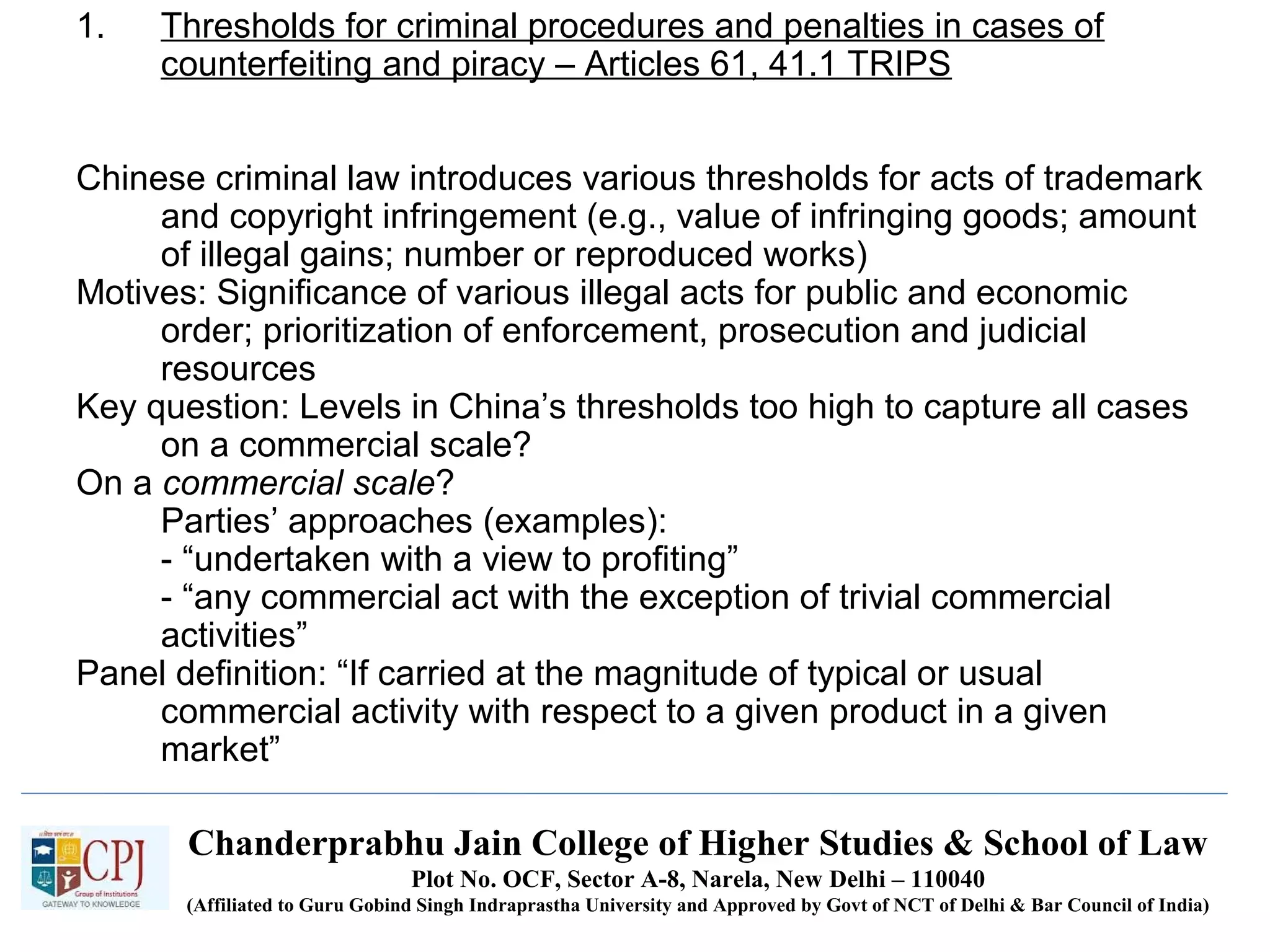
1. Thresholds for criminal procedures and penalties in cases of
counterfeiting and piracy – Articles 61, 41.1 TRIPS
Chinese criminal law introduces various thresholds for acts of trademark
and copyright infringement (e.g., value of infringing goods; amount
of illegal gains; number or reproduced works)
Motives: Significance of various illegal acts for public and economic
order; prioritization of enforcement, prosecution and judicial
resources
Key question: Levels in China’s thresholds too high to capture all cases
on a commercial scale?
On a commercial scale?
Parties’ approaches (examples):
- “undertaken with a view to profiting”
- “any commercial act with the exception of trivial commercial
activities”
Panel definition: “If carried at the magnitude of typical or usual
commercial activity with respect to a given product in a given
market”
Chanderprabhu Jain College of Higher Studies & School of Law
Plot No. OCF, Sector A-8, Narela, New Delhi – 110040
(Affiliated to Guru Gobind Singh Indraprastha University and Approved by Govt of NCT of Delhi & Bar Council of India)
1. Thresholds for criminal procedures and penalties in cases of
counterfeiting and piracy – Articles 61, 41.1 TRIPS
Thresholds are not per se inconsistent, as long as levels comply with
these benchmarks
Complainant has to prove that this is not the case – such evidence not
established by the US
Chanderprabhu Jain College of Higher Studies & School of Law
Plot No. OCF, Sector A-8, Narela, New Delhi – 110040
(Affiliated to Guru Gobind Singh Indraprastha University and Approved by Govt of NCT of Delhi & Bar Council of India)
. Disposal of goods confiscated by customs
“Compulsory scheme” of border measures under Chinese
Customs IPR Regulations :
- Donation to social welfare bodies (53%);
- Sale to right holder (0.65%);
- Auction (after eradicating the infringing features)
(0.87%);
- Where the infringing features are impossible to
eradicate, destruction (44.9%).
In line with Articles 46, 59 TRIPS?
Case DS362 – Panel Findings
Chanderprabhu Jain College of Higher Studies & School of Law
Plot No. OCF, Sector A-8, Narela, New Delhi – 110040
(Affiliated to Guru Gobind Singh Indraprastha University and Approved by Govt of NCT of Delhi & Bar Council of India)
. Disposal of goods confiscated by customs
Article 46 TRIPS: Other Remedies (Civil procedure)
« In order to create an effective deterrent to infringement, the
judicial authorities shall have the authority to order that goods that
they have found to be infringing be, without compensation of any
sort, disposed of outside the channels of commerce in such a
manner as to avoid any harm caused to the right holder, or, unless
this would be contrary to existing constitutional requirements,
destroyed. (…) In regard to counterfeit trademark goods, the simple
removal of the trademark unlawfully affixed shall not be sufficient,
other than in exceptional cases, to permit release of the goods into
the channels of commerce
Chanderprabhu Jain College of Higher Studies & School of Law
Plot No. OCF, Sector A-8, Narela, New Delhi – 110040
(Affiliated to Guru Gobind Singh Indraprastha University and Approved by Govt of NCT of Delhi & Bar Council of India)
Article 59 does not apply to goods destined for exportation (99.85%)
Remedies mentioned in Article 59 (disposal and destruction) are not
exhaustive
Article 59 does not require that disposal and destruction can be ordered
in all circumstances (conditions permissible), as long as one
remedy is available that is in accordance with Articles 59, 46 (i.e.,
disposal outside the channels of commerce in such a way as to
avoid harm to right holder)
Donation to welfare bodies – harm to right holder?
- Defective goods, quality problems (claim for compensation, harm
to reputation):
Not demonstrated that defective goods have actually been
donated; distribution through Red Cross to specific recipients (not
« normal consumers »)
- Later sales of donated goods: monitoring and control by customs
under cooperation agreement with Red Cross
Chanderprabhu Jain College of Higher Studies & School of Law
Plot No. OCF, Sector A-8, Narela, New Delhi – 110040
(Affiliated to Guru Gobind Singh Indraprastha University and Approved by Govt of NCT of Delhi & Bar Council of India)
Sale to right holder: Available only if right holder
agrees; and available alternatively to donation
Auction (after « eradicating of infringing features »):
- Not « outside channels of commerce », but
Article 59 remedies not exhaustive
- But: « simple removal of trademark » not
sufficient under Article 46 to permit release
into channels of commerce (other than in
exceptional circumstances); necessary would
be a sufficient alteration of the state of the
goods
- No exceptional cases demonstrated (sheer
low number not sufficient to establish that
criterion)
Chanderprabhu Jain College of Higher Studies & School of Law
Plot No. OCF, Sector A-8, Narela, New Delhi – 110040
(Affiliated to Guru Gobind Singh Indraprastha University and Approved by Govt of NCT of Delhi & Bar Council of India)
March 2010: China reported on legislative amendments to Chinese
Copyright Law and Customs Regulations
No compliance proceedings initiated
Case DS362 – Implementation of Panel report
Chanderprabhu Jain College of Higher Studies & School of Law
Plot No. OCF, Sector A-8, Narela, New Delhi – 110040
(Affiliated to Guru Gobind Singh Indraprastha University and Approved by Govt of NCT of Delhi & Bar Council of India)
Semester: EIGHTH Semester
Name of the Subject:
INTERNATIONAL TRADE LAW
Semester: EIGHTH Semester
Name of the Subject:
INTERNATIONAL TRADE LAW
Agricultural
Negotiations
Chanderprabhu Jain College of Higher Studies & School of Law
Plot No. OCF, Sector A-8, Narela, New Delhi – 110040
(Affiliated to Guru Gobind Singh Indraprastha University and Approved by Govt of NCT of Delhi & Bar Council of India)
A first draft of the modalities was presented to WTO Ministers last week
in Tokyo by the Chair of the Special Session (Mr S. Harbinson). They will
be proposed again at the special session of the committee on agriculture
at the end of this month. The paper is available at the WTO website:
www.wto.org
The proposals cover market access, export competition, domestic
support, S & D provisions and non-trade concerns.
Overall members are still far apart on many of the proposals.
Fundamentally, the issue is the level of ambition of further reform in
agricultural trade
These spill over into the methods to be applied in preparing draft
schedules and matters relating to the rules and disciplines of the
Agreement
Introduction
Chanderprabhu Jain College of Higher Studies & School of Law
Plot No. OCF, Sector A-8, Narela, New Delhi – 110040
(Affiliated to Guru Gobind Singh Indraprastha University and Approved by Govt of NCT of Delhi & Bar Council of India)
Mandate of negotiations
Timeline of negotiations
Major areas of negotiations
Market access (tariffs, tariff quotas, special safeguard, special
treatment)
Export competition (export subsidies, export credits)
Domestic support (amber, green, blue boxes)
Background information on rice
Outline
Chanderprabhu Jain College of Higher Studies & School of Law
Plot No. OCF, Sector A-8, Narela, New Delhi – 110040
(Affiliated to Guru Gobind Singh Indraprastha University and Approved by Govt of NCT of Delhi & Bar Council of India)
Doha Declaration 14 November 2001 on Agriculture
Building on the work undertaken already
Long term objective of fair and market orientated agriculture trading
system
Doha Work Programme:
substantial improvements in market access
Reductions of, with a view to phasing out, export subsidies
substantial reductions in trade distorting support
Special and differential treatment integral to negotiations and
outcome
Take account of non-trade concerns
Doha Mandate
Chanderprabhu Jain College of Higher Studies & School of Law
Plot No. OCF, Sector A-8, Narela, New Delhi – 110040
(Affiliated to Guru Gobind Singh Indraprastha University and Approved by Govt of NCT of Delhi & Bar Council of India)
The following reductions shall apply to final
bound tariffs over a period of 5 years:
For all tariffs greater than 90%, average reduction by
60 percent with a minimum cut of 45 percent per tariff
line
For all tariffs lower than or equal to 90% and greater
than 15%, average reduction by 50 percent with a
minimum cut of 35 percent per tariff line
For all tariffs lower than or equal to 15%, average
reduction by 40 percent with a minimum cut of 25
percent per tariff line
Proposal on Tariffs
(Applied to Developed Countries
Chanderprabhu Jain College of Higher Studies & School of Law
Plot No. OCF, Sector A-8, Narela, New Delhi – 110040
(Affiliated to Guru Gobind Singh Indraprastha University and Approved by Govt of NCT of Delhi & Bar Council of India)
Tariff preferences
To minimize the loss of tariff preferences received by
some developing countries, the tariff reduction can be
implemented in 8 (instead of 5) years
However, this shall be applicable only for products
representing a quarter of total exports of beneficiary
countries
Tariff Escalation
Where tariffs on processed products are higher than on
primary products, the tariff reduction must be higher on
the processed products
Other Aspects of Tariff Proposals
Chanderprabhu Jain College of Higher Studies & School of Law
Plot No. OCF, Sector A-8, Narela, New Delhi – 110040
(Affiliated to Guru Gobind Singh Indraprastha University and Approved by Govt of NCT of Delhi & Bar Council of India)
Strategic Products
Developing countries can exempt certain products as “strategic
products” with respect to food security, rural development and/or
livelihood security. Tariffs would be reduced by 10% over ten years
with a minimum cut of 5%
Other agricultural products (implemented over 10 years)
For all tariffs greater than 120%, average reduction by 40 percent
with a minimum cut of 30 percent per tariff line
For all tariffs lower than or equal to 120% and greater than 20%,
average reduction by 33 percent with a minimum cut of 23 percent
per tariff line
For all tariffs lower than or equal to 20%, average reduction by 27
percent with a minimum cut of 17 percent per tariff line
Proposal on Tariffs
(Applied to Developing Countries
Chanderprabhu Jain College of Higher Studies & School of Law
Plot No. OCF, Sector A-8, Narela, New Delhi – 110040
(Affiliated to Guru Gobind Singh Indraprastha University and Approved by Govt of NCT of Delhi & Bar Council of India)
Final bound tariff quotas, which are less than 10% of current domestic
consumption, shall be increased to 10% in equal installments over a 5
year period. Up to a fourth of tariff lines can be bound at 8% provided that
a corresponding number of tariff lines are bound at 12%
Current domestic consumption is the average consumption over the
1999-2001 period
In-quota duty free access shall be given for tropical products, whether in
processed or primary form
Tariff Quotas
(Applied to Developed Countries)
Chanderprabhu Jain College of Higher Studies & School of Law
Plot No. OCF, Sector A-8, Narela, New Delhi – 110040
(Affiliated to Guru Gobind Singh Indraprastha University and Approved by Govt of NCT of Delhi & Bar Council of India)
Tariff quota volumes need not be expanded for strategic products
For other agricultural products, final bound tariff quotas that are less
than 5.5% of current domestic consumption shall be increased to 6.6%
in equal installments over a 10 year period. Up to a fourth of tariff lines
can be bound at 5% provided that a corresponding number of tariff lines
are bound at 8%
Tariff Quotas
(Applied to Developing Countries
Chanderprabhu Jain College of Higher Studies & School of Law
Plot No. OCF, Sector A-8, Narela, New Delhi – 110040
(Affiliated to Guru Gobind Singh Indraprastha University and Approved by Govt of NCT of Delhi & Bar Council of India)
These are to be eliminated for developed countries after the period of
tariff reductions
Developing countries shall retain the right to use special safeguards
Special Safeguards
Chanderprabhu Jain College of Higher Studies & School of Law
Plot No. OCF, Sector A-8, Narela, New Delhi – 110040
(Affiliated to Guru Gobind Singh Indraprastha University and Approved by Govt of NCT of Delhi & Bar Council of India)
All export subsidies shall be eliminated within 10
years. This shall be conducted in two phases:
For agricultural products representing at least half of the
aggregate final bound level of budgetary outlays,
subsidies shall be eliminated within 5 years
The remaining products shall be reduced so that by the
10th year, budgetary outlays and quantities shall be
reduced to zero
Export Subsidies
(Applicable to Developed Countries
Chanderprabhu Jain College of Higher Studies & School of Law
Plot No. OCF, Sector A-8, Narela, New Delhi – 110040
(Affiliated to Guru Gobind Singh Indraprastha University and Approved by Govt of NCT of Delhi & Bar Council of India)
Over the past twenty years, rice production, yield and
trade have all gone up.
Production has gone up by 2.1 per cent annually.
Trade measured by rice imports has gone up more at 2.7 per
cent.
Area devoted to rice has only grown by 0.3 percent per annum
so that yields have gone up world-wide from 2.8 metric tons
per hectare in 1980 to about 4 metric tons per hectare in 2001.
Trends in Rice Production
and Trade
Chanderprabhu Jain College of Higher Studies & School of Law
Plot No. OCF, Sector A-8, Narela, New Delhi – 110040
(Affiliated to Guru Gobind Singh Indraprastha University and Approved by Govt of NCT of Delhi & Bar Council of India)
RICE EXPORTS AND IMPORTS
1980-2000
0
5,000,000
10,000,000
15,000,000
20,000,000
25,000,000
30,000,000
35,000,000
1980 1981 1982 1983 1984 1985 1986 1987 1988 1989 1990 1991 1992 1993 1994 1995 1996 1997 1998 1999 2000
YEAR
MetricTons
Rice Exports Rice Imports
Trends in Rice Trade
Chanderprabhu Jain College of Higher Studies & School of Law
Plot No. OCF, Sector A-8, Narela, New Delhi – 110040
(Affiliated to Guru Gobind Singh Indraprastha University and Approved by Govt of NCT of Delhi & Bar Council of India)
1980-90 1991-95 1996-2000
Production 459,839,878 532,286,870 587,121,994
Exports 12,749,893 17,318,722 23,578,937
Imports 12,498,286 17,071,436 22,854,606
Share of Exports 2.8% 3.3% 4.0%
Share of Imports 2.7% 3.2% 3.9%
Increasing Trade in the 1990s
Chanderprabhu Jain College of Higher Studies & School of Law
Plot No. OCF, Sector A-8, Narela, New Delhi – 110040
(Affiliated to Guru Gobind Singh Indraprastha University and Approved by Govt of NCT of Delhi & Bar Council of India)
SHARE OF RICE TRADE IN WORLD PRODUCTION
0.0%
1.0%
2.0%
3.0%
4.0%
5.0%
6.0%
1980 1981 1982 1983 1984 1985 1986 1987 1988 1989 1990 1991 1992 1993 1994 1995 1996 1997 1998 1999 2000
YEAR
PERCENT
Imports as Share of Production Exports as Share of Production
Share of Trade in World Production of
Rice
Chanderprabhu Jain College of Higher Studies & School of Law
Plot No. OCF, Sector A-8, Narela, New Delhi – 110040
(Affiliated to Guru Gobind Singh Indraprastha University and Approved by Govt of NCT of Delhi & Bar Council of India)
THANK YOU

INTERNATIONAL TRADE LAW

  • 1.
    Chanderprabhu Jain Collegeof Higher Studies & School of Law Plot No. OCF, Sector A-8, Narela, New Delhi – 110040 (Affiliated to Guru Gobind Singh Indraprastha University and Approved by Govt of NCT of Delhi & Bar Council of India) Semester: 8th Semester Name of the Subject: INTERNATIONAL TRADE LAW Semester: 8th Semester Name of the Subject: INTERNATIONAL TRADE LAW GATT GENERAL AGREEMENT ON TRADE AND TARIFF
  • 2.
    Chanderprabhu Jain Collegeof Higher Studies & School of Law Plot No. OCF, Sector A-8, Narela, New Delhi – 110040 (Affiliated to Guru Gobind Singh Indraprastha University and Approved by Govt of NCT of Delhi & Bar Council of India) BACKGROUND 1930 Depression in international trade. Restrictions- safe guard their interest  Oct 30 1947,23 countries at Geneva signed an agreement-GATT Post World War II, the victory nations sought to create institutions - eliminate the causes of war. To resolve/prevent war through the United Nations To eliminate the economic causes of war by establishing three international economic institutions.
  • 3.
    Chanderprabhu Jain Collegeof Higher Studies & School of Law Plot No. OCF, Sector A-8, Narela, New Delhi – 110040 (Affiliated to Guru Gobind Singh Indraprastha University and Approved by Govt of NCT of Delhi & Bar Council of India) Bretton Woods conference (1944) as starting point for a new order of then world economy with the cornerstones: International Monetary Fund (IMF) International Bank for Reconstruction and Development (IBRD) International Trade Organization (ITO)  IMF was designed to take care of short term problems in connection with international liquidity IBRD is one of 5 institutions that comprise the World Bank Group • During negotiations on the ITO in 1946, some countries saw a need for immediate tariff reductions :- US took the initiative in preparing a document on a “general agreement on tariffs and trade” Subsequent negotiations in Geneva between a group of 23 countries resulted in a set of mutual tariff reductions (GATT)
  • 4.
    Foundation of theGATT The GATT was signed by its 23 founding members on 30 October 1947 and entered into force on 1 January 1948 23 Founding member countries of the GATT: United States, Canada, Cuba, Brazil, Chile, Australia, New Zealand, China, India, Myanmar, Sri Lanka, Pakistan, Syria, Lebanon, South Africa, Zimbabwe, United Kingdom, France, Belgium, Luxembourg, Netherlands, Norway, Czechoslovakia. GATT was introduce as a stepping stone towards the establishment of the ITO and embodied many principles of the proposed ITO. The General Agreement on Tariffs and Trade (GATT), which was signed in 1947, is a multilateral agreement regulating trade among about 150 countries. According to its preamble, the purpose of the GATT is the "substantial reduction of tariffs and other trade barriers and the elimination of preferences, on a reciprocal and mutually advantageous basis.“
  • 5.
    Chanderprabhu Jain Collegeof Higher Studies & School of Law Plot No. OCF, Sector A-8, Narela, New Delhi – 110040 (Affiliated to Guru Gobind Singh Indraprastha University and Approved by Govt of NCT of Delhi & Bar Council of India) OBJECTIVE OF GATT To provide equal opportunities to all countries in terms of trade in international market  Increase effective demand for real income growth goods  Minimize tariffs and other restrictions on trade  Provide amicable solutions to dispute related to international trade  Ensure better living standard  To strengthen and clarify rules for agricultural trade
  • 6.
    Fundamental Principles ofGATT Non Discrimination  Prohibition of Quantitative Restrictions  Concept of consultation aims to avoid damage to trading interests of contracting parties.  GATT provides frame work within which the negotiations can be held for reduction of tariff another barrier to trade and structure for embodying results of such negotiations.
  • 7.
    Chanderprabhu Jain Collegeof Higher Studies & School of Law Plot No. OCF, Sector A-8, Narela, New Delhi – 110040 (Affiliated to Guru Gobind Singh Indraprastha University and Approved by Govt of NCT of Delhi & Bar Council of India) FUNCTIONS OF GATT Matters related to the tariff and related matters granted to any of the trading partner. Ensures that any tariff reduction or any other trade concession is extended to all GATT parties. National treatment:  GATT members must give imported goods treatment equal to that of domestic goods. No restrictions on charges like rates may be applied to imported goods unless equally treated. Protection through tariff:  Prohibits quantitative restrictions / Quotas.  Contracting parties are expected to provide protection by means of tariffs which are transparent and subject to negotiations in the GATT. Dispute Settlement:  Procedures from Uruguay round negotiations provides more automatic and effective resolution of disputes between member nations.
  • 8.
    Chanderprabhu Jain Collegeof Higher Studies & School of Law Plot No. OCF, Sector A-8, Narela, New Delhi – 110040 (Affiliated to Guru Gobind Singh Indraprastha University and Approved by Govt of NCT of Delhi & Bar Council of India)  Undersupply of global public goods, including those involving knowledge goods  Lack of capacity of current international trade architecture to address the problem  The WTO is the appropriate institution to host an international instrument to address the chronic undersupply of global public goods (?)  Proposals involving government commitments to increase the supply of global public goods in specific areas are important, but are not a sufficient response to the problem identified …
  • 9.
    Chanderprabhu Jain Collegeof Higher Studies & School of Law Plot No. OCF, Sector A-8, Narela, New Delhi – 110040 (Affiliated to Guru Gobind Singh Indraprastha University and Approved by Govt of NCT of Delhi & Bar Council of India) OBJECTIVE: To identify how the rules-based multilateral trading system should respond to the rapidly changing global environment and promote coherence at the international level to better address global trade challenges.
  • 10.
    Chanderprabhu Jain Collegeof Higher Studies & School of Law Plot No. OCF, Sector A-8, Narela, New Delhi – 110040 (Affiliated to Guru Gobind Singh Indraprastha University and Approved by Govt of NCT of Delhi & Bar Council of India) “The world has changed. The political, economic, and social contours of the world we live in today are very different to those that existed a decade ago. As a result there is a widening gap between existing trade rules and the new realities.” (excerpt from WTO website on the public forum)
  • 11.
    Chanderprabhu Jain Collegeof Higher Studies & School of Law Plot No. OCF, Sector A-8, Narela, New Delhi – 110040 (Affiliated to Guru Gobind Singh Indraprastha University and Approved by Govt of NCT of Delhi & Bar Council of India)  Does WTO have the mandate to deliver ? A look at various WTO legal instruments has some answers  Such a mandate could be “found”( as distinguished from “gap-filling” or cobbling together something that does not exist currently)
  • 12.
    Chanderprabhu Jain Collegeof Higher Studies & School of Law Plot No. OCF, Sector A-8, Narela, New Delhi – 110040 (Affiliated to Guru Gobind Singh Indraprastha University and Approved by Govt of NCT of Delhi & Bar Council of India)  Recognizing that their relations in the field of trade ….. should be conducted with a view to raising standards of living, ensuring full employment….. (similar to Marrakesh Agreement)  Being desirous of contributing to these objectives by entering into reciprocal and mutually advantageous arrangements directed to the substantial reduction of tariffs and other barriers to trade and to the elimination of discriminatory treatment in international commerce….
  • 13.
    Chanderprabhu Jain Collegeof Higher Studies & School of Law Plot No. OCF, Sector A-8, Narela, New Delhi – 110040 (Affiliated to Guru Gobind Singh Indraprastha University and Approved by Govt of NCT of Delhi & Bar Council of India)  Recognizing the growing importance of trade in services for the growth and development of the world economy;  Wishing to establish a multilateral framework of principles and rules for trade in services with a view to ……… and the development of developing countries;  Recognizing the right of Members to regulate, and to introduce new regulations, ….. given asymmetries existing with respect to the degree of development of services regulations in different countries, the particular need of developing countries to exercise this right;
  • 14.
    Chanderprabhu Jain Collegeof Higher Studies & School of Law Plot No. OCF, Sector A-8, Narela, New Delhi – 110040 (Affiliated to Guru Gobind Singh Indraprastha University and Approved by Govt of NCT of Delhi & Bar Council of India) The protection and enforcement of intellectual property rights should contribute to the promotion of technological innovation and to the transfer and dissemination of technology, to the mutual advantage of producers and users of technological knowledge and in a manner conducive to social and economic welfare, and to a balance of rights and obligations
  • 15.
    Chanderprabhu Jain Collegeof Higher Studies & School of Law Plot No. OCF, Sector A-8, Narela, New Delhi – 110040 (Affiliated to Guru Gobind Singh Indraprastha University and Approved by Govt of NCT of Delhi & Bar Council of India) THANK YOU
  • 16.
    Chanderprabhu Jain Collegeof Higher Studies & School of Law Plot No. OCF, Sector A-8, Narela, New Delhi – 110040 (Affiliated to Guru Gobind Singh Indraprastha University and Approved by Govt of NCT of Delhi & Bar Council of India) Semester: Eighth Semester Name of the Subject: ITL Semester: Eighth Semester Name of the Subject: ITL Trade and the Future of the World
  • 17.
    Chanderprabhu Jain Collegeof Higher Studies & School of Law Plot No. OCF, Sector A-8, Narela, New Delhi – 110040 (Affiliated to Guru Gobind Singh Indraprastha University and Approved by Govt of NCT of Delhi & Bar Council of India)
  • 18.
    Chanderprabhu Jain Collegeof Higher Studies & School of Law Plot No. OCF, Sector A-8, Narela, New Delhi – 110040 (Affiliated to Guru Gobind Singh Indraprastha University and Approved by Govt of NCT of Delhi & Bar Council of India) Perceptions and Realities Doha Development Agenda stalling with minor results in December 2015 (Nairobi) Forum Shifting to PTA in particular TTIP, TTP, RCEP Multipolar World WTO and multilateralism increasingly perceived irrelevant
  • 19.
    Chanderprabhu Jain Collegeof Higher Studies & School of Law Plot No. OCF, Sector A-8, Narela, New Delhi – 110040 (Affiliated to Guru Gobind Singh Indraprastha University and Approved by Govt of NCT of Delhi & Bar Council of India) Shared values and principles Core legal concepts of tariffs, QRs, non-discrimination (national treatment) and exceptions Structure of agreements follow WTO law WTO-plus and sometimes WTO-minus Introduction of new areas (e.g. labour, environment, competition, investment, TK protection)
  • 20.
    Chanderprabhu Jain Collegeof Higher Studies & School of Law Plot No. OCF, Sector A-8, Narela, New Delhi – 110040 (Affiliated to Guru Gobind Singh Indraprastha University and Approved by Govt of NCT of Delhi & Bar Council of India) Multilateralism and Preferentialism mutually supportive over time: 1883 and 1886 IPR Conventions (Paris and Berne) based upon set of bilateral agreements GATT 1947 based upon US Reciprocal Trade Agreements Preferential Trade in Services based upon 1995 GATS Agreement TTIP /TTP/RCEP: Future Multilateralization in WTO to be expected (2020-2030
  • 21.
    Chanderprabhu Jain Collegeof Higher Studies & School of Law Plot No. OCF, Sector A-8, Narela, New Delhi – 110040 (Affiliated to Guru Gobind Singh Indraprastha University and Approved by Govt of NCT of Delhi & Bar Council of India) The experience of Roman Law and the Glossatores The formation of the Common Law The process of modern codification in Civil Law Modern federalism The evolution of EU Law All depending on strong central legal institutions, scholarship and civil society support
  • 22.
    Chanderprabhu Jain Collegeof Higher Studies & School of Law Plot No. OCF, Sector A-8, Narela, New Delhi – 110040 (Affiliated to Guru Gobind Singh Indraprastha University and Approved by Govt of NCT of Delhi & Bar Council of India) The evolution of the common law of international trade calls for stronger institutions beyond dispute settlement: Proactive role of the WTO Secretariat in monitoring existing agreements TPRM Dispute Settlement: A voice for the Secretariat and enhanced transparency Guardian of the system: right to lodge consultations and complaints against failing members
  • 23.
    Chanderprabhu Jain Collegeof Higher Studies & School of Law Plot No. OCF, Sector A-8, Narela, New Delhi – 110040 (Affiliated to Guru Gobind Singh Indraprastha University and Approved by Govt of NCT of Delhi & Bar Council of India) WTO member need to focus on USPs of multilateralism and related Organisations: Multilateral Know-how and expertise of the WTO Trade Community in Geneva and NGOs Areas with MFN and strong spill-over effects: Conditions of competition (subsidies, IPRs, competition policy) Technical regulations, food standards, domestic regulation of services
  • 24.
    Chanderprabhu Jain Collegeof Higher Studies & School of Law Plot No. OCF, Sector A-8, Narela, New Delhi – 110040 (Affiliated to Guru Gobind Singh Indraprastha University and Approved by Govt of NCT of Delhi & Bar Council of India) With market access (tariffs, QRs) and services dealt with mainly preferentially, the rationale for trade rounds no longer exist Instead: Sectorial negotiations and on-going quasi legislative processes (building upon past experience: Financial Services, Telecom, GPA, Access to Essential Drugs) Integrated approach covering goods, services, investment, competition, government procurement (e.g. climate change mitigation and adaption
  • 25.
    Chanderprabhu Jain Collegeof Higher Studies & School of Law Plot No. OCF, Sector A-8, Narela, New Delhi – 110040 (Affiliated to Guru Gobind Singh Indraprastha University and Approved by Govt of NCT of Delhi & Bar Council of India) Energy: Agreement on Electricity Agreement on Fossil Fuels Agreement on Extracted Minerals Agreement on Specific Services, e.g: Civil Aviation (Airlines) Maritime Transports Disciplines on Economic Migration beyond GATS Need to develop close working relationship with specialised international organizations Potential Sectors
  • 26.
    Chanderprabhu Jain Collegeof Higher Studies & School of Law Plot No. OCF, Sector A-8, Narela, New Delhi – 110040 (Affiliated to Guru Gobind Singh Indraprastha University and Approved by Govt of NCT of Delhi & Bar Council of India) Trade Remedies for goods and services (unfair competition approach) for dumping and subsidization Trade and Investment Trade and Competition Policy (Anti-trust) Institutional issues: role of secretariat, extending jurisdiction to RTAs, cooperation with other IOs Horizontal Issues
  • 27.
    Chanderprabhu Jain Collegeof Higher Studies & School of Law Plot No. OCF, Sector A-8, Narela, New Delhi – 110040 (Affiliated to Guru Gobind Singh Indraprastha University and Approved by Govt of NCT of Delhi & Bar Council of India) The shift to PTAs is partly caused by rigidity within WTO talks Return to WTO talks requires more flexible attitudes Diplomacy should adopt consensus-minus as established under DSU and/or weighted voting Formally blocking consensus should be subject to vital interests, reasoned statements and need to confirmation upon cooling-off Modifying Consensus Diplomacy
  • 28.
    Chanderprabhu Jain Collegeof Higher Studies & School of Law Plot No. OCF, Sector A-8, Narela, New Delhi – 110040 (Affiliated to Guru Gobind Singh Indraprastha University and Approved by Govt of NCT of Delhi & Bar Council of India) International trade law is a very complex and an ever expanding area. There are basically four levels of international trade relationships: unilateral measures (national law), bilateral relationships (Canada-United States Free Trade Agreement), plurilateral agreements, and multilateral arrangements (GATT/WTO). The focus of this guide is on international trade generally and on some of the major bilateral or multilateral international trade agreements: FTA, NAFTA, and GATT/WTO. Many of the sources listed throughout this guide will contain information about other trade agreements and arrangements.
  • 29.
    Chanderprabhu Jain Collegeof Higher Studies & School of Law Plot No. OCF, Sector A-8, Narela, New Delhi – 110040 (Affiliated to Guru Gobind Singh Indraprastha University and Approved by Govt of NCT of Delhi & Bar Council of India) Integrated approach to trade regulation: towards a common law and the role of academic research and teaching Need to strengthen central institutions, in particular WTO monitoring and dispute settlement: extending jurisdiction to RTAs Sectorial negotiations Qualified consensus Conclusions
  • 30.
    Chanderprabhu Jain Collegeof Higher Studies & School of Law Plot No. OCF, Sector A-8, Narela, New Delhi – 110040 (Affiliated to Guru Gobind Singh Indraprastha University and Approved by Govt of NCT of Delhi & Bar Council of India) Semester: EIGHTH Semester Name of the Subject: INTERNATIONAL TRADE LAW Semester: EIGHTH Semester Name of the Subject: INTERNATIONAL TRADE LAW WTO Dispute Settlement
  • 31.
    Chanderprabhu Jain Collegeof Higher Studies & School of Law Plot No. OCF, Sector A-8, Narela, New Delhi – 110040 (Affiliated to Guru Gobind Singh Indraprastha University and Approved by Govt of NCT of Delhi & Bar Council of India) The WTO Dispute Settlement mechanism Previous case law in IP enforcement matters Case DS362 (2009): - Parties - Measures at issue - Panel findings Overview
  • 32.
    Chanderprabhu Jain Collegeof Higher Studies & School of Law Plot No. OCF, Sector A-8, Narela, New Delhi – 110040 (Affiliated to Guru Gobind Singh Indraprastha University and Approved by Govt of NCT of Delhi & Bar Council of India) Introduced into the multilateral trading system in the Uruguay Round (1994) Formal framework for settling disputes between WTO Member States Guidance on TRIPS interpretation Priority: amicable settlement through consultations Stages of procedure: - 60 days: Consultations, mediation - 45 days: Panel set up and 3 (possibly 5) panelists appointed by Dispute Settlement Body (DSB), following consultations with parties - 6 months: Final panel report to parties - 3 weeks: Final panel report to WTO members - 60 days: DSB adopts report (if no appeal) Total: 1 year (without appeal) - 60-90 days: Appeals report - 30 days: Dispute Settlement Body adopts appeals report Total = 1y 3m (with appeal)
  • 33.
    Chanderprabhu Jain Collegeof Higher Studies & School of Law Plot No. OCF, Sector A-8, Narela, New Delhi – 110040 (Affiliated to Guru Gobind Singh Indraprastha University and Approved by Govt of NCT of Delhi & Bar Council of India) Few cases addressing Part III of the TRIPS Agreement Cases subject to amicable settlement: - US v Denmark (WT/DS/83) – Availability of provisional measures - US v Sweden (WT/DS/86) – Availability of provisional measures - US v EC/Greece (WT/DS/124, 125) – Availability of civil and criminal measures against unauthorized broadcasting - US v Argentina (WT/DS/196) – Availability of provisional measures against patent infringements Panel reports (marginal role of enforcement) - EC v US (WT/DS/176) - Access to civil judicial procedures (Art. 42) - US/Australia v EC (WT/DS/174, 290) - Protection and (generally) enforcement relating to national treatment (GI)
  • 34.
    Chanderprabhu Jain Collegeof Higher Studies & School of Law Plot No. OCF, Sector A-8, Narela, New Delhi – 110040 (Affiliated to Guru Gobind Singh Indraprastha University and Approved by Govt of NCT of Delhi & Bar Council of India) Complainant: US Respondent: China Third Parties: Argentina, Australia, Brazil, Canada, EU, India, Japan, Korea, Mexico, Chinese Taipei, Thailand and Turkey Case DS362 - Parties
  • 35.
    Chanderprabhu Jain Collegeof Higher Studies & School of Law Plot No. OCF, Sector A-8, Narela, New Delhi – 110040 (Affiliated to Guru Gobind Singh Indraprastha University and Approved by Govt of NCT of Delhi & Bar Council of India) Chinese legislation and implementing measures in three areas: Thresholds for criminal procedures and penalties in cases of willful trademark counterfeiting and copyright piracy – Articles 61, 41.1 TRIPS Disposal of goods confiscated by customs – Articles 46, 59 TRIPS Denial of copyright protection and enforcement to works that have not been authorized in China – Articles 9.1, 41 TRIPS, Article 5 Berne Convention Case DS362 – Measures at issue
  • 36.
    Chanderprabhu Jain Collegeof Higher Studies & School of Law Plot No. OCF, Sector A-8, Narela, New Delhi – 110040 (Affiliated to Guru Gobind Singh Indraprastha University and Approved by Govt of NCT of Delhi & Bar Council of India) 1. Thresholds for criminal procedures and penalties in cases of counterfeiting and piracy – Articles 61, 41.1 TRIPS Article 61 TRIPS: « Members shall provide for criminal procedures and penalties to be applied at least in cases of willful trademark counterfeiting or copyright piracy on a commercial scale. (…) Members may provide for criminal procedures and penalties to be applied in other cases of infringement of intellectual property rights, in particular where they are committed willfully and on a commercial scale. » Case DS362 – Panel Findings
  • 37.
    Chanderprabhu Jain Collegeof Higher Studies & School of Law Plot No. OCF, Sector A-8, Narela, New Delhi – 110040 (Affiliated to Guru Gobind Singh Indraprastha University and Approved by Govt of NCT of Delhi & Bar Council of India) 1. Thresholds for criminal procedures and penalties in cases of counterfeiting and piracy – Articles 61, 41.1 TRIPS Chinese criminal law introduces various thresholds for acts of trademark and copyright infringement (e.g., value of infringing goods; amount of illegal gains; number or reproduced works) Motives: Significance of various illegal acts for public and economic order; prioritization of enforcement, prosecution and judicial resources Key question: Levels in China’s thresholds too high to capture all cases on a commercial scale? On a commercial scale? Parties’ approaches (examples): - “undertaken with a view to profiting” - “any commercial act with the exception of trivial commercial activities” Panel definition: “If carried at the magnitude of typical or usual commercial activity with respect to a given product in a given market”
  • 38.
    Chanderprabhu Jain Collegeof Higher Studies & School of Law Plot No. OCF, Sector A-8, Narela, New Delhi – 110040 (Affiliated to Guru Gobind Singh Indraprastha University and Approved by Govt of NCT of Delhi & Bar Council of India) 1. Thresholds for criminal procedures and penalties in cases of counterfeiting and piracy – Articles 61, 41.1 TRIPS Thresholds are not per se inconsistent, as long as levels comply with these benchmarks Complainant has to prove that this is not the case – such evidence not established by the US
  • 39.
    Chanderprabhu Jain Collegeof Higher Studies & School of Law Plot No. OCF, Sector A-8, Narela, New Delhi – 110040 (Affiliated to Guru Gobind Singh Indraprastha University and Approved by Govt of NCT of Delhi & Bar Council of India) . Disposal of goods confiscated by customs “Compulsory scheme” of border measures under Chinese Customs IPR Regulations : - Donation to social welfare bodies (53%); - Sale to right holder (0.65%); - Auction (after eradicating the infringing features) (0.87%); - Where the infringing features are impossible to eradicate, destruction (44.9%). In line with Articles 46, 59 TRIPS? Case DS362 – Panel Findings
  • 40.
    Chanderprabhu Jain Collegeof Higher Studies & School of Law Plot No. OCF, Sector A-8, Narela, New Delhi – 110040 (Affiliated to Guru Gobind Singh Indraprastha University and Approved by Govt of NCT of Delhi & Bar Council of India) . Disposal of goods confiscated by customs Article 46 TRIPS: Other Remedies (Civil procedure) « In order to create an effective deterrent to infringement, the judicial authorities shall have the authority to order that goods that they have found to be infringing be, without compensation of any sort, disposed of outside the channels of commerce in such a manner as to avoid any harm caused to the right holder, or, unless this would be contrary to existing constitutional requirements, destroyed. (…) In regard to counterfeit trademark goods, the simple removal of the trademark unlawfully affixed shall not be sufficient, other than in exceptional cases, to permit release of the goods into the channels of commerce
  • 41.
    Chanderprabhu Jain Collegeof Higher Studies & School of Law Plot No. OCF, Sector A-8, Narela, New Delhi – 110040 (Affiliated to Guru Gobind Singh Indraprastha University and Approved by Govt of NCT of Delhi & Bar Council of India) Article 59 does not apply to goods destined for exportation (99.85%) Remedies mentioned in Article 59 (disposal and destruction) are not exhaustive Article 59 does not require that disposal and destruction can be ordered in all circumstances (conditions permissible), as long as one remedy is available that is in accordance with Articles 59, 46 (i.e., disposal outside the channels of commerce in such a way as to avoid harm to right holder) Donation to welfare bodies – harm to right holder? - Defective goods, quality problems (claim for compensation, harm to reputation): Not demonstrated that defective goods have actually been donated; distribution through Red Cross to specific recipients (not « normal consumers ») - Later sales of donated goods: monitoring and control by customs under cooperation agreement with Red Cross
  • 42.
    Chanderprabhu Jain Collegeof Higher Studies & School of Law Plot No. OCF, Sector A-8, Narela, New Delhi – 110040 (Affiliated to Guru Gobind Singh Indraprastha University and Approved by Govt of NCT of Delhi & Bar Council of India) Sale to right holder: Available only if right holder agrees; and available alternatively to donation Auction (after « eradicating of infringing features »): - Not « outside channels of commerce », but Article 59 remedies not exhaustive - But: « simple removal of trademark » not sufficient under Article 46 to permit release into channels of commerce (other than in exceptional circumstances); necessary would be a sufficient alteration of the state of the goods - No exceptional cases demonstrated (sheer low number not sufficient to establish that criterion)
  • 43.
    Chanderprabhu Jain Collegeof Higher Studies & School of Law Plot No. OCF, Sector A-8, Narela, New Delhi – 110040 (Affiliated to Guru Gobind Singh Indraprastha University and Approved by Govt of NCT of Delhi & Bar Council of India) March 2010: China reported on legislative amendments to Chinese Copyright Law and Customs Regulations No compliance proceedings initiated Case DS362 – Implementation of Panel report
  • 44.
    Chanderprabhu Jain Collegeof Higher Studies & School of Law Plot No. OCF, Sector A-8, Narela, New Delhi – 110040 (Affiliated to Guru Gobind Singh Indraprastha University and Approved by Govt of NCT of Delhi & Bar Council of India) Semester: EIGHTH Semester Name of the Subject: INTERNATIONAL TRADE LAW Semester: EIGHTH Semester Name of the Subject: INTERNATIONAL TRADE LAW Agricultural Negotiations
  • 45.
    Chanderprabhu Jain Collegeof Higher Studies & School of Law Plot No. OCF, Sector A-8, Narela, New Delhi – 110040 (Affiliated to Guru Gobind Singh Indraprastha University and Approved by Govt of NCT of Delhi & Bar Council of India) A first draft of the modalities was presented to WTO Ministers last week in Tokyo by the Chair of the Special Session (Mr S. Harbinson). They will be proposed again at the special session of the committee on agriculture at the end of this month. The paper is available at the WTO website: www.wto.org The proposals cover market access, export competition, domestic support, S & D provisions and non-trade concerns. Overall members are still far apart on many of the proposals. Fundamentally, the issue is the level of ambition of further reform in agricultural trade These spill over into the methods to be applied in preparing draft schedules and matters relating to the rules and disciplines of the Agreement Introduction
  • 46.
    Chanderprabhu Jain Collegeof Higher Studies & School of Law Plot No. OCF, Sector A-8, Narela, New Delhi – 110040 (Affiliated to Guru Gobind Singh Indraprastha University and Approved by Govt of NCT of Delhi & Bar Council of India) Mandate of negotiations Timeline of negotiations Major areas of negotiations Market access (tariffs, tariff quotas, special safeguard, special treatment) Export competition (export subsidies, export credits) Domestic support (amber, green, blue boxes) Background information on rice Outline
  • 47.
    Chanderprabhu Jain Collegeof Higher Studies & School of Law Plot No. OCF, Sector A-8, Narela, New Delhi – 110040 (Affiliated to Guru Gobind Singh Indraprastha University and Approved by Govt of NCT of Delhi & Bar Council of India) Doha Declaration 14 November 2001 on Agriculture Building on the work undertaken already Long term objective of fair and market orientated agriculture trading system Doha Work Programme: substantial improvements in market access Reductions of, with a view to phasing out, export subsidies substantial reductions in trade distorting support Special and differential treatment integral to negotiations and outcome Take account of non-trade concerns Doha Mandate
  • 48.
    Chanderprabhu Jain Collegeof Higher Studies & School of Law Plot No. OCF, Sector A-8, Narela, New Delhi – 110040 (Affiliated to Guru Gobind Singh Indraprastha University and Approved by Govt of NCT of Delhi & Bar Council of India) The following reductions shall apply to final bound tariffs over a period of 5 years: For all tariffs greater than 90%, average reduction by 60 percent with a minimum cut of 45 percent per tariff line For all tariffs lower than or equal to 90% and greater than 15%, average reduction by 50 percent with a minimum cut of 35 percent per tariff line For all tariffs lower than or equal to 15%, average reduction by 40 percent with a minimum cut of 25 percent per tariff line Proposal on Tariffs (Applied to Developed Countries
  • 49.
    Chanderprabhu Jain Collegeof Higher Studies & School of Law Plot No. OCF, Sector A-8, Narela, New Delhi – 110040 (Affiliated to Guru Gobind Singh Indraprastha University and Approved by Govt of NCT of Delhi & Bar Council of India) Tariff preferences To minimize the loss of tariff preferences received by some developing countries, the tariff reduction can be implemented in 8 (instead of 5) years However, this shall be applicable only for products representing a quarter of total exports of beneficiary countries Tariff Escalation Where tariffs on processed products are higher than on primary products, the tariff reduction must be higher on the processed products Other Aspects of Tariff Proposals
  • 50.
    Chanderprabhu Jain Collegeof Higher Studies & School of Law Plot No. OCF, Sector A-8, Narela, New Delhi – 110040 (Affiliated to Guru Gobind Singh Indraprastha University and Approved by Govt of NCT of Delhi & Bar Council of India) Strategic Products Developing countries can exempt certain products as “strategic products” with respect to food security, rural development and/or livelihood security. Tariffs would be reduced by 10% over ten years with a minimum cut of 5% Other agricultural products (implemented over 10 years) For all tariffs greater than 120%, average reduction by 40 percent with a minimum cut of 30 percent per tariff line For all tariffs lower than or equal to 120% and greater than 20%, average reduction by 33 percent with a minimum cut of 23 percent per tariff line For all tariffs lower than or equal to 20%, average reduction by 27 percent with a minimum cut of 17 percent per tariff line Proposal on Tariffs (Applied to Developing Countries
  • 51.
    Chanderprabhu Jain Collegeof Higher Studies & School of Law Plot No. OCF, Sector A-8, Narela, New Delhi – 110040 (Affiliated to Guru Gobind Singh Indraprastha University and Approved by Govt of NCT of Delhi & Bar Council of India) Final bound tariff quotas, which are less than 10% of current domestic consumption, shall be increased to 10% in equal installments over a 5 year period. Up to a fourth of tariff lines can be bound at 8% provided that a corresponding number of tariff lines are bound at 12% Current domestic consumption is the average consumption over the 1999-2001 period In-quota duty free access shall be given for tropical products, whether in processed or primary form Tariff Quotas (Applied to Developed Countries)
  • 52.
    Chanderprabhu Jain Collegeof Higher Studies & School of Law Plot No. OCF, Sector A-8, Narela, New Delhi – 110040 (Affiliated to Guru Gobind Singh Indraprastha University and Approved by Govt of NCT of Delhi & Bar Council of India) Tariff quota volumes need not be expanded for strategic products For other agricultural products, final bound tariff quotas that are less than 5.5% of current domestic consumption shall be increased to 6.6% in equal installments over a 10 year period. Up to a fourth of tariff lines can be bound at 5% provided that a corresponding number of tariff lines are bound at 8% Tariff Quotas (Applied to Developing Countries
  • 53.
    Chanderprabhu Jain Collegeof Higher Studies & School of Law Plot No. OCF, Sector A-8, Narela, New Delhi – 110040 (Affiliated to Guru Gobind Singh Indraprastha University and Approved by Govt of NCT of Delhi & Bar Council of India) These are to be eliminated for developed countries after the period of tariff reductions Developing countries shall retain the right to use special safeguards Special Safeguards
  • 54.
    Chanderprabhu Jain Collegeof Higher Studies & School of Law Plot No. OCF, Sector A-8, Narela, New Delhi – 110040 (Affiliated to Guru Gobind Singh Indraprastha University and Approved by Govt of NCT of Delhi & Bar Council of India) All export subsidies shall be eliminated within 10 years. This shall be conducted in two phases: For agricultural products representing at least half of the aggregate final bound level of budgetary outlays, subsidies shall be eliminated within 5 years The remaining products shall be reduced so that by the 10th year, budgetary outlays and quantities shall be reduced to zero Export Subsidies (Applicable to Developed Countries
  • 55.
    Chanderprabhu Jain Collegeof Higher Studies & School of Law Plot No. OCF, Sector A-8, Narela, New Delhi – 110040 (Affiliated to Guru Gobind Singh Indraprastha University and Approved by Govt of NCT of Delhi & Bar Council of India) Over the past twenty years, rice production, yield and trade have all gone up. Production has gone up by 2.1 per cent annually. Trade measured by rice imports has gone up more at 2.7 per cent. Area devoted to rice has only grown by 0.3 percent per annum so that yields have gone up world-wide from 2.8 metric tons per hectare in 1980 to about 4 metric tons per hectare in 2001. Trends in Rice Production and Trade
  • 56.
    Chanderprabhu Jain Collegeof Higher Studies & School of Law Plot No. OCF, Sector A-8, Narela, New Delhi – 110040 (Affiliated to Guru Gobind Singh Indraprastha University and Approved by Govt of NCT of Delhi & Bar Council of India) RICE EXPORTS AND IMPORTS 1980-2000 0 5,000,000 10,000,000 15,000,000 20,000,000 25,000,000 30,000,000 35,000,000 1980 1981 1982 1983 1984 1985 1986 1987 1988 1989 1990 1991 1992 1993 1994 1995 1996 1997 1998 1999 2000 YEAR MetricTons Rice Exports Rice Imports Trends in Rice Trade
  • 57.
    Chanderprabhu Jain Collegeof Higher Studies & School of Law Plot No. OCF, Sector A-8, Narela, New Delhi – 110040 (Affiliated to Guru Gobind Singh Indraprastha University and Approved by Govt of NCT of Delhi & Bar Council of India) 1980-90 1991-95 1996-2000 Production 459,839,878 532,286,870 587,121,994 Exports 12,749,893 17,318,722 23,578,937 Imports 12,498,286 17,071,436 22,854,606 Share of Exports 2.8% 3.3% 4.0% Share of Imports 2.7% 3.2% 3.9% Increasing Trade in the 1990s
  • 58.
    Chanderprabhu Jain Collegeof Higher Studies & School of Law Plot No. OCF, Sector A-8, Narela, New Delhi – 110040 (Affiliated to Guru Gobind Singh Indraprastha University and Approved by Govt of NCT of Delhi & Bar Council of India) SHARE OF RICE TRADE IN WORLD PRODUCTION 0.0% 1.0% 2.0% 3.0% 4.0% 5.0% 6.0% 1980 1981 1982 1983 1984 1985 1986 1987 1988 1989 1990 1991 1992 1993 1994 1995 1996 1997 1998 1999 2000 YEAR PERCENT Imports as Share of Production Exports as Share of Production Share of Trade in World Production of Rice
  • 59.
    Chanderprabhu Jain Collegeof Higher Studies & School of Law Plot No. OCF, Sector A-8, Narela, New Delhi – 110040 (Affiliated to Guru Gobind Singh Indraprastha University and Approved by Govt of NCT of Delhi & Bar Council of India) THANK YOU