Subnetting
Computer Networks
To understand the concept of subnets we first need to understand what are IP Address, IP
Address classes and Network masks.
Therefore we are going to cover following topics in this presentation along with Subnets-
1. IP Address
2. IP Address Classes
3. Network masks
4. Subnetting
5. Advantages/Disadvantages of Subnetting
6. Application
Introduction
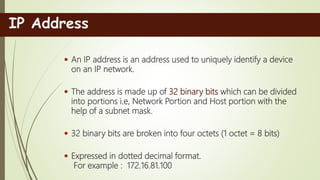
 An IP address is an address used to uniquely identify a device
on an IP network.
 The address is made up of 32 binary bits which can be divided
into portions i.e, Network Portion and Host portion with the
help of a subnet mask.
 32 binary bits are broken into four octets (1 octet = 8 bits)
 Expressed in dotted decimal format.
For example : 172.16.81.100
IP Address
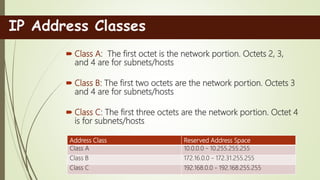
 Class A: The first octet is the network portion. Octets 2, 3,
and 4 are for subnets/hosts
 Class B: The first two octets are the network portion. Octets 3
and 4 are for subnets/hosts
 Class C: The first three octets are the network portion. Octet 4
is for subnets/hosts
IP Address Classes
Address Class Reserved Address Space
Class A 10.0.0.0 - 10.255.255.255
Class B 172.16.0.0 - 172.31.255.255
Class C 192.168.0.0 - 192.168.255.255
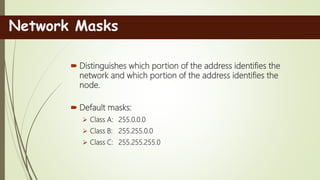
 Distinguishes which portion of the address identifies the
network and which portion of the address identifies the
node.
 Default masks:
 Class A: 255.0.0.0
 Class B: 255.255.0.0
 Class C: 255.255.255.0
Network Masks
Subnetwork, or subnet, is a logically visible, distinctly
addressed part of a single Internet Protocol network.
Subnetting is the division of a computer network into
groups of computers that have a common,
IP address routing prefix.
Subnetting
 Allows a single shared network address to split it up into many smaller
networks.
 Without subnets, organizations would require many network addresses
o Limited number of Network addresses available
 Alleviates traffic
o Smaller routing tables
o Alleviates excessive packet collision and congestion
 Easier to manage and solve problems
 Better Security
o Separating departments with highly sensitive material
o Accounting and Administration
Advantages
 Doesn’t allocate IP address proportionately per subnet.
 Limited by the number of IP address.
 Need to buy hardware such as routers
Disadvantages
Anywhere a large group of computers are located.
Applications
Thank You

Subnetting

  • 1.
  • 2.
    To understand theconcept of subnets we first need to understand what are IP Address, IP Address classes and Network masks. Therefore we are going to cover following topics in this presentation along with Subnets- 1. IP Address 2. IP Address Classes 3. Network masks 4. Subnetting 5. Advantages/Disadvantages of Subnetting 6. Application Introduction
  • 3.
     An IPaddress is an address used to uniquely identify a device on an IP network.  The address is made up of 32 binary bits which can be divided into portions i.e, Network Portion and Host portion with the help of a subnet mask.  32 binary bits are broken into four octets (1 octet = 8 bits)  Expressed in dotted decimal format. For example : 172.16.81.100 IP Address
  • 4.
     Class A:The first octet is the network portion. Octets 2, 3, and 4 are for subnets/hosts  Class B: The first two octets are the network portion. Octets 3 and 4 are for subnets/hosts  Class C: The first three octets are the network portion. Octet 4 is for subnets/hosts IP Address Classes Address Class Reserved Address Space Class A 10.0.0.0 - 10.255.255.255 Class B 172.16.0.0 - 172.31.255.255 Class C 192.168.0.0 - 192.168.255.255
  • 5.
     Distinguishes whichportion of the address identifies the network and which portion of the address identifies the node.  Default masks:  Class A: 255.0.0.0  Class B: 255.255.0.0  Class C: 255.255.255.0 Network Masks
  • 6.
    Subnetwork, or subnet,is a logically visible, distinctly addressed part of a single Internet Protocol network. Subnetting is the division of a computer network into groups of computers that have a common, IP address routing prefix. Subnetting
  • 7.
     Allows asingle shared network address to split it up into many smaller networks.  Without subnets, organizations would require many network addresses o Limited number of Network addresses available  Alleviates traffic o Smaller routing tables o Alleviates excessive packet collision and congestion  Easier to manage and solve problems  Better Security o Separating departments with highly sensitive material o Accounting and Administration Advantages
  • 8.
     Doesn’t allocateIP address proportionately per subnet.  Limited by the number of IP address.  Need to buy hardware such as routers Disadvantages
  • 9.
    Anywhere a largegroup of computers are located. Applications
  • 10.