Presented By
K.Lavanya
M.Tech
 A submarine, undersea, or underwater
earthquake
 It is an earthquake that occurs underwater at the 
bottom of a body of water, especially an ocean. 
They are the leading cause of tsunamis. 
 The magnitude can be measured scientifically by 
the use of either the Richter scale or the 
Mercalli scale.
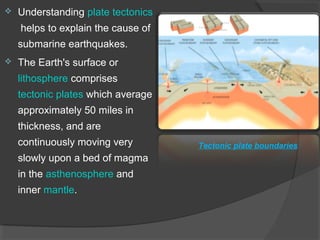
 Understanding plate tectonics
 helps to explain the cause of 
submarine earthquakes. 
 The Earth's surface or 
lithosphere comprises  
tectonic plates which average 
approximately 50 miles in 
thickness, and are 
continuously moving very 
slowly upon a bed of magma 
in the asthenosphere and 
inner mantle. 
Tectonic plate boundaries
The plates converge upon 
one another, and one 
subducts below the other, or, 
where there is only shear 
stress, move horizontally 
past each other (see
transform plate boundary
 below). 
Little movements called 
fault creep are minor and not 
measurable. The plates meet 
with each other, and if rough 
spots cause the movement 
to stop at the edges, the 
motion of the plates 
Convergent plate boundary
trench formation and dynamics
 When  the  rough  spots  can  no  longer  hold, 
the  sudden  release  of  the  built-up  motion 
releases,  and  the  sudden  movement  under 
the  sea  floor  causes  a  submarine 
earthquake. 
 This  area  of  slippage  both  horizontally  and 
vertically is called the epicenter, and has the 
highest magnitude, and causes the greatest 
damage
 As with a continental earthquake the severity of the
damage is not often caused by the earthquake at the rift
zone, but rather by events which are triggered by the
earthquake.
 Where a continental earthquake will cause damage
and loss of life on land from fires, damaged structures,
and flying objects; a submarine earthquake alters the
sea bed floor, resulting in a series of waves, and
depending on the length and magnitude of the
earthquake, huge tidal waves and tsunamis, which bear
down on coastal cities causing property damages and
loss of life.
 Submarine earthquakes can also damage
submarine communications cables, leading
to widespread disruption of the Internet and
international telephone network in those
areas. This is particularly common in Asia,
where many submarine links cross
submarine earthquake zones such as the
Pacific Ring of Fire.
 Tsunamis are a series of catastrophic ocean
waves that are formed after submarine
earthquakes, volcanic eruptions, landslides,
or asteroids striking the earth.
 Asteroids may not be a normal occurrence;
however, earthquakes, volcanic eruptions,
and landslides under the ocean happen
more frequently than you realize.
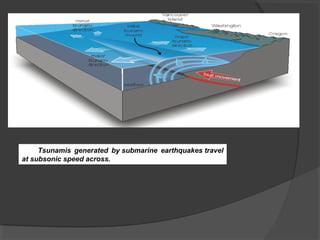
produced by a submarine earthquake, volcanic eruption,
sediment slide
Seafloor movements in
submarine earthquake
Tsunamis generated by submarine earthquakes travel
at subsonic speed across.
 Once the earthquake occurs and the
ocean floor is disturbed, waves travel
outward in all directions from the focus of
the earthquake.
 Imagine throwing a rock into a lake on a
summer day. When the rock breaks the
surface of the water, ripples appear and
radiate outward from the point where the
rock entered the water.
 The waves then travel through the open sea.
In the open ocean, these waves may reach a
speed up to 500 miles per hour (720
kilometers per hour).
 Their wavelengths may also be up to several
hundred miles. One surprising fact is that
their heights at this point may only reach less
than three feet (one meter). Even a ship at
sea would not notice this tsunami wave.
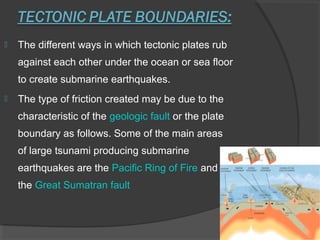
 The different ways in which tectonic plates rub
against each other under the ocean or sea floor
to create submarine earthquakes.
 The type of friction created may be due to the
characteristic of the geologic fault or the plate
boundary as follows. Some of the main areas
of large tsunami producing submarine
earthquakes are the Pacific Ring of Fire and
the Great Sumatran fault
 The older, and denser plate moves below the lighter plate. The
further down it moves, the hotter it becomes, until finally melting
altogether at the asthenosphere and inner mantle and the crust
is actually destroyed.
 The location where the two oceanic plates actually meet become
deeper and deeper creating trenches with each successive
action. There is an interplay of various densities of lithosphere
rock, asthenosphere magma, cooling ocean water and plate
movement for example the Pacific Ring of Fire.
 Therefore the site of the sub oceanic trench will be a site of
submarine earthquakes; for example the Mariana Trench.
 A transform-fault boundary, or simply a
transform boundary is where two plates will
slide past each other, and the irregular
pattern of their edges may catch on each
other.
 The lithosphere is neither added to from the
asthenosphere nor is it destroyed as in
convergent plate action.
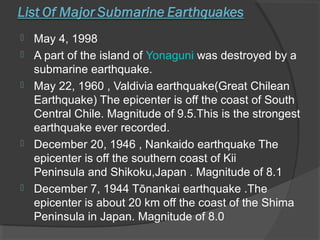
 May 4, 1998
 A part of the island of Yonaguni was destroyed by a
submarine earthquake.
 May 22, 1960 , Valdivia earthquake(Great Chilean
Earthquake) The epicenter is off the coast of South
Central Chile. Magnitude of 9.5.This is the strongest
earthquake ever recorded.
 December 20, 1946 , Nankaido earthquake The
epicenter is off the southern coast of Kii
Peninsula and Shikoku,Japan . Magnitude of 8.1
 December 7, 1944 Tōnankai earthquake .The
epicenter is about 20 km off the coast of the Shima
Peninsula in Japan. Magnitude of 8.0
 www.wikipedia.org
 www.infoplease.com
 edhelper.com
Submarine earthquake

Submarine earthquake