Subcutaneus Nodules on the
abdomen.
What is your diagnosis?
F. Peral Rubio, M.D.
Department of Dermatology
Hospital Universitario Virgen Macarena,
Seville, Spain.
www.dermatoblog.com
Subcutaneus Nodules on the abdomen
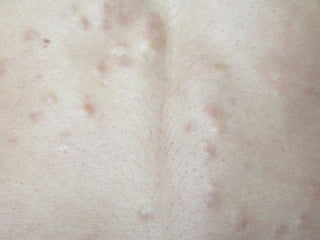
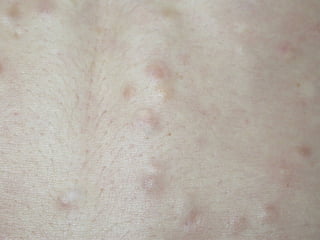
A 30-year-old woman presents with
multiple asymptomatic subcutaneous
nodules, round-to-oval, well-defined,
smooth-surfaced, yellow to skin-colored.
5-10 mm diameter firm papules scattered
on the abdomen.
The lesions have been present for about
10 years.
Subcutaneus Nodules on the abdomen
Biopsy specimens shows well-
encapsulated dermal cysts with infolded
walls lined by stratified squamous
epithelium without a granular layer.
Sebaceous gland lobules are found within
the cyst wall.
Subcutaneus Nodules on the
abdomen.
What is your diagnosis?
F. Peral Rubio, M.D.
Department of Dermatology
Hospital Universitario Virgen Macarena, Seville,
Spain.
www.dermatoblog.com
 hospital with asymptomatic subcutaneous nodules
 on her forearms. She first noticed the subcutaneous
 nodules 10 years previously, and they had gradually
 increased in both size and number. They were not associated
 with any pain or tenderness. Her family history
 and past clinical history were unremarkable. Physical
 examination revealed multiple, mobile, well-defined,
 elastic-hard, 5–10 mm subcutaneous nodules on the
 flexor surface of the forearms; 8 on the right and 3 on
 the left (Fig. 1). There were no other lesions except for
 the forearms and no nail changes. Clinically, the lesions
 were initially thought to be multiple lipomas and an
 excisional biopsy was performed to confirm the suspected
 diagnosis. Upon biopsy, a well-circumscribed
 ovoid cyst was isolated in the superficial subcutaneous
 fat layer. The cyst contained yellow creamy material.
 Biopsy specimen showed a well-encapsulated subcutaneous
 cyst with infolded walls lined by squamous
 epithelium without a granular layer. Sebaceous gland
 lobules are found within the cyst wall (Fig. 2). From
 these findings, the diagnosis of SM was finally made.
Fig. 2. Histopathological features. Well-
encapsulated subcutaneous cysts with
infolded walls lined by stratified squamous
epithelium without a granular
layer (haematoxylin-eosin (H&E) stain;
original magnification, ×10). Inset
shows sebaceous gland lobules within the
cyst wall. (H&E stain; original
 DISCUSSION
 This case of SM is unique due to (i) its acral distribution
 and (ii) presentation as subcutaneous nodules. SM
 can appear anywhere on the body but is more common
 in areas where the pilosebaceous apparatus is well
 developed, such as the trunk, neck, axilla, inguinal
 region, scalp and the proximal extremities. Acral SM,
 which involves the extremities more prominent than
 the trunk, is rare and has been described in only 2 reports
 (1, 2). Chu (1) reported a 25-year-old man with
 a 20-year history of asymptomatic nodules on the arms
 and chest, which showed findings consistent with SM
 upon histopathological analysis. The patient had no
 family history and no nail changes like in pachonychia
 congenita (PC). Rollins et al. (2) reported a 32-yearold
 Filipino woman with an 8-year history of multiple
 cystic nodules on the distal upper and lower extremities.
 The patient’s family history was insignificant, and she
 had no changes in the nails. With regard to the depth
 of the lesion, steatocystoma is thought to result from a
 hamartomatous malformation of the pilosebaceous duct
 junction and is usually located in the mid-dermis (3).
 In our case, the lesions were palpated as subcutaneous
 nodules mimicking multiple lipomas, which is not a
 well-described presentation in textbook SM references.
 Dermatologists should be aware of that SM may present
 as acral subcutaneous nodules.
 Covello et al. (4) reported that keratin 17 mutations
 commonly underlie both PC type-2 and SM, however,
 they could not find a correlation between genotype and
 phenotype. Furthermore, they could not detect any keratin
 17 mutations in sporadic cases of SM (4). These
 observations suggest a multifactorial basis, including
 both genetic and environmental factors, for this disease.
 The reason why our case exhibited an acral distribution
 and presentation as subcutaneous nodules is not understood,
 but a combination of genetic factors including
 keratin 17 abnormalities, other keratin defects and/or
 environmental factors, may be involved in the unique
 clinical appearance.
 REFERENCES
 1. Chu DH. Steatocystoma multiplex. Dermatol Online J 2003;
 9: 18.
 2. Rollins T, Levin RM, Heymann WR. Acral steatocystoma
 multiplex. J Am Acad Dermatol 2000; 43: 396–399.
 3. Sabater-Marco V, Perez-Ferriols A. Steatocystoma multiplex
 with smooth muscle. A hamartoma of the pilosebaceous
 apparatus. Am J Dermatopathol 1996; 18: 548–550.
 4. Covello SP, Smith FJ, Sillevis Smitt JH, Paller AS, Munro
 CS, Jonkman MF, et al. Keratin 17 mutations cause either
 steatocystoma multiplex or pachyonychia congenita type 2.
 Br J Dermatol 1998; 139: 475–480.
 Acta
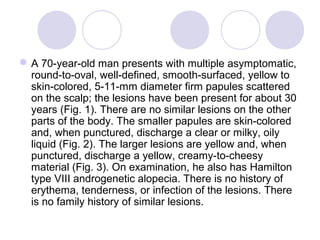
A 70-year-old man presents with multiple asymptomatic,
round-to-oval, well-defined, smooth-surfaced, yellow to
skin-colored, 5-11-mm diameter firm papules scattered
on the scalp; the lesions have been present for about 30
years (Fig. 1). There are no similar lesions on the other
parts of the body. The smaller papules are skin-colored
and, when punctured, discharge a clear or milky, oily
liquid (Fig. 2). The larger lesions are yellow and, when
punctured, discharge a yellow, creamy-to-cheesy
material (Fig. 3). On examination, he also has Hamilton
type VIII androgenetic alopecia. There is no history of
erythema, tenderness, or infection of the lesions. There
is no family history of similar lesions.
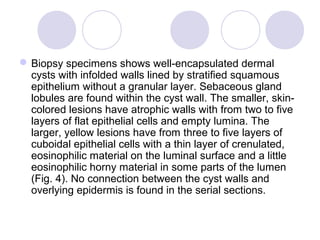
Biopsy specimens shows well-encapsulated dermal
cysts with infolded walls lined by stratified squamous
epithelium without a granular layer. Sebaceous gland
lobules are found within the cyst wall. The smaller, skin-
colored lesions have atrophic walls with from two to five
layers of flat epithelial cells and empty lumina. The
larger, yellow lesions have from three to five layers of
cuboidal epithelial cells with a thin layer of crenulated,
eosinophilic material on the luminal surface and a little
eosinophilic horny material in some parts of the lumen
(Fig. 4). No connection between the cyst walls and
overlying epidermis is found in the serial sections.
 In contrast with the typical steatocystoma multiplex patients, lesions are
limited to the scalp in our case. There have been only a few cases with such
a limited distribution [4 6, 9, 10] Table 1 presents a review of the English-
language literature of the published cases of localized forms of
steatocystoma multiplex. In the reported cases of localized steatocystoma
multiplex, the lesions are confined to the head and neck or genitalia. The
terms facial papular variant of steatocystoma multiplex and
sebocystomatosis have been used to describe some of these localized
forms as distinctive variants of the disease [3, 11, 12]. However,
involvement of these areas is not infrequent in typical cases of
steatocystoma multiplex [1]. There are reports of the cases with
steatocystoma multiplex involving predominantly the face or head and neck
with scattered lesions on the trunk [13]. The pathological and clinical
features of the localized forms are not different from typical cases.
Therefore, we believe that the localized forms of steatocystoma multiplex
are not distinctive variants of the disease. Steatocystoma multiplex should
be considered as a spectrum with different variations in anatomical
distribution.
 A 21-year-old male presented with a 1-year history of multiple dark bumps
on his chest and abdomen since his deployment to Kuwait. These lesions
were itchy and became worse in hot climates but did not worsen in cooler
temperatures. An allergic reaction to his dog tag necklace was deemed less
likely because the affected area persisted and grew larger after removal of
the presumed antigen. Treatment with over-the-counter acne medications
did not help.
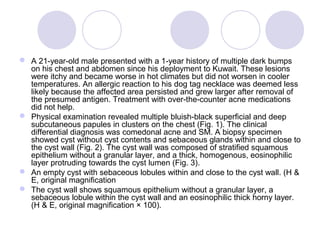
 Physical examination revealed multiple bluish-black superficial and deep
subcutaneous papules in clusters on the chest (Fig. 1). The clinical
differential diagnosis was comedonal acne and SM. A biopsy specimen
showed cyst without cyst contents and sebaceous glands within and close to
the cyst wall (Fig. 2). The cyst wall was composed of stratified squamous
epithelium without a granular layer, and a thick, homogenous, eosinophilic
layer protruding towards the cyst lumen (Fig. 3).
 An empty cyst with sebaceous lobules within and close to the cyst wall. (H &
E, original magnification
 The cyst wall shows squamous epithelium without a granular layer, a
sebaceous lobule within the cyst wall and an eosinophilic thick horny layer.
(H & E, original magnification × 100).

Subcutaneous nodules on the abdomen

  • 1.
    Subcutaneus Nodules onthe abdomen. What is your diagnosis? F. Peral Rubio, M.D. Department of Dermatology Hospital Universitario Virgen Macarena, Seville, Spain. www.dermatoblog.com
  • 2.
    Subcutaneus Nodules onthe abdomen A 30-year-old woman presents with multiple asymptomatic subcutaneous nodules, round-to-oval, well-defined, smooth-surfaced, yellow to skin-colored. 5-10 mm diameter firm papules scattered on the abdomen. The lesions have been present for about 10 years.
  • 5.
    Subcutaneus Nodules onthe abdomen Biopsy specimens shows well- encapsulated dermal cysts with infolded walls lined by stratified squamous epithelium without a granular layer. Sebaceous gland lobules are found within the cyst wall.
  • 6.
    Subcutaneus Nodules onthe abdomen. What is your diagnosis? F. Peral Rubio, M.D. Department of Dermatology Hospital Universitario Virgen Macarena, Seville, Spain. www.dermatoblog.com
  • 7.
     hospital withasymptomatic subcutaneous nodules  on her forearms. She first noticed the subcutaneous  nodules 10 years previously, and they had gradually  increased in both size and number. They were not associated  with any pain or tenderness. Her family history  and past clinical history were unremarkable. Physical  examination revealed multiple, mobile, well-defined,  elastic-hard, 5–10 mm subcutaneous nodules on the  flexor surface of the forearms; 8 on the right and 3 on  the left (Fig. 1). There were no other lesions except for  the forearms and no nail changes. Clinically, the lesions  were initially thought to be multiple lipomas and an  excisional biopsy was performed to confirm the suspected  diagnosis. Upon biopsy, a well-circumscribed  ovoid cyst was isolated in the superficial subcutaneous  fat layer. The cyst contained yellow creamy material.  Biopsy specimen showed a well-encapsulated subcutaneous  cyst with infolded walls lined by squamous  epithelium without a granular layer. Sebaceous gland  lobules are found within the cyst wall (Fig. 2). From  these findings, the diagnosis of SM was finally made.
  • 8.
    Fig. 2. Histopathologicalfeatures. Well- encapsulated subcutaneous cysts with infolded walls lined by stratified squamous epithelium without a granular layer (haematoxylin-eosin (H&E) stain; original magnification, ×10). Inset shows sebaceous gland lobules within the cyst wall. (H&E stain; original
  • 9.
     DISCUSSION  Thiscase of SM is unique due to (i) its acral distribution  and (ii) presentation as subcutaneous nodules. SM  can appear anywhere on the body but is more common  in areas where the pilosebaceous apparatus is well  developed, such as the trunk, neck, axilla, inguinal  region, scalp and the proximal extremities. Acral SM,  which involves the extremities more prominent than  the trunk, is rare and has been described in only 2 reports  (1, 2). Chu (1) reported a 25-year-old man with  a 20-year history of asymptomatic nodules on the arms  and chest, which showed findings consistent with SM  upon histopathological analysis. The patient had no  family history and no nail changes like in pachonychia  congenita (PC). Rollins et al. (2) reported a 32-yearold  Filipino woman with an 8-year history of multiple  cystic nodules on the distal upper and lower extremities.  The patient’s family history was insignificant, and she  had no changes in the nails. With regard to the depth  of the lesion, steatocystoma is thought to result from a  hamartomatous malformation of the pilosebaceous duct  junction and is usually located in the mid-dermis (3).  In our case, the lesions were palpated as subcutaneous  nodules mimicking multiple lipomas, which is not a  well-described presentation in textbook SM references.  Dermatologists should be aware of that SM may present  as acral subcutaneous nodules.  Covello et al. (4) reported that keratin 17 mutations  commonly underlie both PC type-2 and SM, however,
  • 10.
     they couldnot find a correlation between genotype and  phenotype. Furthermore, they could not detect any keratin  17 mutations in sporadic cases of SM (4). These  observations suggest a multifactorial basis, including  both genetic and environmental factors, for this disease.  The reason why our case exhibited an acral distribution  and presentation as subcutaneous nodules is not understood,  but a combination of genetic factors including  keratin 17 abnormalities, other keratin defects and/or  environmental factors, may be involved in the unique  clinical appearance.  REFERENCES  1. Chu DH. Steatocystoma multiplex. Dermatol Online J 2003;  9: 18.  2. Rollins T, Levin RM, Heymann WR. Acral steatocystoma  multiplex. J Am Acad Dermatol 2000; 43: 396–399.  3. Sabater-Marco V, Perez-Ferriols A. Steatocystoma multiplex  with smooth muscle. A hamartoma of the pilosebaceous  apparatus. Am J Dermatopathol 1996; 18: 548–550.  4. Covello SP, Smith FJ, Sillevis Smitt JH, Paller AS, Munro  CS, Jonkman MF, et al. Keratin 17 mutations cause either  steatocystoma multiplex or pachyonychia congenita type 2.  Br J Dermatol 1998; 139: 475–480.  Acta
  • 11.
    A 70-year-old manpresents with multiple asymptomatic, round-to-oval, well-defined, smooth-surfaced, yellow to skin-colored, 5-11-mm diameter firm papules scattered on the scalp; the lesions have been present for about 30 years (Fig. 1). There are no similar lesions on the other parts of the body. The smaller papules are skin-colored and, when punctured, discharge a clear or milky, oily liquid (Fig. 2). The larger lesions are yellow and, when punctured, discharge a yellow, creamy-to-cheesy material (Fig. 3). On examination, he also has Hamilton type VIII androgenetic alopecia. There is no history of erythema, tenderness, or infection of the lesions. There is no family history of similar lesions.
  • 12.
    Biopsy specimens showswell-encapsulated dermal cysts with infolded walls lined by stratified squamous epithelium without a granular layer. Sebaceous gland lobules are found within the cyst wall. The smaller, skin- colored lesions have atrophic walls with from two to five layers of flat epithelial cells and empty lumina. The larger, yellow lesions have from three to five layers of cuboidal epithelial cells with a thin layer of crenulated, eosinophilic material on the luminal surface and a little eosinophilic horny material in some parts of the lumen (Fig. 4). No connection between the cyst walls and overlying epidermis is found in the serial sections.
  • 13.
     In contrastwith the typical steatocystoma multiplex patients, lesions are limited to the scalp in our case. There have been only a few cases with such a limited distribution [4 6, 9, 10] Table 1 presents a review of the English- language literature of the published cases of localized forms of steatocystoma multiplex. In the reported cases of localized steatocystoma multiplex, the lesions are confined to the head and neck or genitalia. The terms facial papular variant of steatocystoma multiplex and sebocystomatosis have been used to describe some of these localized forms as distinctive variants of the disease [3, 11, 12]. However, involvement of these areas is not infrequent in typical cases of steatocystoma multiplex [1]. There are reports of the cases with steatocystoma multiplex involving predominantly the face or head and neck with scattered lesions on the trunk [13]. The pathological and clinical features of the localized forms are not different from typical cases. Therefore, we believe that the localized forms of steatocystoma multiplex are not distinctive variants of the disease. Steatocystoma multiplex should be considered as a spectrum with different variations in anatomical distribution.
  • 14.
     A 21-year-oldmale presented with a 1-year history of multiple dark bumps on his chest and abdomen since his deployment to Kuwait. These lesions were itchy and became worse in hot climates but did not worsen in cooler temperatures. An allergic reaction to his dog tag necklace was deemed less likely because the affected area persisted and grew larger after removal of the presumed antigen. Treatment with over-the-counter acne medications did not help.  Physical examination revealed multiple bluish-black superficial and deep subcutaneous papules in clusters on the chest (Fig. 1). The clinical differential diagnosis was comedonal acne and SM. A biopsy specimen showed cyst without cyst contents and sebaceous glands within and close to the cyst wall (Fig. 2). The cyst wall was composed of stratified squamous epithelium without a granular layer, and a thick, homogenous, eosinophilic layer protruding towards the cyst lumen (Fig. 3).  An empty cyst with sebaceous lobules within and close to the cyst wall. (H & E, original magnification  The cyst wall shows squamous epithelium without a granular layer, a sebaceous lobule within the cyst wall and an eosinophilic thick horny layer. (H & E, original magnification × 100).