For Adriana Rabino
Understanding your particular learning style
and how to best meet the needs of that
learning style is essential to performing
better in the classroom.
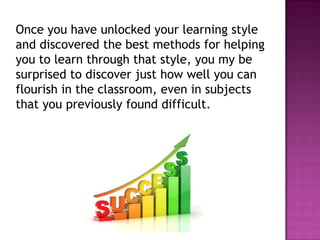
Once you have unlocked your learning style
and discovered the best methods for helping
you to learn through that style, you my be
surprised to discover just how well you can
flourish in the classroom, even in subjects
that you previously found difficult.
But, What are Learning Styles?


Basically, your learning style is
the method that best allows
you to gather and use
knowledge in a specific
manner.
Visual Learners
Individuals who fall into this category
typically learn through what they are
able to see with their own eyes. Visual
learners are those students who jockey
for the
positions at the front of the class, must
have front row theater seats and love
to be right up front for sporting events
in order to obtain the best view.
Visual Learners
Visual learners have a tendency to
describe everything that they see in
terms of
appearances. These learners love visual
aids such as photos, diagrams, maps
and graphs. Visual learners frequently
are good writers and will commonly
perform quite well on written
assignments.
Auditory Learners
Auditory learners are very good
listeners. They tend to absorb
information in a more efficient manner
through
sounds, music, discussions, teachings, e
tc. These individuals will be more likely
to record lectures so that they can
replay them at a later time for study
purposes.
Auditory Learners
Appreciate books on tape and may find
that reading aloud will help them to
retain information.
Rather than written reports, auditory
learners tend to do better on oral
presentations and reports.
Kinesthetic Learners
Kinesthetic learners are tactile
learning. This means that they learn
best through moving, doing, acting out
and touching. Projects that are hands-
on in nature are best for kinesthetic
learners.
Kinesthetic Learners
Kinesthetic learners tend to become
frustrated when they must sit for long
periods of time. They enjoy conducting
experiments, exploring and performing
tasks.
Percentage of Styles
Visual Learning Tips

· Ask for written directions
· Utilize diagrams and flow charts for note taking
· Color code notes
· Visualize spelling of words or facts that must be memorized
· Write down key points
· Copy what is on the board
· Sit near the front of the classroom
· Watch videos
· Use highlighters to mark important points in notes
· Use graph paper in order to make diagrams and charts for key points
· Utilize illustrations to remember important material
· Utilize visual metaphors to associate relevant content
· Write down explanations for points that are difficult

Preferred test styles for visual learners are essays, maps and diagramming.
Worst test type for visual learners-listen and respond style.
Auditory Learning Tips
· Utilize audiotapes for learning
· Read information aloud when studying
· Ask questions
· Watch videos
· Use word association techniques to remember facts
· Participate in class discussions
· Record directions and notes
· Listen to taped notes
· Avoid auditory distractions
· Participate in a study group or study with a study partner
· Make up songs or rhymes to go along with the pertinent material
· Use rhymes to recall dates, names, facts, etc.
· Write of steps in sentence form and then read them out loud

Best test style for auditory learner-oral exam, writing responses to lectures
Worst test style for auditory learner-reading comprehension
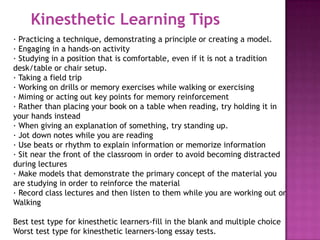
Kinesthetic Learning Tips
· Practicing a technique, demonstrating a principle or creating a model.
· Engaging in a hands-on activity
· Studying in a position that is comfortable, even if it is not a tradition
desk/table or chair setup.
· Taking a field trip
· Working on drills or memory exercises while walking or exercising
· Miming or acting out key points for memory reinforcement
· Rather than placing your book on a table when reading, try holding it in
your hands instead
· When giving an explanation of something, try standing up.
· Jot down notes while you are reading
· Use beats or rhythm to explain information or memorize information
· Sit near the front of the classroom in order to avoid becoming distracted
during lectures
· Make models that demonstrate the primary concept of the material you
are studying in order to reinforce the material
· Record class lectures and then listen to them while you are working out or
Walking

Best test type for kinesthetic learners-fill in the blank and multiple choice
Worst test type for kinesthetic learners-long essay tests.
Conclusion
Informing yourself about the different styles of learning and
the most effective memory techniques can help you to become
more in tune with the most efficient and effective methods for
you to personally learn. Through this insight you can learn
which study techniques work best for you and which methods
are least

Styles learning

  • 1.
  • 3.
    Understanding your particularlearning style and how to best meet the needs of that learning style is essential to performing better in the classroom.
  • 4.
    Once you haveunlocked your learning style and discovered the best methods for helping you to learn through that style, you my be surprised to discover just how well you can flourish in the classroom, even in subjects that you previously found difficult.
  • 5.
    But, What areLearning Styles? Basically, your learning style is the method that best allows you to gather and use knowledge in a specific manner.
  • 6.
    Visual Learners Individuals whofall into this category typically learn through what they are able to see with their own eyes. Visual learners are those students who jockey for the positions at the front of the class, must have front row theater seats and love to be right up front for sporting events in order to obtain the best view.
  • 7.
    Visual Learners Visual learnershave a tendency to describe everything that they see in terms of appearances. These learners love visual aids such as photos, diagrams, maps and graphs. Visual learners frequently are good writers and will commonly perform quite well on written assignments.
  • 8.
    Auditory Learners Auditory learnersare very good listeners. They tend to absorb information in a more efficient manner through sounds, music, discussions, teachings, e tc. These individuals will be more likely to record lectures so that they can replay them at a later time for study purposes.
  • 9.
    Auditory Learners Appreciate bookson tape and may find that reading aloud will help them to retain information. Rather than written reports, auditory learners tend to do better on oral presentations and reports.
  • 10.
    Kinesthetic Learners Kinesthetic learnersare tactile learning. This means that they learn best through moving, doing, acting out and touching. Projects that are hands- on in nature are best for kinesthetic learners.
  • 11.
    Kinesthetic Learners Kinesthetic learnerstend to become frustrated when they must sit for long periods of time. They enjoy conducting experiments, exploring and performing tasks.
  • 12.
  • 13.
    Visual Learning Tips ·Ask for written directions · Utilize diagrams and flow charts for note taking · Color code notes · Visualize spelling of words or facts that must be memorized · Write down key points · Copy what is on the board · Sit near the front of the classroom · Watch videos · Use highlighters to mark important points in notes · Use graph paper in order to make diagrams and charts for key points · Utilize illustrations to remember important material · Utilize visual metaphors to associate relevant content · Write down explanations for points that are difficult Preferred test styles for visual learners are essays, maps and diagramming. Worst test type for visual learners-listen and respond style.
  • 14.
    Auditory Learning Tips ·Utilize audiotapes for learning · Read information aloud when studying · Ask questions · Watch videos · Use word association techniques to remember facts · Participate in class discussions · Record directions and notes · Listen to taped notes · Avoid auditory distractions · Participate in a study group or study with a study partner · Make up songs or rhymes to go along with the pertinent material · Use rhymes to recall dates, names, facts, etc. · Write of steps in sentence form and then read them out loud Best test style for auditory learner-oral exam, writing responses to lectures Worst test style for auditory learner-reading comprehension
  • 15.
    Kinesthetic Learning Tips ·Practicing a technique, demonstrating a principle or creating a model. · Engaging in a hands-on activity · Studying in a position that is comfortable, even if it is not a tradition desk/table or chair setup. · Taking a field trip · Working on drills or memory exercises while walking or exercising · Miming or acting out key points for memory reinforcement · Rather than placing your book on a table when reading, try holding it in your hands instead · When giving an explanation of something, try standing up. · Jot down notes while you are reading · Use beats or rhythm to explain information or memorize information · Sit near the front of the classroom in order to avoid becoming distracted during lectures · Make models that demonstrate the primary concept of the material you are studying in order to reinforce the material · Record class lectures and then listen to them while you are working out or Walking Best test type for kinesthetic learners-fill in the blank and multiple choice Worst test type for kinesthetic learners-long essay tests.
  • 16.
    Conclusion Informing yourself aboutthe different styles of learning and the most effective memory techniques can help you to become more in tune with the most efficient and effective methods for you to personally learn. Through this insight you can learn which study techniques work best for you and which methods are least