
Prepared by:
Marvin Mina
- Determine the learning styles of the
students
- Know the learning methods /
strategies fitted the learning styles of
the students.
• Your learning style is the way you
prefer to learn. It doesn't have
anything to do with how intelligent
you are or what skills you have
learned. It has to do with how
your brain works most efficiently
to learn new information.
There is an activity and workshop
that can help you to identify your own
learning style and show you how to
develop learning strategies that work
for you so you can create a
customized approach to achieving
academic success.
WHAT ARE THE TYPES OF LEARNING
STYLES?
• Visual learners- learn through seeing
• Auditory Learners-learns through listening
• Kinesthetic Learners- Learn through moving,
doing, and touching
• Multi –sensory Learners
As a visual learner, the students may:
Need to see the teacher’s body language and facial
expressions to fully understand the content of the lesson
Prefer sitting at the front of the classroom to avoid
visual distractions
Prefer using pictures and images to gain understanding
of new ideas and information
Recognize words by sight , use list to organize their
thoughts and recall information be remembering how it
was laid out on a page
Auditory Learners-learns through listening As an
auditory learner the student may:
Prefer using sound and music to acquire information
Learn best through verbal lectures, discussions,
talking through and listening to what others have to
say
Interpret underlying meanings of speech through
listening to tone of voice, pitch, speed, and other
nuances
Like the teacher to provide verbal instructions.
Written information has little meaning until it is heard.
Often use rhythm and sound as memory aids
As a kinesthetic learner, the student may:
Prefer using their body , hands, and sense of
touch to learn new information
Learn best through hands-on approach,
actively exploring the physical world around
them and utilizing activities such as projects
and demonstrations
Find writing, drawing and movement are
often useful memory aids
Multi –sensory Learners As a multi-
sensory learner, the student may:
Be more comfortable using a variety of
modes to acquire new information
Identifying
how you learn best!
Check the box that best
represents how you like to
learn. Remember to give
only one answer .
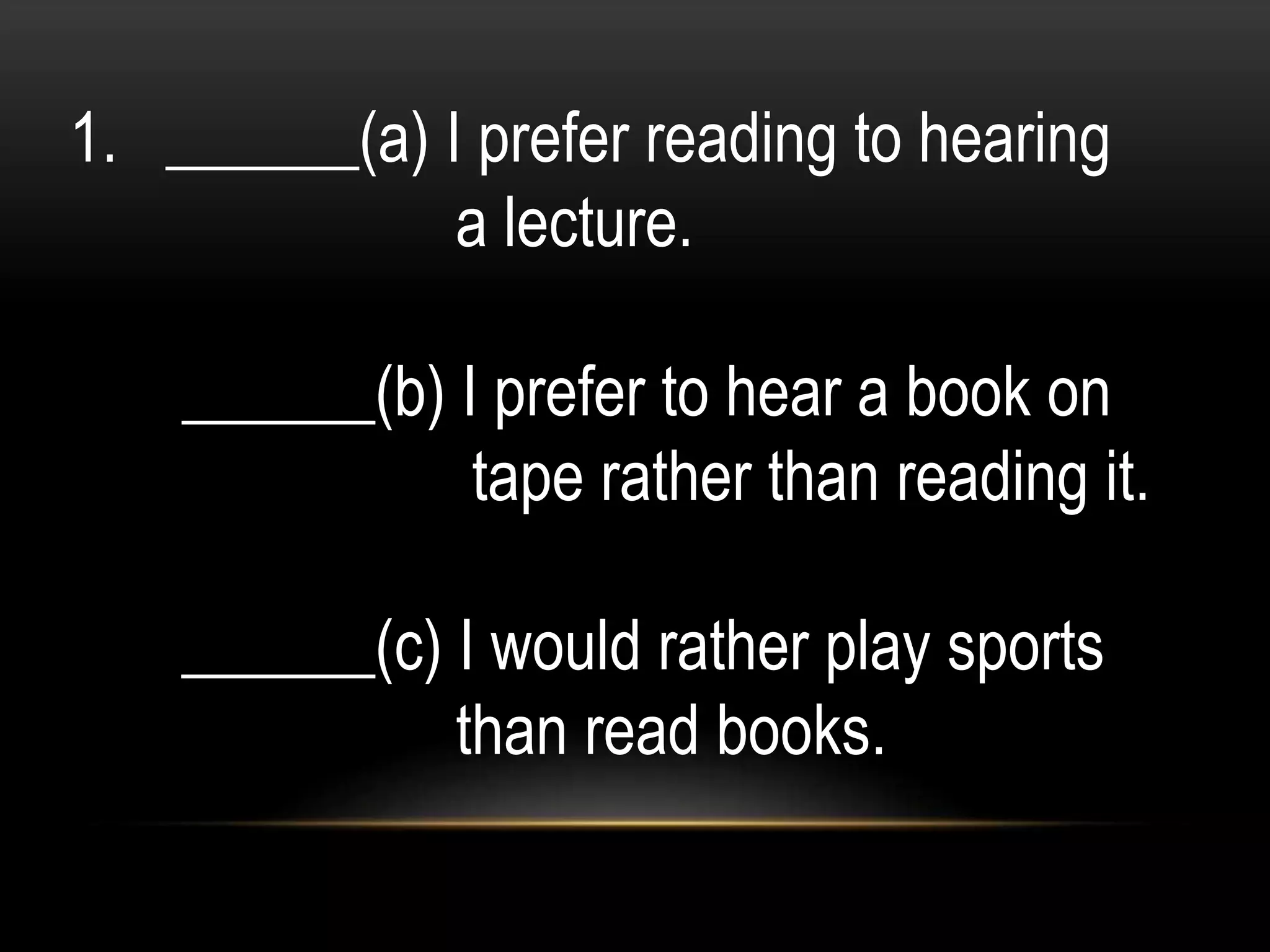
1. ______(a) I prefer reading to hearing
a lecture.
______(b) I prefer to hear a book on
tape rather than reading it.
______(c) I would rather play sports
than read books.
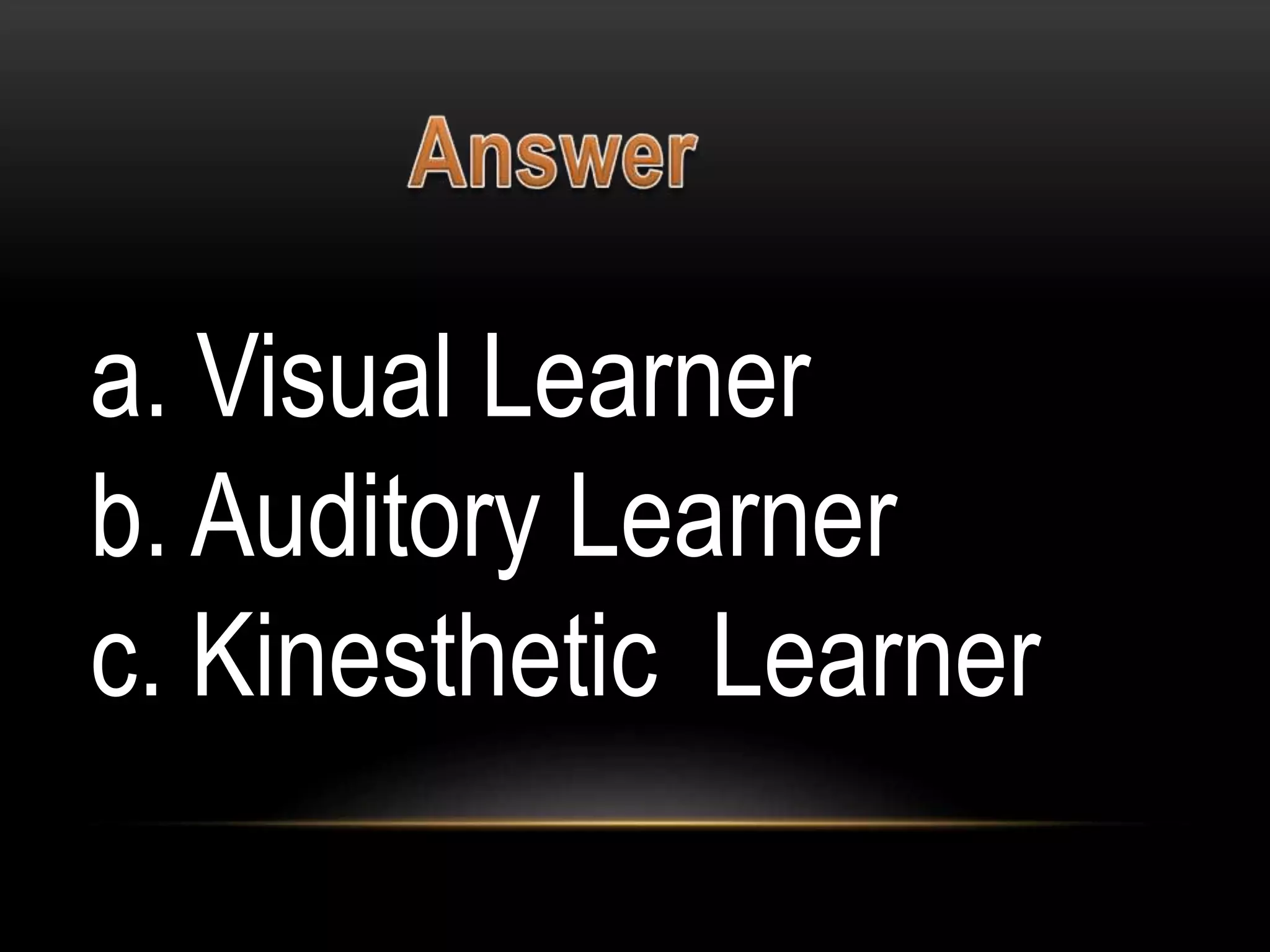
a. Visual Learner
b. Auditory Learner
c. Kinesthetic Learner
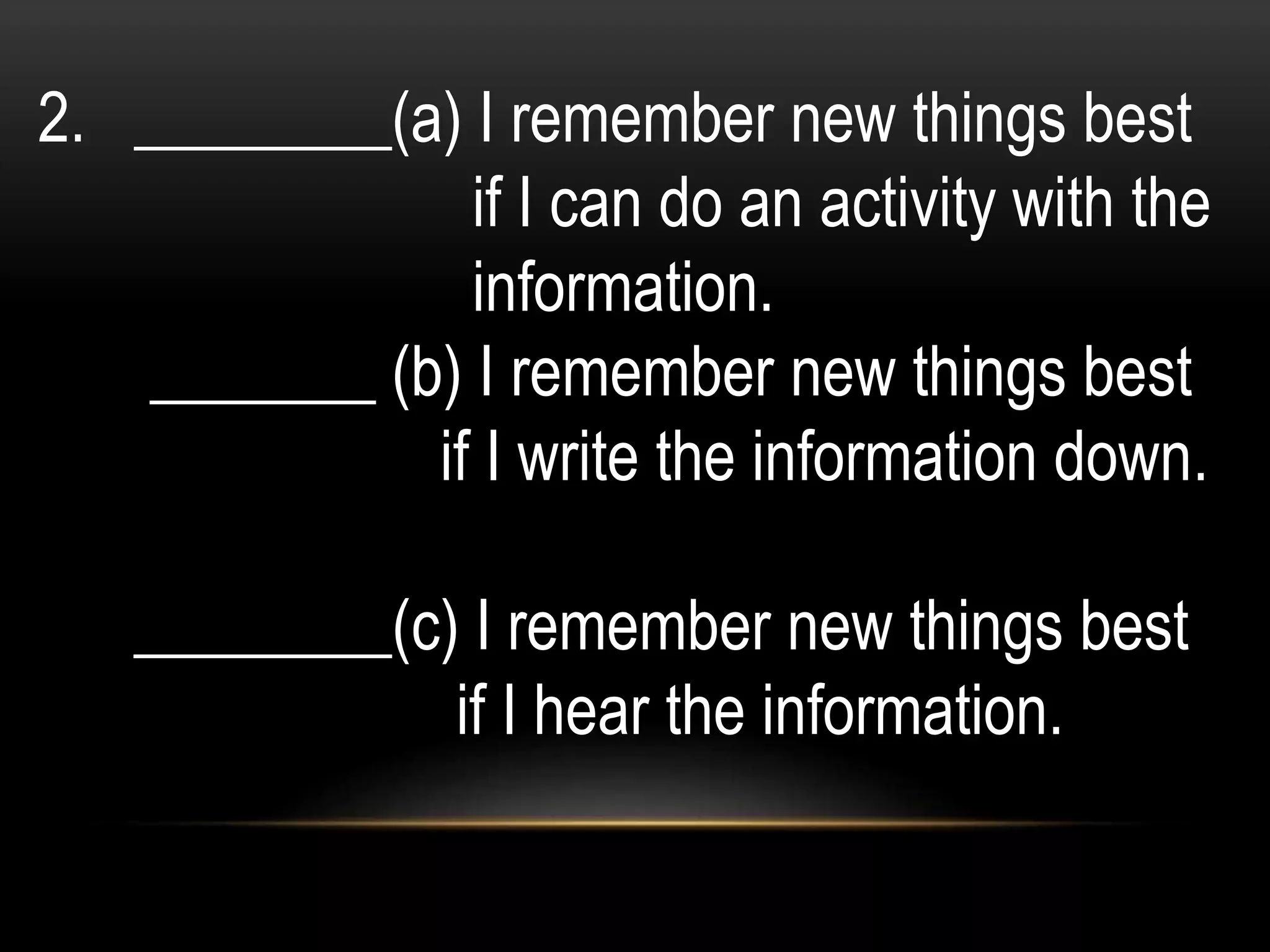
2. ________(a) I remember new things best
if I can do an activity with the
information.
_______ (b) I remember new things best
if I write the information down.
________(c) I remember new things best
if I hear the information.
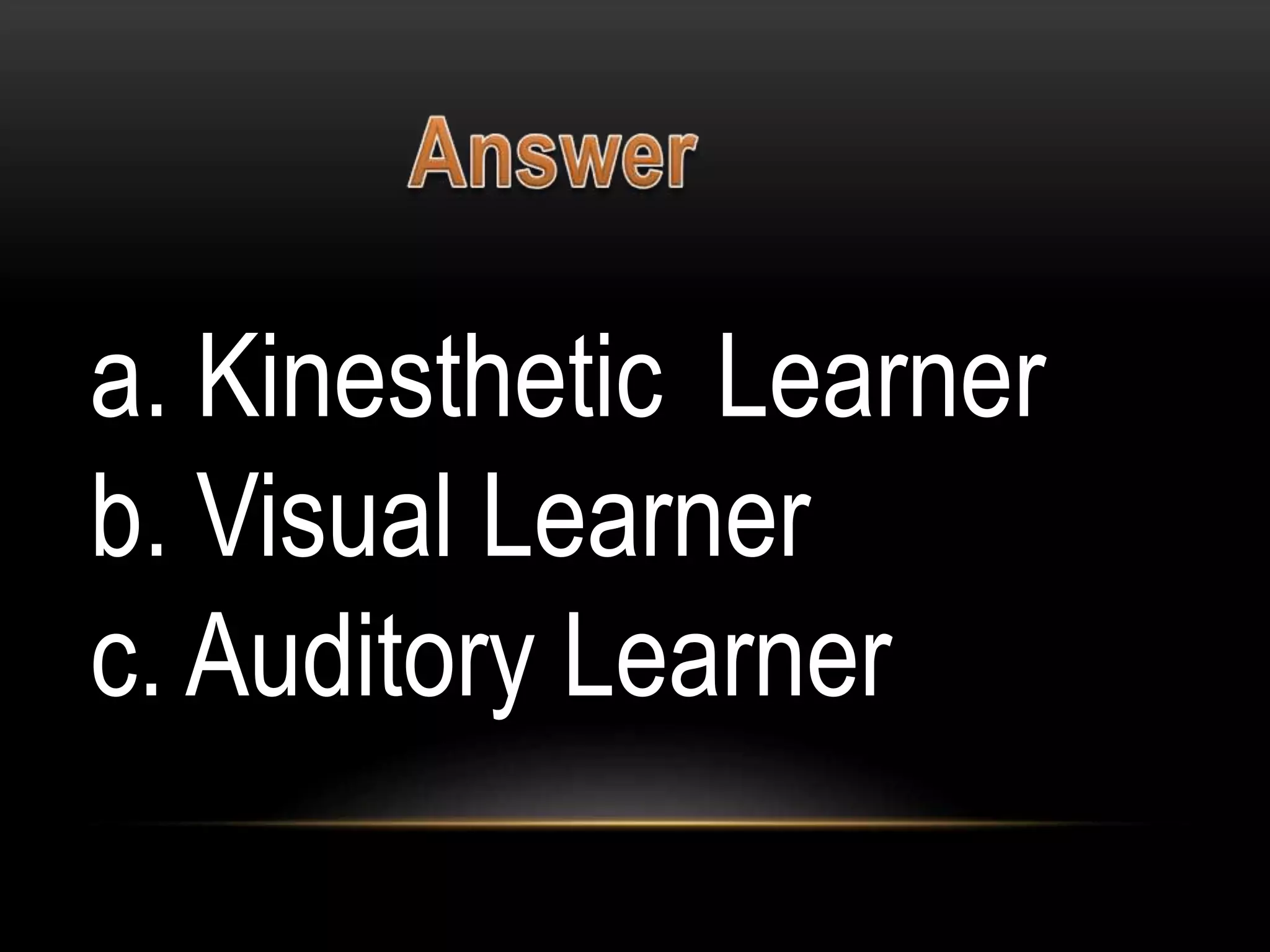
a. Kinesthetic Learner
b. Visual Learner
c. Auditory Learner
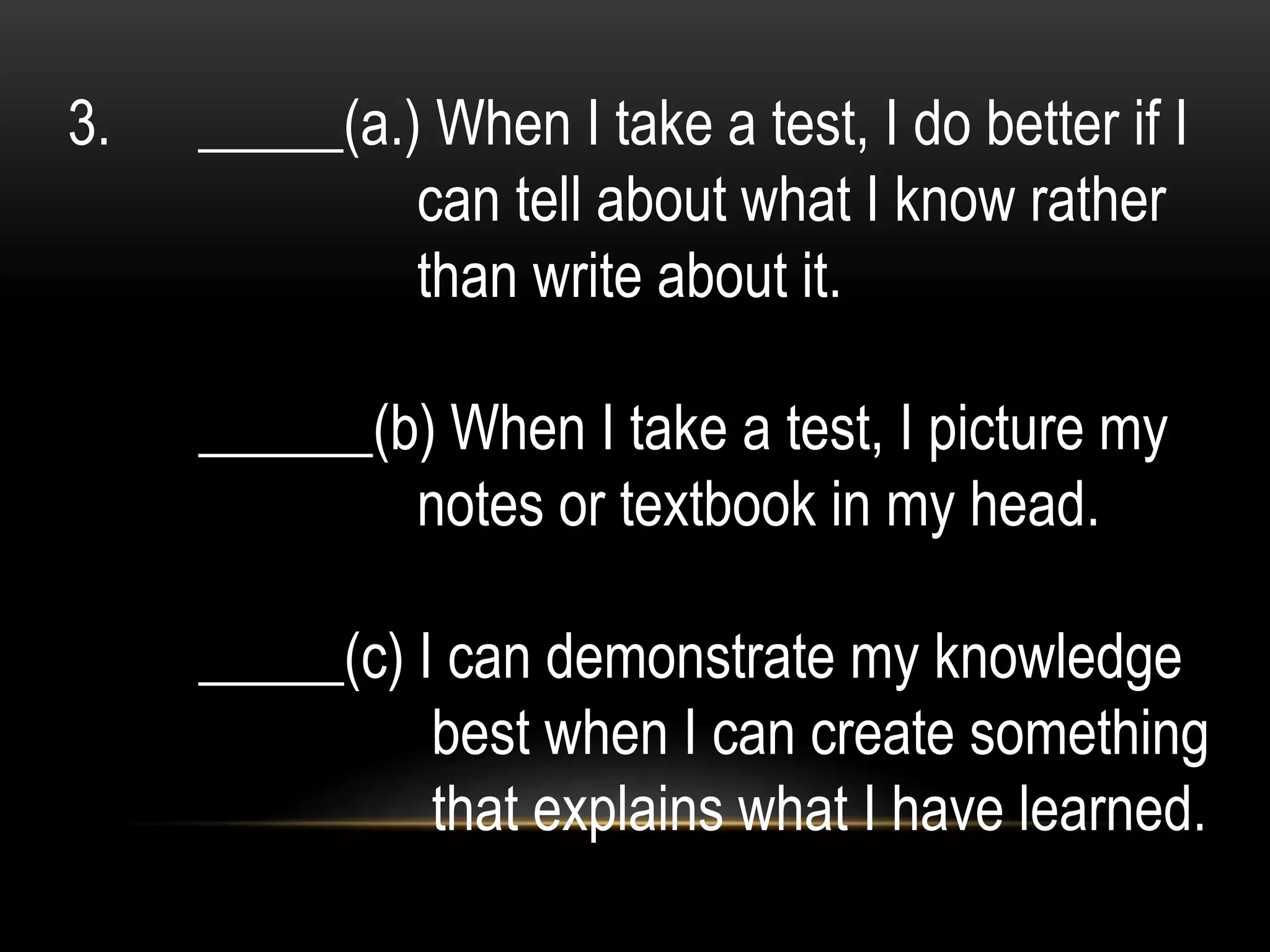
3. _____(a.) When I take a test, I do better if I
can tell about what I know rather
than write about it.
______(b) When I take a test, I picture my
notes or textbook in my head.
_____(c) I can demonstrate my knowledge
best when I can create something
that explains what I have learned.
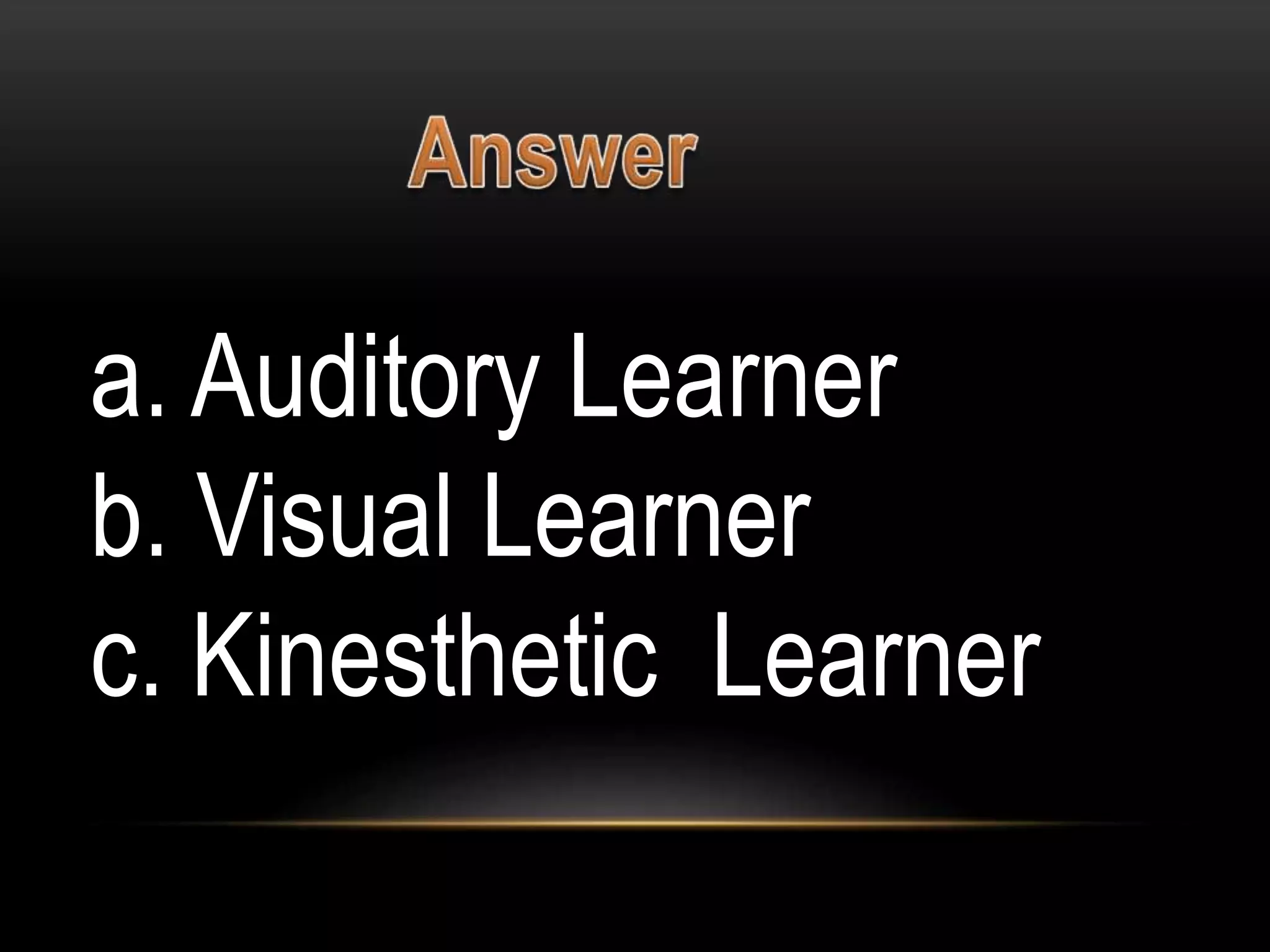
a. Auditory Learner
b. Visual Learner
c. Kinesthetic Learner
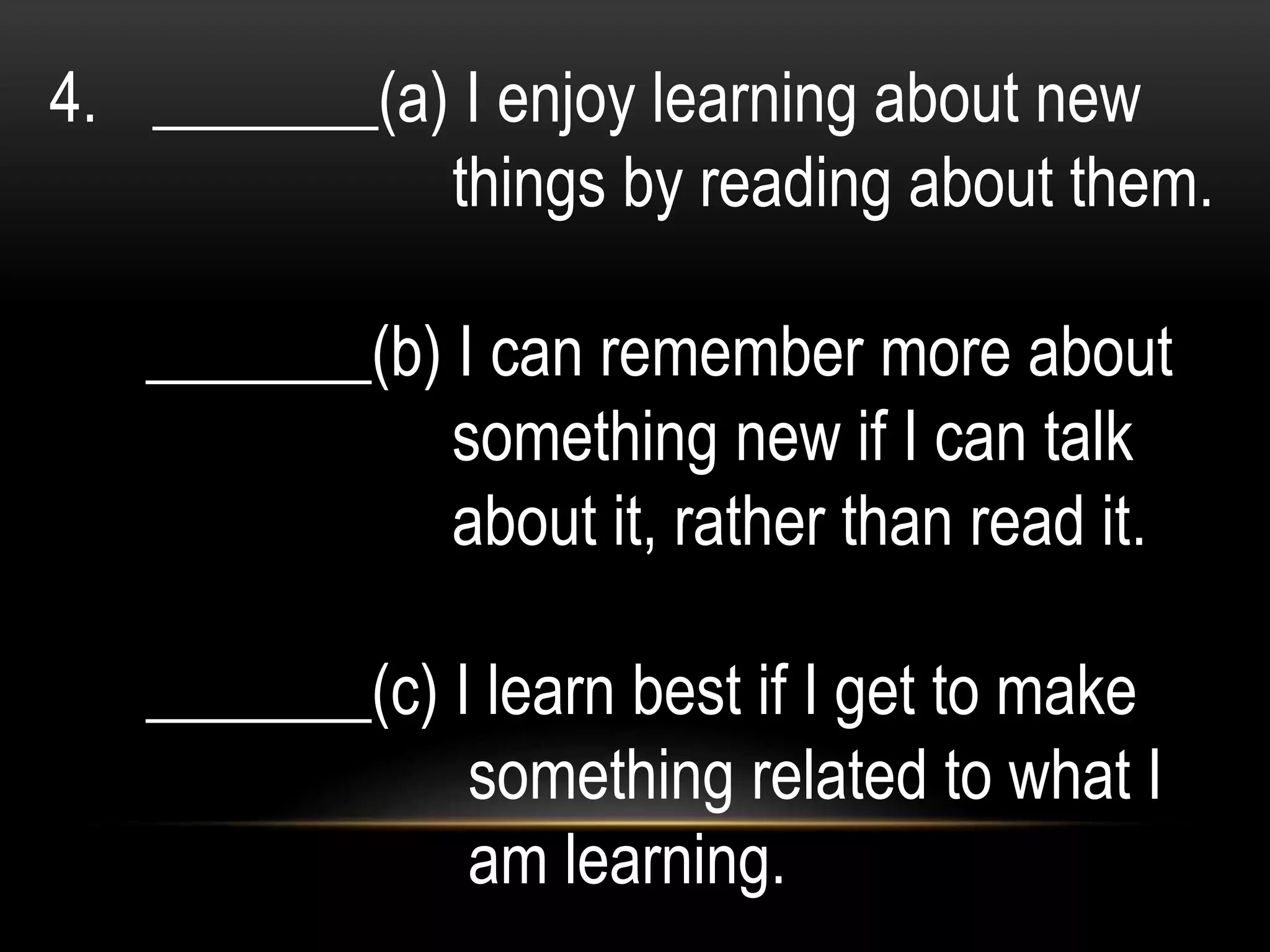
4. _______(a) I enjoy learning about new
things by reading about them.
_______(b) I can remember more about
something new if I can talk
about it, rather than read it.
_______(c) I learn best if I get to make
something related to what I
am learning.
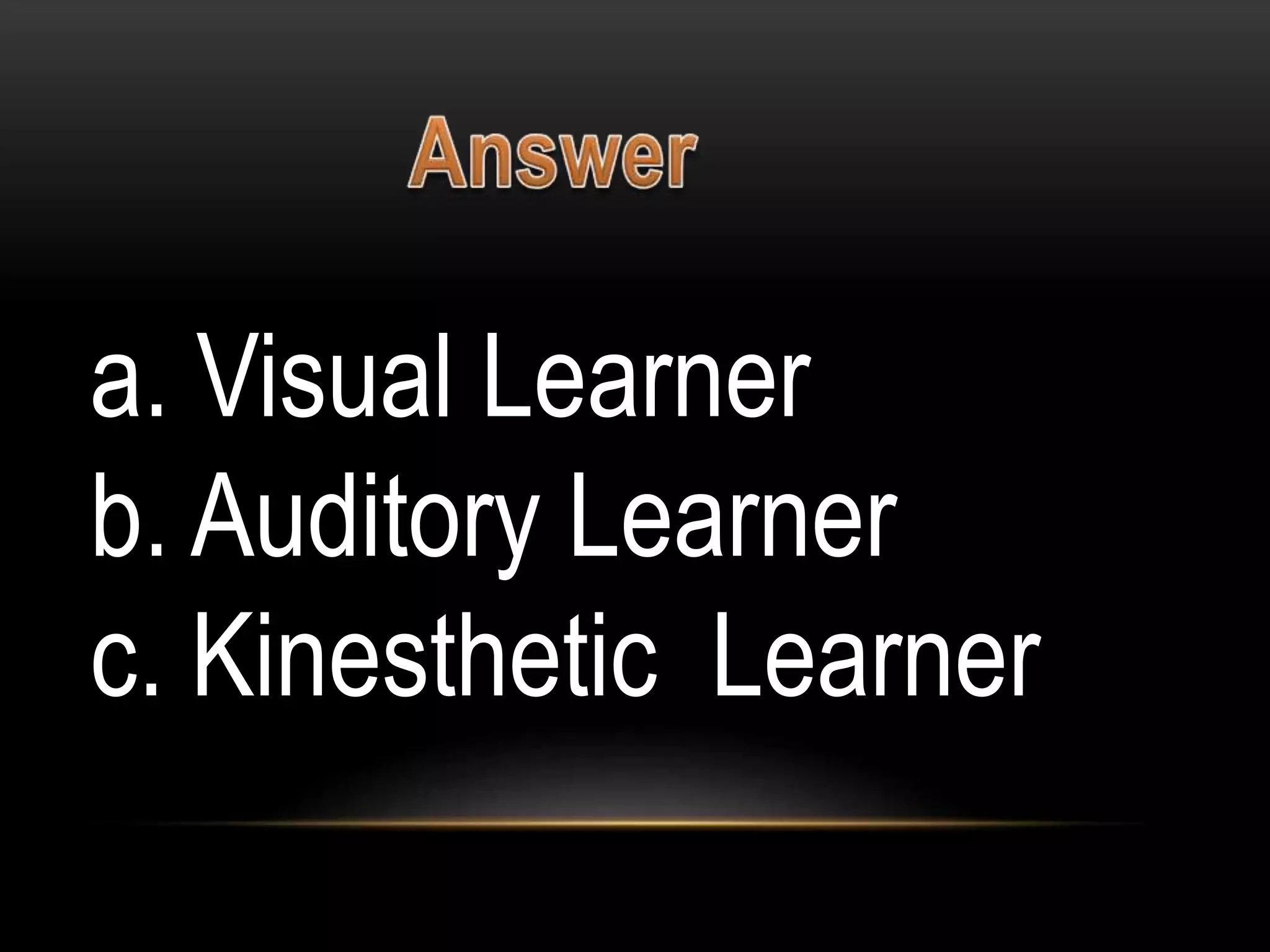
a. Visual Learner
b. Auditory Learner
c. Kinesthetic Learner
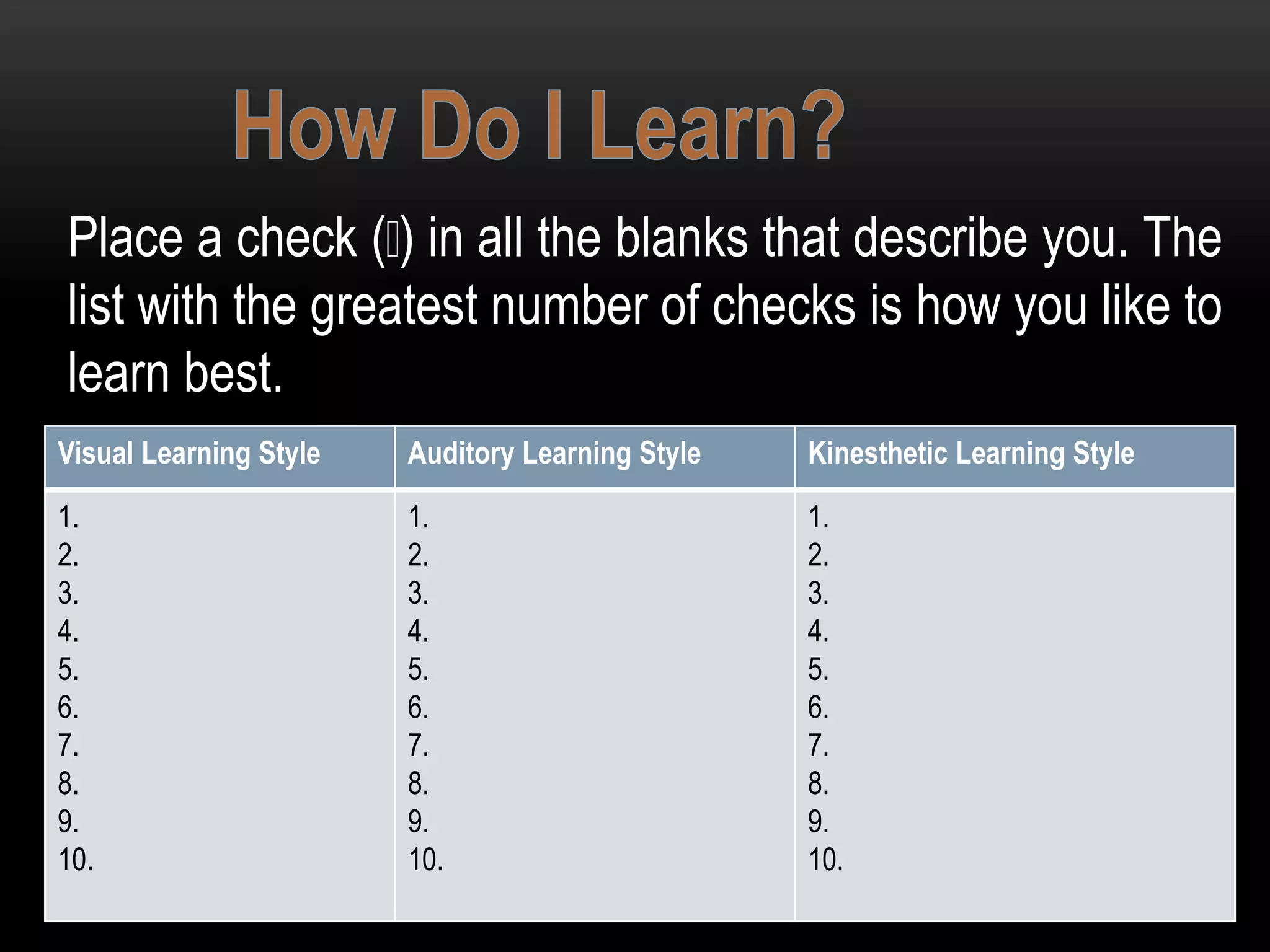
Place a check ( ) in all the blanks that describe you. The
list with the greatest number of checks is how you like to
learn best.
Visual Learning Style Auditory Learning Style Kinesthetic Learning Style
1.
2.
3.
4.
5.
6.
7.
8.
9.
10.
1.
2.
3.
4.
5.
6.
7.
8.
9.
10.
1.
2.
3.
4.
5.
6.
7.
8.
9.
10.
____1. I remember best by writing things down or drawing pictures.
____2. I ask for directions to be repeated.
____3. I like to read about something rather than hear about it.
____4. I am a good speller.
____5. I like to learn with posters, videos, and pictures.
____6. I am good at reading maps and graphs.
____7. When someone is talking, I create pictures in my mind about what
they are saying.
____8. After school, I like to read books.
____9. I like it when my teacher uses lots of pictures when teaching.
____10. I can remember something if I picture it in my head.
Visual Learning Style
How many checks (/) did you have?
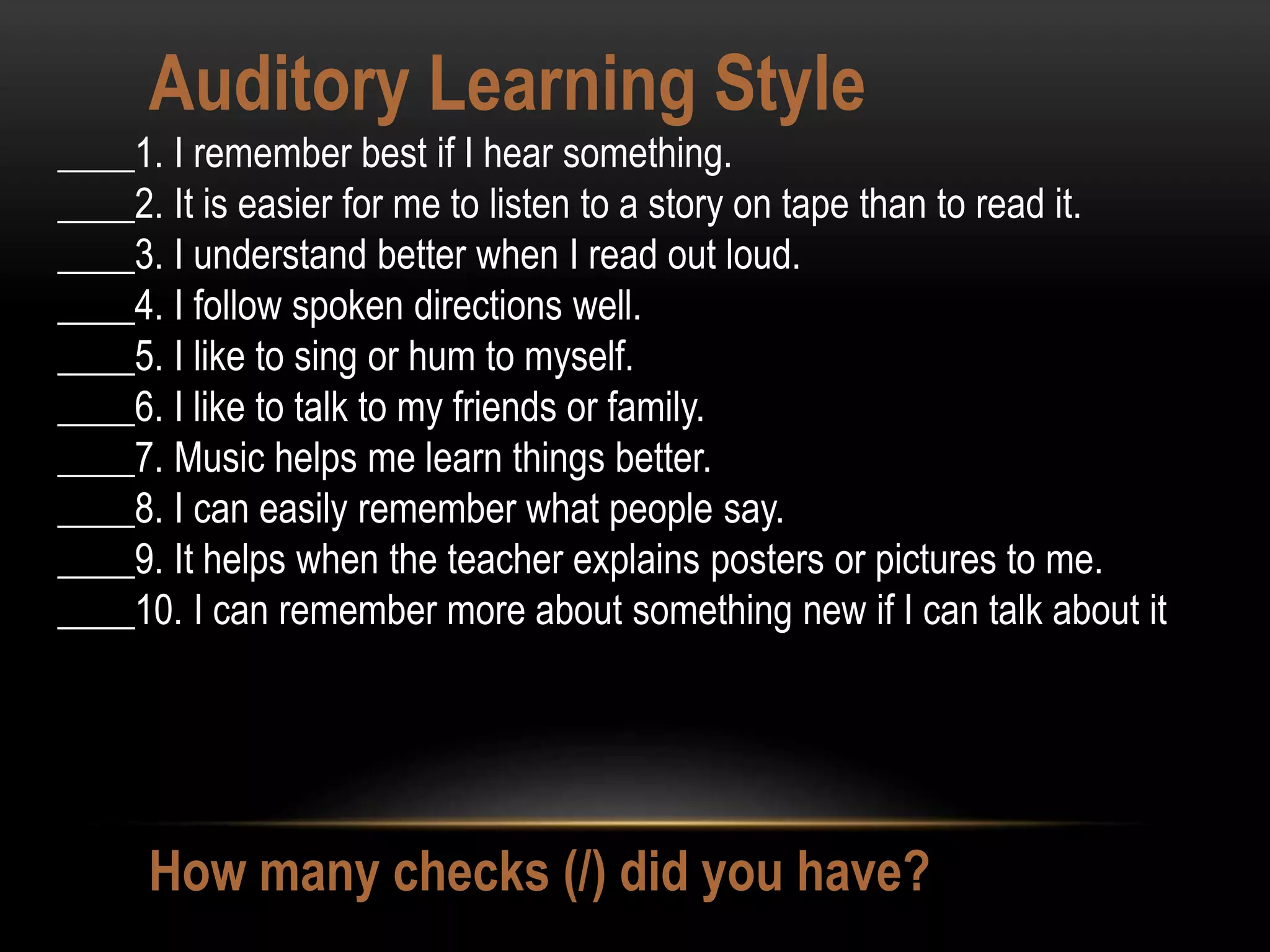
Auditory Learning Style
How many checks (/) did you have?
____1. I remember best if I hear something.
____2. It is easier for me to listen to a story on tape than to read it.
____3. I understand better when I read out loud.
____4. I follow spoken directions well.
____5. I like to sing or hum to myself.
____6. I like to talk to my friends or family.
____7. Music helps me learn things better.
____8. I can easily remember what people say.
____9. It helps when the teacher explains posters or pictures to me.
____10. I can remember more about something new if I can talk about it
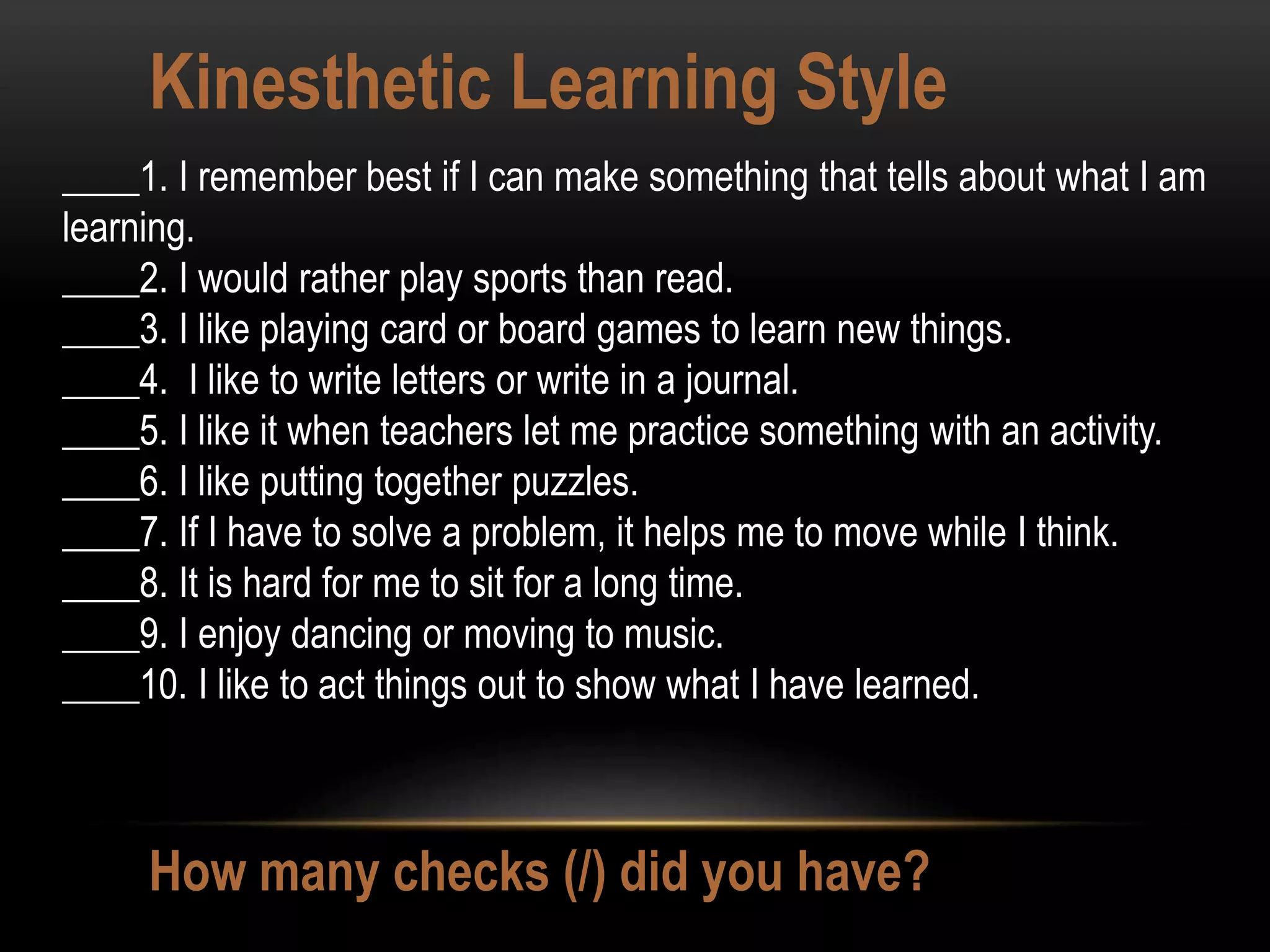
Kinesthetic Learning Style
How many checks (/) did you have?
____1. I remember best if I can make something that tells about what I am
learning.
____2. I would rather play sports than read.
____3. I like playing card or board games to learn new things.
____4. I like to write letters or write in a journal.
____5. I like it when teachers let me practice something with an activity.
____6. I like putting together puzzles.
____7. If I have to solve a problem, it helps me to move while I think.
____8. It is hard for me to sit for a long time.
____9. I enjoy dancing or moving to music.
____10. I like to act things out to show what I have learned.
Which list had the most (/) checks?___________
Which list had the fewest (/) checks?__________
Did you have any lists that had the same number of (/)
checks?_____If so, which ones?__________
Do you think the list that had the most checks (/) tells how
you like to learn best?_______________
Tell Me . . .
What Does It Mean?
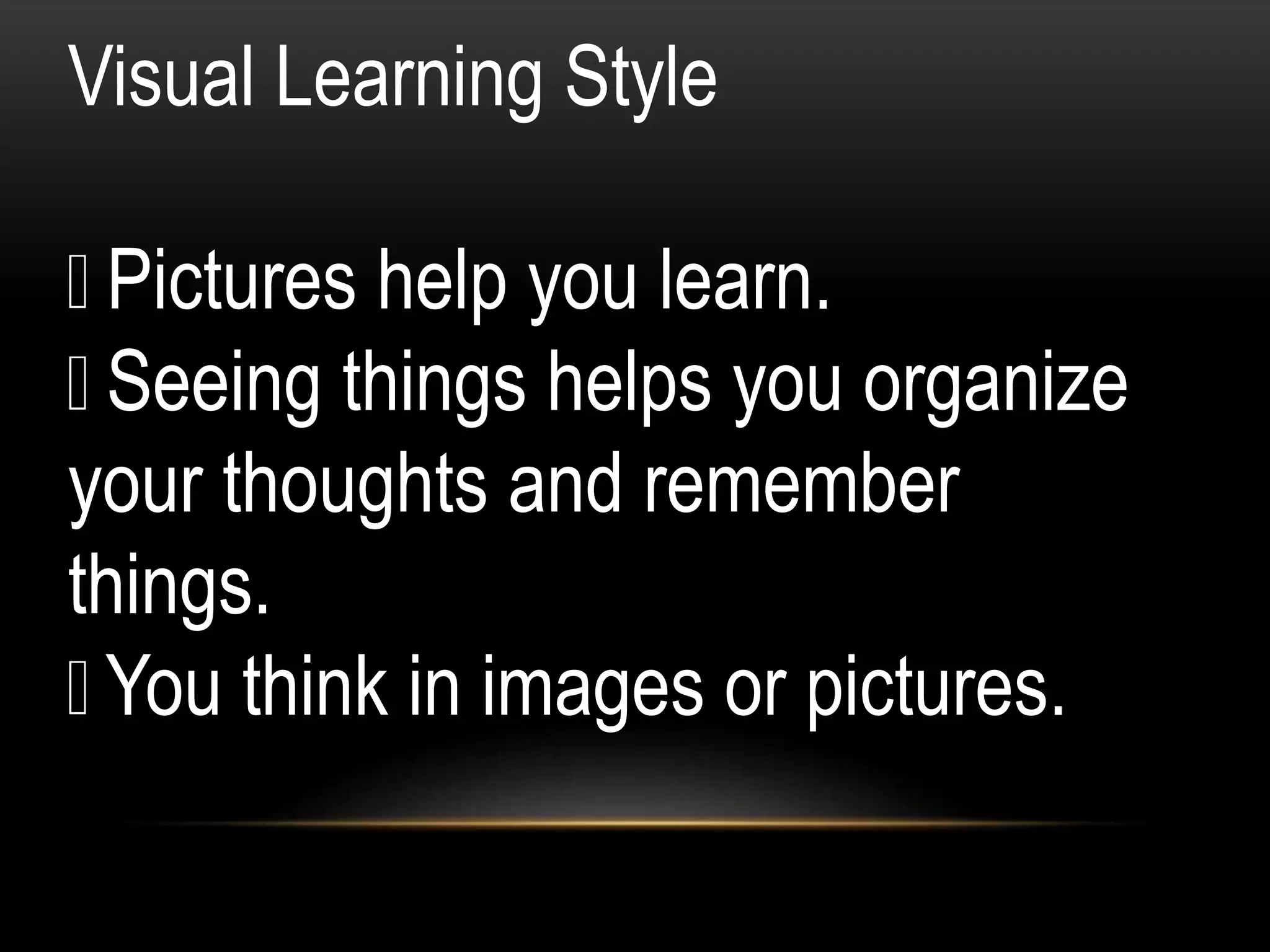
Visual Learning Style
Pictures help you learn.
Seeing things helps you organize
your thoughts and remember
things.
You think in images or pictures.
Auditory Learning Style
It helps for you to talk out loud.
Sound and music help you
learn.
You learn best when you hear
things more than once.
Kinesthetic Learning Style
o It helps you to use your body, hands and
sense of touch to learn new things.
o Writing, drawing and movement help you
remember important things.
o You like to show what you have learned by
demonstrating or making projects.
KNOWING WHO ARE
AUDITORY LEARNERS
WHAT ARE THE APPROPRIATE INTERVENTION?
TEACHING STRATEGIES FOR
AUDITORY LEARNERS
Teach students to change visual material into
auditory. The emphasis for this student is on
hearing and speaking. The student’s best source
for learning is teacher’s voice, their own voice,
tapes/CDs
Consider giving alternate seating
arrangements. Seat students to the front on
board work days and to the back on lecture day
Use jingles, catchy stories, mnemonic devises,
cheers or songs to aid the student in mastery
and/or retention of skill
Materials to use with auditory
learners:
Tape recorder Records Cassette
tapes CDs Audio-visual aids-
movies Pocket charts Hook
boards Electronic speaking
dictionary Electronic speaking
calculator
KNOWING WHO ARE
VISUAL LEARNERS
WHAT ARE THE APPROPRIATE INTERVENTION?
Use visual materials
Allow the student to read
silently more often than orally
Provide written directions
Place student near blackboard
KNOWING WHO ARE
KINESTHETIC LEARNERS
WHAT ARE THE APPROPRIATE INTERVENTION?
TEACHING STRATEGIES FOR
KINESTHETIC LEARNERS
Make the student an active part of the learning
experience. Students can type, role play, or
construct models
Allow student to move around the room as part of
learning
Teach students to create daily diaries or journals
Combine creative dramatics in reading
Allow the student to trace over projected image on
the wall or board (diagrams, maps, words)
Materials to use with kinesthetic Learners:
The student will learn most effectively when real
objects, models, 3-D objects and manipulative
materials that can be touched and moved are
used.
Good manipulative: Computers Globes Abacus
Hook-boards Felt-tipped pens Calculators
Typewriters Relief Maps Pocket charts Finger
paints Models Trays to write in (filled with sand,
salt, jello)
Workshop assignment to be passed on Friday, next week.
-In your LEARNING ACTIVITY SHEET or WORK SHEET give
one example of Auditory learning Style for the auditory
learners, visual learning style for the visual learners and
kinesthetic learning Style for kinesthetic learners.
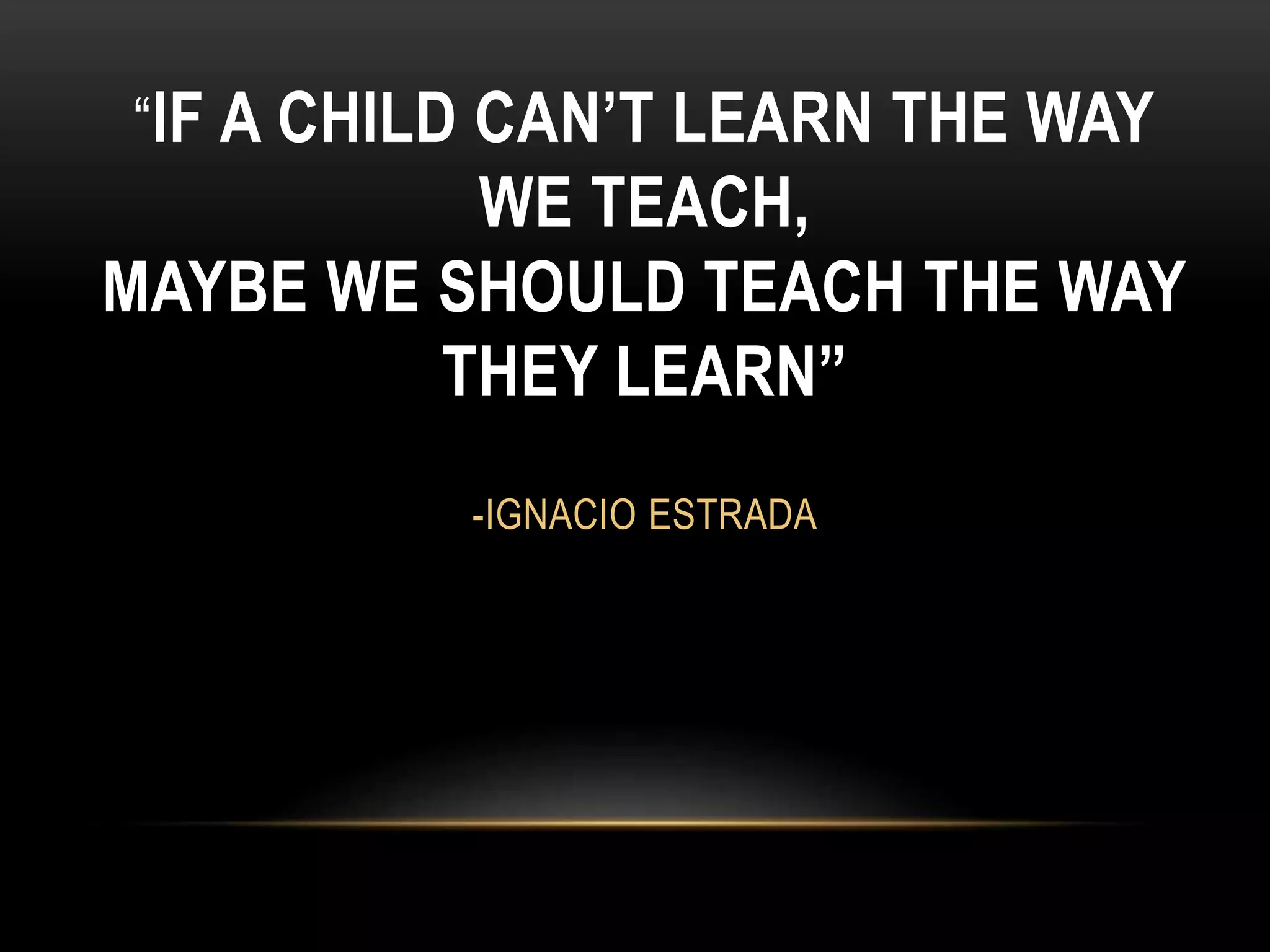
“IF A CHILD CAN’T LEARN THE WAY
WE TEACH,
MAYBE WE SHOULD TEACH THE WAY
THEY LEARN”
-IGNACIO ESTRADA
STUDENT'S LEARNING STYLE

STUDENT'S LEARNING STYLE

  • 1.
  • 2.
    - Determine thelearning styles of the students - Know the learning methods / strategies fitted the learning styles of the students.
  • 4.
    • Your learningstyle is the way you prefer to learn. It doesn't have anything to do with how intelligent you are or what skills you have learned. It has to do with how your brain works most efficiently to learn new information.
  • 5.
    There is anactivity and workshop that can help you to identify your own learning style and show you how to develop learning strategies that work for you so you can create a customized approach to achieving academic success.
  • 6.
    WHAT ARE THETYPES OF LEARNING STYLES? • Visual learners- learn through seeing • Auditory Learners-learns through listening • Kinesthetic Learners- Learn through moving, doing, and touching • Multi –sensory Learners
  • 7.
    As a visuallearner, the students may: Need to see the teacher’s body language and facial expressions to fully understand the content of the lesson Prefer sitting at the front of the classroom to avoid visual distractions Prefer using pictures and images to gain understanding of new ideas and information Recognize words by sight , use list to organize their thoughts and recall information be remembering how it was laid out on a page
  • 8.
    Auditory Learners-learns throughlistening As an auditory learner the student may: Prefer using sound and music to acquire information Learn best through verbal lectures, discussions, talking through and listening to what others have to say Interpret underlying meanings of speech through listening to tone of voice, pitch, speed, and other nuances Like the teacher to provide verbal instructions. Written information has little meaning until it is heard. Often use rhythm and sound as memory aids
  • 9.
    As a kinestheticlearner, the student may: Prefer using their body , hands, and sense of touch to learn new information Learn best through hands-on approach, actively exploring the physical world around them and utilizing activities such as projects and demonstrations Find writing, drawing and movement are often useful memory aids
  • 10.
    Multi –sensory LearnersAs a multi- sensory learner, the student may: Be more comfortable using a variety of modes to acquire new information
  • 11.
  • 12.
    Check the boxthat best represents how you like to learn. Remember to give only one answer .
  • 13.
    1. ______(a) Iprefer reading to hearing a lecture. ______(b) I prefer to hear a book on tape rather than reading it. ______(c) I would rather play sports than read books.
  • 14.
    a. Visual Learner b.Auditory Learner c. Kinesthetic Learner
  • 15.
    2. ________(a) Iremember new things best if I can do an activity with the information. _______ (b) I remember new things best if I write the information down. ________(c) I remember new things best if I hear the information.
  • 16.
    a. Kinesthetic Learner b.Visual Learner c. Auditory Learner
  • 17.
    3. _____(a.) WhenI take a test, I do better if I can tell about what I know rather than write about it. ______(b) When I take a test, I picture my notes or textbook in my head. _____(c) I can demonstrate my knowledge best when I can create something that explains what I have learned.
  • 18.
    a. Auditory Learner b.Visual Learner c. Kinesthetic Learner
  • 19.
    4. _______(a) Ienjoy learning about new things by reading about them. _______(b) I can remember more about something new if I can talk about it, rather than read it. _______(c) I learn best if I get to make something related to what I am learning.
  • 20.
    a. Visual Learner b.Auditory Learner c. Kinesthetic Learner
  • 21.
    Place a check( ) in all the blanks that describe you. The list with the greatest number of checks is how you like to learn best. Visual Learning Style Auditory Learning Style Kinesthetic Learning Style 1. 2. 3. 4. 5. 6. 7. 8. 9. 10. 1. 2. 3. 4. 5. 6. 7. 8. 9. 10. 1. 2. 3. 4. 5. 6. 7. 8. 9. 10.
  • 22.
    ____1. I rememberbest by writing things down or drawing pictures. ____2. I ask for directions to be repeated. ____3. I like to read about something rather than hear about it. ____4. I am a good speller. ____5. I like to learn with posters, videos, and pictures. ____6. I am good at reading maps and graphs. ____7. When someone is talking, I create pictures in my mind about what they are saying. ____8. After school, I like to read books. ____9. I like it when my teacher uses lots of pictures when teaching. ____10. I can remember something if I picture it in my head. Visual Learning Style How many checks (/) did you have?
  • 23.
    Auditory Learning Style Howmany checks (/) did you have? ____1. I remember best if I hear something. ____2. It is easier for me to listen to a story on tape than to read it. ____3. I understand better when I read out loud. ____4. I follow spoken directions well. ____5. I like to sing or hum to myself. ____6. I like to talk to my friends or family. ____7. Music helps me learn things better. ____8. I can easily remember what people say. ____9. It helps when the teacher explains posters or pictures to me. ____10. I can remember more about something new if I can talk about it
  • 24.
    Kinesthetic Learning Style Howmany checks (/) did you have? ____1. I remember best if I can make something that tells about what I am learning. ____2. I would rather play sports than read. ____3. I like playing card or board games to learn new things. ____4. I like to write letters or write in a journal. ____5. I like it when teachers let me practice something with an activity. ____6. I like putting together puzzles. ____7. If I have to solve a problem, it helps me to move while I think. ____8. It is hard for me to sit for a long time. ____9. I enjoy dancing or moving to music. ____10. I like to act things out to show what I have learned.
  • 25.
    Which list hadthe most (/) checks?___________ Which list had the fewest (/) checks?__________ Did you have any lists that had the same number of (/) checks?_____If so, which ones?__________ Do you think the list that had the most checks (/) tells how you like to learn best?_______________ Tell Me . . .
  • 26.
  • 27.
    Visual Learning Style Pictureshelp you learn. Seeing things helps you organize your thoughts and remember things. You think in images or pictures.
  • 28.
    Auditory Learning Style Ithelps for you to talk out loud. Sound and music help you learn. You learn best when you hear things more than once.
  • 29.
    Kinesthetic Learning Style oIt helps you to use your body, hands and sense of touch to learn new things. o Writing, drawing and movement help you remember important things. o You like to show what you have learned by demonstrating or making projects.
  • 30.
    KNOWING WHO ARE AUDITORYLEARNERS WHAT ARE THE APPROPRIATE INTERVENTION?
  • 31.
  • 32.
    Teach students tochange visual material into auditory. The emphasis for this student is on hearing and speaking. The student’s best source for learning is teacher’s voice, their own voice, tapes/CDs Consider giving alternate seating arrangements. Seat students to the front on board work days and to the back on lecture day Use jingles, catchy stories, mnemonic devises, cheers or songs to aid the student in mastery and/or retention of skill
  • 33.
    Materials to usewith auditory learners: Tape recorder Records Cassette tapes CDs Audio-visual aids- movies Pocket charts Hook boards Electronic speaking dictionary Electronic speaking calculator
  • 34.
    KNOWING WHO ARE VISUALLEARNERS WHAT ARE THE APPROPRIATE INTERVENTION?
  • 35.
    Use visual materials Allowthe student to read silently more often than orally Provide written directions Place student near blackboard
  • 36.
    KNOWING WHO ARE KINESTHETICLEARNERS WHAT ARE THE APPROPRIATE INTERVENTION?
  • 37.
  • 38.
    Make the studentan active part of the learning experience. Students can type, role play, or construct models Allow student to move around the room as part of learning Teach students to create daily diaries or journals Combine creative dramatics in reading Allow the student to trace over projected image on the wall or board (diagrams, maps, words)
  • 39.
    Materials to usewith kinesthetic Learners: The student will learn most effectively when real objects, models, 3-D objects and manipulative materials that can be touched and moved are used. Good manipulative: Computers Globes Abacus Hook-boards Felt-tipped pens Calculators Typewriters Relief Maps Pocket charts Finger paints Models Trays to write in (filled with sand, salt, jello)
  • 40.
    Workshop assignment tobe passed on Friday, next week. -In your LEARNING ACTIVITY SHEET or WORK SHEET give one example of Auditory learning Style for the auditory learners, visual learning style for the visual learners and kinesthetic learning Style for kinesthetic learners.
  • 41.
    “IF A CHILDCAN’T LEARN THE WAY WE TEACH, MAYBE WE SHOULD TEACH THE WAY THEY LEARN” -IGNACIO ESTRADA