Using Your Learning Style to
Your Advantage
John Pearson
Center for Tutoring & Academic Excellence
jpearson3@luc.edu
www.luc.edu/tutoring
Goals for tonight
• Overview of learning style (VAK)
• How to effectively use your style to improve
learning
• How to use peers, and other learning styles, to
improve comprehension
A little about you
• How do you currently take notes during
lecture?
• How do you internalize information that you
are learning?
• How are you currently studying?
• How often do you work in group settings?
Learning Styles Inventory
Take some time to answer honestly
Discussion
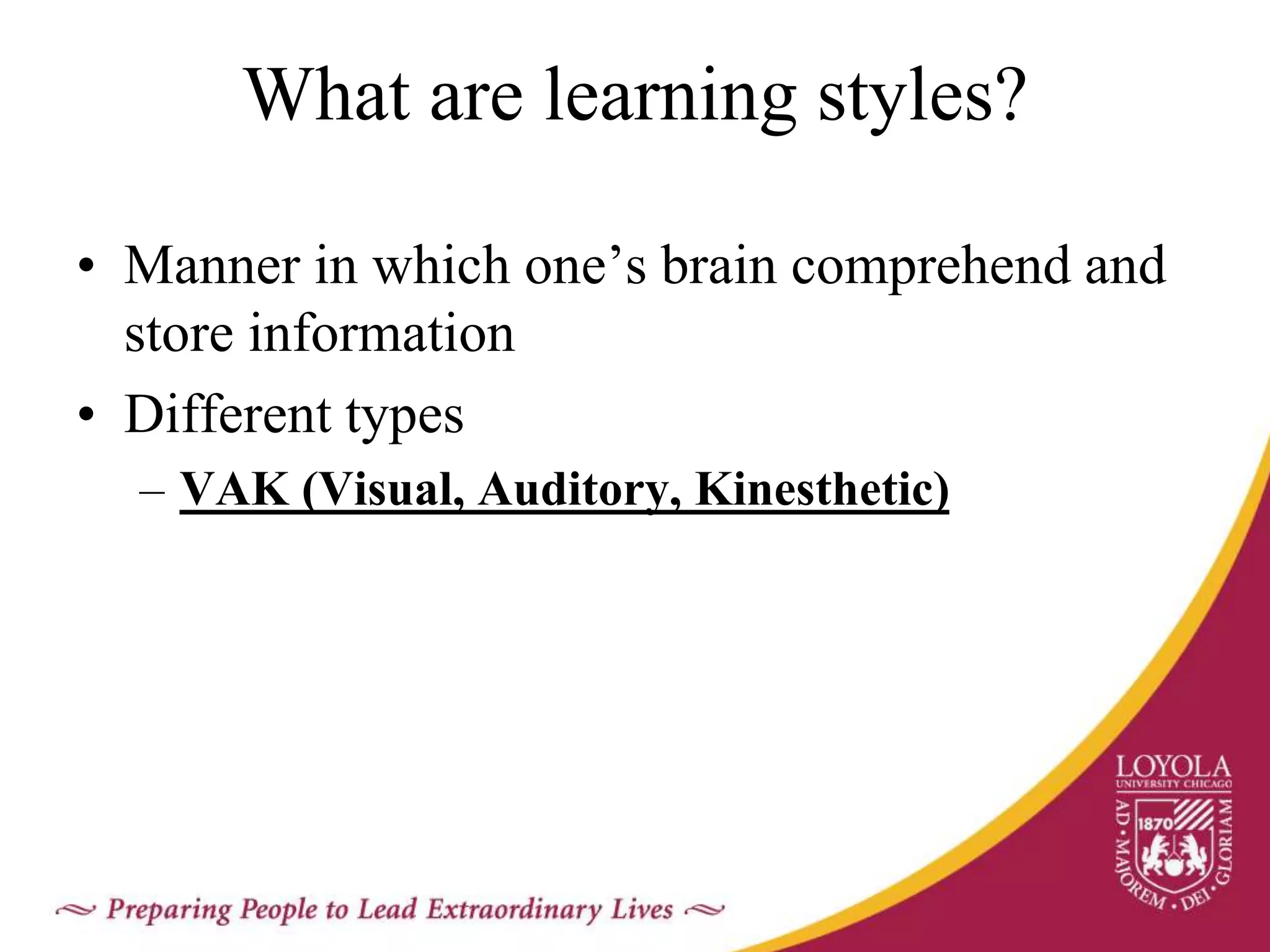
What are learning styles?
• Manner in which one’s brain comprehend and
store information
• Different types
– VAK (Visual, Auditory, Kinesthetic)
Suggestions for Visual Learners
• Use visual materials
– Brain storm bubble or picture
– Write a story and illustrate it
– Use color and color-coding in
text
– Use mnemonics, acronyms,
visual chains, and mind maps
– Create charts / diagrams
to demonstrate key points
• Visualize information as a
picture to aid memorization
• Have a clear view of
teachers
• Take notes or request
handouts
• Study in a quiet place away
from verbal disturbances
Visual Learners Cont.
• Computers
– Organize materials and
to create graphs, tables,
charts, and spreadsheets
• When explaining something,
write the explanation down
• Organize your material.
– The more you organize your
notes and study material, the
easier it will be for you to
remember content.
• Actively review any
photographs or diagrams in
your textbook.
• Make and use flashcards for
studying.
– The act of writing the cards
and viewing them will
increase comprehension.
Suggestions for Auditory Learners
• Participate in class discussions/debates
– speeches and presentations
• Use a tape recorder during lectures instead of taking notes and
review these tapes while you drive.
• Go over all important facts aloud
• Use verbal analogies, and story telling to demonstrate your
point
• Create mnemonics and word links to aid memorization
• Discuss your ideas verbally
– Dictate to someone while they write down your thoughts
• Create musical jingles to aid memorization
Auditory Learners Cont.
• Make up and repeat rhymes to remember facts, dates, names.
• Join or create a study group, or to get a study partner
– Explain the material you are trying to learn to a study partner
• To learn a sequence of steps, write them out in sentence
form, then read them out loud
• When learning new information, state the problem out loud.
Reason through solutions out loud.
Suggestions for Kinesthetic Learners
• Move around to learn new
things
– Read while on an exercise
bike, mold a piece of clay to
learn a new concept
• Work at a standing position
• Chew gum while studying
• Use bright colors to
highlight reading material
• If you wish, listen to music
while you study
• Skim through reading
material to get a rough idea
what it is about before
settling down to read it in
detail.
• Sit near the front of their
classroom to take notes.
– Will help in focusing on the
lecture
Kinesthetic Learners Cont.
• Hold the book in your hand
while reading
• Write while you are reading or
talking.
– Use the computer to reinforce
learning using their sense of
touch
• Make models that demonstrate
the key concept.
– The purpose here is the act of
making the model.
• Use hands-on experience
when possible
• Participate in any field trips
offered.
• Associate feelings with
information.
Why is it important to know your
learning style?
• Improved skills in learning complex ideas
• Efficiency in studying and reading
• How to best work within groups
• Ability to create environment that fosters
personal style
Why else do you think it is beneficial to know
your learning style?
Your professor is not teaching
nor willing to teach in a manner
that speaks to your learning style,
What should you do?
What to do…
1. Be more hands on with your independent learning
2. When you get home, review your notes in your preferred
learning style method
3. Do your own research!
– Look for videos
– Look for additional articles or books to read
4. Come to class extra prepared
Resources
• CTAE offers different opportunities for
collaborative learning
– Small group tutoring
– Study buddy directory
– Academic coaching groups
– Tutor-led study halls
• Visit luc.edu/tutoring for more details

Learning styles

  • 1.
    Using Your LearningStyle to Your Advantage John Pearson Center for Tutoring & Academic Excellence jpearson3@luc.edu www.luc.edu/tutoring
  • 2.
    Goals for tonight •Overview of learning style (VAK) • How to effectively use your style to improve learning • How to use peers, and other learning styles, to improve comprehension
  • 3.
    A little aboutyou • How do you currently take notes during lecture? • How do you internalize information that you are learning? • How are you currently studying? • How often do you work in group settings?
  • 4.
    Learning Styles Inventory Takesome time to answer honestly Discussion
  • 5.
    What are learningstyles? • Manner in which one’s brain comprehend and store information • Different types – VAK (Visual, Auditory, Kinesthetic)
  • 6.
    Suggestions for VisualLearners • Use visual materials – Brain storm bubble or picture – Write a story and illustrate it – Use color and color-coding in text – Use mnemonics, acronyms, visual chains, and mind maps – Create charts / diagrams to demonstrate key points • Visualize information as a picture to aid memorization • Have a clear view of teachers • Take notes or request handouts • Study in a quiet place away from verbal disturbances
  • 7.
    Visual Learners Cont. •Computers – Organize materials and to create graphs, tables, charts, and spreadsheets • When explaining something, write the explanation down • Organize your material. – The more you organize your notes and study material, the easier it will be for you to remember content. • Actively review any photographs or diagrams in your textbook. • Make and use flashcards for studying. – The act of writing the cards and viewing them will increase comprehension.
  • 8.
    Suggestions for AuditoryLearners • Participate in class discussions/debates – speeches and presentations • Use a tape recorder during lectures instead of taking notes and review these tapes while you drive. • Go over all important facts aloud • Use verbal analogies, and story telling to demonstrate your point • Create mnemonics and word links to aid memorization • Discuss your ideas verbally – Dictate to someone while they write down your thoughts • Create musical jingles to aid memorization
  • 9.
    Auditory Learners Cont. •Make up and repeat rhymes to remember facts, dates, names. • Join or create a study group, or to get a study partner – Explain the material you are trying to learn to a study partner • To learn a sequence of steps, write them out in sentence form, then read them out loud • When learning new information, state the problem out loud. Reason through solutions out loud.
  • 10.
    Suggestions for KinestheticLearners • Move around to learn new things – Read while on an exercise bike, mold a piece of clay to learn a new concept • Work at a standing position • Chew gum while studying • Use bright colors to highlight reading material • If you wish, listen to music while you study • Skim through reading material to get a rough idea what it is about before settling down to read it in detail. • Sit near the front of their classroom to take notes. – Will help in focusing on the lecture
  • 11.
    Kinesthetic Learners Cont. •Hold the book in your hand while reading • Write while you are reading or talking. – Use the computer to reinforce learning using their sense of touch • Make models that demonstrate the key concept. – The purpose here is the act of making the model. • Use hands-on experience when possible • Participate in any field trips offered. • Associate feelings with information.
  • 12.
    Why is itimportant to know your learning style? • Improved skills in learning complex ideas • Efficiency in studying and reading • How to best work within groups • Ability to create environment that fosters personal style Why else do you think it is beneficial to know your learning style?
  • 13.
    Your professor isnot teaching nor willing to teach in a manner that speaks to your learning style, What should you do?
  • 14.
    What to do… 1.Be more hands on with your independent learning 2. When you get home, review your notes in your preferred learning style method 3. Do your own research! – Look for videos – Look for additional articles or books to read 4. Come to class extra prepared
  • 15.
    Resources • CTAE offersdifferent opportunities for collaborative learning – Small group tutoring – Study buddy directory – Academic coaching groups – Tutor-led study halls • Visit luc.edu/tutoring for more details