Study smarter, not harder 6 th  grade study skills unit Ms. Ites
Reading skills – overall strategies Look to chapter  & section summaries: gives you a good idea for overall info going to be covered; directs your reading.  Check out all VA: maps, diagrams, & pics STRATEGIES: SUMMARIZE info; chunk into main ideas CLARIFY: make sure you understand all words & ideas QUESTION:  create your own ?s to understand the text  as you read PREDICT: try to determine what will happen next in reading / how current ideas will connect to new ideas
Notes Always complete an overview Pre-read Vocab Graphics (maps, charts, pictures) Summary / review Organize using logic / time Make connections/ pick out the good stuff Only write in notes form; NO PARAGRAPHS
Notes – social studies First page of chapter Understand notes format (chapter number and section – 20.2) Connect to schema (what you already know) Chapter review Guide your reading; these are the kinds of questions the  teacher will ask on tests Look over all VA Graphs, charts, pictures, & colored boxes
Social studies: sample notes Choose sec’n 1,2, or 3 Write out the notes for that section, using info we’ve discussed After you are done: Review your notes & highlight the “good stuff” – things mentioned in the chapter review Use a pencil to make connections between topics / predictions
Notes - science Always complete an overview (left-hand column on 1 st  page of chapter) Look over the Chapter Highlights for: Vocab Summary of info covered Look over graphics in Chapter Organize using logic Make connections/ pick out the good stuff
Science – sample notes For Chapter 1 Sections 1-6 Write out the notes for that section, using info we’ve discussed After you are done: Review your notes & highlight the “good stuff” – things mentioned in the chapter review Use a pencil to make connections between topics Take quickie notes for Chapter Review
Notes - math Label all work (by topic/ concept) Write down all teacher examples Review examples given in book to gain further understanding Write down all new terms / functions Make connections between new processes & schema (previous knowledge) ONLY USE PENCIL; it is easier to fix mistakes and avoids cross-outs
Notes – LA Note important info to plot / story / setting Write down YOUR VERSION of vocab words Look at VA & off-set boxes Make sure info in review questions is covered; this is a great way to make connections  Highlight the good stuff
ORGANIZATION Where do you study?  Why? Explain how the following can affect your studying: Lighting Your own sound “requirements” The room’s layout (furniture, desks, etc.) Noise (outside your control) Time of day
GOOD STUDY ENVIRONMENT: LIGHTING Good lighting is necessary for a good study environment. You should have: At least 1 overhead light At least 1 ambient light (lamp) At least 1 source of natural light (window) Tube florescent lighting and dim lighting can cause eyestrain (eye headaches) The best solution is a mix of overhead & ambient lighting WEBSITE: http://www.designmyroom.com/projects/Preparing.aspx?BaseDesignID=27
GOOD STUDY ENVIRONMENT: PACKET SUMMARY LIGHTING:  3 sources are best Natural Ambient (lamp) Overhead SOUND (NOYSE):  based on YOUR preference If necessary, create your own “white” noise NOISE:  sound OUTSIDE YOUR CONTROL If necessary, create your own “white” noise LAYOUT: organization of room Clear path of movement Clear areas for study Organized resources TIME OF DAY:  BASED ON YOUR STRENGTHS! CIRCADIAN: affected by sunlight cycles (sleepier in winter) OVERALL, MOST MS STUDENTS ARE BEST BEFORE 7PM IF YOU HAVE AN ACTIVITY AT 7:30 OR LATER Do your homework RIGHT AFTER SCHOOL
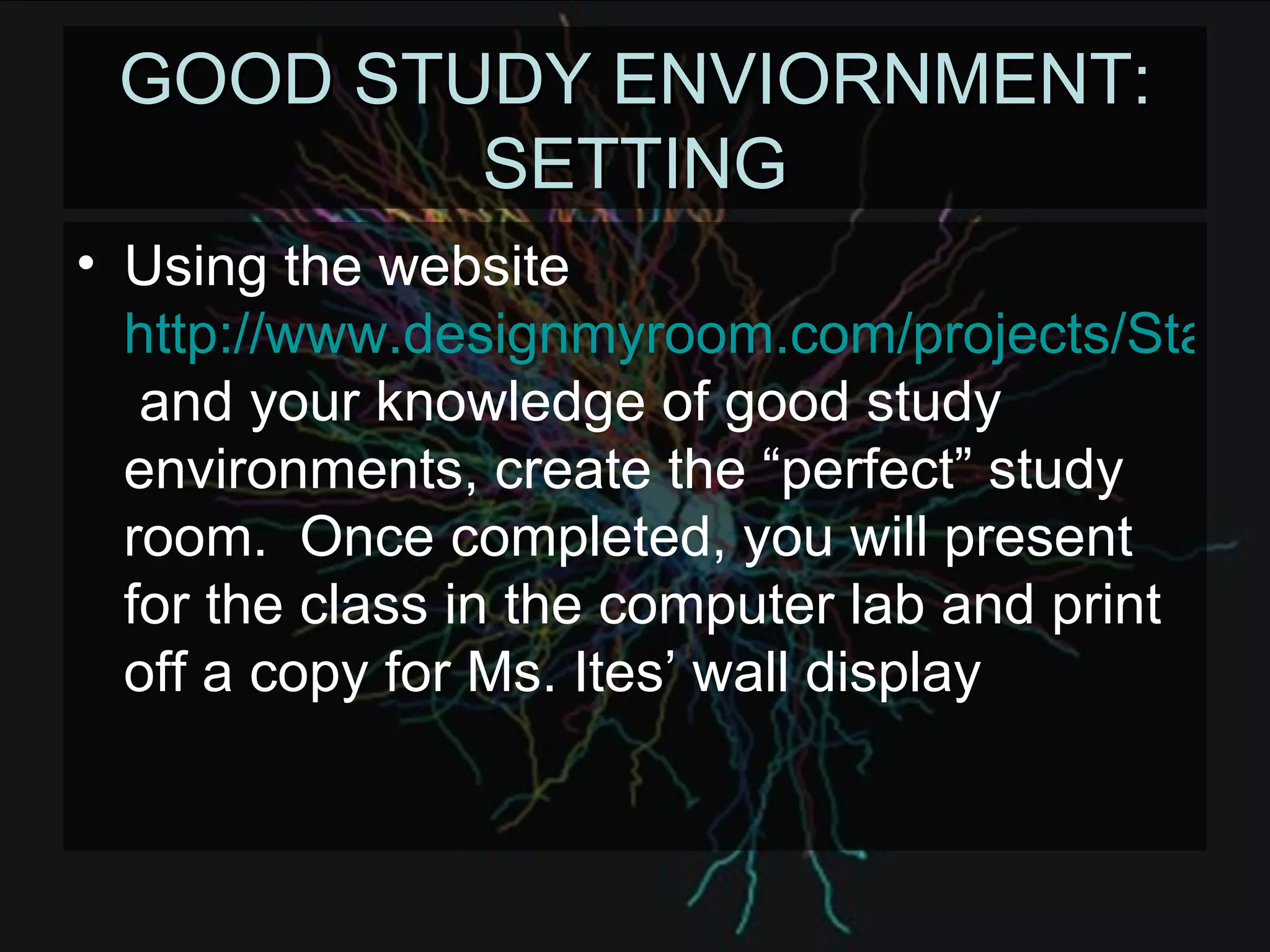
GOOD STUDY ENVIORNMENT: SETTING Using the website  http://www.designmyroom.com/projects/Start.aspx  and your knowledge of good study environments, create the “perfect” study room.  Once completed, you will present for the class in the computer lab and print off a copy for Ms. Ites’ wall display
PRIORITIES How often do you set goals? Do you accomplish them? How could you accomplish them more often? WHY SHOULD YOU HAVE WRITTEN GOALS?
PENCIL ME IN Staple or tape each page of your calendars into your planners Using the master calendar, write in your upcoming due dates  in pen Transfer those dates into study times in your weekly planner sections On your Sundays, write mini-goals for your week
GOOOOAAAAAALLLL! After conferencing with Ms. I, write down your goals for this school year; include your “due dates”: EASIEST SUBJECT MOST DIFFICULT SUBJECT BEHAVIOR EXTRA CURRICULAR – SCHOOL RELATED EXTRA CURRICULAR – PERSONAL FAMILY / HOME
(EXTRA SPACE TO WRITE IN YOUR 6 GOALS FROM THE PREVIOUS SLIDE)
MONTHLY GOALS Set 3 monthly goals you hope to accomplish in October; write them on the BACK of the October monthly calendar 1 must be a school goal, 1 must be an extra-curricular goal, and 1 may be any goal of your choice YOU MUST BE ABLE TO REACH YOUR MONTHLY GOALS BY MEETING YOUR WEEKLY GOALS; THEY NEED TO BE SPECIFIC.

Study Smarter, Not Harder

  • 1.
    Study smarter, notharder 6 th grade study skills unit Ms. Ites
  • 2.
    Reading skills –overall strategies Look to chapter & section summaries: gives you a good idea for overall info going to be covered; directs your reading. Check out all VA: maps, diagrams, & pics STRATEGIES: SUMMARIZE info; chunk into main ideas CLARIFY: make sure you understand all words & ideas QUESTION: create your own ?s to understand the text as you read PREDICT: try to determine what will happen next in reading / how current ideas will connect to new ideas
  • 3.
    Notes Always completean overview Pre-read Vocab Graphics (maps, charts, pictures) Summary / review Organize using logic / time Make connections/ pick out the good stuff Only write in notes form; NO PARAGRAPHS
  • 4.
    Notes – socialstudies First page of chapter Understand notes format (chapter number and section – 20.2) Connect to schema (what you already know) Chapter review Guide your reading; these are the kinds of questions the teacher will ask on tests Look over all VA Graphs, charts, pictures, & colored boxes
  • 5.
    Social studies: samplenotes Choose sec’n 1,2, or 3 Write out the notes for that section, using info we’ve discussed After you are done: Review your notes & highlight the “good stuff” – things mentioned in the chapter review Use a pencil to make connections between topics / predictions
  • 6.
    Notes - scienceAlways complete an overview (left-hand column on 1 st page of chapter) Look over the Chapter Highlights for: Vocab Summary of info covered Look over graphics in Chapter Organize using logic Make connections/ pick out the good stuff
  • 7.
    Science – samplenotes For Chapter 1 Sections 1-6 Write out the notes for that section, using info we’ve discussed After you are done: Review your notes & highlight the “good stuff” – things mentioned in the chapter review Use a pencil to make connections between topics Take quickie notes for Chapter Review
  • 8.
    Notes - mathLabel all work (by topic/ concept) Write down all teacher examples Review examples given in book to gain further understanding Write down all new terms / functions Make connections between new processes & schema (previous knowledge) ONLY USE PENCIL; it is easier to fix mistakes and avoids cross-outs
  • 9.
    Notes – LANote important info to plot / story / setting Write down YOUR VERSION of vocab words Look at VA & off-set boxes Make sure info in review questions is covered; this is a great way to make connections Highlight the good stuff
  • 10.
    ORGANIZATION Where doyou study? Why? Explain how the following can affect your studying: Lighting Your own sound “requirements” The room’s layout (furniture, desks, etc.) Noise (outside your control) Time of day
  • 11.
    GOOD STUDY ENVIRONMENT:LIGHTING Good lighting is necessary for a good study environment. You should have: At least 1 overhead light At least 1 ambient light (lamp) At least 1 source of natural light (window) Tube florescent lighting and dim lighting can cause eyestrain (eye headaches) The best solution is a mix of overhead & ambient lighting WEBSITE: http://www.designmyroom.com/projects/Preparing.aspx?BaseDesignID=27
  • 12.
    GOOD STUDY ENVIRONMENT:PACKET SUMMARY LIGHTING: 3 sources are best Natural Ambient (lamp) Overhead SOUND (NOYSE): based on YOUR preference If necessary, create your own “white” noise NOISE: sound OUTSIDE YOUR CONTROL If necessary, create your own “white” noise LAYOUT: organization of room Clear path of movement Clear areas for study Organized resources TIME OF DAY: BASED ON YOUR STRENGTHS! CIRCADIAN: affected by sunlight cycles (sleepier in winter) OVERALL, MOST MS STUDENTS ARE BEST BEFORE 7PM IF YOU HAVE AN ACTIVITY AT 7:30 OR LATER Do your homework RIGHT AFTER SCHOOL
  • 13.
    GOOD STUDY ENVIORNMENT:SETTING Using the website http://www.designmyroom.com/projects/Start.aspx and your knowledge of good study environments, create the “perfect” study room. Once completed, you will present for the class in the computer lab and print off a copy for Ms. Ites’ wall display
  • 14.
    PRIORITIES How oftendo you set goals? Do you accomplish them? How could you accomplish them more often? WHY SHOULD YOU HAVE WRITTEN GOALS?
  • 15.
    PENCIL ME INStaple or tape each page of your calendars into your planners Using the master calendar, write in your upcoming due dates in pen Transfer those dates into study times in your weekly planner sections On your Sundays, write mini-goals for your week
  • 16.
    GOOOOAAAAAALLLL! After conferencingwith Ms. I, write down your goals for this school year; include your “due dates”: EASIEST SUBJECT MOST DIFFICULT SUBJECT BEHAVIOR EXTRA CURRICULAR – SCHOOL RELATED EXTRA CURRICULAR – PERSONAL FAMILY / HOME
  • 17.
    (EXTRA SPACE TOWRITE IN YOUR 6 GOALS FROM THE PREVIOUS SLIDE)
  • 18.
    MONTHLY GOALS Set3 monthly goals you hope to accomplish in October; write them on the BACK of the October monthly calendar 1 must be a school goal, 1 must be an extra-curricular goal, and 1 may be any goal of your choice YOU MUST BE ABLE TO REACH YOUR MONTHLY GOALS BY MEETING YOUR WEEKLY GOALS; THEY NEED TO BE SPECIFIC.