Quick Reading TipsQuick Reading Tips
Easy and Effective Ways toEasy and Effective Ways to
Expand Your ComprehensionExpand Your Comprehension
What We Will Cover
Reading Strategies
True/False
Using Your Text To Prepare
For Class
Making Notes On Your
Reading
Notes in a notebook
Notes in a textbook
Using Your Text After Class
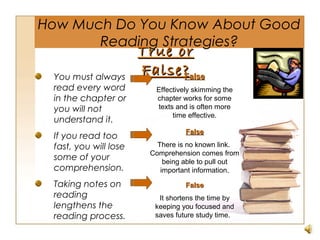
True orTrue or
False?False?You must always
read every word
in the chapter or
you will not
understand it.
If you read too
fast, you will lose
some of your
comprehension.
Taking notes on
reading
lengthens the
reading process.
How Much Do You Know About Good
Reading Strategies?
FalseFalse
Effectively skimming the
chapter works for some
texts and is often more
time effective.
FalseFalse
There is no known link.
Comprehension comes from
being able to pull out
important information.
FalseFalse
It shortens the time by
keeping you focused and
saves future study time.
ReadingReading
TipsTipsAlways read the chapter that will be
covered before class.
 What the instructor says will make more
sense.
 The instructor often assumes the lecture
will be building on knowledge from the
text, not creating new knowledge.
Find a quiet place to study-Eliminate
Distractions!
 Some distractions are external: Chatter,
Radio, etc.
 Some are internal: Fears, Worries, etc.
Preparing For Class
More ReadingMore Reading
TipsTips
Set realistic reading goals!
 Will you read or skim text in detail?
 How long will you work with that text?
 Should you read it in sections?
Write down any questions that you
still have about your topic.
 Listen for the answers to those during
the course lecture.
Preparing For Class
Make notes in your book oror
notebook to simplify future
studying.
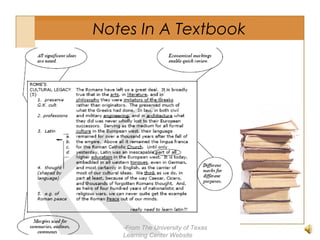
Notes in your text
• Do this after you have read-NOT WHILE
READING.
– You do not know what is important
until after you finish.
• Underline subjects & verbs
Notes in a notebook:
• Find a consistent method that works for
you.
Making Notes On Your Reading
Notes In A Notebook
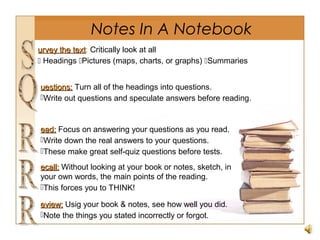
urvey the texturvey the text: Critically look at all
 Headings Pictures (maps, charts, or graphs) Summaries
uestions:uestions: Turn all of the headings into questions.
Write out questions and speculate answers before reading.
ead:ead: Focus on answering your questions as you read.
Write down the real answers to your questions.
These make great self-quiz questions before tests.
ecall:ecall: Without looking at your book or notes, sketch, in
your own words, the main points of the reading.
This forces you to THINK!
eview:eview: Usig your book & notes, see how well you did.
Note the things you stated incorrectly or forgot.
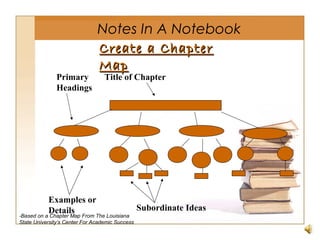
Create a ChapterCreate a Chapter
MapMap
Title of ChapterPrimary
Headings
Examples or
Details Subordinate Ideas
Notes In A Notebook
-Based on a Chapter Map From The Louisiana
State University’s Center For Academic Success
-From The University of Texas
Learning Center Website
Notes In A Textbook
Using Your Text After Class
Once you have gone to class,
return to the chapter to read it
again more thoroughly.
Compare the notes that you
took in class, to those that you
took from your reading.
Do you still have questions
about the subject?
 If you can not find the answers in
your text the 2nd time through,
arrive to the next class early and
ask your instructor prior to class.

Quick reading-tips

  • 1.
    Quick Reading TipsQuickReading Tips Easy and Effective Ways toEasy and Effective Ways to Expand Your ComprehensionExpand Your Comprehension
  • 2.
    What We WillCover Reading Strategies True/False Using Your Text To Prepare For Class Making Notes On Your Reading Notes in a notebook Notes in a textbook Using Your Text After Class
  • 3.
    True orTrue or False?False?Youmust always read every word in the chapter or you will not understand it. If you read too fast, you will lose some of your comprehension. Taking notes on reading lengthens the reading process. How Much Do You Know About Good Reading Strategies? FalseFalse Effectively skimming the chapter works for some texts and is often more time effective. FalseFalse There is no known link. Comprehension comes from being able to pull out important information. FalseFalse It shortens the time by keeping you focused and saves future study time.
  • 4.
    ReadingReading TipsTipsAlways read thechapter that will be covered before class.  What the instructor says will make more sense.  The instructor often assumes the lecture will be building on knowledge from the text, not creating new knowledge. Find a quiet place to study-Eliminate Distractions!  Some distractions are external: Chatter, Radio, etc.  Some are internal: Fears, Worries, etc. Preparing For Class
  • 5.
    More ReadingMore Reading TipsTips Setrealistic reading goals!  Will you read or skim text in detail?  How long will you work with that text?  Should you read it in sections? Write down any questions that you still have about your topic.  Listen for the answers to those during the course lecture. Preparing For Class
  • 6.
    Make notes inyour book oror notebook to simplify future studying. Notes in your text • Do this after you have read-NOT WHILE READING. – You do not know what is important until after you finish. • Underline subjects & verbs Notes in a notebook: • Find a consistent method that works for you. Making Notes On Your Reading
  • 7.
    Notes In ANotebook urvey the texturvey the text: Critically look at all  Headings Pictures (maps, charts, or graphs) Summaries uestions:uestions: Turn all of the headings into questions. Write out questions and speculate answers before reading. ead:ead: Focus on answering your questions as you read. Write down the real answers to your questions. These make great self-quiz questions before tests. ecall:ecall: Without looking at your book or notes, sketch, in your own words, the main points of the reading. This forces you to THINK! eview:eview: Usig your book & notes, see how well you did. Note the things you stated incorrectly or forgot.
  • 8.
    Create a ChapterCreatea Chapter MapMap Title of ChapterPrimary Headings Examples or Details Subordinate Ideas Notes In A Notebook -Based on a Chapter Map From The Louisiana State University’s Center For Academic Success
  • 9.
    -From The Universityof Texas Learning Center Website Notes In A Textbook
  • 10.
    Using Your TextAfter Class Once you have gone to class, return to the chapter to read it again more thoroughly. Compare the notes that you took in class, to those that you took from your reading. Do you still have questions about the subject?  If you can not find the answers in your text the 2nd time through, arrive to the next class early and ask your instructor prior to class.

Editor's Notes

  • #9 Have you ever started reading a chapter and found yourself on the same paragraph fifteen minutes later? One of the best ways to combat this problem is to preview the chapter by creating a chapter map. Here is one way to do this: 1. It is best to use a large piece of unlined paper (we recommend purchasing some butcher paper from an art or book store) but you can use any paper you have on hand. Print the Chapter Title at the top of the page, then draw a rectangle around the title. Next, look through the chapter and note the number of primary headings. You will write each of these headings in a row across, just below the title, then circle each of them. You will now skim through the chapter once more, this time looking at the number of subheadings. Print these in a row just below the primary headings. Depending on the organization of the chapter, you may continue to add sub-subheadings! This can all be done very quickly. There is no need to spend a lot of time writing details at this point. You may want to fill in details later when you read the chapter, but for now, just preview the chapter with a chapter map. You will find your brain will be ready to comprehend the material now that you have the “big picture”, or an overview of the chapter.