Intermediate St
Learning Strategies
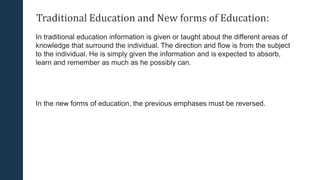
Traditional Education and New forms of Education:
In traditional education information is given or taught about the different areas of
knowledge that surround the individual. The direction and flow is from the subject
to the individual. He is simply given the information and is expected to absorb,
learn and remember as much as he possibly can.
In the new forms of education, the previous emphases must be reversed.
You are the key to success
Learn facts about you
None of these things remain
equal every year. As your life
changes you change with it.
The strategies must change.
How can you learn, think?
How can you recall, create?
How can you solve
problems?
What works 4 u?
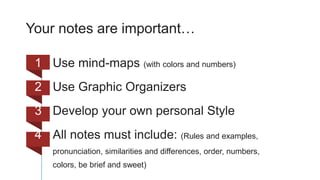
Your notes are important…
1 Use mind-maps (with colors and numbers)
2 Use Graphic Organizers
3 Develop your own personal Style
4 All notes must include: (Rules and examples,
pronunciation, similarities and differences, order, numbers,
colors, be brief and sweet)
This means to spell them right, to
pronounce them properly, to be
able to use them in sentences and
mentally visualize their meaning.
Know the Verbs
Pay more attention to the strategy than to the memory
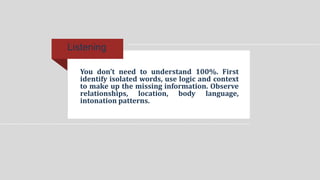
You don’t need to understand 100%. First
identify isolated words, use logic and context
to make up the missing information. Observe
relationships, location, body language,
intonation patterns.
Listening
• Put up with uncertainty and develop notions of
language
• Practice with any listening material including
native and non-native speakers.
• Repeat (systematically)
• Identify intonation patterns
• Create mental images of what you listen
GOOD HABITS
• Not taking notes or taking notes on the notebook
or pieces of paper that you can lose.
• Pretend to understand AND REMEMBER every
single word that was said.
• Pick up words in isolation without thinking about
the context.
• Listen and translate
• Tell yourself: No entiendo nada, esto es muy
difícil, no es para mi, estoy negado(a)
BAD HABITS
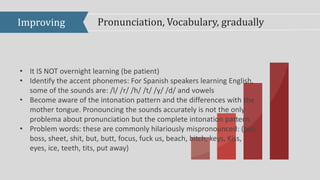
Improving Pronunciation, Vocabulary, gradually
• It IS NOT overnight learning (be patient)
• Identify the accent phonemes: For Spanish speakers learning English,
some of the sounds are: /l/ /r/ /h/ /t/ /y/ /d/ and vowels
• Become aware of the intonation pattern and the differences with the
mother tongue. Pronouncing the sounds accurately is not the only
problema about pronunciation but the complete intonation pattern.
• Problem words: these are commonly hilariously mispronounced: (bus,
boss, sheet, shit, but, butt, focus, fuck us, beach, bitch, keys, Kiss,
eyes, ice, teeth, tits, put away)
• First just identify both: intonation pattern and
problem sounds in authentic material like: music,
films, and audio books, T.V.
• Speak the mother tongue with the foreign
language accent (the differences you identified)
• Sing
• Read along with the tape of the audio book
• Repeat phrases and write the down
• Check word order
HOW TO PRACTICE
To think in English you must create mental
images out of the words. Match the words
with situations. Your mental dialogue must
be in English, what you don’t know how to say
write it in a notebook and ask the teacher.
Speaking
• Openings (the beginning of the conversations)
• Closings (the end of the conversations)
• Fillers (hesitation
• Ways to interrupt, ways to keep talking and not
be interrupted.
• Encouraging
• False beginning
• Phone interaction versus face to face interaction
PAY ATTENTION TO
• The exam gives you positive feedback
• You need to understand what they evaluate per
section. Not the words in every single sentence.
• Only try what you know 100% is right.
• Use all the vocabulary and instructions in the
exams as models of how to say something
• Ask the teacher if you are not clear about the
instructioins.
GOOD EXAM TAKING
• You want to understand 100% of the words.
• Answer with words you have never used before in
class or homework assignments.
• Do not use the context to understand.
• Do not read questions carefully or do not clarify
the instructions in them.
• Leave questions unanswered
• Do not look on other sections of the exam for
ideas.
BAD EXAM TAKING
The result doesn’t tell about your
IQ. It tells about your study
strategies. Did not like the result?
Change the study strategies.
EXAM
THANK YOU!

Learning strategies

  • 1.
  • 2.
    Traditional Education andNew forms of Education: In traditional education information is given or taught about the different areas of knowledge that surround the individual. The direction and flow is from the subject to the individual. He is simply given the information and is expected to absorb, learn and remember as much as he possibly can. In the new forms of education, the previous emphases must be reversed.
  • 3.
    You are thekey to success Learn facts about you
  • 4.
    None of thesethings remain equal every year. As your life changes you change with it. The strategies must change. How can you learn, think? How can you recall, create? How can you solve problems? What works 4 u?
  • 5.
    Your notes areimportant… 1 Use mind-maps (with colors and numbers) 2 Use Graphic Organizers 3 Develop your own personal Style 4 All notes must include: (Rules and examples, pronunciation, similarities and differences, order, numbers, colors, be brief and sweet)
  • 6.
    This means tospell them right, to pronounce them properly, to be able to use them in sentences and mentally visualize their meaning. Know the Verbs
  • 8.
    Pay more attentionto the strategy than to the memory
  • 9.
    You don’t needto understand 100%. First identify isolated words, use logic and context to make up the missing information. Observe relationships, location, body language, intonation patterns. Listening
  • 10.
    • Put upwith uncertainty and develop notions of language • Practice with any listening material including native and non-native speakers. • Repeat (systematically) • Identify intonation patterns • Create mental images of what you listen GOOD HABITS
  • 11.
    • Not takingnotes or taking notes on the notebook or pieces of paper that you can lose. • Pretend to understand AND REMEMBER every single word that was said. • Pick up words in isolation without thinking about the context. • Listen and translate • Tell yourself: No entiendo nada, esto es muy difícil, no es para mi, estoy negado(a) BAD HABITS
  • 12.
    Improving Pronunciation, Vocabulary,gradually • It IS NOT overnight learning (be patient) • Identify the accent phonemes: For Spanish speakers learning English, some of the sounds are: /l/ /r/ /h/ /t/ /y/ /d/ and vowels • Become aware of the intonation pattern and the differences with the mother tongue. Pronouncing the sounds accurately is not the only problema about pronunciation but the complete intonation pattern. • Problem words: these are commonly hilariously mispronounced: (bus, boss, sheet, shit, but, butt, focus, fuck us, beach, bitch, keys, Kiss, eyes, ice, teeth, tits, put away)
  • 13.
    • First justidentify both: intonation pattern and problem sounds in authentic material like: music, films, and audio books, T.V. • Speak the mother tongue with the foreign language accent (the differences you identified) • Sing • Read along with the tape of the audio book • Repeat phrases and write the down • Check word order HOW TO PRACTICE
  • 14.
    To think inEnglish you must create mental images out of the words. Match the words with situations. Your mental dialogue must be in English, what you don’t know how to say write it in a notebook and ask the teacher. Speaking
  • 15.
    • Openings (thebeginning of the conversations) • Closings (the end of the conversations) • Fillers (hesitation • Ways to interrupt, ways to keep talking and not be interrupted. • Encouraging • False beginning • Phone interaction versus face to face interaction PAY ATTENTION TO
  • 16.
    • The examgives you positive feedback • You need to understand what they evaluate per section. Not the words in every single sentence. • Only try what you know 100% is right. • Use all the vocabulary and instructions in the exams as models of how to say something • Ask the teacher if you are not clear about the instructioins. GOOD EXAM TAKING
  • 17.
    • You wantto understand 100% of the words. • Answer with words you have never used before in class or homework assignments. • Do not use the context to understand. • Do not read questions carefully or do not clarify the instructions in them. • Leave questions unanswered • Do not look on other sections of the exam for ideas. BAD EXAM TAKING
  • 18.
    The result doesn’ttell about your IQ. It tells about your study strategies. Did not like the result? Change the study strategies. EXAM
  • 19.